FUSED DEPOSITION
MODELING
By
NAVEEN R
Intern @Mould Smith
3D PRINTING
 3D printing or additive
manufacturing is a process
of making three
dimensional solid objects
from a digital file.
 The creation of a 3D
printed object is achieved
using additive processes.
 An object is created by
laying down successive
layers of material until the
object is created.
DIFFERENCE BETWEEN ADDITIVE AND
SUBTRACTIVE MANUFACTURING
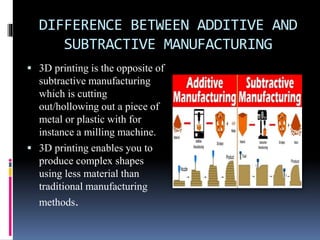
 3D printing is the opposite of
subtractive manufacturing
which is cutting
out/hollowing out a piece of
metal or plastic with for
instance a milling machine.
 3D printing enables you to
produce complex shapes
using less material than
traditional manufacturing
methods.
TYPES OF ADDITIVE
MANUFACTURING
FUSED DEPOSITION MODELING
 Fused deposition modeling (FDM) was established in the
late 1980s to produce several series of machines, such as
FDM Titan, FDM Dimension, FDM Vantage, FDM
Maxum, FDM 3000, and FDM Prodigy Plus.
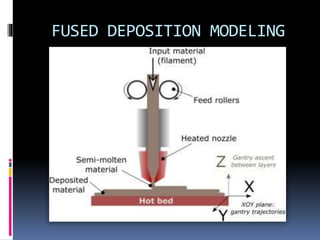
 Fused deposition modeling (FDM) is a technology where
the melt extrusion method is used to deposit filaments of
thermal plastics according to a specific pattern.
 FDM consists of a print head able to move along X and Y
directions above a build platform. The polymer is extruded
through the heated nozzle and laid down as filaments
according to the CAD design.
ADVANTAGES
 FDM is simpler and easy
demodulation
 Less expensive
 FDM system does not need
synchronization but TDM needs
synchronization.
 FDM system has high reliability
 It is used for analogue signals
 In this system due to slow
narrowband fading, only one channel
gets affected
 A large number of the signal can be
transmitted simultaneously
DISADVANTAGES
 FDM system extremely expensive
 FDM provides less throughput
 FDM has not dynamic coordination
 The full bandwidth of the channel
cannot be used on the FDM system
 The communication must have very
large bandwidth
 A large number of modulator and filter
required
 FDM channel can get affected wideband
fading
 FDM system needs a carrier wave or
carrier signal but TDM does not need
carrier signal
ALGORITHM
3D Modelling
Export in stl (stereolithography) file format
Import stl file in slicing software
Export in g-code file format
Upload to the FDM 3D printer
Obtain result in the form of solid object
Thank you

FUSED DEPOSITION MODELING.pptx

  • 1.
  • 2.
    3D PRINTING  3Dprinting or additive manufacturing is a process of making three dimensional solid objects from a digital file.  The creation of a 3D printed object is achieved using additive processes.  An object is created by laying down successive layers of material until the object is created.
  • 3.
    DIFFERENCE BETWEEN ADDITIVEAND SUBTRACTIVE MANUFACTURING  3D printing is the opposite of subtractive manufacturing which is cutting out/hollowing out a piece of metal or plastic with for instance a milling machine.  3D printing enables you to produce complex shapes using less material than traditional manufacturing methods.
  • 4.
  • 5.
  • 6.
    FUSED DEPOSITION MODELING Fused deposition modeling (FDM) was established in the late 1980s to produce several series of machines, such as FDM Titan, FDM Dimension, FDM Vantage, FDM Maxum, FDM 3000, and FDM Prodigy Plus.  Fused deposition modeling (FDM) is a technology where the melt extrusion method is used to deposit filaments of thermal plastics according to a specific pattern.  FDM consists of a print head able to move along X and Y directions above a build platform. The polymer is extruded through the heated nozzle and laid down as filaments according to the CAD design.
  • 7.
    ADVANTAGES  FDM issimpler and easy demodulation  Less expensive  FDM system does not need synchronization but TDM needs synchronization.  FDM system has high reliability  It is used for analogue signals  In this system due to slow narrowband fading, only one channel gets affected  A large number of the signal can be transmitted simultaneously
  • 8.
    DISADVANTAGES  FDM systemextremely expensive  FDM provides less throughput  FDM has not dynamic coordination  The full bandwidth of the channel cannot be used on the FDM system  The communication must have very large bandwidth  A large number of modulator and filter required  FDM channel can get affected wideband fading  FDM system needs a carrier wave or carrier signal but TDM does not need carrier signal
  • 9.
    ALGORITHM 3D Modelling Export instl (stereolithography) file format Import stl file in slicing software Export in g-code file format Upload to the FDM 3D printer Obtain result in the form of solid object
  • 10.