FUNDS FOR INNOVATION A.S.Rao, asrao@nic.in
Angel investors angels provide capital and frequently valuable guidance and strategic assistance.  The ideal angel is someone who is a generation ahead of the entrepreneur in creating value in the industry.  Angels are sometimes said to invest  'emotional money ,' while venture capitalists are said to invest  'logical money' .
To capture angels attention :  An in-depth understanding of the market in which they're competing. A product or service that can be differentiated from the crowd.  A concept that is very "scalable" (one that can be rapidly expanded).
VENTURE CAPITAL FUND (VCF) Venture capitalist or a venture capital company can be defined as a financial institution, which joins the entrepreneurs as a co-promoter, in a project and shares the risks and rewards of an enterprise. startup financing sequence starts with the entrepreneurs (inventors) putting their own available funding into a shoestring operation. Next, an angel investor may be convinced to contribute funding. Thereafter comes venture capital.
VC  expects the enterprise to have a very high growth rate provides management and business skills to the enterprise expects medium to long-term gains and does not expect any collateral to cover the capital provided
Advantages of venture capital Finance   Business Partner   Mentoring   Alliances   Facilitation of Exit
STAGES IN VENTURE FUNDING Seed Stage   Early Stage  -not yet sold their product commercially  Expansion/Development Stage  - a period of rapid growth and the company will usually require several rounds of capital injection as it achieves the milestones set in the business plan.
VC APPRAISAL PROCESS Preparation of Info-Memo- business plan, market estimate ,resumes   Letter of Intent  – after Due Diligence , Broad subscription terms  Investment Valuation  -Details like board seats, veto powers, requirements for additional investment, vesting schedules, salaries. Also financial structure
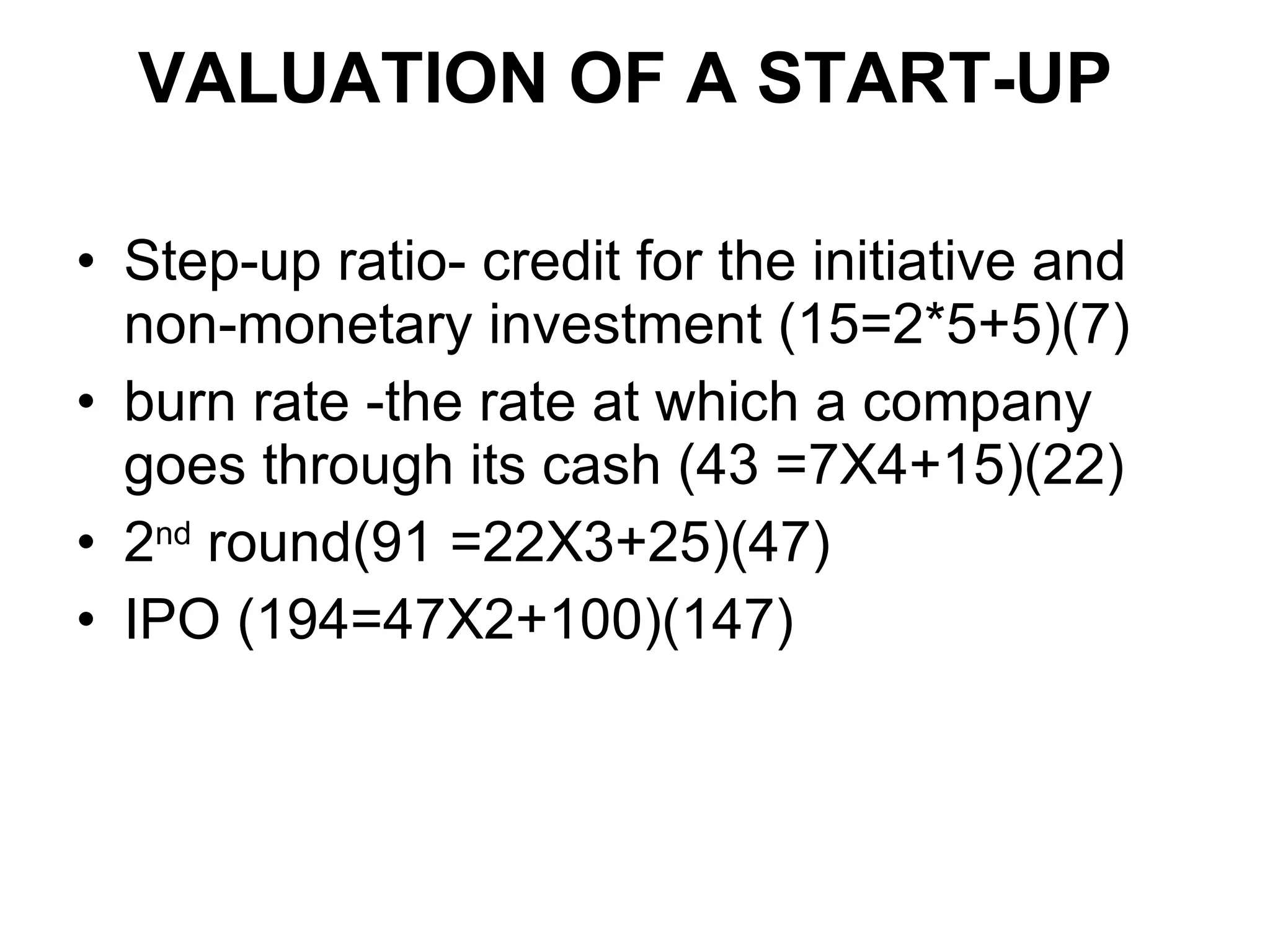
VALUATION OF A START-UP  Step-up ratio-  credit for the initiative and non-monetary investment (15=2*5+5)(7) burn rate -the rate at which a company goes through its cash (43 =7X4+15)(22) 2 nd  round(91 =22X3+25)(47) IPO (194=47X2+100)(147)
RISKS IN VC A change in industry growth vis. assumptions A change in competitive pricing vis. assumptions Difficulties in achieving product development schedule Difficulties in obtaining parts and raw materials A change in market structure (e.g. a new entrant or a new technology) A change in the availability of appropriately priced and trained labour
Promoter Risk  Integrity / honesty of the entrepreneur / promoter First generation entrepreneur Lack of experience in related field Lack of contacts with resource persons Lack of experience about - market - technology
Product Risk  Development stage of product Product life cycle Risk of reverse engineering Manufacturing complexities Number of constituent technologies
Technological Risk Availability of superior technology Unpredictable technology development Technology life cycle Investment requirement for assimilation Lack of organisational capability to assimilate Source of technology / Goodwill of supplier Level of technology (high or low)
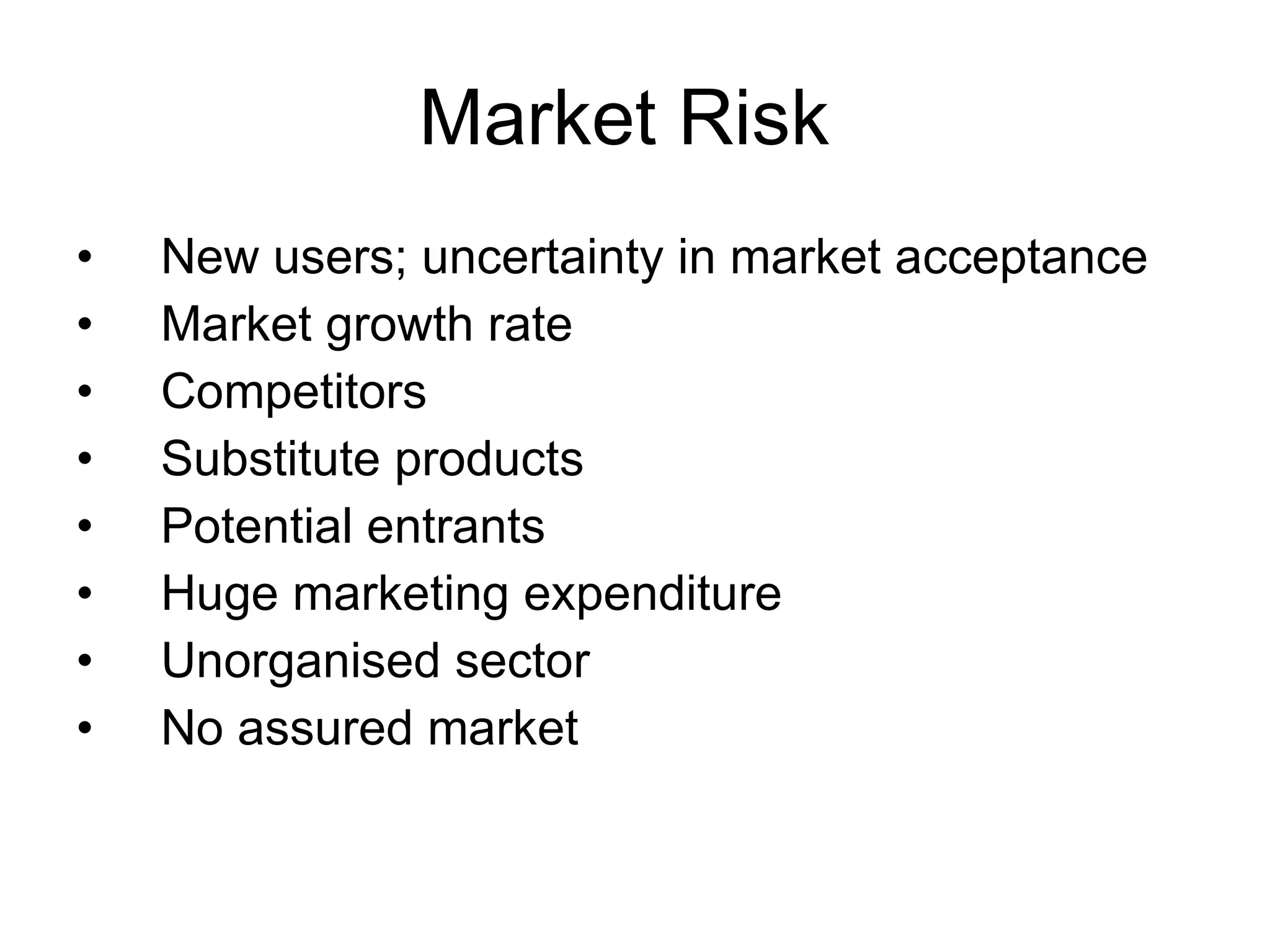
Market Risk  New users; uncertainty in market acceptance Market growth rate Competitors  Substitute products Potential entrants Huge marketing expenditure Unorganised sector No assured market
Financial Risk  Capital market situation (e.g. lack of exit opportunities) Current leverage ratio not in par with industry average Growth prospect of the company Foreign exchange risk Problem with working capital; Liquidity problem Expected rate of return Lack of understanding of standard financial procedures
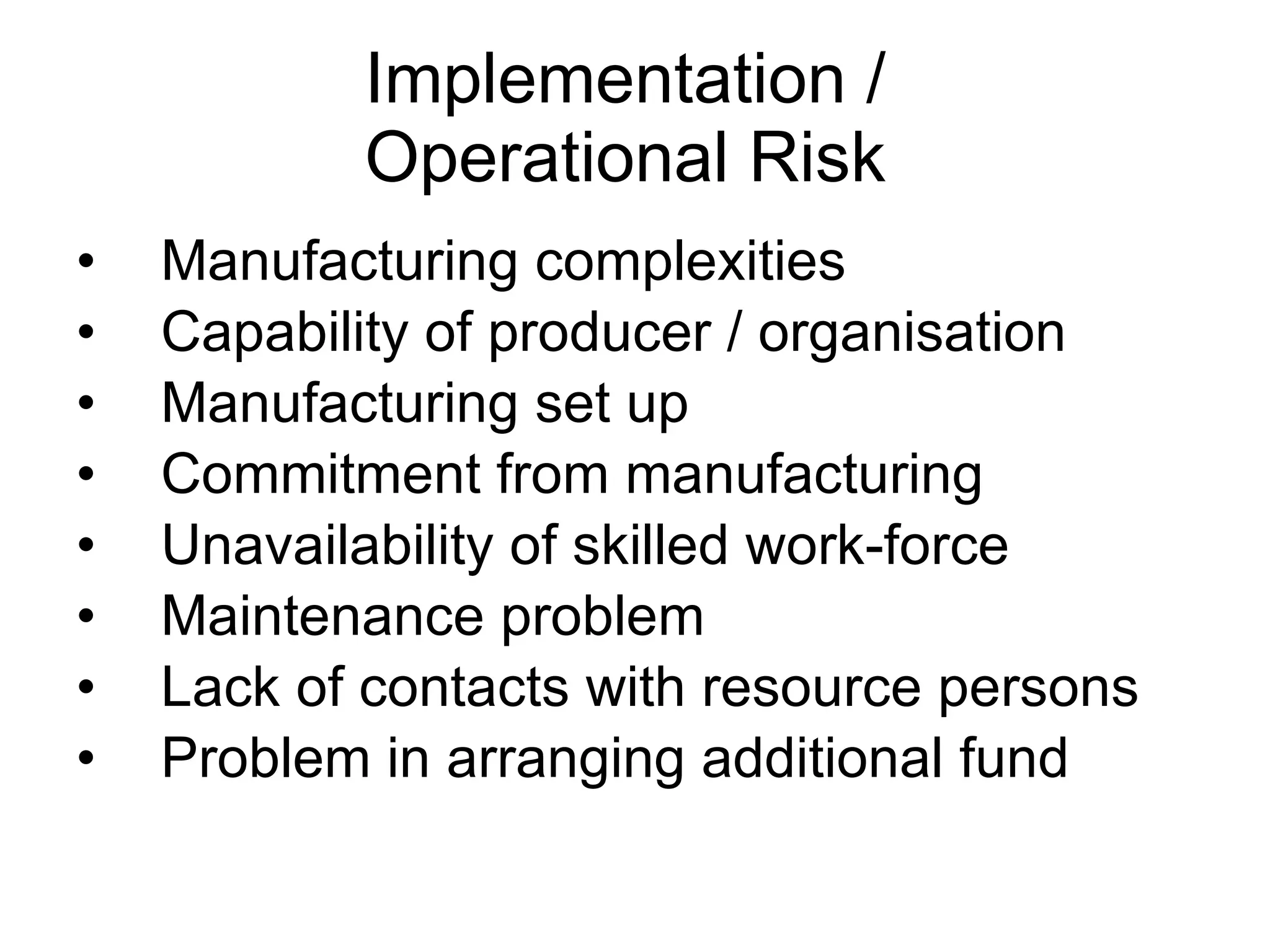
Implementation /  Operational Risk  Manufacturing complexities Capability of producer / organisation Manufacturing set up Commitment from manufacturing Unavailability of skilled work-force Maintenance problem Lack of contacts with resource persons Problem in arranging additional fund
Organisational Risk  Motivation of employees Employee turnover Dependence on few workers
Strategy Risk  Loosing competitiveness Unrelated diversification
Environmental Risk  Changes in Government policy Lack of understanding about regulations Pollution / hazard Availability of raw material Legal barriers - piracy / patent etc.
HOW TO IMPRESS A VENTURE CAPITALIST VC Fundamentals- The venture capital firm get paid first. Whether by means of a liquidity event or the liquidation of the company in the event of failure, the VC firm will get paid first. Participation in the upside of the venture. The VC will benefit from the appreciation in value of the venture over and above the original investment. Control over critical events. VC will want to have decision rights in matters that vitally affect the business, such as the decision to do an IPO. Creation of a path to liquidity. There must be a way for the VC to cash out of the venture.
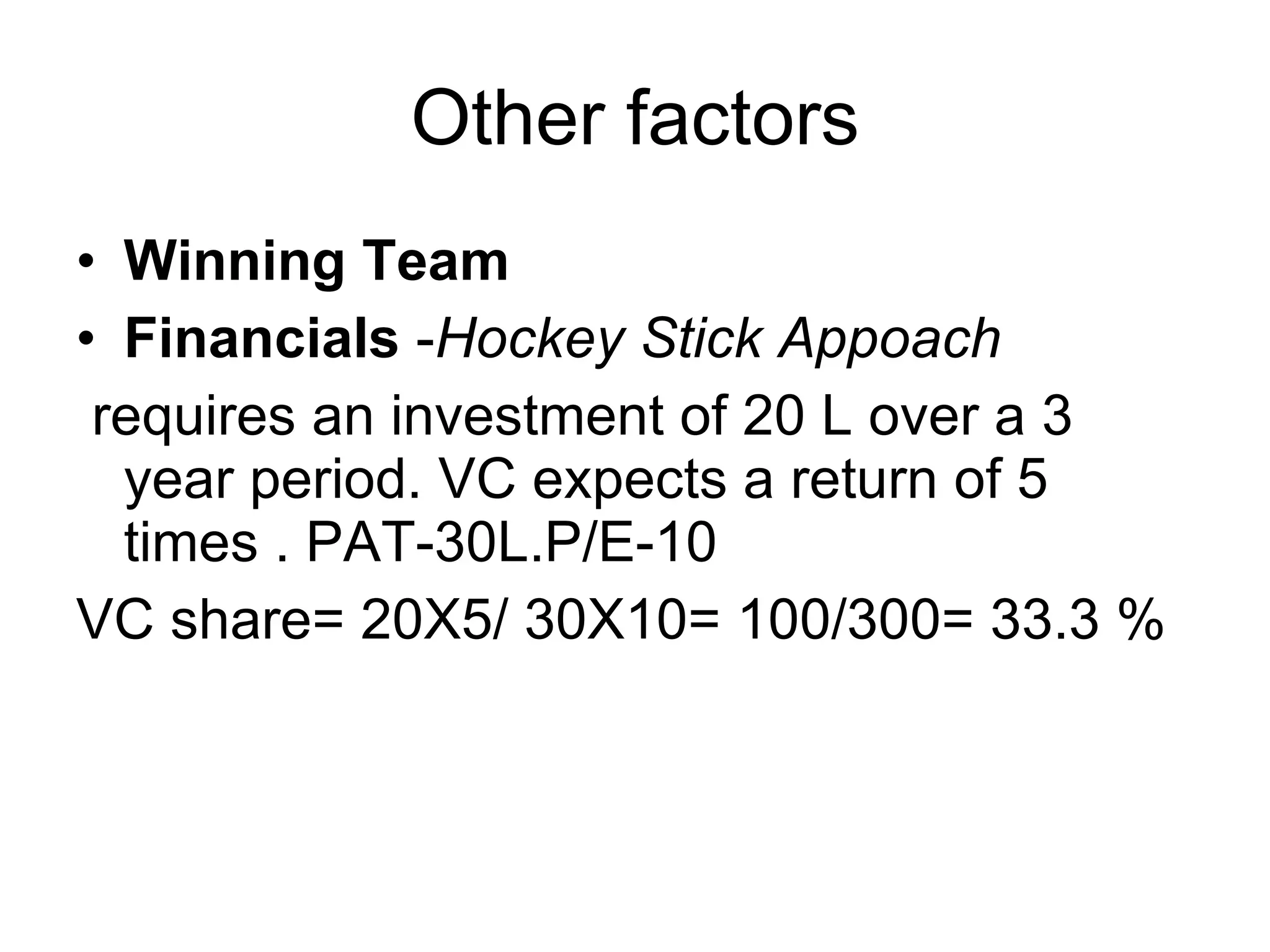
Other factors Winning Team   Financials  - Hockey Stick Appoach requires an investment of 20 L over a 3 year period. VC expects a return of 5 times . PAT-30L.P/E-10 VC share= 20X5/ 30X10= 100/300= 33.3 %

Funds For Innovation

  • 1.
    FUNDS FOR INNOVATIONA.S.Rao, asrao@nic.in
  • 2.
    Angel investors angelsprovide capital and frequently valuable guidance and strategic assistance. The ideal angel is someone who is a generation ahead of the entrepreneur in creating value in the industry. Angels are sometimes said to invest 'emotional money ,' while venture capitalists are said to invest 'logical money' .
  • 3.
    To capture angelsattention : An in-depth understanding of the market in which they're competing. A product or service that can be differentiated from the crowd. A concept that is very "scalable" (one that can be rapidly expanded).
  • 4.
    VENTURE CAPITAL FUND(VCF) Venture capitalist or a venture capital company can be defined as a financial institution, which joins the entrepreneurs as a co-promoter, in a project and shares the risks and rewards of an enterprise. startup financing sequence starts with the entrepreneurs (inventors) putting their own available funding into a shoestring operation. Next, an angel investor may be convinced to contribute funding. Thereafter comes venture capital.
  • 5.
    VC expectsthe enterprise to have a very high growth rate provides management and business skills to the enterprise expects medium to long-term gains and does not expect any collateral to cover the capital provided
  • 6.
    Advantages of venturecapital Finance Business Partner Mentoring Alliances Facilitation of Exit
  • 7.
    STAGES IN VENTUREFUNDING Seed Stage Early Stage -not yet sold their product commercially Expansion/Development Stage - a period of rapid growth and the company will usually require several rounds of capital injection as it achieves the milestones set in the business plan.
  • 8.
    VC APPRAISAL PROCESSPreparation of Info-Memo- business plan, market estimate ,resumes Letter of Intent – after Due Diligence , Broad subscription terms Investment Valuation -Details like board seats, veto powers, requirements for additional investment, vesting schedules, salaries. Also financial structure
  • 9.
    VALUATION OF ASTART-UP Step-up ratio- credit for the initiative and non-monetary investment (15=2*5+5)(7) burn rate -the rate at which a company goes through its cash (43 =7X4+15)(22) 2 nd round(91 =22X3+25)(47) IPO (194=47X2+100)(147)
  • 10.
    RISKS IN VCA change in industry growth vis. assumptions A change in competitive pricing vis. assumptions Difficulties in achieving product development schedule Difficulties in obtaining parts and raw materials A change in market structure (e.g. a new entrant or a new technology) A change in the availability of appropriately priced and trained labour
  • 11.
    Promoter Risk Integrity / honesty of the entrepreneur / promoter First generation entrepreneur Lack of experience in related field Lack of contacts with resource persons Lack of experience about - market - technology
  • 12.
    Product Risk Development stage of product Product life cycle Risk of reverse engineering Manufacturing complexities Number of constituent technologies
  • 13.
    Technological Risk Availabilityof superior technology Unpredictable technology development Technology life cycle Investment requirement for assimilation Lack of organisational capability to assimilate Source of technology / Goodwill of supplier Level of technology (high or low)
  • 14.
    Market Risk New users; uncertainty in market acceptance Market growth rate Competitors Substitute products Potential entrants Huge marketing expenditure Unorganised sector No assured market
  • 15.
    Financial Risk Capital market situation (e.g. lack of exit opportunities) Current leverage ratio not in par with industry average Growth prospect of the company Foreign exchange risk Problem with working capital; Liquidity problem Expected rate of return Lack of understanding of standard financial procedures
  • 16.
    Implementation / Operational Risk Manufacturing complexities Capability of producer / organisation Manufacturing set up Commitment from manufacturing Unavailability of skilled work-force Maintenance problem Lack of contacts with resource persons Problem in arranging additional fund
  • 17.
    Organisational Risk Motivation of employees Employee turnover Dependence on few workers
  • 18.
    Strategy Risk Loosing competitiveness Unrelated diversification
  • 19.
    Environmental Risk Changes in Government policy Lack of understanding about regulations Pollution / hazard Availability of raw material Legal barriers - piracy / patent etc.
  • 20.
    HOW TO IMPRESSA VENTURE CAPITALIST VC Fundamentals- The venture capital firm get paid first. Whether by means of a liquidity event or the liquidation of the company in the event of failure, the VC firm will get paid first. Participation in the upside of the venture. The VC will benefit from the appreciation in value of the venture over and above the original investment. Control over critical events. VC will want to have decision rights in matters that vitally affect the business, such as the decision to do an IPO. Creation of a path to liquidity. There must be a way for the VC to cash out of the venture.
  • 21.
    Other factors WinningTeam Financials - Hockey Stick Appoach requires an investment of 20 L over a 3 year period. VC expects a return of 5 times . PAT-30L.P/E-10 VC share= 20X5/ 30X10= 100/300= 33.3 %