Fundamentals Of Digital Logic With Vhdl Design 4th Edition Stephen Brown
Fundamentals Of Digital Logic With Vhdl Design 4th Edition Stephen Brown
Fundamentals Of Digital Logic With Vhdl Design 4th Edition Stephen Brown
Fundamentals Of Digital Logic With Vhdl Design 4th Edition Stephen Brown
Fundamentals Of Digital Logic With Vhdl Design 4th Edition Stephen Brown
1.
Fundamentals Of DigitalLogic With Vhdl Design
4th Edition Stephen Brown download
https://ebookbell.com/product/fundamentals-of-digital-logic-with-
vhdl-design-4th-edition-stephen-brown-52146382
Explore and download more ebooks at ebookbell.com
2.
Here are somerecommended products that we believe you will be
interested in. You can click the link to download.
Fundamentals Of Digital Logic With Vhdl Design With Cdrom 3rd Edition
Stephen Brown
https://ebookbell.com/product/fundamentals-of-digital-logic-with-vhdl-
design-with-cdrom-3rd-edition-stephen-brown-2451378
Fundamentals Of Digital Logic With Vhdl Design 3rd Edition Stephen D M
Brown Zvonko G Vranesic
https://ebookbell.com/product/fundamentals-of-digital-logic-with-vhdl-
design-3rd-edition-stephen-d-m-brown-zvonko-g-vranesic-11154558
Fundamentals Of Digital Logic With Vhdl Design 4th Edition Stephen
Brown
https://ebookbell.com/product/fundamentals-of-digital-logic-with-vhdl-
design-4th-edition-stephen-brown-44755174
Fundamentals Of Digital Logic With Vhdl 2nd Edition Brown S Vranesic Z
https://ebookbell.com/product/fundamentals-of-digital-logic-with-
vhdl-2nd-edition-brown-s-vranesic-z-2309962
3.
Fundamentals Of DigitalLogic With Verilog Design 3rd Edition Stephen
Brown
https://ebookbell.com/product/fundamentals-of-digital-logic-with-
verilog-design-3rd-edition-stephen-brown-22632370
Fundamentals Of Digital Logic With Verilog Design Stephen Brown
https://ebookbell.com/product/fundamentals-of-digital-logic-with-
verilog-design-stephen-brown-5641032
Fundamentals Of Digital Logic With Verilog Design Solution Manual
Stephen Brown
https://ebookbell.com/product/fundamentals-of-digital-logic-with-
verilog-design-solution-manual-stephen-brown-33946954
Fundamentals Of Digital Logic And Microcomputer Design 5th Edition M
Rafiquzzaman
https://ebookbell.com/product/fundamentals-of-digital-logic-and-
microcomputer-design-5th-edition-m-rafiquzzaman-2270636
Fundamentals Of Digital Logic And Microcontrollers 6th Edition M
Rafiquzzaman
https://ebookbell.com/product/fundamentals-of-digital-logic-and-
microcontrollers-6th-edition-m-rafiquzzaman-5255970
7.
FUNDAMENTALS
OF
DIGITAL LOGIC WITHVHDL
DESIGN
FOURTH EDITION
Stephen Brown and Zvonko Vranesic
Department of Electrical and Computer Engineering
University of Toronto
All credits appearingon page or at the end of the book are considered to be
an extension of the copyright page.
The Internet addresses listed in the text were accurate at the time of
publication. The inclusion of a website does not indicate an endorsement by
the authors or McGraw Hill LLC, and McGraw Hill LLC does not
guarantee the accuracy of the information presented at these sites.
mheducation.com/highered
ABOUT THE AUTHORS
StephenBrown received the Ph.D. and M.A.Sc. degrees in Electrical
Engineering from the University of Toronto, and his B.A.Sc. degree in
Electrical Engineering from the University of New Brunswick. He joined
the University of Toronto faculty in 1992, where he is now a Professor in
the Department of Electrical & Computer Engineering. He is also the
Director of FPGA Academic Programs for Intel Corporation.
His research interests include field-programmable VLSI technology,
CAD algorithms, computer architecture, and applications of machine
learning. He won the Canadian Natural Sciences and Engineering Research
Council's 1992 Doctoral Prize for the best Ph.D. thesis in Canada, and the
New Brunswick Governor-General's 1985 award for the highest academic
standing in the Faculty of Engineering. He is a coauthor of more than 150
scientific research papers and two other textbooks: Fundamentals of Digital
Logic with Verilog Design and Field-Programmable Gate Arrays.
He has won many awards for excellence in teaching electrical
engineering, computer engineering, and computer science courses.
Zvonko Vranesic received his B.A.Sc., M.A.Sc., and Ph.D. degrees, all in
Electrical Engineering, from the University of Toronto. From 1963 to 1965
he worked as a design engineer with the Northern Electric Co. Ltd. in
Bramalea, Ontario. In 1968 he joined the University of Toronto, where he is
now a Professor Emeritus in the Department of Electrical & Computer
Engineering. During the 1978-79 academic year, he was a Senior Visitor at
the University of Cambridge, England, and during 1984-85 he was at the
University of Paris, 6. From 1995 to 2000 he served as Chair of the
Division of Engineering Science at the University of Toronto.
13.
He is acoauthor of four other books: Computer Organization and
Embedded Systems, 6th ed.; Fundamentals of Digital Logic with Verilog
Design, 3rd ed.; Microcomputer Structures; and Field-Programmable Gate
Arrays. In 1990, he received the Wighton Fellowship for "innovative and
distinctive contributions to undergraduate laboratory instruction." In 2004,
he received the Faculty Teaching Award from the Faculty of Applied
Science and Engineering at the University of Toronto.
He has represented Canada in numerous chess competitions. He holds the
title of International Master.
14.
PREFACE
This book isintended for an introductory course in digital logic design,
which is a basic course in most electrical and computer engineering
programs. A successful designer of digital logic circuits needs a good
understanding of the classical methods of logic design and a firm grasp of
the modern design approach that relies on computer-aided design (CAD)
tools.
The main goals of this book are (1) to teach students the fundamental
concepts of classical manual digital design and (2) illustrate clearly the way
in which digital circuits are designed today, using CAD tools. Even though
current modern designers very rarely use manual techniques, our motivation
for teaching such techniques is to give students an intuitive feeling for how
digital circuits operate. The manual techniques also provide an illustration
of the types of manipulations performed by CAD tools, giving students an
appreciation of the benefits provided by design automation. Throughout the
book, basic concepts are introduced by way of simple design examples,
which we perform using both manual techniques and modern CAD-tool-
based methods. After basic concepts are established, more complex
examples are provided using the CAD tools. Thus, to illustrate how digital
design is presently carried out in practice, our emphasis is on modern
design methodology.
TECHNOLOGY
This book discusses modern digital circuit implementation technologies.
The emphasis is placed on programmable logic devices (PLDs), which is
the most appropriate technology for use in a textbook for two reasons. First,
PLDs are widely used in practice and are suitable for almost all types of
digital circuit designs. In fact, students are more likely to be involved in
15.
PLD-based designs atsome point in their careers than in any other
technology. Second, circuits are implemented in PLDs by end-user
programming. Therefore, students can be provided with the opportunity, in
a laboratory setting, to implement this book's design examples in actual
chips. Students can also simulate the behavior of their designed circuits on
their own computers. We use the two most popular types of PLDs for
targeting of designs: complex programmable logic devices (CPLDs) and
field-programmable gate arrays (FPGAs).
We emphasize the use of a hardware description language (HDL) in
specifying the logic circuits, because an HDL-based approach is the most
efficient design method to use in practice. We describe in detail the IEEE
Standard VHDL language and use it extensively in examples.
SCOPE OF THE BOOK
This edition of the book has been extensively restructured. All of the
material that should be covered in a one-semester course is now included in
Chapters 1 to 6. More advanced material is presented in Chapters 7 to 11.
Chapter 1 provides a general introduction to the process of designing
digital systems. It discusses the key steps in the design process and explains
how CAD tools can be used to automate many of the required tasks. It also
introduces the representation of digital information.
Chapter 2 introduces logic circuits. It shows how Boolean algebra is used
to represent such circuits. It introduces the concepts of logic circuit
synthesis and optimization, and shows how logic gates are used to
implement simple circuits. It also gives the reader a first glimpse at VHDL,
as an example of a hardware description language that may be used to
specify the logic circuits.
Chapter 3 concentrates on circuits that perform arithmetic operations. It
discusses numbers and shows how they can be manipulated using logic
circuits. This chapter illustrates how VHDL can be used to specify a desired
functionality and how CAD tools can provide a mechanism for developing
the required circuits.
Chapter 4 presents combinational circuits such as multiplexers, encoders,
and decoders that are used as building blocks in larger circuits. These
circuits are very convenient for illustrating the application of many VHDL
16.
constructs, giving thereader the opportunity to discover more advanced
features of VHDL.
Chapter 5 introduces storage elements. The use of flip-flops to realize
regular structures, such as shift registers and counters, is discussed. VHDL-
specified designs of these structures are included.
Chapter 6 gives a detailed presentation of synchronous sequential circuits
(finite state machines). It explains the behavior of these circuits and
develops practical techniques for both manual and automated design.
Chapter 7 is a discussion of a number of issues that arise in the design of
digital logic systems. It reveals and highlights problems that are often
encountered in practice, and explains how they can be overcome. Examples
of larger circuits illustrate a hierarchical approach in designing digital
systems. Complete VHDL code for these circuits is presented.
Chapter 8 deals with more advanced methods for optimized
implementation of logic functions. It presents algorithmic techniques for
optimization, and also explains how logic functions can be specified using a
cubical representation or binary decision diagrams.
Chapter 9 discusses asynchronous sequential circuits. While this
treatment is not exhaustive, a clear indication of the main characteristics of
such circuits is provided. Even though asynchronous circuits are not used
extensively in practice, they provide an excellent vehicle for gaining a more
complete understanding of the operation of digital circuits. Asynchronous
circuits illustrate the importance of clearly understanding how the structure
of a circuit affects the propagation delays of signals, and how these delays
can impact a circuit's functionality.
Chapter 10 presents a complete CAD flow that a designer experiences
when creating, implementing, and testing a digital circuit.
Chapter 11 introduces the topic of testing. A designer of logic circuits
must be aware of the need to test circuits and should be conversant with at
least the most basic aspects of testing.
Appendix A provides a complete summary of VHDL features. Although
use of VHDL is integrated throughout the book, this appendix provides a
convenient reference that the reader may occasionally consult while writing
VHDL code.
Appendix B presents the electronic aspects of digital circuits. This
appendix shows how the basic gates are built using transistors and presents
various factors that affect circuit performance. The most modern
17.
technologies are emphasized,with particular focus on CMOS technology
and PLDs.
WHAT CAN BE COVERED IN A COURSE
Much of the material in the book can be covered in 2 one-quarter courses.
Thorough coverage of the most important material can be achieved in a
single one-semester, or even a one-quarter, course. This is possible only if
the instructor does not spend too much time discussing the intricacies of
VHDL and CAD tools. To make this approach possible, we organized the
VHDL material in a modular style that is conducive to self-study. Our
experience in teaching students at the University of Toronto has shown that
the instructor may only spend a total of three to four lecture hours on
VHDL, describing how the code should be structured (including the use of
design hierarchy) using scalar and vector variables, and the style of code
needed to specify sequential circuits. The VHDL examples given in this
book are largely self-explanatory, and students can understand them with
ease.
The book is also suitable for a course in logic design that does not
include exposure to VHDL. However, some knowledge of VHDL, even at a
rudimentary level, is beneficial to the students, and is great preparation for a
job as a design engineer.
One-Semester Course
The following material should be covered in lectures:
• Chapter 1—all sections.
• Chapter 2—all sections.
• Chapter 3—sections 3.1 to 3.5.
• Chapter 4—all sections.
• Chapter 5—all sections.
• Chapter 6—all sections.
One-Quarter Course
In a one-quarter course the following material can be covered:
18.
• Chapter 1—allsections.
• Chapter 2—all sections.
• Chapter 3—sections 3.1 to 3.3 and section 3.5.
• Chapter 4—all sections.
• Chapter 5—all sections.
• Chapter 6—sections 6.1 to 6.4.
VHDL
VHDL is a complex language that some instructors feel is too hard for
beginning students to grasp. We fully appreciate this issue and have
attempted to solve it by presenting only the most important VHDL
constructs that are useful for the design and synthesis of logic circuits.
Many other language constructs, such as those that have meaning only
when using the language for simulation purposes, are omitted. The VHDL
material is integrated gradually, with more advanced features presented only
at points where their use can be demonstrated in the design of relevant
circuits.
The book includes more than 150 examples of VHDL code. These
examples illustrate how VHDL is used to describe a wide range of logic
circuits, from those that contain only a few gates to those that represent
digital systems such as a simple processor.
CAD TOOLS
All of the examples of VHDL code presented in the book are provided on
the authors' website at
www.eecg.toronto.edu/~brown
To gain a more thorough understanding of the VHDL code examples, the
reader is encouraged to compile and simulate the code using a
commercially-available simulation CAD tool. Toward this end each
example of VHDL code on the Authors' website is accompanied by setup
files for the widely-used ModelSim simulator available from Mentor
19.
Graphics. A detailedtutorial is provided that includes step-by-step
instructions for obtaining, installing, and using this VHDL simulator.
Modern digital systems are quite large. They contain complex logic
circuits that would be difficult to design without using good CAD tools.
Our treatment of VHDL should enable the reader to develop VHDL code
that specifies logic circuits of varying degrees of complexity. To gain a
proper appreciation of the design process, in addition to simulating the
behavior of VHDL code (as mentioned above) it is highly beneficial to
implement the designs in commercially-available PLDs by using CAD
tools.
Some excellent CAD tools are available free of charge, for example, Intel
Corporation's Quartus CAD software, which is widely used for
implementing designs in programmable logic devices such as FPGAs. The
Lite Edition of the Quartus software can be downloaded from Intel's
website and used free-of-charge. Intel also provides a set of FPGA-based
laboratory boards with accompanying tutorials and laboratory exercises that
are appropriate for use with this book in a university setting. This material
can be found on the Internet by searching for "Intel FPGA Academic
Program".
SOLVED PROBLEMS
The chapters include examples of solved problems. They provide typical
homework problems and show how they may be solved.
HOMEWORK PROBLEMS
More than 400 homework problems are provided in this book. Answers to
selected problems are given at the back. Full solutions to all problems are
available to instructors in the accompanying Solutions Manual.
POWERPOINT SLIDES AND SOLUTIONS MANUAL
A set of PowerPoint slides that contain all of the figures in the book is
available on the Authors' website. Instructors can request access to these
slides, as well as access to the Solutions Manual for the book, at:
www.mhhe.com/brownvranesic
20.
ACKNOWLEDGMENTS
We wish toexpress our thanks to the people who have helped during the
preparation of this book. Dan Vranesic produced a substantial amount of
artwork. He and Deshanand Singh also helped with the preparation of the
solutions manual, and Tom Czajkowski helped in checking the answers to
problems. Matthew Brown edited the text to improve readability, and
Andrew Brown helped to create some examples of VHDL code. The
reviewers, William Barnes, New Jersey Institute of Technology; Thomas
Bradicich, North Carolina State University; James Clark, McGill
University; Stephen DeWeerth, Georgia Institute of Technology; Sander
Eller, Cal Poly Pomona; Clay Gloster, Jr., North Carolina State University
(Raleigh); Carl Hamacher, Queen's University; Vincent Heuring, University
of Colorado; Yu Hen Hu, University of Wisconsin; Wei-Ming Lin,
University of Texas (San Antonio); Wayne Loucks, University of Waterloo;
Kartik Mohanram, Rice University; Jane Morehead, Mississippi State
University; Chris Myers, University of Utah; Vojin Oklobdzija, University
of California (Davis); James Palmer, Rochester Institute of Technology;
Gandhi Puvvada, University of Southern California; Teodoro Robles,
Milwaukee School of Engineering; Tatyana Roziner, Boston University;
Rob Rutenbar, Carnegie Mellon University; Eric Schwartz, University of
Florida; Wen-Tsong Shiue, Oregon State University; Peter Simko, Miami
University; Scott Smith, University of Missouri (Rolla); Arun Somani, Iowa
State University; Bernard Svihel, University of Texas (Arlington); and
Zeljko Zilic, McGill University provided constructive criticism and made
numerous suggestions for improvements.
Nicholas Reeder, Sinclair Community College, Dayton, OH, provided
excellent proof reading.
Stephen Brown and Zvonko Vranesic
21.
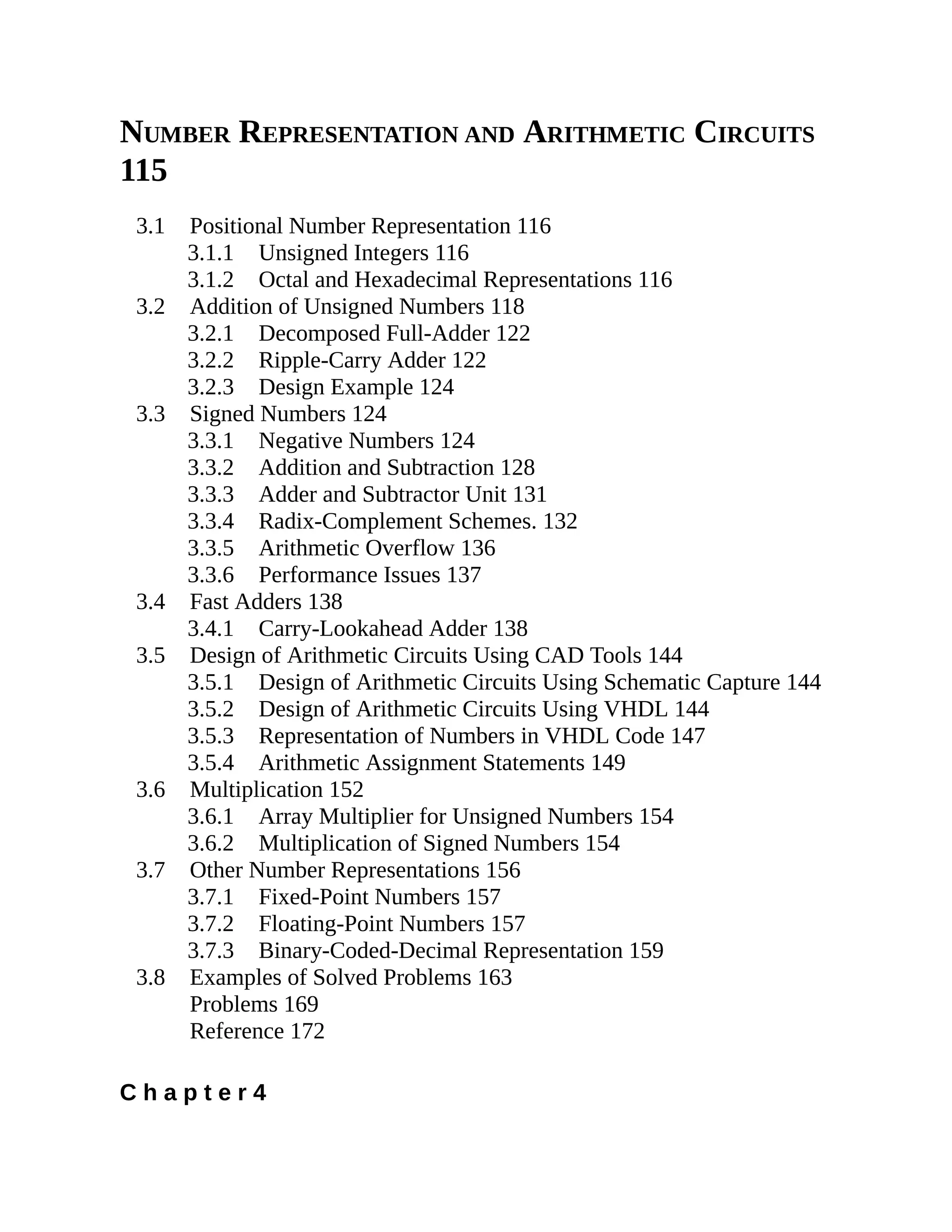
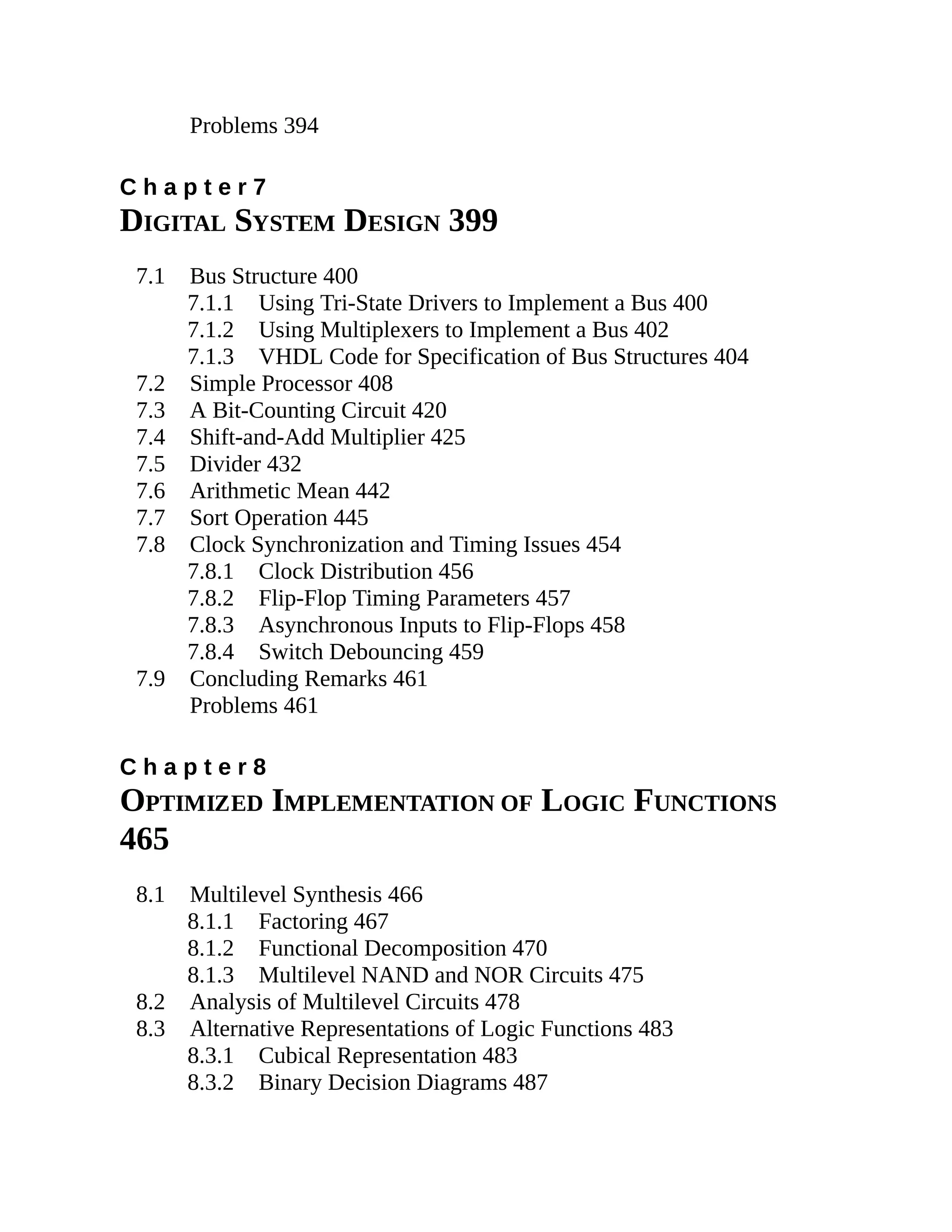
CONTENTS
C h ap t e r 1
INTRODUCTION 1
1.1 Digital Hardware 2
1.1.1 Standard Chips 4
1.1.2 Programmable Logic Devices 4
1.1.3 Custom-Designed Chips 5
1.2 The Design Process 5
1.3 Structure of a Computer 7
1.4 Logic Circuit Design in This Book 10
1.5 Digital Representation of Information 10
1.5.1 Binary Numbers 11
1.5.2 Conversion between Decimal and Binary Systems 13
1.5.3 ASCII Character Code 14
1.5.4 Digital and Analog Information 14
1.6 Theory and Practice 16
Problems 17
C h a p t e r 2
INTRODUCTION TO LOGIC CIRCUITS 19
2.1 Variables and Functions 20
2.2 Inversion 23
2.3 Truth Tables 24
2.4 Logic Gates and Networks 25
2.4.1 Analysis of a Logic Network 26
2.5 Boolean Algebra 30
22.
2.5.1 The VennDiagram 34
2.5.2 Notation and Terminology 38
2.5.3 Precedence of Operations 40
2.6 Synthesis Using AND, OR, and NOT Gates 40
2.6.1 Sum-of-Products and Product-of-Sums Forms 44
2.7 NAND and NOR Logic Networks 50
2.8 Design Examples 54
2.8.1 Three-Way Light Control 55
2.8.2 Multiplexer Circuit 56
2.8.3 Number Display 58
2.9 Introduction to CAD Tools 59
2.9.1 Design Entry 60
2.9.2 Logic Synthesis 61
2.9.3 Functional Simulation 62
2.9.4 Physical Design 62
2.9.5 Timing Analysis 62
2.9.6 Circuit Implementation 63
2.9.7 Complete Design Flow 63
2.10 Introduction to VHDL 63
2.10.1 Structural Specification of Logic Circuits 65
2.10.2 Behavioral Specification of Logic Circuits 69
2.10.3 Hierarchical VHDL Code 70
2.10.4 How not to Write VHDL Code 73
2.11 Minimization and Karnaugh Maps 73
2.12 Strategy for Minimization 81
2.12.1 Terminology 81
2.12.2 Minimization Procedure 83
2.13 Minimization of Product-of-Sums Forms 86
2.14 Incompletely Specified Functions 88
2.15 Multiple-Output Circuits 90
2.16 Concluding Remarks 95
2.17 Examples of Solved Problems 95
Problems 105
References 113
C h a p t e r 3
23.
NUMBER REPRESENTATION ANDARITHMETIC CIRCUITS
115
3.1 Positional Number Representation 116
3.1.1 Unsigned Integers 116
3.1.2 Octal and Hexadecimal Representations 116
3.2 Addition of Unsigned Numbers 118
3.2.1 Decomposed Full-Adder 122
3.2.2 Ripple-Carry Adder 122
3.2.3 Design Example 124
3.3 Signed Numbers 124
3.3.1 Negative Numbers 124
3.3.2 Addition and Subtraction 128
3.3.3 Adder and Subtractor Unit 131
3.3.4 Radix-Complement Schemes. 132
3.3.5 Arithmetic Overflow 136
3.3.6 Performance Issues 137
3.4 Fast Adders 138
3.4.1 Carry-Lookahead Adder 138
3.5 Design of Arithmetic Circuits Using CAD Tools 144
3.5.1 Design of Arithmetic Circuits Using Schematic Capture 144
3.5.2 Design of Arithmetic Circuits Using VHDL 144
3.5.3 Representation of Numbers in VHDL Code 147
3.5.4 Arithmetic Assignment Statements 149
3.6 Multiplication 152
3.6.1 Array Multiplier for Unsigned Numbers 154
3.6.2 Multiplication of Signed Numbers 154
3.7 Other Number Representations 156
3.7.1 Fixed-Point Numbers 157
3.7.2 Floating-Point Numbers 157
3.7.3 Binary-Coded-Decimal Representation 159
3.8 Examples of Solved Problems 163
Problems 169
Reference 172
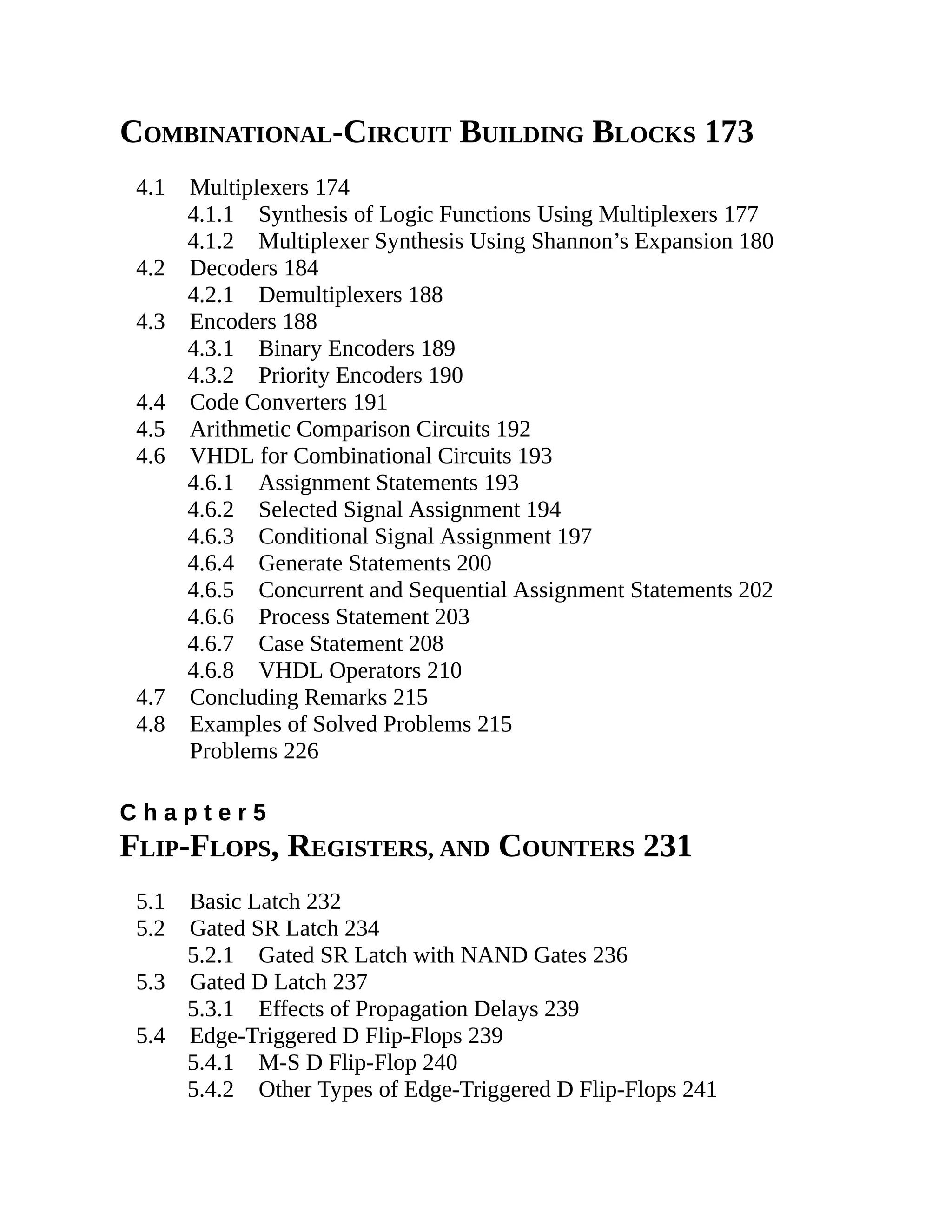
C h a p t e r 4
24.
COMBINATIONAL-CIRCUIT BUILDING BLOCKS173
4.1 Multiplexers 174
4.1.1 Synthesis of Logic Functions Using Multiplexers 177
4.1.2 Multiplexer Synthesis Using Shannon’s Expansion 180
4.2 Decoders 184
4.2.1 Demultiplexers 188
4.3 Encoders 188
4.3.1 Binary Encoders 189
4.3.2 Priority Encoders 190
4.4 Code Converters 191
4.5 Arithmetic Comparison Circuits 192
4.6 VHDL for Combinational Circuits 193
4.6.1 Assignment Statements 193
4.6.2 Selected Signal Assignment 194
4.6.3 Conditional Signal Assignment 197
4.6.4 Generate Statements 200
4.6.5 Concurrent and Sequential Assignment Statements 202
4.6.6 Process Statement 203
4.6.7 Case Statement 208
4.6.8 VHDL Operators 210
4.7 Concluding Remarks 215
4.8 Examples of Solved Problems 215
Problems 226
C h a p t e r 5
FLIP-FLOPS, REGISTERS, AND COUNTERS 231
5.1 Basic Latch 232
5.2 Gated SR Latch 234
5.2.1 Gated SR Latch with NAND Gates 236
5.3 Gated D Latch 237
5.3.1 Effects of Propagation Delays 239
5.4 Edge-Triggered D Flip-Flops 239
5.4.1 M-S D Flip-Flop 240
5.4.2 Other Types of Edge-Triggered D Flip-Flops 241
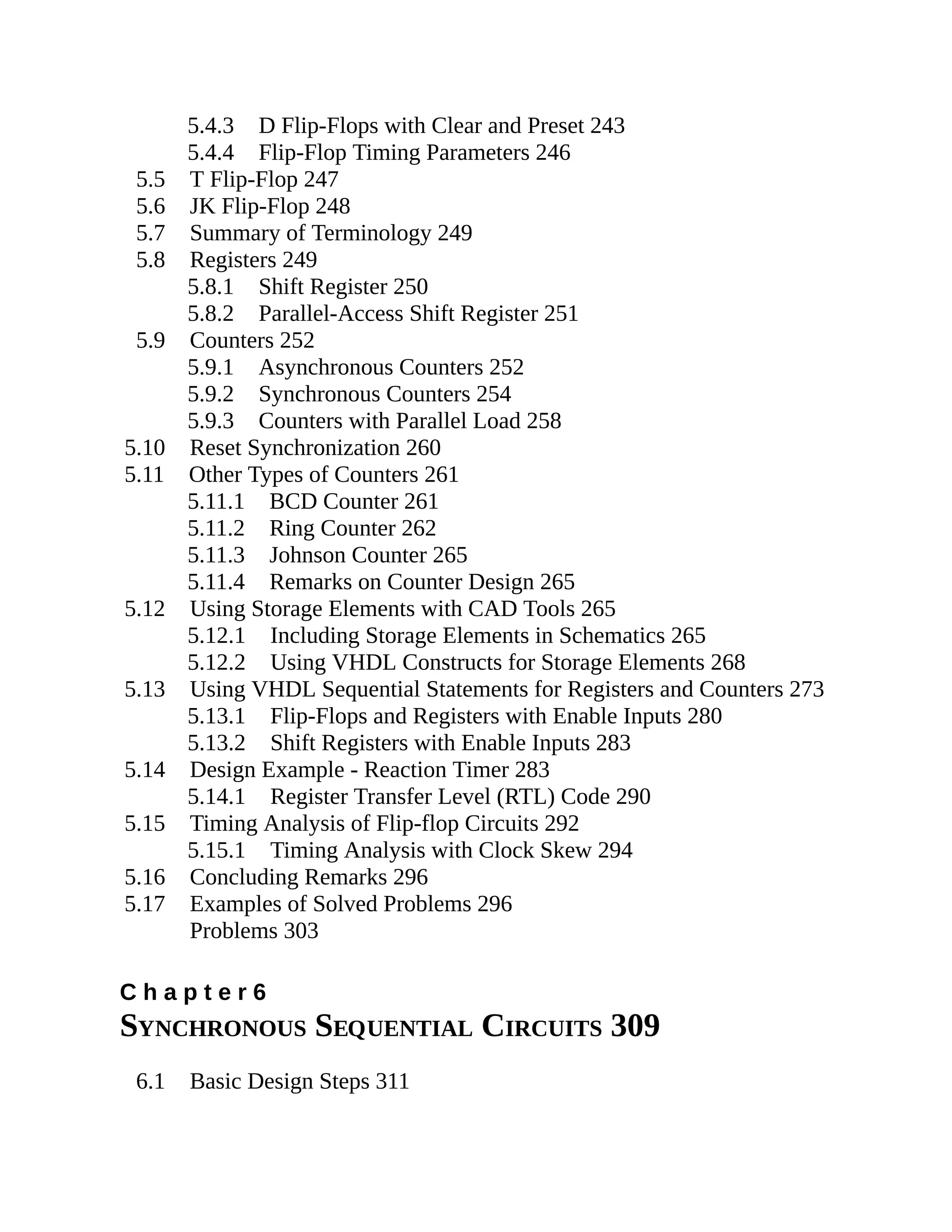
25.
5.4.3 D Flip-Flopswith Clear and Preset 243
5.4.4 Flip-Flop Timing Parameters 246
5.5 T Flip-Flop 247
5.6 JK Flip-Flop 248
5.7 Summary of Terminology 249
5.8 Registers 249
5.8.1 Shift Register 250
5.8.2 Parallel-Access Shift Register 251
5.9 Counters 252
5.9.1 Asynchronous Counters 252
5.9.2 Synchronous Counters 254
5.9.3 Counters with Parallel Load 258
5.10 Reset Synchronization 260
5.11 Other Types of Counters 261
5.11.1 BCD Counter 261
5.11.2 Ring Counter 262
5.11.3 Johnson Counter 265
5.11.4 Remarks on Counter Design 265
5.12 Using Storage Elements with CAD Tools 265
5.12.1 Including Storage Elements in Schematics 265
5.12.2 Using VHDL Constructs for Storage Elements 268
5.13 Using VHDL Sequential Statements for Registers and Counters 273
5.13.1 Flip-Flops and Registers with Enable Inputs 280
5.13.2 Shift Registers with Enable Inputs 283
5.14 Design Example - Reaction Timer 283
5.14.1 Register Transfer Level (RTL) Code 290
5.15 Timing Analysis of Flip-flop Circuits 292
5.15.1 Timing Analysis with Clock Skew 294
5.16 Concluding Remarks 296
5.17 Examples of Solved Problems 296
Problems 303
C h a p t e r 6
SYNCHRONOUS SEQUENTIAL CIRCUITS 309
6.1 Basic Design Steps 311
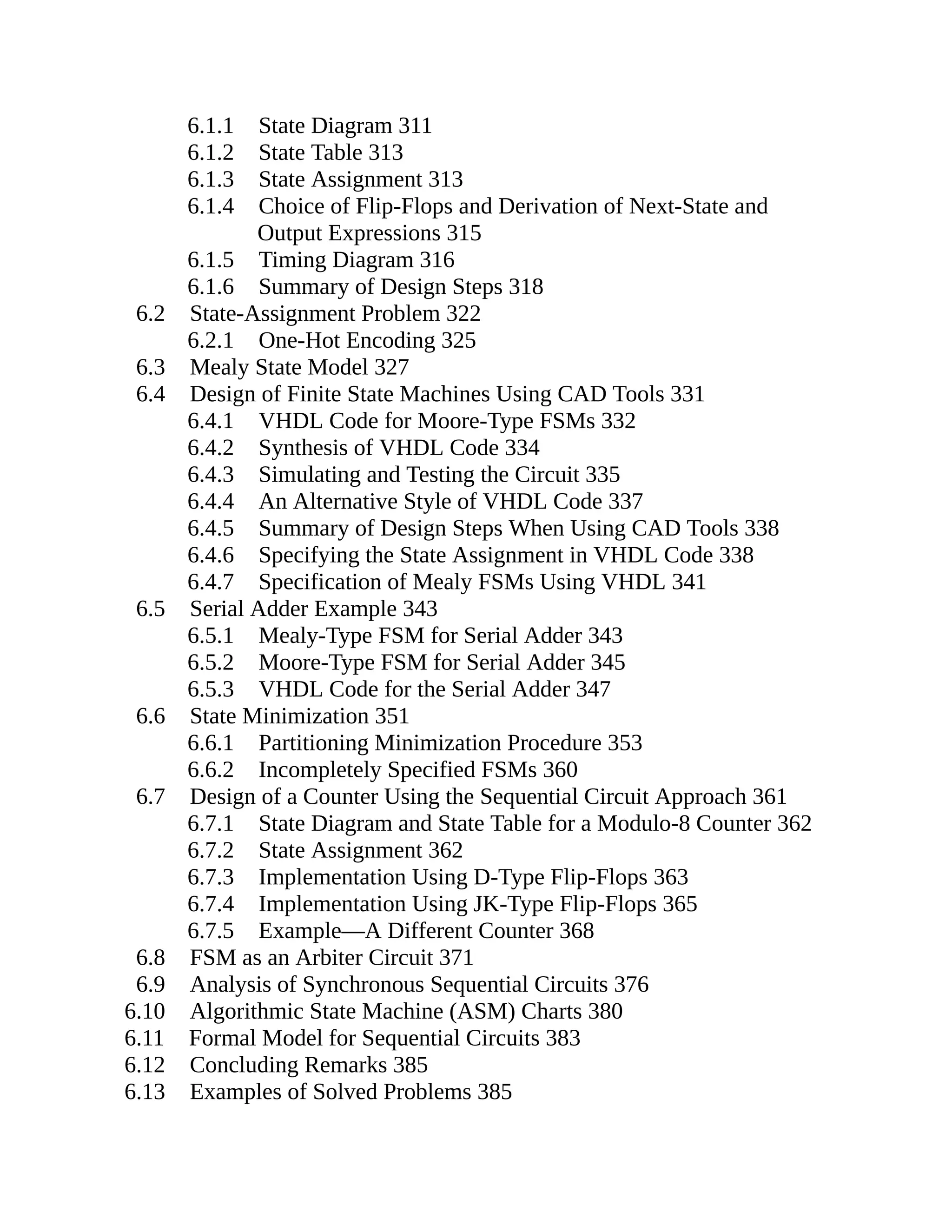
26.
6.1.1 State Diagram311
6.1.2 State Table 313
6.1.3 State Assignment 313
6.1.4 Choice of Flip-Flops and Derivation of Next-State and
Output Expressions 315
6.1.5 Timing Diagram 316
6.1.6 Summary of Design Steps 318
6.2 State-Assignment Problem 322
6.2.1 One-Hot Encoding 325
6.3 Mealy State Model 327
6.4 Design of Finite State Machines Using CAD Tools 331
6.4.1 VHDL Code for Moore-Type FSMs 332
6.4.2 Synthesis of VHDL Code 334
6.4.3 Simulating and Testing the Circuit 335
6.4.4 An Alternative Style of VHDL Code 337
6.4.5 Summary of Design Steps When Using CAD Tools 338
6.4.6 Specifying the State Assignment in VHDL Code 338
6.4.7 Specification of Mealy FSMs Using VHDL 341
6.5 Serial Adder Example 343
6.5.1 Mealy-Type FSM for Serial Adder 343
6.5.2 Moore-Type FSM for Serial Adder 345
6.5.3 VHDL Code for the Serial Adder 347
6.6 State Minimization 351
6.6.1 Partitioning Minimization Procedure 353
6.6.2 Incompletely Specified FSMs 360
6.7 Design of a Counter Using the Sequential Circuit Approach 361
6.7.1 State Diagram and State Table for a Modulo-8 Counter 362
6.7.2 State Assignment 362
6.7.3 Implementation Using D-Type Flip-Flops 363
6.7.4 Implementation Using JK-Type Flip-Flops 365
6.7.5 Example—A Different Counter 368
6.8 FSM as an Arbiter Circuit 371
6.9 Analysis of Synchronous Sequential Circuits 376
6.10 Algorithmic State Machine (ASM) Charts 380
6.11 Formal Model for Sequential Circuits 383
6.12 Concluding Remarks 385
6.13 Examples of Solved Problems 385
27.
Problems 394
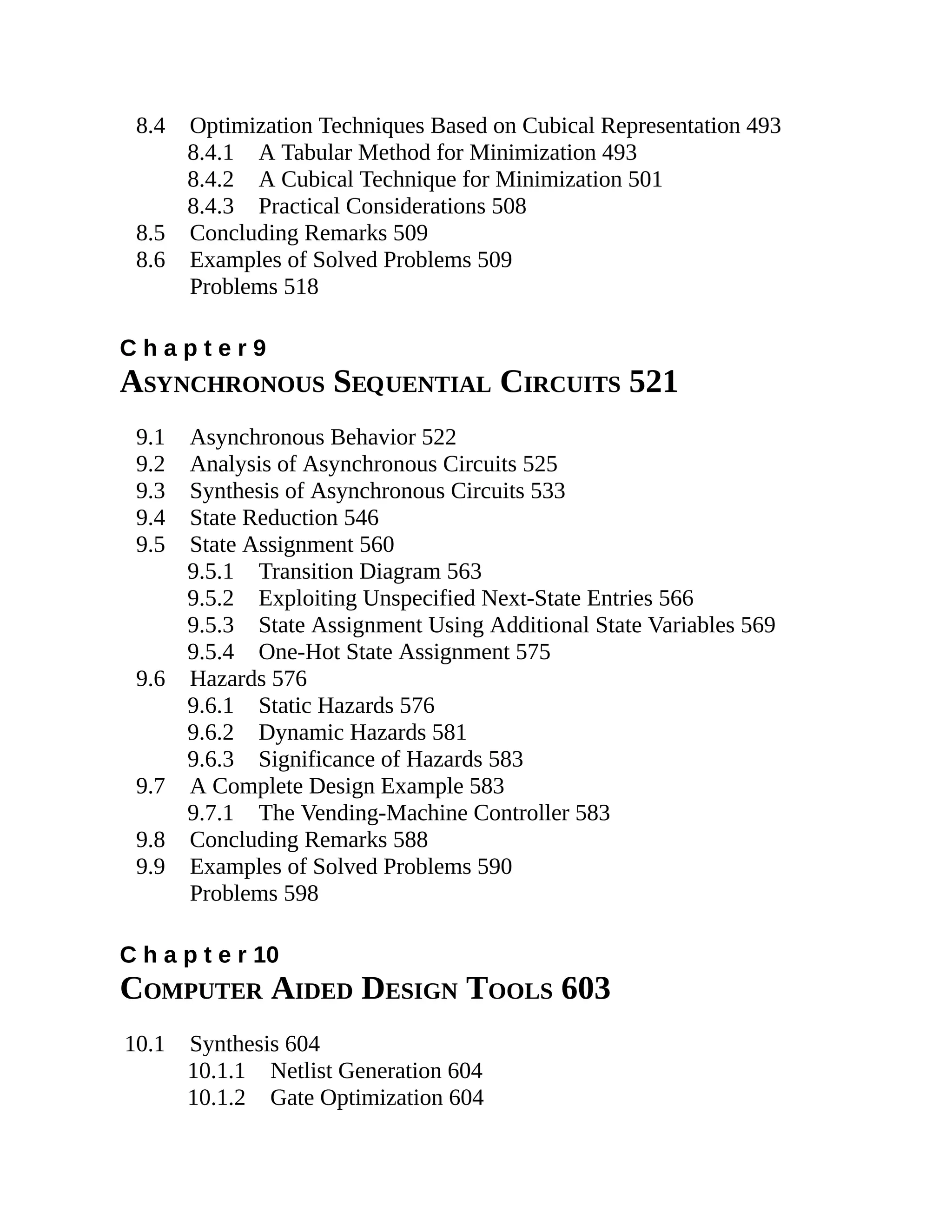
C ha p t e r 7
DIGITAL SYSTEM DESIGN 399
7.1 Bus Structure 400
7.1.1 Using Tri-State Drivers to Implement a Bus 400
7.1.2 Using Multiplexers to Implement a Bus 402
7.1.3 VHDL Code for Specification of Bus Structures 404
7.2 Simple Processor 408
7.3 A Bit-Counting Circuit 420
7.4 Shift-and-Add Multiplier 425
7.5 Divider 432
7.6 Arithmetic Mean 442
7.7 Sort Operation 445
7.8 Clock Synchronization and Timing Issues 454
7.8.1 Clock Distribution 456
7.8.2 Flip-Flop Timing Parameters 457
7.8.3 Asynchronous Inputs to Flip-Flops 458
7.8.4 Switch Debouncing 459
7.9 Concluding Remarks 461
Problems 461
C h a p t e r 8
OPTIMIZED IMPLEMENTATION OF LOGIC FUNCTIONS
465
8.1 Multilevel Synthesis 466
8.1.1 Factoring 467
8.1.2 Functional Decomposition 470
8.1.3 Multilevel NAND and NOR Circuits 475
8.2 Analysis of Multilevel Circuits 478
8.3 Alternative Representations of Logic Functions 483
8.3.1 Cubical Representation 483
8.3.2 Binary Decision Diagrams 487
28.
8.4 Optimization TechniquesBased on Cubical Representation 493
8.4.1 A Tabular Method for Minimization 493
8.4.2 A Cubical Technique for Minimization 501
8.4.3 Practical Considerations 508
8.5 Concluding Remarks 509
8.6 Examples of Solved Problems 509
Problems 518
C h a p t e r 9
ASYNCHRONOUS SEQUENTIAL CIRCUITS 521
9.1 Asynchronous Behavior 522
9.2 Analysis of Asynchronous Circuits 525
9.3 Synthesis of Asynchronous Circuits 533
9.4 State Reduction 546
9.5 State Assignment 560
9.5.1 Transition Diagram 563
9.5.2 Exploiting Unspecified Next-State Entries 566
9.5.3 State Assignment Using Additional State Variables 569
9.5.4 One-Hot State Assignment 575
9.6 Hazards 576
9.6.1 Static Hazards 576
9.6.2 Dynamic Hazards 581
9.6.3 Significance of Hazards 583
9.7 A Complete Design Example 583
9.7.1 The Vending-Machine Controller 583
9.8 Concluding Remarks 588
9.9 Examples of Solved Problems 590
Problems 598
C h a p t e r 10
COMPUTER AIDED DESIGN TOOLS 603
10.1 Synthesis 604
10.1.1 Netlist Generation 604
10.1.2 Gate Optimization 604
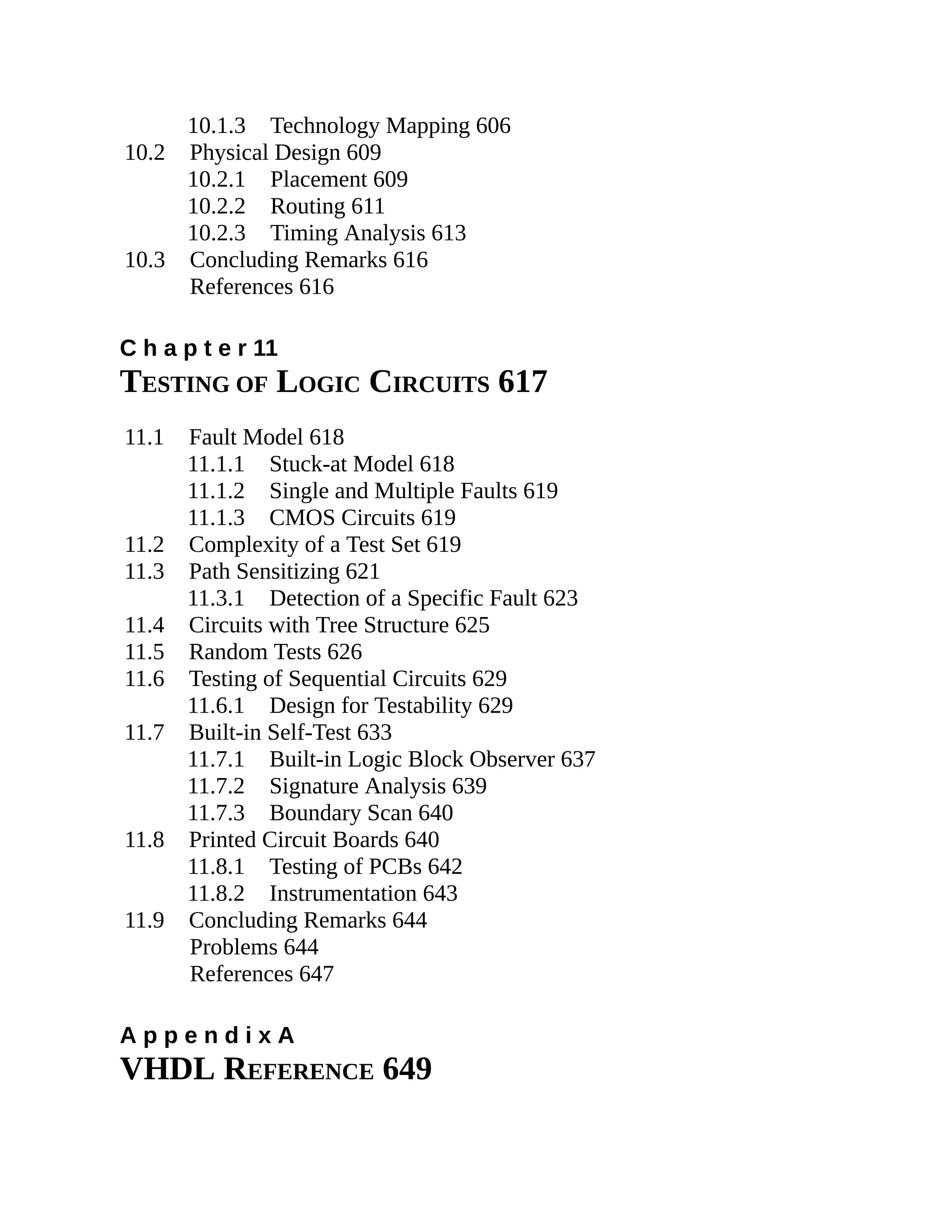
29.
10.1.3 Technology Mapping606
10.2 Physical Design 609
10.2.1 Placement 609
10.2.2 Routing 611
10.2.3 Timing Analysis 613
10.3 Concluding Remarks 616
References 616
C h a p t e r 11
TESTING OF LOGIC CIRCUITS 617
11.1 Fault Model 618
11.1.1 Stuck-at Model 618
11.1.2 Single and Multiple Faults 619
11.1.3 CMOS Circuits 619
11.2 Complexity of a Test Set 619
11.3 Path Sensitizing 621
11.3.1 Detection of a Specific Fault 623
11.4 Circuits with Tree Structure 625
11.5 Random Tests 626
11.6 Testing of Sequential Circuits 629
11.6.1 Design for Testability 629
11.7 Built-in Self-Test 633
11.7.1 Built-in Logic Block Observer 637
11.7.2 Signature Analysis 639
11.7.3 Boundary Scan 640
11.8 Printed Circuit Boards 640
11.8.1 Testing of PCBs 642
11.8.2 Instrumentation 643
11.9 Concluding Remarks 644
Problems 644
References 647
A p p e n d i x A
VHDL REFERENCE 649
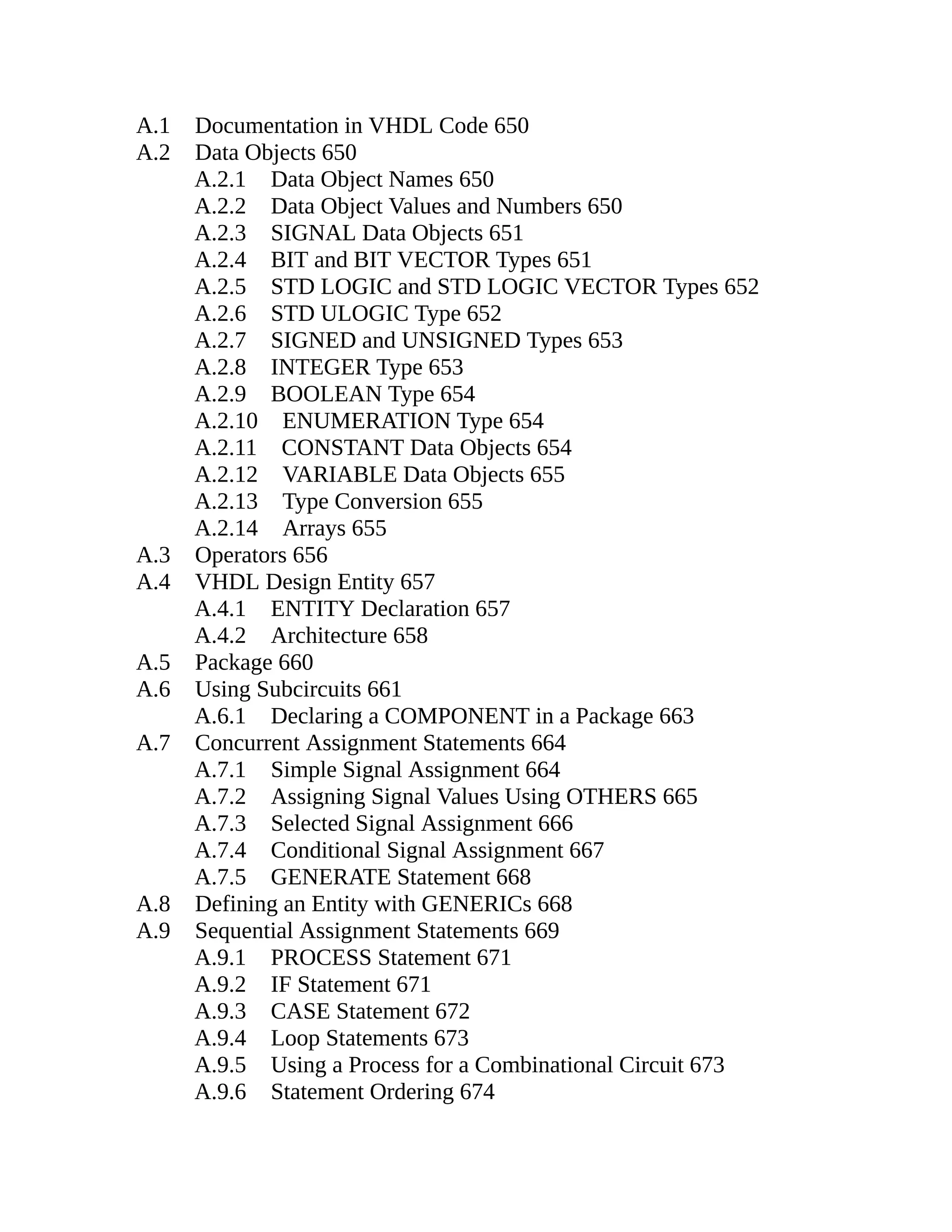
30.
A.1 Documentation inVHDL Code 650
A.2 Data Objects 650
A.2.1 Data Object Names 650
A.2.2 Data Object Values and Numbers 650
A.2.3 SIGNAL Data Objects 651
A.2.4 BIT and BIT VECTOR Types 651
A.2.5 STD LOGIC and STD LOGIC VECTOR Types 652
A.2.6 STD ULOGIC Type 652
A.2.7 SIGNED and UNSIGNED Types 653
A.2.8 INTEGER Type 653
A.2.9 BOOLEAN Type 654
A.2.10 ENUMERATION Type 654
A.2.11 CONSTANT Data Objects 654
A.2.12 VARIABLE Data Objects 655
A.2.13 Type Conversion 655
A.2.14 Arrays 655
A.3 Operators 656
A.4 VHDL Design Entity 657
A.4.1 ENTITY Declaration 657
A.4.2 Architecture 658
A.5 Package 660
A.6 Using Subcircuits 661
A.6.1 Declaring a COMPONENT in a Package 663
A.7 Concurrent Assignment Statements 664
A.7.1 Simple Signal Assignment 664
A.7.2 Assigning Signal Values Using OTHERS 665
A.7.3 Selected Signal Assignment 666
A.7.4 Conditional Signal Assignment 667
A.7.5 GENERATE Statement 668
A.8 Defining an Entity with GENERICs 668
A.9 Sequential Assignment Statements 669
A.9.1 PROCESS Statement 671
A.9.2 IF Statement 671
A.9.3 CASE Statement 672
A.9.4 Loop Statements 673
A.9.5 Using a Process for a Combinational Circuit 673
A.9.6 Statement Ordering 674
31.
A.9.7 Using aVARIABLE in a PROCESS 675
A.10 Sequential Circuits 680
A.10.1 A Gated D Latch 680
A.10.2 D Flip-Flop 681
A.10.3 Using a WAIT UNTIL Statement 681
A.10.4 A Flip-Flop with Asynchronous Reset 682
A.10.5 Synchronous Reset 682
A.10.6 Registers 684
A.10.7 Shift Registers 686
A.10.8 Counters 688
A.10.9 Using Subcircuits with GENERIC Parameters 688
A.10.10 A Moore-Type Finite State Machine 692
A.10.11 A Mealy-Type Finite State Machine 696
A.11 Common Errors in VHDL Code 696
A.12 Concluding Remarks 699
References 700
A p p e n d i x B
IMPLEMENTATION TECHNOLOGY 701
B.1 Transistor Switches 702
B.2 NMOS Logic Gates 704
B.3 CMOS Logic Gates 707
B.3.1 Speed of Logic Gate Circuits 714
B.4 Negative Logic System 715
B.5 Standard Chips 718
B.5.1 7400-Series Standard Chips 718
B.6 Programmable Logic Devices 720
B.6.1 Programmable Logic Array (PLA) 721
B.6.2 Programmable Array Logic (PAL) 723
B.6.3 Programming of PLAs and PALs 725
B.6.4 Complex Programmable Logic Devices (CPLDs) 727
B.6.5 Field-Programmable Gate Arrays 731
B.7 Custom Chips, Standard Cells, and Gate Arrays 736
B.8 Practical Aspects 738
B.8.1 MOSFET Fabrication and Behavior 738
32.
B.8.2 MOSFET On-Resistance742
B.8.3 Voltage Levels in Logic Gates 743
B.8.4 Noise Margin 745
B.8.5 Dynamic Operation of Logic Gates 746
B.8.6 Power Dissipation in Logic Gates 749
B.8.7 Passing 1s and 0s Through Transistor Switches 751
B.8.8 Transmission Gates 753
B.8.9 Fan-in and Fan-out in Logic Gates 755
B.8.10 Tri-state Drivers 759
B.9 Static Random Access Memory (SRAM) 761
B.9.1 SRAM Blocks in PLDs 762
B.10 Implementation Details for SPLDs, CPLDs, and FPGAs 763
B.10.1 Implementation in FPGAs 771
B.11 Concluding Remarks 773
B.12 Examples of Solved Problems 773
Problems 780
References 790
ANSWERS 791
INDEX 805
35.
c h ap t e r
1
INTRODUCTION
CHAPTER OBJECTIVES
In this chapter you will be introduced to:
• Digital hardware components
• An overview of the design process
• Binary numbers
• Digital representation of information
This book is about logic circuits—the circuits from which computers are
built. Proper understanding of logic circuits is vital for today's electrical and
computer engineers. These circuits are the key ingredient of computers and
are also used in many other applications. They are found in commonly used
products like music and video players, electronic games, digital watches,
cameras, televisions, printers, and many household appliances, as well as in
large systems, such as telephone networks, Internet equipment, television
broadcast equipment, industrial control units, and medical instruments. In
short, logic circuits are an important part of almost all modern products.
36.
The material inthis book will introduce the reader to the many issues
involved in the design of logic circuits. It explains the key ideas with simple
examples and shows how complex circuits can be derived from elementary
ones. We cover the classical theory used in the design of logic circuits
because it provides the reader with an intuitive understanding of the nature
of such circuits. But, throughout the book, we also illustrate the modern
way of designing logic circuits using sophisticated computer aided design
(CAD) software tools. The CAD methodology adopted in the book is based
on the industry-standard design language called VHDL. Design with VHDL
is first introduced in Chapter 2, and usage of VHDL and CAD tools is an
integral part of each chapter in the book.
Logic circuits are implemented electronically, using transistors on an
integrated circuit chip. Commonly available chips that use modern
technology may contain more than a billion transistors, as in the case of
some computer processors. The basic building blocks for such circuits are
easy to understand, but there is nothing simple about a circuit that contains
billions of transistors. The complexity that comes with large circuits can be
handled successfully only by using highly organized design techniques. We
introduce these techniques in this chapter, but first we briefly describe the
hardware technology used to build logic circuits.
1.1 DIGITAL HARDWARE
Logic circuits are used to build computer hardware, as well as many other
types of products. All such products are broadly classified as digital
hardware. The reason that the name digital is used will be explained in
Section 1.5—it derives from the way in which information is represented in
computers, as electronic signals that correspond to digits of information.
The technology used to build digital hardware has evolved dramatically
over the past few decades. Until the 1960s logic circuits were constructed
with bulky components, such as transistors and resistors that came as
individual parts. The advent of integrated circuits made it possible to place
a number of transistors, and thus an entire circuit, on a single chip. In the
beginning these circuits had only a few transistors, but as the technology
improved they became more complex. Integrated circuit chips are
37.
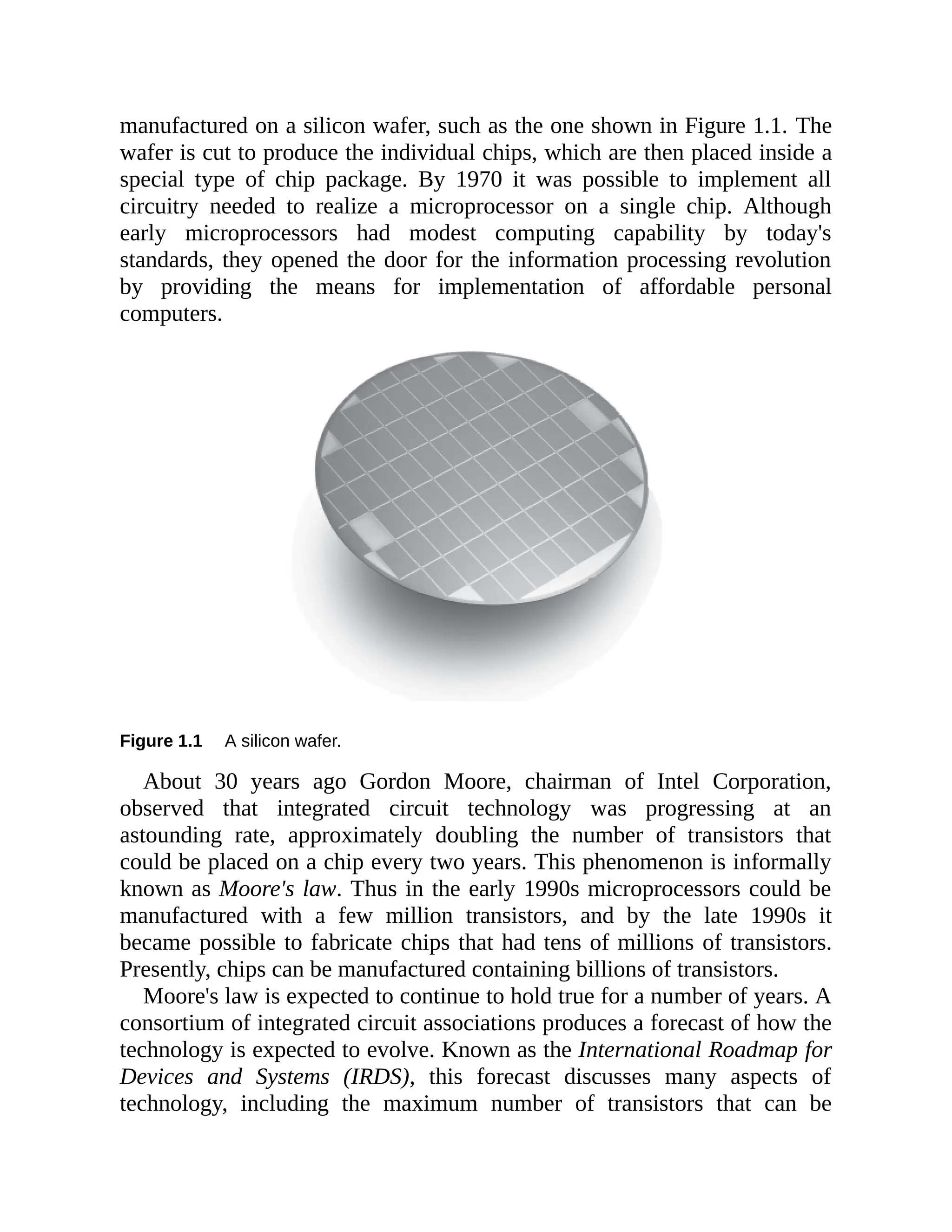
manufactured on asilicon wafer, such as the one shown in Figure 1.1. The
wafer is cut to produce the individual chips, which are then placed inside a
special type of chip package. By 1970 it was possible to implement all
circuitry needed to realize a microprocessor on a single chip. Although
early microprocessors had modest computing capability by today's
standards, they opened the door for the information processing revolution
by providing the means for implementation of affordable personal
computers.
Figure 1.1 A silicon wafer.
About 30 years ago Gordon Moore, chairman of Intel Corporation,
observed that integrated circuit technology was progressing at an
astounding rate, approximately doubling the number of transistors that
could be placed on a chip every two years. This phenomenon is informally
known as Moore's law. Thus in the early 1990s microprocessors could be
manufactured with a few million transistors, and by the late 1990s it
became possible to fabricate chips that had tens of millions of transistors.
Presently, chips can be manufactured containing billions of transistors.
Moore's law is expected to continue to hold true for a number of years. A
consortium of integrated circuit associations produces a forecast of how the
technology is expected to evolve. Known as the International Roadmap for
Devices and Systems (IRDS), this forecast discusses many aspects of
technology, including the maximum number of transistors that can be
38.
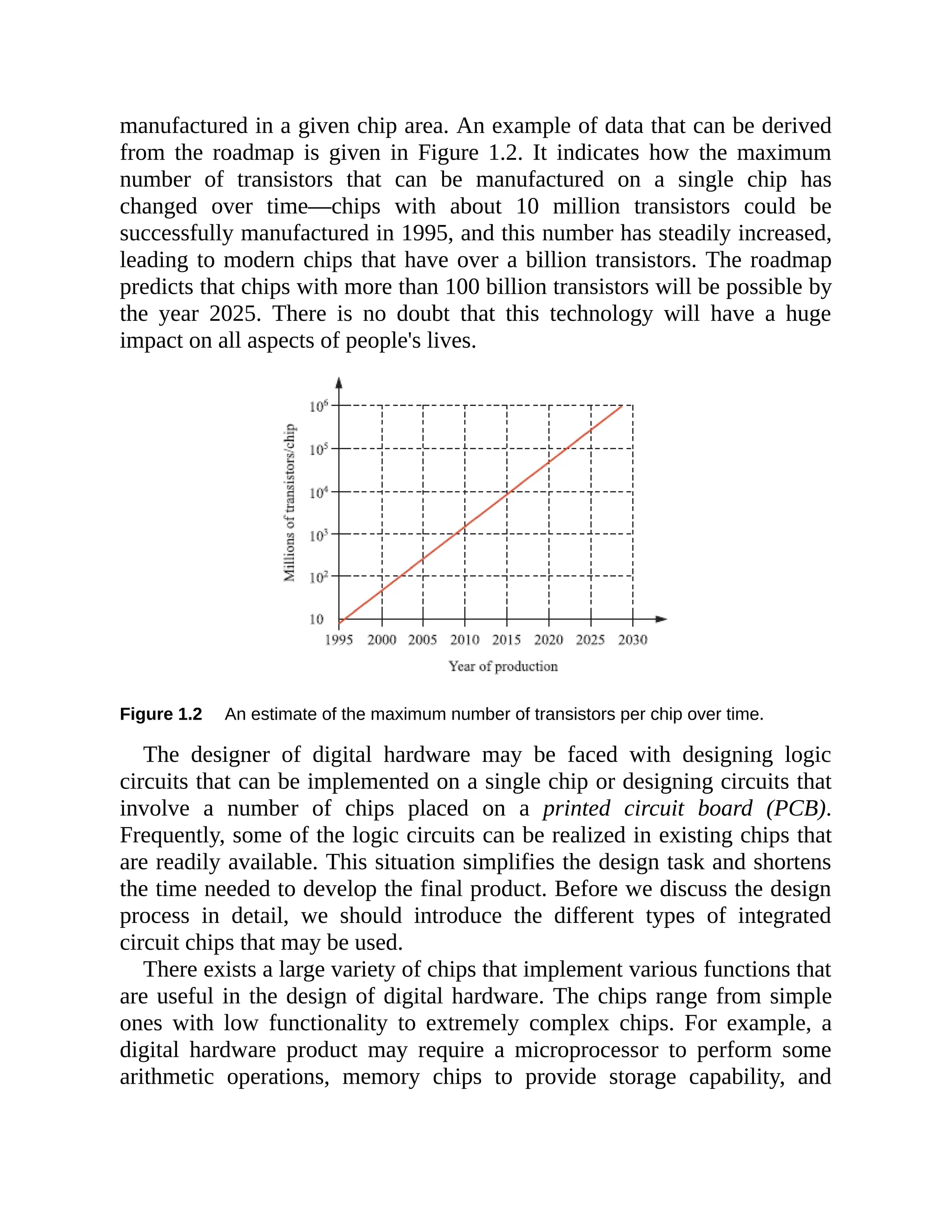
manufactured in agiven chip area. An example of data that can be derived
from the roadmap is given in Figure 1.2. It indicates how the maximum
number of transistors that can be manufactured on a single chip has
changed over time—chips with about 10 million transistors could be
successfully manufactured in 1995, and this number has steadily increased,
leading to modern chips that have over a billion transistors. The roadmap
predicts that chips with more than 100 billion transistors will be possible by
the year 2025. There is no doubt that this technology will have a huge
impact on all aspects of people's lives.
Figure 1.2 An estimate of the maximum number of transistors per chip over time.
The designer of digital hardware may be faced with designing logic
circuits that can be implemented on a single chip or designing circuits that
involve a number of chips placed on a printed circuit board (PCB).
Frequently, some of the logic circuits can be realized in existing chips that
are readily available. This situation simplifies the design task and shortens
the time needed to develop the final product. Before we discuss the design
process in detail, we should introduce the different types of integrated
circuit chips that may be used.
There exists a large variety of chips that implement various functions that
are useful in the design of digital hardware. The chips range from simple
ones with low functionality to extremely complex chips. For example, a
digital hardware product may require a microprocessor to perform some
arithmetic operations, memory chips to provide storage capability, and
39.
interface chips thatallow easy connection to input and output devices. Such
chips are available from various vendors.
For many digital hardware products, it is also necessary to design and
build some logic circuits from scratch. For implementing these circuits,
three main types of chips may be used: standard chips, programmable logic
devices, and custom chips. These are discussed next.
1.1.1 STANDARD CHIPS
Numerous chips are available that realize some commonly used logic
circuits. We will refer to these as standard chips, because they usually
conform to an agreed-upon standard in terms of functionality and physical
configuration. Each standard chip contains a small amount of circuitry
(usually involving fewer than 100 transistors) and performs a simple
function. To build a logic circuit, the designer chooses the chips that
perform whatever functions are needed and then defines how these chips
should be interconnected to realize a larger logic circuit.
Standard chips were popular for building logic circuits until the early
1980s. However, as integrated circuit technology improved, it became
inefficient to use valuable space on PCBs for chips with low functionality.
Another drawback of standard chips is that the functionality of each chip is
fixed and cannot be changed.
1.1.2 PROGRAMMABLE LOGIC DEVICES
In contrast to standard chips that have fixed functionality, it is possible to
construct chips that contain circuitry which can be configured by the user to
implement a wide range of different logic circuits. These chips have a very
general structure and include a collection of programmable switches that
allow the internal circuitry in the chip to be configured in many different
ways. The designer can implement whatever functions are required for a
particular application by setting the programmable switches as needed. The
switches are programmed by the end user, rather than when the chip is
manufactured. Such chips are known as programmable logic devices
(PLDs).
PLDs are available in a wide range of sizes, and can be used to
implement very large logic circuits. The most commonly used type of PLD
is known as a field-programmable gate array (FPGA). The largest FPGAs
40.
contain billions oftransistors and support the implementation of complex
digital systems. An FPGA consists of a large number of small logic circuit
elements, which can be connected together by using programmable
switches in the FPGA. Because of their high capacity, and their capability
to be tailored to meet the requirements of a specific application, FPGAs are
widely used today.
1.1.3 CUSTOM-DESIGNED CHIPS
FPGAs are available as off-the-shelf components that can be purchased
from different suppliers. Because they are programmable, they can be used
to implement most logic circuits found in digital hardware. However, they
also have a drawback in that the programmable switches consume valuable
chip area and limit the speed of operation of implemented circuits. Thus in
some cases FPGAs may not meet the desired performance or cost
objectives. In such situations it is possible to design a chip from scratch;
namely, the logic circuitry that must be included on the chip is designed
first and then the chip is manufactured by a company that has the
fabrication facilities. This approach is known as custom or semi-custom
design, and such chips are often called application-specific integrated
circuits (ASICs).
The main advantage of a custom chip is that its design can be optimized
for a specific task; hence it usually leads to better performance. It is
possible to include a larger amount of logic circuitry in a custom chip than
would be possible in other types of chips. The cost of producing such chips
is high, but if they are used in a product that is sold in large quantities, then
the cost per chip, amortized over the total number of chips fabricated, may
be lower than the total cost of off-the-shelf chips that would be needed to
implement the same function(s). Moreover, if a single chip can be used
instead of multiple chips to achieve the same goal, then a smaller area is
needed on a PCB that houses the chips in the final product. This results in a
further reduction in cost.
A disadvantage of the custom-design approach is that manufacturing a
custom chip often takes a considerable amount of time, on the order of
months. In contrast, if an FPGA can be used instead, then the chips are
programmed by the end user and no manufacturing delays are involved.
41.
1.2 THE DESIGNPROCESS
The availability of computer-based tools has greatly influenced the design
process in a wide variety of environments. For example, designing an
automobile is similar in the general approach to designing a furnace or a
computer. Certain steps in the development cycle must be performed if the
final product is to meet the specified objectives.
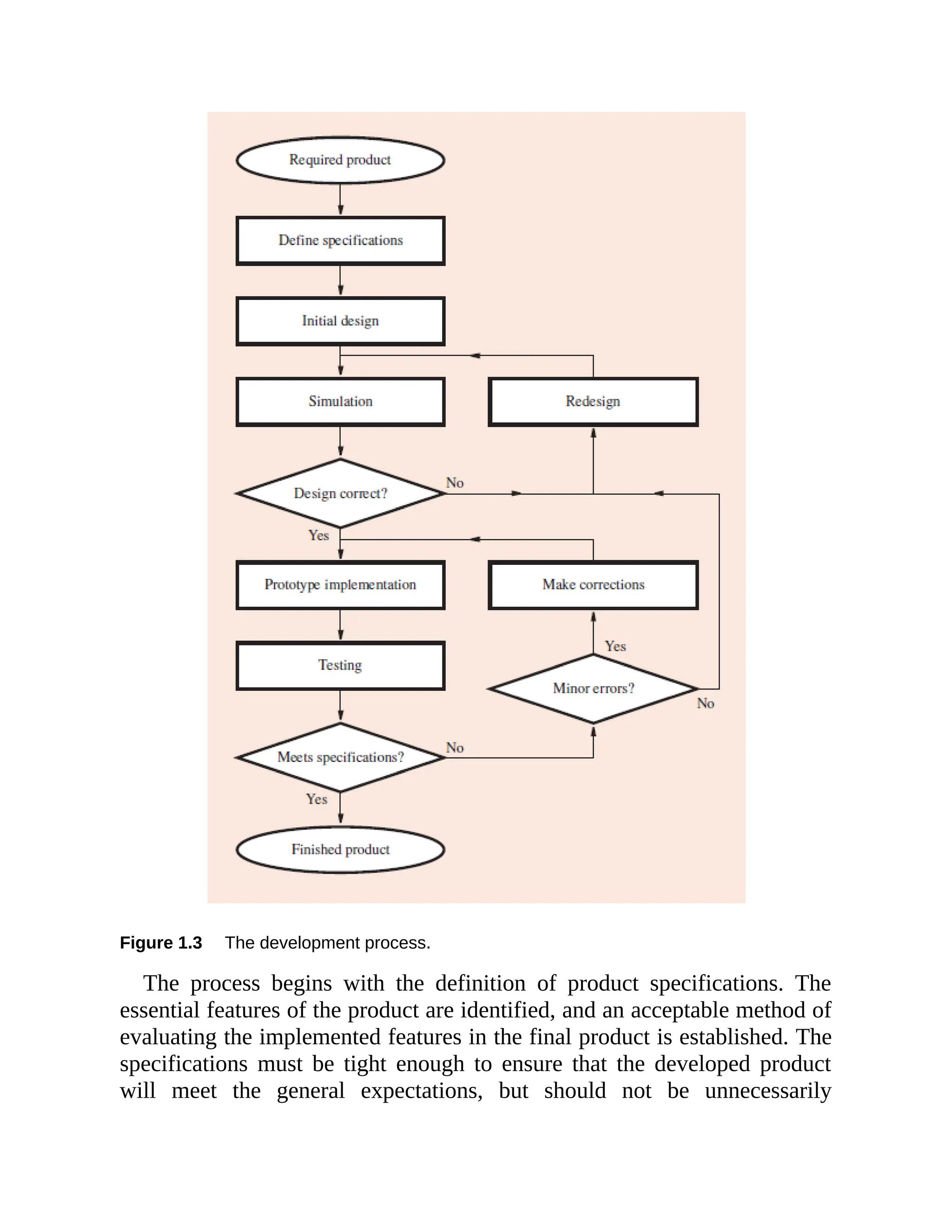
The flowchart in Figure 1.3 depicts a typical development process. We
assume that the process is to develop a product that meets certain
expectations. The most obvious requirements are that the product must
function properly, that it must meet an expected level of performance, and
that its cost should not exceed a given target.
42.
Figure 1.3 Thedevelopment process.
The process begins with the definition of product specifications. The
essential features of the product are identified, and an acceptable method of
evaluating the implemented features in the final product is established. The
specifications must be tight enough to ensure that the developed product
will meet the general expectations, but should not be unnecessarily
43.
constraining (that is,the specifications should not prevent design choices
that may lead to unforeseen advantages).
From a complete set of specifications, it is necessary to define the general
structure of an initial design of the product. This step is difficult to
automate. It is usually performed by a human designer because there is no
clear-cut strategy for developing a product's overall structure—it requires
considerable design experience and intuition.
After the general structure is established, CAD tools are used to work out
the details. Many types of CAD tools are available, ranging from those that
help with the design of individual parts of the system to those that allow the
entire system's structure to be represented in a computer. When the initial
design is finished, the results must be verified against the original
specifications. Traditionally, before the advent of CAD tools, this step
involved constructing a physical model of the designed product, usually
including just the key parts. Today it is seldom necessary to build a physical
model. CAD tools enable designers to simulate the behavior of incredibly
complex products, and such simulations are used to determine whether the
obtained design meets the required specifications. If errors are found, then
appropriate changes are made and the verification of the new design is
repeated through simulation. Although some design flaws may escape
detection via simulation, usually all but the most subtle problems are
discovered in this way.
When the simulation indicates that the design is correct, a complete
physical prototype of the product is constructed. The prototype is
thoroughly tested for conformance with the specifications. Any errors
revealed in the testing must be fixed. The errors may be minor, and often
they can be eliminated by making small corrections directly on the
prototype of the product. In case of large errors, it is necessary to redesign
the product and repeat the steps explained above. When the prototype
passes all the tests, then the product is deemed to be successfully designed
and it can go into production.
1.3 STRUCTURE OF A COMPUTER
44.
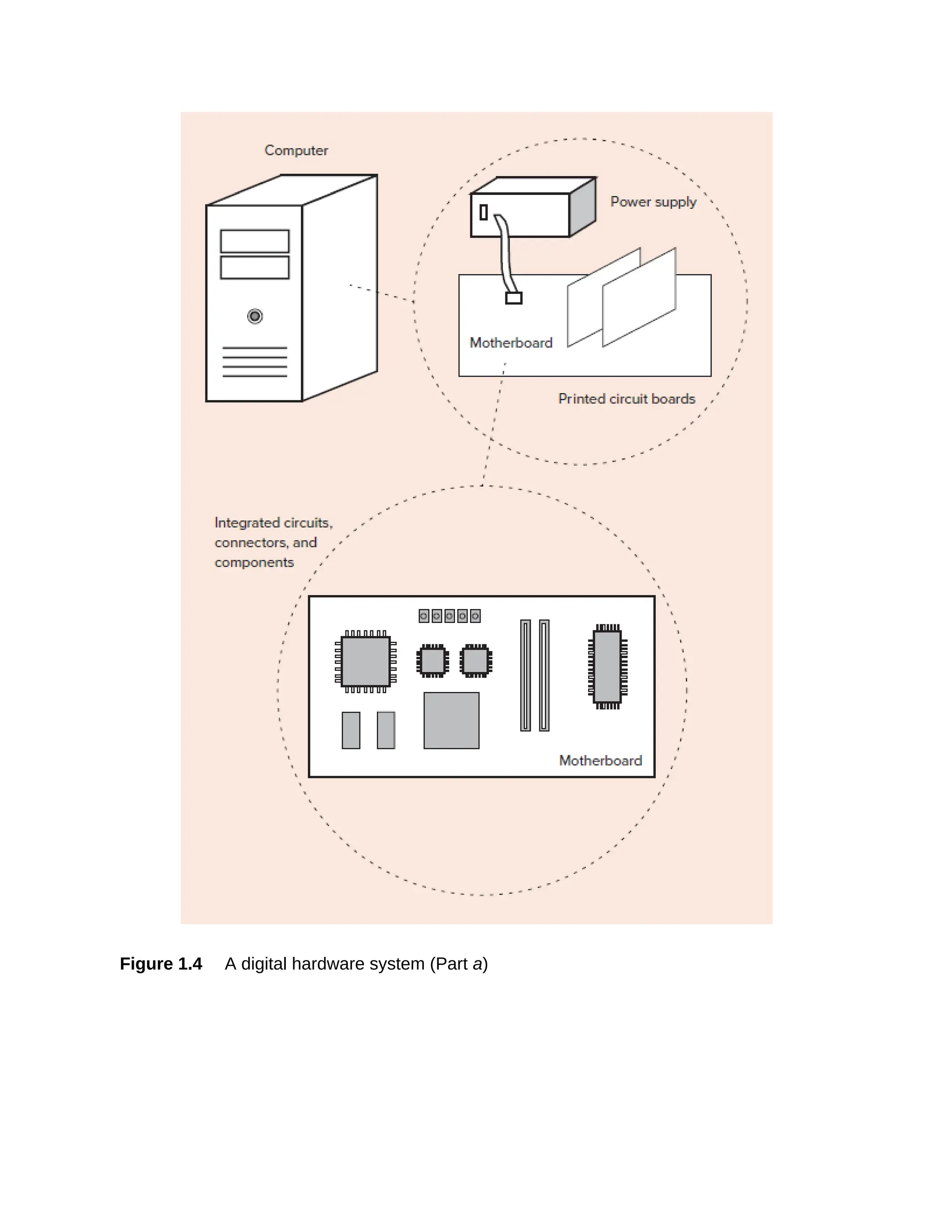
To understand therole that logic circuits play in digital systems, consider
the structure of a typical computer, as illustrated in Figure 1.4a. The
computer case houses a number of printed circuit boards (PCBs), a power
supply, and (not shown in the figure) storage units, like a hard disk and
DVD or CD-ROM drives. Each unit is plugged into a main PCB, called the
motherboard. As indicated on the bottom of the figure, the motherboard
holds several integrated circuit chips, and it provides slots for connecting
other PCBs, such as audio, video, and network boards.
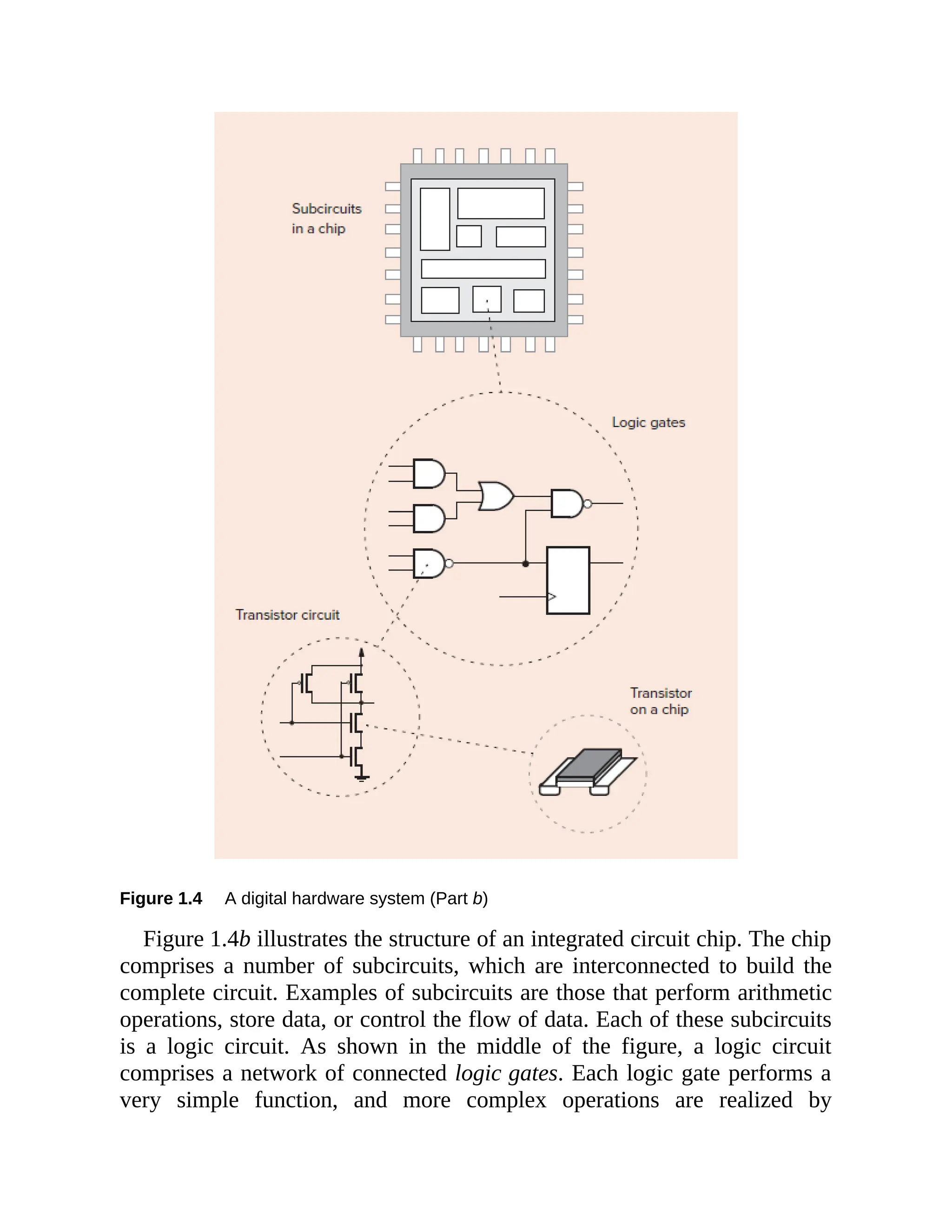
Figure 1.4 Adigital hardware system (Part b)
Figure 1.4b illustrates the structure of an integrated circuit chip. The chip
comprises a number of subcircuits, which are interconnected to build the
complete circuit. Examples of subcircuits are those that perform arithmetic
operations, store data, or control the flow of data. Each of these subcircuits
is a logic circuit. As shown in the middle of the figure, a logic circuit
comprises a network of connected logic gates. Each logic gate performs a
very simple function, and more complex operations are realized by
47.
connecting gates together.Logic gates are built with transistors, which in
turn are implemented by fabricating various layers of material on a silicon
chip.
This book is primarily concerned with the center portion of Figure 1.4b
—the design of logic circuits. We explain how to design circuits that
perform important functions, such as adding, subtracting, or multiplying
numbers, counting, storing data, and controlling the processing of
information. We show how the behavior of such circuits is specified, how
the circuits are designed for minimum cost or maximum speed of operation,
and how the circuits can be tested to ensure correct operation. We also
briefly explain how transistors operate, and how they are built on silicon
chips.
1.4 LOGIC CIRCUIT DESIGN IN THIS BOOK
In this book we use a modern design approach based on the VHDL
hardware description language and CAD tools to illustrate many aspects of
logic circuit design. We selected this technology because it is widely used
in industry and because it enables the readers to implement their designs in
FPGA chips, as discussed below. This technology is particularly well-suited
for educational purposes because many readers have access to facilities for
using CAD tools and programming FPGA devices.
To gain practical experience and a deeper understanding of logic circuits,
we advise the reader to implement the examples in this book using CAD
software. Most of the major vendors of CAD systems provide their software
at no cost to university students for educational use. Some examples are
Intel, Cadence, Mentor Graphics, Synopsys, and Xilinx. The CAD systems
offered by any of these companies can be used equally well with this book.
Two examples of CAD systems that are particularly well-suited for use with
this book are those provided by Intel and Xilinx. The CAD tools from both
of these corporations support all phases of the design cycle for logic circuits
and are powerful and easy to use. The reader is encouraged to visit the
website for these companies, where the software tools and tutorials that
explain their use can be downloaded and installed onto any personal
computer.
48.
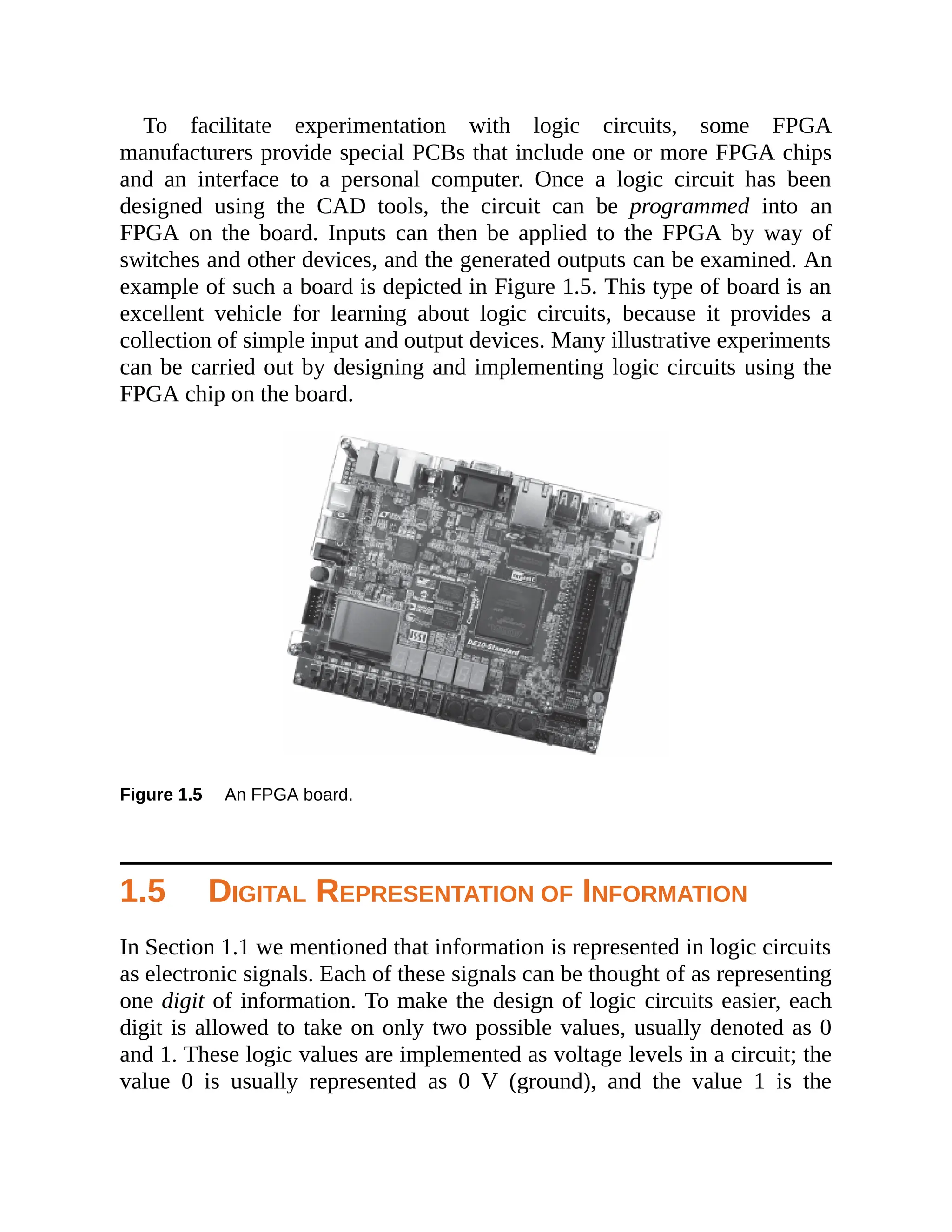
To facilitate experimentationwith logic circuits, some FPGA
manufacturers provide special PCBs that include one or more FPGA chips
and an interface to a personal computer. Once a logic circuit has been
designed using the CAD tools, the circuit can be programmed into an
FPGA on the board. Inputs can then be applied to the FPGA by way of
switches and other devices, and the generated outputs can be examined. An
example of such a board is depicted in Figure 1.5. This type of board is an
excellent vehicle for learning about logic circuits, because it provides a
collection of simple input and output devices. Many illustrative experiments
can be carried out by designing and implementing logic circuits using the
FPGA chip on the board.
Figure 1.5 An FPGA board.
1.5 DIGITAL REPRESENTATION OF INFORMATION
In Section 1.1 we mentioned that information is represented in logic circuits
as electronic signals. Each of these signals can be thought of as representing
one digit of information. To make the design of logic circuits easier, each
digit is allowed to take on only two possible values, usually denoted as 0
and 1. These logic values are implemented as voltage levels in a circuit; the
value 0 is usually represented as 0 V (ground), and the value 1 is the
49.
voltage level ofthe circuit's power supply. As we discuss in Appendix B,
typical power-supply voltages in logic circuits range from 1 V DC to 5 V
DC.
In general, all information in logic circuits is represented as combinations
of 0 and 1 digits. Before beginning our discussion of logic circuits in
Chapter 2, it will be helpful to examine how numbers, alphanumeric data
(text), and other information can be represented using the digits 0 and 1.
1.5.1 BINARY NUMBERS
In the familiar decimal system, a number consists of digits that have 10
possible values, from 0 to 9, and each digit represents a multiple of a power
of 10. For example, the number 8547 represents
. We do not normally write the powers of 10
with the number, because they are implied by the positions of the digits. In
general, a decimal integer is expressed by an n-tuple comprising n decimal
digits
which represents the value
This is referred to as the positional number representation.
Because the digits have 10 possible values and each digit is weighted as a
power of 10, we say that decimal numbers are base-10 numbers. Decimal
numbers are familiar, convenient, and easy to understand. However, since
digital circuits represent information using only the values 0 and 1, it is not
practical to have digits that can assume ten values. In these circuits it is
more appropriate to use the binary, or base-2, system which has only the
digits 0 and 1. Each binary digit is called a bit. In the binary number
system, the same positional number representation is used so that
represents an integer that has the value
50.
For example, thebinary number 1101 represents the value
Because a particular digit pattern has different meanings for different bases,
we will indicate the base as a subscript when there is potential for
confusion. Thus to specify that 1101 is a base-2 number, we will write
(1101)2. Evaluating the preceding expression for V gives .
Hence
The range of integers that can be represented by a binary number depends
on the number of bits used. Table 1.1 lists the first 15 positive integers and
shows their binary representations using four bits. An example of a larger
number is . In general, using n bits allows representation of
positive integers in the range 0 to .
Table 1-1 Numbers in decimal and binary.
51.
In a binarynumber the rightmost bit is usually referred to as the least-
significant bit (LSB). The left-most bit, which has the highest power of 2
associated with it, is called the most-significant bit (MSB). In digital
systems it is often convenient to consider several bits together as a group. A
group of four bits is called a nibble, and a group of eight bits is called a
byte.
1.5.2 CONVERSION BETWEEN DECIMAL AND BINARY
SYSTEMS
A binary number is converted into a decimal number simply by applying
Equation 1.1 and evaluating it using decimal arithmetic. Converting a
decimal number into a binary number is not quite as straightforward,
because we need to construct the number by using powers of 2. For
example, the number is , and the number is
. In general, the conversion can be performed by
successively dividing the decimal number by 2 as follows. Suppose that a
decimal number , with a value V, is to be converted into a
binary number . Then, we can write V in the form
If we now divide V by 2, the result is
The quotient of this integer division is , and the
remainder is . If the remainder is 0, then ; if it is 1, then .
Observe that the quotient is just another binary number, which comprises
bits, rather than n bits. Dividing this number by 2 yields the remainder
. The new quotient is
Continuing the process of dividing the new quotient by 2, and determining
one bit in each step, will produce all bits of the binary number. The process
continues until the quotient becomes 0. Figure 1.6 illustrates the conversion
process, using the example . Note that the least-significant bit
52.
(LSB) is generatedfirst and the most-significant bit (MSB) is generated
last.
Figure 1.6 Conversion from decimal to binary.
So far, we have considered only the representation of positive integers. In
Chapter 3 we will complete the discussion of number representation by
explaining how negative numbers are handled and how fixed-point and
floating-point numbers may be represented. We will also explain how
arithmetic operations are performed in computers.
1.5.3 ASCII CHARACTER CODE
Alphanumeric information, such as letters and numbers typed on a
computer keyboard, is represented as codes consisting of 0 and 1 digits. The
most common code used for this type of information is known as the ASCII
code, which stands for the American Standard Code for Information
Interchange. The code specified by this standard is presented in Table 1.2.
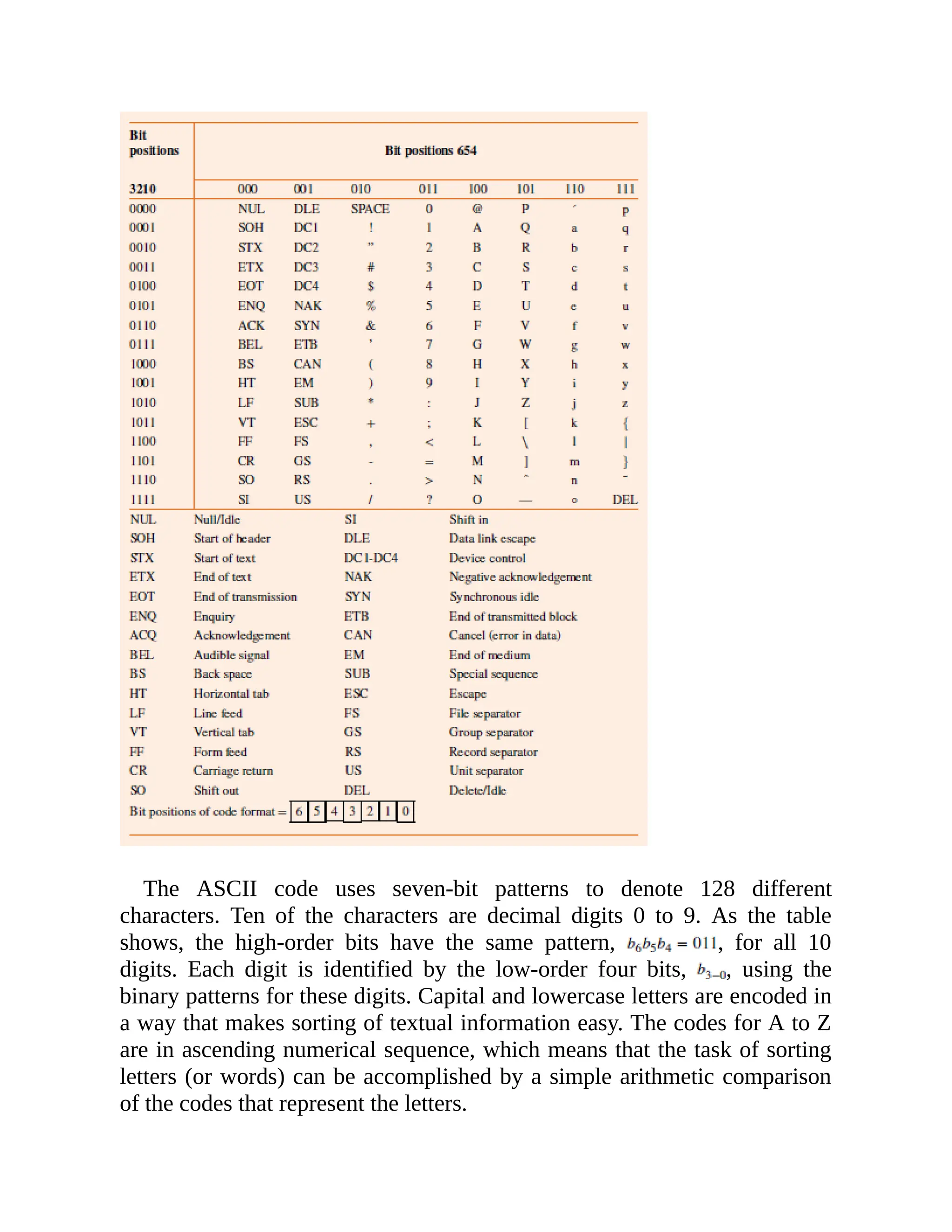
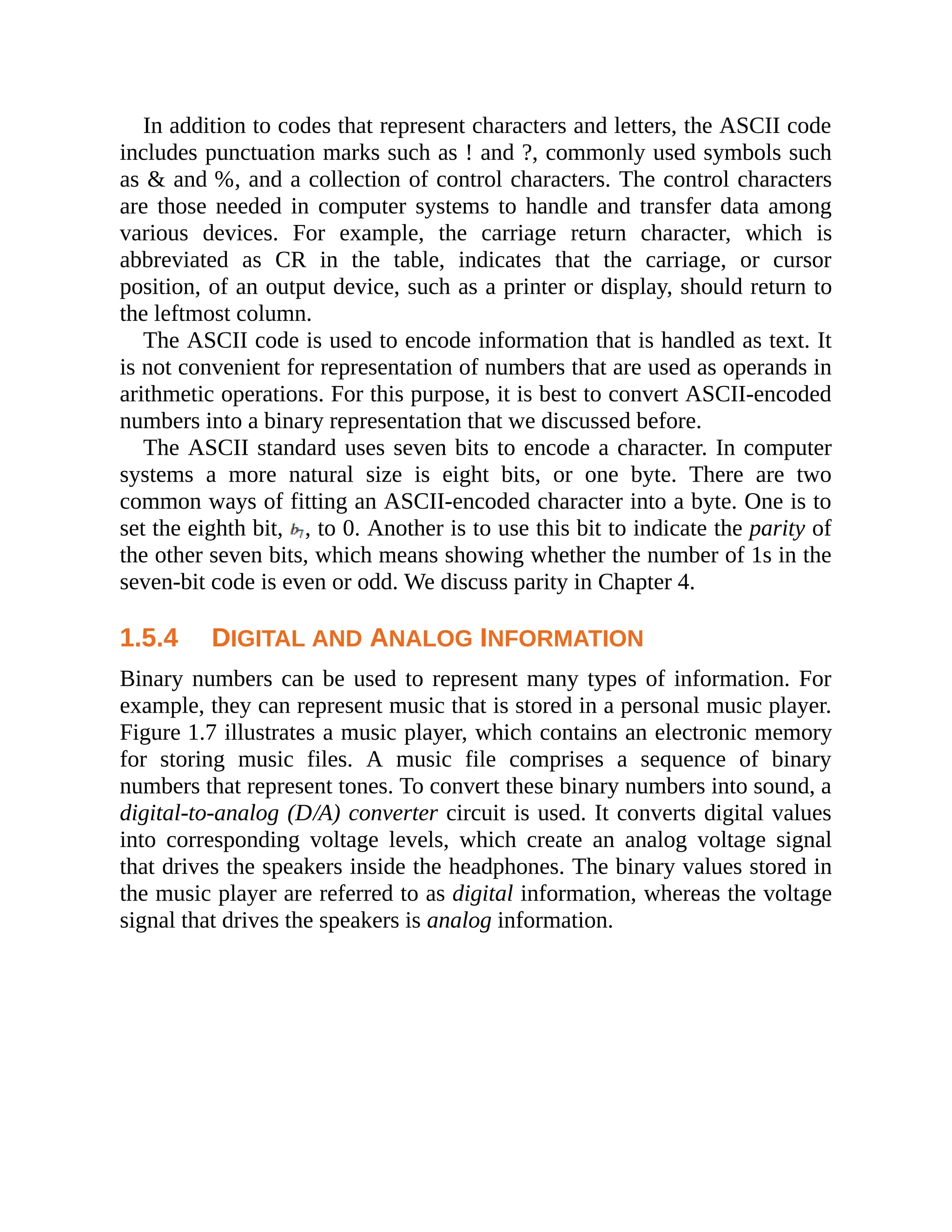
Table 1-2 The seven-bit ASCII code.
53.
The ASCII codeuses seven-bit patterns to denote 128 different
characters. Ten of the characters are decimal digits 0 to 9. As the table
shows, the high-order bits have the same pattern, , for all 10
digits. Each digit is identified by the low-order four bits, , using the
binary patterns for these digits. Capital and lowercase letters are encoded in
a way that makes sorting of textual information easy. The codes for A to Z
are in ascending numerical sequence, which means that the task of sorting
letters (or words) can be accomplished by a simple arithmetic comparison
of the codes that represent the letters.
54.
In addition tocodes that represent characters and letters, the ASCII code
includes punctuation marks such as ! and ?, commonly used symbols such
as & and %, and a collection of control characters. The control characters
are those needed in computer systems to handle and transfer data among
various devices. For example, the carriage return character, which is
abbreviated as CR in the table, indicates that the carriage, or cursor
position, of an output device, such as a printer or display, should return to
the leftmost column.
The ASCII code is used to encode information that is handled as text. It
is not convenient for representation of numbers that are used as operands in
arithmetic operations. For this purpose, it is best to convert ASCII-encoded
numbers into a binary representation that we discussed before.
The ASCII standard uses seven bits to encode a character. In computer
systems a more natural size is eight bits, or one byte. There are two
common ways of fitting an ASCII-encoded character into a byte. One is to
set the eighth bit, , to 0. Another is to use this bit to indicate the parity of
the other seven bits, which means showing whether the number of 1s in the
seven-bit code is even or odd. We discuss parity in Chapter 4.
1.5.4 DIGITAL AND ANALOG INFORMATION
Binary numbers can be used to represent many types of information. For
example, they can represent music that is stored in a personal music player.
Figure 1.7 illustrates a music player, which contains an electronic memory
for storing music files. A music file comprises a sequence of binary
numbers that represent tones. To convert these binary numbers into sound, a
digital-to-analog (D/A) converter circuit is used. It converts digital values
into corresponding voltage levels, which create an analog voltage signal
that drives the speakers inside the headphones. The binary values stored in
the music player are referred to as digital information, whereas the voltage
signal that drives the speakers is analog information.
quiet woman—you knoweveryone in Scarborough—to stay with me;
and come yourself whenever you can, and I shall be content."
"There will be no difficulty in finding such a person as you want,"
said Helen. "But I think my plan is best."
Marion shook her head. "No," she insisted. "I abused your hospitality
once. I can never forget that; and I do not think that, kind and good
as she is, my aunt will ever forget it; so do not let us talk of my
going to you. Some day, perhaps, if I have no other refuge in the
world, I may come and ask you for a shelter, but not now."
She was immovable in this, even when Mrs. Dalton seconded Helen's
invitation; and so they did what she asked—found a pleasant, quiet,
elderly lady to stay with her; and let her have her own way.
It was a strange time, the period of waiting which followed—a kind
of interlude, a breathing space, as it were, between the rush of
events which had reached this conclusion, and other events which
were to follow and change life yet again, in what degree no one
could say. It seemed to Marion that she could hardly be said to live
during these weeks. She merely existed—in a state partly of
expectation, partly of that lassitude which follows a high degree of
mental as well as physical tension. She had passed rapidly through
many experiences, many intense emotions; and now, menaced by
others of which she could not see the end, she suddenly sank down
to rest, like a soldier on the field of battle.
She had but two sources of pleasure during this time: one was
Helen's companionship, which she had never before valued or
appreciated; the other, the services of the Catholic church. The plain
little chapel, which had at first repelled her, began to seem to her
like a true home of the soul; religious influences sank more and
more deeply into her heart; and dimly, as new ideas shape and
present themselves, there began to dawn on her the meaning of
Helen's simple words. "It certainly would not be happiness if it did
not have God's blessing on it," Helen had said. Was it because no
blessing of God had been on her happiness that, in every form, it
57.
had so quicklyeluded her grasp? She asked herself this question,
and when a soul has once asked it the answer is not long in coming.
But whether or not it will be heeded when it comes, is too often a
matter of doubt. Impressions pass quickly, the sway of the world is
hard to break, and who can tell how far the poor soul may be swept
into storm and darkness before it is brought safe into port at last?
CHAPTER XXIV.
THE period of waiting ended very abruptly one day. It was by this
time soft, Indian-summer weather; and Marion was seated in the
garden with Helen one afternoon, mellow sunshine and brilliant
masses of flowers all around them, when a servant appeared with
the intelligence that Mr. Singleton was in the house and wished to
see her.
"Mr. Singleton!" she repeated, a little startled. "What Mr. Singleton?"
"Mr. Tom, ma'am," repeated the servant, who had been accustomed
to distinguish him in this manner during the life of the elder Mr.
Singleton.
"Oh!" she said. And then she turned to Helen with a faint smile. "I
don't know whether I am relieved or disappointed," she observed. "I
thought it was the other."
"But the other would hardly be likely to come without warning—and
alone," returned Helen.
"That is very true. But I wonder what this Mr. Singleton can want—if
he has any news?"
"You can only find out by going to see," said Helen.
"Yes," assented Marion. She rose as she spoke, and made a few
steps toward the house, then paused and looked back like one who
is taking a farewell. "The crisis must be at hand," she said. "I feel as
58.
if I wereon the verge of a great change. When I see you again,
Helen, I may be dispossessed of all my riches."
"Don't talk nonsense!" said Helen, in a matter-of-fact way. "How can
you be dispossessed in so short a time?"
The other laughed. "'If 'twere done when 'tis done, then 'twere well
it were done quickly,'" she said, and so went on toward the house.
Mr. Singleton, who was awaiting her in the drawing-room, came
forward and shook hands very cordially. They had always been good
friends, and he had a very kind feeling toward the beautiful and
comparatively friendless girl. This kindness had now an emphasis,
which she perceived, together with something of compassion. She
looked at him and smiled.
"Has the true heir appeared?" she asked; "and have you come to
warn me to prepare for abdication?"
"How shrewd you are!" he said. But, in truth, he was much relieved
that she was shrewd enough to divine the object of his visit,—a visit
which it had required a considerable effort on his part to undertake.
"The true heir—if you consider him so—has appeared; but there is
no question of abdication for you. He will be very glad if you consent
to compromise, and so save him a contest over the will."
She sat down in a chair conveniently near, looking a little pale.
Notwithstanding her question, she had not really anticipated such
positive assurance at once; and recognizing this, Mr. Singleton
regretted having been so abrupt.
"I thought you expected it," he said; "but I see that you were not
quite prepared. I am sorry—"
She put up her hand with a gesture which stopped his words. "There
is nothing for which to be sorry," she said. "Of course I expected it,
but perhaps not so immediately or so positively. But I don't mean to
be foolish: I intend to be quite cool and business-like. Mr. George
Singleton has arrived, then. Have you recognized him?"
59.
"Perfectly. He haschanged very little, considering all things, and
there can be no question of his identity."
"Are the other members of the family, and friends of the family, as
positive as yourself?"
"Yes: no one has a doubt but that it is George. In fact, no one could
have a doubt who had ever known him. He was twenty years old
when he went away, and of a very marked personal appearance.
The change of sixteen years is by no means so great as might be
imagined. Appearance, manner, habits—all prove that he is George
himself. Indeed I must be quite frank and tell you that there is not
even a peg on which to hang a doubt of his identity."
She looked at him for a moment in silence, her brow drawn together
by the earnestness with which she seemed trying to read his face. At
length she said, slowly: "I must trust your opinion; I have no one
else to trust. And I do not think you would deceive me."
"I certainly would not," he answered, gravely. "Why should I?
Putting honor aside, I have nothing to gain by espousing George
Singleton's cause. As a matter of fact, I do not espouse it at all. I
merely come to you as a friend, and tell you that he is certainly the
man he claims to be. And, under these circumstances, I think your
best plan will be to compromise with him as speedily as possible."
"Of that there is no question in my mind," she said, with her old air
of pride. "If I could, I would not retain the fortune of a man whose
son is living. Tell Mr. George Singleton that I will turn over his
father's estate to him as soon as may be."
"But that," said Mr. Singleton, with energy, "can not be allowed. As
one of the executors of the will, I should protest against it. Whether
my uncle believed in the death of his son or not, we can not know,
neither can we know how he would have acted if he had certainly
been aware of his existence. All that we have to deal with is the
simple fact that he left his fortune to you without even mentioning
his son's name; and this being so, it is not demanded of you—it is
neither just nor right—that you should turn it all over to him."
60.
"But he isthe natural and rightful heir to it, and no one shall ever
say of me that I grasped or held what rightfully belonged to
another."
"My dear young lady, you said a moment ago that you intended to
be quite cool and business-like in discussing this matter. Allow me,
then, to put it before you in its business-like aspect. You are at the
present time the lawful possessor of my uncle's fortune by his direct
bequest, and unless the courts set aside his will you must remain so.
The issue of an attempt to set aside the will is, of course, uncertain;
and the contest would be long, troublesome and costly to all
concerned. Recognizing these facts, George Singleton says that he is
willing to agree on a liberal basis of compromise. And, since my
uncle certainly wished you to have all his fortune why should you
refuse to retain a part of it?"
"I have already told you, because in justice it belongs to his son; and
why should I keep a part any more than the whole of what is not
justly mine?"
Mr. Singleton had an air of saying to himself, "Heaven grant me
patience!" but, possessing a good deal of that quality, he said aloud:
"How in the name of common-sense can that be held to belong to
George Singleton which has been given to you? Honestly, if you
divide with him it is as much as you can be expected to do."
"It is something I should despise myself for doing," she said, with a
sudden flush of color in her face. "You are very kind, Mr. Singleton,
and I really believe that you are considering my interest in this
matter. But you forget the position I occupy—that of an interloper
who has come in to take a fortune away from its natural heirs, and
who, no doubt, is held to have schemed to that end. You know
better than that, I am sure; but the world does not know better, and
Mr. George Singleton does not know better. Now, I shall be glad to
prove that, although I value wealth and desire wealth—why should I
deny it?—I would not acquire it at the cost of my self-respect. Since
you say Mr. Singleton's son is certainly living, I do not feel that I
61.
have any rightto keep his fortune any longer than I can put it out of
my hands. Pray be good enough to tell him so."
"My dear Miss Lynde, I can not agree to tell him anything of the
kind. You must positively take time for consideration and advice."
She shook her head. "I do not need time, and I shall certainly not
seek advice. I have already made up my mind what to do. Can you
imagine that I have not considered this in the weeks that I have
been waiting? If you decline to give my message to Mr. Singleton, I
shall have to communicate with him directly myself."
"It would be best that you should communicate with him directly, if
you could by that means be brought to look at the matter in a
reasonable light, and see that there is no possible cause why it
should not be arranged on the basis of a liberal compromise. Half a
million is surely enough to divide."
She put out her hands, as if to push the proposal from her. "I will
not hear of it," she said. "I will not seem to grasp money which is
not mine. Do not argue the point further, Mr. Singleton. I appreciate
your kindness, but I can not yield."
"Well," he said reluctantly, "I am sorry for it. Believe me you are
making a great mistake, and one which, in the nature of things, you
must regret as time goes on. We are not young and impulsive
forever, and some day you will say, 'I had a right to my share of that
fortune, and I was wrong to give it up.'"
"It may be," she answered; "but I can not keep it now—I can not!
Where is Mr. George Singleton?—where can I address him, if you will
not take my message to him? It is impossible for me to address him
through his lawyer."
"He will have no use for a lawyer if you persevere in your intention,"
said Mr. Singleton, shrugging his shoulders. "As for his address, he is
here in Scarborough, and quite ready to wait upon you at your
convenience, if you will receive him."
62.
She started. Thiswas coming a little closer than she anticipated. And
yet, she asked herself, why not? "'Twere well it were done quickly,"
and it seemed likely now to be done quickly enough. After a moment
she said, steadily: "There is no reason why I should not receive him
whenever he likes to come, since you assure me that he is really the
man he claims to be."
"Of that there can be no doubt."
"Then let him come—the sooner the better. But do not let him bring
Mr. Rathborne with him. That person I cannot receive."
"I will come with him myself," said Mr. Singleton. "I should not have
thought of doing otherwise."
She held out her hand to him with a grateful gesture. "You are very
good to me—very kind," she said. "I shall never forget it."
"I wish you would let me be of some use to you, by taking my
advice," he answered.
But when he went away it was with the reflection that women are
surely obstinate creatures; and, however charming they may be,
they are, as a rule, quite devoid of reason. Marion had proved
immovable in her resolution, as also in her determination not to take
advice on it. Once fully assured that the man purporting to be Mr.
Singleton's son was really so, her mind was made up what to do.
She went back into the garden like one moving in a dream, and told
Helen the news.
"The fairy tale is over," she said; "my fairy fortune is about to slip
away from me. Am I sorry? I think I am more apathetic just now
than either glad or sorry. It has not brought me one day of
happiness, but I know the world well enough to be aware that it is
better to be rich and unhappy than poor and unhappy. Poverty
aggravates every other evil; and yet I am not grieved to have the
opportunity to prove that I am not so mercenary as—some people
doubtless believe me. Brian Earle will not think that I have schemed
for his inheritance when he learns that I have voluntarily given it up
to his cousin."
63.
Helen looked upwith a keenness of perception which was rather
unusual in her soft eyes. "I think," she said, "that that is the
consideration which moves you chiefly. But is it altogether a right
consideration? Mr. Earle does not injure you by believing what is
untrue of you, but you will injure yourself by giving up everything,
and surely you are not bound to do so. If Mr. Singleton had not
desired you to have part at least of his fortune, he would never have
left you all of it."
"One would think you had heard the arguments of the gentleman
who has just gone away," said Marion, smiling. "Dear Helen, don't
make me go over it all again. I fear that it is more pride than
conscience which makes me feel that I must resign the fortune. But
I can never recover my own self-respect until I have done so. And
my own self-respect is not another name for the respect of Brian
Earle. If I were conscious of being right I might not care that he
thought ill of me; but my own judgment echoes his. I have been
willing to barter everything of value in life for money, and now it is
right enough that the money should be taken from me. I feel as if by
giving it up altogether I might recover, not what I have lost—I do
not dream of that,—but the right to hope for some form of
happiness again."
Helen gravely shook her head. "You talk like a pagan," she said. "All
this sounds like propitiating gods, and sacrificing to fate, and things
of that kind. The fact is, you are trusting entirely to your own
judgment in the matter, and that is strange; for there seems to me a
point of conscience involved. Either you have a right to a part of this
fortune, or you have not. If you have, why should you give it away
to a man who does not ask it and does not need it? While if you
have not a right, there would be no more to be said about it; you
would have the consciousness of some firm ground under your feet,
and no reason hereafter for regret."
"Helen, you astonish me!" said Marion, who certainly looked
astonished at this unexpected view of the case. "How on earth did
you contrive to get at the kernel of the thing in that manner?"
64.
"Why, there isnothing surprising in that," remarked Helen. "It is the
way any Catholic would look at it. Things like that never trouble us.
There is always a plain right or a plain wrong."
"And where do you find the law or rule by means of which to tell
what is right and what is wrong?"
"There is no difficulty in that," was the reply. "We have certain very
clear rules given us, and if there is any difficulty in their application
we know where to go to have the difficulty solved."
"To a priest, I suppose?"
"Yes, to a priest. You can not think that strange if you remember
that the priest is trained in the most special and careful manner, as
well as enlightened by God, in order to enable him to deal with such
difficulties."
There was silence for a minute or two, while Marion, leaning back in
her chair, looked up at the deep-blue sky, and some golden boughs
that crossed it. Presently she said, in a meditative tone:—
"There do not seem to be any difficulties to speak of in this case, but
I should not mind putting it before some one altogether outside of it,
and without any interest in it. Still, I could not go to a priest,
because I am no Catholic."
"You are more of a Catholic than anything else," said Helen. "You
know that. And I think if you went to Father Byrne, and put the
abstract question to him, he would tell you what is right."
"You forget that I have no right to go to him. It would be
presumption on my part. Why should I, who do not belong to his
people, trouble him with my personal affairs?"
Helen smiled. "You don't know Father Byrne," she answered. "He is
always glad to serve any one. I know that, even as a friend, he
would gladly advise you. I will ask him, if you consent."
"Ask him what?"
"To see you and tell you what he thinks."
65.
"Helen, you shouldnot tempt me to make myself a nuisance.
Besides, Father Byrne does not like me, and that renders me more
reluctant to trouble him."
"What has put such an absurd idea into your head? Why should he
not like you?"
"Why? Ah! who can answer such questions? But realty in this case
there is an easy answer. He thinks me an objectionable sort of girl; I
used to see it in his face when we met at your mother's house. He
would look at me sometimes with a mild but quite decided
disapproval when I had been saying something particularly frivolous
or satirical; and I did not blame him in the least. How could he
approve of me? You are the type of girl that he approves, and he is
quite right."
"Marion, I wish you would not say such things."
"But they are true things. And, then, of course he knows the story of
how your engagement ended, and very likely thinks me worse than I
am in regard to that. Then I am worldly to the tips of my fingers; I
have inherited a fortune to which I have no right, and—well, there is
no good in going on. These are quite sufficient reasons why Father
Byrne does not like me, and why I should not trouble him."
"All this is absolute nonsense; and I will prove that it is, if you do not
positively object. I will go to him and ask him to see you, and you
will find how quickly he will say yes."
Marion laughed a little—a laugh without any merriment, only a kind
of sad self-scorn. "Upon my word," she said, "I am in so weak a
frame of mind that a straw might influence me; and this being so, it
is a comfort to trust to you, who will never lead any one wrong. Go
to Father Byrne, if you will; but don't be surprised if he declines to
have anything to do with me."
66.
CHAPTER XXV.
IT waswithout the least fear of Father Byrne's declining to have
anything to do with Marion that Helen went to him—and it was
something of a shock to her to find that Marion had been right in her
opinion, and that he very much disapproved of and distrusted that
fascinating young lady. He looked troubled at her request, and put
out his lip in a way he had when anything perplexed him.
"My dear child," he said, hesitatingly, "I really don't see what I can
do for your cousin. She is not a Catholic, she does not come to me
for religious advice; and if she wants a worldly opinion, there are
many people who could give it much better and with much more
propriety than I."
"She does not think so, Father, and neither do I. It is not merely a
worldly opinion, though it regards worldly matters; but a point where
conscience comes in, and she wants to know what is right."
"But why come to me?" he asked. "Has she not her own spiritual
guides?"
"Marion!" said Helen. She laughed a little. "I cannot fancy Marion
regarding any Protestant as a spiritual guide; and since, as you say,
she is not a Catholic, she has none at all. But I believe that her
becoming a Catholic is only a question of time, and therefore she will
have confidence in your opinion."
Father Byrne put out his lip still farther and shook his head. "I do not
know very much of the young lady," he replied; "but from what I do
know I should say that her ever becoming a Catholic is more than
doubtful."
"I am afraid that you are prejudiced against her, Father," said Helen.
"I think not," he answered, gravely. "Why should I be prejudiced
against any one? But I should profit very little by my experience of
the world if I did not learn to judge character from some
67.
manifestations. I donot wish to say anything severe of your cousin,
my child, but she has not impressed me favorably."
"Poor Marion!" said Helen. "She is and always has been her own
worst enemy. Nobody knows her as well as I do, Father—that is,
nobody except Claire;—and know how much good there really is in
her. All that is worse is on the surface; and she shows it so recklessly
that people think there is nothing else. But I see a great change in
her of late, and I think it would be well to encourage her in anything
that draws her nearer to religious influences. Therefore, if it is not
asking too much of you to see her and give her a little advice on this
matter, which is so important to her, I should be very glad."
"Should you?" asked the good priest, smiling. "Well, to make you
glad in such an unselfish way I would do a good deal. There is really
no reason why I should not give Miss Lynde the counsel she asks,
though it is rather curious that she should seek it from me. You can
bring her to me whenever it is convenient for you; and, if she does
not object, I should wish you to be present at the interview."
"She will not object," answered Helen; "and it is very good of you to
consent. I can bring her immediately, for I left her in the church
while I came to you. There is need for haste, because to-morrow
probably she will have to decide finally what she is to do."
"Bring her, then, at once," said Father Byrne, with an air of
resignation. He felt, though he did not say, that his own people
troubled him quite sufficiently with their personal affairs, without an
outsider finding it expedient to throw upon him the very perplexing
burden of decision in an affair which involved the interests of others.
And Marion Lynde was the last person with whose affairs he would
have wished to be concerned in the least degree. If any one beside
Helen had come to him in her behalf, he would certainly have
refused to do so; but it was impossible for him to refuse Helen. It
was not only that he was attached to her, as, in one degree or
another, every one who knew her was; but he was specially touched
by her interest in and kindness to one who had certainly been the
cause of much pain to her, if not of serious injury. "If she had not
68.
the most generousheart in the world, she would not vex herself
about Miss Lynde's affairs," he said to himself; "but since she does, I
should not mind helping her a little."
So it came to pass that Helen brought Marion from the church to the
pastoral residence adjoining, where they found Father Byrne
awaiting them in the plainly-furnished sitting-room, which had yet a
picturesque, monastic suggestion from the religious objects that
were its only adornments, and its latticed windows opening on
depths of verdure. The priest received them kindly; and then, with
some inward nervousness, though outward composure, Marion
opened her subject.
"I feel that I have no right at all to come to you, Father, and trouble
you with my private matters; but perhaps your kindness will lead you
to excuse me on the ground that there is no one else to whom I can
go. I have not many friends, and among them there is not one
person whose judgment in this case would not have an interested
bias. Besides, I should like to know what is the moral view of it—the
really right thing to do,—and you, if you will, can tell me that."
"I can give you the view which would be presented to a Catholic,"
said Father Byrne; "but you will not recognize anything binding in
that."
"I shall be bound by whatever you tell me is right," she answered,
simply. "I do not seek your advice without meaning to be guided by
it, else there would be no excuse for coming to you. I beg you to
speak as frankly as if you were addressing a Catholic."
"Tell me, then," he said, "exactly the point on which you are in
doubt."
She told him briefly, but with great clearness; and he listened
attentively to all that she had to say before uttering a word. Then
when she paused he replied, with the air of one who is accustomed
to give prompt decisions:—
"From what you tell me I think there can be no question but that
you are clearly entitled to retain a part of the fortune. Since it was
69.
the desire ofthe testator that, under the circumstances of the
supposed death of his son, you should have all of it, we must believe
that even had he known his son to be living he would not have failed
to leave you a legacy. It would be entirely just and right, therefore,
that you should retain a part, while it is also right that you should
resign the bulk of the estate to its natural heir."
Helen directed a triumphant glance toward Marion, which said, "You
see how entirely Father Byrne is of my opinion!" but Marion did not
perceive it. She was looking down with rather a disappointed air.
"I should prefer to give it all up," she said—"to keep nothing."
Father Byrne spread out his hands with a gesture very familiar to
those who knew him well. "There is nothing to prevent that," he
observed. "It would not be wrong; but, if you will permit me to say
so, it would be foolish. Why should you wish to defeat entirely the
kind intentions of the dead man in your behalf?"
"I can hardly explain," she answered, "without going into personal
details, which would not interest you. About the manner in which I
received this money, my conscience is clear enough; for I did
nothing to induce Mr. Singleton to make such a will, and no one was
more surprised by it than I. But—before that—" she hesitated,
paused, then with an effort went on: "Everything might have been
different if I had acted differently at an earlier period. I made a very
deliberate and mercenary choice then. It led to this disposition of Mr.
Singleton's fortune; and now I feel that there is retribution,
punishment, whatever you like to call it, in the circumstances that
are taking it away from me. That makes me reluctant to keep any of
it. I should feel as if I were still being paid for—what I lost. I express
myself obscurely, but I hope that you understand me."
"Yes," he replied, "I think that I do. You feel as if this fortune had
been bought at a certain price, and therefore it has lost value in your
eyes. That is purely a matter of feeling, with which the abstract
question involved has nothing to do—unless there is some point on
which your conscience accuses you of wrong-doing."
70.
She shook herhead. "There is none directly touching the money.
But, indirectly, the money was the root of everything—of a choice
which has brought me no happiness."
"And you think, perhaps, that by resigning it you may recover what
you have lost?"
She colored vividly. "No," she said quickly, almost indignantly. "I
have no thought of the kind. That choice is made irrevocably. I can
recover nothing but my own self-respect."
Father Byrne looked a little puzzled. "I fail to see," he said, "how
your self-respect has been lost by having a fortune left you which
you declare you did nothing to secure. But that is a question for
yourself alone, since it is evidently a matter of feeling. The moral
point I have answered to the best of my ability."
"You think that I ought to retain part of this fortune?"
"I cannot go so far as to say that you ought. There is no moral
obligation binding you to do so, as far as I am aware of the
circumstances. I can only say that it is clearly right for you to do so
—if you think fit."
Evidently after this there was no more to be said; and Marion rose to
take leave, saying a few words of sincere thanks for the kindness
with which he had received her. "It has been very good of you to
advise me," she said, gratefully. "I shall never forget it."
"I only hope that the advice may be of some use to you," answered
Father Byrne. "But it will be better if you ask God to guide and direct
you."
"Well, are you satisfied?" asked Helen, when they found themselves
outside. "Have you decided what to do?"
"Not yet," said Marion. "I have only been told what I may do, and I
must take a little time to decide whether or not I will do it."
"Then you have really gained nothing by going to Father Byrne,"
Helen continued, in a disappointed tone.
71.
"Oh, yes! Ihave gained a great deal," the other said quickly. "I seem
to feel myself standing on firm ground—to know just what I ought to
do and what I ought not, what is permitted and what is not. The
question still remains, however, whether or not to do what is
permitted."
"I can't see that you have gained much," replied Helen, with a sigh.
But Marion felt that she had gained much when she faced the
question alone, as all important questions must at last be faced. She
had been assured that there was no reason why she should not
retain a part of the money which had come into her possession; and
she said to herself that even Brian Earle—indeed Brian Earle of all
men—would recognize the authority of the voice which had so
assured her. She need not hold herself grasping and mercenary if
she did this—if she kept a little of the fortune that its possessor had
given to her in its entirety. So much, therefore, was clear. But there
could be no doubt that she would prefer to give it all up—to close
forever the passage in her life which had been so bitter, and in the
end so humiliating; to disprove by a magnificent act of generosity all
the charges of scheming which she felt sure had been made against
her, and to know that Brian Earle would learn that none of his
uncle's money remained in her hands.
But if she gratified herself in this manner what was before her? Not
only the old dependence, but a dependence which would be doubly
embittered by the resentment with which her relatives were sure to
regard the step which she thought of taking. "My uncle will never
forgive me," she thought. "He will say that I had no right to throw
away the means to help myself, and fall back on his already
overburdened hands. That is true. It will be bitter as death to do so.
And yet how can I keep this money? Oh, if I only had been spared
the necessity of such a choice! If it was wrong to desire wealth so
much, surely I am punished for it, since what it has brought on me
is worse than the poverty from which I have escaped. That, at least,
was simple; I had only to endure it. But this is fraught with serious
72.
consequences, that gobeyond myself and touch other people. What
shall I do—ah! what shall I do?"
She was walking up and down her chamber, all alone in the silence
of the night. Suddenly, as she wrung her hands with the silent force
of her inward appeal, Father Byrne's last words recurred to her
memory: "It will be better if you ask God to guide and direct you."
She stopped short. Was there any hope that God would really do this
if she ventured to ask Him? It proved how much of an unconscious
pagan she was that such a question should have occurred to her. But
the imperative need at this moment for some guidance, stronger
even than that to which she had already appealed, seemed to
answer the question. She sank on her knees and lifted her heart to
Him who hears all petitions, begging, simply, earnestly, like a child,
to be directed into the course right and best to pursue.
The next morning Marion's companion—a quiet, elderly widow—
noticed that she was more than usually restless; that she settled to
no occupation, but wandered from the house to the garden and back
again; from room to room and window to window, as if in
expectation of some event. Mrs. Winter was not a person easily
"fidgeted:" she bore this for some time without remark, but at length
she was driven to say, "You are looking for some one this morning?"
"Yes," answered Marion, promptly. "I am looking for two people, and
I have very important business to settle when they come. That
makes me a little restless. I wish it were over." Then she laughed a
little. "It is not every day, however, that one has a chance to see a
dead man," she said. "That should prove interesting."
Mrs. Winter looked startled. "A dead man!" she repeated. "How—
what do you mean?"
"I mean," replied Marion, calmly, "that it is a case of the dead alive.
You have not heard, then? If you went out into Scarborough, I fancy
you would hear very quickly. Mr. Singleton's son, who was supposed
to be dead, has proved to be very much alive, and I am expecting a
visit from him to-day."
73.
"My dear MissLynde!"—the good woman fairly gasped—"what a
piece of news! And how quietly you take it! Mr. Singleton's son alive!
Good Heavens! In that case, who will have the property?"
"That is what we are going to settle," said Marion. "It strikes me that
a son should inherit his father's estate; do you not think so?"
"I don't know," answered Mrs. Winter, more than ever confounded
by this cool inquiry. "Usually—oh! yes, I suppose so," she added
after a minute. "But in this case—the young man was so wild that
his father cast him off, did he not?"
"I never heard the story clearly from any one who had authority to
tell it," answered Marion. "I do not know what occurred between
father and son, but I am quite sure that Mr. Singleton believed his
son to be dead when he made the will in which he left me his
fortune."
"Then, my dear, if I may ask, what do you mean to do?"
"What is right and honest," said Marion, with a faint smile. "Wish me
courage, for there is the door-bell!"
CHAPTER XXVI.
THE first thing of which Marion was conscious when she entered the
drawing-room was that a pair of bold, bright and keen dark eyes
were instantly fastened on her. The owner of these eyes was a tall
and very striking-looking man, whose originally brunette skin was so
deeply bronzed by exposure to a tropical sun that he scarcely had
the appearance of a white man at all; but whose clear-cut features
at once recalled those of old Mr. Singleton, whose whole aspect was
so unusual and so remarkably handsome that it would have been
impossible for him either to personate or be mistaken for any one
else. Marion recognized this even while Mr. Tom Singleton was in the
act of stepping forward to take her hand, and said to herself that no
74.
one who hadever seen this man once could doubt whether or not
he was the person he assumed to be.
"How do you do this morning, Miss Lynde?" said Mr. Singleton, who
tried to conceal a certain awkwardness under more than his usual
geniality of manner. "I hope we have not disturbed you too early, but
I had your permission to present my cousin, Mr. George Singleton."
"Not my permission only, but my request," observed Marion, looking
at the tall, handsome stranger, who bowed. "I am very glad to see
Mr. George Singleton—at last."
"You are very good to say so," replied that gentleman, easily. "I
assure you that, so far from expecting you to be glad to see me, I
feel as apologetic as possible about my existence. Pray believe, Miss
Lynde, that I mean to give you as little trouble as possible. I have no
doubt we can soon arrive at an amicable arrangement."
"I have no doubt of it," said Marion, calmly. "But you will allow me to
say how sorry I am that any arrangement should be necessary,—
that your father was not aware of your existence when he made his
will."
Mr. George Singleton shrugged his shoulders. "I am by no means
certain that my father believed me to be dead," he answered. "At
least he had no special reason for such a belief. He had indeed not
heard from or of me in a long time, because that was thoroughly
settled when we parted. I threw off his control, and he washed his
hands of me. But I hardly thought he would ignore me completely in
his will. No doubt he had a right to do so, for I had ignored every
duty of a son; but he should have remembered that he also had
something to answer for in our estrangement. However, that is
neither here nor there. What I mean to say is that the consciousness
of my shortcomings will make me easy to deal with; for I feel that
my father was in great measure justified when he selected another
heir."
This cool, careless frankness was so unexpected that for a moment
Marion could only look at the speaker with a sense of surprise. He
75.
was so totallyunlike what she had imagined! His bold, bright glance
met hers, and, as if divining her thoughts, he smiled.
"Don't expect me to be like other people, Miss Lynde," he continued.
"Tom here will tell you that I never was. Even as a boy I was always
a law unto myself—a wild creature whom nothing could tame or
restrain. Perhaps it is because I am still something of a wild man
that I see no reason why we should not discuss and settle this
business between us in a friendly manner. I have only the most
friendly sentiments for you, being aware that my coming to life is
rather hard lines for you."
Marion could not but respond to his smile and what seemed to be
the genuine though somewhat blunt friendliness of his manner. Yet
when she spoke her tone was slightly haughty.
"Pray do not think of me," she said. "The fact that your father left
his fortune to me was the greatest surprise of my life,—a surprise
from which I have hardly yet recovered. Naturally, therefore, it will
be no great hardship to give it up."
"But I don't ask you to give it up," replied the tall, dark man, hastily.
"There is enough to divide, and I assure you I am not a grasping
fellow. Ask Tom if I am."
Mr. Tom Singleton smiled. "If so," he observed, "you must have
changed very much."
"I haven't changed a particle. I did not give a thought to my father's
fortune when I left him: I was thinking only of freedom, of escape
from irksome control. And I hardly gave it a thought during the
years that I have been out yonder, thoroughly satisfied with my own
mode of life. I should not be here now but for the fact that a lawyer
—what is his name?—took the trouble to write and inform me that
my father was dead and I disinherited. Naturally one does not like to
be ignored in that way; so I replied, directing him to contest the will.
But since I have come, heard the circumstances of the case, and—
and seen you, Miss Lynde, I perceive no reason for any such contest.
We'll settle the matter more simply, if you say so."
76.
"Seen you MissLynde!" It sounded simple enough, but the eyes of
this wild man, as he called himself, emphasized the statement so
that Marion could not doubt that her beauty might again secure for
her an easy victory—if she cared for it. But she did not suffer this
consciousness to appear in her manner or her voice as she replied:—
"We can settle it very simply, I think. Shall we now put aside the
preliminaries and proceed to business?"
"Immediately, if you desire," answered Mr. Singleton. He bent
forward slightly, pulling his long, dark moustache with a muscular,
sunburned hand, while his brilliant gaze never wavered from
Marion's face. His cousin also looked at her, apprehensively as it
seemed, and gave a nervous cough. She met his eyes for an instant
and smiled gravely, then turned her glance back to the other man.
"I am very sure, Mr. Singleton," she said, "that your father must
have left his fortune to me under a wrong impression of your death.
If this were not so he certainly left it under a false impression of my
character. To retain money of which the rightful heir is living, is
something of which I could never be guilty if every court of law in
the land declared that the will should stand. Your father's fortune,
then, is yours, and I will immediately take steps to resign all claim of
mine upon it."
"But I have not asked you to resign more than a portion of it,"
answered Singleton, impetuously. "It is right enough that you should
have half, since my father gave you the whole."
"You are very generous," she said, with a proud gentleness of tone;
"but it is quite impossible for me to keep the half of your fortune.
Your father would never have left it to me but for circumstances
which need not be entered into—he wished to punish some one
else. But he could never have wished to disinherit his son. I am
certain of that. He liked me, however—I think I may say as much as
that; he was very kind to me, and I believe that even if he had
known of your existence he might have remembered me with a
77.
legacy; do younot think so?" She turned, as she uttered the last
words, to Mr. Tom Singleton.
"I am sure of it," replied that gentleman.
"Believing this, I am willing to take what he would have been likely
to give. It is rather difficult, of course, to conjecture what the exact
amount would have been, but it seems to me that he would
probably have left me about ten thousand dollars."
Both men uttered a sharp exclamation. "Absurd! You must certainly
take more than that," said George Singleton.
"Remember that you are giving up half a million," remarked his
cousin.
But Marion shook her head. "It is with extreme reluctance," she said,
"that I have decided to take anything. Mr. Singleton is aware that my
intention yesterday was to keep nothing, but I have been advised to
the contrary by one whose opinion I respect; and so I have
determined to take what I think your father, under ordinary
circumstances, might have given one with no claim upon him, but in
whom he had taken an interest."
"But why should you fix upon such a paltry sum?" demanded George
Singleton. "There was nothing niggardly about my father. He was
cold and hard as an icicle, but he always gave like a prince."
"That would have been a very generous bequest to one who had
touched his life as slightly as I had," remarked Marion, "and who had
no claim upon him whatever—"
"He calls you his adopted daughter in his will."
"He was very good to me," she replied, simply, while tears came to
her eyes. "But I think he only said that to make such a disposition of
his fortune seem more reasonable. Your cousin here has perhaps
told you, or at least he can tell you, all the circumstances—how your
father was disappointed in some one else on whom he had set his
heart."
78.
"Brian Earle," saidGeorge Singleton, carelessly. "Yes, I know."
"Well, he thought that I had been disappointed too; and so—partly
from a generous impulse to atone for the disappointment, and partly
from a desire to punish one who had greatly angered him—he made
me his heir. But it was all an accident, a caprice, if I may say so; and
if he had lived longer he would have undone it, no doubt."
"You did not know my father if you think so," said the son, quietly.
"He had caprices perhaps, but they hardened into resolutions that
never changed. Who should know that better than I? No, no, Miss
Lynde, this will never do! I can not take a fortune from your hands
without litigation or any difficulty whatever, and leave you only a
paltry ten thousand dollars. It is simply impossible."
"It is altogether impossible that I can retain any more," answered
Marion. "As I have already said, I would prefer to retain none at all;
and if I consent to keep anything, it can only be such a moderate
legacy as might have been left me."
"As would never have been left to you! My father was not a man to
do things in that manner. What was your legacy, Tom?"
"Fifty thousand dollars," replied Mr. Tom Singleton.
"Something like that I might agree to, Miss Lynde, if you will insist
on the legacy view of the matter; but I should much prefer to simply
divide the fortune."
"You are certainly your father's son in generosity, Mr. Singleton," said
Marion. "But believe me you are wasting words. My resolution is
finally taken. I shall make over your fortune to you, retaining only
ten thousand dollars for myself. That is settled."
It was natural, however, that neither of the two men would accept
this settlement of the case. Both declared it was manifestly unjust,
and each exhausted his powers of argument and persuasion in
trying to move Marion. It was a singular battle; a singular turn in an
altogether singular affair;—and when at last they were forced to go
without having altered her resolution, they looked at each other with
79.
a sense ofbaffled defeat, which presently made George Singleton
burst into a laugh.
"By Jove!" he said, "this is a reversal of the usual order of things. To
think of a disinherited man, instead of having to fight for his rights,
being forced to beg and pray that his supplanter will keep a fair
share of the inheritance! What makes the girl so obstinate? Has she
money besides?"
"I don't believe that she has a sixpence," replied his cousin.
"Then what on earth, in the name of all that is wonderful, is the
meaning of it? She does not look like a fool."
Mr. Singleton laughed. "Miss Lynde," he said, "is about as far from
being a fool as it is possible to imagine. We all thought her at first
very shrewd and scheming, and there is no doubt but that she might
have wound your father round her finger without any trouble at all.
She is just the kind of a person he liked best: beautiful, clever—he
never fancied fools, you know,—and she charmed him, without any
apparent effort, from the first. But if she schemed for any share of
his fortune it was in a very subtle way—"
"In the light of her conduct now, I don't see how it is possible to
believe that she ever schemed at all," interposed the other.
"I don't believe it," said Tom Singleton; "although the fact remains
that, in choosing between Brian and his uncle, she stood by the
latter."
"There might have been other than mercenary considerations for
that. I can't imagine that this splendid creature ever cared about
marrying Brian."
Mr. Singleton did not commit himself to an opinion on that point. He
said, diplomatically: "It is hard to tell what a woman does care to do
in such a case, and Miss Lynde by no means wears her heart on her
sleeve. Well, the long and short of the matter was that Brian
obstinately went away, and that your father made this girl his heir—
for the very reasons she has given, I have no doubt. She was most
80.
genuinely astonished whenI told her the news, and my belief that
she had ever schemed for such a result was shaken then. But from
something she said to me yesterday I think she is afraid that such a
belief lingers in people's minds, and she is determined to disprove it
as completely as possible. Hence her quixotic conduct. I can explain
it in no other way."
"She is a queer girl," observed George Singleton, meditatively; "and
so handsome that I don't wonder she knocked over my father—who
was always a worshiper of beauty,—and even that solemn prig, Mr.
Brian Earle, without loss of time."
"She knocked over another man here in Scarborough, who has a
hand in her affairs at present," said Mr. Singleton, significantly. "Did
it ever occur to you to wonder why that fellow Rathborne should
have interested himself to look you up and notify you of your lost
inheritance?"
"Why should I wonder over anything so simple? Self-interest
prompted him, of course. If there had been a contest over the will,
he might have pocketed a considerable slice of the fortune."
"Well, I suppose that influenced him; but his chief reason was a
desire to do Miss Lynde an ill turn, and so revenge himself for her
having trifled with his feelings."
"You are sure of this?" asked George Singleton, with a quick look out
of his dark, flashing eyes.
"Perfectly sure. Everyone in Scarborough knows the circumstances.
He considered himself very badly used, I believe—chiefly because he
was engaged to Miss Lynde's cousin; and the latter, who is
something of an heiress, broke the engagement. He fell between
two stools, and has never forgiven her who was the cause of the
fall."
"The wretched cad!" said George Singleton, emphatically. "As if
anything that a woman could do to a man would justify him in such
cowardly retaliation! I am glad you told me this. I will end my
81.
association with himas soon as may be, and let him know at the
same time my opinion of him—and of Miss Lynde."
"Do be cautious, George. I shall be sorry I told you the story if you
go out of your way to insult the man in consequence. No doubt he
was badly used."
The other laughed scornfully. "As if that would excuse him! But I
don't believe a word of it. That girl is too proud ever to have taken
the trouble to use him badly. But a man might lose his head just by
looking at her. What a beauty she is!"
CHAPTER XXVII.
"AND now the question is—what am I to do?" It was Marion who
asked herself this, after the departure of the lawyer, who, with some
remonstrance, had taken her instructions for drawing up the
necessary papers to transfer to George Singleton his father's fortune.
It was not with regard to the act itself that the lawyer remonstrated
—that he thought just and wise enough,—but with regard to the
sum which the heiress of the whole announced her intention of
retaining.
"You might just as well keep fifty or a hundred thousand dollars," he
declared. "Mr. Singleton is willing to relinquish even so much as half
of the fortune; and it is absolute folly—if you will excuse me—for you
to throw away a comfortable independence, and retain only a sum
which is paltry in comparison to the amount of the fortune, and to
your needs of life."
"You must allow me to be the best judge of that," Marion replied,
firmly.
And, as she held inflexibly to her resolution, the lawyer finally went
away with the same baffled feeling that the Singleton cousins had
82.
experienced. "What foolswomen are when it comes to the practical
concerns of life!" he said, from the depths of his masculine scorn.
"They are always in one extreme or the other. Here is this girl, who,
from what I hear, must have been willing to do anything to secure
the fortune, now throws it away for a whim without reason!"
Meanwhile Marion, left face to face, as it were, with her
accomplished resolve, said to herself, "What am I to do now?"
It was certainly a necessary question. To remain where she was,
living with the state of Mr. Singleton's heiress, was impossible; to go
to her uncle, who would be incensed against her on account of the
step she had taken, was equally impossible; to stay with Helen,
however much Helen in her kindness might desire it, was out of the
question. Where, then, could she go?—where should she turn to find
a friend?
Marion was pacing up and down the long drawing-room as she
revolved these thoughts in her mind, when her attention was
attracted by her own reflection in a mirror which hung at the end of
the apartment. She paused and stood looking at it, while a faint,
bitter smile gathered on her lip. Her beauty was as striking, as
indisputable as ever; but what had it gained for her—this talisman
by which she had confidently hoped to win from the world all that
she desired? "I have been a fool!" she said, with sudden humility.
"And now—what remains to me now?"
It almost seemed as if it was in answer to the question that a
servant at this moment entered, bringing the morning mail. Marion
turned over carelessly two or three papers and letters, and then
suddenly felt a thrill of pleasure when she saw a foreign stamp and
Claire's familiar handwriting. She threw herself into a chair and
opened the letter.
It was dated from Rome. "I am at last in the city of my dreams and
of my heart," wrote Claire; "pleasantly settled in an apartment with
my kind friend Mrs. Kerr, who knows Rome so well that she proves
invaluable as a cicerone. Already I, too, feel familiar with this
83.
wonderful, this EternalCity; and its spell grows upon me day by day.
Now that you have gained your fairy fortune, dear Marion, why
should you not come and join me here? I have thought of it so much
of late that it seems to me like an inspiration, and I can perceive no
possible reason why you should not come. Pray do. It would make
me so happy to see you, and I am sure you would enjoy many
things which form part of our life here. Having lived abroad many
years with her husband (who was an artist), Mrs. Kerr has a large
cosmopolitan acquaintance, and her salon is constantly filled with
pleasant and interesting people. Come,—Marion, come! I find every
reason why you should, and none why you should not. Have I not
heard you say a thousand times that you wanted to see this world,
and do not I want to see you and hear all about the magical change
that so short a time has made in your fortunes? Write, then, and tell
me that you will come. Helen has had you for months, and it is my
turn now."
"Ah, how little she knows!" Marion thought with a pang as she read
the last words. The letter dropped from her hand into her lap; she
felt as if she hardly cared to read further. Would Claire desire to see
her if she knew the story of all that had happened since they
parted? There was no one else in the world from whose judgment
Marion shrank so much, and yet this summons seemed to her more
of a command than an invitation. It came as an answer to her
doubts and indecision. "What shall I do?—where shall I go?" she had
asked herself. "Come to me," Claire answered from across the sea;
and it seemed to her that she had no alternative but to obey—to go,
even though it were to meet Claire's condemnation.
That condemnation would be gentle, she knew, though perhaps
unsparing. Helen's affection had indeed returned to her in a degree
she could never have expected; but it is impossible that the stronger
nature can depend upon the weaker, and she knew it was for Claire's
unswerving standards and Claire's clear judgments her heart most
strongly yearned.
84.
Welcome to ourwebsite – the perfect destination for book lovers and
knowledge seekers. We believe that every book holds a new world,
offering opportunities for learning, discovery, and personal growth.
That’s why we are dedicated to bringing you a diverse collection of
books, ranging from classic literature and specialized publications to
self-development guides and children's books.
More than just a book-buying platform, we strive to be a bridge
connecting you with timeless cultural and intellectual values. With an
elegant, user-friendly interface and a smart search system, you can
quickly find the books that best suit your interests. Additionally,
our special promotions and home delivery services help you save time
and fully enjoy the joy of reading.
Join us on a journey of knowledge exploration, passion nurturing, and
personal growth every day!
ebookbell.com