Airport
Airport
Engineering
Engineering
Unit-4
Unit-4
Prof. P. V. Khandve
Prof. P. V. Khandve
B.E.Civil, M.Tech.(Env.Engg.)(Hons.),
D.B.M., D.I.D., D.I.T., D.I.J., B.A.Soc.
M.I.E., M.I.S.T.E., M.I.S.E.T, M.I.S.C.A., M.I.W.W.A., M.I.A.S.
Airport Engg by PVK
2
Surveys for site selection
 Traffic surveys – traffic volume, traffic intensity etc
Traffic surveys – traffic volume, traffic intensity etc
 Meteorological survey - direction, duration,
Meteorological survey - direction, duration,
intensity of wind, rainfall, fog, temperature &
pressure
pressure
 Topographical Survey – topography of ground,
Topographical Survey – topography of ground,
trees, streams, contour map, Location map,
Layout map, etc.
Layout map, etc.
 Soil survey – type of soil, properties of soil, ground
Soil survey – type of soil, properties of soil, ground
water table details etc.
 Drainage survey – quantity of storm water,
Drainage survey – quantity of storm water,
pattern of drainage, possibilities of diversions etc.
 Material survey – availability of construction
Material survey – availability of construction
material etc
material etc
 TMTSDM
TMTSDM
Airport Engg by PVK
3
Airport Site Selection
 Regional Plan – National network of airport
Regional Plan – National network of airport
 Airport use – Civil or military use
Airport use – Civil or military use
 Proximity to other airports – Small – 2 miles, big – 4
Proximity to other airports – Small – 2 miles, big – 4
miles, piston engine – 16 miles, jet engine – 100 miles
 Ground accessibility – 30 m distance, near highway,
Ground accessibility – 30 m distance, near highway,
bus stand and railway station.
 Topography – raised ground, hill top, less obstruction,
Topography – raised ground, hill top, less obstruction,
natural drainage, uniform wind, better visibility (fog)
 Obstructions – landing or takeoff – approach areas,
Obstructions – landing or takeoff – approach areas,
less fences, trees, poles, lines, buildings etc. future
growth, controlled by zoning laws
 Visibility – free from visibility reduction conditions, fog,
Visibility – free from visibility reduction conditions, fog,
smoke, smog etc., industrial area proximity checked
Airport Engg by PVK
4
Airport Site Selection
 Wind – Orientation of runway, windword side of city
Wind – Orientation of runway, windword side of city
 Noise nuisance – engine noise, buffer zone,
Noise nuisance – engine noise, buffer zone,
preferential runway used.
 Grading, Drainage and Soil characteristics –
Grading, Drainage and Soil characteristics –
construction and maintenance, grading, and
drainage system, gravel, sand mix
 Future Development – provisions for expansion,
Future Development – provisions for expansion,
parking, passanger facilities
 Availability of utilities from towns – water supply,
Availability of utilities from towns – water supply,
electricity, sewer, telephone etc.
 Economic consideration – land cost, clearing,
Economic consideration – land cost, clearing,
grading, drainage, construction, roads, parking,
facilities etc. cost
Airport Engg by PVK
5
Airport drainage
Airport drainage
requirements
requirements
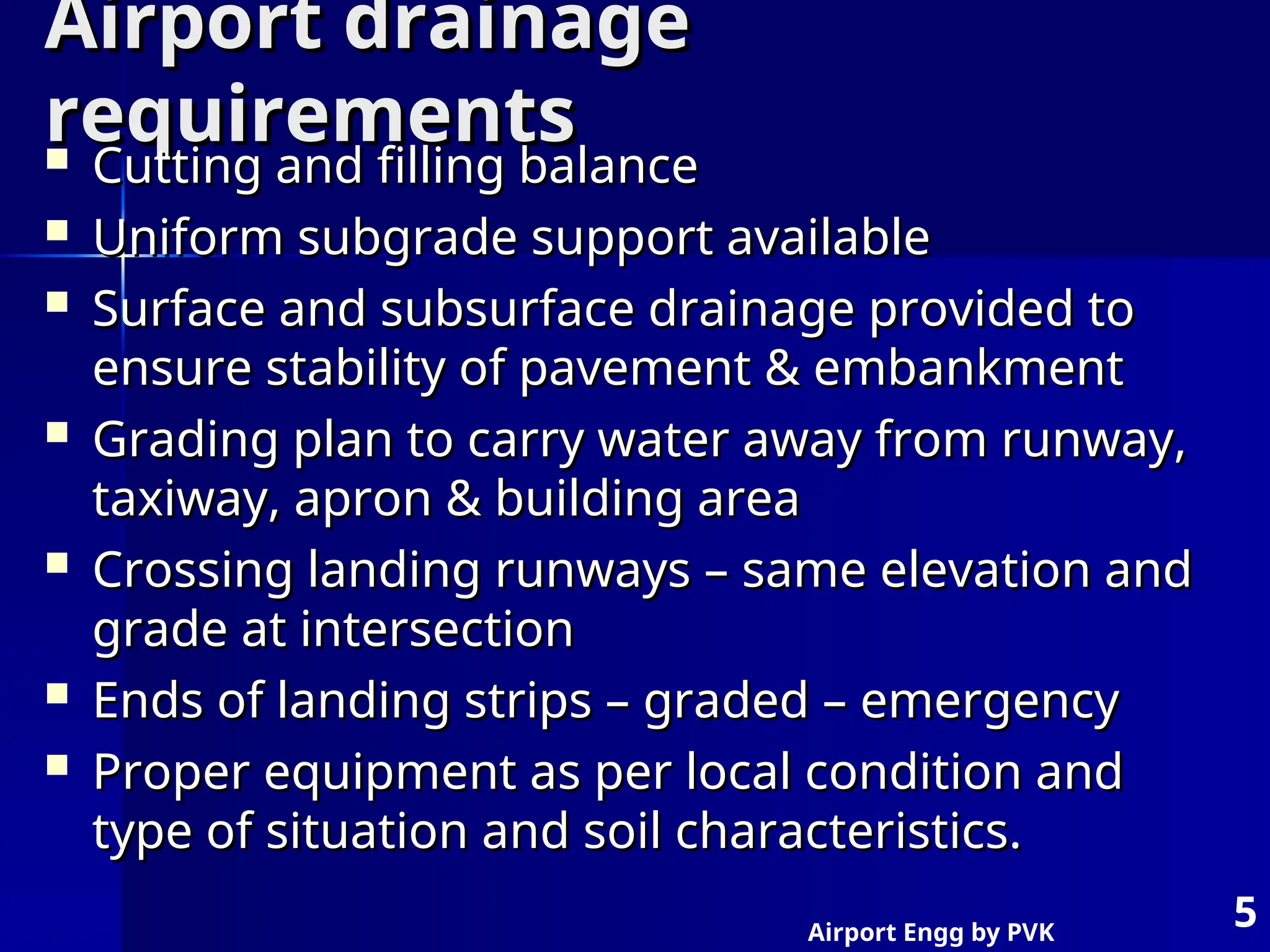
 Cutting and filling balance
Cutting and filling balance
 Uniform subgrade support available
Uniform subgrade support available
 Surface and subsurface drainage provided to
Surface and subsurface drainage provided to
ensure stability of pavement & embankment
 Grading plan to carry water away from runway,
Grading plan to carry water away from runway,
taxiway, apron & building area
 Crossing landing runways – same elevation and
Crossing landing runways – same elevation and
grade at intersection
 Ends of landing strips – graded – emergency
Ends of landing strips – graded – emergency
 Proper equipment as per local condition and
Proper equipment as per local condition and
type of situation and soil characteristics.
Airport Engg by PVK
6
Functions of Airport Drainage system
 Removal of surface run off the airfield
Removal of surface run off the airfield
 Interception of surface and ground water
Interception of surface and ground water
flow originating from land adjacent to airfield
 Diversion of surface and ground water flow
Diversion of surface and ground water flow
originating from land adjacent to airfield
 Lowering of subsurface water level in the
Lowering of subsurface water level in the
airfield areas.
airfield areas.
 Providing safety of aircraft
Providing safety of aircraft
 Providing long life of runway pavement
Providing long life of runway pavement
Airport Engg by PVK
7
Characteristics of Airport Drainage
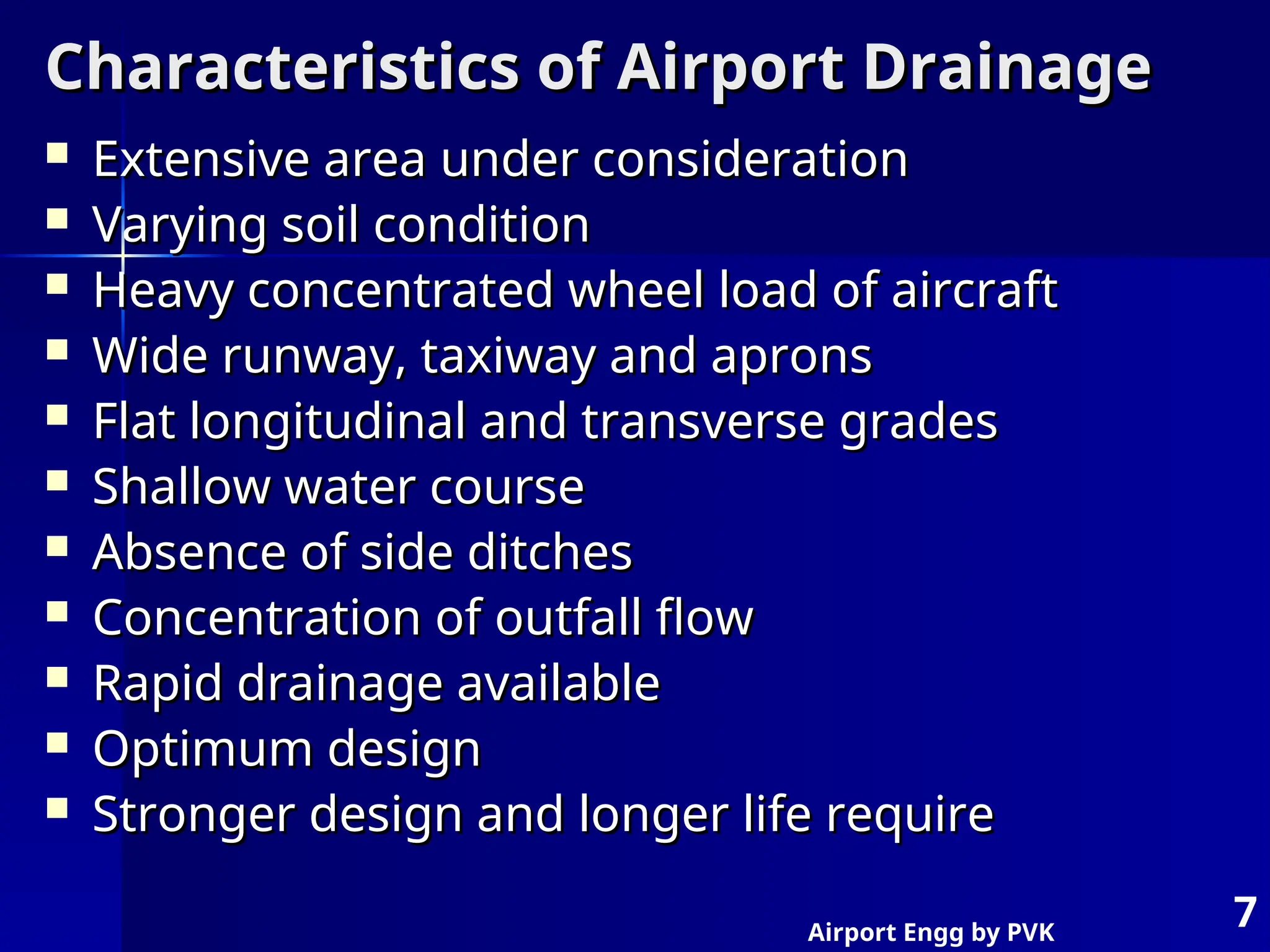
 Extensive area under consideration
Extensive area under consideration
 Varying soil condition
Varying soil condition
 Heavy concentrated wheel load of aircraft
Heavy concentrated wheel load of aircraft
 Wide runway, taxiway and aprons
Wide runway, taxiway and aprons
 Flat longitudinal and transverse grades
Flat longitudinal and transverse grades
 Shallow water course
Shallow water course
 Absence of side ditches
Absence of side ditches
 Concentration of outfall flow
Concentration of outfall flow
 Rapid drainage available
Rapid drainage available
 Optimum design
Optimum design
 Stronger design and longer life require
Stronger design and longer life require
Airport Engg by PVK
8
Drainage design
Drainage design
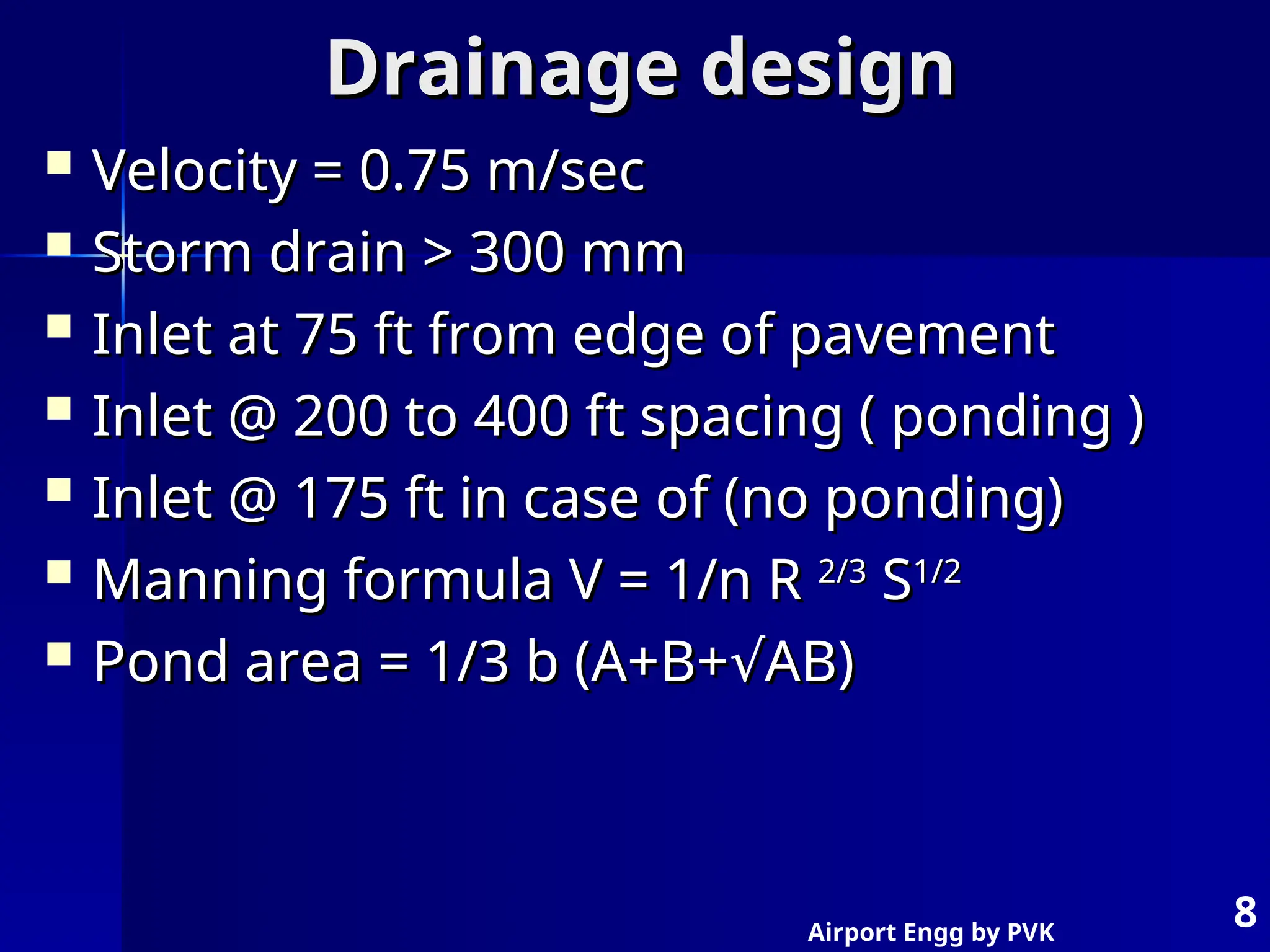
 Velocity = 0.75 m/sec
Velocity = 0.75 m/sec
 Storm drain > 300 mm
Storm drain > 300 mm
 Inlet at 75 ft from edge of pavement
Inlet at 75 ft from edge of pavement
 Inlet @ 200 to 400 ft spacing ( ponding )
Inlet @ 200 to 400 ft spacing ( ponding )
 Inlet @ 175 ft in case of (no ponding)
Inlet @ 175 ft in case of (no ponding)
 Manning formula V = 1/n R
Manning formula V = 1/n R 2/3
2/3
S
S1/2
1/2
 Pond area = 1/3 b (A+B+ AB)
√
Pond area = 1/3 b (A+B+ AB)
√
Airport Engg by PVK
9
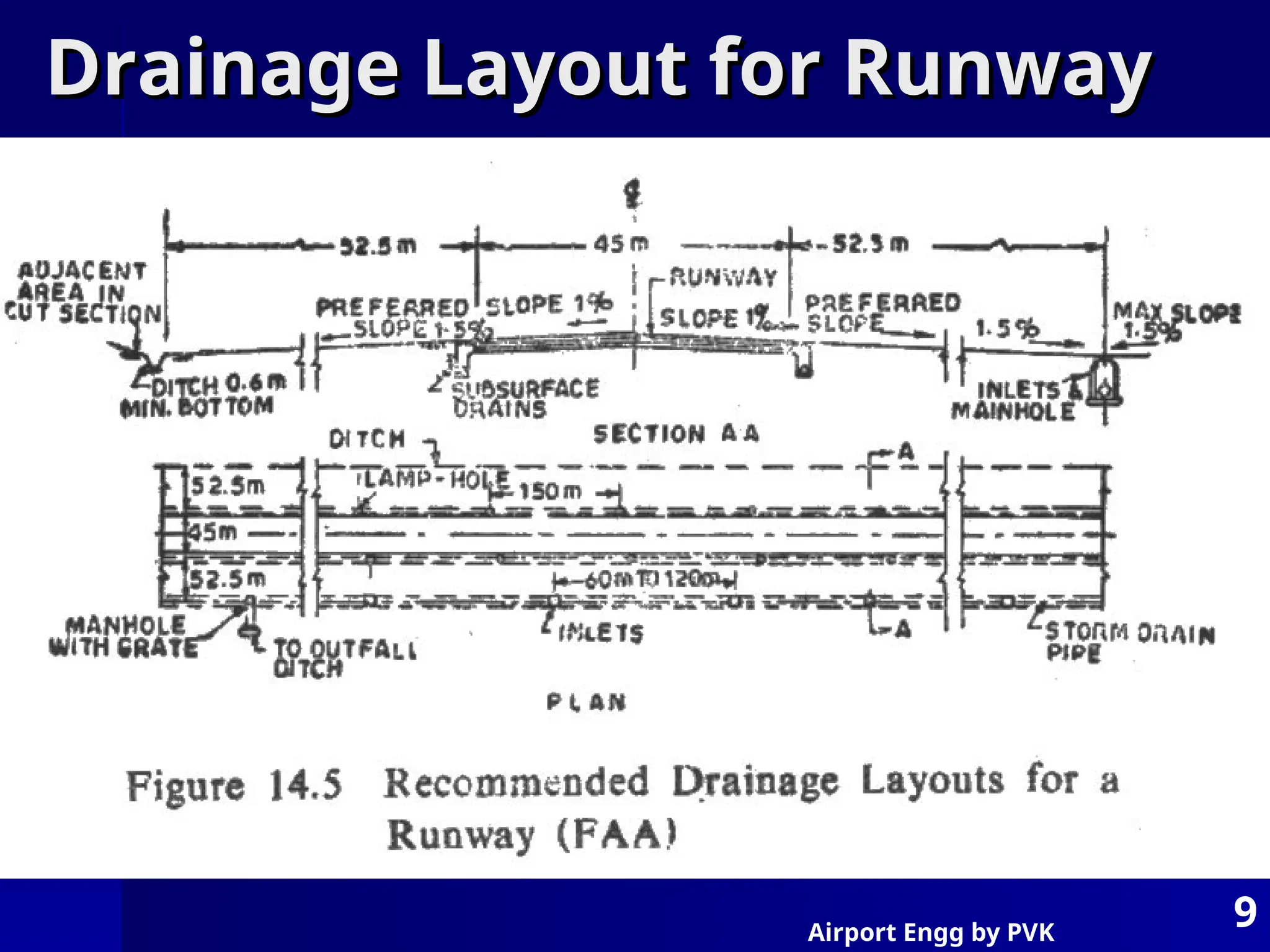
Drainage Layout for Runway
Airport Engg by PVK
10
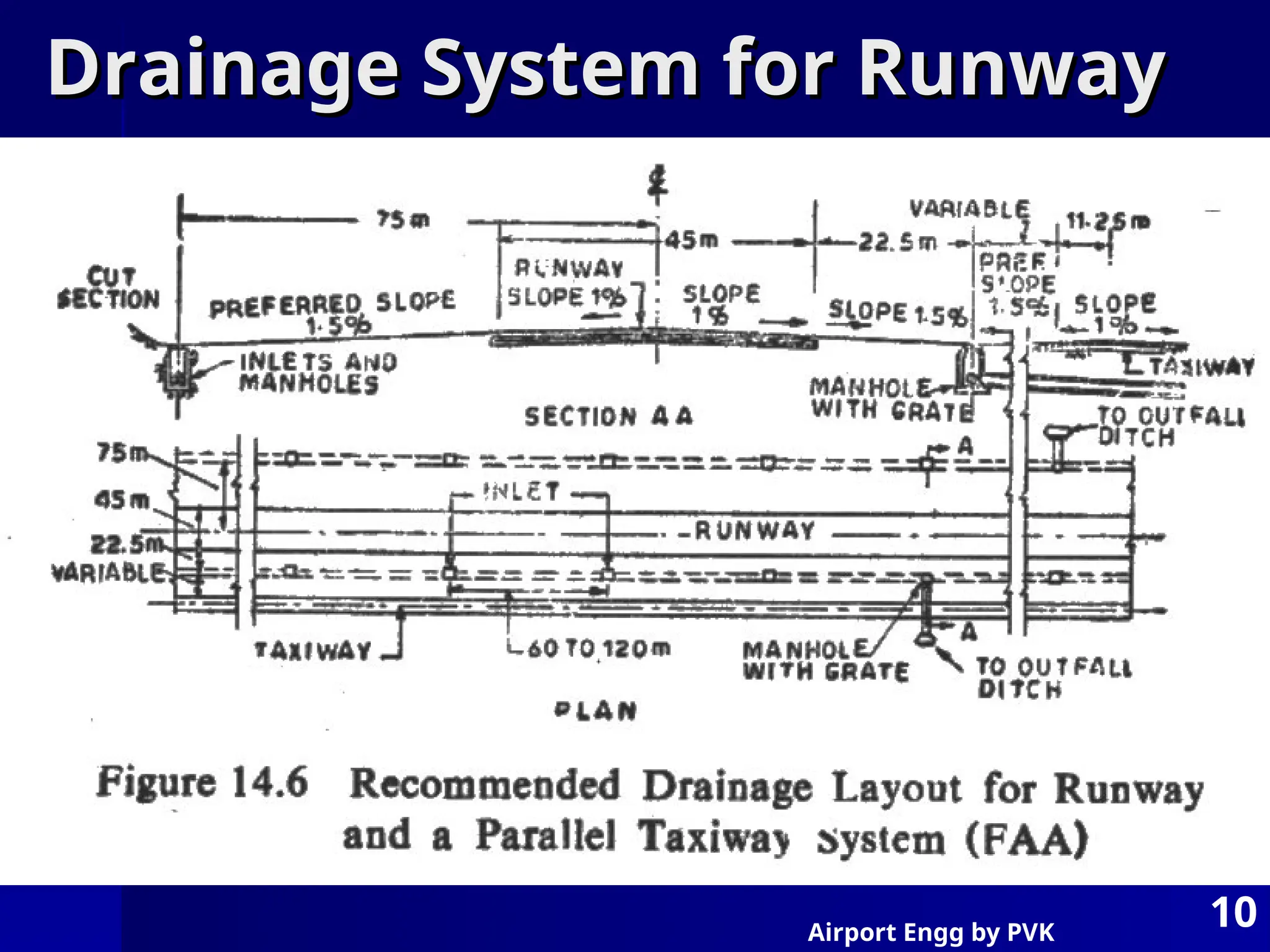
Drainage System for Runway
Airport Engg by PVK
11
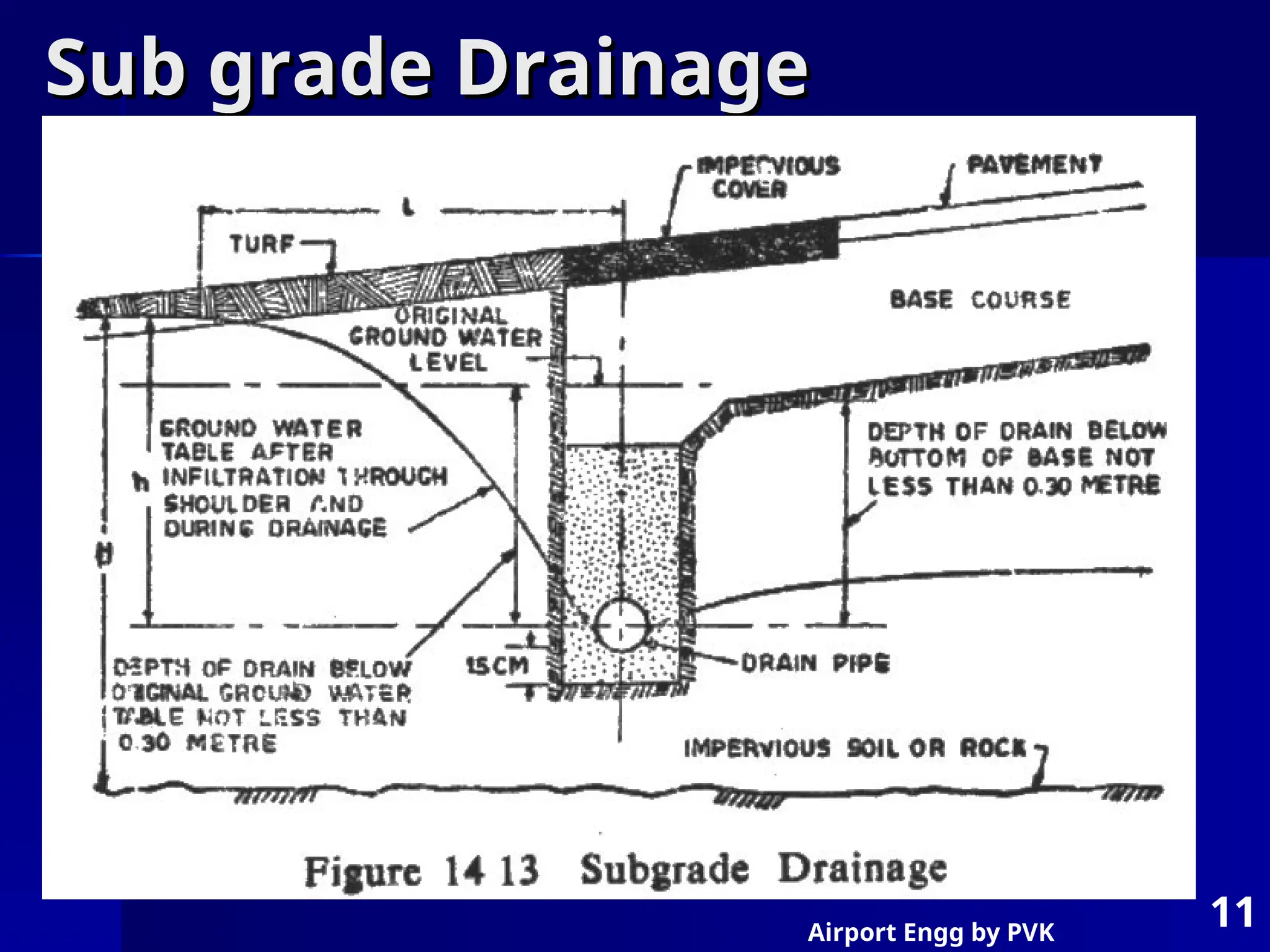
Sub grade Drainage
Sub grade Drainage
Airport Engg by PVK
12
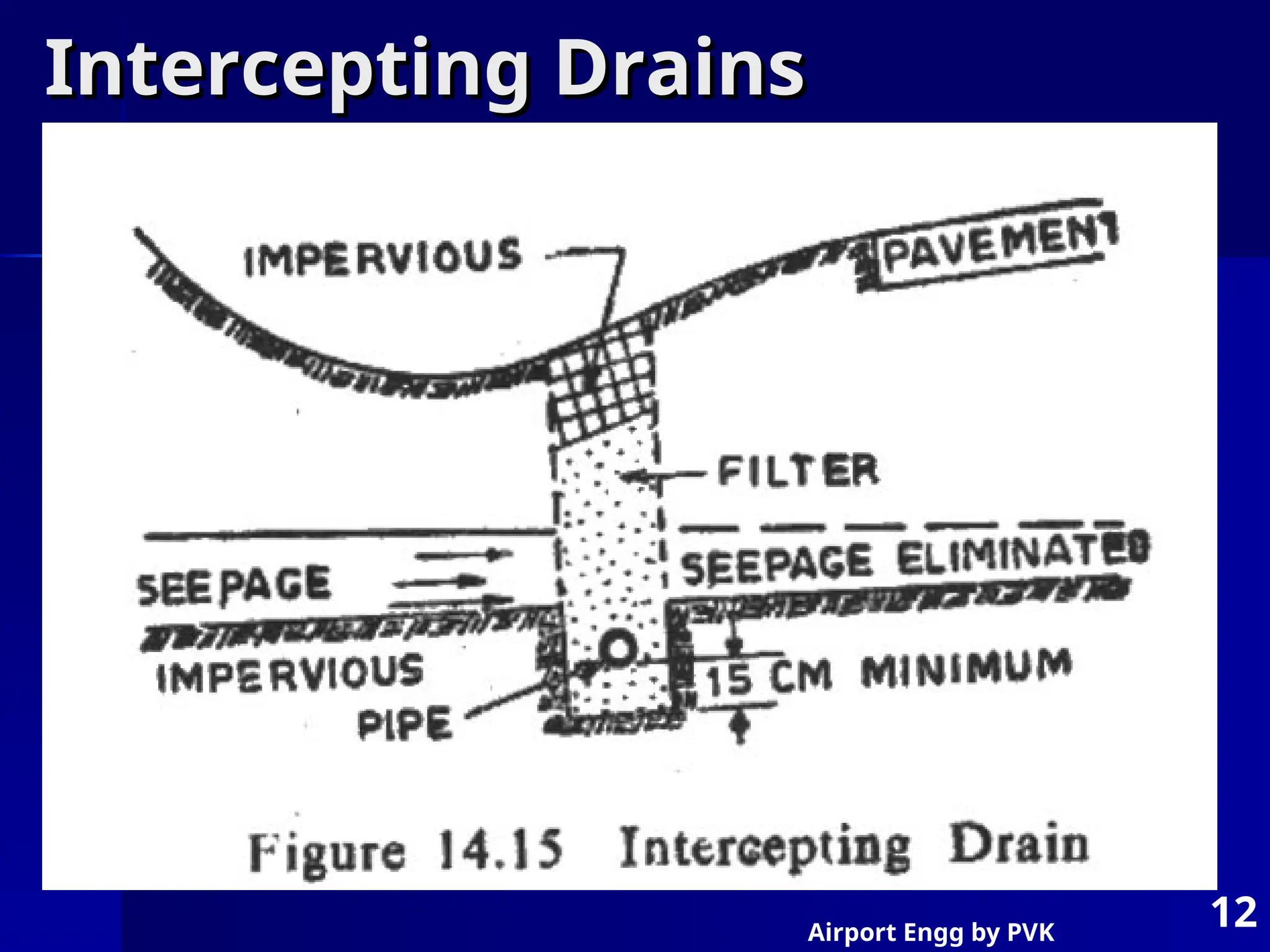
Intercepting Drains
Intercepting Drains
Airport Engg by PVK
13
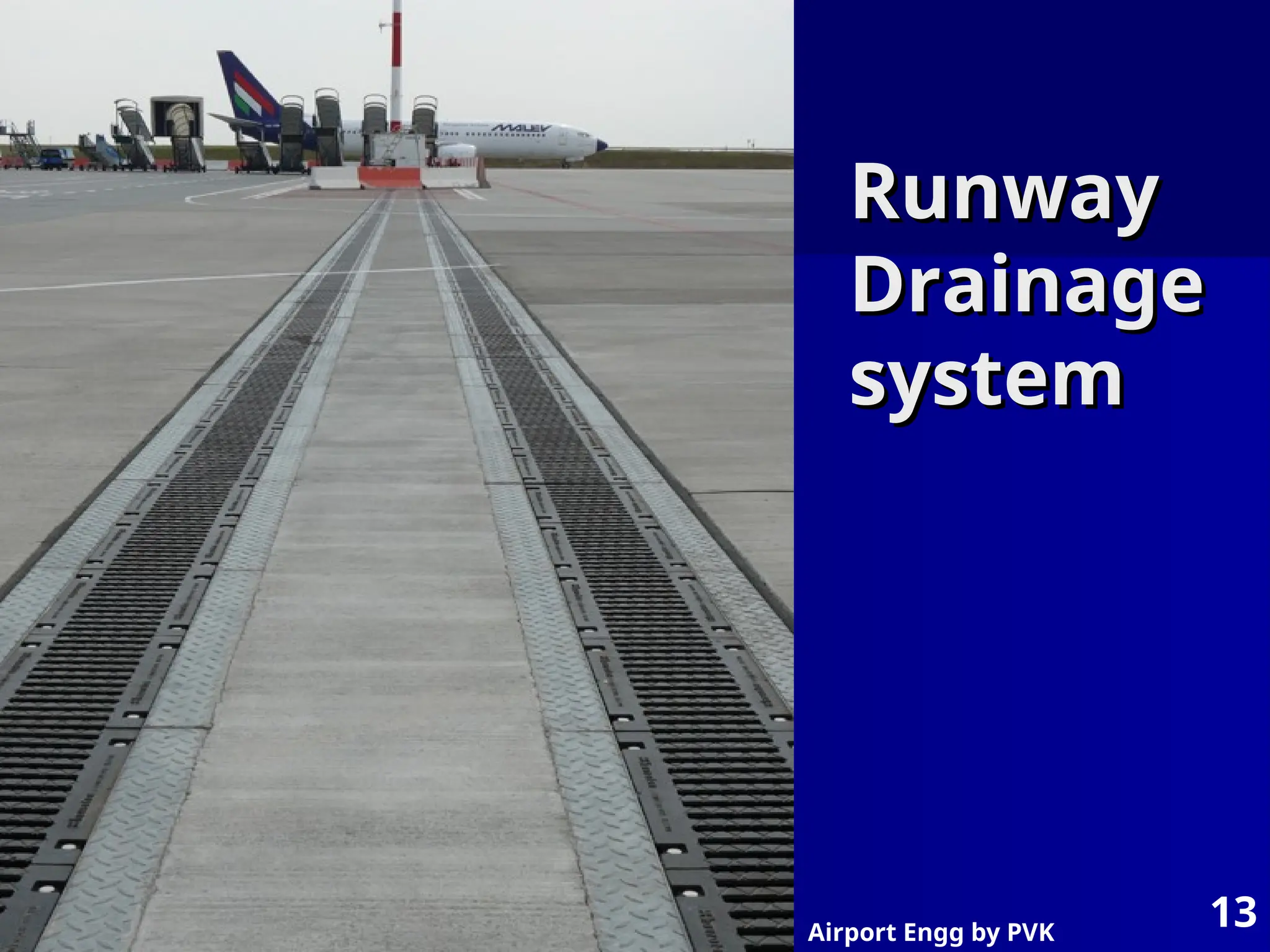
Runway
Runway
Drainage
Drainage
system
system
Airport Engg by PVK
14
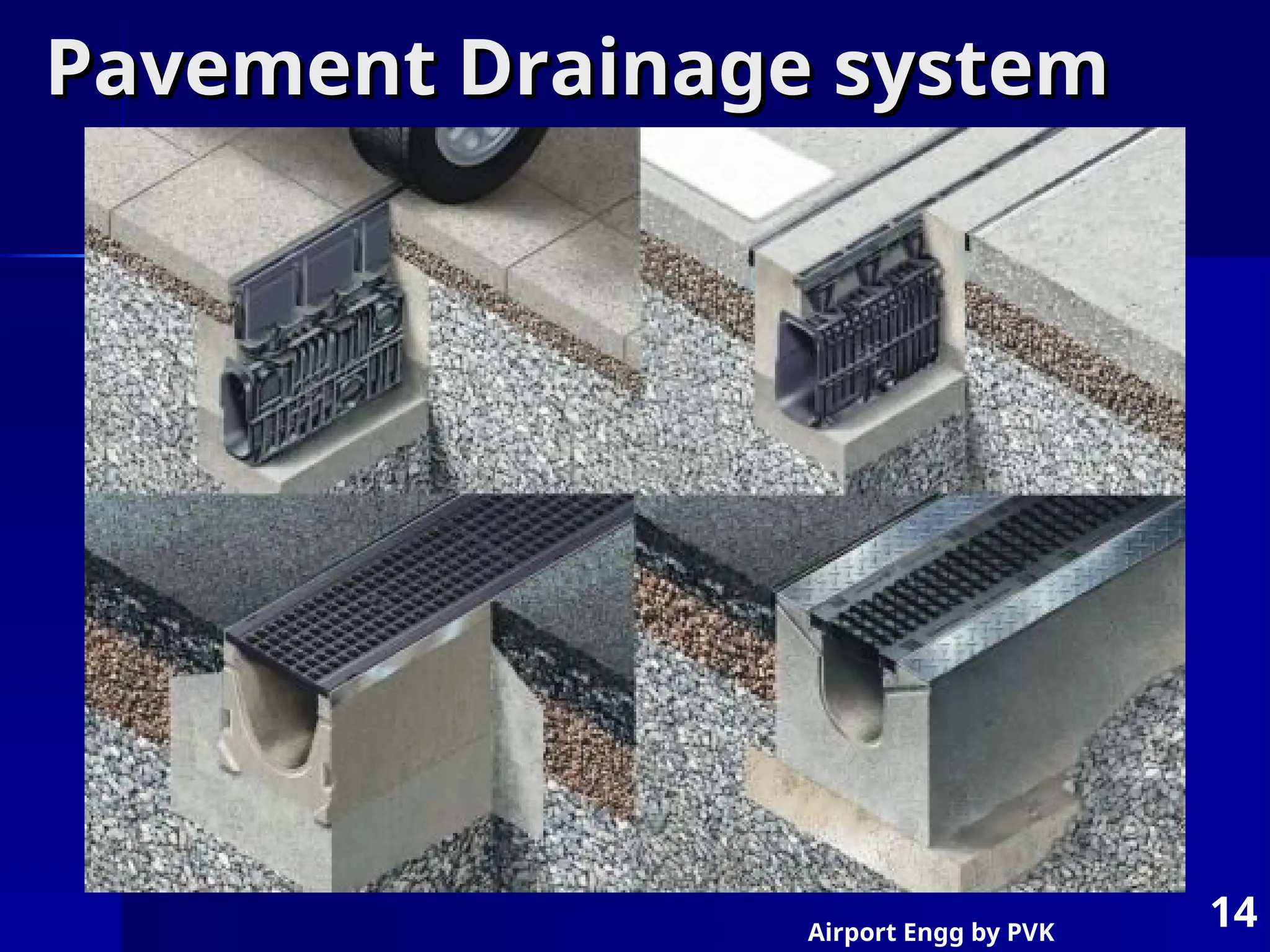
Pavement Drainage system
Airport Engg by PVK
15
Component parts of Aircraft
 Engine –
Engine –
– Piston engine – low altitude, moderate speed
Piston engine – low altitude, moderate speed
– Turbo jet engine – baloone, take-compress-burn-expand-exhaust
Turbo jet engine – baloone, take-compress-burn-expand-exhaust
– Turbo Propulsion engine – mix
Turbo Propulsion engine – mix
– Ram jet – divergent convergent tube inside
Ram jet – divergent convergent tube inside
– Rocket engine – own oxygen supply
Rocket engine – own oxygen supply
 Propeller – two blades – forces air inside at high speed
Propeller – two blades – forces air inside at high speed
 Fuselage – body containing power plant, fuel, cockpit, pasengers,
Fuselage – body containing power plant, fuel, cockpit, pasengers,
cargo etc. – aerogenic shape
 Wings – Aeilron, leading edge, trailing edge, flight path, angle of
Wings – Aeilron, leading edge, trailing edge, flight path, angle of
incidence, camber, Aerofoil.
 Three controls
Three controls
– Elevator – up / down / 50
Elevator – up / down / 500
0
/ 60
/ 600
0
/ at tail plane
/ at tail plane
– Rudder – right / left / 30
Rudder – right / left / 300
0
/
/
– Aileron – Tilting 45
Aileron – Tilting 450
0
/
/
 Flaps – under wings – like aileron
Flaps – under wings – like aileron
 Trycycle undercarriage – to absorb landing shocks, to enable
Trycycle undercarriage – to absorb landing shocks, to enable
movement on ground,
movement on ground,
Airport Engg by PVK
16
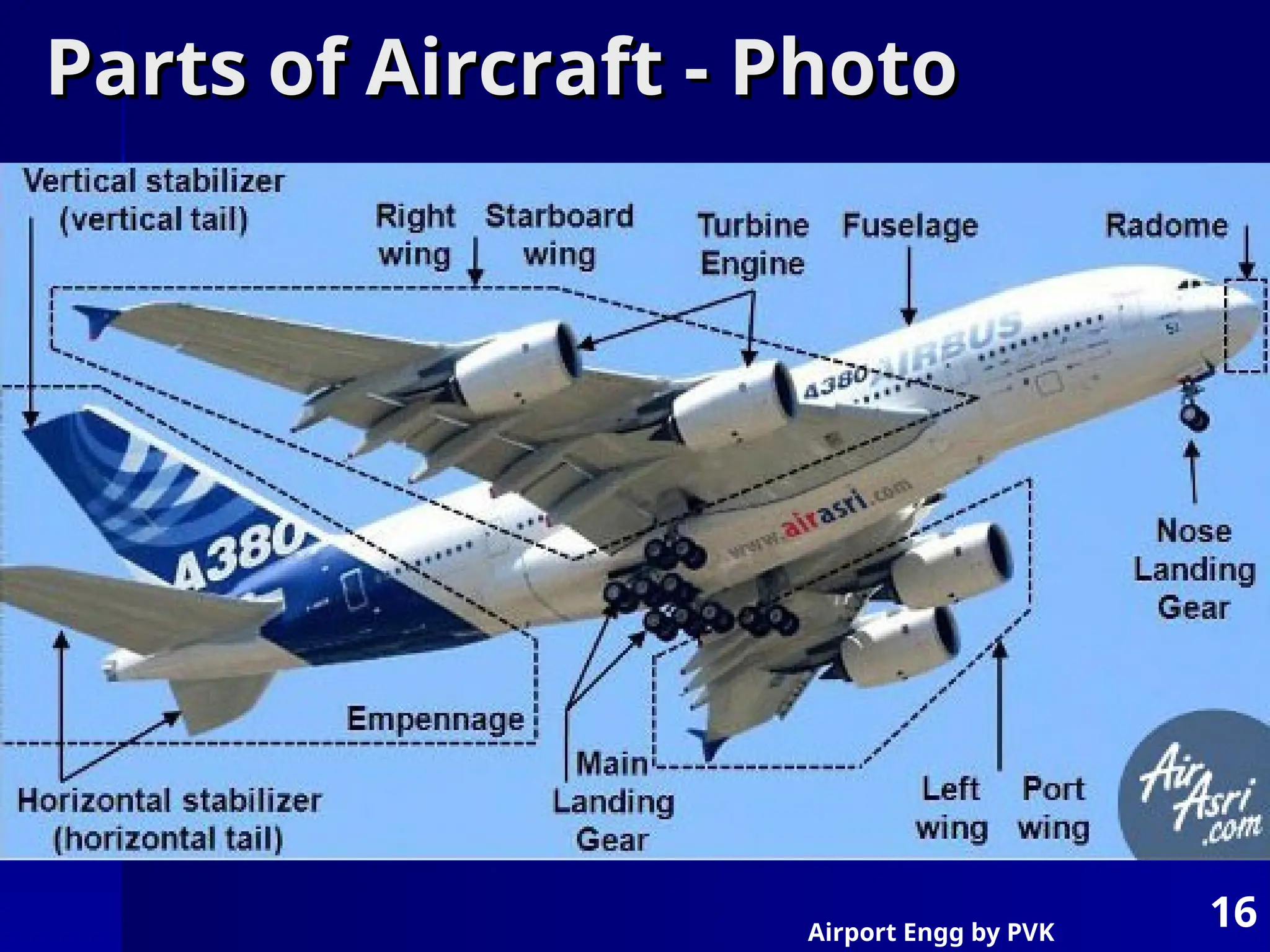
Parts of Aircraft - Photo
Airport Engg by PVK
17
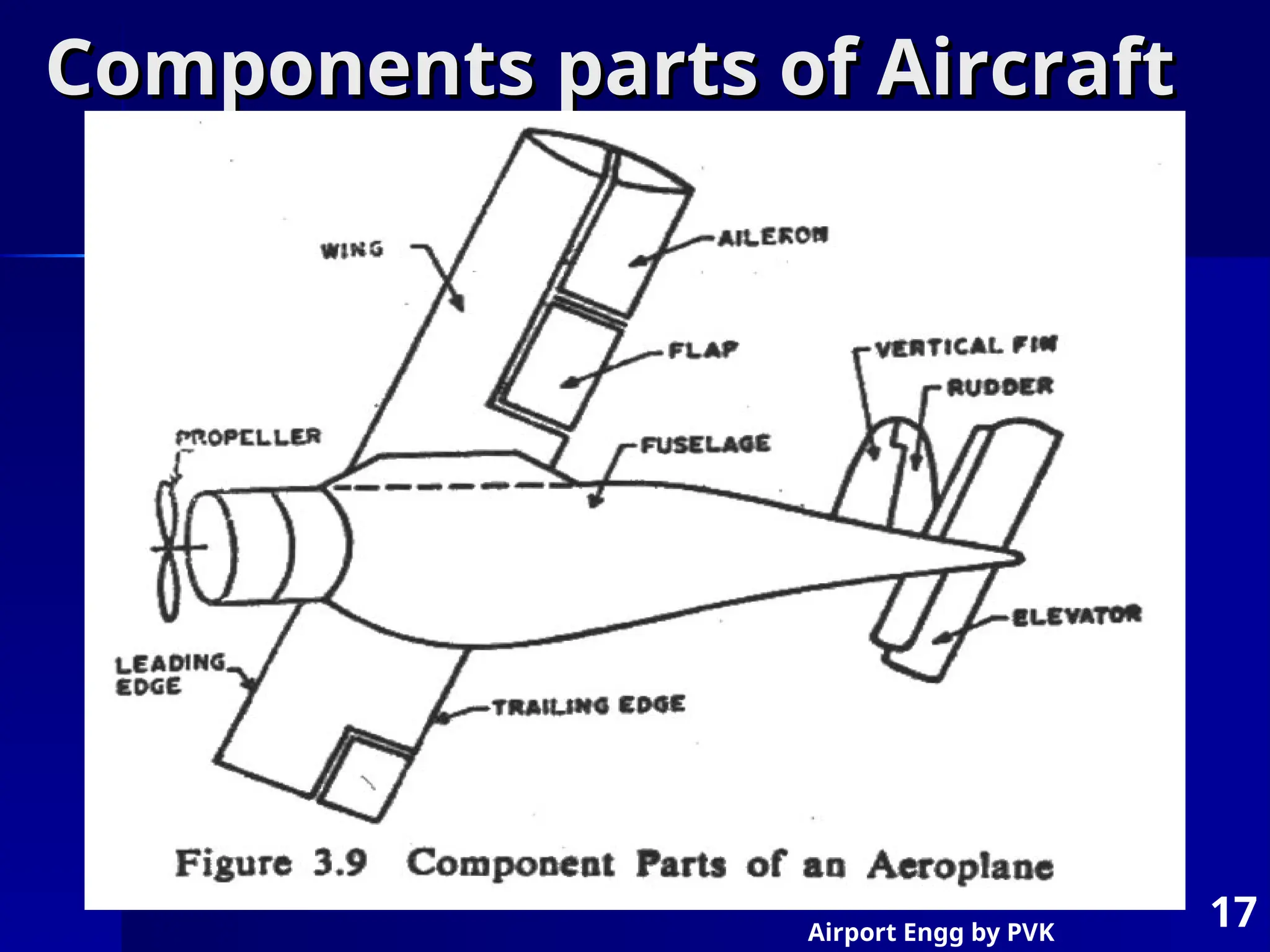
Components parts of Aircraft
Airport Engg by PVK
18
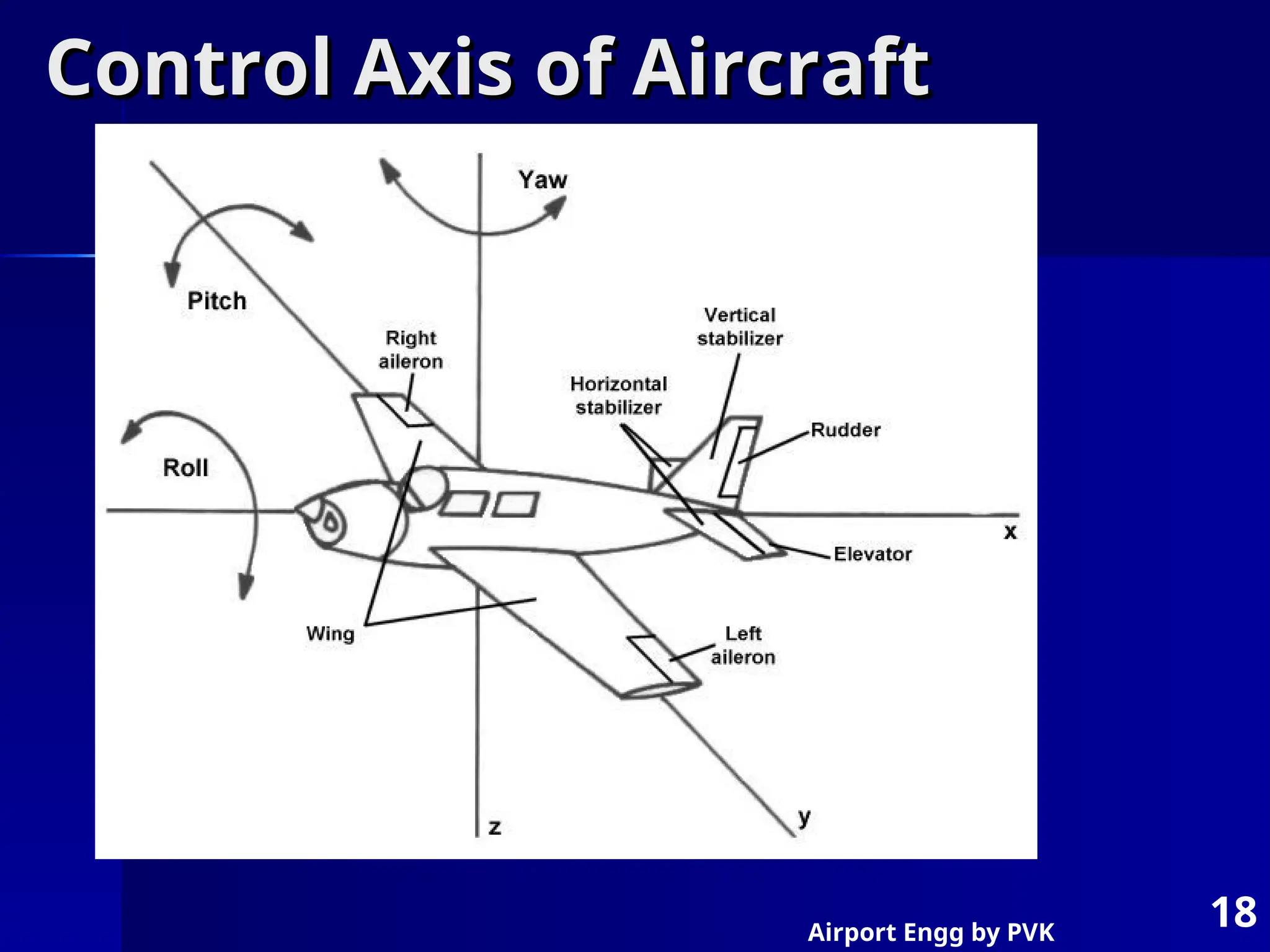
Control Axis of Aircraft
Airport Engg by PVK
19
Aircraft Parts and functions
Airport Engg by PVK
20
Aircraft Component Parts - Plan
Airport Engg by PVK
21
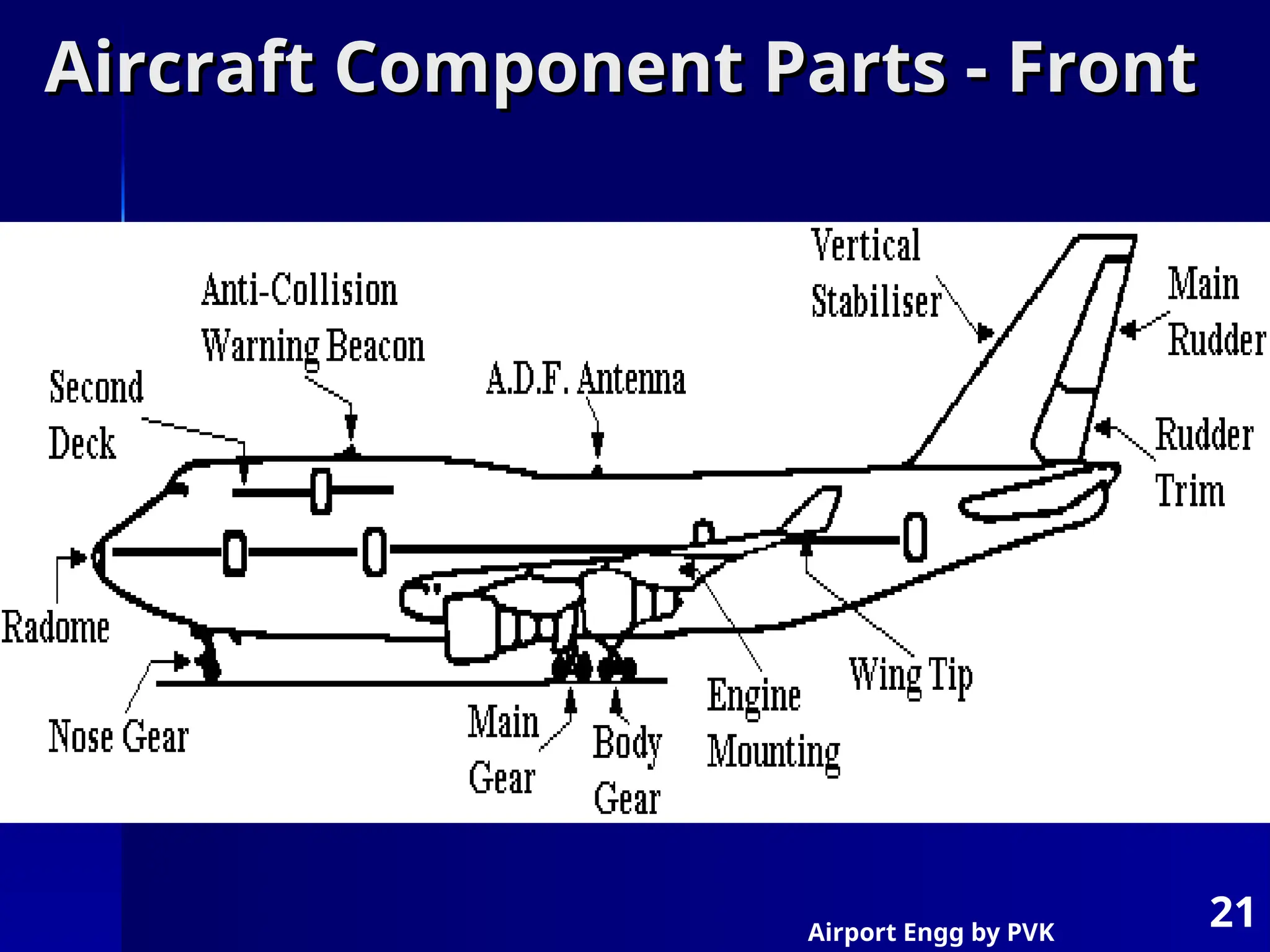
Aircraft Component Parts - Front
Airport Engg by PVK
22
Aircraft Characteristics
 Type of propulsion
Type of propulsion
 Size of aircraft
Size of aircraft
 Min turning radius
Min turning radius
 Min circling radius
Min circling radius
 Speed of aircraft
Speed of aircraft
 Capacity of aircraft
Capacity of aircraft
 Aircraft weight and wheel configuration
Aircraft weight and wheel configuration
 Jet blast
Jet blast
 Fuel spillage
Fuel spillage
 Noise
Noise
Airport Engg by PVK
23
Airport Obstructions
 Zoning Laws -
Zoning Laws -
 Classification of Obstructions
Classification of Obstructions
– a) objects protruding above imaginary surface
a) objects protruding above imaginary surface
– b) object exceeding limiting heights in approach zone
b) object exceeding limiting heights in approach zone
and turning zones
and turning zones
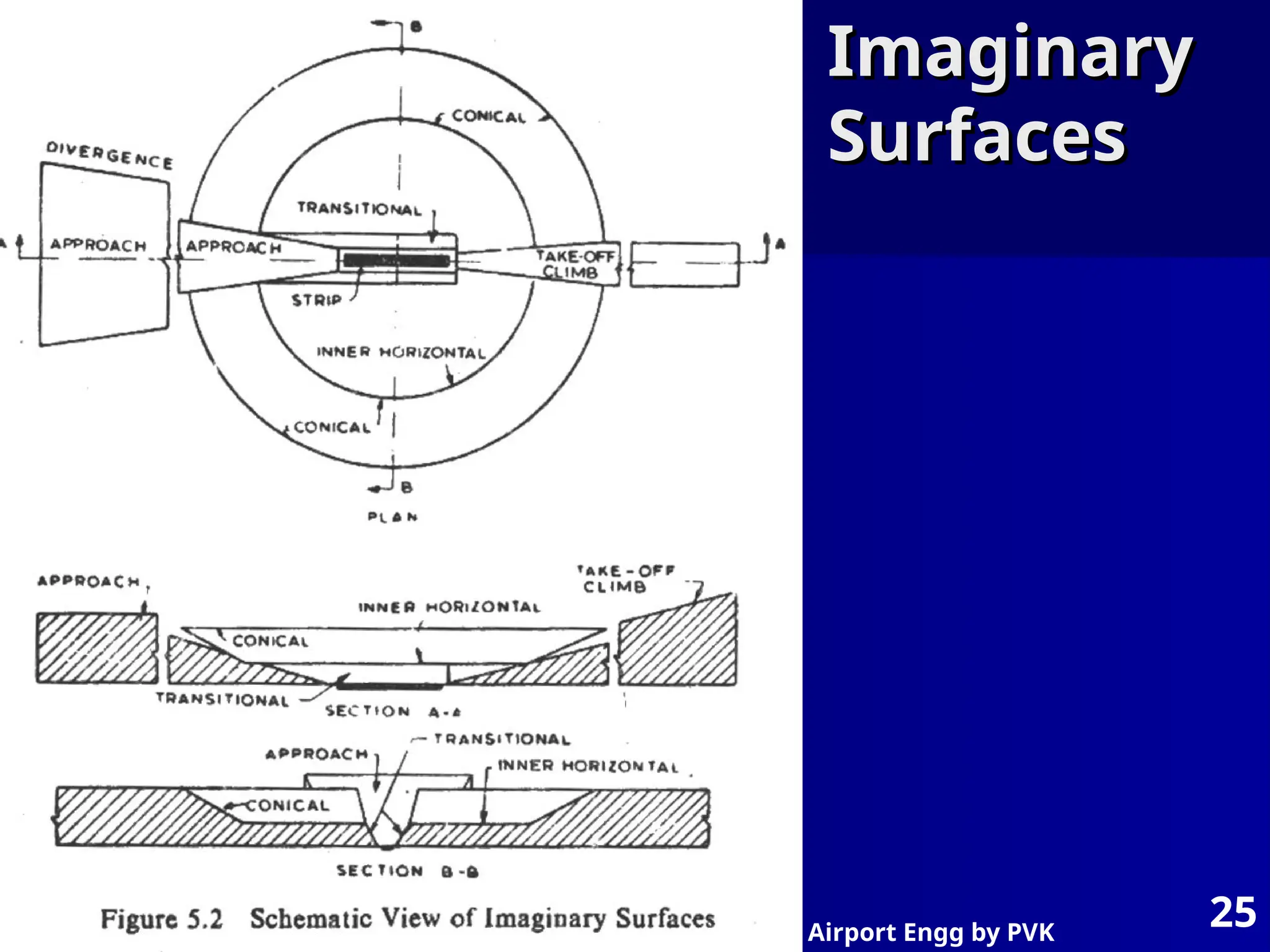
 Imaginary surfaces
Imaginary surfaces
– Take-off climb surface
Take-off climb surface
– Approach surface
Approach surface
– Inner horizontal surface
Inner horizontal surface
– Conical surface
Conical surface
– Transitional surface
Transitional surface
– Outer horizontal surface
Outer horizontal surface
Airport Engg by PVK
24
Imaginary Surfaces (Runway)
Airport Engg by PVK
25
Imaginary
Imaginary
Surfaces
Surfaces
Airport Engg by PVK
26
Clear zone
Clear zone
 Innermost portion of approach zone,
Innermost portion of approach zone,
 Critical portion from obstruction view point
Critical portion from obstruction view point
 Clearance over Highway and Railway
Clearance over Highway and Railway
 Limiting height
Limiting height
– 30m up to 4.5 KM
30m up to 4.5 KM
– 30+7.5 m for 4.5+1.5 Km
30+7.5 m for 4.5+1.5 Km
– 75m up to 15 Km
75m up to 15 Km
– 150 m in approach zone
150 m in approach zone
 Turning zone -
Turning zone -
– Mort than 51 m upto 4.5 Km from runway reference
Mort than 51 m upto 4.5 Km from runway reference
point
point
– More than 51 + 30 m for every 1.5 Km
More than 51 + 30 m for every 1.5 Km
– 150 m upto 15 Km
150 m upto 15 Km
Airport Engg by PVK
27
Runway Clear Zone
Runway Clear Zone
Airport Engg by PVK
28
Clearance Over Highway & Railway
Airport Engg by PVK
29
Approach Zone Profile for Runway
Airport Engg by PVK
30
Runway Orientation
Runway Orientation
 Direction of prevailing winds
Direction of prevailing winds
 Head wind – supports takeoff
Head wind – supports takeoff
 Breaking effect – supports landing
Breaking effect – supports landing
 Shorter runway length require
Shorter runway length require
 Along wind direction – require more length
Along wind direction – require more length
 Cross wind component – V sin
Cross wind component – V sin

 Small air crafts – 15 kmph
Small air crafts – 15 kmph
 Mixed air crafts – 25 kmph
Mixed air crafts – 25 kmph
 Big aircraft – 33 kmph
Big aircraft – 33 kmph
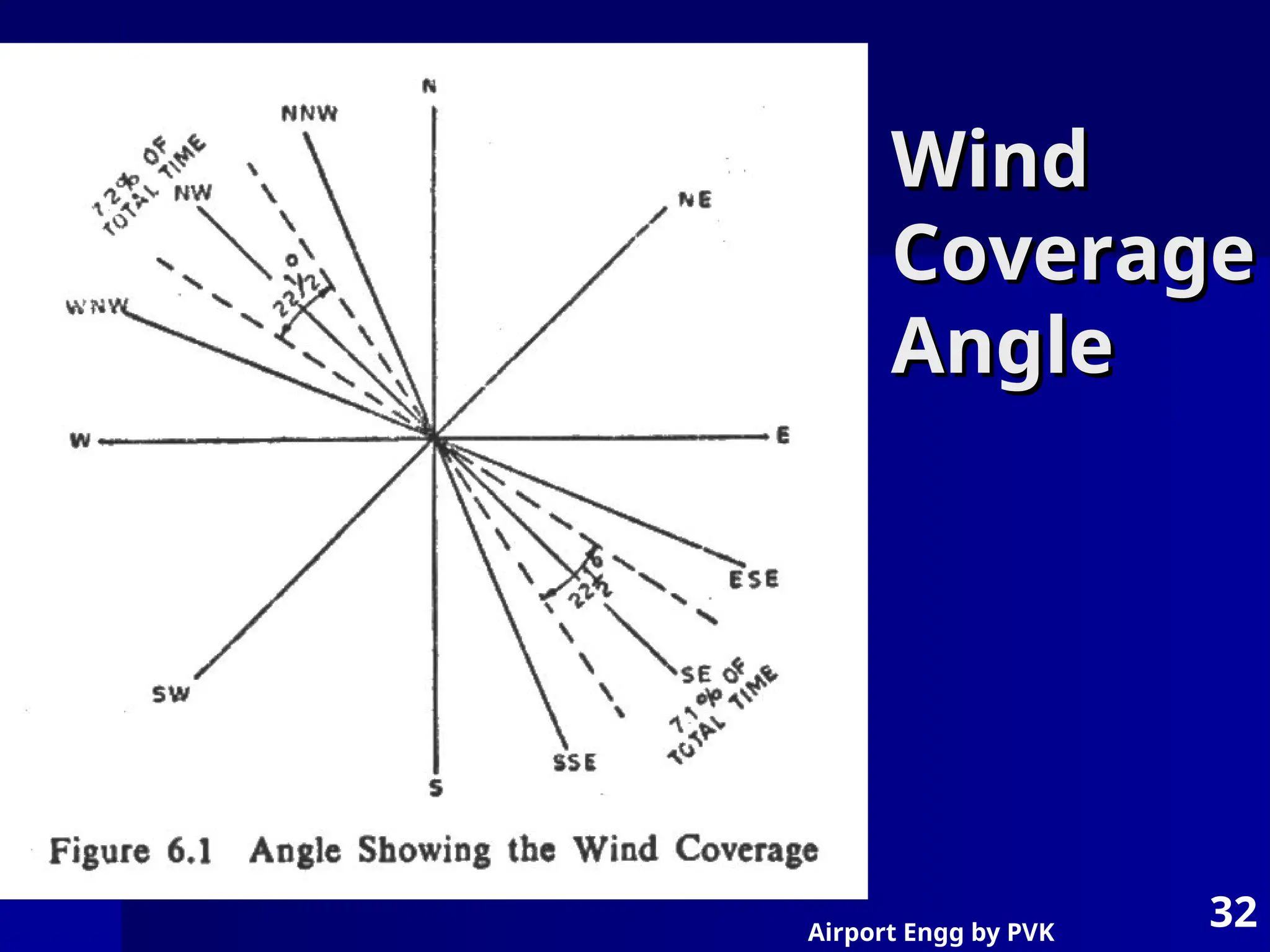
 Wind coverage = % of time in year cws is within
Wind coverage = % of time in year cws is within
limit 95 % - 25 kmph.
Airport Engg by PVK
31
Wind rose Diagram
Wind rose Diagram
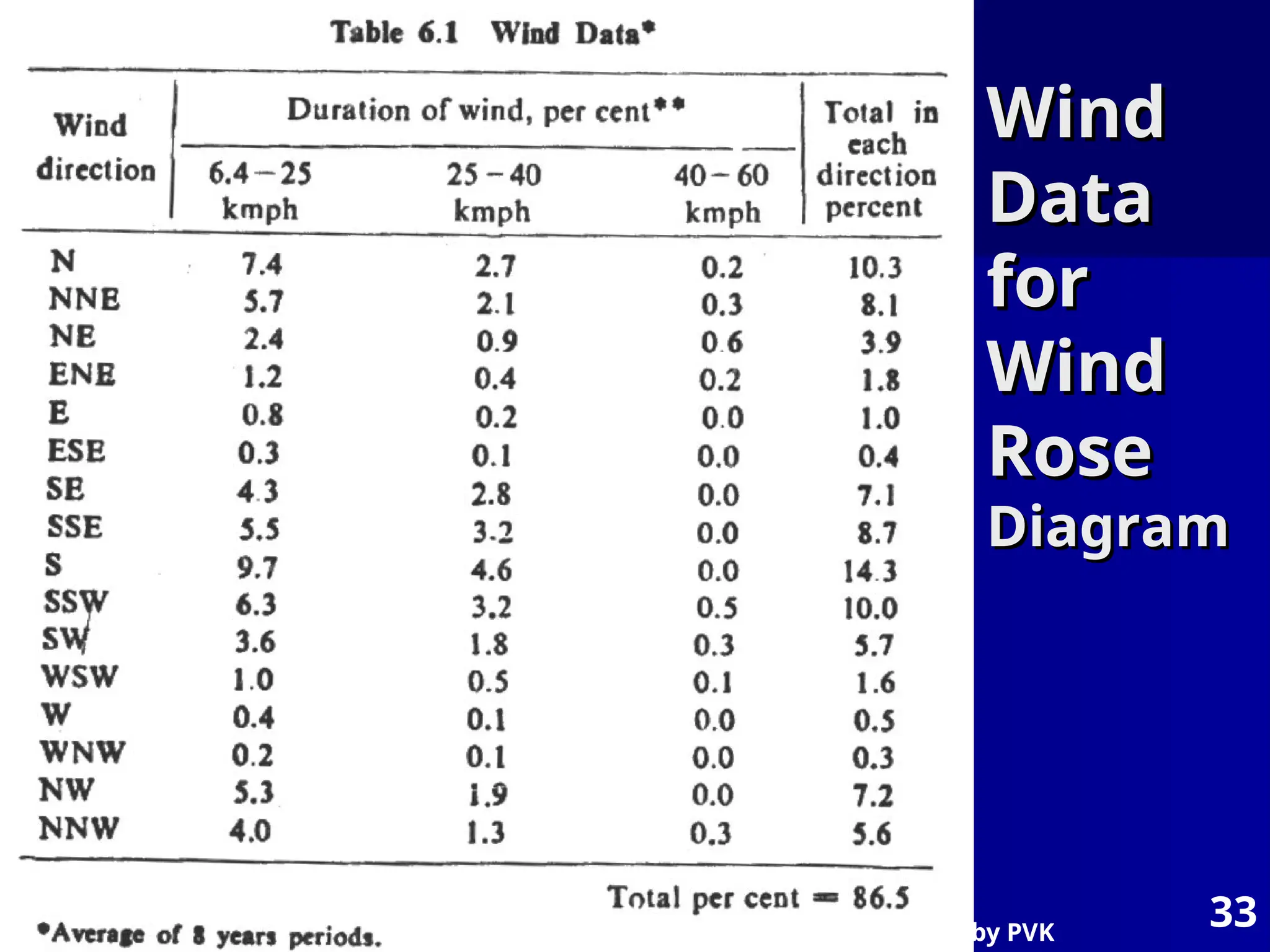
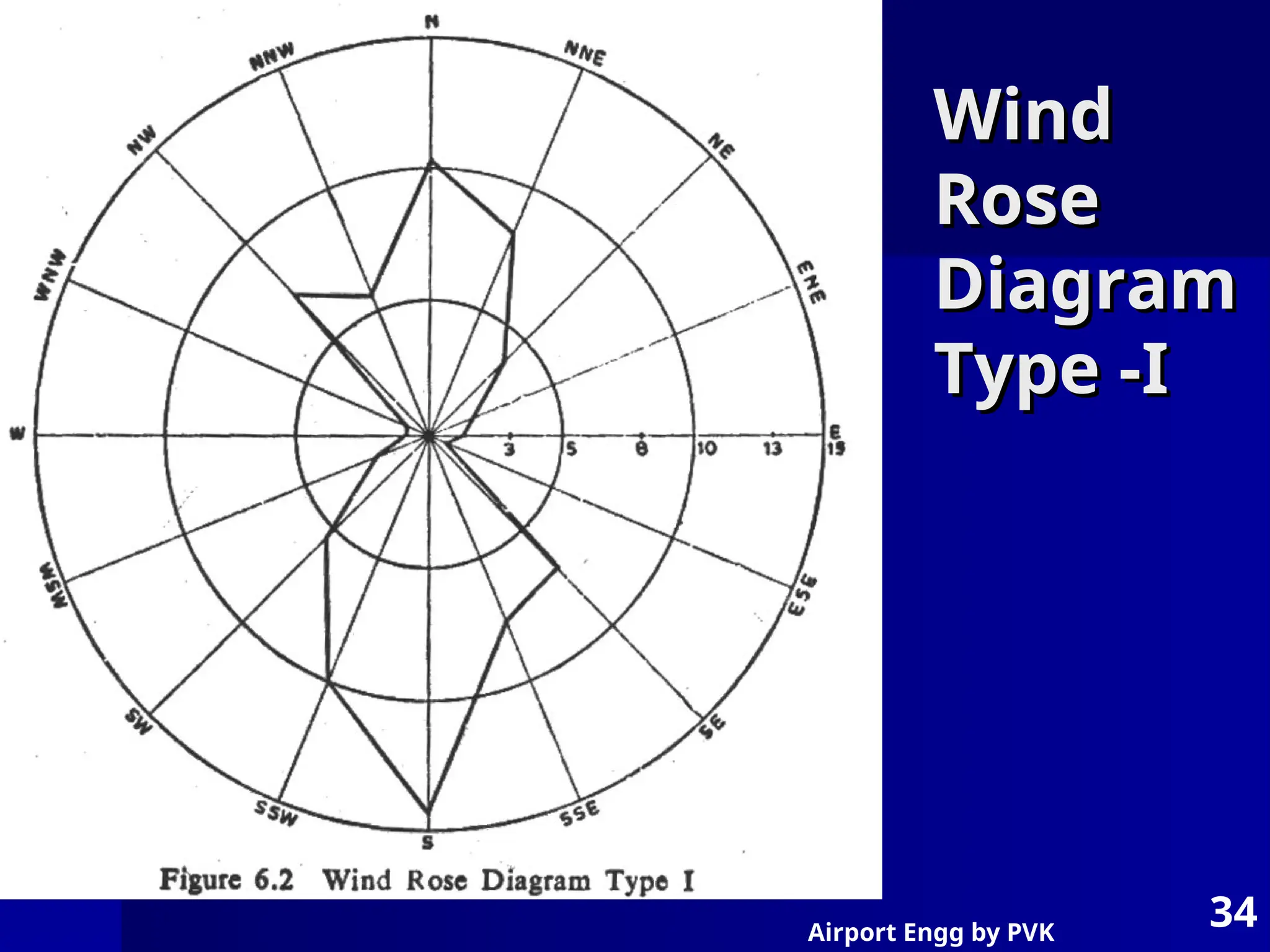
 The wind data – direction, duration & intensity
The wind data – direction, duration & intensity
are graphically represented by wind rose
diagram.
diagram.
 5 to 10 years
5 to 10 years
 Analyzing wind data for orientation of runway
Analyzing wind data for orientation of runway
 Direction, duration in %, total % in each
Direction, duration in %, total % in each
direction
direction
 Type – 1, type -2
Type – 1, type -2
 Wind coverage 2.5
Wind coverage 2.50
0
2
2
 Obstructions, excessive grading, Noise nuisance
Obstructions, excessive grading, Noise nuisance
Airport Engg by PVK
32
Wind
Wind
Coverage
Coverage
Angle
Angle
Airport Engg by PVK
33
Wind
Wind
Data
Data
for
for
Wind
Wind
Rose
Rose
Diagram
Diagram
Airport Engg by PVK
34
Wind
Wind
Rose
Rose
Diagram
Diagram
Type -I
Type -I
Airport Engg by PVK
35
Wind Rose
Wind Rose
Diagram
Diagram
Type-II
Type-II
Airport Engg by PVK
36
Basic runway length
Basic runway length
Assumptions
Assumptions
 i) airport altitude is at sea level
i) airport altitude is at sea level
 Temp at airport is standard 15 0
Temp at airport is standard 15 0
 Runway is leveled in longitudional direction
Runway is leveled in longitudional direction
 No wind is blowing on runway
No wind is blowing on runway
 Aircraft is loaded to its full loading capacity
Aircraft is loaded to its full loading capacity
 There is no wind blowing enroute to
There is no wind blowing enroute to
destination city
destination city
 Enroute temperature is standard
Enroute temperature is standard
Airport Engg by PVK
37
Basic Runway length
Basic Runway length
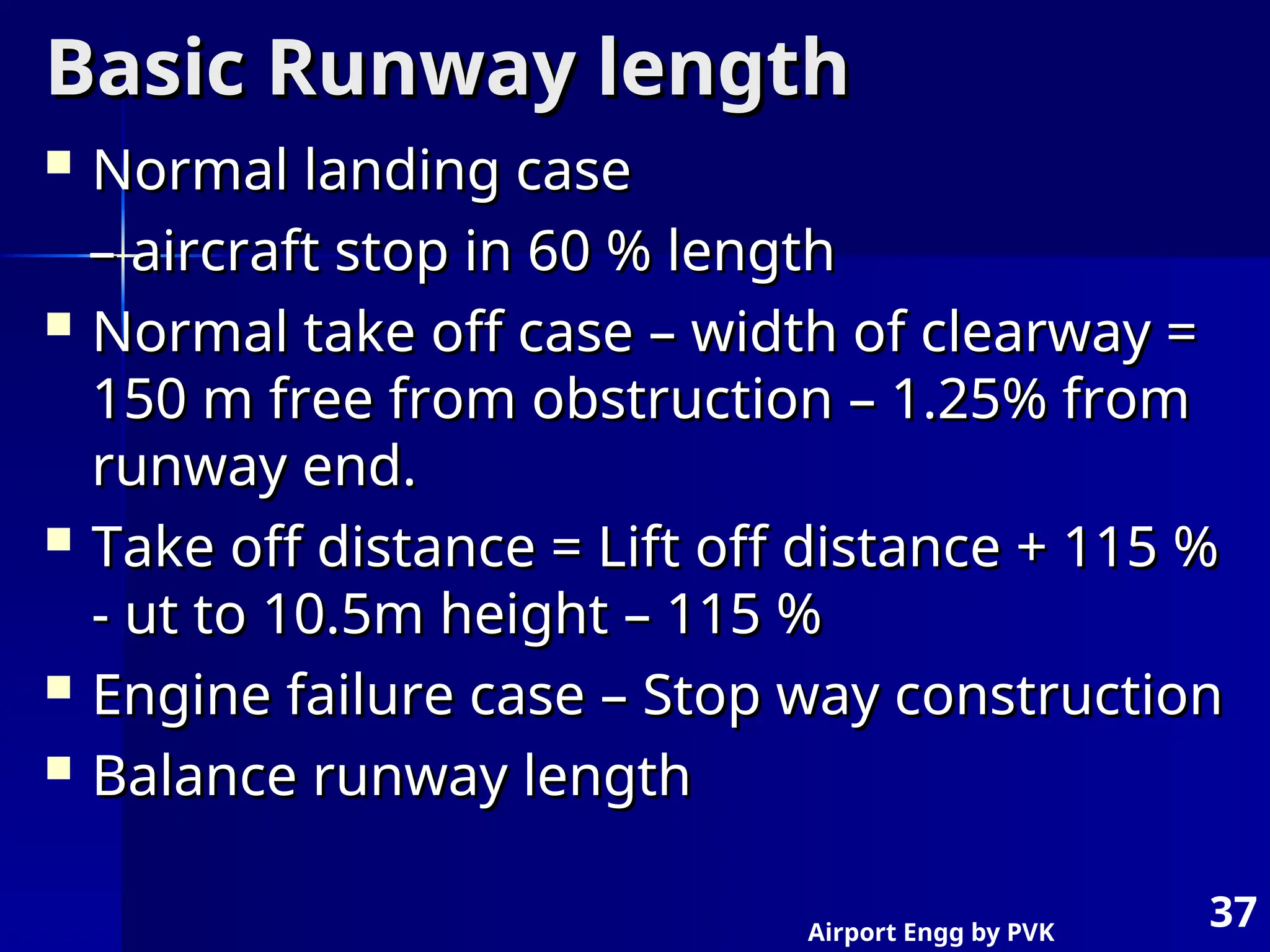
 Normal landing case
Normal landing case
–
– aircraft stop in 60 % length
aircraft stop in 60 % length
 Normal take off case – width of clearway =
Normal take off case – width of clearway =
150 m free from obstruction – 1.25% from
runway end.
runway end.
 Take off distance = Lift off distance + 115 %
Take off distance = Lift off distance + 115 %
- ut to 10.5m height – 115 %
 Engine failure case – Stop way construction
Engine failure case – Stop way construction
 Balance runway length
Balance runway length
Airport Engg by PVK
38
Correction for Elevation, Temperature
and gradient
and gradient
 Elevation correction = + 7 % per 300 m rise
Elevation correction = + 7 % per 300 m rise
above MSL
above MSL
 Temperature correction = Ta + (Tm – Ta)/3
Temperature correction = Ta + (Tm – Ta)/3
 Tm – monthly max average daily temp.
Tm – monthly max average daily temp.
 Ta – monthly mean average daily temp.
Ta – monthly mean average daily temp.
 Total elevation and Temperature correction
Total elevation and Temperature correction
should not exceed 35 %
 Correction for Gradient for 1 % of effective
Correction for Gradient for 1 % of effective
gradient correction in runway length = 20 %
 Effective gradient = max – min / basic length
Effective gradient = max – min / basic length
Airport Engg by PVK
39
Airport Engg by PVK
40
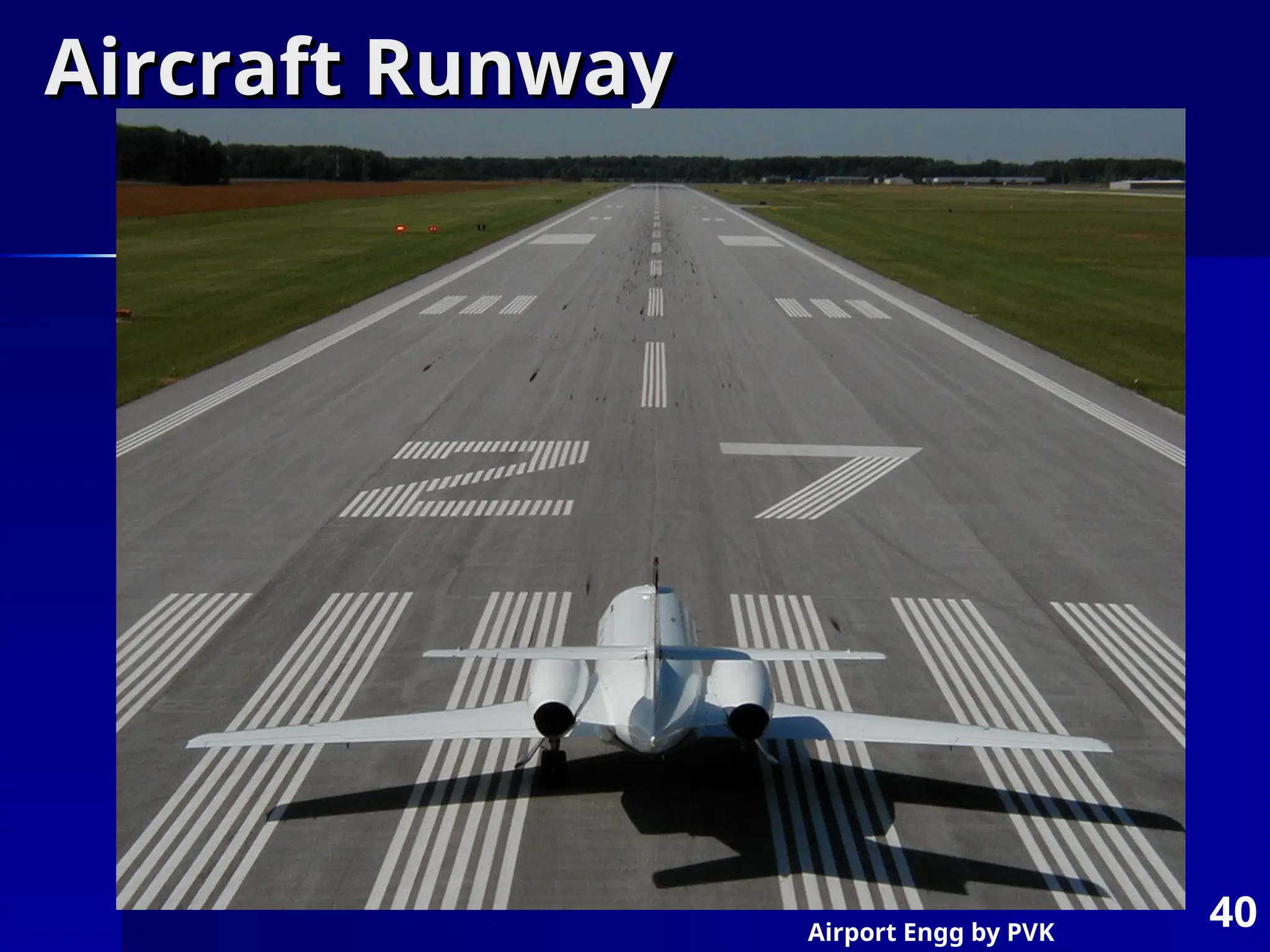
Aircraft Runway
Aircraft Runway
Airport Engg by PVK
41
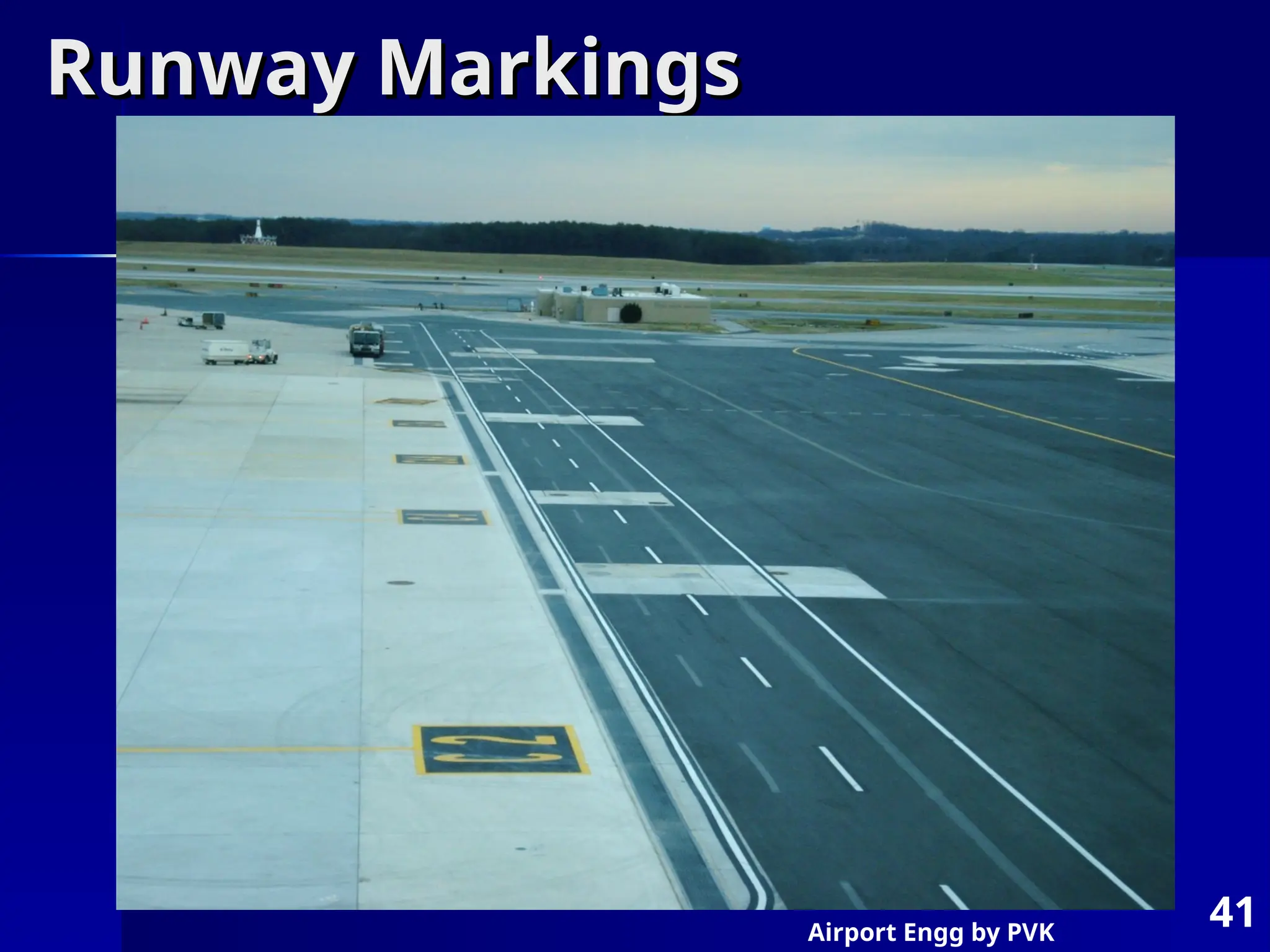
Runway Markings
Runway Markings
Airport Engg by PVK
42
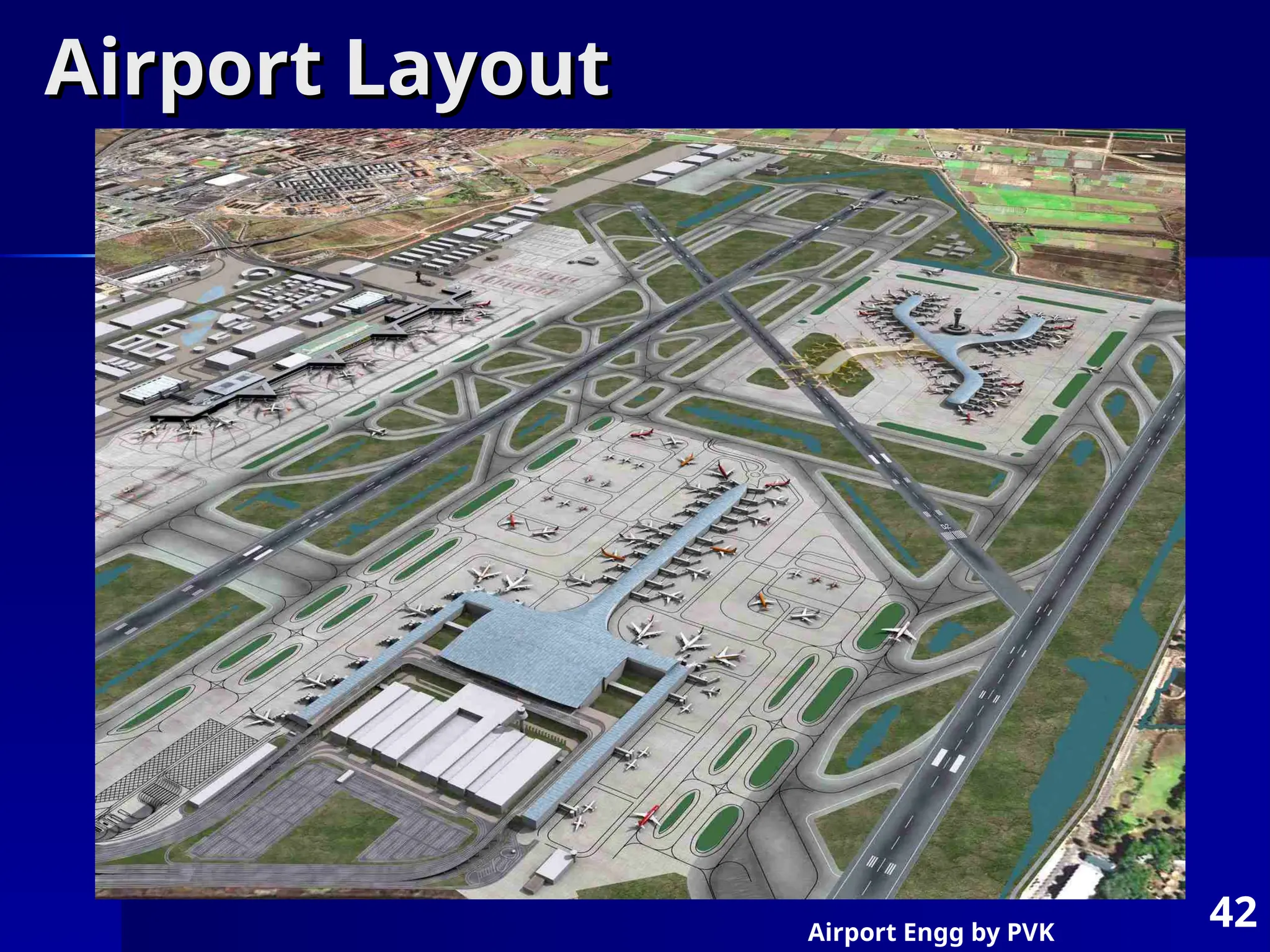
Airport Layout
Airport Layout
Airport Engg by PVK
43
Terminal Parking Area
Airport Engg by PVK
44
Airport Terminal Layout
Airport Engg by PVK
45
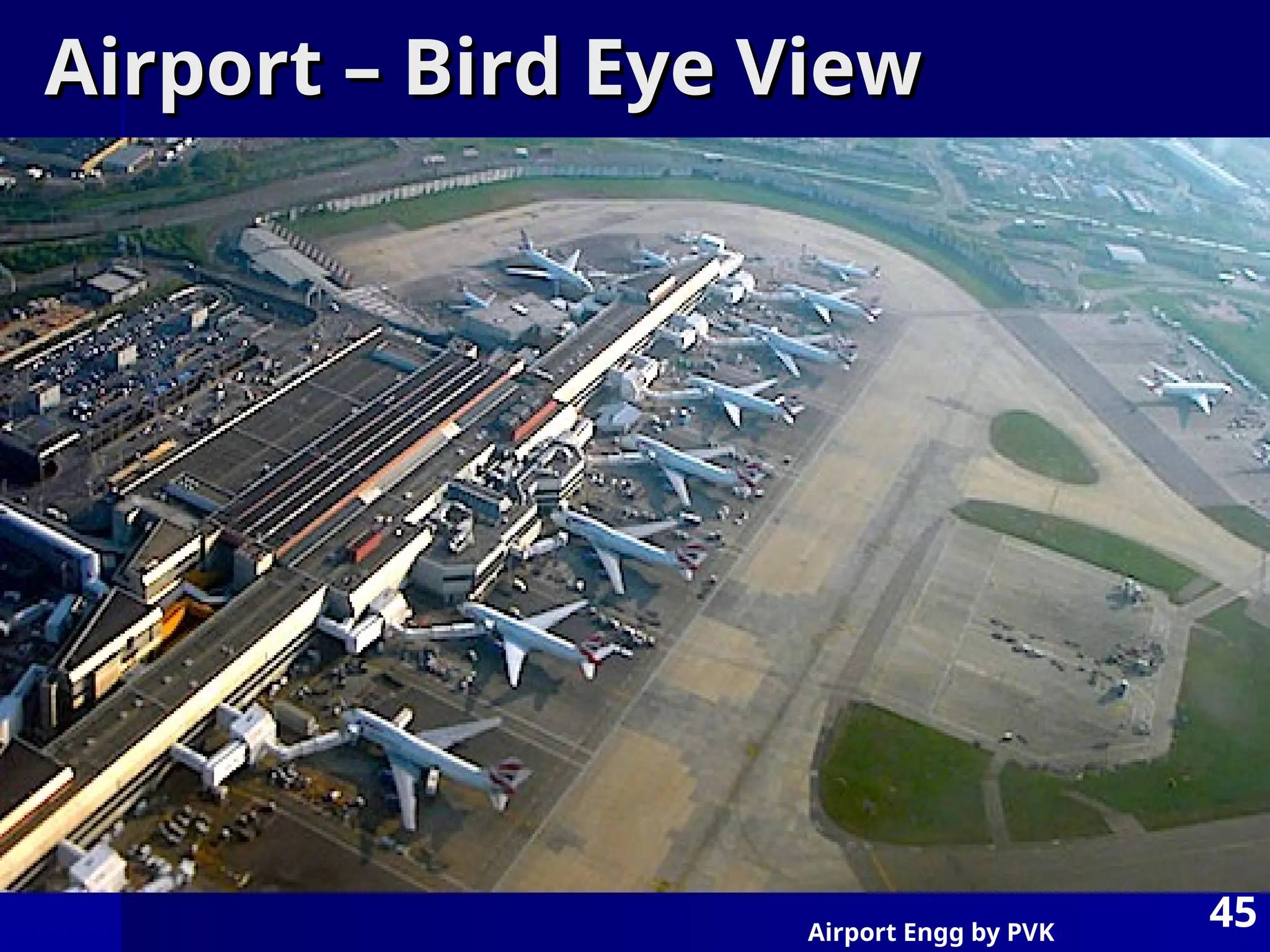
Airport – Bird Eye View
Airport Engg by PVK
46
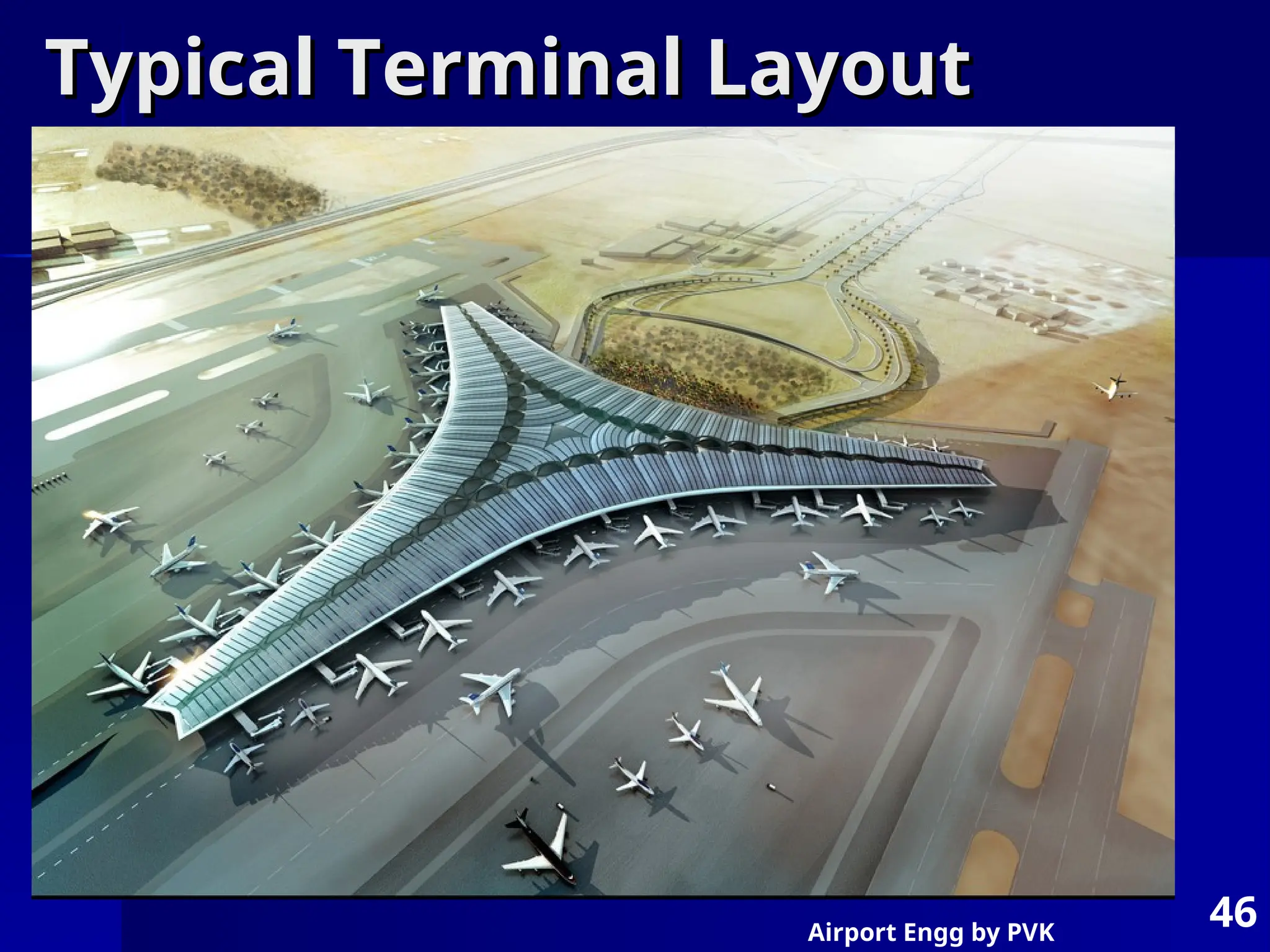
Typical Terminal Layout
Airport Engg by PVK
47
Airport Terminal and Aero dram
Airport Engg by PVK
48
Airport Terminal
Airport Terminal
Airport Engg by PVK
49
Airport Engg by PVK
50
Thanks!
Thanks!
Prof. P. V. Khandve
Prof. P. V. Khandve
B.E.Civil, M.Tech.(Env.Engg.)(Hons.),
D.B.M., D.I.D., D.I.T., D.I.J., B.A.Soc.
M.I.E., M.I.S.T.E., M.I.S.E.T, M.I.S.C.A., M.I.W.W.A., M.I.A.S.
khandvesir@gmail.com

Fundamentals of Airport Engineering Unit-1

  • 1.
    Airport Airport Engineering Engineering Unit-4 Unit-4 Prof. P. V.Khandve Prof. P. V. Khandve B.E.Civil, M.Tech.(Env.Engg.)(Hons.), B.E.Civil, M.Tech.(Env.Engg.)(Hons.), D.B.M., D.I.D., D.I.T., D.I.J., B.A.Soc. D.B.M., D.I.D., D.I.T., D.I.J., B.A.Soc. M.I.E., M.I.S.T.E., M.I.S.E.T, M.I.S.C.A., M.I.W.W.A., M.I.A.S.
  • 2.
    Airport Engg byPVK 2 Surveys for site selection Surveys for site selection  Traffic surveys – traffic volume, traffic intensity etc Traffic surveys – traffic volume, traffic intensity etc  Meteorological survey - direction, duration, Meteorological survey - direction, duration, intensity of wind, rainfall, fog, temperature & intensity of wind, rainfall, fog, temperature & pressure pressure  Topographical Survey – topography of ground, Topographical Survey – topography of ground, trees, streams, contour map, Location map, trees, streams, contour map, Location map, Layout map, etc. Layout map, etc.  Soil survey – type of soil, properties of soil, ground Soil survey – type of soil, properties of soil, ground water table details etc. water table details etc.  Drainage survey – quantity of storm water, Drainage survey – quantity of storm water, pattern of drainage, possibilities of diversions etc. pattern of drainage, possibilities of diversions etc.  Material survey – availability of construction Material survey – availability of construction material etc material etc  TMTSDM TMTSDM
  • 3.
    Airport Engg byPVK 3 Airport Site Selection Airport Site Selection  Regional Plan – National network of airport Regional Plan – National network of airport  Airport use – Civil or military use Airport use – Civil or military use  Proximity to other airports – Small – 2 miles, big – 4 Proximity to other airports – Small – 2 miles, big – 4 miles, piston engine – 16 miles, jet engine – 100 miles miles, piston engine – 16 miles, jet engine – 100 miles  Ground accessibility – 30 m distance, near highway, Ground accessibility – 30 m distance, near highway, bus stand and railway station. bus stand and railway station.  Topography – raised ground, hill top, less obstruction, Topography – raised ground, hill top, less obstruction, natural drainage, uniform wind, better visibility (fog) natural drainage, uniform wind, better visibility (fog)  Obstructions – landing or takeoff – approach areas, Obstructions – landing or takeoff – approach areas, less fences, trees, poles, lines, buildings etc. future less fences, trees, poles, lines, buildings etc. future growth, controlled by zoning laws growth, controlled by zoning laws  Visibility – free from visibility reduction conditions, fog, Visibility – free from visibility reduction conditions, fog, smoke, smog etc., industrial area proximity checked smoke, smog etc., industrial area proximity checked
  • 4.
    Airport Engg byPVK 4 Airport Site Selection Airport Site Selection  Wind – Orientation of runway, windword side of city Wind – Orientation of runway, windword side of city  Noise nuisance – engine noise, buffer zone, Noise nuisance – engine noise, buffer zone, preferential runway used. preferential runway used.  Grading, Drainage and Soil characteristics – Grading, Drainage and Soil characteristics – construction and maintenance, grading, and construction and maintenance, grading, and drainage system, gravel, sand mix drainage system, gravel, sand mix  Future Development – provisions for expansion, Future Development – provisions for expansion, parking, passanger facilities parking, passanger facilities  Availability of utilities from towns – water supply, Availability of utilities from towns – water supply, electricity, sewer, telephone etc. electricity, sewer, telephone etc.  Economic consideration – land cost, clearing, Economic consideration – land cost, clearing, grading, drainage, construction, roads, parking, grading, drainage, construction, roads, parking, facilities etc. cost facilities etc. cost
  • 5.
    Airport Engg byPVK 5 Airport drainage Airport drainage requirements requirements  Cutting and filling balance Cutting and filling balance  Uniform subgrade support available Uniform subgrade support available  Surface and subsurface drainage provided to Surface and subsurface drainage provided to ensure stability of pavement & embankment ensure stability of pavement & embankment  Grading plan to carry water away from runway, Grading plan to carry water away from runway, taxiway, apron & building area taxiway, apron & building area  Crossing landing runways – same elevation and Crossing landing runways – same elevation and grade at intersection grade at intersection  Ends of landing strips – graded – emergency Ends of landing strips – graded – emergency  Proper equipment as per local condition and Proper equipment as per local condition and type of situation and soil characteristics. type of situation and soil characteristics.
  • 6.
    Airport Engg byPVK 6 Functions of Airport Drainage system Functions of Airport Drainage system  Removal of surface run off the airfield Removal of surface run off the airfield  Interception of surface and ground water Interception of surface and ground water flow originating from land adjacent to airfield flow originating from land adjacent to airfield  Diversion of surface and ground water flow Diversion of surface and ground water flow originating from land adjacent to airfield originating from land adjacent to airfield  Lowering of subsurface water level in the Lowering of subsurface water level in the airfield areas. airfield areas.  Providing safety of aircraft Providing safety of aircraft  Providing long life of runway pavement Providing long life of runway pavement
  • 7.
    Airport Engg byPVK 7 Characteristics of Airport Drainage Characteristics of Airport Drainage  Extensive area under consideration Extensive area under consideration  Varying soil condition Varying soil condition  Heavy concentrated wheel load of aircraft Heavy concentrated wheel load of aircraft  Wide runway, taxiway and aprons Wide runway, taxiway and aprons  Flat longitudinal and transverse grades Flat longitudinal and transverse grades  Shallow water course Shallow water course  Absence of side ditches Absence of side ditches  Concentration of outfall flow Concentration of outfall flow  Rapid drainage available Rapid drainage available  Optimum design Optimum design  Stronger design and longer life require Stronger design and longer life require
  • 8.
    Airport Engg byPVK 8 Drainage design Drainage design  Velocity = 0.75 m/sec Velocity = 0.75 m/sec  Storm drain > 300 mm Storm drain > 300 mm  Inlet at 75 ft from edge of pavement Inlet at 75 ft from edge of pavement  Inlet @ 200 to 400 ft spacing ( ponding ) Inlet @ 200 to 400 ft spacing ( ponding )  Inlet @ 175 ft in case of (no ponding) Inlet @ 175 ft in case of (no ponding)  Manning formula V = 1/n R Manning formula V = 1/n R 2/3 2/3 S S1/2 1/2  Pond area = 1/3 b (A+B+ AB) √ Pond area = 1/3 b (A+B+ AB) √
  • 9.
    Airport Engg byPVK 9 Drainage Layout for Runway Drainage Layout for Runway
  • 10.
    Airport Engg byPVK 10 Drainage System for Runway Drainage System for Runway
  • 11.
    Airport Engg byPVK 11 Sub grade Drainage Sub grade Drainage
  • 12.
    Airport Engg byPVK 12 Intercepting Drains Intercepting Drains
  • 13.
    Airport Engg byPVK 13 Runway Runway Drainage Drainage system system
  • 14.
    Airport Engg byPVK 14 Pavement Drainage system Pavement Drainage system
  • 15.
    Airport Engg byPVK 15 Component parts of Aircraft Component parts of Aircraft  Engine – Engine – – Piston engine – low altitude, moderate speed Piston engine – low altitude, moderate speed – Turbo jet engine – baloone, take-compress-burn-expand-exhaust Turbo jet engine – baloone, take-compress-burn-expand-exhaust – Turbo Propulsion engine – mix Turbo Propulsion engine – mix – Ram jet – divergent convergent tube inside Ram jet – divergent convergent tube inside – Rocket engine – own oxygen supply Rocket engine – own oxygen supply  Propeller – two blades – forces air inside at high speed Propeller – two blades – forces air inside at high speed  Fuselage – body containing power plant, fuel, cockpit, pasengers, Fuselage – body containing power plant, fuel, cockpit, pasengers, cargo etc. – aerogenic shape cargo etc. – aerogenic shape  Wings – Aeilron, leading edge, trailing edge, flight path, angle of Wings – Aeilron, leading edge, trailing edge, flight path, angle of incidence, camber, Aerofoil. incidence, camber, Aerofoil.  Three controls Three controls – Elevator – up / down / 50 Elevator – up / down / 500 0 / 60 / 600 0 / at tail plane / at tail plane – Rudder – right / left / 30 Rudder – right / left / 300 0 / / – Aileron – Tilting 45 Aileron – Tilting 450 0 / /  Flaps – under wings – like aileron Flaps – under wings – like aileron  Trycycle undercarriage – to absorb landing shocks, to enable Trycycle undercarriage – to absorb landing shocks, to enable movement on ground, movement on ground,
  • 16.
    Airport Engg byPVK 16 Parts of Aircraft - Photo Parts of Aircraft - Photo
  • 17.
    Airport Engg byPVK 17 Components parts of Aircraft Components parts of Aircraft
  • 18.
    Airport Engg byPVK 18 Control Axis of Aircraft Control Axis of Aircraft
  • 19.
    Airport Engg byPVK 19 Aircraft Parts and functions Aircraft Parts and functions
  • 20.
    Airport Engg byPVK 20 Aircraft Component Parts - Plan Aircraft Component Parts - Plan
  • 21.
    Airport Engg byPVK 21 Aircraft Component Parts - Front Aircraft Component Parts - Front
  • 22.
    Airport Engg byPVK 22 Aircraft Characteristics Aircraft Characteristics  Type of propulsion Type of propulsion  Size of aircraft Size of aircraft  Min turning radius Min turning radius  Min circling radius Min circling radius  Speed of aircraft Speed of aircraft  Capacity of aircraft Capacity of aircraft  Aircraft weight and wheel configuration Aircraft weight and wheel configuration  Jet blast Jet blast  Fuel spillage Fuel spillage  Noise Noise
  • 23.
    Airport Engg byPVK 23 Airport Obstructions Airport Obstructions  Zoning Laws - Zoning Laws -  Classification of Obstructions Classification of Obstructions – a) objects protruding above imaginary surface a) objects protruding above imaginary surface – b) object exceeding limiting heights in approach zone b) object exceeding limiting heights in approach zone and turning zones and turning zones  Imaginary surfaces Imaginary surfaces – Take-off climb surface Take-off climb surface – Approach surface Approach surface – Inner horizontal surface Inner horizontal surface – Conical surface Conical surface – Transitional surface Transitional surface – Outer horizontal surface Outer horizontal surface
  • 24.
    Airport Engg byPVK 24 Imaginary Surfaces (Runway) Imaginary Surfaces (Runway)
  • 25.
    Airport Engg byPVK 25 Imaginary Imaginary Surfaces Surfaces
  • 26.
    Airport Engg byPVK 26 Clear zone Clear zone  Innermost portion of approach zone, Innermost portion of approach zone,  Critical portion from obstruction view point Critical portion from obstruction view point  Clearance over Highway and Railway Clearance over Highway and Railway  Limiting height Limiting height – 30m up to 4.5 KM 30m up to 4.5 KM – 30+7.5 m for 4.5+1.5 Km 30+7.5 m for 4.5+1.5 Km – 75m up to 15 Km 75m up to 15 Km – 150 m in approach zone 150 m in approach zone  Turning zone - Turning zone - – Mort than 51 m upto 4.5 Km from runway reference Mort than 51 m upto 4.5 Km from runway reference point point – More than 51 + 30 m for every 1.5 Km More than 51 + 30 m for every 1.5 Km – 150 m upto 15 Km 150 m upto 15 Km
  • 27.
    Airport Engg byPVK 27 Runway Clear Zone Runway Clear Zone
  • 28.
    Airport Engg byPVK 28 Clearance Over Highway & Railway Clearance Over Highway & Railway
  • 29.
    Airport Engg byPVK 29 Approach Zone Profile for Runway Approach Zone Profile for Runway
  • 30.
    Airport Engg byPVK 30 Runway Orientation Runway Orientation  Direction of prevailing winds Direction of prevailing winds  Head wind – supports takeoff Head wind – supports takeoff  Breaking effect – supports landing Breaking effect – supports landing  Shorter runway length require Shorter runway length require  Along wind direction – require more length Along wind direction – require more length  Cross wind component – V sin Cross wind component – V sin   Small air crafts – 15 kmph Small air crafts – 15 kmph  Mixed air crafts – 25 kmph Mixed air crafts – 25 kmph  Big aircraft – 33 kmph Big aircraft – 33 kmph  Wind coverage = % of time in year cws is within Wind coverage = % of time in year cws is within limit 95 % - 25 kmph. limit 95 % - 25 kmph.
  • 31.
    Airport Engg byPVK 31 Wind rose Diagram Wind rose Diagram  The wind data – direction, duration & intensity The wind data – direction, duration & intensity are graphically represented by wind rose are graphically represented by wind rose diagram. diagram.  5 to 10 years 5 to 10 years  Analyzing wind data for orientation of runway Analyzing wind data for orientation of runway  Direction, duration in %, total % in each Direction, duration in %, total % in each direction direction  Type – 1, type -2 Type – 1, type -2  Wind coverage 2.5 Wind coverage 2.50 0 2 2  Obstructions, excessive grading, Noise nuisance Obstructions, excessive grading, Noise nuisance
  • 32.
    Airport Engg byPVK 32 Wind Wind Coverage Coverage Angle Angle
  • 33.
    Airport Engg byPVK 33 Wind Wind Data Data for for Wind Wind Rose Rose Diagram Diagram
  • 34.
    Airport Engg byPVK 34 Wind Wind Rose Rose Diagram Diagram Type -I Type -I
  • 35.
    Airport Engg byPVK 35 Wind Rose Wind Rose Diagram Diagram Type-II Type-II
  • 36.
    Airport Engg byPVK 36 Basic runway length Basic runway length Assumptions Assumptions  i) airport altitude is at sea level i) airport altitude is at sea level  Temp at airport is standard 15 0 Temp at airport is standard 15 0  Runway is leveled in longitudional direction Runway is leveled in longitudional direction  No wind is blowing on runway No wind is blowing on runway  Aircraft is loaded to its full loading capacity Aircraft is loaded to its full loading capacity  There is no wind blowing enroute to There is no wind blowing enroute to destination city destination city  Enroute temperature is standard Enroute temperature is standard
  • 37.
    Airport Engg byPVK 37 Basic Runway length Basic Runway length  Normal landing case Normal landing case – – aircraft stop in 60 % length aircraft stop in 60 % length  Normal take off case – width of clearway = Normal take off case – width of clearway = 150 m free from obstruction – 1.25% from 150 m free from obstruction – 1.25% from runway end. runway end.  Take off distance = Lift off distance + 115 % Take off distance = Lift off distance + 115 % - ut to 10.5m height – 115 % - ut to 10.5m height – 115 %  Engine failure case – Stop way construction Engine failure case – Stop way construction  Balance runway length Balance runway length
  • 38.
    Airport Engg byPVK 38 Correction for Elevation, Temperature Correction for Elevation, Temperature and gradient and gradient  Elevation correction = + 7 % per 300 m rise Elevation correction = + 7 % per 300 m rise above MSL above MSL  Temperature correction = Ta + (Tm – Ta)/3 Temperature correction = Ta + (Tm – Ta)/3  Tm – monthly max average daily temp. Tm – monthly max average daily temp.  Ta – monthly mean average daily temp. Ta – monthly mean average daily temp.  Total elevation and Temperature correction Total elevation and Temperature correction should not exceed 35 % should not exceed 35 %  Correction for Gradient for 1 % of effective Correction for Gradient for 1 % of effective gradient correction in runway length = 20 % gradient correction in runway length = 20 %  Effective gradient = max – min / basic length Effective gradient = max – min / basic length
  • 39.
  • 40.
    Airport Engg byPVK 40 Aircraft Runway Aircraft Runway
  • 41.
    Airport Engg byPVK 41 Runway Markings Runway Markings
  • 42.
    Airport Engg byPVK 42 Airport Layout Airport Layout
  • 43.
    Airport Engg byPVK 43 Terminal Parking Area Terminal Parking Area
  • 44.
    Airport Engg byPVK 44 Airport Terminal Layout Airport Terminal Layout
  • 45.
    Airport Engg byPVK 45 Airport – Bird Eye View Airport – Bird Eye View
  • 46.
    Airport Engg byPVK 46 Typical Terminal Layout Typical Terminal Layout
  • 47.
    Airport Engg byPVK 47 Airport Terminal and Aero dram Airport Terminal and Aero dram
  • 48.
    Airport Engg byPVK 48 Airport Terminal Airport Terminal
  • 49.
  • 50.
    Airport Engg byPVK 50 Thanks! Thanks! Prof. P. V. Khandve Prof. P. V. Khandve B.E.Civil, M.Tech.(Env.Engg.)(Hons.), B.E.Civil, M.Tech.(Env.Engg.)(Hons.), D.B.M., D.I.D., D.I.T., D.I.J., B.A.Soc. D.B.M., D.I.D., D.I.T., D.I.J., B.A.Soc. M.I.E., M.I.S.T.E., M.I.S.E.T, M.I.S.C.A., M.I.W.W.A., M.I.A.S. khandvesir@gmail.com