Characteristics
of skeletal
muscle
FUNCTIONAL
ANATOMY
THINGS TO REMEMBER
 Use these slides as a study guide
 If you are unsure ask questions???
 Use these slides and SEQTA resources to catch up on any missed
work
 Use text-books & websites for additional information that you may
have missed in class.
 Flashcards and revision sheets are good
 Study book (write sample test/exam questions out by hand)
FUNCTIONAL ANATOMY – WHAT IS THAT?
 Very important to know
 Anatomy - the branch of science concerned with the
bodily structure of humans
 Physiology - the branch of biology that deals with the
normal functions of living organisms and their parts. We
will do more of this in the Exercise Physiology Unit
 Important to use the correct terminology when
describing movement throughout this course
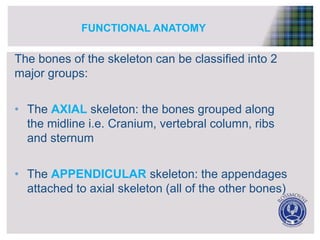
The bones of the skeleton can be classified into 2
major groups:
• The AXIAL skeleton: the bones grouped along
the midline i.e. Cranium, vertebral column, ribs
and sternum
• The APPENDICULAR skeleton: the appendages
attached to axial skeleton (all of the other bones)
FUNCTIONAL ANATOMY
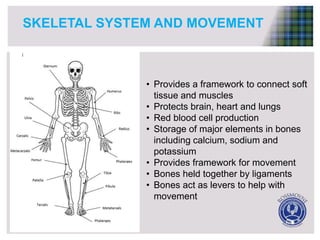
SKELETAL SYSTEM AND MOVEMENT
• Provides a framework to connect soft
tissue and muscles
• Protects brain, heart and lungs
• Red blood cell production
• Storage of major elements in bones
including calcium, sodium and
potassium
• Provides framework for movement
• Bones held together by ligaments
• Bones act as levers to help with
movement
SO HOW DO WE MOVE?
 Bones are LEVERS! Remember this for next year!!
 The skeleton alone can’t produce movement. The
bones in the skeleton must form joints. Muscles
are attached to bones and cross over joints.
 When a muscle contracts (more on how this
happens later) it shortens and brings the bones of
the joint closer together – producing movement.
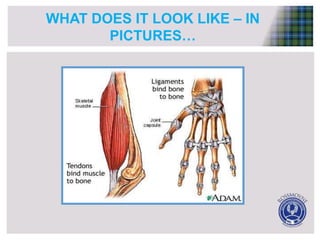
WHAT DOES IT LOOK LIKE – IN
PICTURES…
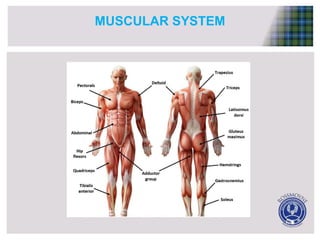
MUSCULAR SYSTEM
REVISION –DIAGRAMS
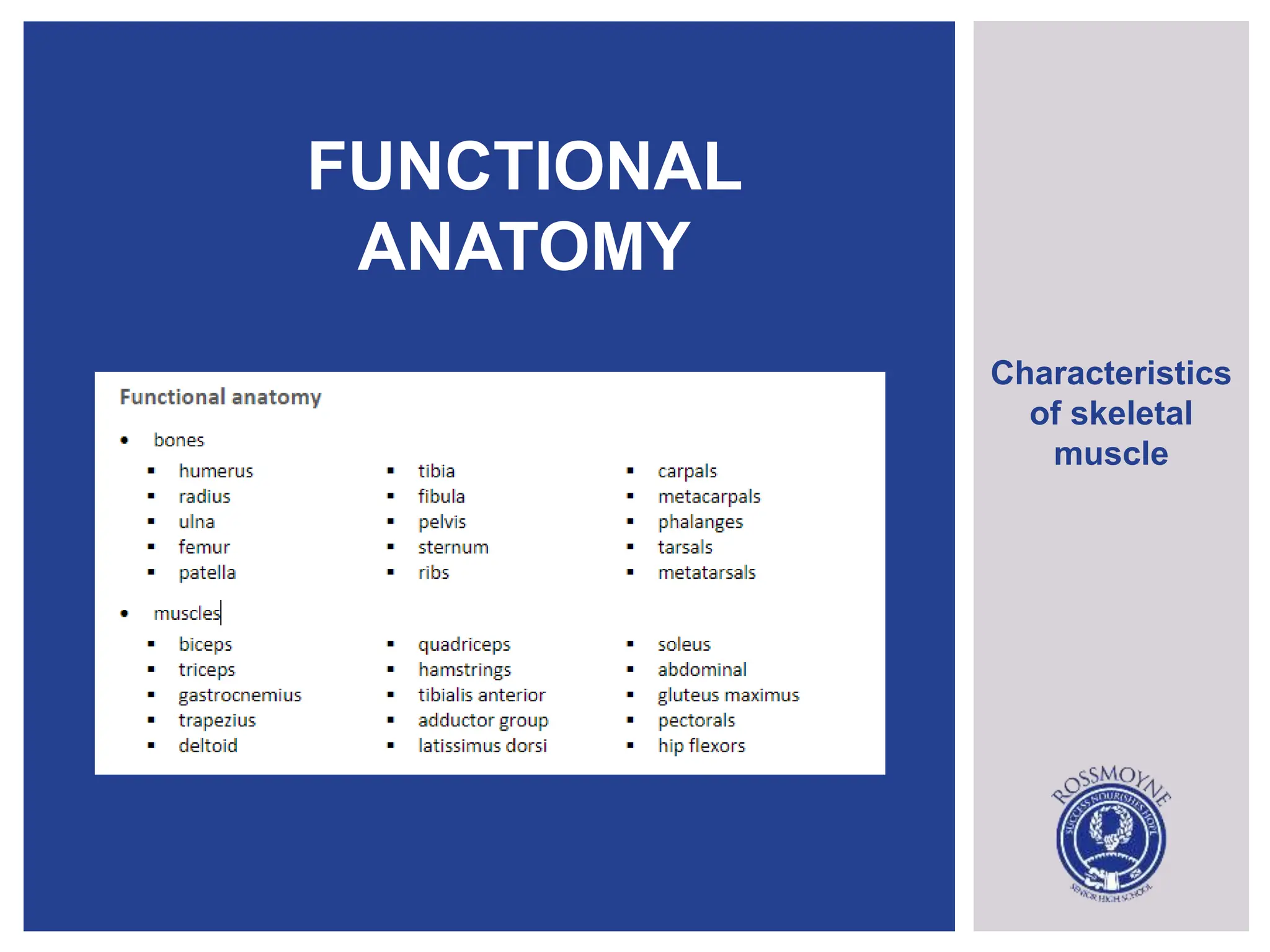
 Skeleton Diagram
 Muscle Diagram

Functional Anatomy 1 - Musculoskeletal system.pptx

  • 1.
  • 2.
    THINGS TO REMEMBER Use these slides as a study guide  If you are unsure ask questions???  Use these slides and SEQTA resources to catch up on any missed work  Use text-books & websites for additional information that you may have missed in class.  Flashcards and revision sheets are good  Study book (write sample test/exam questions out by hand)
  • 3.
    FUNCTIONAL ANATOMY –WHAT IS THAT?  Very important to know  Anatomy - the branch of science concerned with the bodily structure of humans  Physiology - the branch of biology that deals with the normal functions of living organisms and their parts. We will do more of this in the Exercise Physiology Unit  Important to use the correct terminology when describing movement throughout this course
  • 4.
    The bones ofthe skeleton can be classified into 2 major groups: • The AXIAL skeleton: the bones grouped along the midline i.e. Cranium, vertebral column, ribs and sternum • The APPENDICULAR skeleton: the appendages attached to axial skeleton (all of the other bones) FUNCTIONAL ANATOMY
  • 5.
    SKELETAL SYSTEM ANDMOVEMENT • Provides a framework to connect soft tissue and muscles • Protects brain, heart and lungs • Red blood cell production • Storage of major elements in bones including calcium, sodium and potassium • Provides framework for movement • Bones held together by ligaments • Bones act as levers to help with movement
  • 6.
    SO HOW DOWE MOVE?  Bones are LEVERS! Remember this for next year!!  The skeleton alone can’t produce movement. The bones in the skeleton must form joints. Muscles are attached to bones and cross over joints.  When a muscle contracts (more on how this happens later) it shortens and brings the bones of the joint closer together – producing movement.
  • 7.
    WHAT DOES ITLOOK LIKE – IN PICTURES…
  • 8.
  • 9.
    REVISION –DIAGRAMS  SkeletonDiagram  Muscle Diagram

Editor's Notes

  • #4 Anatomy plays a role in how we interact in our environment. Some sports its advantageous to be flexible (gymnastics) and others such as basketball it’s a disadvantage so they tape areas to avoid injury (Phyiscal Education Studies 2A/B, P.Whipp, 2010) It is important to understand that anatomy relates to the bones, muscles and organs of the body acting not only individually but interacting with each other.
  • #6 Human skeleton – endoskeleton – 206 bones Ligaments – hold bones together and are fibrous connective tissue, not flexible but allow some movement.
  • #9 Muscles create movement, muscles shorten when developing tension, (contractile = shorten, extensibility = lengthening, elasticity = returns to original shape Skeletal muscle is made up of long muscle fibres bundled together and are connected to bones. The brain sends a signal to the muscles to either contract or relax. What major muscles are used to perform the basketball shot? Interactive skeletal & muscle naming games: https://www.sporcle.com/games/Scuadrado/muscle-anatomy-picture-click?t=anatomy https://www.sporcle.com/games/g/bones?t=anatomy https://www.realbodywork.com/articles/anatomy-games/