Full Stack Web Development
SlideMake.com
Introduction to Full Stack Web Development
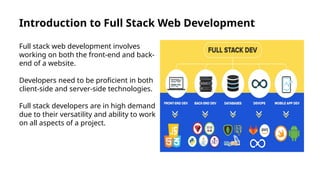
Full stack web development involves
working on both the front-end and back-
end of a website.
Developers need to be proficient in both
client-side and server-side technologies.
Full stack developers are in high demand
due to their versatility and ability to work
on all aspects of a project.
Front-End Technologies
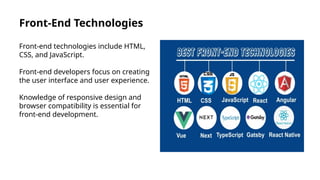
Front-end technologies include HTML,
CSS, and JavaScript.
Front-end developers focus on creating
the user interface and user experience.
Knowledge of responsive design and
browser compatibility is essential for
front-end development.
Back-End Technologies
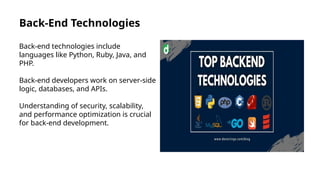
Back-end technologies include
languages like Python, Ruby, Java, and
PHP.
Back-end developers work on server-side
logic, databases, and APIs.
Understanding of security, scalability,
and performance optimization is crucial
for back-end development.
Database Management
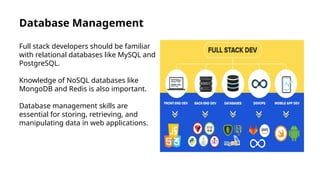
Full stack developers should be familiar
with relational databases like MySQL and
PostgreSQL.
Knowledge of NoSQL databases like
MongoDB and Redis is also important.
Database management skills are
essential for storing, retrieving, and
manipulating data in web applications.
Version Control and Collaboration
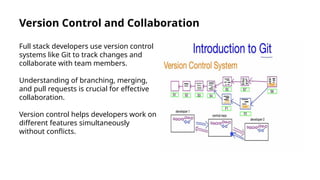
Full stack developers use version control
systems like Git to track changes and
collaborate with team members.
Understanding of branching, merging,
and pull requests is crucial for effective
collaboration.
Version control helps developers work on
different features simultaneously
without conflicts.
DevOps and Deployment
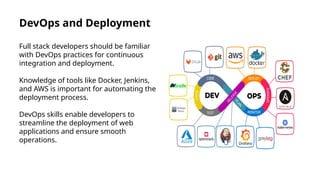
Full stack developers should be familiar
with DevOps practices for continuous
integration and deployment.
Knowledge of tools like Docker, Jenkins,
and AWS is important for automating the
deployment process.
DevOps skills enable developers to
streamline the deployment of web
applications and ensure smooth
operations.
Front-End Frameworks
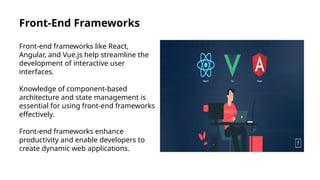
Front-end frameworks like React,
Angular, and Vue.js help streamline the
development of interactive user
interfaces.
Knowledge of component-based
architecture and state management is
essential for using front-end frameworks
effectively.
Front-end frameworks enhance
productivity and enable developers to
create dynamic web applications.
Back-End Frameworks
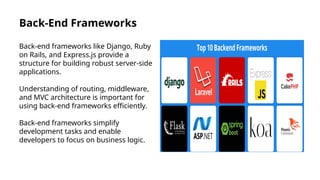
Back-end frameworks like Django, Ruby
on Rails, and Express.js provide a
structure for building robust server-side
applications.
Understanding of routing, middleware,
and MVC architecture is important for
using back-end frameworks efficiently.
Back-end frameworks simplify
development tasks and enable
developers to focus on business logic.
Full Stack Development Tools
Full stack developers use tools like Visual
Studio Code, Postman, and Chrome
Developer Tools for coding, testing, and
debugging.
Knowledge of package managers like
npm and yarn is important for managing
dependencies in web projects.
Utilizing development tools effectively
enhances productivity and enables
developers to build high-quality web
applications.
Continuous Learning and Growth
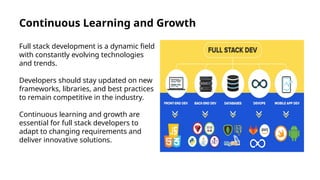
Full stack development is a dynamic field
with constantly evolving technologies
and trends.
Developers should stay updated on new
frameworks, libraries, and best practices
to remain competitive in the industry.
Continuous learning and growth are
essential for full stack developers to
adapt to changing requirements and
deliver innovative solutions.
Challenges and Opportunities
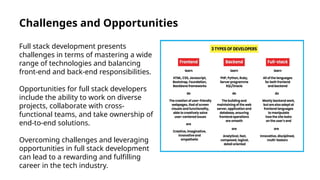
Full stack development presents
challenges in terms of mastering a wide
range of technologies and balancing
front-end and back-end responsibilities.
Opportunities for full stack developers
include the ability to work on diverse
projects, collaborate with cross-
functional teams, and take ownership of
end-to-end solutions.
Overcoming challenges and leveraging
opportunities in full stack development
can lead to a rewarding and fulfilling
career in the tech industry.
Conclusion
Full stack web development offers a
comprehensive skill set that enables
developers to work on all aspects of web
applications.
Versatility, problem-solving skills, and a
passion for learning are key attributes
for success in full stack development.
Embracing the challenges and
opportunities in full stack development
can lead to a fulfilling career and
impactful contributions to the world of
technology.

Full Stack Web Development report on.pptx

  • 1.
    Full Stack WebDevelopment SlideMake.com
  • 2.
    Introduction to FullStack Web Development Full stack web development involves working on both the front-end and back- end of a website. Developers need to be proficient in both client-side and server-side technologies. Full stack developers are in high demand due to their versatility and ability to work on all aspects of a project.
  • 3.
    Front-End Technologies Front-end technologiesinclude HTML, CSS, and JavaScript. Front-end developers focus on creating the user interface and user experience. Knowledge of responsive design and browser compatibility is essential for front-end development.
  • 4.
    Back-End Technologies Back-end technologiesinclude languages like Python, Ruby, Java, and PHP. Back-end developers work on server-side logic, databases, and APIs. Understanding of security, scalability, and performance optimization is crucial for back-end development.
  • 5.
    Database Management Full stackdevelopers should be familiar with relational databases like MySQL and PostgreSQL. Knowledge of NoSQL databases like MongoDB and Redis is also important. Database management skills are essential for storing, retrieving, and manipulating data in web applications.
  • 6.
    Version Control andCollaboration Full stack developers use version control systems like Git to track changes and collaborate with team members. Understanding of branching, merging, and pull requests is crucial for effective collaboration. Version control helps developers work on different features simultaneously without conflicts.
  • 7.
    DevOps and Deployment Fullstack developers should be familiar with DevOps practices for continuous integration and deployment. Knowledge of tools like Docker, Jenkins, and AWS is important for automating the deployment process. DevOps skills enable developers to streamline the deployment of web applications and ensure smooth operations.
  • 8.
    Front-End Frameworks Front-end frameworkslike React, Angular, and Vue.js help streamline the development of interactive user interfaces. Knowledge of component-based architecture and state management is essential for using front-end frameworks effectively. Front-end frameworks enhance productivity and enable developers to create dynamic web applications.
  • 9.
    Back-End Frameworks Back-end frameworkslike Django, Ruby on Rails, and Express.js provide a structure for building robust server-side applications. Understanding of routing, middleware, and MVC architecture is important for using back-end frameworks efficiently. Back-end frameworks simplify development tasks and enable developers to focus on business logic.
  • 10.
    Full Stack DevelopmentTools Full stack developers use tools like Visual Studio Code, Postman, and Chrome Developer Tools for coding, testing, and debugging. Knowledge of package managers like npm and yarn is important for managing dependencies in web projects. Utilizing development tools effectively enhances productivity and enables developers to build high-quality web applications.
  • 11.
    Continuous Learning andGrowth Full stack development is a dynamic field with constantly evolving technologies and trends. Developers should stay updated on new frameworks, libraries, and best practices to remain competitive in the industry. Continuous learning and growth are essential for full stack developers to adapt to changing requirements and deliver innovative solutions.
  • 12.
    Challenges and Opportunities Fullstack development presents challenges in terms of mastering a wide range of technologies and balancing front-end and back-end responsibilities. Opportunities for full stack developers include the ability to work on diverse projects, collaborate with cross- functional teams, and take ownership of end-to-end solutions. Overcoming challenges and leveraging opportunities in full stack development can lead to a rewarding and fulfilling career in the tech industry.
  • 13.
    Conclusion Full stack webdevelopment offers a comprehensive skill set that enables developers to work on all aspects of web applications. Versatility, problem-solving skills, and a passion for learning are key attributes for success in full stack development. Embracing the challenges and opportunities in full stack development can lead to a fulfilling career and impactful contributions to the world of technology.

Editor's Notes

  • #2 Image source: https://qawithexperts.com/article/technology/what-is-full-stack-web-development-and-its-advantage/301
  • #3 Image source: https://www.trickyenough.com/best-front-end-technologies-to-use/
  • #4 Image source: https://www.devstringx.com/top-backend-technologies
  • #5 Image source: https://qawithexperts.com/article/technology/what-is-full-stack-web-development-and-its-advantage/301
  • #6 Image source: https://fity.club/lists/suggestions/version-control/
  • #7 Image source: https://ashok198510.hashnode.dev/devops-roadmap-automating-and-scaling-infrastructure-for-effective-development
  • #8 Image source: https://planetary.co/insight/2022-03-03-comparing-front-end-frameworks
  • #9 Image source: https://blog.back4app.com/fr/frameworks-backend/
  • #10 Image source: https://oraniumtech.com/hybernate/
  • #11 Image source: https://qawithexperts.com/article/technology/what-is-full-stack-web-development-and-its-advantage/301
  • #12 Image source: https://redblink.com/full-stack-developer-roadmap/
  • #13 Image source: https://codup.co/full-stack-development-a-short-guide-to-get-you-started/