1
Fulgent Genetics, Inc.
NASDAQ | FLGT | US
Market capitalization (Nov 24th, 2017): $60.7 million
Share price (Nov 24th, 2017): $3.4
Expected return range: 54% - 107%
Short thesis: Buying a recent IPO and high-growth potential business with limited downside risk.
The Company has more than $40 million in cash (close to 65% of market capitalization) and
management owns approximately 60% of the business, which have insider buying significantly.
Evidence suggest high probability of dissipation of temporary headwinds that are currently
affecting the operating results and the market perception about the company.
Company overview
Founded in 2011, Fulgent is a technology company with an initial focus on the idea of bringing
flexibility and affordability to the genetic testing market to provide physicians with clinically
actionable diagnostic information they can use to improve the overall quality of patient care. By
merging the fields of genetics, molecular biology, and computer science, the company offers highly
flexible solutions in diagnostic testing, affordable genomic sequencing, and provider services.
2
Disclaimer
"INBESTCOMPANY SAPI DE CV Asesor en Inversiones Independiente (hereinafter referred to as EVIDIKA)
does not offer legal, accounting, or tax advice. The information and opinions contained in this document
have been prepared solely for informational purposes and is not a solicitation or an offer to buy or sell any
security or instrument or to participate in any trading strategy nor is to be relied upon in making an
investment decision. EVIDIKA specific advice is given only within the context of our contractual agreements
with each client. You agree not to hold EVIDIKA liable for any possible claim for damages arising from any
decision you make based on information made available to you through this website.
While EVIDIKA uses reasonable efforts to obtain information from sources which it believes to be reliable,
EVIDIKA makes no representation that the information or opinions contained on the website are accurate,
reliable or complete. The information and opinions contained in this document are subject to change
without notice.
Moreover, all registered or unregistered service marks, trademarks and trade names referred to in this
presentation are the property of their respective owners, and EVIDIKA’s use herein does not imply an
affiliation with, or endorsement by, the owners of these service marks, trademarks and trade names or the
goods and services sold or offered by such owners.”
3
Business model
Genetic testing
Genetic testing identifies mutations in genes or chromosomal abnormalities to confirm or rule out
a suspected genetic condition or to evaluate a person’s likelihood of developing a genetic
condition. For example, a person displaying symptoms of one or more conditions could use genetic
testing to determine or confirm a diagnosis, which can be especially useful for conditions that are
difficult to diagnose. Further, a person with a family history of a particular condition, such as breast
cancer, could use genetic testing to predict the likelihood of developing the condition. For instance,
a mutation in the BRCA1 gene indicates an estimated 84% cumulative risk of developing breast
cancer by age 70. The results of genetic testing can also be used to improve the selection and
implementation of drug treatment programs targeting specific diseases.
Genetic testing is expected to become an important part of standard medical care and the
knowledge of a person’s unique genetic makeup is expected to begin to play a more important
role in the practice of medicine as well. The advent of next generation sequencing, or NGS,
technology, a relatively new genetic testing technique that enables millions of DNA fragments to
be sequenced in parallel, has dramatically lowered the cost and improved the quality of genetic
testing, contributing to increased adoption.
Technology platform
Fulgent’s current test menu includes more than 18,000 single-gene tests and more than 200 pre-
established, multi-gene, disease-specific panels that collectively test for more than 7,500 genetic
conditions, including various cancers, cardiovascular diseases and neurological disorders.
While adoption of genetic testing has increased in recent years, widespread utilization has been
limited in large part because of certain barriers to adoption that exist in today’s market, including
challenges such as: high costs of some genetic tests, limited reimbursement options, limited scope
of genetic analysis, inefficient testing processes and time-consuming interpretation of results.
Because of these challenges, the company has developed a genetic testing solution that provides
broad genetic coverage and the flexibility to customize tests for individual patient needs, while
maintaining accuracy and affordability
The proprietary technology platform of Fulgent enables them to solve some of the challenges
facing the genetic testing industry today. Its technology platform includes: proprietary gene
probes, advanced database algorithms, adaptive learning software and proprietary laboratory
management systems. Together, the elements of this technology platform have permitted Fulgent
to provide tests at a low cost and accessible price points to their customers; offer a broad test
menu; continually expand and improve their proprietary genetic reference library; improve the
detection rates and accuracy of data, which has enable to produce actionable results that are
valued for their customers.
4
Customers
Fulgent’s existing customer base consists primarily of hospitals and medical institutions, which are
frequent and high-volume users of genetic tests and which typically pay directly for the tests. They
have approached the genetic testing market with a focus on these customers in part because they
are frequent and high-volume users of genetic tests and because this customer base provides a
meaningful opportunity for further growth by vertically deepening these relationships to drive
increased ordering.
Additionally, collection of billings from these institutional customers is more attainable than other
types of customers in the reimbursement market. Approximately 86% of test billings in 2016 were
paid during that period. This path has converted Fulgent in one of the few cash-flow positive and
profitable companies on their industry, which the management believes is a starting step for a
more sustainable business model than other companies and to penetrate the adjacent payor
markets in the future.
Approximately 40% of their revenues come from customers outside the U.S. and Canada and
third-party payors account for only 5% to 7% of the revenue.1
Management
The company was founded by its current President, Chairman and CEO, Ming Hsieh. A billionaire
technology entrepreneur who also founded Cogent Systems, a biometric identification systems
company sold to 3M for close to $1 billion six years ago, and who owns more than 40% of Fulgent.
Paul Kim, the CFO, was also at Cogent with Ming Hsieh. Together with executive officers, directors
and affiliates own more than 60% of the company.
We believe this evidence suggests that management interests are aligned, and business prosperity
is in the best interests of all the owners.
The company has 70 employees which includes personnel with expertise in a number of fields such
as bioinformatics, genetics, software engineering, laboratory management and sales and
marketing.
Industry and competition
The availability and accessibility of genetic testing has grown significantly in recent years, due in
large part to improvements in testing technologies that have driven costs down. The National
Institutes of Health gene testing registry includes over 480 genetic testing laboratories and, as of
February 16, 2017, genetests.org estimates that over 4,900 disorders can be identified via genetic
testing.
1
As of FY2016.
5
Due to the continued expansion of testing availability and accessibility, a growing and aging
population and the increasing overall incidence of disease, among other factors, the global market
for genetic testing is expected to grow significantly. According to GrandView Research, the size of
the global NGS genetic testing market, which includes pre-sequencing, sequencing and data
analysis, is estimated to have been approximately $4.0 billion in 2016, including approximately
$1.4 billion in the United States, and is expected to reach approximately $10.5 billion by 2022,
including approximately $3.6 billion in the United States. This implies an approximate 16% CAGR
for the next five years.
Competitors include companies focused on molecular genetic testing services, including specialty
and reference laboratories that offer traditional single-gene and multi-gene tests. Principal
competitors include Ambry Genetics, Inc.; Counsyl; Foundation Medicine, Inc.; GeneDx, a subsidiary
of OPKO Health, Inc.; Invitae Corporation; Myriad Genetics, Inc.; and Pathway Genomics
Corporation, as well as other commercial and academic laboratories.
Strategy
Fulgent’s strategy aims to convert on the leading provider of genetic information and other
diagnostic tools to physicians for disease prediction and prognosis, as well as for
pharmacogenomic purposes. Their strategy for long-term growth is focused on the key drivers of
the business:
• Grow their customer base;
• Further broaden their test menu;
• Increase global presence of their business;
• Maintain their low-cost operations;
• Develop relationships with payors by focusing on established genetic testing markets;
• Pursue additional opportunities in pharmacogenomics and drug discovery; and leverage
their technology platform into other diagnostic modalities.
6
Current situation
The company begin its public history with record financial results, double-digit revenue growth,
strong cash flow generation and high and expanding profit margins. Fulgent came to its IPO as a
disruptor of the current genetic testing market, rapidly gaining market share and expanding their
offerings, markets and geographies.
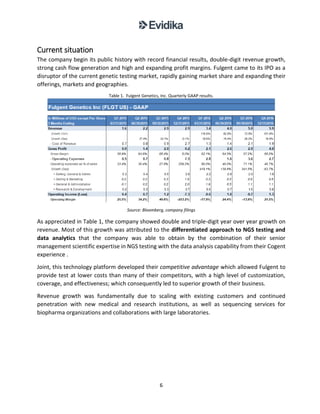
Table 1. Fulgent Genetics, Inc. Quarterly GAAP results.
Source: Bloomberg, company filings
As appreciated in Table 1, the company showed double and triple-digit year over year growth on
revenue. Most of this growth was attributed to the differentiated approach to NGS testing and
data analytics that the company was able to obtain by the combination of their senior
management scientific expertise in NGS testing with the data analysis capability from their Cogent
experience .
Joint, this technology platform developed their competitive advantage which allowed Fulgent to
provide test at lower costs than many of their competitors, with a high level of customization,
coverage, and effectiveness; which consequently led to superior growth of their business.
Revenue growth was fundamentally due to scaling with existing customers and continued
penetration with new medical and research institutions, as well as sequencing services for
biopharma organizations and collaborations with large laboratories.
7
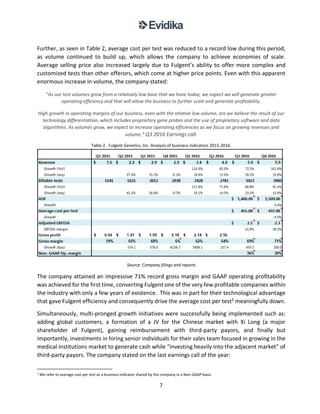
Further, as seen in Table 2, average cost per test was reduced to a record low during this period,
as volume continued to build up, which allows the company to achieve economies of scale.
Average selling price also increased largely due to Fulgent’s ability to offer more complex and
customized tests than other offerors, which come at higher price points. Even with this apparent
enormous increase in volume, the company stated:
“As our test volumes grow from a relatively low base that we have today, we expect we will generate greater
operating efficiency and that will allow the business to further scale and generate profitability.
High growth in operating margins of our business, even with the relative low volume, are we believe the result of our
technology differentiation, which includes proprietary gene probes and the use of proprietary software and data
algorithms. As volumes grow, we expect to increase operating efficiencies as we focus on growing revenues and
volume.” Q3 2016 Earnings call.
Table 2. Fulgent Genetics, Inc. Analysis of business indicators 2015-2016.
Source: Company filings and reports
The company attained an impressive 71% record gross margin and GAAP operating profitability
was achieved for the first time, converting Fulgent one of the very few profitable companies within
the industry with only a few years of existence. This was in part for their technological advantage
that gave Fulgent efficiency and consequently drive the average cost per test2 meaningfully down.
Simultaneously, multi-pronged growth initiatives were successfully being implemented such as:
adding global customers, a formation of a JV for the Chinese market with Xi Long (a major
shareholder of Fulgent), gaining reimbursement with third-party payors, and finally but
importantly, investments in hiring senior individuals for their sales team focused in growing in the
medical institutions market to generate cash while “investing heavily into the adjacent market” of
third-party payors. The company stated on the last earnings call of the year:
2 We refer to average cost per test as a business indicator shared by the company in a Non-GAAP basis.
8
“Despite these investments our GAAP operating margins were in excess of 20% in the quarter. Excluding stock-based
compensation, non-GAAP operating margins were over 30%. We believe we have lots of excess capacity and can
demonstrate further leverage as we continue to bring down COGS in 2017.” Q4 2016, earnings call.
Most of these successes were essentially attributed to their differentiated business model and
proprietary technology even with relatively limited sales and marketing effort (at the time, the
company had a small sales force), controlled investments (which were mainly cash flow financed)
and a focus toward GAAP profitability and positive cash flow generation.
With these fairly optimistic results, the company continued with ambitious expectations toward
the financial year 2017 with “at least” double the volume of 2016, revenue growth of between
65% and 100% and strong margins:
“Even with assumptions regarding the price declines and continued investments, we see non-GAAP gross and
operating margins for 2017 in excess of 65% and 30% respectively. We also see upside to these margins as price
declines have not materialized for our business.” Q4 2016, earnings call.
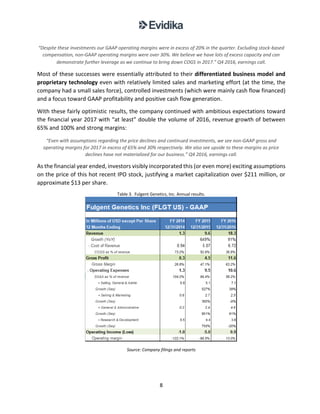
As the financial year ended, investors visibly incorporated this (or even more) exciting assumptions
on the price of this hot recent IPO stock, justifying a market capitalization over $211 million, or
approximate $13 per share.
Table 3. Fulgent Genetics, Inc. Annual results.
Source: Company filings and reports
9
FY 2017
In many instances, unrealistic expectations fail to materialize due to unanticipated events or
biased reasoning for their argumentation. In this case, we believe both occurred.
Table 4. Fulgent Genetics, Inc. Analysis of business indicators 2015-Q3 2017
Source: Company filings and reports
Average selling price had a surprising fall from $1,500 to around $1,200 in the first quarter of the
2017 financial year. As stated in the past, revenue mix affects this variable. During the three
quarters of the present financial year, fewer exome-based test (one of the high price and
complex tests) were seen, which decreased the ASP as low as $1,106 during the third quarter.
“Also – although we have been talking about uncertainty regarding product mix and pricing for some time, we did
not anticipate a 20% drop in ASPs in one given quarter. Based on these factors, we anticipate second quarter
revenues will be slightly lower than Q1 revenue. We also anticipate our revenue for the full-year will be lower than
our initial guidance. We now expect our revenue for the full-year 2017 to be in the range of $24 million to $28
million.” Q1 2017, earnings call.
Volume, although increasing, but at a lower than expected pace, combined lower ASP negatively
impacted revenue. Revenue drastically slowed its growth during the first half of the year and
turned negative during the third quarter, fact that visibly dissapointed investors forecasts.
Average cost per test increased, ceasing the record lows achieved before by Fulgent’s
technological advantage. Costs increased primarily due to deleverage of volume and investments
in lab capacity amplification. Margins also gradually decreased to a record low of 53%.
“We expect our gross margin may fluctuate as our test mix varies quarter-to-quarter. However, we expect to focus on
continuing to drive down cost per test via increased volumes and continued automation and productivity in the lab,
which will continue to counter any pricing degradation we may see in our business or in the industry generally.” Q1
2017, earnings call.
“Non-GAAP gross margin in the second quarter was 61%, a modest decline compared to 68% last quarter. […]
However our gross margin remained the highest in the industry as a result of our technology platform and
operational efficiency including lower overall cost to us per test. We expect gross margin will remain strong in the
coming quarters as we increase our volume.” Q2 2017, earnings call.
10
“Longer term, we still expect to see a lower average cost per test as we ramp volumes and continue to improve
productivity and automation in the lab. We believe that our differentiated technology and operating efficiencies will
give us an advantage with margins long term despite pricing degradation we may see in our business or in the
industry overall.” Q2 2017, earnings call.
An important point during the progress of the 2017 financial year, is that management continued
investments in the sales organization in anticipation of increased volume in the near future. The
company commented:
“Moving to operating expenses, we made meaningful investments in the quarter with the hiring of senior members
to our sales team, which Ming discussed. We added six individuals to our sales and marketing team and anticipate
having approximately 13 sales employees at the end of our second quarter.
The biggest factor we have taken into consideration in providing our outlook is the time needed for a new sales
organization to have an impact in revenue generation. Though, we do not expect it would take much time for these
senior individuals to get up to speed, they will take few months for them to develop familiarity with their products,
tasks, pricing, lab process and systems. Also, there will be a lag between attaining any new customers and recording
revenue from those customers.” Q1 2017, earnings call.
Nonetheless, the progress during the following quarters was not the expected. The "rent" of the
sales organization was visibly delayed, negatively impacting the revenue growth expectations of
the company:
“As expected, it is taking time for us, our new sales team, to fully ramp and we expect to see these changes to our
sales organization positively impact our revenue growth in the second half of the year.” Q2 2017, earnings call.
“Our results in the quarter came below our expectations as thick and longer than we expected for our new sales
organization to fully rent, which has impact our topline growth.” Q3 2017, earnings call.
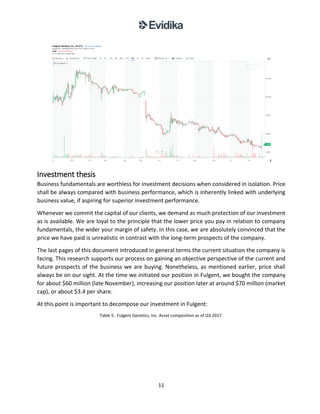
After constant lowering/missing of guidance and apparent deepening of these headwinds, most
investors lost their patience. The market’s perspective switched for Fulgent, once being a
promising genetic testing company. The market dissapointment was drammatical, discounting
more than 70% from its pre Q1 2017 prices:
11
Investment thesis
Business fundamentals are worthless for investment decisions when considered in isolation. Price
shall be always compared with business performance, which is inherently linked with underlying
business value, if aspiring for superior investment performance.
Whenever we commit the capital of our clients, we demand as much protection of our investment
as is available. We are loyal to the principle that the lower price you pay in relation to company
fundamentals, the wider your margin of safety. In this case, we are absolutely convinced that the
price we have paid is unrealistic in contrast with the long-term prospects of the company.
The last pages of this document introduced in general terms the current situation the company is
facing. This research supports our process on gaining an objective perspective of the current and
future prospects of the business we are buying. Nonetheless, as mentioned earlier, price shall
always be on our sight. At the time we initiated our position in Fulgent, we bought the company
for about $60 million (late November), increasing our position later at around $70 million (market
cap), or about $3.4 per share.
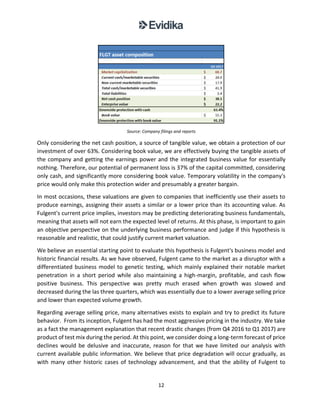
At this point is important to decompose our investment in Fulgent:
Table 5. Fulgent Genetics, Inc. Asset composition as of Q3 2017.
12
Source: Company filings and reports
Only considering the net cash position, a source of tangible value, we obtain a protection of our
investment of over 63%. Considering book value, we are effectively buying the tangible assets of
the company and getting the earnings power and the integrated business value for essentially
nothing. Therefore, our potential of permanent loss is 37% of the capital committed, considering
only cash, and significantly more considering book value. Temporary volatility in the company's
price would only make this protection wider and presumably a greater bargain.
In most occasions, these valuations are given to companies that inefficiently use their assets to
produce earnings, assigning their assets a similar or a lower price than its accounting value. As
Fulgent's current price implies, investors may be predicting deteriorating business fundamentals,
meaning that assets will not earn the expected level of returns. At this phase, is important to gain
an objective perspective on the underlying business performance and judge if this hypothesis is
reasonable and realistic, that could justify current market valuation.
We believe an essential starting point to evaluate this hypothesis is Fulgent's business model and
historic financial results. As we have observed, Fulgent came to the market as a disruptor with a
differentiated business model to genetic testing, which mainly explained their notable market
penetration in a short period while also maintaining a high-margin, profitable, and cash flow
positive business. This perspective was pretty much erased when growth was slowed and
decreased during the las three quarters, which was essentially due to a lower average selling price
and lower than expected volume growth.
Regarding average selling price, many alternatives exists to explain and try to predict its future
behavior. From its inception, Fulgent has had the most aggressive pricing in the industry. We take
as a fact the management explanation that recent drastic changes (from Q4 2016 to Q1 2017) are
product of test mix during the period. At this point, we consider doing a long-term forecast of price
declines would be delusive and inaccurate, reason for that we have limited our analysis with
current available public information. We believe that price degradation will occur gradually, as
with many other historic cases of technology advancement, and that the ability of Fulgent to
13
protect their margins, specially their gross margin, will mostly depend upon its ability to continue
to maintain their low-cost operations to draw down the average cost per test.
Apparently, costs have increased in the recent period, however, most of it is explained by recent
capacity investments (in anticipation of and volume deleverage:
“As a result of our higher costs, we saw a dip in our non-GAAP gross margin, which was 61% in the quarter. Our
gross margin will continue to fluctuate as our test mix varies and our volumes scale. Longer term, we still expect to
see a lower average cost per test as we ramp volumes and continue to improve productivity and automation in
the lab. We believe that our differentiated technology and operating efficiencies will give us an advantage with
margins long term despite pricing degradation we may see in our business or in the industry overall.” Q2 2017,
earnings call.
“Non-GAAP gross margin in the third quarter were 53% down from 61% in the last quarter. Our gross margin in the
quarter was impacted by the gross investment we made in our lab operations as we anticipate the higher test
warning going forward. This investment includes our overall cost of goods, so they include having more employees,
depreciated from expansion in square footage as well as purchasing more equipments.” Q3 2017, earnings call.
“So almost all the increase we had in our cost structure was intentional, meaning that we continue to make
investments in terms of equipment. We expanded our laboratory. We actually have a separate location for
bioinformatics team down the street, which is about half a mile from our lab.
So, the old headquarters it’s going to be solely dedicated for the anticipated volume going forward. The other thing
that we did was we beefed up the number of hires that we had internally for the operations. So, it's equipment,
facilities and headcount and we're very excited about the readiness that we have for the operations and going
forward as volumes, they pick up, we should be able to see in the numbers the uplift that we have in the gross
margins based on our investment.” Ming Hsieh, Q3 2017, earnings call.
With this evidence, we think is reasonable to expect better costs as capacity is in place to take
advantage of increasing volume. In consonance with management, we believe their technological
superiority to drive down costs is sustainable in the foreseeable future, and could help the
company protect their margins from current and future competition.
Concerning volume growth, we are convinced that it is a temporary operative headwind. Volume
growth in the past was focused in the cash paying market, with a relatively little marketing effort
and small sales force. The company began implementing its strategy to grow its sale organization
and invest in their marketing operations. The sales force, however, has taken more than expected
to "ramp up" with sales during the most recent reportable periods, but we believe there is
evidence to believe that high probability of normalization of this situation can be expected:
“First, the institution, domestic team has recently come over two dozen new accounts. We should
leave noticeable increase in order of volume in the month of October, while I don't see impact of this new
account to our third quarter results, it is encouraging sign for warning in the months ahead. This team also
working on the exclusion of grievance, which should lead us sustained ongoing business in the key
accounts.
14
Second, the reimbursement team is in the process of signing additional third-party payers and are working
with various group person organization to try volume start in 2018. Third we had several people in our
international team to address some market outside the U.S. including Canada, Australia and the Middle
East. Fourth, we're seeing more proposals opportunities in our sequencing for our service community with
the seller large bio pharma organizations.” Q3 2017, earnings call.
“As Ming indicated, we have been some promising indications that our business should reaccelerate in
the coming year. We saw a meaningful increase in billable test volume in the month of October with our
sales team recently signed a number of new client who have secured multiple sequencing for service
orders.
Specifically, our overall billable orders jumped more than 35% in the month of October, compared to the
average monthly orders that we saw in July, August as well as September. This momentum continued in
the first week of November through today. The increase came from various key accounts we won in recent
months for existing test as well as newly launched carrier test.” Q3 2017, earnings call.
“The growth we have seen in October has continued through November.” Fulgent
Genetics, November 28th
, 2017. Piper Jaffray 29th Annual Healthcare Conference
A hypothesis could be created for the low volume growth the company presented during the most
recent period, as a decline in demand for Fulgent products. These early commercial successes, not
yet incorporated in reportable periods, support our belief that volume deacceleration was mostly
related to insufficient investment in their sales and marketing efforts. In our opinion, is reasonable
to believe results can normalize in the near term.
We also view important to note that Fulgent is one of the very few high margin and profitable
companies, and with a healthy liquidity profile and capital structure of its industry. Most of its
investments have been cash flow financed to date, and its cash generated by operations fully
covers its run-rate of operating expenses. Considering this, we believe is not likely to expect cash
burn.
Another relevant detail to consider, although it is not determinant of our investment decision, is
the management team and their commitment in the company. The management has a
demonstrated capability and experience to design and implement its strategy, as well as technical
expertise. As previously exposed, management owns more than a 60% of the company, which
supports our confidence that business prosperity is in the best interest of the owners. Additionally,
our degrees of confidence have increased while observing the meaningful insider-buying since the
first quarter of FY2017.
15
Conclusion
Current price incorporates more than poor performance from the underlying business as the most
probable outcome for the long-term. We believe this is an unrealistic hypothesis, as it lacks
sufficiently valid elements to assess with confidence high probability of this long-term prospects.
Contrarily, carefully considering available facts, our opinion is that normalization of results can be
expected in the near future which could serve as a catalyst of the erroneous market perspective.
As with business fundamentals in isolation, we are convinced that potential return is useless if it is
not compared with the risk of permanent loss incurred. Examining the arguments exposed before,
we translated this information into our valuation tool and evaluated the company.
Considering a conservative valuation scenario, gives us an expected return of around 53% over our
initial buying. Comparing our potential return with the protection in our investment described
above, this represents a very attractive opportunity of capital appreciation, effectively creating an
asymmetric relationship between risk and reward. Evaluating more optimistic assumptions, we
obtain close to a 107% potential return, which biases this investment even more in our favor. All
of this speaking about absolute company value; if relative value was considered, the appreciation
potential increases significantly more as most of Fulgent peers trade at notably higher multiples.
In other words, we have little to lose and much to win, and we believe the evidence suggest the
odds are in our favor.
In conclusion, our capital is protected with tangible assets and we are paying cheaply for the
operations value of a profitable, high margin, and cash flow positive business with high growth
expectations, a capable and committed management team and a sound value proposition for its
users.

Fulgent Genetics - Biotech - Total return >200%

  • 1.
    1 Fulgent Genetics, Inc. NASDAQ| FLGT | US Market capitalization (Nov 24th, 2017): $60.7 million Share price (Nov 24th, 2017): $3.4 Expected return range: 54% - 107% Short thesis: Buying a recent IPO and high-growth potential business with limited downside risk. The Company has more than $40 million in cash (close to 65% of market capitalization) and management owns approximately 60% of the business, which have insider buying significantly. Evidence suggest high probability of dissipation of temporary headwinds that are currently affecting the operating results and the market perception about the company. Company overview Founded in 2011, Fulgent is a technology company with an initial focus on the idea of bringing flexibility and affordability to the genetic testing market to provide physicians with clinically actionable diagnostic information they can use to improve the overall quality of patient care. By merging the fields of genetics, molecular biology, and computer science, the company offers highly flexible solutions in diagnostic testing, affordable genomic sequencing, and provider services.
  • 2.
    2 Disclaimer "INBESTCOMPANY SAPI DECV Asesor en Inversiones Independiente (hereinafter referred to as EVIDIKA) does not offer legal, accounting, or tax advice. The information and opinions contained in this document have been prepared solely for informational purposes and is not a solicitation or an offer to buy or sell any security or instrument or to participate in any trading strategy nor is to be relied upon in making an investment decision. EVIDIKA specific advice is given only within the context of our contractual agreements with each client. You agree not to hold EVIDIKA liable for any possible claim for damages arising from any decision you make based on information made available to you through this website. While EVIDIKA uses reasonable efforts to obtain information from sources which it believes to be reliable, EVIDIKA makes no representation that the information or opinions contained on the website are accurate, reliable or complete. The information and opinions contained in this document are subject to change without notice. Moreover, all registered or unregistered service marks, trademarks and trade names referred to in this presentation are the property of their respective owners, and EVIDIKA’s use herein does not imply an affiliation with, or endorsement by, the owners of these service marks, trademarks and trade names or the goods and services sold or offered by such owners.”
  • 3.
    3 Business model Genetic testing Genetictesting identifies mutations in genes or chromosomal abnormalities to confirm or rule out a suspected genetic condition or to evaluate a person’s likelihood of developing a genetic condition. For example, a person displaying symptoms of one or more conditions could use genetic testing to determine or confirm a diagnosis, which can be especially useful for conditions that are difficult to diagnose. Further, a person with a family history of a particular condition, such as breast cancer, could use genetic testing to predict the likelihood of developing the condition. For instance, a mutation in the BRCA1 gene indicates an estimated 84% cumulative risk of developing breast cancer by age 70. The results of genetic testing can also be used to improve the selection and implementation of drug treatment programs targeting specific diseases. Genetic testing is expected to become an important part of standard medical care and the knowledge of a person’s unique genetic makeup is expected to begin to play a more important role in the practice of medicine as well. The advent of next generation sequencing, or NGS, technology, a relatively new genetic testing technique that enables millions of DNA fragments to be sequenced in parallel, has dramatically lowered the cost and improved the quality of genetic testing, contributing to increased adoption. Technology platform Fulgent’s current test menu includes more than 18,000 single-gene tests and more than 200 pre- established, multi-gene, disease-specific panels that collectively test for more than 7,500 genetic conditions, including various cancers, cardiovascular diseases and neurological disorders. While adoption of genetic testing has increased in recent years, widespread utilization has been limited in large part because of certain barriers to adoption that exist in today’s market, including challenges such as: high costs of some genetic tests, limited reimbursement options, limited scope of genetic analysis, inefficient testing processes and time-consuming interpretation of results. Because of these challenges, the company has developed a genetic testing solution that provides broad genetic coverage and the flexibility to customize tests for individual patient needs, while maintaining accuracy and affordability The proprietary technology platform of Fulgent enables them to solve some of the challenges facing the genetic testing industry today. Its technology platform includes: proprietary gene probes, advanced database algorithms, adaptive learning software and proprietary laboratory management systems. Together, the elements of this technology platform have permitted Fulgent to provide tests at a low cost and accessible price points to their customers; offer a broad test menu; continually expand and improve their proprietary genetic reference library; improve the detection rates and accuracy of data, which has enable to produce actionable results that are valued for their customers.
  • 4.
    4 Customers Fulgent’s existing customerbase consists primarily of hospitals and medical institutions, which are frequent and high-volume users of genetic tests and which typically pay directly for the tests. They have approached the genetic testing market with a focus on these customers in part because they are frequent and high-volume users of genetic tests and because this customer base provides a meaningful opportunity for further growth by vertically deepening these relationships to drive increased ordering. Additionally, collection of billings from these institutional customers is more attainable than other types of customers in the reimbursement market. Approximately 86% of test billings in 2016 were paid during that period. This path has converted Fulgent in one of the few cash-flow positive and profitable companies on their industry, which the management believes is a starting step for a more sustainable business model than other companies and to penetrate the adjacent payor markets in the future. Approximately 40% of their revenues come from customers outside the U.S. and Canada and third-party payors account for only 5% to 7% of the revenue.1 Management The company was founded by its current President, Chairman and CEO, Ming Hsieh. A billionaire technology entrepreneur who also founded Cogent Systems, a biometric identification systems company sold to 3M for close to $1 billion six years ago, and who owns more than 40% of Fulgent. Paul Kim, the CFO, was also at Cogent with Ming Hsieh. Together with executive officers, directors and affiliates own more than 60% of the company. We believe this evidence suggests that management interests are aligned, and business prosperity is in the best interests of all the owners. The company has 70 employees which includes personnel with expertise in a number of fields such as bioinformatics, genetics, software engineering, laboratory management and sales and marketing. Industry and competition The availability and accessibility of genetic testing has grown significantly in recent years, due in large part to improvements in testing technologies that have driven costs down. The National Institutes of Health gene testing registry includes over 480 genetic testing laboratories and, as of February 16, 2017, genetests.org estimates that over 4,900 disorders can be identified via genetic testing. 1 As of FY2016.
  • 5.
    5 Due to thecontinued expansion of testing availability and accessibility, a growing and aging population and the increasing overall incidence of disease, among other factors, the global market for genetic testing is expected to grow significantly. According to GrandView Research, the size of the global NGS genetic testing market, which includes pre-sequencing, sequencing and data analysis, is estimated to have been approximately $4.0 billion in 2016, including approximately $1.4 billion in the United States, and is expected to reach approximately $10.5 billion by 2022, including approximately $3.6 billion in the United States. This implies an approximate 16% CAGR for the next five years. Competitors include companies focused on molecular genetic testing services, including specialty and reference laboratories that offer traditional single-gene and multi-gene tests. Principal competitors include Ambry Genetics, Inc.; Counsyl; Foundation Medicine, Inc.; GeneDx, a subsidiary of OPKO Health, Inc.; Invitae Corporation; Myriad Genetics, Inc.; and Pathway Genomics Corporation, as well as other commercial and academic laboratories. Strategy Fulgent’s strategy aims to convert on the leading provider of genetic information and other diagnostic tools to physicians for disease prediction and prognosis, as well as for pharmacogenomic purposes. Their strategy for long-term growth is focused on the key drivers of the business: • Grow their customer base; • Further broaden their test menu; • Increase global presence of their business; • Maintain their low-cost operations; • Develop relationships with payors by focusing on established genetic testing markets; • Pursue additional opportunities in pharmacogenomics and drug discovery; and leverage their technology platform into other diagnostic modalities.
  • 6.
    6 Current situation The companybegin its public history with record financial results, double-digit revenue growth, strong cash flow generation and high and expanding profit margins. Fulgent came to its IPO as a disruptor of the current genetic testing market, rapidly gaining market share and expanding their offerings, markets and geographies. Table 1. Fulgent Genetics, Inc. Quarterly GAAP results. Source: Bloomberg, company filings As appreciated in Table 1, the company showed double and triple-digit year over year growth on revenue. Most of this growth was attributed to the differentiated approach to NGS testing and data analytics that the company was able to obtain by the combination of their senior management scientific expertise in NGS testing with the data analysis capability from their Cogent experience . Joint, this technology platform developed their competitive advantage which allowed Fulgent to provide test at lower costs than many of their competitors, with a high level of customization, coverage, and effectiveness; which consequently led to superior growth of their business. Revenue growth was fundamentally due to scaling with existing customers and continued penetration with new medical and research institutions, as well as sequencing services for biopharma organizations and collaborations with large laboratories.
  • 7.
    7 Further, as seenin Table 2, average cost per test was reduced to a record low during this period, as volume continued to build up, which allows the company to achieve economies of scale. Average selling price also increased largely due to Fulgent’s ability to offer more complex and customized tests than other offerors, which come at higher price points. Even with this apparent enormous increase in volume, the company stated: “As our test volumes grow from a relatively low base that we have today, we expect we will generate greater operating efficiency and that will allow the business to further scale and generate profitability. High growth in operating margins of our business, even with the relative low volume, are we believe the result of our technology differentiation, which includes proprietary gene probes and the use of proprietary software and data algorithms. As volumes grow, we expect to increase operating efficiencies as we focus on growing revenues and volume.” Q3 2016 Earnings call. Table 2. Fulgent Genetics, Inc. Analysis of business indicators 2015-2016. Source: Company filings and reports The company attained an impressive 71% record gross margin and GAAP operating profitability was achieved for the first time, converting Fulgent one of the very few profitable companies within the industry with only a few years of existence. This was in part for their technological advantage that gave Fulgent efficiency and consequently drive the average cost per test2 meaningfully down. Simultaneously, multi-pronged growth initiatives were successfully being implemented such as: adding global customers, a formation of a JV for the Chinese market with Xi Long (a major shareholder of Fulgent), gaining reimbursement with third-party payors, and finally but importantly, investments in hiring senior individuals for their sales team focused in growing in the medical institutions market to generate cash while “investing heavily into the adjacent market” of third-party payors. The company stated on the last earnings call of the year: 2 We refer to average cost per test as a business indicator shared by the company in a Non-GAAP basis.
  • 8.
    8 “Despite these investmentsour GAAP operating margins were in excess of 20% in the quarter. Excluding stock-based compensation, non-GAAP operating margins were over 30%. We believe we have lots of excess capacity and can demonstrate further leverage as we continue to bring down COGS in 2017.” Q4 2016, earnings call. Most of these successes were essentially attributed to their differentiated business model and proprietary technology even with relatively limited sales and marketing effort (at the time, the company had a small sales force), controlled investments (which were mainly cash flow financed) and a focus toward GAAP profitability and positive cash flow generation. With these fairly optimistic results, the company continued with ambitious expectations toward the financial year 2017 with “at least” double the volume of 2016, revenue growth of between 65% and 100% and strong margins: “Even with assumptions regarding the price declines and continued investments, we see non-GAAP gross and operating margins for 2017 in excess of 65% and 30% respectively. We also see upside to these margins as price declines have not materialized for our business.” Q4 2016, earnings call. As the financial year ended, investors visibly incorporated this (or even more) exciting assumptions on the price of this hot recent IPO stock, justifying a market capitalization over $211 million, or approximate $13 per share. Table 3. Fulgent Genetics, Inc. Annual results. Source: Company filings and reports
  • 9.
    9 FY 2017 In manyinstances, unrealistic expectations fail to materialize due to unanticipated events or biased reasoning for their argumentation. In this case, we believe both occurred. Table 4. Fulgent Genetics, Inc. Analysis of business indicators 2015-Q3 2017 Source: Company filings and reports Average selling price had a surprising fall from $1,500 to around $1,200 in the first quarter of the 2017 financial year. As stated in the past, revenue mix affects this variable. During the three quarters of the present financial year, fewer exome-based test (one of the high price and complex tests) were seen, which decreased the ASP as low as $1,106 during the third quarter. “Also – although we have been talking about uncertainty regarding product mix and pricing for some time, we did not anticipate a 20% drop in ASPs in one given quarter. Based on these factors, we anticipate second quarter revenues will be slightly lower than Q1 revenue. We also anticipate our revenue for the full-year will be lower than our initial guidance. We now expect our revenue for the full-year 2017 to be in the range of $24 million to $28 million.” Q1 2017, earnings call. Volume, although increasing, but at a lower than expected pace, combined lower ASP negatively impacted revenue. Revenue drastically slowed its growth during the first half of the year and turned negative during the third quarter, fact that visibly dissapointed investors forecasts. Average cost per test increased, ceasing the record lows achieved before by Fulgent’s technological advantage. Costs increased primarily due to deleverage of volume and investments in lab capacity amplification. Margins also gradually decreased to a record low of 53%. “We expect our gross margin may fluctuate as our test mix varies quarter-to-quarter. However, we expect to focus on continuing to drive down cost per test via increased volumes and continued automation and productivity in the lab, which will continue to counter any pricing degradation we may see in our business or in the industry generally.” Q1 2017, earnings call. “Non-GAAP gross margin in the second quarter was 61%, a modest decline compared to 68% last quarter. […] However our gross margin remained the highest in the industry as a result of our technology platform and operational efficiency including lower overall cost to us per test. We expect gross margin will remain strong in the coming quarters as we increase our volume.” Q2 2017, earnings call.
  • 10.
    10 “Longer term, westill expect to see a lower average cost per test as we ramp volumes and continue to improve productivity and automation in the lab. We believe that our differentiated technology and operating efficiencies will give us an advantage with margins long term despite pricing degradation we may see in our business or in the industry overall.” Q2 2017, earnings call. An important point during the progress of the 2017 financial year, is that management continued investments in the sales organization in anticipation of increased volume in the near future. The company commented: “Moving to operating expenses, we made meaningful investments in the quarter with the hiring of senior members to our sales team, which Ming discussed. We added six individuals to our sales and marketing team and anticipate having approximately 13 sales employees at the end of our second quarter. The biggest factor we have taken into consideration in providing our outlook is the time needed for a new sales organization to have an impact in revenue generation. Though, we do not expect it would take much time for these senior individuals to get up to speed, they will take few months for them to develop familiarity with their products, tasks, pricing, lab process and systems. Also, there will be a lag between attaining any new customers and recording revenue from those customers.” Q1 2017, earnings call. Nonetheless, the progress during the following quarters was not the expected. The "rent" of the sales organization was visibly delayed, negatively impacting the revenue growth expectations of the company: “As expected, it is taking time for us, our new sales team, to fully ramp and we expect to see these changes to our sales organization positively impact our revenue growth in the second half of the year.” Q2 2017, earnings call. “Our results in the quarter came below our expectations as thick and longer than we expected for our new sales organization to fully rent, which has impact our topline growth.” Q3 2017, earnings call. After constant lowering/missing of guidance and apparent deepening of these headwinds, most investors lost their patience. The market’s perspective switched for Fulgent, once being a promising genetic testing company. The market dissapointment was drammatical, discounting more than 70% from its pre Q1 2017 prices:
  • 11.
    11 Investment thesis Business fundamentalsare worthless for investment decisions when considered in isolation. Price shall be always compared with business performance, which is inherently linked with underlying business value, if aspiring for superior investment performance. Whenever we commit the capital of our clients, we demand as much protection of our investment as is available. We are loyal to the principle that the lower price you pay in relation to company fundamentals, the wider your margin of safety. In this case, we are absolutely convinced that the price we have paid is unrealistic in contrast with the long-term prospects of the company. The last pages of this document introduced in general terms the current situation the company is facing. This research supports our process on gaining an objective perspective of the current and future prospects of the business we are buying. Nonetheless, as mentioned earlier, price shall always be on our sight. At the time we initiated our position in Fulgent, we bought the company for about $60 million (late November), increasing our position later at around $70 million (market cap), or about $3.4 per share. At this point is important to decompose our investment in Fulgent: Table 5. Fulgent Genetics, Inc. Asset composition as of Q3 2017.
  • 12.
    12 Source: Company filingsand reports Only considering the net cash position, a source of tangible value, we obtain a protection of our investment of over 63%. Considering book value, we are effectively buying the tangible assets of the company and getting the earnings power and the integrated business value for essentially nothing. Therefore, our potential of permanent loss is 37% of the capital committed, considering only cash, and significantly more considering book value. Temporary volatility in the company's price would only make this protection wider and presumably a greater bargain. In most occasions, these valuations are given to companies that inefficiently use their assets to produce earnings, assigning their assets a similar or a lower price than its accounting value. As Fulgent's current price implies, investors may be predicting deteriorating business fundamentals, meaning that assets will not earn the expected level of returns. At this phase, is important to gain an objective perspective on the underlying business performance and judge if this hypothesis is reasonable and realistic, that could justify current market valuation. We believe an essential starting point to evaluate this hypothesis is Fulgent's business model and historic financial results. As we have observed, Fulgent came to the market as a disruptor with a differentiated business model to genetic testing, which mainly explained their notable market penetration in a short period while also maintaining a high-margin, profitable, and cash flow positive business. This perspective was pretty much erased when growth was slowed and decreased during the las three quarters, which was essentially due to a lower average selling price and lower than expected volume growth. Regarding average selling price, many alternatives exists to explain and try to predict its future behavior. From its inception, Fulgent has had the most aggressive pricing in the industry. We take as a fact the management explanation that recent drastic changes (from Q4 2016 to Q1 2017) are product of test mix during the period. At this point, we consider doing a long-term forecast of price declines would be delusive and inaccurate, reason for that we have limited our analysis with current available public information. We believe that price degradation will occur gradually, as with many other historic cases of technology advancement, and that the ability of Fulgent to
  • 13.
    13 protect their margins,specially their gross margin, will mostly depend upon its ability to continue to maintain their low-cost operations to draw down the average cost per test. Apparently, costs have increased in the recent period, however, most of it is explained by recent capacity investments (in anticipation of and volume deleverage: “As a result of our higher costs, we saw a dip in our non-GAAP gross margin, which was 61% in the quarter. Our gross margin will continue to fluctuate as our test mix varies and our volumes scale. Longer term, we still expect to see a lower average cost per test as we ramp volumes and continue to improve productivity and automation in the lab. We believe that our differentiated technology and operating efficiencies will give us an advantage with margins long term despite pricing degradation we may see in our business or in the industry overall.” Q2 2017, earnings call. “Non-GAAP gross margin in the third quarter were 53% down from 61% in the last quarter. Our gross margin in the quarter was impacted by the gross investment we made in our lab operations as we anticipate the higher test warning going forward. This investment includes our overall cost of goods, so they include having more employees, depreciated from expansion in square footage as well as purchasing more equipments.” Q3 2017, earnings call. “So almost all the increase we had in our cost structure was intentional, meaning that we continue to make investments in terms of equipment. We expanded our laboratory. We actually have a separate location for bioinformatics team down the street, which is about half a mile from our lab. So, the old headquarters it’s going to be solely dedicated for the anticipated volume going forward. The other thing that we did was we beefed up the number of hires that we had internally for the operations. So, it's equipment, facilities and headcount and we're very excited about the readiness that we have for the operations and going forward as volumes, they pick up, we should be able to see in the numbers the uplift that we have in the gross margins based on our investment.” Ming Hsieh, Q3 2017, earnings call. With this evidence, we think is reasonable to expect better costs as capacity is in place to take advantage of increasing volume. In consonance with management, we believe their technological superiority to drive down costs is sustainable in the foreseeable future, and could help the company protect their margins from current and future competition. Concerning volume growth, we are convinced that it is a temporary operative headwind. Volume growth in the past was focused in the cash paying market, with a relatively little marketing effort and small sales force. The company began implementing its strategy to grow its sale organization and invest in their marketing operations. The sales force, however, has taken more than expected to "ramp up" with sales during the most recent reportable periods, but we believe there is evidence to believe that high probability of normalization of this situation can be expected: “First, the institution, domestic team has recently come over two dozen new accounts. We should leave noticeable increase in order of volume in the month of October, while I don't see impact of this new account to our third quarter results, it is encouraging sign for warning in the months ahead. This team also working on the exclusion of grievance, which should lead us sustained ongoing business in the key accounts.
  • 14.
    14 Second, the reimbursementteam is in the process of signing additional third-party payers and are working with various group person organization to try volume start in 2018. Third we had several people in our international team to address some market outside the U.S. including Canada, Australia and the Middle East. Fourth, we're seeing more proposals opportunities in our sequencing for our service community with the seller large bio pharma organizations.” Q3 2017, earnings call. “As Ming indicated, we have been some promising indications that our business should reaccelerate in the coming year. We saw a meaningful increase in billable test volume in the month of October with our sales team recently signed a number of new client who have secured multiple sequencing for service orders. Specifically, our overall billable orders jumped more than 35% in the month of October, compared to the average monthly orders that we saw in July, August as well as September. This momentum continued in the first week of November through today. The increase came from various key accounts we won in recent months for existing test as well as newly launched carrier test.” Q3 2017, earnings call. “The growth we have seen in October has continued through November.” Fulgent Genetics, November 28th , 2017. Piper Jaffray 29th Annual Healthcare Conference A hypothesis could be created for the low volume growth the company presented during the most recent period, as a decline in demand for Fulgent products. These early commercial successes, not yet incorporated in reportable periods, support our belief that volume deacceleration was mostly related to insufficient investment in their sales and marketing efforts. In our opinion, is reasonable to believe results can normalize in the near term. We also view important to note that Fulgent is one of the very few high margin and profitable companies, and with a healthy liquidity profile and capital structure of its industry. Most of its investments have been cash flow financed to date, and its cash generated by operations fully covers its run-rate of operating expenses. Considering this, we believe is not likely to expect cash burn. Another relevant detail to consider, although it is not determinant of our investment decision, is the management team and their commitment in the company. The management has a demonstrated capability and experience to design and implement its strategy, as well as technical expertise. As previously exposed, management owns more than a 60% of the company, which supports our confidence that business prosperity is in the best interest of the owners. Additionally, our degrees of confidence have increased while observing the meaningful insider-buying since the first quarter of FY2017.
  • 15.
    15 Conclusion Current price incorporatesmore than poor performance from the underlying business as the most probable outcome for the long-term. We believe this is an unrealistic hypothesis, as it lacks sufficiently valid elements to assess with confidence high probability of this long-term prospects. Contrarily, carefully considering available facts, our opinion is that normalization of results can be expected in the near future which could serve as a catalyst of the erroneous market perspective. As with business fundamentals in isolation, we are convinced that potential return is useless if it is not compared with the risk of permanent loss incurred. Examining the arguments exposed before, we translated this information into our valuation tool and evaluated the company. Considering a conservative valuation scenario, gives us an expected return of around 53% over our initial buying. Comparing our potential return with the protection in our investment described above, this represents a very attractive opportunity of capital appreciation, effectively creating an asymmetric relationship between risk and reward. Evaluating more optimistic assumptions, we obtain close to a 107% potential return, which biases this investment even more in our favor. All of this speaking about absolute company value; if relative value was considered, the appreciation potential increases significantly more as most of Fulgent peers trade at notably higher multiples. In other words, we have little to lose and much to win, and we believe the evidence suggest the odds are in our favor. In conclusion, our capital is protected with tangible assets and we are paying cheaply for the operations value of a profitable, high margin, and cash flow positive business with high growth expectations, a capable and committed management team and a sound value proposition for its users.