From Vision to Real Value:
How and Where to Leverage GenAI?
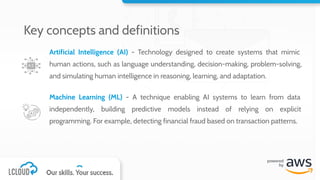
Artificial Intelligence (AI) - Technology designed to create systems that mimic
human actions, such as language understanding, decision-making, problem-solving,
and simulating human intelligence in reasoning, learning, and adaptation.
Machine Learning (ML) - A technique enabling AI systems to learn from data
independently, building predictive models instead of relying on explicit
programming. For example, detecting financial fraud based on transaction patterns.
Key concepts and definitions
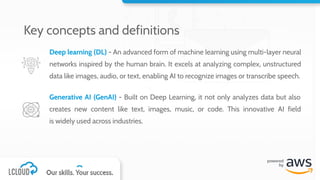
Deep learning (DL) - An advanced form of machine learning using multi-layer neural
networks inspired by the human brain. It excels at analyzing complex, unstructured
data like images, audio, or text, enabling AI to recognize images or transcribe speech.
Generative AI (GenAI) - Built on Deep Learning, it not only analyzes data but also
creates new content like text, images, music, or code. This innovative AI field
is widely used across industries.
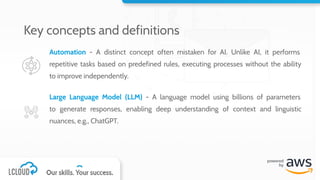
Key concepts and definitions
Automation - A distinct concept often mistaken for AI. Unlike AI, it performs
repetitive tasks based on predefined rules, executing processes without the ability
to improve independently.
Large Language Model (LLM) - A language model using billions of parameters
to generate responses, enabling deep understanding of context and linguistic
nuances, e.g., ChatGPT.
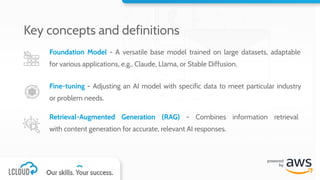
Key concepts and definitions
Foundation Model - A versatile base model trained on large datasets, adaptable
for various applications, e.g., Claude, Llama, or Stable Diffusion.
Fine-tuning - Adjusting an AI model with specific data to meet particular industry
or problem needs.
Retrieval-Augmented Generation (RAG) - Combines information retrieval
with content generation for accurate, relevant AI responses.
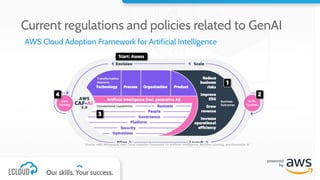
AWS Cloud Adoption Framework for Artificial Intelligence
Source: AWS Whitepaper, AWS Cloud Adoption Framework for Artificial Intelligence, Machine Learning, and Generative AI
Current regulations and policies related to GenAI
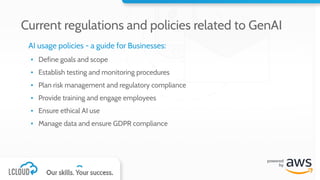
AI usage policies - a guide for Businesses:
▪ Define goals and scope
▪ Establish testing and monitoring procedures
▪ Plan risk management and regulatory compliance
▪ Provide training and engage employees
▪ Ensure ethical AI use
▪ Manage data and ensure GDPR compliance
Current regulations and policies related to GenAI
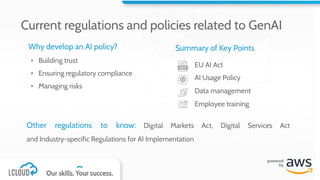
Why develop an AI policy?
▪ Building trust
▪ Ensuring regulatory compliance
▪ Managing risks
Other regulations to know: Digital Markets Act, Digital Services Act
and Industry-specific Regulations for AI Implementation
Summary of Key Points
EU AI Act
AI Usage Policy
Data management
Employee training
Current regulations and policies related to GenAI
Customer:
▪ A low-code platform for remote collaboration and task management, offering
features like task assignment, project tracking, calendar management and document
sharing for business users across industries.
Challenges:
▪ The onboarding process was too lengthy, taking up to 3 months, with high costs due
to mentors' involvement. Communication barriers and lack of motivation hindered
efficient onboarding, with new hires preferring to ask a bot over mentors.
Case Study 1: Chatbot for onboarding support
Solutions:
▪ An AI chatbot integrated Amazon Q for Business with Slack, company PDFs, video tutorials
and a knowledge base. The bot acted as a personal onboarding assistant, providing instant
answers and combining information from Slack, PDFs and videos.
Benefits:
▪ Productivity and motivation increased, as communication barriers were reduced, enabling freer
interactions with the chatbot. Onboarding time shortened with immediate answers, reducing
costs by 40%, and the solution proved scalable for other areas, like customer support.
Learn more by reading the full case study.
Case Study 1: Chatbot for onboarding support
A food production company in the FMCG sector aimed to automate quality control
to address high costs, human error, and subjective evaluations.
An AI-powered system processed images from 4 cameras on 4 production lines,
assessed packaging quality, and removed defective products automatically.
The solution reduced labor costs, minimized errors, and optimized defect detection using
YOLO models, ensuring scalable and efficient quality control.
Want to learn more? Download the full case study by clicking this link.
Case study 2: Image analysis on the production line
A platform for personalized diets and recipes utilized AI to enhance user experience and
support rapid growth.
The AI-powered virtual nutritionist provided personalized recommendations,
faster responses and natural communication, ensuring data security via AWS.
Key outcomes included faster order completion, cost savings, improved
user satisfaction and scalable, secure operations.
Learn more by exploring the full case study.
Case Study 3: Virtual Nutritionist
Funding Options and POC for GenAI Projects
Proof of Concept with LCloud
▪ Collaboration with experienced engineers specializing in AI projects,
▪ Support in selecting the right technology, working with data, and managing the entire
AI adoption process in your company,
▪ Access to AWS funding programs, requiring only your team’s involvement
as an investment,
▪ Opportunity to receive up to $10,000 in non-repayable funding.
LCloud and AWS support you in EU funding programs by:
▪ assessing opportunities to secure EU funding,
▪ identifying relevant grant competitions,
▪ planning and optimizing architecture,
▪ collaborating with firms specializing in grant applications,
▪ meeting environmental requirements,
▪ selecting subcontractors for R&D, including academic partners,
▪ participating in international projects.
Funding Options and POC for GenAI Projects
Contact us
LCloud Sp. z o.o.
Złota 59
00-120 Warszawa
+48 22 355 23 55
kontakt@lcloud.pl
Quick contact:
biuro@lcloud.pl
Business:
sale@lcloud.pl
+48 22 355 23 57

From vision to real value | Generative AI (GenAI)

  • 1.
    From Vision toReal Value: How and Where to Leverage GenAI?
  • 2.
    Artificial Intelligence (AI)- Technology designed to create systems that mimic human actions, such as language understanding, decision-making, problem-solving, and simulating human intelligence in reasoning, learning, and adaptation. Machine Learning (ML) - A technique enabling AI systems to learn from data independently, building predictive models instead of relying on explicit programming. For example, detecting financial fraud based on transaction patterns. Key concepts and definitions
  • 3.
    Deep learning (DL)- An advanced form of machine learning using multi-layer neural networks inspired by the human brain. It excels at analyzing complex, unstructured data like images, audio, or text, enabling AI to recognize images or transcribe speech. Generative AI (GenAI) - Built on Deep Learning, it not only analyzes data but also creates new content like text, images, music, or code. This innovative AI field is widely used across industries. Key concepts and definitions
  • 4.
    Automation - Adistinct concept often mistaken for AI. Unlike AI, it performs repetitive tasks based on predefined rules, executing processes without the ability to improve independently. Large Language Model (LLM) - A language model using billions of parameters to generate responses, enabling deep understanding of context and linguistic nuances, e.g., ChatGPT. Key concepts and definitions
  • 5.
    Key concepts anddefinitions Foundation Model - A versatile base model trained on large datasets, adaptable for various applications, e.g., Claude, Llama, or Stable Diffusion. Fine-tuning - Adjusting an AI model with specific data to meet particular industry or problem needs. Retrieval-Augmented Generation (RAG) - Combines information retrieval with content generation for accurate, relevant AI responses.
  • 6.
    AWS Cloud AdoptionFramework for Artificial Intelligence Source: AWS Whitepaper, AWS Cloud Adoption Framework for Artificial Intelligence, Machine Learning, and Generative AI Current regulations and policies related to GenAI
  • 7.
    AI usage policies- a guide for Businesses: ▪ Define goals and scope ▪ Establish testing and monitoring procedures ▪ Plan risk management and regulatory compliance ▪ Provide training and engage employees ▪ Ensure ethical AI use ▪ Manage data and ensure GDPR compliance Current regulations and policies related to GenAI
  • 8.
    Why develop anAI policy? ▪ Building trust ▪ Ensuring regulatory compliance ▪ Managing risks Other regulations to know: Digital Markets Act, Digital Services Act and Industry-specific Regulations for AI Implementation Summary of Key Points EU AI Act AI Usage Policy Data management Employee training Current regulations and policies related to GenAI
  • 9.
    Customer: ▪ A low-codeplatform for remote collaboration and task management, offering features like task assignment, project tracking, calendar management and document sharing for business users across industries. Challenges: ▪ The onboarding process was too lengthy, taking up to 3 months, with high costs due to mentors' involvement. Communication barriers and lack of motivation hindered efficient onboarding, with new hires preferring to ask a bot over mentors. Case Study 1: Chatbot for onboarding support
  • 10.
    Solutions: ▪ An AIchatbot integrated Amazon Q for Business with Slack, company PDFs, video tutorials and a knowledge base. The bot acted as a personal onboarding assistant, providing instant answers and combining information from Slack, PDFs and videos. Benefits: ▪ Productivity and motivation increased, as communication barriers were reduced, enabling freer interactions with the chatbot. Onboarding time shortened with immediate answers, reducing costs by 40%, and the solution proved scalable for other areas, like customer support. Learn more by reading the full case study. Case Study 1: Chatbot for onboarding support
  • 11.
    A food productioncompany in the FMCG sector aimed to automate quality control to address high costs, human error, and subjective evaluations. An AI-powered system processed images from 4 cameras on 4 production lines, assessed packaging quality, and removed defective products automatically. The solution reduced labor costs, minimized errors, and optimized defect detection using YOLO models, ensuring scalable and efficient quality control. Want to learn more? Download the full case study by clicking this link. Case study 2: Image analysis on the production line
  • 12.
    A platform forpersonalized diets and recipes utilized AI to enhance user experience and support rapid growth. The AI-powered virtual nutritionist provided personalized recommendations, faster responses and natural communication, ensuring data security via AWS. Key outcomes included faster order completion, cost savings, improved user satisfaction and scalable, secure operations. Learn more by exploring the full case study. Case Study 3: Virtual Nutritionist
  • 13.
    Funding Options andPOC for GenAI Projects Proof of Concept with LCloud ▪ Collaboration with experienced engineers specializing in AI projects, ▪ Support in selecting the right technology, working with data, and managing the entire AI adoption process in your company, ▪ Access to AWS funding programs, requiring only your team’s involvement as an investment, ▪ Opportunity to receive up to $10,000 in non-repayable funding.
  • 14.
    LCloud and AWSsupport you in EU funding programs by: ▪ assessing opportunities to secure EU funding, ▪ identifying relevant grant competitions, ▪ planning and optimizing architecture, ▪ collaborating with firms specializing in grant applications, ▪ meeting environmental requirements, ▪ selecting subcontractors for R&D, including academic partners, ▪ participating in international projects. Funding Options and POC for GenAI Projects
  • 15.
    Contact us LCloud Sp.z o.o. Złota 59 00-120 Warszawa +48 22 355 23 55 kontakt@lcloud.pl Quick contact: biuro@lcloud.pl Business: sale@lcloud.pl +48 22 355 23 57