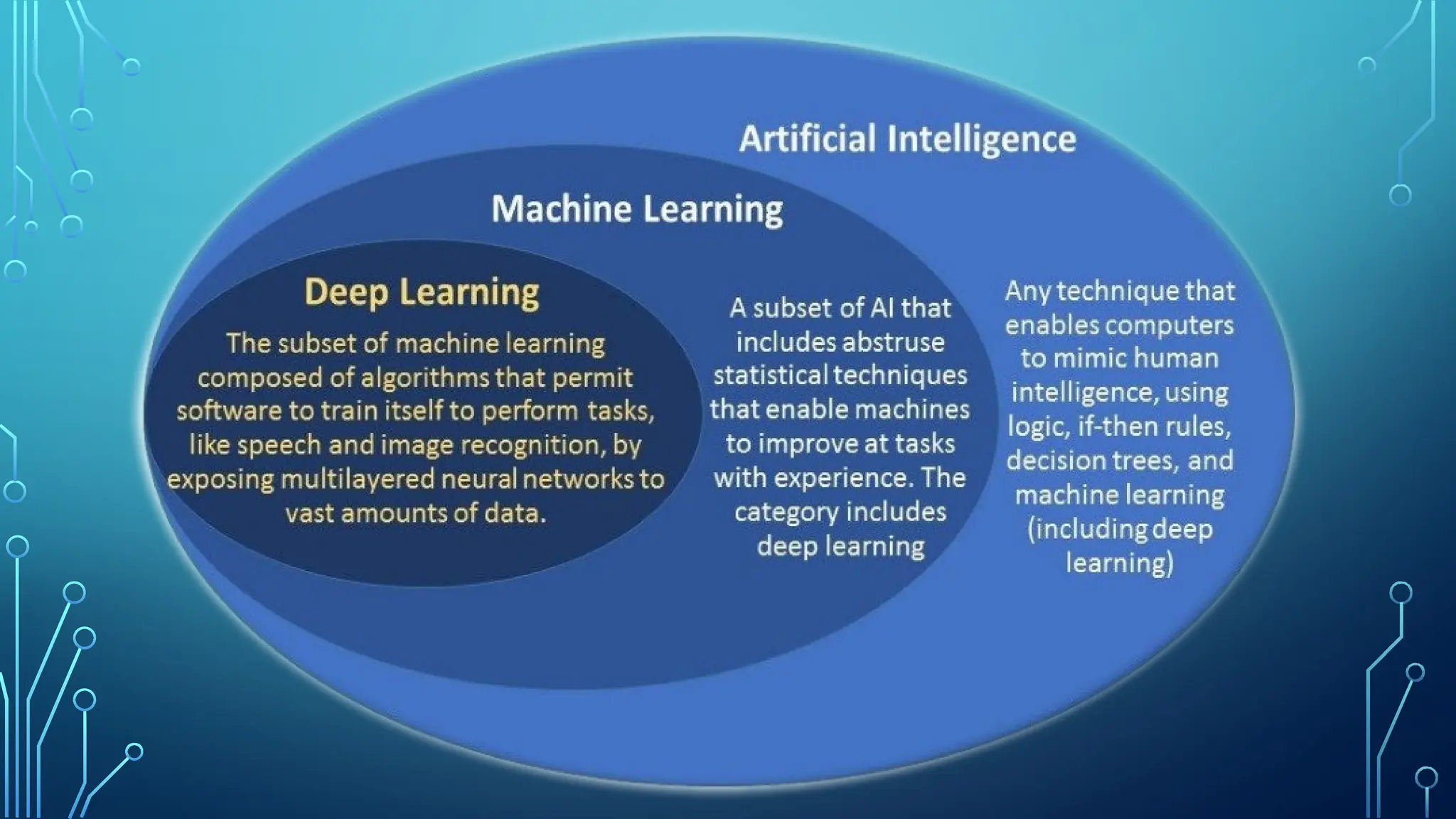
AI Artificial Intelligent
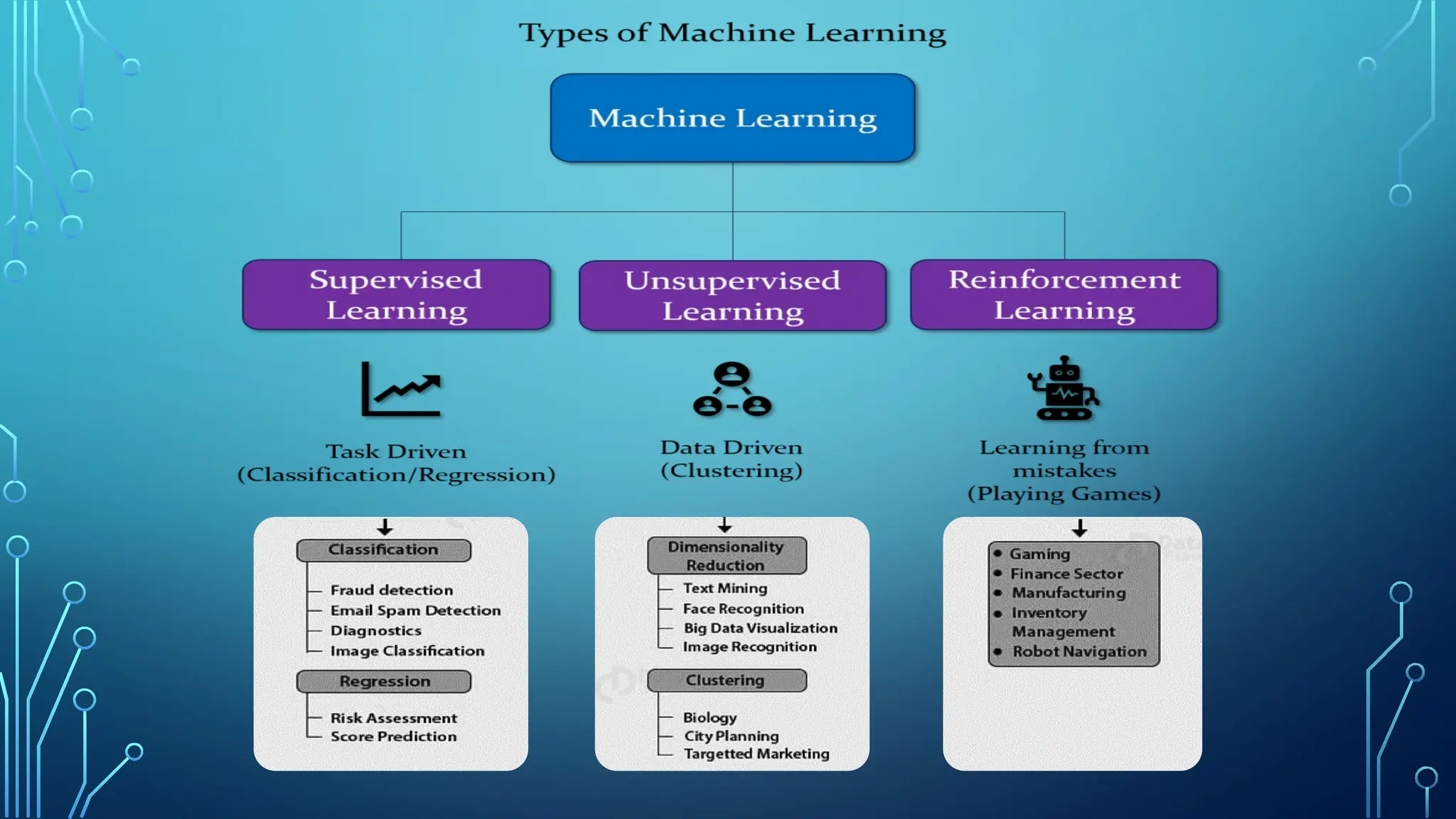
Machine Learning
Deep Learning
1. Introduction
DEFINITION
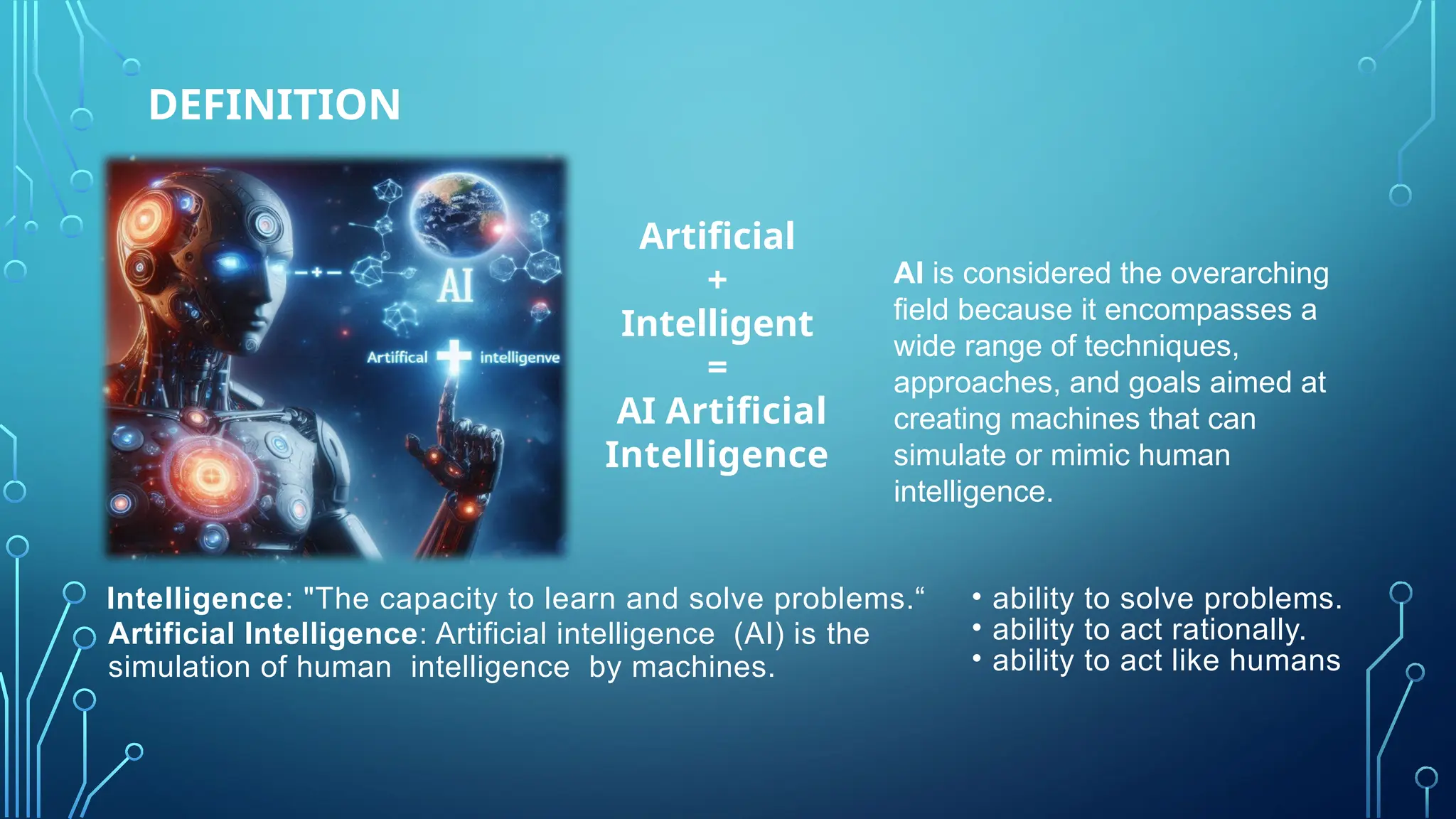
Intelligence: "The capacity to learn and solve problems.“
Artificial Intelligence: Artificial intelligence (AI) is the
simulation of human intelligence by machines.
Artificial
+
Intelligent
=
AI Artificial
Intelligence
AI is considered the overarching
field because it encompasses a
wide range of techniques,
approaches, and goals aimed at
creating machines that can
simulate or mimic human
intelligence.
• ability to solve problems.
• ability to act rationally.
• ability to act like humans
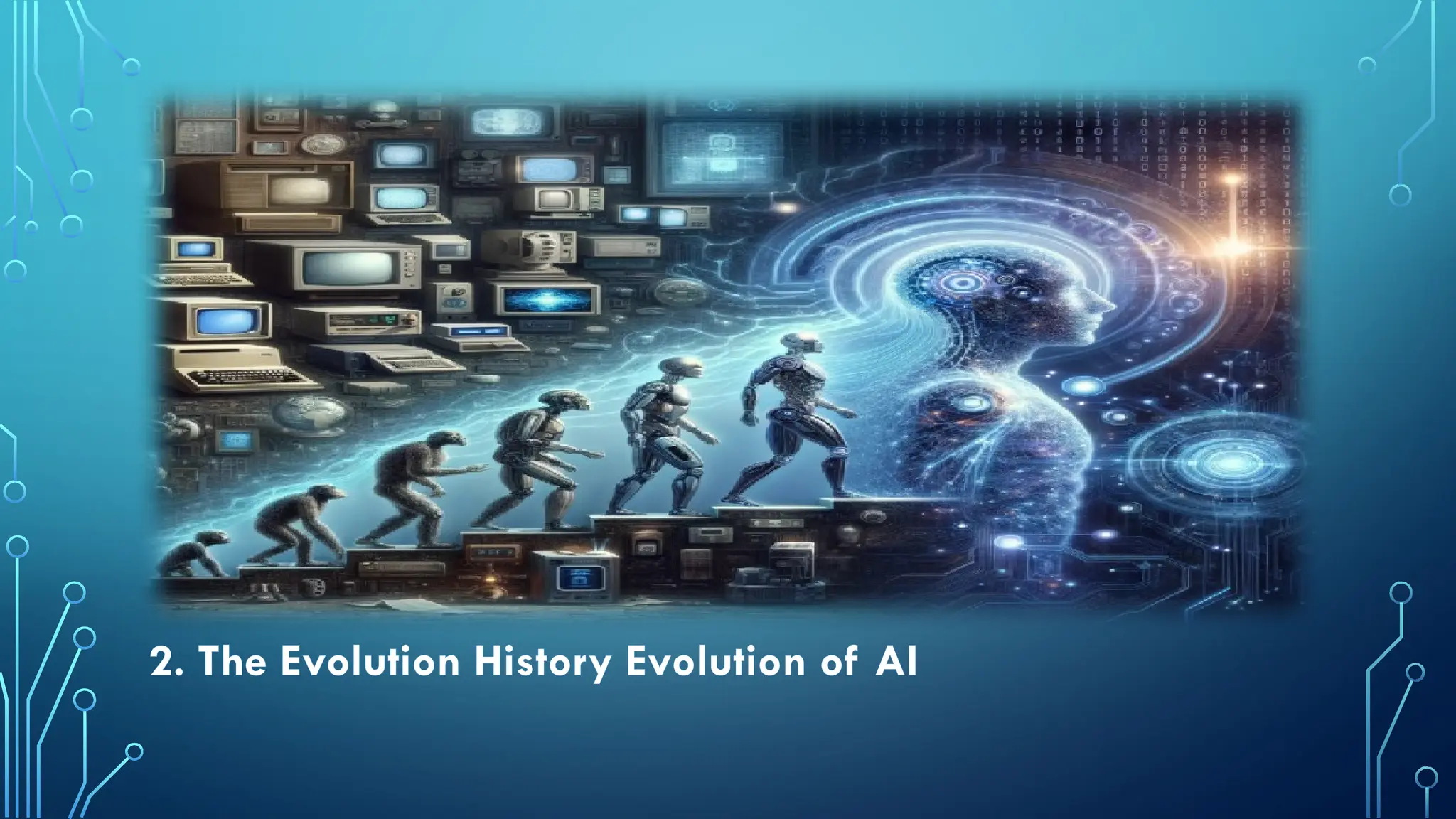
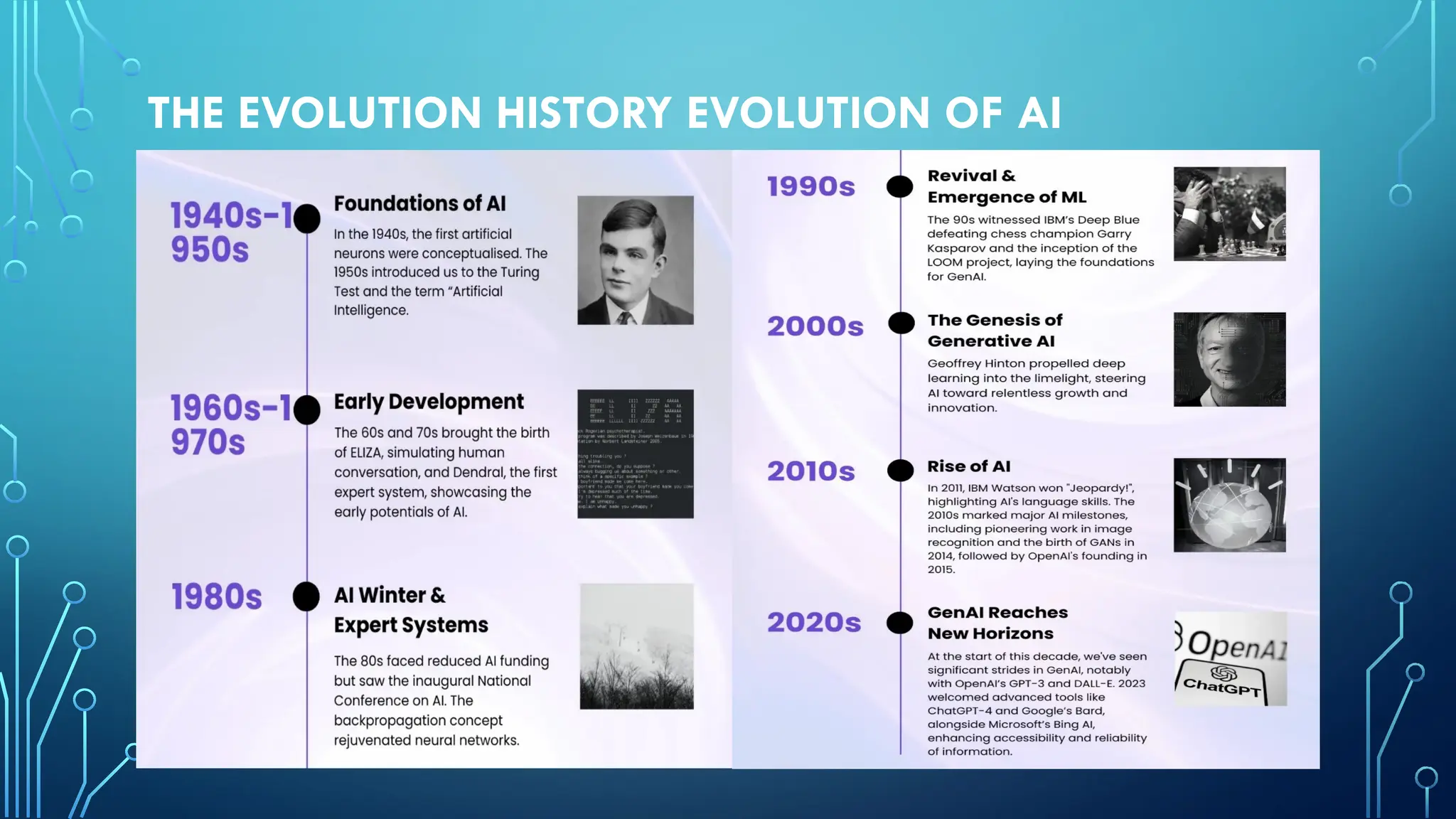
2. The Evolution History Evolution of AI
THE EVOLUTION HISTORY EVOLUTION OF AI
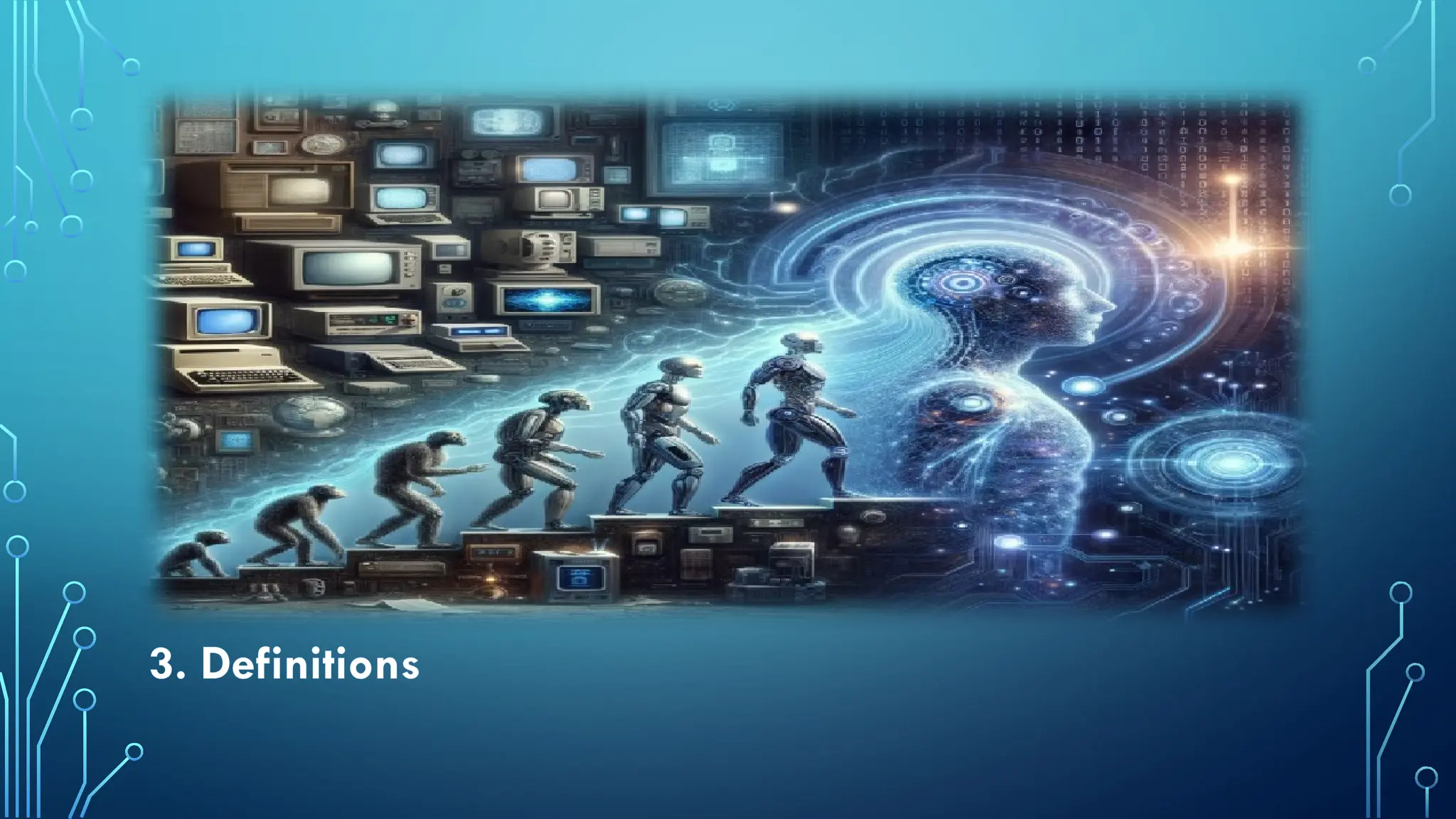
3. Definitions
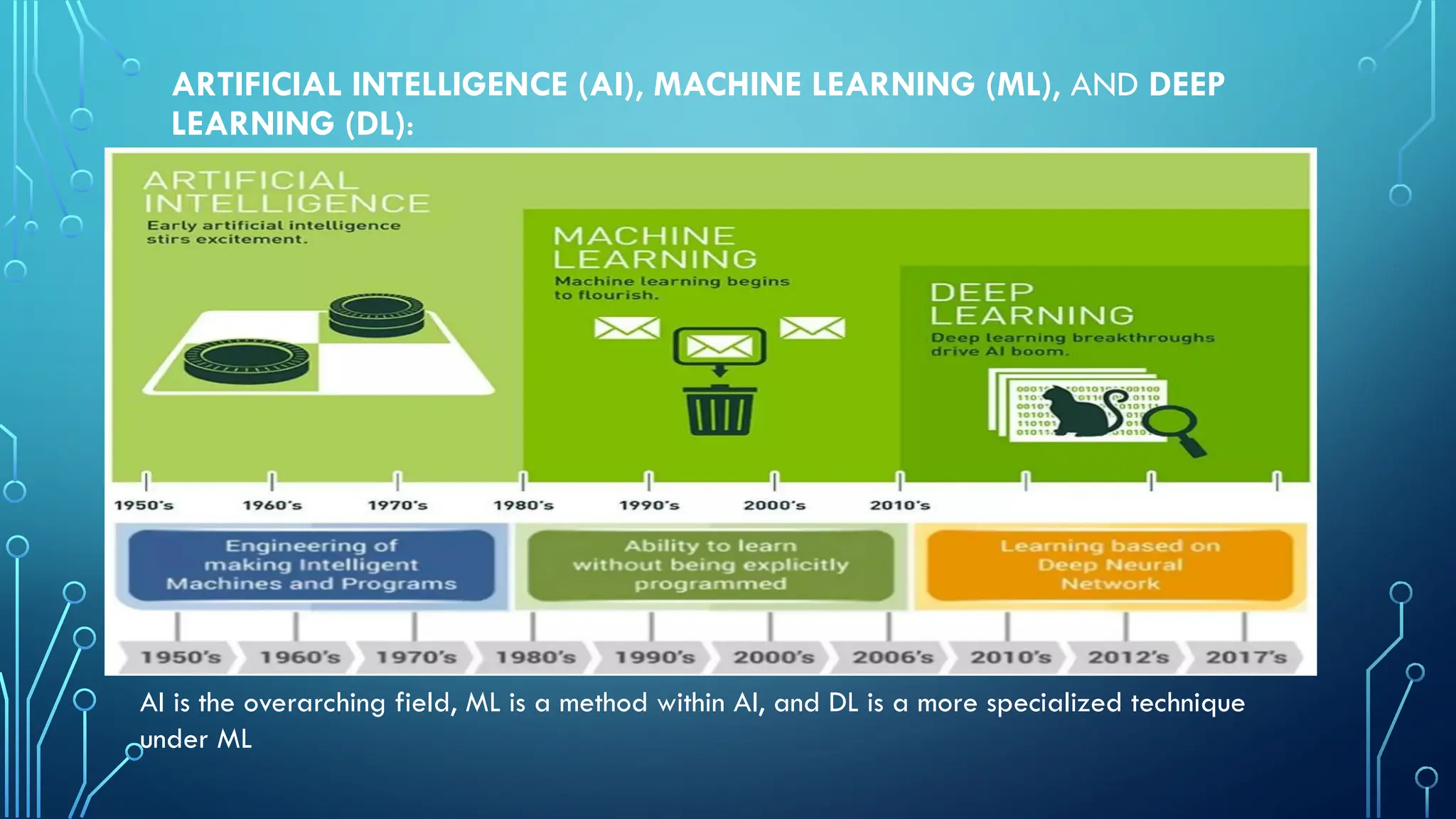
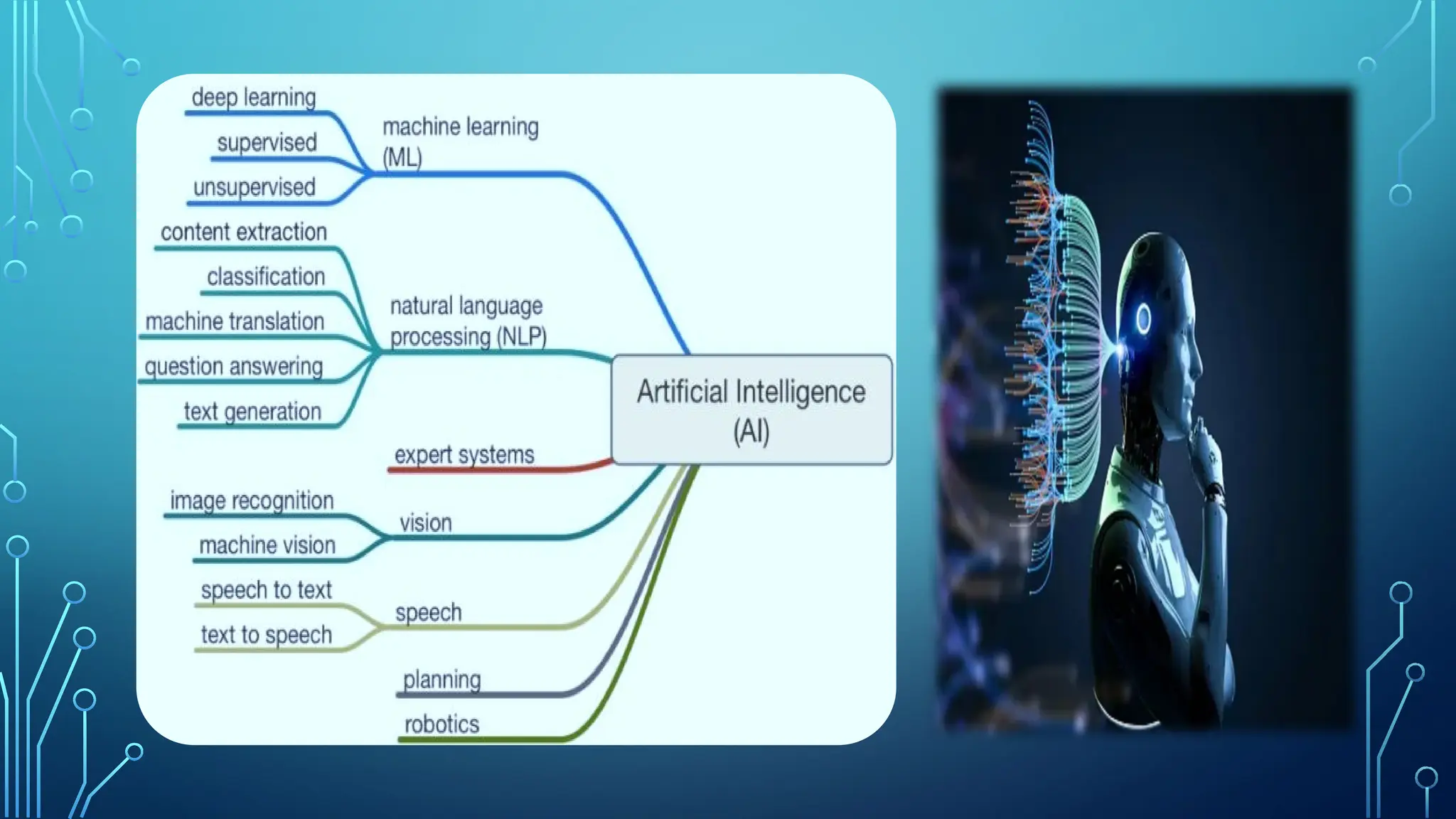
AI is the overarching field, ML is a method within AI, and DL is a more specialized technique
under ML
ARTIFICIAL INTELLIGENCE (AI), MACHINE LEARNING (ML), AND DEEP
LEARNING (DL):
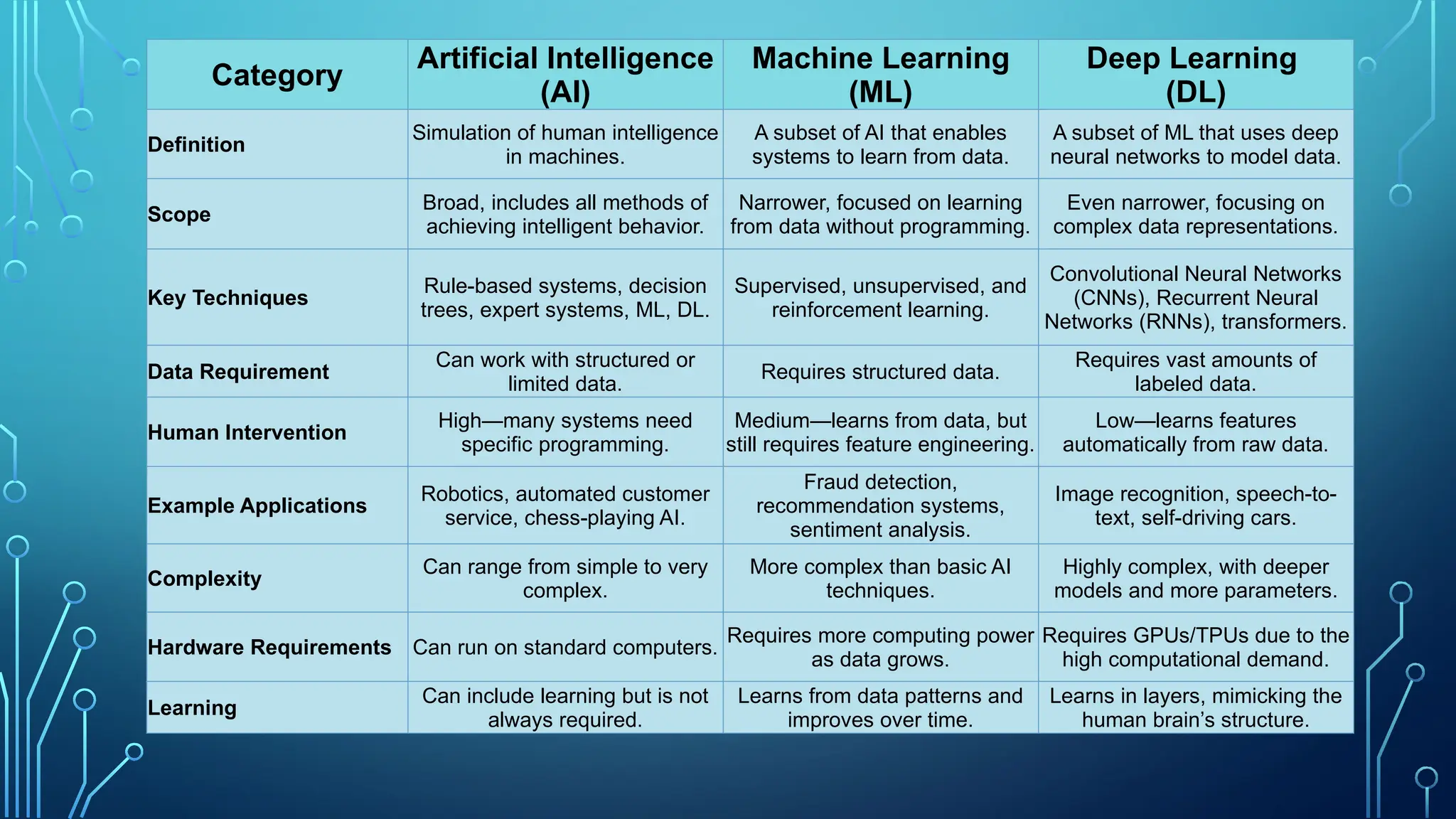
Category
Artificial Intelligence
(AI)
Machine Learning
(ML)
Deep Learning
(DL)
Definition
Simulation of human intelligence
in machines.
A subset of AI that enables
systems to learn from data.
A subset of ML that uses deep
neural networks to model data.
Scope
Broad, includes all methods of
achieving intelligent behavior.
Narrower, focused on learning
from data without programming.
Even narrower, focusing on
complex data representations.
Key Techniques
Rule-based systems, decision
trees, expert systems, ML, DL.
Supervised, unsupervised, and
reinforcement learning.
Convolutional Neural Networks
(CNNs), Recurrent Neural
Networks (RNNs), transformers.
Data Requirement
Can work with structured or
limited data.
Requires structured data.
Requires vast amounts of
labeled data.
Human Intervention
High—many systems need
specific programming.
Medium—learns from data, but
still requires feature engineering.
Low—learns features
automatically from raw data.
Example Applications
Robotics, automated customer
service, chess-playing AI.
Fraud detection,
recommendation systems,
sentiment analysis.
Image recognition, speech-to-
text, self-driving cars.
Complexity
Can range from simple to very
complex.
More complex than basic AI
techniques.
Highly complex, with deeper
models and more parameters.
Hardware Requirements Can run on standard computers.
Requires more computing power
as data grows.
Requires GPUs/TPUs due to the
high computational demand.
Learning
Can include learning but is not
always required.
Learns from data patterns and
improves over time.
Learns in layers, mimicking the
human brain’s structure.
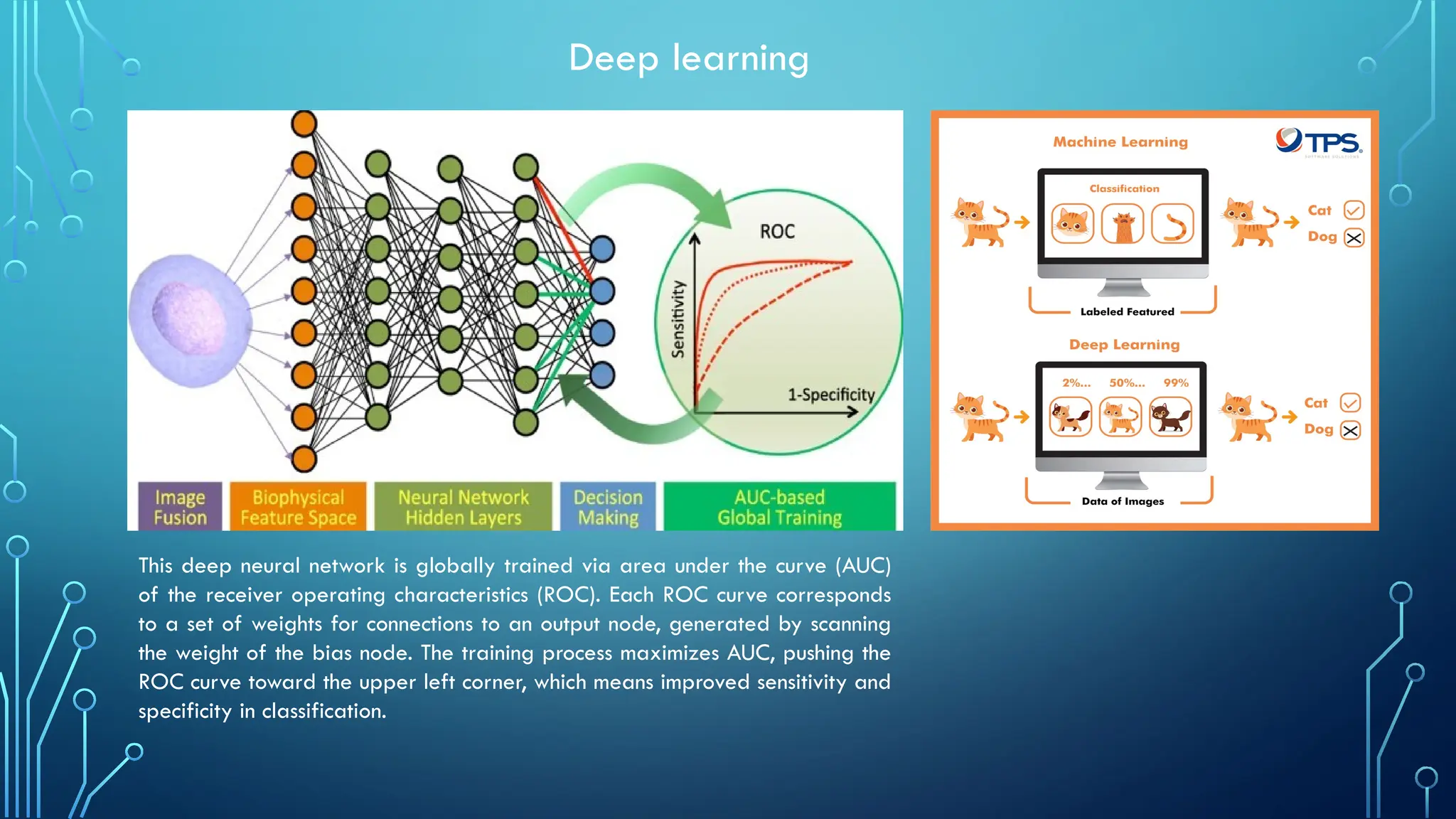
This deep neural network is globally trained via area under the curve (AUC)
of the receiver operating characteristics (ROC). Each ROC curve corresponds
to a set of weights for connections to an output node, generated by scanning
the weight of the bias node. The training process maximizes AUC, pushing the
ROC curve toward the upper left corner, which means improved sensitivity and
specificity in classification.
Deep learning
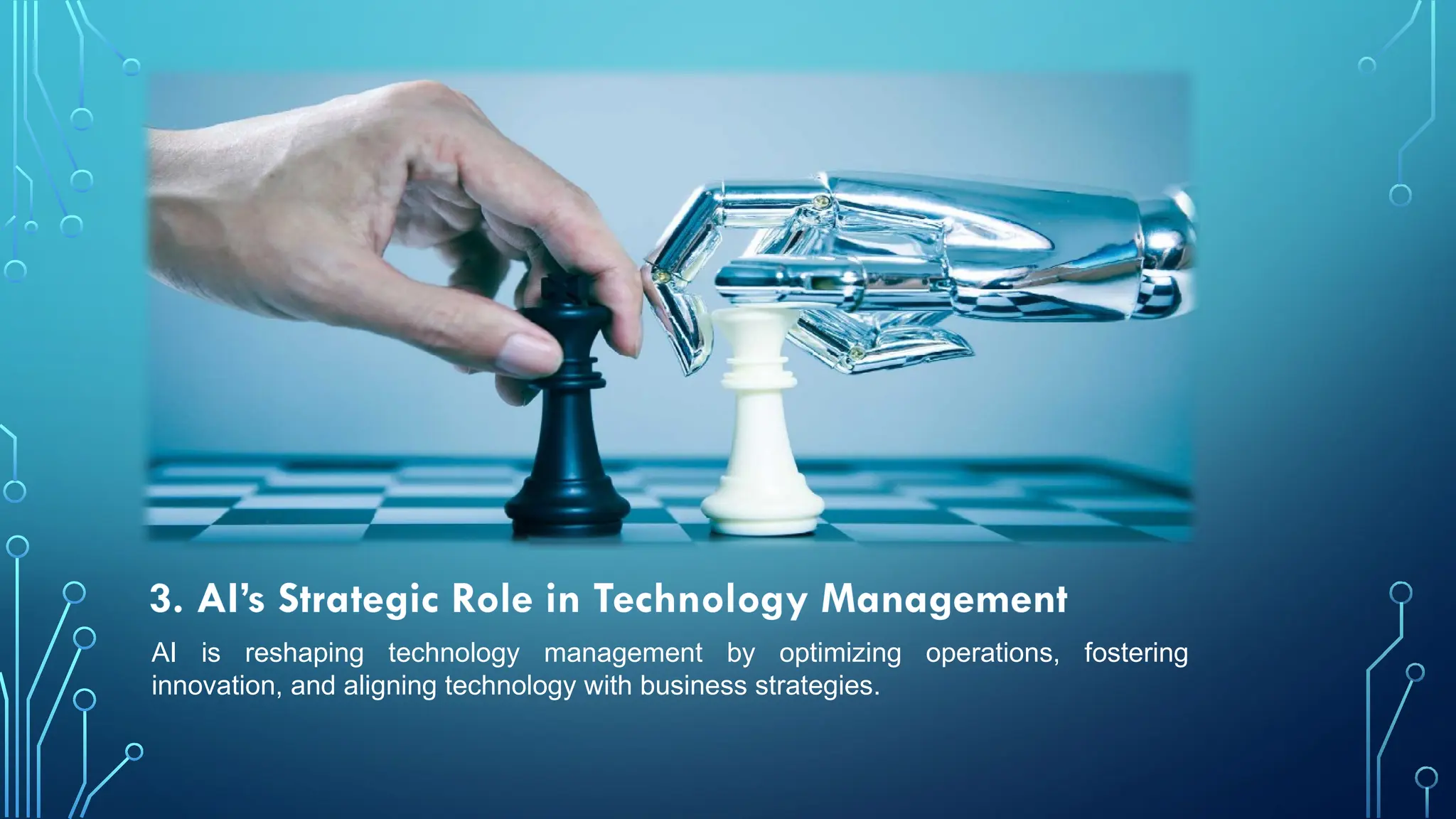
3. AI’s Strategic Role in Technology Management
AI is reshaping technology management by optimizing operations, fostering
innovation, and aligning technology with business strategies.
1. AI FOR IT INFRASTRUCTURE MANAGEMENT
Automated IT Operations (AIOps):
• AI helps manage and optimize IT infrastructures
through AIOps platforms, which use machine
learning to predict system failures, resolve issues
in real-time, and enhance network security.
• Predictive Maintenance: AI-powered tools can
foresee potential breakdowns in IT hardware or
software systems, allowing preemptive repairs
and reducing downtime.
• Dynamic Resource Allocation: AI monitors usage
patterns and automatically allocates computing
resources to where they are needed, improving
system performance and efficiency.
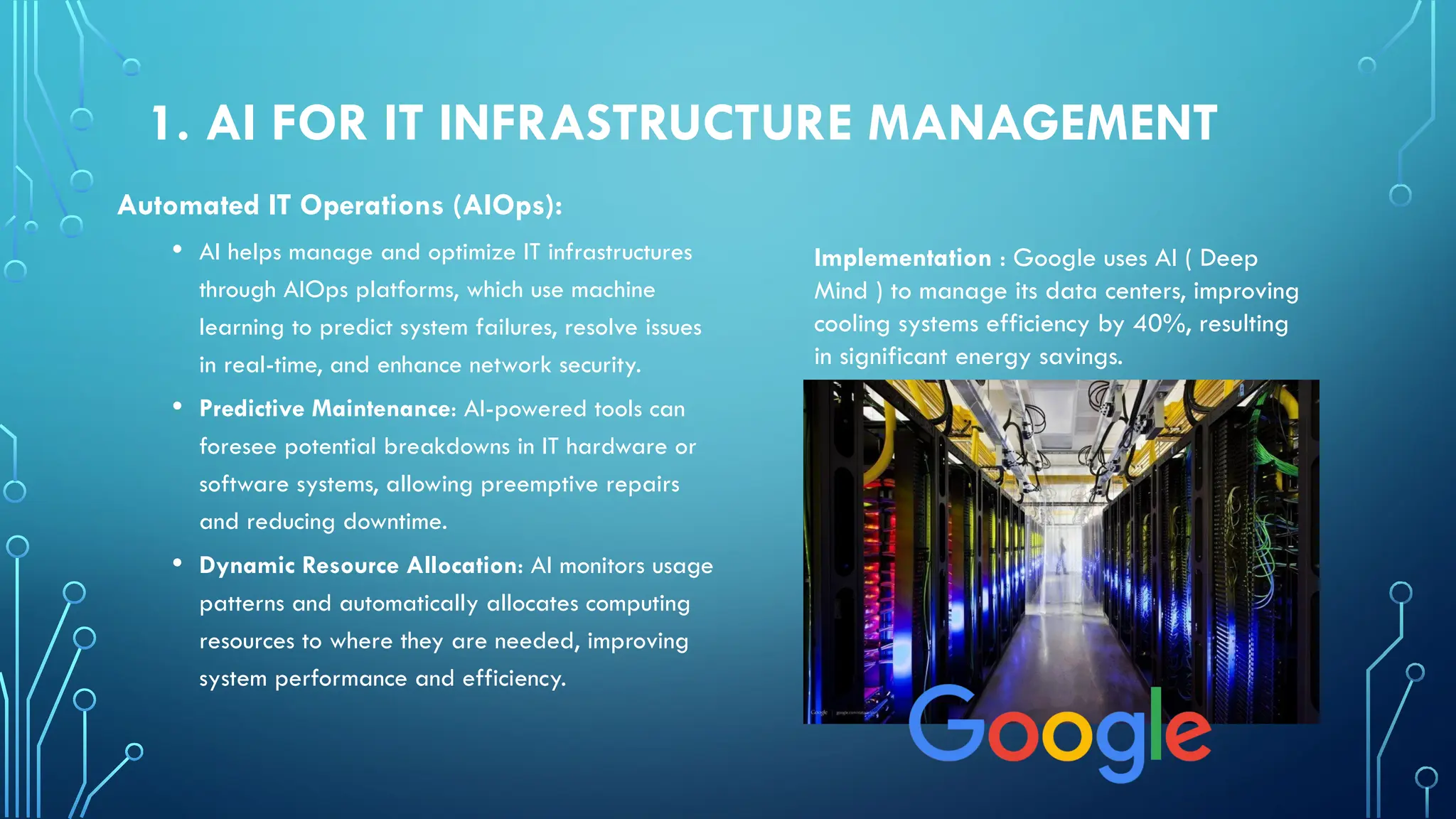
Implementation : Google uses AI ( Deep
Mind ) to manage its data centers, improving
cooling systems efficiency by 40%, resulting
in significant energy savings.
•Data-Driven Strategic Planning:
• AI provides actionable insights by analyzing large
datasets from various sources, helping tech
leaders make informed decisions regarding
technology investments, innovation, and long-term
strategy.
• AI-Enhanced Forecasting: AI models help
anticipate future technology trends, market
demands, and emerging threats, allowing
companies to stay ahead of competitors.
• Example: IBM's Watson AI assists companies in
designing data-driven technology strategies,
assessing risks, and identifying new opportunities
for innovation.
•AI in Innovation Management:
• AI systems can analyze patent data, R&D
outcomes, and emerging technologies to spot
trends and gaps in innovation. This enables
businesses to focus their innovation efforts on
high-impact areas, reduce research time, and
speed up the time-to-market for new
technologies.
2. ENHANCING DECISION-MAKING IN TECHNOLOGY STRATEGY
Readily build custom AI applications for your business, manage all
data sources, and accelerate responsible AI workflows—all on one
platform.
https://youtu.be/WZMJHh4yz6g?si=yrX6La8s_c0NqC4V
3. OPTIMIZING SOFTWARE DEVELOPMENT AND LIFECYCLE MANAGEMENT
• AI in DevOps:
• AI is increasingly integrated into DevOps
processes, automating the software
development lifecycle, from code generation
to testing, deployment, and maintenance.
• Automated Testing and Debugging: AI
tools can detect bugs, errors, or inefficiencies
in code before it’s deployed, drastically
reducing development time and improving
product quality.
• Predictive Analytics for IT Operations: AI
helps developers anticipate potential system
failures or security vulnerabilities during the
development process, optimizing the
software’s reliability.
https://youtu.be/jxXyz86vwcU
Example: Microsoft's Azure DevOps services leverage AI to
provide real-time analytics and predictive insights to developers,
improving deployment cycles and service delivery.
4. AI-DRIVEN CYBERSECURITY AND RISK MANAGEMENT
• AI in Cybersecurity:
• AI plays a key role in detecting and mitigating
cyber threats by using machine learning to
recognize attack patterns, identify vulnerabilities,
and respond to incidents autonomously.
• Threat Detection: AI-based systems can detect
irregular patterns in network behavior, helping
prevent data breaches and phishing attacks.
• Incident Response Automation: AI tools are
used to automatically address security threats as
they arise, allowing for faster resolution and
minimizing damage to the organization’s IT
systems.
https://youtu.be/-W63WHhsftM?si=XIJqyU-7Uth7rtAs
Example: Darktrace, a cybersecurity company, uses AI to
autonomously detect and respond to cyber threats in real time,
helping businesses mitigate security risks without manual
intervention.
5. AI IN TECHNOLOGY PROCUREMENT AND VENDOR MANAGEMENT
• Smart Procurement:
• AI assists businesses in optimizing their procurement
strategies by analyzing market trends, comparing
vendors, and forecasting prices for hardware,
software, and services.
• Vendor Risk Management: AI tools assess the risk
associated with different vendors by analyzing
performance data, compliance history, and
financial stability, ensuring that companies choose
reliable technology partners.
• Contract Optimization: AI helps businesses
negotiate contracts more effectively by reviewing
historical data and market trends to suggest
optimal terms.
Implementation: GE uses AI to streamline procurement for its industrial
operations, automating contract management and vendor selection
based on performance data and predictive analytics.
6. AI IN PROJECT AND PORTFOLIO MANAGEMENT (PPM)
• AI-Enhanced Project Management:
• AI helps optimize project management by
providing real-time insights into resource
allocation, project risks, timelines, and
budgets.
• Predictive Project Analytics: AI systems can
predict project outcomes based on historical
data, helping managers identify risks and
allocate resources efficiently to ensure project
success.
• AI in Resource Planning: AI tools recommend
optimal resource distribution, reducing overall
costs and improving project outcomes.
Example: Companies like Oracle use AI-driven project management tools to ensure that
large IT projects are delivered on time and within budget by forecasting bottlenecks and
suggesting solutions.
https://youtu.be/H-C5dH3w1Dg
7. AI’S ROLE IN HUMAN CAPITAL AND TALENT MANAGEMENT IN TECH
AI for Talent Acquisition and Retention:
• In technology management, AI assists
with recruitment by analyzing resumes,
assessing skills, and predicting candidate
success in specific roles.
• Skill Gap Analysis: AI identifies the skills
needed for future projects and compares
them to current employee capabilities,
helping companies plan training and
upskilling initiatives.
• AI in Performance Management: AI
systems monitor employee performance
metrics and provide personalized
feedback, enhancing talent development
and retention.
Example: SAP uses AI-based HR systems to manage talent pipelines,
improve workforce planning, and predict attrition rates.
https://youtu.be/z9d1NxbwyAg?si=aQUOV7_Ps2GpTe0s
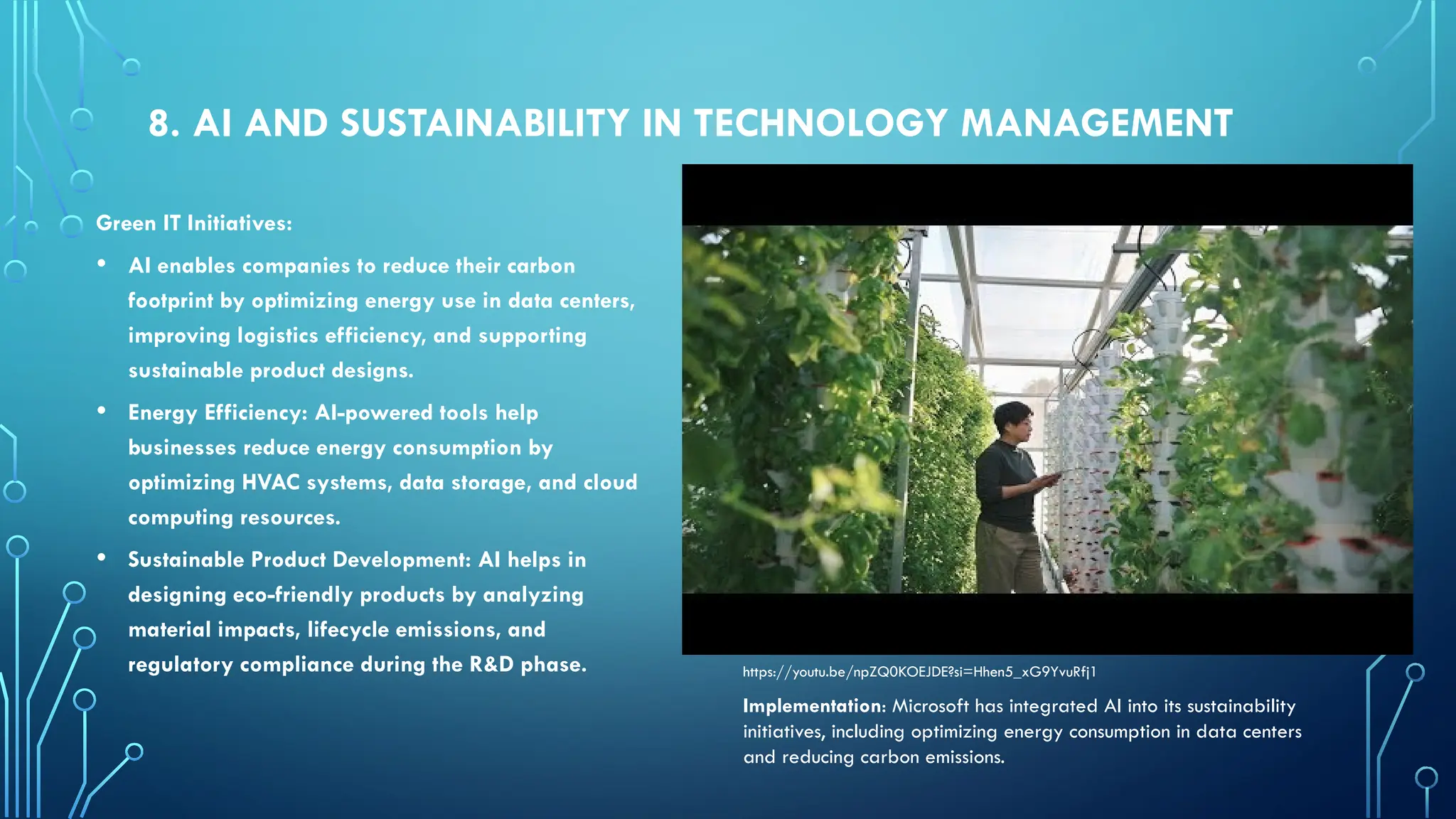
8. AI AND SUSTAINABILITY IN TECHNOLOGY MANAGEMENT
Green IT Initiatives:
• AI enables companies to reduce their carbon
footprint by optimizing energy use in data centers,
improving logistics efficiency, and supporting
sustainable product designs.
• Energy Efficiency: AI-powered tools help
businesses reduce energy consumption by
optimizing HVAC systems, data storage, and cloud
computing resources.
• Sustainable Product Development: AI helps in
designing eco-friendly products by analyzing
material impacts, lifecycle emissions, and
regulatory compliance during the R&D phase.
Implementation: Microsoft has integrated AI into its sustainability
initiatives, including optimizing energy consumption in data centers
and reducing carbon emissions.
https://youtu.be/npZQ0KOEJDE?si=Hhen5_xG9YvuRfj1
4. Machine Learning in Business Decision-Making
DEFINITION OF MACHINE LEARNING (ML):
MACHINE LEARNING (ML) IS A SUBSET OF ARTIFICIAL
INTELLIGENCE (AI) FOCUSED ON CREATING ALGORITHMS THAT
ENABLE COMPUTERS TO LEARN FROM DATA AND MAKE
PREDICTIONS OR DECISIONS WITHOUT BEING EXPLICITLY
PROGRAMMED.
ROLE OF ML IN AUTOMATING AND IMPROVING DECISION-
MAKING:
AUTOMATION: ML AUTOMATES REPETITIVE TASKS AND
PROCESSES, REDUCING MANUAL EFFORT AND INCREASING
EFFICIENCY.
IMPROVEMENT: BY ANALYZING LARGE DATASETS, ML MODELS
IDENTIFY PATTERNS AND INSIGHTS THAT ENHANCE DECISION-
MAKING ACCURACY AND SPEED, LEADING TO BETTER
OUTCOMES.
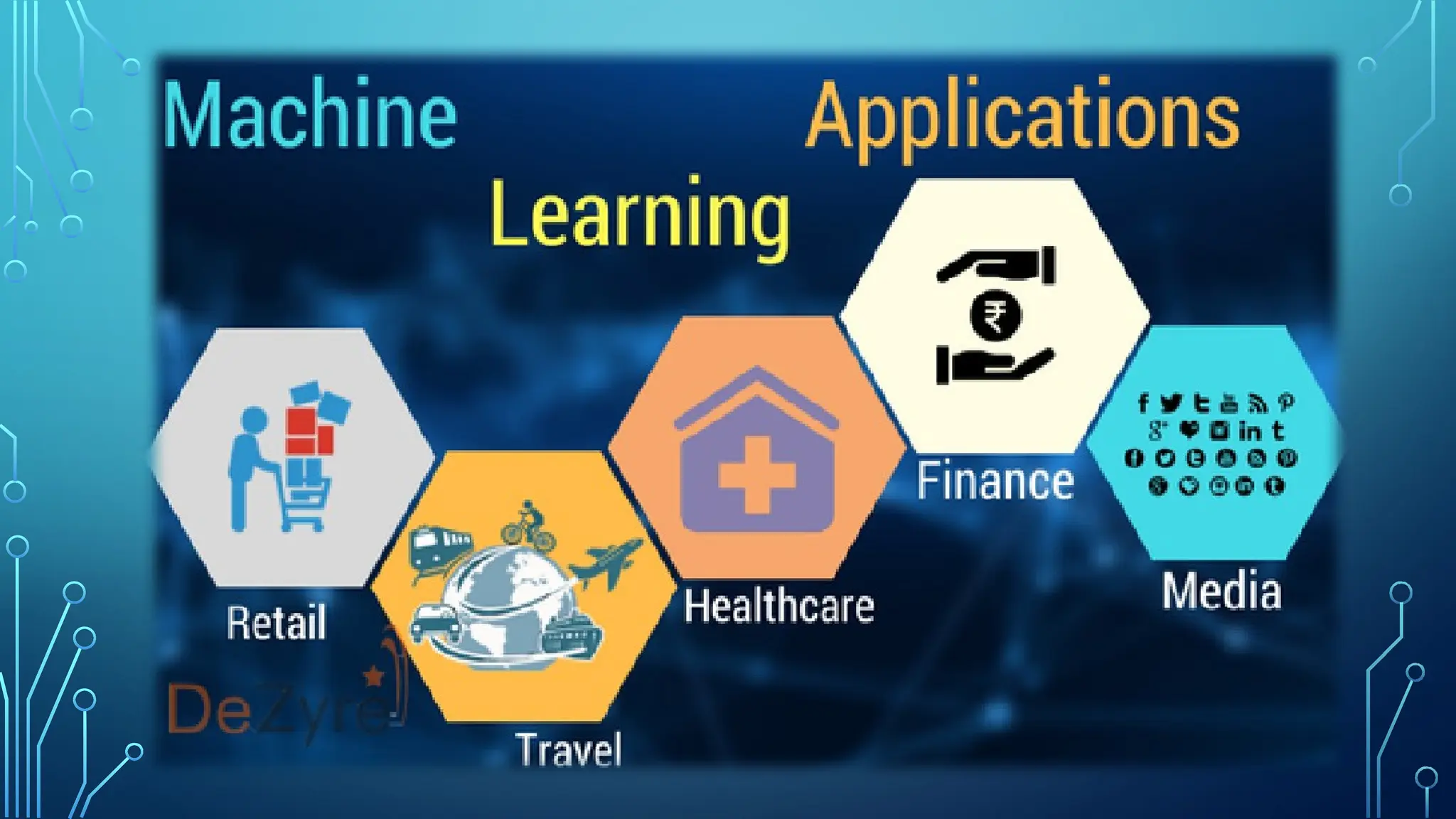
OVERVIEW OF APPLICATIONS ACROSS INDUSTRIES:
FINANCE: CREDIT RISK ASSESSMENT, FRAUD DETECTION,
ALGORITHMIC TRADING.
HEALTHCARE: DISEASE PREDICTION, PERSONALIZED MEDICINE,
PATIENT CARE OPTIMIZATION.
MARKETING: CUSTOMER SEGMENTATION, TARGETED
ADVERTISING, CAMPAIGN EFFECTIVENESS ANALYSIS.
RETAIL: DEMAND FORECASTING, INVENTORY MANAGEMENT,
PERSONALIZED RECOMMENDATIONS.
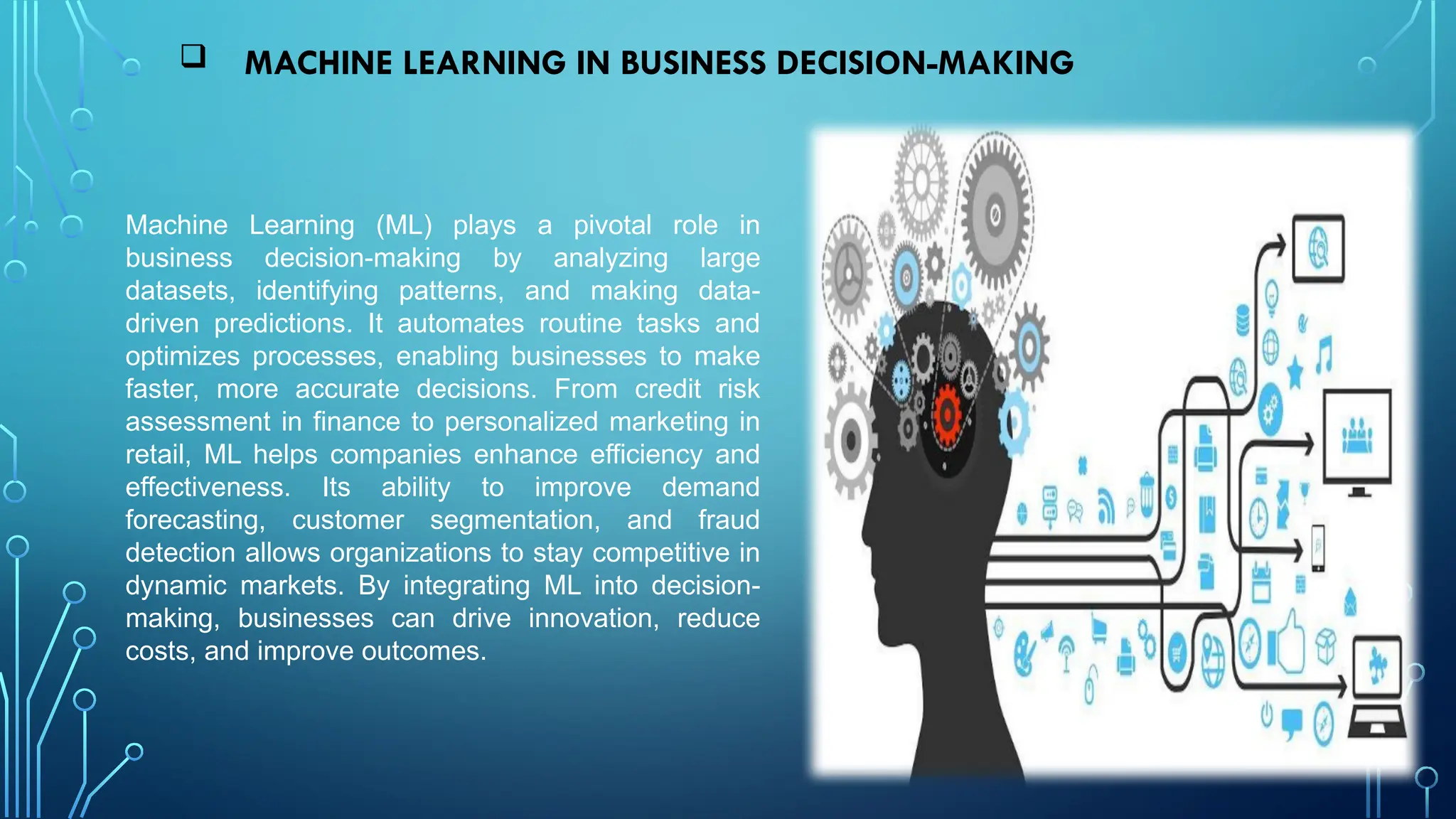
 MACHINE LEARNING IN BUSINESS DECISION-MAKING
Machine Learning (ML) plays a pivotal role in
business decision-making by analyzing large
datasets, identifying patterns, and making data-
driven predictions. It automates routine tasks and
optimizes processes, enabling businesses to make
faster, more accurate decisions. From credit risk
assessment in finance to personalized marketing in
retail, ML helps companies enhance efficiency and
effectiveness. Its ability to improve demand
forecasting, customer segmentation, and fraud
detection allows organizations to stay competitive in
dynamic markets. By integrating ML into decision-
making, businesses can drive innovation, reduce
costs, and improve outcomes.
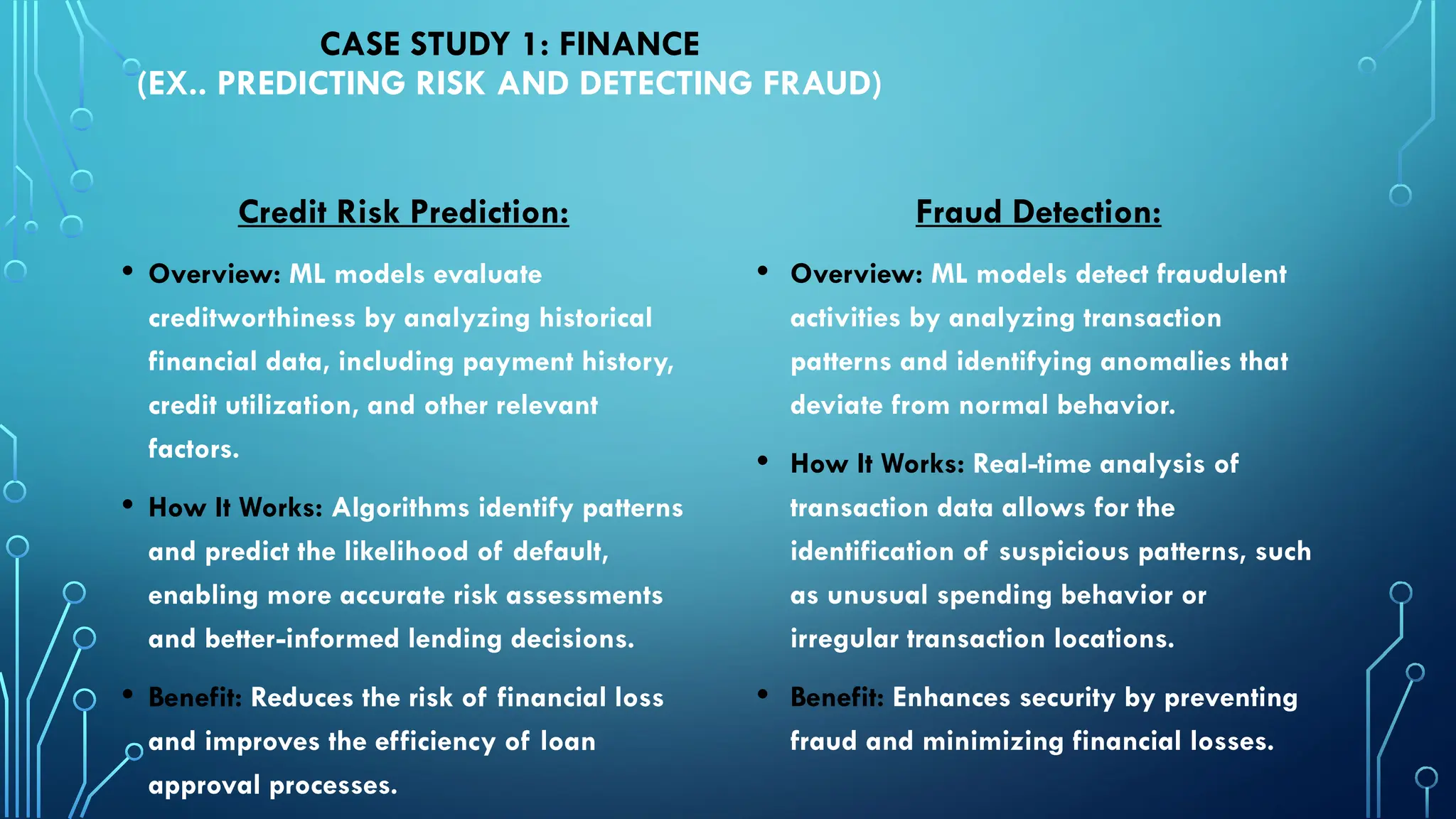
Credit Risk Prediction:
• Overview: ML models evaluate
creditworthiness by analyzing historical
financial data, including payment history,
credit utilization, and other relevant
factors.
• How It Works: Algorithms identify patterns
and predict the likelihood of default,
enabling more accurate risk assessments
and better-informed lending decisions.
• Benefit: Reduces the risk of financial loss
and improves the efficiency of loan
approval processes.
CASE STUDY 1: FINANCE
(EX.. PREDICTING RISK AND DETECTING FRAUD)
Fraud Detection:
• Overview: ML models detect fraudulent
activities by analyzing transaction
patterns and identifying anomalies that
deviate from normal behavior.
• How It Works: Real-time analysis of
transaction data allows for the
identification of suspicious patterns, such
as unusual spending behavior or
irregular transaction locations.
• Benefit: Enhances security by preventing
fraud and minimizing financial losses.
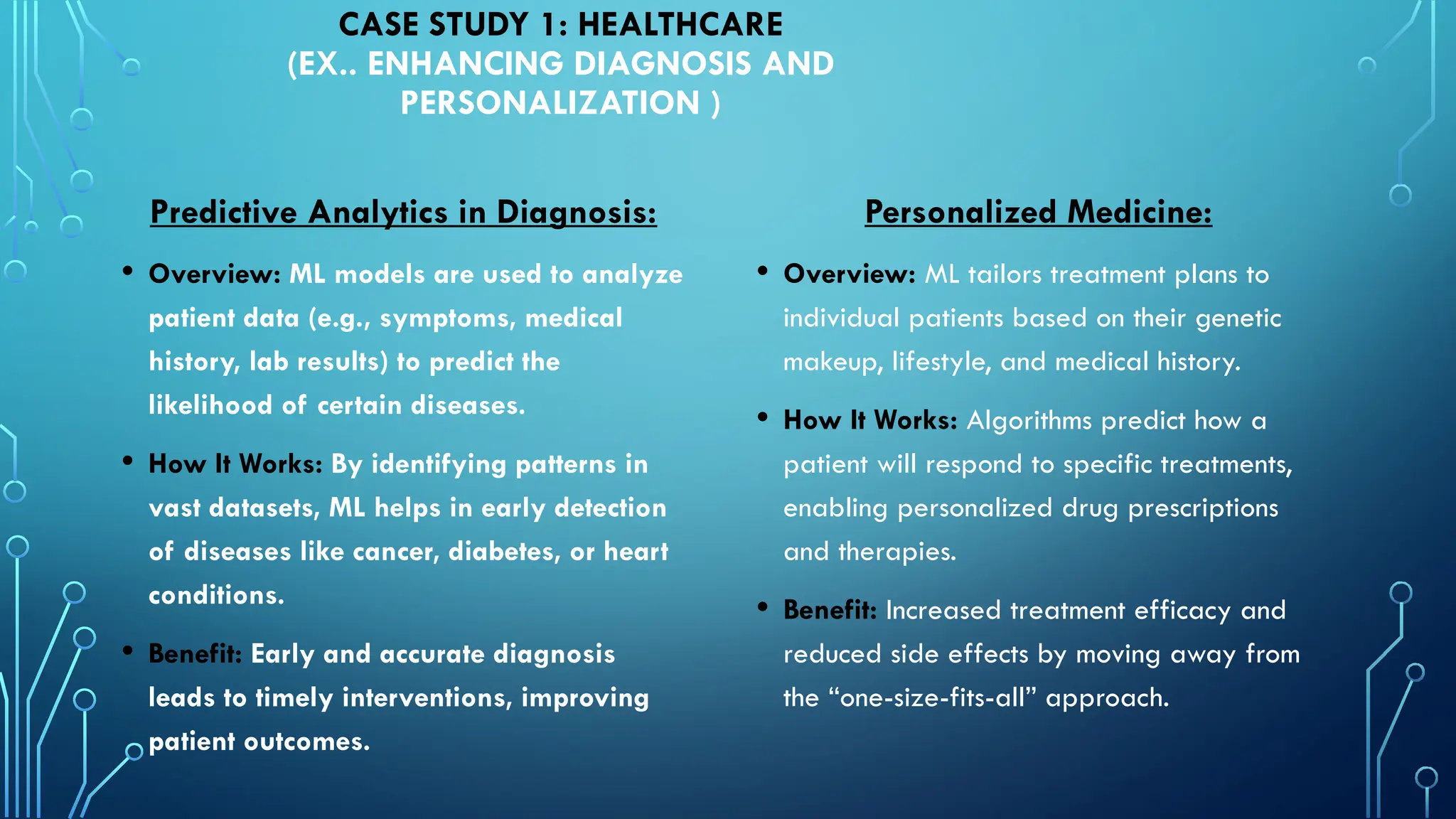
Predictive Analytics in Diagnosis:
• Overview: ML models are used to analyze
patient data (e.g., symptoms, medical
history, lab results) to predict the
likelihood of certain diseases.
• How It Works: By identifying patterns in
vast datasets, ML helps in early detection
of diseases like cancer, diabetes, or heart
conditions.
• Benefit: Early and accurate diagnosis
leads to timely interventions, improving
patient outcomes.
CASE STUDY 1: HEALTHCARE
(EX.. ENHANCING DIAGNOSIS AND
PERSONALIZATION )
Personalized Medicine:
• Overview: ML tailors treatment plans to
individual patients based on their genetic
makeup, lifestyle, and medical history.
• How It Works: Algorithms predict how a
patient will respond to specific treatments,
enabling personalized drug prescriptions
and therapies.
• Benefit: Increased treatment efficacy and
reduced side effects by moving away from
the “one-size-fits-all” approach.
5. THE TRANSFORMATIONAL POTENTIAL OF DEEP LEARNING
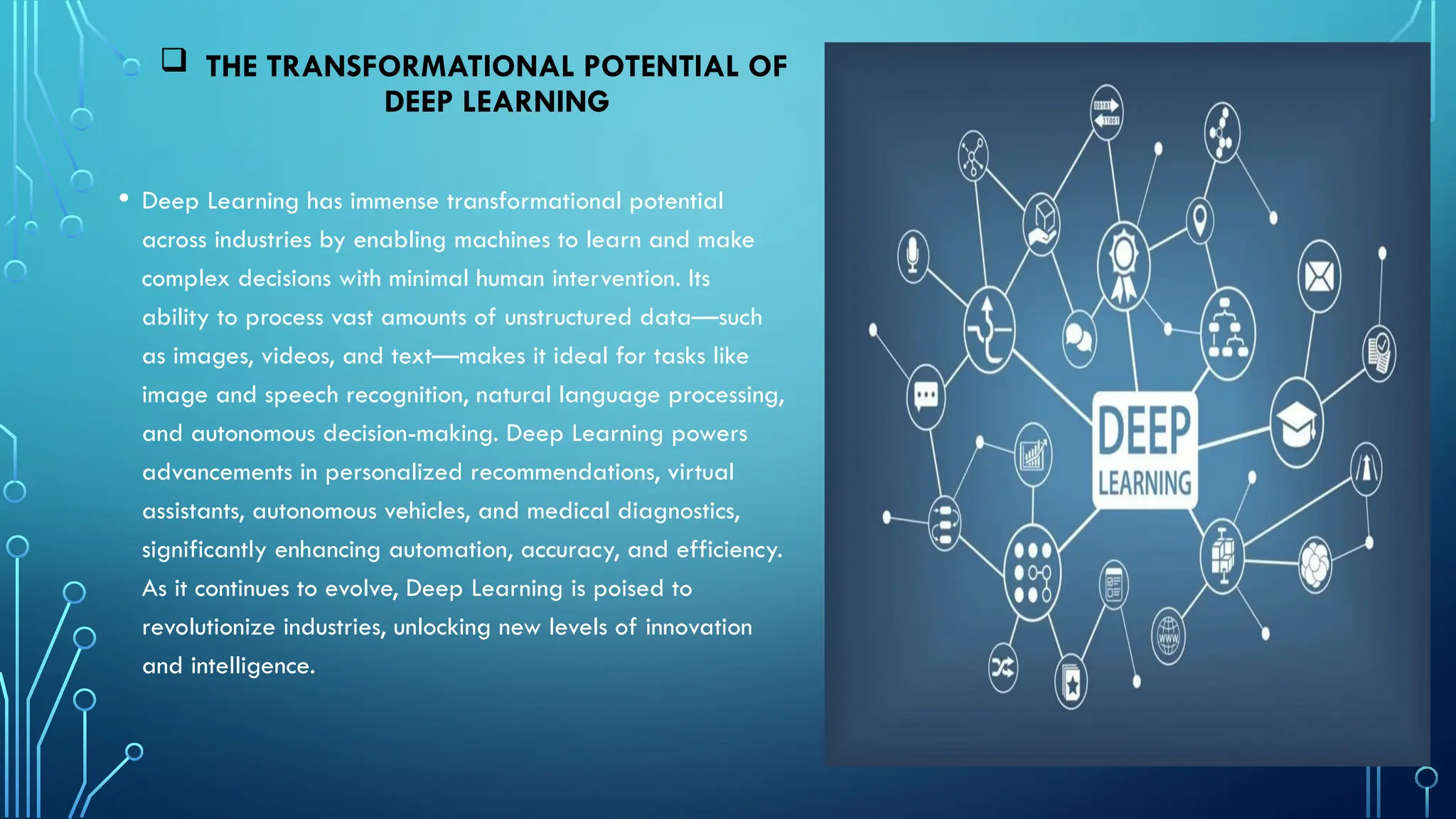
• Deep Learning has immense transformational potential
across industries by enabling machines to learn and make
complex decisions with minimal human intervention. Its
ability to process vast amounts of unstructured data—such
as images, videos, and text—makes it ideal for tasks like
image and speech recognition, natural language processing,
and autonomous decision-making. Deep Learning powers
advancements in personalized recommendations, virtual
assistants, autonomous vehicles, and medical diagnostics,
significantly enhancing automation, accuracy, and efficiency.
As it continues to evolve, Deep Learning is poised to
revolutionize industries, unlocking new levels of innovation
and intelligence.
 THE TRANSFORMATIONAL POTENTIAL OF
DEEP LEARNING
TRANSFORMATIONAL POTENTIAL OF DEEP LEARNING
 Automation of Complex Tasks
• High-Level Pattern Recognition: Deep Learning (DL) is especially powerful in recognizing intricate patterns
in data that are difficult for traditional algorithms to detect. This makes it highly effective in automating
complex tasks such as:
• Image Recognition: DL models, particularly convolutional neural networks (CNNs), have dramatically improved the
accuracy of image classification, object detection, and facial recognition. These models are used in applications like
medical imaging (e.g., detecting tumors in MRI scans) and security systems.
• Speech Recognition: DL, through recurrent neural networks (RNNs) and transformer models, enables virtual assistants
like Siri, Alexa, and Google Assistant to understand and respond to human speech. These systems continuously
improve, thanks to DL’s ability to learn from vast datasets of spoken language.
• Natural Language Processing (NLP): DL models, such as GPT and BERT, drive advancements in language translation,
sentiment analysis, and summarization. These models understand the context and semantics of language, making
them effective in Chabot's, content generation, and automated customer support.
• Autonomous Decision-Making: DL systems power self-driving cars and drones, allowing them to make real-time
decisions by analyzing vast streams of sensory data. These systems rely on deep neural networks to recognize
objects, navigate environments, and predict future movements of surrounding objects (e.g., pedestrians, other
vehicles).
TRANSFORMATIONAL POTENTIAL OF DEEP LEARNING
 Advanced Personalization
• Recommendation Engines: DL is the backbone of recommendation engines used by platforms like Netflix, Amazon, and YouTube. By
analyzing user behavior and preferences, DL models suggest content or products that are highly relevant to individual users. This
personalization improves user engagement and satisfaction.
• Netflix: Deep learning algorithms analyze viewing history, preferences, and patterns to recommend movies and shows tailored to each
user, increasing viewing time and customer retention.
• Amazon: DL helps recommend products based on browsing history, past purchases, and even predicted future needs, driving significant
increases in sales.
• Chabot's and Virtual Assistants: Deep learning powers advanced Chabot's that provide personalized customer support by understanding
and responding to complex queries. Virtual assistants like Google Assistant and Alexa use DL to learn user preferences over time, offering
increasingly personalized interactions.
• Customer Support: DL-based Chabot's not only respond to inquiries but also predict the best responses based on previous conversations,
enabling personalized assistance and reducing the need for human intervention.
• Virtual Assistants: By analyzing individual user data, virtual assistants learn to schedule tasks, send reminders, and even make
purchasing decisions based on personalized insights. Over time, these systems grow smarter and more intuitive.
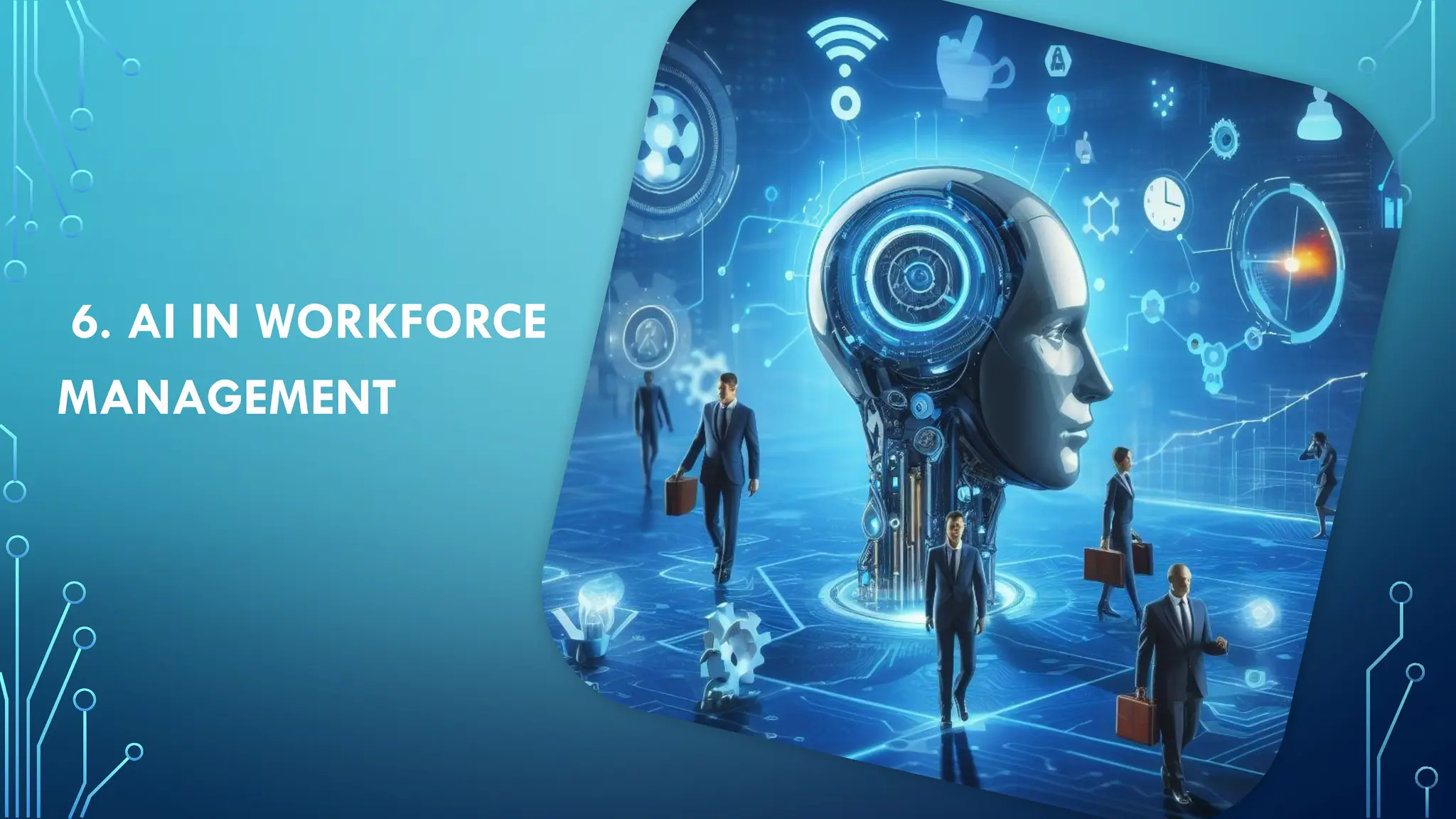
6. AI IN WORKFORCE
MANAGEMENT
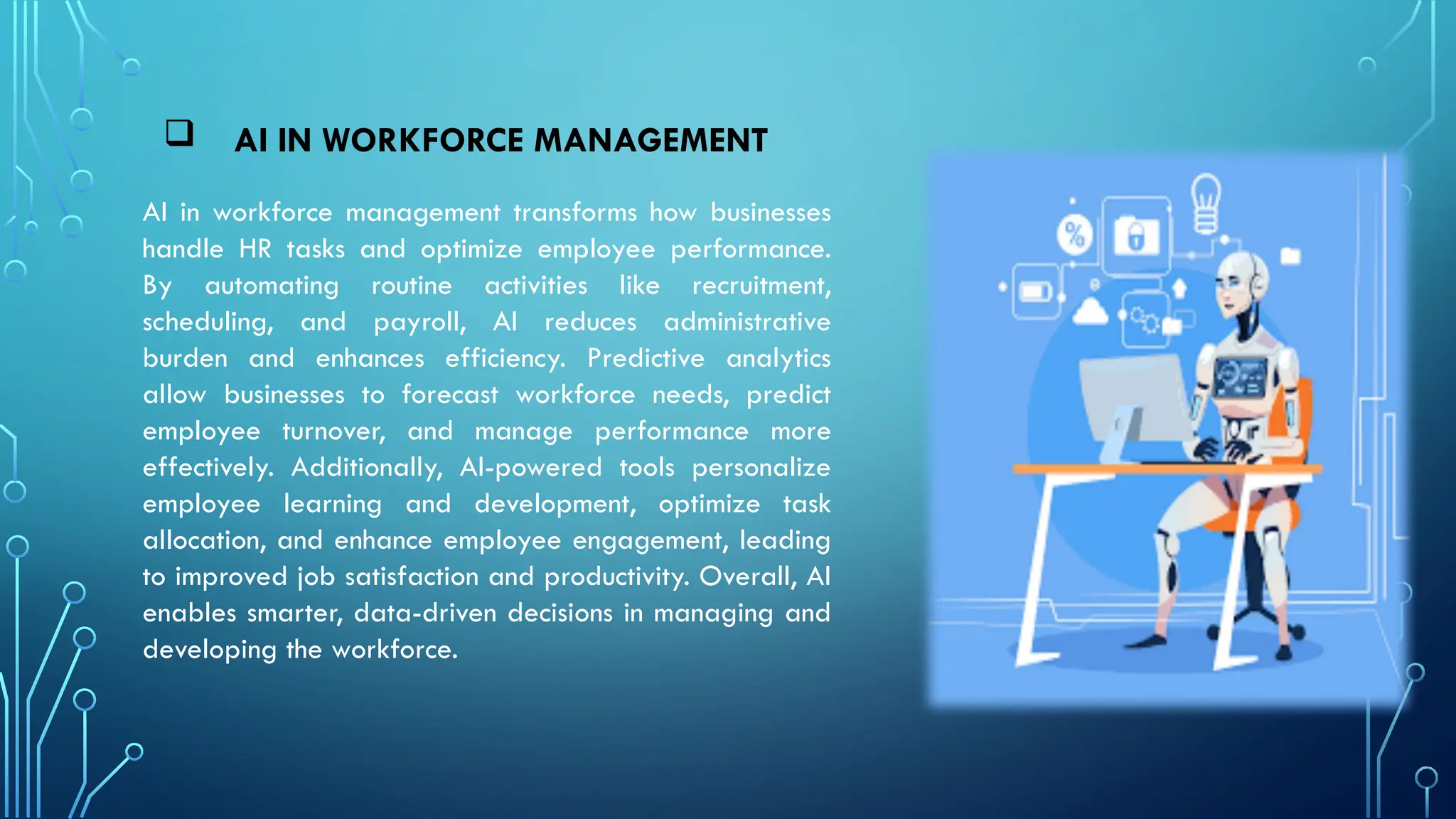
 AI IN WORKFORCE MANAGEMENT
AI in workforce management transforms how businesses
handle HR tasks and optimize employee performance.
By automating routine activities like recruitment,
scheduling, and payroll, AI reduces administrative
burden and enhances efficiency. Predictive analytics
allow businesses to forecast workforce needs, predict
employee turnover, and manage performance more
effectively. Additionally, AI-powered tools personalize
employee learning and development, optimize task
allocation, and enhance employee engagement, leading
to improved job satisfaction and productivity. Overall, AI
enables smarter, data-driven decisions in managing and
developing the workforce.
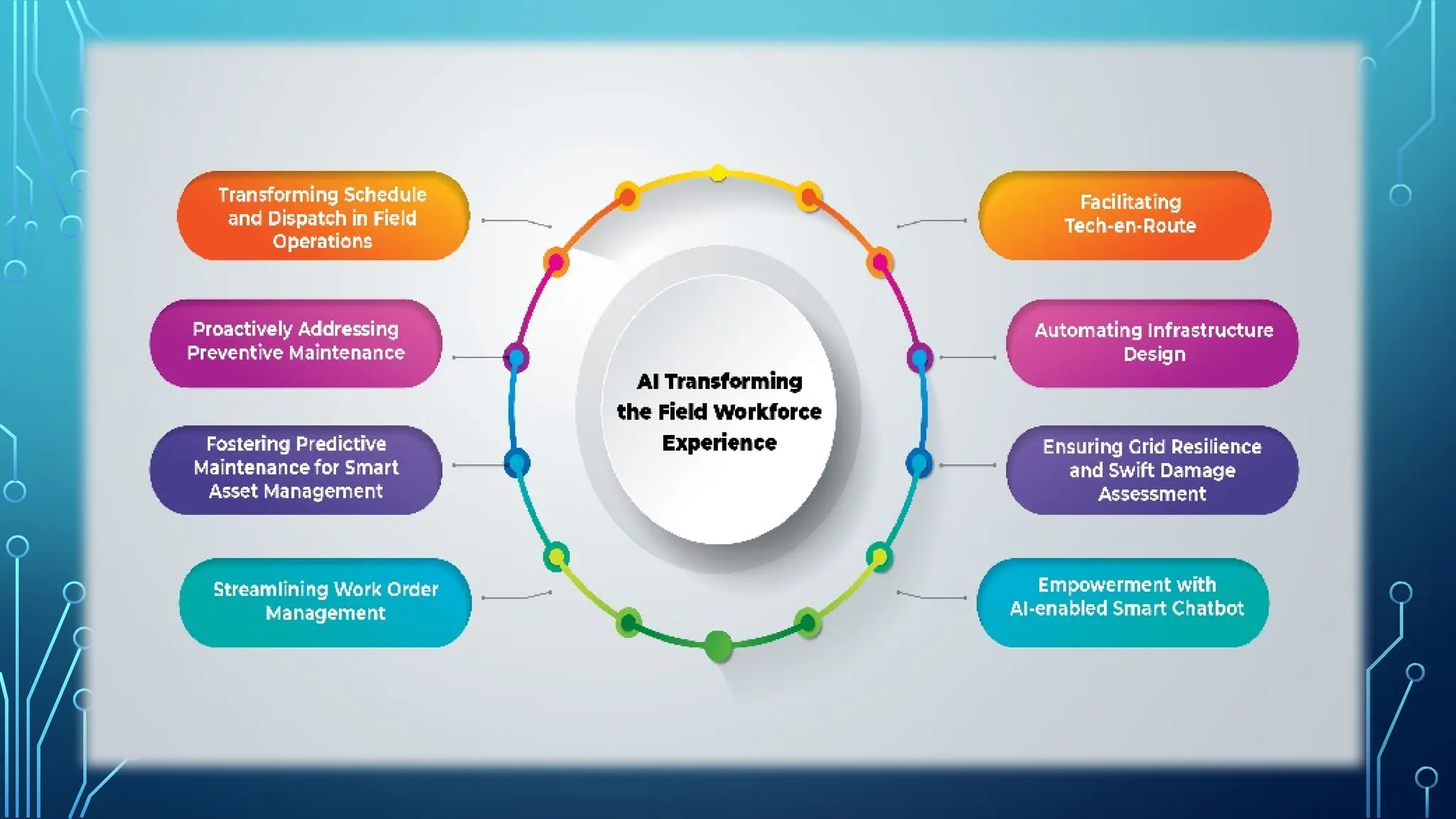
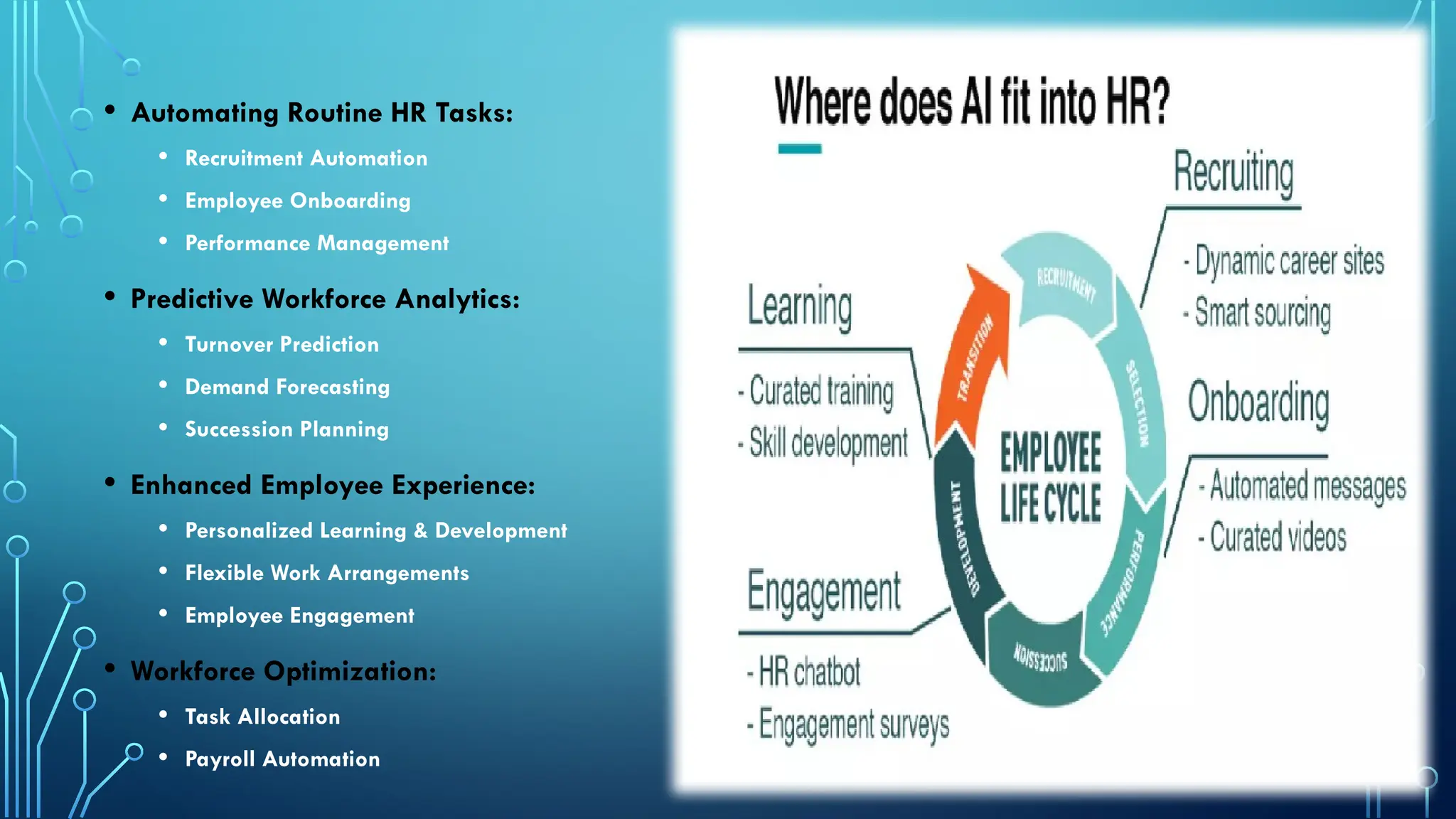
• Automating Routine HR Tasks:
• Recruitment Automation
• Employee Onboarding
• Performance Management
• Predictive Workforce Analytics:
• Turnover Prediction
• Demand Forecasting
• Succession Planning
• Enhanced Employee Experience:
• Personalized Learning & Development
• Flexible Work Arrangements
• Employee Engagement
• Workforce Optimization:
• Task Allocation
• Payroll Automation
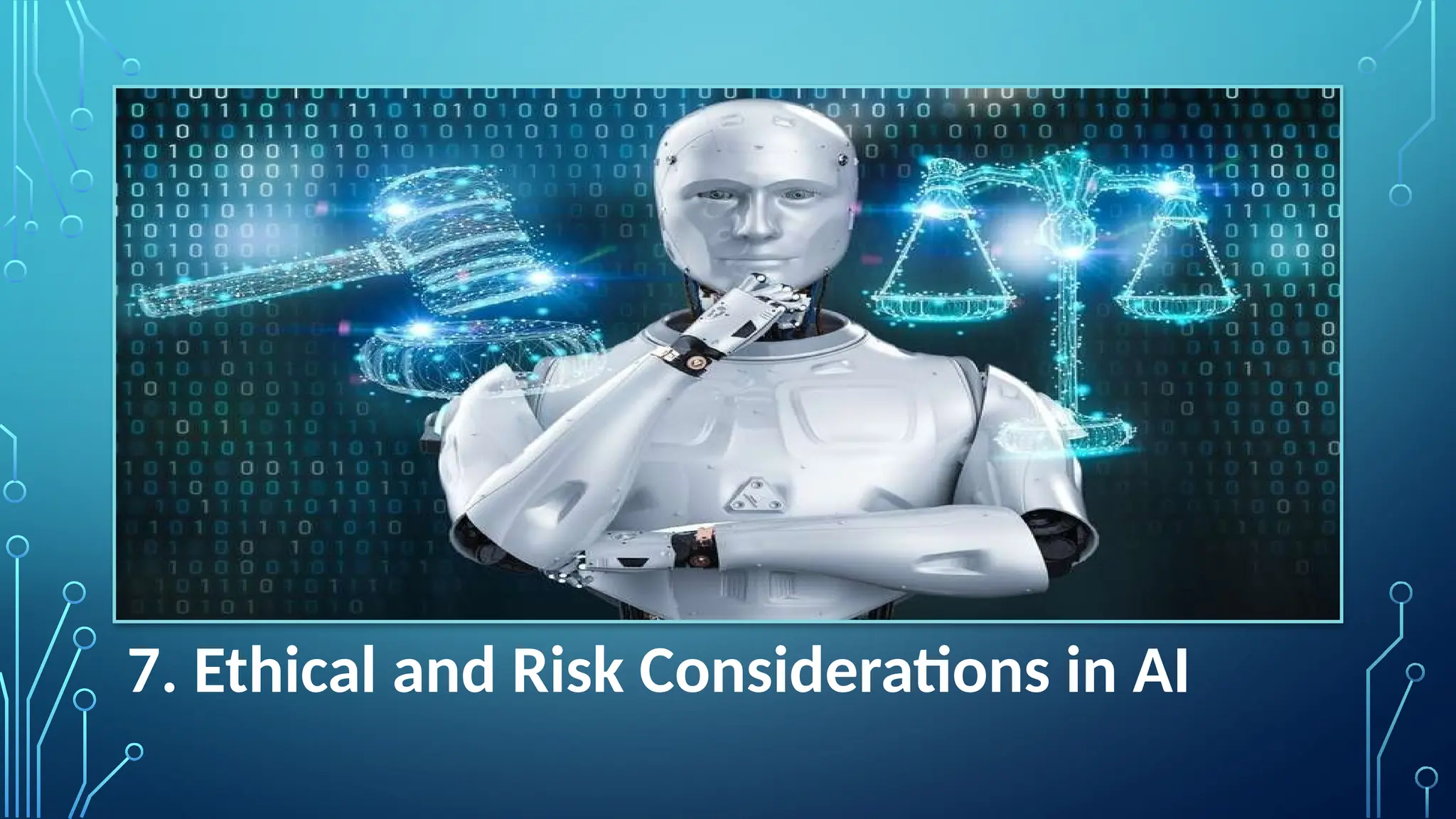
7. Ethical and Risk Considerations in AI
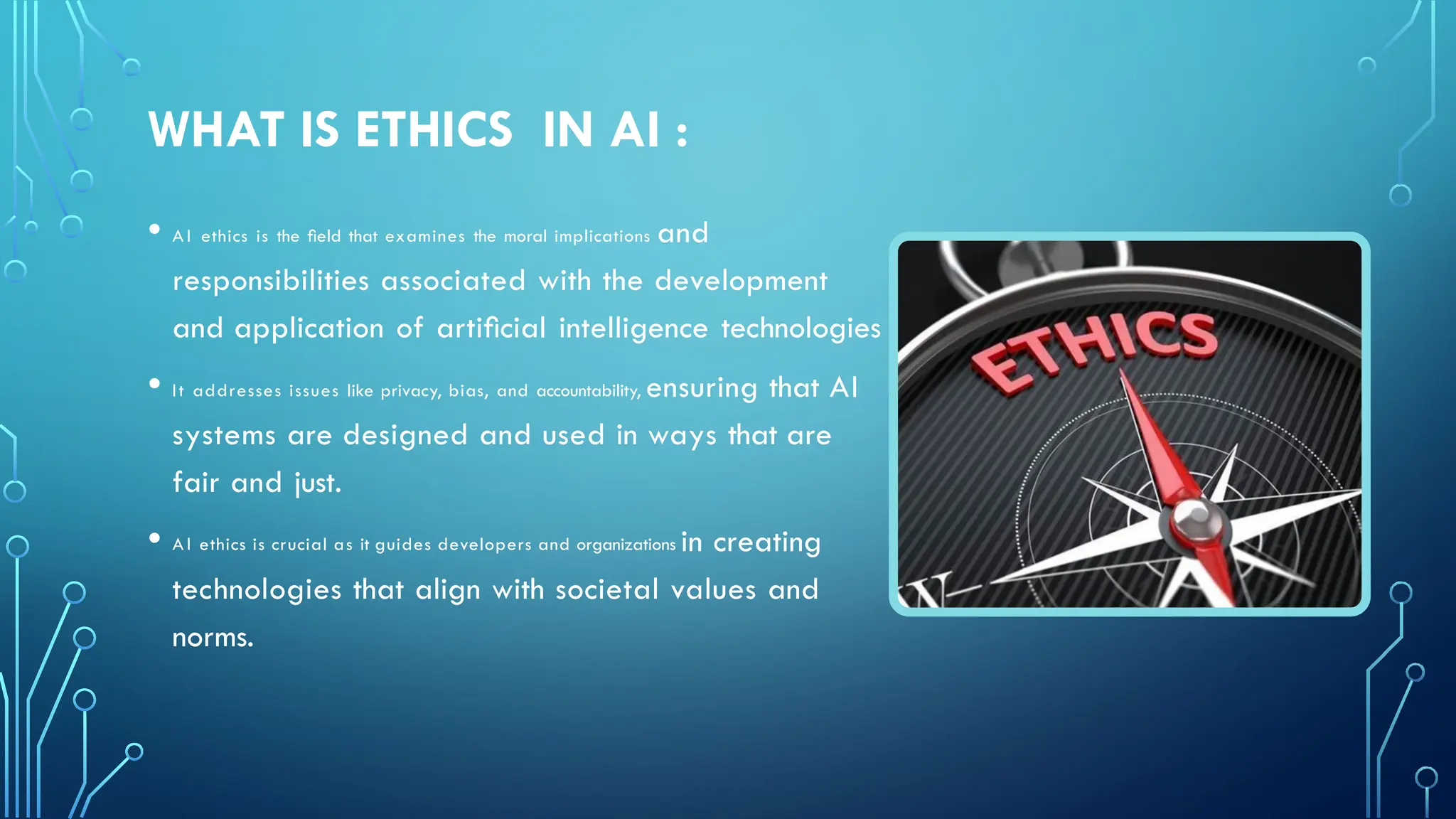
WHAT IS ETHICS IN AI :
• AI ethics is the field that examines the moral implications and
responsibilities associated with the development
and application of artificial intelligence technologies
• It addresses issues like privacy, bias, and accountability, ensuring that AI
systems are designed and used in ways that are
fair and just.
• AI ethics is crucial as it guides developers and organizations in creating
technologies that align with societal values and
norms.
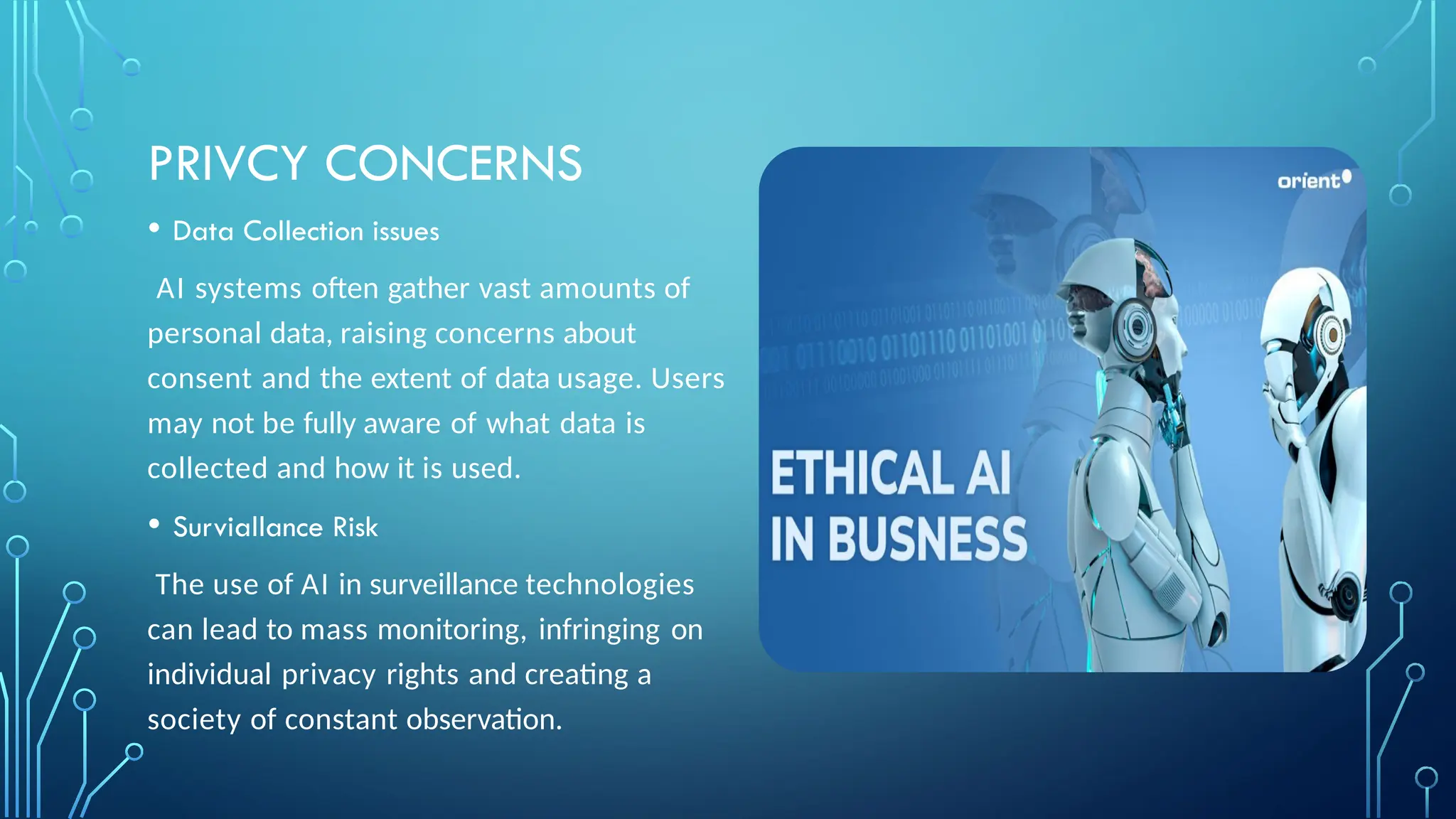
PRIVCY CONCERNS
• Data Collection issues
AI systems often gather vast amounts of
personal data, raising concerns about
consent and the extent of data usage. Users
may not be fully aware of what data is
collected and how it is used.
• Surviallance Risk
The use of AI in surveillance technologies
can lead to mass monitoring, infringing on
individual privacy rights and creating a
society of constant observation.
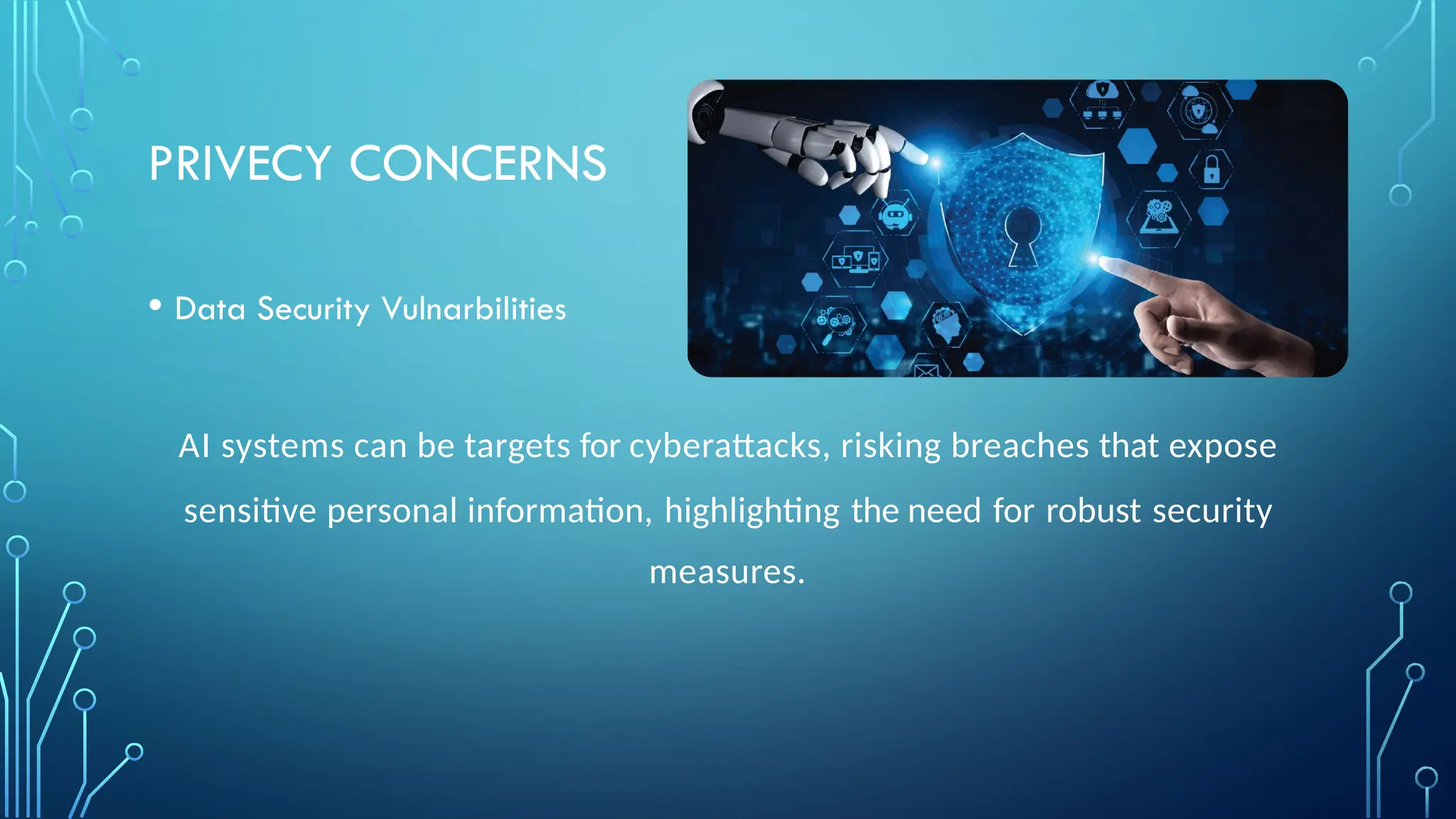
PRIVECY CONCERNS
• Data Security Vulnarbilities
AI systems can be targets for cyberattacks, risking breaches that expose
sensitive personal information, highlighting the need for robust security
measures.
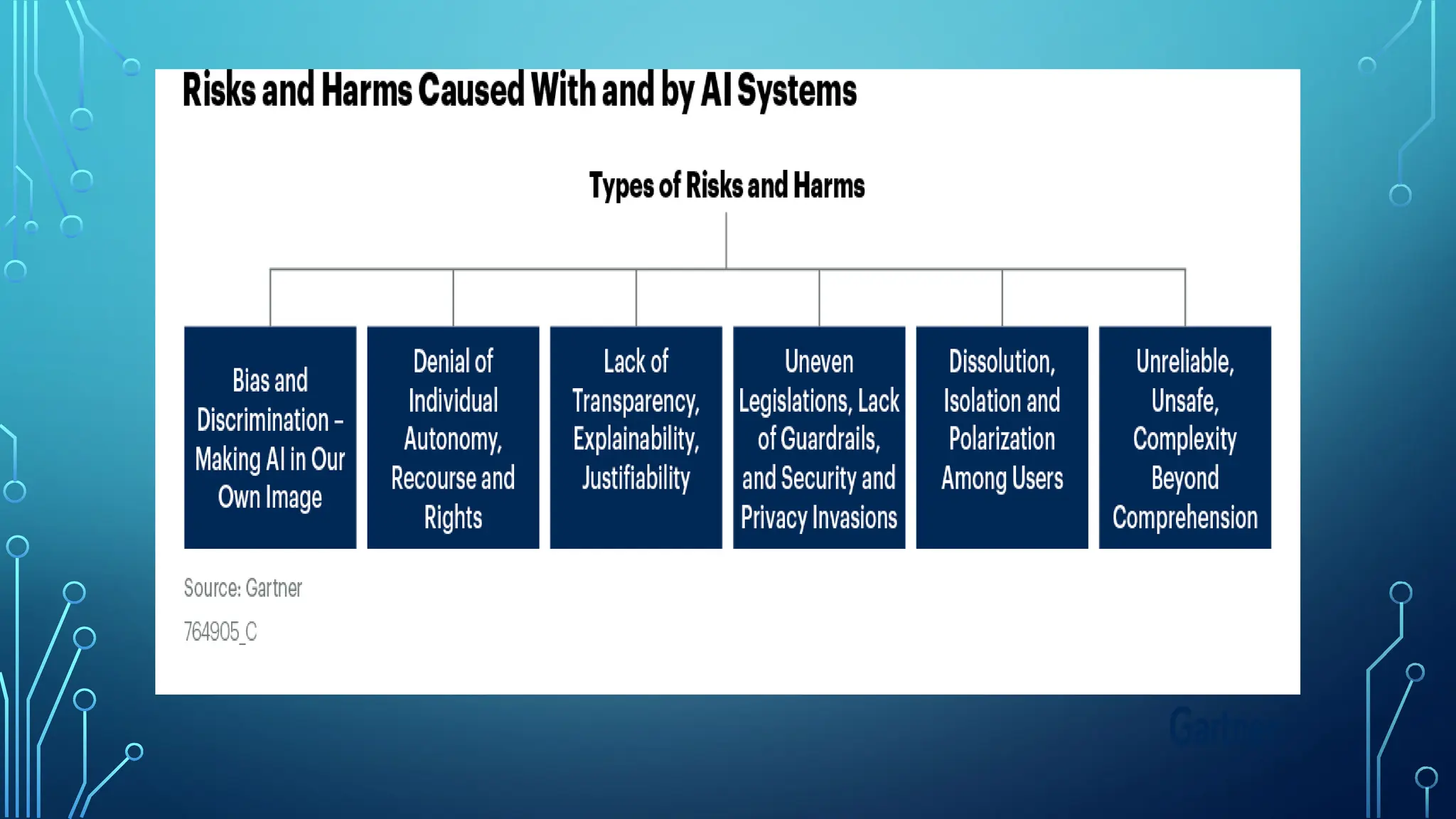
BIAS IN AI
UNDERSTANDING AI BIAS
AI bias occurs when
algorithms produce
prejudiced results
due to flawed training
data or design.
IMPLICATIONS OF AI BIAS
Bias in AI can lead to
unfair treatment in
areas like hiring,
lending, and law
enforcement.
ADDRESING AI BIAS
Solutions include
diversifying training
data, implementing bias
detection tools, and
ensuring transparency.
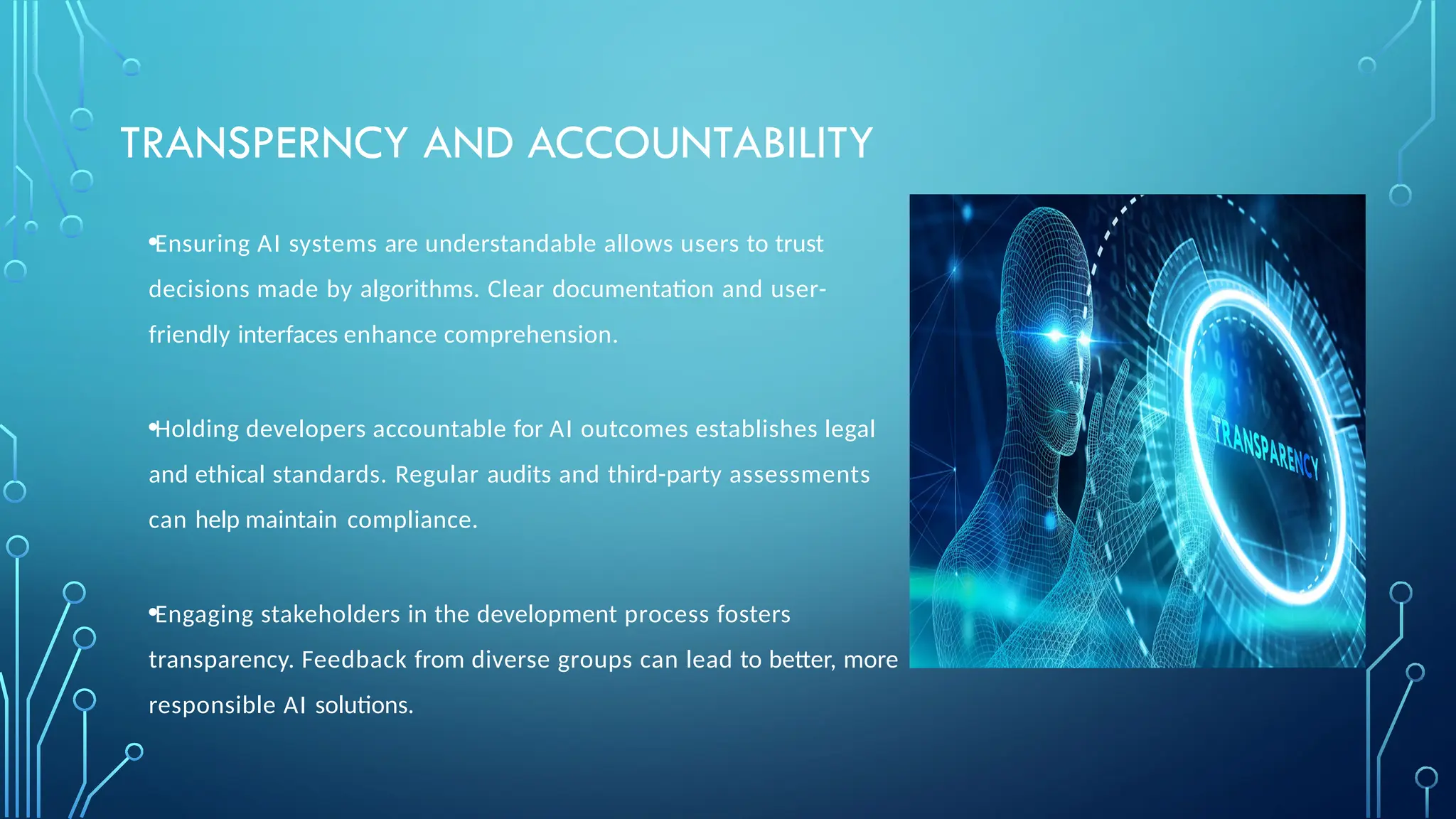
TRANSPERNCY AND ACCOUNTABILITY
•Ensuring AI systems are understandable allows users to trust
decisions made by algorithms. Clear documentation and user-
friendly interfaces enhance comprehension.
•Holding developers accountable for AI outcomes establishes legal
and ethical standards. Regular audits and third-party assessments
can help maintain compliance.
•Engaging stakeholders in the development process fosters
transparency. Feedback from diverse groups can lead to better, more
responsible AI solutions.
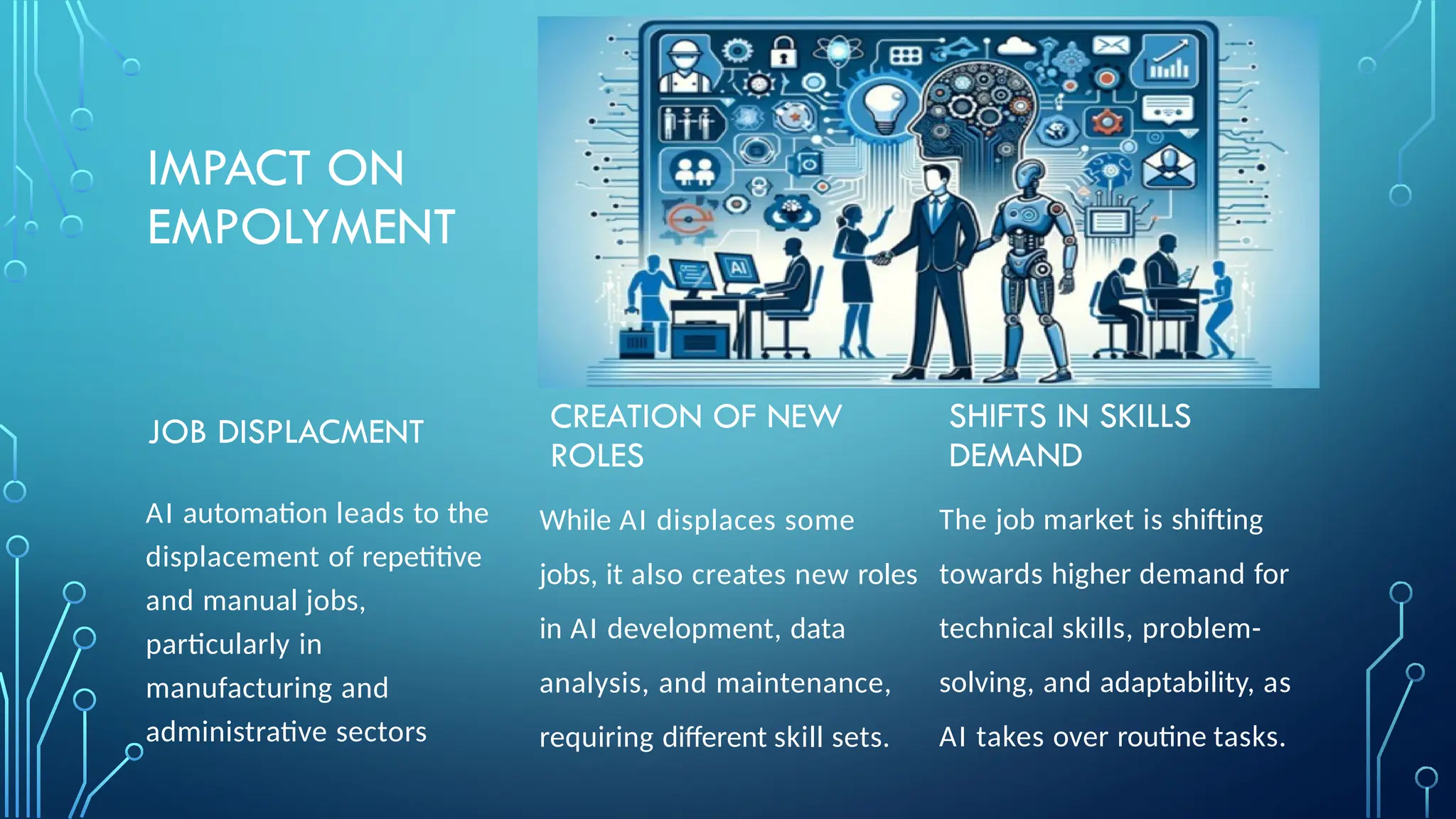
IMPACT ON
EMPOLYMENT
JOB DISPLACMENT
AI automation leads to the
displacement of repetitive
and manual jobs,
particularly in
manufacturing and
administrative sectors
CREATION OF NEW
ROLES
SHIFTS IN SKILLS
DEMAND
While AI displaces some
jobs, it also creates new roles
in AI development, data
analysis, and maintenance,
requiring different skill sets.
The job market is shifting
towards higher demand for
technical skills, problem-
solving, and adaptability, as
AI takes over routine tasks.
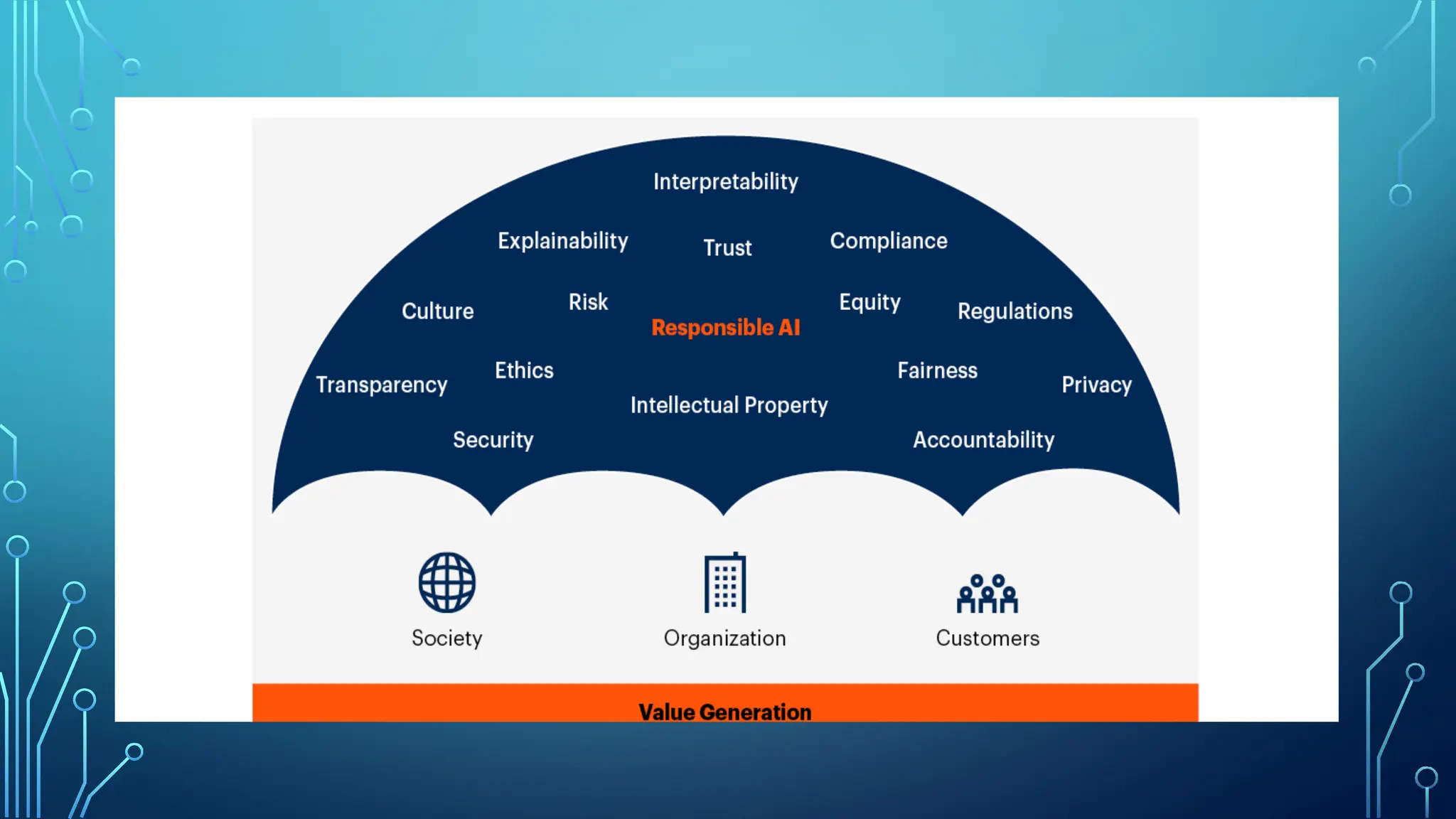
ETHICAL GUIDLINES
FAIRNESS
AI systems should be designed to
treat all individuals fairly, avoiding
bias in data and algorithms.
ACCOUNTABILITY
• Developers and organizations
must be accountable for AI
decisions and their impacts on
society.
AI IN
HEALTHCARE
BIAS
MITIGATION
The AI system was
trained on diverse
datasets to reduce bias
in treatment
recommendations for
different demographics.
POSITIVE PATIENT
OUTCOME
Post-implementation,
the hospital reported a
20% increase in diagnostic
accuracy and higher
patient satisfaction scores.
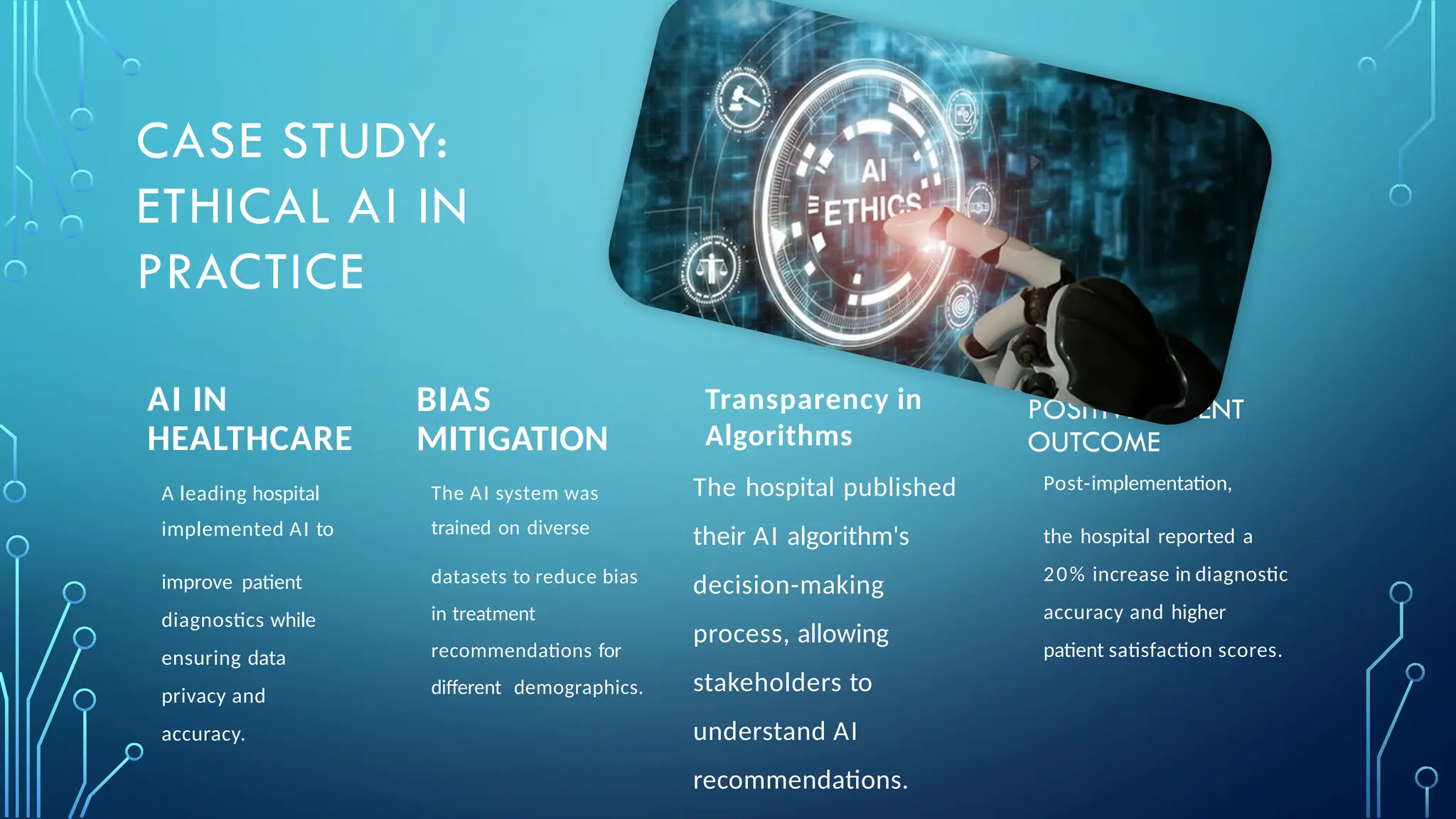
CASE STUDY:
ETHICAL AI IN
PRACTICE
The hospital published
their AI algorithm's
decision-making
process, allowing
stakeholders to
understand AI
recommendations.
Transparency in
Algorithms
A leading hospital
implemented AI to
improve patient
diagnostics while
ensuring data
privacy and
accuracy.
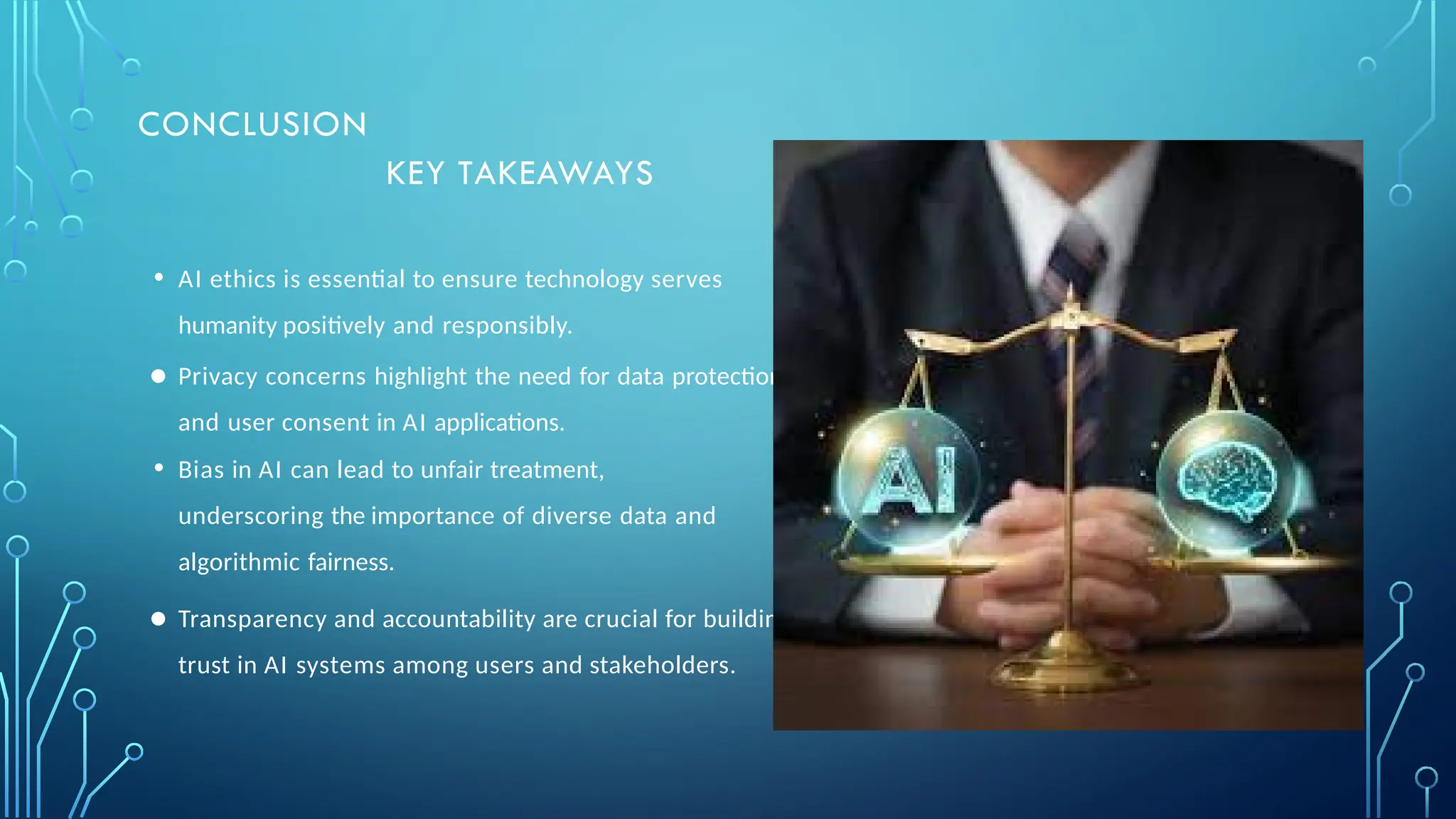
• AI ethics is essential to ensure technology serves
humanity positively and responsibly.
● Privacy concerns highlight the need for data protection
and user consent in AI applications.
• Bias in AI can lead to unfair treatment,
underscoring the importance of diverse data and
algorithmic fairness.
● Transparency and accountability are crucial for building
trust in AI systems among users and stakeholders.
CONCLUSION
KEY TAKEAWAYS
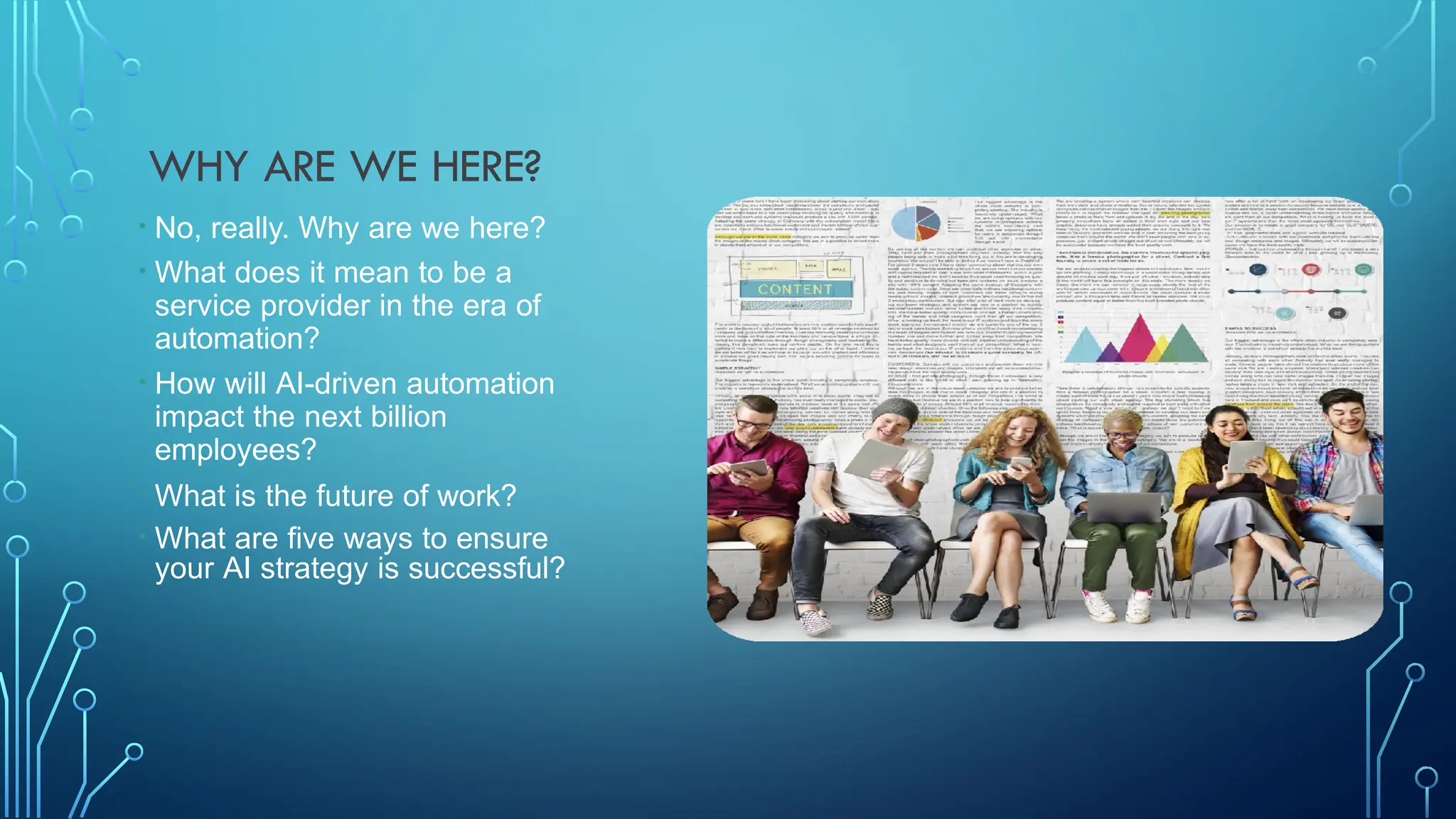
WHY ARE WE HERE?
• No, really. Why are we here?
• What does it mean to be a
service provider in the era of
automation?
• How will AI-driven automation
impact the next billion
employees?
• What is the future of work?
• What are five ways to ensure
your AI strategy is successful?
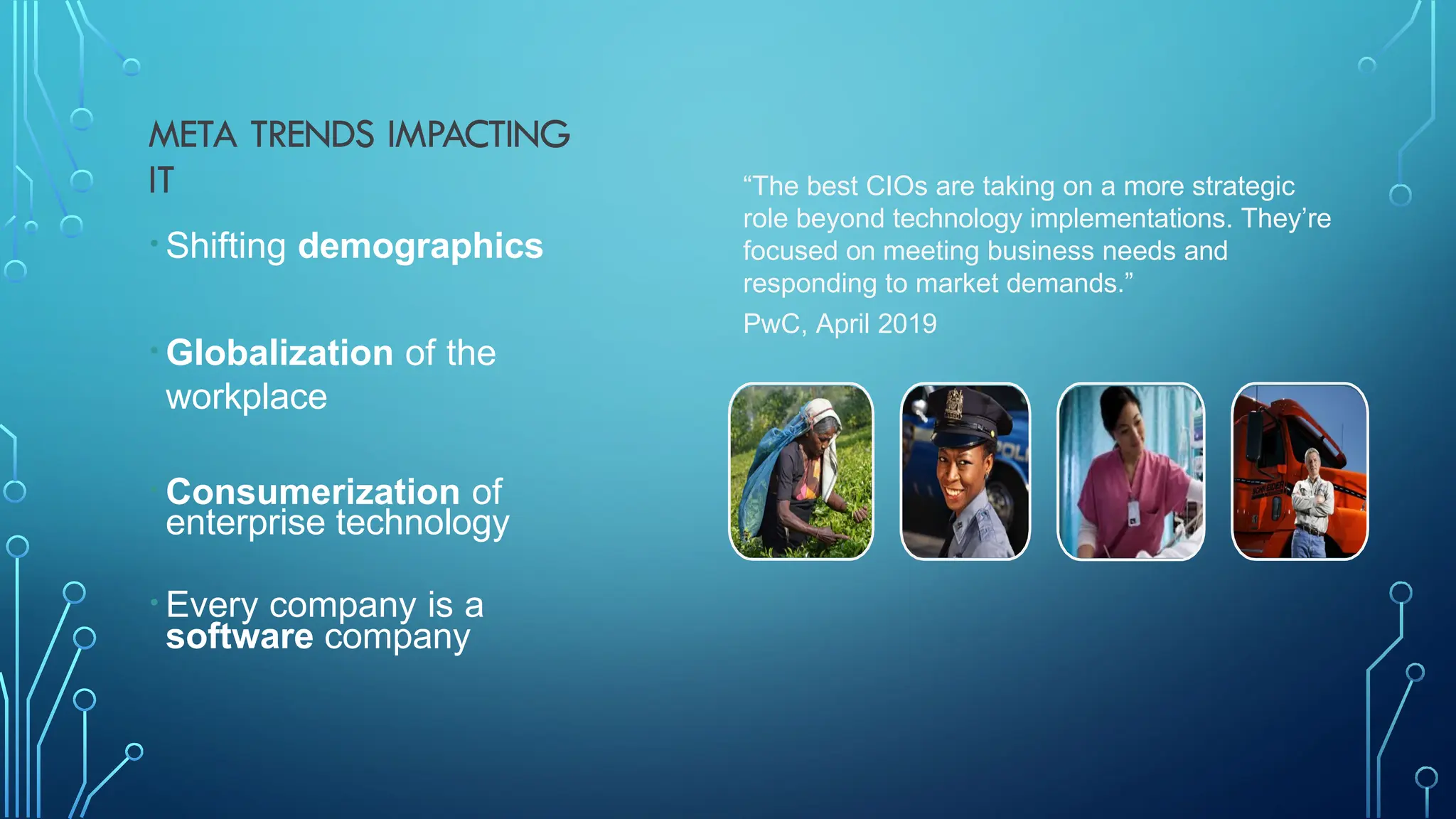
META TRENDS IMPACTING
IT
• Shifting demographics
• Globalization of the
workplace
• Consumerization of
enterprise technology
• Every company is a
software company
“The best CIOs are taking on a more strategic
role beyond technology implementations. They’re
focused on meeting business needs and
responding to market demands.”
PwC, April 2019
THE FUTURE OF EMPLOYEE SERVICE
AUTOMATE THE SERVICE LIFE CYCLE
• RCAs
• Knowledge gaps
• Upskilling
• Contextual
handoffs
• Trending issues
• Configurable
thresholds
Request
[Catalog | Knowledge]
Learn
[KCS | CSI]
[Orchestration]
Resolve
Diagnose
[IPC | Config]
BILLIONS [MORE] SERVED… THANKS TO AI
AUTOMATION REDUCES DOWNTIME… FOR TWO
MILLION EMPLOYEES IN 40,000 RESTAURANTS
“We started using AI to route tickets
and within weeks it automated our
manual process. It saved us $3M in
the first year. We have big plans for
AI!”
Joel Eagle
McDonald’s Sr. Director
Technology & Architecture
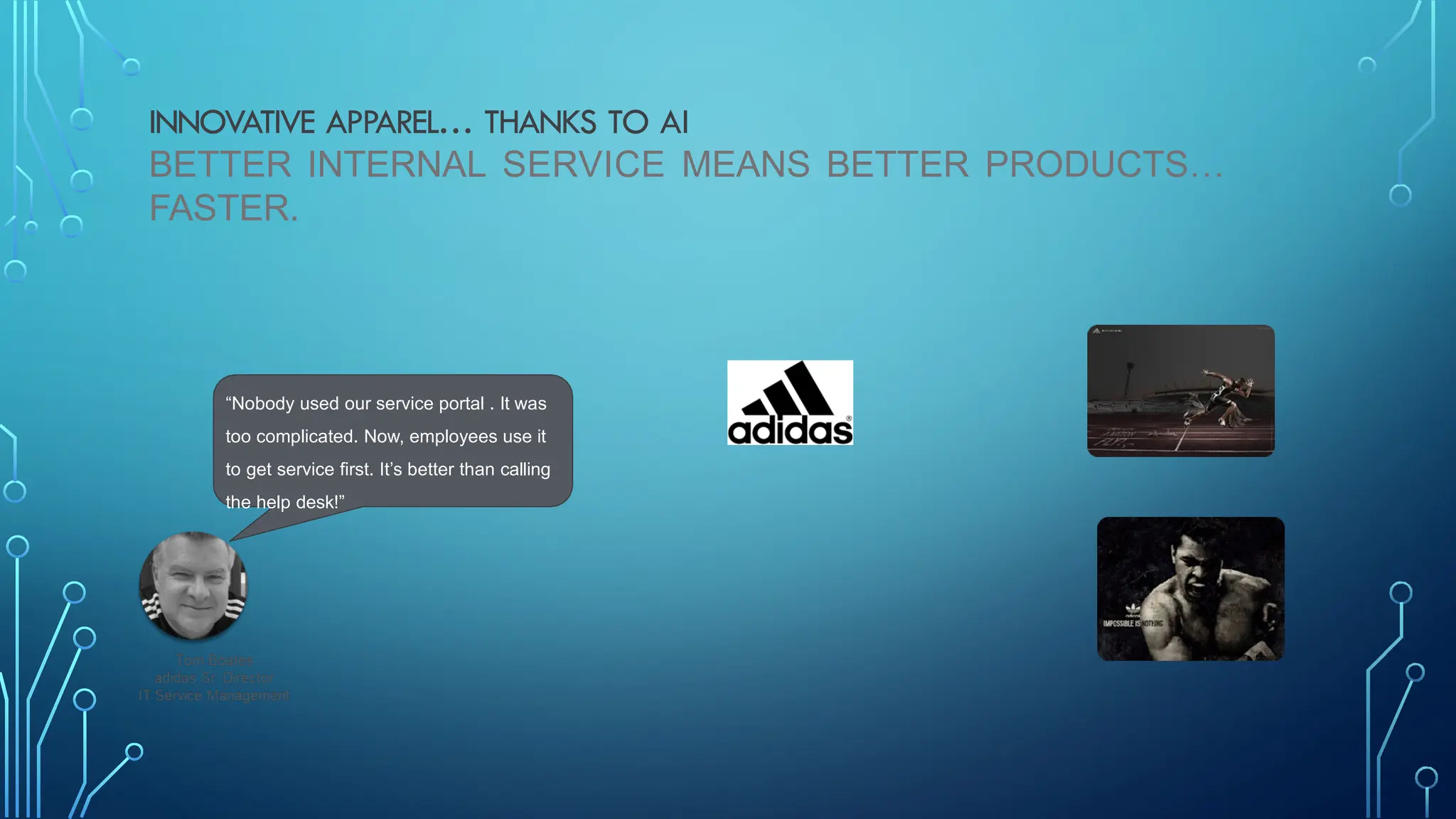
INNOVATIVE APPAREL… THANKS TO AI
BETTER INTERNAL SERVICE MEANS BETTER PRODUCTS…
FASTER.
“Nobody used our service portal . It was
too complicated. Now, employees use it
to get service first. It’s better than calling
the help desk!”
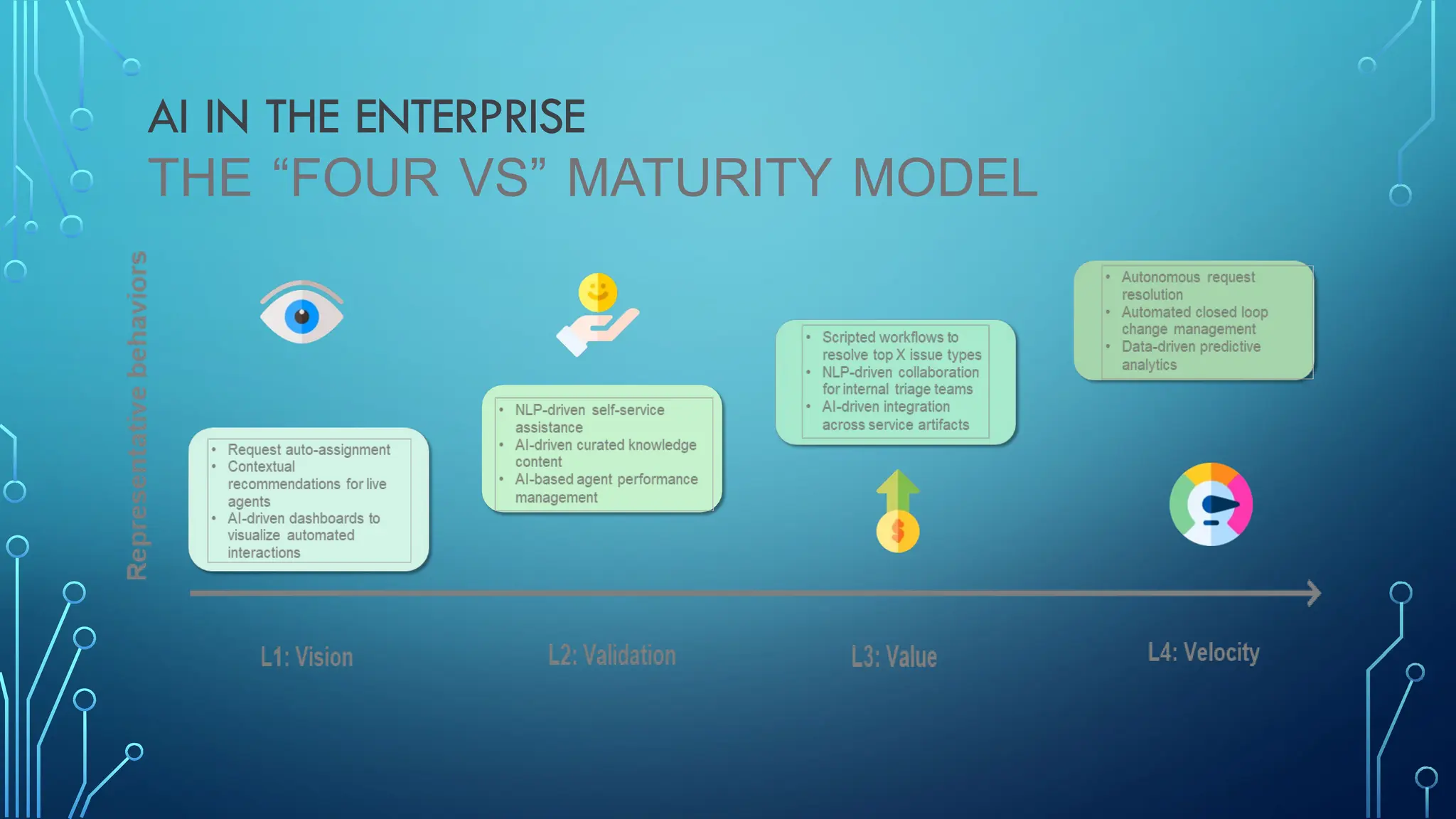
AI IN THE ENTERPRISE
THE “FOUR VS” MATURITY MODEL
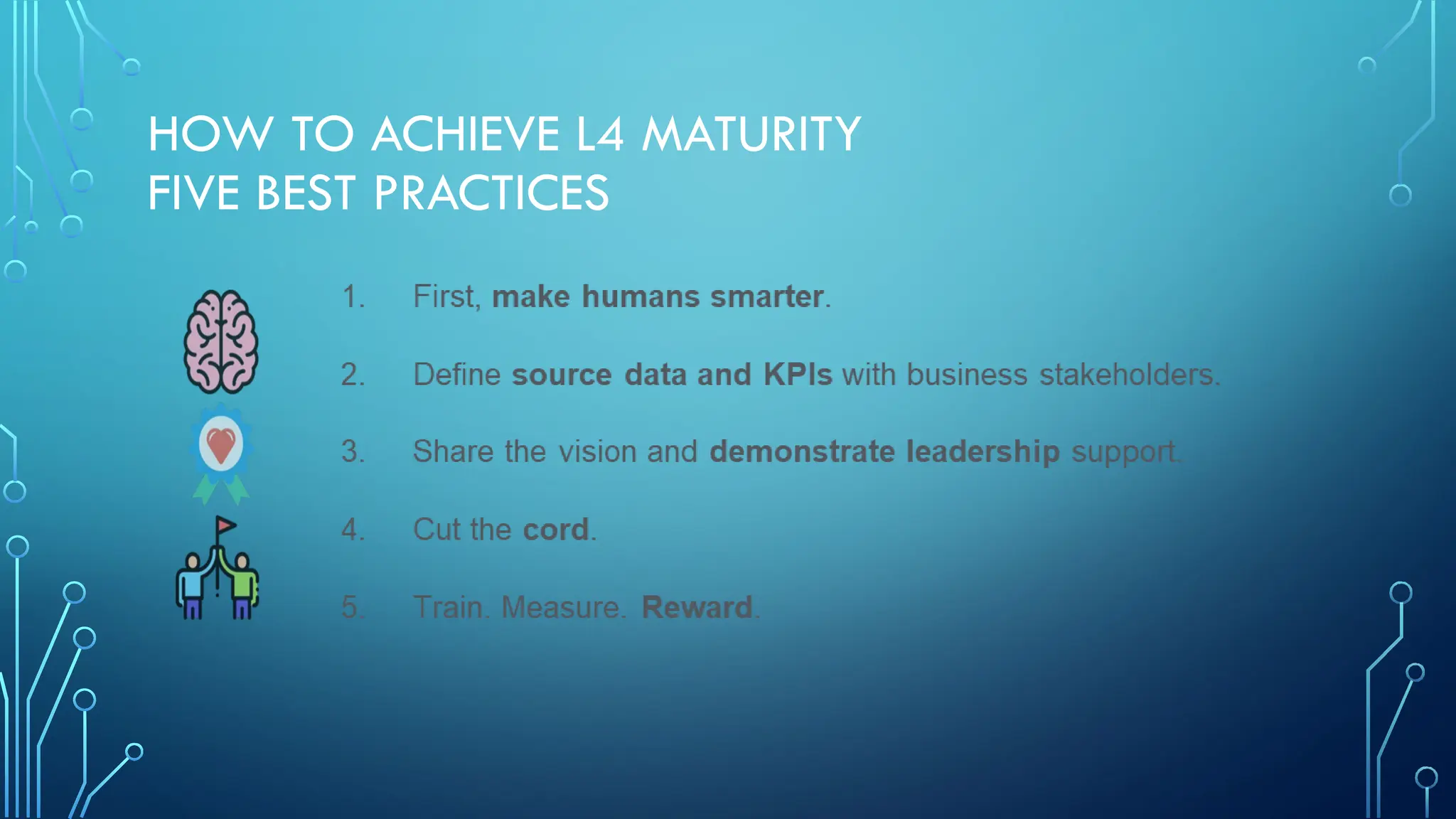
HOW TO ACHIEVE L4 MATURITY
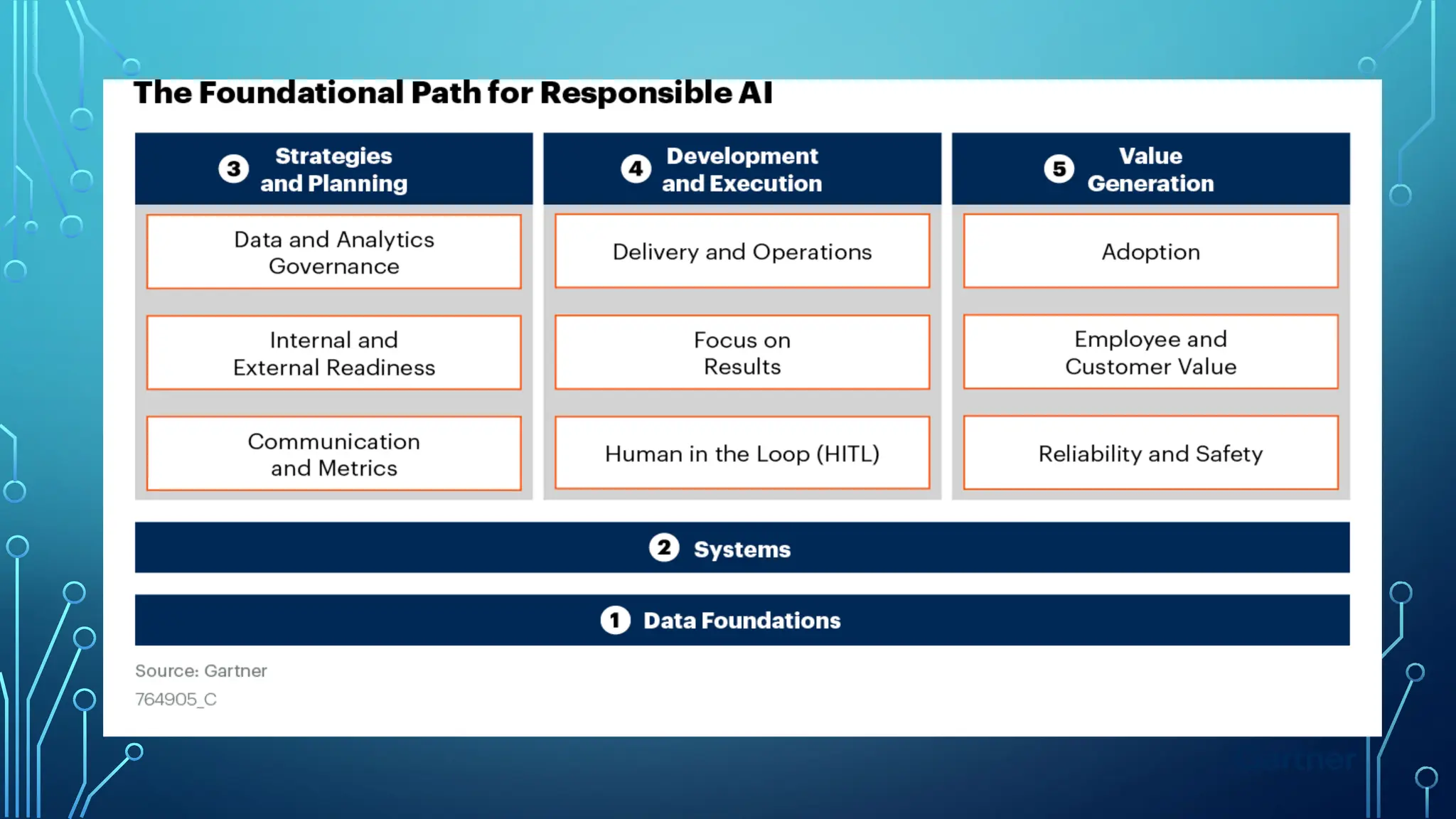
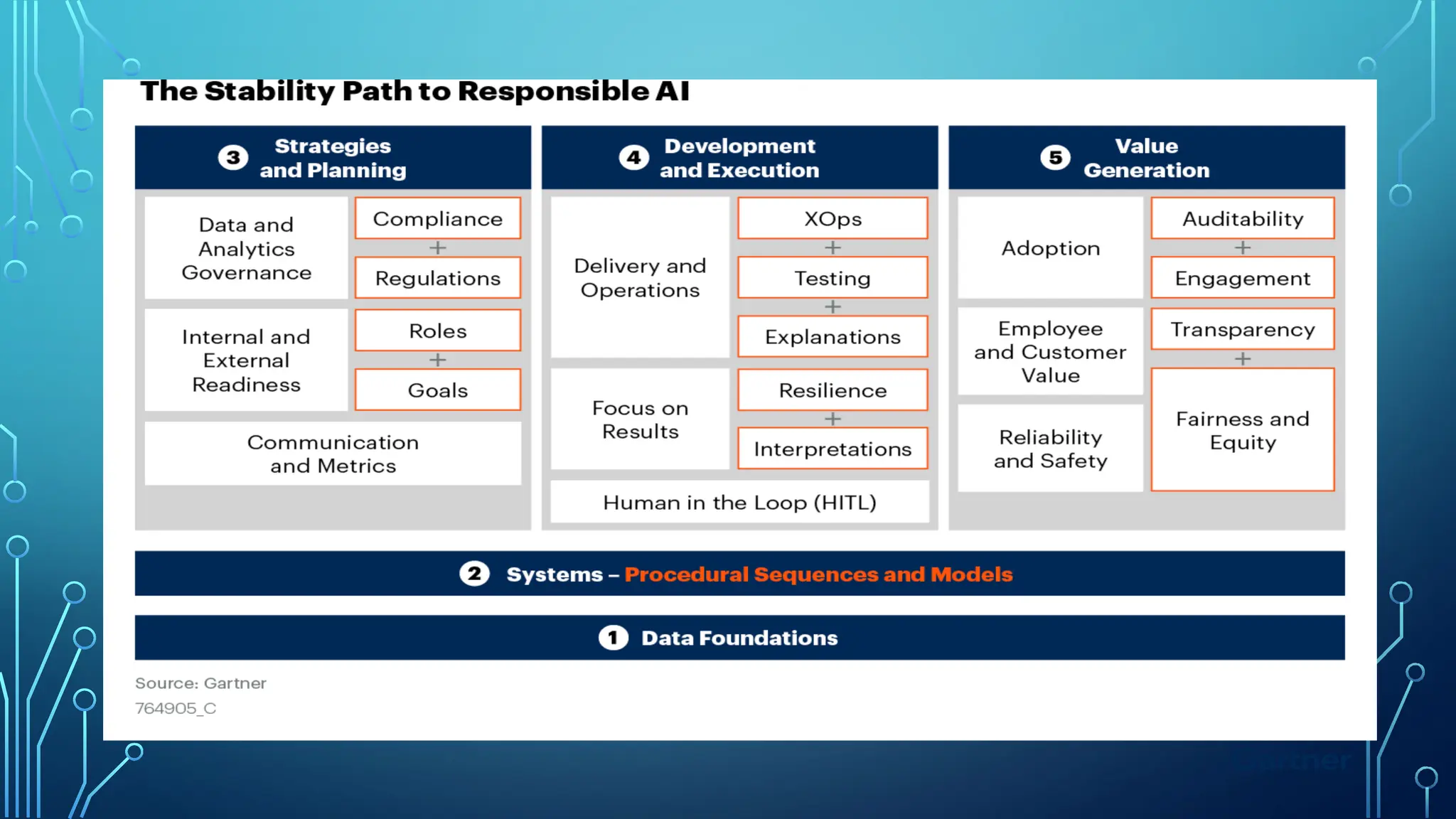
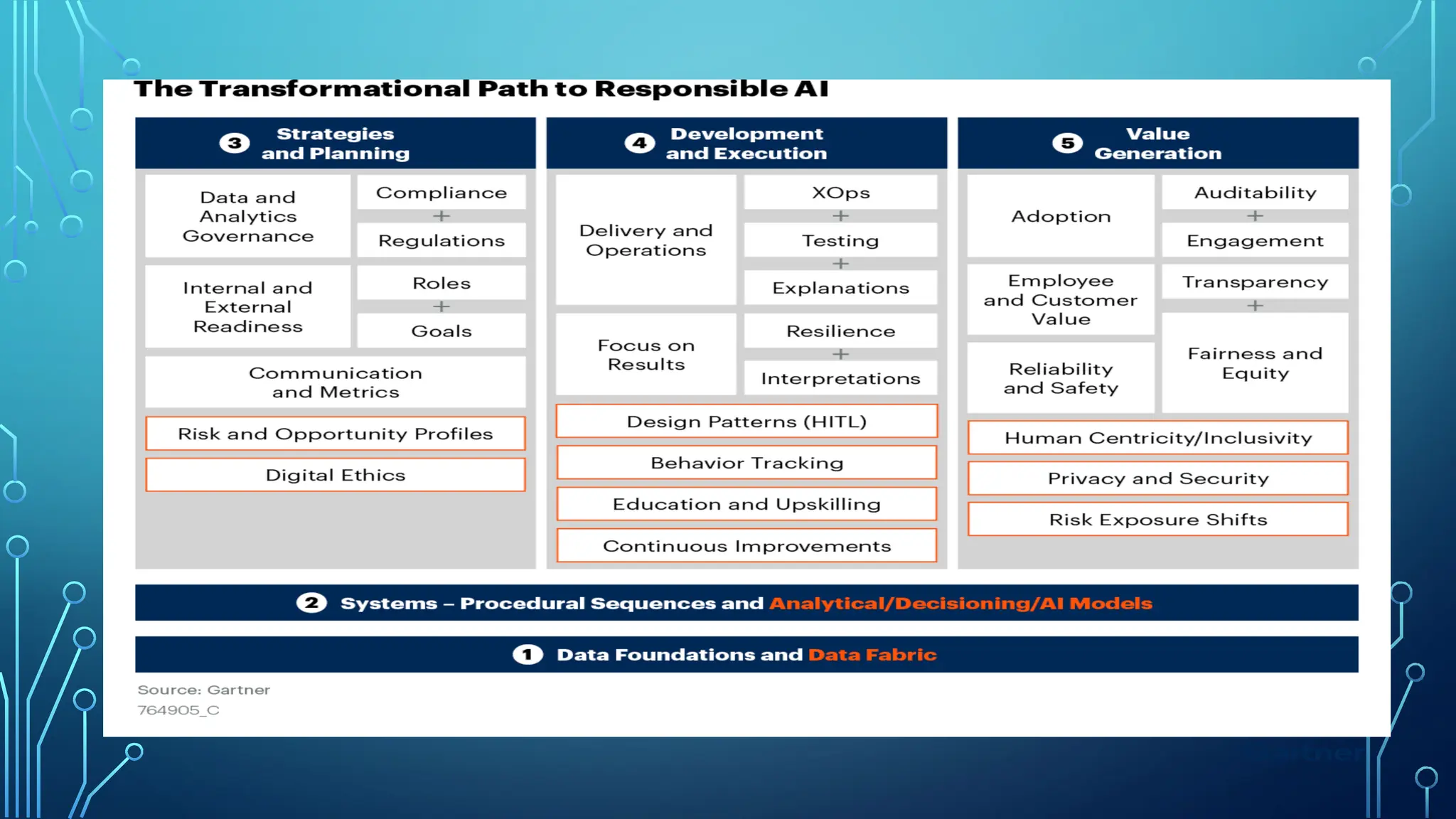
FIVE BEST PRACTICES
Thank You

AI Artificial Intelligent-Machine Learning-Deep Learning .pptx

  • 1.
    AI Artificial Intelligent MachineLearning Deep Learning
  • 2.
  • 3.
    DEFINITION Intelligence: "The capacityto learn and solve problems.“ Artificial Intelligence: Artificial intelligence (AI) is the simulation of human intelligence by machines. Artificial + Intelligent = AI Artificial Intelligence AI is considered the overarching field because it encompasses a wide range of techniques, approaches, and goals aimed at creating machines that can simulate or mimic human intelligence. • ability to solve problems. • ability to act rationally. • ability to act like humans
  • 4.
    2. The EvolutionHistory Evolution of AI
  • 5.
    THE EVOLUTION HISTORYEVOLUTION OF AI
  • 6.
  • 7.
    AI is theoverarching field, ML is a method within AI, and DL is a more specialized technique under ML ARTIFICIAL INTELLIGENCE (AI), MACHINE LEARNING (ML), AND DEEP LEARNING (DL):
  • 8.
    Category Artificial Intelligence (AI) Machine Learning (ML) DeepLearning (DL) Definition Simulation of human intelligence in machines. A subset of AI that enables systems to learn from data. A subset of ML that uses deep neural networks to model data. Scope Broad, includes all methods of achieving intelligent behavior. Narrower, focused on learning from data without programming. Even narrower, focusing on complex data representations. Key Techniques Rule-based systems, decision trees, expert systems, ML, DL. Supervised, unsupervised, and reinforcement learning. Convolutional Neural Networks (CNNs), Recurrent Neural Networks (RNNs), transformers. Data Requirement Can work with structured or limited data. Requires structured data. Requires vast amounts of labeled data. Human Intervention High—many systems need specific programming. Medium—learns from data, but still requires feature engineering. Low—learns features automatically from raw data. Example Applications Robotics, automated customer service, chess-playing AI. Fraud detection, recommendation systems, sentiment analysis. Image recognition, speech-to- text, self-driving cars. Complexity Can range from simple to very complex. More complex than basic AI techniques. Highly complex, with deeper models and more parameters. Hardware Requirements Can run on standard computers. Requires more computing power as data grows. Requires GPUs/TPUs due to the high computational demand. Learning Can include learning but is not always required. Learns from data patterns and improves over time. Learns in layers, mimicking the human brain’s structure.
  • 10.
    This deep neuralnetwork is globally trained via area under the curve (AUC) of the receiver operating characteristics (ROC). Each ROC curve corresponds to a set of weights for connections to an output node, generated by scanning the weight of the bias node. The training process maximizes AUC, pushing the ROC curve toward the upper left corner, which means improved sensitivity and specificity in classification. Deep learning
  • 13.
    3. AI’s StrategicRole in Technology Management AI is reshaping technology management by optimizing operations, fostering innovation, and aligning technology with business strategies.
  • 14.
    1. AI FORIT INFRASTRUCTURE MANAGEMENT Automated IT Operations (AIOps): • AI helps manage and optimize IT infrastructures through AIOps platforms, which use machine learning to predict system failures, resolve issues in real-time, and enhance network security. • Predictive Maintenance: AI-powered tools can foresee potential breakdowns in IT hardware or software systems, allowing preemptive repairs and reducing downtime. • Dynamic Resource Allocation: AI monitors usage patterns and automatically allocates computing resources to where they are needed, improving system performance and efficiency. Implementation : Google uses AI ( Deep Mind ) to manage its data centers, improving cooling systems efficiency by 40%, resulting in significant energy savings.
  • 15.
    •Data-Driven Strategic Planning: •AI provides actionable insights by analyzing large datasets from various sources, helping tech leaders make informed decisions regarding technology investments, innovation, and long-term strategy. • AI-Enhanced Forecasting: AI models help anticipate future technology trends, market demands, and emerging threats, allowing companies to stay ahead of competitors. • Example: IBM's Watson AI assists companies in designing data-driven technology strategies, assessing risks, and identifying new opportunities for innovation. •AI in Innovation Management: • AI systems can analyze patent data, R&D outcomes, and emerging technologies to spot trends and gaps in innovation. This enables businesses to focus their innovation efforts on high-impact areas, reduce research time, and speed up the time-to-market for new technologies. 2. ENHANCING DECISION-MAKING IN TECHNOLOGY STRATEGY Readily build custom AI applications for your business, manage all data sources, and accelerate responsible AI workflows—all on one platform. https://youtu.be/WZMJHh4yz6g?si=yrX6La8s_c0NqC4V
  • 16.
    3. OPTIMIZING SOFTWAREDEVELOPMENT AND LIFECYCLE MANAGEMENT • AI in DevOps: • AI is increasingly integrated into DevOps processes, automating the software development lifecycle, from code generation to testing, deployment, and maintenance. • Automated Testing and Debugging: AI tools can detect bugs, errors, or inefficiencies in code before it’s deployed, drastically reducing development time and improving product quality. • Predictive Analytics for IT Operations: AI helps developers anticipate potential system failures or security vulnerabilities during the development process, optimizing the software’s reliability. https://youtu.be/jxXyz86vwcU Example: Microsoft's Azure DevOps services leverage AI to provide real-time analytics and predictive insights to developers, improving deployment cycles and service delivery.
  • 17.
    4. AI-DRIVEN CYBERSECURITYAND RISK MANAGEMENT • AI in Cybersecurity: • AI plays a key role in detecting and mitigating cyber threats by using machine learning to recognize attack patterns, identify vulnerabilities, and respond to incidents autonomously. • Threat Detection: AI-based systems can detect irregular patterns in network behavior, helping prevent data breaches and phishing attacks. • Incident Response Automation: AI tools are used to automatically address security threats as they arise, allowing for faster resolution and minimizing damage to the organization’s IT systems. https://youtu.be/-W63WHhsftM?si=XIJqyU-7Uth7rtAs Example: Darktrace, a cybersecurity company, uses AI to autonomously detect and respond to cyber threats in real time, helping businesses mitigate security risks without manual intervention.
  • 18.
    5. AI INTECHNOLOGY PROCUREMENT AND VENDOR MANAGEMENT • Smart Procurement: • AI assists businesses in optimizing their procurement strategies by analyzing market trends, comparing vendors, and forecasting prices for hardware, software, and services. • Vendor Risk Management: AI tools assess the risk associated with different vendors by analyzing performance data, compliance history, and financial stability, ensuring that companies choose reliable technology partners. • Contract Optimization: AI helps businesses negotiate contracts more effectively by reviewing historical data and market trends to suggest optimal terms. Implementation: GE uses AI to streamline procurement for its industrial operations, automating contract management and vendor selection based on performance data and predictive analytics.
  • 19.
    6. AI INPROJECT AND PORTFOLIO MANAGEMENT (PPM) • AI-Enhanced Project Management: • AI helps optimize project management by providing real-time insights into resource allocation, project risks, timelines, and budgets. • Predictive Project Analytics: AI systems can predict project outcomes based on historical data, helping managers identify risks and allocate resources efficiently to ensure project success. • AI in Resource Planning: AI tools recommend optimal resource distribution, reducing overall costs and improving project outcomes. Example: Companies like Oracle use AI-driven project management tools to ensure that large IT projects are delivered on time and within budget by forecasting bottlenecks and suggesting solutions. https://youtu.be/H-C5dH3w1Dg
  • 20.
    7. AI’S ROLEIN HUMAN CAPITAL AND TALENT MANAGEMENT IN TECH AI for Talent Acquisition and Retention: • In technology management, AI assists with recruitment by analyzing resumes, assessing skills, and predicting candidate success in specific roles. • Skill Gap Analysis: AI identifies the skills needed for future projects and compares them to current employee capabilities, helping companies plan training and upskilling initiatives. • AI in Performance Management: AI systems monitor employee performance metrics and provide personalized feedback, enhancing talent development and retention. Example: SAP uses AI-based HR systems to manage talent pipelines, improve workforce planning, and predict attrition rates. https://youtu.be/z9d1NxbwyAg?si=aQUOV7_Ps2GpTe0s
  • 21.
    8. AI ANDSUSTAINABILITY IN TECHNOLOGY MANAGEMENT Green IT Initiatives: • AI enables companies to reduce their carbon footprint by optimizing energy use in data centers, improving logistics efficiency, and supporting sustainable product designs. • Energy Efficiency: AI-powered tools help businesses reduce energy consumption by optimizing HVAC systems, data storage, and cloud computing resources. • Sustainable Product Development: AI helps in designing eco-friendly products by analyzing material impacts, lifecycle emissions, and regulatory compliance during the R&D phase. Implementation: Microsoft has integrated AI into its sustainability initiatives, including optimizing energy consumption in data centers and reducing carbon emissions. https://youtu.be/npZQ0KOEJDE?si=Hhen5_xG9YvuRfj1
  • 22.
    4. Machine Learningin Business Decision-Making
  • 23.
    DEFINITION OF MACHINELEARNING (ML): MACHINE LEARNING (ML) IS A SUBSET OF ARTIFICIAL INTELLIGENCE (AI) FOCUSED ON CREATING ALGORITHMS THAT ENABLE COMPUTERS TO LEARN FROM DATA AND MAKE PREDICTIONS OR DECISIONS WITHOUT BEING EXPLICITLY PROGRAMMED. ROLE OF ML IN AUTOMATING AND IMPROVING DECISION- MAKING: AUTOMATION: ML AUTOMATES REPETITIVE TASKS AND PROCESSES, REDUCING MANUAL EFFORT AND INCREASING EFFICIENCY. IMPROVEMENT: BY ANALYZING LARGE DATASETS, ML MODELS IDENTIFY PATTERNS AND INSIGHTS THAT ENHANCE DECISION- MAKING ACCURACY AND SPEED, LEADING TO BETTER OUTCOMES. OVERVIEW OF APPLICATIONS ACROSS INDUSTRIES: FINANCE: CREDIT RISK ASSESSMENT, FRAUD DETECTION, ALGORITHMIC TRADING. HEALTHCARE: DISEASE PREDICTION, PERSONALIZED MEDICINE, PATIENT CARE OPTIMIZATION. MARKETING: CUSTOMER SEGMENTATION, TARGETED ADVERTISING, CAMPAIGN EFFECTIVENESS ANALYSIS. RETAIL: DEMAND FORECASTING, INVENTORY MANAGEMENT, PERSONALIZED RECOMMENDATIONS.
  • 25.
     MACHINE LEARNINGIN BUSINESS DECISION-MAKING Machine Learning (ML) plays a pivotal role in business decision-making by analyzing large datasets, identifying patterns, and making data- driven predictions. It automates routine tasks and optimizes processes, enabling businesses to make faster, more accurate decisions. From credit risk assessment in finance to personalized marketing in retail, ML helps companies enhance efficiency and effectiveness. Its ability to improve demand forecasting, customer segmentation, and fraud detection allows organizations to stay competitive in dynamic markets. By integrating ML into decision- making, businesses can drive innovation, reduce costs, and improve outcomes.
  • 26.
    Credit Risk Prediction: •Overview: ML models evaluate creditworthiness by analyzing historical financial data, including payment history, credit utilization, and other relevant factors. • How It Works: Algorithms identify patterns and predict the likelihood of default, enabling more accurate risk assessments and better-informed lending decisions. • Benefit: Reduces the risk of financial loss and improves the efficiency of loan approval processes. CASE STUDY 1: FINANCE (EX.. PREDICTING RISK AND DETECTING FRAUD) Fraud Detection: • Overview: ML models detect fraudulent activities by analyzing transaction patterns and identifying anomalies that deviate from normal behavior. • How It Works: Real-time analysis of transaction data allows for the identification of suspicious patterns, such as unusual spending behavior or irregular transaction locations. • Benefit: Enhances security by preventing fraud and minimizing financial losses.
  • 27.
    Predictive Analytics inDiagnosis: • Overview: ML models are used to analyze patient data (e.g., symptoms, medical history, lab results) to predict the likelihood of certain diseases. • How It Works: By identifying patterns in vast datasets, ML helps in early detection of diseases like cancer, diabetes, or heart conditions. • Benefit: Early and accurate diagnosis leads to timely interventions, improving patient outcomes. CASE STUDY 1: HEALTHCARE (EX.. ENHANCING DIAGNOSIS AND PERSONALIZATION ) Personalized Medicine: • Overview: ML tailors treatment plans to individual patients based on their genetic makeup, lifestyle, and medical history. • How It Works: Algorithms predict how a patient will respond to specific treatments, enabling personalized drug prescriptions and therapies. • Benefit: Increased treatment efficacy and reduced side effects by moving away from the “one-size-fits-all” approach.
  • 29.
    5. THE TRANSFORMATIONALPOTENTIAL OF DEEP LEARNING
  • 30.
    • Deep Learninghas immense transformational potential across industries by enabling machines to learn and make complex decisions with minimal human intervention. Its ability to process vast amounts of unstructured data—such as images, videos, and text—makes it ideal for tasks like image and speech recognition, natural language processing, and autonomous decision-making. Deep Learning powers advancements in personalized recommendations, virtual assistants, autonomous vehicles, and medical diagnostics, significantly enhancing automation, accuracy, and efficiency. As it continues to evolve, Deep Learning is poised to revolutionize industries, unlocking new levels of innovation and intelligence.  THE TRANSFORMATIONAL POTENTIAL OF DEEP LEARNING
  • 31.
    TRANSFORMATIONAL POTENTIAL OFDEEP LEARNING  Automation of Complex Tasks • High-Level Pattern Recognition: Deep Learning (DL) is especially powerful in recognizing intricate patterns in data that are difficult for traditional algorithms to detect. This makes it highly effective in automating complex tasks such as: • Image Recognition: DL models, particularly convolutional neural networks (CNNs), have dramatically improved the accuracy of image classification, object detection, and facial recognition. These models are used in applications like medical imaging (e.g., detecting tumors in MRI scans) and security systems. • Speech Recognition: DL, through recurrent neural networks (RNNs) and transformer models, enables virtual assistants like Siri, Alexa, and Google Assistant to understand and respond to human speech. These systems continuously improve, thanks to DL’s ability to learn from vast datasets of spoken language. • Natural Language Processing (NLP): DL models, such as GPT and BERT, drive advancements in language translation, sentiment analysis, and summarization. These models understand the context and semantics of language, making them effective in Chabot's, content generation, and automated customer support. • Autonomous Decision-Making: DL systems power self-driving cars and drones, allowing them to make real-time decisions by analyzing vast streams of sensory data. These systems rely on deep neural networks to recognize objects, navigate environments, and predict future movements of surrounding objects (e.g., pedestrians, other vehicles).
  • 32.
    TRANSFORMATIONAL POTENTIAL OFDEEP LEARNING  Advanced Personalization • Recommendation Engines: DL is the backbone of recommendation engines used by platforms like Netflix, Amazon, and YouTube. By analyzing user behavior and preferences, DL models suggest content or products that are highly relevant to individual users. This personalization improves user engagement and satisfaction. • Netflix: Deep learning algorithms analyze viewing history, preferences, and patterns to recommend movies and shows tailored to each user, increasing viewing time and customer retention. • Amazon: DL helps recommend products based on browsing history, past purchases, and even predicted future needs, driving significant increases in sales. • Chabot's and Virtual Assistants: Deep learning powers advanced Chabot's that provide personalized customer support by understanding and responding to complex queries. Virtual assistants like Google Assistant and Alexa use DL to learn user preferences over time, offering increasingly personalized interactions. • Customer Support: DL-based Chabot's not only respond to inquiries but also predict the best responses based on previous conversations, enabling personalized assistance and reducing the need for human intervention. • Virtual Assistants: By analyzing individual user data, virtual assistants learn to schedule tasks, send reminders, and even make purchasing decisions based on personalized insights. Over time, these systems grow smarter and more intuitive.
  • 34.
    6. AI INWORKFORCE MANAGEMENT
  • 35.
     AI INWORKFORCE MANAGEMENT AI in workforce management transforms how businesses handle HR tasks and optimize employee performance. By automating routine activities like recruitment, scheduling, and payroll, AI reduces administrative burden and enhances efficiency. Predictive analytics allow businesses to forecast workforce needs, predict employee turnover, and manage performance more effectively. Additionally, AI-powered tools personalize employee learning and development, optimize task allocation, and enhance employee engagement, leading to improved job satisfaction and productivity. Overall, AI enables smarter, data-driven decisions in managing and developing the workforce.
  • 36.
    • Automating RoutineHR Tasks: • Recruitment Automation • Employee Onboarding • Performance Management • Predictive Workforce Analytics: • Turnover Prediction • Demand Forecasting • Succession Planning • Enhanced Employee Experience: • Personalized Learning & Development • Flexible Work Arrangements • Employee Engagement • Workforce Optimization: • Task Allocation • Payroll Automation
  • 37.
    7. Ethical andRisk Considerations in AI
  • 38.
    WHAT IS ETHICSIN AI : • AI ethics is the field that examines the moral implications and responsibilities associated with the development and application of artificial intelligence technologies • It addresses issues like privacy, bias, and accountability, ensuring that AI systems are designed and used in ways that are fair and just. • AI ethics is crucial as it guides developers and organizations in creating technologies that align with societal values and norms.
  • 39.
    PRIVCY CONCERNS • DataCollection issues AI systems often gather vast amounts of personal data, raising concerns about consent and the extent of data usage. Users may not be fully aware of what data is collected and how it is used. • Surviallance Risk The use of AI in surveillance technologies can lead to mass monitoring, infringing on individual privacy rights and creating a society of constant observation.
  • 40.
    PRIVECY CONCERNS • DataSecurity Vulnarbilities AI systems can be targets for cyberattacks, risking breaches that expose sensitive personal information, highlighting the need for robust security measures.
  • 41.
    BIAS IN AI UNDERSTANDINGAI BIAS AI bias occurs when algorithms produce prejudiced results due to flawed training data or design. IMPLICATIONS OF AI BIAS Bias in AI can lead to unfair treatment in areas like hiring, lending, and law enforcement. ADDRESING AI BIAS Solutions include diversifying training data, implementing bias detection tools, and ensuring transparency.
  • 42.
    TRANSPERNCY AND ACCOUNTABILITY •EnsuringAI systems are understandable allows users to trust decisions made by algorithms. Clear documentation and user- friendly interfaces enhance comprehension. •Holding developers accountable for AI outcomes establishes legal and ethical standards. Regular audits and third-party assessments can help maintain compliance. •Engaging stakeholders in the development process fosters transparency. Feedback from diverse groups can lead to better, more responsible AI solutions.
  • 43.
    IMPACT ON EMPOLYMENT JOB DISPLACMENT AIautomation leads to the displacement of repetitive and manual jobs, particularly in manufacturing and administrative sectors CREATION OF NEW ROLES SHIFTS IN SKILLS DEMAND While AI displaces some jobs, it also creates new roles in AI development, data analysis, and maintenance, requiring different skill sets. The job market is shifting towards higher demand for technical skills, problem- solving, and adaptability, as AI takes over routine tasks.
  • 44.
    ETHICAL GUIDLINES FAIRNESS AI systemsshould be designed to treat all individuals fairly, avoiding bias in data and algorithms. ACCOUNTABILITY • Developers and organizations must be accountable for AI decisions and their impacts on society.
  • 45.
    AI IN HEALTHCARE BIAS MITIGATION The AIsystem was trained on diverse datasets to reduce bias in treatment recommendations for different demographics. POSITIVE PATIENT OUTCOME Post-implementation, the hospital reported a 20% increase in diagnostic accuracy and higher patient satisfaction scores. CASE STUDY: ETHICAL AI IN PRACTICE The hospital published their AI algorithm's decision-making process, allowing stakeholders to understand AI recommendations. Transparency in Algorithms A leading hospital implemented AI to improve patient diagnostics while ensuring data privacy and accuracy.
  • 46.
    • AI ethicsis essential to ensure technology serves humanity positively and responsibly. ● Privacy concerns highlight the need for data protection and user consent in AI applications. • Bias in AI can lead to unfair treatment, underscoring the importance of diverse data and algorithmic fairness. ● Transparency and accountability are crucial for building trust in AI systems among users and stakeholders. CONCLUSION KEY TAKEAWAYS
  • 56.
    WHY ARE WEHERE? • No, really. Why are we here? • What does it mean to be a service provider in the era of automation? • How will AI-driven automation impact the next billion employees? • What is the future of work? • What are five ways to ensure your AI strategy is successful?
  • 57.
    META TRENDS IMPACTING IT •Shifting demographics • Globalization of the workplace • Consumerization of enterprise technology • Every company is a software company “The best CIOs are taking on a more strategic role beyond technology implementations. They’re focused on meeting business needs and responding to market demands.” PwC, April 2019
  • 58.
    THE FUTURE OFEMPLOYEE SERVICE AUTOMATE THE SERVICE LIFE CYCLE • RCAs • Knowledge gaps • Upskilling • Contextual handoffs • Trending issues • Configurable thresholds Request [Catalog | Knowledge] Learn [KCS | CSI] [Orchestration] Resolve Diagnose [IPC | Config]
  • 59.
    BILLIONS [MORE] SERVED…THANKS TO AI AUTOMATION REDUCES DOWNTIME… FOR TWO MILLION EMPLOYEES IN 40,000 RESTAURANTS “We started using AI to route tickets and within weeks it automated our manual process. It saved us $3M in the first year. We have big plans for AI!” Joel Eagle McDonald’s Sr. Director Technology & Architecture
  • 60.
    INNOVATIVE APPAREL… THANKSTO AI BETTER INTERNAL SERVICE MEANS BETTER PRODUCTS… FASTER. “Nobody used our service portal . It was too complicated. Now, employees use it to get service first. It’s better than calling the help desk!”
  • 61.
    AI IN THEENTERPRISE THE “FOUR VS” MATURITY MODEL
  • 62.
    HOW TO ACHIEVEL4 MATURITY FIVE BEST PRACTICES
  • 64.