Let it be!
★Pre-writing: This stage
involves generating ideas,
planning, and organizing
thoughts before actually
writing. Techniques such
as brainstorming,
freewriting, outlining, or
clustering are often used
to generate and organize
ideas.
★ Drafting: In this stage,
the writer begins putting
ideas into sentences and
in a paragraph . The focus
is on getting ideas down
on paper without
worrying too much about
grammar, spelling, or
structure.
Adopt
DRAFTING!
Be clear,
consider your
audience!
NOAUTHORS
IN THE INTRO!
★ Main idea (TOPIC
SENTENCE)
★ Explanations
(SECONDARY SENTENCES)
★ State the purpose of your
essay (What is the idea
you will discuss about the
main topic?)
6.
Adopt
DRAFTING!
Cite authors to
buildyour
THEORETICAL
FRAMEWORK!
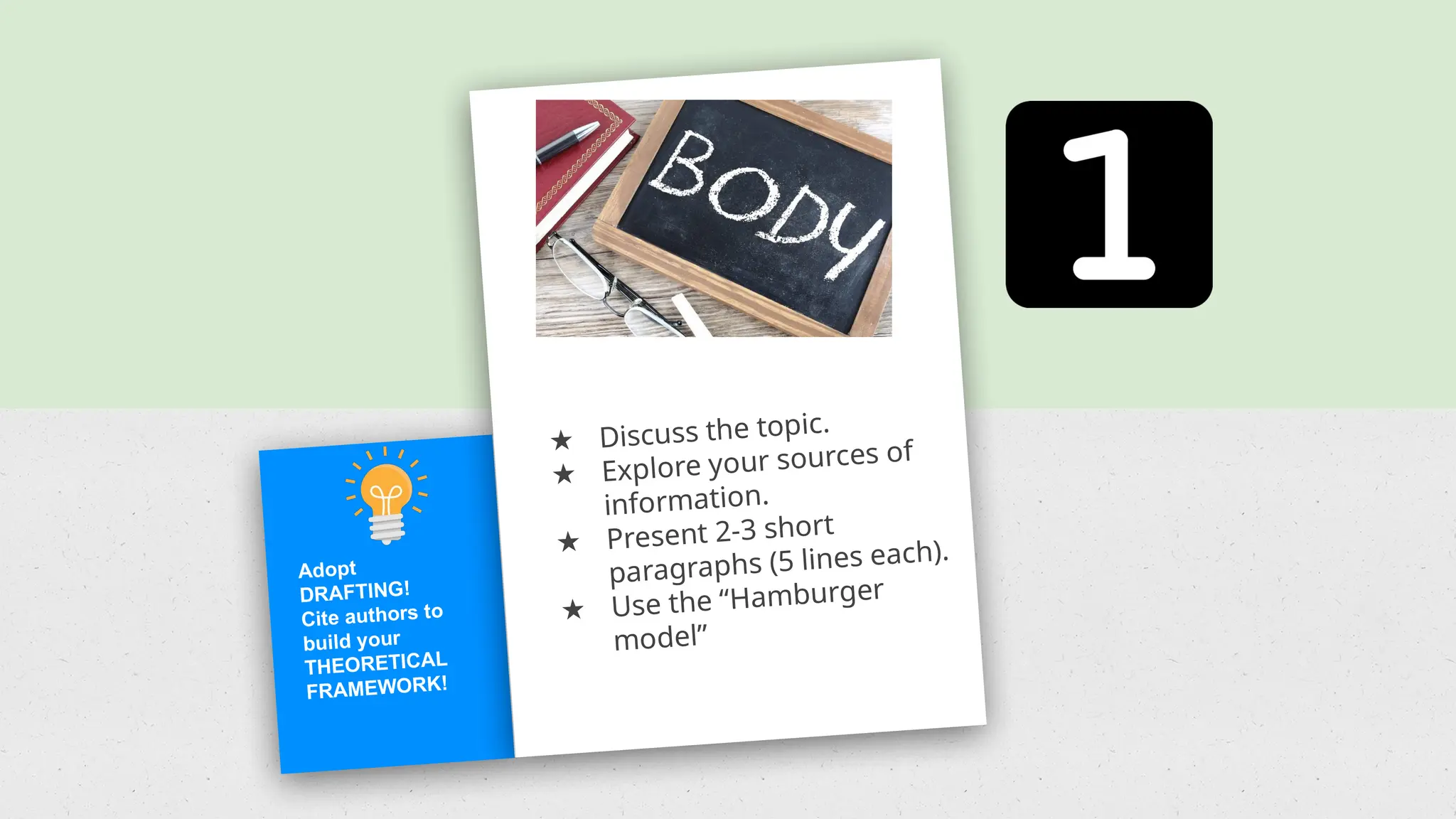
★ Discuss the topic.
★ Explore your sources of
information.
★ Present 2-3 short
paragraphs (5 lines each).
★ Use the “Hamburger
model”
7.
Check cohesion,
coherence!
Adopt
PROOFREADING!
Use onlinetools!
Use markers to
denote your stance
and the tone of the
discussion.
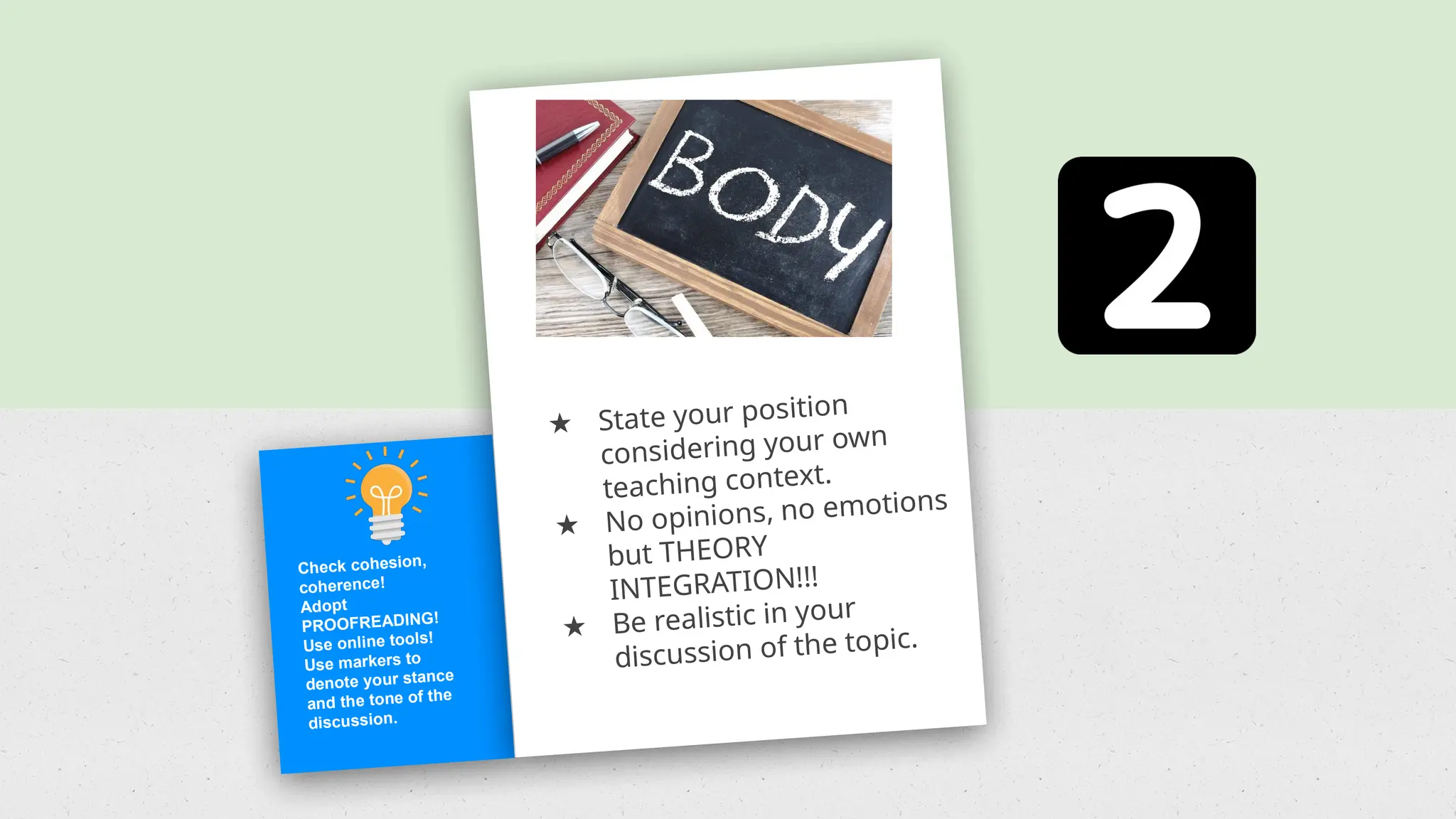
★ State your position
considering your own
teaching context.
★ No opinions, no emotions
but THEORY
INTEGRATION!!!
★ Be realistic in your
discussion of the topic.
8.
Check cohesion,
coherence!
Re readwhat you
have written before.
Do not include new
information.
Let the reader know
that you have
concluded your
analysis.
★ Recover the idea in the
introductory paragraph
and restate it.
★ Present the main
argument in your
discussion.
★ No opinions, no feelings,
no new information.
★ You must state your
conclusions after your
analysis.
9.
Alphabetical order.
Try thistool:
https://www.citefast.
com/?s=APA7#_Rep
ort
★ Include a LIST OF
REFERENCES.
★ Follow APA GUIDELINES
7th EDITION.
10.
The title isa
summary of what
comes next.
No gerunds!
Subject +
Predicate
Create a hook:
captivate your
audience!
★ Select a title for your
essay.
★ Write a COMPELLING
STATEMENT.
★ BE CREATIVE!
And follow academic
register! : )
11.
Great!
★ Revising: refinethe content, structure, and
organization of the writing. This may
involve adding, deleting, or rearranging
sentences or paragraphs to improve clarity,
coherence, and effectiveness.
★ Editing: review the writing for errors in
grammar, punctuation, spelling, and
mechanics. It also includes polishing the
language and style to enhance readability
and impact.
★ Publishing: The final stage involves
preparing the writing for its intended
audience, which may include formatting,
proofreading, and presenting the writing in
its final form.
#1 Hi everybody, this is the first part OF process writing in AL.
#2 Go back to what you have written about a language problem on the campus. I mean, the Initial steps in doing AL forum
#3 With that language problem in mind and recalling what you have read from the Mandatory materials in this course, start organizing your thoughts before you begin writing…Drafting is crucial, so now, focus on content, not on language forms, style and or grammar…
#4 Review the video about the Hamburger model and WRITE YOUR MAIN SENTENCE SUMMARIZING THE LANGUAGE PROBLEM…LET YOUR IDEAS FLOW…
#5 WRITE, WRITE, GO ON WRITING AT LEAST 5 OR 6 LINES, this will be the introduction of your essay. When you finish, assess yourself by checking THE REQUIREMENTS HERE: YOUR TOPIC SENTENCE MUST BEGIN THE PARAGRAPH, THEN, YOU WILL PRESENT THE NECESSARY EXPLANATIONS: SO YOU WILL WRITE 2 OR 3 SECONDARY SENTENCES (DO NOT FORGET TO STRIKE A BALANCE IN THE NUMBER OF WORDS). END THE INTRODUCTION BY STATING THE PURPOSE OF THIS ESSAY…THEN RELAX, HAND IN THE TEXT. ASSESSMENT WILL COME SOON.