FROM LIGHT TO SUPER RESOLUTION:
Evolution of Optical Microscopy in Cell Imaging
Presented By: Ms. Farhana Parween
Roll No.: CGU251103
Registration No.: 2503060020
M.Sc. Biotechnology, Semester I
Course: Bioinstrumentation and Biotechniques
Under the Guidance of: Dr. Jyoti Prakash Sahoo
OPTICAL MICROSCOPY
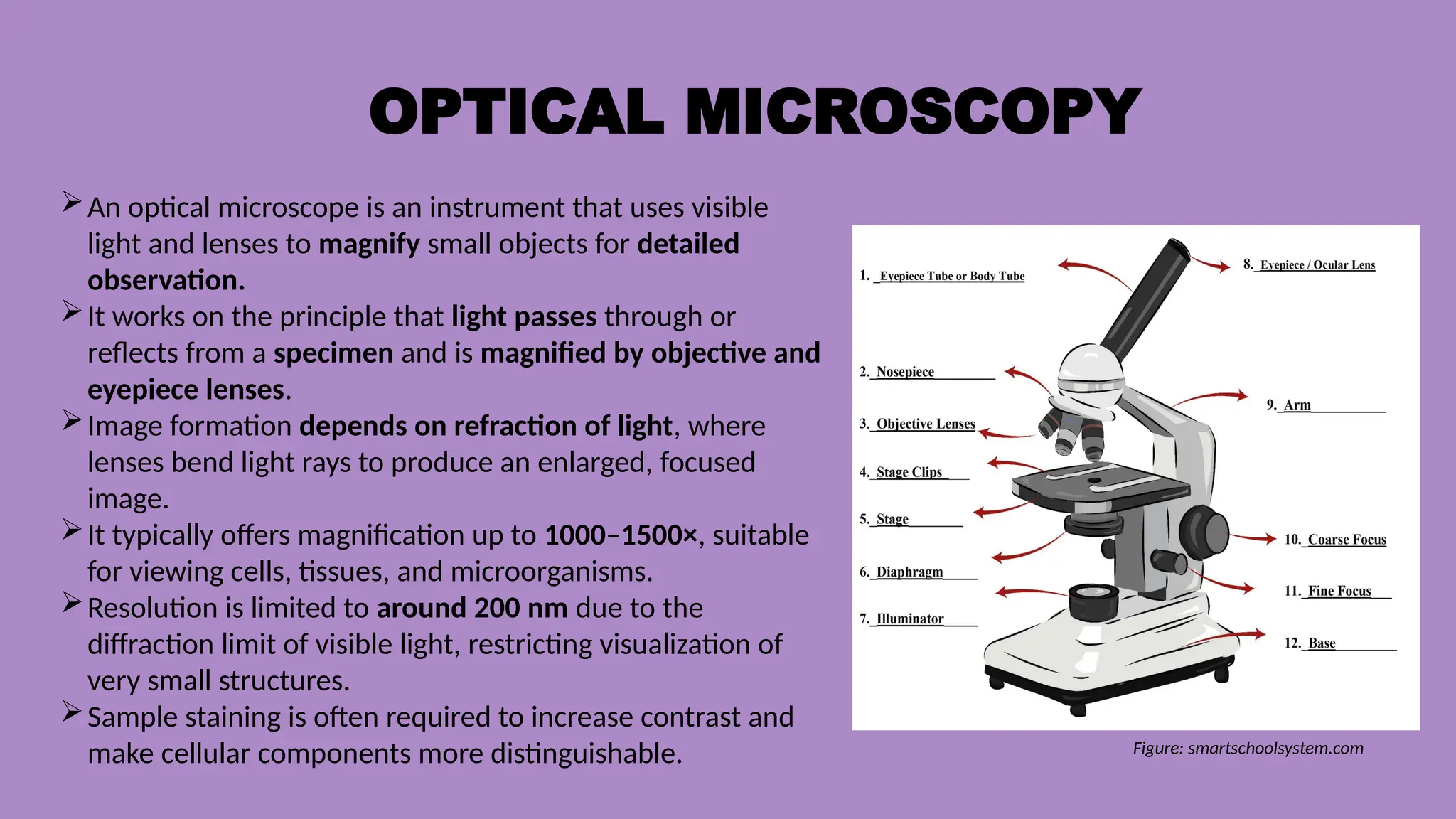
An optical microscope is an instrument that uses visible
light and lenses to magnify small objects for detailed
observation.
It works on the principle that light passes through or
reflects from a specimen and is magnified by objective and
eyepiece lenses.
Image formation depends on refraction of light, where
lenses bend light rays to produce an enlarged, focused
image.
It typically offers magnification up to 1000–1500×, suitable
for viewing cells, tissues, and microorganisms.
Resolution is limited to around 200 nm due to the
diffraction limit of visible light, restricting visualization of
very small structures.
Sample staining is often required to increase contrast and
make cellular components more distinguishable. Figure: smartschoolsystem.com
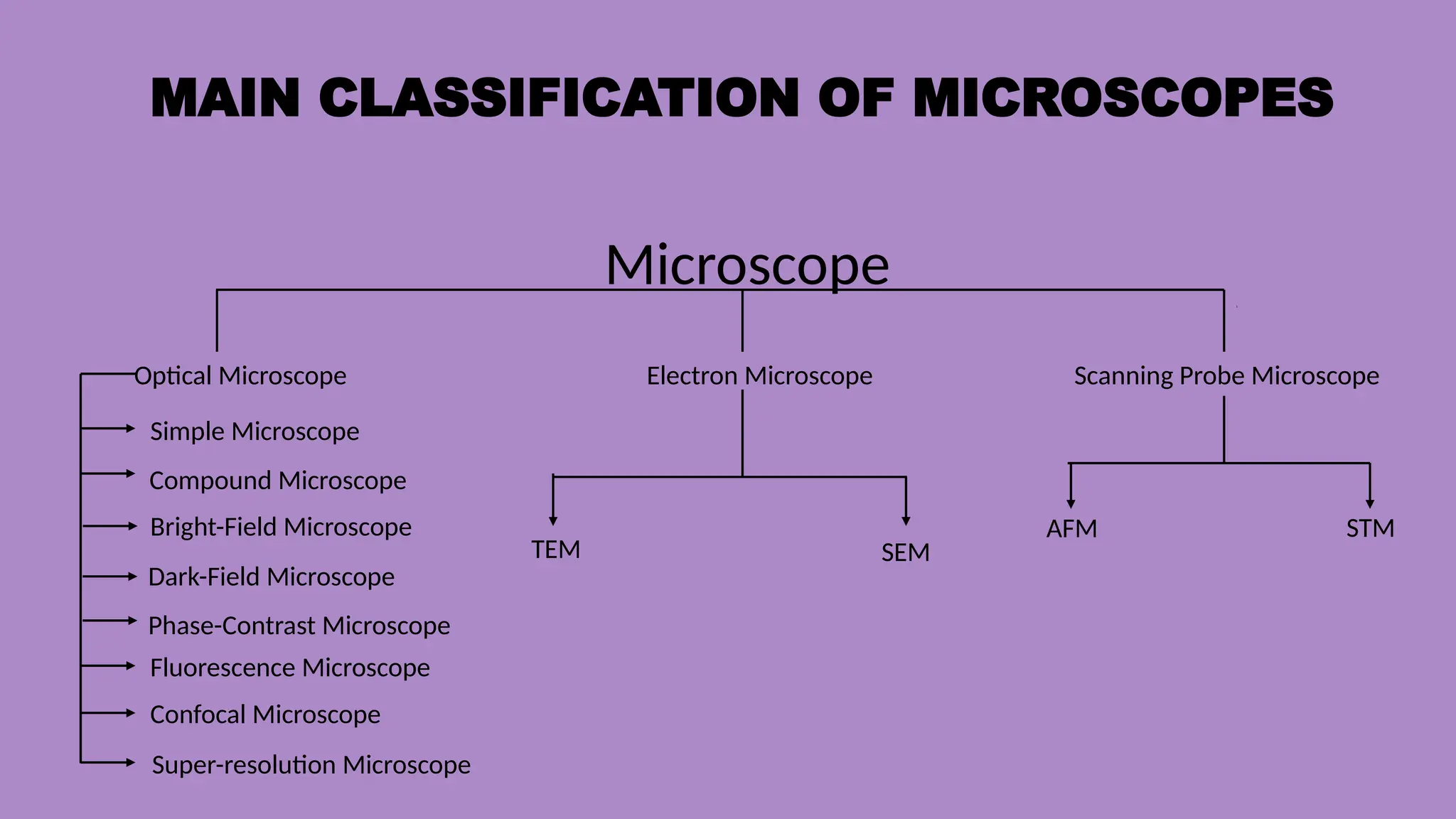
MAIN CLASSIFICATION OF MICROSCOPES
Microscope
Optical Microscope Electron Microscope Scanning Probe Microscope
Simple Microscope
Compound Microscope
Bright-Field Microscope
Dark-Field Microscope
Phase-Contrast Microscope
Super-resolution Microscope
Fluorescence Microscope
Confocal Microscope
STM
AFM
TEM SEM
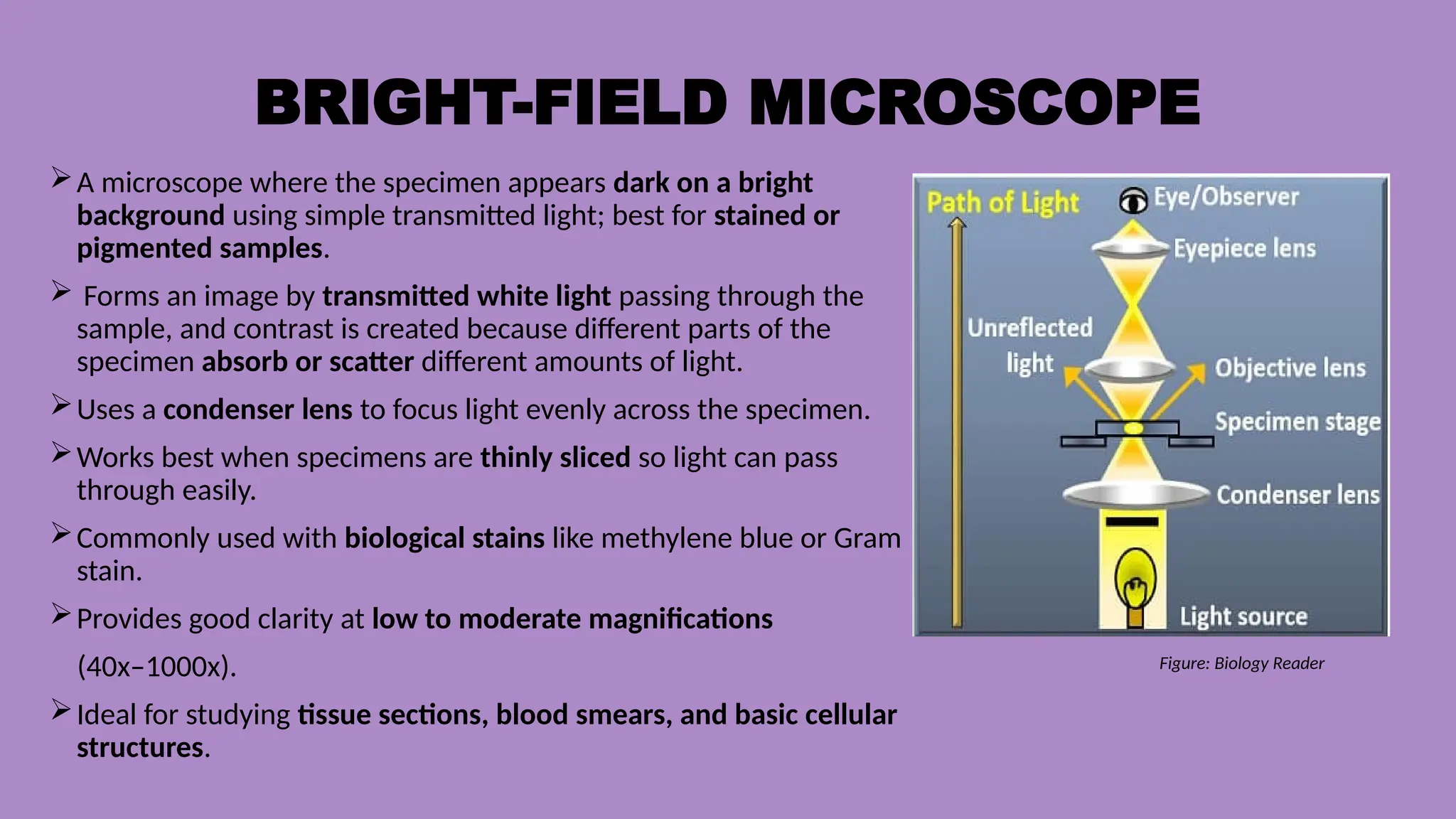
BRIGHT-FIELD MICROSCOPE
A microscope where the specimen appears dark on a bright
background using simple transmitted light; best for stained or
pigmented samples.
 Forms an image by transmitted white light passing through the
sample, and contrast is created because different parts of the
specimen absorb or scatter different amounts of light.
Uses a condenser lens to focus light evenly across the specimen.
Works best when specimens are thinly sliced so light can pass
through easily.
Commonly used with biological stains like methylene blue or Gram
stain.
Provides good clarity at low to moderate magnifications
(40x–1000x).
Ideal for studying tissue sections, blood smears, and basic cellular
structures.
Figure: Biology Reader
DARK-FIELD MICROSCOPY
A microscope that shows the specimen as bright against a dark
background by collecting only scattered light; ideal for unstained, thin,
motile cells.
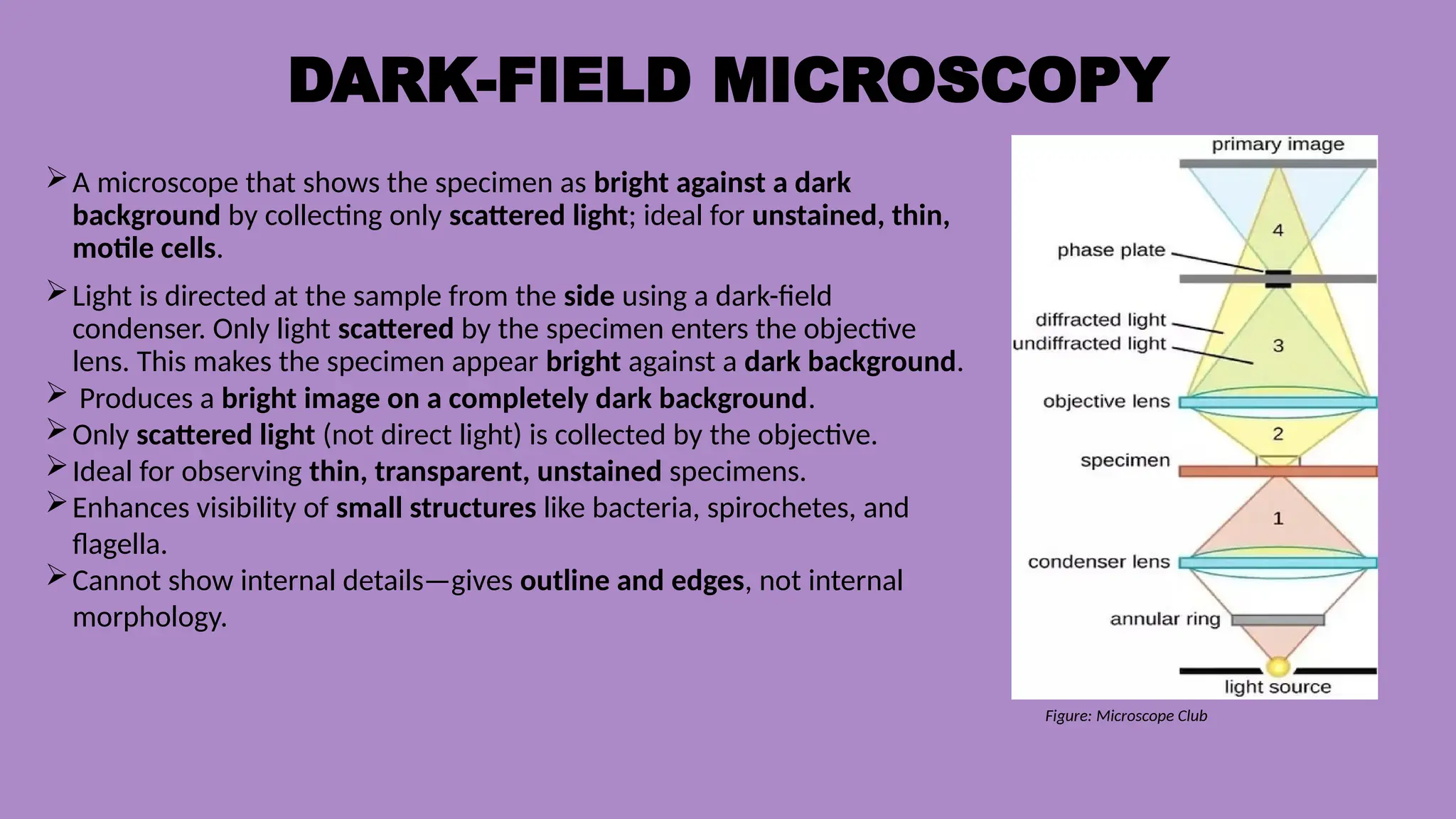
Light is directed at the sample from the side using a dark-field
condenser. Only light scattered by the specimen enters the objective
lens. This makes the specimen appear bright against a dark background.
 Produces a bright image on a completely dark background.
Only scattered light (not direct light) is collected by the objective.
Ideal for observing thin, transparent, unstained specimens.
Enhances visibility of small structures like bacteria, spirochetes, and
flagella.
Cannot show internal details—gives outline and edges, not internal
morphology.
Figure: Microscope Club
PHASE CONTRAST MICROSCOPY
A microscope that converts light phase differences into
contrast, allowing clear viewing of live, transparent,
unstained cells.
Phase-contrast converts differences in refractive index
(phase shifts) into visible brightness differences.
Transparent cells that normally look invisible become high-
contrast images.
Converts phase differences → intensity differences using
phase plates and annular rings.
Enables clear viewing of live, unstained cells without killing
them.
Excellent for observing organelles, cytoplasmic
movements, and cell division.
Produces images with bright halo or shade-off around
structures (optical artifact).
Very useful in cell biology, microbiology, and tissue culture
labs.
CONFOCAL MICROSCOPY
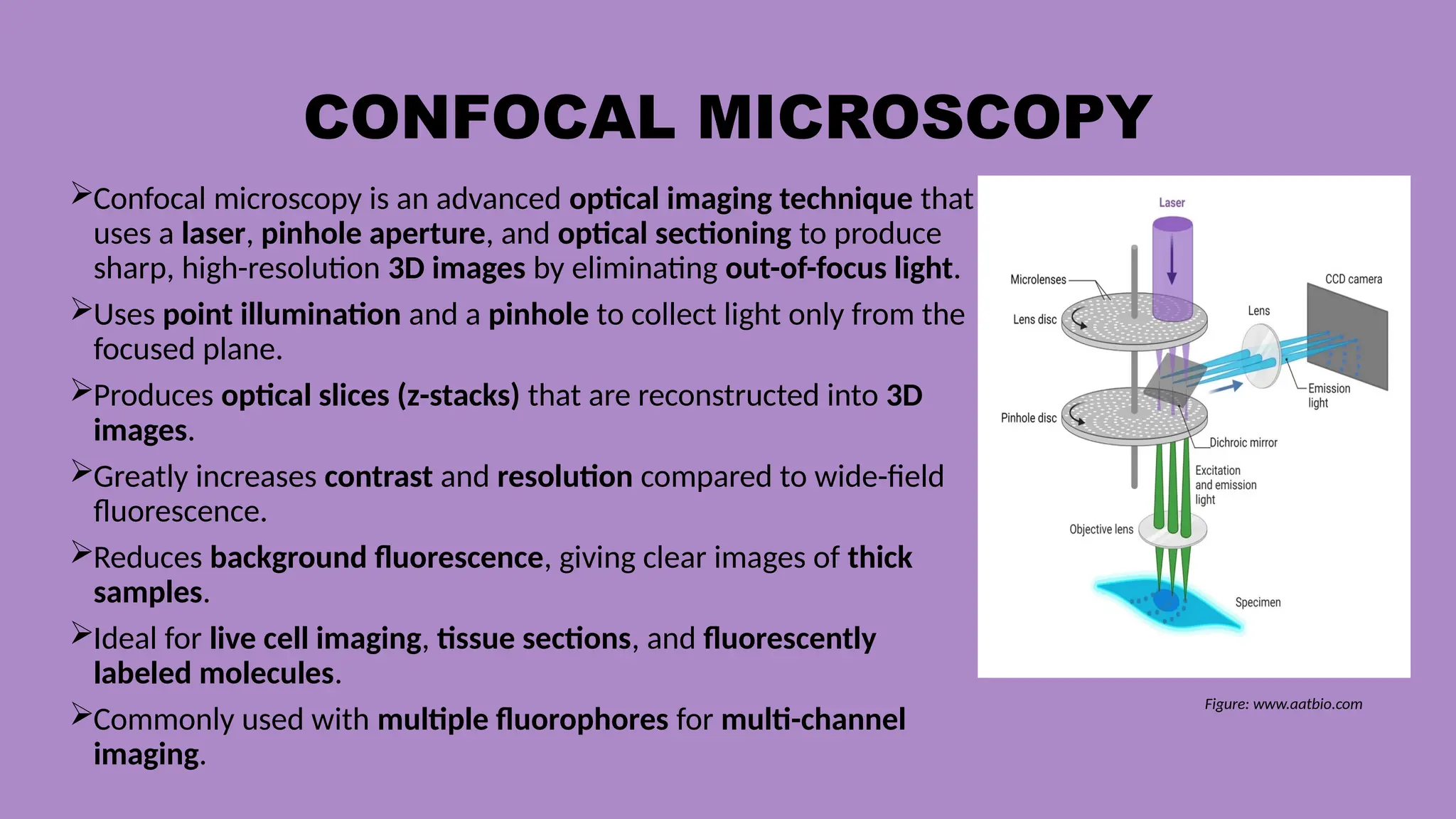
Confocal microscopy is an advanced optical imaging technique that
uses a laser, pinhole aperture, and optical sectioning to produce
sharp, high-resolution 3D images by eliminating out-of-focus light.
Uses point illumination and a pinhole to collect light only from the
focused plane.
Produces optical slices (z-stacks) that are reconstructed into 3D
images.
Greatly increases contrast and resolution compared to wide-field
fluorescence.
Reduces background fluorescence, giving clear images of thick
samples.
Ideal for live cell imaging, tissue sections, and fluorescently
labeled molecules.
Commonly used with multiple fluorophores for multi-channel
imaging.
Figure: www.aatbio.com
Stimulated Emission Depletion Microscopy
STED is a super-resolution fluorescence microscopy
technique that uses a depletion laser to shrink the
fluorescent spot beyond the diffraction limit, achieving
extremely high spatial resolution.
Uses two lasers: one for excitation, one for depleting
fluorescence around the focal point.
The depletion laser creates a donut-shaped beam that
leaves only the center fluorescing.
Achieves 20–50 nm resolution, far below the ~250 nm
light limit.
Provides real-time imaging of fine cellular structures like
synapses and the cytoskeleton.
Requires photostable fluorophores due to intense laser
power.
Useful in neurobiology, membrane studies, and
molecular architecture research.
Figure: www.Swinburne.edu.au
Structured Illumination Microscopy
SIM is a super-resolution method that projects
striped/patterned light onto the specimen and uses
computational reconstruction of interference patterns to
achieve higher resolution.
Improves resolution to ~100 nm, about twice that of standard
fluorescence microscopes.
Uses Moiré patterns formed by patterned illumination
interacting with sample structures.
Produces super-resolution images with low phototoxicity,
suitable for live cells.
Allows fast imaging, ideal for dynamic cell processes.
Works well with standard fluorophores and normal sample
preparation.
Provides super-resolution over large fields of view.
Figure: www.slideserve.com
Photo Activated Localization Microscopy
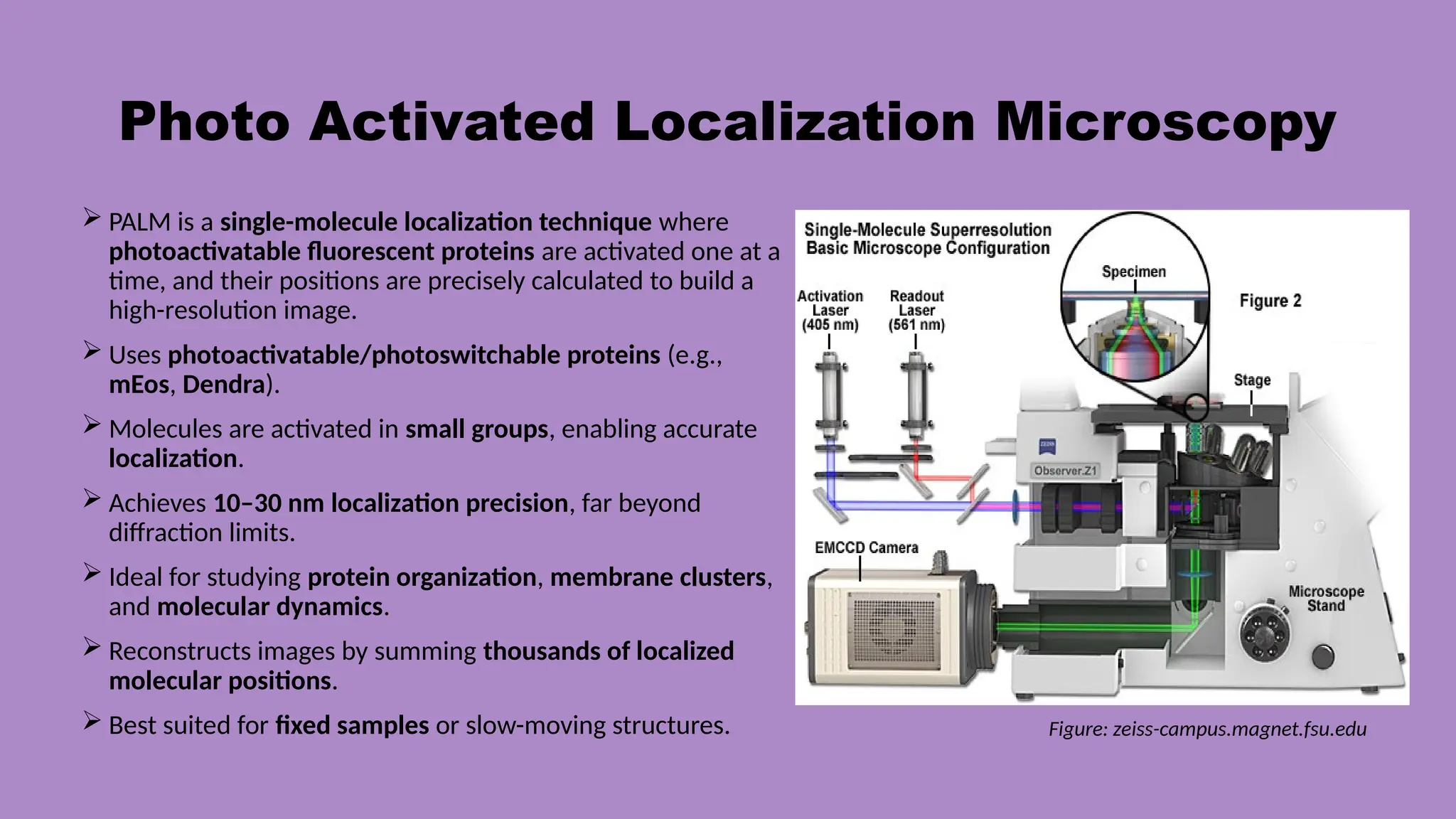
 PALM is a single-molecule localization technique where
photoactivatable fluorescent proteins are activated one at a
time, and their positions are precisely calculated to build a
high-resolution image.
 Uses photoactivatable/photoswitchable proteins (e.g.,
mEos, Dendra).
 Molecules are activated in small groups, enabling accurate
localization.
 Achieves 10–30 nm localization precision, far beyond
diffraction limits.
 Ideal for studying protein organization, membrane clusters,
and molecular dynamics.
 Reconstructs images by summing thousands of localized
molecular positions.
 Best suited for fixed samples or slow-moving structures. Figure: zeiss-campus.magnet.fsu.edu
Stochastic Optical Reconstruction Microscopy
STORM is a single-molecule localization method that uses blinking
fluorophores which switch on and off randomly, allowing precise mapping of
each molecule to form a super-resolution image.
Uses dyes that stochastically blink, producing isolated signals for localization.
Achieves extremely high resolution (~20 nm) by fitting each blinking event.
Works well with organic dyes (e.g., Cy5), which give bright and stable signals.
Produces detailed images of protein networks, cytoskeleton, and membrane
nanostructures.
Requires thousands of frames, so imaging is slower than SIM or confocal.
Commonly used in cell biology, virology, and nanoscale molecular
organization studies.
AI-ASSISTED IMAGE
RECONSTRUCTION
3D LIVE-CELL
IMAGING
Enhances image clarity and resolution by
reducing blur and noise using AI algorithms.
Allows low-light imaging, protecting live
cells from photodamage.
Reconstructs high-quality images from
limited or weak fluorescence signals.
Enables faster imaging by predicting and
restoring missing details.
Supports accurate 3D reconstruction,
especially in live-cell and super-resolution
microscopy.
Captures three-dimensional views of
living cells in real time.
Reveals dynamic processes like cell
division, migration, and organelle
movement.
Uses gentle illumination methods (e.g.,
light-sheet) to minimize phototoxicity.
Provides high temporal resolution,
allowing tracking of rapid cell changes.
Essential for studying cell behavior, drug
response, and intracellular interactions.
SUMMARY
Optical microscopy provides the foundation of cell imaging, with major types such
as bright-field, dark-field, and phase-contrast enabling contrast enhancement and
visualization of unstained or live cells.
Microscopes are broadly classified into light microscopy and electron microscopy,
with additional divisions based on illumination, contrast mechanisms, and resolution
capabilities.
Modern optical advancements—including confocal, STED, SIM, PALM, and STORM—
overcome the diffraction limit to deliver high-resolution and super-resolution
imaging of cellular structures.
Single-molecule localization techniques such as PALM and STORM provide
nanoscale visualization by precisely mapping individual fluorescent molecules.
Integration of AI-assisted image reconstruction and 3D live-cell imaging enables
faster, clearer, and dynamic visualization of cellular processes, transforming modern
biomedical research.
REFERNCE

Karp, G. (2018). Cell and Molecular Biology: Concepts and Experiments. Wiley.
Alberts, B. et al. (2017). Molecular Biology of the Cell. Garland Science.
Chopra, A., & Panwar, H. (2021). Instrumentation and Techniques in Biotechnology.
PHI Learning, India.
Gupta, P. K. (2017). Elements of Biotechnology. Rastogi Publications, India.
Byju’s – Biology & Microscopy Articles https://byjus.com/biology/
Microbe Notes – Microscopy & Microbiology Notes https://microbenotes.com/
Khan Academy – Cell Biology & Microscopy Basics
https://www.khanacademy.org/science/biology
THANK
YOU

From Light to Super Resolution: Microscopy

  • 1.
    FROM LIGHT TOSUPER RESOLUTION: Evolution of Optical Microscopy in Cell Imaging Presented By: Ms. Farhana Parween Roll No.: CGU251103 Registration No.: 2503060020 M.Sc. Biotechnology, Semester I Course: Bioinstrumentation and Biotechniques Under the Guidance of: Dr. Jyoti Prakash Sahoo
  • 2.
    OPTICAL MICROSCOPY An opticalmicroscope is an instrument that uses visible light and lenses to magnify small objects for detailed observation. It works on the principle that light passes through or reflects from a specimen and is magnified by objective and eyepiece lenses. Image formation depends on refraction of light, where lenses bend light rays to produce an enlarged, focused image. It typically offers magnification up to 1000–1500×, suitable for viewing cells, tissues, and microorganisms. Resolution is limited to around 200 nm due to the diffraction limit of visible light, restricting visualization of very small structures. Sample staining is often required to increase contrast and make cellular components more distinguishable. Figure: smartschoolsystem.com
  • 3.
    MAIN CLASSIFICATION OFMICROSCOPES Microscope Optical Microscope Electron Microscope Scanning Probe Microscope Simple Microscope Compound Microscope Bright-Field Microscope Dark-Field Microscope Phase-Contrast Microscope Super-resolution Microscope Fluorescence Microscope Confocal Microscope STM AFM TEM SEM
  • 4.
    BRIGHT-FIELD MICROSCOPE A microscopewhere the specimen appears dark on a bright background using simple transmitted light; best for stained or pigmented samples.  Forms an image by transmitted white light passing through the sample, and contrast is created because different parts of the specimen absorb or scatter different amounts of light. Uses a condenser lens to focus light evenly across the specimen. Works best when specimens are thinly sliced so light can pass through easily. Commonly used with biological stains like methylene blue or Gram stain. Provides good clarity at low to moderate magnifications (40x–1000x). Ideal for studying tissue sections, blood smears, and basic cellular structures. Figure: Biology Reader
  • 5.
    DARK-FIELD MICROSCOPY A microscopethat shows the specimen as bright against a dark background by collecting only scattered light; ideal for unstained, thin, motile cells. Light is directed at the sample from the side using a dark-field condenser. Only light scattered by the specimen enters the objective lens. This makes the specimen appear bright against a dark background.  Produces a bright image on a completely dark background. Only scattered light (not direct light) is collected by the objective. Ideal for observing thin, transparent, unstained specimens. Enhances visibility of small structures like bacteria, spirochetes, and flagella. Cannot show internal details—gives outline and edges, not internal morphology. Figure: Microscope Club
  • 6.
    PHASE CONTRAST MICROSCOPY Amicroscope that converts light phase differences into contrast, allowing clear viewing of live, transparent, unstained cells. Phase-contrast converts differences in refractive index (phase shifts) into visible brightness differences. Transparent cells that normally look invisible become high- contrast images. Converts phase differences → intensity differences using phase plates and annular rings. Enables clear viewing of live, unstained cells without killing them. Excellent for observing organelles, cytoplasmic movements, and cell division. Produces images with bright halo or shade-off around structures (optical artifact). Very useful in cell biology, microbiology, and tissue culture labs.
  • 7.
    CONFOCAL MICROSCOPY Confocal microscopyis an advanced optical imaging technique that uses a laser, pinhole aperture, and optical sectioning to produce sharp, high-resolution 3D images by eliminating out-of-focus light. Uses point illumination and a pinhole to collect light only from the focused plane. Produces optical slices (z-stacks) that are reconstructed into 3D images. Greatly increases contrast and resolution compared to wide-field fluorescence. Reduces background fluorescence, giving clear images of thick samples. Ideal for live cell imaging, tissue sections, and fluorescently labeled molecules. Commonly used with multiple fluorophores for multi-channel imaging. Figure: www.aatbio.com
  • 8.
    Stimulated Emission DepletionMicroscopy STED is a super-resolution fluorescence microscopy technique that uses a depletion laser to shrink the fluorescent spot beyond the diffraction limit, achieving extremely high spatial resolution. Uses two lasers: one for excitation, one for depleting fluorescence around the focal point. The depletion laser creates a donut-shaped beam that leaves only the center fluorescing. Achieves 20–50 nm resolution, far below the ~250 nm light limit. Provides real-time imaging of fine cellular structures like synapses and the cytoskeleton. Requires photostable fluorophores due to intense laser power. Useful in neurobiology, membrane studies, and molecular architecture research. Figure: www.Swinburne.edu.au
  • 9.
    Structured Illumination Microscopy SIMis a super-resolution method that projects striped/patterned light onto the specimen and uses computational reconstruction of interference patterns to achieve higher resolution. Improves resolution to ~100 nm, about twice that of standard fluorescence microscopes. Uses Moiré patterns formed by patterned illumination interacting with sample structures. Produces super-resolution images with low phototoxicity, suitable for live cells. Allows fast imaging, ideal for dynamic cell processes. Works well with standard fluorophores and normal sample preparation. Provides super-resolution over large fields of view. Figure: www.slideserve.com
  • 10.
    Photo Activated LocalizationMicroscopy  PALM is a single-molecule localization technique where photoactivatable fluorescent proteins are activated one at a time, and their positions are precisely calculated to build a high-resolution image.  Uses photoactivatable/photoswitchable proteins (e.g., mEos, Dendra).  Molecules are activated in small groups, enabling accurate localization.  Achieves 10–30 nm localization precision, far beyond diffraction limits.  Ideal for studying protein organization, membrane clusters, and molecular dynamics.  Reconstructs images by summing thousands of localized molecular positions.  Best suited for fixed samples or slow-moving structures. Figure: zeiss-campus.magnet.fsu.edu
  • 11.
    Stochastic Optical ReconstructionMicroscopy STORM is a single-molecule localization method that uses blinking fluorophores which switch on and off randomly, allowing precise mapping of each molecule to form a super-resolution image. Uses dyes that stochastically blink, producing isolated signals for localization. Achieves extremely high resolution (~20 nm) by fitting each blinking event. Works well with organic dyes (e.g., Cy5), which give bright and stable signals. Produces detailed images of protein networks, cytoskeleton, and membrane nanostructures. Requires thousands of frames, so imaging is slower than SIM or confocal. Commonly used in cell biology, virology, and nanoscale molecular organization studies.
  • 12.
    AI-ASSISTED IMAGE RECONSTRUCTION 3D LIVE-CELL IMAGING Enhancesimage clarity and resolution by reducing blur and noise using AI algorithms. Allows low-light imaging, protecting live cells from photodamage. Reconstructs high-quality images from limited or weak fluorescence signals. Enables faster imaging by predicting and restoring missing details. Supports accurate 3D reconstruction, especially in live-cell and super-resolution microscopy. Captures three-dimensional views of living cells in real time. Reveals dynamic processes like cell division, migration, and organelle movement. Uses gentle illumination methods (e.g., light-sheet) to minimize phototoxicity. Provides high temporal resolution, allowing tracking of rapid cell changes. Essential for studying cell behavior, drug response, and intracellular interactions.
  • 13.
    SUMMARY Optical microscopy providesthe foundation of cell imaging, with major types such as bright-field, dark-field, and phase-contrast enabling contrast enhancement and visualization of unstained or live cells. Microscopes are broadly classified into light microscopy and electron microscopy, with additional divisions based on illumination, contrast mechanisms, and resolution capabilities. Modern optical advancements—including confocal, STED, SIM, PALM, and STORM— overcome the diffraction limit to deliver high-resolution and super-resolution imaging of cellular structures. Single-molecule localization techniques such as PALM and STORM provide nanoscale visualization by precisely mapping individual fluorescent molecules. Integration of AI-assisted image reconstruction and 3D live-cell imaging enables faster, clearer, and dynamic visualization of cellular processes, transforming modern biomedical research.
  • 14.
    REFERNCE  Karp, G. (2018).Cell and Molecular Biology: Concepts and Experiments. Wiley. Alberts, B. et al. (2017). Molecular Biology of the Cell. Garland Science. Chopra, A., & Panwar, H. (2021). Instrumentation and Techniques in Biotechnology. PHI Learning, India. Gupta, P. K. (2017). Elements of Biotechnology. Rastogi Publications, India. Byju’s – Biology & Microscopy Articles https://byjus.com/biology/ Microbe Notes – Microscopy & Microbiology Notes https://microbenotes.com/ Khan Academy – Cell Biology & Microscopy Basics https://www.khanacademy.org/science/biology
  • 15.