From Conservation to Crowdsourcing:  A Typology of Citizen Science A Typology of Citizen Science Andrea Wiggins & Kevin Crowston, Syracuse University 7 January, 2011 ~ HICSS-44
Introduction Citizen Science Crowdsourcing scientific research through virtual collaboration between professional researchers and the public Collective goals are addressed through open participation in research Motivations Describe landscape of citizen science Support future research, cyberinfrastructure design, and project management
Related Work More like scientific cyberinfrastructure projects than collaboratories Peer production: similar task structure but different with respect to hierarchical form, not self-organizing Communities of practice: motivation and progressive engagement Not necessarily “open science” but science with open participation, and often open data Prior typologies in the environmental sciences focus on public engagement in different steps of scientific research
Methods Landscape sampling : purposive and comprehensive in type, rather than frequency Examined 30 projects on 80 facets drawn from theoretical framework Manually collected data from the web, published reports, and interviews Example facet types : project demographics, organizational affiliations, funding sources, outcomes, processes, technologies, project and task design Inductive qualitative clustering on dominant project goals and virtuality Practitioner review : intuitive fit to experiences
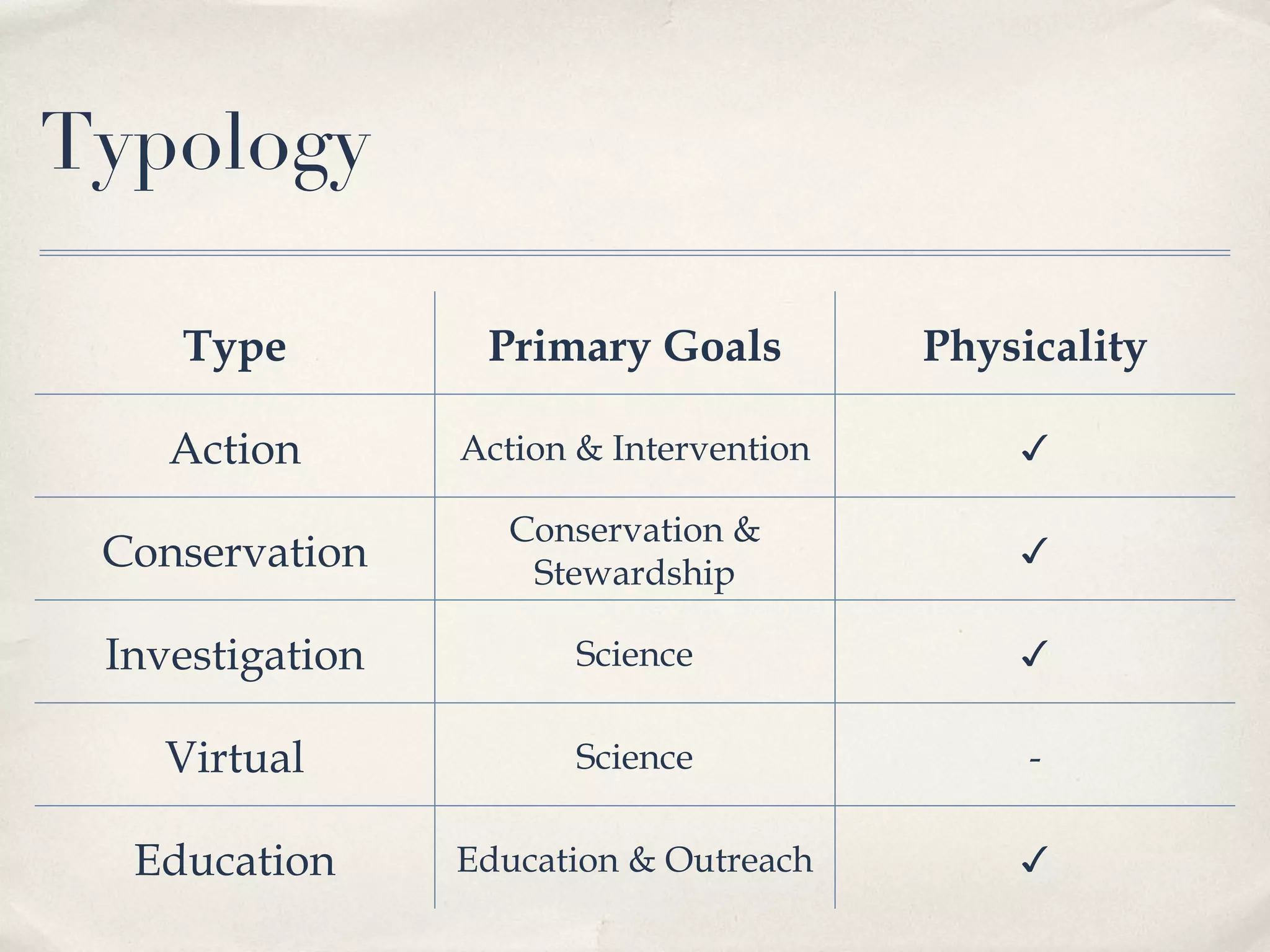
Typology Type Primary Goals Physicality Action Action & Intervention ✓ Conservation Conservation & Stewardship ✓ Investigation Science ✓ Virtual Science - Education Education & Outreach ✓
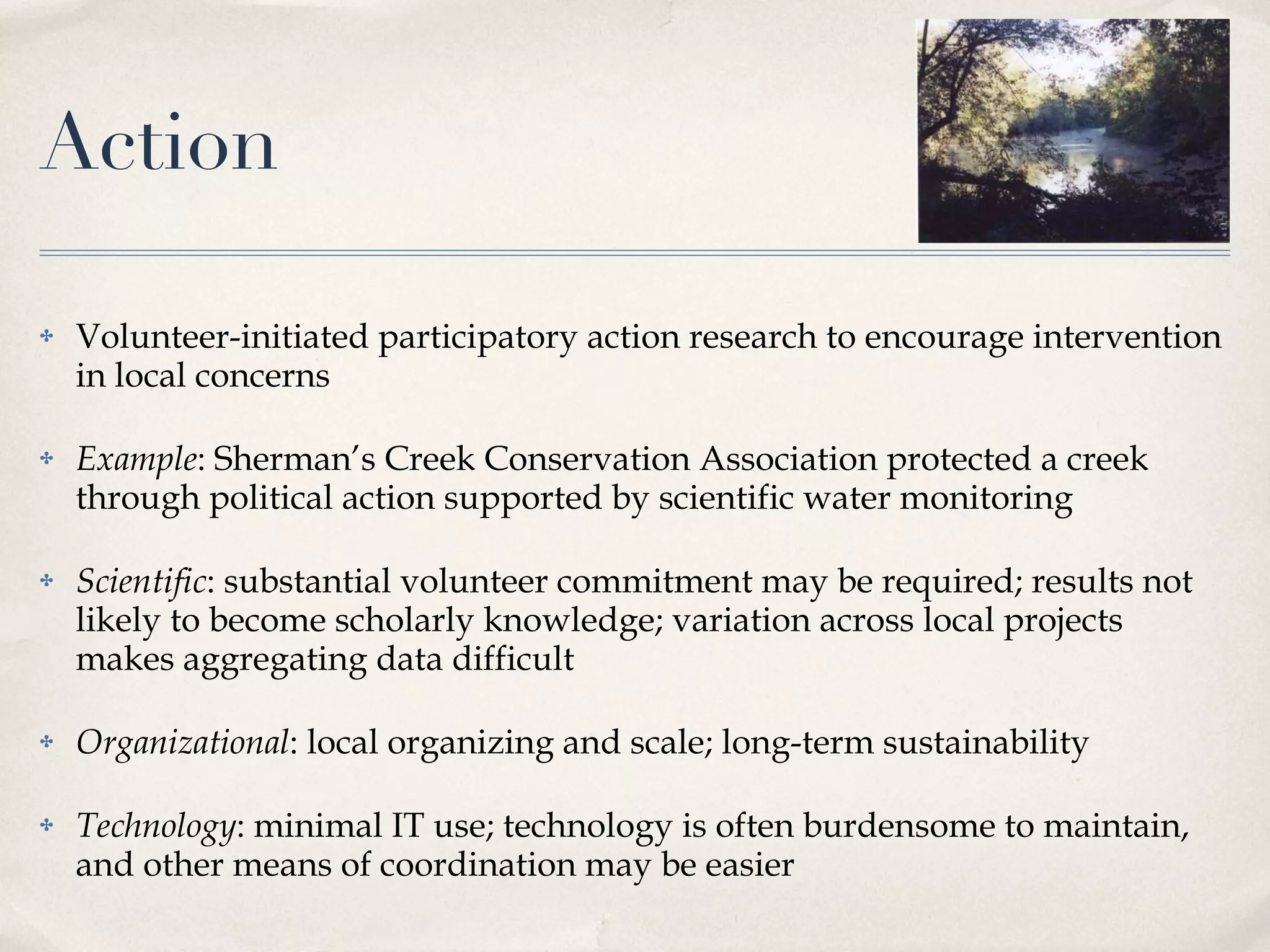
Action Volunteer-initiated participatory action research to encourage intervention in local concerns Example : Sherman’s Creek Conservation Association protected a creek through political action supported by scientific water monitoring Scientific : substantial volunteer commitment may be required; results not likely to become scholarly knowledge; variation across local projects makes aggregating data difficult Organizational : local organizing and scale; long-term sustainability Technology : minimal IT use; technology is often burdensome to maintain, and other means of coordination may be easier
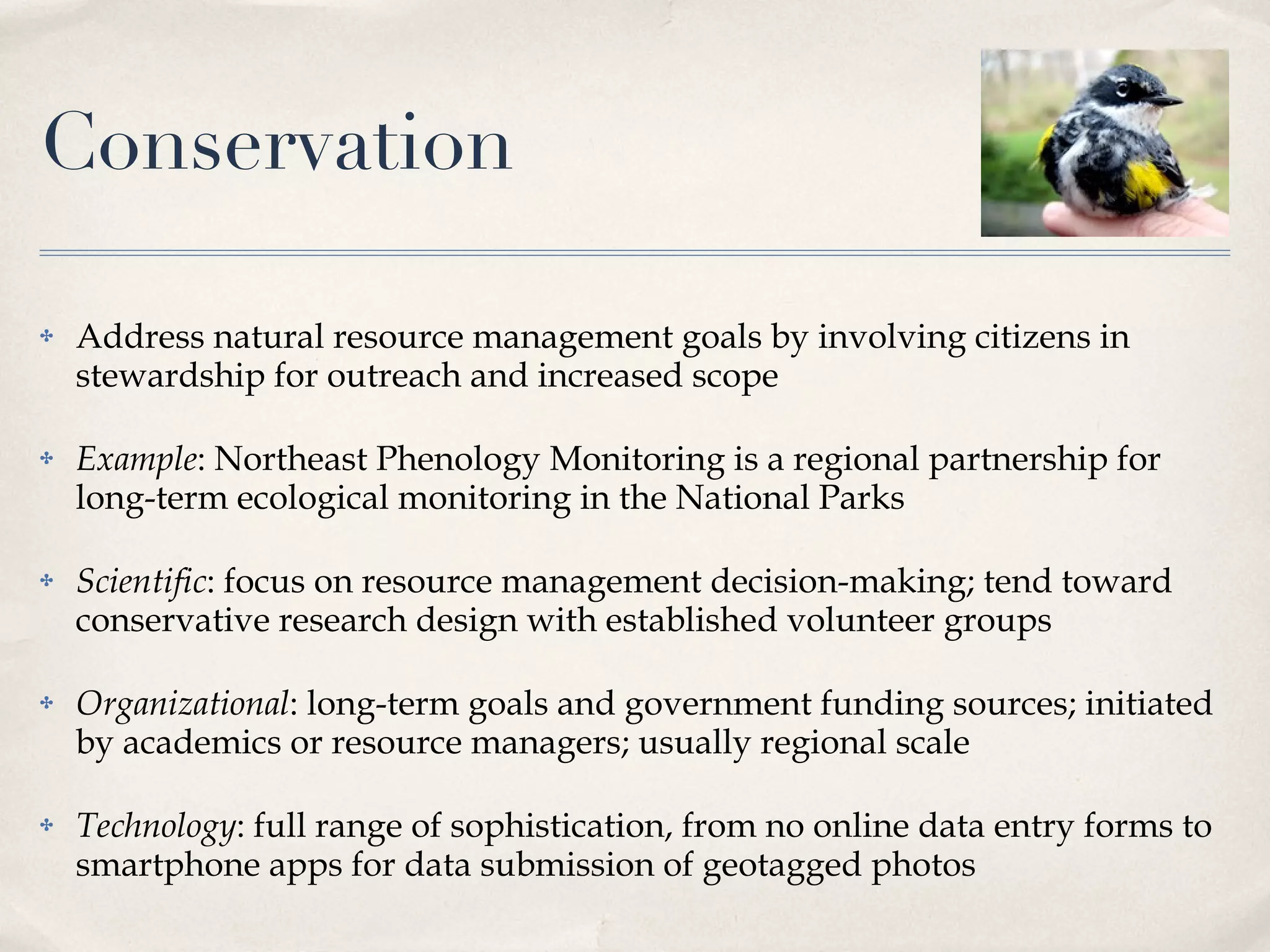
Conservation Address natural resource management goals by involving citizens in stewardship for outreach and increased scope Example : Northeast Phenology Monitoring is a regional partnership for long-term ecological monitoring in the National Parks Scientific : focus on resource management decision-making; tend toward conservative research design with established volunteer groups Organizational : long-term goals and government funding sources; initiated by academics or resource managers; usually regional scale Technology : full range of sophistication, from no online data entry forms to smartphone apps for data submission of geotagged photos
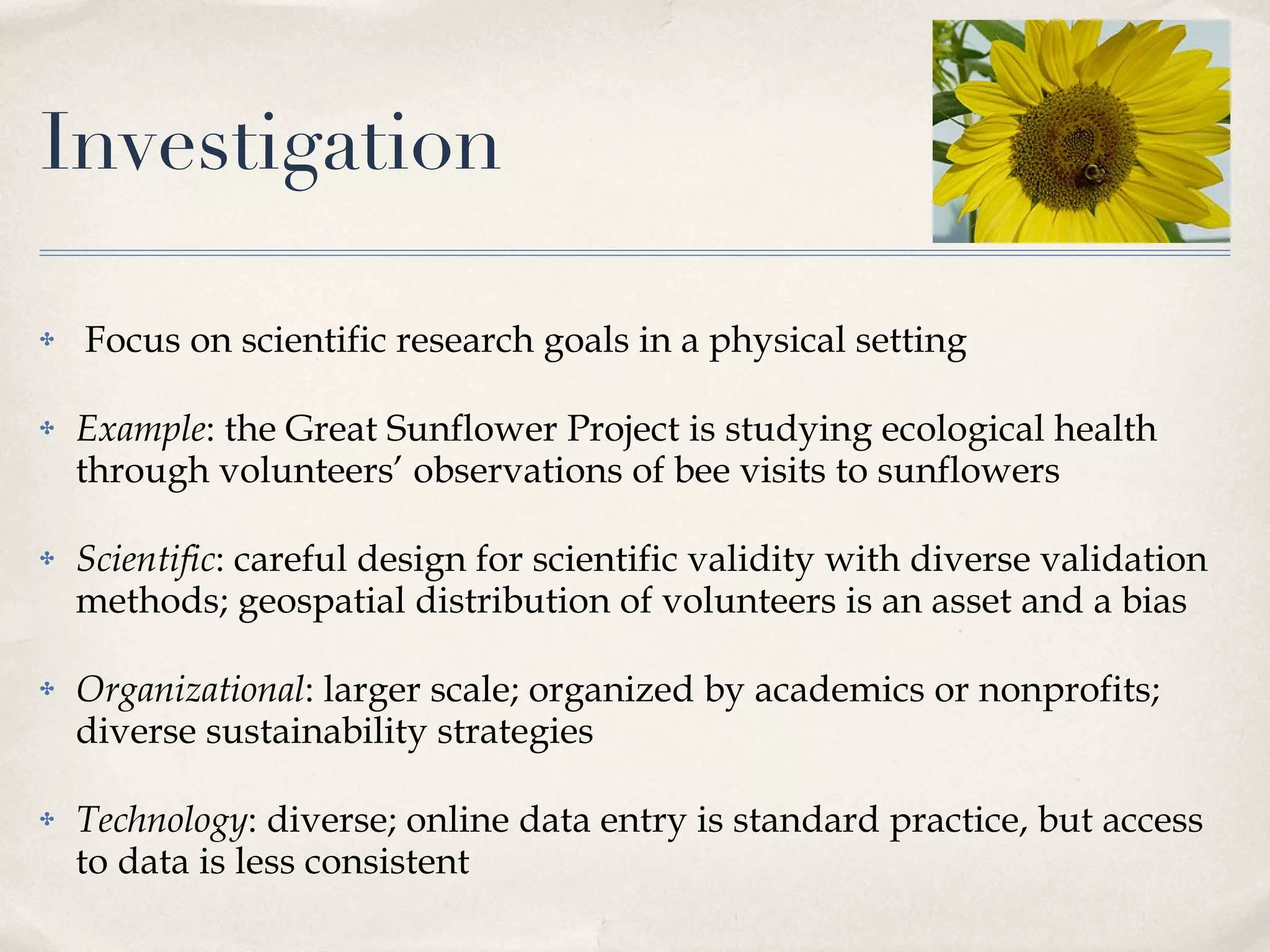
Investigation Focus on scientific research goals in a physical setting Example : the Great Sunflower Project is studying ecological health through volunteers’ observations of bee visits to sunflowers Scientific : careful design for scientific validity with diverse validation methods; geospatial distribution of volunteers is an asset and a bias Organizational : larger scale; organized by academics or nonprofits; diverse sustainability strategies Technology : diverse; online data entry is standard practice, but access to data is less consistent
Virtual Similar goals to Investigation projects (scientific knowledge production), but entirely ICT-mediated and different in several other respects Example : Galaxy Zoo is classifying millions of galaxies by having volunteers judge galaxy characteristics in image recognition tasks Scientific : replication is the primary validation method; online participation requires task design that is both useful and interesting Organizational : organized by academics and supported by research funding; frequently indeterminate in duration Technology : complex custom web platforms; supports reputation rewards, friendly competition, and performance feedback
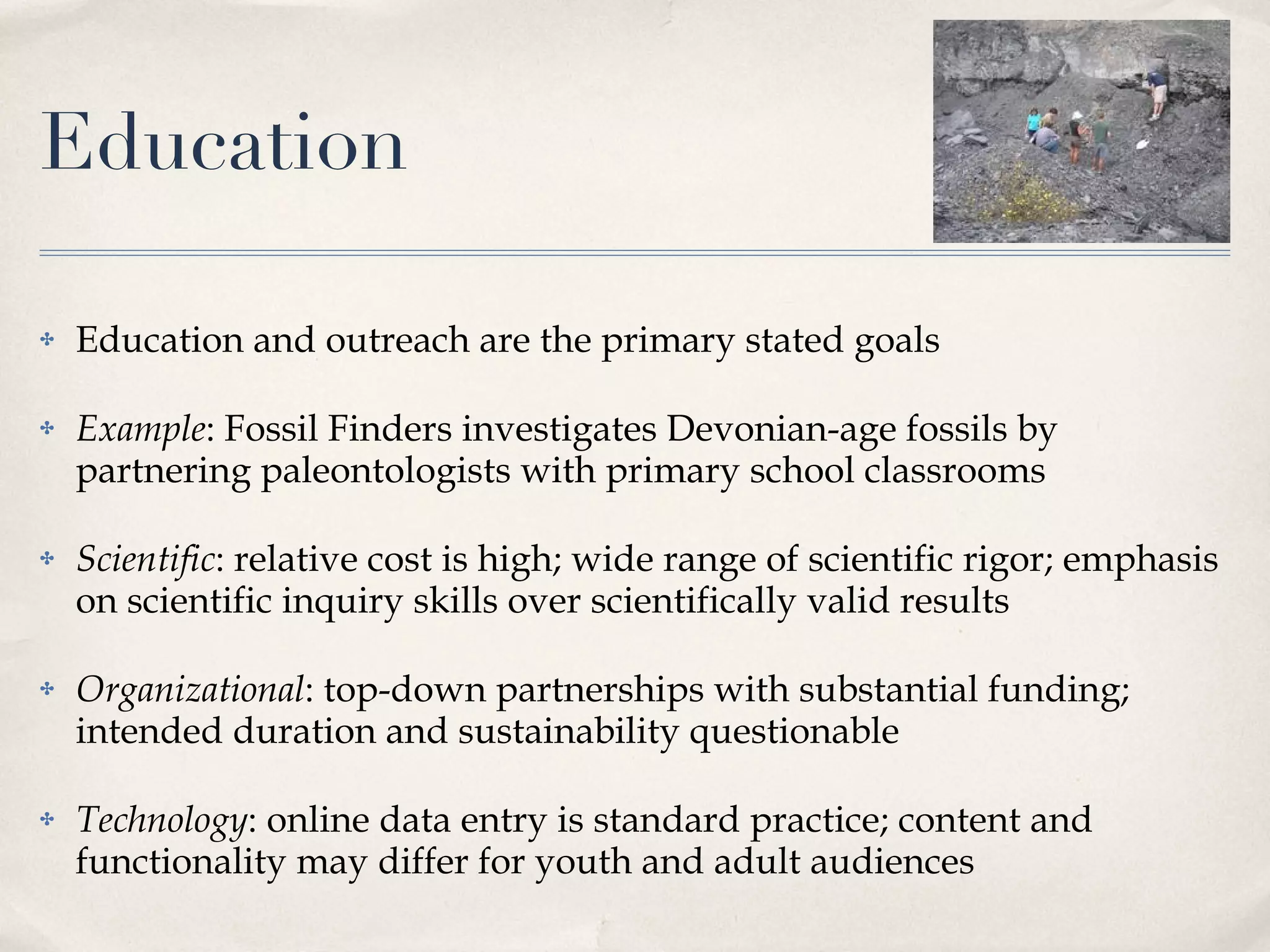
Education Education and outreach are the primary stated goals Example : Fossil Finders investigates Devonian-age fossils by partnering paleontologists with primary school classrooms  Scientific : relative cost is high; wide range of scientific rigor; emphasis on scientific inquiry skills over scientifically valid results Organizational : top-down partnerships with substantial funding; intended duration and sustainability questionable Technology : online data entry is standard practice; content and functionality may differ for youth and adult audiences
Contributions & Implications Contributions Complementary to prior participation-based typologies Identifies previously unrecognized class of projects Implications Guide sampling for future research with readily identifiable info Suggests further inquiry into virtuality and task design Provides examples of project designs and technologies as a resource for future development and evaluation
Limitations & Future Work Limitations Small sample Secondary data Qualitative analysis methods Future work Citizen science project survey using quantitative analysis methods Case studies examining project types in greater depth
Questions? Thanks! Acknowledgements NSF OCI Grant 09- 43049 Public Participation in Scientific Research reading group  at the Cornell Lab of Ornithology More http://voss.syr.edu awiggins@syr.edu, crowston@syr.edu

From Conservation to Crowdsourcing: A Typology of Citizen Science

  • 1.
    From Conservation toCrowdsourcing: A Typology of Citizen Science A Typology of Citizen Science Andrea Wiggins & Kevin Crowston, Syracuse University 7 January, 2011 ~ HICSS-44
  • 2.
    Introduction Citizen ScienceCrowdsourcing scientific research through virtual collaboration between professional researchers and the public Collective goals are addressed through open participation in research Motivations Describe landscape of citizen science Support future research, cyberinfrastructure design, and project management
  • 3.
    Related Work Morelike scientific cyberinfrastructure projects than collaboratories Peer production: similar task structure but different with respect to hierarchical form, not self-organizing Communities of practice: motivation and progressive engagement Not necessarily “open science” but science with open participation, and often open data Prior typologies in the environmental sciences focus on public engagement in different steps of scientific research
  • 4.
    Methods Landscape sampling: purposive and comprehensive in type, rather than frequency Examined 30 projects on 80 facets drawn from theoretical framework Manually collected data from the web, published reports, and interviews Example facet types : project demographics, organizational affiliations, funding sources, outcomes, processes, technologies, project and task design Inductive qualitative clustering on dominant project goals and virtuality Practitioner review : intuitive fit to experiences
  • 5.
    Typology Type PrimaryGoals Physicality Action Action & Intervention ✓ Conservation Conservation & Stewardship ✓ Investigation Science ✓ Virtual Science - Education Education & Outreach ✓
  • 6.
    Action Volunteer-initiated participatoryaction research to encourage intervention in local concerns Example : Sherman’s Creek Conservation Association protected a creek through political action supported by scientific water monitoring Scientific : substantial volunteer commitment may be required; results not likely to become scholarly knowledge; variation across local projects makes aggregating data difficult Organizational : local organizing and scale; long-term sustainability Technology : minimal IT use; technology is often burdensome to maintain, and other means of coordination may be easier
  • 7.
    Conservation Address naturalresource management goals by involving citizens in stewardship for outreach and increased scope Example : Northeast Phenology Monitoring is a regional partnership for long-term ecological monitoring in the National Parks Scientific : focus on resource management decision-making; tend toward conservative research design with established volunteer groups Organizational : long-term goals and government funding sources; initiated by academics or resource managers; usually regional scale Technology : full range of sophistication, from no online data entry forms to smartphone apps for data submission of geotagged photos
  • 8.
    Investigation Focus onscientific research goals in a physical setting Example : the Great Sunflower Project is studying ecological health through volunteers’ observations of bee visits to sunflowers Scientific : careful design for scientific validity with diverse validation methods; geospatial distribution of volunteers is an asset and a bias Organizational : larger scale; organized by academics or nonprofits; diverse sustainability strategies Technology : diverse; online data entry is standard practice, but access to data is less consistent
  • 9.
    Virtual Similar goalsto Investigation projects (scientific knowledge production), but entirely ICT-mediated and different in several other respects Example : Galaxy Zoo is classifying millions of galaxies by having volunteers judge galaxy characteristics in image recognition tasks Scientific : replication is the primary validation method; online participation requires task design that is both useful and interesting Organizational : organized by academics and supported by research funding; frequently indeterminate in duration Technology : complex custom web platforms; supports reputation rewards, friendly competition, and performance feedback
  • 10.
    Education Education andoutreach are the primary stated goals Example : Fossil Finders investigates Devonian-age fossils by partnering paleontologists with primary school classrooms Scientific : relative cost is high; wide range of scientific rigor; emphasis on scientific inquiry skills over scientifically valid results Organizational : top-down partnerships with substantial funding; intended duration and sustainability questionable Technology : online data entry is standard practice; content and functionality may differ for youth and adult audiences
  • 11.
    Contributions & ImplicationsContributions Complementary to prior participation-based typologies Identifies previously unrecognized class of projects Implications Guide sampling for future research with readily identifiable info Suggests further inquiry into virtuality and task design Provides examples of project designs and technologies as a resource for future development and evaluation
  • 12.
    Limitations & FutureWork Limitations Small sample Secondary data Qualitative analysis methods Future work Citizen science project survey using quantitative analysis methods Case studies examining project types in greater depth
  • 13.
    Questions? Thanks! AcknowledgementsNSF OCI Grant 09- 43049 Public Participation in Scientific Research reading group at the Cornell Lab of Ornithology More http://voss.syr.edu awiggins@syr.edu, crowston@syr.edu