Glossary of Literary Terms
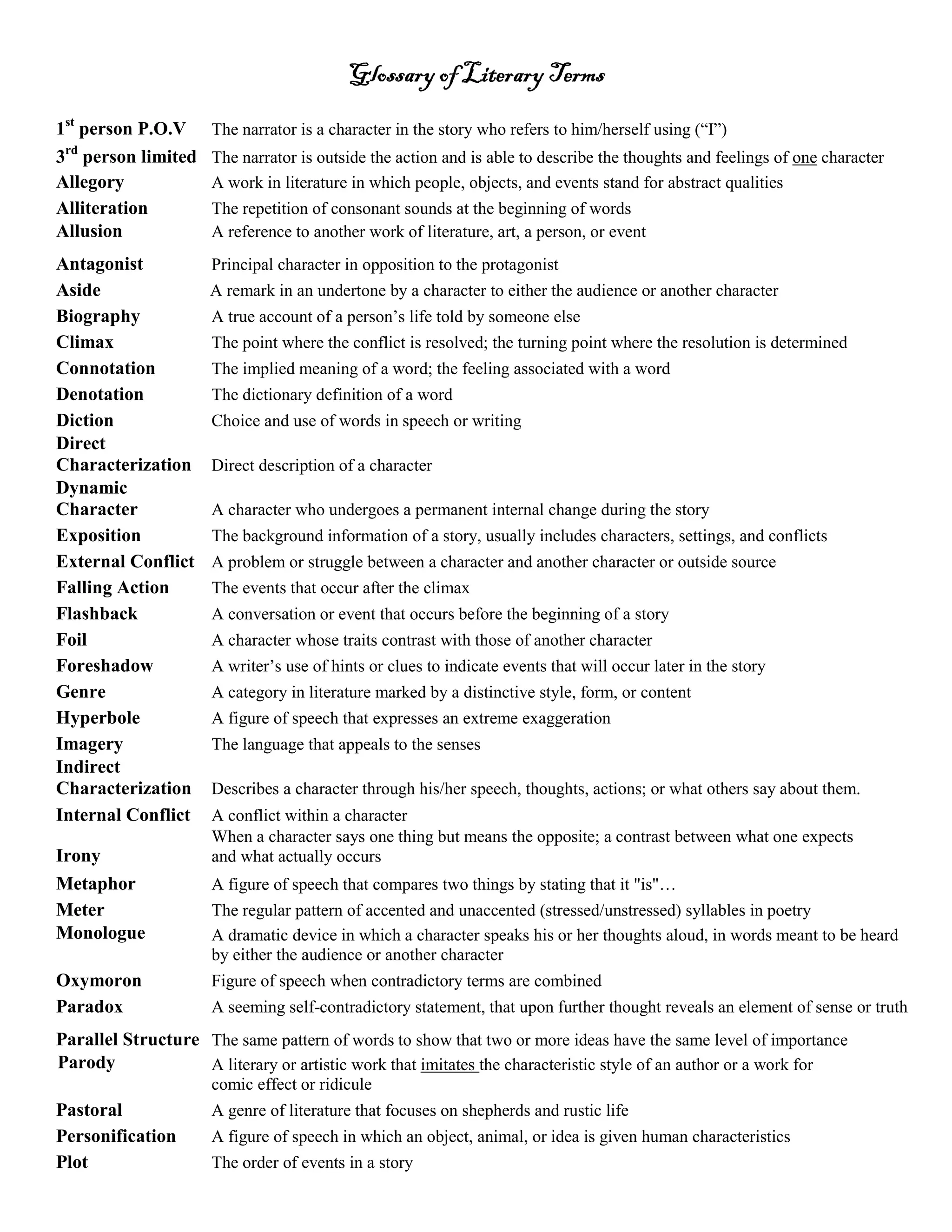
1st person P.O.V     The narrator is a character in the story who refers to him/herself using (“I”)
3rd person limited   The narrator is outside the action and is able to describe the thoughts and feelings of one character
Allegory             A work in literature in which people, objects, and events stand for abstract qualities
Alliteration         The repetition of consonant sounds at the beginning of words
Allusion             A reference to another work of literature, art, a person, or event
Antagonist           Principal character in opposition to the protagonist
Aside                A remark in an undertone by a character to either the audience or another character
Biography            A true account of a person’s life told by someone else
Climax               The point where the conflict is resolved; the turning point where the resolution is determined
Connotation          The implied meaning of a word; the feeling associated with a word
Denotation           The dictionary definition of a word
Diction              Choice and use of words in speech or writing
Direct
Characterization     Direct description of a character
Dynamic
Character            A character who undergoes a permanent internal change during the story
Exposition           The background information of a story, usually includes characters, settings, and conflicts
External Conflict    A problem or struggle between a character and another character or outside source
Falling Action       The events that occur after the climax
Flashback            A conversation or event that occurs before the beginning of a story
Foil                 A character whose traits contrast with those of another character
Foreshadow           A writer’s use of hints or clues to indicate events that will occur later in the story
Genre                A category in literature marked by a distinctive style, form, or content
Hyperbole            A figure of speech that expresses an extreme exaggeration
Imagery              The language that appeals to the senses
Indirect
Characterization     Describes a character through his/her speech, thoughts, actions; or what others say about them.
Internal Conflict    A conflict within a character
                     When a character says one thing but means the opposite; a contrast between what one expects
Irony                and what actually occurs
Metaphor             A figure of speech that compares two things by stating that it "is"…
Meter                The regular pattern of accented and unaccented (stressed/unstressed) syllables in poetry
Monologue            A dramatic device in which a character speaks his or her thoughts aloud, in words meant to be heard
                     by either the audience or another character
Oxymoron             Figure of speech when contradictory terms are combined
Paradox              A seeming self-contradictory statement, that upon further thought reveals an element of sense or truth
Parallel Structure The same pattern of words to show that two or more ideas have the same level of importance
Parody             A literary or artistic work that imitates the characteristic style of an author or a work for
                     comic effect or ridicule
Pastoral             A genre of literature that focuses on shepherds and rustic life
Personification      A figure of speech in which an object, animal, or idea is given human characteristics
Plot                 The order of events in a story
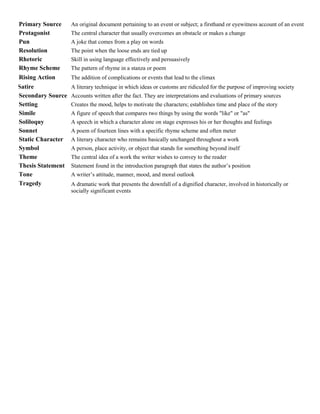
Primary Source     An original document pertaining to an event or subject; a firsthand or eyewitness account of an event
Protagonist        The central character that usually overcomes an obstacle or makes a change
Pun                A joke that comes from a play on words
Resolution         The point when the loose ends are tied up
Rhetoric           Skill in using language effectively and persuasively
Rhyme Scheme       The pattern of rhyme in a stanza or poem
Rising Action      The addition of complications or events that lead to the climax
Satire             A literary technique in which ideas or customs are ridiculed for the purpose of improving society
Secondary Source   Accounts written after the fact. They are interpretations and evaluations of primary sources
Setting            Creates the mood, helps to motivate the characters; establishes time and place of the story
Simile             A figure of speech that compares two things by using the words "like" or "as"
Soliloquy          A speech in which a character alone on stage expresses his or her thoughts and feelings
Sonnet             A poem of fourteen lines with a specific rhyme scheme and often meter
Static Character   A literary character who remains basically unchanged throughout a work
Symbol             A person, place activity, or object that stands for something beyond itself
Theme              The central idea of a work the writer wishes to convey to the reader
Thesis Statement   Statement found in the introduction paragraph that states the author’s position
Tone               A writer’s attitude, manner, mood, and moral outlook
Tragedy            A dramatic work that presents the downfall of a dignified character, involved in historically or
                   socially significant events

Freshman Vocabulary

  • 1.
    Glossary of LiteraryTerms 1st person P.O.V The narrator is a character in the story who refers to him/herself using (“I”) 3rd person limited The narrator is outside the action and is able to describe the thoughts and feelings of one character Allegory A work in literature in which people, objects, and events stand for abstract qualities Alliteration The repetition of consonant sounds at the beginning of words Allusion A reference to another work of literature, art, a person, or event Antagonist Principal character in opposition to the protagonist Aside A remark in an undertone by a character to either the audience or another character Biography A true account of a person’s life told by someone else Climax The point where the conflict is resolved; the turning point where the resolution is determined Connotation The implied meaning of a word; the feeling associated with a word Denotation The dictionary definition of a word Diction Choice and use of words in speech or writing Direct Characterization Direct description of a character Dynamic Character A character who undergoes a permanent internal change during the story Exposition The background information of a story, usually includes characters, settings, and conflicts External Conflict A problem or struggle between a character and another character or outside source Falling Action The events that occur after the climax Flashback A conversation or event that occurs before the beginning of a story Foil A character whose traits contrast with those of another character Foreshadow A writer’s use of hints or clues to indicate events that will occur later in the story Genre A category in literature marked by a distinctive style, form, or content Hyperbole A figure of speech that expresses an extreme exaggeration Imagery The language that appeals to the senses Indirect Characterization Describes a character through his/her speech, thoughts, actions; or what others say about them. Internal Conflict A conflict within a character When a character says one thing but means the opposite; a contrast between what one expects Irony and what actually occurs Metaphor A figure of speech that compares two things by stating that it "is"… Meter The regular pattern of accented and unaccented (stressed/unstressed) syllables in poetry Monologue A dramatic device in which a character speaks his or her thoughts aloud, in words meant to be heard by either the audience or another character Oxymoron Figure of speech when contradictory terms are combined Paradox A seeming self-contradictory statement, that upon further thought reveals an element of sense or truth Parallel Structure The same pattern of words to show that two or more ideas have the same level of importance Parody A literary or artistic work that imitates the characteristic style of an author or a work for comic effect or ridicule Pastoral A genre of literature that focuses on shepherds and rustic life Personification A figure of speech in which an object, animal, or idea is given human characteristics Plot The order of events in a story
  • 2.
    Primary Source An original document pertaining to an event or subject; a firsthand or eyewitness account of an event Protagonist The central character that usually overcomes an obstacle or makes a change Pun A joke that comes from a play on words Resolution The point when the loose ends are tied up Rhetoric Skill in using language effectively and persuasively Rhyme Scheme The pattern of rhyme in a stanza or poem Rising Action The addition of complications or events that lead to the climax Satire A literary technique in which ideas or customs are ridiculed for the purpose of improving society Secondary Source Accounts written after the fact. They are interpretations and evaluations of primary sources Setting Creates the mood, helps to motivate the characters; establishes time and place of the story Simile A figure of speech that compares two things by using the words "like" or "as" Soliloquy A speech in which a character alone on stage expresses his or her thoughts and feelings Sonnet A poem of fourteen lines with a specific rhyme scheme and often meter Static Character A literary character who remains basically unchanged throughout a work Symbol A person, place activity, or object that stands for something beyond itself Theme The central idea of a work the writer wishes to convey to the reader Thesis Statement Statement found in the introduction paragraph that states the author’s position Tone A writer’s attitude, manner, mood, and moral outlook Tragedy A dramatic work that presents the downfall of a dignified character, involved in historically or socially significant events