FRENCH LANGUAGE
TRAINING
INTELIGENES INSTITUTION OF FOREIGN LANGUAGES
Transform your 'Hi' to 'Bonjour' @InteliGenes
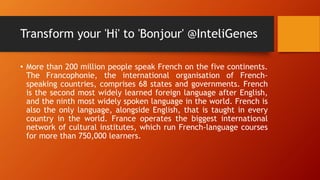
• More than 200 million people speak French on the five continents.
The Francophonie, the international organisation of French-
speaking countries, comprises 68 states and governments. French
is the second most widely learned foreign language after English,
and the ninth most widely spoken language in the world. French is
also the only language, alongside English, that is taught in every
country in the world. France operates the biggest international
network of cultural institutes, which run French-language courses
for more than 750,000 learners.
Transform your 'Hi' to 'Bonjour' @InteliGenes
• French - A language for higher education
• Speaking French opens up study opportunities at renowned French
universities and business schools, ranked among the top higher education
institutions in Europe and the world. Students with a good level of
French are eligible for French government scholarships to enrol in
postgraduate courses in France in any discipline and qualify for
internationally recognised French degrees.
• French - Language for learning other languages
• French is a good base for learning other languages, especially Romance
languages (Spanish, Italian, Portuguese and Romanian) as well as English,
since fifty per cent of current English vocabulary is derived from French.
Transform your 'Hi' to 'Bonjour' @InteliGenes
• Language of love and reason - French
• First and foremost, learning French is the pleasure of learning a beautiful, rich, melodious
language, often called the language of love. French is also an analytical language that structures
thought and develops critical thinking, which is a valuable skill for discussions and negotiations.
• French language for the job market
• An ability to speak French and English is an advantage on the international job market. A knowledge
of French opens the doors of French companies in France and other French-speaking parts of the
world (Canada, Switzerland, Belgium, and North and sub-Saharan Africa). As the world’s fifth
biggest economy and number-three destination for foreign investment, France is a key economic
partner.
• working in the Tourism and Hospitality Industry
• businesspeople
• translators
• and also the needs of students or professional people getting ready for a stay in a French speaking
country or embarking on higher studies in France.
Introduction to DELF , DALF , TEF
• If you’re studying or interested in learning French, you might be
aware of the French proficiency test in India.
• The careers in languages, immigration, traveling, the pursuit of
hobbies, and high-paying language jobs are some of the most
sought-after motivations.
• While there are tons of compelling reasons, the careers requiring
French is immense and full of job choices.
What is the French Proficiency Test?
• The French language proficiency tests are administered for people
whose native language is not French.
• The various French proficiency, namely, DELF, DALF, TEF, TCF, etc.
offers an international standard for measuring and determining
who can communicate effectively on an independent and
proficient level in French.
• The exams are designed to assess the communicative skills of a
candidate in a real-life situation, rather than the theoretical,
linguistic, and formal grammatical knowledge.
What is the French Proficiency Test?
• If you’re learning French, you can demonstrate your level of French
competency by passing an international language test (TEF or TCF) or by
earning a diploma (DELF or DALF).
• Since these certifications give job seekers and employees a competitive
advantage, thus, it is a great asset to include on your resume.
• Instead of asking you about things like “what is an office called in
French.” It is most likely that you would instead be asked, “what level
did you attain in DELF/DALF?
• These diplomas and certifications are recognized and accepted by
French universities and institutions for undergraduate entry as well as
for postgraduate admission.
• There are few more advantages like boosting one’s confidence and
improving the odds if you’re planning to immigrate to French-speaking
countries.
DELF/DALF/TEF/TCF
• DELF stands for Diplôme d’Études en Langue Française
while DALF stands for Diplôme Approfondi de Langue Française.
• Each year in the world, over 300,000 students register to take a various
French proficiency test.
• The above tests are crucial, and they’re currently being administered
and awarded by the French Ministry of Education.
• The proficiency tests of DELF and DALF comprises six different diplomas
that meet the standard set by the CEFR (Common European Reference
Framework for Languages).
• Each of these diplomas is strictly independent of one another. It means
that candidates are free to register and sit for the test of their choice.
• Appearing for DELF Junior/Prime is restricted to candidates aged,
whereas there are no age restrictions on the other versions of DELF /
DALF.
DELF /DALF/TEF/TCF
• One can take the same examination as many times as may be
necessary for obtaining the desired diploma.
• You will have to undergo four different ability tests at each level,
including reading, writing, listening, and speaking.
• The certificates you will obtain from DELF and DALF are valid for
a lifetime and are highly respected worldwide.
• It is even more impressive that once you pass the DALF C1 exams,
you never need to take any other entrance examination when
entering into any French University.
What are the different levels of Certifications?
LEVELS
• DELF A1: Breakthrough or beginner
• DELF A2: Waystage or elementary
• DELF B1: Threshold or intermediate
• DELF B2: Vantage or upper intermediate
• DALF C1: Effective Operational Proficiency or Advanced
• DALF C2: Mastery or proficiency (Near-native)
List of different French Diplomas
• DELF Prim (ages 8-11) – This is an official diploma awarded by the French
Ministry of Education to certify the knowledge in French as a Foreign Language
of children ages 8 to 12. There are only three levels, namely A1.1, A1, and A2.
• DELF Junior (ages 12 +) – It is a specially adapted version for juniors/teenagers
of the DELF diplomas. The levels evaluated are A1 to B2.
• DELF Pro – It assesses communicative skills in familiar business situations. It
allows non-francophone adults in training or activity to enhance their French
language skills in the world of work. Total levels are four — A1, A2, B1, B2.
• DELF Diplôme d’Études en Langue Française (for all age groups) – DELF is
carried for levels A1 – B2. All four exams, A1, A2, B1, and B2, necessarily have
the same structure.
• DALF Diplôme Approfondi de Langue Française (for all age groups) – DALF is
handled for Levels, C1 and C2. After completing DALF exams, candidates are
capable of using the French language for academic and advanced-level
purposes. In the end, proficiency is near-native.
DELF A1 SYLLABUS
•
•
•
•
•
•
DELF A1 SYLLABUS CONTINUE…
•
•
•
•
•
•
DELF A2 Syllabus
• This DELF A2 Syllabus contains an overview of what a student is expected
to know at the A2 level. After completing the DELF A2 level course,
you should be able to accomplish the following:
• Talk about yourself, your educational background, your job, your family,
your neighbourhood
• Talk about your hobbies and daily activities
• Ask for goods in a shop where goods are displayed
• Order a meal in a restaurant if dishes are either displayed or illustrated
on the menu
• Book a hotel room (face to face)
• Ask for basic services in a post office or bank
• Indicate the nature of a medical problem to a doctor
DELF A2 SYLLABUS CONTINUE…
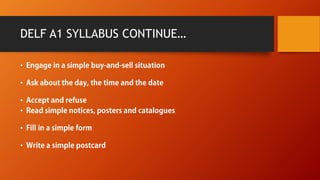
• Make inquiries about a journey at a travel agency
• Use public transport (buses, trains and taxis)
• Ask your way and give directions
• Buy tickets
• Read notices, posters, catalogues, timetables, brochures, menus,
advertisements, signs
• Write notes and simple messages
• Note down times, dates and places from notice boards and announcements
• Note down instructions and requests such as client orders and delivery dates.
• Describe events and daily activities
DELF B1 Syllabus
• The DELF B1 Syllabus contains details of Vocabulary and Grammar,
pertaining to what a student should know regarding 4 skills
outlined by the CEFR: Reading, Writing, Listening and Speaking.
At the B1 level, the student should be able to
accomplish the following:
• Écouter
• Peut comprendre les points essentiels s’il s’agit de sujets familiers
concernant le travail, l’école, les loisirs, etc.
Peut comprendre l’essentiel de nombreuses émissions de radio ou
de télévision sur l’actualité ou sur des sujets qui
l’intéressent à titre personnel ou professionel.
• Lire
• Peut comprendre des textes rédigés essentiellement dans une
langue courante ou relative à son travail.
Peut comprendre la description d’évènements, l’expression de
sentiments et de souhaits dans des lettres personnelles.
CONTINUE…
• S’exprimer oralement en continu
• Peut s’exprimer de manière simple afin de raconter des experiences et
des évènements, ses rêves, ses espoirs ou ses buts.
Peut brièvement donner les raisons et explications des ses opinions ou projets.
Peut raconter une histoire ou l’intrigue d’un livre ou d’un film et exprimer ses
reactions.
• Prendre part à une conversation
• Peut faire face à la majorité des situations que l’on peut rencontrer dans une région
où la langue est parlée.
Peut prendre part sans préparation à une conversation sur des sujets familiers ou
d’intérêt personnel ou qui concernent la vie quotidienne (par exemple: famille,
loisirs, travail, voyage et actualité)
• Écrire
• Peut écrire un texte simple simple et cohérent sur des sujets familiers ou qui
l’intéressent personellement.
Peut écrire des lettres personnelles pour décrire des expériences et
des impressions.
DELF B2 Syllabus
At the B2 level, a student should be able to accomplish
the following:
• Écouter
• 1. Peut comprendre des conférences et des discours assez longs et
même suivre une argumentation complexe si le sujet est
relativement familier.
• 2. Peut comprendre la plupart des émissions de télévision sur
l'actualité et les informations.
• 3. Peut comprendre la plupart des films en langue standard.
• Lire
• 1. Peut lire des articles et des rapports sur des questions
contemporaines dans lesquels les auteurs adoptent une attitude
particulière ou un certain point de vue.
• 2. Peut comprendre un texte littéraire contemporain en prose.
CONTINUE…
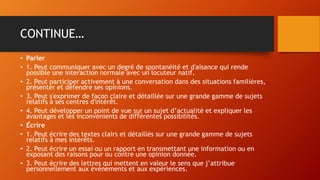
• Parler
• 1. Peut communiquer avec un degré de spontanéité et d'aisance qui rende
possible une interaction normale avec un locuteur natif.
• 2. Peut participer activement à une conversation dans des situations familières,
présenter et défendre ses opinions.
• 3. Peut s'exprimer de façon claire et détaillée sur une grande gamme de sujets
relatifs à ses centres d'intérêt.
• 4. Peut développer un point de vue sur un sujet d’actualité et expliquer les
avantages et les inconvénients de différentes possibilités.
• Écrire
• 1. Peut écrire des textes clairs et détaillés sur une grande gamme de sujets
relatifs à mes intérêts.
• 2. Peut écrire un essai ou un rapport en transmettant une information ou en
exposant des raisons pour ou contre une opinion donnée.
• 3. Peut écrire des lettres qui mettent en valeur le sens que j’attribue
personnellement aux événements et aux expériences.

French language training | Inteligence technology

  • 1.
  • 2.
    Transform your 'Hi'to 'Bonjour' @InteliGenes • More than 200 million people speak French on the five continents. The Francophonie, the international organisation of French- speaking countries, comprises 68 states and governments. French is the second most widely learned foreign language after English, and the ninth most widely spoken language in the world. French is also the only language, alongside English, that is taught in every country in the world. France operates the biggest international network of cultural institutes, which run French-language courses for more than 750,000 learners.
  • 3.
    Transform your 'Hi'to 'Bonjour' @InteliGenes • French - A language for higher education • Speaking French opens up study opportunities at renowned French universities and business schools, ranked among the top higher education institutions in Europe and the world. Students with a good level of French are eligible for French government scholarships to enrol in postgraduate courses in France in any discipline and qualify for internationally recognised French degrees. • French - Language for learning other languages • French is a good base for learning other languages, especially Romance languages (Spanish, Italian, Portuguese and Romanian) as well as English, since fifty per cent of current English vocabulary is derived from French.
  • 4.
    Transform your 'Hi'to 'Bonjour' @InteliGenes • Language of love and reason - French • First and foremost, learning French is the pleasure of learning a beautiful, rich, melodious language, often called the language of love. French is also an analytical language that structures thought and develops critical thinking, which is a valuable skill for discussions and negotiations. • French language for the job market • An ability to speak French and English is an advantage on the international job market. A knowledge of French opens the doors of French companies in France and other French-speaking parts of the world (Canada, Switzerland, Belgium, and North and sub-Saharan Africa). As the world’s fifth biggest economy and number-three destination for foreign investment, France is a key economic partner. • working in the Tourism and Hospitality Industry • businesspeople • translators • and also the needs of students or professional people getting ready for a stay in a French speaking country or embarking on higher studies in France.
  • 5.
    Introduction to DELF, DALF , TEF • If you’re studying or interested in learning French, you might be aware of the French proficiency test in India. • The careers in languages, immigration, traveling, the pursuit of hobbies, and high-paying language jobs are some of the most sought-after motivations. • While there are tons of compelling reasons, the careers requiring French is immense and full of job choices.
  • 6.
    What is theFrench Proficiency Test? • The French language proficiency tests are administered for people whose native language is not French. • The various French proficiency, namely, DELF, DALF, TEF, TCF, etc. offers an international standard for measuring and determining who can communicate effectively on an independent and proficient level in French. • The exams are designed to assess the communicative skills of a candidate in a real-life situation, rather than the theoretical, linguistic, and formal grammatical knowledge.
  • 7.
    What is theFrench Proficiency Test? • If you’re learning French, you can demonstrate your level of French competency by passing an international language test (TEF or TCF) or by earning a diploma (DELF or DALF). • Since these certifications give job seekers and employees a competitive advantage, thus, it is a great asset to include on your resume. • Instead of asking you about things like “what is an office called in French.” It is most likely that you would instead be asked, “what level did you attain in DELF/DALF? • These diplomas and certifications are recognized and accepted by French universities and institutions for undergraduate entry as well as for postgraduate admission. • There are few more advantages like boosting one’s confidence and improving the odds if you’re planning to immigrate to French-speaking countries.
  • 8.
    DELF/DALF/TEF/TCF • DELF standsfor Diplôme d’Études en Langue Française while DALF stands for Diplôme Approfondi de Langue Française. • Each year in the world, over 300,000 students register to take a various French proficiency test. • The above tests are crucial, and they’re currently being administered and awarded by the French Ministry of Education. • The proficiency tests of DELF and DALF comprises six different diplomas that meet the standard set by the CEFR (Common European Reference Framework for Languages). • Each of these diplomas is strictly independent of one another. It means that candidates are free to register and sit for the test of their choice. • Appearing for DELF Junior/Prime is restricted to candidates aged, whereas there are no age restrictions on the other versions of DELF / DALF.
  • 9.
    DELF /DALF/TEF/TCF • Onecan take the same examination as many times as may be necessary for obtaining the desired diploma. • You will have to undergo four different ability tests at each level, including reading, writing, listening, and speaking. • The certificates you will obtain from DELF and DALF are valid for a lifetime and are highly respected worldwide. • It is even more impressive that once you pass the DALF C1 exams, you never need to take any other entrance examination when entering into any French University.
  • 10.
    What are thedifferent levels of Certifications?
  • 11.
    LEVELS • DELF A1:Breakthrough or beginner • DELF A2: Waystage or elementary • DELF B1: Threshold or intermediate • DELF B2: Vantage or upper intermediate • DALF C1: Effective Operational Proficiency or Advanced • DALF C2: Mastery or proficiency (Near-native)
  • 12.
    List of differentFrench Diplomas • DELF Prim (ages 8-11) – This is an official diploma awarded by the French Ministry of Education to certify the knowledge in French as a Foreign Language of children ages 8 to 12. There are only three levels, namely A1.1, A1, and A2. • DELF Junior (ages 12 +) – It is a specially adapted version for juniors/teenagers of the DELF diplomas. The levels evaluated are A1 to B2. • DELF Pro – It assesses communicative skills in familiar business situations. It allows non-francophone adults in training or activity to enhance their French language skills in the world of work. Total levels are four — A1, A2, B1, B2. • DELF Diplôme d’Études en Langue Française (for all age groups) – DELF is carried for levels A1 – B2. All four exams, A1, A2, B1, and B2, necessarily have the same structure. • DALF Diplôme Approfondi de Langue Française (for all age groups) – DALF is handled for Levels, C1 and C2. After completing DALF exams, candidates are capable of using the French language for academic and advanced-level purposes. In the end, proficiency is near-native.
  • 13.
  • 14.
    DELF A1 SYLLABUSCONTINUE… • • • • • •
  • 15.
    DELF A2 Syllabus •This DELF A2 Syllabus contains an overview of what a student is expected to know at the A2 level. After completing the DELF A2 level course, you should be able to accomplish the following: • Talk about yourself, your educational background, your job, your family, your neighbourhood • Talk about your hobbies and daily activities • Ask for goods in a shop where goods are displayed • Order a meal in a restaurant if dishes are either displayed or illustrated on the menu • Book a hotel room (face to face) • Ask for basic services in a post office or bank • Indicate the nature of a medical problem to a doctor
  • 16.
    DELF A2 SYLLABUSCONTINUE… • Make inquiries about a journey at a travel agency • Use public transport (buses, trains and taxis) • Ask your way and give directions • Buy tickets • Read notices, posters, catalogues, timetables, brochures, menus, advertisements, signs • Write notes and simple messages • Note down times, dates and places from notice boards and announcements • Note down instructions and requests such as client orders and delivery dates. • Describe events and daily activities
  • 17.
    DELF B1 Syllabus •The DELF B1 Syllabus contains details of Vocabulary and Grammar, pertaining to what a student should know regarding 4 skills outlined by the CEFR: Reading, Writing, Listening and Speaking.
  • 18.
    At the B1level, the student should be able to accomplish the following: • Écouter • Peut comprendre les points essentiels s’il s’agit de sujets familiers concernant le travail, l’école, les loisirs, etc. Peut comprendre l’essentiel de nombreuses émissions de radio ou de télévision sur l’actualité ou sur des sujets qui l’intéressent à titre personnel ou professionel. • Lire • Peut comprendre des textes rédigés essentiellement dans une langue courante ou relative à son travail. Peut comprendre la description d’évènements, l’expression de sentiments et de souhaits dans des lettres personnelles.
  • 19.
    CONTINUE… • S’exprimer oralementen continu • Peut s’exprimer de manière simple afin de raconter des experiences et des évènements, ses rêves, ses espoirs ou ses buts. Peut brièvement donner les raisons et explications des ses opinions ou projets. Peut raconter une histoire ou l’intrigue d’un livre ou d’un film et exprimer ses reactions. • Prendre part à une conversation • Peut faire face à la majorité des situations que l’on peut rencontrer dans une région où la langue est parlée. Peut prendre part sans préparation à une conversation sur des sujets familiers ou d’intérêt personnel ou qui concernent la vie quotidienne (par exemple: famille, loisirs, travail, voyage et actualité) • Écrire • Peut écrire un texte simple simple et cohérent sur des sujets familiers ou qui l’intéressent personellement. Peut écrire des lettres personnelles pour décrire des expériences et des impressions.
  • 20.
    DELF B2 Syllabus Atthe B2 level, a student should be able to accomplish the following: • Écouter • 1. Peut comprendre des conférences et des discours assez longs et même suivre une argumentation complexe si le sujet est relativement familier. • 2. Peut comprendre la plupart des émissions de télévision sur l'actualité et les informations. • 3. Peut comprendre la plupart des films en langue standard. • Lire • 1. Peut lire des articles et des rapports sur des questions contemporaines dans lesquels les auteurs adoptent une attitude particulière ou un certain point de vue. • 2. Peut comprendre un texte littéraire contemporain en prose.
  • 21.
    CONTINUE… • Parler • 1.Peut communiquer avec un degré de spontanéité et d'aisance qui rende possible une interaction normale avec un locuteur natif. • 2. Peut participer activement à une conversation dans des situations familières, présenter et défendre ses opinions. • 3. Peut s'exprimer de façon claire et détaillée sur une grande gamme de sujets relatifs à ses centres d'intérêt. • 4. Peut développer un point de vue sur un sujet d’actualité et expliquer les avantages et les inconvénients de différentes possibilités. • Écrire • 1. Peut écrire des textes clairs et détaillés sur une grande gamme de sujets relatifs à mes intérêts. • 2. Peut écrire un essai ou un rapport en transmettant une information ou en exposant des raisons pour ou contre une opinion donnée. • 3. Peut écrire des lettres qui mettent en valeur le sens que j’attribue personnellement aux événements et aux expériences.