FREE SPEECH AND HIGHER
EDUCATION: THE FIRST AMENDMENT ON
COLLEGE CAMPUSES
By Danielle Meadows
HISTORY OF THE FIRST
AMENDMENT
• Ratified with nine other amendments to the Constitution, making up
the Bill of Rights, on December 15th, 1781
• Freedom of religion, freedom of speech, freedom of press, the right to
assembly, and the right to petition
• Not very important in American life until the 20th century
• After the U.S. entered World War I, statutes that aimed at political
dissent and antiwar activities led to laws being vigorously enforced,
leading to an eventual shift in how the Court viewed speech restrictions
HISTORIC FREE
SPEECH CASE IN A
PUBLIC SCHOOL
• Tinker v. Des Moines Independent Community School District (1969)
•Friends wore black armbands as a silent protest at school to express
opposition for the Vietnam War
• These students were suspended and sent home when they refused to
remove the armbands
•Supreme Court ruled that wearing an armband is a symbolic form of
speech that can be punished only when educators show that the
expression disrupts learning
•The Tinker case applies to public schools of all kinds, making it clear
that administrators cannot punish a form of speech solely because
they find it offensive
RECENT CASE
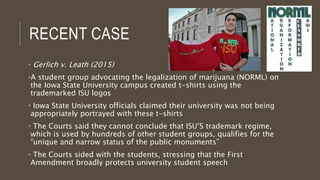
• Gerlich v. Leath (2015)
•A student group advocating the legalization of marijuana (NORML) on
the Iowa State University campus created t-shirts using the
trademarked ISU logos
• Iowa State University officials claimed their university was not being
appropriately portrayed with these t-shirts
• The Courts said they cannot conclude that ISU’S trademark regime,
which is used by hundreds of other student groups, qualifies for the
“unique and narrow status of the public monuments”
• The Courts sided with the students, stressing that the First
Amendment broadly protects university student speech
ANALYSIS
• Smith v. Tarrant County College Dist., (2009) limited students to
designated “free speech zones” for their protests, wouldn’t let
students wear empty holsters to symbolically protest concealed carry
laws, or pass around pamphlets – college viewed these activities as
“disruptive to the learning environment”
• Tinker v. Des Moines Independent Community School District (1969)
• Both of these cases dealt with silent, symbolic forms of protest –
wearing the black armbands and wearing the empty holsters – and
school systems that found these items distracting to learning
environments.
CONCLUSION
• Colleges are often called “marketplaces of ideas” – where else can people
learn from the backgrounds and opinions of others so often?
• Where and when does the line get crossed regarding expression on campus?
• Higher education is a place for learning and sharing ideas to mold students
into independent thinkers
• Determining if something is truly offensive or if college officials are overly
censoring the expression of students is an ongoing argument
“Mere dissemination of ideas – no matter how offensive or to good taste – on
a state university campus may not be shut off in the name alone of
‘conventions of decency’” (Olson 2017, p. 33)

Free Speech in College

  • 1.
    FREE SPEECH ANDHIGHER EDUCATION: THE FIRST AMENDMENT ON COLLEGE CAMPUSES By Danielle Meadows
  • 2.
    HISTORY OF THEFIRST AMENDMENT • Ratified with nine other amendments to the Constitution, making up the Bill of Rights, on December 15th, 1781 • Freedom of religion, freedom of speech, freedom of press, the right to assembly, and the right to petition • Not very important in American life until the 20th century • After the U.S. entered World War I, statutes that aimed at political dissent and antiwar activities led to laws being vigorously enforced, leading to an eventual shift in how the Court viewed speech restrictions
  • 3.
    HISTORIC FREE SPEECH CASEIN A PUBLIC SCHOOL • Tinker v. Des Moines Independent Community School District (1969) •Friends wore black armbands as a silent protest at school to express opposition for the Vietnam War • These students were suspended and sent home when they refused to remove the armbands •Supreme Court ruled that wearing an armband is a symbolic form of speech that can be punished only when educators show that the expression disrupts learning •The Tinker case applies to public schools of all kinds, making it clear that administrators cannot punish a form of speech solely because they find it offensive
  • 4.
    RECENT CASE • Gerlichv. Leath (2015) •A student group advocating the legalization of marijuana (NORML) on the Iowa State University campus created t-shirts using the trademarked ISU logos • Iowa State University officials claimed their university was not being appropriately portrayed with these t-shirts • The Courts said they cannot conclude that ISU’S trademark regime, which is used by hundreds of other student groups, qualifies for the “unique and narrow status of the public monuments” • The Courts sided with the students, stressing that the First Amendment broadly protects university student speech
  • 5.
    ANALYSIS • Smith v.Tarrant County College Dist., (2009) limited students to designated “free speech zones” for their protests, wouldn’t let students wear empty holsters to symbolically protest concealed carry laws, or pass around pamphlets – college viewed these activities as “disruptive to the learning environment” • Tinker v. Des Moines Independent Community School District (1969) • Both of these cases dealt with silent, symbolic forms of protest – wearing the black armbands and wearing the empty holsters – and school systems that found these items distracting to learning environments.
  • 6.
    CONCLUSION • Colleges areoften called “marketplaces of ideas” – where else can people learn from the backgrounds and opinions of others so often? • Where and when does the line get crossed regarding expression on campus? • Higher education is a place for learning and sharing ideas to mold students into independent thinkers • Determining if something is truly offensive or if college officials are overly censoring the expression of students is an ongoing argument “Mere dissemination of ideas – no matter how offensive or to good taste – on a state university campus may not be shut off in the name alone of ‘conventions of decency’” (Olson 2017, p. 33)