Free-body
Diagram
Sir Emman Sano
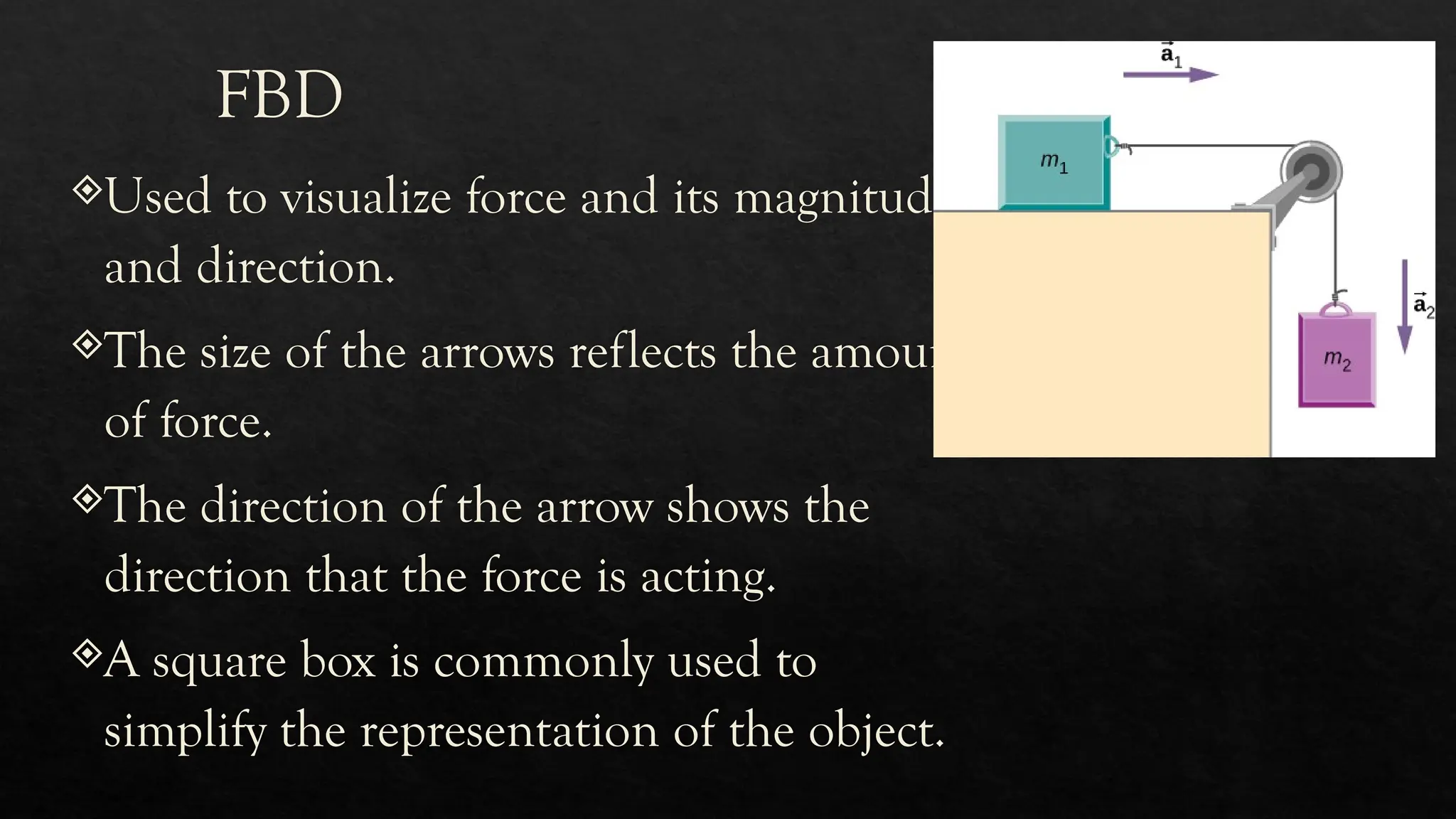
FBD
Used to visualize force and its magnitude
and direction.
The size of the arrows reflects the amount
of force.
The direction of the arrow shows the
direction that the force is acting.
A square box is commonly used to
simplify the representation of the object.
Example:
A book is at rest
on a tabletop.
Diagram the forces
acting on the book.
Force in FBD: Frictional Force
and Normal Force
Force in FBD: Frictional Force
and Normal Force
• Frictional Force is the force that acts when
surfaces slide or tend to slide over one
another.
• The direction of frictional force is always
opposite the direction of motion.
• Stationary object with no applied force has
no friction force.
Force in FBD: Frictional Force
and Normal Force
• Static Force – is when force is applied and
the object gets disturbed, even if it does not
move, friction acts on it.
• The type of friction that opposes motion is
now identified as kinetic friction.
• Static is associated with a lack of movement,
while kinetic is characterized by movement.
Force in FBD: Frictional Force
and Normal Force
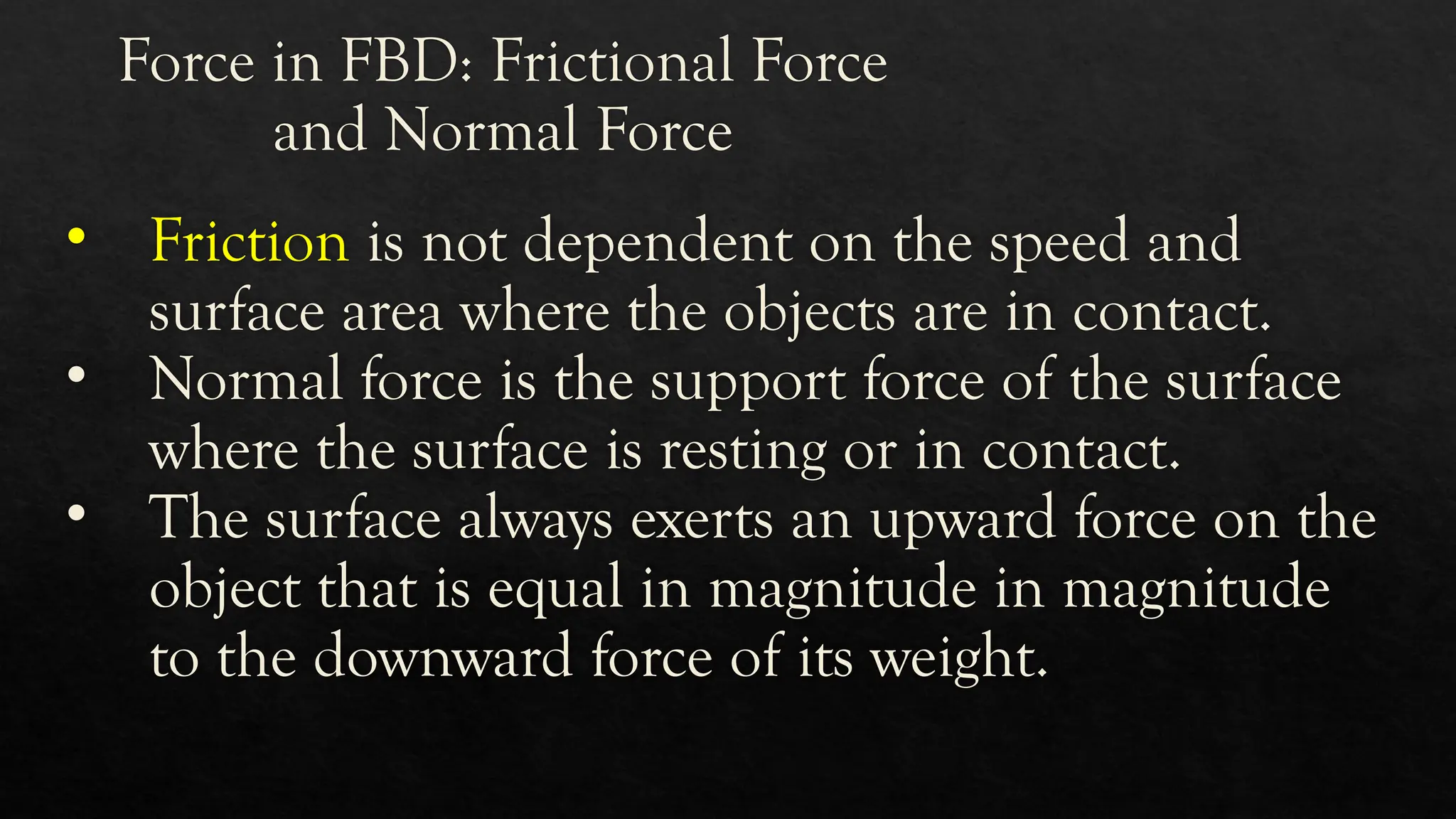
• Friction is not dependent on the speed and
surface area where the objects are in contact.
• Normal force is the support force of the surface
where the surface is resting or in contact.
• The surface always exerts an upward force on the
object that is equal in magnitude in magnitude
to the downward force of its weight.
Force in FBD: Frictional Force
and Normal Force
• Friction is not dependent on the speed and
surface area where the objects are in contact.
• Normal force is the support force of the surface
where the surface is resting or in contact.
• The surface always exerts an upward force on the
object that is equal in magnitude in magnitude
to the downward force of its weight.
FBD of Balanced Force
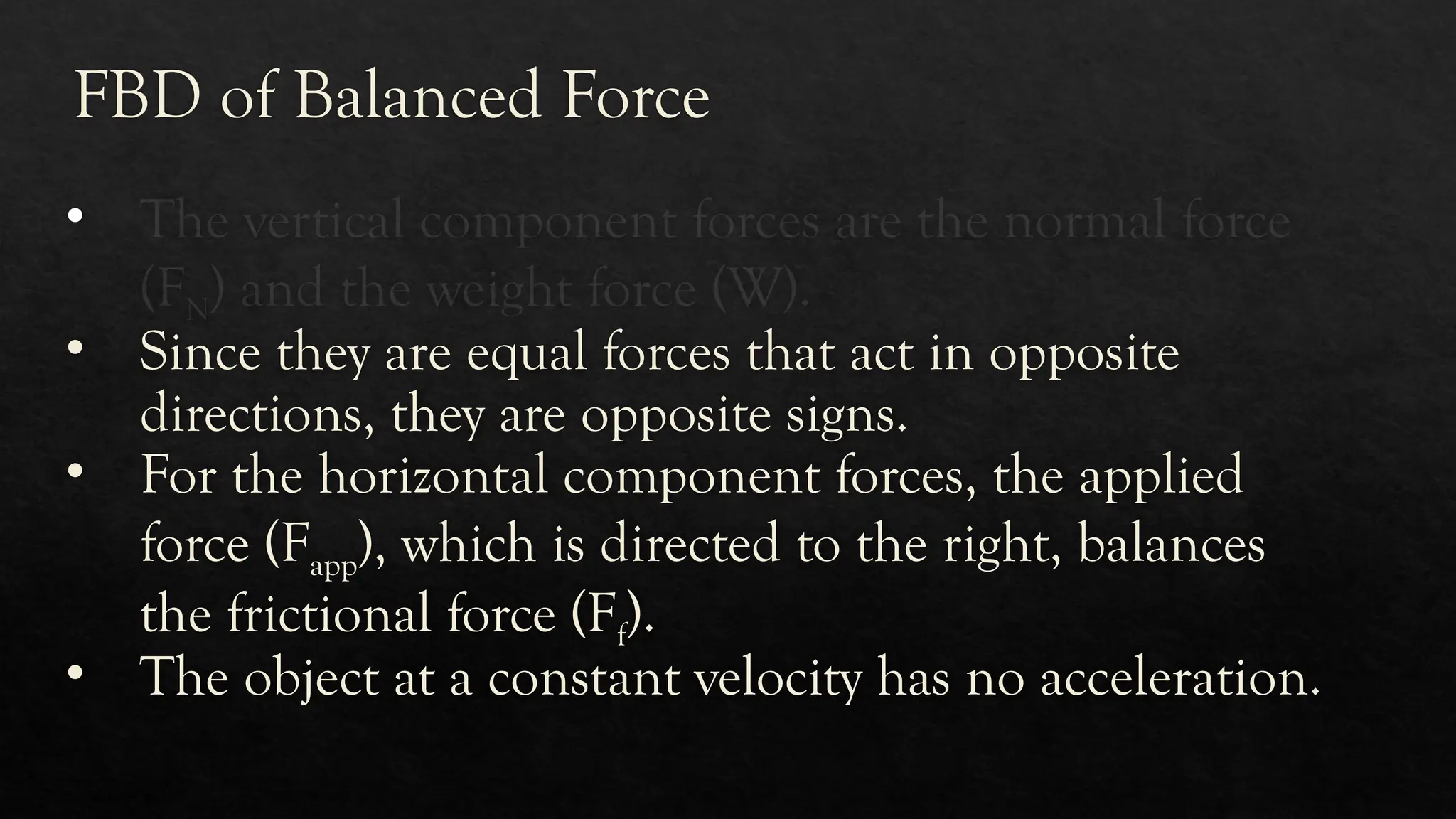
• The vertical component forces are the normal force
(FN) and the weight force (W).
• Since they are equal forces that act in opposite
directions, they are opposite signs.
• For the horizontal component forces, the applied
force (Fapp), which is directed to the right, balances
the frictional force (Ff).
• The object at a constant velocity has no acceleration.
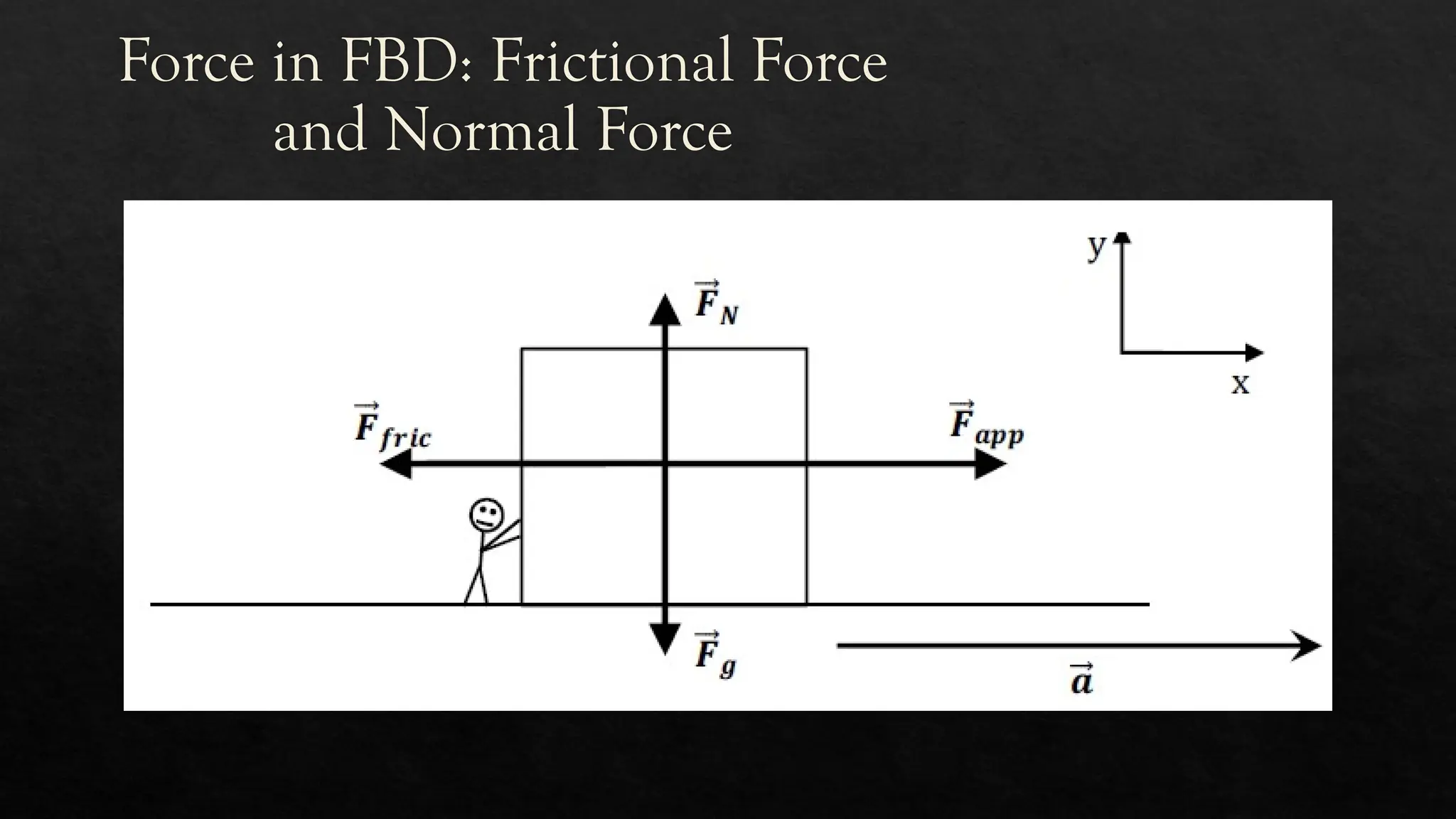
FBD of Unbalanced Forces
• The forces on the y-axis, FN and W have the
same length of arrows oriented in opposite
directions. This means they have balanced forces.
• Fapp on the right is twice as long as the Ff on the
left.
• The left being negative and the right being
positive, the net force is, therefore, on the
positive x-direction.

Free-body Diagram: Static and Kinetic Forces

  • 1.
  • 6.
    FBD Used to visualizeforce and its magnitude and direction. The size of the arrows reflects the amount of force. The direction of the arrow shows the direction that the force is acting. A square box is commonly used to simplify the representation of the object.
  • 7.
    Example: A book isat rest on a tabletop. Diagram the forces acting on the book.
  • 8.
    Force in FBD:Frictional Force and Normal Force
  • 9.
    Force in FBD:Frictional Force and Normal Force • Frictional Force is the force that acts when surfaces slide or tend to slide over one another. • The direction of frictional force is always opposite the direction of motion. • Stationary object with no applied force has no friction force.
  • 10.
    Force in FBD:Frictional Force and Normal Force • Static Force – is when force is applied and the object gets disturbed, even if it does not move, friction acts on it. • The type of friction that opposes motion is now identified as kinetic friction. • Static is associated with a lack of movement, while kinetic is characterized by movement.
  • 11.
    Force in FBD:Frictional Force and Normal Force • Friction is not dependent on the speed and surface area where the objects are in contact. • Normal force is the support force of the surface where the surface is resting or in contact. • The surface always exerts an upward force on the object that is equal in magnitude in magnitude to the downward force of its weight.
  • 12.
    Force in FBD:Frictional Force and Normal Force • Friction is not dependent on the speed and surface area where the objects are in contact. • Normal force is the support force of the surface where the surface is resting or in contact. • The surface always exerts an upward force on the object that is equal in magnitude in magnitude to the downward force of its weight.
  • 13.
    FBD of BalancedForce • The vertical component forces are the normal force (FN) and the weight force (W). • Since they are equal forces that act in opposite directions, they are opposite signs. • For the horizontal component forces, the applied force (Fapp), which is directed to the right, balances the frictional force (Ff). • The object at a constant velocity has no acceleration.
  • 14.
    FBD of UnbalancedForces • The forces on the y-axis, FN and W have the same length of arrows oriented in opposite directions. This means they have balanced forces. • Fapp on the right is twice as long as the Ff on the left. • The left being negative and the right being positive, the net force is, therefore, on the positive x-direction.