COLOMBIA AND THE REGION 
AN STRATEGICAL VIEW 
REMARKS BY 
ALVARO URIBE VÉLEZ 
LIT TLE ROCK, ARKANSAS 
NOVEMBER 2 201 1
Introduction 
 I have been asked to talk about the story behind the Colombian success 
during the last nine years, and to exchange some ideas on how political Will 
can trigger effective change. 
 When I was asked to do that, I felt that this should be the opportunity to 
express that what Colombia has experienced is not only my success as 
President, nor only the success of my administration.It was and it 
should be always remembered as the success of a whole nation 
that recovered CONFIDENCE and decided to mobilize in order to 
build a better future. 
 As President I had the privilege of counting with the support of my fellow 
citizens to put in place the concept of a Comunitary State built in the fertile 
ground of DEMOCRATIC SECURITY, INVESTOR CONFIDENCE AND 
SOCIAL COHESION. This is the story I want to share with you 
today
1. Colombia long history of violence 
 Colombia’s history has been signed by long periods of 
violence: In almost 200 years of independent live, our 
nation has only experienced 47 years of relative peace. 
 Violence has taken many forms: 
 Regional and political organization struggles in the XIX Century. 
 Partisan violence from 1900-1958 
 Guerrilla confrontation since 1960 
 Narco-Terrorism since 1980’s 
 Violence has affected the lives of many Colombians: 
 My father was killed in a kidnapping attempt. I have suffered in my 
own skin the cruelty of terrorism. For that reason I have fought to 
liberate my nation from the reign of fear.
2. Violence destroyed hope 
 Between 1982 and 2002 violence kept on deteriorating and became the root of 
structural problems: lack of investment, unemployment, poverty, brain drain, lack 
of hope. 
 In 2002 Colombia's was considered by many multilateral organizations, as a nation 
in the path of becoming a failed state. 
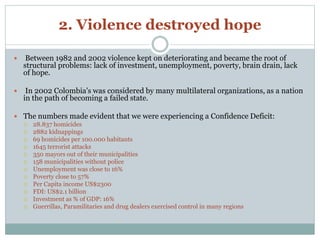
 The numbers made evident that we were experiencing a Confidence Deficit: 
 28.837 homicides 
 2882 kidnappings 
 69 homicides per 100.000 habitants 
 1645 terrorist attacks 
 350 mayors out of their municipalities 
 158 municipalities without police 
 Unemployment was close to 16% 
 Poverty close to 57% 
 Per Capita income US$2300 
 FDI: US$2.1 billion 
 Investment as % of GDP: 16% 
 Guerrillas, Paramilitaries and drug dealers exercised control in many regions
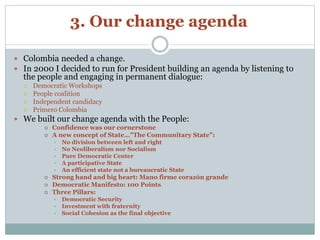
3. Our change agenda 
 Colombia needed a change. 
 In 2000 I decided to run for President building an agenda by listening to 
the people and engaging in permanent dialogue: 
 Democratic Workshops 
 People coalition 
 Independent candidacy 
 Primero Colombia 
 We built our change agenda with the People: 
 Confidence was our cornerstone 
 A new concept of State…”The Communitary State”: 
• No division between left and right 
• No Neoliberalism nor Socialism 
• Pure Democratic Center 
• A participative State 
• An efficient state not a bureaucratic State 
 Strong hand and big heart: Mano firme corazón grande 
 Democratic Manifesto: 100 Points 
 Three Pillars: 
• Democratic Security 
• Investment with fraternity 
• Social Cohesion as the final objective
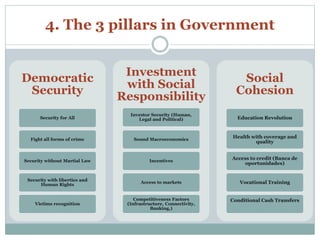
4. The 3 pillars in Government 
Democratic 
Security 
Security for All 
Fight all forms of crime 
Security without Martial Law 
Security with liberties and 
Human Rights 
Victims recognition 
Investment 
with Social 
Responsibility 
Investor Security (Human, 
Legal and Political) 
Sound Macroeconomics 
Incentives 
Access to markets 
Competitiveness Factors 
(Infrastructure, Connectivity, 
Banking,) 
Social 
Cohesion 
Education Revolution 
Health with coverage and 
quality 
Access to credit (Banca de 
oportunidades) 
Vocational Training 
Conditional Cash Transfers
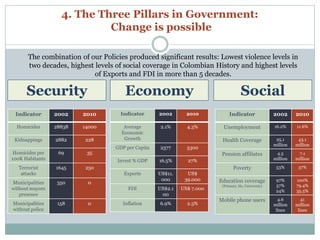
4. The Three Pillars in Government: 
Change is possible 
The combination of our Policies produced significant results: Lowest violence levels in 
two decades, highest levels of social coverage in Colombian History and highest levels 
Security Economy 
Indicator 2002 2010 
Homicides 28838 14000 
Kidnappings 2882 228 
Homicides per 
100K Habitants 
69 35 
Terrorist 
attacks 
1645 250 
Municipalities 
without mayors 
presence 
350 0 
Municipalities 
without police 
158 0 
Indicator 2002 2010 
Average 
Economic 
Growth 
2.1% 4.3% 
GDP per Capita 2377 5300 
Invest % GDP 16.5% 27% 
Exports US$11. 
000 
US$ 
39.000 
FDI US$2.1 
00 
US$ 7.000 
Inflation 6.9% 2.5% 
Social 
Indicator 2002 2010 
Unemployment 16.2% 11.6% 
Health Coverage 25.1 
million 
43.1 
million 
Pension affiliates 4.5 
million 
7.1 
million 
Poverty 53% 37% 
Education coverage 
(Primary, Hs, University) 
97% 
57% 
24% 
100% 
79.4% 
35.5% 
Mobile phone users 4.6 
million 
lines 
41 
million 
lines 
of Exports and FDI in more than 5 decades.
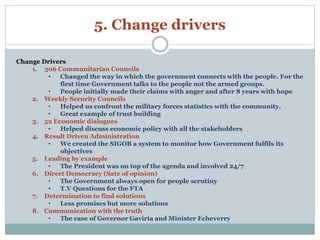
5. Change drivers 
Change Drivers 
1. 306 Communitarian Councils 
• Changed the way in which the government connects with the people. For the 
first time Government talks to the people not the armed groups. 
• People initially made their claims with anger and after 8 years with hope 
2. Weekly Security Councils 
• Helped us confront the military forces statistics with the community. 
• Great example of trust building 
3. 52 Economic dialogues 
• Helped discuss economic policy with all the stakeholders 
4. Result Driven Administration 
• We created the SIGOB a system to monitor how Government fulfils its 
objectives 
5. Leading by example 
• The President was on top of the agenda and involved 24/7 
6. Direct Democracy (Sate of opinion) 
• The Government always open for people scrutiny 
• T.V Questions for the FTA 
7. Determination to find solutions 
• Less promises but more solutions 
8. Communication with the truth 
• The case of Governor Gaviria and Minister Echeverry
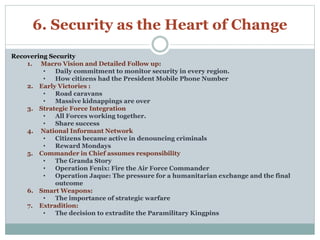
6. Security as the Heart of Change 
Recovering Security 
1. Macro Vision and Detailed Follow up: 
• Daily commitment to monitor security in every region. 
• How citizens had the President Mobile Phone Number 
2. Early Victories : 
• Road caravans 
• Massive kidnappings are over 
3. Strategic Force Integration 
• All Forces working together. 
• Share success 
4. National Informant Network 
• Citizens became active in denouncing criminals 
• Reward Mondays 
5. Commander in Chief assumes responsibility 
• The Granda Story 
• Operation Fenix: Fire the Air Force Commander 
• Operation Jaque: The pressure for a humanitarian exchange and the final 
outcome 
6. Smart Weapons: 
• The importance of strategic warfare 
7. Extradition: 
• The decision to extradite the Paramilitary Kingpins
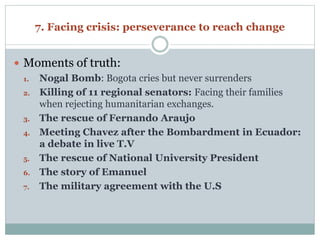
7. Facing crisis: perseverance to reach change 
 Moments of truth: 
1. Nogal Bomb: Bogota cries but never surrenders 
2. Killing of 11 regional senators: Facing their families 
when rejecting humanitarian exchanges. 
3. The rescue of Fernando Araujo 
4. Meeting Chavez after the Bombardment in Ecuador: 
a debate in live T.V 
5. The rescue of National University President 
6. The story of Emanuel 
7. The military agreement with the U.S
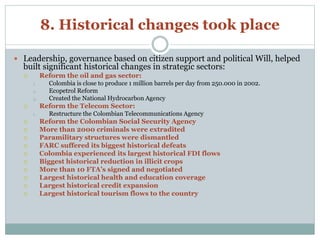
8. Historical changes took place 
 Leadership, governance based on citizen support and political Will, helped 
built significant historical changes in strategic sectors: 
 Reform the oil and gas sector: 
1. Colombia is close to produce 1 million barrels per day from 250.000 in 2002. 
2. Ecopetrol Reform 
3. Created the National Hydrocarbon Agency 
 Reform the Telecom Sector: 
1. Restructure the Colombian Telecommunications Agency 
 Reform the Colombian Social Security Agency 
 More than 2000 criminals were extradited 
 Paramilitary structures were dismantled 
 FARC suffered its biggest historical defeats 
 Colombia experienced its largest historical FDI flows 
 Biggest historical reduction in illicit crops 
 More than 10 FTA’s signed and negotiated 
 Largest historical health and education coverage 
 Largest historical credit expansion 
 Largest historical tourism flows to the country
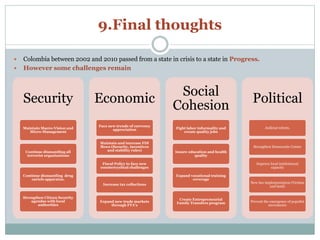
9.Final thoughts 
 Colombia between 2002 and 2010 passed from a state in crisis to a state in Progress. 
 However some challenges remain 
Security 
Maintain Macro-Vision and 
Micro-Management 
Continue dismantling all 
terrorist organizations 
Continue dismantling drug 
cartels apparatus. 
Strengthen Citizen Security 
agendas with local 
authorities 
Economic 
Face new trends of currency 
appreciation 
Maintain and increase FDI 
flows (Security, incentives 
and stability rules) 
Fiscal Policy to face new 
countercyclical challenges 
Increase tax collections 
Expand new trade markets 
through FTA’s 
Social 
Cohesion 
Fight labor informality and 
create quality jobs 
Insure education and health 
quality 
Expand vocational training 
coverage 
Create Entrepreneurial 
Family Transfers program 
Political 
Judicial reform. 
Strengthen Democratic Center 
Improve local institutional 
capacity 
New law implementation (Victims 
and land) 
Prevent the emergence of populist 
movements
The Regional Picture
1. Opportunities, challenges and risks 
 Commentators and analysts continuously talk about Chinas 
transformation and praise its effort for becoming the World second 
largest economy and by being able to allow 400 million people 
come out from the poverty trap. 
 However in our region a silent process of change has also occurred 
and today Latin America is an active contributor to the Emerging 
Nations Century: 
 
 
 
 
 
The regional silent evolution
1. Opportunities, challenges and risks 
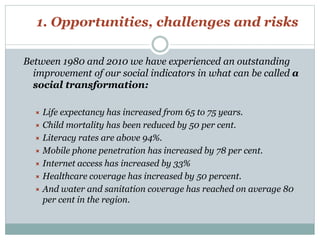
Between 1980 and 2010 we have experienced an outstanding 
improvement of our social indicators in what can be called a 
social transformation: 
 Life expectancy has increased from 65 to 75 years. 
 Child mortality has been reduced by 50 per cent. 
 Literacy rates are above 94%. 
 Mobile phone penetration has increased by 78 per cent. 
 Internet access has increased by 33% 
 Healthcare coverage has increased by 50 percent. 
 And water and sanitation coverage has reached on average 80 
per cent in the region.
1. Opportunities, challenges and risks 
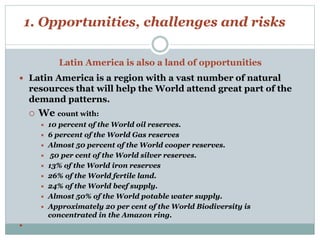
Latin America is also a land of opportunities 
 Latin America is a region with a vast number of natural 
resources that will help the World attend great part of the 
demand patterns. 
 We count with: 
 10 percent of the World oil reserves. 
 6 percent of the World Gas reserves 
 Almost 50 percent of the World cooper reserves. 
 50 per cent of the World silver reserves. 
 13% of the World iron reserves 
 26% of the World fertile land. 
 24% of the World beef supply. 
 Almost 50% of the World potable water supply. 
 Approximately 20 per cent of the World Biodiversity is 
concentrated in the Amazon ring. 

1. Opportunities, challenges and risks 
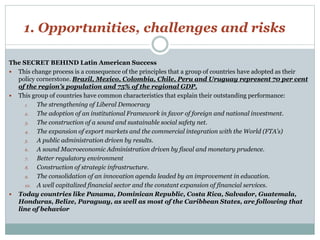
The SECRET BEHIND Latin American Success 
 This change process is a consequence of the principles that a group of countries have adopted as their 
policy cornerstone. Brazil, Mexico, Colombia, Chile, Peru and Uruguay represent 70 per cent 
of the region’s population and 75% of the regional GDP. 
 This group of countries have common characteristics that explain their outstanding performance: 
1. The strengthening of Liberal Democracy 
2. The adoption of an institutional Framework in favor of foreign and national investment. 
3. The construction of a sound and sustainable social safety net. 
4. The expansion of export markets and the commercial integration with the World (FTA’s) 
5. A public administration driven by results. 
6. A sound Macroeconomic Administration driven by fiscal and monetary prudence. 
7. Better regulatory environment 
8. Construction of strategic infrastructure. 
9. The consolidation of an innovation agenda leaded by an improvement in education. 
10. A well capitalized financial sector and the constant expansion of financial services. 
 Today countries like Panama, Dominican Republic, Costa Rica, Salvador, Guatemala, 
Honduras, Belize, Paraguay, as well as most of the Caribbean States, are following that 
line of behavior
1. Opportunities, challenges and risks 
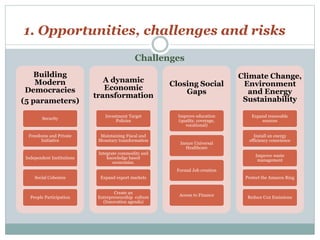
Building 
Modern 
Democracies 
(5 parameters) 
Security 
Freedoms and Private 
Initiative 
Independent Institutions 
Social Cohesion 
People Participation 
A dynamic 
Economic 
transformation 
Investment Target 
Policies 
Maintaining Fiscal and 
Monetary transformation 
Integrate commodity and 
knowledge based 
economies. 
Expand export markets 
Create an 
Entrepreneurship culture 
(Innovation agenda) 
Closing Social 
Gaps 
Improve education 
(quality, coverage, 
vocational) 
Insure Universal 
Healthcare 
Formal Job creation 
Access to Finance 
Climate Change, 
Environment 
and Energy 
Sustainability 
Expand renewable 
sources 
Install an energy 
efficiency conscience 
Improve waste 
management 
Protect the Amazon Ring 
Reduce Co2 Emissions 
Challenges
1. Opportunities, challenges and risks 
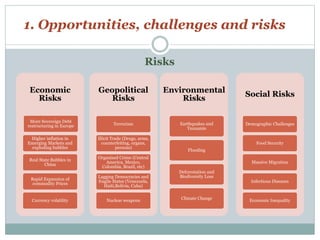
Economic 
Risks 
More Sovereign Debt 
restructuring in Europe 
Higher inflation in 
Emerging Markets and 
exploding bubbles 
Real State Bubbles in 
China 
Rapid Expansion of 
commodity Prices 
Currency volatility 
Geopolitical 
Risks 
Terrorism 
Illicit Trade (Drugs, arms, 
counterfeiting, organs, 
persons) 
Organized Crime (Central 
America, Mexico, 
Colombia, Brazil, etc) 
Lagging Democracies and 
fragile States (Venezuela, 
Haiti,Bolivia, Cuba) 
Nuclear weapons 
Environmental 
Risks 
Earthquakes and 
Tsunamis 
Flooding 
Deforestation and 
Biodiversity Loss 
Climate Change 
Social Risks 
Demographic Challenges 
Food Security 
Massive Migration 
Infectious Diseases 
Economic Inequality 
Risks
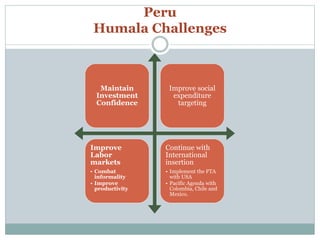
Peru 
Humala Challenges 
Maintain 
Investment 
Confidence 
Improve social 
expenditure 
targeting 
Improve 
Labor 
markets 
• Combat 
informality 
• Improve 
productivity 
Continue with 
International 
insertion 
• Implement the FTA 
with USA 
• Pacific Agenda with 
Colombia, Chile and 
Mexico.
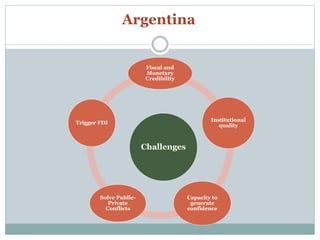
Argentina 
Fiscal and 
Monetary 
Credibility 
Challenges 
Institutional 
quality 
Capacity to 
generate 
confidence 
Trigger FDI 
Solve Public- 
Private 
Conflicts
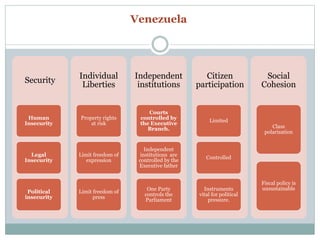
Security 
Human 
Insecurity 
Legal 
Insecurity 
Political 
insecurity 
Individual 
Liberties 
Property rights 
at risk 
Limit freedom of 
expression 
Limit freedom of 
press 
Independent 
institutions 
Courts 
controlled by 
the Executive 
Branch. 
Independent 
institutions are 
controlled by the 
Executive father 
One Party 
controls the 
Parliament 
Citizen 
participation 
Limited 
Controlled 
Instruments 
vital for political 
pressure. 
Social 
Cohesion 
Class 
polarization 
Fiscal policy is 
unsustainable 
Venezuela
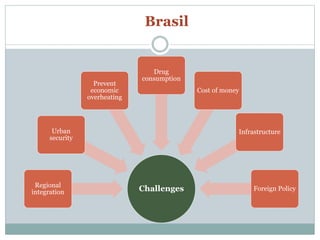
Urban 
security 
Prevent 
economic 
overheating 
Drug 
consumption 
Challenges Regional 
integration 
Cost of money 
Infrastructure 
Foreign Policy 
Brasil
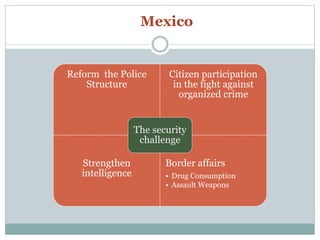
Mexico 
Reform the Police 
Structure 
Citizen participation 
in the fight against 
organized crime 
Strengthen 
intelligence 
The security 
challenge 
Border affairs 
• Drug Consumption 
• Assault Weapons
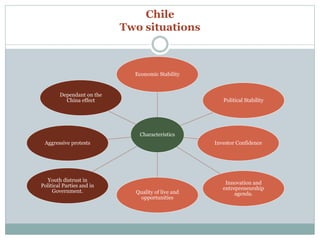
Chile 
Two situations 
Economic Stability 
Characteristics 
Political Stability 
Investor Confidence 
Innovation and 
entrepreneurship 
Quality of live and agenda. 
opportunities 
Dependant on the 
China effect 
Aggressive protests 
Youth distrust in 
Political Parties and in 
Government.
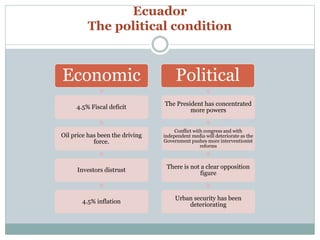
Ecuador 
The political condition 
Economic 
4.5% Fiscal deficit 
Oil price has been the driving 
force. 
Investors distrust 
4.5% inflation 
Political 
The President has concentrated 
more powers 
Conflict with congress and with 
independent media will deteriorate as the 
Government pushes more interventionist 
reforms 
There is not a clear opposition 
figure 
Urban security has been 
deteriorating
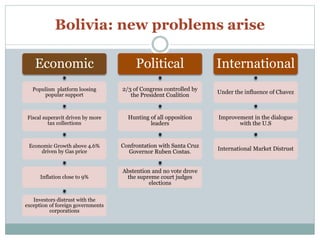
Bolivia: new problems arise 
Economic 
Populism platform loosing 
popular support 
Fiscal superavit driven by more 
tax collections 
Economic Growth above 4.6% 
driven by Gas price 
Inflation close to 9% 
Investors distrust with the 
exception of foreign governments 
corporations 
Political 
2/3 of Congress controlled by 
the President Coalition 
Hunting of all opposition 
leaders 
Confrontation with Santa Cruz 
Governor Ruben Costas. 
Abstention and no vote drove 
the supreme court judges 
elections 
International 
Under the influence of Chavez 
Improvement in the dialogue 
with the U.S 
International Market Distrust
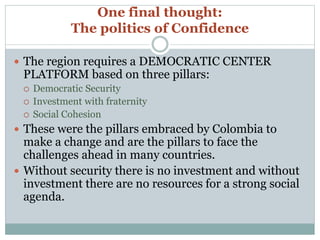
One final thought: 
The politics of Confidence 
 The region requires a DEMOCRATIC CENTER 
PLATFORM based on three pillars: 
 Democratic Security 
 Investment with fraternity 
 Social Cohesion 
 These were the pillars embraced by Colombia to 
make a change and are the pillars to face the 
challenges ahead in many countries. 
 Without security there is no investment and without 
investment there are no resources for a strong social 
agenda.
www.alvarouribevelez.com

Colombia and The Region - an strategical view

  • 1.
    COLOMBIA AND THEREGION AN STRATEGICAL VIEW REMARKS BY ALVARO URIBE VÉLEZ LIT TLE ROCK, ARKANSAS NOVEMBER 2 201 1
  • 2.
    Introduction  Ihave been asked to talk about the story behind the Colombian success during the last nine years, and to exchange some ideas on how political Will can trigger effective change.  When I was asked to do that, I felt that this should be the opportunity to express that what Colombia has experienced is not only my success as President, nor only the success of my administration.It was and it should be always remembered as the success of a whole nation that recovered CONFIDENCE and decided to mobilize in order to build a better future.  As President I had the privilege of counting with the support of my fellow citizens to put in place the concept of a Comunitary State built in the fertile ground of DEMOCRATIC SECURITY, INVESTOR CONFIDENCE AND SOCIAL COHESION. This is the story I want to share with you today
  • 3.
    1. Colombia longhistory of violence  Colombia’s history has been signed by long periods of violence: In almost 200 years of independent live, our nation has only experienced 47 years of relative peace.  Violence has taken many forms:  Regional and political organization struggles in the XIX Century.  Partisan violence from 1900-1958  Guerrilla confrontation since 1960  Narco-Terrorism since 1980’s  Violence has affected the lives of many Colombians:  My father was killed in a kidnapping attempt. I have suffered in my own skin the cruelty of terrorism. For that reason I have fought to liberate my nation from the reign of fear.
  • 4.
    2. Violence destroyedhope  Between 1982 and 2002 violence kept on deteriorating and became the root of structural problems: lack of investment, unemployment, poverty, brain drain, lack of hope.  In 2002 Colombia's was considered by many multilateral organizations, as a nation in the path of becoming a failed state.  The numbers made evident that we were experiencing a Confidence Deficit:  28.837 homicides  2882 kidnappings  69 homicides per 100.000 habitants  1645 terrorist attacks  350 mayors out of their municipalities  158 municipalities without police  Unemployment was close to 16%  Poverty close to 57%  Per Capita income US$2300  FDI: US$2.1 billion  Investment as % of GDP: 16%  Guerrillas, Paramilitaries and drug dealers exercised control in many regions
  • 5.
    3. Our changeagenda  Colombia needed a change.  In 2000 I decided to run for President building an agenda by listening to the people and engaging in permanent dialogue:  Democratic Workshops  People coalition  Independent candidacy  Primero Colombia  We built our change agenda with the People:  Confidence was our cornerstone  A new concept of State…”The Communitary State”: • No division between left and right • No Neoliberalism nor Socialism • Pure Democratic Center • A participative State • An efficient state not a bureaucratic State  Strong hand and big heart: Mano firme corazón grande  Democratic Manifesto: 100 Points  Three Pillars: • Democratic Security • Investment with fraternity • Social Cohesion as the final objective
  • 6.
    4. The 3pillars in Government Democratic Security Security for All Fight all forms of crime Security without Martial Law Security with liberties and Human Rights Victims recognition Investment with Social Responsibility Investor Security (Human, Legal and Political) Sound Macroeconomics Incentives Access to markets Competitiveness Factors (Infrastructure, Connectivity, Banking,) Social Cohesion Education Revolution Health with coverage and quality Access to credit (Banca de oportunidades) Vocational Training Conditional Cash Transfers
  • 7.
    4. The ThreePillars in Government: Change is possible The combination of our Policies produced significant results: Lowest violence levels in two decades, highest levels of social coverage in Colombian History and highest levels Security Economy Indicator 2002 2010 Homicides 28838 14000 Kidnappings 2882 228 Homicides per 100K Habitants 69 35 Terrorist attacks 1645 250 Municipalities without mayors presence 350 0 Municipalities without police 158 0 Indicator 2002 2010 Average Economic Growth 2.1% 4.3% GDP per Capita 2377 5300 Invest % GDP 16.5% 27% Exports US$11. 000 US$ 39.000 FDI US$2.1 00 US$ 7.000 Inflation 6.9% 2.5% Social Indicator 2002 2010 Unemployment 16.2% 11.6% Health Coverage 25.1 million 43.1 million Pension affiliates 4.5 million 7.1 million Poverty 53% 37% Education coverage (Primary, Hs, University) 97% 57% 24% 100% 79.4% 35.5% Mobile phone users 4.6 million lines 41 million lines of Exports and FDI in more than 5 decades.
  • 8.
    5. Change drivers Change Drivers 1. 306 Communitarian Councils • Changed the way in which the government connects with the people. For the first time Government talks to the people not the armed groups. • People initially made their claims with anger and after 8 years with hope 2. Weekly Security Councils • Helped us confront the military forces statistics with the community. • Great example of trust building 3. 52 Economic dialogues • Helped discuss economic policy with all the stakeholders 4. Result Driven Administration • We created the SIGOB a system to monitor how Government fulfils its objectives 5. Leading by example • The President was on top of the agenda and involved 24/7 6. Direct Democracy (Sate of opinion) • The Government always open for people scrutiny • T.V Questions for the FTA 7. Determination to find solutions • Less promises but more solutions 8. Communication with the truth • The case of Governor Gaviria and Minister Echeverry
  • 9.
    6. Security asthe Heart of Change Recovering Security 1. Macro Vision and Detailed Follow up: • Daily commitment to monitor security in every region. • How citizens had the President Mobile Phone Number 2. Early Victories : • Road caravans • Massive kidnappings are over 3. Strategic Force Integration • All Forces working together. • Share success 4. National Informant Network • Citizens became active in denouncing criminals • Reward Mondays 5. Commander in Chief assumes responsibility • The Granda Story • Operation Fenix: Fire the Air Force Commander • Operation Jaque: The pressure for a humanitarian exchange and the final outcome 6. Smart Weapons: • The importance of strategic warfare 7. Extradition: • The decision to extradite the Paramilitary Kingpins
  • 10.
    7. Facing crisis:perseverance to reach change  Moments of truth: 1. Nogal Bomb: Bogota cries but never surrenders 2. Killing of 11 regional senators: Facing their families when rejecting humanitarian exchanges. 3. The rescue of Fernando Araujo 4. Meeting Chavez after the Bombardment in Ecuador: a debate in live T.V 5. The rescue of National University President 6. The story of Emanuel 7. The military agreement with the U.S
  • 11.
    8. Historical changestook place  Leadership, governance based on citizen support and political Will, helped built significant historical changes in strategic sectors:  Reform the oil and gas sector: 1. Colombia is close to produce 1 million barrels per day from 250.000 in 2002. 2. Ecopetrol Reform 3. Created the National Hydrocarbon Agency  Reform the Telecom Sector: 1. Restructure the Colombian Telecommunications Agency  Reform the Colombian Social Security Agency  More than 2000 criminals were extradited  Paramilitary structures were dismantled  FARC suffered its biggest historical defeats  Colombia experienced its largest historical FDI flows  Biggest historical reduction in illicit crops  More than 10 FTA’s signed and negotiated  Largest historical health and education coverage  Largest historical credit expansion  Largest historical tourism flows to the country
  • 12.
    9.Final thoughts Colombia between 2002 and 2010 passed from a state in crisis to a state in Progress.  However some challenges remain Security Maintain Macro-Vision and Micro-Management Continue dismantling all terrorist organizations Continue dismantling drug cartels apparatus. Strengthen Citizen Security agendas with local authorities Economic Face new trends of currency appreciation Maintain and increase FDI flows (Security, incentives and stability rules) Fiscal Policy to face new countercyclical challenges Increase tax collections Expand new trade markets through FTA’s Social Cohesion Fight labor informality and create quality jobs Insure education and health quality Expand vocational training coverage Create Entrepreneurial Family Transfers program Political Judicial reform. Strengthen Democratic Center Improve local institutional capacity New law implementation (Victims and land) Prevent the emergence of populist movements
  • 13.
  • 14.
    1. Opportunities, challengesand risks  Commentators and analysts continuously talk about Chinas transformation and praise its effort for becoming the World second largest economy and by being able to allow 400 million people come out from the poverty trap.  However in our region a silent process of change has also occurred and today Latin America is an active contributor to the Emerging Nations Century:      The regional silent evolution
  • 15.
    1. Opportunities, challengesand risks Between 1980 and 2010 we have experienced an outstanding improvement of our social indicators in what can be called a social transformation:  Life expectancy has increased from 65 to 75 years.  Child mortality has been reduced by 50 per cent.  Literacy rates are above 94%.  Mobile phone penetration has increased by 78 per cent.  Internet access has increased by 33%  Healthcare coverage has increased by 50 percent.  And water and sanitation coverage has reached on average 80 per cent in the region.
  • 16.
    1. Opportunities, challengesand risks Latin America is also a land of opportunities  Latin America is a region with a vast number of natural resources that will help the World attend great part of the demand patterns.  We count with:  10 percent of the World oil reserves.  6 percent of the World Gas reserves  Almost 50 percent of the World cooper reserves.  50 per cent of the World silver reserves.  13% of the World iron reserves  26% of the World fertile land.  24% of the World beef supply.  Almost 50% of the World potable water supply.  Approximately 20 per cent of the World Biodiversity is concentrated in the Amazon ring. 
  • 17.
    1. Opportunities, challengesand risks The SECRET BEHIND Latin American Success  This change process is a consequence of the principles that a group of countries have adopted as their policy cornerstone. Brazil, Mexico, Colombia, Chile, Peru and Uruguay represent 70 per cent of the region’s population and 75% of the regional GDP.  This group of countries have common characteristics that explain their outstanding performance: 1. The strengthening of Liberal Democracy 2. The adoption of an institutional Framework in favor of foreign and national investment. 3. The construction of a sound and sustainable social safety net. 4. The expansion of export markets and the commercial integration with the World (FTA’s) 5. A public administration driven by results. 6. A sound Macroeconomic Administration driven by fiscal and monetary prudence. 7. Better regulatory environment 8. Construction of strategic infrastructure. 9. The consolidation of an innovation agenda leaded by an improvement in education. 10. A well capitalized financial sector and the constant expansion of financial services.  Today countries like Panama, Dominican Republic, Costa Rica, Salvador, Guatemala, Honduras, Belize, Paraguay, as well as most of the Caribbean States, are following that line of behavior
  • 18.
    1. Opportunities, challengesand risks Building Modern Democracies (5 parameters) Security Freedoms and Private Initiative Independent Institutions Social Cohesion People Participation A dynamic Economic transformation Investment Target Policies Maintaining Fiscal and Monetary transformation Integrate commodity and knowledge based economies. Expand export markets Create an Entrepreneurship culture (Innovation agenda) Closing Social Gaps Improve education (quality, coverage, vocational) Insure Universal Healthcare Formal Job creation Access to Finance Climate Change, Environment and Energy Sustainability Expand renewable sources Install an energy efficiency conscience Improve waste management Protect the Amazon Ring Reduce Co2 Emissions Challenges
  • 19.
    1. Opportunities, challengesand risks Economic Risks More Sovereign Debt restructuring in Europe Higher inflation in Emerging Markets and exploding bubbles Real State Bubbles in China Rapid Expansion of commodity Prices Currency volatility Geopolitical Risks Terrorism Illicit Trade (Drugs, arms, counterfeiting, organs, persons) Organized Crime (Central America, Mexico, Colombia, Brazil, etc) Lagging Democracies and fragile States (Venezuela, Haiti,Bolivia, Cuba) Nuclear weapons Environmental Risks Earthquakes and Tsunamis Flooding Deforestation and Biodiversity Loss Climate Change Social Risks Demographic Challenges Food Security Massive Migration Infectious Diseases Economic Inequality Risks
  • 20.
    Peru Humala Challenges Maintain Investment Confidence Improve social expenditure targeting Improve Labor markets • Combat informality • Improve productivity Continue with International insertion • Implement the FTA with USA • Pacific Agenda with Colombia, Chile and Mexico.
  • 21.
    Argentina Fiscal and Monetary Credibility Challenges Institutional quality Capacity to generate confidence Trigger FDI Solve Public- Private Conflicts
  • 22.
    Security Human Insecurity Legal Insecurity Political insecurity Individual Liberties Property rights at risk Limit freedom of expression Limit freedom of press Independent institutions Courts controlled by the Executive Branch. Independent institutions are controlled by the Executive father One Party controls the Parliament Citizen participation Limited Controlled Instruments vital for political pressure. Social Cohesion Class polarization Fiscal policy is unsustainable Venezuela
  • 23.
    Urban security Prevent economic overheating Drug consumption Challenges Regional integration Cost of money Infrastructure Foreign Policy Brasil
  • 24.
    Mexico Reform thePolice Structure Citizen participation in the fight against organized crime Strengthen intelligence The security challenge Border affairs • Drug Consumption • Assault Weapons
  • 25.
    Chile Two situations Economic Stability Characteristics Political Stability Investor Confidence Innovation and entrepreneurship Quality of live and agenda. opportunities Dependant on the China effect Aggressive protests Youth distrust in Political Parties and in Government.
  • 26.
    Ecuador The politicalcondition Economic 4.5% Fiscal deficit Oil price has been the driving force. Investors distrust 4.5% inflation Political The President has concentrated more powers Conflict with congress and with independent media will deteriorate as the Government pushes more interventionist reforms There is not a clear opposition figure Urban security has been deteriorating
  • 27.
    Bolivia: new problemsarise Economic Populism platform loosing popular support Fiscal superavit driven by more tax collections Economic Growth above 4.6% driven by Gas price Inflation close to 9% Investors distrust with the exception of foreign governments corporations Political 2/3 of Congress controlled by the President Coalition Hunting of all opposition leaders Confrontation with Santa Cruz Governor Ruben Costas. Abstention and no vote drove the supreme court judges elections International Under the influence of Chavez Improvement in the dialogue with the U.S International Market Distrust
  • 28.
    One final thought: The politics of Confidence  The region requires a DEMOCRATIC CENTER PLATFORM based on three pillars:  Democratic Security  Investment with fraternity  Social Cohesion  These were the pillars embraced by Colombia to make a change and are the pillars to face the challenges ahead in many countries.  Without security there is no investment and without investment there are no resources for a strong social agenda.
  • 29.