THINGS YOU ALWAYS
THOUGHT YOU KNEW
BUT DIDN’T
Economics is considered as a subject of uninteresting financial trends and
market developments, which is not true.
What is more dangerous, a gun or a swimming pool?
What do schoolteachers and sumo wrestlers have in common?
Why do drug dealers still live with their moms?
How much do parents really matter?
How did the legalization of abortion affect the rate of violent crime?
Introduction: The Hidden Side of Everything
The book is based on four fundamental ideas:
1) Incentives are the cornerstone of modern life.
2) Conventional wisdom is often wrong.
3) Dramatic effects often have distant, even subtle, causes.
4) "Experts" use their informational advantage to serve their own interests.
knowing what to measure, and how to measure it, is the key to
understanding modern life
How is the Ku Klux Klan like a Group of Real-
Estate Agents?
Information asymmetry is one of the most powerful economic tools
Stetson Kennedy helped cripple racist Ku Klux Klan during the era of world war –II simply
by widely disseminating their secrets. He systematically documented the secret rituals and
supplied the records to Hollywood writers, who used the information on radio. gradually,
the mystery, grandeur, and influence of the group were profoundly diminished.
Analyzing data about real estate agents common practices when they are selling their own
houses, shows that not always do they have their clients’ best interests at heart.
YOU AGENT
$10,000
$600
$300
$150
Why Do Drug Dealers Still Live
with Their Moms?
The main take away from this chapter was to prove wrong the
misconception that those who are drug dealers are all very well-off and
make a lot of money. Based on detailed records of an actual Chicago
neighborhood gang, the author found that :-
Top Gang
Leaders
(2.2%)
$100,000 pa
Gang Officers
$700 pm
Foot Soldiers –
Dealers $3.5 ph
Less than minimum wage "They had no choice but to live with their
mothers."
Interesting statistics
• ―The top 120 men in Black Disciples gang
represented just 2.2 percent of the full-fledged
gang membership but took home well more than
half the money.‖
• ―If you were a member of J.T.’s gang for all four
years, [your] chance of being killed =25%
• ―In 2003, Texas put to death…just 5 percent of
the nearly 500 inmates on its death row‖ and
0.5% for soldiers in Iraq war.
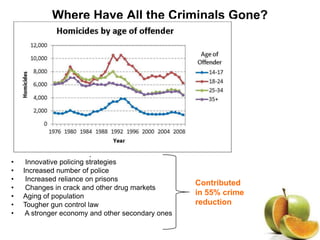
Where Have All the Criminals Gone?
The common assumption was
• Innovative policing strategies
• Increased number of police
• Increased reliance on prisons
• Changes in crack and other drug markets
• Aging of population
• Tougher gun control law
• A stronger economy and other secondary ones
Contributed
in 55% crime
reduction
Legalized Abortion = 45%
What is more dangerous, a gun
or a swimming pool?
Risk= Hazard + Outrage
• In a given year, there is 1 drowning of a child for every 11,000
residential pools in US.
• Meanwhile, there is 1 child killed for every 10,00,000 plus guns.
• Thus risks that scare people and risks that kill people are very
different.
What motivates good parenting?
• What are the deterrents for good parenting……is it MONEY?$$
• 20 late pickups per week i.e. more than double the original average
• Parents chose to earn 30$ an hour over quality time with kids
• Guilt free feeling was as cheap as 3$
Incentive: Moral vs. Economic
Problem: Day care centre substituted an
Economic incentive for a Moral incentive
LITERATURE REVIEW
The following books along with Freakonomics present you with
out of the box explanations for day to day observations-
1.Mobs, Messiahs and Markets: Surviving the public spectacle
in finance and politics.
2.Poop Culture: How America is shaped by its grossest
national product
3. The Logic Of Life: The rational economics of an irrational
world.
4. The Paradox Of Choice: Why more is less.
CRITICAL RESPONSE
Freakonomics is a ground-breaking collaboration between Levitt and Stephen J.
Dubner, an award-winning author and journalist. They usually begin with a
mountain of data and a simple, unasked question. Some of these questions
concern life-and-death issues; others have an admittedly freakish quality. Thus
the new field of study contained in this book: Freakonomics.
CRITICAL RESPONSE contd…
It literally redefines the way we view the modern world. Through forceful
storytelling and wry insight, Levitt and Dubner show that all it takes is a new
way of looking at things. What unites all these stories is a belief that the
modern world, despite a great deal of complexity and downright deceit, is
not impenetrable, is not unknowable, and—if the right questions are
asked—is even more intriguing than we think.
―This book is a brilliant, provocative investigation into motives: what they are, how
they can be changed, and how they affect what people do. It is also a
deceptively easy read: its style is so light, its tone so sunny and humorous, that
it is hard to realise the extent to which the arguments in Freakonomics attack
some of our most basic assumptions about the way people, and society,
work.‖— The Sunday Telegraph
Freakonomics unfolds much less like a typical arcane economic treaties and
more like the type of detective story that has you reading late into the night. In
love with or disgusted by Levitt’s findings, you are compelled to read on.‖
— Chicago Tribune
Critiques & Lauds
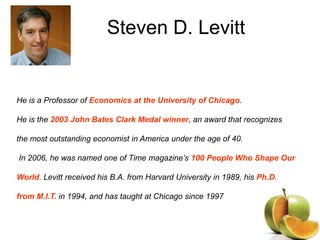
Steven D. Levitt
He is a Professor of Economics at the University of Chicago.
He is the 2003 John Bates Clark Medal winner, an award that recognizes
the most outstanding economist in America under the age of 40.
In 2006, he was named one of Time magazine’s 100 People Who Shape Our
World. Levitt received his B.A. from Harvard University in 1989, his Ph.D.
from M.I.T. in 1994, and has taught at Chicago since 1997
Stephen J. Dubner
He is an award-winning author, journalist, and TV and radio personality
He has taught English at Columbia University and, as a writer, was first
published at the age of 11, in Highlights for Children
Personal Response
The highlight of the book is that it applies rational economic
thinking to emotive subjects and lays stress on solving
intractable problems using unconventional thinking.
Our Outlook
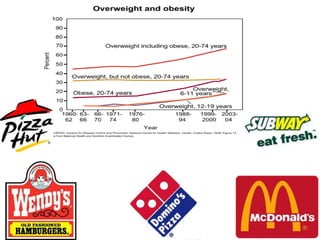
Women Liberalization – Obesity ???
Any Geeks with freaking
questions??

Freakonomics

  • 1.
    THINGS YOU ALWAYS THOUGHTYOU KNEW BUT DIDN’T
  • 2.
    Economics is consideredas a subject of uninteresting financial trends and market developments, which is not true. What is more dangerous, a gun or a swimming pool? What do schoolteachers and sumo wrestlers have in common? Why do drug dealers still live with their moms? How much do parents really matter? How did the legalization of abortion affect the rate of violent crime?
  • 3.
    Introduction: The HiddenSide of Everything The book is based on four fundamental ideas: 1) Incentives are the cornerstone of modern life. 2) Conventional wisdom is often wrong. 3) Dramatic effects often have distant, even subtle, causes. 4) "Experts" use their informational advantage to serve their own interests. knowing what to measure, and how to measure it, is the key to understanding modern life
  • 4.
    How is theKu Klux Klan like a Group of Real- Estate Agents? Information asymmetry is one of the most powerful economic tools Stetson Kennedy helped cripple racist Ku Klux Klan during the era of world war –II simply by widely disseminating their secrets. He systematically documented the secret rituals and supplied the records to Hollywood writers, who used the information on radio. gradually, the mystery, grandeur, and influence of the group were profoundly diminished. Analyzing data about real estate agents common practices when they are selling their own houses, shows that not always do they have their clients’ best interests at heart. YOU AGENT $10,000 $600 $300 $150
  • 5.
    Why Do DrugDealers Still Live with Their Moms? The main take away from this chapter was to prove wrong the misconception that those who are drug dealers are all very well-off and make a lot of money. Based on detailed records of an actual Chicago neighborhood gang, the author found that :- Top Gang Leaders (2.2%) $100,000 pa Gang Officers $700 pm Foot Soldiers – Dealers $3.5 ph Less than minimum wage "They had no choice but to live with their mothers." Interesting statistics • ―The top 120 men in Black Disciples gang represented just 2.2 percent of the full-fledged gang membership but took home well more than half the money.‖ • ―If you were a member of J.T.’s gang for all four years, [your] chance of being killed =25% • ―In 2003, Texas put to death…just 5 percent of the nearly 500 inmates on its death row‖ and 0.5% for soldiers in Iraq war.
  • 6.
    Where Have Allthe Criminals Gone? The common assumption was • Innovative policing strategies • Increased number of police • Increased reliance on prisons • Changes in crack and other drug markets • Aging of population • Tougher gun control law • A stronger economy and other secondary ones Contributed in 55% crime reduction
  • 7.
  • 8.
    What is moredangerous, a gun or a swimming pool?
  • 9.
    Risk= Hazard +Outrage • In a given year, there is 1 drowning of a child for every 11,000 residential pools in US. • Meanwhile, there is 1 child killed for every 10,00,000 plus guns. • Thus risks that scare people and risks that kill people are very different.
  • 10.
    What motivates goodparenting? • What are the deterrents for good parenting……is it MONEY?$$ • 20 late pickups per week i.e. more than double the original average • Parents chose to earn 30$ an hour over quality time with kids • Guilt free feeling was as cheap as 3$
  • 11.
    Incentive: Moral vs.Economic Problem: Day care centre substituted an Economic incentive for a Moral incentive
  • 12.
    LITERATURE REVIEW The followingbooks along with Freakonomics present you with out of the box explanations for day to day observations- 1.Mobs, Messiahs and Markets: Surviving the public spectacle in finance and politics. 2.Poop Culture: How America is shaped by its grossest national product 3. The Logic Of Life: The rational economics of an irrational world. 4. The Paradox Of Choice: Why more is less.
  • 13.
    CRITICAL RESPONSE Freakonomics isa ground-breaking collaboration between Levitt and Stephen J. Dubner, an award-winning author and journalist. They usually begin with a mountain of data and a simple, unasked question. Some of these questions concern life-and-death issues; others have an admittedly freakish quality. Thus the new field of study contained in this book: Freakonomics.
  • 14.
    CRITICAL RESPONSE contd… Itliterally redefines the way we view the modern world. Through forceful storytelling and wry insight, Levitt and Dubner show that all it takes is a new way of looking at things. What unites all these stories is a belief that the modern world, despite a great deal of complexity and downright deceit, is not impenetrable, is not unknowable, and—if the right questions are asked—is even more intriguing than we think.
  • 15.
    ―This book isa brilliant, provocative investigation into motives: what they are, how they can be changed, and how they affect what people do. It is also a deceptively easy read: its style is so light, its tone so sunny and humorous, that it is hard to realise the extent to which the arguments in Freakonomics attack some of our most basic assumptions about the way people, and society, work.‖— The Sunday Telegraph Freakonomics unfolds much less like a typical arcane economic treaties and more like the type of detective story that has you reading late into the night. In love with or disgusted by Levitt’s findings, you are compelled to read on.‖ — Chicago Tribune Critiques & Lauds
  • 16.
    Steven D. Levitt Heis a Professor of Economics at the University of Chicago. He is the 2003 John Bates Clark Medal winner, an award that recognizes the most outstanding economist in America under the age of 40. In 2006, he was named one of Time magazine’s 100 People Who Shape Our World. Levitt received his B.A. from Harvard University in 1989, his Ph.D. from M.I.T. in 1994, and has taught at Chicago since 1997
  • 17.
    Stephen J. Dubner Heis an award-winning author, journalist, and TV and radio personality He has taught English at Columbia University and, as a writer, was first published at the age of 11, in Highlights for Children
  • 18.
    Personal Response The highlightof the book is that it applies rational economic thinking to emotive subjects and lays stress on solving intractable problems using unconventional thinking.
  • 19.
  • 21.
    Any Geeks withfreaking questions??