FRAUD AWARENESS
for Niagara College Students
WHAT IS A SCAM OR FRAUD?
A scam or fraud is a dishonest scheme by someone
who wants to steal money from you, or trick you into
other illegal activities. People who commit this crime
are called scammers or fraudsters. Newcomers to
Canada are more vulnerable to scam/frauds as they
are not as familiar with norms/customs and processes
in Canada. This brochure offers information to help
you identify and report scams or fraud.
If you are still unsure of what a scam/fraud is, how
to identify one, or feel as though you have been
scammed, please reach out to your Student Advisor
and they will be happy to assist you.
.
Types of Scams/Fraud
•	 Telemarketing scams
•	 Online scams
•	 Email and text messages
scam
•	 Identity theft
•	 Mail scams
•	 Door-to-door scams
•	 Housing scams
•	 Immigration fraud
/Citizenship fraud
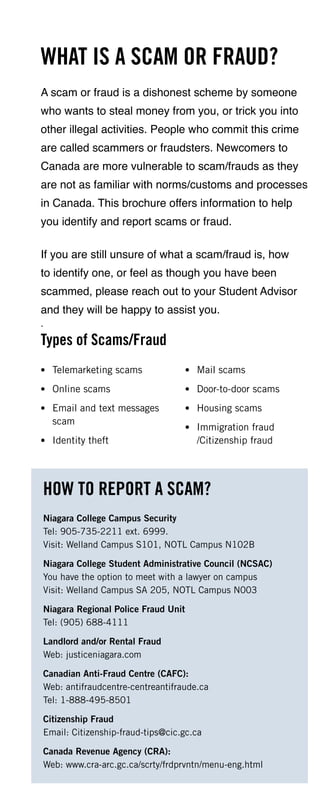
HOW TO REPORT A SCAM?
Niagara College Campus Security
Tel: 905-735-2211 ext. 6999.
Visit: Welland Campus S101, NOTL Campus N102B
Niagara College Student Administrative Council (NCSAC)
You have the option to meet with a lawyer on campus
Visit: Welland Campus SA 205, NOTL Campus N003
Niagara Regional Police Fraud Unit
Tel: (905) 688-4111
Landlord and/or Rental Fraud
Web: justiceniagara.com
Canadian Anti-Fraud Centre (CAFC):
Web: antifraudcentre-centreantifraude.ca
Tel: 1-888-495-8501
Citizenship Fraud
Email: Citizenship-fraud-tips@cic.gc.ca
Canada Revenue Agency (CRA):
Web: www.cra-arc.gc.ca/scrty/frdprvntn/menu-eng.html
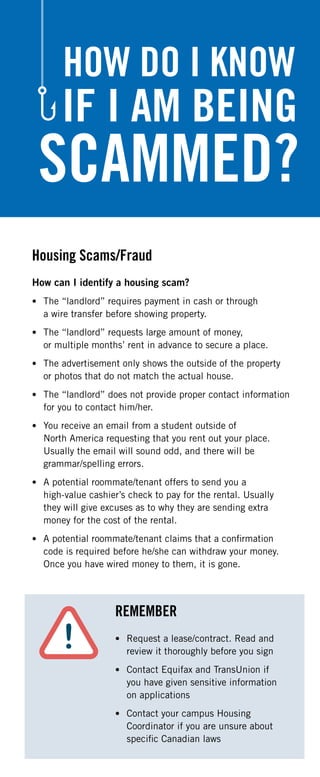
Housing Scams/Fraud
How can I identify a housing scam?
•	 The “landlord” requires payment in cash or through
a wire transfer before showing property.
•	 The “landlord” requests large amount of money,
or multiple months’ rent in advance to secure a place.
•	 The advertisement only shows the outside of the property
or photos that do not match the actual house.
•	 The “landlord” does not provide proper contact information
for you to contact him/her.
•	 You receive an email from a student outside of
North America requesting that you rent out your place.
Usually the email will sound odd, and there will be
grammar/spelling errors.
•	 A potential roommate/tenant offers to send you a
high-value cashier’s check to pay for the rental. Usually
they will give excuses as to why they are sending extra
money for the cost of the rental.
•	 A potential roommate/tenant claims that a confirmation
code is required before he/she can withdraw your money.
Once you have wired money to them, it is gone.
REMEMBER
•	 Request a lease/contract. Read and
review it thoroughly before you sign
•	 Contact Equifax and TransUnion if
you have given sensitive information
on applications
•	 Contact your campus Housing
Coordinator if you are unsure about
specific Canadian laws
Canada Revenue Agency (CRA) and Immigration,
Refugees and Citizenship Canada (IRCC)
Citizenship and Immigration
Canada (CIC) Scams/Fraud
•	 IRCC will never ask for
payment via email or
over phone.
•	 CIC will never ask to verify
personal information such as date
of birth, Social Insurance Number
(SIN) number, bank information etc.
•	 CIC will never call and threaten you with deportation
or jail.
•	 The caller will sound aggressive over the phone
requesting to pay fees immediately and stating you will
face deportation, loss of passport and citizenship.
How can I tell if an immigration website is a scam?
•	 The website offers special, too good to be true immigration
deals, or guarantees entry in Canada, high-paying jobs
or faster processing of your application.
•	 It looks like an official government of Canada site,
but it is in one language only and does not have the
Canada.ca URL or a URL that ends with “.gc.ca”.
•	 It asks you to provide personal information, financial
information or make a deposit before you even start
the application process.
•	 There is no padlock symbol in the window browser or
https:// at the beginning of the web address to show it
is a secure site.
•	 You cannot reach anyone listed in the website’s contact
information, or the website has no contact information.
Job Scams/Fraud
How can I identify and protect myself from a job scam?
•	 If a job sounds too good to be true, it probably is.
•	 You are contacted by a potential employer and offered a job
where you can work from home, set your own hours, and all
you need to do is deposit money into their bank account.
•	 An “employer” asks you to purchase bitcoin, and then send
the bitcoin to another account with the incentive that you
can keep a “commission” from the money deposited.
•	 You receive an email from a potential employer that does
not look official and does not have a company signature and
job contracts are not on company letterhead, etc.
•	 If you receive a cheque or funds deposited to your account
in response to a job application, advise your financial
institution immediately.
•	 Be mindful where you post your resume; scammers use
legitimate websites to seek out victims.
Safety tips for job applicants:
Do not provide personal or sensitive
information in your resume, such as
•	 Social Insurance Number (SIN)
•	 Age, martial status or date of birth
•	 Driver’s licence
•	 Health card number
•	 Any banking or financial institution
that has your credit card or bank
numbers and Personal Identification
Numbers (PIN)
Dating And Romance Scams
Despite the many legitimate dating applications and websites,
there are many dating and romance scams. Be mindful of who
you share personal information with.
How can I identify a dating/romance scam?
•	 Some dating and romance scams work by setting up dating
websites where you are told to pay for each email or message
you send and receive.
•	 The scammer will try to send you vague-sounding messages
filled with talk of love and desire.
•	 The scammer might send you messages with details of their
home country or town that may not refer to you.
•	 Scammers may steal other attractive looking people’s photos
to get your attention.
•	 Scammers may message you to pay online before meeting
in person.
What not to do:
•	 Never send exposing photos to anyone online. They may
threaten to post your photos online if you do not send them
large amounts of money.
•	 Never give out personal banking information or other personal
information in an email or online chat from your computer
or device.
•	 Never send money even if they send you small gifts or express
their “love”.

Fraud Awareness NC

  • 1.
  • 2.
    WHAT IS ASCAM OR FRAUD? A scam or fraud is a dishonest scheme by someone who wants to steal money from you, or trick you into other illegal activities. People who commit this crime are called scammers or fraudsters. Newcomers to Canada are more vulnerable to scam/frauds as they are not as familiar with norms/customs and processes in Canada. This brochure offers information to help you identify and report scams or fraud. If you are still unsure of what a scam/fraud is, how to identify one, or feel as though you have been scammed, please reach out to your Student Advisor and they will be happy to assist you. . Types of Scams/Fraud • Telemarketing scams • Online scams • Email and text messages scam • Identity theft • Mail scams • Door-to-door scams • Housing scams • Immigration fraud /Citizenship fraud HOW TO REPORT A SCAM? Niagara College Campus Security Tel: 905-735-2211 ext. 6999. Visit: Welland Campus S101, NOTL Campus N102B Niagara College Student Administrative Council (NCSAC) You have the option to meet with a lawyer on campus Visit: Welland Campus SA 205, NOTL Campus N003 Niagara Regional Police Fraud Unit Tel: (905) 688-4111 Landlord and/or Rental Fraud Web: justiceniagara.com Canadian Anti-Fraud Centre (CAFC): Web: antifraudcentre-centreantifraude.ca Tel: 1-888-495-8501 Citizenship Fraud Email: Citizenship-fraud-tips@cic.gc.ca Canada Revenue Agency (CRA): Web: www.cra-arc.gc.ca/scrty/frdprvntn/menu-eng.html
  • 3.
    Housing Scams/Fraud How canI identify a housing scam? • The “landlord” requires payment in cash or through a wire transfer before showing property. • The “landlord” requests large amount of money, or multiple months’ rent in advance to secure a place. • The advertisement only shows the outside of the property or photos that do not match the actual house. • The “landlord” does not provide proper contact information for you to contact him/her. • You receive an email from a student outside of North America requesting that you rent out your place. Usually the email will sound odd, and there will be grammar/spelling errors. • A potential roommate/tenant offers to send you a high-value cashier’s check to pay for the rental. Usually they will give excuses as to why they are sending extra money for the cost of the rental. • A potential roommate/tenant claims that a confirmation code is required before he/she can withdraw your money. Once you have wired money to them, it is gone. REMEMBER • Request a lease/contract. Read and review it thoroughly before you sign • Contact Equifax and TransUnion if you have given sensitive information on applications • Contact your campus Housing Coordinator if you are unsure about specific Canadian laws
  • 4.
    Canada Revenue Agency(CRA) and Immigration, Refugees and Citizenship Canada (IRCC) Citizenship and Immigration Canada (CIC) Scams/Fraud • IRCC will never ask for payment via email or over phone. • CIC will never ask to verify personal information such as date of birth, Social Insurance Number (SIN) number, bank information etc. • CIC will never call and threaten you with deportation or jail. • The caller will sound aggressive over the phone requesting to pay fees immediately and stating you will face deportation, loss of passport and citizenship. How can I tell if an immigration website is a scam? • The website offers special, too good to be true immigration deals, or guarantees entry in Canada, high-paying jobs or faster processing of your application. • It looks like an official government of Canada site, but it is in one language only and does not have the Canada.ca URL or a URL that ends with “.gc.ca”. • It asks you to provide personal information, financial information or make a deposit before you even start the application process. • There is no padlock symbol in the window browser or https:// at the beginning of the web address to show it is a secure site. • You cannot reach anyone listed in the website’s contact information, or the website has no contact information.
  • 5.
    Job Scams/Fraud How canI identify and protect myself from a job scam? • If a job sounds too good to be true, it probably is. • You are contacted by a potential employer and offered a job where you can work from home, set your own hours, and all you need to do is deposit money into their bank account. • An “employer” asks you to purchase bitcoin, and then send the bitcoin to another account with the incentive that you can keep a “commission” from the money deposited. • You receive an email from a potential employer that does not look official and does not have a company signature and job contracts are not on company letterhead, etc. • If you receive a cheque or funds deposited to your account in response to a job application, advise your financial institution immediately. • Be mindful where you post your resume; scammers use legitimate websites to seek out victims. Safety tips for job applicants: Do not provide personal or sensitive information in your resume, such as • Social Insurance Number (SIN) • Age, martial status or date of birth • Driver’s licence • Health card number • Any banking or financial institution that has your credit card or bank numbers and Personal Identification Numbers (PIN)
  • 6.
    Dating And RomanceScams Despite the many legitimate dating applications and websites, there are many dating and romance scams. Be mindful of who you share personal information with. How can I identify a dating/romance scam? • Some dating and romance scams work by setting up dating websites where you are told to pay for each email or message you send and receive. • The scammer will try to send you vague-sounding messages filled with talk of love and desire. • The scammer might send you messages with details of their home country or town that may not refer to you. • Scammers may steal other attractive looking people’s photos to get your attention. • Scammers may message you to pay online before meeting in person. What not to do: • Never send exposing photos to anyone online. They may threaten to post your photos online if you do not send them large amounts of money. • Never give out personal banking information or other personal information in an email or online chat from your computer or device. • Never send money even if they send you small gifts or express their “love”.