
“ WHEN BAD THINGS HAPPEN TO YOUR GOOD NAME”
What is Identity Theft? Someone uses your name or personal information to  Open credit card accounts or use existing accounts Take out a loan Make a major purchase Access bank accounts File fraudulent tax returns Or even commit a crime!
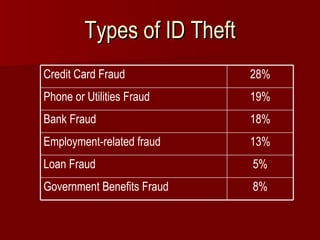
Types of ID Theft 8% Government Benefits Fraud 5% Loan Fraud 13% Employment-related fraud 18% Bank Fraud 19% Phone or Utilities Fraud 28% Credit Card Fraud
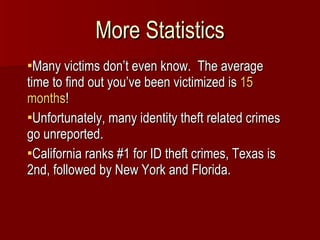
More Statistics Many victims don’t even know.  The average time to find out you’ve been victimized is  15   months ! Unfortunately, many identity theft related crimes go unreported. California ranks #1 for ID theft crimes, Texas is 2nd, followed by New York and Florida.
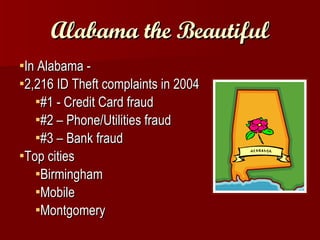
Alabama the Beautiful In Alabama -  2,216 ID Theft complaints in 2004 #1 - Credit Card fraud  #2 – Phone/Utilities fraud #3 – Bank fraud Top cities Birmingham Mobile Montgomery
Are  you  at risk? Test your “Identity Quotient”:  Take the test & see what your score means.
 You receive offers of pre-approved credit every week  (5 points) and, if you decide not to accept, you do not shred them before putting them in the trash.  (5 points)  You carry your Social Security Card in your wallet.  (10 points)
 Your Driver’s License has your SSN printed on it and you have not contacted the DMV to request a new license. (10 points)  You do not have a PO Box or a locked, secured mailbox. (5 points)
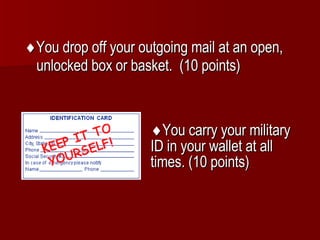
 You drop off your outgoing mail at an open, unlocked box or basket.  (10 points)  You carry your military ID in your wallet at all times. (10 points)
 You do not shred or tear banking and credit information when you throw it in the trash. (10 points)  You provide your Social Security number (SSN) whenever asked.  (10 points) Add (5 points) if you provide it orally without checking to see who might be listening.
 You are required to use your SSN as an employee ID or at college as a student ID number. (5 points)  Your SSN is printed on an employee badge you wear at work. (10 points)
 Your SSN or Driver’s License Number is printed on  your personal checks.  (10 points)  You are listed in a “Who’s Who” Guide.  (5 points)
 You carry your insurance card in your wallet and it contains your SSN or your spouse’s SSN.  (10 points)  You have not ordered a copy of your credit report for at least two years.  (20 points)
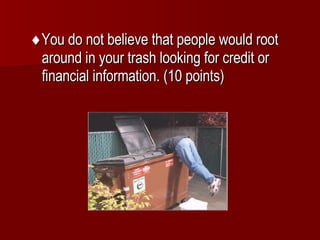
 You do not believe that people would root around in your trash looking for credit or financial information. (10 points)
What your score means: 100+ points:  You are at  high  risk.  You should purchase a paper shredder, become more security aware in document handling. 50-100 points:  Your odds of being victimized are about  average ; higher if you have good credit. 0-50 points:  Congratulations.  You have a high security “IQ”.  Keep up the good work!
How the Thief Works… By stealing wallets & purses containing your information & credit & bank cards. Stealing your mail. Looking through your trash & retrieving discarded bills or credit applications (dumpster diving). Completing a “change of address” form, and having your mail forwarded to them.
Thieves also… Say they work for a bank or credit reporting agency when they ask for your SSN over the phone. Pose as landlords, lawyers, or other officials who have authority to access your information. Use personal information you share on the internet.
How they use your information: They use your information to establish a new ID and pretend to be you. They open utility (phone, cell phone) accounts in your name. They open bank accounts and write bad checks. They file bankruptcy under your name to avoid eviction or payment of any new debt occurred.
They counterfeit checks or debit cards, and drain your bank account. They buy cars by taking out auto loans in your name. They give your name to  police  during an arrest.  If they don’t show up for their court date, an arrest warrant is issued in your name.
Guard Personal Info ATM Card Bank Account Info Bills Calling Card Checks Credit & Debit Cards Credit Report Name & Address Passwords Personnel Records Pre-approved credit card offers
Social Security Number Be  VERY  cautious about giving out your SSN.  If someone asks for it, ask why it is needed, what will happen if you don’t give it, etc. Do  NOT  carry your SS Card in your wallet.  Store it in a safe place, and take it out only when you know that you will need it, such as when starting a new job. Do  NOT   have your SS # printed on your checks or drivers’ license.  (For that matter, don’t print your DL number on your checks either.)
Minimize your Risk Carry ONLY the ID and credit/debit card that you need.  Don’t carry your SS card. Give your SSN only when absolutely necessary. Try to memorize passwords; don’t keep them in your wallet. Don’t use obvious codes for PIN numbers. (Birthday, last 4 digits of SS or phone #) Don’t give out personal info over the phone.
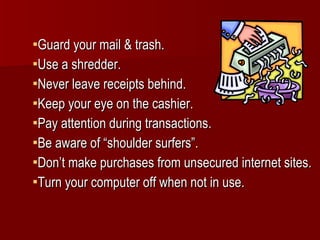
Guard your mail & trash. Use a shredder. Never leave receipts behind. Keep your eye on the cashier. Pay attention during transactions. Be aware of “shoulder surfers”. Don’t make purchases from unsecured internet sites. Turn your computer off when not in use.
What if I become a victim?
File a police report & contact the Federal Trade commission. Contact the 3 major credit bureaus and have a fraud alert placed on your account. Contact creditors where fraudulent accounts were opened, or where fraudulent charges were made. Take action!!!!!
Why file a police report? To get a criminal investigation started. Provide some assurance to your creditors that this is a real crime, not to avoid payment. Creditors often require a copy of the police report for challenged accounts and charges.
Why contact the FTC?  Information is entered into the Consumer Sentinel database, and may assist law enforcement in other jurisdictions on related matters. FTC has great information for ID Theft victims on what to do to clear up their credit reports & challenge fraudulent accounts & charges and what legal protections victims may have.
Contact the credit bureaus… Equifax 1-800-525-6285 Experian 1-888-397-3742 TransUnion 1-800-680-7289
Federal Trade Commission’s ID Theft Hotline 1-877-438-4338 US Postal Inspection Service 1-800-275-8777 Social Security Administration 1-800-772-1213
It’s the law… Identity Theft & Assumption Deterrence Act of 1998 (Federal law enacted by Congress making identity theft a crime) Conviction for ID theft carries a maximum penalty of 15 yrs imprisonment, a fine and forfeiture of any personal property used or intended to be used to commit the crime Alabama Code  §13A-8-190 through 201
FACT Act Effective in Alabama 6/1/05 Allows consumers one free credit report each year from each agency Requires creditors who lent money in your name to an ID Thief help you clear your name Creates one place where you can have a fraud alert placed on your credit history that will be honored across America
What can you do to avoid becoming a victim of  identity theft?
Secure Your Mail Pick up your mail daily. Have mail held at the Post office if you are going out of town. Shred pre-approved credit card offers before throwing them away. Put outgoing mail in a secure receptacle. Cut down on unsolicited offers by calling 1-888-567-8688.
Keep Financial Info Private Carry only the credit cards you need. Be aware of people around you when using cards and/or checks. Limit the information printed on your checks. Store blank checks in a secure place. Pick up new checks at the bank. Be particular about giving out account numbers or other financial info to people.
Know who you’re talking to… Be very careful about giving personal info over the phone. Beware of giving your personal info to a person or company that contacts you. Ask the caller to give you a number you can call to verify his identity. Ask the caller to send you the info in writing. To reduce the number of sales calls you receive, register on the National Do Not Call list by calling 1-888-382-1222 or  www.donotcall.gov .
Use the Internet carefully… Use only secure websites. Always use a credit card when shopping online so you will have the protection of the Fair Credit Billing Act. To avoid a victim of “phishing”, be suspicious of any emails you did not solicit which urgently request your info.  (Companies you deal with already have that info.)
What are some common types of identity theft? Phishing Skimming Parents/Kids Ex-spouses Inside jobs Sweepstakes scams Housekeepers Purse Snatching
For more information, contact: Isaac B. Chappell, Jr. Regional Extension Agent 1702 Noble Street, Suite 108 Anniston, AL  36201 Phone:  (256) 237-1621 www.aces.edu [email_address]

Identity Theft Test

  • 1.
    “ WHEN BADTHINGS HAPPEN TO YOUR GOOD NAME”
  • 2.
    What is IdentityTheft? Someone uses your name or personal information to Open credit card accounts or use existing accounts Take out a loan Make a major purchase Access bank accounts File fraudulent tax returns Or even commit a crime!
  • 3.
    Types of IDTheft 8% Government Benefits Fraud 5% Loan Fraud 13% Employment-related fraud 18% Bank Fraud 19% Phone or Utilities Fraud 28% Credit Card Fraud
  • 4.
    More Statistics Manyvictims don’t even know. The average time to find out you’ve been victimized is 15 months ! Unfortunately, many identity theft related crimes go unreported. California ranks #1 for ID theft crimes, Texas is 2nd, followed by New York and Florida.
  • 5.
    Alabama the BeautifulIn Alabama - 2,216 ID Theft complaints in 2004 #1 - Credit Card fraud #2 – Phone/Utilities fraud #3 – Bank fraud Top cities Birmingham Mobile Montgomery
  • 6.
    Are you at risk? Test your “Identity Quotient”: Take the test & see what your score means.
  • 7.
     You receiveoffers of pre-approved credit every week (5 points) and, if you decide not to accept, you do not shred them before putting them in the trash. (5 points)  You carry your Social Security Card in your wallet. (10 points)
  • 8.
     Your Driver’sLicense has your SSN printed on it and you have not contacted the DMV to request a new license. (10 points)  You do not have a PO Box or a locked, secured mailbox. (5 points)
  • 9.
     You dropoff your outgoing mail at an open, unlocked box or basket. (10 points)  You carry your military ID in your wallet at all times. (10 points)
  • 10.
     You donot shred or tear banking and credit information when you throw it in the trash. (10 points)  You provide your Social Security number (SSN) whenever asked. (10 points) Add (5 points) if you provide it orally without checking to see who might be listening.
  • 11.
     You arerequired to use your SSN as an employee ID or at college as a student ID number. (5 points)  Your SSN is printed on an employee badge you wear at work. (10 points)
  • 12.
     Your SSNor Driver’s License Number is printed on your personal checks. (10 points)  You are listed in a “Who’s Who” Guide. (5 points)
  • 13.
     You carryyour insurance card in your wallet and it contains your SSN or your spouse’s SSN. (10 points)  You have not ordered a copy of your credit report for at least two years. (20 points)
  • 14.
     You donot believe that people would root around in your trash looking for credit or financial information. (10 points)
  • 15.
    What your scoremeans: 100+ points: You are at high risk. You should purchase a paper shredder, become more security aware in document handling. 50-100 points: Your odds of being victimized are about average ; higher if you have good credit. 0-50 points: Congratulations. You have a high security “IQ”. Keep up the good work!
  • 16.
    How the ThiefWorks… By stealing wallets & purses containing your information & credit & bank cards. Stealing your mail. Looking through your trash & retrieving discarded bills or credit applications (dumpster diving). Completing a “change of address” form, and having your mail forwarded to them.
  • 17.
    Thieves also… Saythey work for a bank or credit reporting agency when they ask for your SSN over the phone. Pose as landlords, lawyers, or other officials who have authority to access your information. Use personal information you share on the internet.
  • 18.
    How they useyour information: They use your information to establish a new ID and pretend to be you. They open utility (phone, cell phone) accounts in your name. They open bank accounts and write bad checks. They file bankruptcy under your name to avoid eviction or payment of any new debt occurred.
  • 19.
    They counterfeit checksor debit cards, and drain your bank account. They buy cars by taking out auto loans in your name. They give your name to police during an arrest. If they don’t show up for their court date, an arrest warrant is issued in your name.
  • 20.
    Guard Personal InfoATM Card Bank Account Info Bills Calling Card Checks Credit & Debit Cards Credit Report Name & Address Passwords Personnel Records Pre-approved credit card offers
  • 21.
    Social Security NumberBe VERY cautious about giving out your SSN. If someone asks for it, ask why it is needed, what will happen if you don’t give it, etc. Do NOT carry your SS Card in your wallet. Store it in a safe place, and take it out only when you know that you will need it, such as when starting a new job. Do NOT have your SS # printed on your checks or drivers’ license. (For that matter, don’t print your DL number on your checks either.)
  • 22.
    Minimize your RiskCarry ONLY the ID and credit/debit card that you need. Don’t carry your SS card. Give your SSN only when absolutely necessary. Try to memorize passwords; don’t keep them in your wallet. Don’t use obvious codes for PIN numbers. (Birthday, last 4 digits of SS or phone #) Don’t give out personal info over the phone.
  • 23.
    Guard your mail& trash. Use a shredder. Never leave receipts behind. Keep your eye on the cashier. Pay attention during transactions. Be aware of “shoulder surfers”. Don’t make purchases from unsecured internet sites. Turn your computer off when not in use.
  • 24.
    What if Ibecome a victim?
  • 25.
    File a policereport & contact the Federal Trade commission. Contact the 3 major credit bureaus and have a fraud alert placed on your account. Contact creditors where fraudulent accounts were opened, or where fraudulent charges were made. Take action!!!!!
  • 26.
    Why file apolice report? To get a criminal investigation started. Provide some assurance to your creditors that this is a real crime, not to avoid payment. Creditors often require a copy of the police report for challenged accounts and charges.
  • 27.
    Why contact theFTC? Information is entered into the Consumer Sentinel database, and may assist law enforcement in other jurisdictions on related matters. FTC has great information for ID Theft victims on what to do to clear up their credit reports & challenge fraudulent accounts & charges and what legal protections victims may have.
  • 28.
    Contact the creditbureaus… Equifax 1-800-525-6285 Experian 1-888-397-3742 TransUnion 1-800-680-7289
  • 29.
    Federal Trade Commission’sID Theft Hotline 1-877-438-4338 US Postal Inspection Service 1-800-275-8777 Social Security Administration 1-800-772-1213
  • 30.
    It’s the law…Identity Theft & Assumption Deterrence Act of 1998 (Federal law enacted by Congress making identity theft a crime) Conviction for ID theft carries a maximum penalty of 15 yrs imprisonment, a fine and forfeiture of any personal property used or intended to be used to commit the crime Alabama Code §13A-8-190 through 201
  • 31.
    FACT Act Effectivein Alabama 6/1/05 Allows consumers one free credit report each year from each agency Requires creditors who lent money in your name to an ID Thief help you clear your name Creates one place where you can have a fraud alert placed on your credit history that will be honored across America
  • 32.
    What can youdo to avoid becoming a victim of identity theft?
  • 33.
    Secure Your MailPick up your mail daily. Have mail held at the Post office if you are going out of town. Shred pre-approved credit card offers before throwing them away. Put outgoing mail in a secure receptacle. Cut down on unsolicited offers by calling 1-888-567-8688.
  • 34.
    Keep Financial InfoPrivate Carry only the credit cards you need. Be aware of people around you when using cards and/or checks. Limit the information printed on your checks. Store blank checks in a secure place. Pick up new checks at the bank. Be particular about giving out account numbers or other financial info to people.
  • 35.
    Know who you’retalking to… Be very careful about giving personal info over the phone. Beware of giving your personal info to a person or company that contacts you. Ask the caller to give you a number you can call to verify his identity. Ask the caller to send you the info in writing. To reduce the number of sales calls you receive, register on the National Do Not Call list by calling 1-888-382-1222 or www.donotcall.gov .
  • 36.
    Use the Internetcarefully… Use only secure websites. Always use a credit card when shopping online so you will have the protection of the Fair Credit Billing Act. To avoid a victim of “phishing”, be suspicious of any emails you did not solicit which urgently request your info. (Companies you deal with already have that info.)
  • 37.
    What are somecommon types of identity theft? Phishing Skimming Parents/Kids Ex-spouses Inside jobs Sweepstakes scams Housekeepers Purse Snatching
  • 38.
    For more information,contact: Isaac B. Chappell, Jr. Regional Extension Agent 1702 Noble Street, Suite 108 Anniston, AL 36201 Phone: (256) 237-1621 www.aces.edu [email_address]