Consumer Fraud Just Say No! Presenter: Barbara J. Stark
What is consumer fraud? fraud  is an intentional  deception  made for personal gain or to damage another individual Fraud is a  crime , and also a  civil law  violation. Fraud can be committed through many media, including  mail ,  wire ,  phone , and the  Internet  ( computer crime  and  Internet fraud )
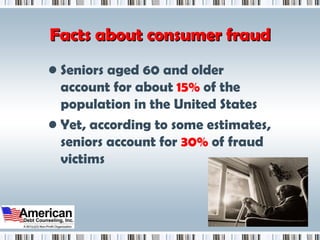
Facts about consumer fraud Seniors aged 60 and older account for about  15%  of the population in the United States Yet, according to some estimates, seniors account for  30%  of fraud victims
Objectives By the end of this presentation you will be able to:  Recognize senior scams  Protect yourself from fraud Know steps to take if you become a victim Know where to learn more
Why are seniors targeted? Generally, seniors are more vulnerable and trusting have trouble spotting fraud find it difficult to end unwanted telemarketing calls are often reluctant to seek advice about financial matters
Types of common scams Sweepstakes and lotteries Charities Sucker lists Deed forgeries Identity theft Caretaker crimes Medicare and health fraud Funeral and burial
Sweepstakes and Lottery scams You’re told that you’ve won a sweepstakes or the Canadian lottery You’re asked to pay for processing, taxes or delivery, or provide a bank account number to verify your identity  No one ever receives a penny except for the thieves
Charity scams ‘ Sound-alike’ names can be tricky and deceptive Nonprofit and charitable groups must file IRS Form 990 Check 990s at GuideStar  www.guidestar.org Before you donate, check to see if the charity is legitimate www.charitywatch.org : 773-529-2300 www.nasconet.org  (report charity fraud)
Sucker lists If you often respond to sweepstakes or contests, your name might be added to lists sold to con artists A sucker list contains the names of people who have been, or are good candidates to be, victims of fraud  People on the lists may hear from crooks who claim they can help recover, for a fee, money lost to a con artist
Deed forgeries Scam artists forge the homeowner’s signature on transfer deeds so that they can illegally acquire ownership of the property Never sign blank contracts or other documents—they could be filled in later by scam artists who want to steal your property
Identity theft ID theft criminals use your personal information to apply for credit or government benefits Your name Your birth date  Your Social Security number Your address Your bank account or credit card numbers
Caretaker crimes Be alert for caregivers who try to isolate you from your friends and family who ask about your will and investments who ask to be given power of attorney who try to dominate or influence you Tell family members or call adult protective services
Medicare fraud It  is illegal for companies offering Medicare drug plans to charge you a fee, or to offer you cash or free food to get you to enroll in a plan. If you are interested in the benefits available to you as a Medicare beneficiary, visit the federal government’s Medicare web site  (www.medicare.gov)  or call  800-MEDICARE (800-633-4227).
Health fraud Signs of health fraud include: Promoters of cures who claim that the medical establishment is keeping information away from consumers Testimonials from people who supposedly have been cured “ Secret formulas” that no one else has The use of infomercials—programs that look like news, but are just lengthy ads paid for by the promoter
Funeral and Burial scams It makes sense to plan your funeral and burial in advance.  Do your homework before paying for funeral/burial services in advance.  Draw up your plans with a reputable funeral business and save a copy for your survivors.  If you want cover the cost of your funeral, you can include funds to do so in your will.
Warning signs of fraud Be suspicious if you hear: You’ve won a prize or free gift You’ve been selected to receive a special offer You must act immediately or lose out You must pay for shipping your prize or free gift Give us your credit card number and expiration date to verify that you are a credit cardholder
More warning signs of fraud You’re asked for personal information You’re asked to donate to an agency whose name sounds like a well known charity You’re one of only a chosen few to receive this offer A courier will come to your home to get your payment
The Grandparents Scam Grandma! Hi, how are you?” “ Hi, Billy.  How are you?” “ Actually, I’m in some trouble, and don’t want Mom and Dad to know . . .”
The Grandparents Scam  (cont’d) How can you avoid this type of scam? Verify the caller’s identity (personal questions) to make sure he’s family! Resist the pressure to act immediately.  Call the local police on a non-emergency line. Do not wire money or send money via an overnight courier. Report the fraud to the FTC.
Protect yourself…Just say “no”! Don’t  be pressured to make immediate decisions Don’t  give your financial account information or Social Security number over the telephone Don’t  buy something merely because it comes with a “free” gift Don’t  fall for statements that you have won a prize, especially if you must send money to claim it Don’t  send cash by messenger or overnight mail
Protect your property and assets Financial exploitation is often committed by a person that is trusted by the victim Keep all important financial documents under lock and key in your home Store valuables in a bank safe deposit box
If you become a victim… Call the police You may need a police report to help you prove that you were a victim Contact your state and local law enforcement agencies such as your district attorney’s office or the state attorney general
Elder Abuse Prevention Directory of Elder Abuse Prevention Resources The National Center on Elder Abuse www.ncea.aoa.gov Click on “Find State Resources” Call 800-677-1116  The federal agency that advocates for older persons www.aoa.gov
Thank you! For more information contact: American Debt Counseling, Inc. A 501(c )(3)non-profit Credit Counseling Organization 14051 NW 14 th  Street Sunrise, FL 33323 www.americandebtcounseling.org 1-888-DEBT USA

Consumer fraud - Just Say No!

  • 1.
    Consumer Fraud JustSay No! Presenter: Barbara J. Stark
  • 2.
    What is consumerfraud? fraud is an intentional deception made for personal gain or to damage another individual Fraud is a crime , and also a civil law violation. Fraud can be committed through many media, including mail , wire , phone , and the Internet ( computer crime and Internet fraud )
  • 3.
    Facts about consumerfraud Seniors aged 60 and older account for about 15% of the population in the United States Yet, according to some estimates, seniors account for 30% of fraud victims
  • 4.
    Objectives By theend of this presentation you will be able to: Recognize senior scams Protect yourself from fraud Know steps to take if you become a victim Know where to learn more
  • 5.
    Why are seniorstargeted? Generally, seniors are more vulnerable and trusting have trouble spotting fraud find it difficult to end unwanted telemarketing calls are often reluctant to seek advice about financial matters
  • 6.
    Types of commonscams Sweepstakes and lotteries Charities Sucker lists Deed forgeries Identity theft Caretaker crimes Medicare and health fraud Funeral and burial
  • 7.
    Sweepstakes and Lotteryscams You’re told that you’ve won a sweepstakes or the Canadian lottery You’re asked to pay for processing, taxes or delivery, or provide a bank account number to verify your identity No one ever receives a penny except for the thieves
  • 8.
    Charity scams ‘Sound-alike’ names can be tricky and deceptive Nonprofit and charitable groups must file IRS Form 990 Check 990s at GuideStar www.guidestar.org Before you donate, check to see if the charity is legitimate www.charitywatch.org : 773-529-2300 www.nasconet.org (report charity fraud)
  • 9.
    Sucker lists Ifyou often respond to sweepstakes or contests, your name might be added to lists sold to con artists A sucker list contains the names of people who have been, or are good candidates to be, victims of fraud People on the lists may hear from crooks who claim they can help recover, for a fee, money lost to a con artist
  • 10.
    Deed forgeries Scamartists forge the homeowner’s signature on transfer deeds so that they can illegally acquire ownership of the property Never sign blank contracts or other documents—they could be filled in later by scam artists who want to steal your property
  • 11.
    Identity theft IDtheft criminals use your personal information to apply for credit or government benefits Your name Your birth date Your Social Security number Your address Your bank account or credit card numbers
  • 12.
    Caretaker crimes Bealert for caregivers who try to isolate you from your friends and family who ask about your will and investments who ask to be given power of attorney who try to dominate or influence you Tell family members or call adult protective services
  • 13.
    Medicare fraud It is illegal for companies offering Medicare drug plans to charge you a fee, or to offer you cash or free food to get you to enroll in a plan. If you are interested in the benefits available to you as a Medicare beneficiary, visit the federal government’s Medicare web site (www.medicare.gov) or call 800-MEDICARE (800-633-4227).
  • 14.
    Health fraud Signsof health fraud include: Promoters of cures who claim that the medical establishment is keeping information away from consumers Testimonials from people who supposedly have been cured “ Secret formulas” that no one else has The use of infomercials—programs that look like news, but are just lengthy ads paid for by the promoter
  • 15.
    Funeral and Burialscams It makes sense to plan your funeral and burial in advance. Do your homework before paying for funeral/burial services in advance. Draw up your plans with a reputable funeral business and save a copy for your survivors. If you want cover the cost of your funeral, you can include funds to do so in your will.
  • 16.
    Warning signs offraud Be suspicious if you hear: You’ve won a prize or free gift You’ve been selected to receive a special offer You must act immediately or lose out You must pay for shipping your prize or free gift Give us your credit card number and expiration date to verify that you are a credit cardholder
  • 17.
    More warning signsof fraud You’re asked for personal information You’re asked to donate to an agency whose name sounds like a well known charity You’re one of only a chosen few to receive this offer A courier will come to your home to get your payment
  • 18.
    The Grandparents ScamGrandma! Hi, how are you?” “ Hi, Billy. How are you?” “ Actually, I’m in some trouble, and don’t want Mom and Dad to know . . .”
  • 19.
    The Grandparents Scam (cont’d) How can you avoid this type of scam? Verify the caller’s identity (personal questions) to make sure he’s family! Resist the pressure to act immediately. Call the local police on a non-emergency line. Do not wire money or send money via an overnight courier. Report the fraud to the FTC.
  • 20.
    Protect yourself…Just say“no”! Don’t be pressured to make immediate decisions Don’t give your financial account information or Social Security number over the telephone Don’t buy something merely because it comes with a “free” gift Don’t fall for statements that you have won a prize, especially if you must send money to claim it Don’t send cash by messenger or overnight mail
  • 21.
    Protect your propertyand assets Financial exploitation is often committed by a person that is trusted by the victim Keep all important financial documents under lock and key in your home Store valuables in a bank safe deposit box
  • 22.
    If you becomea victim… Call the police You may need a police report to help you prove that you were a victim Contact your state and local law enforcement agencies such as your district attorney’s office or the state attorney general
  • 23.
    Elder Abuse PreventionDirectory of Elder Abuse Prevention Resources The National Center on Elder Abuse www.ncea.aoa.gov Click on “Find State Resources” Call 800-677-1116 The federal agency that advocates for older persons www.aoa.gov
  • 24.
    Thank you! Formore information contact: American Debt Counseling, Inc. A 501(c )(3)non-profit Credit Counseling Organization 14051 NW 14 th Street Sunrise, FL 33323 www.americandebtcounseling.org 1-888-DEBT USA