Franchising
•A contractual agreement between a franchisor and a retail franchisee
that allows the franchisee to conduct business under an established
name and according to a given pattern of business
•Franchisee pays an initial fee and a monthly percentage of gross sales
in exchange for the exclusive rights to sell goods and services in an
area
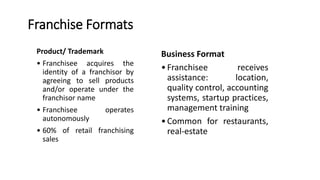
Franchise Formats
Product/ Trademark
• Franchisee acquires the
identity of a franchisor by
agreeing to sell products
and/or operate under the
franchisor name
• Franchisee operates
autonomously
• 60% of retail franchising
sales
Business Format
•Franchisee receives
assistance: location,
quality control, accounting
systems, startup practices,
management training
•Common for restaurants,
real-estate
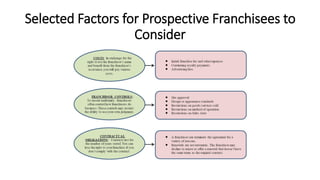
Selected Factors for Prospective Franchisees to
Consider
Franchise Disclosure Document Contents (1 of 3)
• The Franchisor and Any Predecessors
• Litigation History
• Bankruptcy (i.e., any franchisees who may have filed)
• Listing of the Initial Franchise Fee and Other Initial Payments
• Other Fees and Expenses
• Statement of Franchisee's Initial Investment
• Obligations of Franchisee to Purchase or Lease from Designated Sources
• Obligations of Franchisee to Purchase or Lease in Accordance with
Specifications or from Authorized Suppliers
Franchise Disclosure Document Contents (2 of 3)
• Financing Arrangements
• Obligations of the Franchisor; Other Supervision, Assistance or Services
• Exclusive/Designated Area of Territory
• Trademarks, Service Marks, Trade Names, Logotypes and Commercial
Symbols
• Patents and Copyrights
• Obligations of the Franchisee to Participate in the Actual Operation of
the Franchise Business
• Restrictions on Goods and Services Offered by Franchisee
Franchise Disclosure Document Contents (3 of 3)
• Renewal, Termination, Repurchase, Modification and Assignment of the
Franchise Agreement and Related Information
• Arrangements with Public Figures
• Actual, Average, Projected or Forecasted Franchise Sales, Profits or Earnings
• Information Regarding Franchises of the Franchisor
• Financial Statements
• Contracts
• Acknowledgment of Receipt by Respective Franchisee
Pros and Cons of Dunkin’ Donuts Franchise
•Pros:
• No company owned stores
• Outside suppliers can be approved
• No markup on approved signs
• Average sales in Metro NY $914,992– 41.4 percent at or above average
• 19 day initial training program
Pros and Cons of Dunkin’ Donuts Franchise (1 of 2)
• Cons
• No exclusive territory, can license other retailers to sell donuts, seek to
convert other donut shops to Dunkin’ Donuts, can sell donuts in
supermarkets, convenience stores, airports, universities
• Referral incentives to existing franchises, franchise brokers
• Pages 12-34 litigation history. In one case DD settled with payment of
$780,000 to plaintiff; in another repurchased franchise for $1.1 million
• Continuing franchise fees 5.9 percent of sales, continuing advertising fee 5.0
percent of sales, loan guarantee fee 1 percent of loan amount + net, net, net
lease
Pros and Cons of Dunkin’ Donuts Franchise (2 of 2)
•Cons
• Board member sells eggs
• DD has right to approve advertising
• DD can appoint additional members to Brand Advisory Council, can
dissolve council, council is only advisory
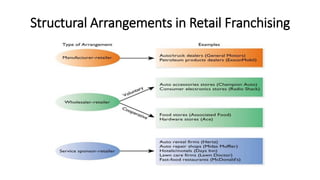
Structural Arrangements in Retail Franchising
Wholesaler-Retailer Structural Franchising
Arrangements
• Voluntary: A wholesaler sets up a franchise system and
grants franchises to individual retailers
• Cooperative: A group of retailers sets up a franchise system
and shares the ownership and operations of a wholesaling
organization
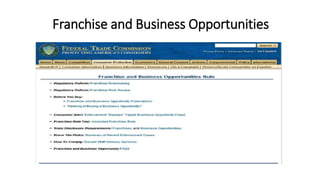
Franchise and Business Opportunities
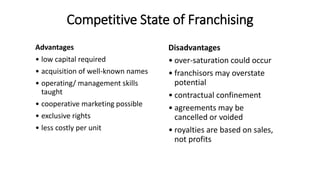
Competitive State of Franchising
Advantages
• low capital required
• acquisition of well-known names
• operating/ management skills
taught
• cooperative marketing possible
• exclusive rights
• less costly per unit
Disadvantages
• over-saturation could occur
• franchisors may overstate
potential
• contractual confinement
• agreements may be
cancelled or voided
• royalties are based on sales,
not profits
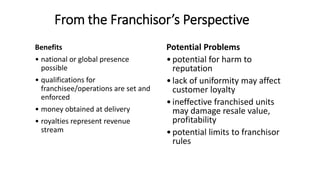
From the Franchisor’s Perspective
Benefits
• national or global presence
possible
• qualifications for
franchisee/operations are set and
enforced
• money obtained at delivery
• royalties represent revenue
stream
Potential Problems
•potential for harm to
reputation
•lack of uniformity may affect
customer loyalty
•ineffective franchised units
may damage resale value,
profitability
•potential limits to franchisor
rules
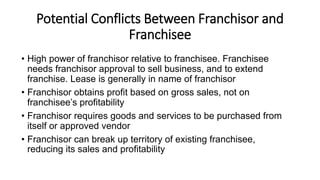
Potential Conflicts Between Franchisor and
Franchisee
• High power of franchisor relative to franchisee. Franchisee
needs franchisor approval to sell business, and to extend
franchise. Lease is generally in name of franchisor
• Franchisor obtains profit based on gross sales, not on
franchisee’s profitability
• Franchisor requires goods and services to be purchased from
itself or approved vendor
• Franchisor can break up territory of existing franchisee,
reducing its sales and profitability
Thank You

Franchising .pdf

  • 1.
    Franchising •A contractual agreementbetween a franchisor and a retail franchisee that allows the franchisee to conduct business under an established name and according to a given pattern of business •Franchisee pays an initial fee and a monthly percentage of gross sales in exchange for the exclusive rights to sell goods and services in an area
  • 2.
    Franchise Formats Product/ Trademark •Franchisee acquires the identity of a franchisor by agreeing to sell products and/or operate under the franchisor name • Franchisee operates autonomously • 60% of retail franchising sales Business Format •Franchisee receives assistance: location, quality control, accounting systems, startup practices, management training •Common for restaurants, real-estate
  • 3.
    Selected Factors forProspective Franchisees to Consider
  • 4.
    Franchise Disclosure DocumentContents (1 of 3) • The Franchisor and Any Predecessors • Litigation History • Bankruptcy (i.e., any franchisees who may have filed) • Listing of the Initial Franchise Fee and Other Initial Payments • Other Fees and Expenses • Statement of Franchisee's Initial Investment • Obligations of Franchisee to Purchase or Lease from Designated Sources • Obligations of Franchisee to Purchase or Lease in Accordance with Specifications or from Authorized Suppliers
  • 5.
    Franchise Disclosure DocumentContents (2 of 3) • Financing Arrangements • Obligations of the Franchisor; Other Supervision, Assistance or Services • Exclusive/Designated Area of Territory • Trademarks, Service Marks, Trade Names, Logotypes and Commercial Symbols • Patents and Copyrights • Obligations of the Franchisee to Participate in the Actual Operation of the Franchise Business • Restrictions on Goods and Services Offered by Franchisee
  • 6.
    Franchise Disclosure DocumentContents (3 of 3) • Renewal, Termination, Repurchase, Modification and Assignment of the Franchise Agreement and Related Information • Arrangements with Public Figures • Actual, Average, Projected or Forecasted Franchise Sales, Profits or Earnings • Information Regarding Franchises of the Franchisor • Financial Statements • Contracts • Acknowledgment of Receipt by Respective Franchisee
  • 7.
    Pros and Consof Dunkin’ Donuts Franchise •Pros: • No company owned stores • Outside suppliers can be approved • No markup on approved signs • Average sales in Metro NY $914,992– 41.4 percent at or above average • 19 day initial training program
  • 8.
    Pros and Consof Dunkin’ Donuts Franchise (1 of 2) • Cons • No exclusive territory, can license other retailers to sell donuts, seek to convert other donut shops to Dunkin’ Donuts, can sell donuts in supermarkets, convenience stores, airports, universities • Referral incentives to existing franchises, franchise brokers • Pages 12-34 litigation history. In one case DD settled with payment of $780,000 to plaintiff; in another repurchased franchise for $1.1 million • Continuing franchise fees 5.9 percent of sales, continuing advertising fee 5.0 percent of sales, loan guarantee fee 1 percent of loan amount + net, net, net lease
  • 9.
    Pros and Consof Dunkin’ Donuts Franchise (2 of 2) •Cons • Board member sells eggs • DD has right to approve advertising • DD can appoint additional members to Brand Advisory Council, can dissolve council, council is only advisory
  • 10.
    Structural Arrangements inRetail Franchising
  • 11.
    Wholesaler-Retailer Structural Franchising Arrangements •Voluntary: A wholesaler sets up a franchise system and grants franchises to individual retailers • Cooperative: A group of retailers sets up a franchise system and shares the ownership and operations of a wholesaling organization
  • 12.
  • 13.
    Competitive State ofFranchising Advantages • low capital required • acquisition of well-known names • operating/ management skills taught • cooperative marketing possible • exclusive rights • less costly per unit Disadvantages • over-saturation could occur • franchisors may overstate potential • contractual confinement • agreements may be cancelled or voided • royalties are based on sales, not profits
  • 14.
    From the Franchisor’sPerspective Benefits • national or global presence possible • qualifications for franchisee/operations are set and enforced • money obtained at delivery • royalties represent revenue stream Potential Problems •potential for harm to reputation •lack of uniformity may affect customer loyalty •ineffective franchised units may damage resale value, profitability •potential limits to franchisor rules
  • 15.
    Potential Conflicts BetweenFranchisor and Franchisee • High power of franchisor relative to franchisee. Franchisee needs franchisor approval to sell business, and to extend franchise. Lease is generally in name of franchisor • Franchisor obtains profit based on gross sales, not on franchisee’s profitability • Franchisor requires goods and services to be purchased from itself or approved vendor • Franchisor can break up territory of existing franchisee, reducing its sales and profitability
  • 16.