FRAMEWORK FOR INDUSTRY’S
NET-ZERO TRANSITION
1
26 October 2022
Joseph Cordonnier
Industry Programme Analyst
Hakimul Batih
Local co-ordinator
Deger Saygin
Industry Programme Lead
Developing financing solutions in emerging and developing
economies
• Introduce the OECD “Framework for industry’s net-zero
transition”
• Identify and discuss the key challenges for the decarbonisation
of the steel sector in Indonesia
• Discuss potential Focus Areas for the Framework implementation
2
Objectives of the Kick-Off Meeting
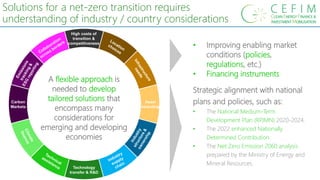
Solutions for a net-zero transition requires
understanding of industry / country considerations
Technology
transfer & R&D
Carbon
Markets
Asset
stranding
High costs of
transition &
competitiveness
A flexible approach is
needed to develop
tailored solutions that
encompass many
considerations for
emerging and developing
economies
• Improving enabling market
conditions (policies,
regulations, etc.)
• Financing instruments
Strategic alignment with national
plans and policies, such as:
• The National Medium-Term
Development Plan (RPJMN) 2020-2024.
• The 2022 enhanced Nationally
Determined Contribution.
• The Net Zero Emission 2060 analysis
prepared by the Ministry of Energy and
Mineral Resources.
Min. of Industry
Min. of Finance
Min. of Energy
Min. of Environment
Min. of Planning
Other government
Financial regulator
Textile
…
MSMEs
Clusters
Iron / steel
…
Heavy
industry
Supply
chains
R&D
Tech.
transfer
Assets
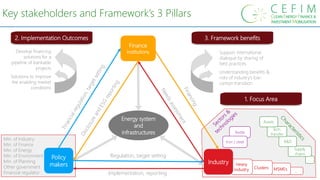
Key stakeholders and Framework’s 3 Pillars
Develop financing
solutions for a
pipeline of bankable
projects
Solutions to improve
the enabling market
conditions
Support international
dialogue by sharing of
best practices
Understanding benefits &
risks of industry’s low-
carbon transition
2. Implementation Outcomes 3. Framework benefits
1. Focus Area
Finance
institutions
Policy
makers
Energy system
and
infrastructures
Regulation, target setting
Implementation, reporting
Industry
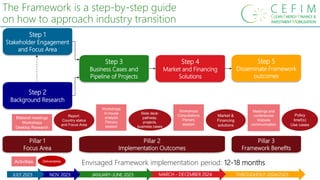
The Framework is a step-by-step guide
on how to approach industry transition
Deliverables
Activities
Step 1
Stakeholder Engagement
and Focus Area
Step 2
Background Research
Step 3
Business Cases and
Pipeline of Projects
Step 4
Market and Financing
Solutions
Step 5
Disseminate Framework
outcomes
Pillar 1
Focus Area
Pillar 2
Implementation Outcomes
Pillar 3
Framework Benefits
Report:
Country status
and Focus Area
Slide deck:
pathway,
projects,
business cases
Market &
Financing
solutions
Policy
brief(s)
Use cases
Bilateral meetings
Workshops
Desktop Research
Workshops
In-house
analysis
Plenary
session
Workshops
Consultations
Plenary
session
Meetings and
conferences
Website
communication
Envisaged Framework implementation period: 12-18 months
JULY 2023 NOV. 2023 JANUARY-JUNE 2023 MARCH - DECEMBER 2024 THROUGHOUT 2024/2025
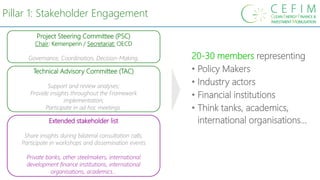
20-30 members representing
• Policy Makers
• Industry actors
• Financial institutions
• Think tanks, academics,
international organisations…
Pillar 1: Stakeholder Engagement
Project Steering Committee (PSC)
Chair: Kemenperin / Secretariat: OECD
Governance, Coordination, Decision-Making.
Technical Advisory Committee (TAC)
Support and review analyses;
Provide insights throughout the Framework
implementation;
Participate in ad hoc meetings.
Extended stakeholder list
Share insights during bilateral consultation calls;
Participate in workshops and dissemination events
Private banks, other steelmakers, international
development finance institutions, international
organisations, academics…
7
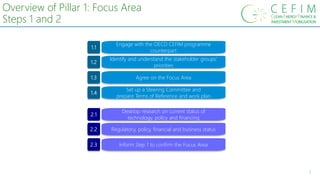
Overview of Pillar 1: Focus Area
Steps 1 and 2
Engage with the OECD CEFIM programme
counterpart
Identify and understand the stakeholder groups’
priorities
Agree on the Focus Area
1.1
1.2
1.3
Set up a Steering Committee and
prepare Terms of Reference and work plan
1.4
2.3
2.2
2.1
Desktop research on current status of
technology, policy and financing
Regulatory, policy, financial and business status
Inform Step 1 to confirm the Focus Area
8
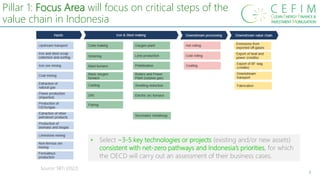
Pillar 1: Focus Area will focus on critical steps of the
value chain in Indonesia
Source: SBTi (2022)
> Select ~3-5 key technologies or projects (existing and/or new assets)
consistent with net-zero pathways and Indonesia’s priorities, for which
the OECD will carry out an assessment of their business cases.
9
Overview of Pillar 2: Implementation Outcomes
Step 3: Business Cases and Pipeline of Projects
Evaluate business cases and identify
a pipeline of projects and financing needs
Assess investment needs
Choose a net zero pathway for the Focus Area
Choose a Current Policies scenario as a reference
3.1
3.2
3.3 3.4
Technology solutions
to close the transition gap:
• Energy efficiency
• Direct use of renewables
• Switching to low-carbon fuels
and feedstocks
• Circular economy
• CCUS
Investment needs for the technology
solutions
Based on quantification of technology
solutions (how many tons of low-carbon
fuels, % of recycling, ...)
2020 2050
2030 2040
Emissions of
Focus Area
[Mt CO2/yr]
Current policies
scenario
Net-zero
transition pathway
Choice of scenario/pathway
based on existing analyses for the
Focus area
Business Cases and pipeline of
projects
Based on a subset of technology
solutions consistent with the net-
zero transition pathway
Selection of relevant technologies
and projects:
• Technical parameters
• Economic parameters (CAPEX,
market prices, …)
• Selection of indicators and
metrics (Internal Rate of Return,
public money spend…)
10
Overview of Pillar 2: Implementation Outcomes
Step 4: Market and financing solutions
4.1
4.3
4.4
4.5
Agree on a monitoring and evaluation
mechanism
Identify financing gaps in the available financing
instruments
Match low-carbon projects and financing
solutions
Establish the financing and market barriers
Develop market enabling solutions
4.2 Develop financing solutions
Analysis of gaps and barriers
Based on extended desktop research and
work with stakeholders, supported by
output of business cases in Step 3
Internal Rate of Return
[ % ]
Low-carbon Conventional
Development of solutions
Based on policy toolboxes and
workshops with stakeholder groups;
covering the capital and the operation
and maintenance costs
Internal Rate of Return
[ % ]
Low-carbon Conventional
Matching of solutions with projects
Based on quantitative KPIs (required
financing, CO2 improvement, ...)
Definition of country-level mechanisms
for monitoring and evaluation
Policy maker Industry
Finance institutions
11
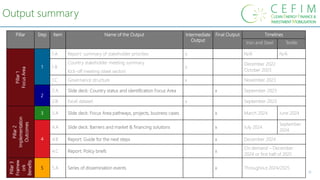
Output summary
Pillar Step Item Name of the Output Intermediate
Output
Final Output Timelines
Iron and Steel Textile
Pillar
1
Focus
Area
1
1.A Report: summary of stakeholder priorities x N/A N/A
1.B
Country stakeholder meeting summary
Kick-off meeting (steel sector)
x
December 2022
October 2023
1.C Governance structure x November 2023
2
2.A Slide deck: Country status and identification Focus Area x September 2023
2.B Excel dataset x September 2023
Pillar
2
Implementation
Outcomes
3 3.A Slide deck: Focus Area pathways, projects, business cases x March 2024 June 2024
4
4.A Slide deck: Barriers and market & financing solutions x July 2024
September
2024
4.B Report: Guide for the next steps x December 2024
4.C Report: Policy briefs x
On demand – December
2024 or first half of 2025
Pillar
3
Framew
ork
Benefits
5 5.A Series of dissemination events x Throughout 2024/2025
SESSION 1: KEY CHALLENGES
FOR THE DECARBONISATION
OF THE STEEL SECTOR IN
INDONESIA
12
6 November 2023
13
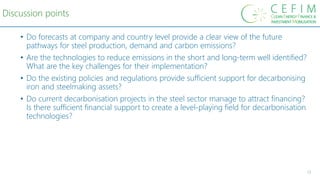
Discussion points
• Do forecasts at company and country level provide a clear view of the future
pathways for steel production, demand and carbon emissions?
• Are the technologies to reduce emissions in the short and long-term well identified?
What are the key challenges for their implementation?
• Do the existing policies and regulations provide sufficient support for decarbonising
iron and steelmaking assets?
• Do current decarbonisation projects in the steel sector manage to attract financing?
Is there sufficient financial support to create a level-playing field for decarbonisation
technologies?
SESSION 2: DISCUSSION ON
THE FOCUS AREA FOR THE
FRAMEWORK
14
6 November 2023
15
Discussion points
• Which processes should the Framework focus on: Blast Furnaces, Direct Reduction
Plants, Electric Arc Furnaces, rolling mills? Could it also address other parts of the
value chain, such as mining processes or sourcing of scrap and alternative
fuels/reductants?
• Should the Framework address both the improvement of existing assets and the
development of new capacities?
• Which projects and low-carbon technologies currently struggle the most to reach
economic viability and/or attract investment?
• Are there examples of decarbonisation projects that could benefit from the outputs
that will be developed in the Framework?
16
Please visit our webpage:
www.oecd.org/cefim/
For more information, please contact:
Joseph Cordonnier
Joseph.CORDONNIER@oecd.org
Hakimul Batih
hakimul.BATIH@oecd.org
Deger Saygin
Deger.SAYGIN@oecd.org
FRAMEWORK FOR INDUSTRY’S
NET-ZERO TRANSITION
17
26 October 2022
Deger Saygin
Industry Programme Lead
Joseph Cordonnier
Industry Programme Analyst
Developing financing solutions in emerging and developing
economies
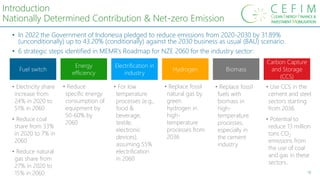
• In 2022 the Government of Indonesia pledged to reduce emissions from 2020-2030 by 31.89%
(unconditionally) up to 43.20% (conditionally) against the 2030 business as usual (BAU) scenario.
• 6 strategic steps identified in MEMR's Roadmap for NZE 2060 for the industry sector:
18
Introduction
Nationally Determined Contribution & Net-zero Emission
Fuel switch
Energy
efficiency
Electrification in
industry
Hydrogen Biomass
Carbon Capture
and Storage
(CCS)
• Electricity share
increase from
24% in 2020 to
51% in 2060
• Reduce coal
share from 33%
in 2020 to 7% in
2060
• Reduce natural
gas share from
27% in 2020 to
15% in 2060
• Reduce
specific energy
consumption of
equipment by
50-60% by
2060
• For low
temperature
processes (e.g.,
food &
beverage,
textile,
electronic
devices),
assuming 55%
electrification
in 2060
• Replace fossil
natural gas by
green
hydrogen in
high-
temperature
processes from
2036
• Replace fossil
fuels with
biomass in
high-
temperature
processes,
especially in
the cement
industry
• Use CCS in the
cement and steel
sectors starting
from 2036
• Potential to
reduce 13 million
tons CO2
emissions from
the use of coal
and gas in these
sectors..
19
Introduction
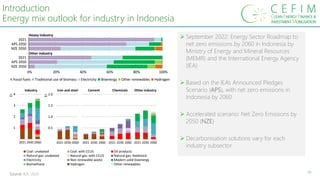
Energy mix outlook for industry in Indonesia
➢ September 2022: Energy Sector Roadmap to
net zero emissions by 2060 in Indonesia by
Ministry of Energy and Mineral Resources
(MEMR) and the International Energy Agency
(IEA)
➢ Based on the IEA’s Announced Pledges
Scenario (APS), with net zero emissions in
Indonesia by 2060
➢ Accelerated scenario: Net Zero Emissions by
2050 (NZE)
➢ Decarbonisation solutions vary for each
industry subsector
Source: IEA, 2022
Breakdown by industry sub-sectors [%] (2016)
20
Contribution to Gross Domestic Product
Manufacturing industry: 20% of Indonesia’s GDP in 2020
Food and beverages,
32.8%
Tobacco products , 5.2%
Textile and apparel,
6.4%
Paper and paper
products, 4.0%
Chemical and pharmacy,
9.9%
Rubber and plastics, 3.5%
Non-metallic
mineral, 3.9%
Basic metal, 4.0%
Fabricated
metal, 10.7%
Transport equipment,
10.5%
Furniture, 1.4%
Wood products, 3.6%
Machinery and
equipment, 1.8%
Source: UNDP, 2018
21
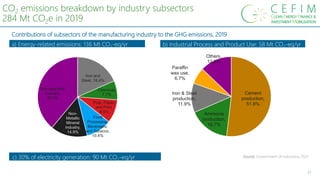
CO2 emissions breakdown by industry subsectors
284 Mt CO2e in 2019
Contributions of subsectors of the manufacturing industry to the GHG emissions, 2019
b) Industrial Process and Product Use: 58 Mt CO2-eq/yr
Source: Government of Indonesia, 2021
Iron and
Steel, 18.4%
Chemical,
7.7%
Pulp, Paper,
and Print,
9.5%
Food
Processing,
Beverages,
and Tobacco,
10.4%
Non-
Metallic
Mineral
Industry,
14.9%
Non-specified
Industry,
39.0%
Cement
production,
51.8%
Ammonia
production,
16.7%
Iron & Steel
production,
11.9%
Paraffin
wax use,
6.7%
Others,
12.9%
a) Energy-related emissions: 136 Mt CO2-eq/yr
c) 30% of electricity generation: 90 Mt CO2-eq/yr
e
22
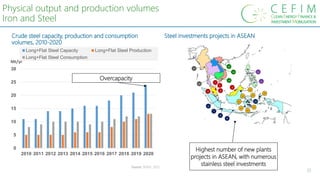
Physical output and production volumes
Iron and Steel
Source: SEAISI, 2022
Crude steel capacity, production and consumption
volumes, 2010-2020
0
5
10
15
20
25
30
2010 2011 2012 2013 2014 2015 2016 2017 2018 2019 2020
Mt/yr
Long+Flat Steel Capacity Long+Flat Steel Production
Long+Flat Steel Consumption
Steel investments projects in ASEAN
Overcapacity
Highest number of new plants
projects in ASEAN, with numerous
stainless steel investments
23
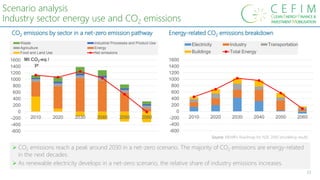
Scenario analysis
Industry sector energy use and CO2 emissions
➢ CO2 emissions reach a peak around 2030 in a net-zero scenario. The majority of CO2 emissions are energy-related
in the next decades.
➢ As renewable electricity develops in a net-zero scenario, the relative share of industry emissions increases.
CO2 emissions by sector in a net-zero emission pathway
Source: MEMR's Roadmap for NZE 2060 (modeling result)
-600
-400
-200
0
200
400
600
800
1000
1200
1400
1600
2010 2020 2030 2040 2050 2060
Electricity Industry Transportation
Buildings Total Energy
Energy-related CO2 emissions breakdown
-600
-400
-200
0
200
400
600
800
1000
1200
1400
1600
2010 2020 2030 2040 2050 2060
Mt CO2-eq /
yr
Waste Industrial Processes and Product Use
Agriculture Energy
Food and Land Use Net emissions
Iron and
steel
Chemical
and
petrochemi
cal
Non-ferrous
metals
Non-
metallic
minerals
Food and
tobacco
Paper, pulp
and printing
Textile and
leather
-5
0
24
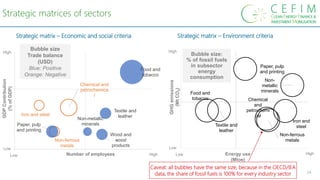
Strategic matrices of sectors
Strategic matrix – Economic and social criteria
Bubble size:
% of fossil fuels
in subsector
energy
consumption
Iron and steel
Chemical and
petrochemica
l
Non-ferrous
metals
Non-metallic
minerals
Food and
tobacco
Paper, pulp
and printing
Wood and
wood
products
Textile and
leather
2
20
30000 600000
Strategic matrix – Environment criteria
GDP
Contribution
(%
of
GDP)
Number of employees High
Low
Low
High
Bubble size
Trade balance
(USD)
Blue: Positive
Orange: Negative
High
Low
Low
High
Energy use
(Mtoe)
GHG
emissions
(Mt
CO
2
)
Caveat: all bubbles have the same size, because in the OECD/IEA
data, the share of fossil fuels is 100% for every industry sector

Framework for Industry's net-zero transition

  • 1.
    FRAMEWORK FOR INDUSTRY’S NET-ZEROTRANSITION 1 26 October 2022 Joseph Cordonnier Industry Programme Analyst Hakimul Batih Local co-ordinator Deger Saygin Industry Programme Lead Developing financing solutions in emerging and developing economies
  • 2.
    • Introduce theOECD “Framework for industry’s net-zero transition” • Identify and discuss the key challenges for the decarbonisation of the steel sector in Indonesia • Discuss potential Focus Areas for the Framework implementation 2 Objectives of the Kick-Off Meeting
  • 3.
    Solutions for anet-zero transition requires understanding of industry / country considerations Technology transfer & R&D Carbon Markets Asset stranding High costs of transition & competitiveness A flexible approach is needed to develop tailored solutions that encompass many considerations for emerging and developing economies • Improving enabling market conditions (policies, regulations, etc.) • Financing instruments Strategic alignment with national plans and policies, such as: • The National Medium-Term Development Plan (RPJMN) 2020-2024. • The 2022 enhanced Nationally Determined Contribution. • The Net Zero Emission 2060 analysis prepared by the Ministry of Energy and Mineral Resources.
  • 4.
    Min. of Industry Min.of Finance Min. of Energy Min. of Environment Min. of Planning Other government Financial regulator Textile … MSMEs Clusters Iron / steel … Heavy industry Supply chains R&D Tech. transfer Assets Key stakeholders and Framework’s 3 Pillars Develop financing solutions for a pipeline of bankable projects Solutions to improve the enabling market conditions Support international dialogue by sharing of best practices Understanding benefits & risks of industry’s low- carbon transition 2. Implementation Outcomes 3. Framework benefits 1. Focus Area Finance institutions Policy makers Energy system and infrastructures Regulation, target setting Implementation, reporting Industry
  • 5.
    The Framework isa step-by-step guide on how to approach industry transition Deliverables Activities Step 1 Stakeholder Engagement and Focus Area Step 2 Background Research Step 3 Business Cases and Pipeline of Projects Step 4 Market and Financing Solutions Step 5 Disseminate Framework outcomes Pillar 1 Focus Area Pillar 2 Implementation Outcomes Pillar 3 Framework Benefits Report: Country status and Focus Area Slide deck: pathway, projects, business cases Market & Financing solutions Policy brief(s) Use cases Bilateral meetings Workshops Desktop Research Workshops In-house analysis Plenary session Workshops Consultations Plenary session Meetings and conferences Website communication Envisaged Framework implementation period: 12-18 months JULY 2023 NOV. 2023 JANUARY-JUNE 2023 MARCH - DECEMBER 2024 THROUGHOUT 2024/2025
  • 6.
    20-30 members representing •Policy Makers • Industry actors • Financial institutions • Think tanks, academics, international organisations… Pillar 1: Stakeholder Engagement Project Steering Committee (PSC) Chair: Kemenperin / Secretariat: OECD Governance, Coordination, Decision-Making. Technical Advisory Committee (TAC) Support and review analyses; Provide insights throughout the Framework implementation; Participate in ad hoc meetings. Extended stakeholder list Share insights during bilateral consultation calls; Participate in workshops and dissemination events Private banks, other steelmakers, international development finance institutions, international organisations, academics…
  • 7.
    7 Overview of Pillar1: Focus Area Steps 1 and 2 Engage with the OECD CEFIM programme counterpart Identify and understand the stakeholder groups’ priorities Agree on the Focus Area 1.1 1.2 1.3 Set up a Steering Committee and prepare Terms of Reference and work plan 1.4 2.3 2.2 2.1 Desktop research on current status of technology, policy and financing Regulatory, policy, financial and business status Inform Step 1 to confirm the Focus Area
  • 8.
    8 Pillar 1: FocusArea will focus on critical steps of the value chain in Indonesia Source: SBTi (2022) > Select ~3-5 key technologies or projects (existing and/or new assets) consistent with net-zero pathways and Indonesia’s priorities, for which the OECD will carry out an assessment of their business cases.
  • 9.
    9 Overview of Pillar2: Implementation Outcomes Step 3: Business Cases and Pipeline of Projects Evaluate business cases and identify a pipeline of projects and financing needs Assess investment needs Choose a net zero pathway for the Focus Area Choose a Current Policies scenario as a reference 3.1 3.2 3.3 3.4 Technology solutions to close the transition gap: • Energy efficiency • Direct use of renewables • Switching to low-carbon fuels and feedstocks • Circular economy • CCUS Investment needs for the technology solutions Based on quantification of technology solutions (how many tons of low-carbon fuels, % of recycling, ...) 2020 2050 2030 2040 Emissions of Focus Area [Mt CO2/yr] Current policies scenario Net-zero transition pathway Choice of scenario/pathway based on existing analyses for the Focus area Business Cases and pipeline of projects Based on a subset of technology solutions consistent with the net- zero transition pathway Selection of relevant technologies and projects: • Technical parameters • Economic parameters (CAPEX, market prices, …) • Selection of indicators and metrics (Internal Rate of Return, public money spend…)
  • 10.
    10 Overview of Pillar2: Implementation Outcomes Step 4: Market and financing solutions 4.1 4.3 4.4 4.5 Agree on a monitoring and evaluation mechanism Identify financing gaps in the available financing instruments Match low-carbon projects and financing solutions Establish the financing and market barriers Develop market enabling solutions 4.2 Develop financing solutions Analysis of gaps and barriers Based on extended desktop research and work with stakeholders, supported by output of business cases in Step 3 Internal Rate of Return [ % ] Low-carbon Conventional Development of solutions Based on policy toolboxes and workshops with stakeholder groups; covering the capital and the operation and maintenance costs Internal Rate of Return [ % ] Low-carbon Conventional Matching of solutions with projects Based on quantitative KPIs (required financing, CO2 improvement, ...) Definition of country-level mechanisms for monitoring and evaluation Policy maker Industry Finance institutions
  • 11.
    11 Output summary Pillar StepItem Name of the Output Intermediate Output Final Output Timelines Iron and Steel Textile Pillar 1 Focus Area 1 1.A Report: summary of stakeholder priorities x N/A N/A 1.B Country stakeholder meeting summary Kick-off meeting (steel sector) x December 2022 October 2023 1.C Governance structure x November 2023 2 2.A Slide deck: Country status and identification Focus Area x September 2023 2.B Excel dataset x September 2023 Pillar 2 Implementation Outcomes 3 3.A Slide deck: Focus Area pathways, projects, business cases x March 2024 June 2024 4 4.A Slide deck: Barriers and market & financing solutions x July 2024 September 2024 4.B Report: Guide for the next steps x December 2024 4.C Report: Policy briefs x On demand – December 2024 or first half of 2025 Pillar 3 Framew ork Benefits 5 5.A Series of dissemination events x Throughout 2024/2025
  • 12.
    SESSION 1: KEYCHALLENGES FOR THE DECARBONISATION OF THE STEEL SECTOR IN INDONESIA 12 6 November 2023
  • 13.
    13 Discussion points • Doforecasts at company and country level provide a clear view of the future pathways for steel production, demand and carbon emissions? • Are the technologies to reduce emissions in the short and long-term well identified? What are the key challenges for their implementation? • Do the existing policies and regulations provide sufficient support for decarbonising iron and steelmaking assets? • Do current decarbonisation projects in the steel sector manage to attract financing? Is there sufficient financial support to create a level-playing field for decarbonisation technologies?
  • 14.
    SESSION 2: DISCUSSIONON THE FOCUS AREA FOR THE FRAMEWORK 14 6 November 2023
  • 15.
    15 Discussion points • Whichprocesses should the Framework focus on: Blast Furnaces, Direct Reduction Plants, Electric Arc Furnaces, rolling mills? Could it also address other parts of the value chain, such as mining processes or sourcing of scrap and alternative fuels/reductants? • Should the Framework address both the improvement of existing assets and the development of new capacities? • Which projects and low-carbon technologies currently struggle the most to reach economic viability and/or attract investment? • Are there examples of decarbonisation projects that could benefit from the outputs that will be developed in the Framework?
  • 16.
    16 Please visit ourwebpage: www.oecd.org/cefim/ For more information, please contact: Joseph Cordonnier Joseph.CORDONNIER@oecd.org Hakimul Batih hakimul.BATIH@oecd.org Deger Saygin Deger.SAYGIN@oecd.org
  • 17.
    FRAMEWORK FOR INDUSTRY’S NET-ZEROTRANSITION 17 26 October 2022 Deger Saygin Industry Programme Lead Joseph Cordonnier Industry Programme Analyst Developing financing solutions in emerging and developing economies
  • 18.
    • In 2022the Government of Indonesia pledged to reduce emissions from 2020-2030 by 31.89% (unconditionally) up to 43.20% (conditionally) against the 2030 business as usual (BAU) scenario. • 6 strategic steps identified in MEMR's Roadmap for NZE 2060 for the industry sector: 18 Introduction Nationally Determined Contribution & Net-zero Emission Fuel switch Energy efficiency Electrification in industry Hydrogen Biomass Carbon Capture and Storage (CCS) • Electricity share increase from 24% in 2020 to 51% in 2060 • Reduce coal share from 33% in 2020 to 7% in 2060 • Reduce natural gas share from 27% in 2020 to 15% in 2060 • Reduce specific energy consumption of equipment by 50-60% by 2060 • For low temperature processes (e.g., food & beverage, textile, electronic devices), assuming 55% electrification in 2060 • Replace fossil natural gas by green hydrogen in high- temperature processes from 2036 • Replace fossil fuels with biomass in high- temperature processes, especially in the cement industry • Use CCS in the cement and steel sectors starting from 2036 • Potential to reduce 13 million tons CO2 emissions from the use of coal and gas in these sectors..
  • 19.
    19 Introduction Energy mix outlookfor industry in Indonesia ➢ September 2022: Energy Sector Roadmap to net zero emissions by 2060 in Indonesia by Ministry of Energy and Mineral Resources (MEMR) and the International Energy Agency (IEA) ➢ Based on the IEA’s Announced Pledges Scenario (APS), with net zero emissions in Indonesia by 2060 ➢ Accelerated scenario: Net Zero Emissions by 2050 (NZE) ➢ Decarbonisation solutions vary for each industry subsector Source: IEA, 2022
  • 20.
    Breakdown by industrysub-sectors [%] (2016) 20 Contribution to Gross Domestic Product Manufacturing industry: 20% of Indonesia’s GDP in 2020 Food and beverages, 32.8% Tobacco products , 5.2% Textile and apparel, 6.4% Paper and paper products, 4.0% Chemical and pharmacy, 9.9% Rubber and plastics, 3.5% Non-metallic mineral, 3.9% Basic metal, 4.0% Fabricated metal, 10.7% Transport equipment, 10.5% Furniture, 1.4% Wood products, 3.6% Machinery and equipment, 1.8% Source: UNDP, 2018
  • 21.
    21 CO2 emissions breakdownby industry subsectors 284 Mt CO2e in 2019 Contributions of subsectors of the manufacturing industry to the GHG emissions, 2019 b) Industrial Process and Product Use: 58 Mt CO2-eq/yr Source: Government of Indonesia, 2021 Iron and Steel, 18.4% Chemical, 7.7% Pulp, Paper, and Print, 9.5% Food Processing, Beverages, and Tobacco, 10.4% Non- Metallic Mineral Industry, 14.9% Non-specified Industry, 39.0% Cement production, 51.8% Ammonia production, 16.7% Iron & Steel production, 11.9% Paraffin wax use, 6.7% Others, 12.9% a) Energy-related emissions: 136 Mt CO2-eq/yr c) 30% of electricity generation: 90 Mt CO2-eq/yr e
  • 22.
    22 Physical output andproduction volumes Iron and Steel Source: SEAISI, 2022 Crude steel capacity, production and consumption volumes, 2010-2020 0 5 10 15 20 25 30 2010 2011 2012 2013 2014 2015 2016 2017 2018 2019 2020 Mt/yr Long+Flat Steel Capacity Long+Flat Steel Production Long+Flat Steel Consumption Steel investments projects in ASEAN Overcapacity Highest number of new plants projects in ASEAN, with numerous stainless steel investments
  • 23.
    23 Scenario analysis Industry sectorenergy use and CO2 emissions ➢ CO2 emissions reach a peak around 2030 in a net-zero scenario. The majority of CO2 emissions are energy-related in the next decades. ➢ As renewable electricity develops in a net-zero scenario, the relative share of industry emissions increases. CO2 emissions by sector in a net-zero emission pathway Source: MEMR's Roadmap for NZE 2060 (modeling result) -600 -400 -200 0 200 400 600 800 1000 1200 1400 1600 2010 2020 2030 2040 2050 2060 Electricity Industry Transportation Buildings Total Energy Energy-related CO2 emissions breakdown -600 -400 -200 0 200 400 600 800 1000 1200 1400 1600 2010 2020 2030 2040 2050 2060 Mt CO2-eq / yr Waste Industrial Processes and Product Use Agriculture Energy Food and Land Use Net emissions
  • 24.
    Iron and steel Chemical and petrochemi cal Non-ferrous metals Non- metallic minerals Food and tobacco Paper,pulp and printing Textile and leather -5 0 24 Strategic matrices of sectors Strategic matrix – Economic and social criteria Bubble size: % of fossil fuels in subsector energy consumption Iron and steel Chemical and petrochemica l Non-ferrous metals Non-metallic minerals Food and tobacco Paper, pulp and printing Wood and wood products Textile and leather 2 20 30000 600000 Strategic matrix – Environment criteria GDP Contribution (% of GDP) Number of employees High Low Low High Bubble size Trade balance (USD) Blue: Positive Orange: Negative High Low Low High Energy use (Mtoe) GHG emissions (Mt CO 2 ) Caveat: all bubbles have the same size, because in the OECD/IEA data, the share of fossil fuels is 100% for every industry sector