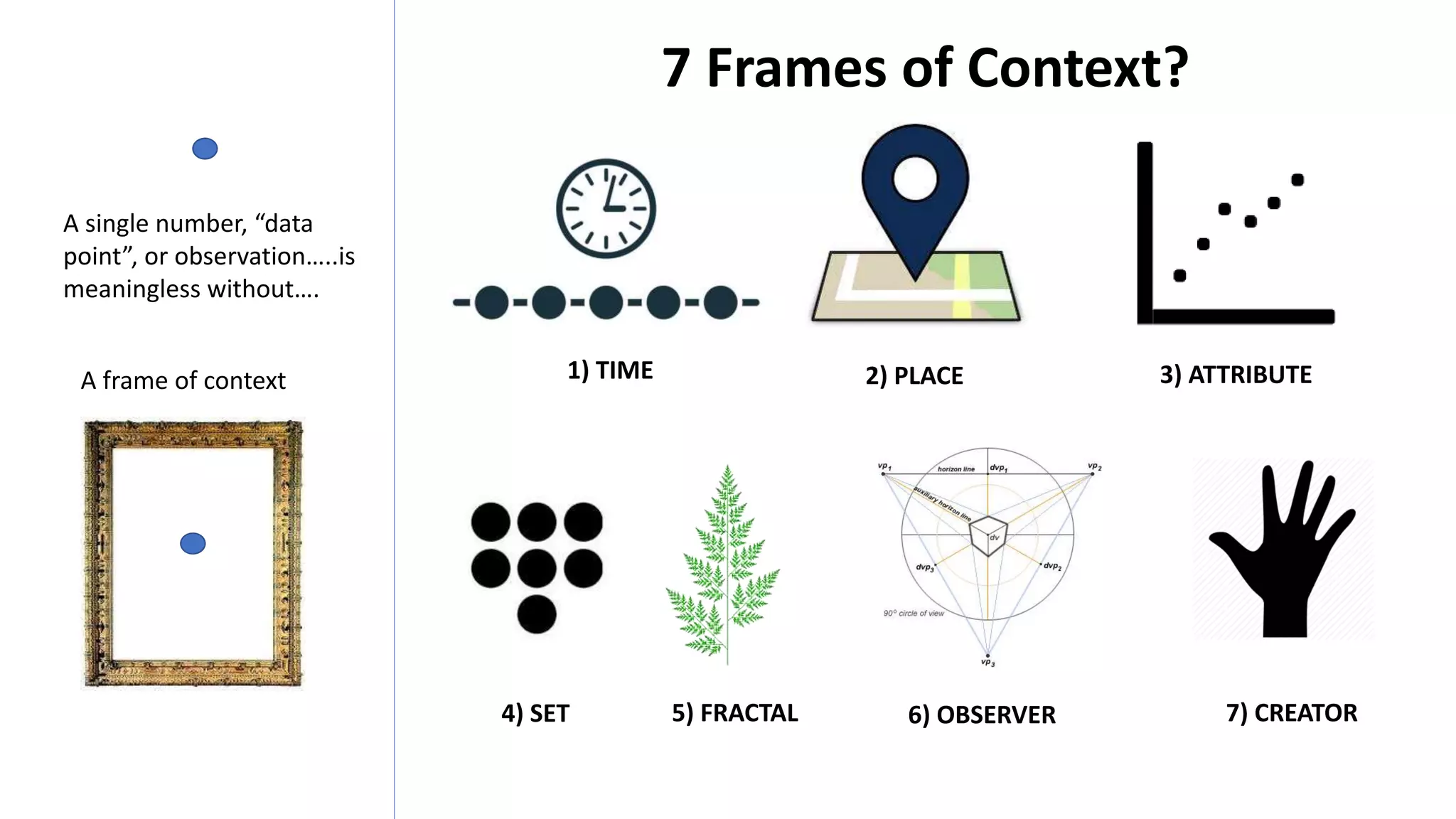
A single number, “data
point”, or observation…..is
meaningless without….
A frame of context
7 Frames of Context?
1) TIME 2) PLACE 3) ATTRIBUTE
4) SET 7) CREATOR5) FRACTAL 6) OBSERVER
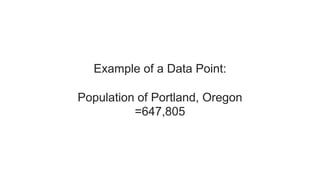
Example of a Data Point:
Population of Portland, Oregon
=647,805
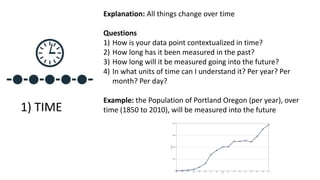
1) TIME
Explanation: All things change over time
Questions
1) How is your data point contextualized in time?
2) How long has it been measured in the past?
3) How long will it be measured going into the future?
4) In what units of time can I understand it? Per year? Per
month? Per day?
Example: the Population of Portland Oregon (per year), over
time (1850 to 2010), will be measured into the future
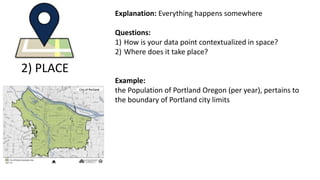
Explanation: Everything happens somewhere
Questions:
1) How is your data point contextualized in space?
2) Where does it take place?
Example:
the Population of Portland Oregon (per year), pertains to
the boundary of Portland city limits
2) PLACE
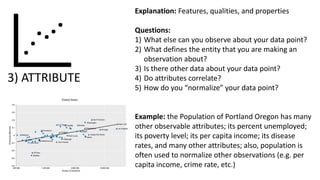
Explanation: Features, qualities, and properties
Questions:
1) What else can you observe about your data point?
2) What defines the entity that you are making an
observation about?
3) Is there other data about your data point?
4) Do attributes correlate?
5) How do you “normalize” your data point?
Example: the Population of Portland Oregon has many
other observable attributes; its percent unemployed;
its poverty level; its per capita income; its disease
rates, and many other attributes; also, population is
often used to normalize other observations (e.g. per
capita income, crime rate, etc.)
3) ATTRIBUTE
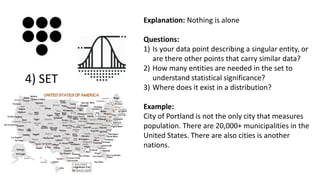
Explanation: Nothing is alone
Questions:
1) Is your data point describing a singular entity, or
are there other points that carry similar data?
2) How many entities are needed in the set to
understand statistical significance?
3) Where does it exist in a distribution?
Example:
City of Portland is not the only city that measures
population. There are 20,000+ municipalities in the
United States. There are also cities is another
nations.
4) SET
5) FRACTAL
Explanation: Everything fits in with other things
Questions:
1) How does this observation aggregate and
disaggregate? Attribute? Space? Time? Source?
2) How do entities in the set add up to or
disaggregate to 100% for ratio calculations on
various scales?
3) What is the resolution of your data?
Example:
the Population of Portland Oregon aggregates up
into population counts for the Metropolitan
Statistical Area, State of Oregon, USA, and Earth; it
disaggregates down to zipcodes, city quarters,
census tract, census block group, household, etc..
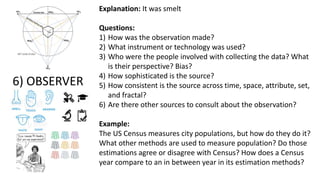
Explanation: It was smelt
Questions:
1) How was the observation made?
2) What instrument or technology was used?
3) Who were the people involved with collecting the data? What
is their perspective? Bias?
4) How sophisticated is the source?
5) How consistent is the source across time, space, attribute, set,
and fractal?
6) Are there other sources to consult about the observation?
Example:
The US Census measures city populations, but how do they do it?
What other methods are used to measure population? Do those
estimations agree or disagree with Census? How does a Census
year compare to an in between year in its estimation methods?
6) OBSERVER
Explanation: It was dealt
Questions:
1) Who or what is responsible for creating or changing the
observation?
2) For us, what role does the City Government play in
shaping the observation, really?
3) What can change the datapoint?
Example:
The population of Portland is influenced by the economy,
the environment, the culture, and the City of Portland’s
management of public resources
7) CREATOR

Frames of Context for Data

  • 1.
    A single number,“data point”, or observation…..is meaningless without…. A frame of context 7 Frames of Context? 1) TIME 2) PLACE 3) ATTRIBUTE 4) SET 7) CREATOR5) FRACTAL 6) OBSERVER
  • 2.
    Example of aData Point: Population of Portland, Oregon =647,805
  • 3.
    1) TIME Explanation: Allthings change over time Questions 1) How is your data point contextualized in time? 2) How long has it been measured in the past? 3) How long will it be measured going into the future? 4) In what units of time can I understand it? Per year? Per month? Per day? Example: the Population of Portland Oregon (per year), over time (1850 to 2010), will be measured into the future
  • 4.
    Explanation: Everything happenssomewhere Questions: 1) How is your data point contextualized in space? 2) Where does it take place? Example: the Population of Portland Oregon (per year), pertains to the boundary of Portland city limits 2) PLACE
  • 5.
    Explanation: Features, qualities,and properties Questions: 1) What else can you observe about your data point? 2) What defines the entity that you are making an observation about? 3) Is there other data about your data point? 4) Do attributes correlate? 5) How do you “normalize” your data point? Example: the Population of Portland Oregon has many other observable attributes; its percent unemployed; its poverty level; its per capita income; its disease rates, and many other attributes; also, population is often used to normalize other observations (e.g. per capita income, crime rate, etc.) 3) ATTRIBUTE
  • 6.
    Explanation: Nothing isalone Questions: 1) Is your data point describing a singular entity, or are there other points that carry similar data? 2) How many entities are needed in the set to understand statistical significance? 3) Where does it exist in a distribution? Example: City of Portland is not the only city that measures population. There are 20,000+ municipalities in the United States. There are also cities is another nations. 4) SET
  • 7.
    5) FRACTAL Explanation: Everythingfits in with other things Questions: 1) How does this observation aggregate and disaggregate? Attribute? Space? Time? Source? 2) How do entities in the set add up to or disaggregate to 100% for ratio calculations on various scales? 3) What is the resolution of your data? Example: the Population of Portland Oregon aggregates up into population counts for the Metropolitan Statistical Area, State of Oregon, USA, and Earth; it disaggregates down to zipcodes, city quarters, census tract, census block group, household, etc..
  • 8.
    Explanation: It wassmelt Questions: 1) How was the observation made? 2) What instrument or technology was used? 3) Who were the people involved with collecting the data? What is their perspective? Bias? 4) How sophisticated is the source? 5) How consistent is the source across time, space, attribute, set, and fractal? 6) Are there other sources to consult about the observation? Example: The US Census measures city populations, but how do they do it? What other methods are used to measure population? Do those estimations agree or disagree with Census? How does a Census year compare to an in between year in its estimation methods? 6) OBSERVER
  • 9.
    Explanation: It wasdealt Questions: 1) Who or what is responsible for creating or changing the observation? 2) For us, what role does the City Government play in shaping the observation, really? 3) What can change the datapoint? Example: The population of Portland is influenced by the economy, the environment, the culture, and the City of Portland’s management of public resources 7) CREATOR