Fox or Hedgehog
How Narrow or Broad
Should Your PhD Be?
Joanne van der Woude, University of Groningen
Fox or Hedgehog
How Narrow or Broad
Should Your PhD Be?
Joanne van der Woude, University of Groningen
Fox or Hedgehog
Finding Your Focus
Finding Your Drive
Joanne van der Woude, University of Groningen
Main topics
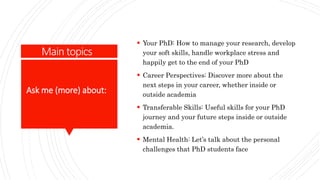
 Your PhD: How to manage your research, develop
your soft skills, handle workplace stress and
happily get to the end of your PhD
 Career Perspectives: Discover more about the
next steps in your career, whether inside or
outside academia
 Transferable Skills: Useful skills for your PhD
journey and your future steps inside or outside
academia.
 Mental Health: Let’s talk about the personal
challenges that PhD students face
Ask me (more) about:
Contents
 History & Theory of Foxes vs. Hedgehogs
 3 Key Career Moments: What to be
When?
 Self Assessment Quiz (F or H)
 Quiz Results vs. Anecdotal Experience
 2 Scenarios for PhD Work
 Concrete plans for acquiring transferable skills
 Career perspectives: when to chase and when to roll up
 (Self): Insight, Acceptance, Change
(Mental Health)
 [extra time: peak fox]
Introductions
https://www.linkedin.com/in/jwoude/
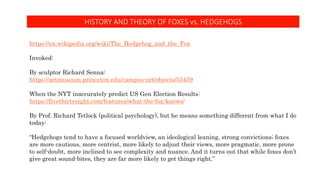
HISTORY AND THEORY OF FOXES vs. HEDGEHOGS
https://en.wikipedia.org/wiki/The_Hedgehog_and_the_Fox
Invoked:
By sculptor Richard Senna:
https://artmuseum.princeton.edu/campus-art/objects/55459
When the NYT inaccurately predict US Gen Election Results:
https://fivethirtyeight.com/features/what-the-fox-knows/
By Prof. Richard Tetlock (political psychology), but he means something different from what I do
today:
“Hedgehogs tend to have a focused worldview, an ideological leaning, strong convictions; foxes
are more cautious, more centrist, more likely to adjust their views, more pragmatic, more prone
to self-doubt, more inclined to see complexity and nuance. And it turns out that while foxes don’t
give great sound-bites, they are far more likely to get things right.”
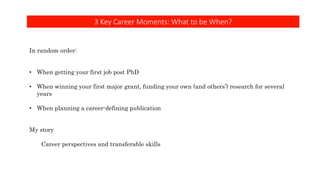
3 Key Career Moments: What to be When?
In random order:
• When getting your first job post PhD
• When winning your first major grant, funding your own (and others’) research for several
years
• When planning a career-defining publication
My story
Career perspectives and transferable skills
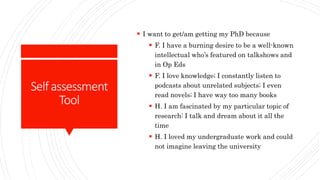
Selfassessment
Tool
 I want to get/am getting my PhD because
 F. I have a burning desire to be a well-known
intellectual who’s featured on talkshows and
in Op Eds
 F. I love knowledge; I constantly listen to
podcasts about unrelated subjects; I even
read novels; I have way too many books
 H. I am fascinated by my particular topic of
research: I talk and dream about it all the
time
 H. I loved my undergraduate work and could
not imagine leaving the university
Selfassessment
Tool
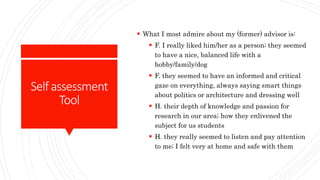
 What I most admire about my (former) advisor is:
 F. I really liked him/her as a person; they seemed
to have a nice, balanced life with a
hobby/family/dog
 F. they seemed to have an informed and critical
gaze on everything, always saying smart things
about politics or architecture and dressing well
 H. their depth of knowledge and passion for
research in our area; how they enlivened the
subject for us students
 H. they really seemed to listen and pay attention
to me; I felt very at home and safe with them
Selfassessment
Tool
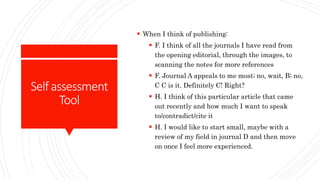
 When I think of publishing:
 F. I think of all the journals I have read from
the opening editorial, through the images, to
scanning the notes for more references
 F. Journal A appeals to me most; no, wait, B; no,
C C is it. Definitely C! Right?
 H. I think of this particular article that came
out recently and how much I want to speak
to/contradict/cite it
 H. I would like to start small, maybe with a
review of my field in journal D and then move
on once I feel more experienced.
Selfassessment
Tool
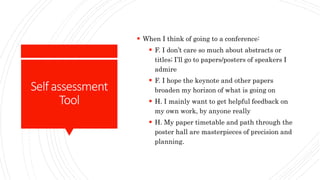
 When I think of going to a conference:
 F. I don’t care so much about abstracts or
titles; I’ll go to papers/posters of speakers I
admire
 F. I hope the keynote and other papers
broaden my horizon of what is going on
 H. I mainly want to get helpful feedback on
my own work, by anyone really
 H. My paper timetable and path through the
poster hall are masterpieces of precision and
planning.
End of the Self Assessment
Do the answers you got out of this test seem representative?
Did anybody get an unexpected answer?
Quiz Results vs. Anecdotal Experience
We all, to a certain extent, have foxes and hedgehogs within us.
The real skill is mediating when to let which one come out.
What have people said about your work so far?
Or, if they haven’t said anything yet, what do you think they would say?
Foxes help us feel joy, curiosity, resourcefulness, even playfulness
Hedgehogs help us think deeply, earnestly, even selflessly
Foxes can be all over the place, unaware of why they’re chasing certain goals, not team players
Hedgehogs can be bored by their narrow scope and don’t take initiative
Often (but not always!), foxes help us find motivation;
whereas hedgehogs help us achieve focus.
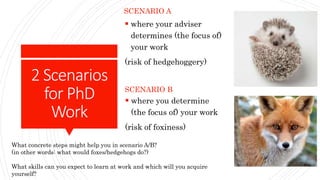
2 Scenarios
for PhD
Work
SCENARIO A
 where your adviser
determines (the focus of)
your work
(risk of hedgehoggery)
SCENARIO B
 where you determine
(the focus of) your work
(risk of foxiness)
What concrete steps might help you in scenario A/B?
(in other words: what would foxes/hedgehogs do?)
What skills can you expect to learn at work and which will you acquire
yourself?
(Self) Insight, Acceptance, Change (Mental Health)
Write down which fox/hedgehog characteristic you most want to acquire
Could you even relate this to or come up with a transferable skill that fits these animals?
How could you practice this particular skill during your PhD?
Going back to the initial characteristic: write down one concrete (measurable) goal that
characteristic will help you attain in the before February 2020
Is there (in addition to all this new self awareness) an activity you could do to achieve
fox/hedgehog balance in your life?
Contents
 History & Theory of Foxes vs. Hedgehogs
 3 Key Career Moments: What to be
When?
 Self Assessment Quiz (F or H)
 Quiz Results vs. Anecdotal Experience
 2 Scenarios for PhD Work
 Concrete plans for acquiring transferable skills
 Career perspectives: when to chase and when to roll up
 (Self): Insight, Acceptance, Change
(Mental Health)
 [extra time: peak fox]
https://www.youtube.com/watch?v=cZvNaGZNLnE&list=PLDMfGNQSwn
hlR2HM04YMyfVIDg28QteHG&index=2&t=9s

Fox or Hedgehog: Finding Your Focus, Finding Your Drive

  • 1.
    Fox or Hedgehog HowNarrow or Broad Should Your PhD Be? Joanne van der Woude, University of Groningen
  • 2.
    Fox or Hedgehog HowNarrow or Broad Should Your PhD Be? Joanne van der Woude, University of Groningen
  • 3.
    Fox or Hedgehog FindingYour Focus Finding Your Drive Joanne van der Woude, University of Groningen
  • 4.
    Main topics  YourPhD: How to manage your research, develop your soft skills, handle workplace stress and happily get to the end of your PhD  Career Perspectives: Discover more about the next steps in your career, whether inside or outside academia  Transferable Skills: Useful skills for your PhD journey and your future steps inside or outside academia.  Mental Health: Let’s talk about the personal challenges that PhD students face Ask me (more) about:
  • 5.
    Contents  History &Theory of Foxes vs. Hedgehogs  3 Key Career Moments: What to be When?  Self Assessment Quiz (F or H)  Quiz Results vs. Anecdotal Experience  2 Scenarios for PhD Work  Concrete plans for acquiring transferable skills  Career perspectives: when to chase and when to roll up  (Self): Insight, Acceptance, Change (Mental Health)  [extra time: peak fox]
  • 6.
  • 7.
    HISTORY AND THEORYOF FOXES vs. HEDGEHOGS https://en.wikipedia.org/wiki/The_Hedgehog_and_the_Fox Invoked: By sculptor Richard Senna: https://artmuseum.princeton.edu/campus-art/objects/55459 When the NYT inaccurately predict US Gen Election Results: https://fivethirtyeight.com/features/what-the-fox-knows/ By Prof. Richard Tetlock (political psychology), but he means something different from what I do today: “Hedgehogs tend to have a focused worldview, an ideological leaning, strong convictions; foxes are more cautious, more centrist, more likely to adjust their views, more pragmatic, more prone to self-doubt, more inclined to see complexity and nuance. And it turns out that while foxes don’t give great sound-bites, they are far more likely to get things right.”
  • 8.
    3 Key CareerMoments: What to be When? In random order: • When getting your first job post PhD • When winning your first major grant, funding your own (and others’) research for several years • When planning a career-defining publication My story Career perspectives and transferable skills
  • 9.
    Selfassessment Tool  I wantto get/am getting my PhD because  F. I have a burning desire to be a well-known intellectual who’s featured on talkshows and in Op Eds  F. I love knowledge; I constantly listen to podcasts about unrelated subjects; I even read novels; I have way too many books  H. I am fascinated by my particular topic of research: I talk and dream about it all the time  H. I loved my undergraduate work and could not imagine leaving the university
  • 10.
    Selfassessment Tool  What Imost admire about my (former) advisor is:  F. I really liked him/her as a person; they seemed to have a nice, balanced life with a hobby/family/dog  F. they seemed to have an informed and critical gaze on everything, always saying smart things about politics or architecture and dressing well  H. their depth of knowledge and passion for research in our area; how they enlivened the subject for us students  H. they really seemed to listen and pay attention to me; I felt very at home and safe with them
  • 11.
    Selfassessment Tool  When Ithink of publishing:  F. I think of all the journals I have read from the opening editorial, through the images, to scanning the notes for more references  F. Journal A appeals to me most; no, wait, B; no, C C is it. Definitely C! Right?  H. I think of this particular article that came out recently and how much I want to speak to/contradict/cite it  H. I would like to start small, maybe with a review of my field in journal D and then move on once I feel more experienced.
  • 12.
    Selfassessment Tool  When Ithink of going to a conference:  F. I don’t care so much about abstracts or titles; I’ll go to papers/posters of speakers I admire  F. I hope the keynote and other papers broaden my horizon of what is going on  H. I mainly want to get helpful feedback on my own work, by anyone really  H. My paper timetable and path through the poster hall are masterpieces of precision and planning.
  • 13.
    End of theSelf Assessment Do the answers you got out of this test seem representative? Did anybody get an unexpected answer?
  • 14.
    Quiz Results vs.Anecdotal Experience We all, to a certain extent, have foxes and hedgehogs within us. The real skill is mediating when to let which one come out. What have people said about your work so far? Or, if they haven’t said anything yet, what do you think they would say? Foxes help us feel joy, curiosity, resourcefulness, even playfulness Hedgehogs help us think deeply, earnestly, even selflessly Foxes can be all over the place, unaware of why they’re chasing certain goals, not team players Hedgehogs can be bored by their narrow scope and don’t take initiative Often (but not always!), foxes help us find motivation; whereas hedgehogs help us achieve focus.
  • 15.
    2 Scenarios for PhD Work SCENARIOA  where your adviser determines (the focus of) your work (risk of hedgehoggery) SCENARIO B  where you determine (the focus of) your work (risk of foxiness) What concrete steps might help you in scenario A/B? (in other words: what would foxes/hedgehogs do?) What skills can you expect to learn at work and which will you acquire yourself?
  • 16.
    (Self) Insight, Acceptance,Change (Mental Health) Write down which fox/hedgehog characteristic you most want to acquire Could you even relate this to or come up with a transferable skill that fits these animals? How could you practice this particular skill during your PhD? Going back to the initial characteristic: write down one concrete (measurable) goal that characteristic will help you attain in the before February 2020 Is there (in addition to all this new self awareness) an activity you could do to achieve fox/hedgehog balance in your life?
  • 17.
    Contents  History &Theory of Foxes vs. Hedgehogs  3 Key Career Moments: What to be When?  Self Assessment Quiz (F or H)  Quiz Results vs. Anecdotal Experience  2 Scenarios for PhD Work  Concrete plans for acquiring transferable skills  Career perspectives: when to chase and when to roll up  (Self): Insight, Acceptance, Change (Mental Health)  [extra time: peak fox]
  • 18.