Volume 7 • Issue 2 • 1000284
J Chem Eng Process Technol
ISSN: 2157-7048 JCEPT, an open access journal
Research Article Open Access
Gargurevich, J Chem Eng Process Technol 2016, 7:2
http://dx.doi.org/10.4172/2157-7048.1000284
Review Article Open Access
Journal of Chemical Engineering &
Process TechnologyJo
urnalofChemica
l Engineering &
ProcessTechnology
ISSN: 2157-7048
Foundations of Chemical Kinetic Modeling, Reaction Models and Reactor
Scale-Up
Ivan A Gargurevich*
Chemical Engineering Consultant, Combustion and Process Technologies, 32593 Cedar Spring Court, Wildomar, CA 92595, USA
*Corresponding author: Ivan A Gargurevich, Chemical Engineering Consultant,
Combustion and Process Technologies, 32593 Cedar Spring Court, Wildomar, CA
92595, USA, Tel: 9516759455; E-mail: ivan_gargurevich@yahoo.com
Received February 10, 2016; Accepted March 06, 2016; Published March 25,
2016
Citation: Gargurevich IA (2016) Foundations of Chemical Kinetic Modeling,
Reaction Models and Reactor Scale-Up. J Chem Eng Process Technol 7: 284.
doi:10.4172/2157-7048.1000284
Copyright: © 2016 Gargurevich IA. This is an open-access article distributed under
the terms of the Creative Commons Attribution License, which permits unrestricted
use, distribution, and reproduction in any medium, provided the original author and
source are credited.
Abstract
The majority of manuscripts dealing with the subject of chemical reactions, detailed chemical reaction models,
and chemical kinetics present the material with strong mathematical foundations and emphasis. This is the reason
for the conceptual approach taken in this manuscript where the result of the application of theory in the form of
mathematical models is not the major consideration but the understanding of the fundamental concepts behind the
complex mathematical theories.
Keywords: Chemical kinetics; Quantum chemistry; Pollution; Heat
The Pillars of Detailed Chemical Kinetic Modeling
(DCKM)
Even today, unfortunately, the industrial professional performing
the design of a chemical reactor may not have the practical experience
in Mathematics as well as Quantum Mechanics or Physical Chemistry
to fully understand the implications of the mathematical formulism.
This is especially true of the mathematical methods used in Quantum
Chemistry as well as quantum mechanics applications to the estimate
of rates of chemical reactions.
Another important consideration that may be difficult during
the composition of reaction models is the generation of elementary
chemical reactions to explain the formation of products and most
important trace components some of which may be of concern due to
pollution of the environment.
Reaction models based on mathematical correlations to predict
formation of trace components of interest are not likely to be accurate.
Note that trace components may have a significant importance for
pollution control in effluent streams sometimes a very expensive
proposition. It is necessary to develop complex models based on
elementary chemical reactions.
Figure 1 depicts the pillars of engineering/science knowledge to be
able to construct a detailed chemical kinetic model (DCKM) consisting
of hundreds of elementary chemical reaction.
General Chemistry & Chemical reactions
Chemical Thermodynamic/Statistical Mechanics
Chemical Kinetic Principles and Theories of Rate Coefficients
Quantum Chemistry
This author is aware of only two manuscripts dealing with the
subject of DCKM. Both are limited in content as well as lacking a
comprehensive and conceptual description of the issues and concepts.
This would make it very difficult for the readers to begin the task of
constructing a complex reaction model and the associated data that is
required such as rate coefficients. The works are highly theoretical and
assume an understanding of Chemical Kinetics, General Chemistry,
and Quantum Chemistry [1,2].
The predictions of any reactor model are only as good as the
chemistry that is assembled to explain the formation of products and
important byproducts. This is frequently the most important and
difficult task.
To model a chemical reactor involves developing Heat, Mass, and
Component balances requiring heats of reaction as well as chemical
kinetics for each reaction participating in the model. The activation
energy for newly found reactions can be estimated with the use of
Quantum Chemistry methods.
Rate coefficients can be estimated with Transition State theory or
the simpler Kinetic theory, better yet is the use of experimental data
applicable to the temperature and pressure conditions of the reactor.
Detailed Chemical Kinetic Models: A Stepwise
Procedure
As introduced above, the design of complex chemical reactors
including the modeling of the relevant chemistry is a fairly complex
undertaking. The design depending on reactor configuration and
thermodynamic conditions may involve solving mass, heat, and
momentum transport equations. This also requires mathematical tools
to solve stiff differential equations involving the chemical reaction
rates.
A very good pictorial representation of the above is given in Figure
2. The most important step is always the assembly of the elementary
reactions that will participate in the model. These reactions should
explain the formation of major products of reaction, but as important
the formation of intermediates and trace components. Very often, trace
components are considered an environmental hazard or pollutant.
It will be necessary (for Heat and Mass balance purposes during
the chemical reactor design) to gather the thermo-chemical data for the
reactions such as Heats of Formation. Experimental data can be most
important. Also through Quantum chemistry and reaction rate theory
Page 2 of 6
Citation: Gargurevich IA (2016) Foundations of Chemical Kinetic Modeling, Reaction Models and Reactor Scale-Up. J Chem Eng Process Technol 7:
284. doi:10.4172/2157-7048.1000284
Volume 7 • Issue 2 • 1000284
J Chem Eng Process Technol
ISSN: 2157-7048 JCEPT, an open access journal
such as Transition State, the activation energy and rate of reaction can
be estimated respectively.
The reaction model is normally validated by the careful selection
of an experimental apparatus. The final objective is then to develop
a commercial scale chemical reactor and predictive tools based on
mathematical models. Figure 3 Westbrook [3] provides a general
guide to the choosing of experimental technique based on reaction
conditions.
Chemical Reactor Scale-up: Fundamental Concepts
It is necessary to introduce reactor scale-up in a manuscript
dealing with detailed chemical kinetic models because it impacts the
development of the model as depicted in Figure 2 during (a) selection
of experimental apparatus and (b) model validation. Further analysis of
rector scale-up can be found in the work of Edgewoth and Wooldridge
[4]. Other important sources of information are Euzen et al., Zlokarnik
and Worsetell [5-7].
The temperature and pressure of operation of the reactor would lead
to selecting a plug flow reactor for example or a burner to investigate
combustion of a fuel or chemical. Attention to detail will lead to better
prediction of the formation of toxic trace components.
The complexity of the Heat, Mass, and Momentum transport
equations to be solved in a Computational Fluid Dynamic (CFD)
simulation of the reactor may necessitate the use of a reduced
mechanism rather than a full blown reaction mechanism consisting
of hundreds of reactions. Chemical reaction because of its exponential
dependence on temperature results in stiff equations that need special
mathematical treatment to be solved and convergence to a solution
could be very time consuming.
Figure 4 is an attempt to expand on the above subject as well as
to depict the necessary steps to take to insure the proper design of
equipment. It is needed that a chemical reactor of commercial size be
designed in accordance to the values of similarity parameters identified
in the smaller model reactor:
-Geometric
- Kinematic
-Dynamic,
-Thermal
-Chemical similarity
One similarity condition requires all of the above. Thus, Chemical
Similarity requires fulfillment of geometric, kinematic, dynamic
and thermal similarity. However, one important consideration in
simplifying scale-up is the identification of the controlling regime: in
a reactor where diffusion is controlling dynamic similarity would be
predominant criteria over all others including chemical similarity.
The approach to developing scaling up parameters depends on the
level of understanding of the system:
•	 Where the differential equations that govern the behavior
of the system are unknown, but provided that we do know all the
variables which would be of importance in the differential equations, it
is possible to develop the similarity criteria by means of Dimensional
Analysis.
•	 Where the differential equations of the system are known but
cannot be integrated, the similarity criteria can be derived from the
General Chemistry: Chemical Reactions
Thermodynamics/Statistical Mechanics
Rxn
Rate
Coefficients
Quantum
Chemistry
Detailed Chemical Kinetic Modeling
Figure 1: The Engineering/Science Pillars of detailed Chemical Kinetic Modeling
(DCKM).
Figure 2: Steps and Methods to Construct Detailed Chemical Reaction Models.
Page 3 of 6
Citation: Gargurevich IA (2016) Foundations of Chemical Kinetic Modeling, Reaction Models and Reactor Scale-Up. J Chem Eng Process Technol 7:
284. doi:10.4172/2157-7048.1000284
Volume 7 • Issue 2 • 1000284
J Chem Eng Process Technol
ISSN: 2157-7048 JCEPT, an open access journal
differential form.
•	 Finally, where the differential equations are both known
and capable of being integrated and solved, there is no need for either
similarity criteria or model experiments, since the behavior of a large-
scale system should be directly calculable.
•	 The approach based on similarity can be very strict and
sometimes not possible due to conflicting parameters leading to
unpractical results such as very large power consumption in the case
of an agitated vessel for example. It requires then selection of the
controlling regime to base scale-up on the proper criteria ignoring
others.
A more practical and often used approach is to design the scaled-up
reactor by “extrapolation” making use of empirical correlations based
on dimensionless numbers such as Reynolds, Prandtl, Schmidt etc.
founded on mass and heat transfer differential equations to arrive at
the proper size of the commercial reactor. In this approach, the model
reactor and scaled-up version are necessarily geometrically similar but
other similarity criteria are not met.
One example is the heat transfer correlation based on the Nusselt
number for the heat transfer coefficient inside tubes of shell and tube
exchangers which has the form,
Re PrX Y
Nu C= * *
where C is a constant, Re is the Reynolds number with exponent x,
and Pr is the Prandlt number with exponent y. Parameters C, x, and y
are determined experimentally with the model system.
Application of Similarity-Bioreactor Scale-Up
Design of a production-scale system on the basis of the performance
of a model system [8,9].
System characteristics
Thermodynamics e.g. CL
*
, CP
(scale independent specific heat)
Kinetics e.g. specific growth rate, m (scale independent)
Transport-phenomena e.g. kL
a (scale independent mass transfer
coefficient)
One of the fundamental problems is incomplete mixing on scale-
up, concentration gradients, cell growth on walls etc.
Similarity between model (M) and prototype (F) in two mixing
systems, it is (ideally) important to achieve:
Geometric similarity: both systems must be the same shape and
linear dimensions in model must be related to the corresponding
dimensions in model must be related to the corresponding dimensions
in the prototype by a constant factor
i.e.
FMFM T
H
T
H
and
T
D
T
D






=











=





etc. D, diameter H, height
Kinematic similarity: similar flow patterns in both vessels;
velocities at corresponding points must have a constant ratio.
Dynamic similarity: all corresponding forces at corresponding
points in two geometrically similar systems have a constant ratio, i.e.
3 5 3 5
M F
P P
N D N D
0 0   
=   
ρ ρ   
or Power number (a function of Reynolds (Re)
and Froude (Fr) numbers)
2 2
M F
ND NDæ ö æ ö÷ ÷ç ç÷ ÷=ç ç÷ ÷ç ç÷ ÷ç çm mè ø è ø
ρ ρ
or Re number
2 2
M F
N D N D
g g
æ ö æ ö÷ ÷ç ç÷ ÷=ç ç÷ ÷ç ç÷ ÷ç çè ø è ø
or Fr number
Note: P, power and N, Impeller rotational speed
However, it is very difficult to achieve dynamic similarity when
more than one dimensionless group is involved in a system as shown
below. For this reason, some bioreactor common criteria for scale-up
have been developed based on which regime is controlling:
•	 Constant P/V
•	 Constant impeller tip speed (pND)
•	 Constant volumetric mass transfer coefficient (kL
a)
•	 Constant impeller Reynolds No
•	 Constant mixing time (tmix
) or circulation time (tcirc
)
•	 Common to scale-up in the basis of geometric similarity and at least
one of the above
Power/Impeller Speed of Fermenter
Assuming dynamic similarity as controlling, can you determine the
power consumption and impeller speed of a 1000 L fermenter, based
on the findings of the optimum conditions from a geometrically similar
1 L vessel? If not, can you scale-up by using a different fluid system?
Solution 1
31 1 1
1000 1000 10
M M
F F
V D
V D
æ ö æ ö÷ç ÷ç÷= Þ = =ç ÷ç÷ ÷ç ç÷ç è øè ø
Geometric Similarity Condition
3 5 3 5
M F
P P
N D N D
æ ö æ ö÷ ÷ç ç÷ ÷=ç ç÷ ÷ç ç÷ ÷ç çr rè ø è ø
Dynamic Similarity Condition
EXPERIMENT PRESSURE
RANGE
TEMPERATURE
(K)
DILUTION MIXING
LIMITS
TRANSPORT
EFFECTS
SHOCK
TUBES
High <1300 Yes None NO
PLUG FLOW
REACTOR
Atmospheric 850-1300 Yes None NO
FLAMES
(Combustion)
Low 800-2500 No Flammability
Limits
Yes
Figure 3: Model validation: Experimental Approach.
MODEL REACTOR
SIMILARITY PARAMETERS
IDENTIFICATION/QUANTIFICATION
Scale-up Effects, Compatibility??
Re, Sc, Pr, etc
Geometric Similarity
Kinematic Similarity
Dynamic Similarity
Thermal Similarity
Chemical Similarity
SCALE UP
COMMERCIAL
REACTOR
REACTOR DESIGN
BASIS
EMPIRICAL
CORRELATIONS
(KNOWN OR DEVELOPED-
DIMENSIONAL ANALYSIS)
HEAT TRANSFER
MASS TRANSFER
BUBBLY FLOW
CHEMICAL REACTION
EXTRAPOLATION
SIMILAR TO
MODEL??
NOT ALWAYS
Figure 4: Chemical Reactor Scale-Up Analysis.
Page 4 of 6
Citation: Gargurevich IA (2016) Foundations of Chemical Kinetic Modeling, Reaction Models and Reactor Scale-Up. J Chem Eng Process Technol 7:
284. doi:10.4172/2157-7048.1000284
Volume 7 • Issue 2 • 1000284
J Chem Eng Process Technol
ISSN: 2157-7048 JCEPT, an open access journal
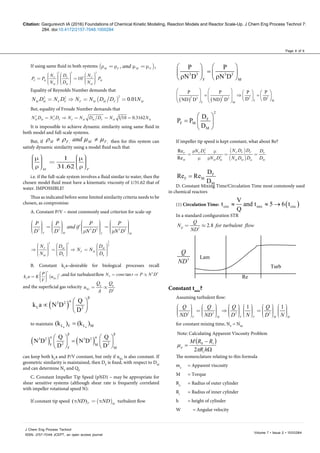
If using same fluid in both systems ( ), ,M F M F
andr = r m = m
3 5 3
5
10F F F
F M M
M M M
N D N
P P P
N D N
æ ö æ ö æ ö÷ ÷ ÷ç ç ç÷ ÷ ÷= =ç ç ç÷ ÷ ÷ç ç ç÷ ÷ ÷ç ç çè ø è ø è ø
Equality of Reynolds Number demands that
( )
22 2
0.01M M F F F M M F M
N D N D N N D D N= Þ = =
But, equality of Froude Number demands that
2 2
1 10 0.3162M M F F F M M F M M
N D N D N N D D N N= Þ = = =
It is impossible to achieve dynamic similarity using same fluid in
both model and full-scale systems.
But, if ,, FMFM and µµρρ ≠≠ then for this system can
satisfy dynamic similarity using a model fluid such that
1
31.62M F
æ ö æ öm m÷ ÷ç ç÷ ÷=ç ç÷ ÷ç ç÷ ÷ç çr rè ø è ø
i.e. if the full-scale system involves a fluid similar to water, then the
chosen model fluid must have a kinematic viscosity of 1/31.62 that of
water. IMPOSSIBLE!
Thus as indicated before some limited similarity criteria needs to be
chosen, as compromise:
A. Constant P/V – most commonly used criterion for scale-up
3 3 3 5 3 5
F M F M
P P P P
and if
D D N D N D
æ ö æ öæ ö æ ö ÷ ÷ç ç÷ ÷ç ç ÷ ÷= =÷ ÷ ç çç ç ÷ ÷÷ ÷ ç çç ç ÷ ÷ç çè ø è ø r rè ø è ø
2
3 2
3
F M M
F M
M F F
N D D
N N
N D D
æ ö æ ö æ ö÷ ÷ ÷ç ç ç÷ ÷ ÷Þ = Þ =ç ç ç÷ ÷ ÷ç ç ç÷ ÷ ÷ç ç çè ø è ø è ø
B. Constant kL
a–desirable for biological processes recall
( )L SG
P
k a K u
V
a
bæ ö÷ç= ÷ç ÷çè ø
,and for turbulentflow 3 5
tanP
N cons t P N D= Þ µ
and the superficial gas velocity 2
g g
SG
Q Q
u
A D
= µ
( )3 2
L 2
Q
k a N D
D
β
α  
∝  
 
to maintain
a aL F L M(k ) (k )=
( ) ( )3 2 3 2
2 2F M
F M
Q Q
N D N D
D D
β β
α α   
=   
   
can keep both kL
a and P/V constant, but only if uSG
is also constant. If
geometric similarity is maintained, then DF
is fixed, with respect to DM
and can determine NF
and QF
C. Constant Impeller Tip Speed (pND) – may be appropriate for
shear sensitive systems (although shear rate is frequently correlated
with impeller rotational speed N):
If constant tip speed ( )( )F M
ND NDp = p turbulent flow
3 5 3 5
F M
P P
N D N D
   
=   
ρ ρ   
( ) ( )
3 3 2 22 2
F M
F M
P P P P
D DND D ND D
       
= ⇒ =                 
2
F
F M
M
D
P P
D
 
=  
 
If impeller tip speed is kept constant, what about Re?
( )
( )
2
2
Re
Re
F F FF F F F
M M M M M m M
N D DN D D
N D N D D D
r m
= = =
m r
F
F M
M
D
Re Re
D
=
D. Constant Mixing Time/Circulation Time most commonly used
in chemical reactors
(1) Circulation Time: ( )circ mix circ
V
t and t 5 6 t
Q
≈ ≈ →
In a standard configuration STR
3
2.8Q
Q
N for turbulent flow
ND
= »
3
Q
ND
Lam
Turb
Re
Constant tmix
?
Assuming turbulent flow:
3 3 3 3
1 1
F M F F M M
Q Q Q Q
ND ND D N D N
æ ö æ ö æ ö æ ö æ ö æ ö÷ ÷ ÷ ÷ ÷ ÷ç ç ç ç ç ç= Þ =÷ ÷ ÷ ÷ ÷ ÷ç ç ç ç ç ç÷ ÷ ÷ ÷ ÷ ÷ç ç ç ç ç çè ø è ø è ø è ø è ø è ø
for constant mixing time, NF
= NM
Note: Calculating Apparent Viscosity Problem
( )
Ω
−
=
hR
RRM
i
i
a
π
µ
2
0
The nomenclature relating to this formula
ma
	 = Apparent viscosity
M	 = Torque
Ro
	 = Radius of outer cylinder
Ri
	 = Radius of inner cylinder
h	 = height of cylinder
W = Angular velocity
Page 5 of 6
Citation: Gargurevich IA (2016) Foundations of Chemical Kinetic Modeling, Reaction Models and Reactor Scale-Up. J Chem Eng Process Technol 7:
284. doi:10.4172/2157-7048.1000284
Volume 7 • Issue 2 • 1000284
J Chem Eng Process Technol
ISSN: 2157-7048 JCEPT, an open access journal
For this case using a rotational speed in RPM
2
60
Np
W =
Where N is the rotational speed of the cylinder in RPM
Convert N to W using above formula
Calculate ma
for each of the above points
Scale-Up by Extrapolation
Extrapolation calls for the model and prototype to be geometrically
similar as necessary condition.
An example is the scale up of a heat exchanger which would
make use of the well know relation involving the Nusselt number as
function of Re and Pr dimensionless numbers to calculate heat transfer
coefficients or,
Re PrX Y
Nu C= * * Nu or Nusselt no., Re, Reynolds no., and
Pr, Prandtl no.
The task would be to determine via pilot plant work for a given
system, the value of the constant C, and exponents X, and Y. Note that
this dependency arises naturally from the development of the heat
transfer differential equations for the system.
The sizing of the commercial heat exchanger makes use of such
empirical correlations to be able to meet the expected performance
specifications, but it will not necessarily be similar to the small scale
model.
The equivalent for mass transfer is
ReX Y
M
Nu C Sc= * * Nu or Nusselt no. for mass, and Sc, Schmidt
no.
Another application arises in the design of packed towers for Gas/
Liquid mass transfer, the overall mass transfer coefficient K often takes
the form,
K = C*(L)X
*(G)Y
Where L is the liquid flux over the packing and G is the Gas flux
flowing up the packing. By means of pilot work, the constant C, and
exponents X, and Y are determined directly for the system under
consideration.
Detail Analysis Chemical Reactor Scale-up
The concepts presented in the previous sections can now help
elucidate issues on the scale-up of chemical reactors as developed below
in more detail. To identify the pertinent dimensionless quantities, the
Heat, Mass, and Momentum Conservation equations are considered:
First consider a gas phase reaction of first order or,
A (g) ==> 2B (g)
and considers the elements in conservation of mass , heat , and
momentum.
Conservation of Mass
–r = rate of accumulation due to chemical reaction
( )
C u C
uC u C u rC V
L L L L
d d d d
= + = + D
d d d d
= rate of accumulation due
to bulk flow, where ΔV is volume change Per unit disappearance of A
=)(
L
C
D
L δ
δ
δ
δ rate of accumulation due to diffusion.
Conservation of Momentum
-ρu
L
P
δ
δ
= force as a result of momentum transferred by bulk flow,
L
P
δ
δ
=force a result of external pressure (relatively nil), ρur ΔV= force as
a result of volume change due to reaction,
R
uu
2
2
δρ
δ = force as a result of
shear viscosity.
Conservation of Thermal Energy
)( Tu
L
C
cp ∆− ρ
δ
δ
= accumulation of heat accompanying flow of fluid
Where ΔT is the temperature in excess of the wall temperature rQ=
heat generated by reaction u
L
P
δ
δ
= heat generated by friction (relatively
nil) k
R
T
2
2
∆
δ
δ = heat transferred by conduction from direction of reactor
wall 4αεσT3
ΔT~ 4αεσ [(T+ΔT)4
-T4
)] = heat transferred by radiant
exchange with walls, where α is the wall surface per unit volume.
The conservation laws lead to seven dimensionless groups that
must be equal for model and prototype in order for complete similitude
to exist as identified by Walas [10].
Table 1 depicts the chemical reactor dimensionless groups. Tables
2- 4 examine other reactor parameters pertinent to scale-up. The Tables
lead to the following conclusions:
•	 Groups (a) through (g) for homogeneous reactions or
Homogenous Reactions Heterogenous Reactions Name of
Group
rL
uC
u
rL V∆
u
rL V∆
Ruρ
µ
2
QrR
k T∆
3
(4 )p
Qr
T T C r Vαεσ ρ∆ − ∆
r
SC
S
r V∆
S
r V∆
pD SLρ
µ
2
34
3
p
p
C S R
k D T
ρ
ρσ+
( )
2
34
3 p
QrR
k D T Tρσ+ ∆
p
Qr
C r V Tρ ∆ ∆
Damkohler
Reynolds
Peclet
Table 1: Chemical Reactor Dimensionless Groups.
2
QrR
k T∆
(a) (h)
(i)
(j)
(k)
(l)
(m)
(n)
(b)
(c)
(d)
(e)
(f)
(g)
Page 6 of 6
Citation: Gargurevich IA (2016) Foundations of Chemical Kinetic Modeling, Reaction Models and Reactor Scale-Up. J Chem Eng Process Technol 7:
284. doi:10.4172/2157-7048.1000284
Volume 7 • Issue 2 • 1000284
J Chem Eng Process Technol
ISSN: 2157-7048 JCEPT, an open access journal
(h)-(n) for heterogeneous reactions, of Table 1 must be satisfied for
complete similitude between model and prototype. On the whole the
requirements for complete similitude are impractical.
•	 Whether chemical or dynamic or thermodynamic, or
geometric similitude individually or in partial combination is adequate
depends on the characteristic of each reaction mixture and the
operating conditions.
•	 Table 2 lists the dimensionless numbers that may be ignored
in certain special cases such as for a batch reactor.
•	 When the controlling condition is either heat transfer or
diffusive mass transfer, dynamical similitude is required since the
coefficients of both processes depend on reynols number.
•	 Chemical Similitude alone is required when the chemical
reaction rate controls the operation, equality of the Damkohler group
rL/uC is then sufficient. Chemical similitude is achieved when reaction
rates, reaction times, and the initial concentration are the same in both
model and prototype.
When chemical similitude is preserved, the geometry and the
heat transfer behavior are also fixed, but not necessarily as required
by dynamical similitude. Geometric and Heat Transfer relations when
chemical similitude is controlling [10].
References
1.	 Senkan SM (1992) Detailed Chemical Kinetic Modeling: Chemical Reaction
Engineering of the Future in Advances in Chemical Engineering. Academic
Press 18: 95-115.
2.	 Swihart MT (2007) Constructing Reaction Mechanisms in Comprehensive
Chemical Kinetics. Green NJB editor 42: 185-242.
3.	 Westbrook CK, Dryer FL (1984) Prog Energy Combust Sci 10: 1-37.
4.	 Edgeworth JR, Wooldridge TM (1957) Pilot Plants, Models, and Scale-up
Methods in Chemical Engineering.
5.	 Euzen JP (1993) Scale-Up Methodology for Chemical Processes.
6.	 Zlokarnik M (2006) Scale-Up in Chemical Engineering, Second, Completely
Revised and Extended Edition.
7.	 Worsetell J (2014) Dimensional Analysis.
8.	 Brechtelsbauer, Clemens (2012) Stirred Tank Scale-Up An (ex-) Practitioner’s
View. Power Point Presentation for mem Tide Process Development Course
London.
9.	 Stoker EB (2011) Comparative Studies on Scale-Up Methods of Single-Use
Bioreactors. MS Thesis, Biological Engineering. Utah State University 1-97.
10.	Stanley WM (1959) Reaction Kinetics for Chemical Engineers.
Conditions Dimensionless Groups of Table 1
That can be ignored
Homogenous Heterogeneous
Batch or low flow rate a, c, d, e h, j, k, l
Small diffusional resistance b i
Constant volume c, g j, n
Small radiation Heat transfer g n
Adiabatic with small heat of reaction f, g m, n
Table 2: Special cases resulting in Limited Similitude.
Item Ratio of Prototype to Model
(λ, ratio of radius)
Homogeneous Heterogeneous
Particle Diameter ----- λ 1
Heat-Transfer surface λ3
λ3
λ3
Volumetric Flow rate - λ 1
Heat Transfer per unit of surface λ3
λ2
λ3
Heat Transfer per unit of throughput 1 λ 1
Table 3: Geometrical Relations in Chemical Similitude.
Item
Ratio of Prototype to Model
(λ, ratio of radius)
Homogeneous Heterogeneous
Particle Diameter ----- λ 1
Heat-Transfer surface λ2
λ2
λ2
Volumetric Flow rate λ3
λ2
λ3
Heat Transfer per unit of surface 1 λ2
λ2
Heat Transfer per unit of throughput λ-1
1 λ-1
Table 4: Heat-Transfer Relations in Chemical Similitude.
Citation: Gargurevich IA (2016) Foundations of Chemical Kinetic Modeling,
Reaction Models and Reactor Scale-Up. J Chem Eng Process Technol 7: 284.
doi:10.4172/2157-7048.1000284
OMICS International: Publication Benefits & Features
Unique features:
•	 Increased global visibility of articles through worldwide distribution and indexing
•	 Showcasing recent research output in a timely and updated manner
•	 Special issues on the current trends of scientific research
Special features:
•	 700 Open Access Journals
•	 50,000 editorial team
•	 Rapid review process
•	 Quality and quick editorial, review and publication processing
•	 Indexing at PubMed (partial), Scopus, EBSCO, Index Copernicus and Google Scholar etc
•	 Sharing Option: Social Networking Enabled
•	 Authors, Reviewers and Editors rewarded with online Scientific Credits
•	 Better discount for your subsequent articles
Submit your manuscript at: http://www.omicsonline.org/submission/

foundations-of-chemical-kinetic-modeling-reaction-models-and-reactorscaleup-2157-7048-1000284

  • 1.
    Volume 7 •Issue 2 • 1000284 J Chem Eng Process Technol ISSN: 2157-7048 JCEPT, an open access journal Research Article Open Access Gargurevich, J Chem Eng Process Technol 2016, 7:2 http://dx.doi.org/10.4172/2157-7048.1000284 Review Article Open Access Journal of Chemical Engineering & Process TechnologyJo urnalofChemica l Engineering & ProcessTechnology ISSN: 2157-7048 Foundations of Chemical Kinetic Modeling, Reaction Models and Reactor Scale-Up Ivan A Gargurevich* Chemical Engineering Consultant, Combustion and Process Technologies, 32593 Cedar Spring Court, Wildomar, CA 92595, USA *Corresponding author: Ivan A Gargurevich, Chemical Engineering Consultant, Combustion and Process Technologies, 32593 Cedar Spring Court, Wildomar, CA 92595, USA, Tel: 9516759455; E-mail: ivan_gargurevich@yahoo.com Received February 10, 2016; Accepted March 06, 2016; Published March 25, 2016 Citation: Gargurevich IA (2016) Foundations of Chemical Kinetic Modeling, Reaction Models and Reactor Scale-Up. J Chem Eng Process Technol 7: 284. doi:10.4172/2157-7048.1000284 Copyright: © 2016 Gargurevich IA. This is an open-access article distributed under the terms of the Creative Commons Attribution License, which permits unrestricted use, distribution, and reproduction in any medium, provided the original author and source are credited. Abstract The majority of manuscripts dealing with the subject of chemical reactions, detailed chemical reaction models, and chemical kinetics present the material with strong mathematical foundations and emphasis. This is the reason for the conceptual approach taken in this manuscript where the result of the application of theory in the form of mathematical models is not the major consideration but the understanding of the fundamental concepts behind the complex mathematical theories. Keywords: Chemical kinetics; Quantum chemistry; Pollution; Heat The Pillars of Detailed Chemical Kinetic Modeling (DCKM) Even today, unfortunately, the industrial professional performing the design of a chemical reactor may not have the practical experience in Mathematics as well as Quantum Mechanics or Physical Chemistry to fully understand the implications of the mathematical formulism. This is especially true of the mathematical methods used in Quantum Chemistry as well as quantum mechanics applications to the estimate of rates of chemical reactions. Another important consideration that may be difficult during the composition of reaction models is the generation of elementary chemical reactions to explain the formation of products and most important trace components some of which may be of concern due to pollution of the environment. Reaction models based on mathematical correlations to predict formation of trace components of interest are not likely to be accurate. Note that trace components may have a significant importance for pollution control in effluent streams sometimes a very expensive proposition. It is necessary to develop complex models based on elementary chemical reactions. Figure 1 depicts the pillars of engineering/science knowledge to be able to construct a detailed chemical kinetic model (DCKM) consisting of hundreds of elementary chemical reaction. General Chemistry & Chemical reactions Chemical Thermodynamic/Statistical Mechanics Chemical Kinetic Principles and Theories of Rate Coefficients Quantum Chemistry This author is aware of only two manuscripts dealing with the subject of DCKM. Both are limited in content as well as lacking a comprehensive and conceptual description of the issues and concepts. This would make it very difficult for the readers to begin the task of constructing a complex reaction model and the associated data that is required such as rate coefficients. The works are highly theoretical and assume an understanding of Chemical Kinetics, General Chemistry, and Quantum Chemistry [1,2]. The predictions of any reactor model are only as good as the chemistry that is assembled to explain the formation of products and important byproducts. This is frequently the most important and difficult task. To model a chemical reactor involves developing Heat, Mass, and Component balances requiring heats of reaction as well as chemical kinetics for each reaction participating in the model. The activation energy for newly found reactions can be estimated with the use of Quantum Chemistry methods. Rate coefficients can be estimated with Transition State theory or the simpler Kinetic theory, better yet is the use of experimental data applicable to the temperature and pressure conditions of the reactor. Detailed Chemical Kinetic Models: A Stepwise Procedure As introduced above, the design of complex chemical reactors including the modeling of the relevant chemistry is a fairly complex undertaking. The design depending on reactor configuration and thermodynamic conditions may involve solving mass, heat, and momentum transport equations. This also requires mathematical tools to solve stiff differential equations involving the chemical reaction rates. A very good pictorial representation of the above is given in Figure 2. The most important step is always the assembly of the elementary reactions that will participate in the model. These reactions should explain the formation of major products of reaction, but as important the formation of intermediates and trace components. Very often, trace components are considered an environmental hazard or pollutant. It will be necessary (for Heat and Mass balance purposes during the chemical reactor design) to gather the thermo-chemical data for the reactions such as Heats of Formation. Experimental data can be most important. Also through Quantum chemistry and reaction rate theory
  • 2.
    Page 2 of6 Citation: Gargurevich IA (2016) Foundations of Chemical Kinetic Modeling, Reaction Models and Reactor Scale-Up. J Chem Eng Process Technol 7: 284. doi:10.4172/2157-7048.1000284 Volume 7 • Issue 2 • 1000284 J Chem Eng Process Technol ISSN: 2157-7048 JCEPT, an open access journal such as Transition State, the activation energy and rate of reaction can be estimated respectively. The reaction model is normally validated by the careful selection of an experimental apparatus. The final objective is then to develop a commercial scale chemical reactor and predictive tools based on mathematical models. Figure 3 Westbrook [3] provides a general guide to the choosing of experimental technique based on reaction conditions. Chemical Reactor Scale-up: Fundamental Concepts It is necessary to introduce reactor scale-up in a manuscript dealing with detailed chemical kinetic models because it impacts the development of the model as depicted in Figure 2 during (a) selection of experimental apparatus and (b) model validation. Further analysis of rector scale-up can be found in the work of Edgewoth and Wooldridge [4]. Other important sources of information are Euzen et al., Zlokarnik and Worsetell [5-7]. The temperature and pressure of operation of the reactor would lead to selecting a plug flow reactor for example or a burner to investigate combustion of a fuel or chemical. Attention to detail will lead to better prediction of the formation of toxic trace components. The complexity of the Heat, Mass, and Momentum transport equations to be solved in a Computational Fluid Dynamic (CFD) simulation of the reactor may necessitate the use of a reduced mechanism rather than a full blown reaction mechanism consisting of hundreds of reactions. Chemical reaction because of its exponential dependence on temperature results in stiff equations that need special mathematical treatment to be solved and convergence to a solution could be very time consuming. Figure 4 is an attempt to expand on the above subject as well as to depict the necessary steps to take to insure the proper design of equipment. It is needed that a chemical reactor of commercial size be designed in accordance to the values of similarity parameters identified in the smaller model reactor: -Geometric - Kinematic -Dynamic, -Thermal -Chemical similarity One similarity condition requires all of the above. Thus, Chemical Similarity requires fulfillment of geometric, kinematic, dynamic and thermal similarity. However, one important consideration in simplifying scale-up is the identification of the controlling regime: in a reactor where diffusion is controlling dynamic similarity would be predominant criteria over all others including chemical similarity. The approach to developing scaling up parameters depends on the level of understanding of the system: • Where the differential equations that govern the behavior of the system are unknown, but provided that we do know all the variables which would be of importance in the differential equations, it is possible to develop the similarity criteria by means of Dimensional Analysis. • Where the differential equations of the system are known but cannot be integrated, the similarity criteria can be derived from the General Chemistry: Chemical Reactions Thermodynamics/Statistical Mechanics Rxn Rate Coefficients Quantum Chemistry Detailed Chemical Kinetic Modeling Figure 1: The Engineering/Science Pillars of detailed Chemical Kinetic Modeling (DCKM). Figure 2: Steps and Methods to Construct Detailed Chemical Reaction Models.
  • 3.
    Page 3 of6 Citation: Gargurevich IA (2016) Foundations of Chemical Kinetic Modeling, Reaction Models and Reactor Scale-Up. J Chem Eng Process Technol 7: 284. doi:10.4172/2157-7048.1000284 Volume 7 • Issue 2 • 1000284 J Chem Eng Process Technol ISSN: 2157-7048 JCEPT, an open access journal differential form. • Finally, where the differential equations are both known and capable of being integrated and solved, there is no need for either similarity criteria or model experiments, since the behavior of a large- scale system should be directly calculable. • The approach based on similarity can be very strict and sometimes not possible due to conflicting parameters leading to unpractical results such as very large power consumption in the case of an agitated vessel for example. It requires then selection of the controlling regime to base scale-up on the proper criteria ignoring others. A more practical and often used approach is to design the scaled-up reactor by “extrapolation” making use of empirical correlations based on dimensionless numbers such as Reynolds, Prandtl, Schmidt etc. founded on mass and heat transfer differential equations to arrive at the proper size of the commercial reactor. In this approach, the model reactor and scaled-up version are necessarily geometrically similar but other similarity criteria are not met. One example is the heat transfer correlation based on the Nusselt number for the heat transfer coefficient inside tubes of shell and tube exchangers which has the form, Re PrX Y Nu C= * * where C is a constant, Re is the Reynolds number with exponent x, and Pr is the Prandlt number with exponent y. Parameters C, x, and y are determined experimentally with the model system. Application of Similarity-Bioreactor Scale-Up Design of a production-scale system on the basis of the performance of a model system [8,9]. System characteristics Thermodynamics e.g. CL * , CP (scale independent specific heat) Kinetics e.g. specific growth rate, m (scale independent) Transport-phenomena e.g. kL a (scale independent mass transfer coefficient) One of the fundamental problems is incomplete mixing on scale- up, concentration gradients, cell growth on walls etc. Similarity between model (M) and prototype (F) in two mixing systems, it is (ideally) important to achieve: Geometric similarity: both systems must be the same shape and linear dimensions in model must be related to the corresponding dimensions in model must be related to the corresponding dimensions in the prototype by a constant factor i.e. FMFM T H T H and T D T D       =            =      etc. D, diameter H, height Kinematic similarity: similar flow patterns in both vessels; velocities at corresponding points must have a constant ratio. Dynamic similarity: all corresponding forces at corresponding points in two geometrically similar systems have a constant ratio, i.e. 3 5 3 5 M F P P N D N D 0 0    =    ρ ρ    or Power number (a function of Reynolds (Re) and Froude (Fr) numbers) 2 2 M F ND NDæ ö æ ö÷ ÷ç ç÷ ÷=ç ç÷ ÷ç ç÷ ÷ç çm mè ø è ø ρ ρ or Re number 2 2 M F N D N D g g æ ö æ ö÷ ÷ç ç÷ ÷=ç ç÷ ÷ç ç÷ ÷ç çè ø è ø or Fr number Note: P, power and N, Impeller rotational speed However, it is very difficult to achieve dynamic similarity when more than one dimensionless group is involved in a system as shown below. For this reason, some bioreactor common criteria for scale-up have been developed based on which regime is controlling: • Constant P/V • Constant impeller tip speed (pND) • Constant volumetric mass transfer coefficient (kL a) • Constant impeller Reynolds No • Constant mixing time (tmix ) or circulation time (tcirc ) • Common to scale-up in the basis of geometric similarity and at least one of the above Power/Impeller Speed of Fermenter Assuming dynamic similarity as controlling, can you determine the power consumption and impeller speed of a 1000 L fermenter, based on the findings of the optimum conditions from a geometrically similar 1 L vessel? If not, can you scale-up by using a different fluid system? Solution 1 31 1 1 1000 1000 10 M M F F V D V D æ ö æ ö÷ç ÷ç÷= Þ = =ç ÷ç÷ ÷ç ç÷ç è øè ø Geometric Similarity Condition 3 5 3 5 M F P P N D N D æ ö æ ö÷ ÷ç ç÷ ÷=ç ç÷ ÷ç ç÷ ÷ç çr rè ø è ø Dynamic Similarity Condition EXPERIMENT PRESSURE RANGE TEMPERATURE (K) DILUTION MIXING LIMITS TRANSPORT EFFECTS SHOCK TUBES High <1300 Yes None NO PLUG FLOW REACTOR Atmospheric 850-1300 Yes None NO FLAMES (Combustion) Low 800-2500 No Flammability Limits Yes Figure 3: Model validation: Experimental Approach. MODEL REACTOR SIMILARITY PARAMETERS IDENTIFICATION/QUANTIFICATION Scale-up Effects, Compatibility?? Re, Sc, Pr, etc Geometric Similarity Kinematic Similarity Dynamic Similarity Thermal Similarity Chemical Similarity SCALE UP COMMERCIAL REACTOR REACTOR DESIGN BASIS EMPIRICAL CORRELATIONS (KNOWN OR DEVELOPED- DIMENSIONAL ANALYSIS) HEAT TRANSFER MASS TRANSFER BUBBLY FLOW CHEMICAL REACTION EXTRAPOLATION SIMILAR TO MODEL?? NOT ALWAYS Figure 4: Chemical Reactor Scale-Up Analysis.
  • 4.
    Page 4 of6 Citation: Gargurevich IA (2016) Foundations of Chemical Kinetic Modeling, Reaction Models and Reactor Scale-Up. J Chem Eng Process Technol 7: 284. doi:10.4172/2157-7048.1000284 Volume 7 • Issue 2 • 1000284 J Chem Eng Process Technol ISSN: 2157-7048 JCEPT, an open access journal If using same fluid in both systems ( ), ,M F M F andr = r m = m 3 5 3 5 10F F F F M M M M M N D N P P P N D N æ ö æ ö æ ö÷ ÷ ÷ç ç ç÷ ÷ ÷= =ç ç ç÷ ÷ ÷ç ç ç÷ ÷ ÷ç ç çè ø è ø è ø Equality of Reynolds Number demands that ( ) 22 2 0.01M M F F F M M F M N D N D N N D D N= Þ = = But, equality of Froude Number demands that 2 2 1 10 0.3162M M F F F M M F M M N D N D N N D D N N= Þ = = = It is impossible to achieve dynamic similarity using same fluid in both model and full-scale systems. But, if ,, FMFM and µµρρ ≠≠ then for this system can satisfy dynamic similarity using a model fluid such that 1 31.62M F æ ö æ öm m÷ ÷ç ç÷ ÷=ç ç÷ ÷ç ç÷ ÷ç çr rè ø è ø i.e. if the full-scale system involves a fluid similar to water, then the chosen model fluid must have a kinematic viscosity of 1/31.62 that of water. IMPOSSIBLE! Thus as indicated before some limited similarity criteria needs to be chosen, as compromise: A. Constant P/V – most commonly used criterion for scale-up 3 3 3 5 3 5 F M F M P P P P and if D D N D N D æ ö æ öæ ö æ ö ÷ ÷ç ç÷ ÷ç ç ÷ ÷= =÷ ÷ ç çç ç ÷ ÷÷ ÷ ç çç ç ÷ ÷ç çè ø è ø r rè ø è ø 2 3 2 3 F M M F M M F F N D D N N N D D æ ö æ ö æ ö÷ ÷ ÷ç ç ç÷ ÷ ÷Þ = Þ =ç ç ç÷ ÷ ÷ç ç ç÷ ÷ ÷ç ç çè ø è ø è ø B. Constant kL a–desirable for biological processes recall ( )L SG P k a K u V a bæ ö÷ç= ÷ç ÷çè ø ,and for turbulentflow 3 5 tanP N cons t P N D= Þ µ and the superficial gas velocity 2 g g SG Q Q u A D = µ ( )3 2 L 2 Q k a N D D β α   ∝     to maintain a aL F L M(k ) (k )= ( ) ( )3 2 3 2 2 2F M F M Q Q N D N D D D β β α α    =        can keep both kL a and P/V constant, but only if uSG is also constant. If geometric similarity is maintained, then DF is fixed, with respect to DM and can determine NF and QF C. Constant Impeller Tip Speed (pND) – may be appropriate for shear sensitive systems (although shear rate is frequently correlated with impeller rotational speed N): If constant tip speed ( )( )F M ND NDp = p turbulent flow 3 5 3 5 F M P P N D N D     =    ρ ρ    ( ) ( ) 3 3 2 22 2 F M F M P P P P D DND D ND D         = ⇒ =                  2 F F M M D P P D   =     If impeller tip speed is kept constant, what about Re? ( ) ( ) 2 2 Re Re F F FF F F F M M M M M m M N D DN D D N D N D D D r m = = = m r F F M M D Re Re D = D. Constant Mixing Time/Circulation Time most commonly used in chemical reactors (1) Circulation Time: ( )circ mix circ V t and t 5 6 t Q ≈ ≈ → In a standard configuration STR 3 2.8Q Q N for turbulent flow ND = » 3 Q ND Lam Turb Re Constant tmix ? Assuming turbulent flow: 3 3 3 3 1 1 F M F F M M Q Q Q Q ND ND D N D N æ ö æ ö æ ö æ ö æ ö æ ö÷ ÷ ÷ ÷ ÷ ÷ç ç ç ç ç ç= Þ =÷ ÷ ÷ ÷ ÷ ÷ç ç ç ç ç ç÷ ÷ ÷ ÷ ÷ ÷ç ç ç ç ç çè ø è ø è ø è ø è ø è ø for constant mixing time, NF = NM Note: Calculating Apparent Viscosity Problem ( ) Ω − = hR RRM i i a π µ 2 0 The nomenclature relating to this formula ma = Apparent viscosity M = Torque Ro = Radius of outer cylinder Ri = Radius of inner cylinder h = height of cylinder W = Angular velocity
  • 5.
    Page 5 of6 Citation: Gargurevich IA (2016) Foundations of Chemical Kinetic Modeling, Reaction Models and Reactor Scale-Up. J Chem Eng Process Technol 7: 284. doi:10.4172/2157-7048.1000284 Volume 7 • Issue 2 • 1000284 J Chem Eng Process Technol ISSN: 2157-7048 JCEPT, an open access journal For this case using a rotational speed in RPM 2 60 Np W = Where N is the rotational speed of the cylinder in RPM Convert N to W using above formula Calculate ma for each of the above points Scale-Up by Extrapolation Extrapolation calls for the model and prototype to be geometrically similar as necessary condition. An example is the scale up of a heat exchanger which would make use of the well know relation involving the Nusselt number as function of Re and Pr dimensionless numbers to calculate heat transfer coefficients or, Re PrX Y Nu C= * * Nu or Nusselt no., Re, Reynolds no., and Pr, Prandtl no. The task would be to determine via pilot plant work for a given system, the value of the constant C, and exponents X, and Y. Note that this dependency arises naturally from the development of the heat transfer differential equations for the system. The sizing of the commercial heat exchanger makes use of such empirical correlations to be able to meet the expected performance specifications, but it will not necessarily be similar to the small scale model. The equivalent for mass transfer is ReX Y M Nu C Sc= * * Nu or Nusselt no. for mass, and Sc, Schmidt no. Another application arises in the design of packed towers for Gas/ Liquid mass transfer, the overall mass transfer coefficient K often takes the form, K = C*(L)X *(G)Y Where L is the liquid flux over the packing and G is the Gas flux flowing up the packing. By means of pilot work, the constant C, and exponents X, and Y are determined directly for the system under consideration. Detail Analysis Chemical Reactor Scale-up The concepts presented in the previous sections can now help elucidate issues on the scale-up of chemical reactors as developed below in more detail. To identify the pertinent dimensionless quantities, the Heat, Mass, and Momentum Conservation equations are considered: First consider a gas phase reaction of first order or, A (g) ==> 2B (g) and considers the elements in conservation of mass , heat , and momentum. Conservation of Mass –r = rate of accumulation due to chemical reaction ( ) C u C uC u C u rC V L L L L d d d d = + = + D d d d d = rate of accumulation due to bulk flow, where ΔV is volume change Per unit disappearance of A =)( L C D L δ δ δ δ rate of accumulation due to diffusion. Conservation of Momentum -ρu L P δ δ = force as a result of momentum transferred by bulk flow, L P δ δ =force a result of external pressure (relatively nil), ρur ΔV= force as a result of volume change due to reaction, R uu 2 2 δρ δ = force as a result of shear viscosity. Conservation of Thermal Energy )( Tu L C cp ∆− ρ δ δ = accumulation of heat accompanying flow of fluid Where ΔT is the temperature in excess of the wall temperature rQ= heat generated by reaction u L P δ δ = heat generated by friction (relatively nil) k R T 2 2 ∆ δ δ = heat transferred by conduction from direction of reactor wall 4αεσT3 ΔT~ 4αεσ [(T+ΔT)4 -T4 )] = heat transferred by radiant exchange with walls, where α is the wall surface per unit volume. The conservation laws lead to seven dimensionless groups that must be equal for model and prototype in order for complete similitude to exist as identified by Walas [10]. Table 1 depicts the chemical reactor dimensionless groups. Tables 2- 4 examine other reactor parameters pertinent to scale-up. The Tables lead to the following conclusions: • Groups (a) through (g) for homogeneous reactions or Homogenous Reactions Heterogenous Reactions Name of Group rL uC u rL V∆ u rL V∆ Ruρ µ 2 QrR k T∆ 3 (4 )p Qr T T C r Vαεσ ρ∆ − ∆ r SC S r V∆ S r V∆ pD SLρ µ 2 34 3 p p C S R k D T ρ ρσ+ ( ) 2 34 3 p QrR k D T Tρσ+ ∆ p Qr C r V Tρ ∆ ∆ Damkohler Reynolds Peclet Table 1: Chemical Reactor Dimensionless Groups. 2 QrR k T∆ (a) (h) (i) (j) (k) (l) (m) (n) (b) (c) (d) (e) (f) (g)
  • 6.
    Page 6 of6 Citation: Gargurevich IA (2016) Foundations of Chemical Kinetic Modeling, Reaction Models and Reactor Scale-Up. J Chem Eng Process Technol 7: 284. doi:10.4172/2157-7048.1000284 Volume 7 • Issue 2 • 1000284 J Chem Eng Process Technol ISSN: 2157-7048 JCEPT, an open access journal (h)-(n) for heterogeneous reactions, of Table 1 must be satisfied for complete similitude between model and prototype. On the whole the requirements for complete similitude are impractical. • Whether chemical or dynamic or thermodynamic, or geometric similitude individually or in partial combination is adequate depends on the characteristic of each reaction mixture and the operating conditions. • Table 2 lists the dimensionless numbers that may be ignored in certain special cases such as for a batch reactor. • When the controlling condition is either heat transfer or diffusive mass transfer, dynamical similitude is required since the coefficients of both processes depend on reynols number. • Chemical Similitude alone is required when the chemical reaction rate controls the operation, equality of the Damkohler group rL/uC is then sufficient. Chemical similitude is achieved when reaction rates, reaction times, and the initial concentration are the same in both model and prototype. When chemical similitude is preserved, the geometry and the heat transfer behavior are also fixed, but not necessarily as required by dynamical similitude. Geometric and Heat Transfer relations when chemical similitude is controlling [10]. References 1. Senkan SM (1992) Detailed Chemical Kinetic Modeling: Chemical Reaction Engineering of the Future in Advances in Chemical Engineering. Academic Press 18: 95-115. 2. Swihart MT (2007) Constructing Reaction Mechanisms in Comprehensive Chemical Kinetics. Green NJB editor 42: 185-242. 3. Westbrook CK, Dryer FL (1984) Prog Energy Combust Sci 10: 1-37. 4. Edgeworth JR, Wooldridge TM (1957) Pilot Plants, Models, and Scale-up Methods in Chemical Engineering. 5. Euzen JP (1993) Scale-Up Methodology for Chemical Processes. 6. Zlokarnik M (2006) Scale-Up in Chemical Engineering, Second, Completely Revised and Extended Edition. 7. Worsetell J (2014) Dimensional Analysis. 8. Brechtelsbauer, Clemens (2012) Stirred Tank Scale-Up An (ex-) Practitioner’s View. Power Point Presentation for mem Tide Process Development Course London. 9. Stoker EB (2011) Comparative Studies on Scale-Up Methods of Single-Use Bioreactors. MS Thesis, Biological Engineering. Utah State University 1-97. 10. Stanley WM (1959) Reaction Kinetics for Chemical Engineers. Conditions Dimensionless Groups of Table 1 That can be ignored Homogenous Heterogeneous Batch or low flow rate a, c, d, e h, j, k, l Small diffusional resistance b i Constant volume c, g j, n Small radiation Heat transfer g n Adiabatic with small heat of reaction f, g m, n Table 2: Special cases resulting in Limited Similitude. Item Ratio of Prototype to Model (λ, ratio of radius) Homogeneous Heterogeneous Particle Diameter ----- λ 1 Heat-Transfer surface λ3 λ3 λ3 Volumetric Flow rate - λ 1 Heat Transfer per unit of surface λ3 λ2 λ3 Heat Transfer per unit of throughput 1 λ 1 Table 3: Geometrical Relations in Chemical Similitude. Item Ratio of Prototype to Model (λ, ratio of radius) Homogeneous Heterogeneous Particle Diameter ----- λ 1 Heat-Transfer surface λ2 λ2 λ2 Volumetric Flow rate λ3 λ2 λ3 Heat Transfer per unit of surface 1 λ2 λ2 Heat Transfer per unit of throughput λ-1 1 λ-1 Table 4: Heat-Transfer Relations in Chemical Similitude. Citation: Gargurevich IA (2016) Foundations of Chemical Kinetic Modeling, Reaction Models and Reactor Scale-Up. J Chem Eng Process Technol 7: 284. doi:10.4172/2157-7048.1000284 OMICS International: Publication Benefits & Features Unique features: • Increased global visibility of articles through worldwide distribution and indexing • Showcasing recent research output in a timely and updated manner • Special issues on the current trends of scientific research Special features: • 700 Open Access Journals • 50,000 editorial team • Rapid review process • Quality and quick editorial, review and publication processing • Indexing at PubMed (partial), Scopus, EBSCO, Index Copernicus and Google Scholar etc • Sharing Option: Social Networking Enabled • Authors, Reviewers and Editors rewarded with online Scientific Credits • Better discount for your subsequent articles Submit your manuscript at: http://www.omicsonline.org/submission/