28th March 2019
Fostering Learning in a Multigenerational Workplace.
Presenters: Nuru Ayiemba & Maggie Gituma
2
You should always be learning. If you’re the
smartest person in the room you’re in the
wrong place.
By Erica Bearman
3
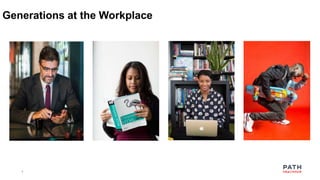
Generations at the Workplace
4
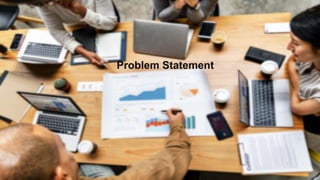
Problem Statement
5
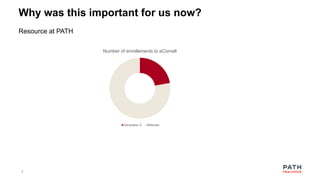
Why was this important for us now?
Resource at PATH
Number of enrollements to eCornell
Generation X Millenials
6
Issues that we deal with!
7
“I see no hope for the future of our people if they are
dependent on frivolous youth of today, for certainly all
youth are reckless beyond words.”
Generational Stereotypes
8
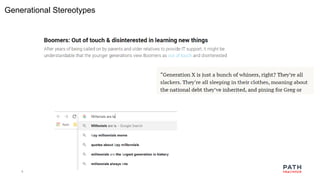
Generational Stereotypes
9
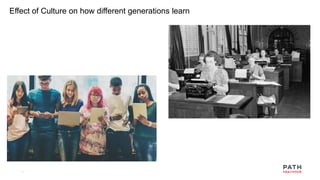
Effect of Culture on how different generations learn
10
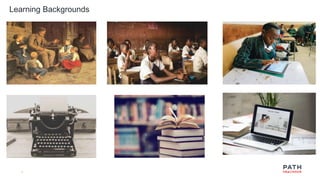
Learning Backgrounds
11
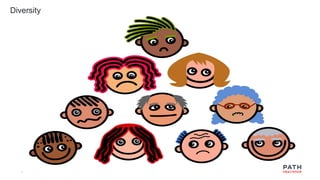
Diversity
12
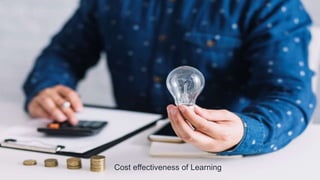
Cost effectiveness of Learning
13
Strategies
14
15
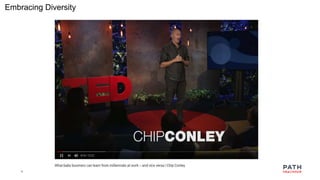
Embracing Diversity
16
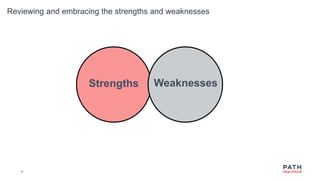
Reviewing and embracing the strengths and weaknesses
Strengths Weaknesses
17
Give the different Generations ways to give feedback
18
Be aware of the Challenges of managing learning in a multigenerational work place
19
Sifting through the Noise
20
Where we are going…

Fostering Learning In A Multi-generational Workplace

Editor's Notes

  • #2  Preparation Have pieces of paper with different learning styles that apply to three generations; baby boomers, generation x and millennials – not much data for generation z yet. So keep the exercise to 3 generations for now. Have the papers coloured so that you can keep tabs on which ones have been picked or encourage people to pick those that have not been picked yet. Ensure you have labels for each of the tables denoting the generations for reference as a facilitator. Activity Pick a piece of paper. Each piece of paper will have a learning preference written on. As the participants not to open their papers as of yet. Give the below brief Hakuna Matata Company is trying to come up with a learning strategy, we would like to figure out the preferred learning styles for staff in the organization Once that is done put the labels for the different preferences on the tables.
  • #3 Irrespective of your generation the consistent thing in life is to learn. How we learn may be different however the need to grow and experience new things and the need to embrace technologies is similar across generations. We learnt from our grandmothers, mothers, teachers, online we learn from others. How we learn however has a lot of bearing on our culture and past experiences, which shape us and impact our learning preferences.
  • #4 When discussing workplace generational learning we need to personalize what we are thinking. This is not an abstract conversation, it is what we experience in our homes, workplace; with team members. Currently at the workplace we currently have 4 generations: Baby boomers(1946 – 1964), Gen X(1965 – 1976), Millennials(1977 – 1995) Gen Z(Born 1996 – TBD) Nuru Story I have 3 children including myself all currently learning. If I was teaching them how to use an app; they want to explore and find information on their own infact even my youngest daughter will say “ just give it to me I try and will let you know”. I would like to be able to know what it does, is it beneficial to me why should I use it…many questions need to be answered prior to my using the app (SLII App story example) As a parent I am conscious that my older son is a Generation Z he is the are employees of the future. He prefers to learn online. He was born with technology, because of him I read books online…I must say I still prefer hard cover books. In our small team in Kenya Maggie and I are from different generations…Generation x and Millennial….we both have to keep learning however how we prefer to learn is different. Taking that into consideration magnify it to the bigger team and organization as a whole. Then we start to understand the importance of taking generations into consideration.
  • #5 Problem statement When an organization has invested in a learning strategy thinking that all sizes fits all, it always becomes a challenge. This is because among other challenges, we currently have 4 generations working together. Employees who worked typewriters are now working with young graduates who have never heard of one. When setting up a learning strategy in an organization, the Learning team must ask itself the following questions in a bid to understand its learners.: Who they are ? How has their upbringing shaped their worldview? What is their learning preference?   It is not enough to simply understand a group’s demographics e.g. age, gender and ethnicity, more has to be done. One of the concepts that learning teams must consider when coming up with a learning strategies is the different generations and their learning preferences. Research done, shows that different generations have distinct learning preferences; whether it is at the workplace or on their own.   To be able to create an effective learning environment, we must know and understand differences of each generation. Appreciating the differences highlights that fact that each generation has something to offer. The baby boomers provide knowledge gained over 30 years in the workplace, while younger generations bring technological expertise, enthusiasm and energy (Tracey L., 2012) While developing a learning strategy that meets the needs of the 4 generations may seem like an impossible task, it does not have to be. As a learning lead or expert in your organization, you should learn the issues as regards learning in a multi-generational workforce and what strategies you can adapt to ensure that all generational preferences are considered.
  • #6  Through Humentum, PATH has a partnership with the Cornell University, which offers the online learning via eCornell. In 2018, we launched a marketing campaign to market our classes in Africa. In view of our topic, we decided to get data that shows which generations took advantage of our offerings. Baby Boomers: They prefer the classroom setting. eCornell being an online platform might have made this platform less exciting for them. Generation X: they prefer self-directed educational opportunities and programs that enable them to learn on their own schedule. A few learners of this generation did the eCornell training but at very irregular intervals. Millennials: They have married the learning preference of their predecessors, favouring personalized training on a self-directed schedule. They like having information when they need it and that is through the internet. This then explains why the number of millennials that took the eCornell in 2018 were high. Due to their preference for technology.
  • #7 What issues are we talking about as regards learning/training in a multigenerational workforce?
  • #8 Generational stereotyping is not new. In the 8th century BC, the poet Hesiod wrote… Stereotyping is not new every generation has an opinion on what the other generation can or cannot do. Each generation tends to bash the new guys (one reason leadership training is so important). Revisit activity here Let us revisit our exercise here. At this point label the tables to indicate what generation that means that they are clustered in. Move tables to respective color codes as per the labels on the table.
  • #9 Continue Activity Have them move to respective generations based on learning preference they chose. Ask the participants to open the piece of paper in and have them move to different tables based on the learning preference denoted on the paper they picked. We say that just because you are a generation x means this is how you must like to learn; while stereotyping helps us to make generalizations it can also be dangerous. Yet also not all stereotypes are entirely based on myth, but tend to reflect negatively- recognition of deep-rooted differences in attitudes and values that are themselves the result of different age cohorts. This of course, covers the differences and expectations people have of education and training. (Field, 2015)
  • #10 The generational culture in which an individual belongs can affect their views and attitudes within the workplace. Every generation brings something into the workplace (Myers & Sadaghiani, 2010). The various generations of employees are frustrated, irritated, and confused by colleagues from different generations because each comes from a different culture and they believe their cultural approach to work and life is the “way things should be done.” (Paul White) Different generations were born or raised when different development or evolutions were taking place. Below are some of the categorizations: Baby boomers: were the counter culture Generation Generation x: The TV Generation. Millennials: Those older than 30 were the last ones to grow up offline and the ones younger than thirty became the digital natives. Generation Z: The first fully connected kids. Source: (NPD Waves) With this you are able to see the differences there are in the cultures, so the expectation that all this individual will learn and internalize information the same way is not true. For example: introducing mobile learning as critical and must have for staff working at the field and the community level, the older generations(baby boomers and part of the Gen X) will most certainly not be very enthusiastic to use this method.
  • #11 All the generation went to school at different times, which means the way they learnt is different through each generation. Image 1: this was the traditional way of learning. Majority of Baby boomers were born before independence, so there was no educational systems. They all learnt from stories from their parents, elders and grandparents. They learnt basic skills, Image 2: We moved from the traditional from of learning to the classroom, which has been there for ages. The learning was now formal and very well structured. Image 3: Generation Z, the luckiest of all( case in Kenya). They use tablets to learn. Their textbooks are now easily accessed in tablet. Image 4: Type writers were massively used by students as a way of writing their college essays and research paper's. Image 5: Books have generally been used throughout the generations. However Gen Z and Millennials have least used them due to the move to technology, with advancement to kindle, audio books and eBooks. Image 6: university education has changed, most young adults will do their college degrees and other specialized trainings online. Universities have changed their to online learning while sites like EDX and Coursera have become the go to sites that young adults access to do just in time learning. We can very well say that the younger generation have had better education than the older generations. This can be demonstrated by their skill profiles and qualifications and the expectations that people have of education and its role in their lives (Field, 2015). With all this individuals with different Learning backgrounds, how do you ensure that you do not leave any one out? Most organizations are now adapting online Learning and trainings, are they considering the older generations while they are making the roll-outs? Do they do trainings to ensure that they are comfortable with the new technology.
  • #12 With different generations at the workplace, different personalities and different interests are in play. With younger workers being more inclined to depending on technology to solve problems and bringing fresh ideas to the workplace, while the older generations contribute understanding of the organization and functional knowledge of how to improvise and work around barriers from organizations own structures and procedures (Fenwick, 2014). With this kind of diversity at the workplace, trying to foster a learning environment can be difficult.
  • #14 Chip Conley Ted talks (Nuru to provide the debrief)
  • #15 Activity Back to our activity. If say we were launching a xxxxxx (come up with a learning issue here) Given your choices of the 3 learning preferences you picked how many would change and which table would you move to now? Give them a minute to move tables. Mention that being aware of learning preferences through deliberate evaluations within the organization will assist in ensuring that we are giving the type of learning that meet peoples’ the organizations needs.
  • #16  Chip Conley Ted talks What baby boomers can learn from millennials at work and vice versa. It is a really good discussion on how we can tap into generational diversity to strengthen our workforce if we can build trust amongst ourselves to share our respective wisdom. We have a lot of young people rise to positions of power ; it talks about age and growth of emotional intelligence and how older generations can mentor young people on relationship management issues. For the first time ever, we have five generations in the workplace at the same time, says entrepreneur Chip Conley. What would happen if we got intentional about how we all work together? In this accessible talk, Conley shows how age diversity makes companies stronger and calls for different generations to mentor each other at work, with wisdom flowing from old to young and young to old alike. Being aware of diversity and how to embrace is really the beginning of tapping into the advantages it can bring to the workplace. Merging the differing skills and knowledge of all the generations, in order to have an effective learning environment is key. Generational upbringing plays a great role on the different learning preferences. “All generations are just products of their environment” (Cox & Holloway, 2011, p. 24). For example, Millennials: having more access to technology are more visually literate than previous generations (Stanford &reeves, 2007). They prefer images and graphics than text. They can merge text, sound and images easily, and transfer between the real and virtual seamlessly (Oblinger &Oblinger, 2005). The Silent and Baby Boomers did not grow up with technology. They tend to rely on their experiences as a source of learning. By understanding this then you can be able to formulate a Learning strategy that incorporates all their preferred learning styles without breaking the bank.
  • #17 Each generation brings something different to the table. They all have their strengths and weaknesses and as a trainer or a HR you should ensure that they are aware of this and they learn that they need each other to be able to establish a culture of continuous learning. Here is a scenario: The younger Generation are quite comfortable with technology, which is essentially the world of today while the older generation have great experience that they have generally gained through out their time at the workplace. This are actually critical qualities, if they are merged together to create a strong learning environment.
  • #18 Feedback is crucial. This is feedback offered during the process of learning. This may be in Training or mentorship. It is crucial to offer feedback channels and more importantly acting on the feedback given by your learners. There different ways of getting feedback: if it is eLearning, you can incorporate surveys after the course, after a mentorship and coaching session have, have review sessions, after training: like contracts training have after training review sessions – this offers learners opportunities to internalize what was learnt, offer feedback on the training itself and what they could have done better.
  • #19 Acknowledging the challenges is the first step to dealing with the issue.
  • #20 Use our organization to look at the issues that we are facing…….no learning opportunities…face to face training/e-learning..we want a certificate….we have no learning… Yet we provide a lot of opportunities for staff to learn…including ones with certificates. We have elearning…etc…
  • #21 Map out our learners Engage your learners Blended learning – give each generation a chance Deliberate feedback…i- if it is bad we want to hear it.. Demystifying learning…group learning different generation can tap into each other’s’ knowledge.