THE STORY OF
THE JURASSIC
TERMITE NESTS
Ariel A. Roth, 2022
www.sciencesandscriptures.com
THE CONTROVERSY
Fossil termite nests have been reported in the fossil
record. The presence of these nests is presented as evidence
challenging the biblical account of beginnings; specifically
the one year Genesis Flood as the cause for much of the
fossil record. The model of slow evolutionary development
of life over millions of years provides the time necessary for
the gradual growth of termite nests. On the other hand, the
biblical account does not accommodate for these termite
nests that take several years to be built. This is a time issue
that engenders questions about the authenticity of these
termite nests.
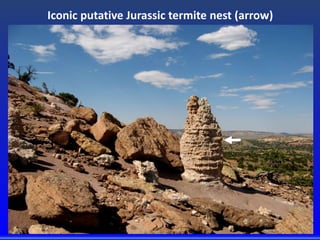
Iconic putative Jurassic termite nest (arrow)
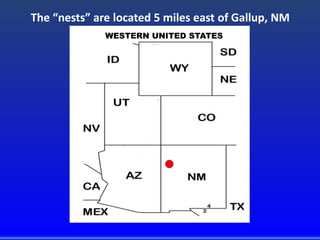
WESTERN UNITED STATES
The “nests” are located 5 miles east of Gallup, NM
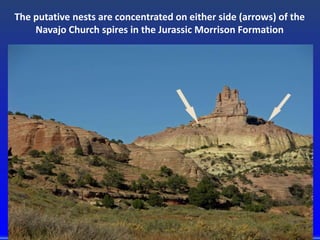
The putative nests are concentrated on either side (arrows) of the
Navajo Church spires in the Jurassic Morrison Formation
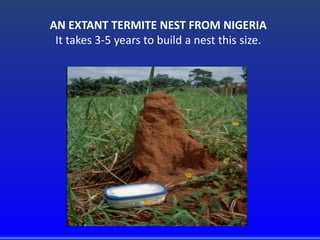
AN EXTANT TERMITE NEST FROM NIGERIA
It takes 3-5 years to build a nest this size.
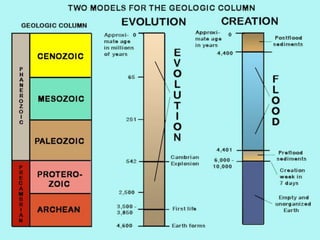
RELATION TO GEOLOGIC COLUMN
The proposed Jurassic fossil termite nests under
discussion here lie in the middle of the Phanerozoic portion
of the geologic layers, with abundant fossils above and
below. In the next slide, they lie in the middle of the
Mesozoic of the left column. In the middle column they lie at
the same level. In the right column, they lie at the same level
in the middle of the Genesis Flood. Note that the time scale
for the middle column is in millions of years for evolution,
while only in years for the right column for creation. Up and
down distances not at the same scale.
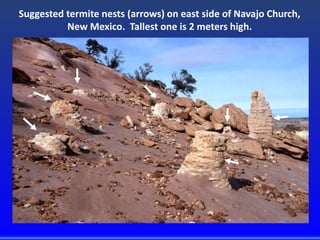
Suggested termite nests (arrows) on east side of Navajo Church,
New Mexico. Tallest one is 2 meters high.
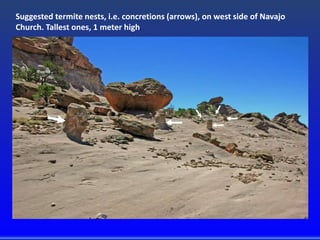
Suggested termite nests, i.e. concretions (arrows), on west side of Navajo
Church. Tallest ones, 1 meter high.
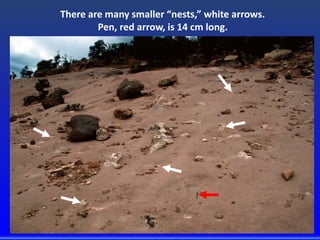
There are many smaller “nests,” white arrows.
Pen, red arrow, is 14 cm long.
DEEP INTEREST IN TERMITES IN 1997
Interest was likely stimulated by an abstract
presented that year at the Geological Society of
America annual meeting, proposing that these
intriguing structures were termite nests.
The next few slides discuss this.
SOME 1997 COMMENTS ABOUT FOSSIL TERMITE NESTS
Hasiotis, ST et al. 1997. GSA Abstracts A-461
“Enormous pillars … are interpreted as … subterranean termite
nests in alluvial and eolian deposits … composed of thousands of simple
and compound galleries … 0.15 to 0.5 cm in diameter … to “pan sized”
chambers … preferentially preserved because of the organics used in
their construction.”
GSA Annual Meeting Press Release, 1997
Nests “… appear to reach 120 feet below the ground … some
types of termites construct their nests around dead and dying tree
stumps and root systems …”
USA TODAY, Internet, updated 1998 (2000 download)
“The insects used saliva, feces and partly digested wood to glue
sand grains together … Their height may have served to protect the
termites from carnivorous dinosaurs seeking high-protein snacks.”
ACCEPTANCE OF FOSSIL TERMITE NEST
INTERPRETATION
• Hasiotis is credited with discovering the world’s
oldest crayfish fossil as well as the oldest bee, ant,
and termite nests
• Children’s Web pages talked about this
• Interpretations of ancient ecosystems include these
• The author of this presentation (Roth) has seen at
least four anti-Biblical Flood web pages that present
termite nests as evidence that most of the
Phanerozoic part of the geologic column could not
have been deposited during the Genesis Flood.
• Course syllabi included these
•
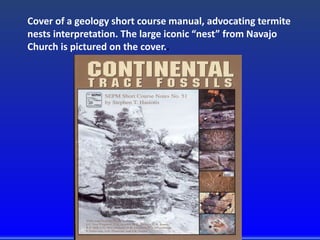
Cover of a geology short course manual, advocating termite
nests interpretation. The large iconic “nest” from Navajo
Church is pictured on the cover..
OF INTEREST:
• There is a report of the “earliest” termite nests in
the fossil record found in the Triassic Chinle
Formation (Hasiotis and Dubiel, 1997). That
formation lies below the Jurassic. However
Labandeira (1998) suggests that this finding awaits
confirmation, and Thorne, et al. (2000) state that
this identification can be “dismissed with almost
complete certainty.” Identification of fossil termite
nests is too often subjective.
WHY THIS STUDY?
• In the late 1990s, there were discussions about time in the fossil
record at meetings of the Biblical Research Institute Science Council
(BRISCO) held in Loma Linda, CA. Some leading participants referred to
fossil termite nests as evidence against a Genesis Flood interpretation
of the fossil record.
• Small termite nests, less than a meter in height can take several years
to be built. It does not seem possible to grow significant termite nests
during the year of the Genesis flood described in the Bible.
• In 1997, in the halls of a Loma Linda University science department,
there appeared a picture of a huge Jurassic fossil termite nest that
would take years to be formed. Interest in fossil termite nests was
growing.
• Were fossil termite nests going to become a “Mecca” for those seeking
to challenge the Genesis Flood, as was the case for the
“superimposed” fossil forests of Yellowstone National Park whose
total age seamed to far exceeds the constraints of biblical chronology?
WHY THIS STUDY?(Continued)
• When the author of this presentation (Roth), saw the
posted picture, he immediately decided to investigate
these structures and see if they were really termite nests.
• Studies soon showed that the nests were not made of the
same composition as the host rocks, while termites
generally use host rock and local loose sediments to build
their nests. Some other external source seemed involved.
• At a later BRISCO meeting, a repeat suggestion that
termite nests challenge the Genesis Flood was summarily
dismissed by many. It did not appear that the termite nest
interpretation was being generally accepted by this group.
• The data showing the difference between the host rock
and the purported termite nests was secured in the
scientific literature in a GSA poster/abstract (Roth, et al.,
2006), and in details in the peer reviewed journal,
Sedimentary Geology (Roth, et al., 2019). Samples follow:
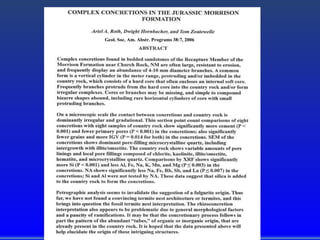
Geol. Soc. Am. Abstr. Programs 38:7, 2006
NOTE ABOUT TERMINOLOGY AND
REFERENCES
• The anomalous structures at Navajo Church have been identified as
“termite nests” (Hasiotis et al. 1997). This new study uses the broader
term “concretion” for designation.
• A concretion is defined as “a hard solid mass formed by the local
accumulation of matter, especially within the body or within a mass of
sediment.”
• References in this PowerPoint text are in the traditional author date
text format. For complete references consult the comprehensive
article:
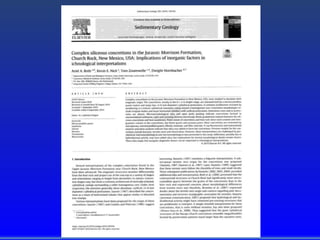
• Roth AA, Nick KE, Zoutwelle T, Hornbacher D. “Complex siliceous
concretions in the Jurassic Morrison Formation, Church Rock, New
Mexico, USA: Implications for inorganic factors in iconological
interpretations ” Sedimentary Geology 392 (2019) 105526
https://doi.org/10.1016/j.sedgeo.2019.105526 .
THE CONCRETIONS ARE NOT
EPIGENOUS
• Epigenous refers to growing from a surface, like a tree
grows up from the surface of the ground.
• The concretions appear to have formed in the host
sedimentary layers after they were laid down, not above
them.
• The sedimentary layers appear to be continuous around or
even through the concretions, indicating that they were
laid down before the concretions were present.
• This implies that the concretions would not represent
typical extant termite nest mounds built above the surface
of the ground as now found in Africa. At best they would
represent underground termite structures. But
underground termites are not known to build vertical
concentric cylindrical structures as these are.
• The next few slides illustrate the continuity of the
sedimentary layers next to the concretions.
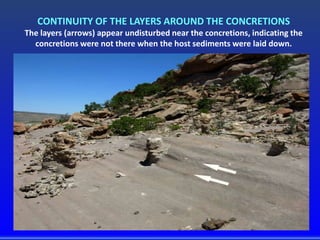
CONTINUITY OF THE LAYERS AROUND THE CONCRETIONS
The layers (arrows) appear undisturbed near the concretions, indicating the
concretions were not there when the host sediments were laid down.
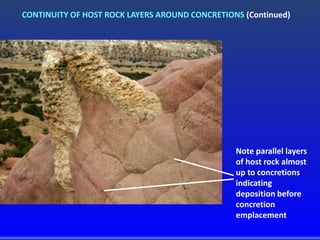
Note parallel layers
of host rock almost
up to concretions
indicating
deposition before
concretion
emplacement
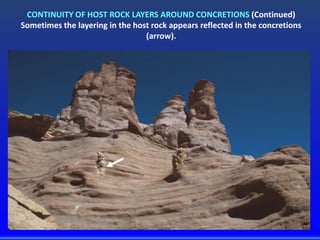
CONTINUITY OF HOST ROCK LAYERS AROUND CONCRETIONS (Continued)
Sometimes the layering in the host rock appears reflected in the concretions
(arrow).
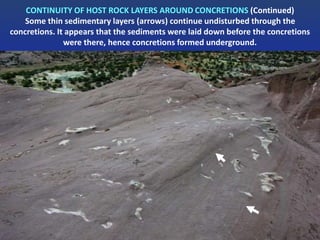
CONTINUITY OF HOST ROCK LAYERS AROUND CONCRETIONS (Continued)
Some thin sedimentary layers (arrows) continue undisturbed through the
concretions. It appears that the sediments were laid down before the concretions
were there, hence concretions formed underground.
DISTRIBUTION
The exposed concretions at Navajo Church
are concentrated on the east and west
shoulders, but are not in the same
sedimentary layers. Other similar
concretions are found at other levels. There
appear to be many more concretions than
the few now exposed.
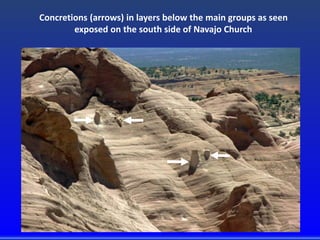
Concretions (arrows) in layers below the main groups as seen
exposed on the south side of Navajo Church
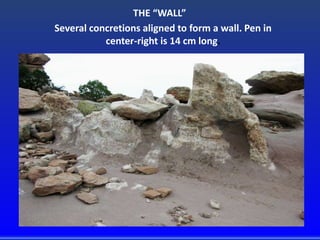
THE “WALL”
Several concretions aligned to form a wall. Pen in
center-right is 14 cm long.
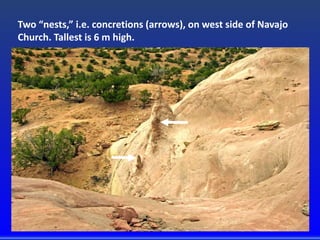
Two “nests,” i.e. concretions (arrows), on west side of Navajo
Church. Tallest is 6 m high.
MACROMORPHOLOGY
SIZE DISTRIBUTION
While there is a continuum of different sizes, the
concretions exposed at Navajo Church can be
generally classified into three groups.
Large, > 1 m high; about 6 samples exposed
Medium, 30 cm to 1m; about 180 samples
Small, < 30 cm high: > 2000 samples
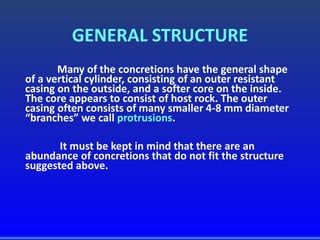
GENERAL STRUCTURE
Many of the concretions have the general shape
of a vertical cylinder, consisting of an outer resistant
casing on the outside, and a softer core on the inside.
The core appears to consist of host rock. The outer
casing often consists of many smaller 4-8 mm diameter
“branches” we call protrusions.
It must be kept in mind that there are an
abundance of concretions that do not fit the structure
suggested above.
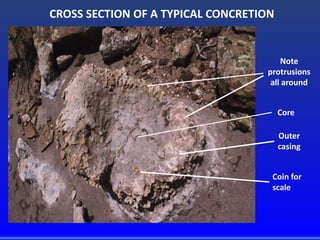
Note
protrusions
all around
Outer
casing
CROSS SECTION OF A TYPICAL CONCRETION
Coin for
scale
Core
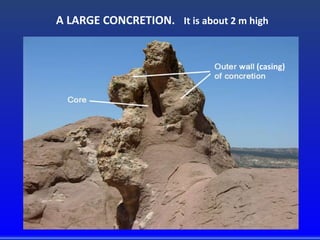
A LARGE CONCRETION. It is about 2 m high
(casing)
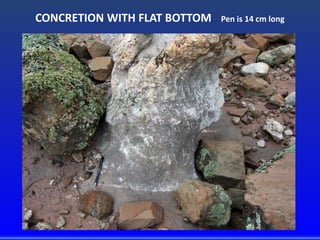
CONCRETION WITH FLAT BOTTOM. Pen is 14 cm long
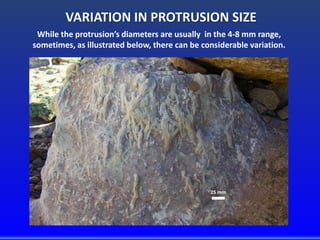
VARIATION IN PROTRUSION SIZE
While the protrusion’s diameters are usually in the 4-8 mm range,
sometimes, as illustrated below, there can be considerable variation.
25 mm
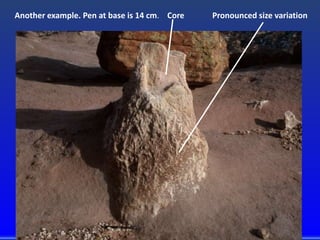
Another example. Pen at base is 14 cm. Core Pronounced size variation
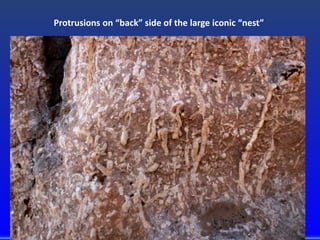
Protrusions on “back” side of the large iconic “nest”
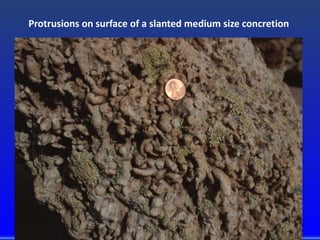
Protrusions on surface of a slanted medium size concretion
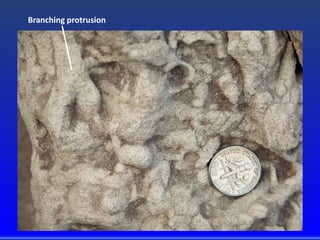
Branching protrusion
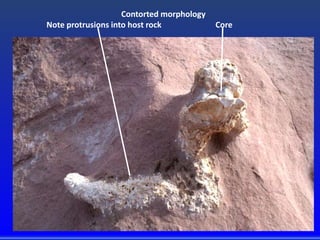
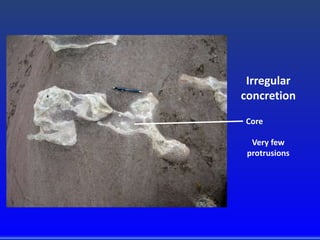
BIZARRE
MORPHOLOGY
While many concretions have a vertical
cylindrical shape, many others are very
different
Contorted morphology
Note protrusions into host rock Core
Irregular
concretion
Very few
protrusions
Core
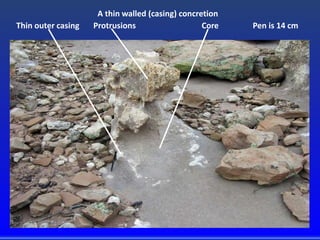
Thin outer casing Protrusions Core Pen is 14 cm
A thin walled (casing) concretion
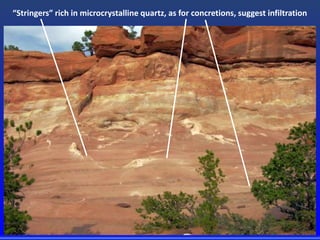
“Stringers” rich in microcrystalline quartz, as for concretions, suggest infiltration
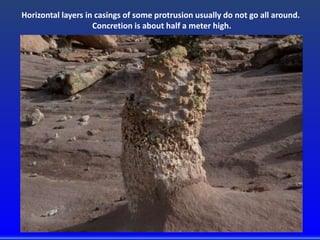
Horizontal layers in casings of some protrusion usually do not go all around.
Concretion is about half a meter high.
MICROMORPHOLOGY
Microscopic views of host rock and
concretions indicate a gradational
contact between the two, also more
cement in the concretions
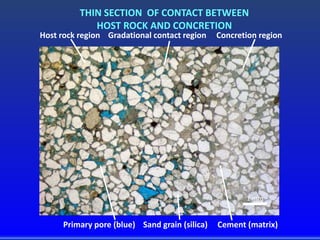
THIN SECTION OF CONTACT BETWEEN
HOST ROCK AND CONCRETION
1 mm
Host rock region Gradational contact region Concretion region
Primary pore (blue) Sand grain (silica) Cement (matrix)
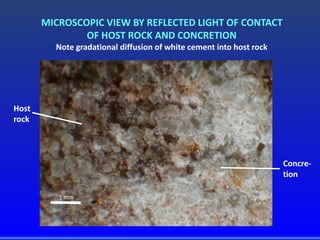
MICROSCOPIC VIEW BY REFLECTED LIGHT OF CONTACT
OF HOST ROCK AND CONCRETION
Note gradational diffusion of white cement into host rock
Concre-
tion
Host
rock
1 mm
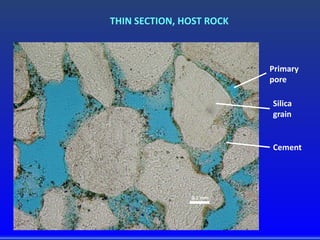
THIN SECTION, HOST ROCK
Primary
pore
Silica
grain
Cement
0.1 mm
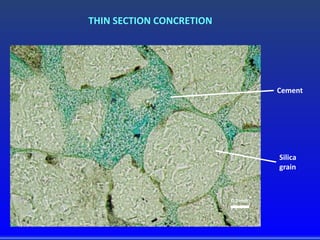
THIN SECTION CONCRETION
Cement
Silica
grain
0.1 mm
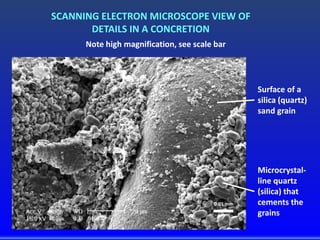
CEMENTATION
Cementation of the grains in the host rock consists
of several common minute minerals including
kaolinite, chlorite, smectite, and sparse
microcrystalline quartz.
Cementation in the concretions consists mainly of
dominant minute microcrystalline quartz crystals.
The next slides illustrate this.
SCANNING ELECTRON MICROSCOPE VIEW OF
DETAILS IN A CONCRETION
Note high magnification, see scale bar
0.01 mm
Surface of a
silica (quartz)
sand grain
Microcrystal-
line quartz
(silica) that
cements the
grains
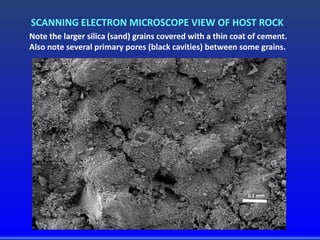
0.1 mm
SCANNING ELECTRON MICROSCOPE VIEW OF HOST ROCK
Note the larger silica (sand) grains covered with a thin coat of cement.
Also note several primary pores (black cavities) between some grains.
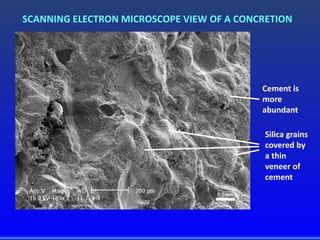
SCANNING ELECTRON MICROSCOPE VIEW OF A CONCRETION
Cement is
more
abundant
Silica grains
covered by
a thin
veneer of
cement
0.1mm
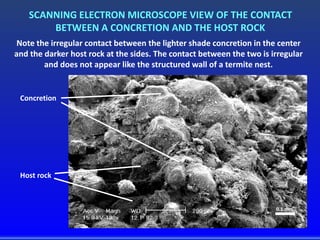
0.1 mm
Concretion
Host rock
SCANNING ELECTRON MICROSCOPE VIEW OF THE CONTACT
BETWEEN A CONCRETION AND THE HOST ROCK
Note the irregular contact between the lighter shade concretion in the center
and the darker host rock at the sides. The contact between the two is irregular
and does not appear like the structured wall of a termite nest.
QUANTITATIVE
STUDIES
The data provided above gives a general view of a usually
significant difference between the concretions and the host
rock. However, because of many observed variations, more
definitive quantitative conclusions were wanted.
Specific quantitative comparisons were obtained by
submitting multiple samples of host rocks and concretions to
quantitative determination of major elements using X-ray
Fluorescence; trace elements using Instrumental Neutron
Activation Analysis; and component concentration using
Point Count Analysis.
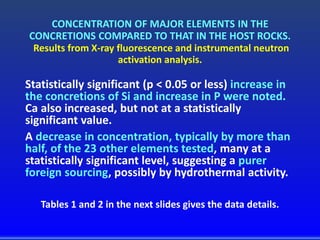
CONCENTRATION OF MAJOR ELEMENTS IN THE
CONCRETIONS COMPARED TO THAT IN THE HOST ROCKS.
Results from X-ray fluorescence and instrumental neutron
activation analysis.
Statistically significant (p < 0.05 or less) increase in
the concretions of Si and increase in P were noted.
Ca also increased, but not at a statistically
significant value.
A decrease in concentration, typically by more than
half, of the 23 other elements tested, many at a
statistically significant level, suggesting a purer
foreign sourcing, possibly by hydrothermal activity.
Tables 1 and 2 in the next slides gives the data details.
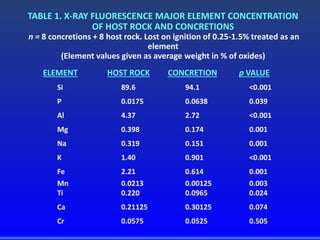
TABLE 1. X-RAY FLUORESCENCE MAJOR ELEMENT CONCENTRATION
OF HOST ROCK AND CONCRETIONS
n = 8 concretions + 8 host rock. Lost on ignition of 0.25-1.5% treated as an
element
(Element values given as average weight in % of oxides)
ELEMENT HOST ROCK CONCRETION p VALUE
Si 89.6 94.1 <0.001
P 0.0175 0.0638 0.039
Al 4.37 2.72 <0.001
Mg 0.398 0.174 0.001
Na 0.319 0.151 0.001
K 1.40 0.901 <0.001
Fe 2.21 0.614 0.001
Mn 0.0213 0.00125 0.003
Ti 0.220 0.0965 0.024
Ca 0.21125 0.30125 0.074
Cr 0.0575 0.0525 0.505
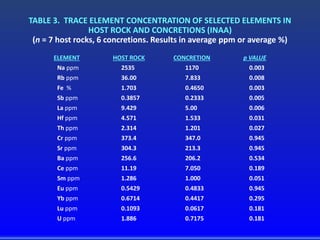
TABLE 3. TRACE ELEMENT CONCENTRATION OF SELECTED ELEMENTS IN
HOST ROCK AND CONCRETIONS (INAA)
(n = 7 host rocks, 6 concretions. Results in average ppm or average %)
ELEMENT HOST ROCK CONCRETION p VALUE
Na ppm 2535 1170 0.003
Rb ppm 36.00 7.833 0.008
Fe % 1.703 0.4650 0.003
Sb ppm 0.3857 0.2333 0.005
La ppm 9.429 5.00 0.006
Hf ppm 4.571 1.533 0.031
Th ppm 2.314 1.201 0.027
Cr ppm 373.4 347.0 0.945
Sr ppm 304.3 213.3 0.945
Ba ppm 256.6 206.2 0.534
Ce ppm 11.19 7.050 0.189
Sm ppm 1.286 1.000 0.051
Eu ppm 0.5429 0.4833 0.945
Yb ppm 0.6714 0.4417 0.295
Lu ppm 0.1093 0.0617 0.181
U ppm 1.886 0.7175 0.181
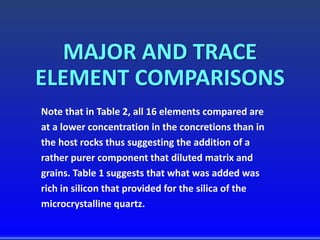
MAJOR AND TRACE
ELEMENT COMPARISONS
Note that in Table 2, all 16 elements compared are
at a lower concentration in the concretions than in
the host rocks thus suggesting the addition of a
rather purer component that diluted matrix and
grains. Table 1 suggests that what was added was
rich in silicon that provided for the silica of the
microcrystalline quartz.
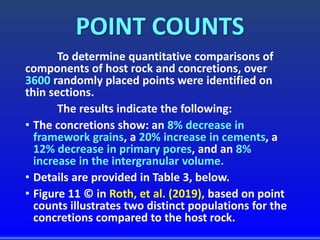
POINT COUNTS
To determine quantitative comparisons of
components of host rock and concretions, over
3600 randomly placed points were identified on
thin sections.
The results indicate the following:
• The concretions show: an 8% decrease in
framework grains, a 20% increase in cements, a
12% decrease in primary pores, and an 8%
increase in the intergranular volume.
• Details are provided in Table 3, below.
• Figure 11 © in Roth, et al. (2019), based on point
counts illustrates two distinct populations for the
concretions compared to the host rock.
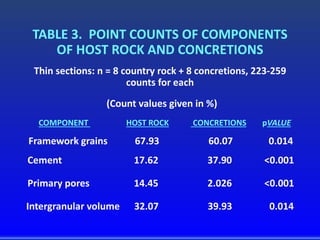
TABLE 3. POINT COUNTS OF COMPONENTS
OF HOST ROCK AND CONCRETIONS
Thin sections: n = 8 country rock + 8 concretions, 223-259
counts for each
(Count values given in %)
COMPONENT HOST ROCK CONCRETIONS pVALUE
Framework grains 67.93 60.07 0.014
Cement 17.62 37.90 <0.001
Primary pores 14.45 2.026 <0.001
Intergranular volume 32.07 39.93 0.014
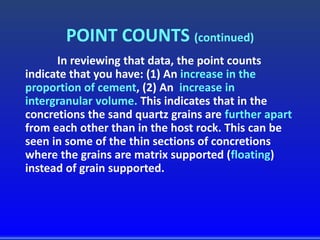
POINT COUNTS (continued)
In reviewing that data, the point counts
indicate that you have: (1) An increase in the
proportion of cement, (2) An increase in
intergranular volume. This indicates that in the
concretions the sand quartz grains are further apart
from each other than in the host rock. This can be
seen in some of the thin sections of concretions
where the grains are matrix supported (floating)
instead of grain supported.
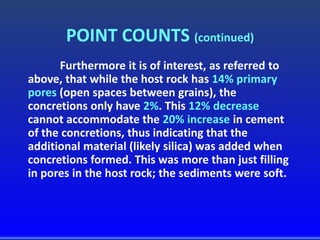
POINT COUNTS (continued)
Furthermore it is of interest, as referred to
above, that while the host rock has 14% primary
pores (open spaces between grains), the
concretions only have 2%. This 12% decrease
cannot accommodate the 20% increase in cement
of the concretions, thus indicating that the
additional material (likely silica) was added when
concretions formed. This was more than just filling
in pores in the host rock; the sediments were soft.
DISCUSSION
OTHER INTERPRETATIONS
There have been four other interpretations for these
concretions. All have serious problems.
• Saucier (1967), Condon and Peterson (1986), suggest
burrows. This interpretation suffers from lack of
consistency in protrusion diameters, and at the
microscopic level a lack of evidence of burrow walls
because the contacts are gradational. The chemical
element differences between host rock and concretions
are also difficult to reconcile with burrowing.
• Hasiotis (1997), mentions, but does not endorse, a
fulgurite (lightning) origin. But there is no evidence of any
fusion of minerals in the concretions.
OTHER INTERPRETATIONS (Continued)
• Hasiotis (1997), and Hasiotis et al. (1997), propose a
termite interpretation, but that view suffers from the
absence of fossil termites (a large termite nest can harbor
1,000,000 termites), a pronounced paucity of termite
chambers on the macromorphological level, and on the
microscopic level, a lack of wall delineation; the contacts
are gradational. Furthermore, if these were termite nests,
it is noteworthy that termites do not select specific
minerals (e.g. microcrystalline quartz) when making nests.
OTHER INTERPRETATIONS (Continued)
• Alonso-Zara et al. (2008), and Genise (2017),
propose a rhizolith origin, i.e. they come from
roots. Problems include the lack of root crowns at
top, absence of rootlet pores or casts in the
protrusion, and absence of a central root in the
homogenous cores of the concretions.
The sediments appear to have been
soft at time of formation of the
concretion
This is as expected for formation during or soon after
the Genesis Flood, before sediments were consolidated.
Significant evidence includes:
1. Increase in intergranular volume with even floating
grain distribution
2. Collapse of a concretion (See Fig. 5b © in Roth, et
al., 2019)
3. Lineation in concretions from sliding of sediments
Details follow
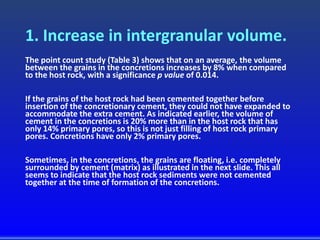
1. Increase in intergranular volume.
The point count study (Table 3) shows that on an average, the volume
between the grains in the concretions increases by 8% when compared
to the host rock, with a significance p value of 0.014.
If the grains of the host rock had been cemented together before
insertion of the concretionary cement, they could not have expanded to
accommodate the extra cement. As indicated earlier, the volume of
cement in the concretions is 20% more than in the host rock that has
only 14% primary pores, so this is not just filling of host rock primary
pores. Concretions have only 2% primary pores.
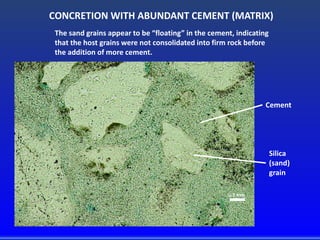
Sometimes, in the concretions, the grains are floating, i.e. completely
surrounded by cement (matrix) as illustrated in the next slide. This all
seems to indicate that the host rock sediments were not cemented
together at the time of formation of the concretions.
CONCRETION WITH ABUNDANT CEMENT (MATRIX)
The sand grains appear to be “floating” in the cement, indicating
that the host grains were not consolidated into firm rock before
the addition of more cement.
Cement
Silica
(sand)
grain
0.1 mm
2. Collapse of a concretion
Figure 5B © in the research report on this study in the journal
Sedimentary Geology [392 (2019) 105526], illustrates what appears to be
a collapsed concretion. The figure below is a general representation of
that figure.
This is a cross-section of a medium-sized concretion. Note the apparent
drift of the insides towards the upper side as indicated by the orientation
of the protrusions, and suggests soft sediment movement.
Casing of
concretion
Protrusion
S-shaped
protrusion
10 cm
5 mm
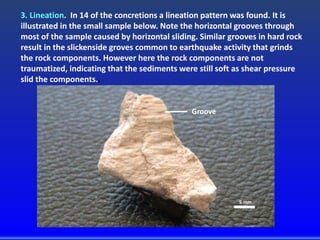
3. Lineation. In 14 of the concretions a lineation pattern was found. It is
illustrated in the small sample below. Note the horizontal grooves through
most of the sample caused by horizontal sliding. Similar grooves in hard rock
result in the slickenside groves common to earthquake activity that grinds
the rock components. However here the rock components are not
traumatized, indicating that the sediments were still soft as shear pressure
slid the components..
Groove
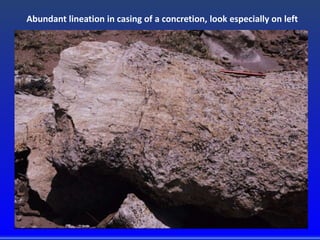
Abundant lineation in casing of a concretion, look especially on left
THE PROTRUSIONS
The protrusions are not common in most sediments, and are the
basis for the biological interpretations for these concretions (termites,
burrows, and roots). However, inorganic interpretations of these kinds of
structures have also been observed. Examples follow:
• Protrusions of the same diameter as at Navajo Church have been
described for deep sediments in the North Sea (Poulsom, 2006).
• There are many subtle cylindrical structures “protrusions” in the host
rocks at Navajo Church with 5-10 mm diameters (Roth et al., 2019).
• Experiments using fine glass beads as sediments, where one sediment
was injected into another, resulted in protrusions with diameters less
than 10 mm, but some nearly 1 m long (Ross et al., 2011).
• The next slides illustrate some protrusions from the Navajo Church
area in CaCO3 concretions, an entirely different kind of rock than the
SiO2 quartz (silica) of the concretions purported to be termite nests.
The protrusion on the carbonate concretions may be a proxy for the
protrusions of the siliceous concretions.
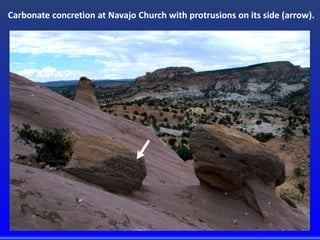
Carbonate concretion at Navajo Church with protrusions on its side (arrow).
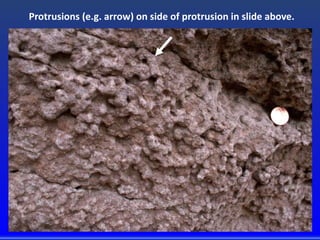
Protrusions (e.g. arrow) on side of protrusion in slide above.
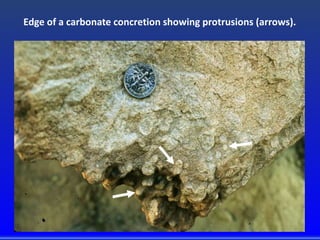
Edge of a carbonate concretion showing protrusions (arrows).
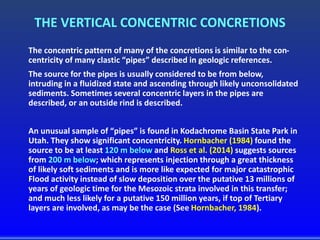
THE VERTICAL CONCENTRIC CONCRETIONS
The concentric pattern of many of the concretions is similar to the con-
centricity of many clastic “pipes” described in geologic references.
The source for the pipes is usually considered to be from below,
intruding in a fluidized state and ascending through likely unconsolidated
sediments. Sometimes several concentric layers in the pipes are
described, or an outside rind is described.
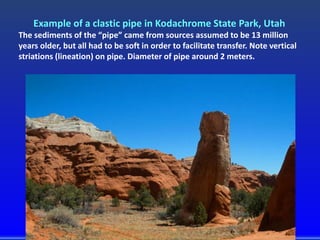
An unusual sample of “pipes” is found in Kodachrome Basin State Park in
Utah. They show significant concentricity. Hornbacher (1984) found the
source to be at least 120 m below and Ross et al. (2014) suggests sources
from 200 m below; which represents injection through a great thickness
of likely soft sediments and is more like expected for major catastrophic
Flood activity instead of slow deposition over the putative 13 millions of
years of geologic time for the Mesozoic strata involved in this transfer;
and much less likely for a putative 150 million years, if top of Tertiary
layers are involved, as may be the case (See Hornbacher, 1984).
Example of a clastic pipe in Kodachrome State Park, Utah
The sediments of the “pipe” came from sources assumed to be 13 million
years older, but all had to be soft in order to facilitate transfer. Note vertical
striations (lineation) on pipe. Diameter of pipe around 2 meters.
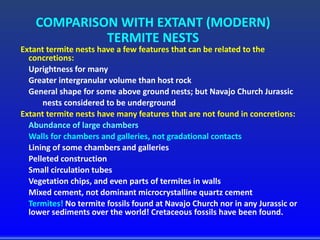
COMPARISON WITH EXTANT (MODERN)
TERMITE NESTS
Extant termite nests have a few features that can be related to the
concretions:
Uprightness for many
Greater intergranular volume than host rock
General shape for some above ground nests; but Navajo Church Jurassic
nests considered to be underground
Extant termite nests have many features that are not found in concretions:
Abundance of large chambers
Walls for chambers and galleries, not gradational contacts
Lining of some chambers and galleries
Pelleted construction
Small circulation tubes
Vegetation chips, and even parts of termites in walls
Mixed cement, not dominant microcrystalline quartz cement
Termites! No termite fossils found at Navajo Church nor in any Jurassic or
lower sediments over the world! Cretaceous fossils have been found.
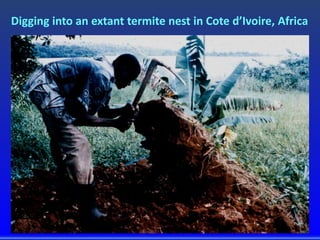
Digging into an extant termite nest in Cote d’Ivoire, Africa
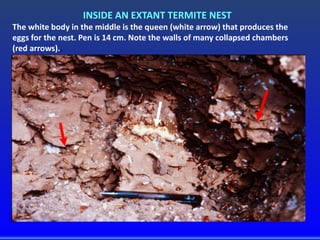
INSIDE AN EXTANT TERMITE NEST
The white body in the middle is the queen (white arrow) that produces the
eggs for the nest. Pen is 14 cm. Note the walls of many collapsed chambers
(red arrows)..
EXTANT TERMITE NESTS
ACTIVITY
• The queen can lay some 30,000 eggs per day, or 10
million in 10 years
• Workers and soldiers are blind.
• Macrotermite nests (large African nests) grow at
5-55 cm/yr.
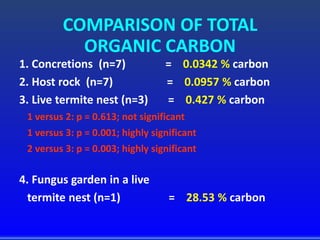
COMPARISON OF TOTAL
ORGANIC CARBON
1. Concretions (n=7) = 0.0342 % carbon
2. Host rock (n=7) = 0.0957 % carbon
3. Live termite nest (n=3) = 0.427 % carbon
1 versus 2: p = 0.613; not significant
1 versus 3: p = 0.001; highly significant
2 versus 3: p = 0.003; highly significant
4. Fungus garden in a live
termite nest (n=1) = 28.53 % carbon
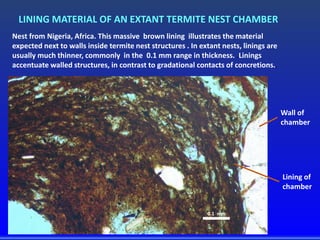
0.1 mm
Wall of
chamber
Lining of
chamber
LINING MATERIAL OF AN EXTANT TERMITE NEST CHAMBER
Nest from Nigeria, Africa. This massive brown lining illustrates the material
expected next to walls inside termite nest structures . In extant nests, linings are
usually much thinner, commonly in the 0.1 mm range in thickness. .Linings
accentuate walled structures, in contrast to gradational contacts of concretions..
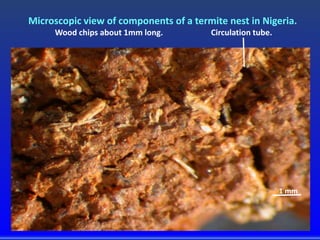
Microscopic view of components of a termite nest in Nigeria.
Wood chips about 1mm long. Circulation tube.
1 mm
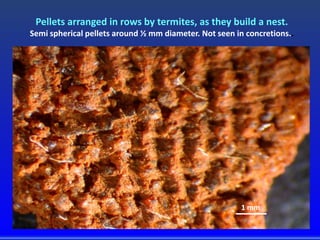
Pellets arranged in rows by termites, as they build a nest.
Semi spherical pellets around ½ mm diameter. Not seen in concretions..
1 mm
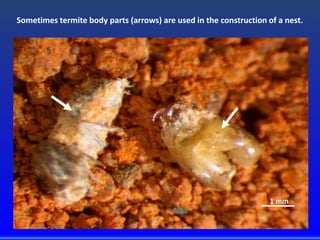
Sometimes termite body parts (arrows) are used in the construction of a nest.
1 mm
Hasiotis’ personal communication
to Roth, July 1, 2007
Agrees that mounds are not “fulgurites nor rhizoconcretions.”
Suggests are termite nests later replaced hydrothermally.
Found organic balls. [SEM by Roth shows random fungus
common]
The area of the nests is in the path of “uranium roll fronts and
other hydrological and hydrothermal activities.”
Suggests igneous activity following termite nests formation
resulting in present structures at Navajo Church.
Body fossils of termites and other social insects are rare to begin
with. This is underplayed by the opposing view.
“Please let’s keep in touch and maybe collaborate on some of
these structures to look at the cement histories in detail.”
PR0BLEMS WITH SECONDARY EMPLACEMENT
OF MICROCRYSTALINE QUARTZ INTO
PROPOSED TERMITE NESTS
1. Where are some original termite nests, or parts
thereof?
2. Where are the walls of the nest chambers and
galleries? The contacts are gradational.
3. Why would microcrystalline quartz form in the
outside walls (casing) of the nests, and inside the
passages (protrusions) and galleries, but not in the
cores? There is great confusion about the basic
structure of these so-called nests?
4. How was the original cement of the nests removed to
make room for the microcrystalline quartz?
Comment from other authors:
Alonso-Zarza AM, Genise JF, Cabrea MC, et al. 2008.
Megarhizoliths in Pleistocene aeolian deposits from Gran
Canaria (Spain). Paleogeography, Paleoclimatology,
Paleoecology 265:39-51.
“From eolian settings in the Jurassic Morrison Formation (USA),
Hasiotis (2004), (Fig. 23) recorded giant cylindrical structures that
resemble megarhizoliths. Regrettably, the description of the trace
fossils in that paper is too brief to allow any discussion regarding their
origin (Bromley et al., 2007). However, when analyzing the origin of
this type of structure, Roth et al. (2006) ruled out fulgurite and termite
nests because of the lack of any micro- or macromorphological
characters. A root origin was also considered problematic given the
classical morphologies used in comparisons, which as shown herein do
not cover the broad morphological range that root traces display.”
Comment by Roth: However, Morrison concretions are different.
Theirs are CaCO3 not SiO2.
LATER DISCUSSIONS:
Genise (2017) in his book ICHNEOENTOMOLOGY
refers to the Navajo Church concretions as roots.
A note to Roth, after the 2019 detailed publication
by Roth et al., indicates that Genise still believes
they are of root origin (rhizoconcretion).
STATEMENTS IN THE ARTICLE BY Roth et al. (2019)
IMPORTANT TO A FLOOD INTERPRETATION.
FROM THE ABSTRACT
“Macromorphological data and open grain packing indicate concretions
formed in unconsolidated sediments.” As expected during a flood.
FROM THE MAIN TEXT
“The host rock preserves an average of 14% large intergranular primary
pores compared to only 2% in concretions (Fig. 9B, D). This 12% decrease
is much lest than the 20% increase in concretion cement.” I.e., sediments
had to be soft to accommodate the excess cement.
(Continued on next slide)
STATEMENTS IN THE MAIN ARTICLE BY Roth et al. (2019)
IMPORTANT TO A FLOOD INTERPRETATION (Continued)
FROM THE MAIN TEXT
“Several lines of data indicate that the concretions were produced in
unconsolidated sediments. These include the preservation of high pre-
compaction levels of intergranular volumes and the dominance of
floating grain textures in the concretions. In 14 of the concretions, a
lineation pattern (slickensides) is present, but the grains appear intact.
This may indicate a record of differential compaction around early
cemented concretions. Although lineation is often attributed to shear
forces in hard rock, it is also observed in soft sediments such as soils … or
mudstones … . Any structural movement in the concretions would seem
more likely if the host sediments were not cemented. … A unique
example … also suggests unconsolidated host sediments and is probably
best explained as a collapsed concretion with fluid escape focused in one
direction and soft sediment deformation producing S-shaped
protrusions.”
STATEMENTS IN THE MAIN ARTICLE BY Roth et al. (2019)
IMPORTANT TO A FLOOD INTERPRETATION (Continued)
FROM THE “CONCLUSIONS”
“Petrographic observations show the silica is in the form of
microcrystalline quartz cement that was emplaced relatively
early, before compaction of the host rock. … Concentric
structures in some concretions may be explained by
diagenetic modification from basinal fluids or fluidized
sediment movement.”
PEER REVIEW PROCESS OF 2019 ARTICLE BY ROTH ET AL.
I.e. for: Complex siliceous concretions in the Jurassic Morison
Formation, Church Rock, New Mexico, USA: Implications of
inorganic factors in ichnological interpretations.
Sedimentary Geology 392, 2019 105526.
Only one minor scientific suggestion was made by one of the
three reviewers about the possibly that more than one kind
of organism may have been involved. However, another
reviewer made several hundred minor format and major
organization suggestions! Suggestions were generally
followed and the article was published.
CONCLUSIONS
A WORD OF CAUTION
This study challenges the iconic Navajo Church termite nests at
Navajo Church, but a number of other fossil termite nest findings,
with or without the evidence of fossil termite body parts, have
been reported in the scientific literature. That some of these
might represent more recent termite activity in older rocks is not
considered. Paleontologists, almost always, date fossils as that of
the putative geological ages of the host rock; but more recent
activity, such as the possibility of recent termite activity in older
rocks, is not considered. For instance if an ant nest built and
abandoned 50 years ago in Morrison sediments is discovered
later, the tendency would be to consider it as Jurassic in age. Also,
too often, odd structures in the fossil record are assigned to
termites without confirming evidence.
CONCLUSIONS
This study indicates that the siliceous concretions at Navajo Church
involve a source extraneous to the hosting rock. Gradational contacts
suggest infiltration activity.
The data also suggests that the concretions formed in unconsolidated
sediments as expected in flood activity such as the Genesis Flood.
This study also indicates that the siliceous concretions in the Jurassic
Morrison Formation do not seem to be termite nests, burrows,
fulgurites, or rhizoconcretions.
A confirming mechanism for structural details awaits further
investigation.
This investigation raises the broader question of what we can believe. It
underlines the need to dig deeper than usual to find what is true.
There are a lot of untested scientific statements that need reevaluation.
While few have time to repeat published research, we should at least
be cautious in accepting what respected scientific journals present as
fact.
ACKNOWLEDGEMENTS
Special gratitude is due to:
Kevin Nick for astute assistance in data and SEM analysis
Floyd Peterson for statistical evaluation
Tom Zoutwelle, and Dwight Hornbacher for persistent
field work and manuscript assistance
Ben Clausen for help in collecting extant African termite
nests
Nellie Begay for permission to collect small samples
Geoscience Research Institute for five research grants
USE PERMIT
Free unrevised use for personal and non-commercial
distribution of this material in its original publication medium
is granted and encouraged. Proper attribution should be
given. Permission for multiple printing for classroom use or
not-for-profit public meetings is also freely allowed.
In using this material in this format, accurate attribution
should be maintained for any illustrations where credit is
designated. Many illustrations are by the author and free use
is granted for all media. However, when credit to another
source is given, permission might be necessary from the
source for certain different kinds of communication media
than the present use.

FOSSIL TERMITES?

  • 1.
    THE STORY OF THEJURASSIC TERMITE NESTS Ariel A. Roth, 2022 www.sciencesandscriptures.com
  • 2.
    THE CONTROVERSY Fossil termitenests have been reported in the fossil record. The presence of these nests is presented as evidence challenging the biblical account of beginnings; specifically the one year Genesis Flood as the cause for much of the fossil record. The model of slow evolutionary development of life over millions of years provides the time necessary for the gradual growth of termite nests. On the other hand, the biblical account does not accommodate for these termite nests that take several years to be built. This is a time issue that engenders questions about the authenticity of these termite nests.
  • 3.
    Iconic putative Jurassictermite nest (arrow)
  • 4.
    WESTERN UNITED STATES The“nests” are located 5 miles east of Gallup, NM
  • 5.
    The putative nestsare concentrated on either side (arrows) of the Navajo Church spires in the Jurassic Morrison Formation
  • 6.
    AN EXTANT TERMITENEST FROM NIGERIA It takes 3-5 years to build a nest this size.
  • 7.
    RELATION TO GEOLOGICCOLUMN The proposed Jurassic fossil termite nests under discussion here lie in the middle of the Phanerozoic portion of the geologic layers, with abundant fossils above and below. In the next slide, they lie in the middle of the Mesozoic of the left column. In the middle column they lie at the same level. In the right column, they lie at the same level in the middle of the Genesis Flood. Note that the time scale for the middle column is in millions of years for evolution, while only in years for the right column for creation. Up and down distances not at the same scale.
  • 9.
    Suggested termite nests(arrows) on east side of Navajo Church, New Mexico. Tallest one is 2 meters high.
  • 10.
    Suggested termite nests,i.e. concretions (arrows), on west side of Navajo Church. Tallest ones, 1 meter high.
  • 11.
    There are manysmaller “nests,” white arrows. Pen, red arrow, is 14 cm long.
  • 12.
    DEEP INTEREST INTERMITES IN 1997 Interest was likely stimulated by an abstract presented that year at the Geological Society of America annual meeting, proposing that these intriguing structures were termite nests. The next few slides discuss this.
  • 13.
    SOME 1997 COMMENTSABOUT FOSSIL TERMITE NESTS Hasiotis, ST et al. 1997. GSA Abstracts A-461 “Enormous pillars … are interpreted as … subterranean termite nests in alluvial and eolian deposits … composed of thousands of simple and compound galleries … 0.15 to 0.5 cm in diameter … to “pan sized” chambers … preferentially preserved because of the organics used in their construction.” GSA Annual Meeting Press Release, 1997 Nests “… appear to reach 120 feet below the ground … some types of termites construct their nests around dead and dying tree stumps and root systems …” USA TODAY, Internet, updated 1998 (2000 download) “The insects used saliva, feces and partly digested wood to glue sand grains together … Their height may have served to protect the termites from carnivorous dinosaurs seeking high-protein snacks.”
  • 14.
    ACCEPTANCE OF FOSSILTERMITE NEST INTERPRETATION • Hasiotis is credited with discovering the world’s oldest crayfish fossil as well as the oldest bee, ant, and termite nests • Children’s Web pages talked about this • Interpretations of ancient ecosystems include these • The author of this presentation (Roth) has seen at least four anti-Biblical Flood web pages that present termite nests as evidence that most of the Phanerozoic part of the geologic column could not have been deposited during the Genesis Flood. • Course syllabi included these •
  • 15.
    Cover of ageology short course manual, advocating termite nests interpretation. The large iconic “nest” from Navajo Church is pictured on the cover..
  • 16.
    OF INTEREST: • Thereis a report of the “earliest” termite nests in the fossil record found in the Triassic Chinle Formation (Hasiotis and Dubiel, 1997). That formation lies below the Jurassic. However Labandeira (1998) suggests that this finding awaits confirmation, and Thorne, et al. (2000) state that this identification can be “dismissed with almost complete certainty.” Identification of fossil termite nests is too often subjective.
  • 17.
    WHY THIS STUDY? •In the late 1990s, there were discussions about time in the fossil record at meetings of the Biblical Research Institute Science Council (BRISCO) held in Loma Linda, CA. Some leading participants referred to fossil termite nests as evidence against a Genesis Flood interpretation of the fossil record. • Small termite nests, less than a meter in height can take several years to be built. It does not seem possible to grow significant termite nests during the year of the Genesis flood described in the Bible. • In 1997, in the halls of a Loma Linda University science department, there appeared a picture of a huge Jurassic fossil termite nest that would take years to be formed. Interest in fossil termite nests was growing. • Were fossil termite nests going to become a “Mecca” for those seeking to challenge the Genesis Flood, as was the case for the “superimposed” fossil forests of Yellowstone National Park whose total age seamed to far exceeds the constraints of biblical chronology?
  • 18.
    WHY THIS STUDY?(Continued) •When the author of this presentation (Roth), saw the posted picture, he immediately decided to investigate these structures and see if they were really termite nests. • Studies soon showed that the nests were not made of the same composition as the host rocks, while termites generally use host rock and local loose sediments to build their nests. Some other external source seemed involved. • At a later BRISCO meeting, a repeat suggestion that termite nests challenge the Genesis Flood was summarily dismissed by many. It did not appear that the termite nest interpretation was being generally accepted by this group. • The data showing the difference between the host rock and the purported termite nests was secured in the scientific literature in a GSA poster/abstract (Roth, et al., 2006), and in details in the peer reviewed journal, Sedimentary Geology (Roth, et al., 2019). Samples follow:
  • 19.
    Geol. Soc. Am.Abstr. Programs 38:7, 2006
  • 21.
    NOTE ABOUT TERMINOLOGYAND REFERENCES • The anomalous structures at Navajo Church have been identified as “termite nests” (Hasiotis et al. 1997). This new study uses the broader term “concretion” for designation. • A concretion is defined as “a hard solid mass formed by the local accumulation of matter, especially within the body or within a mass of sediment.” • References in this PowerPoint text are in the traditional author date text format. For complete references consult the comprehensive article: • Roth AA, Nick KE, Zoutwelle T, Hornbacher D. “Complex siliceous concretions in the Jurassic Morrison Formation, Church Rock, New Mexico, USA: Implications for inorganic factors in iconological interpretations ” Sedimentary Geology 392 (2019) 105526 https://doi.org/10.1016/j.sedgeo.2019.105526 .
  • 22.
    THE CONCRETIONS ARENOT EPIGENOUS • Epigenous refers to growing from a surface, like a tree grows up from the surface of the ground. • The concretions appear to have formed in the host sedimentary layers after they were laid down, not above them. • The sedimentary layers appear to be continuous around or even through the concretions, indicating that they were laid down before the concretions were present. • This implies that the concretions would not represent typical extant termite nest mounds built above the surface of the ground as now found in Africa. At best they would represent underground termite structures. But underground termites are not known to build vertical concentric cylindrical structures as these are. • The next few slides illustrate the continuity of the sedimentary layers next to the concretions.
  • 23.
    CONTINUITY OF THELAYERS AROUND THE CONCRETIONS The layers (arrows) appear undisturbed near the concretions, indicating the concretions were not there when the host sediments were laid down.
  • 24.
    Note parallel layers ofhost rock almost up to concretions indicating deposition before concretion emplacement CONTINUITY OF HOST ROCK LAYERS AROUND CONCRETIONS (Continued)
  • 25.
    CONTINUITY OF HOSTROCK LAYERS AROUND CONCRETIONS (Continued) Sometimes the layering in the host rock appears reflected in the concretions (arrow).
  • 26.
    CONTINUITY OF HOSTROCK LAYERS AROUND CONCRETIONS (Continued) Some thin sedimentary layers (arrows) continue undisturbed through the concretions. It appears that the sediments were laid down before the concretions were there, hence concretions formed underground.
  • 27.
    DISTRIBUTION The exposed concretionsat Navajo Church are concentrated on the east and west shoulders, but are not in the same sedimentary layers. Other similar concretions are found at other levels. There appear to be many more concretions than the few now exposed.
  • 28.
    Concretions (arrows) inlayers below the main groups as seen exposed on the south side of Navajo Church
  • 29.
    THE “WALL” Several concretionsaligned to form a wall. Pen in center-right is 14 cm long.
  • 30.
    Two “nests,” i.e.concretions (arrows), on west side of Navajo Church. Tallest is 6 m high.
  • 31.
  • 32.
    SIZE DISTRIBUTION While thereis a continuum of different sizes, the concretions exposed at Navajo Church can be generally classified into three groups. Large, > 1 m high; about 6 samples exposed Medium, 30 cm to 1m; about 180 samples Small, < 30 cm high: > 2000 samples
  • 33.
    GENERAL STRUCTURE Many ofthe concretions have the general shape of a vertical cylinder, consisting of an outer resistant casing on the outside, and a softer core on the inside. The core appears to consist of host rock. The outer casing often consists of many smaller 4-8 mm diameter “branches” we call protrusions. It must be kept in mind that there are an abundance of concretions that do not fit the structure suggested above.
  • 34.
    Note protrusions all around Outer casing CROSS SECTIONOF A TYPICAL CONCRETION Coin for scale Core
  • 35.
    A LARGE CONCRETION.It is about 2 m high (casing)
  • 36.
    CONCRETION WITH FLATBOTTOM. Pen is 14 cm long
  • 37.
    VARIATION IN PROTRUSIONSIZE While the protrusion’s diameters are usually in the 4-8 mm range, sometimes, as illustrated below, there can be considerable variation. 25 mm
  • 38.
    Another example. Penat base is 14 cm. Core Pronounced size variation
  • 39.
    Protrusions on “back”side of the large iconic “nest”
  • 40.
    Protrusions on surfaceof a slanted medium size concretion
  • 41.
  • 42.
    BIZARRE MORPHOLOGY While many concretionshave a vertical cylindrical shape, many others are very different
  • 43.
  • 44.
  • 45.
    Thin outer casingProtrusions Core Pen is 14 cm A thin walled (casing) concretion
  • 46.
    “Stringers” rich inmicrocrystalline quartz, as for concretions, suggest infiltration
  • 47.
    Horizontal layers incasings of some protrusion usually do not go all around. Concretion is about half a meter high.
  • 48.
    MICROMORPHOLOGY Microscopic views ofhost rock and concretions indicate a gradational contact between the two, also more cement in the concretions
  • 49.
    THIN SECTION OFCONTACT BETWEEN HOST ROCK AND CONCRETION 1 mm Host rock region Gradational contact region Concretion region Primary pore (blue) Sand grain (silica) Cement (matrix)
  • 50.
    MICROSCOPIC VIEW BYREFLECTED LIGHT OF CONTACT OF HOST ROCK AND CONCRETION Note gradational diffusion of white cement into host rock Concre- tion Host rock 1 mm
  • 51.
    THIN SECTION, HOSTROCK Primary pore Silica grain Cement 0.1 mm
  • 52.
  • 53.
    CEMENTATION Cementation of thegrains in the host rock consists of several common minute minerals including kaolinite, chlorite, smectite, and sparse microcrystalline quartz. Cementation in the concretions consists mainly of dominant minute microcrystalline quartz crystals. The next slides illustrate this.
  • 54.
    SCANNING ELECTRON MICROSCOPEVIEW OF DETAILS IN A CONCRETION Note high magnification, see scale bar 0.01 mm Surface of a silica (quartz) sand grain Microcrystal- line quartz (silica) that cements the grains
  • 55.
    0.1 mm SCANNING ELECTRONMICROSCOPE VIEW OF HOST ROCK Note the larger silica (sand) grains covered with a thin coat of cement. Also note several primary pores (black cavities) between some grains.
  • 56.
    SCANNING ELECTRON MICROSCOPEVIEW OF A CONCRETION Cement is more abundant Silica grains covered by a thin veneer of cement 0.1mm
  • 57.
    0.1 mm Concretion Host rock SCANNINGELECTRON MICROSCOPE VIEW OF THE CONTACT BETWEEN A CONCRETION AND THE HOST ROCK Note the irregular contact between the lighter shade concretion in the center and the darker host rock at the sides. The contact between the two is irregular and does not appear like the structured wall of a termite nest.
  • 58.
    QUANTITATIVE STUDIES The data providedabove gives a general view of a usually significant difference between the concretions and the host rock. However, because of many observed variations, more definitive quantitative conclusions were wanted. Specific quantitative comparisons were obtained by submitting multiple samples of host rocks and concretions to quantitative determination of major elements using X-ray Fluorescence; trace elements using Instrumental Neutron Activation Analysis; and component concentration using Point Count Analysis.
  • 59.
    CONCENTRATION OF MAJORELEMENTS IN THE CONCRETIONS COMPARED TO THAT IN THE HOST ROCKS. Results from X-ray fluorescence and instrumental neutron activation analysis. Statistically significant (p < 0.05 or less) increase in the concretions of Si and increase in P were noted. Ca also increased, but not at a statistically significant value. A decrease in concentration, typically by more than half, of the 23 other elements tested, many at a statistically significant level, suggesting a purer foreign sourcing, possibly by hydrothermal activity. Tables 1 and 2 in the next slides gives the data details.
  • 60.
    TABLE 1. X-RAYFLUORESCENCE MAJOR ELEMENT CONCENTRATION OF HOST ROCK AND CONCRETIONS n = 8 concretions + 8 host rock. Lost on ignition of 0.25-1.5% treated as an element (Element values given as average weight in % of oxides) ELEMENT HOST ROCK CONCRETION p VALUE Si 89.6 94.1 <0.001 P 0.0175 0.0638 0.039 Al 4.37 2.72 <0.001 Mg 0.398 0.174 0.001 Na 0.319 0.151 0.001 K 1.40 0.901 <0.001 Fe 2.21 0.614 0.001 Mn 0.0213 0.00125 0.003 Ti 0.220 0.0965 0.024 Ca 0.21125 0.30125 0.074 Cr 0.0575 0.0525 0.505
  • 61.
    TABLE 3. TRACEELEMENT CONCENTRATION OF SELECTED ELEMENTS IN HOST ROCK AND CONCRETIONS (INAA) (n = 7 host rocks, 6 concretions. Results in average ppm or average %) ELEMENT HOST ROCK CONCRETION p VALUE Na ppm 2535 1170 0.003 Rb ppm 36.00 7.833 0.008 Fe % 1.703 0.4650 0.003 Sb ppm 0.3857 0.2333 0.005 La ppm 9.429 5.00 0.006 Hf ppm 4.571 1.533 0.031 Th ppm 2.314 1.201 0.027 Cr ppm 373.4 347.0 0.945 Sr ppm 304.3 213.3 0.945 Ba ppm 256.6 206.2 0.534 Ce ppm 11.19 7.050 0.189 Sm ppm 1.286 1.000 0.051 Eu ppm 0.5429 0.4833 0.945 Yb ppm 0.6714 0.4417 0.295 Lu ppm 0.1093 0.0617 0.181 U ppm 1.886 0.7175 0.181
  • 62.
    MAJOR AND TRACE ELEMENTCOMPARISONS Note that in Table 2, all 16 elements compared are at a lower concentration in the concretions than in the host rocks thus suggesting the addition of a rather purer component that diluted matrix and grains. Table 1 suggests that what was added was rich in silicon that provided for the silica of the microcrystalline quartz.
  • 63.
    POINT COUNTS To determinequantitative comparisons of components of host rock and concretions, over 3600 randomly placed points were identified on thin sections. The results indicate the following: • The concretions show: an 8% decrease in framework grains, a 20% increase in cements, a 12% decrease in primary pores, and an 8% increase in the intergranular volume. • Details are provided in Table 3, below. • Figure 11 © in Roth, et al. (2019), based on point counts illustrates two distinct populations for the concretions compared to the host rock.
  • 64.
    TABLE 3. POINTCOUNTS OF COMPONENTS OF HOST ROCK AND CONCRETIONS Thin sections: n = 8 country rock + 8 concretions, 223-259 counts for each (Count values given in %) COMPONENT HOST ROCK CONCRETIONS pVALUE Framework grains 67.93 60.07 0.014 Cement 17.62 37.90 <0.001 Primary pores 14.45 2.026 <0.001 Intergranular volume 32.07 39.93 0.014
  • 65.
    POINT COUNTS (continued) Inreviewing that data, the point counts indicate that you have: (1) An increase in the proportion of cement, (2) An increase in intergranular volume. This indicates that in the concretions the sand quartz grains are further apart from each other than in the host rock. This can be seen in some of the thin sections of concretions where the grains are matrix supported (floating) instead of grain supported.
  • 66.
    POINT COUNTS (continued) Furthermoreit is of interest, as referred to above, that while the host rock has 14% primary pores (open spaces between grains), the concretions only have 2%. This 12% decrease cannot accommodate the 20% increase in cement of the concretions, thus indicating that the additional material (likely silica) was added when concretions formed. This was more than just filling in pores in the host rock; the sediments were soft.
  • 67.
  • 68.
    OTHER INTERPRETATIONS There havebeen four other interpretations for these concretions. All have serious problems. • Saucier (1967), Condon and Peterson (1986), suggest burrows. This interpretation suffers from lack of consistency in protrusion diameters, and at the microscopic level a lack of evidence of burrow walls because the contacts are gradational. The chemical element differences between host rock and concretions are also difficult to reconcile with burrowing. • Hasiotis (1997), mentions, but does not endorse, a fulgurite (lightning) origin. But there is no evidence of any fusion of minerals in the concretions.
  • 69.
    OTHER INTERPRETATIONS (Continued) •Hasiotis (1997), and Hasiotis et al. (1997), propose a termite interpretation, but that view suffers from the absence of fossil termites (a large termite nest can harbor 1,000,000 termites), a pronounced paucity of termite chambers on the macromorphological level, and on the microscopic level, a lack of wall delineation; the contacts are gradational. Furthermore, if these were termite nests, it is noteworthy that termites do not select specific minerals (e.g. microcrystalline quartz) when making nests.
  • 70.
    OTHER INTERPRETATIONS (Continued) •Alonso-Zara et al. (2008), and Genise (2017), propose a rhizolith origin, i.e. they come from roots. Problems include the lack of root crowns at top, absence of rootlet pores or casts in the protrusion, and absence of a central root in the homogenous cores of the concretions.
  • 71.
    The sediments appearto have been soft at time of formation of the concretion This is as expected for formation during or soon after the Genesis Flood, before sediments were consolidated. Significant evidence includes: 1. Increase in intergranular volume with even floating grain distribution 2. Collapse of a concretion (See Fig. 5b © in Roth, et al., 2019) 3. Lineation in concretions from sliding of sediments Details follow
  • 72.
    1. Increase inintergranular volume. The point count study (Table 3) shows that on an average, the volume between the grains in the concretions increases by 8% when compared to the host rock, with a significance p value of 0.014. If the grains of the host rock had been cemented together before insertion of the concretionary cement, they could not have expanded to accommodate the extra cement. As indicated earlier, the volume of cement in the concretions is 20% more than in the host rock that has only 14% primary pores, so this is not just filling of host rock primary pores. Concretions have only 2% primary pores. Sometimes, in the concretions, the grains are floating, i.e. completely surrounded by cement (matrix) as illustrated in the next slide. This all seems to indicate that the host rock sediments were not cemented together at the time of formation of the concretions.
  • 73.
    CONCRETION WITH ABUNDANTCEMENT (MATRIX) The sand grains appear to be “floating” in the cement, indicating that the host grains were not consolidated into firm rock before the addition of more cement. Cement Silica (sand) grain 0.1 mm
  • 74.
    2. Collapse ofa concretion Figure 5B © in the research report on this study in the journal Sedimentary Geology [392 (2019) 105526], illustrates what appears to be a collapsed concretion. The figure below is a general representation of that figure. This is a cross-section of a medium-sized concretion. Note the apparent drift of the insides towards the upper side as indicated by the orientation of the protrusions, and suggests soft sediment movement. Casing of concretion Protrusion S-shaped protrusion 10 cm
  • 75.
    5 mm 3. Lineation.In 14 of the concretions a lineation pattern was found. It is illustrated in the small sample below. Note the horizontal grooves through most of the sample caused by horizontal sliding. Similar grooves in hard rock result in the slickenside groves common to earthquake activity that grinds the rock components. However here the rock components are not traumatized, indicating that the sediments were still soft as shear pressure slid the components.. Groove
  • 76.
    Abundant lineation incasing of a concretion, look especially on left
  • 77.
    THE PROTRUSIONS The protrusionsare not common in most sediments, and are the basis for the biological interpretations for these concretions (termites, burrows, and roots). However, inorganic interpretations of these kinds of structures have also been observed. Examples follow: • Protrusions of the same diameter as at Navajo Church have been described for deep sediments in the North Sea (Poulsom, 2006). • There are many subtle cylindrical structures “protrusions” in the host rocks at Navajo Church with 5-10 mm diameters (Roth et al., 2019). • Experiments using fine glass beads as sediments, where one sediment was injected into another, resulted in protrusions with diameters less than 10 mm, but some nearly 1 m long (Ross et al., 2011). • The next slides illustrate some protrusions from the Navajo Church area in CaCO3 concretions, an entirely different kind of rock than the SiO2 quartz (silica) of the concretions purported to be termite nests. The protrusion on the carbonate concretions may be a proxy for the protrusions of the siliceous concretions.
  • 78.
    Carbonate concretion atNavajo Church with protrusions on its side (arrow).
  • 79.
    Protrusions (e.g. arrow)on side of protrusion in slide above.
  • 80.
    Edge of acarbonate concretion showing protrusions (arrows).
  • 81.
    THE VERTICAL CONCENTRICCONCRETIONS The concentric pattern of many of the concretions is similar to the con- centricity of many clastic “pipes” described in geologic references. The source for the pipes is usually considered to be from below, intruding in a fluidized state and ascending through likely unconsolidated sediments. Sometimes several concentric layers in the pipes are described, or an outside rind is described. An unusual sample of “pipes” is found in Kodachrome Basin State Park in Utah. They show significant concentricity. Hornbacher (1984) found the source to be at least 120 m below and Ross et al. (2014) suggests sources from 200 m below; which represents injection through a great thickness of likely soft sediments and is more like expected for major catastrophic Flood activity instead of slow deposition over the putative 13 millions of years of geologic time for the Mesozoic strata involved in this transfer; and much less likely for a putative 150 million years, if top of Tertiary layers are involved, as may be the case (See Hornbacher, 1984).
  • 82.
    Example of aclastic pipe in Kodachrome State Park, Utah The sediments of the “pipe” came from sources assumed to be 13 million years older, but all had to be soft in order to facilitate transfer. Note vertical striations (lineation) on pipe. Diameter of pipe around 2 meters.
  • 83.
    COMPARISON WITH EXTANT(MODERN) TERMITE NESTS Extant termite nests have a few features that can be related to the concretions: Uprightness for many Greater intergranular volume than host rock General shape for some above ground nests; but Navajo Church Jurassic nests considered to be underground Extant termite nests have many features that are not found in concretions: Abundance of large chambers Walls for chambers and galleries, not gradational contacts Lining of some chambers and galleries Pelleted construction Small circulation tubes Vegetation chips, and even parts of termites in walls Mixed cement, not dominant microcrystalline quartz cement Termites! No termite fossils found at Navajo Church nor in any Jurassic or lower sediments over the world! Cretaceous fossils have been found.
  • 84.
    Digging into anextant termite nest in Cote d’Ivoire, Africa
  • 85.
    INSIDE AN EXTANTTERMITE NEST The white body in the middle is the queen (white arrow) that produces the eggs for the nest. Pen is 14 cm. Note the walls of many collapsed chambers (red arrows)..
  • 86.
    EXTANT TERMITE NESTS ACTIVITY •The queen can lay some 30,000 eggs per day, or 10 million in 10 years • Workers and soldiers are blind. • Macrotermite nests (large African nests) grow at 5-55 cm/yr.
  • 87.
    COMPARISON OF TOTAL ORGANICCARBON 1. Concretions (n=7) = 0.0342 % carbon 2. Host rock (n=7) = 0.0957 % carbon 3. Live termite nest (n=3) = 0.427 % carbon 1 versus 2: p = 0.613; not significant 1 versus 3: p = 0.001; highly significant 2 versus 3: p = 0.003; highly significant 4. Fungus garden in a live termite nest (n=1) = 28.53 % carbon
  • 88.
    0.1 mm Wall of chamber Liningof chamber LINING MATERIAL OF AN EXTANT TERMITE NEST CHAMBER Nest from Nigeria, Africa. This massive brown lining illustrates the material expected next to walls inside termite nest structures . In extant nests, linings are usually much thinner, commonly in the 0.1 mm range in thickness. .Linings accentuate walled structures, in contrast to gradational contacts of concretions..
  • 89.
    Microscopic view ofcomponents of a termite nest in Nigeria. Wood chips about 1mm long. Circulation tube. 1 mm
  • 90.
    Pellets arranged inrows by termites, as they build a nest. Semi spherical pellets around ½ mm diameter. Not seen in concretions.. 1 mm
  • 91.
    Sometimes termite bodyparts (arrows) are used in the construction of a nest. 1 mm
  • 92.
    Hasiotis’ personal communication toRoth, July 1, 2007 Agrees that mounds are not “fulgurites nor rhizoconcretions.” Suggests are termite nests later replaced hydrothermally. Found organic balls. [SEM by Roth shows random fungus common] The area of the nests is in the path of “uranium roll fronts and other hydrological and hydrothermal activities.” Suggests igneous activity following termite nests formation resulting in present structures at Navajo Church. Body fossils of termites and other social insects are rare to begin with. This is underplayed by the opposing view. “Please let’s keep in touch and maybe collaborate on some of these structures to look at the cement histories in detail.”
  • 93.
    PR0BLEMS WITH SECONDARYEMPLACEMENT OF MICROCRYSTALINE QUARTZ INTO PROPOSED TERMITE NESTS 1. Where are some original termite nests, or parts thereof? 2. Where are the walls of the nest chambers and galleries? The contacts are gradational. 3. Why would microcrystalline quartz form in the outside walls (casing) of the nests, and inside the passages (protrusions) and galleries, but not in the cores? There is great confusion about the basic structure of these so-called nests? 4. How was the original cement of the nests removed to make room for the microcrystalline quartz?
  • 94.
    Comment from otherauthors: Alonso-Zarza AM, Genise JF, Cabrea MC, et al. 2008. Megarhizoliths in Pleistocene aeolian deposits from Gran Canaria (Spain). Paleogeography, Paleoclimatology, Paleoecology 265:39-51. “From eolian settings in the Jurassic Morrison Formation (USA), Hasiotis (2004), (Fig. 23) recorded giant cylindrical structures that resemble megarhizoliths. Regrettably, the description of the trace fossils in that paper is too brief to allow any discussion regarding their origin (Bromley et al., 2007). However, when analyzing the origin of this type of structure, Roth et al. (2006) ruled out fulgurite and termite nests because of the lack of any micro- or macromorphological characters. A root origin was also considered problematic given the classical morphologies used in comparisons, which as shown herein do not cover the broad morphological range that root traces display.” Comment by Roth: However, Morrison concretions are different. Theirs are CaCO3 not SiO2.
  • 95.
    LATER DISCUSSIONS: Genise (2017)in his book ICHNEOENTOMOLOGY refers to the Navajo Church concretions as roots. A note to Roth, after the 2019 detailed publication by Roth et al., indicates that Genise still believes they are of root origin (rhizoconcretion).
  • 96.
    STATEMENTS IN THEARTICLE BY Roth et al. (2019) IMPORTANT TO A FLOOD INTERPRETATION. FROM THE ABSTRACT “Macromorphological data and open grain packing indicate concretions formed in unconsolidated sediments.” As expected during a flood. FROM THE MAIN TEXT “The host rock preserves an average of 14% large intergranular primary pores compared to only 2% in concretions (Fig. 9B, D). This 12% decrease is much lest than the 20% increase in concretion cement.” I.e., sediments had to be soft to accommodate the excess cement. (Continued on next slide)
  • 97.
    STATEMENTS IN THEMAIN ARTICLE BY Roth et al. (2019) IMPORTANT TO A FLOOD INTERPRETATION (Continued) FROM THE MAIN TEXT “Several lines of data indicate that the concretions were produced in unconsolidated sediments. These include the preservation of high pre- compaction levels of intergranular volumes and the dominance of floating grain textures in the concretions. In 14 of the concretions, a lineation pattern (slickensides) is present, but the grains appear intact. This may indicate a record of differential compaction around early cemented concretions. Although lineation is often attributed to shear forces in hard rock, it is also observed in soft sediments such as soils … or mudstones … . Any structural movement in the concretions would seem more likely if the host sediments were not cemented. … A unique example … also suggests unconsolidated host sediments and is probably best explained as a collapsed concretion with fluid escape focused in one direction and soft sediment deformation producing S-shaped protrusions.”
  • 98.
    STATEMENTS IN THEMAIN ARTICLE BY Roth et al. (2019) IMPORTANT TO A FLOOD INTERPRETATION (Continued) FROM THE “CONCLUSIONS” “Petrographic observations show the silica is in the form of microcrystalline quartz cement that was emplaced relatively early, before compaction of the host rock. … Concentric structures in some concretions may be explained by diagenetic modification from basinal fluids or fluidized sediment movement.”
  • 99.
    PEER REVIEW PROCESSOF 2019 ARTICLE BY ROTH ET AL. I.e. for: Complex siliceous concretions in the Jurassic Morison Formation, Church Rock, New Mexico, USA: Implications of inorganic factors in ichnological interpretations. Sedimentary Geology 392, 2019 105526. Only one minor scientific suggestion was made by one of the three reviewers about the possibly that more than one kind of organism may have been involved. However, another reviewer made several hundred minor format and major organization suggestions! Suggestions were generally followed and the article was published.
  • 100.
  • 101.
    A WORD OFCAUTION This study challenges the iconic Navajo Church termite nests at Navajo Church, but a number of other fossil termite nest findings, with or without the evidence of fossil termite body parts, have been reported in the scientific literature. That some of these might represent more recent termite activity in older rocks is not considered. Paleontologists, almost always, date fossils as that of the putative geological ages of the host rock; but more recent activity, such as the possibility of recent termite activity in older rocks, is not considered. For instance if an ant nest built and abandoned 50 years ago in Morrison sediments is discovered later, the tendency would be to consider it as Jurassic in age. Also, too often, odd structures in the fossil record are assigned to termites without confirming evidence.
  • 102.
    CONCLUSIONS This study indicatesthat the siliceous concretions at Navajo Church involve a source extraneous to the hosting rock. Gradational contacts suggest infiltration activity. The data also suggests that the concretions formed in unconsolidated sediments as expected in flood activity such as the Genesis Flood. This study also indicates that the siliceous concretions in the Jurassic Morrison Formation do not seem to be termite nests, burrows, fulgurites, or rhizoconcretions. A confirming mechanism for structural details awaits further investigation. This investigation raises the broader question of what we can believe. It underlines the need to dig deeper than usual to find what is true. There are a lot of untested scientific statements that need reevaluation. While few have time to repeat published research, we should at least be cautious in accepting what respected scientific journals present as fact.
  • 103.
    ACKNOWLEDGEMENTS Special gratitude isdue to: Kevin Nick for astute assistance in data and SEM analysis Floyd Peterson for statistical evaluation Tom Zoutwelle, and Dwight Hornbacher for persistent field work and manuscript assistance Ben Clausen for help in collecting extant African termite nests Nellie Begay for permission to collect small samples Geoscience Research Institute for five research grants
  • 104.
    USE PERMIT Free unreviseduse for personal and non-commercial distribution of this material in its original publication medium is granted and encouraged. Proper attribution should be given. Permission for multiple printing for classroom use or not-for-profit public meetings is also freely allowed. In using this material in this format, accurate attribution should be maintained for any illustrations where credit is designated. Many illustrations are by the author and free use is granted for all media. However, when credit to another source is given, permission might be necessary from the source for certain different kinds of communication media than the present use.