WELCOME TO:
THE BIBLE
AND SCIENCE
Discussions about the great
controversy between creation
and evolution.
INTRODUCTION
This series of topics deals with the great intellectual
warfare going on between science and the Bible. Which is
true? The level of presentation is for the general reader,
not the specialist. The discussions presented are based on
study, research, nearly 200 articles, two books, and
hundreds of lectures given over the world by the author,
Ariel A. Roth, PhD, sciencesandscriptures.com. The date
for the current series is 2014.
The discussions use a PowerPoint format and are
presented as a series of slides including many illustrations.
The text is written especially to facilitate understanding of
the issues in the sciences versus Scriptures battle. Each
discussion is divided into several numbered sections listed
at the beginning as an outline.
INTRODUCTION
(Continued)
Questions and answers are provided at the end of each
discussion to highlight key concepts and facilitate
understanding of complicated concepts. Much can be
learned and reviewed by going through these questions and
answers.
Each discussion is intended to be an independent
rendition with rare duplication and/or reference to other
ones. However, the present series will be easier to follow if
the sequence is followed in numerical order. TITLES of all
the discussions are presented in the next two slides.
Further access through an INDEX and OUTLINES follow.
THE 17 MAIN DISCUSSIONS
1. A DEEP QUESTION: WHICH IS TRUE, SCIENCE OR
THE BIBLE?
2. WHERE DID LIFE COME FROM?
3. FROM COMPLEX TO MORE COMPLEX
4. DARWIN AND THE EYE: Part 1, The Variety of Eyes
5. DARWIN AND THE EYE: Part 2, Complex Eyes
6. THE FINE-TUNED UNIVERSE
7. THE GREAT TIME QUESTIONS: Part 1, Propositions
8. THE GREAT TIME QUESTIONS: Part 2, Questions about
a Recent Creation
9. THE GREAT TIME QUESTIONS: Part 3, Data Favoring a
Recent Creation
Continued on next slide
THE 17 MAIN DISCUSSIONS
Continued
10. FASCINATING FOSSILS
11. FOSSILS AND CREATION
12. PROBLEMS FOSSILS POSE FOR EVOLUTION: Part 1,
Fossil Gaps
13. PROBLEMS FOSSILS POSE FOR EVOLUTION: Part 2,
More Complications
14. THE ASTONISHING GENESIS FLOOD: Part 1,
Introduction
15. THE ASTONISHING GENESIS FLOOD: Part 2, Some
Evidence
16. THE ASTONISHING GENESIS FLOOD: Part 3, More
Evidence
17. IS SCIENCE IN TROUBLE?
ACCESS
To facilitate access, an INDEX of the main
topics discussed is provided in the next 15 slides.
This is followed by the CONTENT DETAILS
of the order of presentation for each of the 17
discussions as an outline of each. OUTLINES are
also provided at the beginning of each discussion.
The order of the QUESTIONS AND ANSWERS at
the end of each discussion follows the sequence of
the discussions.
Access to specific topics can be through the
TITLES of the discussions, the INDEX, or the
OUTLINE of each discussion.
INDEX
INDEX OF MAIN TOPICS
Number before the colon (:) is the DISCUSSION NUMBER; number after the
colon is the SECTION NUMBER within the designated discussion. No colon, or a
comma after a number, indicates the whole discussion applies.
A
Age of universe, of solar system, of life 7:2-7:4
Amino acids 2:3
Animal motility and the Flood 11:3b
Anthropic cosmological principle 6:6
Antony Flew, rejects atheism 2:7
Ark of Noah, was it large enough? 14:8
B
Bats, as a gap in the fossil record 12:3
Bible, rationality of 1:6
Biochemical pathways and evolution 2:6g
Butterfly-caterpillar and creation 3:5
Buoyancy of animals and the Flood 11:3c
INDEX OF MAIN TOPICS
C
Cambrian Explosion in fossil record 13:2c
Catastrophism, trend towards 14:5
Carbon-14 dating 8:2c, 9:2e
Caterpillar-butterfly and creation 3:5
Cells,
origin of 2:6h
origin of reproduction 2:6i
Chemical evolution,
description 2:5
ten problems of 2:6
Cladistics, description 3:7
Coal deposits and the Flood 15:2e
Code, genetic 2:3
Complex systems, examples 3:5
INDEX OF MAIN TOPICS
Coral reefs and time 8:2a
Creation,
as science 1:9
data favoring a recent 9:2
definition of basic concepts 1:3
explanations for fossil sequence 11:3
D
Darwin, Charles,
and the eye 4, 5
brief introduction 1:2
Data and interpretations, the difference 17:3
Data favoring a recent creation 9:2
Dinosaurs,
and the Flood 10:7
on the ark 10:7
with soft tissue 9:2f
Dinosaur-bird fossil 17:4
Disease and parasites 3:9
DNA 2:3, 2:6j
INDEX OF MAIN TOPICS
E
Ecological systems, incomplete 15:2d
Ecological zonation theory 11:3a
Egg and sperm 3:5
Electromagnetic force and gravity, relationship 6:5
Erosion rates too fast for geologic time 9:2a, 16:2b
Escherichia coli, molecular composition 2:3
Evolution,
as religion 1:9
defined 1:3
human, fossil intermediates 11:5
not enough time for 9:3, 11:5
rapid 13:2a
theistic 1:3, 11:6
Evolutionary changes in fossil record 13:2a
Evolutionary mechanism, search for 3:6
Evolutionary trees 12:4
Exclusiveness in science 17:5
Explosion, Cambrian 13:2c
INDEX OF MAIN TOPICS
Eye, 4, 5
common gene for 5:1
complexity of 5:1
evolution problems 4:4, 4:5, 5
evolution’s incomplete 5:2
independent evolution of different kinds 4:5
interdependent parts 5:1
inverted retina 5:3
scanning of Copilia 4:3
of trilobites 5:1
trochlea, pulley of 5:1
Eyes, 4, 5
focusing 4:2, 5:1
four optical systems 4:3
three relational problems for evolution 4:4
varieties of 4:2, 4:3
EZT, (ecological zonation theory) 11:3a
INDEX OF MAIN TOPICS
F
Fine-tuned universe, See also universe 6
responses to evidence for 6:6
Flat gaps in sediments, 16:2c
favor a recent creation 9:2d
Flew, Antony, rejects atheism 2:7
Flood (the Genesis Flood), 14, 15, 16
creation week and 14:4
coal deposits of 15:2e
endurance of continents 16:2b
evidence for 15, 16
extent 14:2
flat gaps 16:2c
incomplete ecological systems and 15:2d
legends 14:3
marine sediments on continents 15:2a
models 14:7
paraconformities 16:2c
INDEX OF MAIN TOPICS
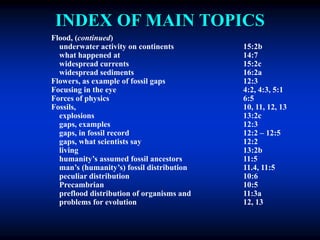
Flood, (continued)
underwater activity on continents 15:2b
what happened at 14:7
widespread currents 15:2c
widespread sediments 16:2a
Flowers, as example of fossil gaps 12:3
Focusing in the eye 4:2, 4:3, 5:1
Forces of physics 6:5
Fossils, 10, 11, 12, 13
explosions 13:2c
gaps, examples 12:3
gaps, in fossil record 12:2 – 12:5
gaps, what scientists say 12:2
living 13:2b
humanity’s assumed fossil ancestors 11:5
man’s (humanity’s) fossil distribution 11.4, 11:5
peculiar distribution 10:6
Precambrian 10:5
preflood distribution of organisms and 11:3a
problems for evolution 12, 13
INDEX OF MAIN TOPICS
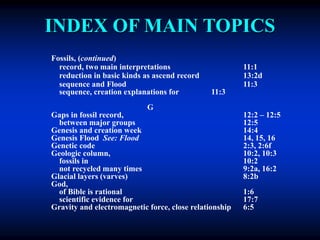
Fossils, (continued)
record, two main interpretations 11:1
reduction in basic kinds as ascend record 13:2d
sequence and Flood 11:3
sequence, creation explanations for 11:3
G
Gaps in fossil record, 12:2 – 12:5
between major groups 12:5
Genesis and creation week 14:4
Genesis Flood See: Flood 14, 15, 16
Genetic code 2:3, 2:6f
Geologic column, 10:2, 10:3
fossils in 10:2
not recycled many times 9:2a, 16:2
Glacial layers (varves) 8:2b
God,
of Bible is rational 1:6
scientific evidence for 17:7
Gravity and electromagnetic force, close relationship 6:5
INDEX OF MAIN TOPICS
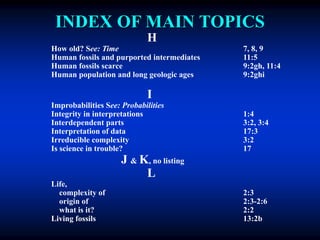
H
How old? See: Time 7, 8, 9
Human fossils and purported intermediates 11:5
Human fossils scarce 9:2gh, 11:4
Human population and long geologic ages 9:2ghi
I
Improbabilities See: Probabilities
Integrity in interpretations 1:4
Interdependent parts 3:2, 3:4
Interpretation of data 17:3
Irreducible complexity 3:2
Is science in trouble? 17
J & K, no listing
L
Life,
complexity of 2:3
origin of 2:3-2:6
what is it? 2:2
Living fossils 13:2b
INDEX OF MAIN TOPICS
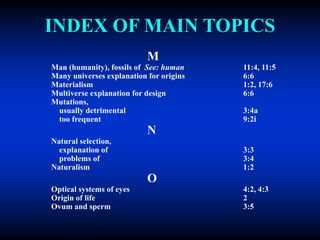
M
Man (humanity), fossils of See: human 11:4, 11:5
Many universes explanation for origins 6:6
Materialism 1:2, 17:6
Multiverse explanation for design 6:6
Mutations,
usually detrimental 3:4a
too frequent 9:2i
N
Natural selection,
explanation of 3:3
problems of 3:4
Naturalism 1:2
O
Optical systems of eyes 4:2, 4:3
Origin of life 2
Ovum and sperm 3:5
INDEX OF MAIN TOPICS
P
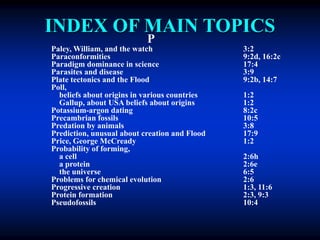
Paley, William, and the watch 3:2
Paraconformities 9:2d, 16:2c
Paradigm dominance in science 17:4
Parasites and disease 3:9
Plate tectonics and the Flood 9:2b, 14:7
Poll,
beliefs about origins in various countries 1:2
Gallup, about USA beliefs about origins 1:2
Potassium-argon dating 8:2c
Precambrian fossils 10:5
Predation by animals 3:8
Prediction, unusual about creation and Flood 17:9
Price, George McCready 1:2
Probability of forming,
a cell 2:6h
a protein 2:6e
the universe 6:5
Problems for chemical evolution 2:6
Progressive creation 1:3, 11:6
Protein formation 2:3, 9:3
Pseudofossils 10:4
INDEX OF MAIN TOPICS
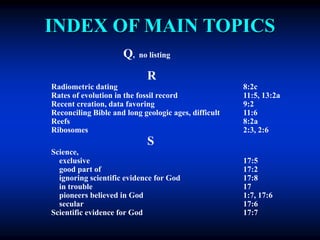
Q, no listing
R
Radiometric dating 8:2c
Rates of evolution in the fossil record 11:5, 13:2a
Recent creation, data favoring 9:2
Reconciling Bible and long geologic ages, difficult 11:6
Reefs 8:2a
Ribosomes 2:3, 2:6
S
Science,
exclusive 17:5
good part of 17:2
ignoring scientific evidence for God 17:8
in trouble 17
pioneers believed in God 1:7, 17:6
secular 17:6
Scientific evidence for God 17:7
INDEX OF MAIN TOPICS
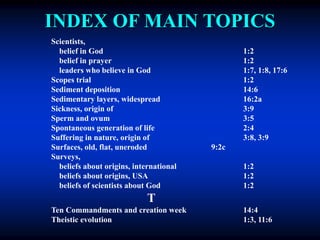
Scientists,
belief in God 1:2
belief in prayer 1:2
leaders who believe in God 1:7, 1:8, 17:6
Scopes trial 1:2
Sediment deposition 14:6
Sedimentary layers, widespread 16:2a
Sickness, origin of 3:9
Sperm and ovum 3:5
Spontaneous generation of life 2:4
Suffering in nature, origin of 3:8, 3:9
Surfaces, old, flat, uneroded 9:2c
Surveys,
beliefs about origins, international 1:2
beliefs about origins, USA 1:2
beliefs of scientists about God 1:2
T
Ten Commandments and creation week 14:4
Theistic evolution 1:3, 11:6
INDEX OF MAIN TOPICS
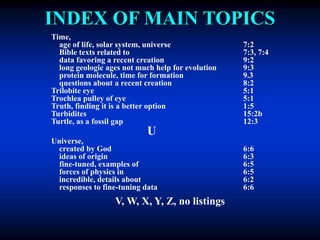
Time,
age of life, solar system, universe 7:2
Bible texts related to 7:3, 7:4
data favoring a recent creation 9:2
long geologic ages not much help for evolution 9:3
protein molecule, time for formation 9.3
questions about a recent creation 8:2
Trilobite eye 5:1
Trochlea pulley of eye 5:1
Truth, finding it is a better option 1:5
Turbidites 15:2b
Turtle, as a fossil gap 12:3
U
Universe,
created by God 6:6
ideas of origin 6:3
fine-tuned, examples of 6:5
forces of physics in 6:5
incredible, details about 6:2
responses to fine-tuning data 6:6
V, W, X, Y, Z, no listings
CONTENTS
OF EACH
DISCUSSION
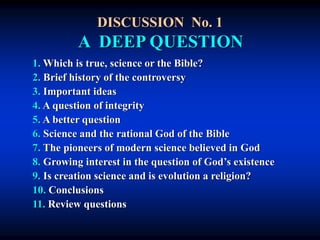
DISCUSSION No. 1
A DEEP QUESTION
1. Which is true, science or the Bible?
2. Brief history of the controversy
3. Important ideas
4. A question of integrity
5. A better question
6. Science and the rational God of the Bible
7. The pioneers of modern science believed in God
8. Growing interest in the question of God’s existence
9. Is creation science and is evolution a religion?
10. Conclusions
11. Review questions
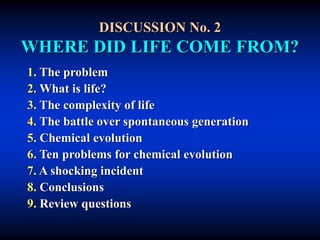
DISCUSSION No. 2
WHERE DID LIFE COME FROM?
1. The problem
2. What is life?
3. The complexity of life
4. The battle over spontaneous generation
5. Chemical evolution
6. Ten problems for chemical evolution
7. A shocking incident
8. Conclusions
9. Review questions
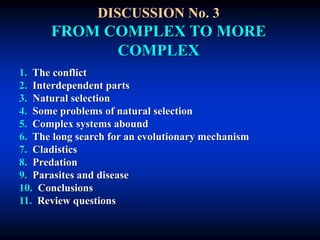
DISCUSSION No. 3
FROM COMPLEX TO MORE
COMPLEX
1. The conflict
2. Interdependent parts
3. Natural selection
4. Some problems of natural selection
5. Complex systems abound
6. The long search for an evolutionary mechanism
7. Cladistics
8. Predation
9. Parasites and disease
10. Conclusions
11. Review questions
DISCUSSION 4
DARWIN AND THE EYE:
Part 1, The Variety of Eyes
1. The eye problem
2. Variety of eyes
3. Four optical systems
4. Three problems the variety of eyes poses for
evolution
5. The evolution solution
6. Conclusions
7. Review questions
DISCUSSION 5
DARWIN AND THE EYE:
Part 2, Complex Eyes
1. Complexity of eyes: Special
and interdependent parts
2. Evolution’s incomplete eye
3. The inverted retina: It works
very well
4. Conclusions
5. Review questions
DISCUSSION 6
THE FINE-TUNED UNIVERSE
1. The question
2. The incredible universe
3. Ideas about the origin of the universe
4. What is the universe made of?
5. Examples of fine-tuning
6. Responses to the fine-tuned universe
7. Conclusions
8. Review questions
DISCUSSION 7
THE GREAT TIME QUESTIONS:
Part 1, Propositions
1. Introduction: The questions
2. How old is the earth, the solar system,
the universe?
3. The Bible texts
4. Interpretations of the Bible texts
5. Conclusions
6. Review questions
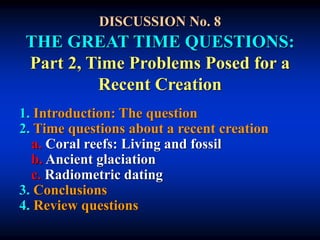
DISCUSSION No. 8
THE GREAT TIME QUESTIONS:
Part 2, Time Problems Posed for a
Recent Creation
1. Introduction: The question
2. Time questions about a recent creation
a. Coral reefs: Living and fossil
b. Ancient glaciation
c. Radiometric dating
3. Conclusions
4. Review questions
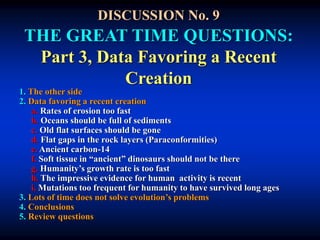
DISCUSSION No. 9
THE GREAT TIME QUESTIONS:
Part 3, Data Favoring a Recent
Creation
1. The other side
2. Data favoring a recent creation
a. Rates of erosion too fast
b. Oceans should be full of sediments
c. Old flat surfaces should be gone
d. Flat gaps in the rock layers (Paraconformities)
e. Ancient carbon-14
f. Soft tissue in “ancient” dinosaurs should not be there
g. Humanity’s growth rate is too fast
h. The impressive evidence for human activity is recent
i. Mutations too frequent for humanity to have survived long ages
3. Lots of time does not solve evolution’s problems
4. Conclusions
5. Review questions
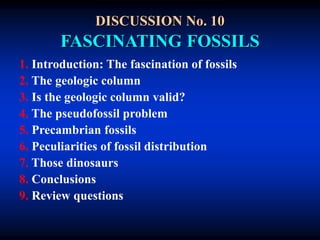
DISCUSSION No. 10
FASCINATING FOSSILS
1. Introduction: The fascination of fossils
2. The geologic column
3. Is the geologic column valid?
4. The pseudofossil problem
5. Precambrian fossils
6. Peculiarities of fossil distribution
7. Those dinosaurs
8. Conclusions
9. Review questions
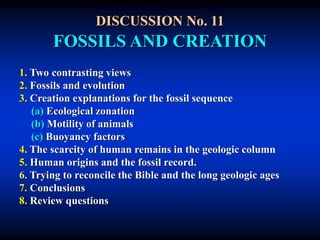
DISCUSSION No. 11
FOSSILS AND CREATION
1. Two contrasting views
2. Fossils and evolution
3. Creation explanations for the fossil sequence
(a) Ecological zonation
(b) Motility of animals
(c) Buoyancy factors
4. The scarcity of human remains in the geologic column
5. Human origins and the fossil record.
6. Trying to reconcile the Bible and the long geologic ages
7. Conclusions
8. Review questions
DISCUSSION No. 12
PROBLEMS FOSSILS POSE FOR EVOLUTION:
Part 1, Fossil Gaps
1. Introduction: fossils, a key factor
2. What some scientists say
3. Examples of gaps
4. Evolutionary trees
5. The gaps are between major groups
6. Conclusions
7. Review questions
DISCUSSION No. 13
PROBLEMS FOSSILS POSE FOR EVOLUTION:
Part 2, More Complications
1. INTRODUCTION
2. MORE COMPLICATIONS
a. Rates of evolutionary change and the fossils
b. Living fossils
c. The Cambrian Explosion and other explosions
d. Reduction in basic kinds as one ascends the
geologic column
3. CONCLUSIONS
4. REVIEW QUESTIONS
DISCUSSION No. 14
THE ASTONISHING GENESIS FLOOD:
Part 1, Introduction
1. The conflict
2. Extent of the Genesis Flood
3. Flood legends
4. The Flood and creation week
5. Things can happen rapidly: Catastrophism
6. Sediment deposition
7. What happened at the Flood?
8. Was the ark large enough?
9. Conclusions
10. Review questions
DISCUSSION No. 15
THE ASTONISHING GENESIS FLOOD:
Part 2, Some Evidence
1. INTRODUCTORY COMMENT
2. SOME EVIDENCE
a. Abundant marine sediments on the
continents
b. Abundant underwater activity
c. Continent-wide direction of currents
d. Incomplete ecological systems
e. Unusual coal deposits
3. CONCLUSIONS
4. REVIEW QUESTIONS
DISCUSSION No. 16
THE ASTONISHING GENESIS FLOOD:
Part 3, More Evidence
1. INTRODUCTION
2. MORE EVIDENCE
a. Unusually widespread sedimentary deposits
b. Rates of erosion of continents too fast
c. Paraconformities: Lack of erosion at flat gaps in
sediments
3. CONCLUSIONS
4. REVIEW QUESTIONS
DISCUSSION No. 17
IS SCIENCE IN TROUBLE?
1. The problem
2. The good part of science
3. The difference between data and interpretation
4. Paradigm dominance in science
5. Exclusiveness in science
6. Secularism in science
7. The scientific evidence for God
8. Can scientists ignore the scientific evidence for God?
9. An unusual prediction
10. Conclusions about: Is Science in Trouble?
11. General conclusions for all the discussions
12. Review questions for: Is Science in Trouble?
ADDITIONAL REFERENCES
For further discussions by the author (Ariel A. Roth) and many additional references, see the
author’s books titled:
1. ORIGINS: LINKING SCIENCE AND SCRIPTURE. Hagerstown, MD. Review and
Herald Publishing Association.
2. SCIENCE DISCOVERS GOD: Seven Convincing Lines of Evidence for His Existence.
Hagerstown, MD. Autumn House Publishing, an imprint of Review and Herald
Publishing Association.
Additional information is available on the author’s Web Page: Sciences and Scriptures.
www.sciencesandscriptures.com. Also see many articles published by the author and
others in the journal ORIGINS which the author edited for 23 years. For access see the
Web Page of the Geoscience Research Institute www.grisda.org.
Highly Recommended URLs are:
Earth History Research Center http://origins.swau.edu
Theological Crossroads www.theox.org
Sean Pitman www.detectingdesign.com
Scientific Theology www.scientifictheology.com
Geoscience Research Institute www.grisda.org
Ariel A. Roth web page: www.sciencesandscriptures.com
Other Web Pages providing a variety of related answers are: Creation-Evolution Headlines,
Creation Ministries International, Institute for Creation Research, and Answers in
Genesis.
USE PERMIT
Free unrevised use for personal and non-commercial
distribution of this material in its original publication
medium is granted and encouraged. Proper attribution
should be given. Permission for multiple printing for
classroom use or not-for-profit public meetings is also
freely allowed.
In using this material in this format, accurate
attribution should be maintained for any illustrations
where credit is designated. Many illustrations are by the
author and free use is granted for all media. However,
when credit to another source is given, permission might
be necessary from the source for certain different kinds of
communication media than the present use.

0. INTRODUCTION

  • 1.
    WELCOME TO: THE BIBLE ANDSCIENCE Discussions about the great controversy between creation and evolution.
  • 2.
    INTRODUCTION This series oftopics deals with the great intellectual warfare going on between science and the Bible. Which is true? The level of presentation is for the general reader, not the specialist. The discussions presented are based on study, research, nearly 200 articles, two books, and hundreds of lectures given over the world by the author, Ariel A. Roth, PhD, sciencesandscriptures.com. The date for the current series is 2014. The discussions use a PowerPoint format and are presented as a series of slides including many illustrations. The text is written especially to facilitate understanding of the issues in the sciences versus Scriptures battle. Each discussion is divided into several numbered sections listed at the beginning as an outline.
  • 3.
    INTRODUCTION (Continued) Questions and answersare provided at the end of each discussion to highlight key concepts and facilitate understanding of complicated concepts. Much can be learned and reviewed by going through these questions and answers. Each discussion is intended to be an independent rendition with rare duplication and/or reference to other ones. However, the present series will be easier to follow if the sequence is followed in numerical order. TITLES of all the discussions are presented in the next two slides. Further access through an INDEX and OUTLINES follow.
  • 4.
    THE 17 MAINDISCUSSIONS 1. A DEEP QUESTION: WHICH IS TRUE, SCIENCE OR THE BIBLE? 2. WHERE DID LIFE COME FROM? 3. FROM COMPLEX TO MORE COMPLEX 4. DARWIN AND THE EYE: Part 1, The Variety of Eyes 5. DARWIN AND THE EYE: Part 2, Complex Eyes 6. THE FINE-TUNED UNIVERSE 7. THE GREAT TIME QUESTIONS: Part 1, Propositions 8. THE GREAT TIME QUESTIONS: Part 2, Questions about a Recent Creation 9. THE GREAT TIME QUESTIONS: Part 3, Data Favoring a Recent Creation Continued on next slide
  • 5.
    THE 17 MAINDISCUSSIONS Continued 10. FASCINATING FOSSILS 11. FOSSILS AND CREATION 12. PROBLEMS FOSSILS POSE FOR EVOLUTION: Part 1, Fossil Gaps 13. PROBLEMS FOSSILS POSE FOR EVOLUTION: Part 2, More Complications 14. THE ASTONISHING GENESIS FLOOD: Part 1, Introduction 15. THE ASTONISHING GENESIS FLOOD: Part 2, Some Evidence 16. THE ASTONISHING GENESIS FLOOD: Part 3, More Evidence 17. IS SCIENCE IN TROUBLE?
  • 6.
    ACCESS To facilitate access,an INDEX of the main topics discussed is provided in the next 15 slides. This is followed by the CONTENT DETAILS of the order of presentation for each of the 17 discussions as an outline of each. OUTLINES are also provided at the beginning of each discussion. The order of the QUESTIONS AND ANSWERS at the end of each discussion follows the sequence of the discussions. Access to specific topics can be through the TITLES of the discussions, the INDEX, or the OUTLINE of each discussion.
  • 7.
  • 8.
    INDEX OF MAINTOPICS Number before the colon (:) is the DISCUSSION NUMBER; number after the colon is the SECTION NUMBER within the designated discussion. No colon, or a comma after a number, indicates the whole discussion applies. A Age of universe, of solar system, of life 7:2-7:4 Amino acids 2:3 Animal motility and the Flood 11:3b Anthropic cosmological principle 6:6 Antony Flew, rejects atheism 2:7 Ark of Noah, was it large enough? 14:8 B Bats, as a gap in the fossil record 12:3 Bible, rationality of 1:6 Biochemical pathways and evolution 2:6g Butterfly-caterpillar and creation 3:5 Buoyancy of animals and the Flood 11:3c
  • 9.
    INDEX OF MAINTOPICS C Cambrian Explosion in fossil record 13:2c Catastrophism, trend towards 14:5 Carbon-14 dating 8:2c, 9:2e Caterpillar-butterfly and creation 3:5 Cells, origin of 2:6h origin of reproduction 2:6i Chemical evolution, description 2:5 ten problems of 2:6 Cladistics, description 3:7 Coal deposits and the Flood 15:2e Code, genetic 2:3 Complex systems, examples 3:5
  • 10.
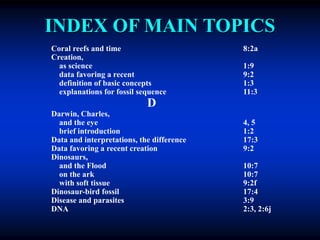
    INDEX OF MAINTOPICS Coral reefs and time 8:2a Creation, as science 1:9 data favoring a recent 9:2 definition of basic concepts 1:3 explanations for fossil sequence 11:3 D Darwin, Charles, and the eye 4, 5 brief introduction 1:2 Data and interpretations, the difference 17:3 Data favoring a recent creation 9:2 Dinosaurs, and the Flood 10:7 on the ark 10:7 with soft tissue 9:2f Dinosaur-bird fossil 17:4 Disease and parasites 3:9 DNA 2:3, 2:6j
  • 11.
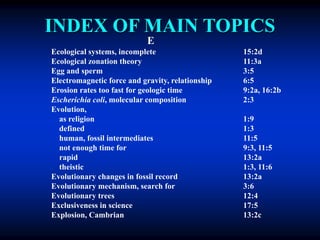
    INDEX OF MAINTOPICS E Ecological systems, incomplete 15:2d Ecological zonation theory 11:3a Egg and sperm 3:5 Electromagnetic force and gravity, relationship 6:5 Erosion rates too fast for geologic time 9:2a, 16:2b Escherichia coli, molecular composition 2:3 Evolution, as religion 1:9 defined 1:3 human, fossil intermediates 11:5 not enough time for 9:3, 11:5 rapid 13:2a theistic 1:3, 11:6 Evolutionary changes in fossil record 13:2a Evolutionary mechanism, search for 3:6 Evolutionary trees 12:4 Exclusiveness in science 17:5 Explosion, Cambrian 13:2c
  • 12.
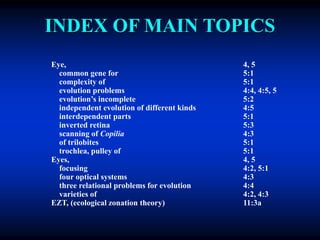
    INDEX OF MAINTOPICS Eye, 4, 5 common gene for 5:1 complexity of 5:1 evolution problems 4:4, 4:5, 5 evolution’s incomplete 5:2 independent evolution of different kinds 4:5 interdependent parts 5:1 inverted retina 5:3 scanning of Copilia 4:3 of trilobites 5:1 trochlea, pulley of 5:1 Eyes, 4, 5 focusing 4:2, 5:1 four optical systems 4:3 three relational problems for evolution 4:4 varieties of 4:2, 4:3 EZT, (ecological zonation theory) 11:3a
  • 13.
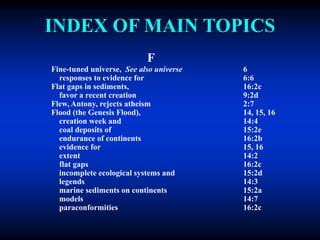
    INDEX OF MAINTOPICS F Fine-tuned universe, See also universe 6 responses to evidence for 6:6 Flat gaps in sediments, 16:2c favor a recent creation 9:2d Flew, Antony, rejects atheism 2:7 Flood (the Genesis Flood), 14, 15, 16 creation week and 14:4 coal deposits of 15:2e endurance of continents 16:2b evidence for 15, 16 extent 14:2 flat gaps 16:2c incomplete ecological systems and 15:2d legends 14:3 marine sediments on continents 15:2a models 14:7 paraconformities 16:2c
  • 14.
    INDEX OF MAINTOPICS Flood, (continued) underwater activity on continents 15:2b what happened at 14:7 widespread currents 15:2c widespread sediments 16:2a Flowers, as example of fossil gaps 12:3 Focusing in the eye 4:2, 4:3, 5:1 Forces of physics 6:5 Fossils, 10, 11, 12, 13 explosions 13:2c gaps, examples 12:3 gaps, in fossil record 12:2 – 12:5 gaps, what scientists say 12:2 living 13:2b humanity’s assumed fossil ancestors 11:5 man’s (humanity’s) fossil distribution 11.4, 11:5 peculiar distribution 10:6 Precambrian 10:5 preflood distribution of organisms and 11:3a problems for evolution 12, 13
  • 15.
    INDEX OF MAINTOPICS Fossils, (continued) record, two main interpretations 11:1 reduction in basic kinds as ascend record 13:2d sequence and Flood 11:3 sequence, creation explanations for 11:3 G Gaps in fossil record, 12:2 – 12:5 between major groups 12:5 Genesis and creation week 14:4 Genesis Flood See: Flood 14, 15, 16 Genetic code 2:3, 2:6f Geologic column, 10:2, 10:3 fossils in 10:2 not recycled many times 9:2a, 16:2 Glacial layers (varves) 8:2b God, of Bible is rational 1:6 scientific evidence for 17:7 Gravity and electromagnetic force, close relationship 6:5
  • 16.
    INDEX OF MAINTOPICS H How old? See: Time 7, 8, 9 Human fossils and purported intermediates 11:5 Human fossils scarce 9:2gh, 11:4 Human population and long geologic ages 9:2ghi I Improbabilities See: Probabilities Integrity in interpretations 1:4 Interdependent parts 3:2, 3:4 Interpretation of data 17:3 Irreducible complexity 3:2 Is science in trouble? 17 J & K, no listing L Life, complexity of 2:3 origin of 2:3-2:6 what is it? 2:2 Living fossils 13:2b
  • 17.
    INDEX OF MAINTOPICS M Man (humanity), fossils of See: human 11:4, 11:5 Many universes explanation for origins 6:6 Materialism 1:2, 17:6 Multiverse explanation for design 6:6 Mutations, usually detrimental 3:4a too frequent 9:2i N Natural selection, explanation of 3:3 problems of 3:4 Naturalism 1:2 O Optical systems of eyes 4:2, 4:3 Origin of life 2 Ovum and sperm 3:5
  • 18.
    INDEX OF MAINTOPICS P Paley, William, and the watch 3:2 Paraconformities 9:2d, 16:2c Paradigm dominance in science 17:4 Parasites and disease 3:9 Plate tectonics and the Flood 9:2b, 14:7 Poll, beliefs about origins in various countries 1:2 Gallup, about USA beliefs about origins 1:2 Potassium-argon dating 8:2c Precambrian fossils 10:5 Predation by animals 3:8 Prediction, unusual about creation and Flood 17:9 Price, George McCready 1:2 Probability of forming, a cell 2:6h a protein 2:6e the universe 6:5 Problems for chemical evolution 2:6 Progressive creation 1:3, 11:6 Protein formation 2:3, 9:3 Pseudofossils 10:4
  • 19.
    INDEX OF MAINTOPICS Q, no listing R Radiometric dating 8:2c Rates of evolution in the fossil record 11:5, 13:2a Recent creation, data favoring 9:2 Reconciling Bible and long geologic ages, difficult 11:6 Reefs 8:2a Ribosomes 2:3, 2:6 S Science, exclusive 17:5 good part of 17:2 ignoring scientific evidence for God 17:8 in trouble 17 pioneers believed in God 1:7, 17:6 secular 17:6 Scientific evidence for God 17:7
  • 20.
    INDEX OF MAINTOPICS Scientists, belief in God 1:2 belief in prayer 1:2 leaders who believe in God 1:7, 1:8, 17:6 Scopes trial 1:2 Sediment deposition 14:6 Sedimentary layers, widespread 16:2a Sickness, origin of 3:9 Sperm and ovum 3:5 Spontaneous generation of life 2:4 Suffering in nature, origin of 3:8, 3:9 Surfaces, old, flat, uneroded 9:2c Surveys, beliefs about origins, international 1:2 beliefs about origins, USA 1:2 beliefs of scientists about God 1:2 T Ten Commandments and creation week 14:4 Theistic evolution 1:3, 11:6
  • 21.
    INDEX OF MAINTOPICS Time, age of life, solar system, universe 7:2 Bible texts related to 7:3, 7:4 data favoring a recent creation 9:2 long geologic ages not much help for evolution 9:3 protein molecule, time for formation 9.3 questions about a recent creation 8:2 Trilobite eye 5:1 Trochlea pulley of eye 5:1 Truth, finding it is a better option 1:5 Turbidites 15:2b Turtle, as a fossil gap 12:3 U Universe, created by God 6:6 ideas of origin 6:3 fine-tuned, examples of 6:5 forces of physics in 6:5 incredible, details about 6:2 responses to fine-tuning data 6:6 V, W, X, Y, Z, no listings
  • 22.
  • 23.
    DISCUSSION No. 1 ADEEP QUESTION 1. Which is true, science or the Bible? 2. Brief history of the controversy 3. Important ideas 4. A question of integrity 5. A better question 6. Science and the rational God of the Bible 7. The pioneers of modern science believed in God 8. Growing interest in the question of God’s existence 9. Is creation science and is evolution a religion? 10. Conclusions 11. Review questions
  • 24.
    DISCUSSION No. 2 WHEREDID LIFE COME FROM? 1. The problem 2. What is life? 3. The complexity of life 4. The battle over spontaneous generation 5. Chemical evolution 6. Ten problems for chemical evolution 7. A shocking incident 8. Conclusions 9. Review questions
  • 25.
    DISCUSSION No. 3 FROMCOMPLEX TO MORE COMPLEX 1. The conflict 2. Interdependent parts 3. Natural selection 4. Some problems of natural selection 5. Complex systems abound 6. The long search for an evolutionary mechanism 7. Cladistics 8. Predation 9. Parasites and disease 10. Conclusions 11. Review questions
  • 26.
    DISCUSSION 4 DARWIN ANDTHE EYE: Part 1, The Variety of Eyes 1. The eye problem 2. Variety of eyes 3. Four optical systems 4. Three problems the variety of eyes poses for evolution 5. The evolution solution 6. Conclusions 7. Review questions
  • 27.
    DISCUSSION 5 DARWIN ANDTHE EYE: Part 2, Complex Eyes 1. Complexity of eyes: Special and interdependent parts 2. Evolution’s incomplete eye 3. The inverted retina: It works very well 4. Conclusions 5. Review questions
  • 28.
    DISCUSSION 6 THE FINE-TUNEDUNIVERSE 1. The question 2. The incredible universe 3. Ideas about the origin of the universe 4. What is the universe made of? 5. Examples of fine-tuning 6. Responses to the fine-tuned universe 7. Conclusions 8. Review questions
  • 29.
    DISCUSSION 7 THE GREATTIME QUESTIONS: Part 1, Propositions 1. Introduction: The questions 2. How old is the earth, the solar system, the universe? 3. The Bible texts 4. Interpretations of the Bible texts 5. Conclusions 6. Review questions
  • 30.
    DISCUSSION No. 8 THEGREAT TIME QUESTIONS: Part 2, Time Problems Posed for a Recent Creation 1. Introduction: The question 2. Time questions about a recent creation a. Coral reefs: Living and fossil b. Ancient glaciation c. Radiometric dating 3. Conclusions 4. Review questions
  • 31.
    DISCUSSION No. 9 THEGREAT TIME QUESTIONS: Part 3, Data Favoring a Recent Creation 1. The other side 2. Data favoring a recent creation a. Rates of erosion too fast b. Oceans should be full of sediments c. Old flat surfaces should be gone d. Flat gaps in the rock layers (Paraconformities) e. Ancient carbon-14 f. Soft tissue in “ancient” dinosaurs should not be there g. Humanity’s growth rate is too fast h. The impressive evidence for human activity is recent i. Mutations too frequent for humanity to have survived long ages 3. Lots of time does not solve evolution’s problems 4. Conclusions 5. Review questions
  • 32.
    DISCUSSION No. 10 FASCINATINGFOSSILS 1. Introduction: The fascination of fossils 2. The geologic column 3. Is the geologic column valid? 4. The pseudofossil problem 5. Precambrian fossils 6. Peculiarities of fossil distribution 7. Those dinosaurs 8. Conclusions 9. Review questions
  • 33.
    DISCUSSION No. 11 FOSSILSAND CREATION 1. Two contrasting views 2. Fossils and evolution 3. Creation explanations for the fossil sequence (a) Ecological zonation (b) Motility of animals (c) Buoyancy factors 4. The scarcity of human remains in the geologic column 5. Human origins and the fossil record. 6. Trying to reconcile the Bible and the long geologic ages 7. Conclusions 8. Review questions
  • 34.
    DISCUSSION No. 12 PROBLEMSFOSSILS POSE FOR EVOLUTION: Part 1, Fossil Gaps 1. Introduction: fossils, a key factor 2. What some scientists say 3. Examples of gaps 4. Evolutionary trees 5. The gaps are between major groups 6. Conclusions 7. Review questions
  • 35.
    DISCUSSION No. 13 PROBLEMSFOSSILS POSE FOR EVOLUTION: Part 2, More Complications 1. INTRODUCTION 2. MORE COMPLICATIONS a. Rates of evolutionary change and the fossils b. Living fossils c. The Cambrian Explosion and other explosions d. Reduction in basic kinds as one ascends the geologic column 3. CONCLUSIONS 4. REVIEW QUESTIONS
  • 36.
    DISCUSSION No. 14 THEASTONISHING GENESIS FLOOD: Part 1, Introduction 1. The conflict 2. Extent of the Genesis Flood 3. Flood legends 4. The Flood and creation week 5. Things can happen rapidly: Catastrophism 6. Sediment deposition 7. What happened at the Flood? 8. Was the ark large enough? 9. Conclusions 10. Review questions
  • 37.
    DISCUSSION No. 15 THEASTONISHING GENESIS FLOOD: Part 2, Some Evidence 1. INTRODUCTORY COMMENT 2. SOME EVIDENCE a. Abundant marine sediments on the continents b. Abundant underwater activity c. Continent-wide direction of currents d. Incomplete ecological systems e. Unusual coal deposits 3. CONCLUSIONS 4. REVIEW QUESTIONS
  • 38.
    DISCUSSION No. 16 THEASTONISHING GENESIS FLOOD: Part 3, More Evidence 1. INTRODUCTION 2. MORE EVIDENCE a. Unusually widespread sedimentary deposits b. Rates of erosion of continents too fast c. Paraconformities: Lack of erosion at flat gaps in sediments 3. CONCLUSIONS 4. REVIEW QUESTIONS
  • 39.
    DISCUSSION No. 17 ISSCIENCE IN TROUBLE? 1. The problem 2. The good part of science 3. The difference between data and interpretation 4. Paradigm dominance in science 5. Exclusiveness in science 6. Secularism in science 7. The scientific evidence for God 8. Can scientists ignore the scientific evidence for God? 9. An unusual prediction 10. Conclusions about: Is Science in Trouble? 11. General conclusions for all the discussions 12. Review questions for: Is Science in Trouble?
  • 40.
    ADDITIONAL REFERENCES For furtherdiscussions by the author (Ariel A. Roth) and many additional references, see the author’s books titled: 1. ORIGINS: LINKING SCIENCE AND SCRIPTURE. Hagerstown, MD. Review and Herald Publishing Association. 2. SCIENCE DISCOVERS GOD: Seven Convincing Lines of Evidence for His Existence. Hagerstown, MD. Autumn House Publishing, an imprint of Review and Herald Publishing Association. Additional information is available on the author’s Web Page: Sciences and Scriptures. www.sciencesandscriptures.com. Also see many articles published by the author and others in the journal ORIGINS which the author edited for 23 years. For access see the Web Page of the Geoscience Research Institute www.grisda.org. Highly Recommended URLs are: Earth History Research Center http://origins.swau.edu Theological Crossroads www.theox.org Sean Pitman www.detectingdesign.com Scientific Theology www.scientifictheology.com Geoscience Research Institute www.grisda.org Ariel A. Roth web page: www.sciencesandscriptures.com Other Web Pages providing a variety of related answers are: Creation-Evolution Headlines, Creation Ministries International, Institute for Creation Research, and Answers in Genesis.
  • 41.
    USE PERMIT Free unreviseduse for personal and non-commercial distribution of this material in its original publication medium is granted and encouraged. Proper attribution should be given. Permission for multiple printing for classroom use or not-for-profit public meetings is also freely allowed. In using this material in this format, accurate attribution should be maintained for any illustrations where credit is designated. Many illustrations are by the author and free use is granted for all media. However, when credit to another source is given, permission might be necessary from the source for certain different kinds of communication media than the present use.