IMAGINAL LEARNING
FOCUSING IMAGES TO ENHANCE LEARNING AND FACILITATION
7TH AND 8TH OCTOBER 2014
WITH LAWRENCE PHILBROOK
INTRODUCTION AND PUBLIC
Facilitators and trainers today serve clients who are acting out of images that are, consciously
or not, influencing their behavior. Many are overwhelmed by an overload of information
intensified by the technological advances in communication. We can better serve clients in
this information age by using and introducing them to the power of graphic, verbal, and
symbolic images in communicating and processing information.
Images have an extraordinary power in communication and facilitation because they instantly
reveal relationships while tapping into memory and intuition. They are key to releasing
intention and will. This program is designed to help facilitators and educators develop
innovative lesson plans and explore more participative approaches to teaching and learning.
Who Should Take This Course:
Professional facilitators, trainers, educators, organizational and social change agents, team
leaders, and human resources professionals and consultants.

19/11/2013 | p. 2
THE POWER OF IMAGES IN FACILITATION INCLUDES:
 Image Theory
 Enhancing group process
 Multiple Intelligences
 The Comprehensive Design Strategy
 Lesson and meeting choreography

19/11/2013 | p. 3
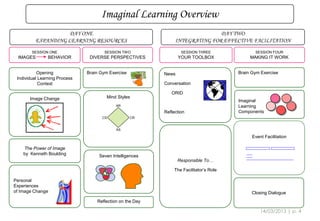
Imaginal Learning Overview
DAY ONE
EXPANDING LEARNING RESOURCES
SESSION ONE

IMAGES

BEHAVIOR

Opening
Individual Learning Process
Context
Image Change

DAY TWO
INTEGRATING FOR EFFECTIVE FACILITATION

SESSION TWO

SESSION THREE

SESSION FOUR

DIVERSE PERSPECTIVES

YOUR TOOLBOX

MAKING IT WORK

Brain Gym Exercise

Brain Gym Exercise

News

Conversation
Mind Styles

ORID

AR

Reflection
CS

Imaginal
Learning
Components

CR

AS

Event Facilitation
The Power of Image
by Kenneth Boulding

Seven Intelligences

Responsible To…
The Facilitator’s Role

Personal
Experiences
of Image Change

Closing Dialogue
Reflection on the Day

19/11/2013 | p. 4
BENEFITS





Understanding behavioral change
Apply behavioral change methods
Reframe facilitation and teaching as transformational process
Ability to maximize the impact of meetings and planning sessions
by the intentional use of verbal and visual images.
 Confidence in designing programs and meetings to achieve
maximum outcomes using the Comprehensive Design Strategy.

19/11/2013 | p. 5
TRAINER AND PRACTICAL INFOMATIONS
Lawrence Philbrook is one of founders of IAF (International Association of Facilitation) and
Ex-President of ICAI (The Institut of Cultural Affairs International). Lawrence Philbrook has
been designing processes for teams and leaders in varied cultural settings in Asia for over
twenty years. Lawrence joined the Institute of Cultural Affairs (ICA) in 1972 and has done
extensive company and community-based projects in over 30 nations.
For the past 18 years he has been the director of ICA Taiwan. His key skill is in design and
facilitation of processes which help recover a sense of respect and trust as a basis for
establishing organizations that can learn and change. Most of his work is utilizing facilitation
in long term change process for communities and organizations. His client list includes more
than 50 multinational organizations as well as local companies and government organizations.
Current projects include corporate projects across Asia and work on Appreciative Leadership
with the United Nations in N & S America, Europe, Africa and Asia.

Date: 7, 8 octobre 2014
Lieu: 34, bd de Sébastopol, 75004, Paris
Tarif: 1400€HT
19/11/2013 | p. 6

Formation Imaginal Learning, 7th and 8th october 2014

  • 1.
    IMAGINAL LEARNING FOCUSING IMAGESTO ENHANCE LEARNING AND FACILITATION 7TH AND 8TH OCTOBER 2014 WITH LAWRENCE PHILBROOK
  • 2.
    INTRODUCTION AND PUBLIC Facilitatorsand trainers today serve clients who are acting out of images that are, consciously or not, influencing their behavior. Many are overwhelmed by an overload of information intensified by the technological advances in communication. We can better serve clients in this information age by using and introducing them to the power of graphic, verbal, and symbolic images in communicating and processing information. Images have an extraordinary power in communication and facilitation because they instantly reveal relationships while tapping into memory and intuition. They are key to releasing intention and will. This program is designed to help facilitators and educators develop innovative lesson plans and explore more participative approaches to teaching and learning. Who Should Take This Course: Professional facilitators, trainers, educators, organizational and social change agents, team leaders, and human resources professionals and consultants. 19/11/2013 | p. 2
  • 3.
    THE POWER OFIMAGES IN FACILITATION INCLUDES:  Image Theory  Enhancing group process  Multiple Intelligences  The Comprehensive Design Strategy  Lesson and meeting choreography 19/11/2013 | p. 3
  • 4.
    Imaginal Learning Overview DAYONE EXPANDING LEARNING RESOURCES SESSION ONE IMAGES BEHAVIOR Opening Individual Learning Process Context Image Change DAY TWO INTEGRATING FOR EFFECTIVE FACILITATION SESSION TWO SESSION THREE SESSION FOUR DIVERSE PERSPECTIVES YOUR TOOLBOX MAKING IT WORK Brain Gym Exercise Brain Gym Exercise News Conversation Mind Styles ORID AR Reflection CS Imaginal Learning Components CR AS Event Facilitation The Power of Image by Kenneth Boulding Seven Intelligences Responsible To… The Facilitator’s Role Personal Experiences of Image Change Closing Dialogue Reflection on the Day 19/11/2013 | p. 4
  • 5.
    BENEFITS     Understanding behavioral change Applybehavioral change methods Reframe facilitation and teaching as transformational process Ability to maximize the impact of meetings and planning sessions by the intentional use of verbal and visual images.  Confidence in designing programs and meetings to achieve maximum outcomes using the Comprehensive Design Strategy. 19/11/2013 | p. 5
  • 6.
    TRAINER AND PRACTICALINFOMATIONS Lawrence Philbrook is one of founders of IAF (International Association of Facilitation) and Ex-President of ICAI (The Institut of Cultural Affairs International). Lawrence Philbrook has been designing processes for teams and leaders in varied cultural settings in Asia for over twenty years. Lawrence joined the Institute of Cultural Affairs (ICA) in 1972 and has done extensive company and community-based projects in over 30 nations. For the past 18 years he has been the director of ICA Taiwan. His key skill is in design and facilitation of processes which help recover a sense of respect and trust as a basis for establishing organizations that can learn and change. Most of his work is utilizing facilitation in long term change process for communities and organizations. His client list includes more than 50 multinational organizations as well as local companies and government organizations. Current projects include corporate projects across Asia and work on Appreciative Leadership with the United Nations in N & S America, Europe, Africa and Asia. Date: 7, 8 octobre 2014 Lieu: 34, bd de Sébastopol, 75004, Paris Tarif: 1400€HT 19/11/2013 | p. 6