The Culture andThe Culture and
Ecosystem ofEcosystem of
Palawan: An OverviewPalawan: An Overview
Fr. Reynante Aguanta
Apostolic Vicariate of Taytay, Palawan
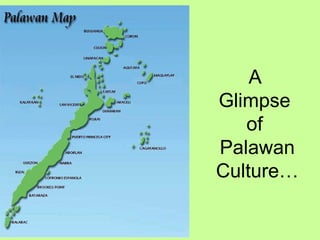
A
Glimpse
of
Palawan
Culture…
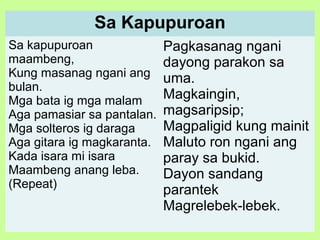
Sa Kapupuroan
Sa kapupuroan
maambeng,
Kung masanag ngani ang
bulan.
Mga bata ig mga malam
Aga pamasiar sa pantalan.
Mga solteros ig daraga
Aga gitara ig magkaranta.
Kada isara mi isara
Maambeng anang leba.
(Repeat)
Pagkasanag ngani
dayong parakon sa
uma.
Magkaingin,
magsaripsip;
Magpaligid kung mainit
Maluto ron ngani ang
paray sa bukid.
Dayon sandang
parantek
Magrelebek-lebek.
Amos mga tangay
Amos kamo mga tangay
Masarot-saot kita anay
Lipatan ta ateng kapilay
Magpanari anay
Dading luto ron ang paray
Kita magkalipay
Indi tay panumbaelen
Ang ateng kabedlay.
(Repeat)
What’s behind it…
Toting, ara kami kanyugan
Ang bisyo y nanay pirming pamagatnan
Anang ing dadara, ungot sanda tunggan
Ang andang semseman kugita ig subingan
(Repeat)
Ay Toting… TOTING!!!
Toting
It tells what…
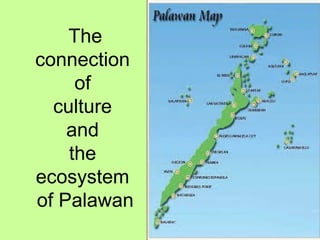
The
connection
of
culture
and
the
ecosystem
of Palawan
“’Laudato Si’, mi’ Signore!’ St. Francis
of Assisi reminds us that our common
home is like a sister with whom we
share our life and a beautiful mother
who opens her arms to embrace us.”
- LS # 1
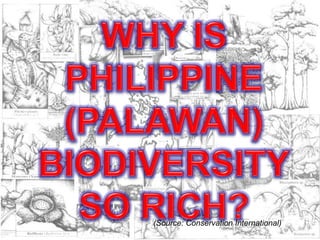
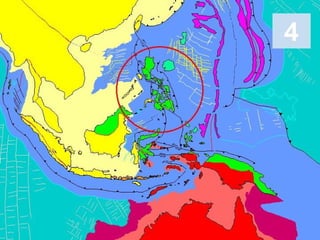
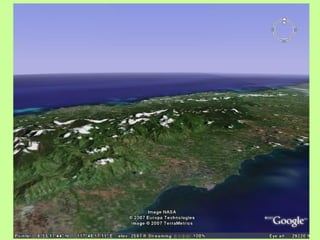
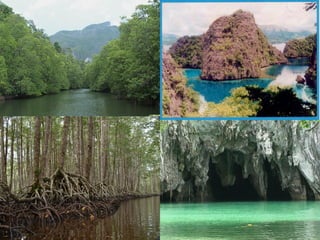
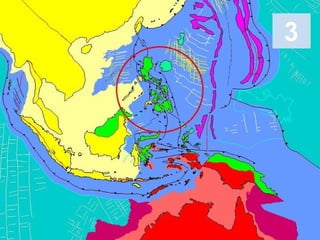
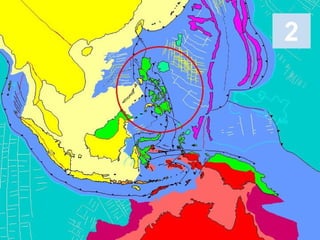
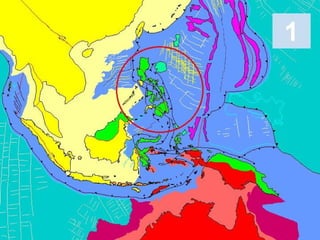
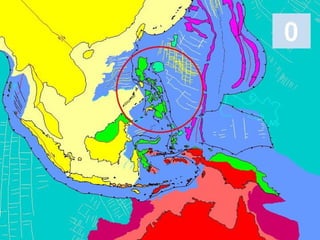
The uniqueness of the Philippine
Archipelago particularly Palawan
(Source: Conservation International)
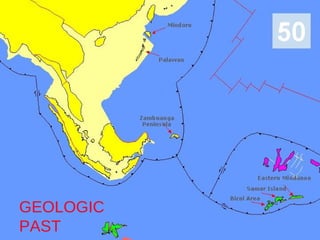
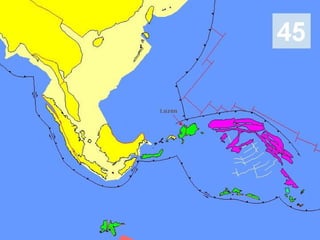
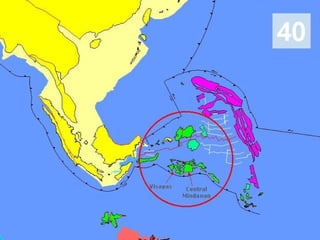
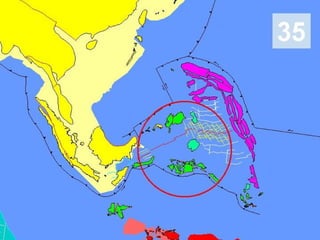
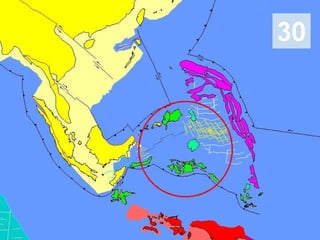
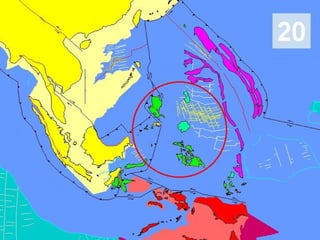
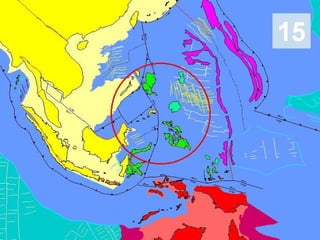
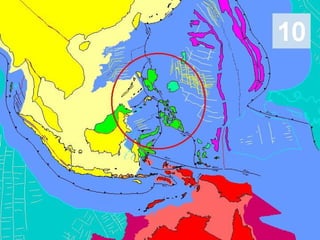
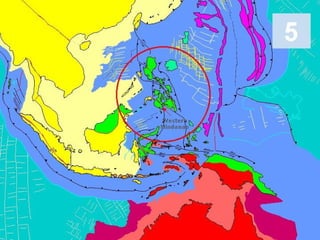
GEOLOGIC
PAST
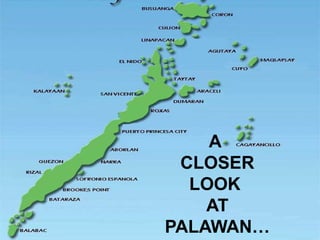
A
CLOSER
LOOK
AT
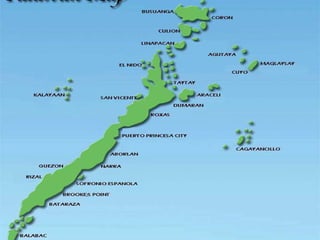
PALAWAN…
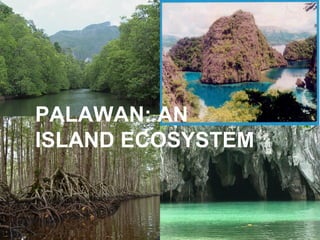
PALAWAN: AN
ISLAND ECOSYSTEM
As an Island Ecosystem…
• Unique, Fragile and Vulnerable
• Distinction:
– Evolution of flora and fauna has
taken place in relative isolation
– Endemism and rich biodiversity
• Many remote islands have some of the most unique
flora in the world; some have species of plants and
animals that are not found anywhere else, which
have evolved in a specialized way, sheltered from
the fierce competition that species face on mainland.
(http://www.eionet.europa.eu/gemet/concept)
As an Island Ecosystem…
• “Palawan is composed of a long main island
lying in a northeast to southwest axis and
surrounding it are clusters of lesser
islands…..The main island has a tall steep
mountain spine running down its length fringed
by narrow coastal plans protected from storm
waves by fringing coral reefs and mangrove
swamps. Although seemingly lush and bountiful,
the environment of Palawan is fragile and its
topsoils are relatively thin, poor and prone to
erosion.”
(Source: Strategic Environmental Plan for Palawan, Towards Sustainable
Development, Prepared by the Palawan Integrated Area Development
Project Office with the assistance of Hunting Technical Services Limited
England in association with the Orient Integrated Development
Consultants, Inc., Philippines and Sir Mac Donald and Partners, England)
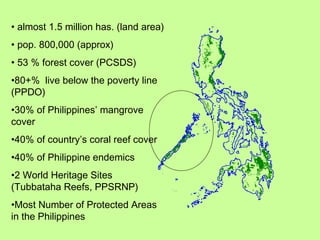
• almost 1.5 million has. (land area)
• pop. 800,000 (approx)
• 53 % forest cover (PCSDS)
•80+% live below the poverty line
(PPDO)
•30% of Philippines’ mangrove
cover
•40% of country’s coral reef cover
•40% of Philippine endemics
•2 World Heritage Sites
(Tubbataha Reefs, PPSRNP)
•Most Number of Protected Areas
in the Philippines
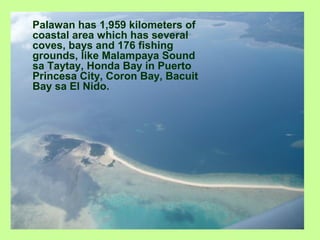
Palawan has 1,959 kilometers of
coastal area which has several
coves, bays and 176 fishing
grounds, like Malampaya Sound
sa Taytay, Honda Bay in Puerto
Princesa City, Coron Bay, Bacuit
Bay sa El Nido.
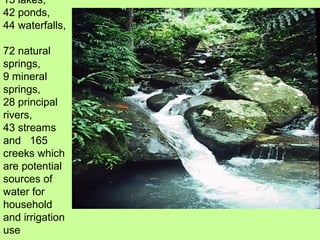
15 lakes,
42 ponds,
44 waterfalls,
72 natural
springs,
9 mineral
springs,
28 principal
rivers,
43 streams
and 165
creeks which
are potential
sources of
water for
household
and irrigation
use
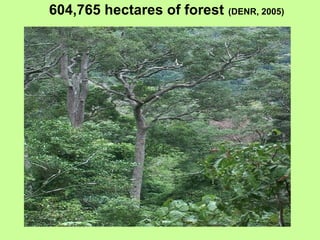
604,765 hectares of forest (DENR, 2005)
As Island Ecosystem…
• “Palawan’s forests support a unique and highly
diverse flora and fauna…Many of Palawan’s
fauna are unique and are considered rare,
threatened or endangered.”
– With few botanical expeditions in the past, many
botanists feel that there are more undiscovered
species of plants.
– Such diversity serve as basis for declaring Palawan
as a “Game Refuge and Bird Sanctuary” in 1967, as
Mangrove Reserve in 1981 and as part of UNESCO’s
“Man and Biosphere Reserve”.
• “Last Frontier” description signifies abundant
and untapped resources, relatively unravaged by
resource overexploitation.
(Source: SEP document)
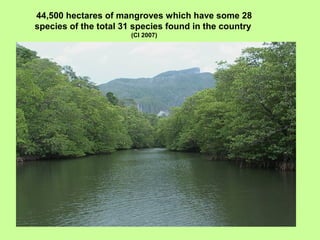
44,500 hectares of mangroves which have some 28
species of the total 31 species found in the country
(CI 2007)
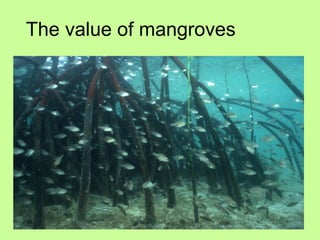
The value of mangroves
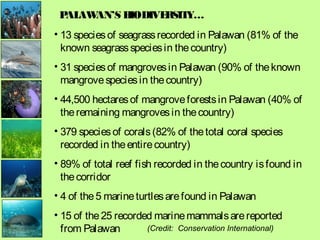
PALAWAN’S BIODIVERSITY…
• 13 speciesof seagrassrecorded in Palawan (81% of the
known seagrassspeciesin thecountry)
• 31 speciesof mangrovesin Palawan (90% of theknown
mangrovespeciesin thecountry)
• 44,500 hectaresof mangroveforestsin Palawan (40% of
theremaining mangrovesin thecountry)
• 379 speciesof corals(82% of thetotal coral species
recorded in theentirecountry)
• 89% of total reef fish recorded in thecountry isfound in
thecorridor
• 4 of the5 marineturtlesarefound in Palawan
• 15 of the25 recorded marinemammalsarereported
from Palawan (Credit: Conservation International)
• 18 speciesof freshwater fish isfound in Palawan (50%
endemic to theprovince)
• 26 speciesof amphibians(25% endemic to thecountry,
majority areconfined to thecorridor
• 69 speciesof reptilesfound in thecorridor (29% are
endemic to thecountry)
• 279 speciesof birds(10% areendemic to thecountry)
• 34% of bird speciesaremigratory, making theregion a
vital flyway for migratory birds
• 58 speciesof terrestrial mammalsarerecorded, 19 or
33% areendemic to thecountry, 16 arerestricted to the
corridor
(Credit: Conservation International)
PALAWAN’S BIODIVERSITY…
BAD NEWS!
 The Philippines is the most
threatened in the world,
particularly the endemic
species.
 Regarded as “hottest of the
conservation hotspots”.
 And so is Palawan…
“Our common home cries out to us because
of the harm we have inflicted on her by our
irresponsible use and abuse of the good
with which God has endowed her.”
-LS # 2
Ang Kapaligiran ngAng Kapaligiran ng
Palawan: Patuloy angPalawan: Patuloy ang
mga Banta at Hamonmga Banta at Hamon
Atty. Grizelda Mayo-Anda
Co-convenor, Palawan Green Thumb Coalition (GTC)
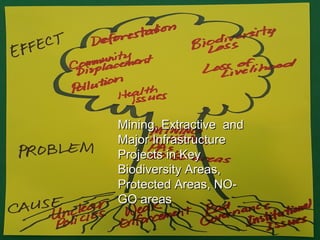
Mining, Extractive andMining, Extractive and
Major InfrastructureMajor Infrastructure
Projects in KeyProjects in Key
Biodiversity Areas,Biodiversity Areas,
Protected Areas, NO-Protected Areas, NO-
GO areasGO areas
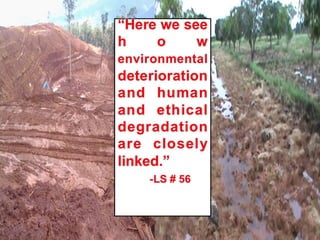
“Now, faced as we are with global
environmental deterioration… calls us to
enter into dialogue about our common
home.”
-LS # 3
What’s happening now in Palawan…
Current Threats to Palawan’s
Biodiversity
“The created things of this world are not free
of ownership: For they are yours, O Lord,
who love the living.”
- LS # 89
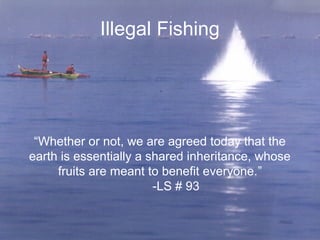
Illegal Fishing
“Whether or not, we are agreed today that the
earth is essentially a shared inheritance, whose
fruits are meant to benefit everyone.”
-LS # 93
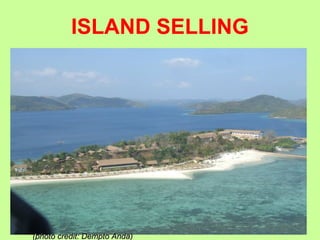
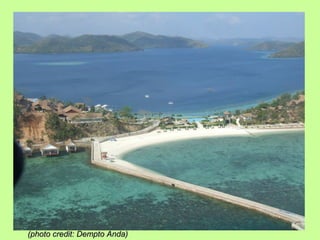
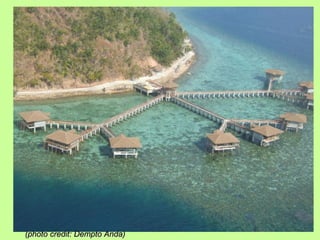
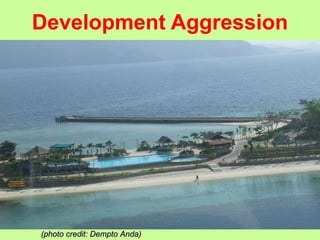
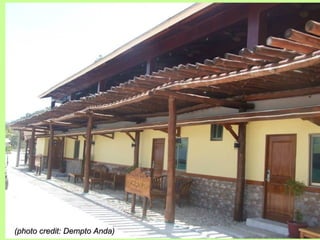
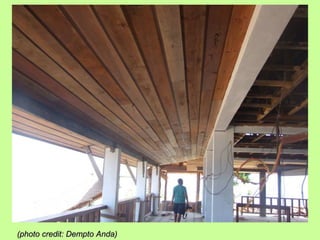
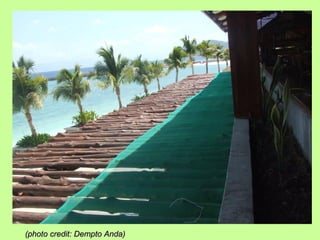
Tourism development (island
selling, land grabbing, development
aggression, illegal logging)
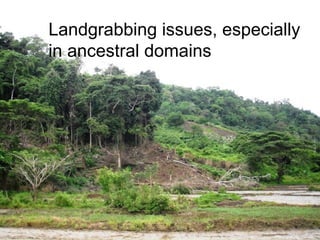
Landgrabbing issues, especially
in ancestral domains
ISLAND SELLING
(photo credit: Dempto Anda)(photo credit: Dempto Anda)
Development Aggression
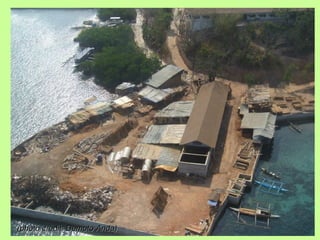
(photo credit: Dempto Anda)(photo credit: Dempto Anda)
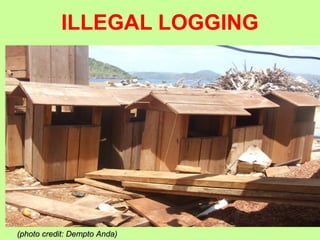
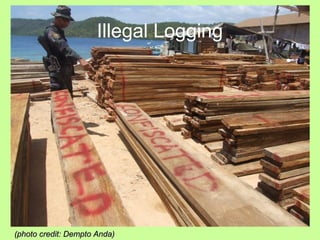
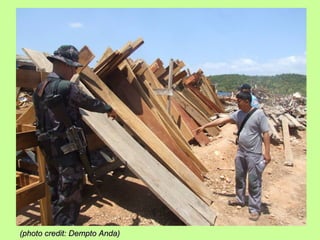
ILLEGAL LOGGING
(photo credit: Dempto Anda)(photo credit: Dempto Anda)
Forest Destruction (logging,
conversion to plantations and
agriculture)
Illegal Logging
(photo credit: Dempto Anda)(photo credit: Dempto Anda)
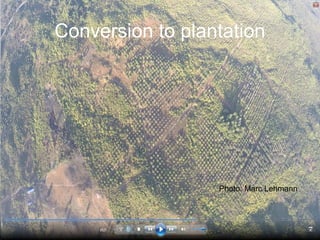
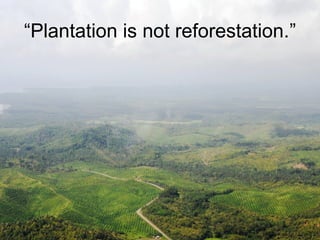
Conversion to plantation
Photo: Marc Lehmann
“Plantation is not reforestation.”
Roads and other Large
Infrastructure development
“In practice, we continue to tolerate that some
consider themselves more human than others, as
if they had been born with greater rights.”
-LS # 90
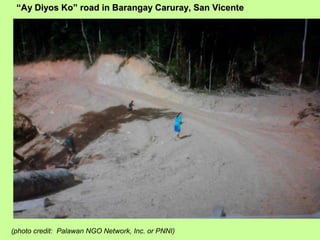
(photo credit: Palawan NGO Network, Inc. or PNNI)
““Ay Diyos KoAy Diyos Ko”” road in Barangay Caruray, San Vicenteroad in Barangay Caruray, San Vicente
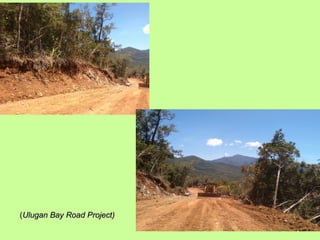
(Ulugan Bay Road Project)Ulugan Bay Road Project)
(photo credit: Dempto Anda)(photo credit: Dempto Anda)
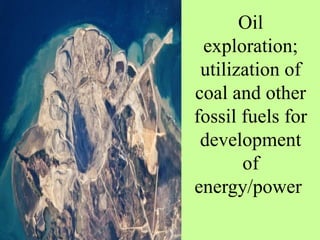
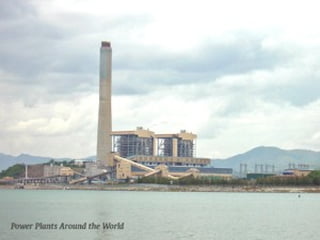
Oil
exploration;
utilization of
coal and other
fossil fuels for
development
of
energy/power
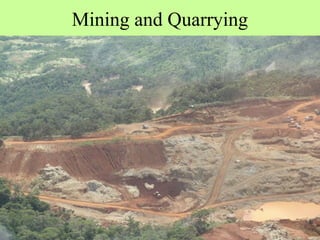
Mining and Quarrying
Other Current Threats to Palawan’s
Biodiversity
• Depletion of marine resources
(mangrove destruction, overfishing, illegal
fishing)
• Wildlife hunting and smuggling
• Furniture industry
• Live fish industry
• Coastal area reclamation
1. Depletion and degradation of resources
- illegal and destructive fishing methods
- rapid coastal population growth
- lack of alternative livelihood and employment
opportunities
- indiscriminate collection
2. Pollution
- waste dumping from both industrial &
domestic
3. Siltation
- deforestation
- mine tailings
- mangrove conversion into fishpond
- reclamation & building of infrastructure
Continuing Threat of Mining
Location of 110
Mining claims in
Palawan
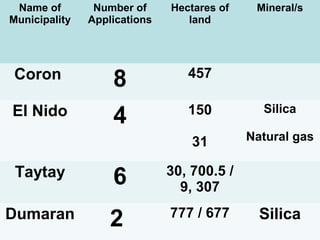
San Vicente- 5 apps- 4, 993/2, 794.6 hectares silica
Roxas- 8 apps – 7, 014/ 43, 455 hectares silica
Name of
Municipality
Number of
Applications
Hectares of
land
Mineral/s
Coron 8 457
El Nido 4 150
31
Silica
Natural gas
Taytay 6 30, 700.5 /
9, 307
Dumaran 2 777 / 677 Silica
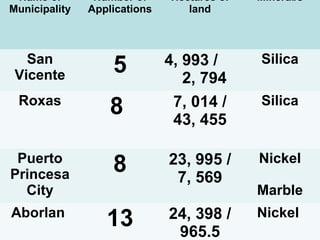
Name of
Municipality
Number of
Applications
Hectares of
land
Mineral/s
San
Vicente
5 4, 993 /
2, 794
Silica
Roxas
8 7, 014 /
43, 455
Silica
Puerto
Princesa
City
8 23, 995 /
7, 569
Nickel
Marble
Aborlan
13 24, 398 /
965.5
Nickel
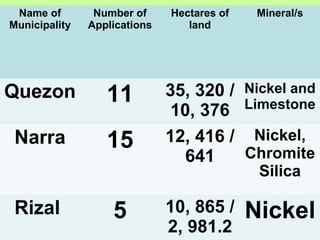
Name of
Municipality
Number of
Applications
Hectares of
land
Mineral/s
Quezon 11 35, 320 /
10, 376
Nickel and
Limestone
Narra 15 12, 416 /
641
Nickel,
Chromite
Silica
Rizal 5 10, 865 /
2, 981.2
Nickel
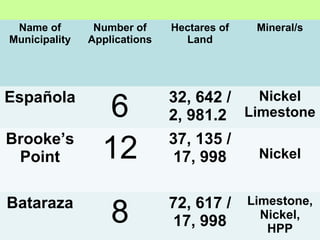
Name of
Municipality
Number of
Applications
Hectares of
Land
Mineral/s
Española
6 32, 642 /
2, 981.2
Nickel
Limestone
Brooke’s
Point 12 37, 135 /
17, 998 Nickel
Bataraza
8 72, 617 /
17, 998
Limestone,
Nickel,
HPP
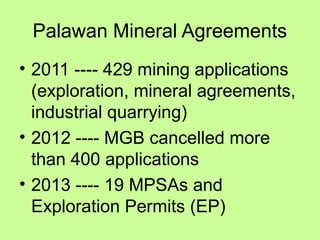
Palawan Mineral Agreements
• 2011 ---- 429 mining applications
(exploration, mineral agreements,
industrial quarrying)
• 2012 ---- MGB cancelled more
than 400 applications
• 2013 ---- 19 MPSAs and
Exploration Permits (EP)
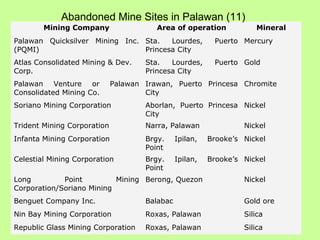
Mining Company Area of operation Mineral
Palawan Quicksilver Mining Inc.
(PQMI)
Sta. Lourdes, Puerto
Princesa City
Mercury
Atlas Consolidated Mining & Dev.
Corp.
Sta. Lourdes, Puerto
Princesa City
Gold
Palawan Venture or Palawan
Consolidated Mining Co.
Irawan, Puerto Princesa
City
Chromite
Soriano Mining Corporation Aborlan, Puerto Princesa
City
Nickel
Trident Mining Corporation Narra, Palawan Nickel
Infanta Mining Corporation Brgy. Ipilan, Brooke’s
Point
Nickel
Celestial Mining Corporation Brgy. Ipilan, Brooke’s
Point
Nickel
Long Point Mining
Corporation/Soriano Mining
Berong, Quezon Nickel
Benguet Company Inc. Balabac Gold ore
Nin Bay Mining Corporation Roxas, Palawan Silica
Republic Glass Mining Corporation Roxas, Palawan Silica
Abandoned Mine Sites in Palawan (11)
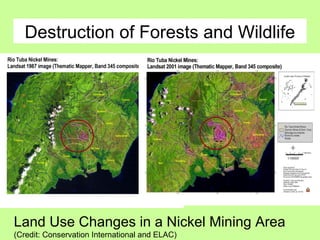
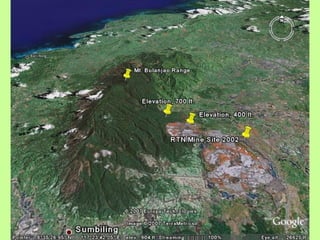
Destruction of Forests and Wildlife
Land Use Changes in a Nickel Mining Area
(Credit: Conservation International and ELAC)
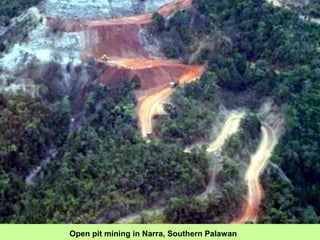
Open pit mining in Narra, Southern Palawan
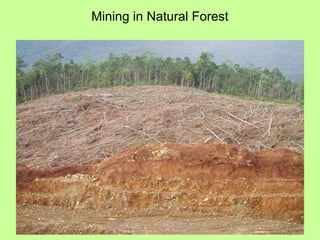
Mining in Natural Forest
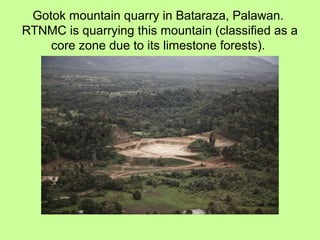
Gotok mountain quarry in Bataraza, Palawan.
RTNMC is quarrying this mountain (classified as a
core zone due to its limestone forests).
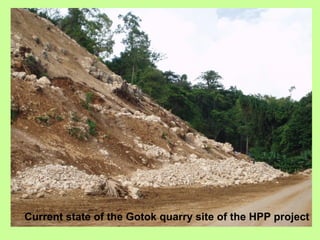
Current state of the Gotok quarry site of the HPP project
Other Issues and Development
• Continuing exploration of MacroAsia in
Brooke’s Point
• Attempts of Ipilan Nickel Corporation and
Lebach Mining to start exploration and mineral
development
• Continuing violations by Citinickel Mining
Corporation (Citinickel) – 2x suspended and
now with Cease-and-Desist Order (CDO)
• Pollutive impacts of Narra Nickel Mining
Development Corporation (NNMDC) in Narra
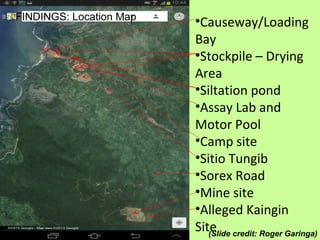
FINDINGS: Location Map
•Causeway/Loading
Bay
•Stockpile – Drying
Area
•Siltation pond
•Assay Lab and
Motor Pool
•Camp site
•Sitio Tungib
•Sorex Road
•Mine site
•Alleged Kaingin
Site(Slide credit: Roger Garinga)
MMT Findings Summary
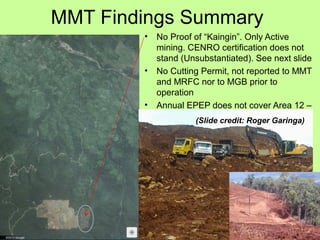
• No Proof of “Kaingin”. Only Active
mining. CENRO certification does not
stand (Unsubstantiated). See next slide
• No Cutting Permit, not reported to MMT
and MRFC nor to MGB prior to
operation
• Annual EPEP does not cover Area 12 –
in violation of ECC # 6.1(Slide credit: Roger Garinga)
MMT Findings Summary
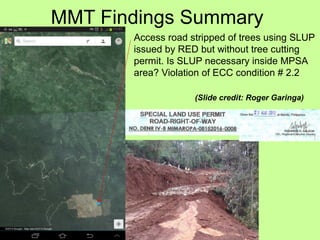
Access road stripped of trees using SLUP
issued by RED but without tree cutting
permit. Is SLUP necessary inside MPSA
area? Violation of ECC condition # 2.2
(Slide credit: Roger Garinga)
MMT Findings Summary
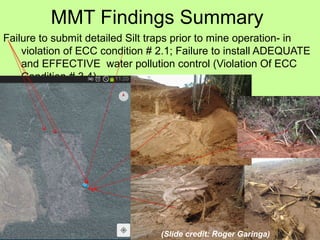
Failure to submit detailed Silt traps prior to mine operation- in
violation of ECC condition # 2.1; Failure to install ADEQUATE
and EFFECTIVE water pollution control (Violation Of ECC
Condition # 3.4)
(Slide credit: Roger Garinga)
MMT Findings
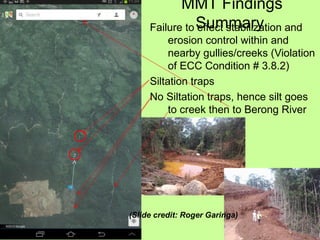
SummaryFailure to effect stabilization and
erosion control within and
nearby gullies/creeks (Violation
of ECC Condition # 3.8.2)
Siltation traps
No Siltation traps, hence silt goes
to creek then to Berong River
(Slide credit: Roger Garinga)
MMT Findings Summary
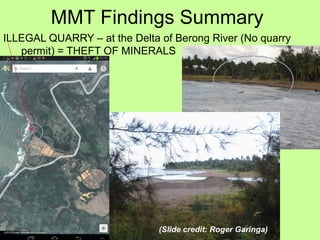
ILLEGAL QUARRY – at the Delta of Berong River (No quarry
permit) = THEFT OF MINERALS
(Slide credit: Roger Garinga)
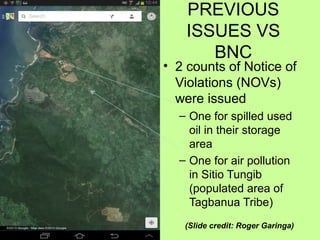
PREVIOUS
ISSUES VS
BNC
• 2 counts of Notice of
Violations (NOVs)
were issued
– One for spilled used
oil in their storage
area
– One for air pollution
in Sitio Tungib
(populated area of
Tagbanua Tribe)
(Slide credit: Roger Garinga)
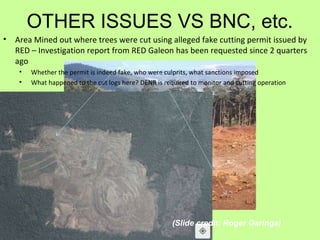
OTHER ISSUES VS BNC, etc.
• Area Mined out where trees were cut using alleged fake cutting permit issued by
RED – Investigation report from RED Galeon has been requested since 2 quarters
ago
• Whether the permit is indeed fake, who were culprits, what sanctions imposed
• What happened to the cut logs here? DENR is required to monitor and cutting operation
(Slide credit: Roger Garinga)
•
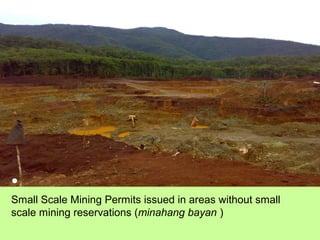
Small Scale Mining Permits issued in areas without small
scale mining reservations (minahang bayan )
Cost and Risks of Mining
vis-à-vis
Biodiversity, Food
Security, Human Dignity
Impacts and Damages
• Household, community displacement
from subsistence or livelihood activities
• Reduced access or availability of local
water supply for in-site and off-site areas
• Unpaid use and depletion of
groundwater
• Pollution of surface water and aquifer
• Leakages, overflowing or collapse of
tailings dam
• Loss of biodiversity
• Impacts on health
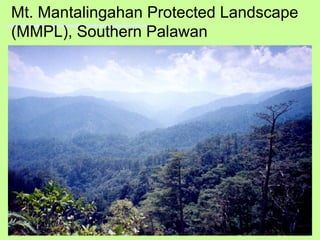
Mt. Mantalingahan Protected Landscape
(MMPL), Southern Palawan
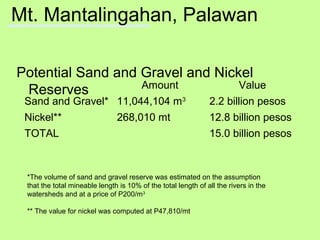
Potential Sand and Gravel and Nickel
Reserves Amount Value
Sand and Gravel* 11,044,104 m3
2.2 billion pesos
Nickel** 268,010 mt 12.8 billion pesos
TOTAL 15.0 billion pesos
*The volume of sand and gravel reserve was estimated on the assumption
that the total mineable length is 10% of the total length of all the rivers in the
watersheds and at a price of P200/m3
** The value for nickel was computed at P47,810/mt
Mt. Mantalingahan, Palawan
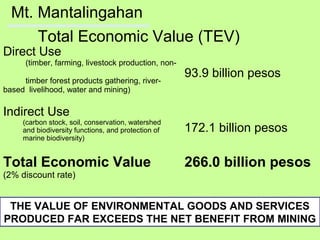
Mt. Mantalingahan
Total Economic Value (TEV)
THE VALUE OF ENVIRONMENTAL GOODS AND SERVICES
PRODUCED FAR EXCEEDS THE NET BENEFIT FROM MINING
Direct Use
(timber, farming, livestock production, non-
timber forest products gathering, river-
based livelihood, water and mining)
93.9 billion pesos
Indirect Use
(carbon stock, soil, conservation, watershed
and biodiversity functions, and protection of
marine biodiversity)
172.1 billion pesos
Total Economic Value
(2% discount rate)
266.0 billion pesos
On political, legal and economic
issues and concerns…
“If the simple fact of being human moves people
to care for the environment of which they are
part, Christians in their turn ‘realize that their
responsibility within creation, and their duty
towards nature and Creator, are an essential
part of their faith.”
- LS # 64
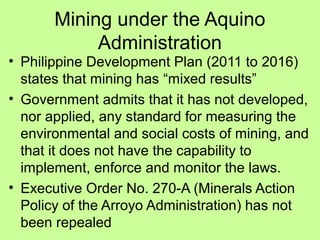
Mining under the Aquino
Administration
• Philippine Development Plan (2011 to 2016)
states that mining has “mixed results”
• Government admits that it has not developed,
nor applied, any standard for measuring the
environmental and social costs of mining, and
that it does not have the capability to
implement, enforce and monitor the laws.
• Executive Order No. 270-A (Minerals Action
Policy of the Arroyo Administration) has not
been repealed
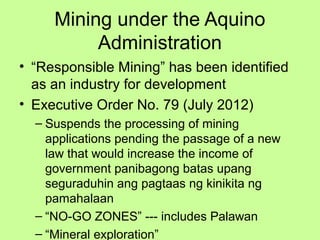
Mining under the Aquino
Administration
• “Responsible Mining” has been identified
as an industry for development
• Executive Order No. 79 (July 2012)
– Suspends the processing of mining
applications pending the passage of a new
law that would increase the income of
government panibagong batas upang
seguraduhin ang pagtaas ng kinikita ng
pamahalaan
– “NO-GO ZONES” --- includes Palawan
– “Mineral exploration”
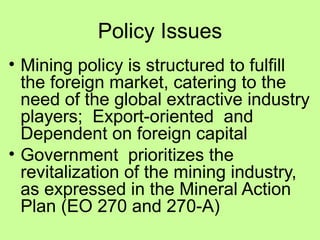
Policy Issues
• Mining policy is structured to fulfill
the foreign market, catering to the
need of the global extractive industry
players; Export-oriented and
Dependent on foreign capital
• Government prioritizes the
revitalization of the mining industry,
as expressed in the Mineral Action
Plan (EO 270 and 270-A)
Legal Issue
• Overgenerous fiscal incentives
and other benefits to mining
corporations in the use of our
mineral and other resources
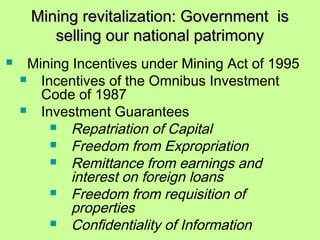
Mining revitalization: Government isMining revitalization: Government is
selling our national patrimonyselling our national patrimony
 Mining Incentives under Mining Act of 1995
 Incentives of the Omnibus Investment
Code of 1987
 Investment Guarantees
 Repatriation of Capital
 Freedom from Expropriation
 Remittance from earnings and
interest on foreign loans
 Freedom from requisition of
properties
 Confidentiality of Information
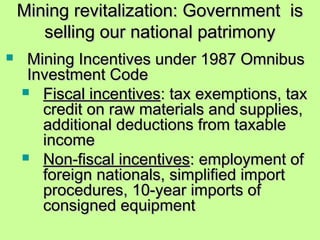
Mining revitalization: Government isMining revitalization: Government is
selling our national patrimonyselling our national patrimony
 Mining Incentives under 1987 OmnibusMining Incentives under 1987 Omnibus
Investment CodeInvestment Code
 Fiscal incentivesFiscal incentives: tax exemptions, tax: tax exemptions, tax
credit on raw materials and supplies,credit on raw materials and supplies,
additional deductions from taxableadditional deductions from taxable
incomeincome
 Non-fiscal incentivesNon-fiscal incentives: employment of: employment of
foreign nationals, simplified importforeign nationals, simplified import
procedures, 10-year imports ofprocedures, 10-year imports of
consigned equipmentconsigned equipment
Incentives under Philippine Mining
Act
 Tax Holiday during recovery of pre-
operating expenses for a maximum of 5
years from commercial production
(FTAA)
 Income Tax carry forward of losses
 Income Tax accelerated depreciation of
fixed assets
 Exemption from payment of real property
taxes on pollution control devices
Existing Mining law gives more
benefits to mining corporations in the
use of our natural resources
(i) preference of “mining rights” over
“surface rights”
(ii) provision of “income tax holiday” under
the Omnibus Investment Code or EO 226
and other “tax incentives” under the Special
Economic Zone Act or RA 7916
(iii) Provision of ancillary rights like “timber
rights, water rights, easement rights”
Not a Single Centavo from Mining
Companies
“xxx the 1987 Constitution mandates the State
to exploit our mineral resources through direct
undertaking, joint venture, or co-production
arrangements. The purpose is for the State, as
owner of the mineral resources, to receive its
fair share in the profits from the exploitation of
our mineral resources. Sadly, for the last 20
years the State has not received a single
centavo from the profits of mining companies.”
Supreme Court Justice Antonio Carpio on Closing the Gaps between Law
and Justice, Regional Convention of Mindanao lawyers on November 30,
2007, Davao City
Legal Issues
• Unclear rules and regulations on the
implementation of the 1% royalty share
for the affected Indigenous
Peoples/Communities
• Non-compliance with environmental
laws, safety standards and permit
requirements
• Institutional: Weak regulatory
mechanisms; weak Implementation of
existing laws
Consent and Acceptability
Issues
• Effect of Moratorium
Ordinances
• Effect of Free, Prior and
Informed Consent (FPIC)
under the Indigenous Peoples’
Rights Act (IPRA, RA 8371)
• Social Acceptability processes
Other Legal Issues
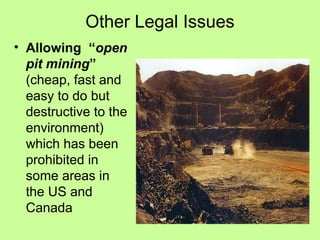
• Allowing “open
pit mining”
(cheap, fast and
easy to do but
destructive to the
environment)
which has been
prohibited in
some areas in
the US and
Canada
Weak Implementation
• Mining activities have been allowed in watersheds,
protected areas and core zones
– Violation of RA 7611 or Strategic Environmental
Plan for Palawan (SEP), which provides that all
natural forests (old-growth or residual forests)
are areas of maximum protection (Section 9, RA
7611)
• Allowing large-scale corporations to apply for
small-scale mining permits while their large-scale
mining permits or MPSAs (mineral production
sharing agreements) are being processed and
pending approval
Weak implementation
• Small scale mining has been allowed in
areas where no small-scale mining
reservations (minahang bayan) were
established
Why should we protect
Palawan’s Ecosystem?
• Last ecological frontier
• Palawan was declared as a national biosphere
• Reserve by the United Nations Educational
Scientific and Cultural Organization
(UNESCO) in 1990
• Home to 2 World Heritage Sites and 7
protected areas
• Has the largest remaining forest cover in the
country (54% or 804, 398 hectares)
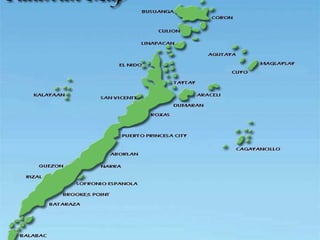
Fast Facts:
• Country’s largest province with total
mainland area of 1.5 million hectares
• A narrow archipelago of 1, 700 islands
• Its length fro tip to tip is 650 kilometers
while total length of coastline is 2, 000
kms.
• Palawan is politically divided into 23
municipalities and one city
More facts…
• There are more than 200
species of bird and over 600
species of butterfly
• 16 endemic birds in Palawan
• 16 species of Palawan
endemic mammals
What are we doing in
Palawan?
“If someone has not learned to stop and
admire something beautiful, we should not
be surprised if he or she treats everything as
an object to be used and abused without
scruple.”
-LS # 215
Initiatives of Local Communities
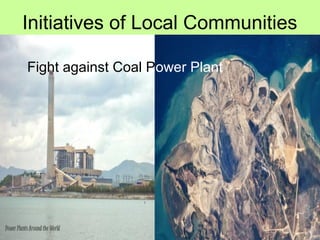
Fight against Coal Power Plant
Initiatives of Local Communities
and Civil Society Groups in
Palawan
• Dialogues and Engagement with
government towards a participatory process
of energy development, particularly,
renewable energy
• Legal Actions: Special Civil Action forLegal Actions: Special Civil Action for
Prohibition and EPO with prayer for TEPOProhibition and EPO with prayer for TEPO
• Advocacy
– Barangay ordinance banning coal in their area
– Barangay ordinance prohibiting the conversion
of agricultural lands into industrial uses
Palawan Environmental Agenda
(a)Cessation of all forms of mining activities
in Palawan’s natural forests, protected areas
and key biodiversity areas
(b) Pro-active development of renewable
energy and a ban on the use of coal power
in the development of Palawan’s
energy/power agenda
Palawan Environmental Agenda
(c) Moratorium in the expansion of oil palm
and similar exotic plantations that threaten
Palawan’s biodiversity and the livelihood of
local communities;
(d) Stopping the conversion of Palawan’s
core zones in the upland, lowland coastal
areas in order to accommodate
infrastructure and extractive projects; and
(e) Halt land-grabbing activities especially
within ancestral domains.
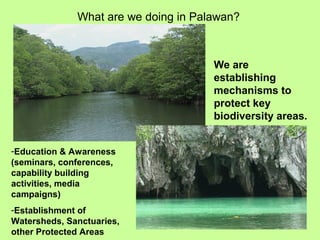
What are we doing in Palawan?
We are
establishing
mechanisms to
protect key
biodiversity areas.
-Education & Awareness
(seminars, conferences,
capability building
activities, media
campaigns)
-Establishment of
Watersheds, Sanctuaries,
other Protected Areas
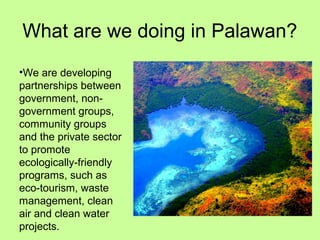
What are we doing in Palawan?
•We are developing
partnerships between
government, non-
government groups,
community groups
and the private sector
to promote
ecologically-friendly
programs, such as
eco-tourism, waste
management, clean
air and clean water
projects.
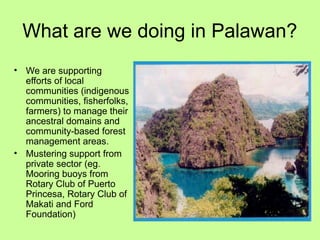
What are we doing in Palawan?
• We are supporting
efforts of local
communities (indigenous
communities, fisherfolks,
farmers) to manage their
ancestral domains and
community-based forest
management areas.
• Mustering support from
private sector (eg.
Mooring buoys from
Rotary Club of Puerto
Princesa, Rotary Club of
Makati and Ford
Foundation)
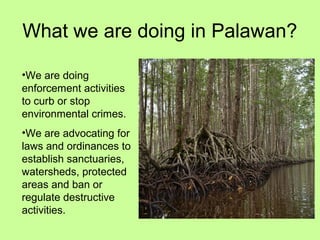
What we are doing in Palawan?
•We are doing
enforcement activities
to curb or stop
environmental crimes.
•We are advocating for
laws and ordinances to
establish sanctuaries,
watersheds, protected
areas and ban or
regulate destructive
activities.
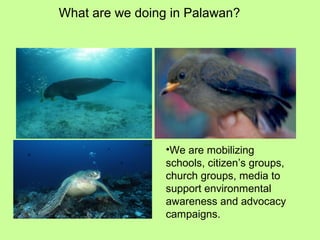
What are we doing in Palawan?
•We are mobilizing
schools, citizen’s groups,
church groups, media to
support environmental
awareness and advocacy
campaigns.
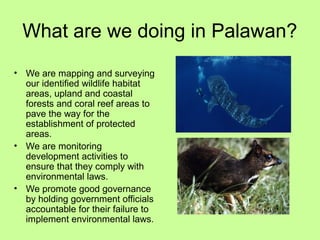
What are we doing in Palawan?
• We are mapping and surveying
our identified wildlife habitat
areas, upland and coastal
forests and coral reef areas to
pave the way for the
establishment of protected
areas.
• We are monitoring
development activities to
ensure that they comply with
environmental laws.
• We promote good governance
by holding government officials
accountable for their failure to
implement environmental laws.
The Apostolic Vicariates of
Taytay and Puerto Princesa on
Ecological Issues
• Ecology as one of the of the pastoral priorities
• First Pastoral letter issued by the Bishop is on
the ecological integrity of Northern Palawan
(2005)
• Creation of the Ecological Ministry of the
Cathedral Parish in partnership with the
Academe (Taytay Central School) in 2014 and
adapted as Vicarial Ministry in 2015
• Social Action activities
CENTRAL TAYTAY
NATIONAL HIGH SCHOOL
(ENVIRONMENTAL
PROGRAMS/ACTIVITIES)
IN PARTNERSHIP WITH THE
APOSTOLIC VICARIATE OF
TAYTAY- PALAWAN
AVT Mission Center
ST. JOSEPH THE WORKER VILLAGE
Poblacion, Taytay, Palawan
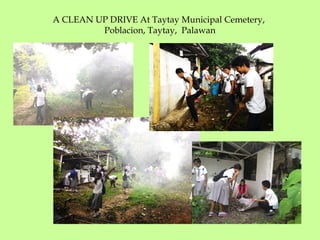
A CLEAN UP DRIVE At Taytay Municipal Cemetery,
Poblacion, Taytay, Palawan
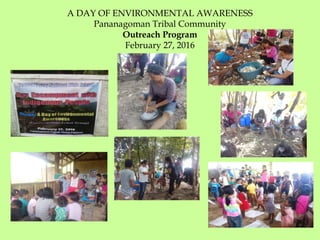
A DAY OF ENVIRONMENTAL AWARENESS
Pananagoman Tribal Community
Outreach Program
February 27, 2016
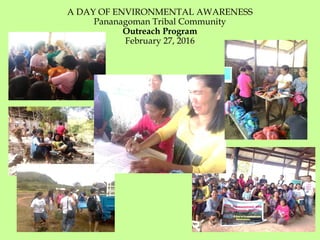
A DAY OF ENVIRONMENTAL AWARENESS
Pananagoman Tribal Community
Outreach Program
February 27, 2016
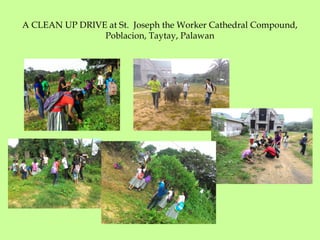
A CLEAN UP DRIVE at St. Joseph the Worker Cathedral Compound,
Poblacion, Taytay, Palawan
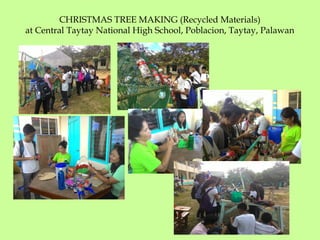
CHRISTMAS TREE MAKING (Recycled Materials)
at Central Taytay National High School, Poblacion, Taytay, Palawan
Central Taytay National
High school
Montevista, Poblacion,
Taytay, Palawan
ENVIRONMENTAL
ADVOCACY
BAYANI NG KALIKASAN
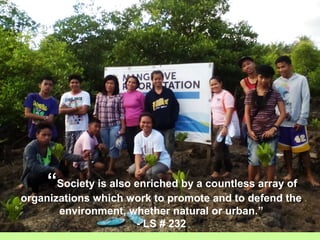
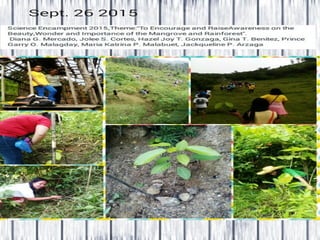
THE MANGROVE REFORESTATION PROJECT
AT SITIO QUELALA, POBLACION, TAYTAY,
PALAWAN
CENTRALIANS WITH THE SUPPORT OF THE
CORAL TRIANGLE INITIATIVE-SOUTH EAST
ASIA
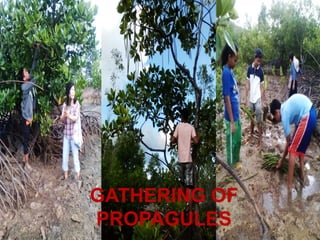
GATHERING OF
PROPAGULES
“Society is also enriched by a countless array of
organizations which work to promote and to defend the
environment, whether natural or urban.”
- LS # 232
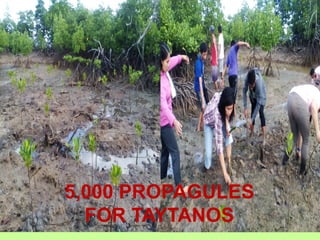
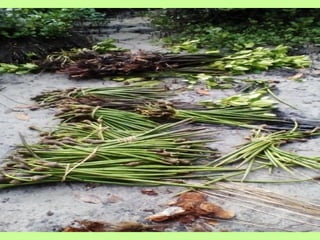
5,000 PROPAGULES
FOR TAYTANOS
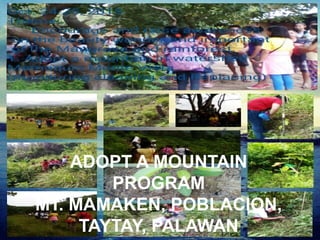
ADOPT A MOUNTAIN
PROGRAM
MT. MAMAKEN, POBLACION,
TAYTAY, PALAWAN
WHAT CAN WE DO?
“We must regain the conviction that we need one
another, that we have a shared responsibility for
others and the world, and that being good and
decent are worth it.”
-LS # 229
Promote Pubic Awareness
• Educate yourself, your family, your friends,
your co-workers and everyone you meet.
• The more people become aware of the
issues, the more likely they are to make
decisions that will be constructive!
• Be active - Speak up in a positive way in
your local community and organization and
help others to commit to conservation and
protecting the environment.
Support Conservation Activities
• Financial and technical assistance and logistical
support to protected area management bodies,
boards, councils
• Support the establishment of watersheds,
sanctuaries, other protected areas and the
implementation of their management plans (mapping,
surveying, enforcement)
• Alternative livelihood and development projects to
communities in areas confronted with
environmentally destructive activities (eg. Cyanide &
dynamite fishing, wildlife smuggling, mangrove
cutting)
• Help implement other eco-friendly programs (eg.
Solid waste management, bio-sand water filter
project)
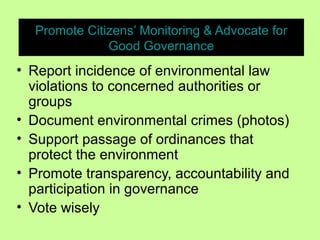
Promote Citizens’ Monitoring & Advocate for
Good Governance
• Report incidence of environmental law
violations to concerned authorities or
groups
• Document environmental crimes (photos)
• Support passage of ordinances that
protect the environment
• Promote transparency, accountability and
participation in governance
• Vote wisely
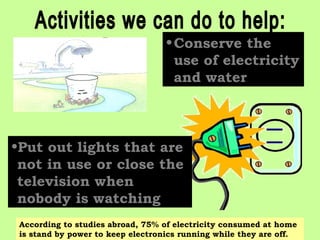
•Conserve the
use of electricity
and water
•Put out lights that are
not in use or close the
television when
nobody is watching
According to studies abroad, 75% of electricity consumed at home
is stand by power to keep electronics running while they are off.
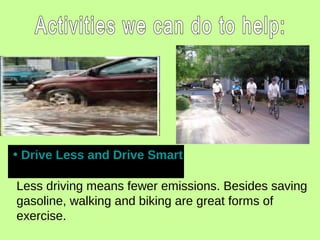
• Drive Less and Drive Smart
Less driving means fewer emissions. Besides saving
gasoline, walking and biking are great forms of
exercise.
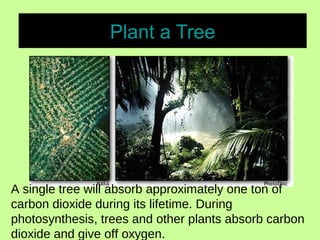
Plant a Tree
A single tree will absorb approximately one ton of
carbon dioxide during its lifetime. During
photosynthesis, trees and other plants absorb carbon
dioxide and give off oxygen.
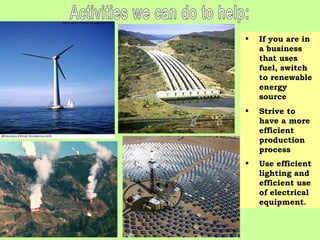
• If you are in
a business
that uses
fuel, switch
to renewable
energy
source
• Strive to
have a more
efficient
production
process
• Use efficient
lighting and
efficient use
of electrical
equipment.
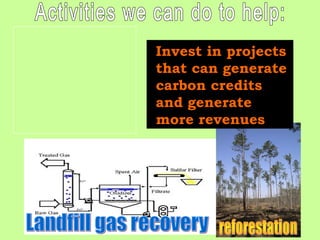
Invest in projects
that can generate
carbon credits
and generate
more revenues
• Replace regular light
bulbs with compact
fluorescent light (CFL)
bulbs.
• Replacing just one 60-
watt incandescent light
bulb with a CFL will save
you Php30.00 over the
life of the bulb.
• CFLs also last 10 times
longer than incandescent
bulbs, and use two-thirds
less energy.
•Change a Light Bulb
Reduce, Reuse, Recycle
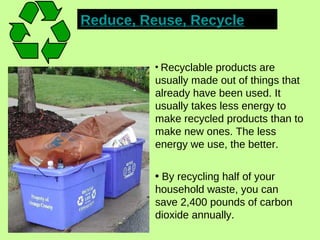
• Recyclable products are
usually made out of things that
already have been used. It
usually takes less energy to
make recycled products than to
make new ones. The less
energy we use, the better.
• By recycling half of your
household waste, you can
save 2,400 pounds of carbon
dioxide annually.
As per proposals and
considerations…
NEW MINING POLICY NEEDED
Bridging the Gap between Law and
Justice
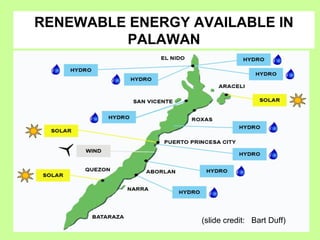
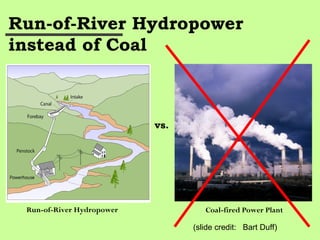
RENEWABLE ENERGY AVAILABLE IN
PALAWAN
(slide credit: Bart Duff)
Run-of-River Hydropower
instead of Coal
vs.
Run-of-River Hydropower Coal-fired Power Plant
(slide credit: Bart Duff)
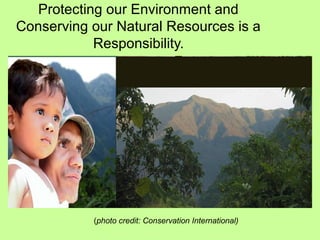
Protecting our Environment and
Conserving our Natural Resources is a
Responsibility.
(photo credit: Conservation International)
“Only when the last tree has died,
the last river has been poisoned
and the last fish has been caught,
only then will man realize that
money cannot be eaten”
--- from a native Indian
Matebek ong
yaten tang
ampoan tang
Dios!
Matamang
salamat ong
nindiong
tanan!
Appeal to Msgr. Gerry Santos...
My brilliant and inspiring Moral
Theology Professor...
Help our Vicarial Ministry on Ecology
Thank you in advance, Mons! 

Forfinalpresentation2

  • 1.
    The Culture andTheCulture and Ecosystem ofEcosystem of Palawan: An OverviewPalawan: An Overview Fr. Reynante Aguanta Apostolic Vicariate of Taytay, Palawan
  • 3.
  • 4.
    Sa Kapupuroan Sa kapupuroan maambeng, Kungmasanag ngani ang bulan. Mga bata ig mga malam Aga pamasiar sa pantalan. Mga solteros ig daraga Aga gitara ig magkaranta. Kada isara mi isara Maambeng anang leba. (Repeat) Pagkasanag ngani dayong parakon sa uma. Magkaingin, magsaripsip; Magpaligid kung mainit Maluto ron ngani ang paray sa bukid. Dayon sandang parantek Magrelebek-lebek.
  • 5.
    Amos mga tangay Amoskamo mga tangay Masarot-saot kita anay Lipatan ta ateng kapilay Magpanari anay Dading luto ron ang paray Kita magkalipay Indi tay panumbaelen Ang ateng kabedlay. (Repeat)
  • 6.
  • 7.
    Toting, ara kamikanyugan Ang bisyo y nanay pirming pamagatnan Anang ing dadara, ungot sanda tunggan Ang andang semseman kugita ig subingan (Repeat) Ay Toting… TOTING!!! Toting
  • 8.
  • 9.
  • 10.
    “’Laudato Si’, mi’Signore!’ St. Francis of Assisi reminds us that our common home is like a sister with whom we share our life and a beautiful mother who opens her arms to embrace us.” - LS # 1 The uniqueness of the Philippine Archipelago particularly Palawan
  • 11.
  • 12.
  • 26.
  • 27.
  • 28.
    As an IslandEcosystem… • Unique, Fragile and Vulnerable • Distinction: – Evolution of flora and fauna has taken place in relative isolation – Endemism and rich biodiversity • Many remote islands have some of the most unique flora in the world; some have species of plants and animals that are not found anywhere else, which have evolved in a specialized way, sheltered from the fierce competition that species face on mainland. (http://www.eionet.europa.eu/gemet/concept)
  • 30.
    As an IslandEcosystem… • “Palawan is composed of a long main island lying in a northeast to southwest axis and surrounding it are clusters of lesser islands…..The main island has a tall steep mountain spine running down its length fringed by narrow coastal plans protected from storm waves by fringing coral reefs and mangrove swamps. Although seemingly lush and bountiful, the environment of Palawan is fragile and its topsoils are relatively thin, poor and prone to erosion.” (Source: Strategic Environmental Plan for Palawan, Towards Sustainable Development, Prepared by the Palawan Integrated Area Development Project Office with the assistance of Hunting Technical Services Limited England in association with the Orient Integrated Development Consultants, Inc., Philippines and Sir Mac Donald and Partners, England)
  • 31.
    • almost 1.5million has. (land area) • pop. 800,000 (approx) • 53 % forest cover (PCSDS) •80+% live below the poverty line (PPDO) •30% of Philippines’ mangrove cover •40% of country’s coral reef cover •40% of Philippine endemics •2 World Heritage Sites (Tubbataha Reefs, PPSRNP) •Most Number of Protected Areas in the Philippines
  • 32.
    Palawan has 1,959kilometers of coastal area which has several coves, bays and 176 fishing grounds, like Malampaya Sound sa Taytay, Honda Bay in Puerto Princesa City, Coron Bay, Bacuit Bay sa El Nido.
  • 33.
    15 lakes, 42 ponds, 44waterfalls, 72 natural springs, 9 mineral springs, 28 principal rivers, 43 streams and 165 creeks which are potential sources of water for household and irrigation use
  • 34.
    604,765 hectares offorest (DENR, 2005)
  • 35.
    As Island Ecosystem… •“Palawan’s forests support a unique and highly diverse flora and fauna…Many of Palawan’s fauna are unique and are considered rare, threatened or endangered.” – With few botanical expeditions in the past, many botanists feel that there are more undiscovered species of plants. – Such diversity serve as basis for declaring Palawan as a “Game Refuge and Bird Sanctuary” in 1967, as Mangrove Reserve in 1981 and as part of UNESCO’s “Man and Biosphere Reserve”. • “Last Frontier” description signifies abundant and untapped resources, relatively unravaged by resource overexploitation. (Source: SEP document)
  • 36.
    44,500 hectares ofmangroves which have some 28 species of the total 31 species found in the country (CI 2007)
  • 37.
    The value ofmangroves
  • 38.
    PALAWAN’S BIODIVERSITY… • 13speciesof seagrassrecorded in Palawan (81% of the known seagrassspeciesin thecountry) • 31 speciesof mangrovesin Palawan (90% of theknown mangrovespeciesin thecountry) • 44,500 hectaresof mangroveforestsin Palawan (40% of theremaining mangrovesin thecountry) • 379 speciesof corals(82% of thetotal coral species recorded in theentirecountry) • 89% of total reef fish recorded in thecountry isfound in thecorridor • 4 of the5 marineturtlesarefound in Palawan • 15 of the25 recorded marinemammalsarereported from Palawan (Credit: Conservation International)
  • 39.
    • 18 speciesoffreshwater fish isfound in Palawan (50% endemic to theprovince) • 26 speciesof amphibians(25% endemic to thecountry, majority areconfined to thecorridor • 69 speciesof reptilesfound in thecorridor (29% are endemic to thecountry) • 279 speciesof birds(10% areendemic to thecountry) • 34% of bird speciesaremigratory, making theregion a vital flyway for migratory birds • 58 speciesof terrestrial mammalsarerecorded, 19 or 33% areendemic to thecountry, 16 arerestricted to the corridor (Credit: Conservation International) PALAWAN’S BIODIVERSITY…
  • 41.
    BAD NEWS!  ThePhilippines is the most threatened in the world, particularly the endemic species.  Regarded as “hottest of the conservation hotspots”.  And so is Palawan…
  • 42.
    “Our common homecries out to us because of the harm we have inflicted on her by our irresponsible use and abuse of the good with which God has endowed her.” -LS # 2
  • 43.
    Ang Kapaligiran ngAngKapaligiran ng Palawan: Patuloy angPalawan: Patuloy ang mga Banta at Hamonmga Banta at Hamon Atty. Grizelda Mayo-Anda Co-convenor, Palawan Green Thumb Coalition (GTC)
  • 44.
    Mining, Extractive andMining,Extractive and Major InfrastructureMajor Infrastructure Projects in KeyProjects in Key Biodiversity Areas,Biodiversity Areas, Protected Areas, NO-Protected Areas, NO- GO areasGO areas
  • 45.
    “Now, faced aswe are with global environmental deterioration… calls us to enter into dialogue about our common home.” -LS # 3 What’s happening now in Palawan…
  • 46.
    Current Threats toPalawan’s Biodiversity “The created things of this world are not free of ownership: For they are yours, O Lord, who love the living.” - LS # 89
  • 47.
    Illegal Fishing “Whether ornot, we are agreed today that the earth is essentially a shared inheritance, whose fruits are meant to benefit everyone.” -LS # 93
  • 48.
    Tourism development (island selling,land grabbing, development aggression, illegal logging)
  • 49.
  • 50.
    ISLAND SELLING (photo credit:Dempto Anda)(photo credit: Dempto Anda)
  • 51.
    (photo credit: DemptoAnda)(photo credit: Dempto Anda)
  • 52.
    (photo credit: DemptoAnda)(photo credit: Dempto Anda)
  • 53.
    Development Aggression (photo credit:Dempto Anda)(photo credit: Dempto Anda)
  • 54.
    (photo credit: DemptoAnda)(photo credit: Dempto Anda)
  • 55.
    (photo credit: DemptoAnda)(photo credit: Dempto Anda)
  • 56.
    (photo credit: DemptoAnda)(photo credit: Dempto Anda)
  • 57.
    ILLEGAL LOGGING (photo credit:Dempto Anda)(photo credit: Dempto Anda)
  • 58.
    Forest Destruction (logging, conversionto plantations and agriculture)
  • 59.
    Illegal Logging (photo credit:Dempto Anda)(photo credit: Dempto Anda)
  • 60.
    (photo credit: DemptoAnda)(photo credit: Dempto Anda)
  • 61.
  • 62.
    “Plantation is notreforestation.”
  • 63.
    Roads and otherLarge Infrastructure development “In practice, we continue to tolerate that some consider themselves more human than others, as if they had been born with greater rights.” -LS # 90
  • 64.
    (photo credit: PalawanNGO Network, Inc. or PNNI) ““Ay Diyos KoAy Diyos Ko”” road in Barangay Caruray, San Vicenteroad in Barangay Caruray, San Vicente
  • 65.
    (Ulugan Bay RoadProject)Ulugan Bay Road Project)
  • 66.
    (photo credit: DemptoAnda)(photo credit: Dempto Anda)
  • 67.
    Oil exploration; utilization of coal andother fossil fuels for development of energy/power
  • 69.
  • 71.
    Other Current Threatsto Palawan’s Biodiversity • Depletion of marine resources (mangrove destruction, overfishing, illegal fishing) • Wildlife hunting and smuggling • Furniture industry • Live fish industry • Coastal area reclamation
  • 72.
    1. Depletion anddegradation of resources - illegal and destructive fishing methods - rapid coastal population growth - lack of alternative livelihood and employment opportunities - indiscriminate collection 2. Pollution - waste dumping from both industrial & domestic 3. Siltation - deforestation - mine tailings - mangrove conversion into fishpond - reclamation & building of infrastructure
  • 73.
  • 74.
    Location of 110 Miningclaims in Palawan
  • 75.
    San Vicente- 5apps- 4, 993/2, 794.6 hectares silica Roxas- 8 apps – 7, 014/ 43, 455 hectares silica Name of Municipality Number of Applications Hectares of land Mineral/s Coron 8 457 El Nido 4 150 31 Silica Natural gas Taytay 6 30, 700.5 / 9, 307 Dumaran 2 777 / 677 Silica
  • 76.
    Name of Municipality Number of Applications Hectaresof land Mineral/s San Vicente 5 4, 993 / 2, 794 Silica Roxas 8 7, 014 / 43, 455 Silica Puerto Princesa City 8 23, 995 / 7, 569 Nickel Marble Aborlan 13 24, 398 / 965.5 Nickel
  • 77.
    Name of Municipality Number of Applications Hectaresof land Mineral/s Quezon 11 35, 320 / 10, 376 Nickel and Limestone Narra 15 12, 416 / 641 Nickel, Chromite Silica Rizal 5 10, 865 / 2, 981.2 Nickel
  • 78.
    Name of Municipality Number of Applications Hectaresof Land Mineral/s Española 6 32, 642 / 2, 981.2 Nickel Limestone Brooke’s Point 12 37, 135 / 17, 998 Nickel Bataraza 8 72, 617 / 17, 998 Limestone, Nickel, HPP
  • 80.
    Palawan Mineral Agreements •2011 ---- 429 mining applications (exploration, mineral agreements, industrial quarrying) • 2012 ---- MGB cancelled more than 400 applications • 2013 ---- 19 MPSAs and Exploration Permits (EP)
  • 81.
    Mining Company Areaof operation Mineral Palawan Quicksilver Mining Inc. (PQMI) Sta. Lourdes, Puerto Princesa City Mercury Atlas Consolidated Mining & Dev. Corp. Sta. Lourdes, Puerto Princesa City Gold Palawan Venture or Palawan Consolidated Mining Co. Irawan, Puerto Princesa City Chromite Soriano Mining Corporation Aborlan, Puerto Princesa City Nickel Trident Mining Corporation Narra, Palawan Nickel Infanta Mining Corporation Brgy. Ipilan, Brooke’s Point Nickel Celestial Mining Corporation Brgy. Ipilan, Brooke’s Point Nickel Long Point Mining Corporation/Soriano Mining Berong, Quezon Nickel Benguet Company Inc. Balabac Gold ore Nin Bay Mining Corporation Roxas, Palawan Silica Republic Glass Mining Corporation Roxas, Palawan Silica Abandoned Mine Sites in Palawan (11)
  • 82.
    Destruction of Forestsand Wildlife Land Use Changes in a Nickel Mining Area (Credit: Conservation International and ELAC)
  • 84.
    Open pit miningin Narra, Southern Palawan
  • 86.
  • 87.
    Gotok mountain quarryin Bataraza, Palawan. RTNMC is quarrying this mountain (classified as a core zone due to its limestone forests).
  • 88.
    Current state ofthe Gotok quarry site of the HPP project
  • 89.
    Other Issues andDevelopment • Continuing exploration of MacroAsia in Brooke’s Point • Attempts of Ipilan Nickel Corporation and Lebach Mining to start exploration and mineral development • Continuing violations by Citinickel Mining Corporation (Citinickel) – 2x suspended and now with Cease-and-Desist Order (CDO) • Pollutive impacts of Narra Nickel Mining Development Corporation (NNMDC) in Narra
  • 90.
    FINDINGS: Location Map •Causeway/Loading Bay •Stockpile– Drying Area •Siltation pond •Assay Lab and Motor Pool •Camp site •Sitio Tungib •Sorex Road •Mine site •Alleged Kaingin Site(Slide credit: Roger Garinga)
  • 91.
    MMT Findings Summary •No Proof of “Kaingin”. Only Active mining. CENRO certification does not stand (Unsubstantiated). See next slide • No Cutting Permit, not reported to MMT and MRFC nor to MGB prior to operation • Annual EPEP does not cover Area 12 – in violation of ECC # 6.1(Slide credit: Roger Garinga)
  • 92.
    MMT Findings Summary Accessroad stripped of trees using SLUP issued by RED but without tree cutting permit. Is SLUP necessary inside MPSA area? Violation of ECC condition # 2.2 (Slide credit: Roger Garinga)
  • 93.
    MMT Findings Summary Failureto submit detailed Silt traps prior to mine operation- in violation of ECC condition # 2.1; Failure to install ADEQUATE and EFFECTIVE water pollution control (Violation Of ECC Condition # 3.4) (Slide credit: Roger Garinga)
  • 94.
    MMT Findings SummaryFailure toeffect stabilization and erosion control within and nearby gullies/creeks (Violation of ECC Condition # 3.8.2) Siltation traps No Siltation traps, hence silt goes to creek then to Berong River (Slide credit: Roger Garinga)
  • 95.
    MMT Findings Summary ILLEGALQUARRY – at the Delta of Berong River (No quarry permit) = THEFT OF MINERALS (Slide credit: Roger Garinga)
  • 96.
    PREVIOUS ISSUES VS BNC • 2counts of Notice of Violations (NOVs) were issued – One for spilled used oil in their storage area – One for air pollution in Sitio Tungib (populated area of Tagbanua Tribe) (Slide credit: Roger Garinga)
  • 97.
    OTHER ISSUES VSBNC, etc. • Area Mined out where trees were cut using alleged fake cutting permit issued by RED – Investigation report from RED Galeon has been requested since 2 quarters ago • Whether the permit is indeed fake, who were culprits, what sanctions imposed • What happened to the cut logs here? DENR is required to monitor and cutting operation (Slide credit: Roger Garinga)
  • 98.
    • Small Scale MiningPermits issued in areas without small scale mining reservations (minahang bayan )
  • 99.
    Cost and Risksof Mining vis-à-vis Biodiversity, Food Security, Human Dignity
  • 100.
    Impacts and Damages •Household, community displacement from subsistence or livelihood activities • Reduced access or availability of local water supply for in-site and off-site areas • Unpaid use and depletion of groundwater • Pollution of surface water and aquifer • Leakages, overflowing or collapse of tailings dam • Loss of biodiversity • Impacts on health
  • 101.
    Mt. Mantalingahan ProtectedLandscape (MMPL), Southern Palawan
  • 102.
    Potential Sand andGravel and Nickel Reserves Amount Value Sand and Gravel* 11,044,104 m3 2.2 billion pesos Nickel** 268,010 mt 12.8 billion pesos TOTAL 15.0 billion pesos *The volume of sand and gravel reserve was estimated on the assumption that the total mineable length is 10% of the total length of all the rivers in the watersheds and at a price of P200/m3 ** The value for nickel was computed at P47,810/mt Mt. Mantalingahan, Palawan
  • 103.
    Mt. Mantalingahan Total EconomicValue (TEV) THE VALUE OF ENVIRONMENTAL GOODS AND SERVICES PRODUCED FAR EXCEEDS THE NET BENEFIT FROM MINING Direct Use (timber, farming, livestock production, non- timber forest products gathering, river- based livelihood, water and mining) 93.9 billion pesos Indirect Use (carbon stock, soil, conservation, watershed and biodiversity functions, and protection of marine biodiversity) 172.1 billion pesos Total Economic Value (2% discount rate) 266.0 billion pesos
  • 104.
    On political, legaland economic issues and concerns… “If the simple fact of being human moves people to care for the environment of which they are part, Christians in their turn ‘realize that their responsibility within creation, and their duty towards nature and Creator, are an essential part of their faith.” - LS # 64
  • 105.
    Mining under theAquino Administration • Philippine Development Plan (2011 to 2016) states that mining has “mixed results” • Government admits that it has not developed, nor applied, any standard for measuring the environmental and social costs of mining, and that it does not have the capability to implement, enforce and monitor the laws. • Executive Order No. 270-A (Minerals Action Policy of the Arroyo Administration) has not been repealed
  • 106.
    Mining under theAquino Administration • “Responsible Mining” has been identified as an industry for development • Executive Order No. 79 (July 2012) – Suspends the processing of mining applications pending the passage of a new law that would increase the income of government panibagong batas upang seguraduhin ang pagtaas ng kinikita ng pamahalaan – “NO-GO ZONES” --- includes Palawan – “Mineral exploration”
  • 107.
    Policy Issues • Miningpolicy is structured to fulfill the foreign market, catering to the need of the global extractive industry players; Export-oriented and Dependent on foreign capital • Government prioritizes the revitalization of the mining industry, as expressed in the Mineral Action Plan (EO 270 and 270-A)
  • 108.
    Legal Issue • Overgenerousfiscal incentives and other benefits to mining corporations in the use of our mineral and other resources
  • 109.
    Mining revitalization: GovernmentisMining revitalization: Government is selling our national patrimonyselling our national patrimony  Mining Incentives under Mining Act of 1995  Incentives of the Omnibus Investment Code of 1987  Investment Guarantees  Repatriation of Capital  Freedom from Expropriation  Remittance from earnings and interest on foreign loans  Freedom from requisition of properties  Confidentiality of Information
  • 110.
    Mining revitalization: GovernmentisMining revitalization: Government is selling our national patrimonyselling our national patrimony  Mining Incentives under 1987 OmnibusMining Incentives under 1987 Omnibus Investment CodeInvestment Code  Fiscal incentivesFiscal incentives: tax exemptions, tax: tax exemptions, tax credit on raw materials and supplies,credit on raw materials and supplies, additional deductions from taxableadditional deductions from taxable incomeincome  Non-fiscal incentivesNon-fiscal incentives: employment of: employment of foreign nationals, simplified importforeign nationals, simplified import procedures, 10-year imports ofprocedures, 10-year imports of consigned equipmentconsigned equipment
  • 111.
    Incentives under PhilippineMining Act  Tax Holiday during recovery of pre- operating expenses for a maximum of 5 years from commercial production (FTAA)  Income Tax carry forward of losses  Income Tax accelerated depreciation of fixed assets  Exemption from payment of real property taxes on pollution control devices
  • 112.
    Existing Mining lawgives more benefits to mining corporations in the use of our natural resources (i) preference of “mining rights” over “surface rights” (ii) provision of “income tax holiday” under the Omnibus Investment Code or EO 226 and other “tax incentives” under the Special Economic Zone Act or RA 7916 (iii) Provision of ancillary rights like “timber rights, water rights, easement rights”
  • 113.
    Not a SingleCentavo from Mining Companies “xxx the 1987 Constitution mandates the State to exploit our mineral resources through direct undertaking, joint venture, or co-production arrangements. The purpose is for the State, as owner of the mineral resources, to receive its fair share in the profits from the exploitation of our mineral resources. Sadly, for the last 20 years the State has not received a single centavo from the profits of mining companies.” Supreme Court Justice Antonio Carpio on Closing the Gaps between Law and Justice, Regional Convention of Mindanao lawyers on November 30, 2007, Davao City
  • 114.
    Legal Issues • Unclearrules and regulations on the implementation of the 1% royalty share for the affected Indigenous Peoples/Communities • Non-compliance with environmental laws, safety standards and permit requirements • Institutional: Weak regulatory mechanisms; weak Implementation of existing laws
  • 115.
    Consent and Acceptability Issues •Effect of Moratorium Ordinances • Effect of Free, Prior and Informed Consent (FPIC) under the Indigenous Peoples’ Rights Act (IPRA, RA 8371) • Social Acceptability processes
  • 116.
    Other Legal Issues •Allowing “open pit mining” (cheap, fast and easy to do but destructive to the environment) which has been prohibited in some areas in the US and Canada
  • 117.
    Weak Implementation • Miningactivities have been allowed in watersheds, protected areas and core zones – Violation of RA 7611 or Strategic Environmental Plan for Palawan (SEP), which provides that all natural forests (old-growth or residual forests) are areas of maximum protection (Section 9, RA 7611) • Allowing large-scale corporations to apply for small-scale mining permits while their large-scale mining permits or MPSAs (mineral production sharing agreements) are being processed and pending approval
  • 118.
    Weak implementation • Smallscale mining has been allowed in areas where no small-scale mining reservations (minahang bayan) were established
  • 119.
    Why should weprotect Palawan’s Ecosystem? • Last ecological frontier • Palawan was declared as a national biosphere • Reserve by the United Nations Educational Scientific and Cultural Organization (UNESCO) in 1990 • Home to 2 World Heritage Sites and 7 protected areas • Has the largest remaining forest cover in the country (54% or 804, 398 hectares)
  • 120.
    Fast Facts: • Country’slargest province with total mainland area of 1.5 million hectares • A narrow archipelago of 1, 700 islands • Its length fro tip to tip is 650 kilometers while total length of coastline is 2, 000 kms. • Palawan is politically divided into 23 municipalities and one city
  • 122.
    More facts… • Thereare more than 200 species of bird and over 600 species of butterfly • 16 endemic birds in Palawan • 16 species of Palawan endemic mammals
  • 123.
    What are wedoing in Palawan? “If someone has not learned to stop and admire something beautiful, we should not be surprised if he or she treats everything as an object to be used and abused without scruple.” -LS # 215
  • 124.
    Initiatives of LocalCommunities Fight against Coal Power Plant
  • 125.
    Initiatives of LocalCommunities and Civil Society Groups in Palawan • Dialogues and Engagement with government towards a participatory process of energy development, particularly, renewable energy • Legal Actions: Special Civil Action forLegal Actions: Special Civil Action for Prohibition and EPO with prayer for TEPOProhibition and EPO with prayer for TEPO • Advocacy – Barangay ordinance banning coal in their area – Barangay ordinance prohibiting the conversion of agricultural lands into industrial uses
  • 126.
    Palawan Environmental Agenda (a)Cessationof all forms of mining activities in Palawan’s natural forests, protected areas and key biodiversity areas (b) Pro-active development of renewable energy and a ban on the use of coal power in the development of Palawan’s energy/power agenda
  • 127.
    Palawan Environmental Agenda (c)Moratorium in the expansion of oil palm and similar exotic plantations that threaten Palawan’s biodiversity and the livelihood of local communities; (d) Stopping the conversion of Palawan’s core zones in the upland, lowland coastal areas in order to accommodate infrastructure and extractive projects; and (e) Halt land-grabbing activities especially within ancestral domains.
  • 128.
    What are wedoing in Palawan? We are establishing mechanisms to protect key biodiversity areas. -Education & Awareness (seminars, conferences, capability building activities, media campaigns) -Establishment of Watersheds, Sanctuaries, other Protected Areas
  • 129.
    What are wedoing in Palawan? •We are developing partnerships between government, non- government groups, community groups and the private sector to promote ecologically-friendly programs, such as eco-tourism, waste management, clean air and clean water projects.
  • 130.
    What are wedoing in Palawan? • We are supporting efforts of local communities (indigenous communities, fisherfolks, farmers) to manage their ancestral domains and community-based forest management areas. • Mustering support from private sector (eg. Mooring buoys from Rotary Club of Puerto Princesa, Rotary Club of Makati and Ford Foundation)
  • 131.
    What we aredoing in Palawan? •We are doing enforcement activities to curb or stop environmental crimes. •We are advocating for laws and ordinances to establish sanctuaries, watersheds, protected areas and ban or regulate destructive activities.
  • 132.
    What are wedoing in Palawan? •We are mobilizing schools, citizen’s groups, church groups, media to support environmental awareness and advocacy campaigns.
  • 133.
    What are wedoing in Palawan? • We are mapping and surveying our identified wildlife habitat areas, upland and coastal forests and coral reef areas to pave the way for the establishment of protected areas. • We are monitoring development activities to ensure that they comply with environmental laws. • We promote good governance by holding government officials accountable for their failure to implement environmental laws.
  • 134.
    The Apostolic Vicariatesof Taytay and Puerto Princesa on Ecological Issues • Ecology as one of the of the pastoral priorities • First Pastoral letter issued by the Bishop is on the ecological integrity of Northern Palawan (2005) • Creation of the Ecological Ministry of the Cathedral Parish in partnership with the Academe (Taytay Central School) in 2014 and adapted as Vicarial Ministry in 2015 • Social Action activities
  • 135.
    CENTRAL TAYTAY NATIONAL HIGHSCHOOL (ENVIRONMENTAL PROGRAMS/ACTIVITIES) IN PARTNERSHIP WITH THE APOSTOLIC VICARIATE OF TAYTAY- PALAWAN AVT Mission Center ST. JOSEPH THE WORKER VILLAGE Poblacion, Taytay, Palawan
  • 136.
    A CLEAN UPDRIVE At Taytay Municipal Cemetery, Poblacion, Taytay, Palawan
  • 137.
    A DAY OFENVIRONMENTAL AWARENESS Pananagoman Tribal Community Outreach Program February 27, 2016
  • 138.
    A DAY OFENVIRONMENTAL AWARENESS Pananagoman Tribal Community Outreach Program February 27, 2016
  • 139.
    A CLEAN UPDRIVE at St. Joseph the Worker Cathedral Compound, Poblacion, Taytay, Palawan
  • 140.
    CHRISTMAS TREE MAKING(Recycled Materials) at Central Taytay National High School, Poblacion, Taytay, Palawan
  • 141.
    Central Taytay National Highschool Montevista, Poblacion, Taytay, Palawan ENVIRONMENTAL ADVOCACY
  • 142.
    BAYANI NG KALIKASAN THEMANGROVE REFORESTATION PROJECT AT SITIO QUELALA, POBLACION, TAYTAY, PALAWAN CENTRALIANS WITH THE SUPPORT OF THE CORAL TRIANGLE INITIATIVE-SOUTH EAST ASIA
  • 143.
  • 144.
    “Society is alsoenriched by a countless array of organizations which work to promote and to defend the environment, whether natural or urban.” - LS # 232
  • 145.
  • 147.
    ADOPT A MOUNTAIN PROGRAM MT.MAMAKEN, POBLACION, TAYTAY, PALAWAN
  • 149.
    WHAT CAN WEDO? “We must regain the conviction that we need one another, that we have a shared responsibility for others and the world, and that being good and decent are worth it.” -LS # 229
  • 150.
    Promote Pubic Awareness •Educate yourself, your family, your friends, your co-workers and everyone you meet. • The more people become aware of the issues, the more likely they are to make decisions that will be constructive! • Be active - Speak up in a positive way in your local community and organization and help others to commit to conservation and protecting the environment.
  • 151.
    Support Conservation Activities •Financial and technical assistance and logistical support to protected area management bodies, boards, councils • Support the establishment of watersheds, sanctuaries, other protected areas and the implementation of their management plans (mapping, surveying, enforcement) • Alternative livelihood and development projects to communities in areas confronted with environmentally destructive activities (eg. Cyanide & dynamite fishing, wildlife smuggling, mangrove cutting) • Help implement other eco-friendly programs (eg. Solid waste management, bio-sand water filter project)
  • 152.
    Promote Citizens’ Monitoring& Advocate for Good Governance • Report incidence of environmental law violations to concerned authorities or groups • Document environmental crimes (photos) • Support passage of ordinances that protect the environment • Promote transparency, accountability and participation in governance • Vote wisely
  • 153.
    •Conserve the use ofelectricity and water •Put out lights that are not in use or close the television when nobody is watching According to studies abroad, 75% of electricity consumed at home is stand by power to keep electronics running while they are off.
  • 154.
    • Drive Lessand Drive Smart Less driving means fewer emissions. Besides saving gasoline, walking and biking are great forms of exercise.
  • 155.
    Plant a Tree Asingle tree will absorb approximately one ton of carbon dioxide during its lifetime. During photosynthesis, trees and other plants absorb carbon dioxide and give off oxygen.
  • 156.
    • If youare in a business that uses fuel, switch to renewable energy source • Strive to have a more efficient production process • Use efficient lighting and efficient use of electrical equipment.
  • 157.
    Invest in projects thatcan generate carbon credits and generate more revenues
  • 158.
    • Replace regularlight bulbs with compact fluorescent light (CFL) bulbs. • Replacing just one 60- watt incandescent light bulb with a CFL will save you Php30.00 over the life of the bulb. • CFLs also last 10 times longer than incandescent bulbs, and use two-thirds less energy. •Change a Light Bulb
  • 159.
    Reduce, Reuse, Recycle •Recyclable products are usually made out of things that already have been used. It usually takes less energy to make recycled products than to make new ones. The less energy we use, the better. • By recycling half of your household waste, you can save 2,400 pounds of carbon dioxide annually.
  • 160.
    As per proposalsand considerations…
  • 161.
    NEW MINING POLICYNEEDED Bridging the Gap between Law and Justice
  • 162.
    RENEWABLE ENERGY AVAILABLEIN PALAWAN (slide credit: Bart Duff)
  • 163.
    Run-of-River Hydropower instead ofCoal vs. Run-of-River Hydropower Coal-fired Power Plant (slide credit: Bart Duff)
  • 164.
    Protecting our Environmentand Conserving our Natural Resources is a Responsibility. (photo credit: Conservation International)
  • 165.
    “Only when thelast tree has died, the last river has been poisoned and the last fish has been caught, only then will man realize that money cannot be eaten” --- from a native Indian
  • 166.
  • 167.
  • 168.
    Appeal to Msgr.Gerry Santos... My brilliant and inspiring Moral Theology Professor... Help our Vicarial Ministry on Ecology Thank you in advance, Mons! 

Editor's Notes

  • #39 Among the critically endangered marine species are marine mammals and sea turtles, to say nothing of endemic fish and coral species… just recently, from a marine mammal survey conducted by CI, the dwarf spinner dolphin was finally documented including a different bottlenose species – the indo-pacific bottlenose dolphin. Likewise, five of the seven sea turtle species can be found in Philippine waters, including the largest congregation of nesting green and hawksbill turtles…
  • #164 Coal-fired power plant photo lifted from: http://www.coal-is-dirty.com/100-coal-plants-stopped-2002 (accessed 16 July 2013)