Forensic history
1900 ad-1920 ad
By: Garrett Wilson
1900
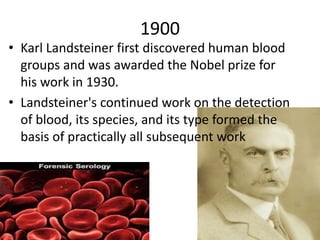
• Karl Landsteiner first discovered human blood
groups and was awarded the Nobel prize for
his work in 1930.
• Landsteiner's continued work on the detection
of blood, its species, and its type formed the
basis of practically all subsequent work
1910
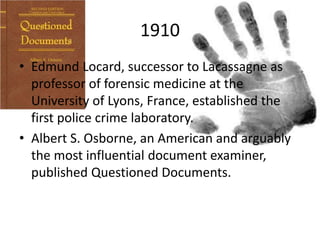
• Edmund Locard, successor to Lacassagne as
professor of forensic medicine at the
University of Lyons, France, established the
first police crime laboratory.
• Albert S. Osborne, an American and arguably
the most influential document examiner,
published Questioned Documents.
1915
• International Association for Criminal
Identification, (to become The International
Association of Identification (IAI), was
organized in Oakland, California.
1920
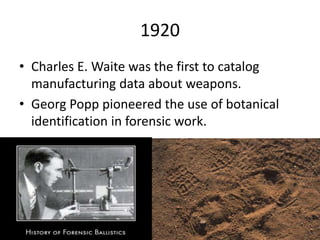
• Charles E. Waite was the first to catalog
manufacturing data about weapons.
• Georg Popp pioneered the use of botanical
identification in forensic work.

Forensic history

  • 1.
    Forensic history 1900 ad-1920ad By: Garrett Wilson
  • 2.
    1900 • Karl Landsteinerfirst discovered human blood groups and was awarded the Nobel prize for his work in 1930. • Landsteiner's continued work on the detection of blood, its species, and its type formed the basis of practically all subsequent work
  • 3.
    1910 • Edmund Locard,successor to Lacassagne as professor of forensic medicine at the University of Lyons, France, established the first police crime laboratory. • Albert S. Osborne, an American and arguably the most influential document examiner, published Questioned Documents.
  • 4.
    1915 • International Associationfor Criminal Identification, (to become The International Association of Identification (IAI), was organized in Oakland, California.
  • 5.
    1920 • Charles E.Waite was the first to catalog manufacturing data about weapons. • Georg Popp pioneered the use of botanical identification in forensic work.