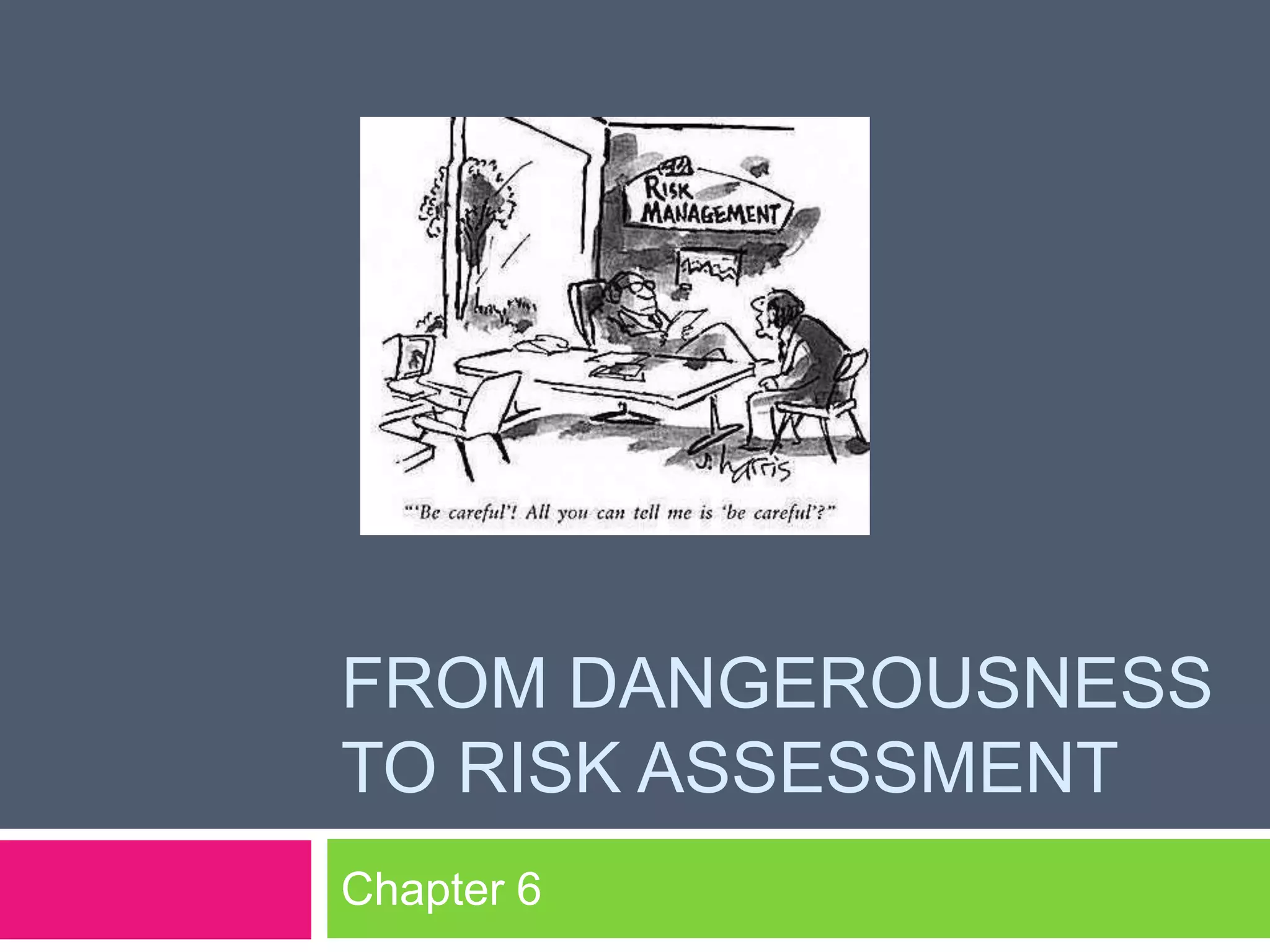
FROM DANGEROUSNESS
TO RISK ASSESSMENT
Chapter 6
Risk Assessment
   Risk assessment – the process of
    conceptualizing hazards in order to make
    judgments about their likelihood and the need
    for various preventative measures
Risk Assessment
   3 types of predictive schemes (Morris & Miller,
    1985)
       clinical prediction: based on clinical experience and
        judgment


       actuarial prediction: based on statistical formulas

       anamnestic prediction: based on analysis of how a
        particular person has acted in the past in similar situations
Predicting Dangerousness
   Practical predictions of future dangerousness
     parole boards, prison release review boards
     human resource managers
     school psychologists
     police
1st Generation of Research
   Few studies done, with most focusing on the
    relationship between mental illness and violence
     mentally ill are less prone to violence and have lower
      arrest rates
     mental health professionals are unable to predict
      dangerousness or violence accurately
Relevant Rulings
   Baxstrom v. Harold (1966)
     Baxstrom   had been held in a state hospital after
      his criminal sentence had expired, which was
      found to be a violation of equal protection
     Aftermath
       After5 years, less than 3% of released inmates had to
       return to security hospitals
Relevant Rulings
   Barefoot v. Estelle (1983)
     convictedof capital murder of a police officer
     sentencing jury must consider “future violence”


   Appeal
        American Psychiatric Association submitted an
        amicus brief reporting that mental health professionals
        are unable to predict with an acceptable degree of
        reliability that a particular criminal will commit other
        crimes in the future
Relevant Rulings
   Barefoot v. Estelle (1983) Ruling
     Supreme Court did not accept the argument that
      mental health professionals were no better off at
      predicting dangerousness than laypersons
     Supreme Court upheld Barefoot’s death sentence
Problems with Predictions of
Dangerousness
   Courts did not accept the information provided
    in the American Psychiatric Association’s
    amicus brief
   Conceptualization of “dangerousness”
2nd Generation of Research
   Shift in focus from “dangerous/not dangerous”
    to measuring risk
   New studies focused on factors that are
    predictive of risk
     Examples
       History
              of previous violence
       Psychopathology

   Consensus that risk assessment can be made
    with “moderate to good” accuracy
Prediction of Violence
   Mental disorder
       Vast majority of people with mental disorders are not
        violent

   Douglas and Webster (1999) identified 20
    variables that seem to be related to the risk of
    violence
     Static – do not change
     Dynamic – change over times and situations
     Risk management
           Stable and supportive environments lower the risk of
            violence
Prediction Sexual Offending
   According to the U.S. Department of Justice
     1/4 women and 1/6 men will experience some sort of
      sexual assault during their lifetime
     67% of sexual assaults occur to those under the age
      of 18
     2/3 are committed by someone who knows the victim

   All 50 states have registration and tracking
    systems
   Missouri:
    http://www.mshp.dps.missouri.gov/MSHPWeb/Pat
    rolDivisions/CRID/SOR/factsheet.html
   National Sexual Assault Hotline: 1-800-656-4673
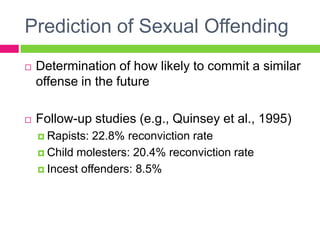
Prediction of Sexual Offending
   Determination of how likely to commit a similar
    offense in the future

   Follow-up studies (e.g., Quinsey et al., 1995)
     Rapists: 22.8% reconviction rate
     Child molesters: 20.4% reconviction rate

     Incest offenders: 8.5%
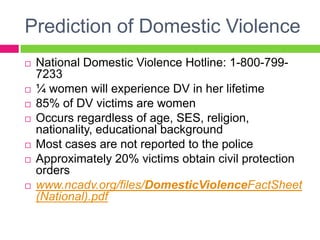
Prediction of Domestic Violence
   National Domestic Violence Hotline: 1-800-799-
    7233
   ¼ women will experience DV in her lifetime
   85% of DV victims are women
   Occurs regardless of age, SES, religion,
    nationality, educational background
   Most cases are not reported to the police
   Approximately 20% victims obtain civil protection
    orders
   www.ncadv.org/files/DomesticViolenceFactSheet
    (National).pdf
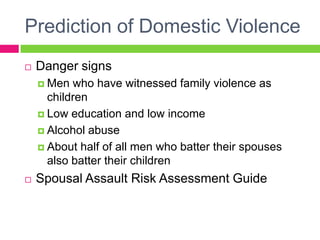
Prediction of Domestic Violence
   Danger signs
     Men  who have witnessed family violence as
      children
     Low education and low income

     Alcohol abuse

     About half of all men who batter their spouses
      also batter their children
   Spousal Assault Risk Assessment Guide
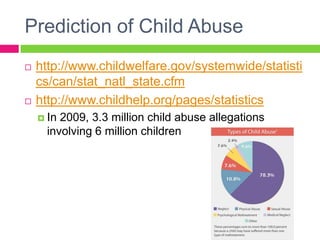
Prediction of Child Abuse
   http://www.childwelfare.gov/systemwide/statisti
    cs/can/stat_natl_state.cfm
   http://www.childhelp.org/pages/statistics
     In2009, 3.3 million child abuse allegations
     involving 6 million children
Prediction of Child Abuse
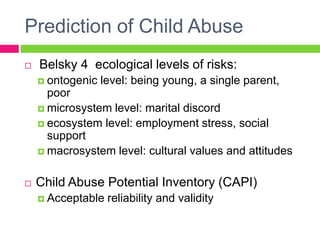
   Belsky 4 ecological levels of risks:
     ontogenic   level: being young, a single parent,
      poor
     microsystem level: marital discord
     ecosystem level: employment stress, social
      support
     macrosystem level: cultural values and attitudes


   Child Abuse Potential Inventory (CAPI)
     Acceptable   reliability and validity
Prediction of Suicide
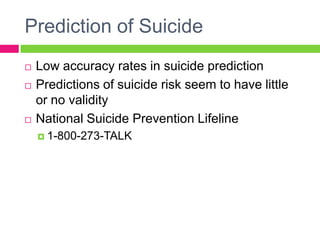
   Low accuracy rates in suicide prediction
   Predictions of suicide risk seem to have little
    or no validity
   National Suicide Prevention Lifeline
     1-800-273-TALK

Forensic chapter 6 student notes

  • 1.
    FROM DANGEROUSNESS TO RISKASSESSMENT Chapter 6
  • 2.
    Risk Assessment  Risk assessment – the process of conceptualizing hazards in order to make judgments about their likelihood and the need for various preventative measures
  • 3.
    Risk Assessment  3 types of predictive schemes (Morris & Miller, 1985)  clinical prediction: based on clinical experience and judgment  actuarial prediction: based on statistical formulas  anamnestic prediction: based on analysis of how a particular person has acted in the past in similar situations
  • 4.
    Predicting Dangerousness  Practical predictions of future dangerousness  parole boards, prison release review boards  human resource managers  school psychologists  police
  • 5.
    1st Generation ofResearch  Few studies done, with most focusing on the relationship between mental illness and violence  mentally ill are less prone to violence and have lower arrest rates  mental health professionals are unable to predict dangerousness or violence accurately
  • 6.
    Relevant Rulings  Baxstrom v. Harold (1966)  Baxstrom had been held in a state hospital after his criminal sentence had expired, which was found to be a violation of equal protection  Aftermath  After5 years, less than 3% of released inmates had to return to security hospitals
  • 7.
    Relevant Rulings  Barefoot v. Estelle (1983)  convictedof capital murder of a police officer  sentencing jury must consider “future violence”  Appeal  American Psychiatric Association submitted an amicus brief reporting that mental health professionals are unable to predict with an acceptable degree of reliability that a particular criminal will commit other crimes in the future
  • 8.
    Relevant Rulings  Barefoot v. Estelle (1983) Ruling  Supreme Court did not accept the argument that mental health professionals were no better off at predicting dangerousness than laypersons  Supreme Court upheld Barefoot’s death sentence
  • 9.
    Problems with Predictionsof Dangerousness  Courts did not accept the information provided in the American Psychiatric Association’s amicus brief  Conceptualization of “dangerousness”
  • 10.
    2nd Generation ofResearch  Shift in focus from “dangerous/not dangerous” to measuring risk  New studies focused on factors that are predictive of risk  Examples  History of previous violence  Psychopathology  Consensus that risk assessment can be made with “moderate to good” accuracy
  • 11.
    Prediction of Violence  Mental disorder  Vast majority of people with mental disorders are not violent  Douglas and Webster (1999) identified 20 variables that seem to be related to the risk of violence  Static – do not change  Dynamic – change over times and situations  Risk management  Stable and supportive environments lower the risk of violence
  • 12.
    Prediction Sexual Offending  According to the U.S. Department of Justice  1/4 women and 1/6 men will experience some sort of sexual assault during their lifetime  67% of sexual assaults occur to those under the age of 18  2/3 are committed by someone who knows the victim  All 50 states have registration and tracking systems  Missouri: http://www.mshp.dps.missouri.gov/MSHPWeb/Pat rolDivisions/CRID/SOR/factsheet.html  National Sexual Assault Hotline: 1-800-656-4673
  • 13.
    Prediction of SexualOffending  Determination of how likely to commit a similar offense in the future  Follow-up studies (e.g., Quinsey et al., 1995)  Rapists: 22.8% reconviction rate  Child molesters: 20.4% reconviction rate  Incest offenders: 8.5%
  • 14.
    Prediction of DomesticViolence  National Domestic Violence Hotline: 1-800-799- 7233  ¼ women will experience DV in her lifetime  85% of DV victims are women  Occurs regardless of age, SES, religion, nationality, educational background  Most cases are not reported to the police  Approximately 20% victims obtain civil protection orders  www.ncadv.org/files/DomesticViolenceFactSheet (National).pdf
  • 15.
    Prediction of DomesticViolence  Danger signs  Men who have witnessed family violence as children  Low education and low income  Alcohol abuse  About half of all men who batter their spouses also batter their children  Spousal Assault Risk Assessment Guide
  • 16.
    Prediction of ChildAbuse  http://www.childwelfare.gov/systemwide/statisti cs/can/stat_natl_state.cfm  http://www.childhelp.org/pages/statistics  In2009, 3.3 million child abuse allegations involving 6 million children
  • 17.
    Prediction of ChildAbuse  Belsky 4 ecological levels of risks:  ontogenic level: being young, a single parent, poor  microsystem level: marital discord  ecosystem level: employment stress, social support  macrosystem level: cultural values and attitudes  Child Abuse Potential Inventory (CAPI)  Acceptable reliability and validity
  • 18.
    Prediction of Suicide  Low accuracy rates in suicide prediction  Predictions of suicide risk seem to have little or no validity  National Suicide Prevention Lifeline  1-800-273-TALK