FORCE AND IT’S TYPES
SAIFEE EIDI ZAHABI INSTITUTE OF SCIENCE AND
TECHNOLOGY
What is Force?
What is Force?
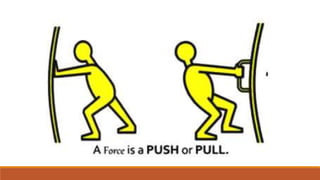
Push or pull of an object is considered a force. Push and pull come from the
objects interacting with one another. Terms like stretch and squeeze can also be
used to denote force.
The push or pull on an object with mass causes it to change its velocity.
Force is an external agent capable of changing a body’s state of rest or motion. It
has a magnitude and a direction. The direction towards which the force is applied
is known as the direction of the force, and the application of force is the point
where force is applied.
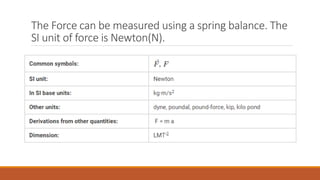
The Force can be measured using a spring balance. The
SI unit of force is Newton(N).
What are the Effects of Force?
In physics, motion is defined as the change in position with respect to
time. In simpler words, motion refers to the movement of a body.
Typically, motion can either be described as:
1. Change in speed
2. Change in direction
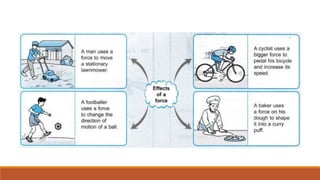
The Force has different effects, and here are some
of them
1. Force can make a body that is at rest to move.
2. It can stop a moving body or slow it down.
3. It can accelerate the speed of a moving body.
4. It can also change the direction of a moving body along with its
shape and size.
Formula for Force
The quantity of force is expressed by the vector product of mass (m) and
acceleration (a). The equation or the formula for force can mathematically be
expressed in the form of:
Where,
•m = mass
•a = acceleration
It is articulated in Newton (N) or Kgm/s2.
Acceleration a is given by a = v/t
Unit of Force
•In the centimeter gram second system of unit (CGS unit) force is
expressed in dyne.
•In the standard international system of unit (SI unit) it is expressed
in Newton (N).
The SI unit of force. It is equal to the force that would give
a mass of one kilogram an acceleration of one meter per
second per second, and is equivalent to 100,000 dynes.
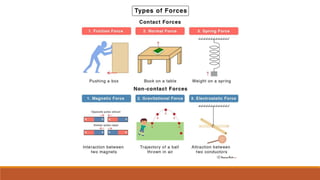
Types of Force
Force is a physical cause that can change an object’s state of motion or
dimensions. There are two types of forces based on their applications:
1. Contact Force
2. Non-Contact Force
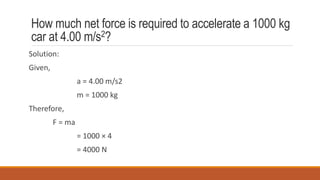
How much net force is required to accelerate a 1000 kg
car at 4.00 m/s2?
Solution:
Given,
a = 4.00 m/s2
m = 1000 kg
Therefore,
F = ma
= 1000 × 4
= 4000 N
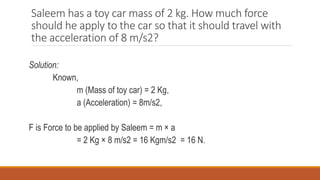
Saleem has a toy car mass of 2 kg. How much force
should he apply to the car so that it should travel with
the acceleration of 8 m/s2?
Solution:
Known,
m (Mass of toy car) = 2 Kg,
a (Acceleration) = 8m/s2,
F is Force to be applied by Saleem = m × a
= 2 Kg × 8 m/s2 = 16 Kgm/s2 = 16 N.
ANY QUESTIONS?
THANK YOU

Forces and its types.pptx

  • 1.
    FORCE AND IT’STYPES SAIFEE EIDI ZAHABI INSTITUTE OF SCIENCE AND TECHNOLOGY
  • 2.
  • 3.
    What is Force? Pushor pull of an object is considered a force. Push and pull come from the objects interacting with one another. Terms like stretch and squeeze can also be used to denote force. The push or pull on an object with mass causes it to change its velocity. Force is an external agent capable of changing a body’s state of rest or motion. It has a magnitude and a direction. The direction towards which the force is applied is known as the direction of the force, and the application of force is the point where force is applied.
  • 5.
    The Force canbe measured using a spring balance. The SI unit of force is Newton(N).
  • 6.
    What are theEffects of Force? In physics, motion is defined as the change in position with respect to time. In simpler words, motion refers to the movement of a body. Typically, motion can either be described as: 1. Change in speed 2. Change in direction
  • 7.
    The Force hasdifferent effects, and here are some of them 1. Force can make a body that is at rest to move. 2. It can stop a moving body or slow it down. 3. It can accelerate the speed of a moving body. 4. It can also change the direction of a moving body along with its shape and size.
  • 9.
    Formula for Force Thequantity of force is expressed by the vector product of mass (m) and acceleration (a). The equation or the formula for force can mathematically be expressed in the form of: Where, •m = mass •a = acceleration It is articulated in Newton (N) or Kgm/s2. Acceleration a is given by a = v/t
  • 10.
    Unit of Force •Inthe centimeter gram second system of unit (CGS unit) force is expressed in dyne. •In the standard international system of unit (SI unit) it is expressed in Newton (N). The SI unit of force. It is equal to the force that would give a mass of one kilogram an acceleration of one meter per second per second, and is equivalent to 100,000 dynes.
  • 11.
    Types of Force Forceis a physical cause that can change an object’s state of motion or dimensions. There are two types of forces based on their applications: 1. Contact Force 2. Non-Contact Force
  • 13.
    How much netforce is required to accelerate a 1000 kg car at 4.00 m/s2? Solution: Given, a = 4.00 m/s2 m = 1000 kg Therefore, F = ma = 1000 × 4 = 4000 N
  • 14.
    Saleem has atoy car mass of 2 kg. How much force should he apply to the car so that it should travel with the acceleration of 8 m/s2? Solution: Known, m (Mass of toy car) = 2 Kg, a (Acceleration) = 8m/s2, F is Force to be applied by Saleem = m × a = 2 Kg × 8 m/s2 = 16 Kgm/s2 = 16 N.
  • 15.
  • 16.