© VISTA 2021 www.vista-geo.de No. 1
Florian Appel, VISTA GmbH, Munich
+ Nicolas Corti, Eva Gleisberg, Christian Miesgang + VISTA team
+ Daniele Marinelli, Giulio Weikmann, Lorenzo Bruzzone, + University of Trento team
Water Demand and Water
Availability for Agriculture and
Food Security in two European
Catchments
Three Years of the Extreme Earth Project - 09/12/2021 Online Workshop
© VISTA 2021 www.vista-geo.de No. 2
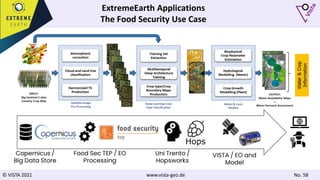
Extreme Earth Applications
The Food Security Use Case
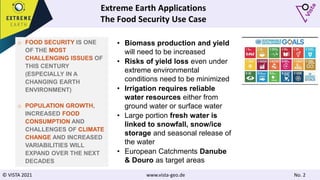
o FOOD SECURITY IS ONE
OF THE MOST
CHALLENGING ISSUES OF
THIS CENTURY
(ESPECIALLY IN A
CHANGING EARTH
ENVIRONMENT)
o POPULATION GROWTH,
INCREASED FOOD
CONSUMPTION AND
CHALLENGES OF CLIMATE
CHANGE AND INCREASED
VARIABILITIES WILL
EXPAND OVER THE NEXT
DECADES
• Biomass production and yield
will need to be increased
• Risks of yield loss even under
extreme environmental
conditions need to be minimized
• Irrigation requires reliable
water resources either from
ground water or surface water
• Large portion fresh water is
linked to snowfall, snow/ice
storage and seasonal release of
the water
• European Catchments Danube
& Douro as target areas
© VISTA 2021 www.vista-geo.de No. 3
Extreme Earth Applications
The Food Security Use Case
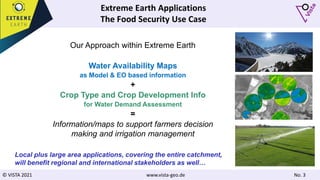
Our Approach within Extreme Earth
Water Availability Maps
as Model & EO based information
+
Crop Type and Crop Development Info
for Water Demand Assessment
=
Information/maps to support farmers decision
making and irrigation management
Local plus large area applications, covering the entire catchment,
will benefit regional and international stakeholders as well…
© VISTA 2021 www.vista-geo.de No. 4
Extreme Earth Applications
The Food Security Use Case
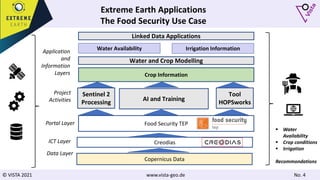
Copernicus Data
Creodias
Food Security TEP
AI and Training
Tool
HOPSworks
Sentinel 2
Processing
Data Layer
ICT Layer
Portal Layer
Project
Activities
Crop Information
Water Availability Irrigation Information
Water and Crop Modelling
Application
and
Information
Layers
Linked Data Applications
 Water
Availability
 Crop conditions
 Irrigation
Recommondations
© VISTA 2021 www.vista-geo.de No. 5
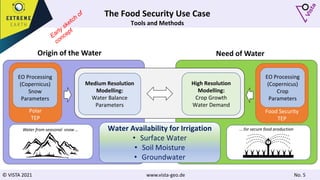
Need of Water
Polar
TEP
EO Processing
(Copernicus)
Snow
Parameters
Medium Resolution
Modelling:
Water Balance
Parameters
High Resolution
Modelling:
Crop Growth
Water Demand
Food Security
TEP
EO Processing
(Copernicus)
Crop
Parameters
… for secure food production
Water Availability for Irrigation
• Surface Water
• Soil Moisture
• Groundwater
Origin of the Water
Water from seasonal snow …
The Food Security Use Case
Tools and Methods
© VISTA 2021 www.vista-geo.de No. 6
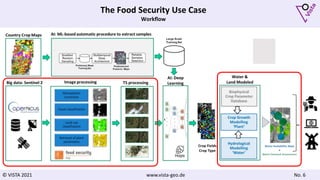
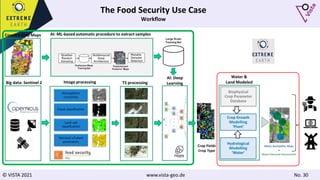
The Food Security Use Case
Workflow
© VISTA 2021 www.vista-geo.de No. 7
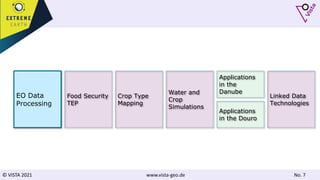
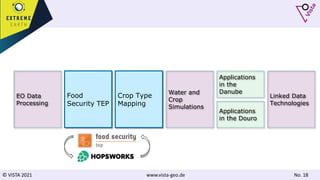
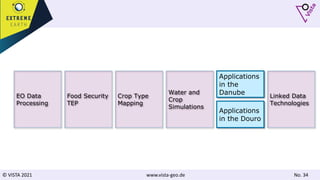
Food Security
TEP
EO Data
Processing
Crop Type
Mapping
Water and
Crop
Simulations
Applications
in the
Danube
Applications
in the Douro
Linked Data
Technologies
© VISTA 2021 www.vista-geo.de No. 8
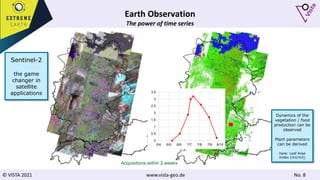
Earth Observation
The power of time series
Acquisitions within 2 weeks
0
0.5
1
1.5
2
2.5
3
3.5
5/4 6/5 6/6 7/7 7/8 7/9 8/10
Sentinel-2
the game
changer in
satellite
applications
Dynamics of the
vegetation / food
production can be
observed
Plant parameters
can be derived
here: Leaf Area
Index (m2/m2)
© VISTA 2021 www.vista-geo.de No. 9
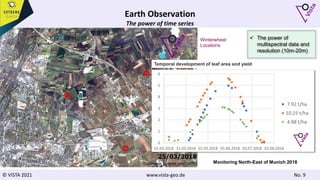
Winterwheat
Locations
Temporal development of leaf area and yield
Monitoring North-East of Munich 2018
Earth Observation
The power of time series
 The power of
multispectral data and
resolution (10m-20m)
© VISTA 2021 www.vista-geo.de No. 10
Sentinel-2 Processing
Leaf area [m²/m²]
Atmospheric
Correction
Cloud
Classification
Retrieval of
Plant
Parameters
Land Surface
Classification
Operational Optical EO Data
 Sentinel-2 EO data from the
Copernicus provides high spatial and
high temporal resolution observation
 Sophisticated processing needs to be
applied to ensure detail information
 Bottom of Atmosphere (BOA)
reflectance information and Leaf Area
Index (LAI) as basic products
 VISTA’s Processing Chain fully
Applied on the Food Security TEP
© VISTA 2021 www.vista-geo.de No. 11
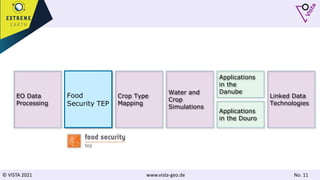
Food
Security TEP
EO Data
Processing
Crop Type
Mapping
Water and
Crop
Simulations
Linked Data
Technologies
Applications
in the
Danube
Applications
in the Douro
© VISTA 2021 www.vista-geo.de No. 12
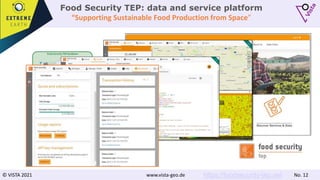
Food Security TEP: data and service platform
“Supporting Sustainable Food Production from Space”
https://foodsecurity-tep.net
© VISTA 2021 www.vista-geo.de No. 13
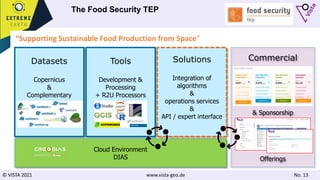
The Food Security TEP
Commercial
& Sponsorship
Offerings
Datasets
Copernicus
&
Complementary
Tools
Development &
Processing
+ R2U Processors
Cloud Environment
DIAS
Solutions
Integration of
algorithms
&
operations services
&
API / expert interface
“Supporting Sustainable Food Production from Space”
Commercial
& Sponsorship
Offerings
Datasets
Copernicus
&
Complementary
Tools
Development &
Processing
+ R2U Processors
Cloud Environment
DIAS
Solutions
Integration of
algorithms
&
operations services
&
API / expert interface
“Supporting Sustainable Food Production from Space”
© VISTA 2021 www.vista-geo.de No. 14
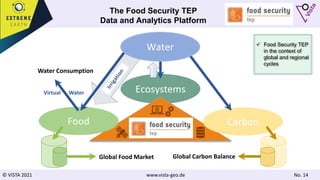
The Food Security TEP
Data and Analytics Platform
Ecosystems
Carbon
Food
Water Consumption
Virtual Water
Global Food Market Global Carbon Balance
Water  Food Security TEP
in the context of
global and regional
cycles
© VISTA 2021 www.vista-geo.de No. 15
Food Security
TEP
EO Data
Processing
Crop Type
Mapping
Water and
Crop
Simulations
Linked Data
Technologies
Applications
in the
Danube
Applications
in the Douro
© VISTA 2021 www.vista-geo.de No. 16
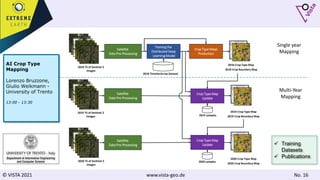
Satellite
Data Pre-Processing
Training the
Distributed Deep
Learning Model
Crop Type Maps
Production
2018 TS of Sentinel 2
Images
2018 Crop Type Map
2018 TimeSen2crop Dataset
2018 Crop Boundary Map
2019 TS of Sentinel 2
Images
2020 TS of Sentinel 2
Images
Crop Type Map
Update
2019 Crop Type Map
2019 Crop Boundary Map
2020 Crop Type Map
2020 Crop Boundary Map
Crop Type Map
Update
Satellite
Data Pre-Processing
Satellite
Data Pre-Processing
2019 samples
2020 samples
Single year
Mapping
Multi-Year
Mapping
AI Crop Type
Mapping
Lorenzo Bruzzone,
Giulio Weikmann -
University of Trento
13:00 - 13:30
 Training
Datasets
 Publications
© VISTA 2021 www.vista-geo.de No. 17
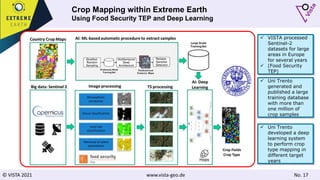
Crop Mapping within Extreme Earth
Using Food Security TEP and Deep Learning
 Uni Trento
generated and
published a large
training database
with more than
one million of
crop samples
 Uni Trento
developed a deep
learning system
to perform crop
type mapping in
different target
years
 VISTA processed
Sentinel-2
datasets for large
areas in Europe
for several years
 (Food Security
TEP)
© VISTA 2021 www.vista-geo.de No. 18
Food
Security TEP
EO Data
Processing
Crop Type
Mapping
Water and
Crop
Simulations
Linked Data
Technologies
Applications
in the
Danube
Applications
in the Douro
© VISTA 2021 www.vista-geo.de No. 19
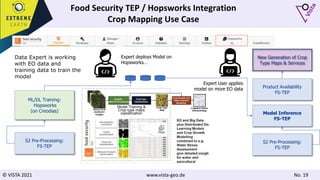
Food Security TEP / Hopsworks Integration
Crop Mapping Use Case
Data Expert is working
with EO data and
training data to train the
model
ML/DL Training:
Hopsworks
(on Creodias)
Expert deploys Model on
Hopsworks…
S2 Pre-Processing:
FS-TEP
Model Inference
FS-TEP
S2 Pre-Processing:
FS-TEP
Product Availability
FS-TEP
New Generation of Crop
Type Maps & Services
Expert User applies
model on more EO data
© VISTA 2021 www.vista-geo.de No. 20
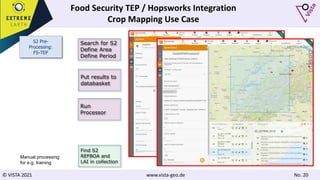
S2 Pre-
Processing:
FS-TEP
Food Security TEP / Hopsworks Integration
Crop Mapping Use Case
Search for S2
Define Area
Define Period
Put results to
databasket
Run
Processor
Manual processing
for e.g. training
Find S2
REFBOA and
LAI in collection
© VISTA 2021 www.vista-geo.de No. 21
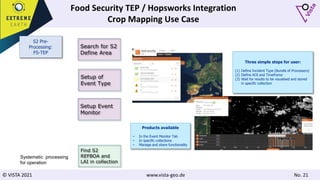
S2 Pre-
Processing:
FS-TEP
Food Security TEP / Hopsworks Integration
Crop Mapping Use Case
Search for S2
Define Area
Setup of
Event Type
Setup Event
Monitor
Find S2
REFBOA and
LAI in collection
Systematic processing
for operation
Three simple steps for user:
(1) Define Incident Type (Bundle of Processors)
(2) Define AOI and Timeframe
(3) Wait for results to be visualised and stored
in specific collection
Products available
• In the Event Monitor Tab
• In specific collections
• Manage and share functionality
© VISTA 2021 www.vista-geo.de No. 22
Food Security TEP / Hopsworks Integration
Crop Mapping Use Case
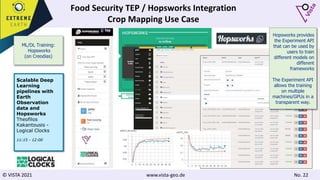
ML/DL Training:
Hopsworks
(on Creodias)
Scalable Deep
Learning
pipelines with
Earth
Observation
data and
Hopsworks
Theofilos
Kakantousis -
Logical Clocks
11:15 - 12:00
Hopsworks provides
the Experiment API
that can be used by
users to train
different models on
different
frameworks
The Experiment API
allows the training
on multiple
machines/GPUs in a
transparent way.
© VISTA 2021 www.vista-geo.de No. 23
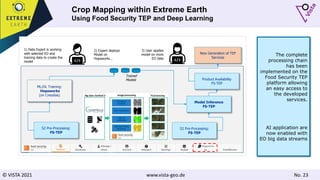
1) Data Expert is working
with selected EO and
training data to create the
model
ML/DL Training:
Hopsworks
(on Creodias)
2) Expert deploys
Model on
Hopsworks…
Model Inference
FS-TEP
S2 Pre-Processing:
FS-TEP
Product Availability
FS-TEP
S2 Pre-Processing:
FS-TEP
New Generation of TEP
Services
3) User applies
model on more
EO data
Trained
Models
Crop Mapping within Extreme Earth
Using Food Security TEP and Deep Learning
The complete
processing chain
has been
implemented on the
Food Security TEP
platform allowing
an easy access to
the developed
services.
AI application are
now enabled with
EO big data streams
© VISTA 2021 www.vista-geo.de No. 24
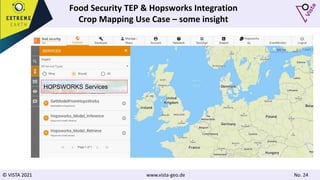
Food Security TEP & Hopsworks Integration
Crop Mapping Use Case – some insight
HOPSWORKS Services
© VISTA 2021 www.vista-geo.de No. 25
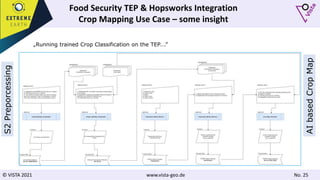
„Running trained Crop Classification on the TEP….”
S2
Preporcessing
AI
based
Crop
Map
Food Security TEP & Hopsworks Integration
Crop Mapping Use Case – some insight
© VISTA 2021 www.vista-geo.de No. 26
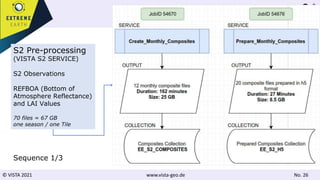
Sequence 1/3
S2 Pre-processing
(VISTA S2 SERVICE)
S2 Observations
REFBOA (Bottom of
Atmosphere Reflectance)
and LAI Values
70 files = 67 GB
one season / one Tile
© VISTA 2021 www.vista-geo.de No. 27
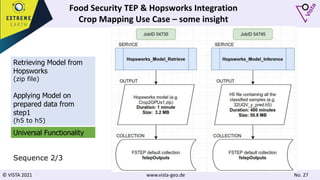
Sequence 2/3
Retrieving Model from
Hopsworks
(zip file)
Applying Model on
prepared data from
step1
(h5 to h5)
Universal Functionality
Food Security TEP & Hopsworks Integration
Crop Mapping Use Case – some insight
© VISTA 2021 www.vista-geo.de No. 28
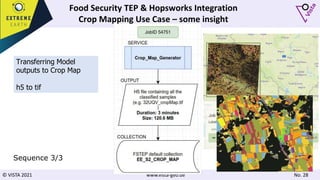
Sequence 3/3
Transferring Model
outputs to Crop Map
h5 to tif
Food Security TEP & Hopsworks Integration
Crop Mapping Use Case – some insight
© VISTA 2021 www.vista-geo.de No. 29
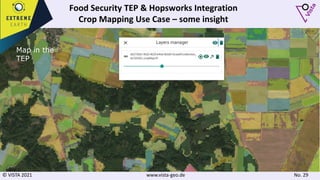
Map in the
TEP
Food Security TEP & Hopsworks Integration
Crop Mapping Use Case – some insight
© VISTA 2021 www.vista-geo.de No. 30
The Food Security Use Case
Workflow
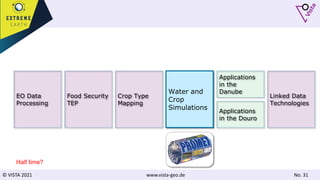
© VISTA 2021 www.vista-geo.de No. 31
Food Security
TEP
EO Data
Processing
Crop Type
Mapping
Water and
Crop
Simulations
Linked Data
Technologies
Applications
in the
Danube
Applications
in the Douro
Half time?
© VISTA 2021 www.vista-geo.de No. 32
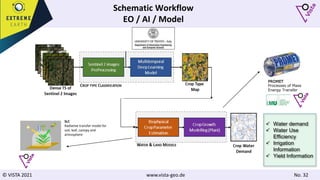
Schematic Workflow
EO / AI / Model
SLC
Radiative transfer model for
soil, leaf, canopy and
atmosphere
PROMET
Processes of Mass
Energy Transfer
 Water demand
 Water Use
Efficiency
 Irrigation
Information
 Yield Information
© VISTA 2021 www.vista-geo.de No. 33
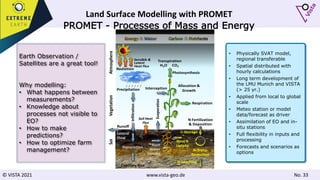
Land Surface Modelling with PROMET
PROMET - Processes of Mass and Energy
Transfer
Runoff
# 18
2.2.2017
Soi
l
Vegetation
Atmosphere
Transpiration
H2O CO2
Photosynthesis
Allocation &
Growth
Respiration
N Fertilization
& Deposition
Precipitation Interception
Radiation
Sensible &
Latent
Heat Flux
Evaporation
Infiltration
Soil Heat
Flux
Lateral
Flow
Percolation
Capillary Rise
Root N
Uptake
N-Leaching
C-Storage
Root
Water
Uptake
N-Trans-
formation
• Physically SVAT model,
regional transferable
• Spatial distributed with
hourly calculations
• Long term development of
the LMU Munich and VISTA
(> 25 yr.)
• Applied from local to global
scale
• Meteo station or model
data/forecast as driver
• Assimilation of EO and in-
situ stations
• Full flexibility in inputs and
processing
• Forecasts and scenarios as
options
Earth Observation /
Satellites are a great tool!
Why modelling:
• What happens between
measurements?
• Knowledge about
processes not visible to
EO?
• How to make
predictions?
• How to optimize farm
management?
© VISTA 2021 www.vista-geo.de No. 34
Food Security
TEP
EO Data
Processing
Crop Type
Mapping
Water and
Crop
Simulations
Linked Data
Technologies
Applications
in the
Danube
Applications
in the Douro
© VISTA 2021 www.vista-geo.de No. 35
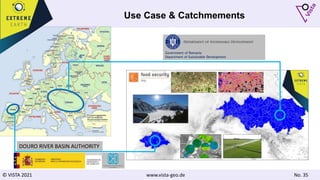
Use Case & Catchmements
Government of Romania
Department of Sustainable Development
DOURO RIVER BASIN AUTHORITY
© VISTA 2021 www.vista-geo.de No. 36
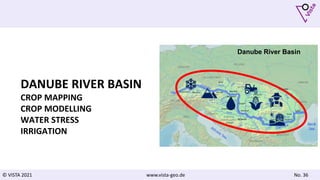
DANUBE RIVER BASIN
CROP MAPPING
CROP MODELLING
WATER STRESS
IRRIGATION
Danube River Basin
© VISTA 2021 www.vista-geo.de No. 37
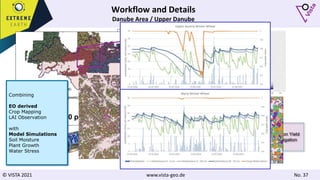
Workflow and Details
Danube Area / Upper Danube
Effects on Yield
and Irrigation
Total: 4.200.000 pixels
• Germany (~ 1.600.000 pixels)
• Austria (~ 400.000 pixels)
• Czech Republic (~ 800.000 pixels)
• Slovakia (~ 800.000 pixels)
• Hungary (~ 600.000 pixels)
Combining
EO derived
Crop Mapping
LAI Observation
with
Model Simulations
Soil Moisture
Plant Growth
Water Stress
© VISTA 2021 www.vista-geo.de No. 38
Results 2018
Danube Area / Upper Danube
0.00
0.20
0.40
0.60
0.80
1.00
0.00
10.00
20.00
30.00
40.00
50.00
crop
water
stress
precipitation
[mm],
crop
water
demand
[mm]
Upper Austria Corn
0.00
0.20
0.40
0.60
0.80
1.00
0.00
10.00
20.00
30.00
40.00
crop
water
stress
precipitation
[mm],
crop
water
demand
[mm]
Styria Corn
Precipitation CWD Water Stress
Upper
Austria
Salzburg
Lower
Austria Burgenland
Styria
Carinthia
Tyrol
Vorarlberg
Water Stress &
Crop Water Demand
Upper
Austria
Salzburg
Lower
Austria Burgenland
Styria
Carinthia
Tyrol
Vorarlberg
Upper
Austria
Salzburg
Lower
Austria
Burgenland
Styria
Carinthia
Tyrol
Vorarlberg
Rainfall
plus Irrigation
enhancing
Model Simulations
Water Stress
Irrigation
Yield
 Publications
 Services
© VISTA 2021 www.vista-geo.de No. 39
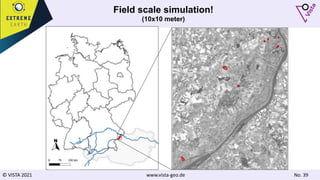
Field scale simulation!
(10x10 meter)
© VISTA 2021 www.vista-geo.de No. 40
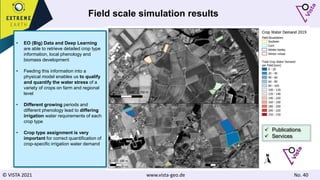
Field scale simulation results
• EO (Big) Data and Deep Learning
are able to retrieve detailed crop type
information, local phenology and
biomass development
• Feeding this information into a
physical model enables us to qualify
and quantify the water stress of a
variety of crops on farm and regional
level
• Different growing periods and
different phenology lead to differing
irrigation water requirements of each
crop type
• Crop type assignment is very
important for correct quantification of
crop-specific irrigation water demand
 Publications
 Services
© VISTA 2021 www.vista-geo.de No. 41
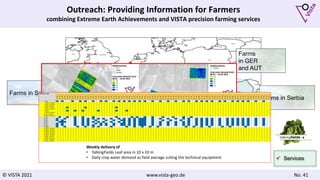
Outreach: Providing Information for Farmers
combining Extreme Earth Achievements and VISTA precision farming services
Farms in Spain
Farms
in GER
and AUT
Farms in Serbia
Weekly delivery of
• TalkingFields Leaf area in 10 x 10 m
• Sum of crop water demand for one week in 10 x 10 m suiting the technical equipment
• First day of water stress
Weekly delivery of
• TalkingFields Leaf area in 10 x 10 m
• Daily crop water demand as field average suiting the technical equipment  Services
© VISTA 2021 www.vista-geo.de No. 42
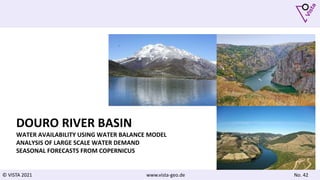
DOURO RIVER BASIN
WATER AVAILABILITY USING WATER BALANCE MODEL
ANALYSIS OF LARGE SCALE WATER DEMAND
SEASONAL FORECASTS FROM COPERNICUS
© VISTA 2021 www.vista-geo.de No. 43
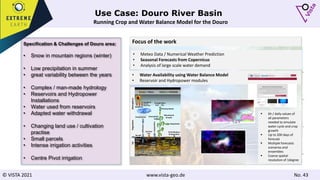
Use Case: Douro River Basin
Running Crop and Water Balance Model for the Douro
Specification & Challenges of Douro area:
• Snow in mountain regions (winter)
• Low precipitation in summer
• great variability between the years
• Complex / man-made hydrology
• Reservoirs and Hydropower
Installations
• Water used from reservoirs
• Adapted water withdrawal
• Changing land use / cultivation
practise
• Small parcels
• Intense irrigation activities
• Centre Pivot irrigation
• Meteo Data / Numerical Weather Prediction
• Seasonal Forecasts from Copernicus
• Analysis of large scale water demand
• Water Availability using Water Balance Model
• Reservoir and Hydropower modules
Focus of the work
Runoff
# 18
2.2.2017
Soi
l
Vegetation
Atmosphere
Transpiration
H2O CO2
Photosynthesis
Allocation &
Growth
Respiration
N Fertilization
& Deposition
Precipitation Interception
Radiation
Sensible &
Latent
Heat Flux
Evaporation
Infiltration
Soil Heat
Flux
Lateral
Flow
Percolation
Capillary Rise
Root N
Uptake
N-Leaching
C-Storage
Root
Water
Uptake
N-Trans-
formation
 6h / daily values of
all parameters
needed to simulate
water cycle and crop
growth
 Up to 200 days of
forecast
 Multiple forecasts
scenarios and
ensembles
 Coarse spatial
resolution of 1degree
© VISTA 2021 www.vista-geo.de No. 44
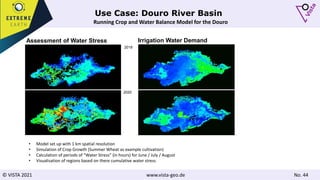
Use Case: Douro River Basin
• Model set up with 1 km spatial resolution
• Simulation of Crop Growth (Summer Wheat as example cultivation)
• Calculation of periods of “Water Stress” (in hours) for June / July / August
• Visualisation of regions based on there cumulative water stress
Running Crop and Water Balance Model for the Douro
Assessment of Water Stress
2019
2020
2019
Irrigation Water Demand
© VISTA 2021 www.vista-geo.de No. 45
Use Case: Douro River Basin
Water Availability (Preliminary Results!)
Details
for
2021
Precipitation
[mm]
April
2021
June
2021
August
2021
Soil Water
Content
[mm]
Water
Availability
© VISTA 2021 www.vista-geo.de No. 46
Use Case: Douro River Basin
Water Availability & Irrigation (Preliminary Results!)
Details for 2021
Irrigation Demand
[mm]
Details
for
2021
May
2021
June
2021
July
2021
© VISTA 2021 www.vista-geo.de No. 47
Use Case: Douro River Basin
Water Availability & Irrigation (Preliminary Results!)
Irrigation Demand
[mm]
Details
for
2021
June
2021
Areas Equipped with Irrigation
(FAO Database)
© VISTA 2021 www.vista-geo.de No. 48
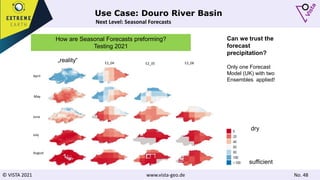
Use Case: Douro River Basin
How are Seasonal Forecasts preforming?
Testing 2021
Next Level: Seasonal Forecasts
2021
Scenario A
2021
Scenario B
April
May
June
July
E1_04 E1_05 E1_06
August
Can we trust the
forecast
precipitation?
Only one Forecast
Model (UK) with two
Ensembles applied!
„reality“ E2_04 E2_05 E2_06
dry
sufficient
© VISTA 2021 www.vista-geo.de No. 49
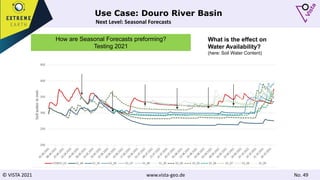
Use Case: Douro River Basin
How are Seasonal Forecasts preforming?
Testing 2021
Next Level: Seasonal Forecasts
What is the effect on
Water Availability?
(here: Soil Water Content)
© VISTA 2021 www.vista-geo.de No. 50
Use Case: Douro River Basin
How are Seasonal Forecasts preforming?
Testing 2021
Next Level: Seasonal Forecasts
2021
Scenario A
What is the effect on
Water Needed
(here: Irrigation Amount)
April
May
June
July
CosmoEU E1_04 E1_05 E1_06
August
E2_04 E2_05 E2_06
© VISTA 2021 www.vista-geo.de No. 51
Use Case: Douro River Basin
How are Seasonal Forecasts preforming?
Testing 2021
Running Crop and Water Balance Model for the Douro
2021
Scenario A
What is the effect on
Water Needed
(here: Irrigation Amount)
June +
July
E2_04 E2_05 E2_06
E1_04 E1_05 E1_06
Reasonable forecast on Water Demand for the summer season!
Water Availability Maps and Water Demand as example products on the Food Security TEP
„reality“
 Potential for
Management
 In Hydrology
 In Agriculture
 ….
© VISTA 2021 www.vista-geo.de No. 52
Project Results available on the Food Security TEP
(after the project)
ExtremeEarth Datasets
 Crop Maps
 Water
Availability
 ….
© VISTA 2021 www.vista-geo.de No. 53
Food Security
TEP
EO Data
Processing
Crop Type
Mapping
Water and
Crop
Simulations
Linked Data
Technologies
Applications
in the
Danube
Applications
in the Douro
© VISTA 2021 www.vista-geo.de No. 54
54
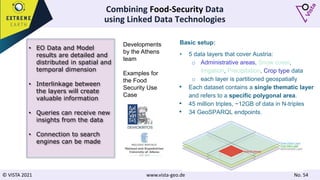
Combining Food-Security Data
using Linked Data Technologies
Basic setup:
• 5 data layers that cover Austria:
o Administrative areas, Snow cover,
Irrigation, Precipitation, Crop type data
o each layer is partitioned geospatially
• Each dataset contains a single thematic layer
and refers to a specific polygonal area.
• 45 million triples, ~12GB of data in N-triples
• 34 GeoSPARQL endpoints.
• EO Data and Model
results are detailed and
distributed in spatial and
temporal dimension
• Interlinkage between
the layers will create
valuable information
• Queries can receive new
insights from the data
• Connection to search
engines can be made
Developments
by the Athens
team
Examples for
the Food
Security Use
Case
© VISTA 2021 www.vista-geo.de No. 55
55
Combining Food-Security Data
using Linked Data Technologies
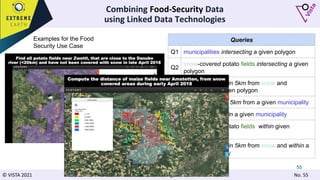
Examples for the Food
Security Use Case
Queries
Q1 municipalities intersecting a given polygon
Q2
snow-covered potato fields intersecting a given
polygon
Q3
potato fields within 5km from snow and
intersecting a given polygon
Q4 snow area within 5km from a given municipality
Q5 potato fields within a given municipality
Q6
snow-covered potato fields within given
municipality
Q7
potato fields within 5km from snow and within a
given municipality
© VISTA 2021 www.vista-geo.de No. 56
56
Combining Food-Security Data
using Linked Data Technologies
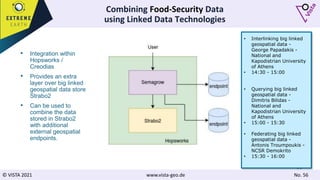
• Integration within
Hopsworks /
Creodias
• Provides an extra
layer over big linked
geospatial data store
Strabo2
• Can be used to
combine the data
stored in Strabo2
with additional
external geospatial
endpoints.
• Interlinking big linked
geospatial data -
George Papadakis -
National and
Kapodistrian University
of Athens
• 14:30 - 15:00
• Querying big linked
geospatial data -
Dimitris Bilidas -
National and
Kapodistrian University
of Athens
• 15:00 - 15:30
• Federating big linked
geospatial data -
Antonis Troumpoukis -
NCSR Demokrito
• 15:30 - 16:00
© VISTA 2021 www.vista-geo.de No. 57
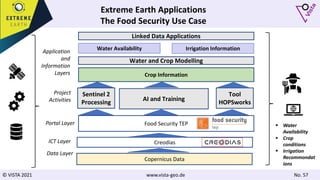
Extreme Earth Applications
The Food Security Use Case
Copernicus Data
Creodias
Food Security TEP
AI and Training
Tool
HOPSworks
Sentinel 2
Processing
Data Layer
ICT Layer
Portal Layer
Project
Activities
Crop Information
Water Availability Irrigation Information
Water and Crop Modelling
Application
and
Information
Layers
Linked Data Applications
 Water
Availability
 Crop
conditions
 Irrigation
Recommondat
ions
© VISTA 2021 www.vista-geo.de No. 58
ExtremeEarth Applications
The Food Security Use Case
© VISTA 2021 www.vista-geo.de No. 59
Your Questions?
EARTHANALYTICS.EU
FOODSECURITY-TEP.NET
VISTA-GEO.DE
VISTA Remote Sensing in Geosciences GmbH
Gabelsbergerstraße 51
D-80333 München
www.vista-geo.de
Florian Appel
appel@vista-geo.de
Heike Bach
bach@vista-geo.de
Silke Migdall
migdall@vista-geo.de

Food Security Use Case - ExtremeEarth Open Workshop

  • 1.
    © VISTA 2021www.vista-geo.de No. 1 Florian Appel, VISTA GmbH, Munich + Nicolas Corti, Eva Gleisberg, Christian Miesgang + VISTA team + Daniele Marinelli, Giulio Weikmann, Lorenzo Bruzzone, + University of Trento team Water Demand and Water Availability for Agriculture and Food Security in two European Catchments Three Years of the Extreme Earth Project - 09/12/2021 Online Workshop
  • 2.
    © VISTA 2021www.vista-geo.de No. 2 Extreme Earth Applications The Food Security Use Case o FOOD SECURITY IS ONE OF THE MOST CHALLENGING ISSUES OF THIS CENTURY (ESPECIALLY IN A CHANGING EARTH ENVIRONMENT) o POPULATION GROWTH, INCREASED FOOD CONSUMPTION AND CHALLENGES OF CLIMATE CHANGE AND INCREASED VARIABILITIES WILL EXPAND OVER THE NEXT DECADES • Biomass production and yield will need to be increased • Risks of yield loss even under extreme environmental conditions need to be minimized • Irrigation requires reliable water resources either from ground water or surface water • Large portion fresh water is linked to snowfall, snow/ice storage and seasonal release of the water • European Catchments Danube & Douro as target areas
  • 3.
    © VISTA 2021www.vista-geo.de No. 3 Extreme Earth Applications The Food Security Use Case Our Approach within Extreme Earth Water Availability Maps as Model & EO based information + Crop Type and Crop Development Info for Water Demand Assessment = Information/maps to support farmers decision making and irrigation management Local plus large area applications, covering the entire catchment, will benefit regional and international stakeholders as well…
  • 4.
    © VISTA 2021www.vista-geo.de No. 4 Extreme Earth Applications The Food Security Use Case Copernicus Data Creodias Food Security TEP AI and Training Tool HOPSworks Sentinel 2 Processing Data Layer ICT Layer Portal Layer Project Activities Crop Information Water Availability Irrigation Information Water and Crop Modelling Application and Information Layers Linked Data Applications  Water Availability  Crop conditions  Irrigation Recommondations
  • 5.
    © VISTA 2021www.vista-geo.de No. 5 Need of Water Polar TEP EO Processing (Copernicus) Snow Parameters Medium Resolution Modelling: Water Balance Parameters High Resolution Modelling: Crop Growth Water Demand Food Security TEP EO Processing (Copernicus) Crop Parameters … for secure food production Water Availability for Irrigation • Surface Water • Soil Moisture • Groundwater Origin of the Water Water from seasonal snow … The Food Security Use Case Tools and Methods
  • 6.
    © VISTA 2021www.vista-geo.de No. 6 The Food Security Use Case Workflow
  • 7.
    © VISTA 2021www.vista-geo.de No. 7 Food Security TEP EO Data Processing Crop Type Mapping Water and Crop Simulations Applications in the Danube Applications in the Douro Linked Data Technologies
  • 8.
    © VISTA 2021www.vista-geo.de No. 8 Earth Observation The power of time series Acquisitions within 2 weeks 0 0.5 1 1.5 2 2.5 3 3.5 5/4 6/5 6/6 7/7 7/8 7/9 8/10 Sentinel-2 the game changer in satellite applications Dynamics of the vegetation / food production can be observed Plant parameters can be derived here: Leaf Area Index (m2/m2)
  • 9.
    © VISTA 2021www.vista-geo.de No. 9 Winterwheat Locations Temporal development of leaf area and yield Monitoring North-East of Munich 2018 Earth Observation The power of time series  The power of multispectral data and resolution (10m-20m)
  • 10.
    © VISTA 2021www.vista-geo.de No. 10 Sentinel-2 Processing Leaf area [m²/m²] Atmospheric Correction Cloud Classification Retrieval of Plant Parameters Land Surface Classification Operational Optical EO Data  Sentinel-2 EO data from the Copernicus provides high spatial and high temporal resolution observation  Sophisticated processing needs to be applied to ensure detail information  Bottom of Atmosphere (BOA) reflectance information and Leaf Area Index (LAI) as basic products  VISTA’s Processing Chain fully Applied on the Food Security TEP
  • 11.
    © VISTA 2021www.vista-geo.de No. 11 Food Security TEP EO Data Processing Crop Type Mapping Water and Crop Simulations Linked Data Technologies Applications in the Danube Applications in the Douro
  • 12.
    © VISTA 2021www.vista-geo.de No. 12 Food Security TEP: data and service platform “Supporting Sustainable Food Production from Space” https://foodsecurity-tep.net
  • 13.
    © VISTA 2021www.vista-geo.de No. 13 The Food Security TEP Commercial & Sponsorship Offerings Datasets Copernicus & Complementary Tools Development & Processing + R2U Processors Cloud Environment DIAS Solutions Integration of algorithms & operations services & API / expert interface “Supporting Sustainable Food Production from Space” Commercial & Sponsorship Offerings Datasets Copernicus & Complementary Tools Development & Processing + R2U Processors Cloud Environment DIAS Solutions Integration of algorithms & operations services & API / expert interface “Supporting Sustainable Food Production from Space”
  • 14.
    © VISTA 2021www.vista-geo.de No. 14 The Food Security TEP Data and Analytics Platform Ecosystems Carbon Food Water Consumption Virtual Water Global Food Market Global Carbon Balance Water  Food Security TEP in the context of global and regional cycles
  • 15.
    © VISTA 2021www.vista-geo.de No. 15 Food Security TEP EO Data Processing Crop Type Mapping Water and Crop Simulations Linked Data Technologies Applications in the Danube Applications in the Douro
  • 16.
    © VISTA 2021www.vista-geo.de No. 16 Satellite Data Pre-Processing Training the Distributed Deep Learning Model Crop Type Maps Production 2018 TS of Sentinel 2 Images 2018 Crop Type Map 2018 TimeSen2crop Dataset 2018 Crop Boundary Map 2019 TS of Sentinel 2 Images 2020 TS of Sentinel 2 Images Crop Type Map Update 2019 Crop Type Map 2019 Crop Boundary Map 2020 Crop Type Map 2020 Crop Boundary Map Crop Type Map Update Satellite Data Pre-Processing Satellite Data Pre-Processing 2019 samples 2020 samples Single year Mapping Multi-Year Mapping AI Crop Type Mapping Lorenzo Bruzzone, Giulio Weikmann - University of Trento 13:00 - 13:30  Training Datasets  Publications
  • 17.
    © VISTA 2021www.vista-geo.de No. 17 Crop Mapping within Extreme Earth Using Food Security TEP and Deep Learning  Uni Trento generated and published a large training database with more than one million of crop samples  Uni Trento developed a deep learning system to perform crop type mapping in different target years  VISTA processed Sentinel-2 datasets for large areas in Europe for several years  (Food Security TEP)
  • 18.
    © VISTA 2021www.vista-geo.de No. 18 Food Security TEP EO Data Processing Crop Type Mapping Water and Crop Simulations Linked Data Technologies Applications in the Danube Applications in the Douro
  • 19.
    © VISTA 2021www.vista-geo.de No. 19 Food Security TEP / Hopsworks Integration Crop Mapping Use Case Data Expert is working with EO data and training data to train the model ML/DL Training: Hopsworks (on Creodias) Expert deploys Model on Hopsworks… S2 Pre-Processing: FS-TEP Model Inference FS-TEP S2 Pre-Processing: FS-TEP Product Availability FS-TEP New Generation of Crop Type Maps & Services Expert User applies model on more EO data
  • 20.
    © VISTA 2021www.vista-geo.de No. 20 S2 Pre- Processing: FS-TEP Food Security TEP / Hopsworks Integration Crop Mapping Use Case Search for S2 Define Area Define Period Put results to databasket Run Processor Manual processing for e.g. training Find S2 REFBOA and LAI in collection
  • 21.
    © VISTA 2021www.vista-geo.de No. 21 S2 Pre- Processing: FS-TEP Food Security TEP / Hopsworks Integration Crop Mapping Use Case Search for S2 Define Area Setup of Event Type Setup Event Monitor Find S2 REFBOA and LAI in collection Systematic processing for operation Three simple steps for user: (1) Define Incident Type (Bundle of Processors) (2) Define AOI and Timeframe (3) Wait for results to be visualised and stored in specific collection Products available • In the Event Monitor Tab • In specific collections • Manage and share functionality
  • 22.
    © VISTA 2021www.vista-geo.de No. 22 Food Security TEP / Hopsworks Integration Crop Mapping Use Case ML/DL Training: Hopsworks (on Creodias) Scalable Deep Learning pipelines with Earth Observation data and Hopsworks Theofilos Kakantousis - Logical Clocks 11:15 - 12:00 Hopsworks provides the Experiment API that can be used by users to train different models on different frameworks The Experiment API allows the training on multiple machines/GPUs in a transparent way.
  • 23.
    © VISTA 2021www.vista-geo.de No. 23 1) Data Expert is working with selected EO and training data to create the model ML/DL Training: Hopsworks (on Creodias) 2) Expert deploys Model on Hopsworks… Model Inference FS-TEP S2 Pre-Processing: FS-TEP Product Availability FS-TEP S2 Pre-Processing: FS-TEP New Generation of TEP Services 3) User applies model on more EO data Trained Models Crop Mapping within Extreme Earth Using Food Security TEP and Deep Learning The complete processing chain has been implemented on the Food Security TEP platform allowing an easy access to the developed services. AI application are now enabled with EO big data streams
  • 24.
    © VISTA 2021www.vista-geo.de No. 24 Food Security TEP & Hopsworks Integration Crop Mapping Use Case – some insight HOPSWORKS Services
  • 25.
    © VISTA 2021www.vista-geo.de No. 25 „Running trained Crop Classification on the TEP….” S2 Preporcessing AI based Crop Map Food Security TEP & Hopsworks Integration Crop Mapping Use Case – some insight
  • 26.
    © VISTA 2021www.vista-geo.de No. 26 Sequence 1/3 S2 Pre-processing (VISTA S2 SERVICE) S2 Observations REFBOA (Bottom of Atmosphere Reflectance) and LAI Values 70 files = 67 GB one season / one Tile
  • 27.
    © VISTA 2021www.vista-geo.de No. 27 Sequence 2/3 Retrieving Model from Hopsworks (zip file) Applying Model on prepared data from step1 (h5 to h5) Universal Functionality Food Security TEP & Hopsworks Integration Crop Mapping Use Case – some insight
  • 28.
    © VISTA 2021www.vista-geo.de No. 28 Sequence 3/3 Transferring Model outputs to Crop Map h5 to tif Food Security TEP & Hopsworks Integration Crop Mapping Use Case – some insight
  • 29.
    © VISTA 2021www.vista-geo.de No. 29 Map in the TEP Food Security TEP & Hopsworks Integration Crop Mapping Use Case – some insight
  • 30.
    © VISTA 2021www.vista-geo.de No. 30 The Food Security Use Case Workflow
  • 31.
    © VISTA 2021www.vista-geo.de No. 31 Food Security TEP EO Data Processing Crop Type Mapping Water and Crop Simulations Linked Data Technologies Applications in the Danube Applications in the Douro Half time?
  • 32.
    © VISTA 2021www.vista-geo.de No. 32 Schematic Workflow EO / AI / Model SLC Radiative transfer model for soil, leaf, canopy and atmosphere PROMET Processes of Mass Energy Transfer  Water demand  Water Use Efficiency  Irrigation Information  Yield Information
  • 33.
    © VISTA 2021www.vista-geo.de No. 33 Land Surface Modelling with PROMET PROMET - Processes of Mass and Energy Transfer Runoff # 18 2.2.2017 Soi l Vegetation Atmosphere Transpiration H2O CO2 Photosynthesis Allocation & Growth Respiration N Fertilization & Deposition Precipitation Interception Radiation Sensible & Latent Heat Flux Evaporation Infiltration Soil Heat Flux Lateral Flow Percolation Capillary Rise Root N Uptake N-Leaching C-Storage Root Water Uptake N-Trans- formation • Physically SVAT model, regional transferable • Spatial distributed with hourly calculations • Long term development of the LMU Munich and VISTA (> 25 yr.) • Applied from local to global scale • Meteo station or model data/forecast as driver • Assimilation of EO and in- situ stations • Full flexibility in inputs and processing • Forecasts and scenarios as options Earth Observation / Satellites are a great tool! Why modelling: • What happens between measurements? • Knowledge about processes not visible to EO? • How to make predictions? • How to optimize farm management?
  • 34.
    © VISTA 2021www.vista-geo.de No. 34 Food Security TEP EO Data Processing Crop Type Mapping Water and Crop Simulations Linked Data Technologies Applications in the Danube Applications in the Douro
  • 35.
    © VISTA 2021www.vista-geo.de No. 35 Use Case & Catchmements Government of Romania Department of Sustainable Development DOURO RIVER BASIN AUTHORITY
  • 36.
    © VISTA 2021www.vista-geo.de No. 36 DANUBE RIVER BASIN CROP MAPPING CROP MODELLING WATER STRESS IRRIGATION Danube River Basin
  • 37.
    © VISTA 2021www.vista-geo.de No. 37 Workflow and Details Danube Area / Upper Danube Effects on Yield and Irrigation Total: 4.200.000 pixels • Germany (~ 1.600.000 pixels) • Austria (~ 400.000 pixels) • Czech Republic (~ 800.000 pixels) • Slovakia (~ 800.000 pixels) • Hungary (~ 600.000 pixels) Combining EO derived Crop Mapping LAI Observation with Model Simulations Soil Moisture Plant Growth Water Stress
  • 38.
    © VISTA 2021www.vista-geo.de No. 38 Results 2018 Danube Area / Upper Danube 0.00 0.20 0.40 0.60 0.80 1.00 0.00 10.00 20.00 30.00 40.00 50.00 crop water stress precipitation [mm], crop water demand [mm] Upper Austria Corn 0.00 0.20 0.40 0.60 0.80 1.00 0.00 10.00 20.00 30.00 40.00 crop water stress precipitation [mm], crop water demand [mm] Styria Corn Precipitation CWD Water Stress Upper Austria Salzburg Lower Austria Burgenland Styria Carinthia Tyrol Vorarlberg Water Stress & Crop Water Demand Upper Austria Salzburg Lower Austria Burgenland Styria Carinthia Tyrol Vorarlberg Upper Austria Salzburg Lower Austria Burgenland Styria Carinthia Tyrol Vorarlberg Rainfall plus Irrigation enhancing Model Simulations Water Stress Irrigation Yield  Publications  Services
  • 39.
    © VISTA 2021www.vista-geo.de No. 39 Field scale simulation! (10x10 meter)
  • 40.
    © VISTA 2021www.vista-geo.de No. 40 Field scale simulation results • EO (Big) Data and Deep Learning are able to retrieve detailed crop type information, local phenology and biomass development • Feeding this information into a physical model enables us to qualify and quantify the water stress of a variety of crops on farm and regional level • Different growing periods and different phenology lead to differing irrigation water requirements of each crop type • Crop type assignment is very important for correct quantification of crop-specific irrigation water demand  Publications  Services
  • 41.
    © VISTA 2021www.vista-geo.de No. 41 Outreach: Providing Information for Farmers combining Extreme Earth Achievements and VISTA precision farming services Farms in Spain Farms in GER and AUT Farms in Serbia Weekly delivery of • TalkingFields Leaf area in 10 x 10 m • Sum of crop water demand for one week in 10 x 10 m suiting the technical equipment • First day of water stress Weekly delivery of • TalkingFields Leaf area in 10 x 10 m • Daily crop water demand as field average suiting the technical equipment  Services
  • 42.
    © VISTA 2021www.vista-geo.de No. 42 DOURO RIVER BASIN WATER AVAILABILITY USING WATER BALANCE MODEL ANALYSIS OF LARGE SCALE WATER DEMAND SEASONAL FORECASTS FROM COPERNICUS
  • 43.
    © VISTA 2021www.vista-geo.de No. 43 Use Case: Douro River Basin Running Crop and Water Balance Model for the Douro Specification & Challenges of Douro area: • Snow in mountain regions (winter) • Low precipitation in summer • great variability between the years • Complex / man-made hydrology • Reservoirs and Hydropower Installations • Water used from reservoirs • Adapted water withdrawal • Changing land use / cultivation practise • Small parcels • Intense irrigation activities • Centre Pivot irrigation • Meteo Data / Numerical Weather Prediction • Seasonal Forecasts from Copernicus • Analysis of large scale water demand • Water Availability using Water Balance Model • Reservoir and Hydropower modules Focus of the work Runoff # 18 2.2.2017 Soi l Vegetation Atmosphere Transpiration H2O CO2 Photosynthesis Allocation & Growth Respiration N Fertilization & Deposition Precipitation Interception Radiation Sensible & Latent Heat Flux Evaporation Infiltration Soil Heat Flux Lateral Flow Percolation Capillary Rise Root N Uptake N-Leaching C-Storage Root Water Uptake N-Trans- formation  6h / daily values of all parameters needed to simulate water cycle and crop growth  Up to 200 days of forecast  Multiple forecasts scenarios and ensembles  Coarse spatial resolution of 1degree
  • 44.
    © VISTA 2021www.vista-geo.de No. 44 Use Case: Douro River Basin • Model set up with 1 km spatial resolution • Simulation of Crop Growth (Summer Wheat as example cultivation) • Calculation of periods of “Water Stress” (in hours) for June / July / August • Visualisation of regions based on there cumulative water stress Running Crop and Water Balance Model for the Douro Assessment of Water Stress 2019 2020 2019 Irrigation Water Demand
  • 45.
    © VISTA 2021www.vista-geo.de No. 45 Use Case: Douro River Basin Water Availability (Preliminary Results!) Details for 2021 Precipitation [mm] April 2021 June 2021 August 2021 Soil Water Content [mm] Water Availability
  • 46.
    © VISTA 2021www.vista-geo.de No. 46 Use Case: Douro River Basin Water Availability & Irrigation (Preliminary Results!) Details for 2021 Irrigation Demand [mm] Details for 2021 May 2021 June 2021 July 2021
  • 47.
    © VISTA 2021www.vista-geo.de No. 47 Use Case: Douro River Basin Water Availability & Irrigation (Preliminary Results!) Irrigation Demand [mm] Details for 2021 June 2021 Areas Equipped with Irrigation (FAO Database)
  • 48.
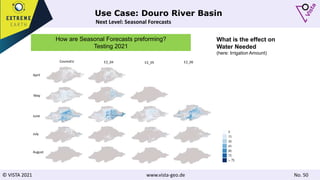
    © VISTA 2021www.vista-geo.de No. 48 Use Case: Douro River Basin How are Seasonal Forecasts preforming? Testing 2021 Next Level: Seasonal Forecasts 2021 Scenario A 2021 Scenario B April May June July E1_04 E1_05 E1_06 August Can we trust the forecast precipitation? Only one Forecast Model (UK) with two Ensembles applied! „reality“ E2_04 E2_05 E2_06 dry sufficient
  • 49.
    © VISTA 2021www.vista-geo.de No. 49 Use Case: Douro River Basin How are Seasonal Forecasts preforming? Testing 2021 Next Level: Seasonal Forecasts What is the effect on Water Availability? (here: Soil Water Content)
  • 50.
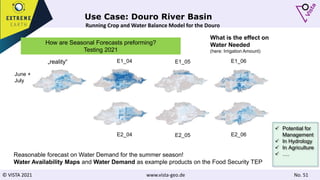
    © VISTA 2021www.vista-geo.de No. 50 Use Case: Douro River Basin How are Seasonal Forecasts preforming? Testing 2021 Next Level: Seasonal Forecasts 2021 Scenario A What is the effect on Water Needed (here: Irrigation Amount) April May June July CosmoEU E1_04 E1_05 E1_06 August E2_04 E2_05 E2_06
  • 51.
    © VISTA 2021www.vista-geo.de No. 51 Use Case: Douro River Basin How are Seasonal Forecasts preforming? Testing 2021 Running Crop and Water Balance Model for the Douro 2021 Scenario A What is the effect on Water Needed (here: Irrigation Amount) June + July E2_04 E2_05 E2_06 E1_04 E1_05 E1_06 Reasonable forecast on Water Demand for the summer season! Water Availability Maps and Water Demand as example products on the Food Security TEP „reality“  Potential for Management  In Hydrology  In Agriculture  ….
  • 52.
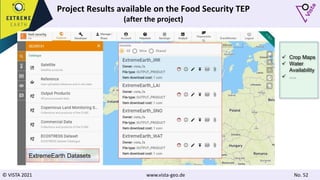
    © VISTA 2021www.vista-geo.de No. 52 Project Results available on the Food Security TEP (after the project) ExtremeEarth Datasets  Crop Maps  Water Availability  ….
  • 53.
    © VISTA 2021www.vista-geo.de No. 53 Food Security TEP EO Data Processing Crop Type Mapping Water and Crop Simulations Linked Data Technologies Applications in the Danube Applications in the Douro
  • 54.
    © VISTA 2021www.vista-geo.de No. 54 54 Combining Food-Security Data using Linked Data Technologies Basic setup: • 5 data layers that cover Austria: o Administrative areas, Snow cover, Irrigation, Precipitation, Crop type data o each layer is partitioned geospatially • Each dataset contains a single thematic layer and refers to a specific polygonal area. • 45 million triples, ~12GB of data in N-triples • 34 GeoSPARQL endpoints. • EO Data and Model results are detailed and distributed in spatial and temporal dimension • Interlinkage between the layers will create valuable information • Queries can receive new insights from the data • Connection to search engines can be made Developments by the Athens team Examples for the Food Security Use Case
  • 55.
    © VISTA 2021www.vista-geo.de No. 55 55 Combining Food-Security Data using Linked Data Technologies Examples for the Food Security Use Case Queries Q1 municipalities intersecting a given polygon Q2 snow-covered potato fields intersecting a given polygon Q3 potato fields within 5km from snow and intersecting a given polygon Q4 snow area within 5km from a given municipality Q5 potato fields within a given municipality Q6 snow-covered potato fields within given municipality Q7 potato fields within 5km from snow and within a given municipality
  • 56.
    © VISTA 2021www.vista-geo.de No. 56 56 Combining Food-Security Data using Linked Data Technologies • Integration within Hopsworks / Creodias • Provides an extra layer over big linked geospatial data store Strabo2 • Can be used to combine the data stored in Strabo2 with additional external geospatial endpoints. • Interlinking big linked geospatial data - George Papadakis - National and Kapodistrian University of Athens • 14:30 - 15:00 • Querying big linked geospatial data - Dimitris Bilidas - National and Kapodistrian University of Athens • 15:00 - 15:30 • Federating big linked geospatial data - Antonis Troumpoukis - NCSR Demokrito • 15:30 - 16:00
  • 57.
    © VISTA 2021www.vista-geo.de No. 57 Extreme Earth Applications The Food Security Use Case Copernicus Data Creodias Food Security TEP AI and Training Tool HOPSworks Sentinel 2 Processing Data Layer ICT Layer Portal Layer Project Activities Crop Information Water Availability Irrigation Information Water and Crop Modelling Application and Information Layers Linked Data Applications  Water Availability  Crop conditions  Irrigation Recommondat ions
  • 58.
    © VISTA 2021www.vista-geo.de No. 58 ExtremeEarth Applications The Food Security Use Case
  • 59.
    © VISTA 2021www.vista-geo.de No. 59 Your Questions? EARTHANALYTICS.EU FOODSECURITY-TEP.NET VISTA-GEO.DE VISTA Remote Sensing in Geosciences GmbH Gabelsbergerstraße 51 D-80333 München www.vista-geo.de Florian Appel appel@vista-geo.de Heike Bach bach@vista-geo.de Silke Migdall migdall@vista-geo.de

Editor's Notes

  • #9 Warum Satellitendaten nutzen (2): Wegen der hohen temporalen Auflösung! Das beste daran: die Satellitendaten sind zuverlässig verfügbar, es werden sogar immer neue Satelliten dazu kommen Permanent neue Daten! Durchschnittlich alle 2,5 Tage eine Sentinel-Szene vom selben Ort Sentinel 2A gestartet am 23. Juni 2015, 2B gestartet am 07. März 2017 Erstes Bild ist Falschfarbendarstellung, 2. Bild ist Landnutzungsklassifikation  Aber es kann viel mehr gerrechnet werden! Wegen vielen Daten können auch Pflanzenparameter in ihrer Entwicklung nachvollzogen werden (dies kann unter anderem auch zur Bestimmung der Fruchtart verwendet werden)
  • #10 By collecting all available satellite imagery, we are able to create time series of vegetation parameters (e.g. LAI). In this case we monitored three winter wheat fields in the north-east of Munich in 2018. Time series begins end of March until 1st of July. Every dot is a satellite image. By assimilating these information to a crop growth model we get yields.
  • #14 Warum Satellitendaten nutzen (2): Wegen der hohen temporalen Auflösung! Das beste daran: die Satellitendaten sind zuverlässig verfügbar, es werden sogar immer neue Satelliten dazu kommen Permanent neue Daten! Durchschnittlich alle 2,5 Tage eine Sentinel-Szene vom selben Ort Sentinel 2A gestartet am 23. Juni 2015, 2B gestartet am 07. März 2017 Erstes Bild ist Falschfarbendarstellung, 2. Bild ist Landnutzungsklassifikation  Aber es kann viel mehr gerrechnet werden! Wegen vielen Daten können auch Pflanzenparameter in ihrer Entwicklung nachvollzogen werden (dies kann unter anderem auch zur Bestimmung der Fruchtart verwendet werden)
  • #15 Warum Satellitendaten nutzen (2): Wegen der hohen temporalen Auflösung! Das beste daran: die Satellitendaten sind zuverlässig verfügbar, es werden sogar immer neue Satelliten dazu kommen Permanent neue Daten! Durchschnittlich alle 2,5 Tage eine Sentinel-Szene vom selben Ort Sentinel 2A gestartet am 23. Juni 2015, 2B gestartet am 07. März 2017 Erstes Bild ist Falschfarbendarstellung, 2. Bild ist Landnutzungsklassifikation  Aber es kann viel mehr gerrechnet werden! Wegen vielen Daten können auch Pflanzenparameter in ihrer Entwicklung nachvollzogen werden (dies kann unter anderem auch zur Bestimmung der Fruchtart verwendet werden)
  • #18 Warum Satellitendaten nutzen (2): Wegen der hohen temporalen Auflösung! Das beste daran: die Satellitendaten sind zuverlässig verfügbar, es werden sogar immer neue Satelliten dazu kommen Permanent neue Daten! Durchschnittlich alle 2,5 Tage eine Sentinel-Szene vom selben Ort Sentinel 2A gestartet am 23. Juni 2015, 2B gestartet am 07. März 2017 Erstes Bild ist Falschfarbendarstellung, 2. Bild ist Landnutzungsklassifikation  Aber es kann viel mehr gerrechnet werden! Wegen vielen Daten können auch Pflanzenparameter in ihrer Entwicklung nachvollzogen werden (dies kann unter anderem auch zur Bestimmung der Fruchtart verwendet werden)
  • #24 Warum Satellitendaten nutzen (2): Wegen der hohen temporalen Auflösung! Das beste daran: die Satellitendaten sind zuverlässig verfügbar, es werden sogar immer neue Satelliten dazu kommen Permanent neue Daten! Durchschnittlich alle 2,5 Tage eine Sentinel-Szene vom selben Ort Sentinel 2A gestartet am 23. Juni 2015, 2B gestartet am 07. März 2017 Erstes Bild ist Falschfarbendarstellung, 2. Bild ist Landnutzungsklassifikation  Aber es kann viel mehr gerrechnet werden! Wegen vielen Daten können auch Pflanzenparameter in ihrer Entwicklung nachvollzogen werden (dies kann unter anderem auch zur Bestimmung der Fruchtart verwendet werden)
  • #33 How do we do that? We have a dense time series of multi-spectral S2 images, which are pre-processed on the Food Security TEP with VISTAs image processing chains The pre-processing includes atmospheric corrections as well as cloud and cloud shadow masking The processed S2 images are then used to retrieve crop type maps with a multitemporal deep learning model Based on the crop type classification a representative sample of pixels is selected with distance from field boundaries or roads to guarantee pure crop information. For each crop, the development of the leaf area, is retrieved by inversion of the pre-processed S2 time series for 15 tiles covering 100 x 100 km each, using the radiative transfer model SLC The Leaf area is then assimilated into the crop growth model PROMET . The physically-based agro-hydrological model allows to simulate for example photosynthesis, evapotranspiration, soil moisture, biomass increase, phenological development, and crop water stress in an hourly temporal resolution. Yield in t/ha and water use efficiency (WUE) in kg yield/m³ evapotranspiration are then derived for a crop season. The model is forced by meteorological parameters (precipitation, air temperature, humidity, radiation and wind speed).
  • #38 How do we do that? We have a dense time series of multi-spectral S2 images, which are pre-processed on the Food Security TEP with VISTAs image processing chains The pre-processing includes atmospheric corrections as well as cloud and cloud shadow masking The processed S2 images are then used to retrieve crop type maps with a multitemporal deep learning model Based on the crop type classification a representative sample of pixels is selected with distance from field boundaries or roads to guarantee pure crop information. For each crop, the development of the leaf area, is retrieved by inversion of the pre-processed S2 time series for 15 tiles covering 100 x 100 km each, using the radiative transfer model SLC The Leaf area is then assimilated into the crop growth model PROMET . The physically-based agro-hydrological model allows to simulate for example photosynthesis, evapotranspiration, soil moisture, biomass increase, phenological development, and crop water stress in an hourly temporal resolution. Yield in t/ha and water use efficiency (WUE) in kg yield/m³ evapotranspiration are then derived for a crop season. The model is forced by meteorological parameters (precipitation, air temperature, humidity, radiation and wind speed).
  • #39 How do we do that? We have a dense time series of multi-spectral S2 images, which are pre-processed on the Food Security TEP with VISTAs image processing chains The pre-processing includes atmospheric corrections as well as cloud and cloud shadow masking The processed S2 images are then used to retrieve crop type maps with a multitemporal deep learning model Based on the crop type classification a representative sample of pixels is selected with distance from field boundaries or roads to guarantee pure crop information. For each crop, the development of the leaf area, is retrieved by inversion of the pre-processed S2 time series for 15 tiles covering 100 x 100 km each, using the radiative transfer model SLC The Leaf area is then assimilated into the crop growth model PROMET . The physically-based agro-hydrological model allows to simulate for example photosynthesis, evapotranspiration, soil moisture, biomass increase, phenological development, and crop water stress in an hourly temporal resolution. Yield in t/ha and water use efficiency (WUE) in kg yield/m³ evapotranspiration are then derived for a crop season. The model is forced by meteorological parameters (precipitation, air temperature, humidity, radiation and wind speed).
  • #40 our approach is also valid for smaller scales like fields Some fields along the Bavarian – Austrian border with different crop types SB, MA, WB, WW
  • #41 Was sehen wir hier? - as irrigation advices are typically given on daily time scale we assessed the LAI of the SB for two different years. Different crops : edge colour , the filling indicates the total crop water demand in mm for the whole field Crop water demand means the water the plant needs in addition to the natural water resources such as rain or groundwater This total crop water demand is calculated with PROMET (which was described before) So this how it looks in the year 2018, lets have a look at the Soybean fields which have a very high crop water demand in 2018 Now this is 2019 and we can see that these fields needs Crop type assignment is very important for correct quantification of crop-specific irrigation water demand In 2018 there was different total crop water demand per field that means water that could be irrigated to achieve full yield. In 2018 the SB fields had the largest crop water demand which was not satisfied, while the other crop types had significantly less crop water demand. Corp type assignment is very important for correct quantification of crop-specific irrigation water demand and it differs from year to year so its important so simulate that with meteorological data and EO information.
  • #55 9 datasets: one per state of Austria. The polygons of the states are touching (non-overlapping).
  • #56 9 datasets: one per state of Austria. The polygons of the states are touching (non-overlapping).
  • #57 9 datasets: one per state of Austria. The polygons of the states are touching (non-overlapping).