OVERVIEW OF THE FOOD INDUSTRY
FOOD INDUSTRY
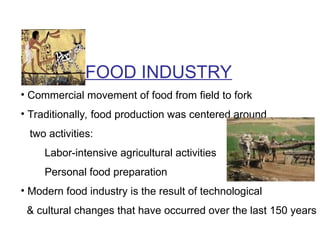
• Commercial movement of food from field to fork
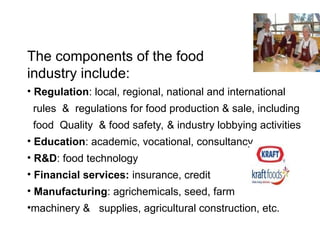
• Traditionally, food production was centered around
two activities:
Labor-intensive agricultural activities
Personal food preparation
• Modern food industry is the result of technological
& cultural changes that have occurred over the last 150 years
The components of the food
industry include:
• Regulation: local, regional, national and international
rules & regulations for food production & sale, including
food Quality & food safety, & industry lobbying activities
• Education: academic, vocational, consultancy
• R&D: food technology
• Financial services: insurance, credit
• Manufacturing: agrichemicals, seed, farm
•machinery & supplies, agricultural construction, etc.
The components of the food industry Cont.
• Agriculture: raising of crops and livestock, seafood
• Food processing: preparation of fresh products for
market, manufacture of prepared food products
• Marketing: promotion of generic products (e.g. milk
board), new products, public opinion, through advertising,
packaging, public relations, etc
• Wholesale & distribution: warehousing, transportation,
logistics
• Retail: supermarket chains and independent food stores,
direct-to-consumer, restaurant, food services
• Modern food industry is reliant on technology,
transportation, management & logistics for physical
fulfillment, and on marketing and government regulation for
maintaining an efficient consumer market Food is grown,
processed, & transported in a global manner
• Wide range of businesses and individuals are employed by
& profit from all aspects of this huge and complex system
Industry Size
• Processed food sales worldwide are approximately
US$3.2 trillion
• In the U.S., consumers spend approximately US$1trillion
annually for food, or nearly 10% of the GDP
• Over 16.5 million people are employed in the food industry
• India is the second largest producer of food next to China
• India has the potential of being the biggest with the
food and agricultural sector
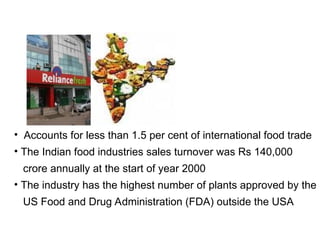
• Accounts for less than 1.5 per cent of international food trade
• The Indian food industries sales turnover was Rs 140,000
crore annually at the start of year 2000
• The industry has the highest number of plants approved by the
US Food and Drug Administration (FDA) outside the USA
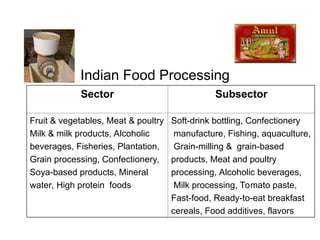
Sector Subsector
Fruit & vegetables, Meat & poultry
Milk & milk products, Alcoholic
beverages, Fisheries, Plantation,
Grain processing, Confectionery,
Soya-based products, Mineral
water, High protein foods
Soft-drink bottling, Confectionery
manufacture, Fishing, aquaculture,
Grain-milling & grain-based
products, Meat and poultry
processing, Alcoholic beverages,
Milk processing, Tomato paste,
Fast-food, Ready-to-eat breakfast
cereals, Food additives, flavors
Indian Food Processing
Food Processing
• The Indian food processing industry is presently growing at
14 % against 6-7 per cent growth in 2003-04
• The industry received foreign direct investments (FDI)
totaling US$ 143.80 million in 2007-08 against US$ 5.70
million in the previous fiscal year
• The size of the global processed-food market is estimated at
US$ 3.2 trillion
Food Processing
• Nearly 80 % of agricultural products in the developed
countries get processed and packaged
• The ministry of food processing is planning to set up
350 new food processing units
• The food and grocery market in India is the sixth
largest in the world
• Food and grocery retail contributes to 70 % of the
total retail sales
Indian food market
• The Indian food market is estimated at over US$ 182 billion
• According to consultancy firm McKinsey & Co, the retail
food sector in India was US$ 70 billion in 2008
• Despite a global slowdown, Indian spice exports are growing
India exported 470,520 tonnes of spices valued at
US$ 11.68 billion an all time high in 2008-09
• 99% of the food processing industry is unorganised
• Immense scope for growth for the organised sector
• The organised food retail sector is largely dominated by
restaurants, fast food outlets
Major investments
• Private investment has been one of the key drivers for
growth of the Indian food industry
Government Initiatives
• The new trade policy places increased focus on agro-based
industries
• Food processing industries in the list of priority sectors for
bank lending
• The government has started work on 10 Mega Food Parks,
& is planning to increase the number to 30 by 2016
• Fruit and vegetable processing units have been completely
exempted from paying excise duty
Food Safety Regulations in India
• Ministry of Food and Consumer Affairs main Government
agency dealing with product standards for consumption in
the domestic market
• The Bureau of Indian Standards (BIS) is the main Standard
Setting body in India for all domestic market requirements
• The Export Inspection Council (EIC) is the Chief
enforcement body for exports
• Policies and plans for the food processing industries is
coordinated by the Ministry of Food Processing Industries
formed in 2001
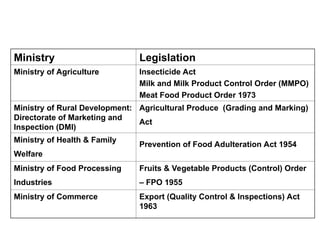
Ministry Legislation
Ministry of Agriculture Insecticide Act
Milk and Milk Product Control Order (MMPO)
Meat Food Product Order 1973
Ministry of Rural Development:
Directorate of Marketing and
Inspection (DMI)
Agricultural Produce (Grading and Marking)
Act
Ministry of Health & Family
Welfare
Prevention of Food Adulteration Act 1954
Ministry of Food Processing
Industries
Fruits & Vegetable Products (Control) Order
– FPO 1955
Ministry of Commerce Export (Quality Control & Inspections) Act
1963
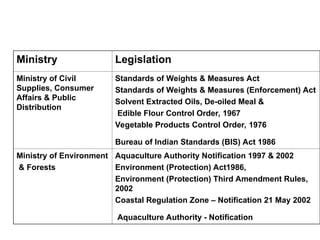
Ministry Legislation
Ministry of Civil
Supplies, Consumer
Affairs & Public
Distribution
Standards of Weights & Measures Act
Standards of Weights & Measures (Enforcement) Act
Solvent Extracted Oils, De-oiled Meal &
Edible Flour Control Order, 1967
Vegetable Products Control Order, 1976
Bureau of Indian Standards (BIS) Act 1986
Ministry of Environment
& Forests
Aquaculture Authority Notification 1997 & 2002
Environment (Protection) Act1986,
Environment (Protection) Third Amendment Rules,
2002
Coastal Regulation Zone – Notification 21 May 2002
Aquaculture Authority - Notification
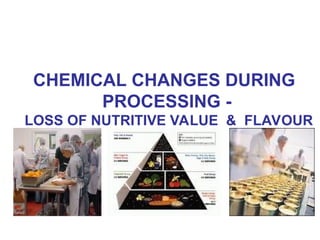
CHEMICAL CHANGES DURING
PROCESSING -
LOSS OF NUTRITIVE VALUE & FLAVOUR
EFFECT OF PROCESSING ON
NUTRIENT CONTENT OF
FOODS
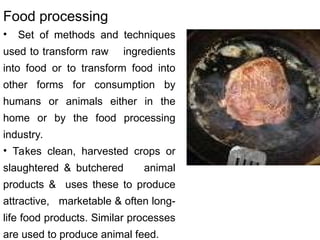
Food processing
• Set of methods and techniques
used to transform raw ingredients
into food or to transform food into
other forms for consumption by
humans or animals either in the
home or by the food processing
industry.
• Takes clean, harvested crops or
slaughtered & butchered animal
products & uses these to produce
attractive, marketable & often long-
life food products. Similar processes
are used to produce animal feed.
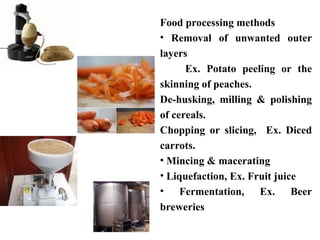
Food processing methods
• Removal of unwanted outer
layers
Ex. Potato peeling or the
skinning of peaches.
De-husking, milling & polishing
of cereals.
Chopping or slicing, Ex. Diced
carrots.
• Mincing & macerating
• Liquefaction, Ex. Fruit juice
• Fermentation, Ex. Beer
breweries
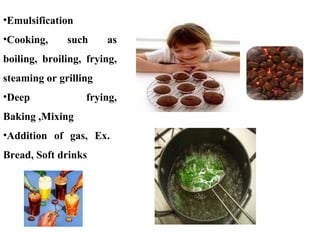
•Emulsification
•Cooking, such as
boiling, broiling, frying,
steaming or grilling
•Deep frying,
Baking ,Mixing
•Addition of gas, Ex.
Bread, Soft drinks
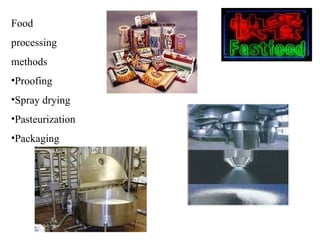
Food
processing
methods
•Proofing
•Spray drying
•Pasteurization
•Packaging
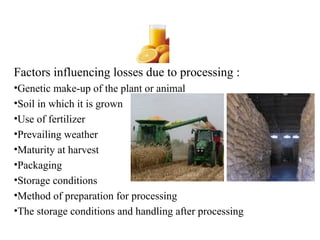
Factors influencing losses due to processing :
•Genetic make-up of the plant or animal
•Soil in which it is grown
•Use of fertilizer
•Prevailing weather
•Maturity at harvest
•Packaging
•Storage conditions
•Method of preparation for processing
•The storage conditions and handling after processing
The effect of food processing on nutrient content
will depend on:
•Characteristics of the food being processed,
•Concentration of the nutrient in the food
•The sensitivity of the nutrient to conditions such as heat, oxygen,
pH and light
Ex. Sensitivity of vitamin C to heat varies with pH
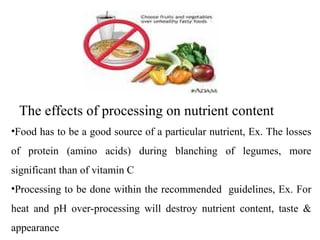
The effects of processing on nutrient content
•Food has to be a good source of a particular nutrient, Ex. The losses
of protein (amino acids) during blanching of legumes, more
significant than of vitamin C
•Processing to be done within the recommended guidelines, Ex. For
heat and pH over-processing will destroy nutrient content, taste &
appearance
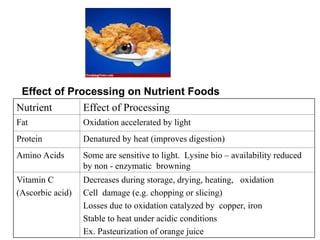
Nutrient Effect of Processing
Fat Oxidation accelerated by light
Protein Denatured by heat (improves digestion)
Amino Acids Some are sensitive to light. Lysine bio – availability reduced
by non - enzymatic browning
Vitamin C
(Ascorbic acid)
Decreases during storage, drying, heating, oxidation
Cell damage (e.g. chopping or slicing)
Losses due to oxidation catalyzed by copper, iron
Stable to heat under acidic conditions
Ex. Pasteurization of orange juice
Effect of Processing on Nutrient Foods
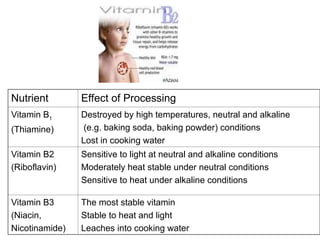
Nutrient Effect of Processing
Vitamin B1
(Thiamine)
Destroyed by high temperatures, neutral and alkaline
(e.g. baking soda, baking powder) conditions
Lost in cooking water
Vitamin B2
(Riboflavin)
Sensitive to light at neutral and alkaline conditions
Moderately heat stable under neutral conditions
Sensitive to heat under alkaline conditions
Vitamin B3
(Niacin,
Nicotinamide)
The most stable vitamin
Stable to heat and light
Leaches into cooking water
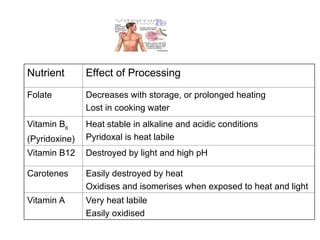
Nutrient Effect of Processing
Folate Decreases with storage, or prolonged heating
Lost in cooking water
Vitamin B6
(Pyridoxine)
Heat stable in alkaline and acidic conditions
Pyridoxal is heat labile
Vitamin B12 Destroyed by light and high pH
Carotenes Easily destroyed by heat
Oxidises and isomerises when exposed to heat and light
Vitamin A Very heat labile
Easily oxidised
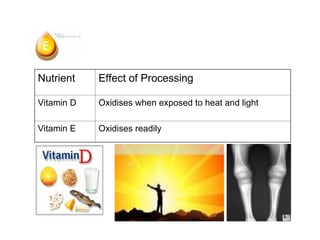
Nutrient Effect of Processing
Vitamin D Oxidises when exposed to heat and light
Vitamin E Oxidises readily
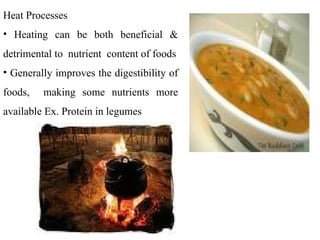
Heat Processes
• Heating can be both beneficial &
detrimental to nutrient content of foods
• Generally improves the digestibility of
foods, making some nutrients more
available Ex. Protein in legumes
Heat Processes
Reduction in protein quality
of the food
• Lysine content most often
affected
• Vitamin C destroyed by
heating
• Losses of other labile
nutrients depend on the
extent of heating and other
prevailing conditions, such
as pH
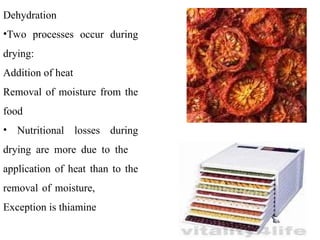
Dehydration
•Two processes occur during
drying:
Addition of heat
Removal of moisture from the
food
• Nutritional losses during
drying are more due to the
application of heat than to the
removal of moisture,
Exception is thiamine
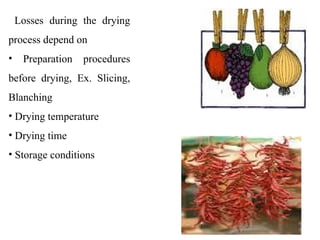
Losses during the drying
process depend on
• Preparation procedures
before drying, Ex. Slicing,
Blanching
• Drying temperature
• Drying time
• Storage conditions
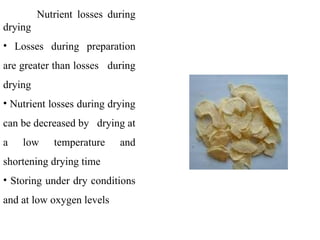
Nutrient losses during
drying
• Losses during preparation
are greater than losses during
drying
• Nutrient losses during drying
can be decreased by drying at
a low temperature and
shortening drying time
• Storing under dry conditions
and at low oxygen levels
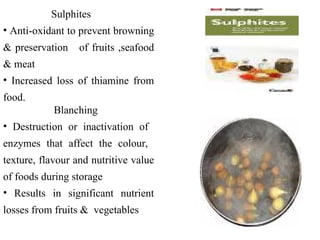
Sulphites
• Anti-oxidant to prevent browning
& preservation of fruits ,seafood
& meat
• Increased loss of thiamine from
food.
Blanching
• Destruction or inactivation of
enzymes that affect the colour,
texture, flavour and nutritive value
of foods during storage
• Results in significant nutrient
losses from fruits & vegetables
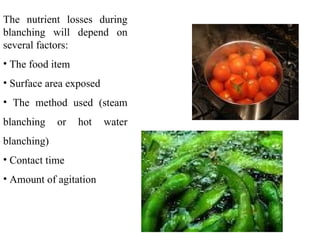
The nutrient losses during
blanching will depend on
several factors:
• The food item
• Surface area exposed
• The method used (steam
blanching or hot water
blanching)
• Contact time
• Amount of agitation
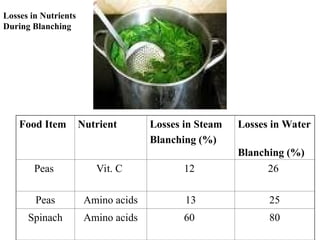
Food Item Nutrient Losses in Steam
Blanching (%)
Losses in Water
Blanching (%)
Peas Vit. C 12 26
Peas Amino acids 13 25
Spinach Amino acids 60 80
Losses in Nutrients
During Blanching
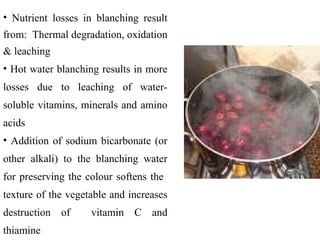
• Nutrient losses in blanching result
from: Thermal degradation, oxidation
& leaching
• Hot water blanching results in more
losses due to leaching of water-
soluble vitamins, minerals and amino
acids
• Addition of sodium bicarbonate (or
other alkali) to the blanching water
for preserving the colour softens the
texture of the vegetable and increases
destruction of vitamin C and
thiamine
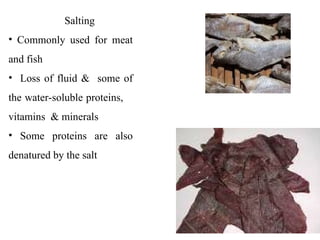
Salting
• Commonly used for meat
and fish
• Loss of fluid & some of
the water-soluble proteins,
vitamins & minerals
• Some proteins are also
denatured by the salt
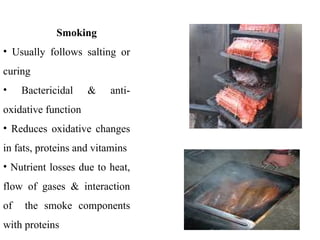
Smoking
• Usually follows salting or
curing
• Bactericidal & anti-
oxidative function
• Reduces oxidative changes
in fats, proteins and vitamins
• Nutrient losses due to heat,
flow of gases & interaction
of the smoke components
with proteins
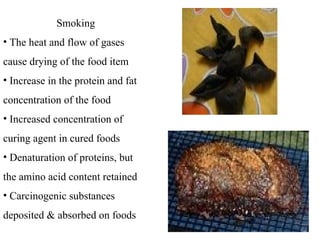
Smoking
• The heat and flow of gases
cause drying of the food item
• Increase in the protein and fat
concentration of the food
• Increased concentration of
curing agent in cured foods
• Denaturation of proteins, but
the amino acid content retained
• Carcinogenic substances
deposited & absorbed on foods
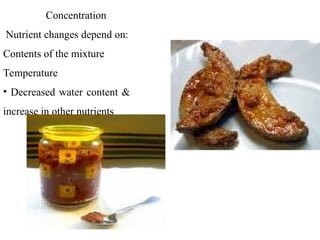
Concentration
Nutrient changes depend on:
Contents of the mixture
Temperature
• Decreased water content &
increase in other nutrients
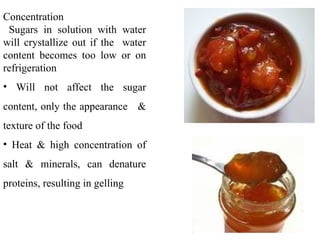
Concentration
Sugars in solution with water
will crystallize out if the water
content becomes too low or on
refrigeration
• Will not affect the sugar
content, only the appearance &
texture of the food
• Heat & high concentration of
salt & minerals, can denature
proteins, resulting in gelling
EFFECT OF PROCESSING ON
FLAVOUR CONTENT OF FOODS
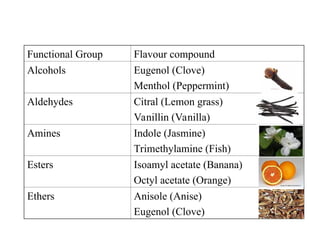
Functional Group Flavour compound
Alcohols Eugenol (Clove)
Menthol (Peppermint)
Aldehydes Citral (Lemon grass)
Vanillin (Vanilla)
Amines Indole (Jasmine)
Trimethylamine (Fish)
Esters Isoamyl acetate (Banana)
Octyl acetate (Orange)
Ethers Anisole (Anise)
Eugenol (Clove)
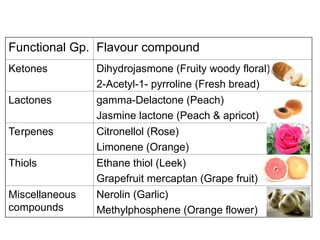
Functional Gp. Flavour compound
Ketones Dihydrojasmone (Fruity woody floral)
2-Acetyl-1- pyrroline (Fresh bread)
Lactones gamma-Delactone (Peach)
Jasmine lactone (Peach & apricot)
Terpenes Citronellol (Rose)
Limonene (Orange)
Thiols Ethane thiol (Leek)
Grapefruit mercaptan (Grape fruit)
Miscellaneous
compounds
Nerolin (Garlic)
Methylphosphene (Orange flower)
• Several processing methods
involve application of heat
Heat affects flavour:
• Heat is both the enemy of
flavour ingredients & essential to
the development of many desired
flavour components in food
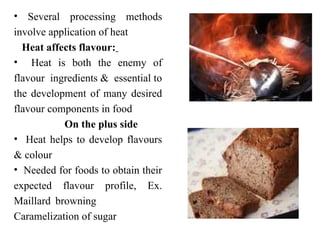
On the plus side
• Heat helps to develop flavours
& colour
• Needed for foods to obtain their
expected flavour profile, Ex.
Maillard browning
Caramelization of sugar
On the minus side
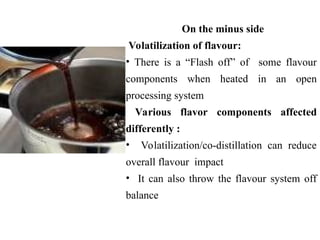
Volatilization of flavour:
• There is a “Flash off” of some flavour
components when heated in an open
processing system
Various flavor components affected
differently :
• Volatilization/co-distillation can reduce
overall flavour impact
• It can also throw the flavour system off
balance
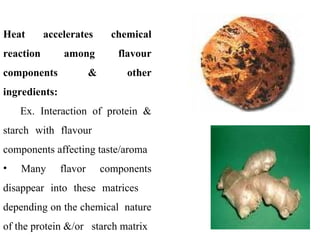
Heat accelerates chemical
reaction among flavour
components & other
ingredients:
Ex. Interaction of protein &
starch with flavour
components affecting taste/aroma
• Many flavor components
disappear into these matrices
depending on the chemical nature
of the protein &/or starch matrix
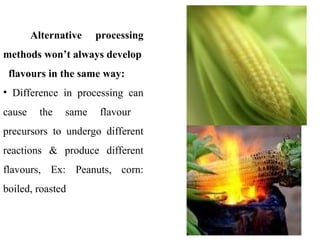
Alternative processing
methods won’t always develop
flavours in the same way:
• Difference in processing can
cause the same flavour
precursors to undergo different
reactions & produce different
flavours, Ex: Peanuts, corn:
boiled, roasted
• Products with reduced fat levels
especially are particularly
susceptible to these interactions
due to presence of starch or protein
based fat mimetics
• Even if flavour components don’t
react directly with other
ingredients, the latter may serve to
destabilize an otherwise heat
stable flavour system
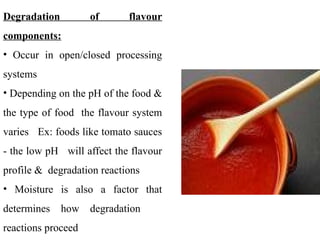
Degradation of flavour
components:
• Occur in open/closed processing
systems
• Depending on the pH of the food &
the type of food the flavour system
varies Ex: foods like tomato sauces
- the low pH will affect the flavour
profile & degradation reactions
• Moisture is also a factor that
determines how degradation
reactions proceed

Food Processing techniques for avoid nutrients loses

  • 1.
    OVERVIEW OF THEFOOD INDUSTRY
  • 2.
    FOOD INDUSTRY • Commercialmovement of food from field to fork • Traditionally, food production was centered around two activities: Labor-intensive agricultural activities Personal food preparation • Modern food industry is the result of technological & cultural changes that have occurred over the last 150 years
  • 3.
    The components ofthe food industry include: • Regulation: local, regional, national and international rules & regulations for food production & sale, including food Quality & food safety, & industry lobbying activities • Education: academic, vocational, consultancy • R&D: food technology • Financial services: insurance, credit • Manufacturing: agrichemicals, seed, farm •machinery & supplies, agricultural construction, etc.
  • 4.
    The components ofthe food industry Cont. • Agriculture: raising of crops and livestock, seafood • Food processing: preparation of fresh products for market, manufacture of prepared food products • Marketing: promotion of generic products (e.g. milk board), new products, public opinion, through advertising, packaging, public relations, etc • Wholesale & distribution: warehousing, transportation, logistics • Retail: supermarket chains and independent food stores, direct-to-consumer, restaurant, food services
  • 5.
    • Modern foodindustry is reliant on technology, transportation, management & logistics for physical fulfillment, and on marketing and government regulation for maintaining an efficient consumer market Food is grown, processed, & transported in a global manner • Wide range of businesses and individuals are employed by & profit from all aspects of this huge and complex system
  • 6.
    Industry Size • Processedfood sales worldwide are approximately US$3.2 trillion • In the U.S., consumers spend approximately US$1trillion annually for food, or nearly 10% of the GDP • Over 16.5 million people are employed in the food industry • India is the second largest producer of food next to China • India has the potential of being the biggest with the food and agricultural sector
  • 7.
    • Accounts forless than 1.5 per cent of international food trade • The Indian food industries sales turnover was Rs 140,000 crore annually at the start of year 2000 • The industry has the highest number of plants approved by the US Food and Drug Administration (FDA) outside the USA
  • 8.
    Sector Subsector Fruit &vegetables, Meat & poultry Milk & milk products, Alcoholic beverages, Fisheries, Plantation, Grain processing, Confectionery, Soya-based products, Mineral water, High protein foods Soft-drink bottling, Confectionery manufacture, Fishing, aquaculture, Grain-milling & grain-based products, Meat and poultry processing, Alcoholic beverages, Milk processing, Tomato paste, Fast-food, Ready-to-eat breakfast cereals, Food additives, flavors Indian Food Processing
  • 9.
    Food Processing • TheIndian food processing industry is presently growing at 14 % against 6-7 per cent growth in 2003-04 • The industry received foreign direct investments (FDI) totaling US$ 143.80 million in 2007-08 against US$ 5.70 million in the previous fiscal year • The size of the global processed-food market is estimated at US$ 3.2 trillion
  • 10.
    Food Processing • Nearly80 % of agricultural products in the developed countries get processed and packaged • The ministry of food processing is planning to set up 350 new food processing units • The food and grocery market in India is the sixth largest in the world • Food and grocery retail contributes to 70 % of the total retail sales
  • 11.
    Indian food market •The Indian food market is estimated at over US$ 182 billion • According to consultancy firm McKinsey & Co, the retail food sector in India was US$ 70 billion in 2008 • Despite a global slowdown, Indian spice exports are growing India exported 470,520 tonnes of spices valued at US$ 11.68 billion an all time high in 2008-09
  • 12.
    • 99% ofthe food processing industry is unorganised • Immense scope for growth for the organised sector • The organised food retail sector is largely dominated by restaurants, fast food outlets Major investments • Private investment has been one of the key drivers for growth of the Indian food industry
  • 13.
    Government Initiatives • Thenew trade policy places increased focus on agro-based industries • Food processing industries in the list of priority sectors for bank lending • The government has started work on 10 Mega Food Parks, & is planning to increase the number to 30 by 2016 • Fruit and vegetable processing units have been completely exempted from paying excise duty
  • 14.
    Food Safety Regulationsin India • Ministry of Food and Consumer Affairs main Government agency dealing with product standards for consumption in the domestic market • The Bureau of Indian Standards (BIS) is the main Standard Setting body in India for all domestic market requirements • The Export Inspection Council (EIC) is the Chief enforcement body for exports • Policies and plans for the food processing industries is coordinated by the Ministry of Food Processing Industries formed in 2001
  • 15.
    Ministry Legislation Ministry ofAgriculture Insecticide Act Milk and Milk Product Control Order (MMPO) Meat Food Product Order 1973 Ministry of Rural Development: Directorate of Marketing and Inspection (DMI) Agricultural Produce (Grading and Marking) Act Ministry of Health & Family Welfare Prevention of Food Adulteration Act 1954 Ministry of Food Processing Industries Fruits & Vegetable Products (Control) Order – FPO 1955 Ministry of Commerce Export (Quality Control & Inspections) Act 1963
  • 16.
    Ministry Legislation Ministry ofCivil Supplies, Consumer Affairs & Public Distribution Standards of Weights & Measures Act Standards of Weights & Measures (Enforcement) Act Solvent Extracted Oils, De-oiled Meal & Edible Flour Control Order, 1967 Vegetable Products Control Order, 1976 Bureau of Indian Standards (BIS) Act 1986 Ministry of Environment & Forests Aquaculture Authority Notification 1997 & 2002 Environment (Protection) Act1986, Environment (Protection) Third Amendment Rules, 2002 Coastal Regulation Zone – Notification 21 May 2002 Aquaculture Authority - Notification
  • 17.
    CHEMICAL CHANGES DURING PROCESSING- LOSS OF NUTRITIVE VALUE & FLAVOUR
  • 18.
    EFFECT OF PROCESSINGON NUTRIENT CONTENT OF FOODS
  • 19.
    Food processing • Setof methods and techniques used to transform raw ingredients into food or to transform food into other forms for consumption by humans or animals either in the home or by the food processing industry. • Takes clean, harvested crops or slaughtered & butchered animal products & uses these to produce attractive, marketable & often long- life food products. Similar processes are used to produce animal feed.
  • 20.
    Food processing methods •Removal of unwanted outer layers Ex. Potato peeling or the skinning of peaches. De-husking, milling & polishing of cereals. Chopping or slicing, Ex. Diced carrots. • Mincing & macerating • Liquefaction, Ex. Fruit juice • Fermentation, Ex. Beer breweries
  • 21.
    •Emulsification •Cooking, such as boiling,broiling, frying, steaming or grilling •Deep frying, Baking ,Mixing •Addition of gas, Ex. Bread, Soft drinks
  • 22.
  • 23.
    Factors influencing lossesdue to processing : •Genetic make-up of the plant or animal •Soil in which it is grown •Use of fertilizer •Prevailing weather •Maturity at harvest •Packaging •Storage conditions •Method of preparation for processing •The storage conditions and handling after processing
  • 24.
    The effect offood processing on nutrient content will depend on: •Characteristics of the food being processed, •Concentration of the nutrient in the food •The sensitivity of the nutrient to conditions such as heat, oxygen, pH and light Ex. Sensitivity of vitamin C to heat varies with pH
  • 25.
    The effects ofprocessing on nutrient content •Food has to be a good source of a particular nutrient, Ex. The losses of protein (amino acids) during blanching of legumes, more significant than of vitamin C •Processing to be done within the recommended guidelines, Ex. For heat and pH over-processing will destroy nutrient content, taste & appearance
  • 26.
    Nutrient Effect ofProcessing Fat Oxidation accelerated by light Protein Denatured by heat (improves digestion) Amino Acids Some are sensitive to light. Lysine bio – availability reduced by non - enzymatic browning Vitamin C (Ascorbic acid) Decreases during storage, drying, heating, oxidation Cell damage (e.g. chopping or slicing) Losses due to oxidation catalyzed by copper, iron Stable to heat under acidic conditions Ex. Pasteurization of orange juice Effect of Processing on Nutrient Foods
  • 27.
    Nutrient Effect ofProcessing Vitamin B1 (Thiamine) Destroyed by high temperatures, neutral and alkaline (e.g. baking soda, baking powder) conditions Lost in cooking water Vitamin B2 (Riboflavin) Sensitive to light at neutral and alkaline conditions Moderately heat stable under neutral conditions Sensitive to heat under alkaline conditions Vitamin B3 (Niacin, Nicotinamide) The most stable vitamin Stable to heat and light Leaches into cooking water
  • 28.
    Nutrient Effect ofProcessing Folate Decreases with storage, or prolonged heating Lost in cooking water Vitamin B6 (Pyridoxine) Heat stable in alkaline and acidic conditions Pyridoxal is heat labile Vitamin B12 Destroyed by light and high pH Carotenes Easily destroyed by heat Oxidises and isomerises when exposed to heat and light Vitamin A Very heat labile Easily oxidised
  • 29.
    Nutrient Effect ofProcessing Vitamin D Oxidises when exposed to heat and light Vitamin E Oxidises readily
  • 30.
    Heat Processes • Heatingcan be both beneficial & detrimental to nutrient content of foods • Generally improves the digestibility of foods, making some nutrients more available Ex. Protein in legumes
  • 31.
    Heat Processes Reduction inprotein quality of the food • Lysine content most often affected • Vitamin C destroyed by heating • Losses of other labile nutrients depend on the extent of heating and other prevailing conditions, such as pH
  • 32.
    Dehydration •Two processes occurduring drying: Addition of heat Removal of moisture from the food • Nutritional losses during drying are more due to the application of heat than to the removal of moisture, Exception is thiamine
  • 33.
    Losses during thedrying process depend on • Preparation procedures before drying, Ex. Slicing, Blanching • Drying temperature • Drying time • Storage conditions
  • 34.
    Nutrient losses during drying •Losses during preparation are greater than losses during drying • Nutrient losses during drying can be decreased by drying at a low temperature and shortening drying time • Storing under dry conditions and at low oxygen levels
  • 35.
    Sulphites • Anti-oxidant toprevent browning & preservation of fruits ,seafood & meat • Increased loss of thiamine from food. Blanching • Destruction or inactivation of enzymes that affect the colour, texture, flavour and nutritive value of foods during storage • Results in significant nutrient losses from fruits & vegetables
  • 36.
    The nutrient lossesduring blanching will depend on several factors: • The food item • Surface area exposed • The method used (steam blanching or hot water blanching) • Contact time • Amount of agitation
  • 37.
    Food Item NutrientLosses in Steam Blanching (%) Losses in Water Blanching (%) Peas Vit. C 12 26 Peas Amino acids 13 25 Spinach Amino acids 60 80 Losses in Nutrients During Blanching
  • 38.
    • Nutrient lossesin blanching result from: Thermal degradation, oxidation & leaching • Hot water blanching results in more losses due to leaching of water- soluble vitamins, minerals and amino acids • Addition of sodium bicarbonate (or other alkali) to the blanching water for preserving the colour softens the texture of the vegetable and increases destruction of vitamin C and thiamine
  • 39.
    Salting • Commonly usedfor meat and fish • Loss of fluid & some of the water-soluble proteins, vitamins & minerals • Some proteins are also denatured by the salt
  • 40.
    Smoking • Usually followssalting or curing • Bactericidal & anti- oxidative function • Reduces oxidative changes in fats, proteins and vitamins • Nutrient losses due to heat, flow of gases & interaction of the smoke components with proteins
  • 41.
    Smoking • The heatand flow of gases cause drying of the food item • Increase in the protein and fat concentration of the food • Increased concentration of curing agent in cured foods • Denaturation of proteins, but the amino acid content retained • Carcinogenic substances deposited & absorbed on foods
  • 42.
    Concentration Nutrient changes dependon: Contents of the mixture Temperature • Decreased water content & increase in other nutrients
  • 43.
    Concentration Sugars in solutionwith water will crystallize out if the water content becomes too low or on refrigeration • Will not affect the sugar content, only the appearance & texture of the food • Heat & high concentration of salt & minerals, can denature proteins, resulting in gelling
  • 44.
    EFFECT OF PROCESSINGON FLAVOUR CONTENT OF FOODS
  • 45.
    Functional Group Flavourcompound Alcohols Eugenol (Clove) Menthol (Peppermint) Aldehydes Citral (Lemon grass) Vanillin (Vanilla) Amines Indole (Jasmine) Trimethylamine (Fish) Esters Isoamyl acetate (Banana) Octyl acetate (Orange) Ethers Anisole (Anise) Eugenol (Clove)
  • 46.
    Functional Gp. Flavourcompound Ketones Dihydrojasmone (Fruity woody floral) 2-Acetyl-1- pyrroline (Fresh bread) Lactones gamma-Delactone (Peach) Jasmine lactone (Peach & apricot) Terpenes Citronellol (Rose) Limonene (Orange) Thiols Ethane thiol (Leek) Grapefruit mercaptan (Grape fruit) Miscellaneous compounds Nerolin (Garlic) Methylphosphene (Orange flower)
  • 47.
    • Several processingmethods involve application of heat Heat affects flavour: • Heat is both the enemy of flavour ingredients & essential to the development of many desired flavour components in food On the plus side • Heat helps to develop flavours & colour • Needed for foods to obtain their expected flavour profile, Ex. Maillard browning Caramelization of sugar
  • 48.
    On the minusside Volatilization of flavour: • There is a “Flash off” of some flavour components when heated in an open processing system Various flavor components affected differently : • Volatilization/co-distillation can reduce overall flavour impact • It can also throw the flavour system off balance
  • 49.
    Heat accelerates chemical reactionamong flavour components & other ingredients: Ex. Interaction of protein & starch with flavour components affecting taste/aroma • Many flavor components disappear into these matrices depending on the chemical nature of the protein &/or starch matrix
  • 50.
    Alternative processing methods won’talways develop flavours in the same way: • Difference in processing can cause the same flavour precursors to undergo different reactions & produce different flavours, Ex: Peanuts, corn: boiled, roasted
  • 51.
    • Products withreduced fat levels especially are particularly susceptible to these interactions due to presence of starch or protein based fat mimetics • Even if flavour components don’t react directly with other ingredients, the latter may serve to destabilize an otherwise heat stable flavour system
  • 52.
    Degradation of flavour components: •Occur in open/closed processing systems • Depending on the pH of the food & the type of food the flavour system varies Ex: foods like tomato sauces - the low pH will affect the flavour profile & degradation reactions • Moisture is also a factor that determines how degradation reactions proceed