VIVEKANANDHA
ARTS AND SCIENCE COLLEGE FOR WOMEN
VEERACHIPALAYAM -636007, SANKARI, TAMIL NADU
DEPARTMENT OF MICROBIOLOGY
SUBJECT : FOOD MICROBIOLOGY
TOPIC : METHYLENE BLUE REDUCTION TEST
SUBJECT INCHARGE: SUBMITTED BY:
DR..R.DINESH KUMAR.. G.GOMATHI
ASSISTANT PROFESSOR III-BSC MICROBIOLOGY
DEPARTMENT OF MICROBIOLOGY DEPARTMENT OF MICROBIOLOGY
VIAAS, SANKAGIRI VIAAS, SANKARI
METHYLENE BLUE REDUCTION
TEST (MBRT TEST)
INTRODUCTION
• The Methylene Blue Reduction Test is a microbiological
assay used to evaluate the quality of milk and other
dairy products by measuring their microbial load.
• It involves adding methylene blue dye to a milk sample
and incubating it at a specified temperature.
• The test’s principle is based on the dye’s ability to act
as an indicator of microbial activity.
INTRODUCTION
• Test to find bacterial contamination of food (especially
milk)
• Based on utilisation of oxygen by bacteria which
reduces dye and decolourizes it
• Faster the decolourization, more inferior is the
bacteriological quality and vice-versa
METHYLENE BLUE REDUCTION TEST
For the Methylene Blue Reduction Test, follow these steps for sample
preparation:
1. Collect the Sample : Obtain a fresh sample of milk. It should be well-
mixed and free from any external contamination.
2. Prepare the Methylene Blue Solution : Use a commercially available
methylene blue solution or prepare it by dissolving methylene blue
powder in distilled water to make a 0.002% (w/v) solution.
METHYLENE BLUE REDUCTION TEST
3. Mix the Sample : In a clean, sterile test tube, add 10 ml of the
milk sample.
4. Add Methylene Blue : Add 1-2 ml of the methylene blue
solution to the milk sample. Mix thoroughly.
5. Incubation : Seal the test tube and incubate it at 37°C for a
specified period, usually 2 hours.
METHYLENE BLUE REDUCTION TEST
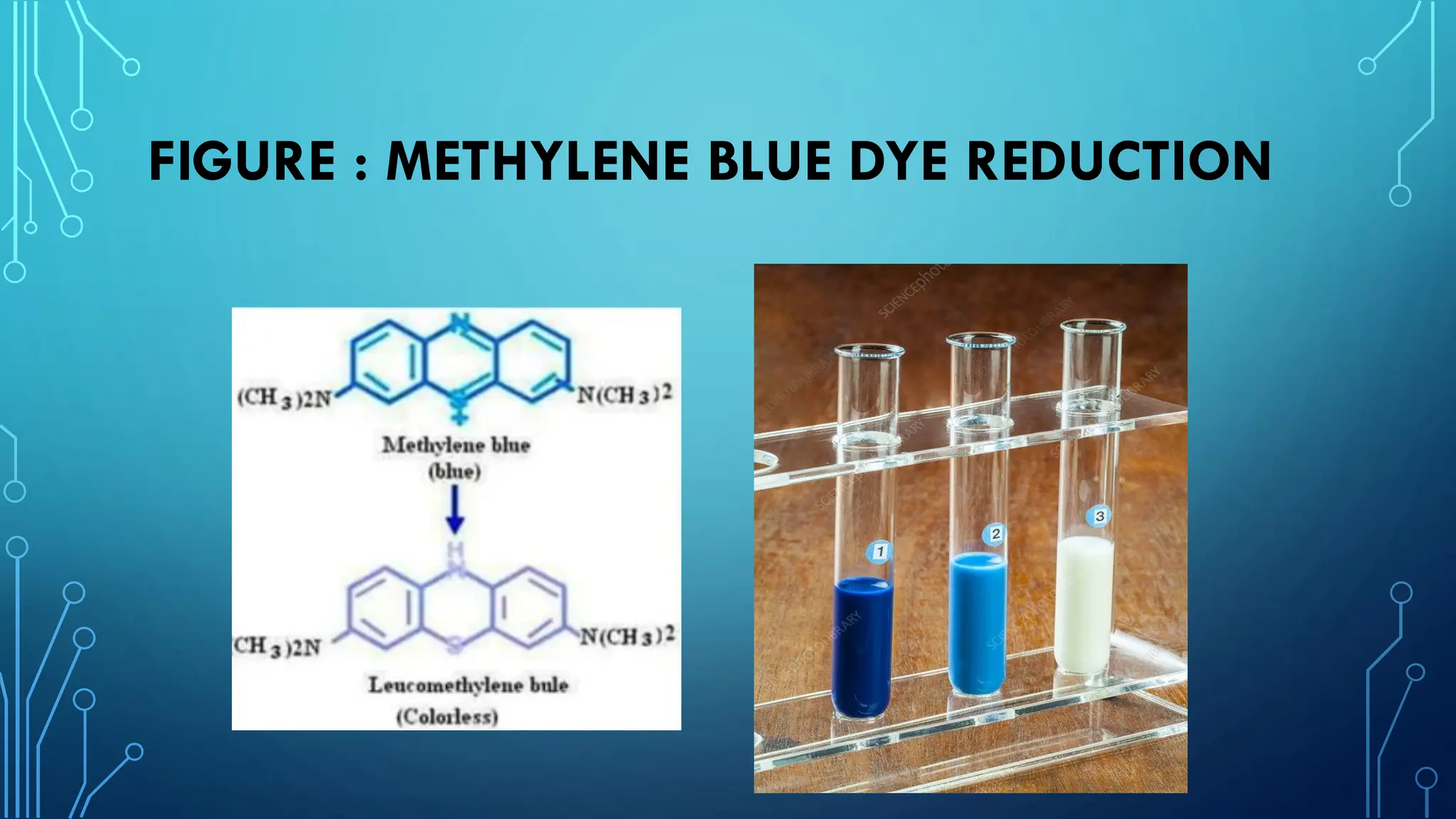
6. Observation : After incubation, check the color of the milk. If
the dye has been reduced to colorless or light blue, it indicates
microbial activity and contamination. If the color remains blue, it
suggests lower microbial contamination.
Ensure all equipment is sterile to avoid contamination and get
accurate results.
FIGURE : METHYLENE BLUE DYE REDUCTION
USED FOR METHYLENE BLUE
• Methylene blue is a versatile compound used in various fields:
1. Medicine : It’s used as a treatment for methemoglobinemia, a
condition where hemoglobin cannot carry oxygen efficiently. It also
has applications in some diagnostic procedures.
2. Biology and Microscopy : In labs, it’s used as a staining agent to
visualize biological tissues and cells under a microscope. It
highlights cell structures and can differentiate between different
cell types.
USED FOR METHYLENE BLUE
3. Chemistry : Methylene blue is used in redox reactions and as a dye in
various chemical analyses.
4. Water Treatment : It can be used to test the efficiency of water treatment
processes and to assess the presence of contaminants.
5. Dyeing : Historically, it was used in dyeing fabrics, though it’s less
common for this purpose now.
Always handle methylene blue with care, as it can stain skin and clothing.
GRADING OF RAW MILK BASED ON MBRT
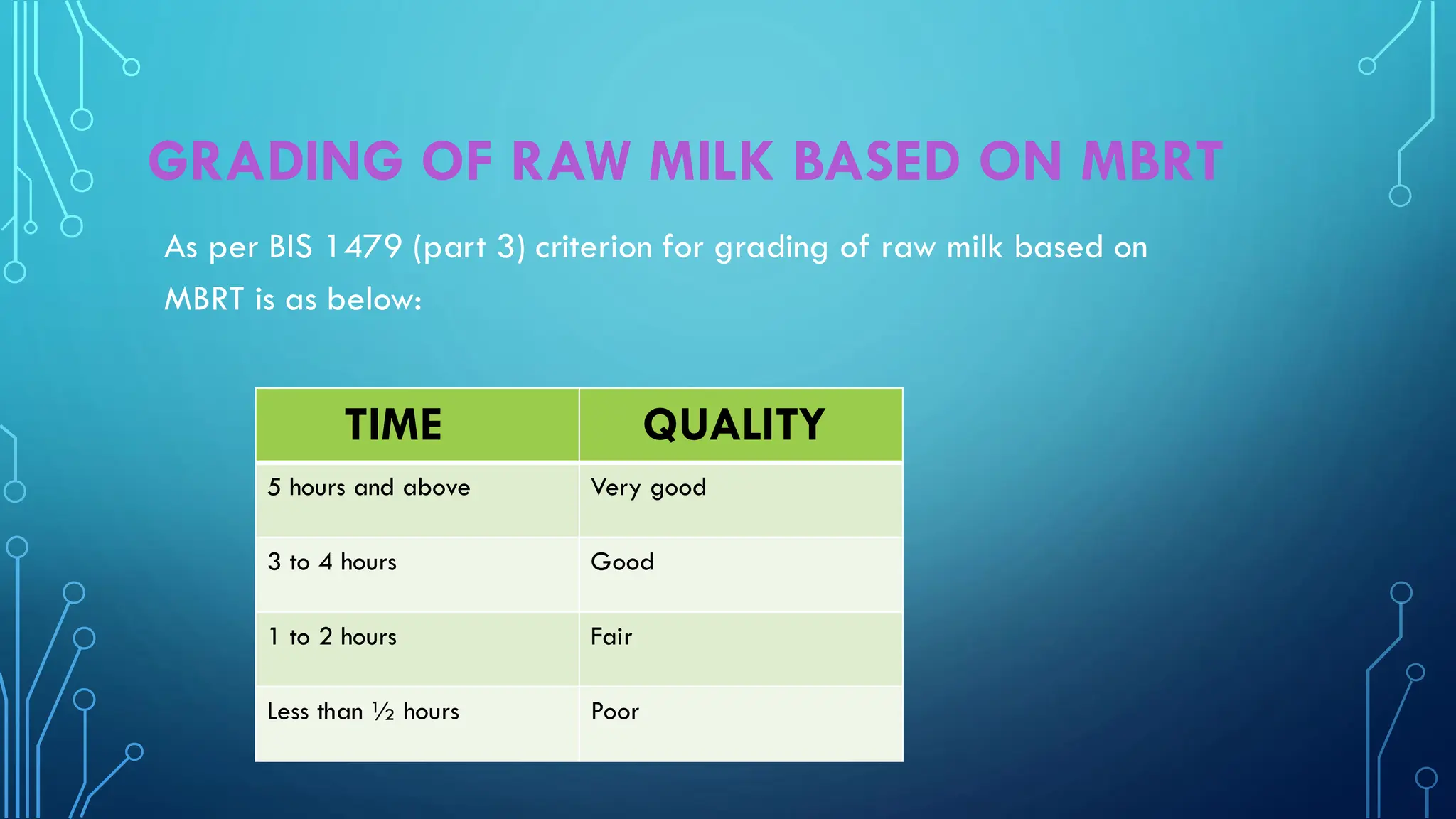
As per BIS 1479 (part 3) criterion for grading of raw milk based on
MBRT is as below:
TIME QUALITY
5 hours and above Very good
3 to 4 hours Good
1 to 2 hours Fair
Less than ½ hours Poor
ADVANTAGE OF METHYLENE BLUE
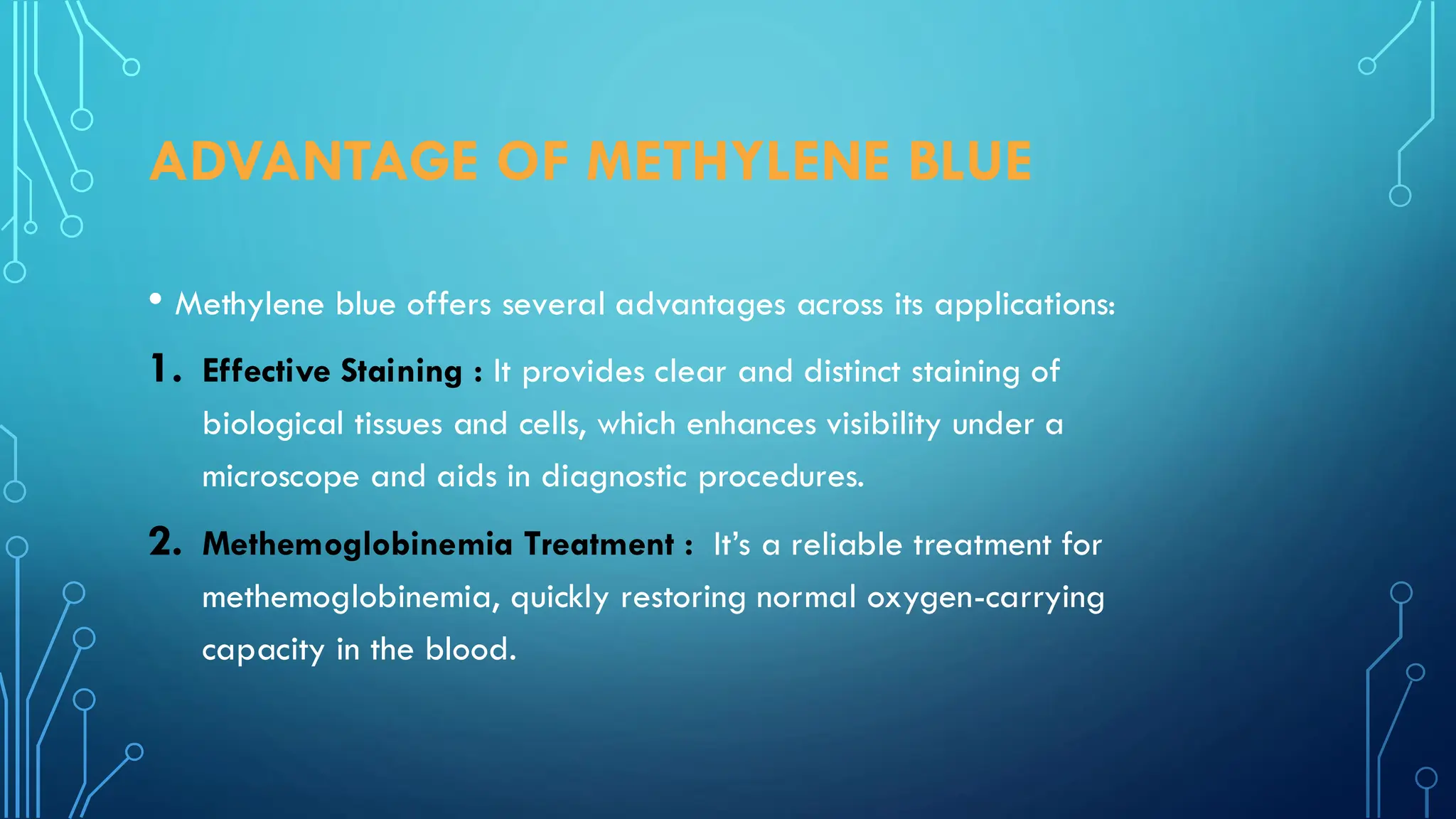
• Methylene blue offers several advantages across its applications:
1. Effective Staining : It provides clear and distinct staining of
biological tissues and cells, which enhances visibility under a
microscope and aids in diagnostic procedures.
2. Methemoglobinemia Treatment : It’s a reliable treatment for
methemoglobinemia, quickly restoring normal oxygen-carrying
capacity in the blood.
ADVANTAGE OF METHYLENE BLUE
3. Antimicrobial Properties : Methylene blue has been shown to have
antimicrobial effects, which can be beneficial in certain medical and
research contexts.
4. Redox Indicator : It serves as a useful redox indicator in various
chemical experiments, allowing for easy monitoring of chemical
reactions.
5. Low Cost : It’s relatively inexpensive and widely available, making it
accessible for many applications.
ADVANTAGE OF METHYLENE BLUE
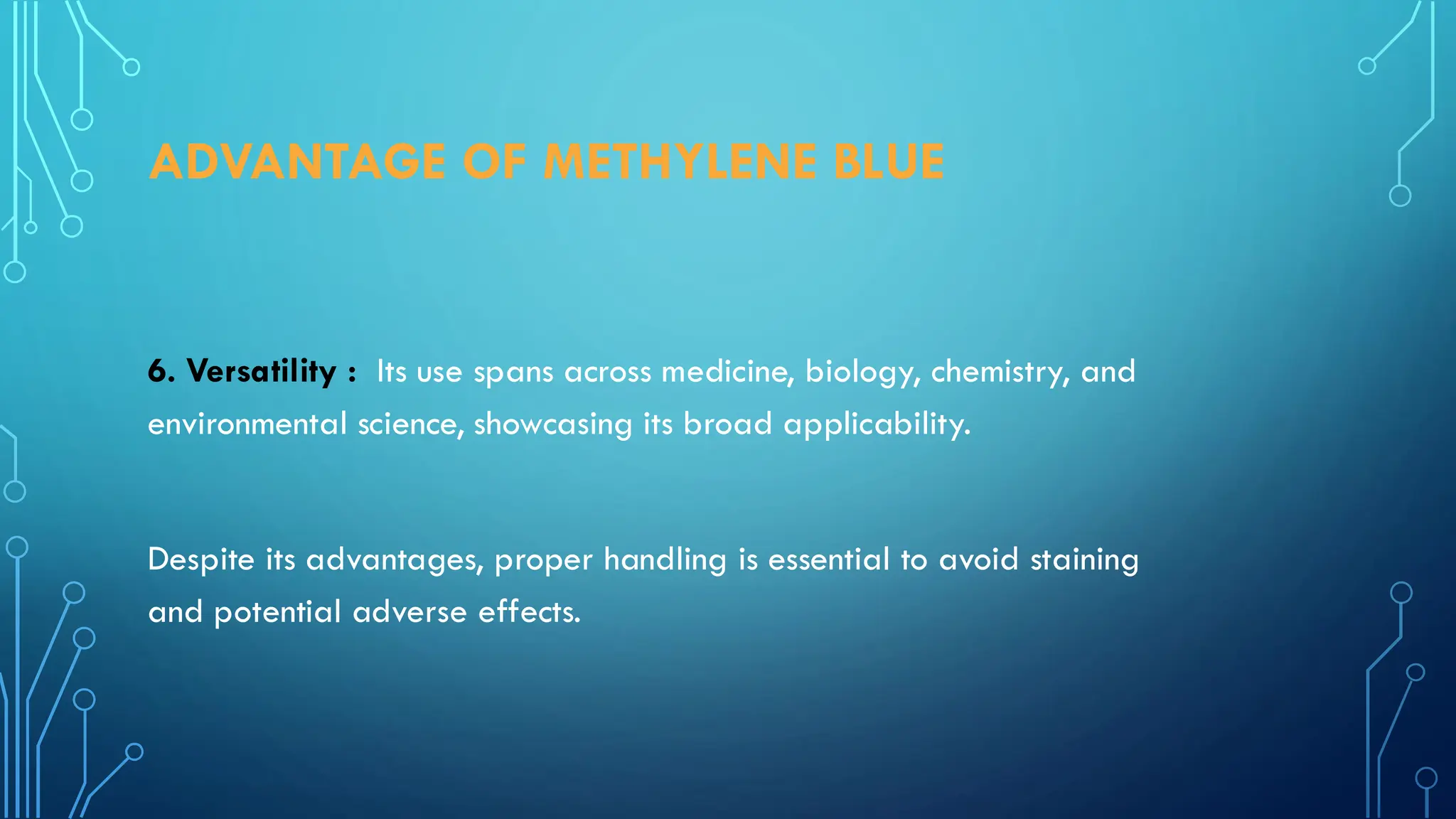
6. Versatility : Its use spans across medicine, biology, chemistry, and
environmental science, showcasing its broad applicability.
Despite its advantages, proper handling is essential to avoid staining
and potential adverse effects.
DISADVANTAGES OF METHYLENE BLUE
• Methylene blue has several potential disadvantages:
1. Staining : It can cause significant staining of skin, clothing, and
surfaces, which can be difficult to remove.
2. Toxicity : In high doses, it can be toxic, potentially leading to
side effects such as nausea, vomiting, and allergic reactions.
Careful dosage and handling are required.
DISADVANTAGES OF METHYLENE BLUE
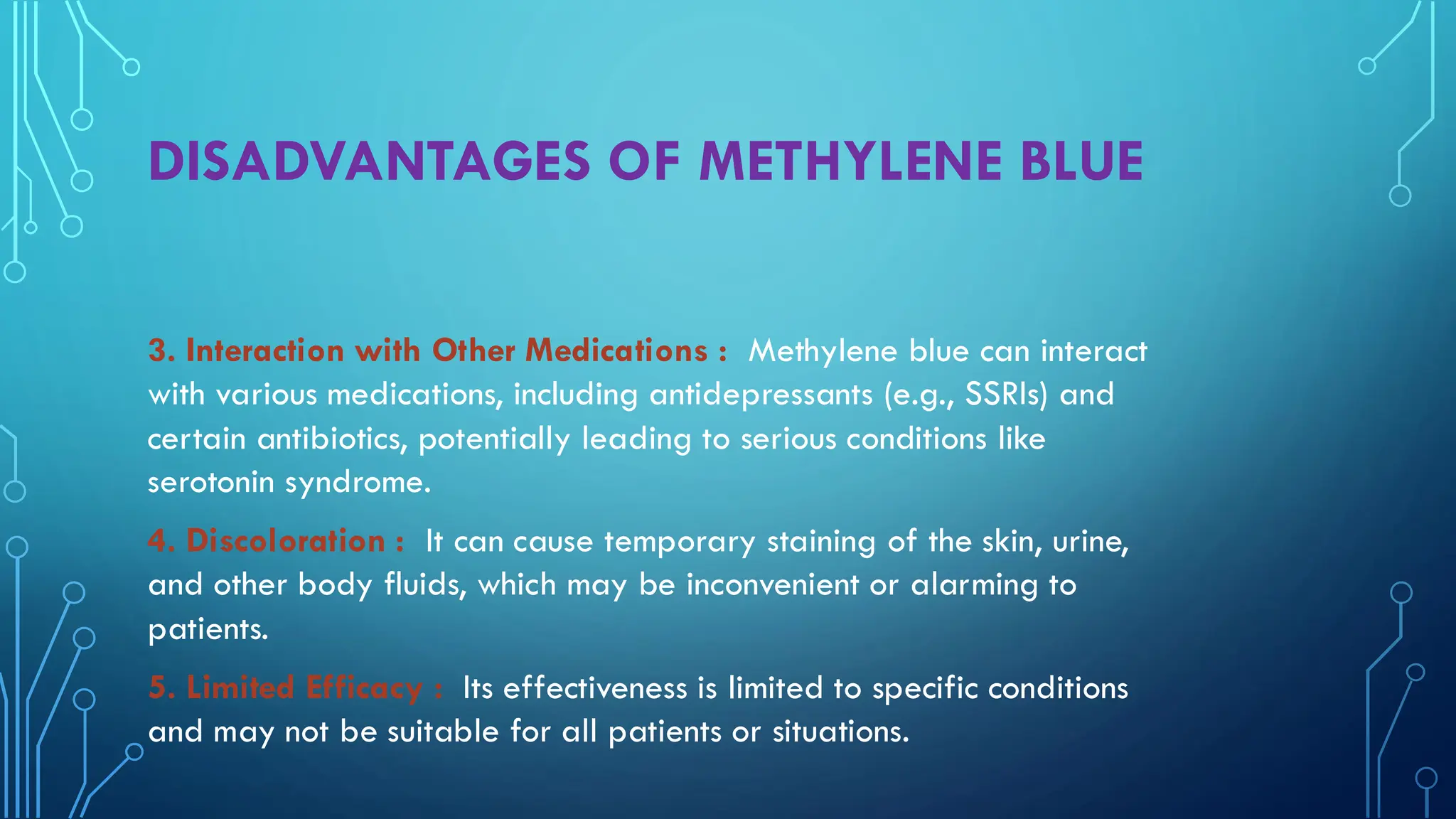
3. Interaction with Other Medications : Methylene blue can interact
with various medications, including antidepressants (e.g., SSRIs) and
certain antibiotics, potentially leading to serious conditions like
serotonin syndrome.
4. Discoloration : It can cause temporary staining of the skin, urine,
and other body fluids, which may be inconvenient or alarming to
patients.
5. Limited Efficacy : Its effectiveness is limited to specific conditions
and may not be suitable for all patients or situations.
DISADVANTAGES OF METHYLENE BLUE
6. Not Suitable for All Conditions : Methylene blue is not appropriate for
every medical condition, and its use is often limited to specific indications
like methemoglobinemia or certain types of infections.
Proper medical oversight is essential when using methylene blue to
minimize these risks and ensure appropriate use.
THANK YOU

Food Microbiology - METHYLENE BLUE REDUCTION TEST

  • 1.
    VIVEKANANDHA ARTS AND SCIENCECOLLEGE FOR WOMEN VEERACHIPALAYAM -636007, SANKARI, TAMIL NADU DEPARTMENT OF MICROBIOLOGY SUBJECT : FOOD MICROBIOLOGY TOPIC : METHYLENE BLUE REDUCTION TEST SUBJECT INCHARGE: SUBMITTED BY: DR..R.DINESH KUMAR.. G.GOMATHI ASSISTANT PROFESSOR III-BSC MICROBIOLOGY DEPARTMENT OF MICROBIOLOGY DEPARTMENT OF MICROBIOLOGY VIAAS, SANKAGIRI VIAAS, SANKARI
  • 2.
  • 3.
    INTRODUCTION • The MethyleneBlue Reduction Test is a microbiological assay used to evaluate the quality of milk and other dairy products by measuring their microbial load. • It involves adding methylene blue dye to a milk sample and incubating it at a specified temperature. • The test’s principle is based on the dye’s ability to act as an indicator of microbial activity.
  • 4.
    INTRODUCTION • Test tofind bacterial contamination of food (especially milk) • Based on utilisation of oxygen by bacteria which reduces dye and decolourizes it • Faster the decolourization, more inferior is the bacteriological quality and vice-versa
  • 5.
    METHYLENE BLUE REDUCTIONTEST For the Methylene Blue Reduction Test, follow these steps for sample preparation: 1. Collect the Sample : Obtain a fresh sample of milk. It should be well- mixed and free from any external contamination. 2. Prepare the Methylene Blue Solution : Use a commercially available methylene blue solution or prepare it by dissolving methylene blue powder in distilled water to make a 0.002% (w/v) solution.
  • 6.
    METHYLENE BLUE REDUCTIONTEST 3. Mix the Sample : In a clean, sterile test tube, add 10 ml of the milk sample. 4. Add Methylene Blue : Add 1-2 ml of the methylene blue solution to the milk sample. Mix thoroughly. 5. Incubation : Seal the test tube and incubate it at 37°C for a specified period, usually 2 hours.
  • 7.
    METHYLENE BLUE REDUCTIONTEST 6. Observation : After incubation, check the color of the milk. If the dye has been reduced to colorless or light blue, it indicates microbial activity and contamination. If the color remains blue, it suggests lower microbial contamination. Ensure all equipment is sterile to avoid contamination and get accurate results.
  • 8.
    FIGURE : METHYLENEBLUE DYE REDUCTION
  • 9.
    USED FOR METHYLENEBLUE • Methylene blue is a versatile compound used in various fields: 1. Medicine : It’s used as a treatment for methemoglobinemia, a condition where hemoglobin cannot carry oxygen efficiently. It also has applications in some diagnostic procedures. 2. Biology and Microscopy : In labs, it’s used as a staining agent to visualize biological tissues and cells under a microscope. It highlights cell structures and can differentiate between different cell types.
  • 10.
    USED FOR METHYLENEBLUE 3. Chemistry : Methylene blue is used in redox reactions and as a dye in various chemical analyses. 4. Water Treatment : It can be used to test the efficiency of water treatment processes and to assess the presence of contaminants. 5. Dyeing : Historically, it was used in dyeing fabrics, though it’s less common for this purpose now. Always handle methylene blue with care, as it can stain skin and clothing.
  • 11.
    GRADING OF RAWMILK BASED ON MBRT As per BIS 1479 (part 3) criterion for grading of raw milk based on MBRT is as below: TIME QUALITY 5 hours and above Very good 3 to 4 hours Good 1 to 2 hours Fair Less than ½ hours Poor
  • 12.
    ADVANTAGE OF METHYLENEBLUE • Methylene blue offers several advantages across its applications: 1. Effective Staining : It provides clear and distinct staining of biological tissues and cells, which enhances visibility under a microscope and aids in diagnostic procedures. 2. Methemoglobinemia Treatment : It’s a reliable treatment for methemoglobinemia, quickly restoring normal oxygen-carrying capacity in the blood.
  • 13.
    ADVANTAGE OF METHYLENEBLUE 3. Antimicrobial Properties : Methylene blue has been shown to have antimicrobial effects, which can be beneficial in certain medical and research contexts. 4. Redox Indicator : It serves as a useful redox indicator in various chemical experiments, allowing for easy monitoring of chemical reactions. 5. Low Cost : It’s relatively inexpensive and widely available, making it accessible for many applications.
  • 14.
    ADVANTAGE OF METHYLENEBLUE 6. Versatility : Its use spans across medicine, biology, chemistry, and environmental science, showcasing its broad applicability. Despite its advantages, proper handling is essential to avoid staining and potential adverse effects.
  • 15.
    DISADVANTAGES OF METHYLENEBLUE • Methylene blue has several potential disadvantages: 1. Staining : It can cause significant staining of skin, clothing, and surfaces, which can be difficult to remove. 2. Toxicity : In high doses, it can be toxic, potentially leading to side effects such as nausea, vomiting, and allergic reactions. Careful dosage and handling are required.
  • 16.
    DISADVANTAGES OF METHYLENEBLUE 3. Interaction with Other Medications : Methylene blue can interact with various medications, including antidepressants (e.g., SSRIs) and certain antibiotics, potentially leading to serious conditions like serotonin syndrome. 4. Discoloration : It can cause temporary staining of the skin, urine, and other body fluids, which may be inconvenient or alarming to patients. 5. Limited Efficacy : Its effectiveness is limited to specific conditions and may not be suitable for all patients or situations.
  • 17.
    DISADVANTAGES OF METHYLENEBLUE 6. Not Suitable for All Conditions : Methylene blue is not appropriate for every medical condition, and its use is often limited to specific indications like methemoglobinemia or certain types of infections. Proper medical oversight is essential when using methylene blue to minimize these risks and ensure appropriate use.
  • 18.