FOLATE
What is Folate?
Folate and folic acid are different
terms for the same B
vitamin. Folic acid is the form
found in vitamin supplements
while folate is the form found in
food.

Why need Folate?
*To help prevent anaemia:
Without enough folate to make
healthy red blood cells one may
feel weak or tired and find it hard
to concentrate.

*For a healthy heart:
Folate keeps both the blood
vessels and heart healthy.


*To reduce the risks of some
birth defects:
When women of child-bearing age
take folic acid before and during
pregnancy, the risks of birth
defects are reduced.


Folate & Pregnancy
Having a healthy baby means
making sure you're healthy, too.
One of the most important things
you can do to help prevent serious
birth defects in your baby is to get
enough folic acid every day —
especially before conception and
during early pregnancy.

Every year , about 3,000 infants
are born with neural tube defects
(NTDs), according to the CDC.
>The most common neural tube
defects are :

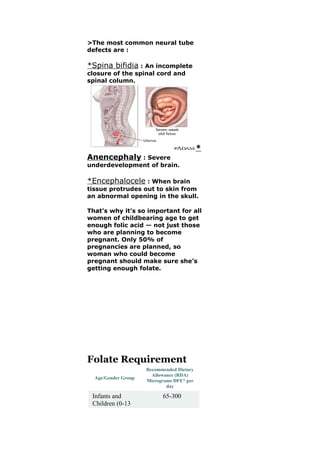
*Spina bifidia : An incomplete
closure of the spinal cord and
spinal column.


                                           *
Anencephaly : Severe
underdevelopment of brain.

*Encephalocele : When brain
tissue protrudes out to skin from
an abnormal opening in the skull.

That’s why it’s so important for all
women of childbearing age to get
enough folic acid — not just those
who are planning to become
pregnant. Only 50% of
pregnancies are planned, so
woman who could become
pregnant should make sure she’s
getting enough folate.


Folate Requirement
                     Recommended Dietary
                       Allowance (RDA)
  Age/Gender Group
                     Micrograms DFE* per
                             day

 Infants and               65-300
 Children (0-13
years)

  Teenagers (14-18
                          400
  years)
  Adults (19
                          400
  years+)
  Pregnant
                          600
  Women**
  Lactating Women         500

 Folate & Diet
 Some foods contain the natural
 form of folate, called food folate.
 However, body absorb folic acid
 in vitamin supplements and
 Enriched grain foods more easily.
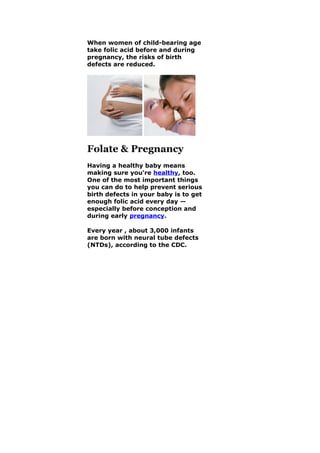
 Folate rich foods are :

* Dark green leafy vegetables such
as spinach, Legumes such as dried
beans and peas and peanuts,
Asparagus, Orange juice and
oranges, Avocado, Strawberries.


 Preserving Folate in
 Foods
 Folate is a water soluble vitamin.
 It can easily be lost from foods
 when you cook them, especially if
 you cook foods in water or other
 liquids.

 *Cook vegetables in only a small
 amount of water.
 *If you cook vegetables in water,
 reuse the water in soups or stews
to get back the lost vitamins or
minerals.
*Use other ways to cook
vegetables, including steaming,
micro waving, grilling, or roasting.
*Don't soak foods in water or
other liquids for long periods of
time.

Folate

  • 1.
  • 2.
    What is Folate? Folateand folic acid are different terms for the same B vitamin. Folic acid is the form found in vitamin supplements while folate is the form found in food. Why need Folate? *To help prevent anaemia: Without enough folate to make healthy red blood cells one may feel weak or tired and find it hard to concentrate. *For a healthy heart: Folate keeps both the blood vessels and heart healthy. *To reduce the risks of some birth defects:
  • 3.
    When women ofchild-bearing age take folic acid before and during pregnancy, the risks of birth defects are reduced. Folate & Pregnancy Having a healthy baby means making sure you're healthy, too. One of the most important things you can do to help prevent serious birth defects in your baby is to get enough folic acid every day — especially before conception and during early pregnancy. Every year , about 3,000 infants are born with neural tube defects (NTDs), according to the CDC.
  • 4.
    >The most commonneural tube defects are : *Spina bifidia : An incomplete closure of the spinal cord and spinal column. * Anencephaly : Severe underdevelopment of brain. *Encephalocele : When brain tissue protrudes out to skin from an abnormal opening in the skull. That’s why it’s so important for all women of childbearing age to get enough folic acid — not just those who are planning to become pregnant. Only 50% of pregnancies are planned, so woman who could become pregnant should make sure she’s getting enough folate. Folate Requirement Recommended Dietary Allowance (RDA) Age/Gender Group Micrograms DFE* per day Infants and 65-300 Children (0-13
  • 5.
    years) Teenagers(14-18 400 years) Adults (19 400 years+) Pregnant 600 Women** Lactating Women 500 Folate & Diet Some foods contain the natural form of folate, called food folate. However, body absorb folic acid in vitamin supplements and Enriched grain foods more easily. Folate rich foods are : * Dark green leafy vegetables such as spinach, Legumes such as dried beans and peas and peanuts, Asparagus, Orange juice and oranges, Avocado, Strawberries. Preserving Folate in Foods Folate is a water soluble vitamin. It can easily be lost from foods when you cook them, especially if you cook foods in water or other liquids. *Cook vegetables in only a small amount of water. *If you cook vegetables in water, reuse the water in soups or stews
  • 6.
    to get backthe lost vitamins or minerals. *Use other ways to cook vegetables, including steaming, micro waving, grilling, or roasting. *Don't soak foods in water or other liquids for long periods of time.