RESEARCH METHODOLOGY SECTION - D   1
RESEARCH METHODOLOGY SECTION - D   2
   What did you learn
    or have reinforced?
   What makes a focus group a focus
    group?
   Why would I want to use a focus group?
   How is a focus group conducted?
   Who participates in a focus group?
   How many groups are needed?
   What do you do with all the information
    that you get?

            RESEARCH METHODOLOGY SECTION - D   3
RESEARCH METHODOLOGY SECTION - D   4
RESEARCH METHODOLOGY SECTION - D   5
What
 A carefully
  planned
  discussion
 To obtain
  perceptions of a
  defined interest
  area


       RESEARCH METHODOLOGY SECTION - D   6
   To collect qualitative data

   To determine feelings, perceptions and
    manner of thinking.

   Attitudes and perceptions are developed
    in part by interaction with other people

   To promote self-disclosure among
    participants


         RESEARCH METHODOLOGY SECTION - D   7
   5-8 people per
    group
   Individuals with
    common
    characteristics .


       RESEARCH METHODOLOGY SECTION - D   8
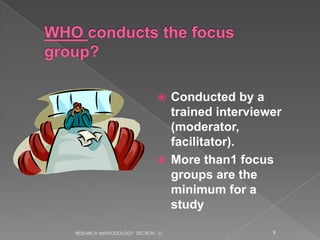
 Conducted by a
                                trained interviewer
                                (moderator,
                                facilitator).
                               More than1 focus
                                groups are the
                                minimum for a
                                study

RESEARCH METHODOLOGY SECTION - D                 9
   People reveal
    more when they
    are relaxed and
    having a good
    time.


         RESEARCH METHODOLOGY SECTION - D   10
People
take risks
if they
feel safe…


Participation is a RISK.
     RESEARCH METHODOLOGY SECTION - D   11
produce more
information
quicker and
at less cost than
individual interviews
results can’t
be used to
make statements
about the wider community…

they can indicate a range of views
and opinions, but not the
distribution among the community
Focus groups are effective
when
   •People have something
   to share (motivations)
   •The goal is to
   understand human
   behavior

Focus groups are not
effective when
   •People are divided or
   angry
   •The goal is to gather
   factual information
   oOrganization is trying to
   improve its image

          RESEARCH METHODOLOGY SECTION - D   14
Steps in a successful
   focus group
 Planning the study
 Selecting
   participants carefully
 Moderating the
   group skillfully
 Capturing the data
 Asking quality
   questions
 Using appropriate
   analysis

         RESEARCH METHODOLOGY SECTION - D   15
 The first few moments
  are critical
   › Create a
     thoughtful, permissive
     atmosphere
   › Build rapport
   › Set the tone
 Standard introduction:
   › Welcome
   › Overview and purpose
   › Procedures
   › Ground rules


         RESEARCH METHODOLOGY SECTION - D   16
 Define Research Objectives
 Manage Respondent Recruitment
 Moderate
 Analyze and Report


     RESEARCH METHODOLOGY SECTION - D   17
RESEARCH METHODOLOGY SECTION - D   18
   Use open-ended questions
   Avoid dichotomous questions
   "Why?" is rarely asked
   Use "think back" questions
   Carefully prepare focus questions
   Ask uncued questions first, cued
    questions second
   Consider standardized questions

         RESEARCH METHODOLOGY SECTION - D   19
   Summary question
    "Is this an adequate summary?"
   All things considered question
    Ask participants to reflect on the entire discussion and
    then offer their positions or opinions
   Final question
    "Have we missed anything?


            RESEARCH METHODOLOGY SECTION - D           20
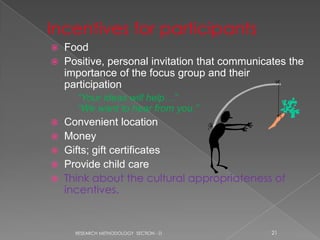
   Food
   Positive, personal invitation that communicates the
    importance of the focus group and their
    participation
      “Your ideas will help…”
      “We want to hear from you.”
 Convenient location
 Money
 Gifts; gift certificates
 Provide child care
 Think about the cultural appropriateness of
  incentives.


      RESEARCH METHODOLOGY SECTION - D          21
   Use a communications strategy
   Use an appropriate reporting style that the
    client finds helpful and meets expectations
   Strive for enlightenment
   Make points memorable
   Use narrative or bulleted format
   Give thought to the oral report


         RESEARCH METHODOLOGY SECTION - D   22
   A focus group is a special type of group
    discussion.
   It requires skill to conduct them well
   Careful planning will yield better results.
    Give special attention to:
     › Participant selection; recruiting the
        participants
     › Developing meaningful questions


     RESEARCH METHODOLOGY SECTION - D      23
RESEARCH METHODOLOGY SECTION - D   24

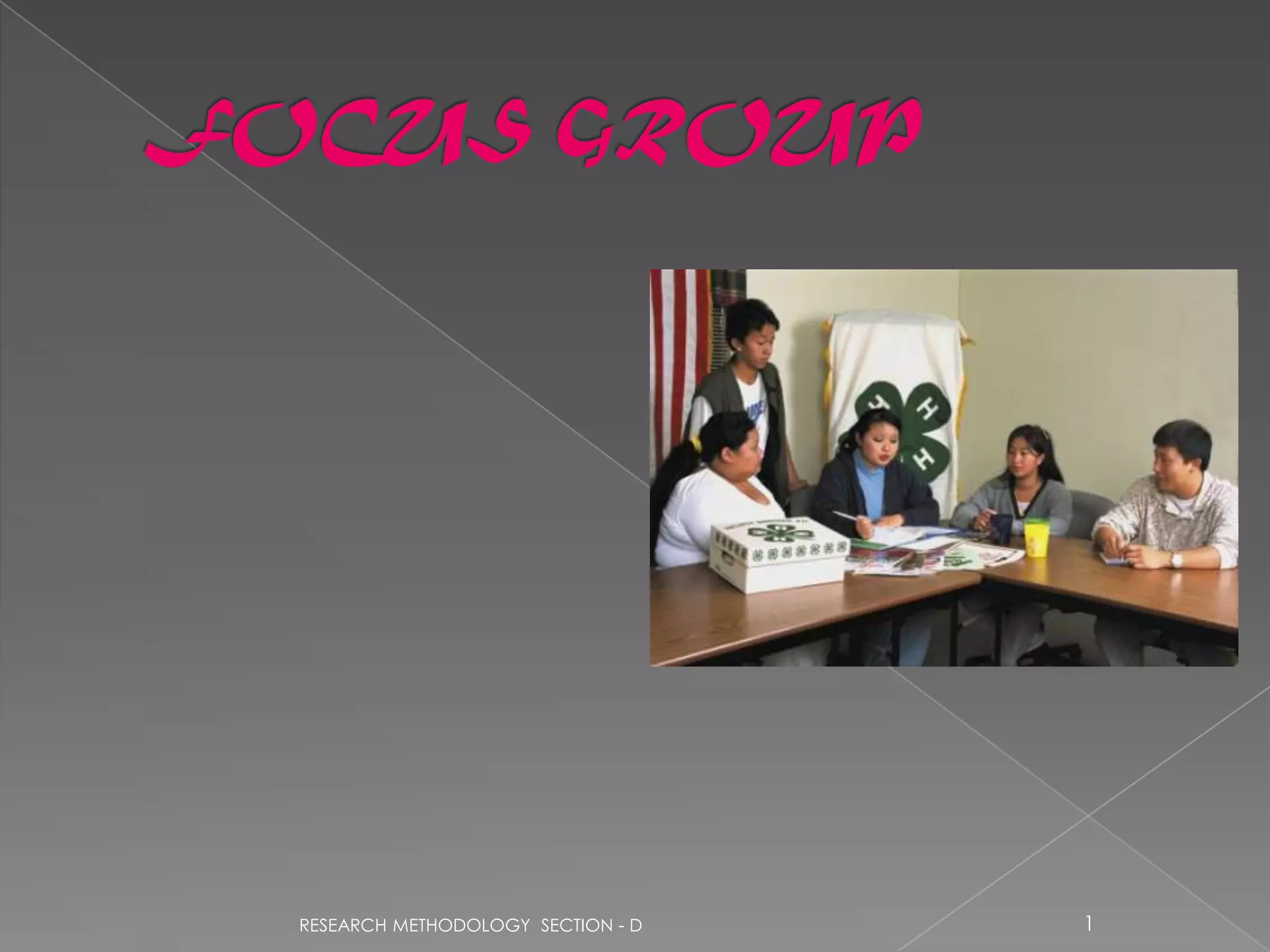
Focus group

  • 1.
  • 2.
  • 3.
    What did you learn or have reinforced?  What makes a focus group a focus group?  Why would I want to use a focus group?  How is a focus group conducted?  Who participates in a focus group?  How many groups are needed?  What do you do with all the information that you get? RESEARCH METHODOLOGY SECTION - D 3
  • 4.
  • 5.
  • 6.
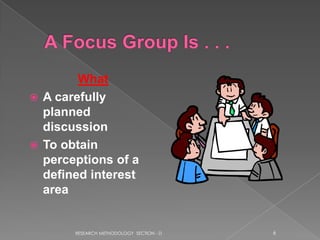
    What  A carefully planned discussion  To obtain perceptions of a defined interest area RESEARCH METHODOLOGY SECTION - D 6
  • 7.
    To collect qualitative data  To determine feelings, perceptions and manner of thinking.  Attitudes and perceptions are developed in part by interaction with other people  To promote self-disclosure among participants RESEARCH METHODOLOGY SECTION - D 7
  • 8.
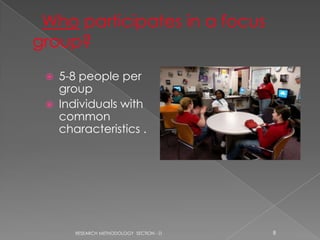
    5-8 people per group  Individuals with common characteristics . RESEARCH METHODOLOGY SECTION - D 8
  • 9.
     Conducted bya trained interviewer (moderator, facilitator).  More than1 focus groups are the minimum for a study RESEARCH METHODOLOGY SECTION - D 9
  • 10.
    People reveal more when they are relaxed and having a good time. RESEARCH METHODOLOGY SECTION - D 10
  • 11.
    People take risks if they feelsafe… Participation is a RISK. RESEARCH METHODOLOGY SECTION - D 11
  • 12.
    produce more information quicker and atless cost than individual interviews
  • 13.
    results can’t be usedto make statements about the wider community… they can indicate a range of views and opinions, but not the distribution among the community
  • 14.
    Focus groups areeffective when •People have something to share (motivations) •The goal is to understand human behavior Focus groups are not effective when •People are divided or angry •The goal is to gather factual information oOrganization is trying to improve its image RESEARCH METHODOLOGY SECTION - D 14
  • 15.
    Steps in asuccessful focus group  Planning the study  Selecting participants carefully  Moderating the group skillfully  Capturing the data  Asking quality questions  Using appropriate analysis RESEARCH METHODOLOGY SECTION - D 15
  • 16.
     The firstfew moments are critical › Create a thoughtful, permissive atmosphere › Build rapport › Set the tone  Standard introduction: › Welcome › Overview and purpose › Procedures › Ground rules RESEARCH METHODOLOGY SECTION - D 16
  • 17.
     Define ResearchObjectives  Manage Respondent Recruitment  Moderate  Analyze and Report RESEARCH METHODOLOGY SECTION - D 17
  • 18.
  • 19.
    Use open-ended questions  Avoid dichotomous questions  "Why?" is rarely asked  Use "think back" questions  Carefully prepare focus questions  Ask uncued questions first, cued questions second  Consider standardized questions RESEARCH METHODOLOGY SECTION - D 19
  • 20.
    Summary question "Is this an adequate summary?"  All things considered question Ask participants to reflect on the entire discussion and then offer their positions or opinions  Final question "Have we missed anything? RESEARCH METHODOLOGY SECTION - D 20
  • 21.
    Food  Positive, personal invitation that communicates the importance of the focus group and their participation “Your ideas will help…” “We want to hear from you.”  Convenient location  Money  Gifts; gift certificates  Provide child care  Think about the cultural appropriateness of incentives. RESEARCH METHODOLOGY SECTION - D 21
  • 22.
    Use a communications strategy  Use an appropriate reporting style that the client finds helpful and meets expectations  Strive for enlightenment  Make points memorable  Use narrative or bulleted format  Give thought to the oral report RESEARCH METHODOLOGY SECTION - D 22
  • 23.
    A focus group is a special type of group discussion.  It requires skill to conduct them well  Careful planning will yield better results. Give special attention to: › Participant selection; recruiting the participants › Developing meaningful questions RESEARCH METHODOLOGY SECTION - D 23
  • 24.

Editor's Notes

  • #11 Before a program begins, during a program or after a program endsPeople reveal more when they are relaxed and having a good time.
  • #12 Participants to self-disclose. Thus, we want to conduct focusgroup in a comfortable,permissive, non-threatening environment .