TABLE OF CONTENTS:
•DEFINITION OF RISK
• METHODS OF HANDLING RISK
• INSURANCE AS A DEVICE FOR HANDLING RISK
• BUSINESS AND THE USE OF LIFE INSURANCE
• FIRE INSURANCE
• MOTOR CAR INSURANCE
• MARINE INSURANCE
• GENERAL LIABILITY INSURANCE
• SURETY BONDS
• MISCELLANEOUS INSURANCE LINES
3.
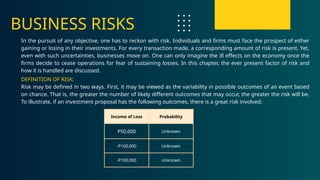
Income of LossProbability
P50,000 Unknown
-P100,000 Unknown
-P100,000 Unknown
BUSINESS RISKS
In the pursuit of any objective, one has to reckon with risk. Individuals and firms must face the prospect of either
gaining or losing in their investments. For every transaction made, a corresponding amount of risk is present. Yet,
even with such uncertainties, businesses move on. One can only imagine the ill effects on the economy once the
firms decide to cease operations for fear of sustaining losses. In this chapter, the ever present factor of risk and
how it is handled are discussed.
DEFINITION OF RISK:
Risk may be defined in two ways. First, it may be viewed as the variability in possible outcomes of an event based
on chance. That is, the greater the number of likely different outcomes that may occur, the greater the risk will be.
To illustrate, if an investment proposal has the following outcomes, there is a great risk involved:
4.
METHODS OF
HANDLING RISK
Experienceshave led mankind to adopt ways of
handling risk. The methods are more pronounced when
applied to business finance. These methods are the
following:
1.risk may be avoided;
2.risk may be retained;
3. hazard may be reduced;
4. loss may be reduced;
5. risk may be shifted; and
6. risk may be reduced.
5.
A businessman whowants to avoid the risk of losing his building to fire, may do so by
simply avoiding the ownership of one. In fact, there are ways of avoiding risk. One of
them is through leasing.
There are instances when risk cannot be avoided. They are simply retained. As not all
properties are good objects of lease agreements, the ownership of some cannot be
avoided. The risks inherent to ownership are, then, retained. An example is the
unavoidable ownership of small items like ballpens and pencils.
Hazards are those conditions that create or increase the chance of loss. An unlighted
stairway is a hazard that may cause accidents in a factory. Potential losses may be
reduced by providing suitable lighting along the stairway.
When losses happen, some actions may be done to minimize such losses. When car
accidents happen, injuries to the driver and passengers may be reduced with the use
of seatbelts. When buildings are physically separated, the chance of losing all the
buildings in the event of a fire is minimized. Big corporations prohibit their key
employees from traveling in one group and boarding the same plane. The reason for
this is obvious. The firms do not want to lose their key personnel in one unfortunate
event. Hedging, subcontracting, the use of surety bonds, incorporation, and
insurance are examples of shifting risks to another party.
6.
fire
marine
motor car
liability
crime
glass
boiler and
machinery
credit
Effectivemanagerial control tends to reduce risk. Examples are materials control
systems, audits and other accounting controls, and process and product
inspection plans.
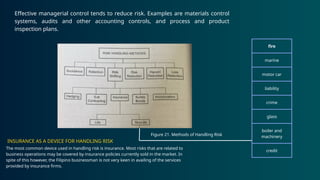
Figure 21. Methods of Handling Risk
The most common device used in handling risk is insurance. Most risks that are related to
business operations may be covered by insurance policies currently sold in the market. In
spite of this however, the Filipino businessman is not very keen in availing of the services
provided by insurance firms.
INSURANCE AS A DEVICE FOR HANDLING RISK
7.
INSURANCE DEFINED
Insurance maybe defined in various ways. From the legal viewpoint, a contract of insurance is an
agreement whereby one undertakes for a consideration, to indemnify another against loss,
damage, or liability arising from an unknown or contingent event. From the viewpoint of business
economics, insurance is an economic device used to reducing risk by combining a sufficient
number of exposure units to make their individual losses collectively predictable.
THE INSURANCE POLICY
The insurance policy is the written instrument in which a contract of insurance is set
forth. It contains the following:
Declarations. The nature of the risk is described in the "declarations" which are usually found on
the first page of an insurance policy. Information related to the following are included
1. declarations;
2. insuring
agreements;
3. exclusions; and
4. conditions
1. subjects covered, such as machinery and installations in a fire policy;
2. person or persons insured, such as Mr. Roberto Montevirgen or Mr. and Mrs. Rodolfo Padua;
3. the premium to be paid, which includes all or some of the following:
a the rate of premium expressed in percentage;
b. the amount of premium;
c. the amount of documentary stamps payable;
d. the amount of premium tax payable; and
e. the amount of fire service tax payable (applicable to fire policies).
8.
4. the periodof coverage, such as 12:00 noon, June 7, 2005 to 12:00 noon, June 7, 2006;
5. policy limits or amounts of insurance, such as ONE MILLION PESOS (P1,000,000.00) PHILIPPINE CURRENCY;
and
6. warranties or promises made by the insured with respect to the nature and control of the hazard, such as
Non-Hazardous Chemists and Druggists Warranty.
Insuring Agreements. The insuring agreements is that part of the policy which states what the insurer agrees
to do and the major conditions under which it agrees. The insurer promises to compensate the insured if a loss
under the insured peril occurs and if the insured meets the conditions of the contract. The insurer has no
obligation to pay if the conditions are not met.
The insuring agreements in a personal accident policy, for instance, usually include the table of benefits,
provisos, and general conditions.
Conditions. Conditions may be general or specific. The general conditions usually cover the following:
1. conditions or payment of premium;
2. notices required;
3. evidence of loss;
4. cancellation;
5. short-period rate scale;
6. arbitration clause;
Exclusions. An exclusion is a provision or part of the insurance contract limiting the scope of Death and
disablement due to war and invasion, for example, are excluded in the risks covered by a personal accident
policy.coverage. Exclusions comprise certain causes and conditions listed in the policy which are not covered.
7. agreement on the effect of legal provision on extra-ordinary inflation;
8. omnibus clause;
9. important notice;
10. action or suit clause; and
11. settlement clause.
9.
TYPES OF INSURANCE
COVERAGES
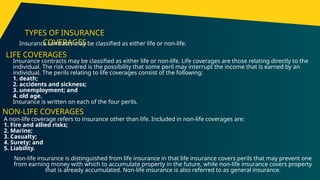
Insurancecontracts may be classified as either life or non-life.
LIFE COVERAGES
Insurance contracts may be classified as either life or non-life. Life coverages are those relating directly to the
individual. The risk covered is the possibility that some peril may interrupt the income that is earned by an
individual. The perils relating to life coverages consist of the following:
1. death;
2. accidents and sickness;
3. unemployment; and
4. old age.
Insurance is written on each of the four perils.
NON-LIFE COVERAGES
A non-life coverage refers to insurance other than life. Included in non-life coverages are:
1. Fire and allied risks;
2. Marine;
3. Casualty;
4. Surety; and
5. Liability.
Non-life insurance is distinguished from life insurance in that life insurance covers perils that may prevent one
from earning money with which to accumulate property in the future, while non-life insurance covers property
that is already accumulated. Non-life insurance is also referred to as general insurance.
10.
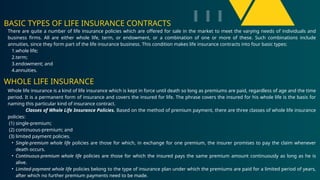
BASIC TYPES OFLIFE INSURANCE CONTRACTS
There are quite a number of life insurance policies which are offered for sale in the market to meet the varying needs of individuals and
business firms. All are either whole life, term, or endowment, or a combination of one or more of these. Such combinations include
annuities, since they form part of the life insurance business. This condition makes life insurance contracts into four basic types:
1.whole life;
2.term;
3.endowment; and
4.annuities.
Whole life insurance is a kind of life insurance which is kept in force until death so long as premiums are paid, regardless of age and the time
period. It is a permanent form of insurance and covers the insured for life. The phrase covers the insured for his whole life is the basis for
naming this particular kind of insurance contract.
Classes of Whole Life Insurance Policies. Based on the method of premium payment, there are three classes of whole life insurance
policies:
(1) single-premium;
(2) continuous-premium; and
(3) limited payment policies.
• Single-premium whole life policies are those for which, in exchange for one premium, the insurer promises to pay the claim whenever
death occurs.
• Continuous-premium whole life policies are those for which the insured pays the same premium amount continuously as long as he is
alive.
• Limited-payment whole life policies belong to the type of insurance plan under which the premiums are paid for a limited period of years,
after which no further premium payments need to be made.
WHOLE LIFE INSURANCE
11.
TEAM INSURANCE
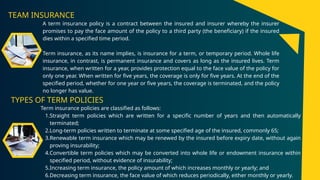
A terminsurance policy is a contract between the insured and insurer whereby the insurer
promises to pay the face amount of the policy to a third party (the beneficiary) if the insured
dies within a specified time period.
Term insurance, as its name implies, is insurance for a term, or temporary period. Whole life
insurance, in contrast, is permanent insurance and covers as long as the insured lives. Term
insurance, when written for a year, provides protection equal to the face value of the policy for
only one year. When written for five years, the coverage is only for five years. At the end of the
specified period, whether for one year or five years, the coverage is terminated, and the policy
no longer has value.
TYPES OF TERM POLICIES
Term insurance policies are classified as follows:
1.Straight term policies which are written for a specific number of years and then automatically
terminated;
2.Long-term policies written to terminate at some specified age of the insured, commonly 65;
3.Renewable term insurance which may be renewed by the insured before expiry date, without again
proving insurability;
4.Convertible term policies which may be converted into whole life or endowment insurance within
specified period, without evidence of insurability;
5.Increasing term insurance, the policy amount of which increases monthly or yearly; and
6.Decreasing term insurance, the face value of which reduces periodically, either monthly or yearly.
12.
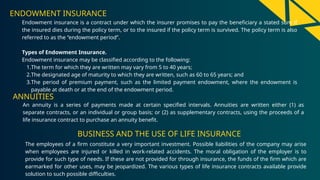
ENDOWMENT INSURANCE
Endowment insuranceis a contract under which the insurer promises to pay the beneficiary a stated sum if
the insured dies during the policy term, or to the insured if the policy term is survived. The policy term is also
referred to as the “endowment period”.
Types of Endowment Insurance.
Endowment insurance may be classified according to the following:
1.The term for which they are written may vary from 5 to 40 years;
2.The designated age of maturity to which they are written, such as 60 to 65 years; and
3.The period of premium payment, such as the limited payment endowment, where the endowment is
payable at death or at the end of the endowment period.
An annuity is a series of payments made at certain specified intervals. Annuities are written either (1) as
separate contracts, or an individual or group basis; or (2) as supplementary contracts, using the proceeds of a
life insurance contract to purchase an annuity benefit.
ANNUITIES
BUSINESS AND THE USE OF LIFE INSURANCE
The employees of a firm constitute a very important investment. Possible liabilities of the company may arise
when employees are injured or killed in work-related accidents. The moral obligation of the employer is to
provide for such type of needs. If these are not provided for through insurance, the funds of the firm which are
earmarked for other uses, may be jeopardized. The various types of life insurance contracts available provide
solution to such possible difficulties.
13.
FIRE INSURANCE
Fire isone of the most destructive perils known to man. It kills people and it destroys properties. As people
and properties are important business resources, some device must be used to protect both. News reports
abound about properties and lives lost due to fire.
A fire insurance contract covers all direct losses and damages by fire or lightning and by removal from premises
endangered by fire. In the attempt to rescue property, losses due to theft may occur. Such losses are also covered by a
fire policy.
Other allied perils may be covered in a fire insurance contract, provided they are specifically named in the policy. The
allied perils refer to the following:
1.earthquake fire;
2.earthquake shock;
3.windstorm, typhoons, and flood;
4.riot and strike damage and riot fire; and
5.explosions.
Perils Covered
Fire insurance contracts are designed to cover any of the following:
1.building;
2. contents of the building like machinery, appliances, furniture and fixtures, stock-in-trade, and others; or
3. both building and contents.
What May Be Insured
14.
MOTOR CAR INSURANCE
Mostbusiness firms cannot avoid the ownership of motor vehicles. Conveyances are needed by the firm for
transporting goods and persons. Its executives will need cars in the performance of their assigned jobs.
Products need to be delivered to customers. Supplies need to be fetched from where they were bought.
Employees need to be transported from their homes to their place of work and vice versa. All these needs will
require the firm to own motor vehicles. Owning a vehicle, however, entails some risks inherent to such
undertaking. These risks include possible irtjuries to persons or damage to properties. Fortunately, insurance
policies may be bought to cover such risks.
The types of insurance coverages applicable to motor car are the following:
1. Compulsory Third Party Liability (CTPL);
2. Third Party Property Damage (TPPD);
3. Passenger Liability (PL);
4. Own Damage (OD) and theft, and
5. Personal accident coverage for drivers and passengers of private and commercial vehicles.
Compulsory Third Party Liability. The compulsory third party liability (CTPL) insurance covers loss or damage
inflicted upon third parties owing to the use of a motor car. Loss or damage refers to pedestrians or passengers of other
vehicles who may be injured or killed by a vehicle driven by a person.
CTPL provides for death benefits, burial, and hospitalization expenses amounting to a maximum of 50,000 depending on
the classification of the vehicle. The maximum amount of coverage could be raised provided additional premiums are paid to
the insurer.
MOTOR VEHICLE INSURANCE COVERAGES
15.
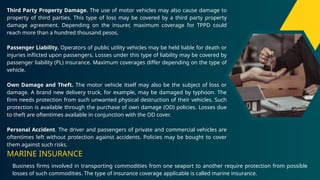
Third Party PropertyDamage. The use of motor vehicles may also cause damage to
property of third parties. This type of loss may be covered by a third party property
damage agreement. Depending on the insurer, maximum coverage for TPPD could
reach more than a hundred thousand pesos.
Passenger Liability. Operators of public utility vehicles may be held liable for death or
injuries inflicted upon passengers. Losses under this type of liability may be covered by
passenger liability (PL) insurance. Maximum coverages differ depending on the type of
vehicle.
Own Damage and Theft. The motor vehicle itself may also be the subject of loss or
damage. A brand new delivery truck, for example, may be damaged by typhoon. The
firm needs protection from such unwanted physical destruction of their vehicles. Such
protection is available through the purchase of own damage (OD) policies. Losses due
to theft are oftentimes available in conjunction with the OD cover.
Personal Accident. The driver and passengers of private and commercial vehicles are
oftentimes left without protection against accidents. Policies may be bought to cover
them against such risks.
Business firms involved in transporting commodities from one seaport to another require protection from possible
losses of such commodities. The type of insurance coverage applicable is called marine insurance.
MARINE INSURANCE
16.
Section 99 ofthe Insurance Code of the Philippines indicates what is included in marine
insurance. These are the following:
1. Insurance against loss or damage to:
a. Vessels, craft, aircraft, vehicles, goods, freights, merchandise, effects, disbursements,
profits, moneys, securities, choses in action, evidence of debt, valuable papers, bottomry, and
respondentia interest and all other kinds of property and interests therein, in respect to,
appertaining to or in connection with any and all risks or perils of navigation, transit or
transportation, or while being assembled, packed. crated, baled, compressed or similarly
prepared for shipment, or while awaiting shipment or reshipment incident thereto, including
war risks, marine builder's risks, and all personal property floater risks.
b. Person or property in connection with or appertaining to a marine, inland marine, including
liability for loss of or damage arising out of or in connection with the construction or repair,
operation, maintenance, or use of the subject matter of such insurance
C. Precious stones, jewels, jewelry, precious metals, whether in course of transportation or
otherwise.
d. Bridges, tunnels, and or other instrumentalities of transportation and communication,
piers, wharves, docks and ships, and other aids to navigation and transportation, including dry
docks and marine railways, dams and appurtenant facilities for the control of waterways.
2. Marine protection and indemnity insurance meaning insurance against, or against legal liability of the insured for
loss, damage, or expense incident to ownership, operation, chartering, maintenance, use, repair, or construction of
any vessel, craft or instrumentality in use in ocean or inland waterways including liability of the insured for personal
injury, illness or death or for loss of or damage to the property of another person.
17.
GENERAL LIABILITY INSURANCE
Businessfirms may at times be subjected to liability claims by other parties. Damages paid to claimants are
sometimes enough to cause bankruptcy to the firm. To protect the firm from such adverse financial difficulties,
some sort of insurance cover is required. Such need is covered by liability insurance policies.
General liability exposures may be classified into three broad areas: (1) business liability; (2) professional liability; and
(3) personal liability. The first class concerns business and it may be covered by business liability forms. These forms
consist of the following:
1. Owners', landlords', and tenants' form:
2 Manufacturers' and contractors' form;
3. Comprehensive general liability form;
4. Contractual liability form;
5. Owners' and contractors' protective liability insurance;
6. Products and completed-operations liability form;
7 Products recall insurance;
8. Personal injury liability policy;
9. Storekeeper liability policy; and
10. Dramshop liability policy.
BUSINESS LIABILITY FORMS
The firm may also be exposed to possible losses involving the following:
1. The mishandling or misappropriation of goods or funds by employees; and
2. The non-performance of a party who has entered into an agreement with the firm.
The first type of exposure to loss may be covered by fidelity bonds, while the second type may be covered by surety bonds.
SURETY BONDS
18.
FIDELITY BOND
A fidelitybond is one that covers an employee or employees in position/s of probate trust and it guarantees the
employer against loss up to the penalty of the bond should the employee or employees bonded be proven
dishonest.
A surety bond guarantees to the obligee that the principal named in the bond will perform a certain obligation and if
he fails to do so, the surety will perform the obligation or pay the damages up to the amount of the bond.
Surety Bond
There are other types of insurance coverages which may protect the firm from possible financial losses. These are the
following:
1. Crime insurance;
2. Glass insurance;
3. Boiler and machinery insurance; and
4. Credit insurance
MISCELLANEOUS INSURANCE LINES
Crime insurance protects owners of property against losses due to its being wrongfully taken by someone else. Crime
coverages include possible losses from burglary, robbery, larceny, theft, forgery, embezzlement, and other dishonest acts.
Crime Insurance
19.
BOILER AND MACHINERYINSURANCE
The boiler and machinery insurance is a type of insurance contract which provides protection against loss resulting
from the accidental bursting or breaking of a great variety of apparatus.
Credit Insurance
Credit insurance is a contract whereby the insurer promises, in consideration of a premium paid, and subject to
specified conditions as to the persons to whom credit is to be extended, indemnify the insured, wholly or in part,
against loss that may result from the insolvency of persons to whom he may extend credit within the term of
insurance.
Credit insurance may be classified into five types, namely:
1. credit life and credit accident and sickness insurance;
2. accounts receivable insurance;
3. domestic merchandise credit insurance;
4. governmental credit insurance; and
5. export credit insurance.
20.
SUMMARY
Business firms arealways confronted with risks. However, there are several ways of handling
risks: (1) risk avoidance; (2) risk retention; (3) hazard reduction; (4) loss reduction; (5) risk
shifting: and (5) risk reduction. Insurance is the most common device used in handling risks,
The written instrument in which a contract of insurance is set forth is the insurance policy.
Insurance contracts may be classified as either life or non-life. Life insurance contracts consist
of four basic types: (1) whole life; (2) term; (3) endowment; and (4) annuities. Non-life
insurance contracts may be classified as either: (1) fire and allied risks; (2) marine; (3) casualty;
(4) surety; or (5) liability.