FAST MOVING
               CONSUMER GOODS


www.ibef.org
FAST MOVING
CONSUMER GOODS
WHY INDIA                                      3

INDIA COMPETITIVENESS AND COMPARISON WITH     7
THE WORLD MARKETS

POLICY                                         9

TRENDS AND PLAYERS                            12

MARKET OPPORTUNITIES FOR INVESTMENT           32

ANNEX: APEX CONTACTS AGENCIES                 38


A report by PricewaterhouseCoopers for IBEF
Executive summary   The Indian FMCG sector is the fourth largest sector in the economy
                    with a total market size in excess of US$ 13.1 billion.
                    It has a strong MNC presence and is characterised by a well-
                    established distribution network, intense competition between
                    the organised and unorganised segments and low operational cost.
                    Availability of key raw materials, cheaper labour costs and presence
                    across the entire value chain gives India a competitive advantage.

                    The FMCG market is set to treble from US$ 11.6 billion in 2003
                    to US$ 33.4 billion in 2015. Penetration level as well as per capita
                    consumption in most product categories like jams, toothpaste, skin
                    care, hair wash etc in India is low indicating the untapped market
                    potential. Burgeoning Indian population, particularly the middle class
                    and the rural segments, presents an opportunity to makers
                    of branded products to convert consumers to branded products.
                    Growth is also likely to come from consumer 'upgrading' in the
                    matured product categories. With 200 million people expected to
                    shift to processed and packaged food by 2010, India needs around
                    US$ 28 billion of investment in the food-processing industry.
FAST MOVING CONSUMER GOODS                     PAGE 3


WHY INDIA
Large domestic market

India is one of the largest emerging markets, with a population of
over one billion. India is one of the largest economies in the world
in terms of purchasing power and has a strong middle class base of
300 million.

Rural and urban potential

Rural-urban profile

                                                  Urban                     Rural
 Population 2001-02 (mn household)                      53                    135

 Population 2009-10 (mn household)                      69                    153
 % Distribution (2001-02)                               28                      72

 Market (Towns/Villages)                            3,768               627,000

 Universe of Outlets (mn)                                 1                     3.3

                                  Source: Statistical Outline of India (2001-02), NCAER

Around 70 per cent of the total households in India (188 million)
resides in the rural areas. The total number of rural households are
expected to rise from 135 million in 2001-02 to 153 million in
2009-10. This presents the largest potential market in the world.
The annual size of the rural FMCG market was estimated at around
US$ 10.5 billion in 2001-02. With growing incomes at both the
rural and the urban level, the market potential is expected to
expand further.
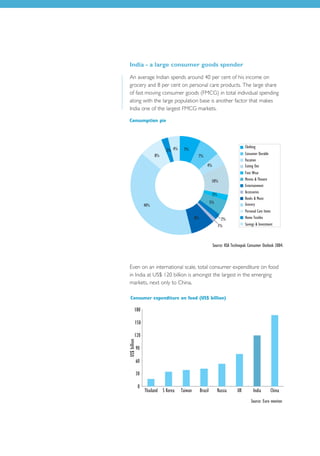
India - a large consumer goods spender
An average Indian spends around 40 per cent of his income on
grocery and 8 per cent on personal care products. The large share
of fast moving consumer goods (FMCG) in total individual spending
along with the large population base is another factor that makes
India one of the largest FMCG markets.

Consumption pie


                                    Source: KSA Technopak Consumer Outlook 2004.


Even on an international scale, total consumer expenditure on food
in India at US$ 120 billion is amongst the largest in the emerging
markets, next only to China.

Consumer expenditure on food (US$ billion)


                                                            Source: Euro monitor.
FAST MOVING CONSUMER GOODS                     PAGE 5


Change in the Indian consumer profile

Consumer Profile

                                         1999               2001            2006
 Population (millions)                     846             1,012           1,087

 Population < 25 years of age              480                546             565
 Urbanisation (%)                            26                 28              31


                                        Source: Statistical Outline of India (2002-03).

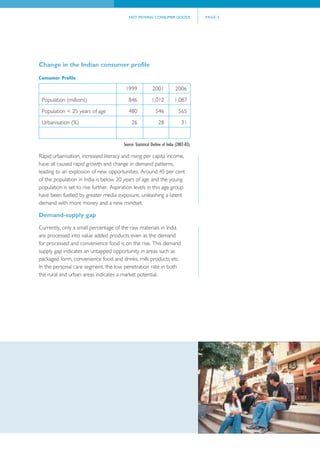
Rapid urbanisation, increased literacy and rising per capita income,
have all caused rapid growth and change in demand patterns,
leading to an explosion of new opportunities. Around 45 per cent
of the population in India is below 20 years of age and the young
population is set to rise further. Aspiration levels in this age group
have been fuelled by greater media exposure, unleashing a latent
demand with more money and a new mindset.

Demand-supply gap

Currently, only a small percentage of the raw materials in India
are processed into value added products even as the demand
for processed and convenience food is on the rise. This demand
supply gap indicates an untapped opportunity in areas such as
packaged form, convenience food and drinks, milk products etc.
In the personal care segment, the low penetration rate in both
the rural and urban areas indicates a market potential.
FMCG Category and products
 Category         Products
 Household Care   Fabric wash (laundry soaps and synthetic
                  detergents); household cleaners (dish/utensil
                  cleaners, floor cleaners, toilet cleaners, air
                  fresheners, insecticides and mosquito repellents,
                  metal polish and furniture polish).

 Food and         Health beverages; soft drinks; staples/cereals;
 Beverages        bakery products (biscuits, bread, cakes); snack
                  food; chocolates; ice cream; tea; coffee; soft
                  drinks; processed fruits, vegetables; dairy
                  products; bottled water; branded flour; branded
                  rice; branded sugar; juices etc.

 Personal Care    Oral care, hair care, skin care, personal wash
                  (soaps); cosmetics and toiletries; deodorants;
                  perfumes; feminine hygiene; paper products.
FAST MOVING CONSUMER GOODS          PAGE 7


INDIA COMPETITIVENESS AND
COMPARISON WITH THE WORLD
MARKETS

Materials availability
India has a diverse agro-climatic condition due to which there exists
a wide-ranging and large raw material base suitable for food
processing industries. India is the largest producer of livestock, milk,
sugarcane, coconut, spices and cashew and is the second largest
producer of rice, wheat and fruits & vegetables.

India also has an ample supply of caustic soda and soda ash, the raw
materials in the production of soaps and detergents - India
produced 1.6 million tonnes of caustic soda in 2003-04. Tata
Chemicals, one of the largest producers of synthetic soda ash in the
world is located in India. The availability of these raw materials gives
India the locational advantage.

Cost competitiveness
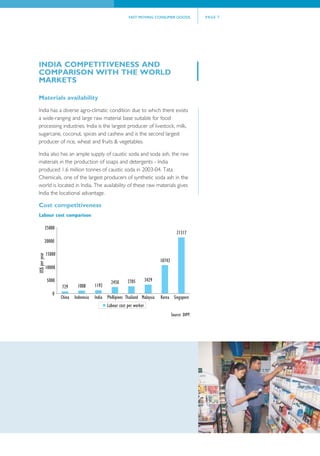
Labour cost comparison


                                                               Source: DIPP.
Apart from the advantage in terms of ample raw material availability,
existence of low-cost labour force also works in favour of India.
Labour cost in India is amongst the lowest in Asian countries. Easy
raw material availability and low labour costs have resulted in a lower
cost of production. Many multi-nationals have set up large low cost
production bases in India to outsource for domestic as well as
export markets.

 Leveraging the cost advantage

 Global major, Unilever, sources a major portion of its product
 requirements from its Indian subsidiary, HLL. In 2003-04, Unilever
 outsourced around US$ 218 million of home and personal care
 along with food products to leverage on the cost arbitrage
 opportunities with the West.

 To take another case, Procter & Gamble (P&G) outsourced the
 manufacture of Vicks Vaporub to contract manufacturers in
 Hyderabad, India. This enables P&G to continue exporting Vicks
 Vaporub to Australia, Japan and other Asian countries, but at
 more competitive rates, whilst maintaining its high quality and cost
 efficiency.

Presence across value chain
Indian firms also have a presence across the entire value chain of the
FMCG industry from supply of raw material to final processed and
packaged goods, both in the personal care products and in the food
processing sector. For instance, Indian firm Amul's product portfolio
includes supply of milk as well as the supply of processed dairy
products like cheese and butter. This makes the firms located in India
more cost competitive.
FAST MOVING CONSUMER GOODS     PAGE 9


POLICY

India has enacted policies aimed at attaining international
competitiveness through lifting of the quantitative restrictions,
reduced excise duties, automatic foreign investment and food laws
resulting in an environment that fosters growth. 100 per cent export
oriented units can be set up by government approval and use of
foreign brand names is now freely permitted.

FDI Policy
Automatic investment approval (including foreign technology
agreements within specified norms), up to 100 per cent foreign
equity or 100 per cent for NRI and Overseas Corporate Bodies
(OCBs) investment, is allowed for most of the food processing
sector except malted food, alcoholic beverages and those reserved
for small scale industries (SSI). 24 per cent foreign equity is
permitted in the small-scale sector. Temporary approvals for
imports for test marketing can also be obtained from the Director
General of Foreign Trade. The evolution of a more liberal FDI policy
environment in India is clearly supported by the successful operation
of some of the global majors like PepsiCo in India.

 PepsiCo's India experience

 After a not so successful attempt to enter the Indian market in
 1985, Pepsi re-entered in 1988 with a joint venture of PepsiCo,
 Punjab government-owned Punjab Agro Industrial Corporation
 (PAIC) and Voltas India Limited. By 1994, Pepsi took advantage
 of the liberalised policies and took control of Pepsi Foods by
 making an offer to both Voltas and PAIC to buy their equity. The
 Indian government gave concessions to the company, Pepsi was
 allowed to increase its turnover of beverages component to
 beyond 25 per cent and was no longer restricted by its
 commitment to export 50 per cent of its turnover. The
 government approved more than US$ 400 million worth of
investment of which over US$ 330 million has already been
 invested. The government also allowed PepsiCo to set up a new
 company in India called PepsiCo India Holdings Pvt Ltd, a wholly
 owned subsidiary of PepsiCo International, which is engaged in
 beverage manufacturing, bottling and exports activities as Pepsi
 Foods Ltd.

 Since then, the company has bought over bottlers in different
 parts of India along with Dukes, a popular soft-drink brand in
 western India to consolidate its market share. This was followed
 by an introduction of Tropicana juice in the New Delhi and
 Bangalore markets in 1999.

 Currently, soft drink concentrate, snack foods and vegetable and
 food processing are the key products of the company. Pepsi
 considers India, along with China, as one of the two largest and
 fastest growing businesses outside North America. Pepsi has 19
 company owned factories while their Indian bottling partners own
 21. The company has set up 8 greenfield sites in backward regions
 of different states. PepsiCo intends to expand its operations and is
 planning an investment of approximately US$ 150 million in the
 next two-three years.

Removal of Quantitative Restrictions
and Reservation Policy
The Indian government has abolished licensing for almost all food
and agro-processing industries except for some items like alcohol,
cane sugar, hydrogenated animal fats and oils etc., and items
reserved for the exclusive manufacture in the small scale industry
(SSI) sector. Quantitative restrictions were removed in 2001 and
Union Budget 2004-05 further identified 85 items that would be
taken out of the reserved list. This has resulted in a boom in the
FMCG market through market expansion and greater product
opportunities.
FAST MOVING CONSUMER GOODS      PAGE 11


Central and state initiatives
Various states governments like Himachal Pradesh, Uttaranchal
and Jammu & Kashmir have encouraged companies to set up
manufacturing facilities in their regions through a package of fiscal
incentives. Jammu and Kashmir offers incentives such as allotment of
land at concessional rates, 100 per cent subsidy on project reports
and 30 per cent capital investment subsidy on fixed capital
investment upto US$ 63,000. The Himachal Pradesh government
offers sales tax and power concessions, capital subsidies and other
incentives for setting up a plant in its tax free zones. Five-year tax
holiday for new food processing units in fruits and vegetable
processing have also been extended in the Union Budget 2004-05.

Wide-ranging fiscal policy changes have been introduced
progressively. Excise and import duty rates have been reduced
substantially. Many processed food items are totally exempt from
excise duty. Customs duties have been substantially reduced
on plant and equipment, as well as on raw materials and
intermediates, especially for export production. Capital goods
are also freely importable, including second hand ones in the
food-processing sector.

Food laws
Consumer protection against adulterated food has been brought to
the fore by "The Prevention of Food Adulteration Act (PFA), 1954",
which applies to domestic and imported food commodities,
encompassing food colour and preservatives, pesticide residues,
packaging, labelling and regulation of sales.
TRENDS AND PLAYERS

The structure
The Indian FMCG sector is the fourth largest sector in the economy
and creates employment for three million people in downstream
activities. Within the FMCG sector, the Indian food processing
industry represented 6.3 per cent of GDP and accounted for 13 per
cent of the country's exports in 2003-04.
 A distinct feature of the FMCG industry is the presence of most
global players through their subsidiaries (HLL, P&G, Nestle), which
ensures new product launches in the Indian market from the
parent's portfolio.

  Critical operating rules in Indian FMCG sector
  • Heavy launch costs on new products on launch
    advertisements, free samples and product promotions.
  • Majority of the product classes require very low investment
    in fixed assets
  • Existence of contract manufacturing
  • Marketing assumes a significant place in the brand building
    process
  • Extensive distribution networks and logistics are key to
    achieving a high level of penetration in both the urban
    and rural markets
  • Factors like low entry barriers in terms of low capital
    investment, fiscal incentives from government and low brand
    awareness in rural areas have led to the mushrooming of
    the unorganised sector
  • Providing good price points is the key to success
FAST MOVING CONSUMER GOODS                    PAGE 13


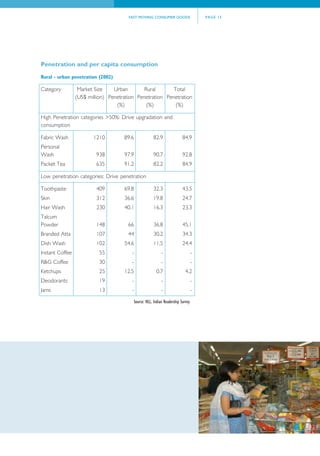
Penetration and per capita consumption
Rural - urban penetration (2002)

Category          Market Size    Urban        Rural       Total
                 (US$ million) Penetration Penetration Penetration
                                  (%)          (%)         (%)

High Penetration categories >50%: Drive upgradation and
consumption

Fabric Wash             1210         89.6                82.9               84.9
Personal
Wash                     938         97.9                90.7               92.8
Packet Tea               635         91.2                82.2               84.9

Low penetration categories: Drive penetration

Toothpaste               409         69.8                32.3               43.5
Skin                     312         36.6                19.8               24.7
Hair Wash                230         40.1                16.3               23.3
Talcum
Powder                   148           66                36.8               45.1
Branded Atta             107           44                30.2               34.3
Dish Wash                102         54.6                11.5               24.4
Instant Coffee             55           -                     -                  -
R&G Coffee                 30           -                     -                  -
Ketchups                   25        12.5                  0.7                4.2
Deodorants                 19           -                     -                  -
Jams                       13           -                     -                  -

                                            Source: HLL, Indian Readership Survey.
Penetration level in most product categories like jams, toothpaste,
skin care, hair wash etc in India is low. The contrast is particularly
striking between the rural and urban segments - the average
consumption by rural households is much lower than their urban
counterparts. Low penetration indicates the existence of
unsaturated markets, which are likely to expand as the income levels
rise. This provides an excellent opportunity for the industry players
in the form of a vastly untapped market.

Moreover, per capita consumption in most of the FMCG categories
(including the high penetration categories) in India is low as
compared to both the developed markets and other emerging
economies. A rise in per capita consumption, with improvement in
incomes and affordability and change in tastes and preferences, is
further expected to boost FMCG demand. Growth is also likely to
come from consumer "upgrading", especially in the matured product
categories.

Detergent per capita consumption (in kg) (2001)


Tea per capita consumption (in kg) (2001)
FAST MOVING CONSUMER GOODS         PAGE 15


Personal wash per capita consumption (in kg) (2001)


Toothpaste per capita consumption (in kg) (2001)


Skin care products per capita consumption (in Rs) (2001)


                                                           US$ 1=Rs 47.2
Ice cream per capita consumption (in litre) (2001)


Shampoo per capita consumption (in kg) (2001)


Fabric wash per capita consumption (in kg) (2001)
FAST MOVING CONSUMER GOODS                 PAGE 17


The rural urban break-up

Indian FMCG market - urban


Indian FMCG market - rural


                             Source: Indian Market Demographic Report, NCAER.
Most Indian FMCG companies focus on urban markets for value and
rural markets for volumes. The total market has expanded from US$
17.6 billion in 1992-93 to US$ 22 billion in 1998-99 at current
prices. Rural demand constituted around 52.5 per cent of the total
demand in 1998-99. Hence, rural marketing has become a critical
factor in boosting bottomlines. As a result, most companies' have
offered low price products in convenient packaging. These
contribute the majority of the sales volume. In comparison, the
urban elite consumes a proportionately higher value of FMCGs, but
not volume.

Rural markets: small is beautiful

  By the early nineties FMCG marketers had figured out two things
  • Rural markets are vital for survival since the urban
    markets were getting saturated
  • Rural markets are extremely price-sensitive

  Thus, a number of companies followed the strategy of launching
  a wide range of package sizes and prices to suit the purchasing
  preferences of India's varied consumer segments. Hindustan
  Lever, a subsidiary of Unilever, coined the term nano-marketing
  in the early nineties, when it introduced its products in small
  sachets. Small sachets were introduced in almost all the FMCG
  segments from oil, shampoo, and detergents to beverages.

  Cola major, Coke, brought down the average price of its
  products from around twenty cents to ten cents, thereby
  bridging the gap between soft drinks and other local options like
  tea, butter milk or lemon juice. It also doubled the number of
  outlets in rural areas from 80,000 during 2001 to 160,000 the
  next year, thereby almost doubling its market penetration from
  13 per cent to 25 per cent. This along with greater marketing,
  led to the rural market accounting for 80 per cent
  of new Coke drinkers and 30 per cent of its total volumes.
  The rural market for colas grew at 37 per cent in 2002, against a
  24 per cent growth in urban areas. The per capita consumption in
  rural areas also doubled during 2000-02.
FAST MOVING CONSUMER GOODS         PAGE 19


Consumer-class boom

Household income distribution - 2003


Household income distribution - 2015


                                                    Source: HLL, NCAER.
Demand for FMCG products is set to boom by almost 60 per cent
by 2007 and more than 100 per cent by 2015. This will be driven
by the rise in share of middle class (defined as the climbers and
consuming class) from 67 per cent in 2003 to 88 per cent in 2015.
The boom in various consumer categories, further, indicates a latent
demand for various product segments. For example, the upper end
of very rich and a part of the consuming class indicate
a small but rapidly growing segment for branded products.
The middle segment, on the other hand, indicates a large market for
the mass end products.

The BRICs report indicates that India's per capita disposable income,
currently at US$ 556 per annum, will rise to US$ 1150 by 2015 -
another FMCG demand driver. Spurt in the industrial and services
sector growth is also likely to boost the urban consumption
demand.

Rise in Indian disposable income (US$/annum)


                                 Source: Euro monitor, BRICs Report (Goldman Sachs).
FAST MOVING CONSUMER GOODS            PAGE 21


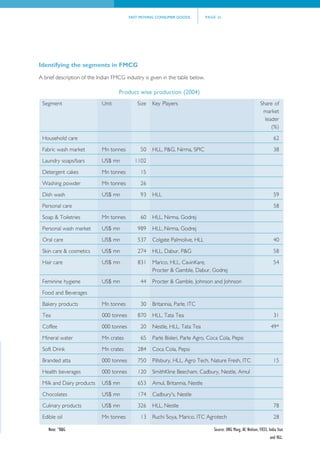
Identifying the segments in FMCG
A brief description of the Indian FMCG industry is given in the table below.

                                    Product wise production (2004)
 Segment                    Unit             Size   Key Players                                                  Share of
                                                                                                                  market
                                                                                                                   leader
                                                                                                                      (%)

 Household care                                                                                                           62

 Fabric wash market         Mn tonnes         50    HLL, P&G, Nirma, SPIC                                                 38
 Laundry soaps/bars         US$ mn          1102

 Detergent cakes            Mn tonnes         15
 Washing powder             Mn tonnes         26

 Dish wash                  US$ mn            93    HLL                                                                   59
 Personal care                                                                                                            58

 Soap & Toiletries          Mn tonnes         60    HLL, Nirma, Godrej

 Personal wash market       US$ mn           989    HLL, Nirma, Godrej
 Oral care                  US$ mn           537    Colgate Palmolive, HLL                                                40

 Skin care & cosmetics      US$ mn           274    HLL, Dabur, P&G                                                       58
 Hair care                  US$ mn           831    Marico, HLL, CavinKare,                                               54
                                                    Procter & Gamble, Dabur, Godrej

 Feminine hygiene           US$ mn            44    Procter & Gamble, Johnson and Johnson
 Food and Beverages

 Bakery products            Mn tonnes         30    Britannia, Parle, ITC
 Tea                        000 tonnes       870    HLL, Tata Tea                                                         31

 Coffee                     000 tonnes        20    Nestle, HLL, Tata Tea                                               49*

 Mineral water              Mn crates         65    Parle Bisleri, Parle Agro, Coca Cola, Pepsi
 Soft Drink                 Mn crates        284    Coca Cola, Pepsi

 Branded atta               000 tonnes       750    Pillsbury, HLL, Agro Tech, Nature Fresh, ITC                          15
 Health beverages           000 tonnes       120    SmithKline Beecham, Cadbury, Nestle, Amul

 Milk and Dairy products    US$ mn           653    Amul, Britannia, Nestle

 Chocolates                 US$ mn           174    Cadbury's, Nestle
 Culinary products          US$ mn           326    HLL, Nestle                                                           78

 Edible oil                 Mn tonnes         13    Ruchi Soya, Marico, ITC Agrotech                                      28

    Note: *R&G                                                                    Source: ORG Marg, AC Nielson, FICCI, India Stat
                                                                                                                        and HLL.
Household care
The size of the fabric wash market is estimated to be US$ 1 billion,
household cleaners to be US$ 239 million and the production of
synthetic detergents at 2.6 million tonnes. The demand for
detergents has been growing at an annual growth rate of 10 to 11
per cent during the past five years. The urban market prefers
washing powder and detergents to bars on account of convenience
of usage, increased purchasing power, aggressive advertising and
increased penetration of washing machines. The regional and small-
unorganised players account for a major share of the total detergent
market in volumes.

Personal care

The size of the personal wash products is estimated at US$ 989
million; hair care products at US$ 831 million and oral care products
at US$ 537 million. While the overall personal wash market is
growing at one per cent, the premium and middle-end soaps are
growing at a rate of 10 per cent. The leading players in this market
are HLL, Nirma, Godrej Soaps and Reckitt & Colman. The oral care
market, especially toothpastes, remains under penetrated in India
(with penetration level below 45 per cent) due to lack of hygiene
awareness among rural markets. The industry is very competitive
both for organised and smaller regional players.

The Indian skin care and cosmetics market is valued at US$ 274
million and dominated by HLL, Colgate Palmolive, Gillette India and
Godrej Soaps. This segment has witnessed the entry of a number of
international brands, like Oriflame, Avon and Aviance leading to
increased competition. The coconut oil market accounts for 72 per
cent share in the hair oil market. In the branded coconut hair oil
market, Marico (with Parachute) and Dabur are the leading players.
The market for branded coconut oil is valued at approximately US$
174 million.
FAST MOVING CONSUMER GOODS      PAGE 23


Food and Beverages

Food

According to the Ministry of Food Processing, the size of the Indian
food processing industry is around US$ 65.6 billion including US$
20.6 billion of value added products. Of this, the health beverage
industry is valued at US$ 230 billion; bread and biscuits at US$ 1.7
billion; chocolates at US$ 73 million and ice creams at US$ 188
million.

The size of the semi-processed/ready to eat food segment is
over US$ 1.1 billion. Large biscuits & confectionery units, soya-
processing units and starch/glucose/sorbitol producing units have
also come up, catering to domestic and international markets.
The three largest consumed categories of packaged foods are
packed tea, biscuits and soft drinks.

Beverages
The Indian beverage industry faces over supply in segments like
coffee and tea. However, more than half of this is available in
unpacked or loose form. Indian hot beverage market is a tea
dominant market. Consumers in different parts of the country
have heterogeneous tastes. Dust tea is popular in southern India,
while loose tea in preferred in western India. The urban-rural split of
the tea market was 51:49 in 2000. Coffee is consumed largely
in the southern states. The size of the total packaged coffee market
is 19,600 tonnes or US$ 87 million. The urban rural split
in the coffee market was 61:39 in 2000 as against 59:41 in 1995.

The total soft drink (carbonated beverages and juices) market is
estimated at 284 million crates a year or US$ 1 billion. The market
is highly seasonal in nature with consumption varying from 25 million
crates per month during peak season to 15 million during off-
season. The market is predominantly urban with 25 per cent
contribution from rural areas. Coca cola and Pepsi dominate the
Indian soft drinks market.
Mineral water market in India is a 65 million crates (US$ 50 million)
industry. On an average, the monthly consumption is estimated at
4.9 million crates, which increases to 5.2 million
during peak season.

Exports
India is one of the world's largest producers for a number of FMCG
products but its exports are a very small proportion of the overall
production. Total exports of food processing industry was US$ 2.9
billion in 2001-02 and marine products accounted for 40 per cent of
the total exports. Though the Indian companies are going global,
they are focusing more on the overseas markets like Bangladesh,
Pakistan, Nepal, Middle East and the CIS countries because of the
similar lifestyle and consumption habits between these countries and
India. HLL, Godrej Consumer, Marico, Dabur and Vicco laboratories
are amongst the top exporting companies.

Investment in the FMCG sector
The FMCG sector accounts for around 3 per cent of the total FDI
inflow and roughly 7.3 per cent of the total sectoral investment. The
food-processing sector attracts the highest FDI, while the vegetable
oils and vanaspati sector accounts for the highest domestic
investment in the FMCG sector.

Investments in the FMCG sector (August 1991-April 2004)


                                                   Source: SIA Newsletter, DIPP.
FAST MOVING CONSUMER GOODS      PAGE 25


Domestic players
Britannia India Ltd (BIL)

Britannia India Ltd was incorporated in 1918 as Britannia Biscuit Co
Ltd and currently the Groupe Danone (GD) of France (a global
major in the food processing business) and the Nusli Wadia Group
hold a 45.3 per cent equity stake in BIL through AIBH Ltd (a 50:50
joint venture). BIL is a dominant player in the Indian biscuit industry,
with major brands such as Tiger glucose, Mariegold, Fifty-Fifty, Good
Day, Pure Magic, Bourbon etc.
The company holds a 40 per cent market share in the overall
organised biscuit market and has a capacity of 300,000 tonne per
annum. Currently, the bakery product business accounts for 99.1
per cent of BIL's turnover. The company reported net sales of US$
280 million in 2002-03. Britannia Industries Ltd (BIL) plans to
increase its manufacturing capacity through outsourced contract
manufacturing and a greenfield plant in Uttaranchal to expand its
share in the domestic biscuit and confectionery market.

Dabur India Ltd

Established in 1884, Dabur India Ltd is the largest Indian FMCG
and ayurvedic products company. The group comprises Dabur
Finance, Dabur Nepal Pvt Ltd, Dabur Egypt Ltd, Dabur Overseas
Ltd and Dabur International Ltd. The product portfolio of the
company includes health care, food products, natural gums
& allied chemicals, pharma, and veterinary products. Some of its
leading brands are Dabur Amla, Dabur Chyawanprash, Vatika,
Hajmola, Lal Dant Manjan, Pudin Hara and the Real range of fruit
juices. The company reported net sales of US$ 218 million in 2003-
04. Dabur has firmed up plans to restructure its sales and
distribution structure and focus on its core businesses of fast-moving
consumer good products and over-the-counter drugs. Under the
restructured set-up, the company plans to increase direct coverage
to gap outlets and gap towns where Dabur is not
present. A roadmap is also being prepared to rationalise the
stockists' network in different regions between various products and
divisions.

Indian Tobacco Corporation Ltd (ITCL)

Indian Tobacco Corporation Ltd is an associate of British American
Tobacco with a 37 per cent stake. In 1910 the company's operations
were restricted to trading in imported cigarettes.
The company changed its name to ITC Limited in the mid seventies
when it diversified into other businesses. ITC is one of India's
foremost private sector companies with a turnover of US$ 2.6
billion. While ITC is an outstanding market leader in its traditional
businesses of cigarettes, hotels, paperboards, packaging and agri-
exports, it is rapidly gaining market share even in its nascent
businesses of branded apparel, greeting cards and packaged foods
and confectionary. After the merger of ITC Hotels with ITC Ltd, the
company will ramp up its growth plans by strengthening its alliance
with Sheraton and through focus on international projects in Dubai
and the Far East. ITC's subsidiary, International Travel House (ITH)
also aims to launch new products and services
by way of boutiques that will provide complete travel services.

Marico
Marico is a leading Indian Group incorporated in 1990 and operating
in consumer products, aesthetics services and global ayurvedic
businesses. The company also markets food products and distributes
third party products. Marico owns well-known brands such as
Parachute, Saffola, Sweekar, Shanti Amla, Hair & Care, Revive,
Mediker, Oil of Malabar and the Sil range of processed foods. It has
six factories, and sub-contract facilities for production. In 2003-04,
the company reported a turnover of US$ 200 million. The overseas
sales franchise of Marico's branded FMCG products is one of the
largest amongst Indian companies.
It is also the largest Indian FMCG company in Bangladesh.
FAST MOVING CONSUMER GOODS     PAGE 27


The company plans to capture growth through constant realignment
of portfolio along higher margin lines and focus on volume growth,
consolidation of market shares, strengthening flagship brands and
new product offerings (2-3 new product launches are expected in
2004-05). It also plans to expand its international business to
Pakistan.

Nirma Limited

Nirma Ltd, promoted by Karsanbhai Patel, is a homegrown FMCG
major with a presence in the detergent and soap markets. It was
incorporated in 1980 as a private company and was listed in fiscal
1994. Associate companies' Nirma Detergents, Shiva Soaps and
Detergents, Nirma Soaps and Detergents and Nilnita Chemicals
were merged with Nirma in 1996-1997. The company has also set
up a wholly owned subsidiary Nirma Consumer Care Ltd, which is
the sole marketing licensee of the Nirma brand in India. Nirma also
makes alfa olefin, fatty acid and glycerine. Nirma is one of the most
successful brands in the rural markets with extremely low priced
offerings. Nirma has plants located in Gujarat, Madhya Pradesh and
Uttar Pradesh. Its new LAB plant is located in Baroda and the soda
ash complex is located in Gujarat. Nirma has strong distributor
strength of 400 and a retail reach of over 1 million outlets. The
company reported gross sales of US$ 561 million in 2003-04. It
plans to continue to target the mid and mass segments for future
growth.
Foreign players
Cadbury India Ltd (CIL)

Cadbury Indian Ltd is a 93.5 per cent subsidiary of Cadbury
Schweppes Plc, UK, a global major in the chocolate and sugar
confectionery industry. CIL was set up as a trading concern in 1947
and subsequently began its operations with the small scale
processing of imported chocolates and food drinks. CIL is currently
the largest player in the chocolate industry in India with a 70 per
cent market share. The company is also a key player in the malted
foods, cocoa powder, drinking chocolate, malt extract food and
sugar confectionery segment. The company had also entered the
soft drinks market with brands like 'Canada Dry' and 'Crush', which
were subsequently sold to Coca Cola in 1999. Established brands
include Dairy Milk, Perk, Crackle, 5 Star, Éclairs, Gems, Fructus,
Bournvita etc. The company reported net sales of US$ 160 million in
2003. The company plans to increase the number of retail outlets
for future growth and market expansion.

Cargill

Cargill Inc is one of the world's leading agri-business companies with
a strong presence in processing and merchandising, industrial
production and financial services. Its products and geographic
diversity (over 40 product lines with a direct presence in over 65
countries and business activities in about 130 countries) as well as its
vast communication and transportation network help optimise
commodity movements and provide competitive advantage. Cargill
India was incorporated in April 1996 as a 100 per cent subsidiary of
Cargill Inc of the US. It is engaged in trading in soyabean meals,
wheat, edible oils, fertilisers and other agricultural commodities
besides marketing branded packaged foods. It has also set up its own
anchorage facilities at Rosy near Jamnagar in Gujarat for efficient
handling of its import and export consignments.
FAST MOVING CONSUMER GOODS     PAGE 29


Coca Cola
Coca-Cola started its India operations in 1993. The Coca-Cola
system in India comprises 27 wholly company-owned bottling
operations and another 17 franchisee-owned bottling operations.
A network of 29 contract-packers also manufacture a range of
products for the company. Leading Indian brands Thums Up, Limca,
Maaza, Citra and Gold Spot exist in the Company's international
family of brands along with Coca-Cola, Diet Coke, Kinley, Sprite and
Fanta, plus the Schweppes product range. During the past decade,
the Coca-Cola system has invested more than US$ 1 billion in India.
In 2003, Coca-Cola India pledged to invest a further US$ 100
million in its operations.

Colgate-Palmolive India

Colgate Palmolive India is a 51 per cent subsidiary of Colgate
Palmolive Company, USA. It is the market leader in the Indian oral
care market, with a 51 per cent market share in the toothpaste
segment, 48 per cent market share in the toothpowder market and
a 30 per cent share in the toothbrush market. The company also
has a presence in the premium toilet soap segment and in shaving
products, which are sold under the Palmolive brand. Other well-
known consumer brands include Charmis skin cream and Axion dish
wash. The company reported sales of US$ 226 million in 2003-04.
The company's strategy is to focus on growing volumes by
improving penetration through aggressive campaigning and
consumer promotions. The company plans to launch new products
in oral and personal care segments and is prepared to continue
spending on advertising and marketing to gain market share. Margin
gains are being targeted through efficient supply chain management
and bringing down cost of operations.
H J Heinz Co
A US$ 8.4 billion American foods major, H J Heinz Co comprises
4,000 strong brand buffet in infant food, sauces and condiments.
The company was the first to commence manufacturing and bottling
of tomato ketchup in 1876. In India, Heinz has a presence through
its 100 per cent subsidiary Heinz India Pvt Ltd. Heinz acquired the
consumer products division of pharmaceutical major Glaxo in 1994.
Heinz's product range in India consists of Complan milk beverage,
health drink Glucon-D, infant food Farex and Nycil prickly heat
powder, besides the Heinz ketchup range.

Hindustan Lever Ltd (HLL)
Hindustan Lever Ltd is a 51 per cent owned subsidiary of the
Anglo-Dutch giant Unilever, which has been expanding the scope of
its operations in India since 1888. It is the country's biggest
consumer goods company with net sales of US$ 2.4 billion in 2003.
HLL is amongst the top five exporters of the country and also the
biggest exporter of tea and castor oil. The product portfolio of the
company includes household and personal care products like soaps,
detergents, shampoos, skin care products, colour cosmetics,
deodorants and fragrances. It is also the market leader in tea,
processed coffee, branded wheat flour, tomato products, ice cream,
jams and squashes. HLL enjoys a formidable distribution network
covering over 3,400 distributors and 16 million outlets. In the future,
the company plans to concentrate on its herbal health care portfolio
(Ayush) and confectionary business (Max). Its strategy to grow
includes focussing on the power brands' growth through consumer
relevant information, cross category extensions, leveraging channel
opportunities and increased focus on rural growth.

Nestle India Ltd (NIL)
Nestle India Ltd a 59.8 per cent subsidiary of Nestle SA,
Switzerland, is a leading manufacturer of food products in India.
Its products include soluble coffee, coffee blends and teas,
condensed milk, noodles (81 per cent market share), infant milk
powders (75 per cent market share) and cereals (80 per cent
market share). Nestle has also established its presence in chocolates,
confectioneries and other processed foods. Soluble beverages and
milk products are the major contributors to Nestle's total sales.
Some of Nestle's popular brands are Nescafe, Milkmaid, Maggi and
Cerelac. The company has entered the chilled dairy segment with
the launch of Nestle Dahi and Nestle Butter. Nestle has also made a
foray in non-carbonated cold beverages segment through placement
of Nestea iced tea and Nescafe Frappe vending machines. Exports
contribute to 23 per cent of its turnover and the company reported
net sales of US$ 440 million in 2003.
FAST MOVING CONSUMER GOODS     PAGE 31


PepsiCo
PepsiCo is a world leader in convenient foods and beverages,
with revenues of about US$ 27 billion. PepsiCo brands are available
in nearly 200 markets across the world. The company has an
extremely positive outlook for India. "Outside North America two
of our largest and fastest growing businesses are in India and China,
which include more than a third of the world's population"
(Pepsico's annual report). PepsiCo entered India in 1989 and is
concentrating on three focus areas - soft drink concentrate, snack
foods and vegetable and food processing. PepsiCo's success is the
result of superior products, high standards of performance and
distinctive competitive strategies.

Procter & Gamble Hygiene and Health Care Limited
Richardson Hindustan Limited (RHL), manufacturer of the Vicks
range of products, was rechristened 'Procter & Gamble India' in
October 1985, following its affiliation to the 'Procter & Gamble
Company', USA. Procter & Gamble Hygiene and Health Care
Limited (PGHHCL) acquired its current name in 1998, reflecting the
two key segments of its business. P&G, USA has a 65 per cent stake
in PGHHCL. The parent also has a 100 per cent subsidiary, Procter
& Gamble Home Products (PGHP). The overall portfolio of the
company includes healthcare; feminine-care; hair care and fabric care
businesses. PGHH operates in just two business segments - Vicks
range of cough & cold remedies and Whisper range of feminine
hygiene. The detergent and shampoo business has been relocated
globally to Vietnam. The company imports
and markets most of the products from South East Asian countries
and China, while manufacturing, marketing and export of Vicks and
sanitary napkins has been retained in India. The company reported
sales of US$ 91 million in 2002-03. The parent company has
announced its plan to explore further external collaborations
in India to meet its global innovation and knowledge needs.
MARKET OPPORTUNITIES
FOR INVESTMENT

Measuring the opportunity: Domestic FMCG
market to treble
FMCG Market Size (US$ billion)


                                                       Source: HH Panel data

According to estimates based on China's current per capita
consumption, the Indian FMCG market is set to treble from
US$ 11.6 billion in 2003 to US$ 33.4 billion in 2015. The dominance
of Indian markets by unbranded products, change in eating habits and
the increased affordability of the growing Indian population presents
an opportunity to makers of branded products, who can convert
consumers to branded products.

The investment potential in rural markets

The Indian rural market with its vast size and demand base offers a
huge opportunity for investment. Rural India has a large consuming
class with 41 per cent of India's middle-class and 58 per cent of the
total disposable income. With population in the rural areas set to rise
to 153 million households by 2009-10 and with higher saturation in
the urban markets, future growth in the FMCG sector will come
FAST MOVING CONSUMER GOODS   PAGE 33


from increased rural and small town penetration. Technological
advances such as the internet and e-commerce will aid in better
logistics and distribution in these areas. Already Indian corporates
such as HLL and ITC have identified the opportunity and have
initiated projects such as 'Project Shakti' and 'e-Choupal' to first,
expand rural income, and then, to penetrate this market.


  Boosting rural income - novel experiments by
  Indian corporates

  PROJECT SHAKTI
  FMCG giant Hindustan Lever initiated 'Project Shakti' to spur
  growth and increase the penetration of its products in rural
  India while changing lives and boosting incomes. Through a
  combination of micro-credit and training in enterprise
  management, women from self-help groups turned direct-to-
  home distributors of a range of HLL products and helped the
  company test hitherto unexplored rural hinterlands. The project
  was piloted in Nalgonda district in Andhra Pradesh (AP) in
  2001, it has since been scaled up and extended to over 5,000
  villages in 52 districts in AP, Karnataka, Gujarat, Chattisgarh,
  Orissa and Madhya Pradesh with around 1,000 women
  entrepreneurs in its fold. The vision is to create about 11,000
  Shakti entrepreneurs covering 100,000 villages and 100 million
  rural consumers by 2010.
  For HLL, greater penetration in rural areas is also imperative
  since over 50 per cent of its incomes for several of its product
  categories like soaps and detergents come from rural India. The
  project has borne fruit for HLL. In Andhra Pradesh, so far, since
  the experiment began, HLL has seen 15 per cent incremental
  sales from rural Andhra, which contributes 50 per cent to
  overall sales from Andhra of HLL products.
e-CHOUPAL

  An example of the successful application of IT is the e-Choupal
  experiment kicked off by diversified tobacco giant ITC. ITC has
  designed and set up internet kiosks called e-Choupals to
  support its agricultural product supply chain.
  The e-Choupals are totally owned and set up by ITC with
  the operators not having any investment or risk of their own.
  There are four kinds of e-Choupals tailored for shrimps, coffee,
  wheat and soyabeans. The focus is on creating internet access
  for global market information to guide production and supply
  decisions. It provides price information and thus, price certainty
  to the farmers. In addition, the farmers get access to
  operational information, developed by ITC experts, pertaining
  to cropping, seeds, fertilisers etc.

  The initial benefits of the ITC effort include a substantial
  reduction in transaction costs, from 8 per cent to just 2 per
  cent. These gains are shared roughly equally between ITC and
  individual farmers. The longer-term goal is to use
  e-Choupals as sales points for soyabean oil and a range of
  other consumer goods. ITC has also set up its first rural mall
  near Bhopal, where it distributes products of other FMCG
  majors as well. Hence, incomes generated through
  e-choupals will be targeted by the FMCG major to drive their
  product sales.


Export potential
India has a locational advantage that can be exploited to use it as
a sourcing base for FMCG exports. Export of pre-prepared meals
with Indian vegetables for large Asian ethnic population settled in
developed countries is a very big opportunity for India. South East
Asia, which is presently being catered to by USA and EU, can be
sourced from India due to its lower freight cost.
FAST MOVING CONSUMER GOODS     PAGE 35


Investments can also be made in Indian dairy industries to
manufacture and package dairy food (through contract or local
collaboration) for export to Middle East, Singapore, Malaysia,
Indonesia, Korea, Thailand and Hong Kong. Commodities like dry
milk, condensed milk, ghee and certain cheese varieties that are
utilised as ingredients in foreign countries can also be exported.
These markets can be expanded to include value-added ingredients
like packaged cheese sauce and dehydrated cheese powders. Large
export potential also exists in the soya products industry.

Sectoral opportunities

According to the Ministry of Food Processing, with 200 million
people expected to shift to processed and packaged food by 2010,
India needs around US$ 28 billion of investment to raise food-
processing levels by 8-10 per cent. In the personal care segment,
the lower penetration rates also presents an untapped potential.
Key sectoral opportunities are mentioned below:
• Staple: branded and unbranded: While the expenditure
  on mass-based, high volume, low margin basic foods such
  as wheat, wheat flour and homogenised milk is expected to
  increase substantially with the rise in population, there is also
  a market for branded staples is also expected to emerge.
  Investment in branded staples is likely to rise with the popularity
  of branded rice and flour among urban population.
• Dairy based products: India is the largest milk producer
  in the world, yet only 15 per cent of the milk is processed.
  The US$ 2.4 billion organised dairy industry requires huge
  investment for conversion and growth. Investment opportunities
  exist in value-added products like desserts, puddings etc. The
  organised liquid milk business is in its
  infancy and also has large long-term growth potential.
• Packaged food: Only about 8-10 per cent of output is
  processed and consumed in packaged form, thus highlighting
the huge potential for expansion of this industry. Currently, the
   semi processed and ready to eat packaged food segment has a
   size of over US$ 70 billion and is growing at 15 per cent per
   annum. Growth of dual income households, where both spouses
   are earning, has given rise to demand for instant foods, especially
   in urban areas. Increased health consciousness and abundant
   production of quality soyabean also indicates a growing demand
   for soya food segment.
• Personal care and hygiene: The oral care industry, especially
  toothpastes, remains under penetrated in India with penetration
  rates below 45 per cent. With rise in per capita incomes
  and awareness of oral hygiene, the growth potential is huge.
  Lower price and smaller packs are also likely to drive potential
  uptrading. In the personal care segment, according to forecasts
  made by the Centre for Industrial and Economic Research
  (CIER), detergent demand is likely to rise to 4,180, 000 metric
  tonnes by 2011-12 with an annual growth rate of 7 per cent
  between 2006 and 2012. The demand for toilet soap
  is expected to grow at an annual rate of 4 per cent between
  2006-12 to 870,000 metric tonnes by 2011-12. Rapid
  urbanisation is expected to propel the demand for cosmetics
  to 100,000 metric tonnes by 2011-12, with an annual growth
  rate of 10 per cent.
• Beverages: The US$ 2 billion Indian tea market has been growing
  at 1.5 to 2 per cent annually and is likely to see a further rise as
  Indian consumers convert from loose tea to branded tea
  products. In the aerated drinks segment, the per capita
  consumption of soft drinks in India is 6 bottles compared to
  Pakistan's 17 bottles, Sri Lanka's 21, Thailand's 73, the Philippines
  173 and Mexico's 605. The demand for soft drink
  in India is expected to grow at an annual rate of 10 per cent per
  annum between 2006-12 with demand at 805 million cases by
  2011-12. Per capita coffee consumption in India is being
  promoted by the coffee chains and by the emergence of instant
FAST MOVING CONSUMER GOODS   PAGE 37


   cold coffee. According to CIER, demand for coffee is
   expected to rise to 535,000 metric tonnes by 2012, with
   an annual growth rate of 5 per cent between 2006-12.
• Edible oil: The demand for edible oil in India, according
  to CIER, is expected to rise to 21 million tonnes by
  2011-12 with an annual growth rate of 7 per cent
  per annum.
• Confectionary: The explosion of the young age
  population in India will trigger a spurt in confectionary
  products. In the long run the industry is slated to grow at
  8 to 10 per cent annually to 870,000 metric tonnes by
  2011-12.
ANNEXURE: APEX CONTACT AGENCIES

Indian Dairy Association (IDA)

Established in 1948, Indian Dairy Association is the apex body
of the dairy industry in India. The key functions of IDA are
transmission of technical/scientific information to the members, both
individuals as well as institutions, to organise periodic conferences,
seminars and workshops on subjects of current interest and to
undertake consultancy projects both overseas
as well as in the country whenever such a request is received
from any central ministry of the Government of India. IDA also
intervenes on the policy issues like presentation of pre-budget
memorandum, addressing issues arising out of the tariff rates, import/
export, sanitary standards including PFA issues etc.

Indian Dairy Association (IDA)
Sector IV, R.K. Puram (Near Syndicate Bank),
New Delhi - 110 022
India
Tel: +91 11 26165355 / 26165237 / 26170781
Fax: +91 11 26174719
Web: http://www.indairyasso.org/

The Solvent Extractors' Association of India (SEA)

The Solvents Extractors' Association is an all India body of solvent
extraction industry having wide representative membership
consisting of processors of rice bran, oilcakes, minor oilseeds and
soybean. SEA is the Trade Promotion Organisation for the exports
of various de-oiled meals (feed ingredients), animal and poultry feeds
and minor oils (fats) from India. SEA acts as a catalyst between
international buyers and local exporters and is responsible for export
promotion and performs various
export promotion functions.
FAST MOVING CONSUMER GOODS   PAGE 39


The Solvent Extractors' Association of India
Premier Association of Vegetable Oil Industry & Trade
142, Jolly Maker Chambers No.2,
14th Floor, 225 Nariman Point,
Mumbai 400 021
India
Tel: +91 22 2202 1475/ 2282 1692
Fax: +91 22 2202 1692
Web: www.seaofindia.com
E-mail: solvent@vsnl.com

OTHERS
Indian Soap & Toiletries Manufacturers Association
Raheja Centre, 6th Floor, Room No. 614, Backbay Reclamation,
Mumbai - 400 021
India
Tel: +91 22 2824115
Fax: +91 22 2853649
E-Mail: istma@bom3.vsnl.net.in

Vanaspati Manufacturers Association of India
903, Akashdeep Bldg,
26-A, Barakhamba Road, New Delhi
India
Tel : +91 11 23312640, 23310758
Fax : +91 11 011-65521
E-mail: vmai.vanaspati@smy.sprintrpg.ems

All India Food Preservers Association
206, Aurobindo Place Market Complex
Hauz Khas, New Delhi - 110 016
India
Tel: +91 11 26510860/26518848
Fax: +91 11 26510860
Web: http://www.aifpa.com/
All India Bread Manufacturers Association
Commercial Complex,
9A, Connaught Place, New Delhi
India
Tel: +91 11 23327421
Fax: +91 11 23324483

Federation of Biscuit Manufacturers of India
9A, Connaught Place, New Delhi.
India
Tel: +91 11 26863801
Fax: +91 11 26863135

Indian Soft Drinks manufacturers' Association
New Delhi.
India
Tel: +91 11 23716782
Fax: +91 11 23327747
DISCLAIMER


This publication has been prepared for the India Brand Equity Foundation (“IBEF”).

All rights reserved. All copyright in this publication and related works is owned by IBEF.
The same may not be reproduced, wholly or in part in any material form (including
photocopying or storing it in any medium by electronic means and whether or not
transiently or incidentally to some other use of this publication), modified or in any
manner communicated to any third party except with the written approval of IBEF.

This publication is for information purposes only. While due care has been taken
during the compilation of this publication to ensure that the information is accurate
to the best of IBEF’s knowledge and belief, the content is not to be construed in any
manner whatsoever as a substitute for professional advice.

IBEF neither recommends nor endorses any specific products or services that may have
been mentioned in this publication and nor does it assume any liability or responsibility
for the outcome of decisions taken as a result of any reliance placed
on this publication.

IBEF shall in no way, be liable for any direct or indirect damages that may arise due
to any act or omission on the part of the user due to any reliance placed
or guidance taken from any portion of this publication.
The India Brand Equity Foundation is a public-private partnership
between the Ministry of Commerce and Industry, Government of India and
 the Confederation of Indian Industry. The Foundation's primary objective
        is to build positive economic perceptions of India globally.

                     India Brand Equity Foundation
                  c/o Confederation of Indian Industry
                            249-F Sector 18
                          Udyog Vihar Phase IV
                       Gurgaon 122015 Haryana
                                 INDIA

             Tel +91 124 501 4087 Fax +91 124 501 3873
                     E-mail ajay.khanna@ciionline.org
                         Web www.ciionline.org

Fmcg sectoral

  • 1.
    FAST MOVING CONSUMER GOODS www.ibef.org
  • 3.
    FAST MOVING CONSUMER GOODS WHYINDIA 3 INDIA COMPETITIVENESS AND COMPARISON WITH 7 THE WORLD MARKETS POLICY 9 TRENDS AND PLAYERS 12 MARKET OPPORTUNITIES FOR INVESTMENT 32 ANNEX: APEX CONTACTS AGENCIES 38 A report by PricewaterhouseCoopers for IBEF
  • 4.
    Executive summary The Indian FMCG sector is the fourth largest sector in the economy with a total market size in excess of US$ 13.1 billion. It has a strong MNC presence and is characterised by a well- established distribution network, intense competition between the organised and unorganised segments and low operational cost. Availability of key raw materials, cheaper labour costs and presence across the entire value chain gives India a competitive advantage. The FMCG market is set to treble from US$ 11.6 billion in 2003 to US$ 33.4 billion in 2015. Penetration level as well as per capita consumption in most product categories like jams, toothpaste, skin care, hair wash etc in India is low indicating the untapped market potential. Burgeoning Indian population, particularly the middle class and the rural segments, presents an opportunity to makers of branded products to convert consumers to branded products. Growth is also likely to come from consumer 'upgrading' in the matured product categories. With 200 million people expected to shift to processed and packaged food by 2010, India needs around US$ 28 billion of investment in the food-processing industry.
  • 5.
    FAST MOVING CONSUMERGOODS PAGE 3 WHY INDIA Large domestic market India is one of the largest emerging markets, with a population of over one billion. India is one of the largest economies in the world in terms of purchasing power and has a strong middle class base of 300 million. Rural and urban potential Rural-urban profile Urban Rural Population 2001-02 (mn household) 53 135 Population 2009-10 (mn household) 69 153 % Distribution (2001-02) 28 72 Market (Towns/Villages) 3,768 627,000 Universe of Outlets (mn) 1 3.3 Source: Statistical Outline of India (2001-02), NCAER Around 70 per cent of the total households in India (188 million) resides in the rural areas. The total number of rural households are expected to rise from 135 million in 2001-02 to 153 million in 2009-10. This presents the largest potential market in the world. The annual size of the rural FMCG market was estimated at around US$ 10.5 billion in 2001-02. With growing incomes at both the rural and the urban level, the market potential is expected to expand further.
  • 6.
    India - alarge consumer goods spender An average Indian spends around 40 per cent of his income on grocery and 8 per cent on personal care products. The large share of fast moving consumer goods (FMCG) in total individual spending along with the large population base is another factor that makes India one of the largest FMCG markets. Consumption pie Source: KSA Technopak Consumer Outlook 2004. Even on an international scale, total consumer expenditure on food in India at US$ 120 billion is amongst the largest in the emerging markets, next only to China. Consumer expenditure on food (US$ billion) Source: Euro monitor.
  • 7.
    FAST MOVING CONSUMERGOODS PAGE 5 Change in the Indian consumer profile Consumer Profile 1999 2001 2006 Population (millions) 846 1,012 1,087 Population < 25 years of age 480 546 565 Urbanisation (%) 26 28 31 Source: Statistical Outline of India (2002-03). Rapid urbanisation, increased literacy and rising per capita income, have all caused rapid growth and change in demand patterns, leading to an explosion of new opportunities. Around 45 per cent of the population in India is below 20 years of age and the young population is set to rise further. Aspiration levels in this age group have been fuelled by greater media exposure, unleashing a latent demand with more money and a new mindset. Demand-supply gap Currently, only a small percentage of the raw materials in India are processed into value added products even as the demand for processed and convenience food is on the rise. This demand supply gap indicates an untapped opportunity in areas such as packaged form, convenience food and drinks, milk products etc. In the personal care segment, the low penetration rate in both the rural and urban areas indicates a market potential.
  • 8.
    FMCG Category andproducts Category Products Household Care Fabric wash (laundry soaps and synthetic detergents); household cleaners (dish/utensil cleaners, floor cleaners, toilet cleaners, air fresheners, insecticides and mosquito repellents, metal polish and furniture polish). Food and Health beverages; soft drinks; staples/cereals; Beverages bakery products (biscuits, bread, cakes); snack food; chocolates; ice cream; tea; coffee; soft drinks; processed fruits, vegetables; dairy products; bottled water; branded flour; branded rice; branded sugar; juices etc. Personal Care Oral care, hair care, skin care, personal wash (soaps); cosmetics and toiletries; deodorants; perfumes; feminine hygiene; paper products.
  • 9.
    FAST MOVING CONSUMERGOODS PAGE 7 INDIA COMPETITIVENESS AND COMPARISON WITH THE WORLD MARKETS Materials availability India has a diverse agro-climatic condition due to which there exists a wide-ranging and large raw material base suitable for food processing industries. India is the largest producer of livestock, milk, sugarcane, coconut, spices and cashew and is the second largest producer of rice, wheat and fruits & vegetables. India also has an ample supply of caustic soda and soda ash, the raw materials in the production of soaps and detergents - India produced 1.6 million tonnes of caustic soda in 2003-04. Tata Chemicals, one of the largest producers of synthetic soda ash in the world is located in India. The availability of these raw materials gives India the locational advantage. Cost competitiveness Labour cost comparison Source: DIPP.
  • 10.
    Apart from theadvantage in terms of ample raw material availability, existence of low-cost labour force also works in favour of India. Labour cost in India is amongst the lowest in Asian countries. Easy raw material availability and low labour costs have resulted in a lower cost of production. Many multi-nationals have set up large low cost production bases in India to outsource for domestic as well as export markets. Leveraging the cost advantage Global major, Unilever, sources a major portion of its product requirements from its Indian subsidiary, HLL. In 2003-04, Unilever outsourced around US$ 218 million of home and personal care along with food products to leverage on the cost arbitrage opportunities with the West. To take another case, Procter & Gamble (P&G) outsourced the manufacture of Vicks Vaporub to contract manufacturers in Hyderabad, India. This enables P&G to continue exporting Vicks Vaporub to Australia, Japan and other Asian countries, but at more competitive rates, whilst maintaining its high quality and cost efficiency. Presence across value chain Indian firms also have a presence across the entire value chain of the FMCG industry from supply of raw material to final processed and packaged goods, both in the personal care products and in the food processing sector. For instance, Indian firm Amul's product portfolio includes supply of milk as well as the supply of processed dairy products like cheese and butter. This makes the firms located in India more cost competitive.
  • 11.
    FAST MOVING CONSUMERGOODS PAGE 9 POLICY India has enacted policies aimed at attaining international competitiveness through lifting of the quantitative restrictions, reduced excise duties, automatic foreign investment and food laws resulting in an environment that fosters growth. 100 per cent export oriented units can be set up by government approval and use of foreign brand names is now freely permitted. FDI Policy Automatic investment approval (including foreign technology agreements within specified norms), up to 100 per cent foreign equity or 100 per cent for NRI and Overseas Corporate Bodies (OCBs) investment, is allowed for most of the food processing sector except malted food, alcoholic beverages and those reserved for small scale industries (SSI). 24 per cent foreign equity is permitted in the small-scale sector. Temporary approvals for imports for test marketing can also be obtained from the Director General of Foreign Trade. The evolution of a more liberal FDI policy environment in India is clearly supported by the successful operation of some of the global majors like PepsiCo in India. PepsiCo's India experience After a not so successful attempt to enter the Indian market in 1985, Pepsi re-entered in 1988 with a joint venture of PepsiCo, Punjab government-owned Punjab Agro Industrial Corporation (PAIC) and Voltas India Limited. By 1994, Pepsi took advantage of the liberalised policies and took control of Pepsi Foods by making an offer to both Voltas and PAIC to buy their equity. The Indian government gave concessions to the company, Pepsi was allowed to increase its turnover of beverages component to beyond 25 per cent and was no longer restricted by its commitment to export 50 per cent of its turnover. The government approved more than US$ 400 million worth of
  • 12.
    investment of whichover US$ 330 million has already been invested. The government also allowed PepsiCo to set up a new company in India called PepsiCo India Holdings Pvt Ltd, a wholly owned subsidiary of PepsiCo International, which is engaged in beverage manufacturing, bottling and exports activities as Pepsi Foods Ltd. Since then, the company has bought over bottlers in different parts of India along with Dukes, a popular soft-drink brand in western India to consolidate its market share. This was followed by an introduction of Tropicana juice in the New Delhi and Bangalore markets in 1999. Currently, soft drink concentrate, snack foods and vegetable and food processing are the key products of the company. Pepsi considers India, along with China, as one of the two largest and fastest growing businesses outside North America. Pepsi has 19 company owned factories while their Indian bottling partners own 21. The company has set up 8 greenfield sites in backward regions of different states. PepsiCo intends to expand its operations and is planning an investment of approximately US$ 150 million in the next two-three years. Removal of Quantitative Restrictions and Reservation Policy The Indian government has abolished licensing for almost all food and agro-processing industries except for some items like alcohol, cane sugar, hydrogenated animal fats and oils etc., and items reserved for the exclusive manufacture in the small scale industry (SSI) sector. Quantitative restrictions were removed in 2001 and Union Budget 2004-05 further identified 85 items that would be taken out of the reserved list. This has resulted in a boom in the FMCG market through market expansion and greater product opportunities.
  • 13.
    FAST MOVING CONSUMERGOODS PAGE 11 Central and state initiatives Various states governments like Himachal Pradesh, Uttaranchal and Jammu & Kashmir have encouraged companies to set up manufacturing facilities in their regions through a package of fiscal incentives. Jammu and Kashmir offers incentives such as allotment of land at concessional rates, 100 per cent subsidy on project reports and 30 per cent capital investment subsidy on fixed capital investment upto US$ 63,000. The Himachal Pradesh government offers sales tax and power concessions, capital subsidies and other incentives for setting up a plant in its tax free zones. Five-year tax holiday for new food processing units in fruits and vegetable processing have also been extended in the Union Budget 2004-05. Wide-ranging fiscal policy changes have been introduced progressively. Excise and import duty rates have been reduced substantially. Many processed food items are totally exempt from excise duty. Customs duties have been substantially reduced on plant and equipment, as well as on raw materials and intermediates, especially for export production. Capital goods are also freely importable, including second hand ones in the food-processing sector. Food laws Consumer protection against adulterated food has been brought to the fore by "The Prevention of Food Adulteration Act (PFA), 1954", which applies to domestic and imported food commodities, encompassing food colour and preservatives, pesticide residues, packaging, labelling and regulation of sales.
  • 14.
    TRENDS AND PLAYERS Thestructure The Indian FMCG sector is the fourth largest sector in the economy and creates employment for three million people in downstream activities. Within the FMCG sector, the Indian food processing industry represented 6.3 per cent of GDP and accounted for 13 per cent of the country's exports in 2003-04. A distinct feature of the FMCG industry is the presence of most global players through their subsidiaries (HLL, P&G, Nestle), which ensures new product launches in the Indian market from the parent's portfolio. Critical operating rules in Indian FMCG sector • Heavy launch costs on new products on launch advertisements, free samples and product promotions. • Majority of the product classes require very low investment in fixed assets • Existence of contract manufacturing • Marketing assumes a significant place in the brand building process • Extensive distribution networks and logistics are key to achieving a high level of penetration in both the urban and rural markets • Factors like low entry barriers in terms of low capital investment, fiscal incentives from government and low brand awareness in rural areas have led to the mushrooming of the unorganised sector • Providing good price points is the key to success
  • 15.
    FAST MOVING CONSUMERGOODS PAGE 13 Penetration and per capita consumption Rural - urban penetration (2002) Category Market Size Urban Rural Total (US$ million) Penetration Penetration Penetration (%) (%) (%) High Penetration categories >50%: Drive upgradation and consumption Fabric Wash 1210 89.6 82.9 84.9 Personal Wash 938 97.9 90.7 92.8 Packet Tea 635 91.2 82.2 84.9 Low penetration categories: Drive penetration Toothpaste 409 69.8 32.3 43.5 Skin 312 36.6 19.8 24.7 Hair Wash 230 40.1 16.3 23.3 Talcum Powder 148 66 36.8 45.1 Branded Atta 107 44 30.2 34.3 Dish Wash 102 54.6 11.5 24.4 Instant Coffee 55 - - - R&G Coffee 30 - - - Ketchups 25 12.5 0.7 4.2 Deodorants 19 - - - Jams 13 - - - Source: HLL, Indian Readership Survey.
  • 16.
    Penetration level inmost product categories like jams, toothpaste, skin care, hair wash etc in India is low. The contrast is particularly striking between the rural and urban segments - the average consumption by rural households is much lower than their urban counterparts. Low penetration indicates the existence of unsaturated markets, which are likely to expand as the income levels rise. This provides an excellent opportunity for the industry players in the form of a vastly untapped market. Moreover, per capita consumption in most of the FMCG categories (including the high penetration categories) in India is low as compared to both the developed markets and other emerging economies. A rise in per capita consumption, with improvement in incomes and affordability and change in tastes and preferences, is further expected to boost FMCG demand. Growth is also likely to come from consumer "upgrading", especially in the matured product categories. Detergent per capita consumption (in kg) (2001) Tea per capita consumption (in kg) (2001)
  • 17.
    FAST MOVING CONSUMERGOODS PAGE 15 Personal wash per capita consumption (in kg) (2001) Toothpaste per capita consumption (in kg) (2001) Skin care products per capita consumption (in Rs) (2001) US$ 1=Rs 47.2
  • 18.
    Ice cream percapita consumption (in litre) (2001) Shampoo per capita consumption (in kg) (2001) Fabric wash per capita consumption (in kg) (2001)
  • 19.
    FAST MOVING CONSUMERGOODS PAGE 17 The rural urban break-up Indian FMCG market - urban Indian FMCG market - rural Source: Indian Market Demographic Report, NCAER.
  • 20.
    Most Indian FMCGcompanies focus on urban markets for value and rural markets for volumes. The total market has expanded from US$ 17.6 billion in 1992-93 to US$ 22 billion in 1998-99 at current prices. Rural demand constituted around 52.5 per cent of the total demand in 1998-99. Hence, rural marketing has become a critical factor in boosting bottomlines. As a result, most companies' have offered low price products in convenient packaging. These contribute the majority of the sales volume. In comparison, the urban elite consumes a proportionately higher value of FMCGs, but not volume. Rural markets: small is beautiful By the early nineties FMCG marketers had figured out two things • Rural markets are vital for survival since the urban markets were getting saturated • Rural markets are extremely price-sensitive Thus, a number of companies followed the strategy of launching a wide range of package sizes and prices to suit the purchasing preferences of India's varied consumer segments. Hindustan Lever, a subsidiary of Unilever, coined the term nano-marketing in the early nineties, when it introduced its products in small sachets. Small sachets were introduced in almost all the FMCG segments from oil, shampoo, and detergents to beverages. Cola major, Coke, brought down the average price of its products from around twenty cents to ten cents, thereby bridging the gap between soft drinks and other local options like tea, butter milk or lemon juice. It also doubled the number of outlets in rural areas from 80,000 during 2001 to 160,000 the next year, thereby almost doubling its market penetration from 13 per cent to 25 per cent. This along with greater marketing, led to the rural market accounting for 80 per cent of new Coke drinkers and 30 per cent of its total volumes. The rural market for colas grew at 37 per cent in 2002, against a 24 per cent growth in urban areas. The per capita consumption in rural areas also doubled during 2000-02.
  • 21.
    FAST MOVING CONSUMERGOODS PAGE 19 Consumer-class boom Household income distribution - 2003 Household income distribution - 2015 Source: HLL, NCAER.
  • 22.
    Demand for FMCGproducts is set to boom by almost 60 per cent by 2007 and more than 100 per cent by 2015. This will be driven by the rise in share of middle class (defined as the climbers and consuming class) from 67 per cent in 2003 to 88 per cent in 2015. The boom in various consumer categories, further, indicates a latent demand for various product segments. For example, the upper end of very rich and a part of the consuming class indicate a small but rapidly growing segment for branded products. The middle segment, on the other hand, indicates a large market for the mass end products. The BRICs report indicates that India's per capita disposable income, currently at US$ 556 per annum, will rise to US$ 1150 by 2015 - another FMCG demand driver. Spurt in the industrial and services sector growth is also likely to boost the urban consumption demand. Rise in Indian disposable income (US$/annum) Source: Euro monitor, BRICs Report (Goldman Sachs).
  • 23.
    FAST MOVING CONSUMERGOODS PAGE 21 Identifying the segments in FMCG A brief description of the Indian FMCG industry is given in the table below. Product wise production (2004) Segment Unit Size Key Players Share of market leader (%) Household care 62 Fabric wash market Mn tonnes 50 HLL, P&G, Nirma, SPIC 38 Laundry soaps/bars US$ mn 1102 Detergent cakes Mn tonnes 15 Washing powder Mn tonnes 26 Dish wash US$ mn 93 HLL 59 Personal care 58 Soap & Toiletries Mn tonnes 60 HLL, Nirma, Godrej Personal wash market US$ mn 989 HLL, Nirma, Godrej Oral care US$ mn 537 Colgate Palmolive, HLL 40 Skin care & cosmetics US$ mn 274 HLL, Dabur, P&G 58 Hair care US$ mn 831 Marico, HLL, CavinKare, 54 Procter & Gamble, Dabur, Godrej Feminine hygiene US$ mn 44 Procter & Gamble, Johnson and Johnson Food and Beverages Bakery products Mn tonnes 30 Britannia, Parle, ITC Tea 000 tonnes 870 HLL, Tata Tea 31 Coffee 000 tonnes 20 Nestle, HLL, Tata Tea 49* Mineral water Mn crates 65 Parle Bisleri, Parle Agro, Coca Cola, Pepsi Soft Drink Mn crates 284 Coca Cola, Pepsi Branded atta 000 tonnes 750 Pillsbury, HLL, Agro Tech, Nature Fresh, ITC 15 Health beverages 000 tonnes 120 SmithKline Beecham, Cadbury, Nestle, Amul Milk and Dairy products US$ mn 653 Amul, Britannia, Nestle Chocolates US$ mn 174 Cadbury's, Nestle Culinary products US$ mn 326 HLL, Nestle 78 Edible oil Mn tonnes 13 Ruchi Soya, Marico, ITC Agrotech 28 Note: *R&G Source: ORG Marg, AC Nielson, FICCI, India Stat and HLL.
  • 24.
    Household care The sizeof the fabric wash market is estimated to be US$ 1 billion, household cleaners to be US$ 239 million and the production of synthetic detergents at 2.6 million tonnes. The demand for detergents has been growing at an annual growth rate of 10 to 11 per cent during the past five years. The urban market prefers washing powder and detergents to bars on account of convenience of usage, increased purchasing power, aggressive advertising and increased penetration of washing machines. The regional and small- unorganised players account for a major share of the total detergent market in volumes. Personal care The size of the personal wash products is estimated at US$ 989 million; hair care products at US$ 831 million and oral care products at US$ 537 million. While the overall personal wash market is growing at one per cent, the premium and middle-end soaps are growing at a rate of 10 per cent. The leading players in this market are HLL, Nirma, Godrej Soaps and Reckitt & Colman. The oral care market, especially toothpastes, remains under penetrated in India (with penetration level below 45 per cent) due to lack of hygiene awareness among rural markets. The industry is very competitive both for organised and smaller regional players. The Indian skin care and cosmetics market is valued at US$ 274 million and dominated by HLL, Colgate Palmolive, Gillette India and Godrej Soaps. This segment has witnessed the entry of a number of international brands, like Oriflame, Avon and Aviance leading to increased competition. The coconut oil market accounts for 72 per cent share in the hair oil market. In the branded coconut hair oil market, Marico (with Parachute) and Dabur are the leading players. The market for branded coconut oil is valued at approximately US$ 174 million.
  • 25.
    FAST MOVING CONSUMERGOODS PAGE 23 Food and Beverages Food According to the Ministry of Food Processing, the size of the Indian food processing industry is around US$ 65.6 billion including US$ 20.6 billion of value added products. Of this, the health beverage industry is valued at US$ 230 billion; bread and biscuits at US$ 1.7 billion; chocolates at US$ 73 million and ice creams at US$ 188 million. The size of the semi-processed/ready to eat food segment is over US$ 1.1 billion. Large biscuits & confectionery units, soya- processing units and starch/glucose/sorbitol producing units have also come up, catering to domestic and international markets. The three largest consumed categories of packaged foods are packed tea, biscuits and soft drinks. Beverages The Indian beverage industry faces over supply in segments like coffee and tea. However, more than half of this is available in unpacked or loose form. Indian hot beverage market is a tea dominant market. Consumers in different parts of the country have heterogeneous tastes. Dust tea is popular in southern India, while loose tea in preferred in western India. The urban-rural split of the tea market was 51:49 in 2000. Coffee is consumed largely in the southern states. The size of the total packaged coffee market is 19,600 tonnes or US$ 87 million. The urban rural split in the coffee market was 61:39 in 2000 as against 59:41 in 1995. The total soft drink (carbonated beverages and juices) market is estimated at 284 million crates a year or US$ 1 billion. The market is highly seasonal in nature with consumption varying from 25 million crates per month during peak season to 15 million during off- season. The market is predominantly urban with 25 per cent contribution from rural areas. Coca cola and Pepsi dominate the Indian soft drinks market.
  • 26.
    Mineral water marketin India is a 65 million crates (US$ 50 million) industry. On an average, the monthly consumption is estimated at 4.9 million crates, which increases to 5.2 million during peak season. Exports India is one of the world's largest producers for a number of FMCG products but its exports are a very small proportion of the overall production. Total exports of food processing industry was US$ 2.9 billion in 2001-02 and marine products accounted for 40 per cent of the total exports. Though the Indian companies are going global, they are focusing more on the overseas markets like Bangladesh, Pakistan, Nepal, Middle East and the CIS countries because of the similar lifestyle and consumption habits between these countries and India. HLL, Godrej Consumer, Marico, Dabur and Vicco laboratories are amongst the top exporting companies. Investment in the FMCG sector The FMCG sector accounts for around 3 per cent of the total FDI inflow and roughly 7.3 per cent of the total sectoral investment. The food-processing sector attracts the highest FDI, while the vegetable oils and vanaspati sector accounts for the highest domestic investment in the FMCG sector. Investments in the FMCG sector (August 1991-April 2004) Source: SIA Newsletter, DIPP.
  • 27.
    FAST MOVING CONSUMERGOODS PAGE 25 Domestic players Britannia India Ltd (BIL) Britannia India Ltd was incorporated in 1918 as Britannia Biscuit Co Ltd and currently the Groupe Danone (GD) of France (a global major in the food processing business) and the Nusli Wadia Group hold a 45.3 per cent equity stake in BIL through AIBH Ltd (a 50:50 joint venture). BIL is a dominant player in the Indian biscuit industry, with major brands such as Tiger glucose, Mariegold, Fifty-Fifty, Good Day, Pure Magic, Bourbon etc. The company holds a 40 per cent market share in the overall organised biscuit market and has a capacity of 300,000 tonne per annum. Currently, the bakery product business accounts for 99.1 per cent of BIL's turnover. The company reported net sales of US$ 280 million in 2002-03. Britannia Industries Ltd (BIL) plans to increase its manufacturing capacity through outsourced contract manufacturing and a greenfield plant in Uttaranchal to expand its share in the domestic biscuit and confectionery market. Dabur India Ltd Established in 1884, Dabur India Ltd is the largest Indian FMCG and ayurvedic products company. The group comprises Dabur Finance, Dabur Nepal Pvt Ltd, Dabur Egypt Ltd, Dabur Overseas Ltd and Dabur International Ltd. The product portfolio of the company includes health care, food products, natural gums & allied chemicals, pharma, and veterinary products. Some of its leading brands are Dabur Amla, Dabur Chyawanprash, Vatika, Hajmola, Lal Dant Manjan, Pudin Hara and the Real range of fruit juices. The company reported net sales of US$ 218 million in 2003- 04. Dabur has firmed up plans to restructure its sales and distribution structure and focus on its core businesses of fast-moving consumer good products and over-the-counter drugs. Under the restructured set-up, the company plans to increase direct coverage to gap outlets and gap towns where Dabur is not
  • 28.
    present. A roadmapis also being prepared to rationalise the stockists' network in different regions between various products and divisions. Indian Tobacco Corporation Ltd (ITCL) Indian Tobacco Corporation Ltd is an associate of British American Tobacco with a 37 per cent stake. In 1910 the company's operations were restricted to trading in imported cigarettes. The company changed its name to ITC Limited in the mid seventies when it diversified into other businesses. ITC is one of India's foremost private sector companies with a turnover of US$ 2.6 billion. While ITC is an outstanding market leader in its traditional businesses of cigarettes, hotels, paperboards, packaging and agri- exports, it is rapidly gaining market share even in its nascent businesses of branded apparel, greeting cards and packaged foods and confectionary. After the merger of ITC Hotels with ITC Ltd, the company will ramp up its growth plans by strengthening its alliance with Sheraton and through focus on international projects in Dubai and the Far East. ITC's subsidiary, International Travel House (ITH) also aims to launch new products and services by way of boutiques that will provide complete travel services. Marico Marico is a leading Indian Group incorporated in 1990 and operating in consumer products, aesthetics services and global ayurvedic businesses. The company also markets food products and distributes third party products. Marico owns well-known brands such as Parachute, Saffola, Sweekar, Shanti Amla, Hair & Care, Revive, Mediker, Oil of Malabar and the Sil range of processed foods. It has six factories, and sub-contract facilities for production. In 2003-04, the company reported a turnover of US$ 200 million. The overseas sales franchise of Marico's branded FMCG products is one of the largest amongst Indian companies. It is also the largest Indian FMCG company in Bangladesh.
  • 29.
    FAST MOVING CONSUMERGOODS PAGE 27 The company plans to capture growth through constant realignment of portfolio along higher margin lines and focus on volume growth, consolidation of market shares, strengthening flagship brands and new product offerings (2-3 new product launches are expected in 2004-05). It also plans to expand its international business to Pakistan. Nirma Limited Nirma Ltd, promoted by Karsanbhai Patel, is a homegrown FMCG major with a presence in the detergent and soap markets. It was incorporated in 1980 as a private company and was listed in fiscal 1994. Associate companies' Nirma Detergents, Shiva Soaps and Detergents, Nirma Soaps and Detergents and Nilnita Chemicals were merged with Nirma in 1996-1997. The company has also set up a wholly owned subsidiary Nirma Consumer Care Ltd, which is the sole marketing licensee of the Nirma brand in India. Nirma also makes alfa olefin, fatty acid and glycerine. Nirma is one of the most successful brands in the rural markets with extremely low priced offerings. Nirma has plants located in Gujarat, Madhya Pradesh and Uttar Pradesh. Its new LAB plant is located in Baroda and the soda ash complex is located in Gujarat. Nirma has strong distributor strength of 400 and a retail reach of over 1 million outlets. The company reported gross sales of US$ 561 million in 2003-04. It plans to continue to target the mid and mass segments for future growth.
  • 30.
    Foreign players Cadbury IndiaLtd (CIL) Cadbury Indian Ltd is a 93.5 per cent subsidiary of Cadbury Schweppes Plc, UK, a global major in the chocolate and sugar confectionery industry. CIL was set up as a trading concern in 1947 and subsequently began its operations with the small scale processing of imported chocolates and food drinks. CIL is currently the largest player in the chocolate industry in India with a 70 per cent market share. The company is also a key player in the malted foods, cocoa powder, drinking chocolate, malt extract food and sugar confectionery segment. The company had also entered the soft drinks market with brands like 'Canada Dry' and 'Crush', which were subsequently sold to Coca Cola in 1999. Established brands include Dairy Milk, Perk, Crackle, 5 Star, Éclairs, Gems, Fructus, Bournvita etc. The company reported net sales of US$ 160 million in 2003. The company plans to increase the number of retail outlets for future growth and market expansion. Cargill Cargill Inc is one of the world's leading agri-business companies with a strong presence in processing and merchandising, industrial production and financial services. Its products and geographic diversity (over 40 product lines with a direct presence in over 65 countries and business activities in about 130 countries) as well as its vast communication and transportation network help optimise commodity movements and provide competitive advantage. Cargill India was incorporated in April 1996 as a 100 per cent subsidiary of Cargill Inc of the US. It is engaged in trading in soyabean meals, wheat, edible oils, fertilisers and other agricultural commodities besides marketing branded packaged foods. It has also set up its own anchorage facilities at Rosy near Jamnagar in Gujarat for efficient handling of its import and export consignments.
  • 31.
    FAST MOVING CONSUMERGOODS PAGE 29 Coca Cola Coca-Cola started its India operations in 1993. The Coca-Cola system in India comprises 27 wholly company-owned bottling operations and another 17 franchisee-owned bottling operations. A network of 29 contract-packers also manufacture a range of products for the company. Leading Indian brands Thums Up, Limca, Maaza, Citra and Gold Spot exist in the Company's international family of brands along with Coca-Cola, Diet Coke, Kinley, Sprite and Fanta, plus the Schweppes product range. During the past decade, the Coca-Cola system has invested more than US$ 1 billion in India. In 2003, Coca-Cola India pledged to invest a further US$ 100 million in its operations. Colgate-Palmolive India Colgate Palmolive India is a 51 per cent subsidiary of Colgate Palmolive Company, USA. It is the market leader in the Indian oral care market, with a 51 per cent market share in the toothpaste segment, 48 per cent market share in the toothpowder market and a 30 per cent share in the toothbrush market. The company also has a presence in the premium toilet soap segment and in shaving products, which are sold under the Palmolive brand. Other well- known consumer brands include Charmis skin cream and Axion dish wash. The company reported sales of US$ 226 million in 2003-04. The company's strategy is to focus on growing volumes by improving penetration through aggressive campaigning and consumer promotions. The company plans to launch new products in oral and personal care segments and is prepared to continue spending on advertising and marketing to gain market share. Margin gains are being targeted through efficient supply chain management and bringing down cost of operations.
  • 32.
    H J HeinzCo A US$ 8.4 billion American foods major, H J Heinz Co comprises 4,000 strong brand buffet in infant food, sauces and condiments. The company was the first to commence manufacturing and bottling of tomato ketchup in 1876. In India, Heinz has a presence through its 100 per cent subsidiary Heinz India Pvt Ltd. Heinz acquired the consumer products division of pharmaceutical major Glaxo in 1994. Heinz's product range in India consists of Complan milk beverage, health drink Glucon-D, infant food Farex and Nycil prickly heat powder, besides the Heinz ketchup range. Hindustan Lever Ltd (HLL) Hindustan Lever Ltd is a 51 per cent owned subsidiary of the Anglo-Dutch giant Unilever, which has been expanding the scope of its operations in India since 1888. It is the country's biggest consumer goods company with net sales of US$ 2.4 billion in 2003. HLL is amongst the top five exporters of the country and also the biggest exporter of tea and castor oil. The product portfolio of the company includes household and personal care products like soaps, detergents, shampoos, skin care products, colour cosmetics, deodorants and fragrances. It is also the market leader in tea, processed coffee, branded wheat flour, tomato products, ice cream, jams and squashes. HLL enjoys a formidable distribution network covering over 3,400 distributors and 16 million outlets. In the future, the company plans to concentrate on its herbal health care portfolio (Ayush) and confectionary business (Max). Its strategy to grow includes focussing on the power brands' growth through consumer relevant information, cross category extensions, leveraging channel opportunities and increased focus on rural growth. Nestle India Ltd (NIL) Nestle India Ltd a 59.8 per cent subsidiary of Nestle SA, Switzerland, is a leading manufacturer of food products in India. Its products include soluble coffee, coffee blends and teas, condensed milk, noodles (81 per cent market share), infant milk powders (75 per cent market share) and cereals (80 per cent market share). Nestle has also established its presence in chocolates, confectioneries and other processed foods. Soluble beverages and milk products are the major contributors to Nestle's total sales. Some of Nestle's popular brands are Nescafe, Milkmaid, Maggi and Cerelac. The company has entered the chilled dairy segment with the launch of Nestle Dahi and Nestle Butter. Nestle has also made a foray in non-carbonated cold beverages segment through placement of Nestea iced tea and Nescafe Frappe vending machines. Exports contribute to 23 per cent of its turnover and the company reported net sales of US$ 440 million in 2003.
  • 33.
    FAST MOVING CONSUMERGOODS PAGE 31 PepsiCo PepsiCo is a world leader in convenient foods and beverages, with revenues of about US$ 27 billion. PepsiCo brands are available in nearly 200 markets across the world. The company has an extremely positive outlook for India. "Outside North America two of our largest and fastest growing businesses are in India and China, which include more than a third of the world's population" (Pepsico's annual report). PepsiCo entered India in 1989 and is concentrating on three focus areas - soft drink concentrate, snack foods and vegetable and food processing. PepsiCo's success is the result of superior products, high standards of performance and distinctive competitive strategies. Procter & Gamble Hygiene and Health Care Limited Richardson Hindustan Limited (RHL), manufacturer of the Vicks range of products, was rechristened 'Procter & Gamble India' in October 1985, following its affiliation to the 'Procter & Gamble Company', USA. Procter & Gamble Hygiene and Health Care Limited (PGHHCL) acquired its current name in 1998, reflecting the two key segments of its business. P&G, USA has a 65 per cent stake in PGHHCL. The parent also has a 100 per cent subsidiary, Procter & Gamble Home Products (PGHP). The overall portfolio of the company includes healthcare; feminine-care; hair care and fabric care businesses. PGHH operates in just two business segments - Vicks range of cough & cold remedies and Whisper range of feminine hygiene. The detergent and shampoo business has been relocated globally to Vietnam. The company imports and markets most of the products from South East Asian countries and China, while manufacturing, marketing and export of Vicks and sanitary napkins has been retained in India. The company reported sales of US$ 91 million in 2002-03. The parent company has announced its plan to explore further external collaborations in India to meet its global innovation and knowledge needs.
  • 34.
    MARKET OPPORTUNITIES FOR INVESTMENT Measuringthe opportunity: Domestic FMCG market to treble FMCG Market Size (US$ billion) Source: HH Panel data According to estimates based on China's current per capita consumption, the Indian FMCG market is set to treble from US$ 11.6 billion in 2003 to US$ 33.4 billion in 2015. The dominance of Indian markets by unbranded products, change in eating habits and the increased affordability of the growing Indian population presents an opportunity to makers of branded products, who can convert consumers to branded products. The investment potential in rural markets The Indian rural market with its vast size and demand base offers a huge opportunity for investment. Rural India has a large consuming class with 41 per cent of India's middle-class and 58 per cent of the total disposable income. With population in the rural areas set to rise to 153 million households by 2009-10 and with higher saturation in the urban markets, future growth in the FMCG sector will come
  • 35.
    FAST MOVING CONSUMERGOODS PAGE 33 from increased rural and small town penetration. Technological advances such as the internet and e-commerce will aid in better logistics and distribution in these areas. Already Indian corporates such as HLL and ITC have identified the opportunity and have initiated projects such as 'Project Shakti' and 'e-Choupal' to first, expand rural income, and then, to penetrate this market. Boosting rural income - novel experiments by Indian corporates PROJECT SHAKTI FMCG giant Hindustan Lever initiated 'Project Shakti' to spur growth and increase the penetration of its products in rural India while changing lives and boosting incomes. Through a combination of micro-credit and training in enterprise management, women from self-help groups turned direct-to- home distributors of a range of HLL products and helped the company test hitherto unexplored rural hinterlands. The project was piloted in Nalgonda district in Andhra Pradesh (AP) in 2001, it has since been scaled up and extended to over 5,000 villages in 52 districts in AP, Karnataka, Gujarat, Chattisgarh, Orissa and Madhya Pradesh with around 1,000 women entrepreneurs in its fold. The vision is to create about 11,000 Shakti entrepreneurs covering 100,000 villages and 100 million rural consumers by 2010. For HLL, greater penetration in rural areas is also imperative since over 50 per cent of its incomes for several of its product categories like soaps and detergents come from rural India. The project has borne fruit for HLL. In Andhra Pradesh, so far, since the experiment began, HLL has seen 15 per cent incremental sales from rural Andhra, which contributes 50 per cent to overall sales from Andhra of HLL products.
  • 36.
    e-CHOUPAL Anexample of the successful application of IT is the e-Choupal experiment kicked off by diversified tobacco giant ITC. ITC has designed and set up internet kiosks called e-Choupals to support its agricultural product supply chain. The e-Choupals are totally owned and set up by ITC with the operators not having any investment or risk of their own. There are four kinds of e-Choupals tailored for shrimps, coffee, wheat and soyabeans. The focus is on creating internet access for global market information to guide production and supply decisions. It provides price information and thus, price certainty to the farmers. In addition, the farmers get access to operational information, developed by ITC experts, pertaining to cropping, seeds, fertilisers etc. The initial benefits of the ITC effort include a substantial reduction in transaction costs, from 8 per cent to just 2 per cent. These gains are shared roughly equally between ITC and individual farmers. The longer-term goal is to use e-Choupals as sales points for soyabean oil and a range of other consumer goods. ITC has also set up its first rural mall near Bhopal, where it distributes products of other FMCG majors as well. Hence, incomes generated through e-choupals will be targeted by the FMCG major to drive their product sales. Export potential India has a locational advantage that can be exploited to use it as a sourcing base for FMCG exports. Export of pre-prepared meals with Indian vegetables for large Asian ethnic population settled in developed countries is a very big opportunity for India. South East Asia, which is presently being catered to by USA and EU, can be sourced from India due to its lower freight cost.
  • 37.
    FAST MOVING CONSUMERGOODS PAGE 35 Investments can also be made in Indian dairy industries to manufacture and package dairy food (through contract or local collaboration) for export to Middle East, Singapore, Malaysia, Indonesia, Korea, Thailand and Hong Kong. Commodities like dry milk, condensed milk, ghee and certain cheese varieties that are utilised as ingredients in foreign countries can also be exported. These markets can be expanded to include value-added ingredients like packaged cheese sauce and dehydrated cheese powders. Large export potential also exists in the soya products industry. Sectoral opportunities According to the Ministry of Food Processing, with 200 million people expected to shift to processed and packaged food by 2010, India needs around US$ 28 billion of investment to raise food- processing levels by 8-10 per cent. In the personal care segment, the lower penetration rates also presents an untapped potential. Key sectoral opportunities are mentioned below: • Staple: branded and unbranded: While the expenditure on mass-based, high volume, low margin basic foods such as wheat, wheat flour and homogenised milk is expected to increase substantially with the rise in population, there is also a market for branded staples is also expected to emerge. Investment in branded staples is likely to rise with the popularity of branded rice and flour among urban population. • Dairy based products: India is the largest milk producer in the world, yet only 15 per cent of the milk is processed. The US$ 2.4 billion organised dairy industry requires huge investment for conversion and growth. Investment opportunities exist in value-added products like desserts, puddings etc. The organised liquid milk business is in its infancy and also has large long-term growth potential. • Packaged food: Only about 8-10 per cent of output is processed and consumed in packaged form, thus highlighting
  • 38.
    the huge potentialfor expansion of this industry. Currently, the semi processed and ready to eat packaged food segment has a size of over US$ 70 billion and is growing at 15 per cent per annum. Growth of dual income households, where both spouses are earning, has given rise to demand for instant foods, especially in urban areas. Increased health consciousness and abundant production of quality soyabean also indicates a growing demand for soya food segment. • Personal care and hygiene: The oral care industry, especially toothpastes, remains under penetrated in India with penetration rates below 45 per cent. With rise in per capita incomes and awareness of oral hygiene, the growth potential is huge. Lower price and smaller packs are also likely to drive potential uptrading. In the personal care segment, according to forecasts made by the Centre for Industrial and Economic Research (CIER), detergent demand is likely to rise to 4,180, 000 metric tonnes by 2011-12 with an annual growth rate of 7 per cent between 2006 and 2012. The demand for toilet soap is expected to grow at an annual rate of 4 per cent between 2006-12 to 870,000 metric tonnes by 2011-12. Rapid urbanisation is expected to propel the demand for cosmetics to 100,000 metric tonnes by 2011-12, with an annual growth rate of 10 per cent. • Beverages: The US$ 2 billion Indian tea market has been growing at 1.5 to 2 per cent annually and is likely to see a further rise as Indian consumers convert from loose tea to branded tea products. In the aerated drinks segment, the per capita consumption of soft drinks in India is 6 bottles compared to Pakistan's 17 bottles, Sri Lanka's 21, Thailand's 73, the Philippines 173 and Mexico's 605. The demand for soft drink in India is expected to grow at an annual rate of 10 per cent per annum between 2006-12 with demand at 805 million cases by 2011-12. Per capita coffee consumption in India is being promoted by the coffee chains and by the emergence of instant
  • 39.
    FAST MOVING CONSUMERGOODS PAGE 37 cold coffee. According to CIER, demand for coffee is expected to rise to 535,000 metric tonnes by 2012, with an annual growth rate of 5 per cent between 2006-12. • Edible oil: The demand for edible oil in India, according to CIER, is expected to rise to 21 million tonnes by 2011-12 with an annual growth rate of 7 per cent per annum. • Confectionary: The explosion of the young age population in India will trigger a spurt in confectionary products. In the long run the industry is slated to grow at 8 to 10 per cent annually to 870,000 metric tonnes by 2011-12.
  • 40.
    ANNEXURE: APEX CONTACTAGENCIES Indian Dairy Association (IDA) Established in 1948, Indian Dairy Association is the apex body of the dairy industry in India. The key functions of IDA are transmission of technical/scientific information to the members, both individuals as well as institutions, to organise periodic conferences, seminars and workshops on subjects of current interest and to undertake consultancy projects both overseas as well as in the country whenever such a request is received from any central ministry of the Government of India. IDA also intervenes on the policy issues like presentation of pre-budget memorandum, addressing issues arising out of the tariff rates, import/ export, sanitary standards including PFA issues etc. Indian Dairy Association (IDA) Sector IV, R.K. Puram (Near Syndicate Bank), New Delhi - 110 022 India Tel: +91 11 26165355 / 26165237 / 26170781 Fax: +91 11 26174719 Web: http://www.indairyasso.org/ The Solvent Extractors' Association of India (SEA) The Solvents Extractors' Association is an all India body of solvent extraction industry having wide representative membership consisting of processors of rice bran, oilcakes, minor oilseeds and soybean. SEA is the Trade Promotion Organisation for the exports of various de-oiled meals (feed ingredients), animal and poultry feeds and minor oils (fats) from India. SEA acts as a catalyst between international buyers and local exporters and is responsible for export promotion and performs various export promotion functions.
  • 41.
    FAST MOVING CONSUMERGOODS PAGE 39 The Solvent Extractors' Association of India Premier Association of Vegetable Oil Industry & Trade 142, Jolly Maker Chambers No.2, 14th Floor, 225 Nariman Point, Mumbai 400 021 India Tel: +91 22 2202 1475/ 2282 1692 Fax: +91 22 2202 1692 Web: www.seaofindia.com E-mail: solvent@vsnl.com OTHERS Indian Soap & Toiletries Manufacturers Association Raheja Centre, 6th Floor, Room No. 614, Backbay Reclamation, Mumbai - 400 021 India Tel: +91 22 2824115 Fax: +91 22 2853649 E-Mail: istma@bom3.vsnl.net.in Vanaspati Manufacturers Association of India 903, Akashdeep Bldg, 26-A, Barakhamba Road, New Delhi India Tel : +91 11 23312640, 23310758 Fax : +91 11 011-65521 E-mail: vmai.vanaspati@smy.sprintrpg.ems All India Food Preservers Association 206, Aurobindo Place Market Complex Hauz Khas, New Delhi - 110 016 India Tel: +91 11 26510860/26518848 Fax: +91 11 26510860 Web: http://www.aifpa.com/
  • 42.
    All India BreadManufacturers Association Commercial Complex, 9A, Connaught Place, New Delhi India Tel: +91 11 23327421 Fax: +91 11 23324483 Federation of Biscuit Manufacturers of India 9A, Connaught Place, New Delhi. India Tel: +91 11 26863801 Fax: +91 11 26863135 Indian Soft Drinks manufacturers' Association New Delhi. India Tel: +91 11 23716782 Fax: +91 11 23327747
  • 43.
    DISCLAIMER This publication hasbeen prepared for the India Brand Equity Foundation (“IBEF”). All rights reserved. All copyright in this publication and related works is owned by IBEF. The same may not be reproduced, wholly or in part in any material form (including photocopying or storing it in any medium by electronic means and whether or not transiently or incidentally to some other use of this publication), modified or in any manner communicated to any third party except with the written approval of IBEF. This publication is for information purposes only. While due care has been taken during the compilation of this publication to ensure that the information is accurate to the best of IBEF’s knowledge and belief, the content is not to be construed in any manner whatsoever as a substitute for professional advice. IBEF neither recommends nor endorses any specific products or services that may have been mentioned in this publication and nor does it assume any liability or responsibility for the outcome of decisions taken as a result of any reliance placed on this publication. IBEF shall in no way, be liable for any direct or indirect damages that may arise due to any act or omission on the part of the user due to any reliance placed or guidance taken from any portion of this publication.
  • 44.
    The India BrandEquity Foundation is a public-private partnership between the Ministry of Commerce and Industry, Government of India and the Confederation of Indian Industry. The Foundation's primary objective is to build positive economic perceptions of India globally. India Brand Equity Foundation c/o Confederation of Indian Industry 249-F Sector 18 Udyog Vihar Phase IV Gurgaon 122015 Haryana INDIA Tel +91 124 501 4087 Fax +91 124 501 3873 E-mail ajay.khanna@ciionline.org Web www.ciionline.org