App
Development: Building
Cross-Platform Apps
www.shivlab.com
Introduction
What is Flutter?
Advantages of Flutter
Flutter Architecture
Dart Programming Language
Networking and Data Management
Testing and Debugging
Deployment and Distribution
Conclusion
Thank You
Table of Contents
Introduction
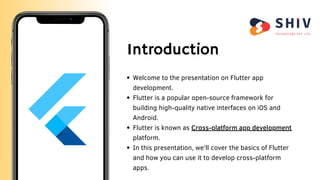
Welcome to the presentation on Flutter app
development.
Flutter is a popular open-source framework for
building high-quality native interfaces on iOS and
Android.
Flutter is known as Cross-platform app development
platform.
In this presentation, we'll cover the basics of Flutter
and how you can use it to develop cross-platform
apps.
What is Flutter?
Flutter is a UI framework developed by Google.
It allows developers to build beautiful and high-performance applications for multiple platforms from
a single codebase.
Flutter uses a reactive and declarative programming style, making it easier to build and maintain
complex user interfaces.
Advantages
of Flutter
Hot Reload: Flutter's hot reload feature enables developers to see changes
instantly, speeding up the development process.
Cross-Platform Development: Write once, run anywhere. Flutter apps can be
compiled to run on iOS, Android, web, desktop, and more.
Beautiful UI: Flutter offers a rich set of customizable widgets to create stunning
user interfaces.
Fast Performance: Flutter's performance is comparable to native apps, thanks to its
use of the Dart programming language and a high-performance rendering engine.
Open-Source Community: Flutter has a thriving open-source community, providing
a wealth of libraries, packages, and resources.
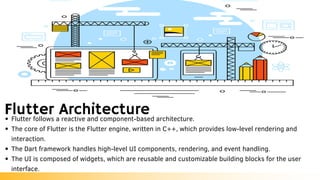
Flutter Architecture
Flutter follows a reactive and component-based architecture.
The core of Flutter is the Flutter engine, written in C++, which provides low-level rendering and
interaction.
The Dart framework handles high-level UI components, rendering, and event handling.
The UI is composed of widgets, which are reusable and customizable building blocks for the user
interface.
Dart Programming Language
Flutter uses the Dart programming language.
Dart is a modern, object-oriented language with features like type inference, garbage collection,
and asynchronous programming.
It has a clean syntax and is easy to learn for developers coming from other programming
languages.
Networking and Data Management
Flutter has built-in support for making HTTP requests and handling network communication.
It offers packages like Dio and http for making API calls.
For state management, Flutter provides options like Provider, BLoC, and Redux, allowing you to
manage app state efficiently.
Testing and Debugging
Flutter provides a suite of testing tools for unit testing, integration testing, and widget testing.
The Flutter framework integrates with popular testing frameworks like Mockito and Flutter
Driver.
The Dart devtools provide debugging and profiling tools for optimizing app performance.
Deployment and Distribution
Flutter apps can be compiled to native code and distributed through app stores like Google Play
Store and Apple App Store.
The Flutter tooling provides commands to build release versions of the app for different platforms.
Continuous integration and delivery (CI/CD) pipelines can be set up to automate the build and
distribution process.
Conclusion
Flutter is a powerful framework for developing cross-platform apps.
It offers a rich set of features, excellent performance, and a supportive community.
Get started with Flutter today and build amazing applications!
Thank You!
Phone Number
+1 (647) 510-0106
Email Address
contact@shivlab.com
Website
www.shivlab.com
Contact Information
HOW TO REACH OUT
WWW.SHIVLAB.COM

Flutter App Development Building Cross-Platform Apps.pdf

  • 1.
  • 2.
    Introduction What is Flutter? Advantagesof Flutter Flutter Architecture Dart Programming Language Networking and Data Management Testing and Debugging Deployment and Distribution Conclusion Thank You Table of Contents
  • 3.
    Introduction Welcome to thepresentation on Flutter app development. Flutter is a popular open-source framework for building high-quality native interfaces on iOS and Android. Flutter is known as Cross-platform app development platform. In this presentation, we'll cover the basics of Flutter and how you can use it to develop cross-platform apps.
  • 4.
    What is Flutter? Flutteris a UI framework developed by Google. It allows developers to build beautiful and high-performance applications for multiple platforms from a single codebase. Flutter uses a reactive and declarative programming style, making it easier to build and maintain complex user interfaces.
  • 5.
    Advantages of Flutter Hot Reload:Flutter's hot reload feature enables developers to see changes instantly, speeding up the development process. Cross-Platform Development: Write once, run anywhere. Flutter apps can be compiled to run on iOS, Android, web, desktop, and more. Beautiful UI: Flutter offers a rich set of customizable widgets to create stunning user interfaces. Fast Performance: Flutter's performance is comparable to native apps, thanks to its use of the Dart programming language and a high-performance rendering engine. Open-Source Community: Flutter has a thriving open-source community, providing a wealth of libraries, packages, and resources.
  • 6.
    Flutter Architecture Flutter followsa reactive and component-based architecture. The core of Flutter is the Flutter engine, written in C++, which provides low-level rendering and interaction. The Dart framework handles high-level UI components, rendering, and event handling. The UI is composed of widgets, which are reusable and customizable building blocks for the user interface.
  • 7.
    Dart Programming Language Flutteruses the Dart programming language. Dart is a modern, object-oriented language with features like type inference, garbage collection, and asynchronous programming. It has a clean syntax and is easy to learn for developers coming from other programming languages.
  • 8.
    Networking and DataManagement Flutter has built-in support for making HTTP requests and handling network communication. It offers packages like Dio and http for making API calls. For state management, Flutter provides options like Provider, BLoC, and Redux, allowing you to manage app state efficiently.
  • 9.
    Testing and Debugging Flutterprovides a suite of testing tools for unit testing, integration testing, and widget testing. The Flutter framework integrates with popular testing frameworks like Mockito and Flutter Driver. The Dart devtools provide debugging and profiling tools for optimizing app performance.
  • 10.
    Deployment and Distribution Flutterapps can be compiled to native code and distributed through app stores like Google Play Store and Apple App Store. The Flutter tooling provides commands to build release versions of the app for different platforms. Continuous integration and delivery (CI/CD) pipelines can be set up to automate the build and distribution process.
  • 11.
    Conclusion Flutter is apowerful framework for developing cross-platform apps. It offers a rich set of features, excellent performance, and a supportive community. Get started with Flutter today and build amazing applications! Thank You!
  • 12.
    Phone Number +1 (647)510-0106 Email Address contact@shivlab.com Website www.shivlab.com Contact Information HOW TO REACH OUT WWW.SHIVLAB.COM