A Practical Approach to

Large Scale Agile Development
Gary Gruver
Nov 1, 2013
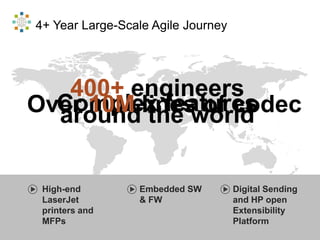
4+ Year Large-Scale Agile Journey

400+ engineers
Complex features
Over 10M lines of codec
around the world
High-end
LaserJet
printers and
MFPs

Embedded SW
& FW

Digital Sending
and HP open
Extensibility
Platform
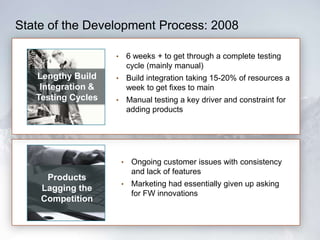
State of the Development Process: 2008
•

Lengthy Build
Integration &
Testing Cycles

6 weeks + to get through a complete testing
cycle (mainly manual)

•

Build integration taking 15-20% of resources a
week to get fixes to main

•

Manual testing a key driver and constraint for
adding products

•

Products
Lagging the
Competition

Ongoing customer issues with consistency
and lack of features

•

Marketing had essentially given up asking
for FW innovations
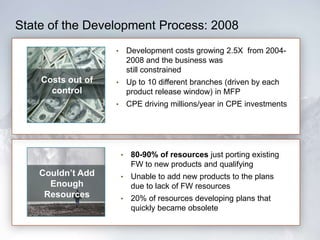
State of the Development Process: 2008
•

•

Up to 10 different branches (driven by each
product release window) in MFP

•

Costs out of
control

Development costs growing 2.5X from 20042008 and the business was
still constrained

CPE driving millions/year in CPE investments

•

Couldn’t Add
Enough
Resources

80-90% of resources just porting existing
FW to new products and qualifying

•

Unable to add new products to the plans
due to lack of FW resources

•

20% of resources developing plans that
quickly became obsolete
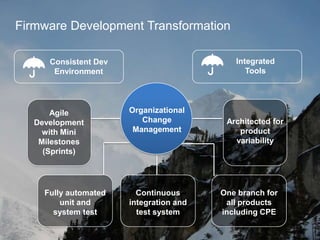
Firmware Development Transformation
Integrated
Tools

Consistent Dev
Environment

Agile
Development
with Mini
Milestones
(Sprints)

Fully automated
unit and
system test

Organizational
Change
Management

Continuous
integration and
test system

Architected for
product
variability

One branch for
all products
including CPE
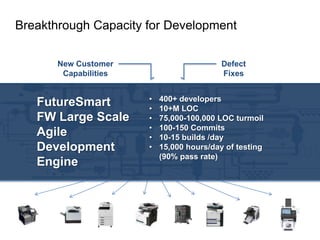
Breakthrough Capacity Transformation
Firmware Development for Development
New Customer
Capabilities

FutureSmart
FW Large Scale
Agile
Development
Engine

Defect
Fixes
•
•
•
•
•
•

400+ developers
10+M LOC
75,000-100,000 LOC turmoil
100-150 Commits
10-15 builds /day
15,000 hours/day of testing
(90% pass rate)
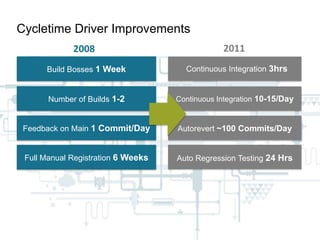
Cycletime Driver Improvements
2008

2011

Build Bosses 1 Week

Continuous Integration 3hrs

Number of Builds 1-2

Continuous Integration 10-15/Day

Feedback on Main 1 Commit/Day

Autorevert ~100 Commits/Day

Full Manual Registration 6 Weeks

Auto Regression Testing 24 Hrs
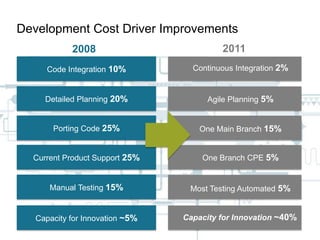
Development Cost Driver Improvements
2008

2011

Code Integration 10%

Continuous Integration 2%

Detailed Planning 20%

Agile Planning 5%

Porting Code 25%

One Main Branch 15%

Current Product Support 25%

One Branch CPE 5%

Manual Testing 15%

Most Testing Automated 5%

Capacity for Innovation ~5%

Capacity for Innovation ~40%
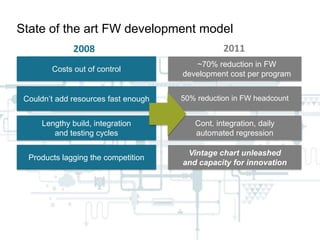
State of the art FW development model
2008

2011

Costs out of control

~70% reduction in FW
development cost per program

Couldn’t add resources fast enough

50% reduction in FW headcount

Lengthy build, integration
and testing cycles

Cont. integration, daily
automated regression

Products lagging the competition

Vintage chart unleashed
and capacity for innovation
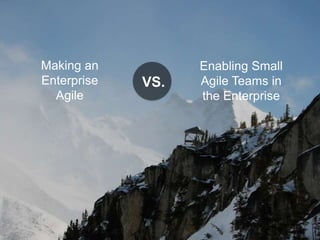
Making an
Enterprise
Agile

VS.

Enabling Small
Agile Teams in
the Enterprise
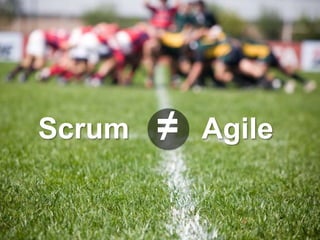
Scrum

≠

Agile
Water Scrum

Fall
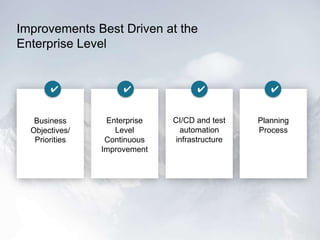
Improvements Best Driven at the
Enterprise Level

✔

Business
Objectives/
Priorities

✔

Enterprise
Level
Continuous
Improvement

✔

✔

CI/CD and test
automation
infrastructure

Planning
Process
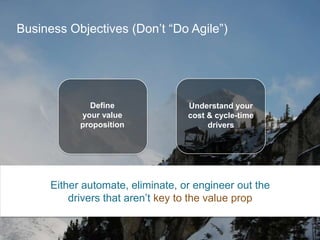
Business Objectives (Don’t “Do Agile”)

Define
your value
proposition

Understand your
cost & cycle-time
drivers

Either automate, eliminate, or engineer out the
drivers that aren’t key to the value prop
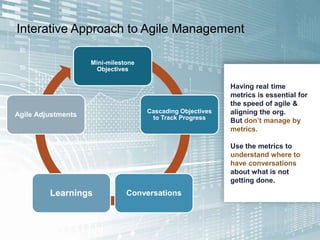
Interative Approach to Agile Management
Mini-milestone
Objectives

Agile Adjustments

Cascading Objectives
to Track Progress

Having real-time
metrics is essential for
the speed of agile &
aligning the org.
But don’t manage by
metrics.
Use the metrics to
understand where to
have conversations
about what is not
getting done.

Learnings

Conversations
Finding the offending code
What Code?
When? Are you
sure it wasn’t Bob?
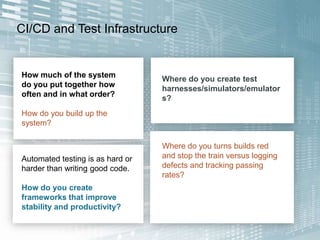
CI/CD and Test Infrastructure

How much of the system
do you put together how
often and in what order?

Where do you create test
harnesses/simulators/emulator
s?

How do you build up the
system?

Automated testing is as hard or
harder than writing good code.
How do you create
frameworks that improve
stability and productivity?

Where do you turns builds red
and stop the train versus logging
defects and tracking passing
rates?
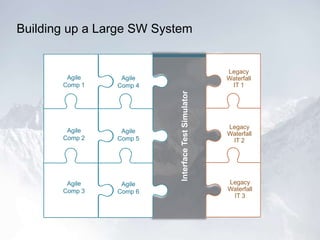
Building up a Large SW System

Agile
Comp 4

Agile
Comp 2

Agile
Comp 5

Agile
Comp 3

Agile
Comp 6

Legacy
Waterfall
IT 1

Interface Test Simulator

Agile
Comp 1

Legacy
Waterfall
IT 2

Legacy
Waterfall
IT 3
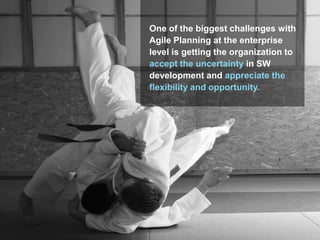
One of the biggest challenges with
Agile Planning at the enterprise
level is getting the organization to
accept the uncertainty in SW
development and appreciate the
flexibility and opportunity.
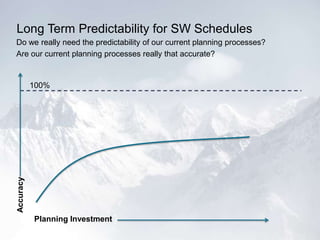
Long Term Predictability for SW Schedules
Do we really need the predictability of our current planning processes?
Are our current planning processes really that accurate?

Accuracy

100%

Planning Investment
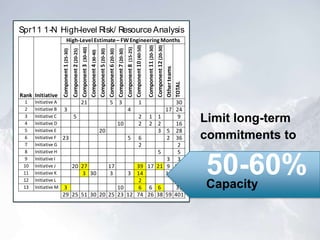
Spr11 1-N High-level Risk/ Resource Analysis

1
2
3
4
5
6
7
8
9
10
11
12
13

Initiative A
21
5 3
Initiative B 3
4
Initiative C
5
Initiative D
10
Initiative E
20
Initiative F 23
5
Initiative G
Initiative H
Initiative I
Initiative J
20 27
17
Initiative K
3 30
3
3
Initiative L
Initiative M 3
10

Component 12 (20-30)
Other teams
TOTAL

Component 11 (20-30)

Component 8 (15-25)
Component 10 (40-50)

Component 7 (20-30)

Component 6 (20-30)

Component 5 (20-30)

Component 4 (30-40)

Component 3 (30-40)

Component 2 (20-25)

Rank Initiative

Component 1 (25-30)

High-Level Estimate – FW Engineering Months

1
17
2
2
6
2

1 1
2 2
3 5
2
5

3
39 17 21 9
14
12
2
6 6 6
29 25 51 30 20 25 23 12 74 26 38 59

30
24
9
16
28
36
2
5
3
150
65
2
31
401

Limit long-term
commitments to

50-60%
Capacity
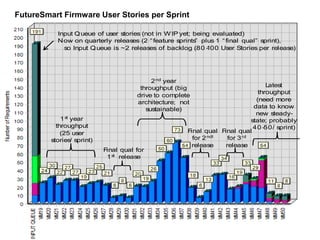
FutureSmart Firmware per Sprint
FutureSmart Firmware User Stories User Stories per

Sprint

Input Q ueue of user stories (not in W IP yet; being evaluated)
N ow on quarterly releases (2 “ feature sprints plus 1 “ final qual” sprint),
”
so Input Q ueue is ~2 releases of backlog (80 - 00 User Stories per release)
1

2 nd year
throughput (big
drive to complete
architecture; not
sustainable)
1 st year
throughput
(25 user
stories/ sprint)
F
inal qual for
1 st release

L
atest
throughput
(need more
data to know
new steadystate; probably
40 -50/ sprint)
F
inal qual F
inal qual
for 2 ndt
for 3 rd
release
release
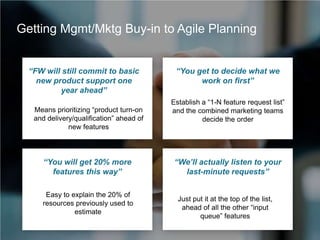
Getting Mgmt/Mktg Buy-in to Agile Planning

“FW will still commit to basic
new product support one
year ahead”
Means prioritizing “product turn-on
and delivery/qualification” ahead of
new features

“You will get 20% more
features this way”
Easy to explain the 20% of
resources previously used to
estimate

“You get to decide what we
work on first”
Establish a “1-N feature request list”
and the combined marketing teams
decide the order

“We’ll actually listen to your
last-minute requests”

Just put it at the top of the list,
ahead of all the other “input
queue” features
A Practical Approach to

Large Scale Agile Development
E-mail: gbgruver@gmail.com
Blog: largescaleagile.com
Twitter: @GRUVERGary

FlowCon 2013 Conference

  • 1.
    A Practical Approachto Large Scale Agile Development Gary Gruver Nov 1, 2013
  • 2.
    4+ Year Large-ScaleAgile Journey 400+ engineers Complex features Over 10M lines of codec around the world High-end LaserJet printers and MFPs Embedded SW & FW Digital Sending and HP open Extensibility Platform
  • 3.
    State of theDevelopment Process: 2008 • Lengthy Build Integration & Testing Cycles 6 weeks + to get through a complete testing cycle (mainly manual) • Build integration taking 15-20% of resources a week to get fixes to main • Manual testing a key driver and constraint for adding products • Products Lagging the Competition Ongoing customer issues with consistency and lack of features • Marketing had essentially given up asking for FW innovations
  • 4.
    State of theDevelopment Process: 2008 • • Up to 10 different branches (driven by each product release window) in MFP • Costs out of control Development costs growing 2.5X from 20042008 and the business was still constrained CPE driving millions/year in CPE investments • Couldn’t Add Enough Resources 80-90% of resources just porting existing FW to new products and qualifying • Unable to add new products to the plans due to lack of FW resources • 20% of resources developing plans that quickly became obsolete
  • 5.
    Firmware Development Transformation Integrated Tools ConsistentDev Environment Agile Development with Mini Milestones (Sprints) Fully automated unit and system test Organizational Change Management Continuous integration and test system Architected for product variability One branch for all products including CPE
  • 6.
    Breakthrough Capacity Transformation FirmwareDevelopment for Development New Customer Capabilities FutureSmart FW Large Scale Agile Development Engine Defect Fixes • • • • • • 400+ developers 10+M LOC 75,000-100,000 LOC turmoil 100-150 Commits 10-15 builds /day 15,000 hours/day of testing (90% pass rate)
  • 7.
    Cycletime Driver Improvements 2008 2011 BuildBosses 1 Week Continuous Integration 3hrs Number of Builds 1-2 Continuous Integration 10-15/Day Feedback on Main 1 Commit/Day Autorevert ~100 Commits/Day Full Manual Registration 6 Weeks Auto Regression Testing 24 Hrs
  • 8.
    Development Cost DriverImprovements 2008 2011 Code Integration 10% Continuous Integration 2% Detailed Planning 20% Agile Planning 5% Porting Code 25% One Main Branch 15% Current Product Support 25% One Branch CPE 5% Manual Testing 15% Most Testing Automated 5% Capacity for Innovation ~5% Capacity for Innovation ~40%
  • 9.
    State of theart FW development model 2008 2011 Costs out of control ~70% reduction in FW development cost per program Couldn’t add resources fast enough 50% reduction in FW headcount Lengthy build, integration and testing cycles Cont. integration, daily automated regression Products lagging the competition Vintage chart unleashed and capacity for innovation
  • 10.
  • 11.
  • 12.
  • 13.
    Improvements Best Drivenat the Enterprise Level ✔ Business Objectives/ Priorities ✔ Enterprise Level Continuous Improvement ✔ ✔ CI/CD and test automation infrastructure Planning Process
  • 14.
    Business Objectives (Don’t“Do Agile”) Define your value proposition Understand your cost & cycle-time drivers Either automate, eliminate, or engineer out the drivers that aren’t key to the value prop
  • 15.
    Interative Approach toAgile Management Mini-milestone Objectives Agile Adjustments Cascading Objectives to Track Progress Having real-time metrics is essential for the speed of agile & aligning the org. But don’t manage by metrics. Use the metrics to understand where to have conversations about what is not getting done. Learnings Conversations
  • 17.
    Finding the offendingcode What Code? When? Are you sure it wasn’t Bob?
  • 18.
    CI/CD and TestInfrastructure How much of the system do you put together how often and in what order? Where do you create test harnesses/simulators/emulator s? How do you build up the system? Automated testing is as hard or harder than writing good code. How do you create frameworks that improve stability and productivity? Where do you turns builds red and stop the train versus logging defects and tracking passing rates?
  • 19.
    Building up aLarge SW System Agile Comp 4 Agile Comp 2 Agile Comp 5 Agile Comp 3 Agile Comp 6 Legacy Waterfall IT 1 Interface Test Simulator Agile Comp 1 Legacy Waterfall IT 2 Legacy Waterfall IT 3
  • 20.
    One of thebiggest challenges with Agile Planning at the enterprise level is getting the organization to accept the uncertainty in SW development and appreciate the flexibility and opportunity.
  • 21.
    Long Term Predictabilityfor SW Schedules Do we really need the predictability of our current planning processes? Are our current planning processes really that accurate? Accuracy 100% Planning Investment
  • 22.
    Spr11 1-N High-levelRisk/ Resource Analysis 1 2 3 4 5 6 7 8 9 10 11 12 13 Initiative A 21 5 3 Initiative B 3 4 Initiative C 5 Initiative D 10 Initiative E 20 Initiative F 23 5 Initiative G Initiative H Initiative I Initiative J 20 27 17 Initiative K 3 30 3 3 Initiative L Initiative M 3 10 Component 12 (20-30) Other teams TOTAL Component 11 (20-30) Component 8 (15-25) Component 10 (40-50) Component 7 (20-30) Component 6 (20-30) Component 5 (20-30) Component 4 (30-40) Component 3 (30-40) Component 2 (20-25) Rank Initiative Component 1 (25-30) High-Level Estimate – FW Engineering Months 1 17 2 2 6 2 1 1 2 2 3 5 2 5 3 39 17 21 9 14 12 2 6 6 6 29 25 51 30 20 25 23 12 74 26 38 59 30 24 9 16 28 36 2 5 3 150 65 2 31 401 Limit long-term commitments to 50-60% Capacity
  • 23.
    FutureSmart Firmware perSprint FutureSmart Firmware User Stories User Stories per Sprint Input Q ueue of user stories (not in W IP yet; being evaluated) N ow on quarterly releases (2 “ feature sprints plus 1 “ final qual” sprint), ” so Input Q ueue is ~2 releases of backlog (80 - 00 User Stories per release) 1 2 nd year throughput (big drive to complete architecture; not sustainable) 1 st year throughput (25 user stories/ sprint) F inal qual for 1 st release L atest throughput (need more data to know new steadystate; probably 40 -50/ sprint) F inal qual F inal qual for 2 ndt for 3 rd release release
  • 24.
    Getting Mgmt/Mktg Buy-into Agile Planning “FW will still commit to basic new product support one year ahead” Means prioritizing “product turn-on and delivery/qualification” ahead of new features “You will get 20% more features this way” Easy to explain the 20% of resources previously used to estimate “You get to decide what we work on first” Establish a “1-N feature request list” and the combined marketing teams decide the order “We’ll actually listen to your last-minute requests” Just put it at the top of the list, ahead of all the other “input queue” features
  • 25.
    A Practical Approachto Large Scale Agile Development E-mail: gbgruver@gmail.com Blog: largescaleagile.com Twitter: @GRUVERGary

Editor's Notes

  • #2 This content should fit the slide set layout and kill the build outStart with architected, go clockwise, then organizational change management
  • #3 This content should fit the slide set layout and kill the build out
  • #8 Fix arrow build
  • #9 I cleaned up some wording
  • #10 Fix arrow build
  • #12 These next two slides got dropped for some reason. I am okay with better slides but I need to keep the content
  • #15 1Understand your value proposition2-Define your cost driversEither automate or engineer out the drivers that aren’t focused on value prop
  • #16 I added some text
  • #17 I need to accuracyvs planning investment graph in here somehow.
  • #18 Katie, can we put a slide here that has a bunch graphic type people where we are trying to find who committed the offending code. I have an idea that might work where we build with colors focusing it down to a smaller group of people and then one person. Start with a hole page of people colored when you are doing qrtly releases. Then focus CI and daily builds down to 5 and then 1 with the build process.
  • #20 I think this would make a good puzzle example.
  • #21 A judo graphic would be nice if it work but I would understand if it does not work with the theme
  • #22 I need to accuracyvs planning investment graph in here somehow.
  • #23 Any way we can focus this slide to have just this concept and this graphic. Limit long term commitments to 50-60% of capacity is a key point here. Not sure how to do this but I am just putting out the key context for your design flexibility
  • #24 Any way we can focus this slide to have just this concept and this graphic.