Division of Telecommunications
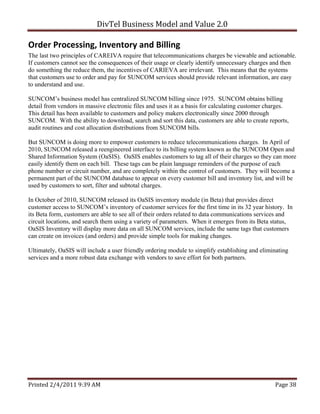
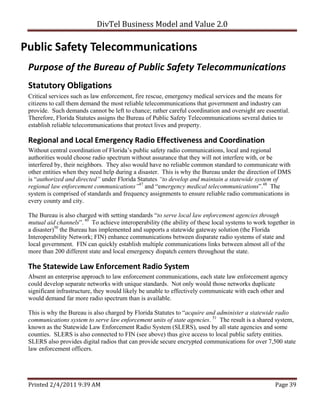
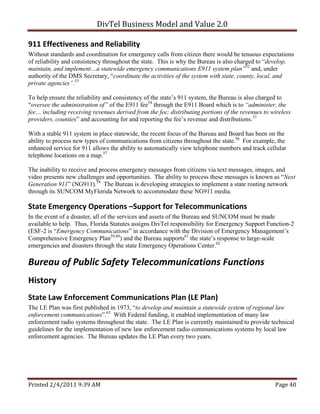
  Business Model and Value
        1st Edition,
                  Version 2.0
DivTel Business Model and Value 2.0 


Table of Contents 
 Table of Contents .......................................................................................................................................................... 2 
 Executive Summary ...................................................................................................................................................... 4 
 General Document Layout ............................................................................................................................................ 6 
 SUNCOM Telecommunications Services .................................................................................................................... 8 
    SUNCOM’s Functions .............................................................................................................................. 8 
        History .................................................................................................................................................. 8 
        Services ............................................................................................................................................... 14 
        Customers ........................................................................................................................................... 18 
        Standards ............................................................................................................................................. 20 
        Unbillable Support of the Florida Government Enterprise ................................................................. 20 
    SUNCOM’s Purpose ............................................................................................................................... 23 
        Enterprise Cost Savings ...................................................................................................................... 23 
        Interoperability .................................................................................................................................... 26 
        Security ............................................................................................................................................... 26 
        Accountability, Customer Empowerment and Stakeholder Transparency ......................................... 26 
        Catalyst for Technological Transition................................................................................................. 27 
    SUNCOM’s Approach and Principles .................................................................................................... 28 
        Establishing Standards ........................................................................................................................ 28 
        Developing Services ........................................................................................................................... 28 
        Cost Accounting.................................................................................................................................. 30 
        Order Processing, Inventory and Billing............................................................................................. 38 
 Public Safety Telecommunications ............................................................................................................................. 39 
    Purpose of the Bureau of Public Safety Telecommunications ................................................................ 39 
        Statutory Obligations .......................................................................................................................... 39 
    Bureau of Public Safety Telecommunications Functions ....................................................................... 40 
        History ................................................................................................................................................ 40 
        Services ............................................................................................................................................... 42 
    How the Bureau of Public Safety Telecommunications Performs Its Mission ....................................... 45 
        Leveraging SUNCOM ........................................................................................................................ 45 
        Planning .............................................................................................................................................. 46 
        Keeping in Touch ................................................................................................................................ 46 

 Printed 2/4/2011 9:39 AM                                                                                                                               Page 2 
DivTel Business Model and Value 2.0 
       Balancing Needs versus Cost .............................................................................................................. 46 
       Engineering for Reliability with Performance Standards ................................................................... 47 
       Specialized software and data management tools ............................................................................... 47 
       Coordination ....................................................................................................................................... 47 
       Partnerships with Government and Industry ....................................................................................... 47 
       Committees ......................................................................................................................................... 48 
       Testing and Inspecting ........................................................................................................................ 48 
       Training ............................................................................................................................................... 48 
Future of Telecommunications in Florida Government .............................................................................................. 49 
   Technology Convergence ....................................................................................................................... 49 
       Technology Convergence Opportunities for the Enterprise................................................................ 49 
   Convergence of Wireless ........................................................................................................................ 53 
   911 Modernization .................................................................................................................................. 55 
       SLERS Coverage Improvements ........................................................................................................ 55 
       Need for Telecommunications Convergence for Public Safety .......................................................... 56 
   Network Convergence ............................................................................................................................ 58 
       Intelligent Transportation System (ITS) ............................................................................................. 58 
       Florida LambdaRail (FLR) ................................................................................................................. 58 
       How Florida’s Telecommunications Assets could be Optimized ....................................................... 59 
       Local and Regional Governments ....................................................................................................... 60 
   Extending Customer Empowerment ....................................................................................................... 60 
   Enhancing Florida’ Economic Competitiveness with Broadband .......................................................... 61 
       DMS’s Broadband Statutory Mandate ................................................................................................ 61 
       General Strategy.................................................................................................................................. 61 
       Consensus Building and Partnerships ................................................................................................. 61 
       Mapping .............................................................................................................................................. 62 
       Broadband Strategic Planning ............................................................................................................. 62 
       E-rate Assistance to Schools and Libraries ......................................................................................... 63 
Table of Attachments .................................................................................................................................................. 64 
Endnotes...................................................................................................................................................................... 96 


Printed 2/4/2011 9:39 AM                                                                                                                              Page 3 
DivTel Business Model and Value 2.0 

Executive Summary 
 The Division of Telecommunications within the Department of Management Services provides
 Florida government enterprise level telecommunications strategic planning and services in two
 broad categories:

    1) Voice, data and conferencing communications services for government under the brand
       name SUNCOM.

    2) Planning, coordinating and fostering effective public safety telecommunications
       throughout the state at all levels of government.

 SUNCOM’s primary purpose is to reduce costs and minimize unnecessary usage of
 telecommunications services for the State of Florida. It achieves this from economies of scale,
 volume discounts, reducing vendor costs and risks, pooling services and focused expertise on
 getting the best value. Using product design and cost accounting techniques and a robust
 inventory/billing system, SUNCOM brings transparency, accountability and incentives to
 motivate and empower government customers to save.

 SUNCOM provides a variety of voice, data and conferencing telecommunications services over
 wires and wirelessly for a wide range of public sector customers. SUNCOM’s state agency
 customers are required by Florida Statutes to use SUNCOM, but the Legislature, Judiciary,
 counties, cities, universities and some private nonprofits are patrons as well. For users of its
 services, SUNCOM establishes interoperability and security standards both formally through
 Florida Administrative Code and informally through consolidation of common services.
 SUNCOM also acts as a catalyst for bringing the benefits of technological change through self-
 funded investments without incurring the cost premiums of early adopters and straggling
 participation.

 Despite periodic difficulties, SUNCOM has brought long term savings, innovation and
 standardization to Florida government since 1975. Its strategies have included use of a dedicated
 backbone when the market was restricted and expensive, then dismantling that backbone as
 competition grew. SUNCOM continues to enhance its contribution through its inventory and
 invoicing system, extension of Internet Protocol (IP) technology and further aggregation of
 government telecommunications like mobile services.

 The Bureau of Public Safety Telecommunications has five major statutory mandates:

       Offer a single statewide radio system for use by all state and participating local law
        enforcement officials. The Bureau has met this requirement through the Statewide Law
        Enforcement Radio System (SLERS) under a public/private partnership contract.

       Coordinate Florida’s public safety radio communications so that state, local and regional
        authorities can effectively communicate with assurance that they will not interfere with,
        or be interfered by, their neighbors. The Bureau meets this requirement through settings
        standards and frequency assignments, and providing assistance to local entities.

 Printed 2/4/2011 9:39 AM                                                                  Page 4 
DivTel Business Model and Value 2.0 

      Set standards to enable state and local public safety entities to communicate with each
       other when they need to work together. The Bureau has met this requirement through
       standards for common “mutual aid” channels and by implementing the Florida
       Interoperability Network (FIN) which translates between disparate radio systems
       statewide.

      Develop, enhance, and ensure the reliability and consistency of 911 services throughout
       the state. The Bureau, as the administrative arm of a board for this purpose, has met this
       requirement through setting standards, collecting and distributing funds and developing
       strategic plans for improvement.

      Provide telecommunications support to the state during disasters. DivTel meets this
       requirement by planning and establishing standards of disaster communications and
       making its assets, services and staff available during disasters.

In the future, DivTel faces significant challenges such as dilution of Florida’s enterprise
telecommunications infrastructure, necessary innovation in public safety telecommunications
and the requirement to extend the reach of broadband throughout the state. But with the support
of effective public policies, DivTel has the right strategic approach, resource management
methods and business culture to meet those challenges.


Printed 2/4/2011 9:39 AM                                                                   Page 5 
DivTel Business Model and Value 2.0 


General Document Layout 


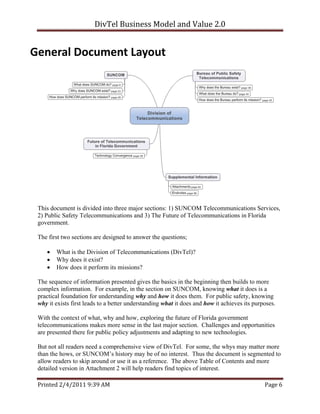
 This document is divided into three major sections: 1) SUNCOM Telecommunications Services,
 2) Public Safety Telecommunications and 3) The Future of Telecommunications in Florida
 government.

 The first two sections are designed to answer the questions;

       What is the Division of Telecommunications (DivTel)?
       Why does it exist?
       How does it perform its missions?

 The sequence of information presented gives the basics in the beginning then builds to more
 complex information. For example, in the section on SUNCOM, knowing what it does is a
 practical foundation for understanding why and how it does them. For public safety, knowing
 why it exists first leads to a better understanding what it does and how it achieves its purposes.

 With the context of what, why and how, exploring the future of Florida government
 telecommunications makes more sense in the last major section. Challenges and opportunities
 are presented there for public policy adjustments and adapting to new technologies.

 But not all readers need a comprehensive view of DivTel. For some, the whys may matter more
 than the hows, or SUNCOM’s history may be of no interest. Thus the document is segmented to
 allow readers to skip around or use it as a reference. The above Table of Contents and more
 detailed version in Attachment 2 will help readers find topics of interest.

 Printed 2/4/2011 9:39 AM                                                                     Page 6 
DivTel Business Model and Value 2.0 

Finally, this document makes extensive use of endnotes that elaborate, give additional
explanations, refer to detailed sources or cite legal authorization. Because such supplemental
information can be a distraction, endnotes rather than footnotes were used and the document is
informative even if they are never read. However, reading endnotes that elaborate is necessary
to achieve a more complete understanding of DivTel. The best way to do so is to separate those
pages to use as a companion document while reading the body.


Printed 2/4/2011 9:39 AM                                                                Page 7 
DivTel Business Model and Value 2.0 

SUNCOM Telecommunications Services 
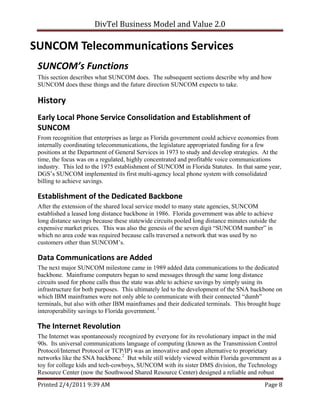
 SUNCOM’s Functions 
 This section describes what SUNCOM does. The subsequent sections describe why and how
 SUNCOM does these things and the future direction SUNCOM expects to take.

 History 
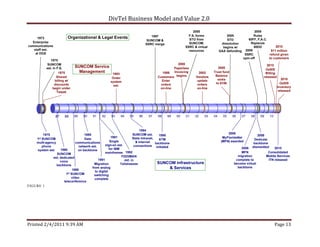
 Early Local Phone Service Consolidation and Establishment of 
 SUNCOM 
 From recognition that enterprises as large as Florida government could achieve economies from
 internally coordinating telecommunications, the legislature appropriated funding for a few
 positions at the Department of General Services in 1973 to study and develop strategies. At the
 time, the focus was on a regulated, highly concentrated and profitable voice communications
 industry. This led to the 1975 establishment of SUNCOM in Florida Statutes. In that same year,
 DGS’s SUNCOM implemented its first multi-agency local phone system with consolidated
 billing to achieve savings.

 Establishment of the Dedicated Backbone 
 After the extension of the shared local service model to many state agencies, SUNCOM
 established a leased long distance backbone in 1986. Florida government was able to achieve
 long distance savings because these statewide circuits pooled long distance minutes outside the
 expensive market prices. This was also the genesis of the seven digit “SUNCOM number” in
 which no area code was required because calls traversed a network that was used by no
 customers other than SUNCOM’s.

 Data Communications are Added 
 The next major SUNCOM milestone came in 1989 added data communications to the dedicated
 backbone. Mainframe computers began to send messages through the same long distance
 circuits used for phone calls thus the state was able to achieve savings by simply using its
 infrastructure for both purposes. This ultimately led to the development of the SNA backbone on
 which IBM mainframes were not only able to communicate with their connected “dumb”
 terminals, but also with other IBM mainframes and their dedicated terminals. This brought huge
 interoperability savings to Florida government. 1

 The Internet Revolution 
 The Internet was spontaneously recognized by everyone for its revolutionary impact in the mid
 90s. Its universal communications language of computing (known as the Transmission Control
 Protocol/Internet Protocol or TCP/IP) was an innovative and open alternative to proprietary
 networks like the SNA backbone.2 But while still widely viewed within Florida government as a
 toy for college kids and tech-cowboys, SUNCOM with its sister DMS division, the Technology
 Resource Center (now the Southwood Shared Resource Center) designed a reliable and robust
 Printed 2/4/2011 9:39 AM                                                                  Page 8 
DivTel Business Model and Value 2.0 
State Intranet using TCP/IP in 1993. It ultimately served all state agencies as a viable business
tool. SUNCOM eventually established several Internet Protocol services on its backbone.

State Technology Office Setback 
The State Technology Office (STO) was created in July of 2000 with the goal of achieving
enterprise efficiencies for state computing. It was initially comprised of the Division of
Communications (SUNCOM’s parent organization) and the Technology Resource Center. STO
was slated to aggregate all Florida government information technology, but was widely viewed
as hastily planned and poorly executed. Hence it was dissolved between 2005 and 2007 through
a series of budgetary and statutory actions.

During the STO era, much of SUNCOM’s funds normally used to design, develop and manage
telecommunications services were repurposed to STO enterprise information technology
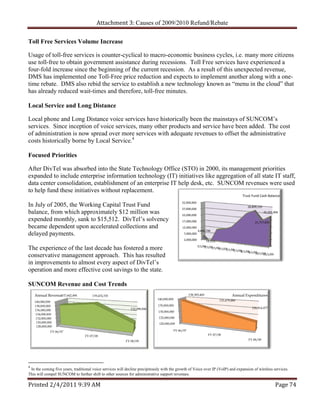
consulting and projects. This depleted SUNCOM’s trust fund, from which approximately $12
million was disbursed monthly, to a balance of $15,500 by July 1, 2005. SUNCOM came
dangerously close to the public sector equivalent of bankruptcy that would have required an
unprecedented cash appropriation to pay SUNCOM vendors.

MyFlorida Network: The MPLS Service 
Despite the loss of some focus in of the STO era, SUNCOM engineers were able to design a
network to use innovative Internet Protocol (IP) technology known as Multi Protocol Label
Switching (MPLS). MPLS held the promise of bringing all of the best features of existing
SUNCOM IP services into one at considerable savings, faster speeds with more capabilities.
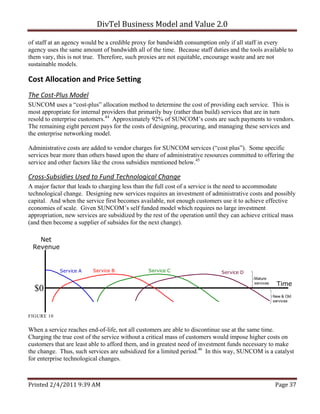
Under the SUNCOM brand known as “MyFloridaNet” (MFN), the MPLS contract was awarded
to AT&T in September 2006 and all customers were migrated by April 2008. MFN has
delivered approximately $14 million in annual cost savings ever since.

Dedicated Backbone Retired 
Simultaneous to implementation of MFN, SUNCOM dismantled its dedicated backbone. The
MFN contract used vendor infrastructure thus needed no state backbone to carry data
communications. And the newly competitive voice long distance market offered prices that
overcame the advantages of internal infrastructure. The dedicated backbone was completely
retired by June 2008 leaving SUNCOM largely reliant upon vendor infrastructure and the
competitively open market.

SUNCOM’s Thriving Contribution 
With rededicated focus on SUNCOM’s core mission it reemerged from the STO era as an
effective enterprise provider. Despite a series of rate reductions3 that included $14 million in
annual savings from MFN, SUNCOM realized additional unexpected savings from
implementation of MFN and elimination of the backbone.4 The SUNCOM trust fund accrued
balances that led to a $10.2 million reduction through rebates and further rate reductions to
customers over calendar year 2010.


Printed 2/4/2011 9:39 AM                                                                    Page 9 
DivTel Business Model and Value 2.0 

Diminished School Support 
In August of 2008, the Department of Education attempted to reprocure the Florida Information
Resource Network (FIRN) without SUNCOM involvement. 5 Prior to that, FIRN was a
SUNCOM service.

As the data communications network for Florida’s schools, FIRN was almost exclusively funded
through federal grants known as “E-rate” (averaging 70%) and a state match (averaging 30%).

In October 2008, vendor bids were submitted to DOE with the lowest being 39.5% higher than
existing SUNCOM services. DOE abandoned the effort and SUNCOM was compelled to
quickly develop a replacement service.

Less than a year later, DOE discontinued providing assistance to schools to help them obtain
these complicated grants and the 2010 General Appropriations Act eliminated direct funding of
FIRN with its state E-rate match in favor of giving those funds directly to schools.

SUNCOM continues to provide E-rated services to schools and libraries that now seek E-rate
grants without DOE assistance. But the assistance must come from billing and engineering staff
that are not experts and have competing duties.

Florida Schools and libraries have applied for over $1.4 billion in funding since inception of the
program. Over half of the funding requests were rejected. In comparison, the state of New York
with a similar student population, received twice the amount of Florida’s E-rate funding in 2009.
Since the beginning of E-rate New York has averaged 13.4% of the national E-rate funding while
Florida has averaged 3.25%.

Order Processing, Billing and Inventory Innovation 
SUNCOM’s centralized order processing, billing and inventory systems have been powerful
tools for controlling telecommunications costs from almost the beginning of SUNCOM.
Customers have been able to obtain detail billing information and place orders electronically
since 1998 and 2000 respectively.

But in 2006 it became clear that, after years of ad hoc development to accommodate the ever
changing SUNCOM portfolio of services, SUNCOM had two choices; 1) implement a wholesale
replacement of these systems with one comprehensive integrated system (commonly called an
Enterprise Resource Planning system or ERP) or 2) reengineer SUNCOM’s foundational
components (“backend”) gradually and implement new user interfaces along the way.

ERPs cost tens of millions of dollars, are very complex, require years to design and develop,
require a risky “flash-cut” implementation (i.e. on a given day, old systems are turned-off when
the ERP is turned-on), and often result in failure.6 SUNCOM chose the other approach by
creating the SUNCOM Open and Shared Information System (OaSIS) using a small team at low
cost and with periodic low-risk release of enhancements.

After two years of reengineering, the first OaSIS user enhancement of SUNCOM bills was
released in April of 2010. A second inventory component was released in Beta in October 2010.
Printed 2/4/2011 9:39 AM                                                                 Page 10 
DivTel Business Model and Value 2.0 
OaSIS has already achieved widespread popularity among agencies with its innovative features
such as the customer ability to permanently tag charges with plain language labels. It will
ultimately empower customers to control charges to an extent that is uncommon to both the
telecommunications industry and ERPs.

A Complete Mobile Telecommunications Offering 
Near the end of the STO era, DMS management decided to offer mobile telecommunications
services through two different DMS divisions. SUNCOM provided smart phones and air cards
while the Division of Purchasing established a State Term Contract for standard cell phones.

This diluted enterprise purchasing leverage and economies of scale, and gave the state no central
repository of mobile services usage and costs. 7 Worse yet, the distinction between smart phones
and cell phones became increasingly difficult thus obscuring the assignment of these services
between the two divisions.

In 2009, DMS decided to consolidate these services under SUNCOM under its existing authority
to provide enterprise telecommunications. This led to the release of SUNCOM’s Mobile
Telecommunications Services Invitation to Negotiate in September of 2010. Through this
procurement and use of OaSIS, SUNCOM expects to implement a contract akin to a “family
plan” for all enterprise mobile charges in which call minutes are cheap, few of them are wasted
and all of them are accountable.

Federal Support for Expanding Broadband 
In 2008, a new Federal program was established to expand consumer and institutional access to
broadband. This program was initially funded for a nationwide inventory of broadband to be
followed with grants to expand it. States were to coordinate their respective efforts and DMS
was chosen to do so during the 2009 Legislative Session through establishment of Section
364.0135 F.S.8

In December of 2009, DMS was awarded $2,568,458 to establish a statewide inventory of
broadband services. The funding has provided for an online mapping system that is accessible to
the public at www.connect-florida.org.

In September, 2010 DMS was awarded another $6,308,570 to establish the “Broadband Florida”
initiative to be managed by a “Broadband Program Office” (BPO). The BPO will

      Continue the broadband inventory and mapping project through the year 2014.

      Manage the development and implementation of Regional Broadband Planning project in
       partnership with Florida’s 11 Regional Planning Councils (RPCs). Using regional
       planning processes, toolkits and training, the project will inventory local and regional
       broadband assets and demand. The process will be inclusive of residents and businesses,
       and local, regional and state institutions.


Printed 2/4/2011 9:39 AM                                                                 Page 11 
DivTel Business Model and Value 2.0 

      Establish a Florida E-Rate Team to assist and coordinate support to schools, libraries and
       health care entities that seek Federal grants provided through Universal Service Fund
       programs such as E-rate.

      Establish a Broadband Grant Team that will coordinate and support Florida anchor
       institutions seeking to identify and apply for grant opportunities to expand the availability
       and use of broadband services at lower costs.

      Assess the 180 Florida public libraries in rural and underserved communities to identify
       gaps where support is lacking for libraries in their grant funding applications.


Printed 2/4/2011 9:39 AM                                                                   Page 12 
DivTel Business Model and Value 2.0 


FIGURE 1


Printed 2/4/2011 9:39 AM                                           Page 13 
DivTel Business Model and Value 2.0 


Services 
Abbreviated Service List 

Voice
    Local Phone Service (Centrex)
    Long Distance Phone Services
    Toll-Free Phone Services
    STEPS
Data
    MyFloridaNet (MFN)
    Metropolitan Area Network (GMAN)
    Remote Broadband Services (RBS)
    Florida Internet Resource Network (FIRN)
    Southwood Shared Resource Center (SSRC) Ports
    Other Data Services
Conferencing
    Reservationless Voice Conference Services
    Video Conference Services
    Web Conference Services
Infrastructure
    Telecommunications Infrastructure Project Services (TIPS)
Mobile
    Wireless Data Services
    Smart Phones

Detailed Service List 
Voice 
Local Phone Service (Centrex) 
SUNCOM provides local phone access primarily through a service known as “CENTREX”. In
addition to providing toll free local calling within each Local Access Transport Area (LATA),
CENTREX provides features and options like access to SUNCOM’s long distance service, caller
ID, voice mail, call forwarding, etc. Incumbent Local Exchange Carriers (ILECs) such as
AT&T, CenturyLink and Verizon provide this SUNCOM Local Service within their designated
LATAs.

SUNCOM’s local service also provides alternatives to CENTREX for customers that own and
maintain switching equipment on site known as Private Branch Exchanges (PBXs; see “STEPS”
on page 15) move some of the functions and features from telephone company facilities to the
customer’s site. This allows customers to use fewer access lines, or “trunk” lines that share

Printed 2/4/2011 9:39 AM                                                             Page 14 
DivTel Business Model and Value 2.0 
access among their staff. PBXs also give customers more direct control over features such as
voice mail and call routing within their organization.

Long Distance Phone Services 
SUNCOM Long Distance Service allows local service customers to place calls outside a local
area (known as a Local Access and Transport Area or LATA) throughout the United States and
Internationally. For large customers, SUNCOM can provide “Dedicated” circuits to make long
distance calls. Smaller customers use SUNCOM’s “Switched” Long Distance at a slightly
higher price.

Toll‐Free Phone Services 
SUNCOM offers customers the ability to establish in-bound toll free services with available
"vanity" phone numbers. Customers can establish toll free numbers for in-state, national and
(limited) international toll free calls. Offered with many enhanced service feature options, this
SUNCOM service terminates on local telephone lines/trunks and handled like any other
incoming telephone call.

STEPS 
The SUNCOM Telecommunications Equipment on-Premise Service (STEPS) offers telephone
switching equipment known as Private Branch Exchanges (PBXs) at the customer’s site. PBXs
move some of the functions and features from telephone company facilities to the customer’s
site. This allows customers to use fewer access lines, or “trunk” lines that share access among
their staff. PBXs also give customers more direct control over features such as voice mail and
call routing within their organization. PBXs have been around from near the beginning of
telephone services but modern PBXs almost exclusively provide Voice over IP (see “Voice over
IP (VoIP)” on page 51).

STEPS partners include Avaya, Cisco and Siemens.

Data 
MyFloridaNet (MFN) 
The technology at the core of MFN, known as Multi-Protocol Label Switching (MPLS,) is
considered the current standard for the best enterprise data networks. When MFN was
implemented through SUNCOM, it combined all of the best features of several SUNCOM’s data
services into one, with more features, better security, and higher reliability at lower cost.
Through MFN, customers can get equipment and local access to a dedicated enterprise network
for one price with the independent ability design and manage their sub-networks, make
connections, and monitor their security, regardless of their location within the state.

Metropolitan Area Network (GMAN)  
SUNCOM’s Metropolitan Area Network (GMAN) provides the Tallahassee area multi-site,
high-speed networking/connectivity between user local area networks (LANs), with controlled
gateways to common state applications and connects them to wider area networks such as MFN.


Printed 2/4/2011 9:39 AM                                                                   Page 15 
DivTel Business Model and Value 2.0 
The GMAN service is currently available in the Tallahassee area only through CenturyLink,
where the majority of SUNCOM customers are headquartered.

Remote Broadband Services (RBS) 
SUNCOM’s Remote Broadband Service (RBS) provides customers access to the Internet from
locations outside large customer offices. RBS utilizes the latest broadband “best-effort”
transport technologies common to the consumer (rather than the business) market. RBS provides
cost-effective remote broadband access via Digital Subscriber Lines (DSLs), which is digital
data transmission over the wires of a local telephone network. Eligible SUNCOM customers
working from small offices and homes will be able to connect via the Internet to work-related
resources.

Florida Internet Resource Network (FIRN) 
FIRN provides a data communications to K-12 schools. Schools pay for FIRN services almost
exclusively through federal subsidies known as “E-rate” (averaging 70%) and a state match
(averaging 30%).

E-Rate subsidies come from the Universal Service Fund (USF) which is financed through fees
charged to every user of telecommunications services throughout the USA. Erate is one of four
support programs funded through a USF fees charged through companies that provide interstate
and/or international telecommunications services.

FIRN uses the MFN infrastructure provided by AT&T but includes some E-Rate qualified
features, like email and special filtering, that are not a part of MFN.


Southwood Shared Resource Center (SSRC) Ports 
Because the SSRC and DivTel were a part of one organization in the past and collaborated to
provide some integrated services (e.g. the SSRC housed the hub of the State SNA backbone and
the State Internet firewall), SUNCOM provided data communications services to the SSRC and
its customers within the SSRC facility. This relationship is unique because SUNCOM’s
statutory authority and business model do not include services beyond the point (the router)
where a building or campus connect to the State Network. This SUNCOM service was codified
in the 2010 General Appropriations Act and SUNCOM is now required to meter usage (rather
than charge flat fees).9

Other Data Services 
SUNCOM also provides a small quantity of other services that are small and/or near end-of-life
like centralized Fax, Router (a legacy service known as Routed Transport Service, State of
Florida Internet Access (SOFIA) and Local Area Network port management at the Capital
Center Office Complex (where DMS is housed).


Printed 2/4/2011 9:39 AM                                                               Page 16 
DivTel Business Model and Value 2.0 

Conferencing 
Reservationless Voice Conference Services 
SUNCOM Reservationless Voice Conference Services gives on-demand conferencing, 24 hours
a day, 7 days a week for up to 125 participants without the need to make a reservation.

Video Conference Services 
SUNCOM provides video bridging and gateway services which enable real time audio and video
interaction between three or more locations equipped with video conference equipment.

Web Conference services  
Web Conferencing is used to conduct live meetings, training, or presentations via the Internet.
This enables customers to share projects, data, presentations, and ideas from and to any computer
connected to the Internet and a telephone.

Infrastructure 
Telecommunications Infrastructure Project Services (TIPS) 
TIPS assists customers in procuring, installing and project managing telecommunications
infrastructure (e.g., cabling and wires) for communication services, including voice, data, video,
Close Circuit TV, imaging, and wireless LAN within a building or campus. TIPS establishes
contracts and monitors performance of installation vendors, and simplifies contracting and
project management with a single point of contact from start to finish.

Mobile 
Wireless Data Services 
SUNCOM’s Aircard service enables laptop computers to mobile access the Internet or the State
Network through SUNCOM’s secure and encrypted Virtual Private Network service.
SUNCOM’s mobile services partners include AT&T, Sprint and Verizon.

Smart Phones 
SUNCOM’s Smartphone contracts provide more robust SUNCOM sanctioned alternatives to the
State Term contract for cell phones. SUNCOM’s mobile services partners include AT&T, Sprint
and Verizon.


Printed 2/4/2011 9:39 AM                                                                  Page 17 
DivTel Business Model and Value 2.0 

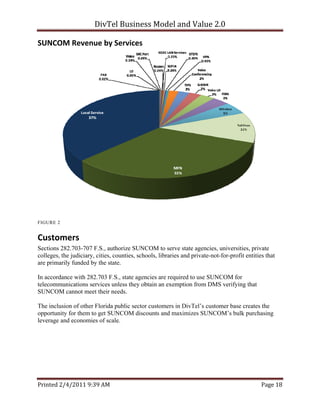
SUNCOM Revenue by Services 


FIGURE 2


Customers 
Sections 282.703-707 F.S., authorize SUNCOM to serve state agencies, universities, private
colleges, the judiciary, cities, counties, schools, libraries and private-not-for-profit entities that
are primarily funded by the state.

In accordance with 282.703 F.S., state agencies are required to use SUNCOM for
telecommunications services unless they obtain an exemption from DMS verifying that
SUNCOM cannot meet their needs.

The inclusion of other Florida public sector customers in DivTel’s customer base creates the
opportunity for them to get SUNCOM discounts and maximizes SUNCOM’s bulk purchasing
leverage and economies of scale.


Printed 2/4/2011 9:39 AM                                                                        Page 18 
DivTel Business Model and Value 2.0 

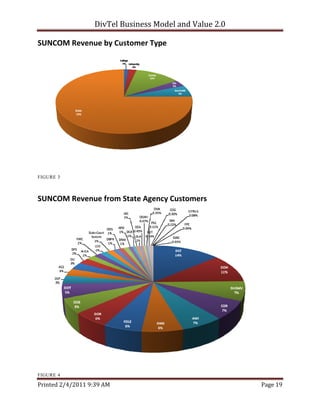
SUNCOM Revenue by Customer Type 


FIGURE 3


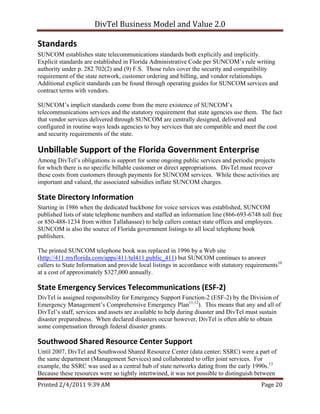
SUNCOM Revenue from State Agency Customers  


FIGURE 4

Printed 2/4/2011 9:39 AM                                  Page 19 
DivTel Business Model and Value 2.0 

Standards 
SUNCOM establishes state telecommunications standards both explicitly and implicitly.
Explicit standards are established in Florida Administrative Code per SUNCOM’s rule writing
authority under p. 282.702(2) and (9) F.S. Those rules cover the security and compatibility
requirement of the state network, customer ordering and billing, and vendor relationships.
Additional explicit standards can be found through operating guides for SUNCOM services and
contract terms with vendors.

SUNCOM’s implicit standards come from the mere existence of SUNCOM’s
telecommunications services and the statutory requirement that state agencies use them. The fact
that vendor services delivered through SUNCOM are centrally designed, delivered and
configured in routine ways leads agencies to buy services that are compatible and meet the cost
and security requirements of the state.

Unbillable Support of the Florida Government Enterprise 
Among DivTel’s obligations is support for some ongoing public services and periodic projects
for which there is no specific billable customer or direct appropriations. DivTel must recover
these costs from customers through payments for SUNCOM services. While these activities are
important and valued, the associated subsidies inflate SUNCOM charges.

State Directory Information 
Starting in 1986 when the dedicated backbone for voice services was established, SUNCOM
published lists of state telephone numbers and staffed an information line (866-693-6748 toll free
or 850-488-1234 from within Tallahassee) to help callers contact state offices and employees.
SUNCOM is also the source of Florida government listings to all local telephone book
publishers.

The printed SUNCOM telephone book was replaced in 1996 by a Web site
(http://411.myflorida.com/apps/411/tel411.public_411) but SUNCOM continues to answer
callers to State Information and provide local listings in accordance with statutory requirements10
at a cost of approximately $327,000 annually.

State Emergency Services Telecommunications (ESF‐2) 
DivTel is assigned responsibility for Emergency Support Function-2 (ESF-2) by the Division of
Emergency Management’s Comprehensive Emergency Plan11,12). This means that any and all of
DivTel’s staff, services and assets are available to help during disaster and DivTel must sustain
disaster preparedness. When declared disasters occur however, DivTel is often able to obtain
some compensation through federal disaster grants.

Southwood Shared Resource Center Support 
Until 2007, DivTel and Southwood Shared Resource Center (data center; SSRC) were a part of
the same department (Management Services) and collaborated to offer joint services. For
example, the SSRC was used as a central hub of state networks dating from the early 1990s.13
Because these resources were so tightly intertwined, it was not possible to distinguish between
Printed 2/4/2011 9:39 AM                                                                  Page 20 
DivTel Business Model and Value 2.0 
the State Network and SSRC customer data traffic that moved through these circuits. SUNCOM
was able to only partially recover these costs by charging SSRC customers small flat fees.

Technology changes have eliminated the need for SSRC to act as a central State Network hub.14
This means that the data communications hardware inside the SSRC and the associated circuits
now serve the SSRC and its customers exclusively. Therefore, SUNCOM has sought to
discontinue subsidizing maintenance of the SSRC’s internal hardware since 2006 but has been
unable to do so. The ongoing cost of this subsidy is $365,000 annually.

SUNCOM recently developed a state-of-the-art method for metering SSRC customer’s usage of
this equipment and circuits. Because this approach will attribute charges precisely in proportion
to customer resource usage (as opposed to flat fees that over-charge minimal users and under-
charge heavy users), it is more equitable and provides customers clear economic incentives (see
“CAREIVA Principles of Product Design and Chargeback” on page 33). SUNCOM hopes to
implement these charges to fully recover the associated costs in the future and turn responsibility
for doing so to the SSRC as is the standard for all other SUNCOM data center customers.

School District Grant Assistance 
All K-12 schools in America are eligible for federal grant subsidies for their telecommunications
services. The program known as E-rate can cover as much as 90% based upon the poverty level
of students (the average for Florida is 70%). Prior to the 2010 Legislative Session, Florida’s
state government paid the other 30% for school’s data communications through an appropriation
to the Department of Education (DOE). DOE used these funds to pay SUNCOM for use of the
Florida Information Resource Network (FIRN the K-12 data network) while schools paid the rest
with E-rate funds or E-rate credits.

By federal rule, SUNCOM is ineligible to receive e-rate funds even to cover its administrative
costs to serve schools. Thus SUNCOM administrative fees were covered by the State match
(which also covered related DOE administrative costs). But because the law limited those
payments to only 7% of the state match was provided (or approximately 2% of total K-12
charges) SUNCOM was compelled to subsidize the rest of its administrative support of school
customers.

SUNCOM’s subsidy of this effort increased in 2010/11 when the state discontinued funding the
DOE E-rate office which helped schools wade through the complicated E-rate grant process.
Because all schools use E-rate to pay for SUNCOM services, SUNCOM must replace the
assistance that DOE provided.15 SUNCOM has federal approval to use its broadband grants for
this purpose and, as of this writing, is seeking legislative approval to do so (see “E-rate
Assistance to Schools and Libraries” on page 63).

Expanding Broadband Access 
The 2009 Legislature enacted section 364.0135 F.S., designating DMS as the lead Agency to
promote broadband deployment. This legislation was written in conjunction of Federal programs
and grants to foster wider availability to broadband in “unserved and underservered regions”.
Among its duties, DMS is to “Encourage the use of broadband Internet service … through grant
programs”. DivTel is meeting its statutory obligation and has obtained Federal grants but
Printed 2/4/2011 9:39 AM                                                                   Page 21 
DivTel Business Model and Value 2.0 
without any initial funding for the effort. See “Enhancing Florida’ Economic Competitiveness
with Broadband” on page 61. DivTel’s ongoing efforts will be funded mostly from Federal
grants but DivTel must satisfy the State’s in-kind contributions to be eligible.

Data Center Consolidation Project 
In 2007, the State of Florida began to consolidate computing services. In most instances this
requires moving servers and mainframes from office buildings where computer users are located
to one of three Primary Data Centers within Tallahassee.

When users are collocated with this equipment, communicating with them is fast and does not
require use of circuits outside of the building. After the equipment is moved across town,
SUNCOM circuits must then carry these communications and these circuits must be substantial
to meet the daily demand of users.16

SUNCOM has engaged in a substantial effort during data center consolidation to design,
implement and test the new IT environment for each affected customer. No funding was
provided to SUNCOM for this costly effort.

Data Center Circuit Consolidation Project 
Twenty SSRC customers had established separate SUNCOM connections from within the SSRC
to the outside. After DivTel mangers described this condition to legislative staff, a requirement
was added to proviso language in the 2010 General Appropriations Act9 compelling these SSRC
customers to move onto a common SUNCOM circuit. See “Pooling” on page 24 for a
description of the savings. No funding was provided to SUNCOM to implement this project.


Printed 2/4/2011 9:39 AM                                                                 Page 22 
DivTel Business Model and Value 2.0 


SUNCOM’s Purpose 
This section describes the reasons SUNCOM does the things described in the previous section.
In essence, it confirms why SUNCOM was created through the benefits it brings to Florida
government.

Enterprise Cost Savings 
Internal service providers, like SUNCOM, have business models that are very similar to the
private sector, but they differ from vendors in its key purpose:

   Success for Vendors comes when customers pay as much as possible,
   SUNCOM’s success comes when customers pay as little as possible.17

SUNCOM’s business model is designed to save money for Florida government in four general
ways:
   1. Getting services at the best price.
   2. Achieving enterprise economies of scale.
   3. Helping consumers get the right service.
   4. Helping consumers get the right amount of service.

Cost Reductions verses Cost Avoidance 
Cost savings come in two forms; cost reductions and cost avoidance.

Cost Reductions 
Cost reductions occur periodically when there is a change to SUNCOM services that enables
lowering prices to SUNCOM customers. Derived from technological advancements,
marketplace changes, new or amended contracts and redesigning services, they are realized one
time; then become unseen perpetual cost avoidance thereafter. Achieving cost reductions
requires vigilant study, innovation and a constant stream of new and/or amended contracts.

Cost Avoidance 
The daily cost avoidance delivered by SUNCOM is more subtle, yet far greater. Conservatively
estimated to be over seven times the annual SUNCOM administrative costs, these savings are
derived from the costs that would be incurred if SUNCOM did not exist. Without SUNCOM, all
of the services it provides would be purchased individually by separate government entities
without the expertise, negotiating leverage and economies of scale SUNCOM delivers.18

Because cost avoidance is an estimate of what was not spent, it is intangible. The question,
“what would it have cost if it had been bought another way?” is impossible to answer without
actually duplicating the purchase. Since such duplication is contrary to the enterprise purchasing
policies set forth in Florida Statutes (for state agencies)91 the lack of comparative examples may
lead some to the mistaken assumption that cost avoidance is not real, thus devaluing the largest
benefit of the enterprise model. In spite of the policy however, there actually is one salient
example.
Printed 2/4/2011 9:39 AM                                                                 Page 23 
DivTel Business Model and Value 2.0 

In October of 2009, the Florida Department of Education (DOE) alone sought to replace the
statewide education network known as the Florida Information Resource Network (FIRN).
FIRN is used primarily by K-12 schools which are subsidized by a Federal grant program known
as E-rate. Prior to DOE’s attempt to replace FIRN, it was a SUNCOM service. Because the bids
to DOE were significantly higher than existing SUNCOM services, DOE ultimately came back
to SUNCOM for those services.

At DOE’s request, SUNCOM established a new FIRN contract to meet specific DOE
requirements rather than use existing SUNCOM services.19 The resulting SUNCOM prices are
39% lower than the best offer to DOE20 even when SUNCOM’s mark-ups to recover
administrative costs are included.21 Extrapolating these 39% savings to all of SUNCOM’s
services suggests savings of approximately $71.8 million annually. This is over seven times
SUNCOM’s administrative costs meaning the state receives at least a 700% return on its annual
investment in SUNCOM.22

Cost Savings Mechanisms 
SUNCOM cost savings come from a variety mechanisms listed below. Almost all of them are
cost avoidance.

Volume Discounts 
Volume discounts are achieved simply from the bulk size of SUNCOM’s contracts. Through
one procurement, vendors provide standardized services to all SUNCOM customers. They are
willing to discount heavily to secure bulk sales that would otherwise go to competitors and to
achieve efficiencies in doing so that would otherwise be impossible. This leverage can only be
achieved through an entity that can aggregate the buying power of the state like SUNCOM.

Pooling 
Volume discounts can be increased when SUNCOM commits to buy23 large blocks of
homogenous services and resells them incrementally.

With these pools, the excess capacity customers must normally buy becomes unnecessary. They
only pay for what they use thus giving them clear incentives to use less. SUNCOM alone takes
the risk that too many or too few services have been bought in the pool and uses the Law of
Large Numbers24 to minimize that risk.25

Vendors are willing to give the greatest discounts for pooled services because of the
predictability and efficiencies derived from fixed quantities of homogenous services.26 And the
state enterprise achieves a high degree of cost saving by rendering large blocks of services into
small units to be used exclusively where they are needed. See how pooling compares to other
enterprise purchases in Figure 6.

An example of this is now being implemented at the Southwood Shared Resource Center
(SSRC). Several customers maintained 20 separate connections to the SSRC. Through a joint
effort between SUNCOM and SSRC staff, these were combined into one for an enterprise

Printed 2/4/2011 9:39 AM                                                                  Page 24 
DivTel Business Model and Value 2.0 
savings of 50% ($512,544 annually). To achieve this, SUNCOM must make a considerable
investment to develop metered billing so each customer pays their fair share of the consolidated
connection. But once in place, this new approach can be ultimately replicated at other data
centers and foster incentives for further savings through peak-load pricing (see “Peak Load
Pricing” on page 34).

Economies of Scale  

State Enterprise Economies of Scale
SUNCOM’s consolidated procurement of telecommunications services eliminates the need for
procurements among state agencies. Simply allowing agencies to order services through
SUNCOM’s existing contracts prevents duplication of effort throughout the enterprise.27

The standardization SUNCOM provides also brings technical economies of scale. Without it,
the technical approach of every state agency would be unique. Interconnecting agencies into a
common network would drain effort and resources. And when problems arise, diagnosis and
resolution would be more difficult and lengthier without a consistent technical approach.
Finally, as staff move between agencies and agencies reorganize, the standardized knowledge of
SUNCOM telecommunications is transferred as well thus avoiding costly relearning and
downtime.

Partner Economies of Scale
Vendors save as well from SUNCOM economies of scale. The processes for ordering, installing,
invoicing, collecting payment and trouble management are standardized under SUNCOM. For
some services, SUNCOM assumes many of these responsibilities because it is in a better position
to do so.28 For the rest, there is savings from uniformity of the processes. In this sense,
SUNCOM acts as a partner to vendors, achieving mutual efficiencies that translate into vendor
discounts.

Vendor Risk Mitigation 
Without SUNCOM acting as a single customer for the enterprise, vendors must bill and collect
from all Florida government customers directly. Some customer payments would trickle in,
others require extra collection efforts and dispute resolution, and still others might not ever
come.

SUNCOM audits and pays these consolidated invoices timely, in one lump-sum; before being
paid by SUNCOM customers.29 And when there is a problem (e.g. disputable charges),
SUNCOM staff stands between the end user and the vendor as a consistent experienced
negotiator with the leverage of SUNCOM’s bulk contract.

By reducing thousands of vendor invoices into one, running standard audits, ensuring timely
payment with float, eliminating the risk of nonpayment, abolishing vendor collection efforts and
acting as a good faith partner, SUNCOM provides saving to vendors that translate into lower
prices to the enterprise.


Printed 2/4/2011 9:39 AM                                                                 Page 25 
DivTel Business Model and Value 2.0 

Specialization and Expertise 
Without SUNCOM, each state agency would need to design, procure and manage
telecommunications services from the ground up. For most, this would be a part time job and
each effort would come in periodic cycles. And for all, the prerequisite knowledge would be
limited by agency needs at a specific time.

SUNCOM has a team of telecommunications engineers with careers dedicated to studying,
designing, procuring and supporting telecommunications. They are engaged in such projects
every day for a variety of customers giving them knowledge they use to the benefit of all
customers and the enterprise as a whole.

Interoperability 
Telecommunications by definition requires compatibility between sender and receiver. The best
way to ensure this is to set standards that all adhere to. To some extent the industry does this
naturally when standards do not impede profits.

SUNCOM is statutorily charged30 to foster interoperability so Florida can realize savings from
standardization and prevent wasteful extra efforts to overcome incompatibilities between Florida
agencies.

Security 
SUNCOM implements network security at an enterprise level for Florida government. This
allows the state to have a common network on which agencies can communicate with each
others with reasonable freedom from the chaos and predation of the Internet. But SUNCOM’s
security also provides a level of security for each customer and opportunities for them to use
SUNCOM tools to monitor their security conditions.31, 32

Accountability, Customer Empowerment and Stakeholder 
Transparency 
SUNCOM’s business model includes the collection and centralization of detailed invoicing data
from vendors. This enables verifying vendor charges and rebilling of SUNCOM customers.

But the way SUNCOM presents invoicing data also gives customers the opportunity to view,
manipulate and report this data in ways that are uncommon to consumer billing. This gives
Florida agencies extra ability to scrutinize charges.

Because this data is comprehensive of telecommunications charges and usage, SUNCOM and its
stakeholders can also use it in strategic planning, negotiations and policy setting. Without this
data, the state would be disadvantaged during negotiations in which vendors are better informed
of than the state about enterprise requirements, trends and opportunities. Policy makers would
also be unable to get comprehensive and accurate reports on the state’s telecommunications
needs. 33


Printed 2/4/2011 9:39 AM                                                                 Page 26 
DivTel Business Model and Value 2.0 

Catalyst for Technological Transition 
Telecommunications Strategic Planning 
No single state agency, focused upon its specific mission to serve citizens, would necessarily
adopt telecommunications strategies that are good for the whole state enterprise. And achieving
consensus through a consortium of part time participants with parochial priorities would be too
slow and ineffective to keep up with technological and market opportunities. This is why
SUNCOM is statutorily charged with enterprise telecommunications planning and does so with a
broad and long term perspective.34

Self Funded Investments 
SUNCOM receives no direct General Revenue appropriations or other tax revenues.35 Rather, it
is self funded through charges to customers for the telecommunications services SUNCOM
provides. This means the Legislature does not need to provide cash infusions to keep Florida
government current with telecommunications progress. Instead, SUNCOM establishes contracts
through which vendors and SUNCOM float these investments with incremental payments for
new services. Vendors often accept pay-as-you go returns based upon SUNCOM’s enterprise
volume commitments.36 This allows the state to reap the rewards of new technology with
minimal penalties from early adoption.

Buffering Costs Outside the Mainstream 
Imposing premium costs on customers using technologies outside of the mainstream is common
to the marketplace.

“Early adopter” prices are higher due to the lack of economies of scale and vendors are able to
use their lead (temporary monopoly) over a technology to quickly recover Research and
Development costs. In spite of these premium costs, some of these technologies can produce
significant rewards from early adoption. Thus, with its ability to design and float new services
that leverage the latest technology on a large scale, and by acting as a partner to vendors making
otherwise risky investments, SUNCOM becomes a catalyst for these savings.36,37

At the other extreme, some customers cannot afford to keep-up with mainstream technology.
Once out of the mainstream, economies of scale are lost, many vendors stop supporting the
technology and competitive pressures on pricing diminish. SUNCOM buffers these costs so
these customers can redirect resources to adopting current technologies rather remaining trapped
in paying premiums for old technology.


Printed 2/4/2011 9:39 AM                                                                  Page 27 
DivTel Business Model and Value 2.0 


SUNCOM’s Approach and Principles 
This section describes how SUNCOM performs it duties in a manner that achieves its purposes.

Establishing Standards 
SUNCOM both implicitly and explicitly establishes standards for the enterprise to ensure:
   Interoperability to mitigate costly incompatibility throughout the enterprise.
   Quality to mitigate costly compensation for deficiencies and downtime.
   Security to mitigate data breaches and malicious attacks.

Service Normalization 
Telecommunications standards are established for Florida government from the mere fact that
bulk services are offered through SUNCOM. Broad use among agencies limits instances when
non-standard technology is used that could lead to incompatibility, and security and quality
deficiencies.38

Florida Statutes and Florida Administrative Code (“Rules”) 
Florida Statutes charge DMS with creating telecommunications standards for the enterprise and
gives it rule writing authority through Florida Administrative Code.30 Through a nine month
process in 2007, SUNCOM engaged in a major rewrite of these rules to create 60FF, F.A.C.
DMS went beyond the requirements for public hearings, the time it dedicated to the process and
solicitations for comment. The results were both detailed and extensive rules covering enterprise
network standards, security and associated business processes that have proven to be reliable and
transparent while granting customers and vendors the flexibility they need.

Developing Services 
SUNCOM strategically plans for services long before developing them. But unlike the private
sector, strategies are not focused on a marketing perspective and profits. Rather, they are based
upon the value that emerging technologies will bring to Florida government.

Two Ways for Internal Providers to Deliver Services 
Internal service providers like SUNCOM can 1) buy assets and pay staff to use those assets to
deliver services, or 2) buy services from the private sector and make them available to internal
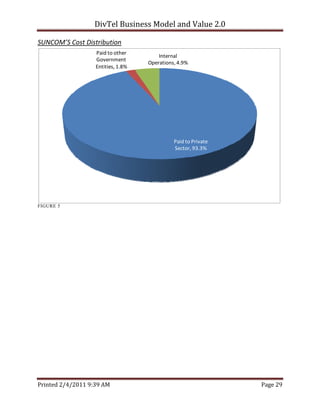
customers. Today, SUNCOM chiefly uses the later approach thus rendering it 93% outsourced.
Another 2% is paid to other government entities with the remaining 5% used to plan, design and
procure these services, and manage orders, inventory and billing for them.39 It should be noted
that the 93% that is outsourced is demand driven; i.e. SUNCOM customers determine how much
is paid to vendors based upon the services they order and use.


Printed 2/4/2011 9:39 AM                                                                  Page 28 
DivTel Business Model and Value 2.0 

SUNCOM’S Cost Distribution 
                   Paid to other 
                                        Internal 
                   Government 
                                    Operations, 4.9%
                   Entities, 1.8%


                                              Paid to Private 
                                              Sector, 93.3%


FIGURE 5


Printed 2/4/2011 9:39 AM                                         Page 29 
DivTel Business Model and Value 2.0 

Service Development Criteria 
Here are the primary criteria SUNCOM uses during the strategic planning to develop new
services.
    1) Is there likely to be sufficient demand for the service? SUNCOM customers ultimately
       determine what technologies will be used because their business needs drive demand.
       SUNCOM must be careful to avoid attractive technologies that have little practical value
       to its customers.
    2) Is providing the service within SUNCOM’s statutory authority? SUNCOM draws a
       bright line between the telecommunications services it provides and other information
       technology based upon the confines of legal its authority.
    3) Can SUNCOM do it better than the alternatives? There are opportunities where
       SUNCOM could establish services that comply with reasonable statutory interpretations
       of SUNCOM’s duties, but SUNCOM should not do so because it is unlikely to do it well
       and/or there are valid enterprise alternatives. SUNCOM defers to better alternatives after
       confirming that the integrity or security of the enterprise model will not be jeopardized.
    4) Will the technology achieve critical mass in the broader market-place? If the technology
       is not widely adopted, economies of scale and wide-spread compatibility will not occur
       leaving SUNCOM to sell a nonstandard and expensive service.
    5) How will the service fit with other SUNCOM technologies, services and infrastructure?
       Some new services may complement existing SUNCOM services. Others can become
       preferred substitutes. Many can leverage supporting SUNCOM services and
       infrastructure to save costs. These factors can make a service more or less viable for
       SUNCOM.
    6) How will the service fit the SUNCOM business model? SUNCOM must be able to render
       technologies into billable services using the principles of CAREIVA (below).
    7) Is investment in a new technology less than its returns? Services that appear attractive
       may actually be undesirable to SUNCOM customers because the cost of transition to it
       will be less than the benefits, or better replacement technologies are emerging, or
       substandard quality will create costly upheaval. SUNCOM must be cautious to avoid
       picking dead-end technologies that will undermine the value it brings to the state.
    8) Is the underlying technology proven to be scalable and reliable? Regardless of how
       elegant a technology is designed, taking it outside of controlled conditions on a small
       scale into the real world can make it untenable as a business tool.
    9) Are the claims regarding the benefits of the technology sound? The creators of new
       technologies often lay claim to lofty improvements in productivity and cost. But they
       sometimes fall short of the promise because the narrow conditions necessary to realize
       them.

Cost Accounting 
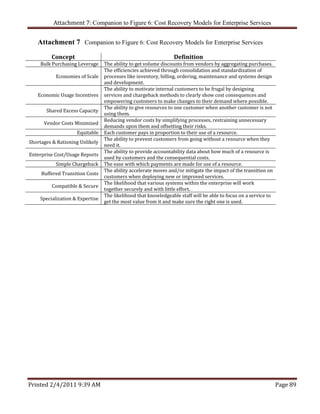
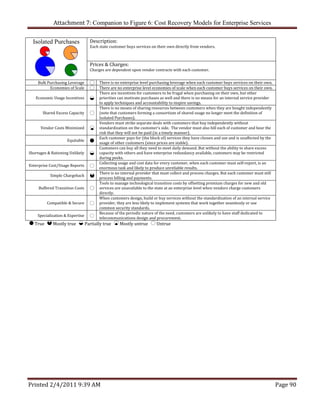
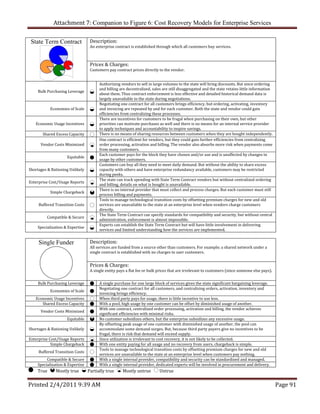
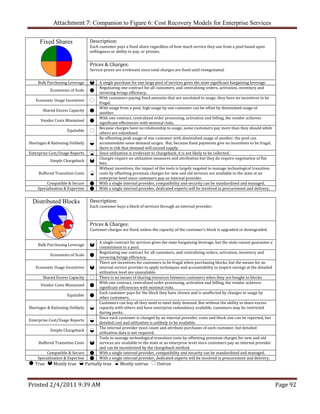
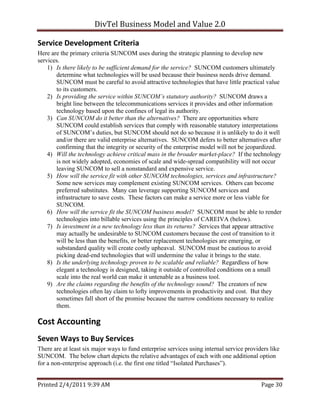
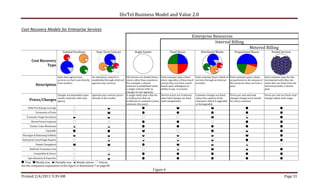
Seven Ways to Buy Services 
There are at least six major ways to fund enterprise services using internal service providers like
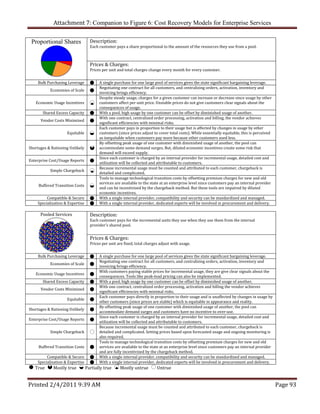
SUNCOM. The below chart depicts the relative advantages of each with one additional option
for a non-enterprise approach (i.e. the first one titled “Isolated Purchases”).


Printed 2/4/2011 9:39 AM                                                                   Page 30 
DivTel Business Model and Value 2.0 

Cost Recovery Models for Enterprise Services 
                                             
                                                                                                                                                   Enterprise Resources 
                                             
                                                                                                                                                               Internal Billing 
                                             
                                                                                                                                                                                                          Metered Billing 
                                   Isolated Purchases           State Term Contract              Single Funder                 Fixed Shares               Distributed Blocks             Proportional Shares                  Pooled Services 


        Cost Recovery 
                 Type 

                                                                                                                                                                                                                                                   
                       Each state agency buys          An enterprise contract is      All services are funded from a  Each customer pays a fixed     Each customer buys a block of    Each customer pays a share       Each customer pays for the 
                       services on their own directly  established through which all  source other than customers.  share regardless of how much  services through an internal        proportional to the amount of    incremental units they use 
                       from vendors.                   agencies buy services.         For example; a shared           service they use from a pool  provider.                         the resources they use from a    when they use them from the 
          Description                                                                 network is established under  based upon willingness or                                         pool.                            internal provider’s shared 
                                                                                      a single contract with no       ability to pay, or proxies.                                                                      pool. 
                                                                                      charges to user agencies. 
                       Charges are dependent upon  Agencies pay contract prices  A single entity pays a flat fee  Service prices are irrelevant  Customer charges are fixed,          Prices per unit and total        Prices per unit are fixed, total 
                       vendor contracts with each      directly to the vendor.        or bulk prices that are         since total charges are fixed  unless the capacity of the       charges change every month       charges adjust with usage. 
      Prices/Charges  agency.                                                         irrelevant to customers (since  until renegotiated.            customer’s block is upgraded     for every customer. 
                                                                                      someone else pays).                                            or downgraded. 
     Bulk Purchasing Leverage                                                                                                                                                                                                             
            Economies of Scale                                                                                                                                                                                                            
    Economic Usage Incentives                                                                                                                                                                                                             
       Shared Excess Capacity                                                                                                                                                                                                             
      Vendor Costs Minimized                                                                                                                                                                                                              
                     Equitable                                                                                                                                                                                                            
Shortages & Rationing Unlikely                                                                                                                                                                                                            
Enterprise Cost/Usage Reports                                                                                                                                                                                                             
            Simple Chargeback                                                                                                                                                                                                             
      Buffered Transition Cost                                                                                                                                                                                                            
          Compatible & Secure                                                                                                                                                                                                             
     Specialization & Expertise                                                                                                                                                                                                           
   True    Mostly true    Partially true    Mostly untrue    Untrue 
See the companion explanation to this figure in Attachment 7 on page 89. 
                                                                                                                  Figure 6
Printed 2/4/2011 9:39 AM                                                                                                                                                                                                                     Page 31 
DivTel Business Model and Value 2.0 


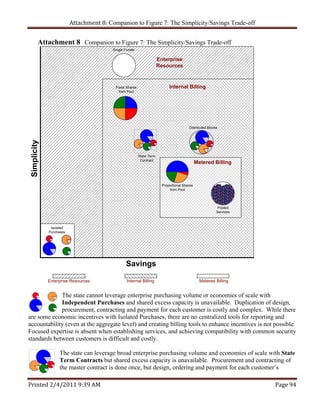
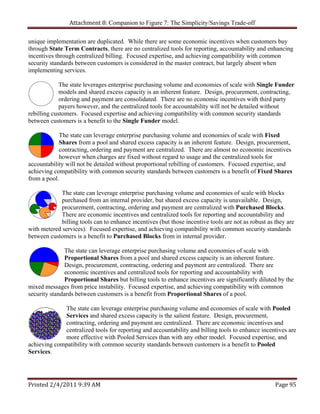
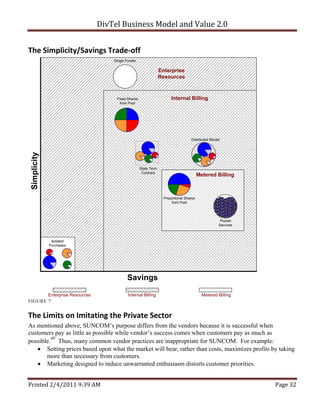
The Simplicity/Savings Trade‐off 
                                  Single Funder

                                                               Enterprise
                                                               Resources


                                   Fixed Shares                      Internal Billing
                                     from Pool


                                                                                 Distributed Blocks


                                                  State Term
                                                   Contract
                                                                                       Metered Billing


                                                                 Proportional Shares
                                                                     from Pool


                                                                                                   Pooled
                                                                                                  Services


         Isolated
        Purchases


                                         Savings

       Enterprise Resources               Internal Billing                               Metered Billing
FIGURE 7


The Limits on Imitating the Private Sector 
As mentioned above, SUNCOM’s purpose differs from the vendors because it is successful when
customers pay as little as possible while vendor’s success comes when customers pay as much as
         40
possible. Thus, many common vendor practices are inappropriate for SUNCOM. For example:
     Setting prices based upon what the market will bear, rather than costs, maximizes profits by taking
       more than necessary from customers.
     Marketing designed to induce unwarranted enthusiasm distorts customer priorities.


Printed 2/4/2011 9:39 AM                                                                                     Page 32 
DivTel Business Model and Value 2.0 

      Bundling services and offering loss-leaders to entice customers to pay for things they do not
       genuinely need enhances income by encouraging waste.
      Creating perpetual dependency on imbedded technologies is a costly impediment to progress.
      Price discrimination based upon the relative availability of alternatives or customer willingness to
       buy enhances profits at the expense of targeted customers.
      Permitting customers to make unnecessary purchases increases profits at the customer’s expense.
      Producing vague invoices and contracts diminishes the opportunity for true cost accounting and
       comparisons.

CAREIVA Principles of Product Design and Chargeback 
SUNCOM services, pricing and marketing are designed to give customers the information, means and
incentives to save money. To achieve this, SUNCOM follows the principles known by the acronym
CAREIVA.

   C   Resource usage must be discretely Countable: the number of units consumed can be measured.
   A   Resource usage must be Attributable: the customer who uses them can be identified.
   R   Counting and Attribution must be done Repeatedly: determining how much each customer uses is
       possible for every bill.
   E   Prices must be Equitable: charges are proportional to cost of resources used or the enterprise value
       usage creates. 41
   I   Prices should give customers clear Incentives: customers are rewarded with savings when they
       consume fewer resources or foster benefits to the enterprise.41
   V   Charges must be Visible: customers can readily see the fiscal consequences of their purchases and
       consumption.
   A   Saving money must be Actionable: customers can easily and quickly do something to reduce or
       eliminate unnecessary charges.

There is cross-dependency between these principles. For example, it is pointless to count usage if the
consumer cannot be identified. And it must be done every month if the service is to be billable. If prices
are not proportional to the resources used, consumption will not be directed to save money, regardless of
how effectively SUNCOM bills. And none of this is useful if the customer cannot see nor do anything to
reduce costs.

In most instances, the CAREIVA principles can best be applied when charges are attributed at the lowest
level possible. Paying by the drink rather than the jug minimizes unused capacity and gives customers the
greatest visibility into the consequences of their demands and provides them the incentives and ability to
do something about it.


Printed 2/4/2011 9:39 AM                                                                           Page 33 
DivTel Business Model and Value 2.0 

Designing SUNCOM Services using CAREIVA 
SUNCOM services must consider CAREIVA principles from inception of a service in order to derive
CAREIVA benefits. Application of CAREIVA is universal for all SUNCOM services. But how they are
applied depends largely upon the mechanisms available for chargeback and whether the service is pooled
or non-pooled.

Redesigning Pooled Services 
       All customers need excess capacity for most services so they have enough during peak demand.
       This means they commit to a size larger than they typically need. When excess capacity is held
       at the enterprise level it can be shared and each customer need not make any volume
commitments.

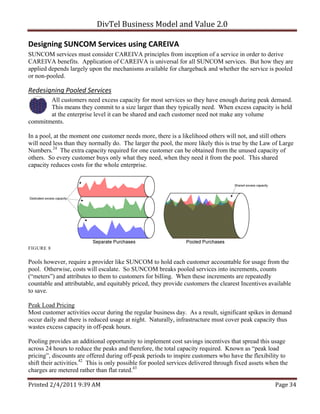
In a pool, at the moment one customer needs more, there is a likelihood others will not, and still others
will need less than they normally do. The larger the pool, the more likely this is true by the Law of Large
Numbers.24 The extra capacity required for one customer can be obtained from the unused capacity of
others. So every customer buys only what they need, when they need it from the pool. This shared
capacity reduces costs for the whole enterprise.


FIGURE 8


Pools however, require a provider like SUNCOM to hold each customer accountable for usage from the
pool. Otherwise, costs will escalate. So SUNCOM breaks pooled services into increments, counts
(“meters”) and attributes to them to customers for billing. When these increments are repeatedly
countable and attributable, and equitably priced, they provide customers the clearest Incentives available
to save.

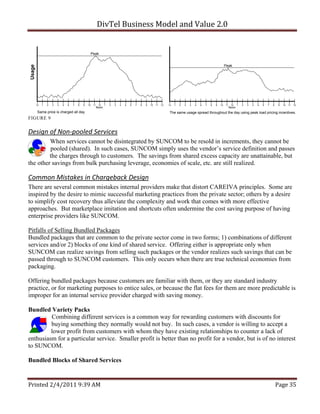
Peak Load Pricing
Most customer activities occur during the regular business day. As a result, significant spikes in demand
occur daily and there is reduced usage at night. Naturally, infrastructure must cover peak capacity thus
wastes excess capacity in off-peak hours.

Pooling provides an additional opportunity to implement cost savings incentives that spread this usage
across 24 hours to reduce the peaks and therefore, the total capacity required. Known as “peak load
pricing”, discounts are offered during off-peak periods to inspire customers who have the flexibility to
shift their activities.42 This is only possible for pooled services delivered through fixed assets when the
charges are metered rather than flat rated.43

Printed 2/4/2011 9:39 AM                                                                             Page 34 
DivTel Business Model and Value 2.0 


                                                 Peak


                                                                                                                                                               Peak


   12   1   2   3   4   5   6   7   8   9   10    11    12    1   2   3   4   5   6   7   8   9   10   11   12   12   1   2   3   4   5   6   7   8   9   10   11    12    1   2   3   4   5   6   7   8    9   10   11   12
                                                       Noon                                                                                                         Noon
    Same price is charged all day.                                                                                The same usage spread throughout the day using peak load pricing incentives.
FIGURE 9


Design of Non‐pooled Services 
         When services cannot be disintegrated by SUNCOM to be resold in increments, they cannot be
         pooled (shared). In such cases, SUNCOM simply uses the vendor’s service definition and passes
         the charges through to customers. The savings from shared excess capacity are unattainable, but
the other savings from bulk purchasing leverage, economies of scale, etc. are still realized.

Common Mistakes in Chargeback Design 
There are several common mistakes internal providers make that distort CAREIVA principles. Some are
inspired by the desire to mimic successful marketing practices from the private sector; others by a desire
to simplify cost recovery thus alleviate the complexity and work that comes with more effective
approaches. But marketplace imitation and shortcuts often undermine the cost saving purpose of having
enterprise providers like SUNCOM.

Pitfalls of Selling Bundled Packages
Bundled packages that are common to the private sector come in two forms; 1) combinations of different
services and/or 2) blocks of one kind of shared service. Offering either is appropriate only when
SUNCOM can realize savings from selling such packages or the vendor realizes such savings that can be
passed through to SUNCOM customers. This only occurs when there are true technical economies from
packaging.

Offering bundled packages because customers are familiar with them, or they are standard industry
practice, or for marketing purposes to entice sales, or because the flat fees for them are more predictable is
improper for an internal service provider charged with saving money.

Bundled Variety Packs
         Combining different services is a common way for rewarding customers with discounts for
         buying something they normally would not buy. In such cases, a vendor is willing to accept a
         lower profit from customers with whom they have existing relationships to counter a lack of
enthusiasm for a particular service. Smaller profit is better than no profit for a vendor, but is of no interest
to SUNCOM.

Bundled Blocks of Shared Services


Printed 2/4/2011 9:39 AM                                                                                                                                                                                   Page 35 
DivTel Business Model and Value 2.0 

         Many services are only available from vendors in bundled blocks with flat fees. For example,
         local phone service provides unlimited local calling for a set monthly fee. This is essentially a
         bundled block of local calls.

But when a pool of services can be shared among internal customers, SUNCOM will miss a big
opportunity for savings if it resells them in smaller bundled blocks. Breaking a large pool into smaller
pools (blocks) dilutes enterprise savings because excess capacity cannot be shared among customers.
Rather, selling the service at the lowest incremental level retains economic incentives and equity.

Pitfalls of Proportional Allocation
           A common practice for internal service providers is to charge each customer a proportionate
           share of the total cost of a pooled resource rather than break those costs into fixed prices tied to
          increments of usage. For example, if four customers equally use a single resource costing a fixed
cost of $100 monthly, proportional charges means each will pay $25 in a given month. If one customer
discontinues, the remainder pay $33.33 each (if they continue using equal shares). This guarantees that
100% of the resource will be recovered, results in no surplus revenue and is equitable if the proportionate
charges are based upon actual customer usage.

But with the guarantee that all costs will be covered, the internal service provider is less likely to take
steps to reduce costs when customers reduce demand.

Worse yet, proportionate charges impair customer Incentives to be frugal because they distort the clear
feedback customers get from fixed prices. When one customer is charged a different amount than the
month before because other customers changed how much they used, the message becomes diluted.
Customers give-up on their efforts to control costs because their actions appear to have little direct impact.

When prices are fixed however, the only variable altering monthly charges is usage. Increased usage
means a higher bill thus showing the consequences to each customer from their demands.

Finally, proportionate charges result in highly unreliable budget projections for customers. They have
some means of predicting their own usage, but no means of predicting usage of others and understanding
the implications to their costs.

If an internal provider is capable of implementing a monthly proportional share approach equitably, it can
implement billing with fixed prices. The two approaches otherwise use the same data to apply charges.
Setting prices rather than apportioning costs has the one additional requirement to make usage projections.
This does create some risks of over/undercharging, but enterprise service providers, by definition, can use
the Law of Large Numbers24 to spread those risks. Therefore, internal providers should bill with fixed
prices to maximize customer incentives and perceived equity.

Pitfalls of Fixed Shares and Proxy Pricing
          Sometimes when it is difficult to count and attribute units of usage, internal service providers rely
          upon other measures in place of usage.

For example, when the amount of bandwidth consumed cannot be attributed to customers from a pool, the
number of customer employees or size of its budget might be used as a basis for charges. But the number

Printed 2/4/2011 9:39 AM                                                                               Page 36 
DivTel Business Model and Value 2.0 

of staff at an agency would be a credible proxy for bandwidth consumption only if all staff in every
agency uses the same amount of bandwidth all of the time. Because staff duties and the tools available to
them vary, this is not true. Therefore, such proxies are not equitable, encourage waste and are not
sustainable models.

Cost Allocation and Price Setting 
The Cost‐Plus Model 
SUNCOM uses a “cost-plus” allocation method to determine the cost of providing each service. This is
most appropriate for internal providers that primarily buy (rather than build) services that are in turn
resold to enterprise customers.44 Approximately 92% of SUNCOM’s costs are such payments to vendors.
The remaining eight percent pays for the costs of designing, procuring, and managing these services and
the enterprise networking model.

Administrative costs are added to vendor charges for SUNCOM services (“cost plus”). Some specific
services bear more than others based upon the share of administrative resources committed to offering the
service and other factors like the cross subsidies mentioned below.45

Cross‐Subsidies Used to Fund Technological Change 
A major factor that leads to charging less than the full cost of a service is the need to accommodate
technological change. Designing new services requires an investment of administrative costs and possibly
capital. And when the service first becomes available, not enough customers use it to achieve effective
economies of scale. Given SUNCOM’s self funded model which requires no large investment
appropriation, new services are subsidized by the rest of the operation until they can achieve critical mass
(and then become a supplier of subsides for the next change).

   Net
 Revenue


            Service A     Service B             Service C                     Service D
                                                                                           Mature
                                                                                           services    Time
  $0
                                                                                                      New & Old
                                                                                                      services


FIGURE 10


When a service reaches end-of-life, not all customers are able to discontinue use at the same time.
Charging the true cost of the service without a critical mass of customers would impose higher costs on
customers that are least able to afford them, and in greatest need of investment funds necessary to make
the change. Thus, such services are subsidized for a limited period.46 In this way, SUNCOM is a catalyst
for enterprise technological changes.


Printed 2/4/2011 9:39 AM                                                                               Page 37 
DivTel Business Model and Value 2.0 

Order Processing, Inventory and Billing 
The last two principles of CAREIVA require that telecommunications charges be viewable and actionable.
If customers cannot see the consequences of their usage or clearly identify unnecessary charges and then
do something the reduce them, the incentives of CARIEVA are irrelevant. This means that the systems
that customers use to order and pay for SUNCOM services should provide relevant information, are easy
to understand and use.

SUNCOM’s business model has centralized SUNCOM billing since 1975. SUNCOM obtains billing
detail from vendors in massive electronic files and uses it as a basis for calculating customer charges.
This detail has been available to customers and policy makers electronically since 2000 through
SUNCOM. With the ability to download, search and sort this data, customers are able to create reports,
audit routines and cost allocation distributions from SUNCOM bills.

But SUNCOM is doing more to empower customers to reduce telecommunications charges. In April of
2010, SUNCOM released a reengineered interface to its billing system known as the SUNCOM Open and
Shared Information System (OaSIS). OaSIS enables customers to tag all of their charges so they can more
easily identify them on each bill. These tags can be plain language reminders of the purpose of each
phone number or circuit number, and are completely within the control of customers. They will become a
permanent part of the SUNCOM database to appear on every customer bill and inventory list, and will be
used by customers to sort, filter and subtotal charges.

In October of 2010, SUNCOM released its OaSIS inventory module (in Beta) that provides direct
customer access to SUNCOM’s inventory of customer services for the first time in its 32 year history. In
its Beta form, customers are able to see all of their orders related to data communications services and
circuit locations, and search them using a variety of parameters. When it emerges from its Beta status,
OaSIS Inventory will display more data on all SUNCOM services, include the same tags that customers
can create on invoices (and orders) and provide simple tools for making changes.

Ultimately, OaSIS will include a user friendly ordering module to simplify establishing and eliminating
services and a more robust data exchange with vendors to save effort for both partners.


Printed 2/4/2011 9:39 AM                                                                          Page 38 
DivTel Business Model and Value 2.0 

Public Safety Telecommunications 
 Purpose of the Bureau of Public Safety Telecommunications 
 Statutory Obligations 
 Critical services such as law enforcement, fire rescue, emergency medical services and the means for
 citizens to call them demand the most reliable telecommunications that government and industry can
 provide. Such demands cannot be left to chance; rather careful coordination and oversight are essential.
 Therefore, Florida Statutes assigns the Bureau of Public Safety Telecommunications several duties to
 establish reliable telecommunications that protect lives and property.

 Regional and Local Emergency Radio Effectiveness and Coordination 
 Without central coordination of Florida’s public safety radio communications, local and regional
 authorities would choose radio spectrum without assurance that they will not interfere with, or be
 interfered by, their neighbors. They also would have no reliable common standard to communicate with
 other entities when they need help during a disaster. This is why the Bureau under the direction of DMS
 is “authorized and directed” under Florida Statutes “to develop and maintain a statewide system of
 regional law enforcement communications”47 and “emergency medical telecommunications”.48 The
 system is comprised of standards and frequency assignments to ensure reliable radio communications in
 every county and city.

 The Bureau is also charged with setting standards “to serve local law enforcement agencies through
 mutual aid channels”. 49 To achieve interoperability (the ability of these local systems to work together in
 a disaster)50 the Bureau has implemented and supports a statewide gateway solution (the Florida
 Interoperability Network; FIN) enhance communications between disparate radio systems of state and
 local government. FIN can quickly establish multiple communications links between almost all of the
 more than 200 different state and local emergency dispatch centers throughout the state.

 The Statewide Law Enforcement Radio System 
 Absent an enterprise approach to law enforcement communications, each state law enforcement agency
 could develop separate networks with unique standards. Not only would those networks duplicate
 significant infrastructure, they would likely be unable to effectively communicate with each other and
 would demand far more radio spectrum than is available.

 This is why the Bureau is also charged by Florida Statutes to “acquire and administer a statewide radio
 communications system to serve law enforcement units of state agencies. 51 The result is a shared system,
 known as the Statewide Law Enforcement Radio System (SLERS), used by all state agencies and some
 counties. SLERS is also connected to FIN (see above) thus give access to local public safety entities.
 SLERS also provides digital radios that can provide secure encrypted communications for over 7,500 state
 law enforcement officers.


 Printed 2/4/2011 9:39 AM                                                                            Page 39 
DivTel Business Model and Value 2.0 

911 Effectiveness and Reliability 
Without standards and coordination for emergency calls from citizen there would be tenuous expectations
of reliability and consistency throughout the state. This is why the Bureau is also charged to “develop,
maintain, and implement…a statewide emergency communications E911 system plan”52 and, under
authority of the DMS Secretary, “coordinate the activities of the system with state, county, local, and
private agencies”.53

To help ensure the reliability and consistency of the state’s 911 system, the Bureau is also charged to
“oversee the administration of” of the E911 fee54 through the E911 Board which is to “administer, the
fee… including receiving revenues derived from the fee; distributing portions of the revenues to wireless
providers, counties” and accounting for and reporting the fee’s revenue and distributions.55

With a stable 911 system in place statewide, the recent focus of the Bureau and Board has been on the
ability to process new types of communications from citizens throughout the state.56 For example, the
enhanced service for 911 allows the ability to automatically view telephone numbers and track cellular
telephone locations on a map.57

The inability to receive and process emergency messages from citizens via text messages, images, and
video presents new challenges and opportunities. The ability to process these messages is known as “Next
Generation 911” (NG911).58 The Bureau is developing strategies to implement a state routing network
through its SUNCOM MyFlorida Network to accommodate these NG911 media.

State Emergency Operations –Support for Telecommunications 
In the event of a disaster, all of the services and assets of the Bureau and SUNCOM must be made
available to help. Thus, Florida Statutes assigns DivTel responsibility for Emergency Support Function-2
(ESF-2 is “Emergency Communications” in accordance with the Division of Emergency Management’s
Comprehensive Emergency Plan59,60) and the Bureau supports61 the state’s response to large-scale
emergencies and disasters through the state Emergency Operations Center.62

Bureau of Public Safety Telecommunications Functions 
History 
State Law Enforcement Communications Plan (LE Plan) 
The LE Plan was first published in 1973, “to develop and maintain a statewide system of regional law
enforcement communications”.63 With Federal funding, it enabled implementation of many law
enforcement radio systems throughout the state. The LE Plan is currently maintained to provide technical
guidelines for the implementation of new law enforcement radio communications systems by local law
enforcement agencies. The Bureau updates the LE Plan every two years.


Printed 2/4/2011 9:39 AM                                                                          Page 40 
DivTel Business Model and Value 2.0 

Florida Emergency Communications Number E911 State Plan (State E911 
Plan) 
The state 911 Plan was first published in 1976 as mandated by legislation in 1974. The state 911 Plan
implemented 911 as the official statewide emergency telephone number. The state E911 Plan is
continually updated to provide a cohesive statewide plan for enhanced 911 services which will provide
citizens with rapid direct access to public safety agencies. Citizen access to 911 reduced response time for
law enforcement, fire, medical, rescue, and other emergency services. The latest edition is now available
on the web.64

National Public Safety Planning Advisory Committee 
This committee made recommendations that the FCC incorporated into rules governing assignment and
use of the 800 MHz National Plan channels for Public Safety communications. Each state has its own
plan and planning committee for allotments to local government agencies. The Regional Plan for radio
spectrum usage by public safety agencies in the State of Florida was prepared by the Florida Region and
Subregion Plan Committees, which represent a cross-section of public safety radio users throughout the
State of Florida.

EMS Communications Plan 
Under Part I of Chapter 401, DMS is assigned the duty of planning the “statewide system of regional
emergency medical telecommunications …whereby maximum use of existing radio channels is achieved in
order to more effectively and rapidly provide emergency medical service to the general population”. 65
The first Emergency Medical Services (EMS) Communications Plan, published in 1975, established the
approval process needed to implement EMS radio systems throughout the state. Federal funds from the
EMS Systems Act supported those implementations until 1981.

State Joint Task Force (JTF) 
SLERS began as JTF in the late 1980s with project direction initially being provided by board members
from five state law enforcement agencies. A pilot project was first implemented in Monroe, Miami-Dade,
and Broward counties. The JTF Board later expanded to include eight state law enforcement agencies and
planned to build out the system statewide.

The initial pilot project was the first of five phases of implementation, with each phase covering a distinct
geographical portion of the state. Phases 1 and 2 covered the east coast of Florida up to St. Johns County
and as far west as the border between Lake and Sumter County.

These first two phases were completed with the original vendor, but the state changed direction by
establishing a new system contract that resulted an award in 2000.66 Under the new contract, phases 3, 4,
and 5 were built with the new vendor’s platform. After completion of phases 3, 4, and 5, phases 1 and 2
were then converted from the old vendor’s platform to the new vendor’s platform under a public/private
partnership where the vendor was to receive existing JTF assets (primarily towers) and the bulk of
revenues from $1 surcharge on license tags for vehicles67 and boats.68. Though the system was initially
implemented in separate geographical phases, all phases are united into a single working statewide
system. The system now referred to as SLERS worked remarkably well through Florida’s hurricanes of


Printed 2/4/2011 9:39 AM                                                                             Page 41 
DivTel Business Model and Value 2.0 

2004 and 2005 and provided radio communications to the state’s law enforcement and disaster responders
without any loss of service.

Project 25 
The Bureau has actively participated in the development of this important standard for digital radio
communications, serving on the Project 25 (P25) National Steering Committee for 10 years and chairing
the User Needs Subcommittee for 5 years. The goals of Project 25 are to establish a standard that will
ensure optimal interoperability across systems regardless of vendor, obtain maximum frequency
efficiency, provide user-friendly equipment that best fits the needs of our public safety users at a
competitive price, and provide a graceful path from analog to digital technologies. If SLERS achieve
complete implementation to this standard, it improved interoperability and enable some significant cost
avoidance.

Public Safety National Coordination Committee 
From 1999 to 2003, the Public Safety National Coordination Committee (a Federal Advisory Committee
chartered by the Federal Communications Commission) provided recommendations to the Commission on
operational and technical standards for use of the 700 MHz public safety band. Florida participated in the
development of these standards through the Bureau.

The Florida 700 MHz Public Safety Interoperability Channel Plan defines the method of administration
and oversight for the Interoperability channels designated for use by Public Safety entities within Florida.
The state is responsible for the administration69 of the 700 MHz interoperability channels.

Services 
The Bureau works to ensure that Florida’s residents and visitors can effectively call for emergency
assistance when needed and reliably get that assistance within minutes. To this end, the Bureau maintains
five core services that support telecommunications for public safety.

Local Government Services 
Consultation 
Historically, most local governments in the state have borne the responsibility of providing their own
public safety radio communications. Thus, there are a number of disparate local radio systems. The
Bureau provides radio communications planning and technical services to assist the county and municipal
public safety agencies, including police departments, sheriff’s offices, and fire departments, in making
decisions for improvements and upgrades to their radio communications.

Spectrum Approval 
The Bureau also supports the Florida Region Committee in administering the “Florida – Region 9 Plan
for Public Safety Communications” (Region 9 Plan).70 This entails the use of specialized software to
perform complex interference studies and maintenance of a database of channel allotments. Every request
from a public safety agency included in the list of eligible entities is reviewed for technical compliance
with this plan and coordinated with all existing allotments before the Florida Region Committee grants
them.

Printed 2/4/2011 9:39 AM                                                                            Page 42 
DivTel Business Model and Value 2.0 

Law Enforcement Communications Plan 
In support of county sheriffs, municipal police departments, and other local law enforcement agencies, the
Bureau maintains the Law Enforcement Communications Plan.71 This plan specifies the minimum
performance for systems and equipment of every local law enforcement agency in Florida. The Bureau
approves systems and equipment for law enforcement communications according to the latest edition of
the plan.

Intergovernmental Radio Communications program 
The Bureau also administers the Intergovernmental Radio Communications Program, which provides
funding from moving traffic violations ($12.50 per violation) to support individual county programs for
radio communications between different government agencies.72 The amount of funding that each county
receives depends on the number of ticketed violations. The Bureau approves or amends each program
based on the documents submitted by the county, but the Bureau does not manage the collection or
expenditure of funds for each county.

Emergency Medical Services 
One of the critical services that the Bureau supports is Emergency Medical Services (EMS) radio
communications.73 EMS is a public safety emergency responder usually called upon via 911. The Bureau
provides radio communications planning and coordination to county and private emergency medical
service agencies and hospital emergency departments. This enhances patient care from the scene of the
injury to delivery into the hospital emergency department.

Interoperability Services 
Local public safety emergency responders (law enforcement, fire, and emergency medical services)
manage their own jurisdictional radio systems. However, when responding to a disaster that requires
resources of more than one government (mutual aid event) within or outside their jurisdiction, their
communications are hampered by operating on disparate radio systems. The ability to operate between
systems, or the ability for equipment from one system to operate with equipment in a different system,
must be established. This is known as “interoperability.

Florida Interoperability Network 
To address this challenge, the Bureau has implemented the Florida Interoperability Network (FIN), a
system that can link various disparate public safety communication systems whenever needed. This
innovative solution leverages the SUNCOM network to pass and translate messages using the widely
adopted Internet Protocol (IP).

Mutual Aid Channels 
Additionally, when emergency responders need to communicate outside their jurisdictional area, they
need access to a compatible radio channel. The Bureau has implemented a statewide system of shared
radio resources (mutual aid stations) to enable direct radio communications between agencies with
incompatible radio equipment. The Bureau also manages these resources and maintains all associated
Federal Communications Commission (FCC) licenses.


Printed 2/4/2011 9:39 AM                                                                          Page 43 
DivTel Business Model and Value 2.0 

New radio channels in the 700 MHz band have been allocated by the FCC for public safety from newly
vacated television channels. To use these new radio channels in Florida, the Bureau has drafted an
interoperability plan.74

State Law Enforcement Radio System Services 
The Bureau provides critical contract and system management, oversight, performance monitoring, and
planning for the State Law Enforcement Radio System (SLERS), one of the first statewide public safety
radio systems in the nation.75

The Joint Task Force on State Agency Law Enforcement Communications (JTF Board)76 communicates
the needs of the JTF agency users, those agencies that are included in SLERS by statutory reference.
Through SLERS partner arrangements, eleven counties now operate on SLERS as their primary law
enforcement communications system. The network is comprised of 196 towers with 99% network uptime.

SLERS has been operational throughout the state since 2004 and performed well through the four
hurricanes in 2004 and 2005 affecting the Sunshine State. SLERS provides mobile communications to
more than 7,500 law enforcement officers77 across 23 state agencies and 27 federal and local jurisdictions
with 16,800 radios in patrol cars, boats, motorcycles, and aircraft and on foot with the ability to quickly
establish multiple communications links between most of the more than 200 different state and local
emergency dispatch centers.78 The service covers 98% of Florida’s 58,000 square miles, plus an estimated
20,000 square miles of off-shore coverage.


FIGURE 11
The “portable” coverage map on the left (for handheld radios) and the “mobile” coverage map on the right (for vehicle and handheld radios)
highlight the areas without coverage. Note that the concentration of no coverage is above the state border.


SLERS Final Acceptance 
After many years of hard work leading to the development of a secure and reliable statewide radio system
for public safety, SLERS final acceptance came in 2010. Though this system has been actively serving
state law enforcement for several years previously, final acceptance of the radio system verified
completion and deliverables from the contractor.

Printed 2/4/2011 9:39 AM                                                                                                         Page 44 
DivTel Business Model and Value 2.0 

E911 Special Support Services 
The ability to obtain emergency assistance statewide is a critical component of Public Safety. Enhanced
911 (E911) services route and transfer 911 calls to answering centers for the appropriate responding
agency. The system automatically provides the caller’s telephone number for call back purposes and
location to speed the response time.

This enhanced service is now established throughout the state for both traditional non-wireless telephones
(landline phones) and wireless telephones (cellular phones). E911 Phase II Statewide Compliance, was a
major milestone for the Bureau, with funding assistance from the E911 Board. It gave all counties in
Florida the ability to automatically locate someone calling 911 on a cellular telephone.

The Bureau works with all 67 counties and the Florida E911 Board for effective delivery of enhanced 911
services statewide. The Bureau oversees the administration79 of the Emergency Communications Number
E911 System Fund (E911 Trust Fund) which receives revenue from the E911 fee ($.50/month) for land-
line and cell-phone subscribers. Net fee collections in 2009 totaled approximately $125 million.80

The Bureau and the E911 Board provide unified leadership for E911 on state 911 issues through planning
and coordination.81 To further improve E911 service statewide, the Bureau assists the E911 Board in
developing, implementing and managing three grant programs for the counties. These programs assist
counties with needed funding for E911 system maintenance, upgrades, and replacements.

E911 Grant Programs, Statewide 
The Bureau and the E911 Board developed three grant programs from the E911 Trust Fund:82
   1) The E911 State Grant Program provided $50,000,000 to assist Florida’s counties in deploying new
      E911 systems that are leading the way for the next generation of IP based systems.
   2) The Rural County Grant program provided funding to help resolve disparities in the statewide 911
      system. Six cycles of the Rural County Grant Program provided over $9 million since 2007.
   3) The E911 Board emergency grant program was established to assist in rebuilding E911 systems
      damaged by catastrophic events not covered by insurance or other assistance programs.

Using a Federal ENHANCE 911 Act Grant, the Bureau is also developing contracts and assisting counties
through the development of long-range projects. These projects will initiate regional E911 mapping,
statewide E911 call routing, and statewide training for 911 personnel. The grant provides 50% of the
funding, which is being matched by a combination of E911 Board funding, county funding and a soft
match (the Bureau’s time, effort and administration to help engineer solutions).

How the Bureau of Public Safety Telecommunications 
Performs Its Mission 
Leveraging SUNCOM 
As part of DIVTEL, the Bureau is well positioned to use SUNCOM resources to avoid duplication and
save money. The most significant current example is the FIN network, which utilizes enhanced
SUNCOM Voice over IP service to enable communications between disparate radio communications

Printed 2/4/2011 9:39 AM                                                                          Page 45 
DivTel Business Model and Value 2.0 

systems. There are many other future opportunities for such convergence addressed in the section below
titled “Convergence Opportunities for Public Safety”.

Planning 
Thorough planning is paramount to the implementation and maintenance of any statewide public safety
system. The Bureau develops and maintains a number of statewide plans including:
     the State E911 Plan
     the EMS Communications Plan
     the Law Enforcement Communications Plan
     the Florida - Region 9 Plan for Public Safety Communications
     the Florida 700 MHz Public Safety Interoperability Channel Plan

Good planning requires careful consideration of the needs and impact on all of the affected parties, in both
the short term and long. Without these plans, Public Safety agencies would lack guidelines and
safeguards needed to establish reliable communications and public safety personnel would be exposed to
greater risk and the emergency response for the safety of life and property would be compromised.

Keeping in Touch 
The Bureau participates in a number of forums to keep abreast or participate in the development of rules,
standards, policies, and to stay in touch with the most current issues. These include meetings of the
following:
     EMS Advisory Council
     EMS Communications Committee
     Florida E911 Board
     Florida E911 coordinators, NG-911 Committee
     National Emergency Number Association (NENA)
     NENA Florida Chapter
     APCO Florida Chapter
     National Association of State 911 Administrators (NASNA)
     Florida-Region 9 Committee
     Joint Task Force Board
     Joint Task Force Technical and Special Operating Procedures Committee
     SLERS Users Group
     State Working Group – Interoperable Communications Committee.
     Florida Executive Interoperability Technologies Committee (FEITC)

Balancing Needs versus Cost  
The Bureau considers the needs of state and local government agencies and the availability of technology
from the industry in the development of statewide plans. The needs of the users must be at the forefront;
however, the industry must be able to provide practical solutions at reasonable cost.


Printed 2/4/2011 9:39 AM                                                                           Page 46 
DivTel Business Model and Value 2.0 

Engineering for Reliability with Performance Standards 
Reliability is a priority in the design of systems for public safety communications. The Bureau keeps this
priority in the forefront at all times. Plans must keep pace with the latest mainstream technologies and
keep track of the existing state and local system implementations. Every plan published by the Public
Safety Bureau includes or cites high-tier standards for systems and equipment performance. These
standards form the basis for recommendations and approvals, ensuring reliable service.

Specialized software and data management tools 
Florida – Region Interference Program (FRIP) 
The Bureau has developed this unique software to facilitate the requests for channel assignments based on
the technical requirements of the FCC rules and the Region 9 Plan. This software tracks all existing
channel assignments and ensures that the planned implementation of a new or upgraded radio system will
not degrade the performance of any existing public-safety system.83

E911 Board ‐ Fee Remittance Database 
The Bureau assisted the E911 Board in the development of a secure relational database to accurately track
the fee receipts that are under the E911 Board’s management. The Bureau now uses this database to assist
the E911 Board in making accurate disbursements to the counties every month.

Coordination 
Effective coordination requires the continuous participation of government on multiple levels.

E911 Coordination 
The Statewide 911 Coordinator works with every county 911 coordinator, which are single points of
contact within each county for E911 service.84 Additionally, the Bureau regularly participates in biannual
911 coordinator meetings.

SLERS User Groups 
SLERS jointly hosts an internal monthly user group meeting for its 7,500 dispatchers and radio users to
keep its customers apprised of enhancements, problems, solutions and provide opportunities to propose
new products and features for the equipment.

SLERS also participates in user group conferences hosted by the supporting industry. Beyond
participation in the P25 standards development through their user group, SLERS attends vendor-hosted
user groups to determine technologies and capabilities being developed by vendors. These vendor-hosted
meetings also serve to share the experience of SLERS and learning details and resolutions for any
difficulties other users have experienced.

Partnerships with Government and Industry 
Partnerships between the state, local governments, and private industry are critical to the success of the
Bureau and effective Florida government emergency response. These systems would not be possible

Printed 2/4/2011 9:39 AM                                                                             Page 47 
DivTel Business Model and Value 2.0 

without the participation of these various players. The Bureau maintains partnerships with industry by
establishing mutually beneficial arrangements for services and fostering industry participation in the
decision-making process.

Florida E911 Board 
The Florida E911 Board, by statute, consists of representatives from the industry that supports E911, local
governments that manage 911 systems, and the state. The Florida E911 Board is required by statute to
meet at least once a month in a public forum and approves all disbursements and expenditures from the
E911 Trust Fund, and addresses the latest issues confronting Florida’s E911 system.

Government SLERS Partnerships 
SLERS has formed partnerships with a number of local, tribal, state, and federal government agencies.
Currently eleven counties85 have joined SLERS and have committed to SLERS being their primary law
enforcement radio system for their county.86

Committees 
The JTF Board is served by a Technical and a Standard Operating Procedure (SOP) Committee. The
makeup and voting rights mirrors the JTF Board. The committees meet regularly and are noticed in the
Florida Administrative Weekly. The committees review operational issues and SLERS partners request
and develops recommendations for the JTF Board for action or approval.

Testing and Inspecting 
To continually ensure optimum performance in these important public safety systems throughout the state,
the Bureau does:
     Performance testing of the State Law Enforcement Radio System (SLERS) for system
       enhancements and new-site deployments,
     Performance testing of the Florida Interoperability Network (FIN),
     Enhanced 911 inspections of Public Safety Answering Points (PSAPs).

Training 
The Bureau provides training for FIN work stations, county 911 coordination, and SLERS usage. The
Bureau also has three field representatives working out of Tallahassee, Orlando and Miami who support
SLERS users. They provide recurrent user and duty officer-dispatcher training at the law enforcement
academy, user locations, and the seven regional communications centers serving SLERS.


Printed 2/4/2011 9:39 AM                                                                           Page 48 
DivTel Business Model and Value 2.0 


Future of Telecommunications in Florida 
Government 
 This section describes future challenges for DivTel for both its SUNCOM and Public Safety components
 and potential strategies for meeting those challenges. In keeping with marketplace trends and its statutory
 mandate, DivTel’s approach is to achieve greater “convergence” in applied technology, business
 operations and public policy.

 Technology Convergence 
 Every technology offers the promise of improved effectiveness and efficiency. But when different
 technologies converge, the impact can go far beyond expectations. Since 1882 when Edison’s
 Illuminating Company first distributed electricity to power his famous invention, refrigerators,
 microwaves and TVs piled on unanticipated benefits from electrification. This phenomenon, where new
 technologies are invented that take advantage of another, is known as technology convergence.

 Internet technology was a Cold War invention to preserve military communications after a nuclear attack.
 By breaking messages into packets so they can take multiple routes and reassemble at their destination,
 the Internet Protocol (IP) provided robust capabilities for a broad range of purposes.

 When the Internet converged with the Personal Computer its capabilities exploded. New business
 software using IP browser standards proliferated with less effort and users gained access to near infinite
 information. Exclusive networks under proprietary control disappeared to be replaced by a few
 connections to a broader network at considerable savings.

 The IP revolution continues as more technologies converge with it. Voice over IP (VoIP) phone calls are
 now sharing local circuits with computers. IP video is being distributed outside conventional TV channels
 and cell phones use IP to browse the Web and send email. Continuing IP convergence means more
 devices will be connected and their functions will become more integrated; users will do more with less
 effort.

 From an enterprise cost perspective, convergence extends the ability to share excess capacity not only
 between various agencies (see “Redesigning Pooled Services” on page 34), but also between voice, video
 and data communications riding common circuits. Economies of scale (see “Economies of Scale” on page
 25) are extended as well when the functions of narrow purpose systems become mere features of more
 versatile devices.

 Technology Convergence Opportunities for the Enterprise 
 Although the Internet is owned by no one, it is not free from conventions. For enterprise organizations
 like the State of Florida, deriving the value from technology convergence requires strategy and
 coordination. SUNCOM provides core IP services, standards setting and coordination to fulfill the
 promises of IP convergence for the State of Florida.


 Printed 2/4/2011 9:39 AM                                                                            Page 49 
DivTel Business Model and Value 2.0 

Managing Complexity through Convergence 
The average worker has a variety of methods for communicating and obtaining information using the
Internet Protocol;

         Phone calls                 Broadcast video                  Data access
             Email                   Audio streaming                 Data exchange
            Texting                 Video conferencing            Software distribution
          Live chat                 Audio conferencing                Web access
         Still pictures             Web conferencing                Video streaming
              Fax

All of these communications can be performed over more than one type of device (PC, cell phone, desk
phone) from several locations (office, home or on the move).

Still lacking is true coordination and integration between these technologies. In fact, despite the promise
of simplifying communications with these new options, the sheer number of them actually adds
complexity as users must maintain each of them and keep track of more contact information for their
associates.

And despite their common use of IP, many types of telecommunications require separate sub-networks
within the State Network (and the Internet) to support them. This is because the technologies they use,
beyond IP itself, are so unique that transporting them requires special handling and software. At either
end of many communications, specialized equipment is also still often needed.

Finally, the promised capabilities and cost savings from these technologies often fall short because the
infrastructure is not in place to deliver all of them. Voice over IP (VoIP) in particular is often
implemented with the belief it will deliver local and long distance phone service savings. But because
VoIP calls must often traverse traditional phone networks (known as the Public Switched Telephone
Network; PSTN) to complete a call, the savings are often less than expected.

Convergence using SIP and IMS 
To fully derive the benefits of emerging IP telecommunications, SUNCOM is now planning to converge
them through new services using Session Initiation Protocol (SIP) and IP Multimedia Subsystems (IMS).

Session Initiation Protocol (SIP) 
Unlike today’s networks which merely connect devices together (by phone number, Internet address, etc.),
SIP enabled networks will know who has the devices, user locations, what the devices can do, whether
they are active, and the user’s preferred and available methods (voice, text, video, etc.). Communicating
will entail picking a person and a method without needing to know a phone number, address, location or
even which device is being used by the other party. The network will verify that the chosen method is
possible and make it happen.

IP Multimedia Subsystems (IMS) 
SIP enabled networks can also talk, text, or display video using one technology; IP Multimedia
Subsystems (IMS). This will eliminate the need for specialized sub-networks within the State Network
Printed 2/4/2011 9:39 AM                                                                            Page 50 
DivTel Business Model and Value 2.0 

(and ultimately the Internet) leading to greater efficiencies and more standardized support. It will also
reduce proprietary characteristics of devices when they use this universal standard. And devices will be
able to hand-off communication sessions on the fly, e.g. a phone call started on desk phone or PC can be
switched to a cell phone during the conversation without the other party being aware of the change.

SIP/IMS from the User’s Perspective 
Basic software on every device will make this simple for users. After turning a device on for the first
time, the network will ask who is using it. If that person is already known to the network, the device will
be registered as just one more that the user has. Simple menus on the device will allow picking preferred
methods of communicating and deactivating them at any time.

When connecting to others, contact lists of users will appear with simple icons representing the
communication methods they can and are willing to receive. User groups can also be chosen to receive
broadcasted messages. While it may be possible for a user to know phone numbers, addresses, types of
devices, etc. of his/her associates, this information will become mostly irrelevant to users because the
network knows what is necessary to make the connection. This is why such networks are described as
“people-centric” rather than “device-centric”.

SIPS/IMS Convergence for the Enterprise and Beyond 
Implementing a SIP/IMS network cannot be effective if it is piecemeal. The servers that hold information
about people, and their devices, preferences, locations and availability must be centralized and accessible
to everyone.87 This is particularly true given the growing mobility of users.

But these benefits reach beyond the enterprise when connected to other SIP networks. Thus the
telecommunications industry is planning for standards of federation between enterprises that will extend
the SIP/IMS functionality to the broader Internet. Enterprise networks like SUNCOM will be a necessary
for early access to the benefits of these technologies.

Voice over IP (VoIP) 
VoIP is a means of placing telephone calls using IP. Aside from sharing circuits with computers to
eliminate duplication, VoIP gives users more control and functionality while the cost of phone services
can be reduced. It is widely expected to replace most traditional business telephony in the next five years.

In recognition of the future value of VoIP, several state agencies independently invested in it. But to date,
there has been little coordination to derive the greatest dividends. The only purchasing leverage agencies
had came through a common State Term Contract for a complex array of equipment. Some agencies paid
“early adopter” prices and experienced costly instability from being on the edge. The savings on local
phone service were reduced by the cost of equipment and software maintenance required with premise
VoIP systems. Promises of lower cost long distance have been largely unattainable without a numbering
plan and enterprise coordination with providers.

SUNCOM has implemented two other major VoIP initiatives to counter these conditions; STEPS and
VoIP Centrex.


Printed 2/4/2011 9:39 AM                                                                            Page 51 
DivTel Business Model and Value 2.0 

STEPS 
The “SUNCOM Telecommunications Equipment on-Premise Services” (STEPS) was a first-time
SUNCOM effort to offer a service that focused on telephone switching equipment known as Private
Branch Exchanges (PBXs) at the customer’s site. PBXs have been around from near the beginning of
telephone services88 but modern PBXs almost exclusively provide VoIP.89 They move some functions
from the telephone company to the customer’s site thus allowing customers to share phone circuits
between multiple telephones (to reduce costs). PBXs also give customers more control and data related to
telephone activity which is particularly useful in call-centers.

Agencies’ PBX purchases have always been subject to SUNCOM review because they are a part of the
state network.90 When SUNCOM was asked to approve them in accordance with 60FF, F.A.C.,91 it had to
balance unique customer needs with its charges to ensure interoperability and economy. Clearly, some
PBX purchases are warranted based upon unique requirements.

But the analysis and deliberation cause some delays and tension between SUNCOM and its customers.
SUNCOM was often pressured to approve these purchases without complete and transparent examination,
a full understanding to the operational need, or opportunities to consider alternatives. As a result,
agencies often do not get the best value due to technical complexity, inexperience and lack of effective
competition. Some communications standards were also lost and monitoring of service quality was
lacking.

SUNCOM’s solution was to make PBXs a part of its portfolio of services through partners such as Avaya,
Cisco and Siemens. This made SUNCOM’s expertise, purchasing leverage, economies of scale and
standardization inherent parts of PBX purchases. SUNCOM has successfully brought more transparency
and competition, and more effectively steered customers to solutions that were optimized to their needs
without unnecessary spending.

SUNCOM however, has several pending concerns about its STEPS service that should be addressed
through budgetary and contractual improvements. SUNCOM concerns about STEPS include;

   1) Because STEPS was SUNCOM’s first effort to offer services through premise hardware solutions
      and partnered with the Division of Purchasing (which has a different business model), negotiations
      and the contract itself became difficult, complex and ultimately lacked some optimal provisions for
      the state. The price sheet had to be significantly revamped and terms were not effectively geared
      towards the intended business model.

   2) A related concern comes from government accounting restrictions associated with hardware.
      SUNCOM does not have the right spending authority to enter into agreements with vendors and
      customers for installment purchases, thus is seeking additional authority in the Consolidated
      Equipment Financing (CEFP) appropriation category which will allow SUNCOM to partner with
      the Department of Financial Services for financing. This would simplify the process for
      customers, vendors and SUNCOM, guide customers towards use of the state’s CEFP, and allow
      staff to focus on technical and cost savings priorities.


Printed 2/4/2011 9:39 AM                                                                        Page 52 
DivTel Business Model and Value 2.0 

Despite these concerns about STEPS, it has been very successful at producing savings by creating new
transparent competition between PBX vendors and by involving SUNCOM staff earlier in the process of
agency PBX purchases to ensure the review of experts in the process.

VoIP Centrex 
SUNCOM also now offers a VoIP alternative to traditional phone service through its telecommunications
company partners. AT&T, CenturyLink and Verizon each offer their versions of VoIP Centrex92, which
provides standard features of traditional local phone service and some benefits from VoIP at lower cost.
This is a VoIP alternative for customers that do not need PBX equipment on site and want to avoid term
purchase/rental commitments because VoIP Centrex is month-to-month.

Convergence of Wireless 
Today, many state employees who use cell phones on the job also have desktop phones. As Office of
Program Policy And Government Accountability (OPPAGA) pointed out in 2009, one of these two
services is redundant for some employees. A common approach is to eliminate the cell phone since it is
often viewed as discretionary. DivTel suggests however, that the desk phone may be the better candidate
for elimination given the staff productivity power that cell phones provide. At a minimum, the two
technologies should be integrated.

As the SIP and IMS technologies described above mature, they will deliver the greatest dividends for a
mobile workforce using the most modern tools and better integrate land-line and mobile communications.
The release of SUNCOM’s mobile services procurement in September of 2010 creates not only an
opportunity for this kind of convergence, but considerable cost savings as well.

Today, Florida government buys mobile services through several different contracts. SUNCOM provides
a small portion through its smart phone and air card services. Non-SUNCOM government consumers use
the State Term Contract established by DMS’ Division of Purchasing or the Western States Contracting
Alliance contract. As a result, Florida’s purchasing leverage is diluted, there is no central repository of
spending and usage information, and there is limited cost accounting.7

Mobile telecommunications services also have unrealized potential to leverage the advantages of the
Pooled Services approach shown in Figure 6 on page 31. Today, mobile services are bought through
Isolated Purchases, the State Term Contract and Purchased Blocks as depicted in Figure 6.

Using State Term Contract pricing as an example, customers who buy unlimited plans pay $45 monthly.
This means that customers pay $45 per minute if they use only one minute in a month as shown in Figure
12 below. As they use more minutes in a month, they pay less per minute until ultimately matching the
State Term Contract piecemeal rate of ¢5.2. That breakeven point is 866 minutes monthly. This means in
any month, if customers use less than the breakeven amount they are effectively wasting minutes because
they could have paid less at the piecemeal rate. On average, State Term Contract customers use 200
minutes.93 So, if they bought the unlimited plan, they paid 333% more ($34.60) than necessary to meet
their needs.

If the State of Florida were to buy a large block for the whole enterprise and resell them internally from a
pool, the excess minutes normally wasted by each customer using a plan would be shared with customers

Printed 2/4/2011 9:39 AM                                                                            Page 53 
DivTel Business Model and Value 2.0 

needing more than usual. And by using the Law of Large Numbers24, the state could minimize unused
minutes at the enterprise level.


  $20.000


    $1.000


    $0.050


    $0.003
             1004
             1063
             1122
             1181
             1240
             1299
             1358
             1417
             1476
             1535
             1594
             1653
             1712
             1771
             1830
             1889
             1948
               60
              119
              178
              237
              296
              355
              414
              473
              532
              591
              650
              709
              768
              827
              886
              945
                1


                                         Piecemeal        Unlimited Plan


FIGURE 12


Through this procurement and use of OaSIS, SUNCOM expects to implement a contract akin to a “family
plan” for all enterprise mobile charges whereby it will commit to buying blocks of minutes each month
and resell them incrementally within the enterprise to achieve significant savings and provide usage
accountability that is absent from the current environment.

This contract will also facilitate the convergence offered through an enterprise network using SIP, IMS94,
Global Positioning, software applications, data distribution, and integration with other state resources
which should bring significant improvements in the efficiency and effectiveness of Florida government
employees using mobile devices.


Printed 2/4/2011 9:39 AM                                                                          Page 54 
DivTel Business Model and Value 2.0 

911 Modernization 
DivTel is engaging in a series of 911 modernization initiatives in the coming years.

      Next Generation 911 Grant Assistance – DivTel and the E911 Board have coordinated
       assistance for county implementation and funding of a Next Generation-911 (NG911) system
       migration. The advancements in E911 systems involve improving the 911 equipment, circuits and
       routing to deliver 911 calls or messages to answering centers for the appropriate responding
       agency.95

      Enhance 911 Act Grant Initiatives96 - With funding from a federal matching grant, the Bureau is
       initiating four projects to improve and maintain enhanced 911 in the state.

      Statewide Routing of Enhanced 911 Calls - This will enable the routing of enhanced 911 calls
       between different public safety answering points, throughout the state. This service will leverage
       the SUNCOM Network for secure and reliable connections.

      Statewide e-Training Program for 911 Call Takers - This will provide call takers, throughout
       the state with web-based specialized training on 911 equipment, methods, techniques and related
       call taking functions.

      Regional E911 Mapping Service for Central Florida - This will enable regional mapping
       services for central Florida counties, to accurately display a caller’s location.

      Regional E911 Backup PSAP for Central Florida - This will provide equipment needed for a
       central Florida regional 911 backup center, for continuous operations of enhanced 911 services
       during a catastrophic event.

SLERS Coverage Improvements 
Although the SLERS system meets the contracted 98% of mobile coverage, and the 98% portable
coverage in defined urban areas, SLERS does not meet our state law enforcement agency’s needs when
officers leave their vehicles. In particular, there are many areas of the state where officers who leave their
police vehicles (mobile radios) have no portable (handheld or on foot) radio communications. Currently,
SLERS coverage in Florida still leaves coverage gaps of approximately 1,160 square miles with no mobile
(vehicle) radio coverage and 11,250 square miles with no portable (handheld) radio coverage. The areas
with no portable coverage are a serious officer and public safety concern.

The Bureau plans to address this concern by adding sites (radio-tower facilities) and base stations to
operate on newly licensed channels where sufficient frequencies are available. The Bureau moved its
aircraft subsystem to a new technology platform in the 700 MHz band to free up the 800 MHz channels
previously supporting the aircraft subsystem. This type of coverage enhancement only minimally
addresses the coverage need, however, due to the limited number of frequencies made available. A
migration to the Project 25 open standards-based technology (see below) for the entire system would
allow use of a reallocated set of 700 MHz frequencies reserved for state use and allow considerable
progress to improving portable coverage.

Printed 2/4/2011 9:39 AM                                                                             Page 55 
DivTel Business Model and Value 2.0 

Need for Telecommunications Convergence for Public Safety 
Perhaps the one area of government telecommunications that has benefited the least from IP technology
convergence has been public safety. Because public safety organizations must balance the need for
uncluttered internal communications against the need to communicate with other organizations,
interoperability has been a difficult challenge.

The historical solution to providing interoperability between organizations came from the assignment of
dedicated frequencies for that purpose. These “mutual aid channels” use analog mode only to avoid
proprietary limitations of current digital technologies.

The special security and availability requirements of the sector, and the limited spectrum dedicated to it,
also make it slow to adopt open standards like IP. Thus, the availability of features that are comparable to
the cell phone industry, like broadband data access, texting, video streaming, etc., are largely absent from
public safety radios. And the solutions IP has developed to balance security with interoperability have
historically been unavailable.

A public safety standard known as P25 using IP has been developed over the past 30 years and is now
becoming commonly adopted among local law enforcement agencies throughout Florida. P25 brings the
promise of greater transmission efficiency and effectiveness, interoperability for voice communications
between organizations using the P25 standard, and the hope of multivendor competition.

DivTel has actively participated in the development of the Project 25 standard by initiating a pilot
migration of SLERS to Project 25. DivTel had planned for eventual migration all of SLERS to the Project
25 standard when a sufficient funding source is identified. This would give SLERS improved
interoperability and enable significant cost avoidance in the future. But because P25 is a narrowband
technology thus primarily designed for voice; it will never be able to provide robust data access.

Florida has an additional impediment to major changes like P25 because it is committed to ten more years
on a 20 year State Law Enforcement Radio System (SLERS) contract. The SLERS contractor provides
public safety radio communications services through its own infrastructure and receives the bulk of
revenues from $1 surcharge on license tags for vehicles97 and boats.98 The state has funds to enhance the
network through a $3 fee added to fines for moving violations99 that it uses to expand geographic
coverage, improve reliability and administer SLERS. But there is currently no funding source large
enough or contractual leverage sufficient to upgrade the core of SLERS to P25 or meet the impending
necessity to replace radio handsets.100

Convergence Opportunities for Public Safety 
Simultaneously, the FCC is fostering significant changes by reserving new wireless spectrum for public
safety telecommunications using Long Term Evolution (LTE) standards for public safety mobile
communications. LTE consists of a series of strategies like SIP and IMS for mobile services broadband
(see Convergence using SIP and IMS on page 50) developed by wireless providers for the consumer
market. This will render public safety telecommunications to be similar to consumer mobile
telecommunications, more competitive and feature rich.101


Printed 2/4/2011 9:39 AM                                                                            Page 56 
DivTel Business Model and Value 2.0 

As of this writing, three bills are now being considered by Congress to put $10 billion in grants behind
development of this technology for public safety.

Support from land-line networks of the caliber of SUNCOM’s MFN102 will be a prerequisite to
implementation of LTE for public safety. This is another example of technology convergence. Today,
few local governments that use public safety radio networks outside of SLERS have networks that are
comparable to MFN.

Implementing such an approach could give public safety officials communications tools that are as good
as those now available to the average consumer, but with all the advantages of dedicated bandwidth,
superior network reliability and hardened devices, etc. Bringing technologies like SIP and IMS to public
safety will allow easily connecting to individuals and groups, inside or outside dedicated networks, using
a variety of media. With comparable changes to 911 systems, it will be possible with IMS to pass text,
pictures and video from citizens to officers in the field. By leveraging the broader marketplace
technology investments, public safety will be better equipped to save lives and prevent crimes.

Combining this approach with the proposed model for mobile services (see “Convergence of Wireless” on
page 53) where clients manage access and payments, could also broaden the funding sources for public
safety, extend participation to many more local governments and provide a means for better cost
allocation and accounting. Today, public safety networks are funded through the “Single Funder” model
as depicted in Figure 6 on page 31.103 By using SUNCOM and OaSIS mechanisms for providing services,
DivTel will be able to move the model to better options like “Purchased Blocks”, “Proportional Shares”
or “Metered Services”.


Printed 2/4/2011 9:39 AM                                                                           Page 57 
DivTel Business Model and Value 2.0 


Network Convergence 
The State of Florida has three major statewide data communications networks; SUNCOM’s MyFlorida
Network (MFN), Florida LambdaRail (FLR) and the Department of Transportation’s (DOT’s) Intelligent
Transportation System (ITS). Many regional/local governments also have separate networks.

So within the State of Florida, there are many distinct public sector networks with some overlap between
them. As such, they duplicate some infrastructure and operational expenditures.

Intelligent Transportation System (ITS) 
The DOT ITS network primarily consists of fiber laid on highway right-of-ways throughout the state. ITS
is designed to provide communications for “Computerized traffic systems and control devices… for the
purpose of motor vehicle traffic control and surveillance…”.104

However, because ITS fiber was installed with a significant portion of Federal DOT funds (up to 90%) for
transportation purposes, it has historically been unavailable to SUNCOM or for other government
purposes.105 DOT’s ITS generally uses few strands of the 96 in the ground and little of the conduit. In
light of available technologies to optimize fiber networks, this means the State of Florida might have106
enormous unused backbone107 broadband capacity.108

DMS saw DOT’s unused ITS capacity as a potentially inexpensive option to buying from the private
sector. Thus, DMS has made information requests to Florida DOT to further understand the potential of
the ITS infrastructure and sought to collaborate. DMS has also sought relief from Federal DOT’s ITS use
restrictions in a 2009 request to the Federal Highway Administration and the FCC.109

DMS and Florida DOT also agreed to develop another joint proposal to the Federal Highway
Administration for relief once the current Government Broadband Study being conducted by the
University of Florida concludes in first quarter of 2011 (see “Broadband Strategic Planning” on page 62).

Finally, DMS has been advising the National Telecommunications and Information Administration
(NTIA) to address the potential use of state DOT ITS networks nationwide. As of this writing, it appears
that NTIA leaders are preparing to approach the Federal DOT about expanding the use of DOT fiber to
more general broadband purposes.

Florida LambdaRail (FLR) 
FLR is a private not-for-profit organization providing a data communications network to Florida’s
University System. Its network is comprised of dedicated circuits. FLR was formed in 2005 as a research
network with access to Internet 2110 and is governed by a board of university representatives. In addition
for paying to use FLR’s network, universities pay dues to the organization.

When FLR was formed, state universities were subject to the statutory provisions of subsection
282.103(3) F.S., which required all state agencies to use SUNCOM. That provision was changed111 in the
2010 Legislative Session through a bill that gave universities increased autonomy in many areas.112


Printed 2/4/2011 9:39 AM                                                                          Page 58 
DivTel Business Model and Value 2.0 

Despite being established to foster university research, FLR now provides operational day-to-day data
communications for the universities as well. Without the same kind of statutory restrictions that guide
SUNCOM, FLR has more flexibility to broker deals with public and private partners and can even
compete with the private sector. FLR has in fact expanded beyond serving universities by striking
agreements with local governments, approached some state agencies and have private sector customers.
In order to effectively recover costs from this expanding base of customers, FLR is establishing billing
and ordering systems much like SUNCOM’s.

Given that the universities chose to develop FLR rather than use SUNCOM services, SUNCOM assumed
that FLR might be able provide services that are cheaper than SUNCOM vendors. SUNCOM also sought
Internet 2 access for its customers through FLR which is the only entity in Florida that can provide it.
Thus, SUNCOM has reached out to FLR since FLR’s inception in 2007 to collaborate or establish a
partnership. In December 2010, FLR contacted SUNCOM to discuss collaboration and offered to provide
Internet 2 access to SUNCOM customers.

How Florida’s Telecommunications Assets could be Optimized 
Clearly the existence of three major state telecommunications networks duplicate infrastructure
investment and operational expenses, dilute aggregate state purchasing leverage and hampers
collaborative opportunities between universities and state agencies. SUNCOM for example pays for the
use of private sector fiber while public fiber goes unused and underutilized.

SUNCOM will continue its efforts to foster collaboration and partnerships with DOT and FLR. But
failing agreement, a broader public policy approach should be considered to combine these network
services under a common business model.113 Such an aggregated model should apply principles like those
described in this paper with particular consideration of three important SUNCOM characteristics:

   1. SUNCOM provides a comprehensive line of telecommunications services. Given the convergence
      of these technologies, i.e. where voice, video, data, landline and wireless applications will become
      better integrated, a comprehensive approach to consolidation makes the most sense.

   2. SUNCOM’s 30 year old processes for cost allocation, billing, order processing and inventory have
      been a staple for savings and accountability. Some aspects of those processes should change little;
      like cost allocation principles and cost recovery mechanisms. Aspects that should be modernized,
      like tools for billing, inventory and order processing are being upgraded today with OaSIS.

   3. SUNCOM’s statutory mandate to achieve savings and culture of transparency and accountability
      should be extended to an aggregated approach. SUNCOM was created by the Legislature in 1975,
      its budget is appropriated through the GAA annually and its duties are periodically modified
      through law. SUNCOM staff have no competing mandates with a commitment to serving public
      entities with robust telecommunications at the lowest possible cost. And SUNCOM’s contracts
      and billing system have been reliable sources to policy makers for detailed information about the
      state’s telecommunications usage and costs that are within SUNCOM’s purview.

The Florida Health Information Network (FHIN) is now a fourth major data network sponsored by a state
agency. The Agency for Health Care Administration (AHCA) included networking services as a part of
its procurement of FHIN’s centralized database and software for exchanging data with and between health

Printed 2/4/2011 9:39 AM                                                                          Page 59 
DivTel Business Model and Value 2.0 

care providers. In anticipation of this, DivTel sought legislation for two years to give SUNCOM the
authority to sell services to rural health care providers so FHIN could be folded into MFN for greater
economies of scale. DivTel did not succeed thus FHIN is emerging as a fourth separate large network.

Local and Regional Governments 
Local governments are listed within the statutes defining SUNCOM’s potential customers. This was done
to both offer the savings SUNCOM can deliver to these public entities and to increase SUNCOM’s
economies of scale. SUNCOM has had limited success given that 16% of its revenue comes from local
governments.

Larger more metropolitan local governments can achieve some economies of scale on their own. Urban
areas also have a distinct advantage because dense populations are easier and cheaper to serve. Many
local governments are also able to use their revenue sources and rights of way to lay circuits rather than
rely upon SUNCOM or private companies. Finally, with the broadband stimulus initiative, local and
regional entities now have access to grants that they can directly use to build broadband infrastructure.

This poses a dilemma for SUNCOM as its customer base is eroded by the independent ability of local
governments to build networks. Thus, SUNCOM has initiated a new strategic approach to local and
regional entities whereby the relationships will evolve away from provider/customer to become
partnerships.

The telecommunications assets that local governments hold are often incomplete with geographic gaps in
their networks where laying fiber is simply too expensive. They also often lack a broad support structure
for maintaining services. In some cases, they outsource services to “light” the fiber. In other cases, staff
turnover can leave a local entity with deficient support.

SUNCOM could bring its contracted service support from vendors to these partnerships in exchange for
use of local infrastructure to be a part of the SUNCOM network. Through SUNCOM’s cost allocation,
billing and asset management processes, equitable exchanges and accountability can be assured. By
combining SUNCOM’s management capabilities, economies of scale and vendor relations with local
infrastructure, the State of Florida may be able reduce costs while increasing the reliability and
capabilities of Florida’s public sector networks.

Consistent with this approach, DivTel is exploring options to incorporate local government networks in its
model. An example of an emerging partnership is with the Regional Planning Councils that are
collaborating with DivTel to develop a grassroots based regional broadband planning capability.

Extending Customer Empowerment 
In addition to the new user friendly and robust interfaces for SUNCOM invoicing, inventory and order
processing, another powerful and innovative feature of OASIS will come from the open and shared design
for which it was named.

Historically, SUNCOM’s larger customers downloaded billing data for use in custom built audit and
accounting systems. Those systems are often duplicated at various agencies as each has similar business
needs.

Printed 2/4/2011 9:39 AM                                                                            Page 60 
DivTel Business Model and Value 2.0 

OaSIS will provide a library to house these systems where they will be shared. Customers will be
encouraged to run them in the SUNCOM computing environment rather than download data. They will
also be able to also use standardized software modules (known as Application Program Interfaces; APIs)
written by SUNCOM staff to simplify development.

Through access to shared software in OaSIS, customers can leverage the work of the whole enterprise
rather than their own limited staff. They can incrementally improve upon software written by others and
turn those improvements back for use by the consortium. Small agencies that previously lacked the
resources to build such audit and accounting software will attain immediate access to tools they could
never build alone.

Enhancing Florida’ Economic Competitiveness with 
Broadband 
DMS’s Broadband Statutory Mandate 
The 2009 Legislature enacted section 364.0135 F.S.,114 designating DMS as the lead Agency to carry out
statutory directives to promote broadband deployment based upon a finding that “…broadband Internet
service is critical to the economic development and is beneficial for libraries, schools, colleges and
universities, health care providers, and community organizations.” Among its duties, DMS is to
“Encourage the use of broadband Internet service … through grant programs”.

Section 364.0135 F.S., included many provisions that correspond with the Broadband Data Improvement
Act (BDIA) passed by Congress in 2008. The Act emphasizes that; the Federal Government should
encourage state efforts to improve the quality and usefulness of broadband data and support public/private
partnerships. The Act also asserted that continued deployment of broadband technology is vital to
maintaining competitiveness and job growth. The Act establishes the State Broadband Data Development
Grant Program (SBDD) which is the current funding source for DMS efforts directed by 364.0135 F.S.

General Strategy 
Upon receiving the assignment as the lead broadband agency, DivTel began developing an approach
designed to leverage the State of Florida as an anchor tenant for new broadband resources. This would
improve the viability of any effort to extend broadband to underserved areas by establishing a reliable
revenue stream to providers.

Consensus Building and Partnerships 
In June of 2009, DMS established a Broadband Workgroup to include entities that were named in statute
and other interested parties to participate in development of broadband strategies for Florida. The
membership represented six state agencies115 and Enterprise Florida. The workgroup held weekly public
meetings to identify broadband plans, projects and needs across the state. The workgroup focused on
approaches consistent with three federal broadband grant programs after they were announced.


Printed 2/4/2011 9:39 AM                                                                          Page 61 
DivTel Business Model and Value 2.0 

Per its designation in section 364.0135 F.S., DMS applied to the State Broadband Data and Development
(SBDD) program.116 DMS also provided support to the three Florida Rural Areas of Critical Economic
Concern (RACEC) who applied for and were awarded a total of $54 million through the Broadband
Technology Opportunities Program (BTOP) program.117

This led to promising partnerships for the whereby RACECs are collaborating with DMS to develop a
grassroots based regional broadband planning capability. DMS is also working with the Department of
State to assess the connectivity capabilities and need for increased library participation in the federal E-
rate program.

DMS continues coordinating the consortium in broadband efforts.

Mapping 
Among the requirements of the law, DMS was to “Conduct a needs assessment of broadband Internet
service … to develop geographical information system maps”. Consistent with this requirement, DMS
obtained funding through a Federal grant designed for the purpose of national and broadband data
collection and state mapping and entered into a contract with Connected Nations to deliver and maintain
the map for two years. A second grant will continue maintenance of the map through three additional
years.

Broadband Strategic Planning 
In accordance with its statutory assignment, DivTel secured grant funds to assist in the development of the
state’s strategic broadband plan. Development of the plan was awarded to the Public Utilities Research
Center (PURC) at the University of Florida in June 2010.

The plan will include comprehensive research and analysis of existing broadband resources and operations
at state and local levels, as well as current policy, legislation and contracts affecting optimal resource
usage.

As Florida policymakers face a multi-billion dollar revenue shortfall, this study will provide
recommendations on how Florida can get the most out of its broadband resources through adjustments to
policies, standards and broadband investment priorities.

The planning study will:
   1.     Research government broadband services, infrastructure, assets and issues in Florida today
   2.     Research current and future government broadband needs for effective and efficient use of
          infrastructure and assets
   3.     Analyze and assess current government approaches to manage assets and results
   4.     Recommendations to address government needs, gaps and issues

The Plan’s scope will consider:
    Assessment of the various public sector broadband infrastructure and service offerings for
       opportunities to aggregate efficiency improvements.
    Identification of current and future public sector broadband requirements and strategies for
       satisfying them in the most effective and efficient manner.

Printed 2/4/2011 9:39 AM                                                                              Page 62 
DivTel Business Model and Value 2.0 

      The blend of these public sector (anchor institutions) opportunities with private sector broadband
       infrastructure enhancements.
      Current broadband network services, technologies and operations provided by government.
      Future broadband requirements of government with focus on public safety, healthcare education.
      Current broadband policy and legislation.
      Current government broadband contracts and pricing.
      Broadband mapping coordination and facilitation needs with Florida Geographic Information
       Systems.
      Florida participation in federal funding programs such as the Universal Service Funded E-rate
       Program.
      Current public private partnerships in Florida.
      Current broadband availability and adoption by government in Florida.
      Current government organization and governance of broadband services and technology.
      Current disparities in broadband adoption and use by government.
      Florida grassroots organizations needs that impact broadband availability and adoption.

E‐rate Assistance to Schools and Libraries 
Consistent with the finding in the new law that “…broadband Internet service is beneficial for libraries,
schools…” DMS sought, and was awarded through its second Federal award, to enhance Florida’s E-rate
participation. E-rate is a program through which schools and libraries can obtain telecommunications
subsidies covering as much as 90% of costs. Most of the K-12 schools and some libraries have been E-
rated customers of DMS since the beginning of the program.

Florida’s DOE historically provided assistance to Florida schools to help them apply and manage these
complex grants. But DOE discontinued doing so in the first quarter of FY 2010/11. DMS has attempted
fill this void using engineering and billing staff, neither of which are E-rate experts, and both of which
have competing duties.

DMS efforts to assist schools and libraries will be partially funded through the second grant and a DMS
match. With the grant, DMS will be able to dedicate resources to the effort, as DOE did, so DMS can
achieve the necessary level of expertise and have the time to give E-rate customers the help needed to be
successful.


Printed 2/4/2011 9:39 AM                                                                           Page 63 
DivTel Business Model and Value 2.0 


Table of Attachments 
 Attachment 1: What Changed from Previous Version ..................................................................65
 Attachment 2: Supplemental Detailed Table of Contents..............................................................66
 Attachment 3: Causes of 2009/2010 Refund/Rebate .....................................................................71
 Attachment 4: Section 364.0135 F.S., - Promotion of Broadband Deployment ...........................76
 Attachment 5: Agreement between DOT and Martin County .......................................................78
 Attachment 6: Letter to FCC Seeking Access to ITS Fiber ...........................................................82
 Attachment 7: Companion to Figure 6: Cost Recovery Models for Enterprise Services .............89
 Attachment 8: Companion to Figure 7: The Simplicity/Savings Trade-off .................................94


 Printed 2/4/2011 9:39 AM                                                                                                  Page 64 
Attachment 1: What Changed from Previous Version 


   Attachment 1 What Changed from Previous Version
Version 2.0 (Latest)
   1. Attachment 1 (“What Changed from Previous Version”) was added to tell readers who have read
       previous versions what is new about the latest version. This will allow them to determine if the
       change is meaningful to them and, if so, quickly focus on the new material without having to
       reread the rest of the document.
   2. A new section titled “Unbillable Support of the Florida Government Enterprise” (page 20) was
       added describing several DivTel activities that have no specific benefiting customer that can be
       billed and are not specifically funded by the General Appropriations Act.
   3. Attachment 7, a “Companion to Figure 6: Cost Recovery Models for Enterprise Services was
       added. It explains the rationale behind the claims made in Figure 6.
   4. A few adjustments were made to Figure 6. The most salient change was the replacement of the
       category “Self Funded Investment” with “Buffered Transition Costs”. Self-funding is primarily a
       function of buying from the private sector or making capital investments from cash reserves in a
       trust fund, thus not necessarily driven by the characteristics of the seven purchasing methods
       shown in the chart. The ability to buffer and/or foster change is a function of those methods
       however, given that an internal provider can use invoicing as a tool of transition and is better
       equipped to do so when billing is detailed.
   5. Figure 7 was modified to better convey its messages by changing the y axis to “Simplicity” rather
       than “Complexity” (as it previously showed). This inversion of the y axis makes both axes
       consistent in meaning as outward movement on them conveys desirable characteristics of the
       purchasing method. Distinctions were also inserted for enterprise resource and billing
       characteristics that are indicative of simplicity and savings conditions. The figure also now
       distinguishes for broad the three categories; “Enterprise Resources”, “Internal Billing” and
       “Metered Billing” (and other).
   6. Attachment 8, a “Companion to Figure 7: The Simplicity/Savings Trade-off ” was added. It
       explains the rationale behind the claims made in Figure 7.
   7. Endnote 113 was added addressing suggestions that a rebid of MFN would provide significant
       savings.
   8. Four simple ways that SUNCOM saves money were specified on page 23.
   9. SLERS coverage maps were added in Figure 11 on page 44.
   10. Grammar and readability corrections throughout the document.

Version 1.1
    Grammar and readability corrections throughout the document.

Version 1.0
    Release of the entire document.


Printed 2/4/2011 9:39 AM                                                                        Page 65 
Attachment 2: Supplemental Detailed Table of Contents


      Attachment 2 Supplemental Detailed Table of Contents
Table of Contents .......................................................................................................................................................... 2 
Executive Summary....................................................................................................................................................... 4 
General Document Layout ............................................................................................................................................ 6 
SUNCOM Telecommunications Services ..................................................................................................................... 8 
   SUNCOM’s Functions .............................................................................................................................................. 8 
       History ................................................................................................................................................................... 8 
            Early Local Phone Service Consolidation and Establishment of SUNCOM .................................... 8 
            Establishment of the Dedicated Backbone ........................................................................................ 8 
            Data Communications are Added ...................................................................................................... 8 
            The Internet Revolution ..................................................................................................................... 8 
            State Technology Office Setback....................................................................................................... 9 
            MyFlorida Network: The MPLS Service........................................................................................... 9 
            Dedicated Backbone Retired.............................................................................................................. 9 
            SUNCOM’s Thriving Contribution ................................................................................................... 9 
            Diminished School Support ............................................................................................................. 10 
            Order Processing, Billing and Inventory Innovation ....................................................................... 10 
            A Complete Mobile Telecommunications Offering ........................................................................ 11 
            Federal Support for Expanding Broadband ..................................................................................... 11 
       Services ............................................................................................................................................................... 14 
            Abbreviated Service List.................................................................................................................. 14 
            Detailed Service List ........................................................................................................................ 14 
            Voice ................................................................................................................................................ 14 
               Local Phone Service (Centrex) .................................................................................................... 14 
               Long Distance Phone Services..................................................................................................... 15 
               Toll-Free Phone Services ............................................................................................................. 15 
               STEPS .......................................................................................................................................... 15 
            Data .................................................................................................................................................. 15 
               MyFloridaNet (MFN) .................................................................................................................. 15 
               Metropolitan Area Network (GMAN) ......................................................................................... 15 
               Remote Broadband Services (RBS) ............................................................................................. 16 
               Florida Internet Resource Network (FIRN) ................................................................................. 16 
               Southwood Shared Resource Center (SSRC) Ports ..................................................................... 16 
               Other Data Services ..................................................................................................................... 16 
            Conferencing .................................................................................................................................... 17 
               Reservationless Voice Conference Services ................................................................................ 17 
               Video Conference Services .......................................................................................................... 17 
               Web Conference services ............................................................................................................. 17 
            Infrastructure .................................................................................................................................... 17 
               Telecommunications Infrastructure Project Services (TIPS) ...................................................... 17 
            Mobile .............................................................................................................................................. 17 
               Wireless Data Services ................................................................................................................ 17 

Printed 2/4/2011 9:39 AM                                                                                                                                              Page 66 
Attachment 2: Supplemental Detailed Table of Contents

           Smart Phones ............................................................................................................................... 17 
         SUNCOM Revenue by Services ...................................................................................................... 18 
    Customers ............................................................................................................................................................ 18 
         SUNCOM Revenue by Customer Type........................................................................................... 19 
         SUNCOM Revenue from State Agency Customers ........................................................................ 19 
    Standards ............................................................................................................................................................. 20 
    Unbillable Support of the Florida Government Enterprise.................................................................................. 20 
         State Directory Information ............................................................................................................. 20 
         State Emergency Services Telecommunications (ESF-2) ............................................................... 20 
         Southwood Shared Resource Center Support .................................................................................. 20 
         School District Grant Assistance ..................................................................................................... 21 
         Expanding Broadband Access ......................................................................................................... 21 
         Data Center Consolidation Project................................................................................................... 22 
         Data Center Circuit Consolidation Project ...................................................................................... 22 
 SUNCOM’s Purpose ............................................................................................................................................... 23 
    Enterprise Cost Savings ....................................................................................................................................... 23 
         Cost Reductions verses Cost Avoidance.......................................................................................... 23 
           Cost Reductions ........................................................................................................................... 23 
           Cost Avoidance ............................................................................................................................ 23 
         Cost Savings Mechanisms ............................................................................................................... 24 
           Volume Discounts ........................................................................................................................ 24 
           Pooling ......................................................................................................................................... 24 
           Economies of Scale ...................................................................................................................... 25 
           Vendor Risk Mitigation ............................................................................................................... 25 
           Specialization and Expertise ........................................................................................................ 26 
    Interoperability .................................................................................................................................................... 26 
    Security ................................................................................................................................................................ 26 
    Accountability, Customer Empowerment and Stakeholder Transparency .......................................................... 26 
    Catalyst for Technological Transition ................................................................................................................. 27 
         Telecommunications Strategic Planning.......................................................................................... 27 
         Self Funded Investments .................................................................................................................. 27 
         Buffering Costs Outside the Mainstream ......................................................................................... 27 
 SUNCOM’s Approach and Principles..................................................................................................................... 28 
    Establishing Standards......................................................................................................................................... 28 
         Service Normalization ..................................................................................................................... 28 
         Florida Statutes and Florida Administrative Code (“Rules”) .......................................................... 28 
    Developing Services ............................................................................................................................................ 28 
         Two Ways for Internal Providers to Deliver Services ..................................................................... 28 
           SUNCOM’S Cost Distribution .................................................................................................... 29 
         Service Development Criteria .......................................................................................................... 30 
    Cost Accounting .................................................................................................................................................. 30 


Printed 2/4/2011 9:39 AM                                                                                                                                          Page 67 
Attachment 2: Supplemental Detailed Table of Contents

           Seven Ways to Buy Services ........................................................................................................... 30 
             Cost Recovery Models for Enterprise Services ........................................................................... 31 
           The Simplicity/Savings Trade-off.................................................................................................... 32 
           The Limits on Imitating the Private Sector ...................................................................................... 32 
           CAREIVA Principles of Product Design and Chargeback .............................................................. 33 
           Designing SUNCOM Services using CAREIVA ............................................................................ 34 
             Redesigning Pooled Services ....................................................................................................... 34 
             Design of Non-pooled Services ................................................................................................... 35 
             Common Mistakes in Chargeback Design ................................................................................... 35 
           Cost Allocation and Price Setting .................................................................................................... 37 
             The Cost-Plus Model ................................................................................................................... 37 
             Cross-Subsidies Used to Fund Technological Change ................................................................ 37 
      Order Processing, Inventory and Billing ............................................................................................................. 38 
Public Safety Telecommunications ............................................................................................................................. 39 
   Purpose of the Bureau of Public Safety Telecommunications ................................................................................ 39 
      Statutory Obligations ........................................................................................................................................... 39 
           Regional and Local Emergency Radio Effectiveness and Coordination ......................................... 39 
           The Statewide Law Enforcement Radio System ............................................................................. 39 
           911 Effectiveness and Reliability .................................................................................................... 40 
           State Emergency Operations –Support for Telecommunications .................................................... 40 
   Bureau of Public Safety Telecommunications Functions ........................................................................................ 40 
      History ................................................................................................................................................................. 40 
           State Law Enforcement Communications Plan (LE Plan) ............................................................... 40 
           Florida Emergency Communications Number E911 State Plan (State E911 Plan)......................... 41 
           National Public Safety Planning Advisory Committee ................................................................... 41 
           EMS Communications Plan ............................................................................................................. 41 
           State Joint Task Force (JTF) ............................................................................................................ 41 
           Project 25 ......................................................................................................................................... 42 
           Public Safety National Coordination Committee ............................................................................ 42 
      Services ............................................................................................................................................................... 42 
           Local Government Services ............................................................................................................. 42 
              Consultation ................................................................................................................................. 42 
              Spectrum Approval ...................................................................................................................... 42 
              Law Enforcement Communications Plan .................................................................................... 43 
              Intergovernmental Radio Communications program................................................................... 43 
           Emergency Medical Services ........................................................................................................... 43 
           Interoperability Services .................................................................................................................. 43 
              Florida Interoperability Network ................................................................................................. 43 
              Mutual Aid Channels ................................................................................................................... 43 
           State Law Enforcement Radio System Services .............................................................................. 44 
              SLERS Final Acceptance ............................................................................................................. 44 
           E911 Special Support Services ........................................................................................................ 45 
              E911 Grant Programs, Statewide ................................................................................................. 45 
   How the Bureau of Public Safety Telecommunications Performs Its Mission .......................................................45 

Printed 2/4/2011 9:39 AM                                                                                                                                            Page 68 
Attachment 2: Supplemental Detailed Table of Contents

      Leveraging SUNCOM ......................................................................................................................................... 45 
      Planning ............................................................................................................................................................... 46 
      Keeping in Touch ................................................................................................................................................ 46 
      Balancing Needs versus Cost .............................................................................................................................. 46 
      Engineering for Reliability with Performance Standards .................................................................................... 47 
      Specialized software and data management tools ............................................................................................... 47 
           Florida – Region Interference Program (FRIP) ............................................................................... 47 
           E911 Board - Fee Remittance Database .......................................................................................... 47 
      Coordination ........................................................................................................................................................ 47 
           E911 Coordination ........................................................................................................................... 47 
           SLERS User Groups ........................................................................................................................ 47 
      Partnerships with Government and Industry ....................................................................................................... 47 
           Florida E911 Board .......................................................................................................................... 48 
           Government SLERS Partnerships .................................................................................................... 48 
      Committees .......................................................................................................................................................... 48 
      Testing and Inspecting ......................................................................................................................................... 48 
      Training ............................................................................................................................................................... 48 
Future of Telecommunications in Florida Government .............................................................................................. 49 
   Technology Convergence ........................................................................................................................................ 49 
      Technology Convergence Opportunities for the Enterprise ................................................................................ 49 
           Managing Complexity through Convergence .................................................................................. 50 
           Convergence using SIP and IMS ..................................................................................................... 50 
             Session Initiation Protocol (SIP) .................................................................................................. 50 
             IP Multimedia Subsystems (IMS)................................................................................................ 50 
             SIP/IMS from the User’s Perspective .......................................................................................... 51 
           SIPS/IMS Convergence for the Enterprise and Beyond .................................................................. 51 
           Voice over IP (VoIP) ....................................................................................................................... 51 
             STEPS .......................................................................................................................................... 52 
             VoIP Centrex ............................................................................................................................... 53 
   Convergence of Wireless ......................................................................................................................................... 53 
   911 Modernization................................................................................................................................................... 55 
      SLERS Coverage Improvements ......................................................................................................................... 55 
      Need for Telecommunications Convergence for Public Safety .......................................................................... 56 
       Convergence Opportunities for Public Safety ................................................................................. 56 
   Network Convergence ............................................................................................................................................. 58 
      Intelligent Transportation System (ITS) .............................................................................................................. 58 
      Florida LambdaRail (FLR) .................................................................................................................................. 58 
      How Florida’s Telecommunications Assets could be Optimized........................................................................ 59 

Printed 2/4/2011 9:39 AM                                                                                                                                           Page 69 
Attachment 2: Supplemental Detailed Table of Contents

       Local and Regional Governments ....................................................................................................................... 60 
   Extending Customer Empowerment ........................................................................................................................ 60 
   Enhancing Florida’ Economic Competitiveness with Broadband ........................................................................... 61 
       DMS’s Broadband Statutory Mandate ................................................................................................................ 61 
       General Strategy .................................................................................................................................................. 61 
       Consensus Building and Partnerships.................................................................................................................. 61 
       Mapping............................................................................................................................................................... 62 
       Broadband Strategic Planning ............................................................................................................................. 62 
       E-rate Assistance to Schools and Libraries ......................................................................................................... 63 
Table of Attachments .................................................................................................................................................. 64 
Endnotes ...................................................................................................................................................................... 96 


Printed 2/4/2011 9:39 AM                                                                                                                                            Page 70 
Attachment 3: Causes of 2009/2010 Refund/Rebate


   Attachment 3 Causes of 2009/2010 Refund/Rebate
Authored January, 2010

Summary
Over the last two fiscal years, the Division of Telecommunications (DivTel) at the Department of
Management Services (DMS) has spent less with telecommunications vendors and on operating costs than
it has charged customers. This has resulted in a surplus in the Communications Working Capital Trust
Fund (CWCTF).

None of the surplus was derived from rate increases.1 Rather, during the last three years, DMS
implemented several telecommunications services price reductions.2


The CWCTF has accrued a surplus for several reasons.
    Two SUNCOM services went through wholesale changes simultaneously; the replacement of the
      State Network backbone with open market services, and replacement of four SUNCOM Internet
      Protocol (IP) services with one IP service. Both changes required migrations of all customers,
      maintenance of legacy infrastructure during the migration, and major cost allocation shifts. This
      caused short term cost and revenue unpredictability. Although DMS cut prices immediately after
      the migrations, it did so conservatively due to some uncertainty of the ultimate outcome.

          The above mentioned migrations and new policies (described below) led to tighter fiscal controls.

          Settlement of a revenue sharing dispute with one vendor led to a major one-time revenue surge and
           recurring increases.

1
  The only SUNCOM services subject to rate increases over the last three years were antiquated, targeted for elimination and subsidized through income from
other SUNCOM services. Higher rates were used to encourage migration away from Dedicated Data and Dial-up services to more modern, less costly services.
The effort was successful as both of these services were eliminated.
2
  • Long Distance minutes were reduced from ¢3.9 to ¢2.9 in January 2009. • Toll-Free minutes were reduced from ¢2.9 to ¢2.5 in July 1, 2009. • Wireless Air
Card rates were reduced $1 per month November 2007. • Smart Phone rates were reduced $2.17 per month in August, 2007 • Premise router equipment rates
were reduced 4% in March 2007 • All Internet Protocol (IP) services were replaced with one that is 16% cheaper in April 2008. • Florida Information Resource
Network (FIRN serving K-12 schools) rates were reduced an average of 44% with the rebid in 2008.

Printed 2/4/2011 9:39 AM                                                                                                                        Page 71 
Attachment 3: Causes of 2009/2010 Refund/Rebate


      Significant increases in use of SUNCOM’s Toll Free service led to an unexpected short-term surge
       in revenue.

      Changing technology and market conditions has allowed shifting more of the administrative
       support cost away from voice onto new services.

      Finally, DivTel’s historical experiences with trust fund depletion fostered policies of fiscal
       prudence and solvency protection.

To deplete the surplus, the Department of Management Services (DMS) will refund customers
approximately $7.7 million. To prevent recurrence of the surplus, DMS will implement permanent rate
reductions with a first year impact of approximately $5 million. Both of these will be rendered in
proportion to the sources of the surplus (i.e. granted to customers of services who paid more than the
allocated cost of the service) and consistent with sound future State Network strategies.

Details on the Sources of the Surplus
The Communications Working Capital Trust Fund has achieved a surplus primarily due to the factors
below.

Elimination of the Statewide Backbone
SUNCOM’s 35 year business model depended upon leasing a network that was dedicated to the state.
This backbone carried large volumes of phone calls and data at much lower rates than could be had from
the regulated market. The advent of competition in the long distance market however, brought rates that
were comparable, and ultimately lower, than SUNCOM could achieve with a dedicated backbone.
DMS has spent the last three years dismantling the SUNCOM backbone and shifting its long distance and
data services to open-market bulk purchases. But because the backbone and its replacement services had
to be available simultaneously during the transition, and DMS sought no additional cash to fund it, the
Communications Working Capital Trust Fund incurred redundant costs, i.e. DMS had to maintain
backbone infrastructure that became increasingly less cost effective as customers migrated off of it.

DMS cautiously avoided premature rate reductions to ensure solvency through the transition. The
completion of the migration also brought greater savings than expected.

Replacement of Several Data Communications Services with MyFloridaNet

Since the beginning of DMS’ Internet Protocol (IP) offerings in 1994, SUNCOM established four primary
IP services. They were:
    o Routed Transport Service (RTS) – a service that allowed customers to access the State IP
        network (Intranet) in the same way the Internet is accessed. Customers could exchange data with
        any site on the protected State Network, access the Internet through a common firewall and add a
        layer of protection with a local firewall.

   o Frame Relay – a service that allowed customers to designate the sites on the State Network and
     Internet to which they connected.


Printed 2/4/2011 9:39 AM                                                                                Page 72 
Attachment 3: Causes of 2009/2010 Refund/Rebate

       o State of Florida Internet Access (SoFIA) – a service that allowed customers to directly connect
         to the Internet using State Network security provisions.

       o Asynchronous Transport Mode (ATM) - a service that allowed customers to use ATM
         technology to create their own networks and manage the service with a high level of independence.

The development of MyFloridaNet, using new technology known as Multi Protocol Label Switching
(MPLS), brought the best features of all these services into one SUNCOM offering at lower prices. But as
with the backbone migration, DMS had to maintain the legacy IP services while migrating all customers
to MyFloridaNet without any additional funds. DMS cautiously avoided premature rate reductions to
ensure solvency through the transition.

In spite of the fact that the administrative charges from the entire legacy IP services are now borne by
MyFloridaNet and applied to a smaller base of charges (i.e. since MyFloridaNet is cheaper), the
completion of the migration brought greater savings than expected.

Tightened Cost Accountability

       o Discovery of unneeded services – Both of the above mentioned migrations resulted in discovery
         of some previously unbilled services and unnecessary infrastructure. This led to some permanent
         cost reductions. Several of these also resulted in unexpected credits from vendors that increased
         the trust fund balance. DMS is developing better invoicing and inventory monitoring tools that
         will prevent these types of unnecessary charges in the future.

       o Reduction of pure pass-through services – Not all services have been marked-up by SUNCOM.
         This means that the administrative costs associated with delivering them are recovered through
         mark-ups on other services. By implementing a policy that all new services will contribute to
         administrative support, the general mark-up can be reduced.

       o Proactive elimination of antiquated services – When a communications technology becomes
         antiquated, most customers abandon it. With few users, economies-of-scale are lost thus rendering
         net losses for the service and subsidies from other services. Carrying these subsidized services can
         therefore affect the competitive viability of the entire SUNCOM portfolio.

DivTel now implements a three-part strategy for accelerating the elimination of these services. Letters are
first sent to customers informing them of the need to migrate off of the service with a notice of an
impending price increase. The letter includes information on alternative services and contact information
to get help. DivTel then reaches out to customers to encourage and help them move. Finally, the price
increases are implemented in stages that provide increasing incentives to make the change.3

Verizon Wireless Settlement

A settlement of a dispute regarding revenue sharing between DMS and Verizon Wireless resulted in the
DMS receiving a one-time payment of $771,340 and ongoing increases of $41,775 monthly.

3
    See footnote 1 for examples.

Printed 2/4/2011 9:39 AM                                                                            Page 73 
Attachment 3: Causes of 2009/2010 Refund/Rebate

Toll Free Services Volume Increase

Usage of toll-free services is counter-cyclical to macro-economic business cycles, i.e. many more citizens
use toll-free to obtain government assistance during recessions. Toll Free services have experienced a
four-fold increase since the beginning of the current recession. As a result of this unexpected revenue,
DMS has implemented one Toll-Free price reduction and expects to implement another along with a one-
time rebate. DMS also rebid the service to establish a new technology known as “menu in the cloud” that
has already reduced wait-times and therefore, toll-free minutes.

Local Service and Long Distance

Local phone and Long Distance voice services have historically been the mainstays of SUNCOM’s
services. Since inception of voice services, many other products and service have been added. The cost
of administration is now spread over more services with adequate revenues to offset the administrative
costs historically borne by Local Service.4

Focused Priorities

After DivTel was absorbed into the State Technology Office (STO) in 2000, its management priorities
expanded to include enterprise information technology (IT) initiatives like aggregation of all state IT staff,
data center consolidation, establishment of an enterprise IT help desk, etc. SUNCOM revenues were used
to help fund these initiatives without replacement.
                                                                                                                                            Trust Fund Cash Balance
                                                                                                32,000,000 
In July of 2005, the Working Capital Trust Fund                                                                                                 28,809,159
                                                                                                27,000,000 
balance, from which approximately $12 million was                                               22,000,000 
                                                                                                                                                             25,355,906

expended monthly, sank to $15,512. DivTel’s solvency                                            17,000,000                                           21,717,835
became dependent upon accelerated collections and                                               12,000,000 
                                                                                                              4,846,746
delayed payments.                                                                                7,000,000 
                                                                                                 2,000,000          15,512
                                                                                                              7/1/04
The experience of the last decade has fostered a more                                                              7/1/05
                                                                                                                        7/1/06
                                                                                                                             7/1/07
                                                                                                                                  7/1/08
                                                                                                                                       7/1/09
                                                                                                                                            8/1/09
                                                                                                                                                 9/1/09
                                                                                                                                                      10/1/09
conservative management approach. This has resulted                                                                                                        11/1/09

in improvements to almost every aspect of DivTel’s
operation and more effective cost savings to the state.

SUNCOM Revenue and Cost Trends
    Annual Revenue
                 137,642,494          139,474,335                                                     138,385,400                    Annual Expenditures
                                                                             140,000,000                                     131,679,486
    140,000,000
    138,000,000                                                              135,000,000
                                                             132,098,806                                                                           126,314,477
    136,000,000                                                               130,000,000
     134,000,000
     132,000,000                                                              125,000,000
     130,000,000                                                              120,000,000
      128,000,000
               FY 06/07                                                                    FY 06/07
                                  FY 07/08                                                                           FY 07/08

                                                          FY 08/09                                                                              FY 08/09


4
 In the coming five years, traditional voice services will decline precipitously with the growth of Voice over IP (VoIP) and expansion of wireless services.
This will compel SUNCOM to further shift to other sources for administrative support revenues.

Printed 2/4/2011 9:39 AM                                                                                                                                             Page 74 
Attachment 3: Causes of 2009/2010 Refund/Rebate

During the periods depicted in the graphs above, declines in both revenues and expenditures were
expected as lower cost services were offered and customers migrated to new technologies. But the
consistency of the decline in expenditures in 07/08, while revenues peaked, was not predicted.

Note however, that the steeper decline in revenues over 08/09 raises a caution against drastic permanent
rate reductions. If that trend were to continue, rate reductions would make the decline steeper still while
expenditures remain steady or decline slower; ultimately jeopardizing SUNCOM solvency. A more
cautious strategy would grant one-time rebates to deplete trust fund balances while maintaining steady
revenues if needed.

Strategies for Depleting the Surplus and Preventing Recurrence
To address the surplus, the Department of Management Services (DMS) will refund its customers using
the following guidelines:

          One time rebates will be issued to deplete the existing surplus of approximately $7.7 million.

          Permanent rate decreases of approximately $5 million will be implemented to prevent recurrence
           of the surplus. Most of these rate reductions will be applied retroactively to July 1, 2009 which
           will require some one-time refunds.

          All of the rate reductions, refunds and rebates will be provided to customers of services that were
           the source of the surplus (i.e. services that provided revenues in excess of the service costs).5, 6

          The one-time refunds and rebates will be calculated based upon recent customer usage of the
           targeted service.

          All of the refunds and rebates will come in the form of credits that SUNCOM customers can apply
           to future charges.


5
  With one exception; Fax Services are new and have not yet achieved the critical mass of usage necessary to break-even (i.e. revenues equal to or greater than
costs for the service). A rate reduction is expected to attract enough customers to achieve that critical mass. Thus, the Fax rate will be reduced but no
retroactive refunds will be granted for the service.
6
  No services that are near end-of-life will receive rate reductions if customers are expected to be migrated from the service in the next two years per the
approach outlined under the heading “Proactive elimination of antiquated services”. Prices are used as incentives to migrate customers. Rate reductions for
end-of-life services will incentivize usage that is counter to technological trends and make migrations more difficult and lengthy, thus ultimately costing the
state more.

Printed 2/4/2011 9:39 AM                                                                                                                           Page 75 
Attachment 4: Section 364.0135 F.S., - Promotion of Broadband Deployment


    Attachment 4 Section 364.0135 F.S., - Promotion of Broadband Deployment
 
         (1)  The Legislature finds that broadband Internet service is critical to the economic development 
of the state and is beneficial for libraries, schools, colleges and universities, health care providers, and 
community organizations. The Legislature further finds that barriers exist to the statewide deployment 
of broadband Internet service, especially in rural, un‐served, or underserved communities. The 
Legislature therefore intends to promote the efficient and effective deployment of broadband Internet 
service throughout the state through a coordinated statewide effort. 
         (2)  The Department of Management Services is authorized to work collaboratively with, and to 
receive staffing support and other resources from, Enterprise Florida, Inc., state agencies, local 
governments, private businesses, and community organizations to: 
         (a)  Conduct a needs assessment of broadband Internet service in collaboration with 
communications service providers, including, but not limited to, wireless and wireline Internet service 
providers, to develop geographical information system maps at the census tract level that will: 
         1.  Identify geographic gaps in broadband services, including areas un‐served by any broadband 
provider and areas served by a single broadband provider; 
         2.  Identify the download and upload transmission speeds made available to businesses and 
individuals in the state, at the census tract level of detail, using data rate benchmarks for broadband 
service used by the Federal Communications Commission to reflect different speed tiers; and 
         3.  Provide a baseline assessment of statewide broadband deployment in terms of percentage of 
households with broadband availability. 
         (b)  Create a strategic plan that has goals and strategies for increasing the use of broadband 
Internet service in the state. 
         (c)  Build and facilitate local technology planning teams or partnerships with members 
representing cross‐sections of the community, which may include, but are not limited to, representatives 
from the following organizations and industries: libraries, K‐12 education, colleges and universities, local 
health care providers, private businesses, community organizations, economic development 
organizations, local governments, tourism, parks and recreation, and agriculture. 
         (d)  Encourage the use of broadband Internet service, especially in the rural, un‐served, and 
underserved communities of the state through grant programs having effective strategies to facilitate 
the statewide deployment of broadband Internet service. For any grants to be awarded, priority must be 
given to projects that: 
         1.  Provide access to broadband education, awareness, training, access, equipment, and support 
to libraries, schools, colleges and universities, health care providers, and community support 
organizations. 
         2.  Encourage investments in primarily un‐served areas to give consumers a choice of more than 
one broadband Internet service provider. 
         3.  Work toward establishing affordable and sustainable broadband Internet service in un‐served 
areas of the state. 
         4.  Facilitate the development of applications, programs, and services, including, but not limited 
to, telework, telemedicine, and e‐learning to increase the usage of, and demand for, broadband Internet 
service in the state. 
         (3)  The department may apply for and accept federal funds for purposes of this section, as well 
as gifts and donations from individuals, foundations, and private organizations. 

Printed 2/4/2011 9:39 AM                                                                            Page 76 
Attachment 4: Section 364.0135 F.S., - Promotion of Broadband Deployment

       (4)  The department is authorized to enter into contracts necessary or useful to carry out the 
purposes of this section. 
       (5)  The department is authorized to establish any committee or workgroup to administer and 
carry out the purposes of this section. 
       (6)  The department is authorized to adopt rules necessary to carry out the purposes of this 
section, including, without limitation, the authority to establish definitions of terms pertinent to this 
section. 
        
History  s.2, ch. 2009‐226.


Printed 2/4/2011 9:39 AM                                                                            Page 77 
Attachment 5: Agreement between DOT and Martin County


   Attachment 5 Agreement between DOT and Martin County
                                   MEMORANDUM OF AGREEMENT

                                                  BETWEEN

                                  FLORIDA’S TURNPIKE ENTERPRISE
                                               AND

                                             MARTIN COUNTY

      THIS AGREEMENT is made and entered into this _______ day for ________________, 2008, by
and between Florida’s Turnpike Enterprise, a part of the Florida Department of Transportation,
(hereinafter, “TURNPIKE”) with principal place of business located at Turnpike Headquarters, Mile Post
263, Building 5315, Post Office Box 613069, Ocoee, Florida 34761, and Martin County, a political
subdivision of the State of Florida with principal place of business located at 100 Ocean Boulevard,
Stuart, Florida 34994, hereinafter referred to as, “COUNTY”.

                                                  WITNESSETH:

      WHEREAS, TURNPIKE and the COUNTY have installed or may install conduit and fiber optic
cable for their respective use within their rights of way; and if such conduit or cable is not fully utilized or
reserved for future use at the present time, the unused conduit and/or fiber optic cable (hereinafter,
“Excess”) may be made available for utilization by the other party; and

     WHEREAS, TURNPIKE and the COUNTY have and will continue to construct noncontiguous
roadway segments; and both recognize the benefit of utilizing each other’s rights-of-way to connect
noncontiguous sections of its fiber network; and

     WHEREAS, the TURNPIKE and the COUNTY acknowledge each to the other that the utilization of
Excess in the right-of-way of the other is a great value which cannot be calculated in dollars; and

      WHEREAS, the TURNPIKE has determined that it will allow the COUNTY the free use of certain
portions of TURNPIKE’s Excess in exchange for the COUNTY allowing the TURNPIKE free use of
certain portions of the COUNTY Excess.

     NOW, THEREFORE, in consideration of the promises contained herein and for good and valuable
consideration, the receipt and sufficiency of which is hereby acknowledged, the TURNPIKE and the
COUNTY agree as follows:

A.      PROCESS. TURNPIKE and the COUNTY agree to abide by the following process for obtaining
the use of the other party’s Excess.

       1.      Request for Use.
               a. TURNPIKE. The TURNPIKE Enterprise Director of Operations, or designee, shall make
a request in writing to the COUNTY, County Administrator, or his designee, for the use of the COUNTY

Printed 2/4/2011 9:39 AM                                                                               Page 78 
Attachment 5: Agreement between DOT and Martin County

Excess. This request shall contain specific details about the number of fibers needed and the specific
location where fibers are needed. If, at the discretion of the COUNTY, it is determined that Excess is
available, the COUNTY, County Administrator, or his designee will approve the request in writing and
provide information detailing the fibers or conduit to be designated for TURNPIKE use.

                b. COUNTY. The COUNTY shall make a request in writing to the TURNPIKE Enterprise
Director of Highway Operations for the use of TURNPIKE Excess. This request shall contain specific
details about the number of fibers needed and the specific location where fibers are needed. If, at the
discretion of TURNPIKE, it determines the Excess is available, the TURNPIKE Enterprise Director of
Operations, or designee, will approve the request in writing and provide information detailing the fibers or
conduit to be designated for the COUNTY use.

        2. Revocation. If the use of Excess is granted by either party and that Excess is needed by the
granting party in the future for any reason, the requesting party will be notified in writing and requested to
vacate the Excess within one (1) year. A preliminary notification shall be submitted in writing six (6)
months prior to the request to vacate thereby providing eighteen (18) months’ notice. This time to vacate
is anticipated to be sufficient to enable the vacating agency to budget, design, and build an alternate route.

B.  Compensation. TURNPIKE agrees that it will not charge the COUNTY for the use of Excess. The
COUNTY agrees that it will not charge TURNPIKE for the use of Excess.

C.       Maintenance and Limitation of Damages. TURNPIKE and the COUNTY will be responsible for
maintaining their own facilities. TURNPIKE and the COUNTY will be responsible for performing utility
locates for their own Facilities. TURNPIKE and the COUNTY will be responsible for performing utility
relocation for their own Facilities as necessary. TURNPIKE and the COUNTY understand and agree that
accidental cuts and dig-ups may occur, causing damage to TURNPIKE and/or the COUNTY Facilities.
TURNPIKE and the COUNTY shall be responsible for repairing or for the cost of repairing their own
facilities due to accidental cuts or dig-ups unless it can be determined that another party is responsible.
Neither party shall be liable for incidental or consequential damages due to information loss arising from
accidental cuts or dig-ups.

D.      Relocation. TURNPIKE and the COUNTY shall be responsible for all costs of relocation and for
performing such relocation activities of their own fiber optic systems, CCTV cameras, vehicle detection
stations and travel time systems. TURNPIKE and the COUNTY agree to use their best efforts to avoid
the need for relocation if and where possible.

E.      Sovereign Immunity. Each party hereto agrees that it shall be solely responsible for the wrongful
acts of its employees, contractors and agents, committed within the lawful scope of employment.
However, nothing contained herein shall constitute a waiver by either party of its sovereign immunity
under Section 768.28, Florida Statutes.

F.      Term. The term of this Memorandum of Agreement shall continue for as long as TURNPIKE and
COUNTY continue to use the other agency’s Excess.
G.      Amendments. Any revision to this Memorandum of Agreement shall require the written approval
of both parties.


Printed 2/4/2011 9:39 AM                                                                             Page 79 
Attachment 5: Agreement between DOT and Martin County

H.      Assignment. This Memorandum of Agreement is intended for the exclusive privilege and benefit
of the parties; any assignment to another agency, department, entity, or person, is strictly prohibited and
shall vest in the non-assigning party the immediate right to termination, unless approved, in advance, by
written instrument executed by both parties.

I.    Utilization. The utilization of the Excess shall meet the rules and standards set forth by the
Department of Management Services (DMS) including but not limited to Chapter 60FF: Division of
Telecommunications.

J.      No Third-Party Beneficiary. It is specifically agreed between the COUNTY and TURNPIKE that
this Agreement is not intended by any of the provisions of any part of this Agreement to establish in favor
of any other party, the public or any member thereof, the rights of a third-party beneficiary hereunder, or
to create or authorize any private right of action by any person or entity not a signatory party to this
Agreement to enforce this Agreement or otherwise arising out of the terms of this Agreement. The duties,
obligations and responsibility of the COUNTY and TURNPIKE with respect to third parties shall remain
as imposed by law.

       IN WITNESS WHEREOF, the parties hereto have caused this instrument to be duly executed the
day and year written.

FLORIDA’S TURNPIKE
ENTERPRISE

By:       _____________________________
          Jennifer Olson
          Deputy Executive Director/Chief Operating Officer

Attest:


Executive Secretary (Seal)


Legal Approval


Printed 2/4/2011 9:39 AM                                                                            Page 80 
Attachment 5: Agreement between DOT and Martin County

MARTIN COUNTY, FLORIDA
BOARD OF COUNTY COMMISSIONERS


ATTEST:                               BOARD OF COUNTY COMMISSIONERS
                                      MARTIN COUNTY, FLORIDA
BY: _______________________           BY: ________________________________
MARSHA EWING, CLERK                   DOUG SMITH, CHAIR

                                      APPROVED AS TO FORM AND CORRECTNESS:


                                      BY: ________________________________
                                      STEPHEN FRY, COUNTY ATTORNEY


Printed 2/4/2011 9:39 AM                                                     Page 81 
Attachment 6 Letter to FCC Seeking Access to ITS Fiber
      NATIONAL BROADBAND AND THE NATIONAL INTELLIGENT TRANSPORTATION SYSTEMS 
                                  PROGRAM (ITS)  
                                         
To achieve the goals of the Recovery Act in creation of a national broadband plan and broadband network that provides 
greater broadband capacity, availability and benefit to the country, we propose an opportunity for the FCC’s consideration 
during development of the National Broadband Plan for Congress.   
 
There are idle fiber network assets in each state funded by Federal programs in support of the Intelligent Transportation 
Systems (ITS).  These assets can accelerate and lower the costs of broadband services.  There are barriers in federal ITS rules 
that prohibit the use of these assets beyond ITS.  We suggest that the FCC, through Inter‐Agency cooperation, amend rules 
to allow state DOT’s the ability to work with designated state authorities charged to provide broadband services to anchor 
institutions to utilize idle fiber or microwave network capacity that is available in state DOT ITS networks. 
 
The federally funded ITS program since 1991 has provided states with funding for broadband telecommunications 
infrastructure as well as other technology in support of ITS applications that are critical to efficient operation of the 
highway system in the country.  Through this paper using Florida as an example, we try to illustrate the idle capacity 
that we believe should be leveraged as part of the National Broadband Plan to provide broadband to anchor 
institutions. 
 
In our role as the provider of broadband services to anchor institutions in Florida, the Department of Management 
Services has researched the USDOT ITS program and Florida’s DOT ITS implementation to determine the extent of idle 
telecommunications capacity of fiber optic communication systems in Florida.  
 
From our research we have found that Florida DOT ITS has deployed up to 96 fiber strands when implementing the 
network.  The Florida DOT ITS office has informed us that this idle network capacity cannot be used for any purposes 
outside of ITS applications due to Federal Highway Administration (FHWA) rules.  And to do so would jeopardize 
funding or require the state to pay the funding back if they were.  The result is that while we seek to create broadband 
capacity with Stimulus funding, the state appears to have idle capacity already in place.  Thus we may not be able to 
leverage all potential economies of scale benefits for the advancement of broadband service to anchor institutions in 
Florida.   
 
Federal and state DOTs have worked together enabling right of way access through resource sharing agreements.  These 
efforts stop short of addressing the idle capacity in the ITS Telecommunications infrastructure as another asset that could 
be leveraged to meet the broadband goals of the country. 
 
In this paper we are providing supporting information that we believe will be useful to the FCC to pursue this opportunity.  
We welcome the opportunity to work with the FCC as you evaluate the options.  Below we have provided an email from a 
Local Federal Highway Safety Administration representative regarding our request for ITS asset use, ITS history, ITS 
documentation, ITS reference links as well as Florida ITS specific information.  We would welcome the opportunity to work 
with you to further this effort. 


                                              We serve those who serve Florida.
Attachment 6: Letter to FCC Seeking Access to ITS Fiber 

SUPPORTING REASEARCH INFORMATION 
Interpretation of FHWA rules regarding use of ITS infrastructure:  
 
If Federal money is used to implement a facility (e.g. a communications network) then FHWA regulations require that the 
facility usage should be limited to transportation purposes. The basis for this is drawn from Title 23; which states in essence 
that the Highway Trust Funds are for Transportation Purposes.  This means if there is excess capacity in the infrastructure 
installed, the non‐highway use would have to be paid back.  
 
History of the Federal ITS Program

The Intermodal Surface Transportation Efficiency Act of 1991 (ISTEA) established a Federal program to research, develop, 
and operationally test Intelligent Transportation Systems (ITS) and to promote their implementation. The program was 
designed to facilitate deployment of technology to enhance the efficiency, safety, and convenience of surface 
transportation, resulting in improved access, saved lives and time, and increased productivity. 

ISTEA originally authorized $659 million for ITS in fiscal years (FY) 1992–1997, with additional funds appropriated by 
Congress to the states, for a total of approximately $1.2 billion. The Transportation Efficiency Act for the 21st Century (TEA‐
21) confirmed the direction of the ITS Program and authorized and appropriated a similar amount through FY 2003: $603 
million for research and development and $679 million for deployment activities, for a total of $1.282 billion. Because 
SAFETEA‐LU was enacted in late FY 2005 (two years after the end of TEA‐21) Congress provided a continuing budget for the 
ITS Program, appropriating $220 million for continued research and development and $244 million for deployment 
activities. Table ES.1 summarizes the allocation of financial resources over the course of the three authorizations. 

            Table ES.1: Allocation of Congressional ITS Appropriations
                                              ISTEA       TEA‐21     Continuing Funding SAFETEA‐LU          Total
                ITS Program Activity       1991‐1997 1998‐2005            2004‐2005          2006‐2008          
            Research and Development         $659M        $603M             $220M              $330M       $1.812B
                    Deployment               $564M        $679M             $244M           Discontinued  $1.487B
                        Total                $1.223B      $1.282B           $464M              $330M       $3.299B

The ITS program carries out its goals through research and development, operational testing, technology transfer, training 
and technical guidance in the areas of intelligent vehicles, advanced traffic and transit management, commercial vehicle 
operations, public safety, traveler information, and intermodal freight. 

US Department of Transportation ITS Telecommunications page: http://www.its.dot.gov/telecom/index.htm 
 
US Department of Transportation ITS Resource sharing page: http://www.its.dot.gov/telecom/tele_srguide.htm 
 
In 1991, ISTEA launched a program of research and testing of intelligent transportation systems, with a charge to U.S. DOT 
to investigate their effectiveness in solving congestion and safety problems, in addressing operating inefficiencies, and in 
reducing the environmental impact of growing travel demand. 


In January of 1996, former Secretary of Transportation Peña set a 10‐year national goal of building an ITS infrastructure 
that would support metropolitan travel management and safety needs. U.S. DOT set similar objectives for rural and 
commercial vehicle ITS applications.  legislation launched an era of ITS infrastructure deployment by mainstreaming ITS 


Printed 2/4/2011 9:39 AM                                                                                              Page 83 
Attachment 6: Letter to FCC Seeking Access to ITS Fiber 

funding eligibility under the National Highway System, Surface Transportation, and Congestion Mitigation and Air 
Quality programs, and by creating the ITS integration and commercial vehicle ITS infrastructure incentive programs.  
TEA‐21 provides funding incentives for ITS deployment through two specific components: the ITS integration incentive 
program and the commercial vehicle ITS infrastructure incentive program. Together, these two programs help facilitate 
the integration of legacy systems, and hasten the mainstream deployment of integrated ITS technologies.  During the 6 
years of TEA‐21 authorization, a total of $679 million is devoted to incentive funding.
 
The National Highway System (NHS) comprises of approximately 163,000 miles (262,000 kilometers) of roadway, 
including the Interstate Highway System (46,837 miles) and significant rural and urban roads serving major 
population centers, international border crossings, intermodal travel facilities, and major travel destinations 
 
Nearly 90 percent of the U.S. population lives within 5 miles (8 km) of an NHS roadway, as does nearly all of the urban areas 
with a population of more than 50,000 and 93 percent of urban areas with a population of between 5,000 and 50,000 
 
Federal highway regulations already strongly encourage the accommodation of utility facilities along the existing right‐of‐
way of highway projects.  Additionally, current highway funding can be utilized to offset the cost of accommodating a 
utility, including the cost of buried "utility tunnels" to accommodate telecommunication lines.[xi] The Federal Highway 
Administration (FHA) estimates that 90 percent of the cost of deploying fiber in public rights of way along roadways is 
associated with digging up and repairing the road to install the buried fiber.[xii] Thus, it is both expedient and significantly 
cheaper to install conduit and fiber while a roadway is already being substantially repaired, reconstructed or built. Installing 
conduit and fiber in open trenches during road construction, costs between $10,000 and $30,000 per mile. Low‐end 
construction costs for highways are around $3 million per lane, per mile, although they can be substantially higher 
depending upon the area.  Thus, adding fiber would increase highway construction costs by as little as 1 percent 
on average. 


Printed 2/4/2011 9:39 AM                                                                                              Page 84 
Attachment 6: Letter to FCC Seeking Access to ITS Fiber 

                                Florida DOT ITS Network 


Printed 2/4/2011 9:39 AM                                                      Page 85 
Florida DOT ITS Microwave Network 


         We serve those who serve Florida.
Florida DOT ITS Video Monitoring Network 


            We serve those who serve Florida.
Additional ITS Reference Documents and Links:
 
The first document is the Rural Interstate Corridor Communications Study: Report to Congress.   
http://www.ops.fhwa.dot.gov/int_its_deployment/rural/congrpt0807/index.htm 
 This report provides a summary of study resources available to the Corridor states to begin the process for possible 
deployment of high‐speed telecommunications (HST) “broadband” in the corridors in question.  The study reveals several 
insights into the issue of how rural Interstates enable greater penetration of high‐speed telecommunications infrastructure in 
rural America.  This report presents the findings of the investigation and a discussion of the potential benefits and costs 
associated with the introduction of a high speed telecommunications backbone facility in each corridor.

Rural Interstate Corridor Communications Study: Report to States 
http://www.ops.fhwa.dot.gov/publications/fhwahop09021/index.htm.  This document is the second of two reports that 
explore the potential for the use of rural Interstate Highway corridor rights‐of‐way for the deployment of fiber optic cable 
and/or wireless communication infrastructure, across multiple states linked by the Interstate Highway system. 
Links

        ITS America 
        ITS JPO 
        ITS Standards 
        National ITS Architecture Version 6.1 
        Electronic Document Library 
        Facilitating Integrated ITS Deployment 
        ITS Cost Benefit Analysis 2003: http://www.itsdocs.fhwa.dot.gov/jpodocs/repts_te/13772_files/13772.pdf 
        IFlorida Model Evaluation Report 2009: http://ntl.bts.gov/lib/31000/31000/31051/14480_files/iflorida.pdf 
        ITS Program Plan 2008: http://www.its.dot.gov/its_plan/es.htm#tabES‐1 
        ITS Operations Resource Guide 2009  : http://www.resourceguide.its.dot.gov/default.asp?SID=6&SSID=41 
        ITS Document Search: http://ntlsearch.bts.gov/tris/ntlc/itsjpo/index.shtm 

          
Regards,  
 
Bill Price 
Department of Management Services 
4030 Esplanade Way 
Tallahassee Florida 
850.410.0709 
bill.price@dms.myflorida.com 


Printed 2/4/2011 9:39 AM                                                                                              Page 88 
Attachment 7: Companion to Figure 6: Cost Recovery Models for Enterprise Services  


   Attachment 7 Companion to Figure 6: Cost Recovery Models for Enterprise Services
          Concept                                                Definition 
     Bulk Purchasing Leverage  The ability to get volume discounts from vendors by aggregating purchases. 
                                The efficiencies achieved through consolidation and standardization of 
            Economies of Scale  processes like inventory, billing, ordering, maintenance and systems design 
                                and development. 
                                The ability to motivate internal customers to be frugal by designing 
   Economic Usage Incentives  services and chargeback methods to clearly show cost consequences and 
                                empowering customers to make changes to their demand where possible. 
                                The ability to give resources to one customer when another customer is not 
       Shared Excess Capacity 
                                using them. 
                                Reducing vendor costs by simplifying processes, restraining unnecessary 
      Vendor Costs Minimized 
                                demands upon them and offsetting their risks. 
                     Equitable  Each customer pays in proportion to their use of a resource. 
                                The ability to prevent customers from going without a resource when they 
Shortages & Rationing Unlikely 
                                need it. 
                                The ability to provide accountability data about how much of a resource is 
Enterprise Cost/Usage Reports 
                                used by customers and the consequential costs. 
            Simple Chargeback  The ease with which payments are made for use of a resource. 
                                The ability accelerate moves and/or mitigate the impact of the transition on 
     Buffered Transition Costs 
                                customers when deploying new or improved services. 
                                The likelihood that various systems within the enterprise will work 
          Compatible & Secure 
                                together securely and with little effort. 
                                The likelihood that knowledgeable staff will be able to focus on a service to 
    Specialization & Expertise 
                                get the most value from it and make sure the right one is used. 


Printed 2/4/2011 9:39 AM                                                                                         Page 89 
Attachment 7: Companion to Figure 6: Cost Recovery Models for Enterprise Services  


  Isolated Purchases               Description: 
                                   Each state customer buys services on their own directly from vendors.


                                   Prices & Charges:
                                   Charges are dependent upon vendor contracts with each customer.


     Bulk Purchasing Leverage          There is no enterprise level purchasing leverage when each customer buys services on their own. 
           Economies of Scale          There are no enterprise level economies of scale when each customer buys services on their own. 
                                       There are incentives for customers to be frugal when purchasing on their own, but other 
   Economic Usage Incentives           priorities can motivate purchases as well and there is no means for an internal service provider 
                                       to apply techniques and accountability to inspire savings. 
                                       There is no means of sharing resources between customers when they are bought independently 
       Shared Excess Capacity          (note that customers forming a consortium of shared usage no longer meet the definition of 
                                       Isolated Purchases). 
                                       Vendors must strike separate deals with customers that buy independently without 
      Vendor Costs Minimized           standardization on the customer’s side.  The vendor must also bill each of customer and bear the 
                                       risk that they will not be paid (in a timely manner). 
                                       Each customer pays for (the block of) services they have chosen and use and is unaffected by the 
                      Equitable        usage of other customers (since prices are stable). 
                                       Customers can buy all they need to meet daily demand. But without the ability to share excess 
Shortages & Rationing Unlikely         capacity with others and have enterprise redundancy available, customers may be restricted 
                                       during peeks. 
                                       Collecting usage and cost data for every customer, when each customer must self‐report, is an 
Enterprise Cost/Usage Reports          enormous task and likely to produce unreliable results. 
                                       There is no internal provider that must collect and process charges. But each customer must still 
             Simple Chargeback         process billing and payments. 
                                       Tools to manage technological transition costs by offsetting premium charges for new and old 
     Buffered Transition Costs         services are unavailable to the state at an enterprise level when vendors charge customers 
                                       directly. 
                                       When customers design, build or buy services without the standardization of an internal service 
            Compatible & Secure        provider, they are less likely to implement systems that work together seamlessly or use 
                                       common security standards. 
                                       Because of the periodic nature of the need, customers are unlikely to have staff dedicated to 
    Specialization & Expertise         telecommunications design and procurement. 
   True        Mostly true      Partially true      Mostly untrue       Untrue                                            


Printed 2/4/2011 9:39 AM                                                                                                                    Page 90 
Attachment 7: Companion to Figure 6: Cost Recovery Models for Enterprise Services  


 State Term Contract                Description: 
                                    An enterprise contract is established through which all customers buy services.


                                    Prices & Charges:
                                    Customers pay contract prices directly to the vendor.


                                           Authorizing vendors to sell in large volumes to the state will bring discounts. But since ordering 
                                           and billing are decentralized, sales are still disaggregated and the state retains little information 
     Bulk Purchasing Leverage              about them. Thus contract enforcement is less effective and detailed historical demand data is 
                                           largely unavailable to the state during negotiations. 
                                           Negotiating one contract for all customers brings efficiency, but ordering, activating, inventory 
             Economies of Scale            and invoicing are repeated by and for each customer. Both the state and vendor could gain 
                                           efficiencies from centralizing these processes. 
                                           There are incentives for customers to be frugal when purchasing on their own, but other 
   Economic Usage Incentives               priorities can motivate purchases as well and there is no means for an internal service provider 
                                           to apply techniques and accountability to inspire savings. 
       Shared Excess Capacity              There is no means of sharing resources between customers when they are bought independently. 
                                           One contract is efficient for vendors, but they could gain further efficiencies from centralizing 
      Vendor Costs Minimized               order processing, activation and billing. The vendor also absorbs more risk when payments come 
                                           from many customers. 
                                           Each customer pays for the block they have chosen and/or use and is unaffected by changes in 
                      Equitable            usage by other customers. 
                                           Customers can buy all they need to meet daily demand. But without the ability to share excess 
Shortages & Rationing Unlikely             capacity with others and have enterprise redundancy available, customers may be restricted 
                                           during peeks. 
                                           The state can track spending with State Term Contract vendors but without centralized ordering 
Enterprise Cost/Usage Reports              and billing, details on what is bought is unavailable. 
                                           There is no internal provider that must collect and process charges. But each customer must still 
             Simple Chargeback             process billing and payments. 
                                           Tools to manage technological transition costs by offsetting premium charges for new and old 
     Buffered Transition Costs             services are unavailable to the state at an enterprise level when vendors charge customers 
                                           directly. 
                                           The State Term Contract can specify standards for compatibility and security, but without central 
          Compatible & Secure              administration, enforcement is almost impossible. 
                                           Experts can establish the State Term Contract but will have little involvement in delivering 
    Specialization & Expertise             services and limited understanding how the services are implemented. 


     Single Funder                  Description: 
                                    All services are funded from a source other than customers. For example; a shared network under a 
                                    single contract is established with no charges to user customers.


                                    Prices & Charges:
                                    A single entity pays a flat fee or bulk prices that are irrelevant to customers (since someone else pays).


     Bulk Purchasing Leverage            A single purchase for one large block of services gives the state significant bargaining leverage. 
                                         Negotiating one contract for all customers, and centralizing orders, activation, inventory and 
             Economies of Scale          invoicing brings efficiency. 
   Economic Usage Incentives             When third party pays for usage, there is little incentive to use less. 
      Shared Excess Capacity             With a pool, high usage by one customer can be offset by diminished usage of another. 
                                         With one contract, centralized order processing, activation and billing, the vendor achieves 
      Vendor Costs Minimized             significant efficiencies with minimal risks. 
                      Equitable          No customer subsidizes others, but the enterprise subsidizes any excessive usage. 
                                         By offsetting peak usage of one customer with diminished usage of another, the pool can 
Shortages & Rationing Unlikely           accommodate some demand surges. But, because third party payers give no incentives to be 
                                         frugal, there is risk that demand will exceed supply. 
Enterprise Cost/Usage Reports            Since utilization is irrelevant to cost recovery, it is not likely to be collected. 
            Simple Chargeback            With one entity paying for all usage and no recovery from users, chargeback is simple. 
                                         Tools to manage technological transition costs by offsetting premium charges for new and old 
     Buffered Transition Costs           services are unavailable to the state at an enterprise level when customers pay nothing. 
         Compatible & Secure             With a single internal provider, compatibility and security can be standardized and managed. 
    Specialization & Expertise           With a single internal provider, dedicated experts will be involved in procurement and delivery. 
    True        Mostly true         Partially true       Mostly untrue        Untrue


Printed 2/4/2011 9:39 AM                                                                                                                            Page 91 
Attachment 7: Companion to Figure 6: Cost Recovery Models for Enterprise Services  


       Fixed Shares                 Description: 
                                    Each customer pays a fixed share regardless of how much service they use from a pool based upon 
                                    willingness or ability to pay, or proxies.


                                    Prices & Charges:
                                    Service prices are irrelevant since total charges are fixed until renegotiated.


      Bulk Purchasing Leverage          A single purchase for one large pool of services gives the state significant bargaining leverage. 
                                        Negotiating one contract for all customers, and centralizing orders, activation, inventory and 
              Economies of Scale        invoicing brings efficiency. 
                                        With customers paying fixed amounts that are unrelated to usage, they have no incentives to be 
     Economic Usage Incentives          frugal. 
                                        With usage from a pool, high usage by one customer can be offset by diminished usage of 
        Shared Excess Capacity          another. 
                                        With one contract, centralized order processing, activation and billing, the vendor achieves 
       Vendor Costs Minimized           significant efficiencies with minimal risks. 
                                        Because charges have no relationship to usage, some customers pay more than they should while 
                       Equitable        others are subsidized. 
                                        By offsetting peak usage of one customer with diminished usage of another, the pool can 
Shortages & Rationing Unlikely          accommodate some demand surges.  But, because fixed payments give no incentives to be frugal, 
                                        there is risk that demand will exceed supply. 
Enterprise Cost/Usage Reports           Since utilization is irrelevant to chargeback, it is not likely to be collected. 
                                        Charges require no utilization measures and attribution but they do require negotiation of flat 
              Simple Chargeback         fees. 
                                        Without incentives, the impact of the tools is largely negated to manage technological transition 
      Buffered Transition Costs         costs by offsetting premium charges for new and old services are available to the state at an 
                                        enterprise level since customers pay an internal provider. 
           Compatible & Secure          With a single internal provider, compatibility and security can be standardized and managed. 
      Specialization & Expertise        With a single internal provider, dedicated experts will be involved in procurement and delivery. 
 
    Distributed Blocks              Description: 
                                    Each customer buys a block of services through an internal provider.


                                    Prices & Charges:
                                    Customer charges are fixed, unless the capacity of the customer’s block is upgraded or downgraded.


                                        A single contract for services gives the state bargaining leverage, but the state cannot guarantee a 
      Bulk Purchasing Leverage          commitment to a pool. 
                                        Negotiating one contract for all customers, and centralizing orders, activation, inventory and 
              Economies of Scale        invoicing brings efficiency. 
                                        There are incentives for customers to be frugal when purchasing blocks, but the means for an 
     Economic Usage Incentives          internal service provider to apply techniques and accountability to inspire savings at the detailed 
                                        utilization level are unavailable. 
        Shared Excess Capacity          There is no means of sharing resources between customers when they are bought in blocks. 
                                        With one contract, centralized order processing, activation and billing, the vendor achieves 
       Vendor Costs Minimized           significant efficiencies with minimal risks. 
                                        Each customer pays for the block they have chosen and is unaffected by changes in usage by 
                       Equitable        other customers. 
                                        Customers can buy all they need to meet daily demand. But without the ability to share excess 
Shortages & Rationing Unlikely          capacity with others and have enterprise redundancy available, customers may be restricted 
                                        during peeks. 
                                        Since each customer is charged by an internal provider, costs and block size can be reported, but 
Enterprise Cost/Usage Reports           detailed cost and utilization is unlikely to be available. 
                                        The internal provider must count and attribute purchases of each customer, but detailed 
              Simple Chargeback         utilization data is not required. 
                                        Tools to manage technological transition costs by offsetting premium charges for new and old 
      Buffered Transition Costs         services are available to the state at an enterprise level since customers pay an internal provider 
                                        and can be incentivized by the chargeback method. 
           Compatible & Secure          With a single internal provider, compatibility and security can be standardized and managed. 
      Specialization & Expertise        With a single internal provider, dedicated experts will be involved in procurement and delivery. 
     True       Mostly true      Partially true       Mostly untrue        Untrue                                             


Printed 2/4/2011 9:39 AM                                                                                                                        Page 92 
Attachment 7: Companion to Figure 6: Cost Recovery Models for Enterprise Services  


    Proportional Shares             Description: 
                                    Each customer pays a share proportional to the amount of the resources they use from a pool.


                                    Prices & Charges:
                                    Prices per unit and total charges change every month for every customer.


      Bulk Purchasing Leverage          A single purchase for one large pool of services gives the state significant bargaining leverage. 
                                        Negotiating one contract for all customers, and centralizing orders, activation, inventory and 
              Economies of Scale        invoicing brings efficiency. 
                                        Despite steady usage, charges for a given customer can increase or decrease since usage by other 
     Economic Usage Incentives          customers affect per unit price. Unstable prices do not give customers clear signals about the 
                                        consequences of usage. 
        Shared Excess Capacity          With a pool, high usage by one customer can be offset by diminished usage of another. 
                                        With one contract, centralized order processing, activation and billing, the vendor achieves 
       Vendor Costs Minimized           significant efficiencies with minimal risks. 
                                        Each customer pays in proportion to their usage but is affected by changes in usage by other 
                       Equitable        customers (since prices adjust to cover total costs). While essentially equitable, this is perceived 
                                        as inequitable when customers pay more because other customers used less. 
                                        By offsetting peak usage of one customer with diminished usage of another, the pool can 
Shortages & Rationing Unlikely          accommodate some demand surges. But, diluted economic incentives create some risk that 
                                        demand will exceed supply. 
                                        Since each customer is charged by an internal provider for incremental usage, detailed cost and 
Enterprise Cost/Usage Reports           utilization will be collected and attributable to customers. 
                                        Because incremental usage must be counted and attributed to each customer, chargeback is 
              Simple Chargeback         detailed and complicated. 
                                        Tools to manage technological transition costs by offsetting premium charges for new and old 
                                        services are available to the state at an enterprise level since customers pay an internal provider 
      Buffered Transition Costs         and can be incentivized by the chargeback method. But these tools are impaired by diluted 
                                        economic incentives. 
           Compatible & Secure          With a single internal provider, compatibility and security can be standardized and managed. 
      Specialization & Expertise        With a single internal provider, dedicated experts will be involved in procurement and delivery. 
 
       Pooled Services              Description: 
                                    Each customer pays for the incremental units they use when they use them from the internal 
                                    provider’s shared pool.


                                    Prices & Charges:
                                    Prices per unit are fixed, total charges adjust with usage.


      Bulk Purchasing Leverage          A single purchase for one large pool of services gives the state significant bargaining leverage. 
                                        Negotiating one contract for all customers, and centralizing orders, activation, inventory and 
              Economies of Scale        invoicing brings efficiency. 
                                        With customers paying stable prices for incremental usage, they are give clear signals about the 
     Economic Usage Incentives          consequences. Tools like peak‐load pricing can also be implemented. 
        Shared Excess Capacity          With a pool, high usage by one customer can be offset by diminished usage of another. 
                                        With one contract, centralized order processing, activation and billing the vendor achieves 
       Vendor Costs Minimized           significant efficiencies with minimal risks. 
                                        Each customer pays directly in proportion to their usage and is unaffected by changes in usage by 
                       Equitable        other customers (since prices are stable) which is equitable in appearance and reality. 
                                        By offsetting peak usage of one customer with diminished usage of another, the pool can 
Shortages & Rationing Unlikely          accommodate demand surges and customers have no incentive to over‐use. 
                                        Since each customer is charged by an internal provider for incremental usage, detailed cost and 
Enterprise Cost/Usage Reports           utilization will be collected and attributable to customers. 
                                        Because incremental usage must be counted and attributed to each customer, chargeback is 
              Simple Chargeback         detailed and complicated. Setting prices based upon forecasted usage and ongoing monitoring is 
                                        also required. 
                                        Tools to manage technological transition costs by offsetting premium charges for new and old 
      Buffered Transition Costs         services are available to the state at an enterprise level since customers pay an internal provider 
                                        and are fully incentivized by the chargeback method. 
           Compatible & Secure          With a single internal provider, compatibility and security can be standardized and managed. 
      Specialization & Expertise        With a single internal provider, dedicated experts will be involved in procurement and delivery. 
     True       Mostly true      Partially true       Mostly untrue        Untrue 


Printed 2/4/2011 9:39 AM                                                                                                                        Page 93 
Attachment 8: Companion to Figure 7: The Simplicity/Savings Trade-off  


   Attachment 8 Companion to Figure 7: The Simplicity/Savings Trade-off
                                    Single Funder

                                                                 Enterprise
                                                                 Resources


                                     Fixed Shares                      Internal Billing
                                       from Pool


                                                                                   Distributed Blocks


                                                    State Term
                                                     Contract
                                                                                         Metered Billing


                                                                   Proportional Shares
                                                                       from Pool


                                                                                                     Pooled
                                                                                                    Services


         Isolated
        Purchases


                                           Savings

        Enterprise Resources                Internal Billing                               Metered Billing


             The state cannot leverage enterprise purchasing volume or economies of scale with
             Independent Purchases and shared excess capacity is unavailable. Duplication of design,
             procurement, contracting and payment for each customer is costly and complex. While there
are some economic incentives with Isolated Purchases, there are no centralized tools for reporting and
accountability (even at the aggregate level) and creating billing tools to enhance incentives is not possible.
Focused expertise is absent when establishing services, and achieving compatibility with common security
standards between customers is difficult and costly.

             The state can leverage broad enterprise purchasing volume and economies of scale with State
             Term Contracts but shared excess capacity is unavailable. Procurement and contracting of
             the master contract is done once, but design, ordering and payment for each customer’s

Printed 2/4/2011 9:39 AM                                                                                       Page 94 
Attachment 8: Companion to Figure 7: The Simplicity/Savings Trade-off  

unique implementation are duplicated. While there are some economic incentives when customers buy
through State Term Contracts, there are no centralized tools for reporting, accountability and enhancing
incentives through centralized billing. Focused expertise, and achieving compatibility with common
security standards between customers is considered in the master contract, but largely absent when
implementing services.

             The state leverages enterprise purchasing volume and economies of scale with Single Funder
             models and shared excess capacity is an inherent feature. Design, procurement, contracting,
             ordering and payment are consolidated. There are no economic incentives with third party
             payers however, and the centralized tools for accountability will not be detailed without
rebilling customers. Focused expertise and achieving compatibility with common security standards
between customers is a benefit to the Single Funder model.

            The state can leverage enterprise purchasing volume and economies of scale with Fixed
            Shares from a pool and shared excess capacity is an inherent feature. Design, procurement,
            contracting, ordering and payment are centralized. There are almost no economic incentives
            however when charges are fixed without regard to usage and the centralized tools for
accountability will not be detailed without proportional rebilling of customers. Focused expertise, and
achieving compatibility with common security standards between customers is a benefit of Fixed Shares
from a pool.

             The state can leverage enterprise purchasing volume and economies of scale with blocks
             purchased from an internal provider, but shared excess capacity is unavailable. Design,
             procurement, contracting, ordering and payment are centralized with Purchased Blocks.
             There are economic incentives and centralized tools for reporting and accountability and
             billing tools can to enhance incentives (but those incentive tools are not as robust as they are
with metered services). Focused expertise, and achieving compatibility with common security standards
between customers is a benefit to Purchased Blocks from in internal provider.

              The state can leverage enterprise purchasing volume and economies of scale with
              Proportional Shares from a pool and shared excess capacity is an inherent feature.
              Design, procurement, contracting, ordering and payment are centralized. There are
              economic incentives and centralized tools for reporting and accountability with
              Proportional Shares but billing tools to enhance incentives are significantly diluted by the
mixed messages from price instability. Focused expertise, and achieving compatibility with common
security standards between customers is a benefit from Proportional Shares of a pool.

             The state can leverage enterprise purchasing volume and economies of scale with Pooled
             Services and shared excess capacity is the salient feature. Design, procurement,
             contracting, ordering and payment are centralized. There are economic incentives and
             centralized tools for reporting and accountability and billing tools to enhance incentives are
             more effective with Pooled Services than with any other model. Focused expertise, and
achieving compatibility with common security standards between customers is a benefit to Pooled
Services.


Printed 2/4/2011 9:39 AM                                                                             Page 95 
DivTel Business Model and Value 2.0 


Endnotes 
 1
     An example of the savings from the SNA backbone came from the elimination of many “dumb terminals”. Before the
     backbone, many users of the state accounting, budgeting and purchasing systems had three dumb terminals. After the
     backbone was created, they could use one terminal to access all three systems.
 2
     Even IBM replaced its proprietary SNA protocol in the late 90s. Despite fact that the SNA backbone represented over 90% of
     SUNCOM’s data communications services at its peak, it was completely gone by 2005.
 3
     • Long Distance minutes were reduced from ¢3.9 to ¢2.9 in January 2009. • Toll-Free minutes were reduced from ¢2.9 to ¢2.5
     in July 1, 2009. • Wireless Air Card rates were reduced $1 per month November 2007. • Smart Phone rates were reduced
     $2.17 per month in August, 2007 • Premise router equipment rates were reduced 4% in March 2007 • All Internet Protocol
     (IP) services were replaced with one that is 16% cheaper in April 2008. • Florida Information Resource Network (FIRN
     serving K-12 schools) rates were reduced an average of 44% with the rebid in 2008.
 4
     See Attachment 3 for a more detailed explanation regarding the reasons SUNCOM accrued the surplus that was returned
     through rebates and refunds.
 5
     DOE’s procurement of FIRN without SUNCOM was actually was not in compliance with Section 282.703 F.S., but DMS
     leadership authorized DOE to make the purchase.
 6
     Three ERP projects in Florida over the last decade are evidence of risk. A new state accounting system was a failure despite
     expenditures of almost $100 million. Two other ERPs, PeopleFirst and MyFlorida Marketplace, have been widely criticized
     for deficiencies and onerous ongoing costs.
 7
     The most obvious frustration with the lack of centralized mobile services came during the 2009 Office of Program Policy And
     Government Accountability (OPPAGA) audit of cell phone usage. Because agencies use a variety of contracts (the largest
     being the State Term Contract) and none of them centralize ordering and billing, OPAGGA was unable to get accurate counts.
     This led to the passing of HB 5611 in the 2010 Session, (later vetoed for unrelated Constitutional issues) directing SUNCOM
     to centralize cell phone procurement and requiring agencies to use SUCNOM. Despite the veto, SUNCOM is using its
     existing statutory authority to consolidate cell phone purchases for the state. When SUNCOM does so, all of the related data
     OPAGGA sought will be available instantaneously.
 8
     See Attachment 4.
 9
     Line Item 2936, 2010 General Appropriations Act
     “From the funds provided in Specific Appropriation 2936, the Division of Telecommunications shall work with the Southwood
     Shared Resource Center (SSRC) to ensure that no later than October 1, 2010, all SSRC customers are utilizing the shared
     SUNCOM telecommunication services connecting the SSRC to the SUNCOM Network for all telecommunications needs. The
     division shall work with the SSRC and its customers to implement a transition plan for migrating all SSRC customers to
     shared SUNCOM telecommunication services. Additionally, the division shall provide to each SSRC customer its associated
     costs and projected reductions for migrating and utilizing shared SUNCOM telecommunication services connecting the SSRC
     to the SUNCOM Network. For the first quarter of Fiscal year 2010-2011, the division shall utilize its Fiscal Year 2009-2010
     cost allocation method for billing the SSRC customers for their network connection and port access charges. Beginning with
     the second quarter of Fiscal Year 2010-2011, the division shall implement a revised cost allocation method based upon the
     anticipated reductions resulting from the migration to the shared SUNCOM telecommunication services for the SSRC
     customers. The division shall work with the SSRC to track utilization of the network during the 2009-2010 fiscal year for the
     purpose of developing a utilization based cost allocation model for implementation by July 1, 2011.”
 10
      Section 282.703 (4) F.S.
     “The department shall maintain a directory of information and services which provides the names, phone numbers, and e-mail
     addresses for employees, agencies, and network devices that are served, in whole or in part, by the SUNCOM Network. State
     agencies and political subdivisions of the state shall cooperate with the department by providing timely and accurate
     directory information in the manner established by the department.”
 11
      Section 252.35 F.S., Emergency management powers; Division of Emergency Management


 Printed 2/4/2011 9:39 AM                                                                                                Page 96 
DivTel Business Model and Value 2.0 

 “(1) The division (of Emergency Management) is responsible for maintaining a comprehensive statewide program of
 emergency management. The division is responsible for coordination with efforts of the Federal Government with other
 departments and agencies of state government, with county and municipal governments and school boards, and with private
 agencies that have a role in emergency management.
 (2) The division is responsible for carrying out the provisions of ss. 252.31-252.90. In performing its duties under ss. 252.31-
  252.90, the division shall:
 (a) Prepare a state comprehensive emergency management plan, which shall be integrated into and coordinated with the
  emergency management plans and programs of the Federal Government. The division must adopt the plan as a rule in
  accordance with chapter 120. The plan shall be implemented by a continuous, integrated comprehensive emergency
  management program. The plan must contain provisions to ensure that the state is prepared for emergencies and minor,
  major, and catastrophic disasters, and the division shall work closely with local governments and agencies and organizations
  with emergency management responsibilities in preparing and maintaining the plan. The state comprehensive emergency
  management plan shall be operations oriented and:
 (8) Assign lead and support responsibilities to state agencies and personnel for emergency support functions and other
  support activities.”
12
     The state comprehensive emergency plan appendix II is found at
     http://www.floridadisaster.org/documents/CEMP/2010/ESF%202.pdf
13
     The SNA backbone, through the SSRC (and its mainframe), facilitated communications between State IBM mainframes and
     dumb terminals. This allowed for example, terminals used for the purchasing system (SPURS) to access the state accounting
     system (SAMAS) rather than buy another dedicated terminal.
 When SUNCOM established the State Intranet (dedicated network using Internet technology) a single State firewall was
 established at the SSRC for all connections to the Internet. This meant that all users of SUNCOM’s Frame Relay and Routed
 Transport Services securely passed through the SSRC to get to the Internet.
14
      MyFlorida Network (MFN), SUNCOM’s current data communications service is able to provide premise firewalls a low
     prices (i.e. place firewalls on customer sites under strict security and quality contract provisions with shared monitoring rather
     than rely upon a central firewall).
15
     Serving schools without understanding or being able to process erate is analogous to practicing geriatric medicine without
     accepting Medicare payments because erate is part-and-parcel to K-12 telecommunications and is complicated.
16
      Because circuits outside of a given office building must be used, the savings from consolidating equipment and data centers
     are diminished by the increased telecommunications costs after the move. By coincidence however, SUNCOM was
     renegotiating the MFN contract during these moves and was able to achieve a savings that prevented a net cost increase from
     the move.
17
      A dilemma inherent to SUNCOM’s purpose of fostering customer savings comes with SUNCOM’s self-funded model. As
     SUNCOM assists customers with reducing costs, SUNCOM’s opportunity to recover administrative costs diminishes. This
     tends to push SUNCOM’s mark-up percentage higher. To counter this, SUNCOM seeks to expand its customer base to
     include more discretionary users and broaden its base of services.
18
     Figure 6 on page 28 compares isolated purchases to a list of benefits from other approaches to enterprise procurement.
19
      DOE’s request that SUNCOM establish another FIRN service rather than use existing services (MyFlorida Network; MFN)
     was a result of DOE claims that MFN services were not compliant with E-rate grant restrictions. This was strongly disputed
     by the MFN vendor’s E-rate experts at the time. However, it was clear at the time of DOE’s failed bid that its mere failure
     (due to its higher comparative prices) qualified MFN as a sanctioned E-rate alternative in accordance with E-rate rules.
20
     This estimate does not however, consider the cost savings from preventing duplicate design, procurement, maintenance, and
     cost allocation projects and interoperability costs incurred by 28 state agencies (which could be as much as 28 times
     SUNCOM’s administrative costs).
21
     The best bid to DOE for FIRN was from Education Networks of American using Florida LambdaRail infrastructure. At
     DOE’s subsequent request, SUNCOM established a new contract that was 39.5% less expensive on average than the best bid


Printed 2/4/2011 9:39 AM                                                                                                    Page 97 
DivTel Business Model and Value 2.0 

     DOE received. However, MyFlorida Network was actually less expensive at the time by 52.7% and is now 62% less
     expensive than the DOE bid since renewal of the MFN contract in December of 2010.
                              SUNCOM
                                FIRN
                 Best         Service w/
                Offer to       Admin.
 Bandwidth       DOE            Costs
 DSL             $300          $96.52
 T1              $700          $586.24
 3 Mbps         $1,025         $920.97
 6 Mbps         $2,050        $1,695.88
 9 Mbps         $2,575        $2,491.89
 12 Mbps        $3,000        $2,722.80
 15 Mbps        $3,225        $2,867.12
 21 Mbps        $3,675        $3,463.27
 33 Mbps        $4,725        $3,919.54
 45 Mbps        $6,625        $4,579.23
 75 Mbps        $8,875        $5,372.62
 90 Mbps        $10,000       $6,208.31
 100 Mbps       $10,750       $6,208.31
 155 Mbps       $16,500       $7,069.02
 200Mbps        $18,900       $8,007.65
   Average      $6,195         $3,747
    Savings                    39.5%


22
     The below calculation uses the example described in Endnote 21 to determine savings from the lower prices SUNCOM can
     achieve.

  SUNCOM                             Avoided Costs
 Savings over       SUNCOM           of All Isolated
  DOE FIRN         Payments to          Agency
  Proposals          Vendors          Purchases*
        40%        $109,949,588        $181,767,998      Costs of independent purchases
                             Less      $109,949,588      SUNCOM current payments to vendors
                           Savings         $71,818,410
                      Divided by           $10,074,056   SUNCOM Administrative costs
                        Savings is      7.129046101 times administrative costs
 * This assumes that all agencies procured telecommunications services independently as DOE attempted to
 do and got similar results. Few would likely have done as well as DOE because its procurement was so
 large.


23
      Sometimes pooled services are not actually bought from vendors, but instead created by internal service providers (like
     SUNCOM). In such cases, pooling is a necessity because investments in infrastructure, staffing, etc. cannot be recovered from
     simply marking-up charges from vendors (since there are no charges from vendors). Virtually all effective data centers take
     this approach. SUNCOM has done this in the past with a dedicated backbone that carried all long distance and data
     telecommunications, i.e. SUNCOM bought large circuits rather than merely services from vendors. The cost of that backbone
     was recovered in the form of services bought by customers served through the backbone. SUNCOM is using this approach
     today with data center ports and may increase use of this model as it considers leveraging telecommunications infrastructure
     held by partners rather than buying services offered by vendors (see “Local and Regional Governments” on page 41).
24
      From Wikipedia, “… the results obtained from a large number of trials should be close to the expected value, and will tend to
     become closer (to the expected value) as more trials are performed.” Many industries use this principle in which they rely
     upon the activities of a large number of average customers to compensate for outliers; e.g. a large number of accident free
     drivers paying premiums offset a few insurance payouts for accidents, etc. But with pooling and incremental charges in the
     SUNCOM model, the outliers will pay their fair share. SUNCOM uses this principle to make commitments to vendors for
     large purchases (with savings) knowing that the inconsistencies of customer demand will be evened-out in the aggregate.

Printed 2/4/2011 9:39 AM                                                                                                Page 98 
DivTel Business Model and Value 2.0 

25
     However, SUNCOM also uses its negotiating leverage to include contract provisions that further mitigate risk; e.g. periodic
     commitment adjustments, no overage penalties, etc.
26
     Perhaps the best current pool example is a “family plan” for cellular minutes. When individuals buy blocks of minutes (like
     1,000 minutes monthly), they frequently pay for minutes that they do not use or risk paying charges for exceeding the limit.
     Family plans allow groups to buy shared blocks (i.e. to make commitment to a pool) thus are more likely to optimize their
     minutes. This is because the risk that one family member will use more than normal is offset by the possibility that another
     will use less. SUNCOM intends to establish a “family plan” for the entire state (more on this below under “SUNCOM
     Consolidated Wireless Contract” on page 53).
27
     Although SUNCOM’s procurements are more strategic, complicated and sometimes lengthier than independent agency
     procurements, they are also less susceptible to defects since they are managed by specialized experts. And the appropriateness
     of the design for the enterprise and sustainability over time is better assured through SUNCOM.
28
     Using the state accounting system, FLAIR, and internal policies and accountability, SUNCOM is better equipped than
     vendors to collect payments. SUNCOM also achieves greater efficiencies by managing orders because doing so also provides
     a centralized inventory to be used in audits of vendor charges and reporting to policy makers.
29
      SUNCOM pays these invoices after verifying that they contain verifiable charges by actually generating SUNCOM customer
     invoices. SUNCOM has an elaborate process for verifying that the vendor has provided accurate supporting information
     through SUNCOM’s billing and inventory systems. Credits are commonly exchanged with vendors to compensate for vendor
     billing errors.
30
      Section 282.702 F.S., - Powers and duties, “(2) To adopt technical standards by rule for the state telecommunications
     network which ensure the interconnection and operational security of computer networks, telecommunications, and
     information systems of agencies.”
31
     Because SUNCOM’s security is limited to the enterprise network however, customers are still obliged to maintain security
     within their distinct local and wide area networks.
32
     An example of a security breach SUNCOM cannot prevent is a virus that comes from a thumb drive inserted in a PC
     connected to a LAN within the state network. If that virus propagates unusual data traffic however, from customer’s LAN
     onto the state network, SUNCOM will likely discover it, notify the customer and take steps to protect the state network and
     other customers.
33
      Perhaps the best example where the Legislature was frustrated by lack of data was during the 2009 OPAGGA audit of cell
     phone usage. Because agencies use a variety of contracts (the largest being the State Term Contract) and none of them
     centralize ordering and billing, OPAGGA was unable to get accurate counts. This led to the passing of HB 5611 in the 2010
     Session, (later vetoed for unrelated Constitutional issues) directing SUNCOM to centralize cell phone procurement and
     requiring agencies to use SUCNOM. Despite the veto, SUNCOM is using its existing statutory authority to consolidate cell
     phone purchases for the state. When SUNCOM replaces the current contracts with the SUNCOM model, all of the related
     data OPAGGA sought will be available instantaneously.
34
     Section 282.702 (1) and (13) F.S., Powers and duties.
 “To publish electronically the portfolio of services available from the department, including pricing information; the policies
 and procedures governing usage of available services; and a forecast of the department’s priorities for each
 telecommunications service.”
35
     However, SUNCOM does receive tax proceeds indirectly through state agency customers. And the General Appropriations
     Act is the exclusive authorizer for SUNCOM trust fund expenditures.
36
      Perhaps the best recent example of a self funded investment came from establishment of the MyFlorida Network now used
     by all state agencies. Through a contract with AT&T, SUNCOM transitioned all state agencies in one year to cutting edge
     technology known as Multi Protocol Label Switching under a robust service at considerable savings over the preceding
     technology. All this was done without any additional appropriation. MFN has saved an estimated $14 million annually for the
     state. But it could not have been made available at lower costs so early without SUNCOM’s design, development and large
     scale contract with AT&T.


Printed 2/4/2011 9:39 AM                                                                                                 Page 99 
DivTel Business Model and Value 2.0 

37
     It should be noted that some customers insist on using the latest technology before it is ready. VoIP has been the most
     common recent example. When SUNCOM is unable to postpone customer demand, it can at least use its leverage, standards
     and technical knowhow to mitigate these costs.
38
      Naturally, SUNCOM must balance the needs of the enterprise against the specific requests of individual state agencies. This
     is why SUNCOM’s Portfolio of Services gives customers various options to achieve a given purpose. And when SUNCOM’s
     portfolio does not accommodate very unique needs, customers are given the leeway to develop their own telecommunications
     solutions through SUNCOM’s exemption process established in S. 60FF-1, F.A.C.
39
     The following is based on projected FY 2011/10 and includes non-operating expenditures.
                                        Paid to other
        Total            Paid to        Government         Internal
     Expenditures     Private Sector      Entities        Operations
     $120,023,644     $112,004,433       $2,172,794       $5,846,417
       100.0%             93.3%             1.8%             4.9%
40
     It should be noted that a dilemma is inherent to SUNCOM’s purpose of fostering customer savings comes with SUNCOM’s
     self-funded model. As SUNCOM assists customers in reducing costs, SUNCOM’s opportunity to recover administrative costs
     diminishes. This tends to push SUNCOM’s mark-up percentage higher. To combat this, SUNCOM seeks to expand its
     customer base to include more discretionary customers and broaden its base of services.
41
      Of note is the common dilemma of balancing the narrow savings that can be achieved for a specific customer with the need
     to keep that customer within the enterprise model. Customers in urban areas for example, are cheaper to serve. If they break
     from the consortium they can sometimes get better prices. But the consortium is left with the more expensive rural areas and
     with fewer participants, thus has diminished bargaining leverage. This causes greater enterprise costs that are almost always
     greater than the parochial savings of the single customer that broke away from the consortium.
42
      A standard requirement of Information Technology services is to periodically exchange large files to update databases. The
     updates are often not urgent so they happen once a day or less frequently. They are often automated, i.e. require no staff to
     launch them. With no incentive to do otherwise, users often exchange them in the middle of the day despite no pressing need
     to do so. By financially deterring exchange of such files when many users are on the network, peak load pricing encourages
     users to reduce congestion, capacity and therefore, costs with no direct impact on their business requirements.
43
     SUNCOM does not now implement Peak-Load Pricing but intends to do so for the connections through the SSRC data center
     after complete implementation of metered charges for pools connections where customers running large file transfers might
     be able to shift them to off-peak hours.
44
      When the internal service provider builds services using assets it owns rather than buying pass-through services, a double-
     step-down allocation is more appropriate. This more complicated method is necessary because the internal provider’s
     expenditures do not directly support customer services; rather they support assets and internal activities that support customer
     services. The indirect relationship between spending and customer services requires determining internal resource costs first,
     then a second step to determine the value each resource contributes to customer services.
45
     SUNCOM is compelled to subsidize some services as a result of start-up and service retirement costs, broader public policy
     decisions, aggregate enterprise concerns, leadership and political directives.
46
     There are opportunities with an enterprise model to use the law, rules and strong leadership to accelerate technological
     change thus minimize subsidies associated with new and old services.
47
     Subsection 282.7101, F. S. - Statewide system of regional law enforcement communications
48
     Section 401.015 F.S., - Statewide regional emergency medical telecommunication system
49
     Subsection 282.709 (1) F.S., - State agency law enforcement radio system and interoperability network
50
     US Department of Homeland Security, SAFECOM,
     http://www.safecomprogram.gov/SAFECOM/interoperability/default.htm “In general, interoperability refers to the ability of
     emergency responders to work seamlessly with other systems or products without any special effort. Wireless
     communications interoperability specifically refers to the ability of emergency response officials to share information via

Printed 2/4/2011 9:39 AM                                                                                                 Page 100 
DivTel Business Model and Value 2.0 

     voice and data signals on demand, in real time, when needed, and as authorized. For example, when communications systems
     are interoperable, police and firefighters responding to a routine incident can talk to each other to coordinate efforts.
     Communications interoperability also makes it possible for emergency response agencies responding to catastrophic
     accidents or disasters to work effectively together. Finally, it allows emergency response personnel to maximize resources in
     planning for major predictable events such as the Super Bowl or an inauguration, or for disaster relief and recovery efforts.”
51
     Subsection 282.709 (1) F.S., - State agency law enforcement radio system and interoperability network
52
     Subsection 365.171 (4) F.S., - Emergency communications number E911 state plan
53
     Subsection 365.171 (5) F.S.
54
     Subsection 365.172 (8) F.S.
55
     Paragraph 365.172 (5) (a) F.S.
56
      See the State E911 Plan for details on each of the county systems. The latest edition of the State E911 Plan is available on
     the web at: http://dms.myflorida.com/suncom/public_safety_bureau/florida_e911/florida_e911_plan
57
     See the E911 Board 2009 Annual Report, Section E, Status of Enhanced 911 Services, Subsections 1 and 2, Phase 1 and
     Phase 2 Wireless Service, respectively.
58
      See the E911 Board 2009 Annual Report, Section E, Status of Enhanced 911 Services, Subsection 4, Next Generation 911
     (NG911). This document is available in its entirety, on the web at:
     http://dms.myflorida.com/media/cits_media/florida_e911_files/e911_board_meeting_schedules/e911_board_meetings_2010/
     e911_board_reports
59
     Section 252.35 F.S., Emergency management powers; Division of Emergency Management
 “(1) The division (of Emergency Management) is responsible for maintaining a comprehensive statewide program of
 emergency management. The division is responsible for coordination with efforts of the Federal Government with other
 departments and agencies of state government, with county and municipal governments and school boards, and with private
 agencies that have a role in emergency management.
 (2) The division is responsible for carrying out the provisions of ss. 252.31-252.90. In performing its duties under ss. 252.31-
  252.90, the division shall:
 (a) Prepare a state comprehensive emergency management plan, which shall be integrated into and coordinated with the
  emergency management plans and programs of the Federal Government. The division must adopt the plan as a rule in
  accordance with chapter 120. The plan shall be implemented by a continuous, integrated comprehensive emergency
  management program. The plan must contain provisions to ensure that the state is prepared for emergencies and minor,
  major, and catastrophic disasters, and the division shall work closely with local governments and agencies and organizations
  with emergency management responsibilities in preparing and maintaining the plan. The state comprehensive emergency
  management plan shall be operations oriented and:
 (8) Assign lead and support responsibilities to state agencies and personnel for emergency support functions and other
  support activities.”
60
     The state comprehensive emergency plan appendix II is found at
     http://www.floridadisaster.org/documents/CEMP/2010/ESF%202.pdf
61
     Section 252.365 F.S., Emergency coordination officers; disaster-preparedness plans
 “(1) The head of each executive department, the executive director of each water management district, the Public Service
 Commission, the Fish and Wildlife Conservation Commission, and the Department of Military Affairs shall select from within
 such agency a person to be designated as the emergency coordination officer for the agency and an alternate.
 (2) The emergency coordination officer is responsible for coordinating with the division on emergency preparedness issues,
  preparing and maintaining emergency preparedness and post-disaster response and recovery plans for such agency,
  maintaining rosters of personnel to assist in disaster operations, and coordinating appropriate training for agency
  personnel.”


Printed 2/4/2011 9:39 AM                                                                                                 Page 101 
DivTel Business Model and Value 2.0 

62
     The State of Florida must be prepared to respond quickly and effectively on a 24-hour basis to developing events. When an
     event or potential event if first detected, the state Emergency Operations Center is activated to a level appropriate to the
     magnitude of the threat. The state's response effort is then initiated through the State Emergency Response Team (SERT),
     which is comprised of Governor-appointed Emergency Coordination Officers (ECO) from state agencies and volunteer
     organizations. These Emergency Coordination Officers are authorized to use the resources of their respective agency or
     organization to carry out response and recovery missions that are assigned by functions.
 All state agencies and volunteer organizations, that comprise the State Emergency Response Team, are grouped into 18
 Emergency Support Functions (ESF) to carry out coordination and completion of assigned missions. These functions
 represent specific response activities that are common to all disasters. Each Emergency Support Function is comprised of one
 or more Primary agency (ies) serving as the lead and several other agencies and organizations providing support.
 The ESF is a mechanism that consolidates multiple agencies that perform similar or like functions into a single, cohesive unit
 to allow for the better management of emergency response functions (for example, many different state and local agencies
 have sworn law enforcement officers. Under the ESF concept, these law enforcement agencies all function as one under ESF
 16). The ESF concept was developed by the Federal Emergency Management Agency (FEMA) in the late 1980s to address
 the potential management concerns that would be necessary to coordinate a federal response to a catastrophic earthquake in
 California. FEMA subsequently implemented the ESF concept in the development of its Federal Response Plan. In Florida,
 15 of the 18 ESFs fall under one of four branches in the Operations Section: Emergency Services, Human Services,
 Infrastructure Support and Operations Support.
63
     Florida Statutes, Chapter 282.7101, Statewide system of regional law enforcement communications.
64
     The latest edition of the State E911 Plan is under rule development. See the new Emergency Communication E911 State
     Plan on the web at: http://dms.myflorida.com/suncom/public_safety_bureau/florida_e911/florida_e911_plan
65
     Section 401.013 F.S., - Statewide regional emergency medical telecommunication system
66
      In 2000, the DMS entered into a unique public-private partnership (via a competitive procurement) with Com-Net Ericsson
     Critical Radio Systems, Inc. to establish a statewide law enforcement radio system (SLERS). Under the resulting 20-year
     contract, using the “shared risk/shared reward” concept, Com-Net agreed to assume responsibility for building, operating and
     maintaining the SLERS. The state in turn provides sustainable funding, project management, contract oversight, engineering,
     frequency licensing, and regulatory management. As the result of a 2009 corporate acquisition, the current vendor under the
     contract is Harris Corporation, based in Melbourne, Florida.
67
     Section 320.0802 F.S., Surcharge on license tax
 “There is hereby levied and imposed on each license tax imposed under s. 320.08, except those set forth in s. 320.08(11), a
 surcharge in the amount of $1, which shall be collected in the same manner as the license tax and deposited into the State
 Agency Law Enforcement Radio System Trust Fund of the Department of Management Services.”
68
     Section 328.72 F.S., Classification; registration; fees and charges; surcharge; disposition of fees; fines; marine turtle stickers
 (9)SURCHARGE.—In addition, there is hereby levied and imposed on each vessel registration fee imposed under subsection
  (1) a surcharge in the amount of $1 for each 12-month period of registration, which shall be collected in the same manner as
  the fee and deposited into the State Agency Law ENFORCEMENT RADIO System Trust Fund of the Department of
  Management Services.
69
     The Bureau lays out the strategy for the implementation and use of each 700 MHz interoperability channel, and grants
     approval for those agencies requesting to license channels.
70
     See the Florida – Region 9 Plan for Public Safety Radio Communications at:
     http://dms.myflorida.com/suncom/public_safety_bureau/radio_communications/radio_communication_plans
71
     See the Law Enforcement Communications Plan at:
     http://dms.myflorida.com/suncom/public_safety_bureau/radio_communications/radio_communication_plans
72
     FS 318.21 (9) Twelve dollars and fifty cents from each moving traffic violation must be used by the county to fund that
     county’s participation in an intergovernmental radio communication program approved by the Department of Management
     Services. If the county is not participating in such a program, funds collected must be used to fund local law enforcement


Printed 2/4/2011 9:39 AM                                                                                                    Page 102 
DivTel Business Model and Value 2.0 

     automation and must be distributed to the municipality or special improvement district in which the violation occurred or to
     the county if the violation occurred within the unincorporated area of the county.
73
     See more on EMS at:
     http://dms.myflorida.com/suncom/public_safety_bureau/radio_communications/emergency_medical_services_ems
74
     See the Florida 700 MHz Public Safety Interoperability Channel Plan, on the web at:
     http://dms.myflorida.com/suncom/public_safety_bureau/radio_communications/radio_communication_plans
75
     Under Section 282.709, Florida Statutes, the Department of Management Services was tasked to: "...acquire and implement a
     statewide radio communications system to serve law enforcement units of state agencies, and to serve local law enforcement
     agencies through mutual aid channels." Additionally, by the same Statute, the Joint Task Force on State Agency Law
     Enforcement Communications was created by in the Department of Management Services ..."to advise the office of member-
     agency needs for the planning, designing and establishment of the joint system."
76
     The Joint Task Force on State Agency Law Enforcement Communications (JTF Board) was established in DMS by Section
     282.709 Florida Statutes, adjunct to the department "to advise the department of member-agency needs relating to the
     planning, designing, and establishment of the statewide communication system." Additionally, the State Law Enforcement
     Trust Fund is established in DMS. This trust fund is funded from surcharges collected under ss.320.0802 and 328.72, Florida
     Statues. The JTF Board, according to statute, consists of eight (8) members.
 Agencies are included in SLERS by statutory reference (Section 282.709, FS) or by acceptance into the Governor's Enterprise-
 wide Sharing of Resources Model (see below). Each member category receives equipment and services as provided by the
 contract with Harris Corporation (formerly Tyco Electronics). The Statutory Agencies are:
           Department of Business and Professional Regulation / Division of Alcoholic Beverages and Tobacco;
           Department of Highway Safety and Motor Vehicles / Division of Florida Highway Patrol;
           Department of Law Enforcement/Criminal Investigations & Florida Capitol Police;
           Fish & Wildlife Conservation Commission;
           Department of Environmental Protection / Division of Law Enforcement
           Department of Corrections;
           Department of Financial Services/Insurance Fraud & State Fire Marshal;
           Department of Transportation/Motor Carrier Compliance, Road Rangers.
77
     See the Report on the State Law Enforcement Radio System (SLERS), Planning Report to the Legislature (12/1/2009). This
     document is available in its entirety, on the web at:
     http://dms.myflorida.com/suncom/public_safety_bureau/radio_communications/statewide_law_enforcement_radio_system_sl
     ers
78
     See status report on the web at:
     http://dms.myflorida.com/suncom/public_safety_bureau/radio_communications/florida_interoperability_network_fin/implem
     entation_status
79
      The Bureau assists the E911 Board with E911 fee revenue collection by tracking remittances to the E911 Trust Fund and
     researching any significant variances from previous months. The Bureau assists in processing the disbursement of funds to
     the counties and to the wireless service providers for cost recovery, which are used to support E911 service in the state.
80
     E911 Board 2009 Annual Report, Section B, Executive Summary, Financial Highlights, page 3.
81
     The E911 Board, established by the Legislature in 2007, is composed of nine members. The secretary of the Department of
     Management Services designates the chair of the board. The governor appoints four members who are county 911
     coordinators and four members from the telecommunications industry.
 The E911 Board meets monthly with the goal of making Florida a national leader in E911 services. The E911 Board provides
 unified leadership for all E911 issues through planning and coordination. The E911 Board advocates E911 issues related to
 system functions, features, and operations to enhance 911 services in this state and considers emerging technology and related
 cost savings for the benefit and safety of our residents and visitors.
82
      The E911 Board provides three grant programs to assist Counties with funding of the County E911 Systems. These include
     the Rural County Grant Program, E911 State Grant Program, and the E911 Emergency Grant Program.

Printed 2/4/2011 9:39 AM                                                                                               Page 103 
DivTel Business Model and Value 2.0 

       o   The Rural County Grant Program is a biannual grant program utilizing two percent of the E911 fee revenue collected
           for equipment and maintenance of E911 systems. The State of Florida E911 Board assists eligible counties through the
           Rural County Grant Program.
      o The State Grant Program is a grant program provided for the purpose of assisting State of Florida counties with the
           installation of Enhanced 911 (E911) systems and to provide seamless E911 throughout the State of Florida. The State
           of Florida E911 Board assists eligible counties through the E911 State Grant Program utilizing E911 trust funds.
      o The State of Florida E911 Board, utilizing E911 trust funds, established the E911 Emergency Grant Program, a grant
           program establishing an expedited schedule for approval of grants, provided to assist counties with the emergency
           restoration of Enhanced 911 throughout the State of Florida resulting from natural and man-made disasters or events.
83
   The Florida Region Interference Program is available, online at:
   http://dms.myflorida.com/suncom/public_safety_bureau/radio_communications/radio_communication_plans/florida_region_
   9_plan_for_public_safety_radio_communications
84
     The Department of Management Services has the following responsibilities for statewide coordination of 911 and enhanced
     911 (E911) services:
       Statewide Emergency Communications Number E911 State Plan
       Coordinating effective delivery of 911 services statewide
       Assisting counties on technical standards and operational capabilities
       Assisting counties with designing and implementing new systems
       Inspecting and issuing certificates to all Public Service Answering Point (PSAP) in compliance with the 911 Plan
       Assisting with county 911 coordinator training
       Monitoring the Florida Public Service Commission (FPSC); Federal Communications Commission (FCC) and other
        regulatory entities on 911/E911 issues.
 A 911 call is answered at a Public Service Answering Point (PSAP), the first point of contact for a person needing law
 enforcement, fire, and emergency medical services response. Enhanced 911 provides the 911 PSAP with the caller's location.
 All Florida counties reported achieving enhanced 911 (E911) for landline telephone service in September 2005.
85
     The following counties are currently SLERS partners: Baker, Bradford, Franklin, Glades, Hendry, Levy, Okaloosa,
     Okeechobee, Taylor, Union and Walton.
86
  Current SLERS Partners:
    Baker County;
    Bradford County - Sheriff's Office;
    Corrections Corporation of America;
    Dept. of Health – Radiation Control;
    Dept. of Health – State Medical Response Team;
    Franklin County;
    Glades County;
    GeoGroup, Inc.;
    Levy County;
    Okaloosa County;
    Okeechobee County;
    Seminole Tribe of Florida;
    Social Security Administration - Investigations;
    SOF - Division of Emergency Management;
    Tampa General Hospital, AeroMed Service;
    Union County - SO Emergency Management;
    Walton County - Fire.
SLERS Interoperability Partners:
    Amtrak Railroad PD;
    Broward Emergency Management;
    Clearwater PD;
    CSX Railroad PD;
    Eglin AFB Fire;

Printed 2/4/2011 9:39 AM                                                                                           Page 104 
DivTel Business Model and Value 2.0 

    Hillsborough Co SO;
    Jupiter PD;
    Leon Co SO;
    North Miami Beach PD;
    Orange Co SO;
    Pinellas Co SO;
    Regional Domestic Security Task Force - Region 1;
    St. Johns Co SO;
    Sumter Co SO;
    U.S. Department of Justice - ATFE;
    US Forestry Service LE (Baker Co. Area);
    U.S. Navy - King's Bay and Jax NAS Fusion Center.
SLERS Affiliate Users: (Affiliate Users - working in conjunction with an authorized State Law Enforcement Agency)
    Florida Department of Transportation-Road Rangers
    National Oceanic Atmospheric Administration
    SOF – Division of Emergency Management – Mobile CP
    U. S. Fish & Wildlife Services
    U. S. Forestry Service
    U. S. Marshal's Service, Violent Fugitive Task Force
87
      However, SIP will provide the ability to render some users anonymous, invisible or allow them to use aliases for security
     reasons.
88
     Operators employed by telephone service customers and located in the customer’s office building who plugged wires into a
     switchboard to connect callers together were effectively the first type of PBX.
89
     Virtually all PBXs sold today that accommodate traditional telephony (as opposed to VoIP) do so to maintain backward
     compatibility with equipment that is not being replaced. SUNCOM offers these “Hybrid” systems under STEPS.
90
      The premise PBX switches are directly linked to the telephone company through SUNCOM’s State Network. As such,
     integration of PBXs with the State Network creates consequences on the State Network from failure to implement or maintain
     PBXs properly. DivTel’s recent migration of the state voice network to eliminate the dedicated backbone was delayed and
     savings opportunities lost because some customer PBXs had not been kept up-to-date.
91
     Section 282.703 F.S., SUNCOM Network; exemptions from the required use.
 “(5) (a) If a SUNCOM Network service does not meet the telecommunications requirements of an agency, the agency must
 notify the department in writing and detail the requirements for that service. If the department is unable to meet an agency’s
 requirements by enhancing SUNCOM Network service, the department may grant the agency an exemption from the required
 use of specified SUNCOM Network services.”
92
     Central office exchange services (Centrex) is a local phone company offering that uses centrally housed equipment to provide
     customers with communications switching and other features (such as voice mail). VoIP Centrex is such a centralized service
     using Voice over IP.
93
     Two hundred minutes was the average usage of State Term Contract users between November of 2009 and May of 2010.
     Verizon was unable to provide data on the plans these users paid for.
94
     SIP and IMS were actually first designed for mobile services because of their mobility and the multifaceted functionality of
     such devices.
95
     State of Florida, 2009 E911 Board Annual Report, Executive Summary, page 2. See this document on the web at:
     http://dms.myflorida.com/media/cits_media/florida_e911_files/florida_e911_board_information_files/e911_board_reports
96
     For information on the ENHANCE 911 Act Grant award to Florida, go to:
     http://dms.myflorida.com/suncom/public_safety_bureau/florida_e911/e911_grant_information
97
     Section 320.0802 F.S., Surcharge on license tax


Printed 2/4/2011 9:39 AM                                                                                               Page 105 
DivTel Business Model and Value 2.0 

 “There is hereby levied and imposed on each license tax imposed under s. 320.08, except those set forth in s. 320.08(11), a
 surcharge in the amount of $1, which shall be collected in the same manner as the license tax and deposited into the State
 Agency Law Enforcement Radio System Trust Fund of the Department of Management Services.”
98
     Section 328.72 F.S., Classification; registration; fees and charges; surcharge; disposition of fees; fines; marine turtle stickers
 (9)SURCHARGE.—In addition, there is hereby levied and imposed on each vessel registration fee imposed under subsection
  (1) a surcharge in the amount of $1 for each 12-month period of registration, which shall be collected in the same manner as
  the fee and deposited into the State Agency Law ENFORCEMENT RADIO System Trust Fund of the Department of
  Management Services.
99
     Section 318.18 F.S., Amount of penalties
“(17)In addition to any penalties imposed, a surcharge of $3 must be paid for all criminal offenses listed in s. 318.17 and for
  all noncriminal moving traffic violations under chapter 316. Revenue from the surcharge shall be remitted to the Department
  of Revenue and deposited quarterly into the State Agency Law ENFORCEMENT RADIO System Trust Fund of the
  Department of Management Services for the state agency law ENFORCEMENT RADIO system, as described in s. 282.709,
  and to provide technical assistance to state agencies and local law ENFORCEMENT agencies with their statewide systems of
  regional law ENFORCEMENT communications, as described in s. 282.7101. This subsection expires July 1, 2012. The
  Department of Management Services may retain funds sufficient to recover the costs and expenses incurred for managing,
  administering, and overseeing the Statewide Law ENFORCEMENT RADIO System, and providing technical assistance to
  state agencies and local law ENFORCEMENT agencies with their statewide systems of regional law ENFORCEMENT
  communications. The Department of Management Services working in conjunction with the Joint Task Force on State Agency
  Law ENFORCEMENT Communications shall determine and direct the purposes for which these funds are used to enhance
  and improve the RADIO system.
100
      When SLERS handsets are upgraded, they will be P25 compatible. But without upgrading the SLERS core infrastructure,
     they will not be able to use P25 during normal day-to-day operations.
101
      See more on wireless broadband data for public safety at:
http://www.fcc.gov/pshs/public-safety-spectrum/700-MHz/safetyband.html
102
      MFN technologies that are critical to LTE for public safety include Multi Protocol Label Switching (MPLS), ability to
     discriminate between users with Quality of Service (QoS) and high levels of reliability and up-time. SIP/IMS services must
     also be supported by the network which are planned features of MFN.
103
      In concert with State Purchasing, DivTel has drafted technical specifications for Project 25 radio equipment for purchase by
     state and local agencies. This contract will assist with the migration from a disparate radio system to a standard-based radio
     system. Using the SUNCOM business model for mobile communications services will add more transparency, accountability
     and possibly more competition to the process since ordering and billing for these purchases will be centralized.
104
      Subsection 335.14 (2) F.S., narrows the purpose of ITS per this full subsection excerpt, “Computerized traffic systems and
     control devices which are used solely for the purpose of motor vehicle traffic control and surveillance shall be exempted from
     the provisions of chapter 282.” The relevant chapter 282 F.S., reference pertains more specifically to section 282.703 that
     requires all state agencies to use SUNCOM.
105
      In spite of the federal and state restrictions however, FDOT has drafted agreements with counties to share ITS fiber. See
     Attachment 5.
106
      The usability of the ITS fiber will not be fully understood without further DMS access to ITS information, study and/or
     inclusion of the fiber in an Invitation to Negotiate through which vendors can tell the state if and how the fiber can be used to
     offset state costs. DOT itself did this in May, 2010 with an ITN-DOT-09/10-9030-LG for a Vidoe Aggregation Subsystem
     Phase II (VAS II) IP video multicast service. The prevailing vendor’s selected proposal from the IBI Group and subcontractor
     Qwest, chose to use the Qwest network and the Internet rather than the DOT ITS network. This suggests some deficiencies in
     the ITS that may make it unsuitable as a network that SUNCOM can depend upon. However, it might also be indicative of a
     disjointed implementation of the ITS network that could be resolved under an enterprise model.
107
      Note that ITS fiber could only be useful for backbone purposes, i.e. carrying communications between major hubs thus not
     useful for the “last mile” to the customer’s premise.


Printed 2/4/2011 9:39 AM                                                                                                    Page 106 
DivTel Business Model and Value 2.0 

108
   For example, a single fiber strand using Dense Wavelength-Division Multiplexing (DWDM) can carry up to 400
  gigabits/second.
109
      See Attachment 6.
110
   Internet 2 was formally organized in 1997 as a not-for-profit corporation under the name of the University Corporation for
  Advanced Internet Development (UCAID), and subsequently changed its name to Internet2. In partnership with Qwest,
  UCAID built in 1998 Internet2, a fiber-optic backbone network known as Abilene that links member networks for purposes
  of education and research. Today Internet2 reports having as members more than 200 U.S. universities; 70 corporations; 45
  government agencies, laboratories and other institutions of higher learning; as well as over 50 international organizations.
  Internet2.
 Thirty-three research and education network members support Internet2 through annual membership fees. Members of
 Internet2 include, among others, the following research and education networks: Florida LambdaRail, NYSERNet in New
 York, and OARnet in Ohio. Internet2. “About Us.” http://www.internet2.edu/about/.
111
   Excerpt from SB 2020 from the 2010 Legislative Session (showing underlines and strikethroughs showing changes to
  Florida Statutes):
 282.703 SUNCOM Network; exemptions from the required use.—
 (1) There is created within the department the SUNCOM Network, which shall be developed to serve as the state
  communications system for providing local and long-distance communications services to state agencies, political 218
  subdivisions of the state, municipalities, state universities, and nonprofit corporations pursuant to this part. The SUNCOM
  Network shall be developed to transmit all types of communications signals, including, but not limited to, voice, data, video,
  image, and radio. State agencies shall cooperate and assist in the development and joint use of communications systems and
  services.
 (3) All state agencies and state universities shall use the SUNCOM Network for agency and state university communications
  services as the services become available; however, no agency or university is relieved of responsibility for maintaining
  communications services necessary for effective management of its programs and functions. The department may provide
  such communications services to a state university if requested by the university. If a SUNCOM Network service does not
  meet the communications requirements of an agency or university, the agency or university shall notify the department in
  writing and detail the requirements for that communications service. If the department is unable to meet an agency’s or
  university’s requirements by enhancing SUNCOM Network service, the department may grant the agency or university an
  exemption from the required use of specified SUNCOM Network services.
 (4) This section may not be construed to require a state university to use SUNCOM Network communication services.
 Section 7. Section 282.706, Florida Statutes, is amended to read:
 282.706 Use of SUNCOM Network by libraries.—The department may provide SUNCOM Network services to any library in
  the state, including libraries in public schools, community colleges, state universities, and nonprofit private postsecondary
  educational institutions, and libraries owned and operated by municipalities and political subdivisions. This section may not
  be construed to require a state university library to use SUNCOM Network services.
112
   The provisions in SB 2020 exempting universities from required use of SUNCOM were the result of an agreement between
  the University System, Legislature and Governor’s Office to grant universities more autonomy in several areas. The
  University System subsequently dropped a lawsuit that had challenged certain Legislative and Executive Branch control.
 113
     Leading up to the five year renewal of MyFloridaNet, there had been six months of unprecedented scrutiny over the
  contract from the Legislative branch. Among options that were considered was rebidding MFN to bring more savings. If
  such savings were to occur however, they would be far less than the $14 million in annual MFN savings achieved when it was
  first bid for two primary reasons.
        1.   MFN was a technological leap forward as Florida’s first Multi Protocol Label Switching network. MPLS
             significantly improved the efficiency and robustness of data communications. Its replacement would be another
             MPLS network, with a few additional features, given that the technology continues to be the state of the art.
             Therefore, a rebid would not reap significant cost savings from technology improvements as it did last time.


Printed 2/4/2011 9:39 AM                                                                                             Page 107 
DivTel Business Model and Value 2.0 

        2.   MFN was a large-scale replacement of the state data backbone and four services provided by several vendors. This
             increased SUNCOM’s buying leverage and economies of scale. A rebid MPLS network would essentially replace
             nothing more than the existing MPLS network thus bring no new economies of scale and buying leverage.
 A rebid of this magnitude will however require a significant investment and opportunity costs. Though simpler than the large-
 scale replacement and migration last time, the $39 million contract will still contain complex technical and performance
 provisions for a comprehensive enterprise network used by a wide variety of customers. It will also entail high stakes for the
 vendors which commonly lead to lengthy and complex legal entanglements (like the unsuccessful vendor bid protest last
 time).
 Meanwhile:
            The State of Florida has no consolidated, transparent and accountable source for mobile communications services.
            SUNCOM voice contracts for local phone service and long distance must be rebid soon and must use nontraditional
             approaches to leverage significant changes to the technologies and industry.
            Achieving transparent competition in state purchases of telephone switching equipment (PBXs) and associated
             hardware and software continues to be problematic.
            There is no single enterprise contract for satellite services.
            Schools and libraries continue to fall short of the opportunities to optimize federal assistance with their
             telecommunications services.
            The Statewide Law Enforcement Radio System (SLERS) in its tenth year of a twenty year contract faces enormous
             challenges in maintaining devices and migrating to modern technologies.
            DivTel has been given several assignments related to data center consolidation and improving data center
             efficiencies.
 All of these issues require significant time, work and talent of DivTel’s best staff.
 If there is a significant change to the stakes in a data communications rebid however, like consolidation of more state assets
  and services from duplicate state networks (like DOT’s Intelligent Transportation System and Florida LambdaRail), then the
  returns on an MFN rebid are likely to overcome these opportunity costs. But as of today, there appears to be no policy
  movement towards making an MFN rebid immediately more worthwhile than other pressing SUNCOM challenges (e.g. in
  fact, the 2010 statutory changes did the opposite by excluding universities from SUNCOM required usage, see endnote 111).
114
      See Attachment 4.
115
   The Agency for Health Care Administration, the Public Service Commission the Departments of Law Enforcement, State,
  Education, Management Services and Enterprise Florida participated in the Broadband Steering Committee.
116
   DMS also applied for a broadband adoption grant to the Broadband Technology Opportunities (BTOP) program that was not
  funded.
117
   The Department of State Division of Libraries applied for a computer center Broadband Technology Opportunities Program
  (BTOP) grant that was also not funded.


Printed 2/4/2011 9:39 AM                                                                                                   Page 108 

State of Florida Telecom Business Model

  • 1.
    Division of Telecommunications Business Model and Value 1st Edition, Version 2.0
  • 2.
    DivTel Business Model and Value 2.0  Table of Contents  Table ofContents .......................................................................................................................................................... 2  Executive Summary ...................................................................................................................................................... 4  General Document Layout ............................................................................................................................................ 6  SUNCOM Telecommunications Services .................................................................................................................... 8  SUNCOM’s Functions .............................................................................................................................. 8  History .................................................................................................................................................. 8  Services ............................................................................................................................................... 14  Customers ........................................................................................................................................... 18  Standards ............................................................................................................................................. 20  Unbillable Support of the Florida Government Enterprise ................................................................. 20  SUNCOM’s Purpose ............................................................................................................................... 23  Enterprise Cost Savings ...................................................................................................................... 23  Interoperability .................................................................................................................................... 26  Security ............................................................................................................................................... 26  Accountability, Customer Empowerment and Stakeholder Transparency ......................................... 26  Catalyst for Technological Transition................................................................................................. 27  SUNCOM’s Approach and Principles .................................................................................................... 28  Establishing Standards ........................................................................................................................ 28  Developing Services ........................................................................................................................... 28  Cost Accounting.................................................................................................................................. 30  Order Processing, Inventory and Billing............................................................................................. 38  Public Safety Telecommunications ............................................................................................................................. 39  Purpose of the Bureau of Public Safety Telecommunications ................................................................ 39  Statutory Obligations .......................................................................................................................... 39  Bureau of Public Safety Telecommunications Functions ....................................................................... 40  History ................................................................................................................................................ 40  Services ............................................................................................................................................... 42  How the Bureau of Public Safety Telecommunications Performs Its Mission ....................................... 45  Leveraging SUNCOM ........................................................................................................................ 45  Planning .............................................................................................................................................. 46  Keeping in Touch ................................................................................................................................ 46  Printed 2/4/2011 9:39 AM  Page 2 
  • 3.
    DivTel Business Model and Value 2.0  Balancing Needs versus Cost .............................................................................................................. 46  Engineering for Reliability with Performance Standards ................................................................... 47  Specialized software and data management tools ............................................................................... 47  Coordination ....................................................................................................................................... 47  Partnerships with Government and Industry ....................................................................................... 47  Committees ......................................................................................................................................... 48  Testing and Inspecting ........................................................................................................................ 48  Training ............................................................................................................................................... 48  Future of Telecommunications in Florida Government .............................................................................................. 49  Technology Convergence ....................................................................................................................... 49  Technology Convergence Opportunities for the Enterprise................................................................ 49  Convergence of Wireless ........................................................................................................................ 53  911 Modernization .................................................................................................................................. 55  SLERS Coverage Improvements ........................................................................................................ 55  Need for Telecommunications Convergence for Public Safety .......................................................... 56  Network Convergence ............................................................................................................................ 58  Intelligent Transportation System (ITS) ............................................................................................. 58  Florida LambdaRail (FLR) ................................................................................................................. 58  How Florida’s Telecommunications Assets could be Optimized ....................................................... 59  Local and Regional Governments ....................................................................................................... 60  Extending Customer Empowerment ....................................................................................................... 60  Enhancing Florida’ Economic Competitiveness with Broadband .......................................................... 61  DMS’s Broadband Statutory Mandate ................................................................................................ 61  General Strategy.................................................................................................................................. 61  Consensus Building and Partnerships ................................................................................................. 61  Mapping .............................................................................................................................................. 62  Broadband Strategic Planning ............................................................................................................. 62  E-rate Assistance to Schools and Libraries ......................................................................................... 63  Table of Attachments .................................................................................................................................................. 64  Endnotes...................................................................................................................................................................... 96  Printed 2/4/2011 9:39 AM  Page 3 
  • 4.
    DivTel Business Model and Value 2.0  Executive Summary  The Divisionof Telecommunications within the Department of Management Services provides Florida government enterprise level telecommunications strategic planning and services in two broad categories: 1) Voice, data and conferencing communications services for government under the brand name SUNCOM. 2) Planning, coordinating and fostering effective public safety telecommunications throughout the state at all levels of government. SUNCOM’s primary purpose is to reduce costs and minimize unnecessary usage of telecommunications services for the State of Florida. It achieves this from economies of scale, volume discounts, reducing vendor costs and risks, pooling services and focused expertise on getting the best value. Using product design and cost accounting techniques and a robust inventory/billing system, SUNCOM brings transparency, accountability and incentives to motivate and empower government customers to save. SUNCOM provides a variety of voice, data and conferencing telecommunications services over wires and wirelessly for a wide range of public sector customers. SUNCOM’s state agency customers are required by Florida Statutes to use SUNCOM, but the Legislature, Judiciary, counties, cities, universities and some private nonprofits are patrons as well. For users of its services, SUNCOM establishes interoperability and security standards both formally through Florida Administrative Code and informally through consolidation of common services. SUNCOM also acts as a catalyst for bringing the benefits of technological change through self- funded investments without incurring the cost premiums of early adopters and straggling participation. Despite periodic difficulties, SUNCOM has brought long term savings, innovation and standardization to Florida government since 1975. Its strategies have included use of a dedicated backbone when the market was restricted and expensive, then dismantling that backbone as competition grew. SUNCOM continues to enhance its contribution through its inventory and invoicing system, extension of Internet Protocol (IP) technology and further aggregation of government telecommunications like mobile services. The Bureau of Public Safety Telecommunications has five major statutory mandates:  Offer a single statewide radio system for use by all state and participating local law enforcement officials. The Bureau has met this requirement through the Statewide Law Enforcement Radio System (SLERS) under a public/private partnership contract.  Coordinate Florida’s public safety radio communications so that state, local and regional authorities can effectively communicate with assurance that they will not interfere with, or be interfered by, their neighbors. The Bureau meets this requirement through settings standards and frequency assignments, and providing assistance to local entities. Printed 2/4/2011 9:39 AM  Page 4 
  • 5.
    DivTel Business Model and Value 2.0   Set standards to enable state and local public safety entities to communicate with each other when they need to work together. The Bureau has met this requirement through standards for common “mutual aid” channels and by implementing the Florida Interoperability Network (FIN) which translates between disparate radio systems statewide.  Develop, enhance, and ensure the reliability and consistency of 911 services throughout the state. The Bureau, as the administrative arm of a board for this purpose, has met this requirement through setting standards, collecting and distributing funds and developing strategic plans for improvement.  Provide telecommunications support to the state during disasters. DivTel meets this requirement by planning and establishing standards of disaster communications and making its assets, services and staff available during disasters. In the future, DivTel faces significant challenges such as dilution of Florida’s enterprise telecommunications infrastructure, necessary innovation in public safety telecommunications and the requirement to extend the reach of broadband throughout the state. But with the support of effective public policies, DivTel has the right strategic approach, resource management methods and business culture to meet those challenges. Printed 2/4/2011 9:39 AM  Page 5 
  • 6.
    DivTel Business Model and Value 2.0  General Document Layout  This documentis divided into three major sections: 1) SUNCOM Telecommunications Services, 2) Public Safety Telecommunications and 3) The Future of Telecommunications in Florida government. The first two sections are designed to answer the questions;  What is the Division of Telecommunications (DivTel)?  Why does it exist?  How does it perform its missions? The sequence of information presented gives the basics in the beginning then builds to more complex information. For example, in the section on SUNCOM, knowing what it does is a practical foundation for understanding why and how it does them. For public safety, knowing why it exists first leads to a better understanding what it does and how it achieves its purposes. With the context of what, why and how, exploring the future of Florida government telecommunications makes more sense in the last major section. Challenges and opportunities are presented there for public policy adjustments and adapting to new technologies. But not all readers need a comprehensive view of DivTel. For some, the whys may matter more than the hows, or SUNCOM’s history may be of no interest. Thus the document is segmented to allow readers to skip around or use it as a reference. The above Table of Contents and more detailed version in Attachment 2 will help readers find topics of interest. Printed 2/4/2011 9:39 AM  Page 6 
  • 7.
    DivTel Business Model and Value 2.0  Finally, this documentmakes extensive use of endnotes that elaborate, give additional explanations, refer to detailed sources or cite legal authorization. Because such supplemental information can be a distraction, endnotes rather than footnotes were used and the document is informative even if they are never read. However, reading endnotes that elaborate is necessary to achieve a more complete understanding of DivTel. The best way to do so is to separate those pages to use as a companion document while reading the body. Printed 2/4/2011 9:39 AM  Page 7 
  • 8.
    DivTel Business Model and Value 2.0  SUNCOM Telecommunications Services  SUNCOM’s Functions  Thissection describes what SUNCOM does. The subsequent sections describe why and how SUNCOM does these things and the future direction SUNCOM expects to take. History  Early Local Phone Service Consolidation and Establishment of  SUNCOM  From recognition that enterprises as large as Florida government could achieve economies from internally coordinating telecommunications, the legislature appropriated funding for a few positions at the Department of General Services in 1973 to study and develop strategies. At the time, the focus was on a regulated, highly concentrated and profitable voice communications industry. This led to the 1975 establishment of SUNCOM in Florida Statutes. In that same year, DGS’s SUNCOM implemented its first multi-agency local phone system with consolidated billing to achieve savings. Establishment of the Dedicated Backbone  After the extension of the shared local service model to many state agencies, SUNCOM established a leased long distance backbone in 1986. Florida government was able to achieve long distance savings because these statewide circuits pooled long distance minutes outside the expensive market prices. This was also the genesis of the seven digit “SUNCOM number” in which no area code was required because calls traversed a network that was used by no customers other than SUNCOM’s. Data Communications are Added  The next major SUNCOM milestone came in 1989 added data communications to the dedicated backbone. Mainframe computers began to send messages through the same long distance circuits used for phone calls thus the state was able to achieve savings by simply using its infrastructure for both purposes. This ultimately led to the development of the SNA backbone on which IBM mainframes were not only able to communicate with their connected “dumb” terminals, but also with other IBM mainframes and their dedicated terminals. This brought huge interoperability savings to Florida government. 1 The Internet Revolution  The Internet was spontaneously recognized by everyone for its revolutionary impact in the mid 90s. Its universal communications language of computing (known as the Transmission Control Protocol/Internet Protocol or TCP/IP) was an innovative and open alternative to proprietary networks like the SNA backbone.2 But while still widely viewed within Florida government as a toy for college kids and tech-cowboys, SUNCOM with its sister DMS division, the Technology Resource Center (now the Southwood Shared Resource Center) designed a reliable and robust Printed 2/4/2011 9:39 AM  Page 8 
  • 9.
    DivTel Business Model and Value 2.0  State Intranet usingTCP/IP in 1993. It ultimately served all state agencies as a viable business tool. SUNCOM eventually established several Internet Protocol services on its backbone. State Technology Office Setback  The State Technology Office (STO) was created in July of 2000 with the goal of achieving enterprise efficiencies for state computing. It was initially comprised of the Division of Communications (SUNCOM’s parent organization) and the Technology Resource Center. STO was slated to aggregate all Florida government information technology, but was widely viewed as hastily planned and poorly executed. Hence it was dissolved between 2005 and 2007 through a series of budgetary and statutory actions. During the STO era, much of SUNCOM’s funds normally used to design, develop and manage telecommunications services were repurposed to STO enterprise information technology consulting and projects. This depleted SUNCOM’s trust fund, from which approximately $12 million was disbursed monthly, to a balance of $15,500 by July 1, 2005. SUNCOM came dangerously close to the public sector equivalent of bankruptcy that would have required an unprecedented cash appropriation to pay SUNCOM vendors. MyFlorida Network: The MPLS Service  Despite the loss of some focus in of the STO era, SUNCOM engineers were able to design a network to use innovative Internet Protocol (IP) technology known as Multi Protocol Label Switching (MPLS). MPLS held the promise of bringing all of the best features of existing SUNCOM IP services into one at considerable savings, faster speeds with more capabilities. Under the SUNCOM brand known as “MyFloridaNet” (MFN), the MPLS contract was awarded to AT&T in September 2006 and all customers were migrated by April 2008. MFN has delivered approximately $14 million in annual cost savings ever since. Dedicated Backbone Retired  Simultaneous to implementation of MFN, SUNCOM dismantled its dedicated backbone. The MFN contract used vendor infrastructure thus needed no state backbone to carry data communications. And the newly competitive voice long distance market offered prices that overcame the advantages of internal infrastructure. The dedicated backbone was completely retired by June 2008 leaving SUNCOM largely reliant upon vendor infrastructure and the competitively open market. SUNCOM’s Thriving Contribution  With rededicated focus on SUNCOM’s core mission it reemerged from the STO era as an effective enterprise provider. Despite a series of rate reductions3 that included $14 million in annual savings from MFN, SUNCOM realized additional unexpected savings from implementation of MFN and elimination of the backbone.4 The SUNCOM trust fund accrued balances that led to a $10.2 million reduction through rebates and further rate reductions to customers over calendar year 2010. Printed 2/4/2011 9:39 AM  Page 9 
  • 10.
    DivTel Business Model and Value 2.0  Diminished School Support  In August of2008, the Department of Education attempted to reprocure the Florida Information Resource Network (FIRN) without SUNCOM involvement. 5 Prior to that, FIRN was a SUNCOM service. As the data communications network for Florida’s schools, FIRN was almost exclusively funded through federal grants known as “E-rate” (averaging 70%) and a state match (averaging 30%). In October 2008, vendor bids were submitted to DOE with the lowest being 39.5% higher than existing SUNCOM services. DOE abandoned the effort and SUNCOM was compelled to quickly develop a replacement service. Less than a year later, DOE discontinued providing assistance to schools to help them obtain these complicated grants and the 2010 General Appropriations Act eliminated direct funding of FIRN with its state E-rate match in favor of giving those funds directly to schools. SUNCOM continues to provide E-rated services to schools and libraries that now seek E-rate grants without DOE assistance. But the assistance must come from billing and engineering staff that are not experts and have competing duties. Florida Schools and libraries have applied for over $1.4 billion in funding since inception of the program. Over half of the funding requests were rejected. In comparison, the state of New York with a similar student population, received twice the amount of Florida’s E-rate funding in 2009. Since the beginning of E-rate New York has averaged 13.4% of the national E-rate funding while Florida has averaged 3.25%. Order Processing, Billing and Inventory Innovation  SUNCOM’s centralized order processing, billing and inventory systems have been powerful tools for controlling telecommunications costs from almost the beginning of SUNCOM. Customers have been able to obtain detail billing information and place orders electronically since 1998 and 2000 respectively. But in 2006 it became clear that, after years of ad hoc development to accommodate the ever changing SUNCOM portfolio of services, SUNCOM had two choices; 1) implement a wholesale replacement of these systems with one comprehensive integrated system (commonly called an Enterprise Resource Planning system or ERP) or 2) reengineer SUNCOM’s foundational components (“backend”) gradually and implement new user interfaces along the way. ERPs cost tens of millions of dollars, are very complex, require years to design and develop, require a risky “flash-cut” implementation (i.e. on a given day, old systems are turned-off when the ERP is turned-on), and often result in failure.6 SUNCOM chose the other approach by creating the SUNCOM Open and Shared Information System (OaSIS) using a small team at low cost and with periodic low-risk release of enhancements. After two years of reengineering, the first OaSIS user enhancement of SUNCOM bills was released in April of 2010. A second inventory component was released in Beta in October 2010. Printed 2/4/2011 9:39 AM  Page 10 
  • 11.
    DivTel Business Model and Value 2.0  OaSIS has alreadyachieved widespread popularity among agencies with its innovative features such as the customer ability to permanently tag charges with plain language labels. It will ultimately empower customers to control charges to an extent that is uncommon to both the telecommunications industry and ERPs. A Complete Mobile Telecommunications Offering  Near the end of the STO era, DMS management decided to offer mobile telecommunications services through two different DMS divisions. SUNCOM provided smart phones and air cards while the Division of Purchasing established a State Term Contract for standard cell phones. This diluted enterprise purchasing leverage and economies of scale, and gave the state no central repository of mobile services usage and costs. 7 Worse yet, the distinction between smart phones and cell phones became increasingly difficult thus obscuring the assignment of these services between the two divisions. In 2009, DMS decided to consolidate these services under SUNCOM under its existing authority to provide enterprise telecommunications. This led to the release of SUNCOM’s Mobile Telecommunications Services Invitation to Negotiate in September of 2010. Through this procurement and use of OaSIS, SUNCOM expects to implement a contract akin to a “family plan” for all enterprise mobile charges in which call minutes are cheap, few of them are wasted and all of them are accountable. Federal Support for Expanding Broadband  In 2008, a new Federal program was established to expand consumer and institutional access to broadband. This program was initially funded for a nationwide inventory of broadband to be followed with grants to expand it. States were to coordinate their respective efforts and DMS was chosen to do so during the 2009 Legislative Session through establishment of Section 364.0135 F.S.8 In December of 2009, DMS was awarded $2,568,458 to establish a statewide inventory of broadband services. The funding has provided for an online mapping system that is accessible to the public at www.connect-florida.org. In September, 2010 DMS was awarded another $6,308,570 to establish the “Broadband Florida” initiative to be managed by a “Broadband Program Office” (BPO). The BPO will  Continue the broadband inventory and mapping project through the year 2014.  Manage the development and implementation of Regional Broadband Planning project in partnership with Florida’s 11 Regional Planning Councils (RPCs). Using regional planning processes, toolkits and training, the project will inventory local and regional broadband assets and demand. The process will be inclusive of residents and businesses, and local, regional and state institutions. Printed 2/4/2011 9:39 AM  Page 11 
  • 12.
    DivTel Business Model and Value 2.0   Establish a Florida E-Rate Team to assist and coordinate support to schools, libraries and health care entities that seek Federal grants provided through Universal Service Fund programs such as E-rate.  Establish a Broadband Grant Team that will coordinate and support Florida anchor institutions seeking to identify and apply for grant opportunities to expand the availability and use of broadband services at lower costs.  Assess the 180 Florida public libraries in rural and underserved communities to identify gaps where support is lacking for libraries in their grant funding applications. Printed 2/4/2011 9:39 AM  Page 12 
  • 13.
  • 14.
    DivTel Business Model and Value 2.0  Services  Abbreviated Service List  Voice  Local Phone Service (Centrex)  Long Distance Phone Services  Toll-Free Phone Services  STEPS Data  MyFloridaNet (MFN)  Metropolitan Area Network (GMAN)  Remote Broadband Services (RBS)  Florida Internet Resource Network (FIRN)  Southwood Shared Resource Center (SSRC) Ports  Other Data Services Conferencing  Reservationless Voice Conference Services  Video Conference Services  Web Conference Services Infrastructure  Telecommunications Infrastructure Project Services (TIPS) Mobile  Wireless Data Services  Smart Phones Detailed Service List  Voice  Local Phone Service (Centrex)  SUNCOM provides local phone access primarily through a service known as “CENTREX”. In addition to providing toll free local calling within each Local Access Transport Area (LATA), CENTREX provides features and options like access to SUNCOM’s long distance service, caller ID, voice mail, call forwarding, etc. Incumbent Local Exchange Carriers (ILECs) such as AT&T, CenturyLink and Verizon provide this SUNCOM Local Service within their designated LATAs. SUNCOM’s local service also provides alternatives to CENTREX for customers that own and maintain switching equipment on site known as Private Branch Exchanges (PBXs; see “STEPS” on page 15) move some of the functions and features from telephone company facilities to the customer’s site. This allows customers to use fewer access lines, or “trunk” lines that share Printed 2/4/2011 9:39 AM  Page 14 
  • 15.
    DivTel Business Model and Value 2.0  access among theirstaff. PBXs also give customers more direct control over features such as voice mail and call routing within their organization. Long Distance Phone Services  SUNCOM Long Distance Service allows local service customers to place calls outside a local area (known as a Local Access and Transport Area or LATA) throughout the United States and Internationally. For large customers, SUNCOM can provide “Dedicated” circuits to make long distance calls. Smaller customers use SUNCOM’s “Switched” Long Distance at a slightly higher price. Toll‐Free Phone Services  SUNCOM offers customers the ability to establish in-bound toll free services with available "vanity" phone numbers. Customers can establish toll free numbers for in-state, national and (limited) international toll free calls. Offered with many enhanced service feature options, this SUNCOM service terminates on local telephone lines/trunks and handled like any other incoming telephone call. STEPS  The SUNCOM Telecommunications Equipment on-Premise Service (STEPS) offers telephone switching equipment known as Private Branch Exchanges (PBXs) at the customer’s site. PBXs move some of the functions and features from telephone company facilities to the customer’s site. This allows customers to use fewer access lines, or “trunk” lines that share access among their staff. PBXs also give customers more direct control over features such as voice mail and call routing within their organization. PBXs have been around from near the beginning of telephone services but modern PBXs almost exclusively provide Voice over IP (see “Voice over IP (VoIP)” on page 51). STEPS partners include Avaya, Cisco and Siemens. Data  MyFloridaNet (MFN)  The technology at the core of MFN, known as Multi-Protocol Label Switching (MPLS,) is considered the current standard for the best enterprise data networks. When MFN was implemented through SUNCOM, it combined all of the best features of several SUNCOM’s data services into one, with more features, better security, and higher reliability at lower cost. Through MFN, customers can get equipment and local access to a dedicated enterprise network for one price with the independent ability design and manage their sub-networks, make connections, and monitor their security, regardless of their location within the state. Metropolitan Area Network (GMAN)   SUNCOM’s Metropolitan Area Network (GMAN) provides the Tallahassee area multi-site, high-speed networking/connectivity between user local area networks (LANs), with controlled gateways to common state applications and connects them to wider area networks such as MFN. Printed 2/4/2011 9:39 AM  Page 15 
  • 16.
    DivTel Business Model and Value 2.0  The GMAN serviceis currently available in the Tallahassee area only through CenturyLink, where the majority of SUNCOM customers are headquartered. Remote Broadband Services (RBS)  SUNCOM’s Remote Broadband Service (RBS) provides customers access to the Internet from locations outside large customer offices. RBS utilizes the latest broadband “best-effort” transport technologies common to the consumer (rather than the business) market. RBS provides cost-effective remote broadband access via Digital Subscriber Lines (DSLs), which is digital data transmission over the wires of a local telephone network. Eligible SUNCOM customers working from small offices and homes will be able to connect via the Internet to work-related resources. Florida Internet Resource Network (FIRN)  FIRN provides a data communications to K-12 schools. Schools pay for FIRN services almost exclusively through federal subsidies known as “E-rate” (averaging 70%) and a state match (averaging 30%). E-Rate subsidies come from the Universal Service Fund (USF) which is financed through fees charged to every user of telecommunications services throughout the USA. Erate is one of four support programs funded through a USF fees charged through companies that provide interstate and/or international telecommunications services. FIRN uses the MFN infrastructure provided by AT&T but includes some E-Rate qualified features, like email and special filtering, that are not a part of MFN. Southwood Shared Resource Center (SSRC) Ports  Because the SSRC and DivTel were a part of one organization in the past and collaborated to provide some integrated services (e.g. the SSRC housed the hub of the State SNA backbone and the State Internet firewall), SUNCOM provided data communications services to the SSRC and its customers within the SSRC facility. This relationship is unique because SUNCOM’s statutory authority and business model do not include services beyond the point (the router) where a building or campus connect to the State Network. This SUNCOM service was codified in the 2010 General Appropriations Act and SUNCOM is now required to meter usage (rather than charge flat fees).9 Other Data Services  SUNCOM also provides a small quantity of other services that are small and/or near end-of-life like centralized Fax, Router (a legacy service known as Routed Transport Service, State of Florida Internet Access (SOFIA) and Local Area Network port management at the Capital Center Office Complex (where DMS is housed). Printed 2/4/2011 9:39 AM  Page 16 
  • 17.
    DivTel Business Model and Value 2.0  Conferencing  Reservationless Voice Conference Services  SUNCOM Reservationless VoiceConference Services gives on-demand conferencing, 24 hours a day, 7 days a week for up to 125 participants without the need to make a reservation. Video Conference Services  SUNCOM provides video bridging and gateway services which enable real time audio and video interaction between three or more locations equipped with video conference equipment. Web Conference services   Web Conferencing is used to conduct live meetings, training, or presentations via the Internet. This enables customers to share projects, data, presentations, and ideas from and to any computer connected to the Internet and a telephone. Infrastructure  Telecommunications Infrastructure Project Services (TIPS)  TIPS assists customers in procuring, installing and project managing telecommunications infrastructure (e.g., cabling and wires) for communication services, including voice, data, video, Close Circuit TV, imaging, and wireless LAN within a building or campus. TIPS establishes contracts and monitors performance of installation vendors, and simplifies contracting and project management with a single point of contact from start to finish. Mobile  Wireless Data Services  SUNCOM’s Aircard service enables laptop computers to mobile access the Internet or the State Network through SUNCOM’s secure and encrypted Virtual Private Network service. SUNCOM’s mobile services partners include AT&T, Sprint and Verizon. Smart Phones  SUNCOM’s Smartphone contracts provide more robust SUNCOM sanctioned alternatives to the State Term contract for cell phones. SUNCOM’s mobile services partners include AT&T, Sprint and Verizon. Printed 2/4/2011 9:39 AM  Page 17 
  • 18.
    DivTel Business Model and Value 2.0  SUNCOM Revenue by Services  FIGURE 2 Customers  Sections 282.703-707F.S., authorize SUNCOM to serve state agencies, universities, private colleges, the judiciary, cities, counties, schools, libraries and private-not-for-profit entities that are primarily funded by the state. In accordance with 282.703 F.S., state agencies are required to use SUNCOM for telecommunications services unless they obtain an exemption from DMS verifying that SUNCOM cannot meet their needs. The inclusion of other Florida public sector customers in DivTel’s customer base creates the opportunity for them to get SUNCOM discounts and maximizes SUNCOM’s bulk purchasing leverage and economies of scale. Printed 2/4/2011 9:39 AM  Page 18 
  • 19.
  • 20.
    DivTel Business Model and Value 2.0  Standards  SUNCOM establishes statetelecommunications standards both explicitly and implicitly. Explicit standards are established in Florida Administrative Code per SUNCOM’s rule writing authority under p. 282.702(2) and (9) F.S. Those rules cover the security and compatibility requirement of the state network, customer ordering and billing, and vendor relationships. Additional explicit standards can be found through operating guides for SUNCOM services and contract terms with vendors. SUNCOM’s implicit standards come from the mere existence of SUNCOM’s telecommunications services and the statutory requirement that state agencies use them. The fact that vendor services delivered through SUNCOM are centrally designed, delivered and configured in routine ways leads agencies to buy services that are compatible and meet the cost and security requirements of the state. Unbillable Support of the Florida Government Enterprise  Among DivTel’s obligations is support for some ongoing public services and periodic projects for which there is no specific billable customer or direct appropriations. DivTel must recover these costs from customers through payments for SUNCOM services. While these activities are important and valued, the associated subsidies inflate SUNCOM charges. State Directory Information  Starting in 1986 when the dedicated backbone for voice services was established, SUNCOM published lists of state telephone numbers and staffed an information line (866-693-6748 toll free or 850-488-1234 from within Tallahassee) to help callers contact state offices and employees. SUNCOM is also the source of Florida government listings to all local telephone book publishers. The printed SUNCOM telephone book was replaced in 1996 by a Web site (http://411.myflorida.com/apps/411/tel411.public_411) but SUNCOM continues to answer callers to State Information and provide local listings in accordance with statutory requirements10 at a cost of approximately $327,000 annually. State Emergency Services Telecommunications (ESF‐2)  DivTel is assigned responsibility for Emergency Support Function-2 (ESF-2) by the Division of Emergency Management’s Comprehensive Emergency Plan11,12). This means that any and all of DivTel’s staff, services and assets are available to help during disaster and DivTel must sustain disaster preparedness. When declared disasters occur however, DivTel is often able to obtain some compensation through federal disaster grants. Southwood Shared Resource Center Support  Until 2007, DivTel and Southwood Shared Resource Center (data center; SSRC) were a part of the same department (Management Services) and collaborated to offer joint services. For example, the SSRC was used as a central hub of state networks dating from the early 1990s.13 Because these resources were so tightly intertwined, it was not possible to distinguish between Printed 2/4/2011 9:39 AM  Page 20 
  • 21.
    DivTel Business Model and Value 2.0  the State Networkand SSRC customer data traffic that moved through these circuits. SUNCOM was able to only partially recover these costs by charging SSRC customers small flat fees. Technology changes have eliminated the need for SSRC to act as a central State Network hub.14 This means that the data communications hardware inside the SSRC and the associated circuits now serve the SSRC and its customers exclusively. Therefore, SUNCOM has sought to discontinue subsidizing maintenance of the SSRC’s internal hardware since 2006 but has been unable to do so. The ongoing cost of this subsidy is $365,000 annually. SUNCOM recently developed a state-of-the-art method for metering SSRC customer’s usage of this equipment and circuits. Because this approach will attribute charges precisely in proportion to customer resource usage (as opposed to flat fees that over-charge minimal users and under- charge heavy users), it is more equitable and provides customers clear economic incentives (see “CAREIVA Principles of Product Design and Chargeback” on page 33). SUNCOM hopes to implement these charges to fully recover the associated costs in the future and turn responsibility for doing so to the SSRC as is the standard for all other SUNCOM data center customers. School District Grant Assistance  All K-12 schools in America are eligible for federal grant subsidies for their telecommunications services. The program known as E-rate can cover as much as 90% based upon the poverty level of students (the average for Florida is 70%). Prior to the 2010 Legislative Session, Florida’s state government paid the other 30% for school’s data communications through an appropriation to the Department of Education (DOE). DOE used these funds to pay SUNCOM for use of the Florida Information Resource Network (FIRN the K-12 data network) while schools paid the rest with E-rate funds or E-rate credits. By federal rule, SUNCOM is ineligible to receive e-rate funds even to cover its administrative costs to serve schools. Thus SUNCOM administrative fees were covered by the State match (which also covered related DOE administrative costs). But because the law limited those payments to only 7% of the state match was provided (or approximately 2% of total K-12 charges) SUNCOM was compelled to subsidize the rest of its administrative support of school customers. SUNCOM’s subsidy of this effort increased in 2010/11 when the state discontinued funding the DOE E-rate office which helped schools wade through the complicated E-rate grant process. Because all schools use E-rate to pay for SUNCOM services, SUNCOM must replace the assistance that DOE provided.15 SUNCOM has federal approval to use its broadband grants for this purpose and, as of this writing, is seeking legislative approval to do so (see “E-rate Assistance to Schools and Libraries” on page 63). Expanding Broadband Access  The 2009 Legislature enacted section 364.0135 F.S., designating DMS as the lead Agency to promote broadband deployment. This legislation was written in conjunction of Federal programs and grants to foster wider availability to broadband in “unserved and underservered regions”. Among its duties, DMS is to “Encourage the use of broadband Internet service … through grant programs”. DivTel is meeting its statutory obligation and has obtained Federal grants but Printed 2/4/2011 9:39 AM  Page 21 
  • 22.
    DivTel Business Model and Value 2.0  without any initialfunding for the effort. See “Enhancing Florida’ Economic Competitiveness with Broadband” on page 61. DivTel’s ongoing efforts will be funded mostly from Federal grants but DivTel must satisfy the State’s in-kind contributions to be eligible. Data Center Consolidation Project  In 2007, the State of Florida began to consolidate computing services. In most instances this requires moving servers and mainframes from office buildings where computer users are located to one of three Primary Data Centers within Tallahassee. When users are collocated with this equipment, communicating with them is fast and does not require use of circuits outside of the building. After the equipment is moved across town, SUNCOM circuits must then carry these communications and these circuits must be substantial to meet the daily demand of users.16 SUNCOM has engaged in a substantial effort during data center consolidation to design, implement and test the new IT environment for each affected customer. No funding was provided to SUNCOM for this costly effort. Data Center Circuit Consolidation Project  Twenty SSRC customers had established separate SUNCOM connections from within the SSRC to the outside. After DivTel mangers described this condition to legislative staff, a requirement was added to proviso language in the 2010 General Appropriations Act9 compelling these SSRC customers to move onto a common SUNCOM circuit. See “Pooling” on page 24 for a description of the savings. No funding was provided to SUNCOM to implement this project. Printed 2/4/2011 9:39 AM  Page 22 
  • 23.
    DivTel Business Model and Value 2.0  SUNCOM’s Purpose  This section describesthe reasons SUNCOM does the things described in the previous section. In essence, it confirms why SUNCOM was created through the benefits it brings to Florida government. Enterprise Cost Savings  Internal service providers, like SUNCOM, have business models that are very similar to the private sector, but they differ from vendors in its key purpose: Success for Vendors comes when customers pay as much as possible, SUNCOM’s success comes when customers pay as little as possible.17 SUNCOM’s business model is designed to save money for Florida government in four general ways: 1. Getting services at the best price. 2. Achieving enterprise economies of scale. 3. Helping consumers get the right service. 4. Helping consumers get the right amount of service. Cost Reductions verses Cost Avoidance  Cost savings come in two forms; cost reductions and cost avoidance. Cost Reductions  Cost reductions occur periodically when there is a change to SUNCOM services that enables lowering prices to SUNCOM customers. Derived from technological advancements, marketplace changes, new or amended contracts and redesigning services, they are realized one time; then become unseen perpetual cost avoidance thereafter. Achieving cost reductions requires vigilant study, innovation and a constant stream of new and/or amended contracts. Cost Avoidance  The daily cost avoidance delivered by SUNCOM is more subtle, yet far greater. Conservatively estimated to be over seven times the annual SUNCOM administrative costs, these savings are derived from the costs that would be incurred if SUNCOM did not exist. Without SUNCOM, all of the services it provides would be purchased individually by separate government entities without the expertise, negotiating leverage and economies of scale SUNCOM delivers.18 Because cost avoidance is an estimate of what was not spent, it is intangible. The question, “what would it have cost if it had been bought another way?” is impossible to answer without actually duplicating the purchase. Since such duplication is contrary to the enterprise purchasing policies set forth in Florida Statutes (for state agencies)91 the lack of comparative examples may lead some to the mistaken assumption that cost avoidance is not real, thus devaluing the largest benefit of the enterprise model. In spite of the policy however, there actually is one salient example. Printed 2/4/2011 9:39 AM  Page 23 
  • 24.
    DivTel Business Model and Value 2.0  In October of2009, the Florida Department of Education (DOE) alone sought to replace the statewide education network known as the Florida Information Resource Network (FIRN). FIRN is used primarily by K-12 schools which are subsidized by a Federal grant program known as E-rate. Prior to DOE’s attempt to replace FIRN, it was a SUNCOM service. Because the bids to DOE were significantly higher than existing SUNCOM services, DOE ultimately came back to SUNCOM for those services. At DOE’s request, SUNCOM established a new FIRN contract to meet specific DOE requirements rather than use existing SUNCOM services.19 The resulting SUNCOM prices are 39% lower than the best offer to DOE20 even when SUNCOM’s mark-ups to recover administrative costs are included.21 Extrapolating these 39% savings to all of SUNCOM’s services suggests savings of approximately $71.8 million annually. This is over seven times SUNCOM’s administrative costs meaning the state receives at least a 700% return on its annual investment in SUNCOM.22 Cost Savings Mechanisms  SUNCOM cost savings come from a variety mechanisms listed below. Almost all of them are cost avoidance. Volume Discounts  Volume discounts are achieved simply from the bulk size of SUNCOM’s contracts. Through one procurement, vendors provide standardized services to all SUNCOM customers. They are willing to discount heavily to secure bulk sales that would otherwise go to competitors and to achieve efficiencies in doing so that would otherwise be impossible. This leverage can only be achieved through an entity that can aggregate the buying power of the state like SUNCOM. Pooling  Volume discounts can be increased when SUNCOM commits to buy23 large blocks of homogenous services and resells them incrementally. With these pools, the excess capacity customers must normally buy becomes unnecessary. They only pay for what they use thus giving them clear incentives to use less. SUNCOM alone takes the risk that too many or too few services have been bought in the pool and uses the Law of Large Numbers24 to minimize that risk.25 Vendors are willing to give the greatest discounts for pooled services because of the predictability and efficiencies derived from fixed quantities of homogenous services.26 And the state enterprise achieves a high degree of cost saving by rendering large blocks of services into small units to be used exclusively where they are needed. See how pooling compares to other enterprise purchases in Figure 6. An example of this is now being implemented at the Southwood Shared Resource Center (SSRC). Several customers maintained 20 separate connections to the SSRC. Through a joint effort between SUNCOM and SSRC staff, these were combined into one for an enterprise Printed 2/4/2011 9:39 AM  Page 24 
  • 25.
    DivTel Business Model and Value 2.0  savings of 50%($512,544 annually). To achieve this, SUNCOM must make a considerable investment to develop metered billing so each customer pays their fair share of the consolidated connection. But once in place, this new approach can be ultimately replicated at other data centers and foster incentives for further savings through peak-load pricing (see “Peak Load Pricing” on page 34). Economies of Scale   State Enterprise Economies of Scale SUNCOM’s consolidated procurement of telecommunications services eliminates the need for procurements among state agencies. Simply allowing agencies to order services through SUNCOM’s existing contracts prevents duplication of effort throughout the enterprise.27 The standardization SUNCOM provides also brings technical economies of scale. Without it, the technical approach of every state agency would be unique. Interconnecting agencies into a common network would drain effort and resources. And when problems arise, diagnosis and resolution would be more difficult and lengthier without a consistent technical approach. Finally, as staff move between agencies and agencies reorganize, the standardized knowledge of SUNCOM telecommunications is transferred as well thus avoiding costly relearning and downtime. Partner Economies of Scale Vendors save as well from SUNCOM economies of scale. The processes for ordering, installing, invoicing, collecting payment and trouble management are standardized under SUNCOM. For some services, SUNCOM assumes many of these responsibilities because it is in a better position to do so.28 For the rest, there is savings from uniformity of the processes. In this sense, SUNCOM acts as a partner to vendors, achieving mutual efficiencies that translate into vendor discounts. Vendor Risk Mitigation  Without SUNCOM acting as a single customer for the enterprise, vendors must bill and collect from all Florida government customers directly. Some customer payments would trickle in, others require extra collection efforts and dispute resolution, and still others might not ever come. SUNCOM audits and pays these consolidated invoices timely, in one lump-sum; before being paid by SUNCOM customers.29 And when there is a problem (e.g. disputable charges), SUNCOM staff stands between the end user and the vendor as a consistent experienced negotiator with the leverage of SUNCOM’s bulk contract. By reducing thousands of vendor invoices into one, running standard audits, ensuring timely payment with float, eliminating the risk of nonpayment, abolishing vendor collection efforts and acting as a good faith partner, SUNCOM provides saving to vendors that translate into lower prices to the enterprise. Printed 2/4/2011 9:39 AM  Page 25 
  • 26.
    DivTel Business Model and Value 2.0  Specialization and Expertise  Without SUNCOM, eachstate agency would need to design, procure and manage telecommunications services from the ground up. For most, this would be a part time job and each effort would come in periodic cycles. And for all, the prerequisite knowledge would be limited by agency needs at a specific time. SUNCOM has a team of telecommunications engineers with careers dedicated to studying, designing, procuring and supporting telecommunications. They are engaged in such projects every day for a variety of customers giving them knowledge they use to the benefit of all customers and the enterprise as a whole. Interoperability  Telecommunications by definition requires compatibility between sender and receiver. The best way to ensure this is to set standards that all adhere to. To some extent the industry does this naturally when standards do not impede profits. SUNCOM is statutorily charged30 to foster interoperability so Florida can realize savings from standardization and prevent wasteful extra efforts to overcome incompatibilities between Florida agencies. Security  SUNCOM implements network security at an enterprise level for Florida government. This allows the state to have a common network on which agencies can communicate with each others with reasonable freedom from the chaos and predation of the Internet. But SUNCOM’s security also provides a level of security for each customer and opportunities for them to use SUNCOM tools to monitor their security conditions.31, 32 Accountability, Customer Empowerment and Stakeholder  Transparency  SUNCOM’s business model includes the collection and centralization of detailed invoicing data from vendors. This enables verifying vendor charges and rebilling of SUNCOM customers. But the way SUNCOM presents invoicing data also gives customers the opportunity to view, manipulate and report this data in ways that are uncommon to consumer billing. This gives Florida agencies extra ability to scrutinize charges. Because this data is comprehensive of telecommunications charges and usage, SUNCOM and its stakeholders can also use it in strategic planning, negotiations and policy setting. Without this data, the state would be disadvantaged during negotiations in which vendors are better informed of than the state about enterprise requirements, trends and opportunities. Policy makers would also be unable to get comprehensive and accurate reports on the state’s telecommunications needs. 33 Printed 2/4/2011 9:39 AM  Page 26 
  • 27.
    DivTel Business Model and Value 2.0  Catalyst for Technological Transition  Telecommunications Strategic Planning  No single stateagency, focused upon its specific mission to serve citizens, would necessarily adopt telecommunications strategies that are good for the whole state enterprise. And achieving consensus through a consortium of part time participants with parochial priorities would be too slow and ineffective to keep up with technological and market opportunities. This is why SUNCOM is statutorily charged with enterprise telecommunications planning and does so with a broad and long term perspective.34 Self Funded Investments  SUNCOM receives no direct General Revenue appropriations or other tax revenues.35 Rather, it is self funded through charges to customers for the telecommunications services SUNCOM provides. This means the Legislature does not need to provide cash infusions to keep Florida government current with telecommunications progress. Instead, SUNCOM establishes contracts through which vendors and SUNCOM float these investments with incremental payments for new services. Vendors often accept pay-as-you go returns based upon SUNCOM’s enterprise volume commitments.36 This allows the state to reap the rewards of new technology with minimal penalties from early adoption. Buffering Costs Outside the Mainstream  Imposing premium costs on customers using technologies outside of the mainstream is common to the marketplace. “Early adopter” prices are higher due to the lack of economies of scale and vendors are able to use their lead (temporary monopoly) over a technology to quickly recover Research and Development costs. In spite of these premium costs, some of these technologies can produce significant rewards from early adoption. Thus, with its ability to design and float new services that leverage the latest technology on a large scale, and by acting as a partner to vendors making otherwise risky investments, SUNCOM becomes a catalyst for these savings.36,37 At the other extreme, some customers cannot afford to keep-up with mainstream technology. Once out of the mainstream, economies of scale are lost, many vendors stop supporting the technology and competitive pressures on pricing diminish. SUNCOM buffers these costs so these customers can redirect resources to adopting current technologies rather remaining trapped in paying premiums for old technology. Printed 2/4/2011 9:39 AM  Page 27 
  • 28.
    DivTel Business Model and Value 2.0  SUNCOM’s Approach and Principles  This section describeshow SUNCOM performs it duties in a manner that achieves its purposes. Establishing Standards  SUNCOM both implicitly and explicitly establishes standards for the enterprise to ensure:  Interoperability to mitigate costly incompatibility throughout the enterprise.  Quality to mitigate costly compensation for deficiencies and downtime.  Security to mitigate data breaches and malicious attacks. Service Normalization  Telecommunications standards are established for Florida government from the mere fact that bulk services are offered through SUNCOM. Broad use among agencies limits instances when non-standard technology is used that could lead to incompatibility, and security and quality deficiencies.38 Florida Statutes and Florida Administrative Code (“Rules”)  Florida Statutes charge DMS with creating telecommunications standards for the enterprise and gives it rule writing authority through Florida Administrative Code.30 Through a nine month process in 2007, SUNCOM engaged in a major rewrite of these rules to create 60FF, F.A.C. DMS went beyond the requirements for public hearings, the time it dedicated to the process and solicitations for comment. The results were both detailed and extensive rules covering enterprise network standards, security and associated business processes that have proven to be reliable and transparent while granting customers and vendors the flexibility they need. Developing Services  SUNCOM strategically plans for services long before developing them. But unlike the private sector, strategies are not focused on a marketing perspective and profits. Rather, they are based upon the value that emerging technologies will bring to Florida government. Two Ways for Internal Providers to Deliver Services  Internal service providers like SUNCOM can 1) buy assets and pay staff to use those assets to deliver services, or 2) buy services from the private sector and make them available to internal customers. Today, SUNCOM chiefly uses the later approach thus rendering it 93% outsourced. Another 2% is paid to other government entities with the remaining 5% used to plan, design and procure these services, and manage orders, inventory and billing for them.39 It should be noted that the 93% that is outsourced is demand driven; i.e. SUNCOM customers determine how much is paid to vendors based upon the services they order and use. Printed 2/4/2011 9:39 AM  Page 28 
  • 29.
    DivTel Business Model and Value 2.0  SUNCOM’S Cost Distribution  Paid to other  Internal  Government  Operations, 4.9% Entities, 1.8% Paid to Private  Sector, 93.3% FIGURE 5   Printed 2/4/2011 9:39 AM  Page 29 
  • 30.
    DivTel Business Model and Value 2.0  Service Development Criteria  Here are theprimary criteria SUNCOM uses during the strategic planning to develop new services. 1) Is there likely to be sufficient demand for the service? SUNCOM customers ultimately determine what technologies will be used because their business needs drive demand. SUNCOM must be careful to avoid attractive technologies that have little practical value to its customers. 2) Is providing the service within SUNCOM’s statutory authority? SUNCOM draws a bright line between the telecommunications services it provides and other information technology based upon the confines of legal its authority. 3) Can SUNCOM do it better than the alternatives? There are opportunities where SUNCOM could establish services that comply with reasonable statutory interpretations of SUNCOM’s duties, but SUNCOM should not do so because it is unlikely to do it well and/or there are valid enterprise alternatives. SUNCOM defers to better alternatives after confirming that the integrity or security of the enterprise model will not be jeopardized. 4) Will the technology achieve critical mass in the broader market-place? If the technology is not widely adopted, economies of scale and wide-spread compatibility will not occur leaving SUNCOM to sell a nonstandard and expensive service. 5) How will the service fit with other SUNCOM technologies, services and infrastructure? Some new services may complement existing SUNCOM services. Others can become preferred substitutes. Many can leverage supporting SUNCOM services and infrastructure to save costs. These factors can make a service more or less viable for SUNCOM. 6) How will the service fit the SUNCOM business model? SUNCOM must be able to render technologies into billable services using the principles of CAREIVA (below). 7) Is investment in a new technology less than its returns? Services that appear attractive may actually be undesirable to SUNCOM customers because the cost of transition to it will be less than the benefits, or better replacement technologies are emerging, or substandard quality will create costly upheaval. SUNCOM must be cautious to avoid picking dead-end technologies that will undermine the value it brings to the state. 8) Is the underlying technology proven to be scalable and reliable? Regardless of how elegant a technology is designed, taking it outside of controlled conditions on a small scale into the real world can make it untenable as a business tool. 9) Are the claims regarding the benefits of the technology sound? The creators of new technologies often lay claim to lofty improvements in productivity and cost. But they sometimes fall short of the promise because the narrow conditions necessary to realize them. Cost Accounting  Seven Ways to Buy Services  There are at least six major ways to fund enterprise services using internal service providers like SUNCOM. The below chart depicts the relative advantages of each with one additional option for a non-enterprise approach (i.e. the first one titled “Isolated Purchases”). Printed 2/4/2011 9:39 AM  Page 30 
  • 31.
    DivTel Business Model and Value 2.0  Cost Recovery Models for Enterprise Services        Enterprise Resources          Internal Billing              Metered Billing  Isolated Purchases  State Term Contract  Single Funder  Fixed Shares Distributed Blocks Proportional Shares  Pooled Services  Cost Recovery  Type            Each state agency buys  An enterprise contract is  All services are funded from a  Each customer pays a fixed  Each customer buys a block of  Each customer pays a share  Each customer pays for the  services on their own directly  established through which all  source other than customers.  share regardless of how much  services through an internal  proportional to the amount of  incremental units they use  from vendors.  agencies buy services.  For example; a shared  service they use from a pool  provider.  the resources they use from a  when they use them from the  Description  network is established under  based upon willingness or  pool.  internal provider’s shared  a single contract with no  ability to pay, or proxies.  pool.  charges to user agencies.  Charges are dependent upon  Agencies pay contract prices  A single entity pays a flat fee  Service prices are irrelevant  Customer charges are fixed,  Prices per unit and total  Prices per unit are fixed, total  vendor contracts with each  directly to the vendor.  or bulk prices that are  since total charges are fixed  unless the capacity of the  charges change every month  charges adjust with usage.  Prices/Charges  agency.  irrelevant to customers (since  until renegotiated.  customer’s block is upgraded  for every customer.  someone else pays).  or downgraded.  Bulk Purchasing Leverage              Economies of Scale              Economic Usage Incentives              Shared Excess Capacity              Vendor Costs Minimized              Equitable              Shortages & Rationing Unlikely              Enterprise Cost/Usage Reports              Simple Chargeback              Buffered Transition Cost               Compatible & Secure              Specialization & Expertise              True    Mostly true    Partially true    Mostly untrue    Untrue  See the companion explanation to this figure in Attachment 7 on page 89.  Figure 6 Printed 2/4/2011 9:39 AM  Page 31 
  • 32.
    DivTel Business Model and Value 2.0  The Simplicity/Savings Trade‐off  Single Funder Enterprise Resources Fixed Shares Internal Billing from Pool Distributed Blocks State Term Contract Metered Billing Proportional Shares from Pool Pooled Services Isolated Purchases Savings Enterprise Resources Internal Billing Metered Billing FIGURE 7 The Limits on Imitating the Private Sector  As mentioned above, SUNCOM’s purpose differs from the vendors because it is successful when customers pay as little as possible while vendor’s success comes when customers pay as much as 40 possible. Thus, many common vendor practices are inappropriate for SUNCOM. For example:  Setting prices based upon what the market will bear, rather than costs, maximizes profits by taking more than necessary from customers.  Marketing designed to induce unwarranted enthusiasm distorts customer priorities. Printed 2/4/2011 9:39 AM  Page 32 
  • 33.
    DivTel Business Model and Value 2.0   Bundling services and offering loss-leaders to entice customers to pay for things they do not genuinely need enhances income by encouraging waste.  Creating perpetual dependency on imbedded technologies is a costly impediment to progress.  Price discrimination based upon the relative availability of alternatives or customer willingness to buy enhances profits at the expense of targeted customers.  Permitting customers to make unnecessary purchases increases profits at the customer’s expense.  Producing vague invoices and contracts diminishes the opportunity for true cost accounting and comparisons. CAREIVA Principles of Product Design and Chargeback  SUNCOM services, pricing and marketing are designed to give customers the information, means and incentives to save money. To achieve this, SUNCOM follows the principles known by the acronym CAREIVA. C Resource usage must be discretely Countable: the number of units consumed can be measured. A Resource usage must be Attributable: the customer who uses them can be identified. R Counting and Attribution must be done Repeatedly: determining how much each customer uses is possible for every bill. E Prices must be Equitable: charges are proportional to cost of resources used or the enterprise value usage creates. 41 I Prices should give customers clear Incentives: customers are rewarded with savings when they consume fewer resources or foster benefits to the enterprise.41 V Charges must be Visible: customers can readily see the fiscal consequences of their purchases and consumption. A Saving money must be Actionable: customers can easily and quickly do something to reduce or eliminate unnecessary charges. There is cross-dependency between these principles. For example, it is pointless to count usage if the consumer cannot be identified. And it must be done every month if the service is to be billable. If prices are not proportional to the resources used, consumption will not be directed to save money, regardless of how effectively SUNCOM bills. And none of this is useful if the customer cannot see nor do anything to reduce costs. In most instances, the CAREIVA principles can best be applied when charges are attributed at the lowest level possible. Paying by the drink rather than the jug minimizes unused capacity and gives customers the greatest visibility into the consequences of their demands and provides them the incentives and ability to do something about it. Printed 2/4/2011 9:39 AM  Page 33 
  • 34.
    DivTel Business Model and Value 2.0  Designing SUNCOM Services using CAREIVA  SUNCOM services mustconsider CAREIVA principles from inception of a service in order to derive CAREIVA benefits. Application of CAREIVA is universal for all SUNCOM services. But how they are applied depends largely upon the mechanisms available for chargeback and whether the service is pooled or non-pooled. Redesigning Pooled Services  All customers need excess capacity for most services so they have enough during peak demand. This means they commit to a size larger than they typically need. When excess capacity is held at the enterprise level it can be shared and each customer need not make any volume commitments. In a pool, at the moment one customer needs more, there is a likelihood others will not, and still others will need less than they normally do. The larger the pool, the more likely this is true by the Law of Large Numbers.24 The extra capacity required for one customer can be obtained from the unused capacity of others. So every customer buys only what they need, when they need it from the pool. This shared capacity reduces costs for the whole enterprise. FIGURE 8 Pools however, require a provider like SUNCOM to hold each customer accountable for usage from the pool. Otherwise, costs will escalate. So SUNCOM breaks pooled services into increments, counts (“meters”) and attributes to them to customers for billing. When these increments are repeatedly countable and attributable, and equitably priced, they provide customers the clearest Incentives available to save. Peak Load Pricing Most customer activities occur during the regular business day. As a result, significant spikes in demand occur daily and there is reduced usage at night. Naturally, infrastructure must cover peak capacity thus wastes excess capacity in off-peak hours. Pooling provides an additional opportunity to implement cost savings incentives that spread this usage across 24 hours to reduce the peaks and therefore, the total capacity required. Known as “peak load pricing”, discounts are offered during off-peak periods to inspire customers who have the flexibility to shift their activities.42 This is only possible for pooled services delivered through fixed assets when the charges are metered rather than flat rated.43 Printed 2/4/2011 9:39 AM  Page 34 
  • 35.
    DivTel Business Model and Value 2.0  Peak Peak 12 1 2 3 4 5 6 7 8 9 10 11 12 1 2 3 4 5 6 7 8 9 10 11 12 12 1 2 3 4 5 6 7 8 9 10 11 12 1 2 3 4 5 6 7 8 9 10 11 12 Noon Noon Same price is charged all day. The same usage spread throughout the day using peak load pricing incentives. FIGURE 9 Design of Non‐pooled Services  When services cannot be disintegrated by SUNCOM to be resold in increments, they cannot be pooled (shared). In such cases, SUNCOM simply uses the vendor’s service definition and passes the charges through to customers. The savings from shared excess capacity are unattainable, but the other savings from bulk purchasing leverage, economies of scale, etc. are still realized. Common Mistakes in Chargeback Design  There are several common mistakes internal providers make that distort CAREIVA principles. Some are inspired by the desire to mimic successful marketing practices from the private sector; others by a desire to simplify cost recovery thus alleviate the complexity and work that comes with more effective approaches. But marketplace imitation and shortcuts often undermine the cost saving purpose of having enterprise providers like SUNCOM. Pitfalls of Selling Bundled Packages Bundled packages that are common to the private sector come in two forms; 1) combinations of different services and/or 2) blocks of one kind of shared service. Offering either is appropriate only when SUNCOM can realize savings from selling such packages or the vendor realizes such savings that can be passed through to SUNCOM customers. This only occurs when there are true technical economies from packaging. Offering bundled packages because customers are familiar with them, or they are standard industry practice, or for marketing purposes to entice sales, or because the flat fees for them are more predictable is improper for an internal service provider charged with saving money. Bundled Variety Packs Combining different services is a common way for rewarding customers with discounts for buying something they normally would not buy. In such cases, a vendor is willing to accept a lower profit from customers with whom they have existing relationships to counter a lack of enthusiasm for a particular service. Smaller profit is better than no profit for a vendor, but is of no interest to SUNCOM. Bundled Blocks of Shared Services Printed 2/4/2011 9:39 AM  Page 35 
  • 36.
    DivTel Business Model and Value 2.0  Many services are only available from vendors in bundled blocks with flat fees. For example, local phone service provides unlimited local calling for a set monthly fee. This is essentially a bundled block of local calls. But when a pool of services can be shared among internal customers, SUNCOM will miss a big opportunity for savings if it resells them in smaller bundled blocks. Breaking a large pool into smaller pools (blocks) dilutes enterprise savings because excess capacity cannot be shared among customers. Rather, selling the service at the lowest incremental level retains economic incentives and equity. Pitfalls of Proportional Allocation A common practice for internal service providers is to charge each customer a proportionate share of the total cost of a pooled resource rather than break those costs into fixed prices tied to increments of usage. For example, if four customers equally use a single resource costing a fixed cost of $100 monthly, proportional charges means each will pay $25 in a given month. If one customer discontinues, the remainder pay $33.33 each (if they continue using equal shares). This guarantees that 100% of the resource will be recovered, results in no surplus revenue and is equitable if the proportionate charges are based upon actual customer usage. But with the guarantee that all costs will be covered, the internal service provider is less likely to take steps to reduce costs when customers reduce demand. Worse yet, proportionate charges impair customer Incentives to be frugal because they distort the clear feedback customers get from fixed prices. When one customer is charged a different amount than the month before because other customers changed how much they used, the message becomes diluted. Customers give-up on their efforts to control costs because their actions appear to have little direct impact. When prices are fixed however, the only variable altering monthly charges is usage. Increased usage means a higher bill thus showing the consequences to each customer from their demands. Finally, proportionate charges result in highly unreliable budget projections for customers. They have some means of predicting their own usage, but no means of predicting usage of others and understanding the implications to their costs. If an internal provider is capable of implementing a monthly proportional share approach equitably, it can implement billing with fixed prices. The two approaches otherwise use the same data to apply charges. Setting prices rather than apportioning costs has the one additional requirement to make usage projections. This does create some risks of over/undercharging, but enterprise service providers, by definition, can use the Law of Large Numbers24 to spread those risks. Therefore, internal providers should bill with fixed prices to maximize customer incentives and perceived equity. Pitfalls of Fixed Shares and Proxy Pricing Sometimes when it is difficult to count and attribute units of usage, internal service providers rely upon other measures in place of usage. For example, when the amount of bandwidth consumed cannot be attributed to customers from a pool, the number of customer employees or size of its budget might be used as a basis for charges. But the number Printed 2/4/2011 9:39 AM  Page 36 
  • 37.
    DivTel Business Model and Value 2.0  of staff atan agency would be a credible proxy for bandwidth consumption only if all staff in every agency uses the same amount of bandwidth all of the time. Because staff duties and the tools available to them vary, this is not true. Therefore, such proxies are not equitable, encourage waste and are not sustainable models. Cost Allocation and Price Setting  The Cost‐Plus Model  SUNCOM uses a “cost-plus” allocation method to determine the cost of providing each service. This is most appropriate for internal providers that primarily buy (rather than build) services that are in turn resold to enterprise customers.44 Approximately 92% of SUNCOM’s costs are such payments to vendors. The remaining eight percent pays for the costs of designing, procuring, and managing these services and the enterprise networking model. Administrative costs are added to vendor charges for SUNCOM services (“cost plus”). Some specific services bear more than others based upon the share of administrative resources committed to offering the service and other factors like the cross subsidies mentioned below.45 Cross‐Subsidies Used to Fund Technological Change  A major factor that leads to charging less than the full cost of a service is the need to accommodate technological change. Designing new services requires an investment of administrative costs and possibly capital. And when the service first becomes available, not enough customers use it to achieve effective economies of scale. Given SUNCOM’s self funded model which requires no large investment appropriation, new services are subsidized by the rest of the operation until they can achieve critical mass (and then become a supplier of subsides for the next change). Net Revenue Service A Service B Service C Service D Mature services Time $0 New & Old services FIGURE 10 When a service reaches end-of-life, not all customers are able to discontinue use at the same time. Charging the true cost of the service without a critical mass of customers would impose higher costs on customers that are least able to afford them, and in greatest need of investment funds necessary to make the change. Thus, such services are subsidized for a limited period.46 In this way, SUNCOM is a catalyst for enterprise technological changes. Printed 2/4/2011 9:39 AM  Page 37 
  • 38.
    DivTel Business Model and Value 2.0  Order Processing, Inventory and Billing  The last twoprinciples of CAREIVA require that telecommunications charges be viewable and actionable. If customers cannot see the consequences of their usage or clearly identify unnecessary charges and then do something the reduce them, the incentives of CARIEVA are irrelevant. This means that the systems that customers use to order and pay for SUNCOM services should provide relevant information, are easy to understand and use. SUNCOM’s business model has centralized SUNCOM billing since 1975. SUNCOM obtains billing detail from vendors in massive electronic files and uses it as a basis for calculating customer charges. This detail has been available to customers and policy makers electronically since 2000 through SUNCOM. With the ability to download, search and sort this data, customers are able to create reports, audit routines and cost allocation distributions from SUNCOM bills. But SUNCOM is doing more to empower customers to reduce telecommunications charges. In April of 2010, SUNCOM released a reengineered interface to its billing system known as the SUNCOM Open and Shared Information System (OaSIS). OaSIS enables customers to tag all of their charges so they can more easily identify them on each bill. These tags can be plain language reminders of the purpose of each phone number or circuit number, and are completely within the control of customers. They will become a permanent part of the SUNCOM database to appear on every customer bill and inventory list, and will be used by customers to sort, filter and subtotal charges. In October of 2010, SUNCOM released its OaSIS inventory module (in Beta) that provides direct customer access to SUNCOM’s inventory of customer services for the first time in its 32 year history. In its Beta form, customers are able to see all of their orders related to data communications services and circuit locations, and search them using a variety of parameters. When it emerges from its Beta status, OaSIS Inventory will display more data on all SUNCOM services, include the same tags that customers can create on invoices (and orders) and provide simple tools for making changes. Ultimately, OaSIS will include a user friendly ordering module to simplify establishing and eliminating services and a more robust data exchange with vendors to save effort for both partners. Printed 2/4/2011 9:39 AM  Page 38 
  • 39.
    DivTel Business Model and Value 2.0  Public Safety Telecommunications  Purpose of the Bureau of Public Safety Telecommunications  Statutory Obligations  Critical services such as law enforcement, fire rescue, emergency medical services and the means for citizens to call them demand the most reliable telecommunications that government and industry can provide. Such demands cannot be left to chance; rather careful coordination and oversight are essential. Therefore, Florida Statutes assigns the Bureau of Public Safety Telecommunications several duties to establish reliable telecommunications that protect lives and property. Regional and Local Emergency Radio Effectiveness and Coordination  Without central coordination of Florida’s public safety radio communications, local and regional authorities would choose radio spectrum without assurance that they will not interfere with, or be interfered by, their neighbors. They also would have no reliable common standard to communicate with other entities when they need help during a disaster. This is why the Bureau under the direction of DMS is “authorized and directed” under Florida Statutes “to develop and maintain a statewide system of regional law enforcement communications”47 and “emergency medical telecommunications”.48 The system is comprised of standards and frequency assignments to ensure reliable radio communications in every county and city. The Bureau is also charged with setting standards “to serve local law enforcement agencies through mutual aid channels”. 49 To achieve interoperability (the ability of these local systems to work together in a disaster)50 the Bureau has implemented and supports a statewide gateway solution (the Florida Interoperability Network; FIN) enhance communications between disparate radio systems of state and local government. FIN can quickly establish multiple communications links between almost all of the more than 200 different state and local emergency dispatch centers throughout the state. The Statewide Law Enforcement Radio System  Absent an enterprise approach to law enforcement communications, each state law enforcement agency could develop separate networks with unique standards. Not only would those networks duplicate significant infrastructure, they would likely be unable to effectively communicate with each other and would demand far more radio spectrum than is available. This is why the Bureau is also charged by Florida Statutes to “acquire and administer a statewide radio communications system to serve law enforcement units of state agencies. 51 The result is a shared system, known as the Statewide Law Enforcement Radio System (SLERS), used by all state agencies and some counties. SLERS is also connected to FIN (see above) thus give access to local public safety entities. SLERS also provides digital radios that can provide secure encrypted communications for over 7,500 state law enforcement officers. Printed 2/4/2011 9:39 AM  Page 39 
  • 40.
    DivTel Business Model and Value 2.0  911 Effectiveness and Reliability  Without standards andcoordination for emergency calls from citizen there would be tenuous expectations of reliability and consistency throughout the state. This is why the Bureau is also charged to “develop, maintain, and implement…a statewide emergency communications E911 system plan”52 and, under authority of the DMS Secretary, “coordinate the activities of the system with state, county, local, and private agencies”.53 To help ensure the reliability and consistency of the state’s 911 system, the Bureau is also charged to “oversee the administration of” of the E911 fee54 through the E911 Board which is to “administer, the fee… including receiving revenues derived from the fee; distributing portions of the revenues to wireless providers, counties” and accounting for and reporting the fee’s revenue and distributions.55 With a stable 911 system in place statewide, the recent focus of the Bureau and Board has been on the ability to process new types of communications from citizens throughout the state.56 For example, the enhanced service for 911 allows the ability to automatically view telephone numbers and track cellular telephone locations on a map.57 The inability to receive and process emergency messages from citizens via text messages, images, and video presents new challenges and opportunities. The ability to process these messages is known as “Next Generation 911” (NG911).58 The Bureau is developing strategies to implement a state routing network through its SUNCOM MyFlorida Network to accommodate these NG911 media. State Emergency Operations –Support for Telecommunications  In the event of a disaster, all of the services and assets of the Bureau and SUNCOM must be made available to help. Thus, Florida Statutes assigns DivTel responsibility for Emergency Support Function-2 (ESF-2 is “Emergency Communications” in accordance with the Division of Emergency Management’s Comprehensive Emergency Plan59,60) and the Bureau supports61 the state’s response to large-scale emergencies and disasters through the state Emergency Operations Center.62 Bureau of Public Safety Telecommunications Functions  History  State Law Enforcement Communications Plan (LE Plan)  The LE Plan was first published in 1973, “to develop and maintain a statewide system of regional law enforcement communications”.63 With Federal funding, it enabled implementation of many law enforcement radio systems throughout the state. The LE Plan is currently maintained to provide technical guidelines for the implementation of new law enforcement radio communications systems by local law enforcement agencies. The Bureau updates the LE Plan every two years. Printed 2/4/2011 9:39 AM  Page 40 
  • 41.
    DivTel Business Model and Value 2.0  Florida Emergency Communications Number E911 State Plan (State E911  Plan)  The state 911Plan was first published in 1976 as mandated by legislation in 1974. The state 911 Plan implemented 911 as the official statewide emergency telephone number. The state E911 Plan is continually updated to provide a cohesive statewide plan for enhanced 911 services which will provide citizens with rapid direct access to public safety agencies. Citizen access to 911 reduced response time for law enforcement, fire, medical, rescue, and other emergency services. The latest edition is now available on the web.64 National Public Safety Planning Advisory Committee  This committee made recommendations that the FCC incorporated into rules governing assignment and use of the 800 MHz National Plan channels for Public Safety communications. Each state has its own plan and planning committee for allotments to local government agencies. The Regional Plan for radio spectrum usage by public safety agencies in the State of Florida was prepared by the Florida Region and Subregion Plan Committees, which represent a cross-section of public safety radio users throughout the State of Florida. EMS Communications Plan  Under Part I of Chapter 401, DMS is assigned the duty of planning the “statewide system of regional emergency medical telecommunications …whereby maximum use of existing radio channels is achieved in order to more effectively and rapidly provide emergency medical service to the general population”. 65 The first Emergency Medical Services (EMS) Communications Plan, published in 1975, established the approval process needed to implement EMS radio systems throughout the state. Federal funds from the EMS Systems Act supported those implementations until 1981. State Joint Task Force (JTF)  SLERS began as JTF in the late 1980s with project direction initially being provided by board members from five state law enforcement agencies. A pilot project was first implemented in Monroe, Miami-Dade, and Broward counties. The JTF Board later expanded to include eight state law enforcement agencies and planned to build out the system statewide. The initial pilot project was the first of five phases of implementation, with each phase covering a distinct geographical portion of the state. Phases 1 and 2 covered the east coast of Florida up to St. Johns County and as far west as the border between Lake and Sumter County. These first two phases were completed with the original vendor, but the state changed direction by establishing a new system contract that resulted an award in 2000.66 Under the new contract, phases 3, 4, and 5 were built with the new vendor’s platform. After completion of phases 3, 4, and 5, phases 1 and 2 were then converted from the old vendor’s platform to the new vendor’s platform under a public/private partnership where the vendor was to receive existing JTF assets (primarily towers) and the bulk of revenues from $1 surcharge on license tags for vehicles67 and boats.68. Though the system was initially implemented in separate geographical phases, all phases are united into a single working statewide system. The system now referred to as SLERS worked remarkably well through Florida’s hurricanes of Printed 2/4/2011 9:39 AM  Page 41 
  • 42.
    DivTel Business Model and Value 2.0  2004 and 2005and provided radio communications to the state’s law enforcement and disaster responders without any loss of service. Project 25  The Bureau has actively participated in the development of this important standard for digital radio communications, serving on the Project 25 (P25) National Steering Committee for 10 years and chairing the User Needs Subcommittee for 5 years. The goals of Project 25 are to establish a standard that will ensure optimal interoperability across systems regardless of vendor, obtain maximum frequency efficiency, provide user-friendly equipment that best fits the needs of our public safety users at a competitive price, and provide a graceful path from analog to digital technologies. If SLERS achieve complete implementation to this standard, it improved interoperability and enable some significant cost avoidance. Public Safety National Coordination Committee  From 1999 to 2003, the Public Safety National Coordination Committee (a Federal Advisory Committee chartered by the Federal Communications Commission) provided recommendations to the Commission on operational and technical standards for use of the 700 MHz public safety band. Florida participated in the development of these standards through the Bureau. The Florida 700 MHz Public Safety Interoperability Channel Plan defines the method of administration and oversight for the Interoperability channels designated for use by Public Safety entities within Florida. The state is responsible for the administration69 of the 700 MHz interoperability channels. Services  The Bureau works to ensure that Florida’s residents and visitors can effectively call for emergency assistance when needed and reliably get that assistance within minutes. To this end, the Bureau maintains five core services that support telecommunications for public safety. Local Government Services  Consultation  Historically, most local governments in the state have borne the responsibility of providing their own public safety radio communications. Thus, there are a number of disparate local radio systems. The Bureau provides radio communications planning and technical services to assist the county and municipal public safety agencies, including police departments, sheriff’s offices, and fire departments, in making decisions for improvements and upgrades to their radio communications. Spectrum Approval  The Bureau also supports the Florida Region Committee in administering the “Florida – Region 9 Plan for Public Safety Communications” (Region 9 Plan).70 This entails the use of specialized software to perform complex interference studies and maintenance of a database of channel allotments. Every request from a public safety agency included in the list of eligible entities is reviewed for technical compliance with this plan and coordinated with all existing allotments before the Florida Region Committee grants them. Printed 2/4/2011 9:39 AM  Page 42 
  • 43.
    DivTel Business Model and Value 2.0  Law Enforcement Communications Plan  In support ofcounty sheriffs, municipal police departments, and other local law enforcement agencies, the Bureau maintains the Law Enforcement Communications Plan.71 This plan specifies the minimum performance for systems and equipment of every local law enforcement agency in Florida. The Bureau approves systems and equipment for law enforcement communications according to the latest edition of the plan. Intergovernmental Radio Communications program  The Bureau also administers the Intergovernmental Radio Communications Program, which provides funding from moving traffic violations ($12.50 per violation) to support individual county programs for radio communications between different government agencies.72 The amount of funding that each county receives depends on the number of ticketed violations. The Bureau approves or amends each program based on the documents submitted by the county, but the Bureau does not manage the collection or expenditure of funds for each county. Emergency Medical Services  One of the critical services that the Bureau supports is Emergency Medical Services (EMS) radio communications.73 EMS is a public safety emergency responder usually called upon via 911. The Bureau provides radio communications planning and coordination to county and private emergency medical service agencies and hospital emergency departments. This enhances patient care from the scene of the injury to delivery into the hospital emergency department. Interoperability Services  Local public safety emergency responders (law enforcement, fire, and emergency medical services) manage their own jurisdictional radio systems. However, when responding to a disaster that requires resources of more than one government (mutual aid event) within or outside their jurisdiction, their communications are hampered by operating on disparate radio systems. The ability to operate between systems, or the ability for equipment from one system to operate with equipment in a different system, must be established. This is known as “interoperability. Florida Interoperability Network  To address this challenge, the Bureau has implemented the Florida Interoperability Network (FIN), a system that can link various disparate public safety communication systems whenever needed. This innovative solution leverages the SUNCOM network to pass and translate messages using the widely adopted Internet Protocol (IP). Mutual Aid Channels  Additionally, when emergency responders need to communicate outside their jurisdictional area, they need access to a compatible radio channel. The Bureau has implemented a statewide system of shared radio resources (mutual aid stations) to enable direct radio communications between agencies with incompatible radio equipment. The Bureau also manages these resources and maintains all associated Federal Communications Commission (FCC) licenses. Printed 2/4/2011 9:39 AM  Page 43 
  • 44.
    DivTel Business Model and Value 2.0  New radio channelsin the 700 MHz band have been allocated by the FCC for public safety from newly vacated television channels. To use these new radio channels in Florida, the Bureau has drafted an interoperability plan.74 State Law Enforcement Radio System Services  The Bureau provides critical contract and system management, oversight, performance monitoring, and planning for the State Law Enforcement Radio System (SLERS), one of the first statewide public safety radio systems in the nation.75 The Joint Task Force on State Agency Law Enforcement Communications (JTF Board)76 communicates the needs of the JTF agency users, those agencies that are included in SLERS by statutory reference. Through SLERS partner arrangements, eleven counties now operate on SLERS as their primary law enforcement communications system. The network is comprised of 196 towers with 99% network uptime. SLERS has been operational throughout the state since 2004 and performed well through the four hurricanes in 2004 and 2005 affecting the Sunshine State. SLERS provides mobile communications to more than 7,500 law enforcement officers77 across 23 state agencies and 27 federal and local jurisdictions with 16,800 radios in patrol cars, boats, motorcycles, and aircraft and on foot with the ability to quickly establish multiple communications links between most of the more than 200 different state and local emergency dispatch centers.78 The service covers 98% of Florida’s 58,000 square miles, plus an estimated 20,000 square miles of off-shore coverage. FIGURE 11 The “portable” coverage map on the left (for handheld radios) and the “mobile” coverage map on the right (for vehicle and handheld radios) highlight the areas without coverage. Note that the concentration of no coverage is above the state border. SLERS Final Acceptance  After many years of hard work leading to the development of a secure and reliable statewide radio system for public safety, SLERS final acceptance came in 2010. Though this system has been actively serving state law enforcement for several years previously, final acceptance of the radio system verified completion and deliverables from the contractor. Printed 2/4/2011 9:39 AM  Page 44 
  • 45.
    DivTel Business Model and Value 2.0  E911 Special Support Services  The ability toobtain emergency assistance statewide is a critical component of Public Safety. Enhanced 911 (E911) services route and transfer 911 calls to answering centers for the appropriate responding agency. The system automatically provides the caller’s telephone number for call back purposes and location to speed the response time. This enhanced service is now established throughout the state for both traditional non-wireless telephones (landline phones) and wireless telephones (cellular phones). E911 Phase II Statewide Compliance, was a major milestone for the Bureau, with funding assistance from the E911 Board. It gave all counties in Florida the ability to automatically locate someone calling 911 on a cellular telephone. The Bureau works with all 67 counties and the Florida E911 Board for effective delivery of enhanced 911 services statewide. The Bureau oversees the administration79 of the Emergency Communications Number E911 System Fund (E911 Trust Fund) which receives revenue from the E911 fee ($.50/month) for land- line and cell-phone subscribers. Net fee collections in 2009 totaled approximately $125 million.80 The Bureau and the E911 Board provide unified leadership for E911 on state 911 issues through planning and coordination.81 To further improve E911 service statewide, the Bureau assists the E911 Board in developing, implementing and managing three grant programs for the counties. These programs assist counties with needed funding for E911 system maintenance, upgrades, and replacements. E911 Grant Programs, Statewide  The Bureau and the E911 Board developed three grant programs from the E911 Trust Fund:82 1) The E911 State Grant Program provided $50,000,000 to assist Florida’s counties in deploying new E911 systems that are leading the way for the next generation of IP based systems. 2) The Rural County Grant program provided funding to help resolve disparities in the statewide 911 system. Six cycles of the Rural County Grant Program provided over $9 million since 2007. 3) The E911 Board emergency grant program was established to assist in rebuilding E911 systems damaged by catastrophic events not covered by insurance or other assistance programs. Using a Federal ENHANCE 911 Act Grant, the Bureau is also developing contracts and assisting counties through the development of long-range projects. These projects will initiate regional E911 mapping, statewide E911 call routing, and statewide training for 911 personnel. The grant provides 50% of the funding, which is being matched by a combination of E911 Board funding, county funding and a soft match (the Bureau’s time, effort and administration to help engineer solutions). How the Bureau of Public Safety Telecommunications  Performs Its Mission  Leveraging SUNCOM  As part of DIVTEL, the Bureau is well positioned to use SUNCOM resources to avoid duplication and save money. The most significant current example is the FIN network, which utilizes enhanced SUNCOM Voice over IP service to enable communications between disparate radio communications Printed 2/4/2011 9:39 AM  Page 45 
  • 46.
    DivTel Business Model and Value 2.0  systems. There aremany other future opportunities for such convergence addressed in the section below titled “Convergence Opportunities for Public Safety”. Planning  Thorough planning is paramount to the implementation and maintenance of any statewide public safety system. The Bureau develops and maintains a number of statewide plans including:  the State E911 Plan  the EMS Communications Plan  the Law Enforcement Communications Plan  the Florida - Region 9 Plan for Public Safety Communications  the Florida 700 MHz Public Safety Interoperability Channel Plan Good planning requires careful consideration of the needs and impact on all of the affected parties, in both the short term and long. Without these plans, Public Safety agencies would lack guidelines and safeguards needed to establish reliable communications and public safety personnel would be exposed to greater risk and the emergency response for the safety of life and property would be compromised. Keeping in Touch  The Bureau participates in a number of forums to keep abreast or participate in the development of rules, standards, policies, and to stay in touch with the most current issues. These include meetings of the following:  EMS Advisory Council  EMS Communications Committee  Florida E911 Board  Florida E911 coordinators, NG-911 Committee  National Emergency Number Association (NENA)  NENA Florida Chapter  APCO Florida Chapter  National Association of State 911 Administrators (NASNA)  Florida-Region 9 Committee  Joint Task Force Board  Joint Task Force Technical and Special Operating Procedures Committee  SLERS Users Group  State Working Group – Interoperable Communications Committee.  Florida Executive Interoperability Technologies Committee (FEITC) Balancing Needs versus Cost   The Bureau considers the needs of state and local government agencies and the availability of technology from the industry in the development of statewide plans. The needs of the users must be at the forefront; however, the industry must be able to provide practical solutions at reasonable cost. Printed 2/4/2011 9:39 AM  Page 46 
  • 47.
    DivTel Business Model and Value 2.0  Engineering for Reliability with Performance Standards  Reliability is apriority in the design of systems for public safety communications. The Bureau keeps this priority in the forefront at all times. Plans must keep pace with the latest mainstream technologies and keep track of the existing state and local system implementations. Every plan published by the Public Safety Bureau includes or cites high-tier standards for systems and equipment performance. These standards form the basis for recommendations and approvals, ensuring reliable service. Specialized software and data management tools  Florida – Region Interference Program (FRIP)  The Bureau has developed this unique software to facilitate the requests for channel assignments based on the technical requirements of the FCC rules and the Region 9 Plan. This software tracks all existing channel assignments and ensures that the planned implementation of a new or upgraded radio system will not degrade the performance of any existing public-safety system.83 E911 Board ‐ Fee Remittance Database  The Bureau assisted the E911 Board in the development of a secure relational database to accurately track the fee receipts that are under the E911 Board’s management. The Bureau now uses this database to assist the E911 Board in making accurate disbursements to the counties every month. Coordination  Effective coordination requires the continuous participation of government on multiple levels. E911 Coordination  The Statewide 911 Coordinator works with every county 911 coordinator, which are single points of contact within each county for E911 service.84 Additionally, the Bureau regularly participates in biannual 911 coordinator meetings. SLERS User Groups  SLERS jointly hosts an internal monthly user group meeting for its 7,500 dispatchers and radio users to keep its customers apprised of enhancements, problems, solutions and provide opportunities to propose new products and features for the equipment. SLERS also participates in user group conferences hosted by the supporting industry. Beyond participation in the P25 standards development through their user group, SLERS attends vendor-hosted user groups to determine technologies and capabilities being developed by vendors. These vendor-hosted meetings also serve to share the experience of SLERS and learning details and resolutions for any difficulties other users have experienced. Partnerships with Government and Industry  Partnerships between the state, local governments, and private industry are critical to the success of the Bureau and effective Florida government emergency response. These systems would not be possible Printed 2/4/2011 9:39 AM  Page 47 
  • 48.
    DivTel Business Model and Value 2.0  without the participationof these various players. The Bureau maintains partnerships with industry by establishing mutually beneficial arrangements for services and fostering industry participation in the decision-making process. Florida E911 Board  The Florida E911 Board, by statute, consists of representatives from the industry that supports E911, local governments that manage 911 systems, and the state. The Florida E911 Board is required by statute to meet at least once a month in a public forum and approves all disbursements and expenditures from the E911 Trust Fund, and addresses the latest issues confronting Florida’s E911 system. Government SLERS Partnerships  SLERS has formed partnerships with a number of local, tribal, state, and federal government agencies. Currently eleven counties85 have joined SLERS and have committed to SLERS being their primary law enforcement radio system for their county.86 Committees  The JTF Board is served by a Technical and a Standard Operating Procedure (SOP) Committee. The makeup and voting rights mirrors the JTF Board. The committees meet regularly and are noticed in the Florida Administrative Weekly. The committees review operational issues and SLERS partners request and develops recommendations for the JTF Board for action or approval. Testing and Inspecting  To continually ensure optimum performance in these important public safety systems throughout the state, the Bureau does:  Performance testing of the State Law Enforcement Radio System (SLERS) for system enhancements and new-site deployments,  Performance testing of the Florida Interoperability Network (FIN),  Enhanced 911 inspections of Public Safety Answering Points (PSAPs). Training  The Bureau provides training for FIN work stations, county 911 coordination, and SLERS usage. The Bureau also has three field representatives working out of Tallahassee, Orlando and Miami who support SLERS users. They provide recurrent user and duty officer-dispatcher training at the law enforcement academy, user locations, and the seven regional communications centers serving SLERS. Printed 2/4/2011 9:39 AM  Page 48 
  • 49.
    DivTel Business Model and Value 2.0  Future of Telecommunications in Florida  Government  This sectiondescribes future challenges for DivTel for both its SUNCOM and Public Safety components and potential strategies for meeting those challenges. In keeping with marketplace trends and its statutory mandate, DivTel’s approach is to achieve greater “convergence” in applied technology, business operations and public policy. Technology Convergence  Every technology offers the promise of improved effectiveness and efficiency. But when different technologies converge, the impact can go far beyond expectations. Since 1882 when Edison’s Illuminating Company first distributed electricity to power his famous invention, refrigerators, microwaves and TVs piled on unanticipated benefits from electrification. This phenomenon, where new technologies are invented that take advantage of another, is known as technology convergence. Internet technology was a Cold War invention to preserve military communications after a nuclear attack. By breaking messages into packets so they can take multiple routes and reassemble at their destination, the Internet Protocol (IP) provided robust capabilities for a broad range of purposes. When the Internet converged with the Personal Computer its capabilities exploded. New business software using IP browser standards proliferated with less effort and users gained access to near infinite information. Exclusive networks under proprietary control disappeared to be replaced by a few connections to a broader network at considerable savings. The IP revolution continues as more technologies converge with it. Voice over IP (VoIP) phone calls are now sharing local circuits with computers. IP video is being distributed outside conventional TV channels and cell phones use IP to browse the Web and send email. Continuing IP convergence means more devices will be connected and their functions will become more integrated; users will do more with less effort. From an enterprise cost perspective, convergence extends the ability to share excess capacity not only between various agencies (see “Redesigning Pooled Services” on page 34), but also between voice, video and data communications riding common circuits. Economies of scale (see “Economies of Scale” on page 25) are extended as well when the functions of narrow purpose systems become mere features of more versatile devices. Technology Convergence Opportunities for the Enterprise  Although the Internet is owned by no one, it is not free from conventions. For enterprise organizations like the State of Florida, deriving the value from technology convergence requires strategy and coordination. SUNCOM provides core IP services, standards setting and coordination to fulfill the promises of IP convergence for the State of Florida. Printed 2/4/2011 9:39 AM  Page 49 
  • 50.
    DivTel Business Model and Value 2.0  Managing Complexity through Convergence  The average workerhas a variety of methods for communicating and obtaining information using the Internet Protocol; Phone calls Broadcast video Data access Email Audio streaming Data exchange Texting Video conferencing Software distribution Live chat Audio conferencing Web access Still pictures Web conferencing Video streaming Fax All of these communications can be performed over more than one type of device (PC, cell phone, desk phone) from several locations (office, home or on the move). Still lacking is true coordination and integration between these technologies. In fact, despite the promise of simplifying communications with these new options, the sheer number of them actually adds complexity as users must maintain each of them and keep track of more contact information for their associates. And despite their common use of IP, many types of telecommunications require separate sub-networks within the State Network (and the Internet) to support them. This is because the technologies they use, beyond IP itself, are so unique that transporting them requires special handling and software. At either end of many communications, specialized equipment is also still often needed. Finally, the promised capabilities and cost savings from these technologies often fall short because the infrastructure is not in place to deliver all of them. Voice over IP (VoIP) in particular is often implemented with the belief it will deliver local and long distance phone service savings. But because VoIP calls must often traverse traditional phone networks (known as the Public Switched Telephone Network; PSTN) to complete a call, the savings are often less than expected. Convergence using SIP and IMS  To fully derive the benefits of emerging IP telecommunications, SUNCOM is now planning to converge them through new services using Session Initiation Protocol (SIP) and IP Multimedia Subsystems (IMS). Session Initiation Protocol (SIP)  Unlike today’s networks which merely connect devices together (by phone number, Internet address, etc.), SIP enabled networks will know who has the devices, user locations, what the devices can do, whether they are active, and the user’s preferred and available methods (voice, text, video, etc.). Communicating will entail picking a person and a method without needing to know a phone number, address, location or even which device is being used by the other party. The network will verify that the chosen method is possible and make it happen. IP Multimedia Subsystems (IMS)  SIP enabled networks can also talk, text, or display video using one technology; IP Multimedia Subsystems (IMS). This will eliminate the need for specialized sub-networks within the State Network Printed 2/4/2011 9:39 AM  Page 50 
  • 51.
    DivTel Business Model and Value 2.0  (and ultimately theInternet) leading to greater efficiencies and more standardized support. It will also reduce proprietary characteristics of devices when they use this universal standard. And devices will be able to hand-off communication sessions on the fly, e.g. a phone call started on desk phone or PC can be switched to a cell phone during the conversation without the other party being aware of the change. SIP/IMS from the User’s Perspective  Basic software on every device will make this simple for users. After turning a device on for the first time, the network will ask who is using it. If that person is already known to the network, the device will be registered as just one more that the user has. Simple menus on the device will allow picking preferred methods of communicating and deactivating them at any time. When connecting to others, contact lists of users will appear with simple icons representing the communication methods they can and are willing to receive. User groups can also be chosen to receive broadcasted messages. While it may be possible for a user to know phone numbers, addresses, types of devices, etc. of his/her associates, this information will become mostly irrelevant to users because the network knows what is necessary to make the connection. This is why such networks are described as “people-centric” rather than “device-centric”. SIPS/IMS Convergence for the Enterprise and Beyond  Implementing a SIP/IMS network cannot be effective if it is piecemeal. The servers that hold information about people, and their devices, preferences, locations and availability must be centralized and accessible to everyone.87 This is particularly true given the growing mobility of users. But these benefits reach beyond the enterprise when connected to other SIP networks. Thus the telecommunications industry is planning for standards of federation between enterprises that will extend the SIP/IMS functionality to the broader Internet. Enterprise networks like SUNCOM will be a necessary for early access to the benefits of these technologies. Voice over IP (VoIP)  VoIP is a means of placing telephone calls using IP. Aside from sharing circuits with computers to eliminate duplication, VoIP gives users more control and functionality while the cost of phone services can be reduced. It is widely expected to replace most traditional business telephony in the next five years. In recognition of the future value of VoIP, several state agencies independently invested in it. But to date, there has been little coordination to derive the greatest dividends. The only purchasing leverage agencies had came through a common State Term Contract for a complex array of equipment. Some agencies paid “early adopter” prices and experienced costly instability from being on the edge. The savings on local phone service were reduced by the cost of equipment and software maintenance required with premise VoIP systems. Promises of lower cost long distance have been largely unattainable without a numbering plan and enterprise coordination with providers. SUNCOM has implemented two other major VoIP initiatives to counter these conditions; STEPS and VoIP Centrex. Printed 2/4/2011 9:39 AM  Page 51 
  • 52.
    DivTel Business Model and Value 2.0  STEPS  The “SUNCOM TelecommunicationsEquipment on-Premise Services” (STEPS) was a first-time SUNCOM effort to offer a service that focused on telephone switching equipment known as Private Branch Exchanges (PBXs) at the customer’s site. PBXs have been around from near the beginning of telephone services88 but modern PBXs almost exclusively provide VoIP.89 They move some functions from the telephone company to the customer’s site thus allowing customers to share phone circuits between multiple telephones (to reduce costs). PBXs also give customers more control and data related to telephone activity which is particularly useful in call-centers. Agencies’ PBX purchases have always been subject to SUNCOM review because they are a part of the state network.90 When SUNCOM was asked to approve them in accordance with 60FF, F.A.C.,91 it had to balance unique customer needs with its charges to ensure interoperability and economy. Clearly, some PBX purchases are warranted based upon unique requirements. But the analysis and deliberation cause some delays and tension between SUNCOM and its customers. SUNCOM was often pressured to approve these purchases without complete and transparent examination, a full understanding to the operational need, or opportunities to consider alternatives. As a result, agencies often do not get the best value due to technical complexity, inexperience and lack of effective competition. Some communications standards were also lost and monitoring of service quality was lacking. SUNCOM’s solution was to make PBXs a part of its portfolio of services through partners such as Avaya, Cisco and Siemens. This made SUNCOM’s expertise, purchasing leverage, economies of scale and standardization inherent parts of PBX purchases. SUNCOM has successfully brought more transparency and competition, and more effectively steered customers to solutions that were optimized to their needs without unnecessary spending. SUNCOM however, has several pending concerns about its STEPS service that should be addressed through budgetary and contractual improvements. SUNCOM concerns about STEPS include; 1) Because STEPS was SUNCOM’s first effort to offer services through premise hardware solutions and partnered with the Division of Purchasing (which has a different business model), negotiations and the contract itself became difficult, complex and ultimately lacked some optimal provisions for the state. The price sheet had to be significantly revamped and terms were not effectively geared towards the intended business model. 2) A related concern comes from government accounting restrictions associated with hardware. SUNCOM does not have the right spending authority to enter into agreements with vendors and customers for installment purchases, thus is seeking additional authority in the Consolidated Equipment Financing (CEFP) appropriation category which will allow SUNCOM to partner with the Department of Financial Services for financing. This would simplify the process for customers, vendors and SUNCOM, guide customers towards use of the state’s CEFP, and allow staff to focus on technical and cost savings priorities. Printed 2/4/2011 9:39 AM  Page 52 
  • 53.
    DivTel Business Model and Value 2.0  Despite these concernsabout STEPS, it has been very successful at producing savings by creating new transparent competition between PBX vendors and by involving SUNCOM staff earlier in the process of agency PBX purchases to ensure the review of experts in the process. VoIP Centrex  SUNCOM also now offers a VoIP alternative to traditional phone service through its telecommunications company partners. AT&T, CenturyLink and Verizon each offer their versions of VoIP Centrex92, which provides standard features of traditional local phone service and some benefits from VoIP at lower cost. This is a VoIP alternative for customers that do not need PBX equipment on site and want to avoid term purchase/rental commitments because VoIP Centrex is month-to-month. Convergence of Wireless  Today, many state employees who use cell phones on the job also have desktop phones. As Office of Program Policy And Government Accountability (OPPAGA) pointed out in 2009, one of these two services is redundant for some employees. A common approach is to eliminate the cell phone since it is often viewed as discretionary. DivTel suggests however, that the desk phone may be the better candidate for elimination given the staff productivity power that cell phones provide. At a minimum, the two technologies should be integrated. As the SIP and IMS technologies described above mature, they will deliver the greatest dividends for a mobile workforce using the most modern tools and better integrate land-line and mobile communications. The release of SUNCOM’s mobile services procurement in September of 2010 creates not only an opportunity for this kind of convergence, but considerable cost savings as well. Today, Florida government buys mobile services through several different contracts. SUNCOM provides a small portion through its smart phone and air card services. Non-SUNCOM government consumers use the State Term Contract established by DMS’ Division of Purchasing or the Western States Contracting Alliance contract. As a result, Florida’s purchasing leverage is diluted, there is no central repository of spending and usage information, and there is limited cost accounting.7 Mobile telecommunications services also have unrealized potential to leverage the advantages of the Pooled Services approach shown in Figure 6 on page 31. Today, mobile services are bought through Isolated Purchases, the State Term Contract and Purchased Blocks as depicted in Figure 6. Using State Term Contract pricing as an example, customers who buy unlimited plans pay $45 monthly. This means that customers pay $45 per minute if they use only one minute in a month as shown in Figure 12 below. As they use more minutes in a month, they pay less per minute until ultimately matching the State Term Contract piecemeal rate of ¢5.2. That breakeven point is 866 minutes monthly. This means in any month, if customers use less than the breakeven amount they are effectively wasting minutes because they could have paid less at the piecemeal rate. On average, State Term Contract customers use 200 minutes.93 So, if they bought the unlimited plan, they paid 333% more ($34.60) than necessary to meet their needs. If the State of Florida were to buy a large block for the whole enterprise and resell them internally from a pool, the excess minutes normally wasted by each customer using a plan would be shared with customers Printed 2/4/2011 9:39 AM  Page 53 
  • 54.
    DivTel Business Model and Value 2.0  needing more thanusual. And by using the Law of Large Numbers24, the state could minimize unused minutes at the enterprise level. $20.000 $1.000 $0.050 $0.003 1004 1063 1122 1181 1240 1299 1358 1417 1476 1535 1594 1653 1712 1771 1830 1889 1948 60 119 178 237 296 355 414 473 532 591 650 709 768 827 886 945 1 Piecemeal Unlimited Plan FIGURE 12 Through this procurement and use of OaSIS, SUNCOM expects to implement a contract akin to a “family plan” for all enterprise mobile charges whereby it will commit to buying blocks of minutes each month and resell them incrementally within the enterprise to achieve significant savings and provide usage accountability that is absent from the current environment. This contract will also facilitate the convergence offered through an enterprise network using SIP, IMS94, Global Positioning, software applications, data distribution, and integration with other state resources which should bring significant improvements in the efficiency and effectiveness of Florida government employees using mobile devices.   Printed 2/4/2011 9:39 AM  Page 54 
  • 55.
    DivTel Business Model and Value 2.0  911 Modernization  DivTel is engagingin a series of 911 modernization initiatives in the coming years.  Next Generation 911 Grant Assistance – DivTel and the E911 Board have coordinated assistance for county implementation and funding of a Next Generation-911 (NG911) system migration. The advancements in E911 systems involve improving the 911 equipment, circuits and routing to deliver 911 calls or messages to answering centers for the appropriate responding agency.95  Enhance 911 Act Grant Initiatives96 - With funding from a federal matching grant, the Bureau is initiating four projects to improve and maintain enhanced 911 in the state.  Statewide Routing of Enhanced 911 Calls - This will enable the routing of enhanced 911 calls between different public safety answering points, throughout the state. This service will leverage the SUNCOM Network for secure and reliable connections.  Statewide e-Training Program for 911 Call Takers - This will provide call takers, throughout the state with web-based specialized training on 911 equipment, methods, techniques and related call taking functions.  Regional E911 Mapping Service for Central Florida - This will enable regional mapping services for central Florida counties, to accurately display a caller’s location.  Regional E911 Backup PSAP for Central Florida - This will provide equipment needed for a central Florida regional 911 backup center, for continuous operations of enhanced 911 services during a catastrophic event. SLERS Coverage Improvements  Although the SLERS system meets the contracted 98% of mobile coverage, and the 98% portable coverage in defined urban areas, SLERS does not meet our state law enforcement agency’s needs when officers leave their vehicles. In particular, there are many areas of the state where officers who leave their police vehicles (mobile radios) have no portable (handheld or on foot) radio communications. Currently, SLERS coverage in Florida still leaves coverage gaps of approximately 1,160 square miles with no mobile (vehicle) radio coverage and 11,250 square miles with no portable (handheld) radio coverage. The areas with no portable coverage are a serious officer and public safety concern. The Bureau plans to address this concern by adding sites (radio-tower facilities) and base stations to operate on newly licensed channels where sufficient frequencies are available. The Bureau moved its aircraft subsystem to a new technology platform in the 700 MHz band to free up the 800 MHz channels previously supporting the aircraft subsystem. This type of coverage enhancement only minimally addresses the coverage need, however, due to the limited number of frequencies made available. A migration to the Project 25 open standards-based technology (see below) for the entire system would allow use of a reallocated set of 700 MHz frequencies reserved for state use and allow considerable progress to improving portable coverage. Printed 2/4/2011 9:39 AM  Page 55 
  • 56.
    DivTel Business Model and Value 2.0  Need for Telecommunications Convergence for Public Safety  Perhaps the onearea of government telecommunications that has benefited the least from IP technology convergence has been public safety. Because public safety organizations must balance the need for uncluttered internal communications against the need to communicate with other organizations, interoperability has been a difficult challenge. The historical solution to providing interoperability between organizations came from the assignment of dedicated frequencies for that purpose. These “mutual aid channels” use analog mode only to avoid proprietary limitations of current digital technologies. The special security and availability requirements of the sector, and the limited spectrum dedicated to it, also make it slow to adopt open standards like IP. Thus, the availability of features that are comparable to the cell phone industry, like broadband data access, texting, video streaming, etc., are largely absent from public safety radios. And the solutions IP has developed to balance security with interoperability have historically been unavailable. A public safety standard known as P25 using IP has been developed over the past 30 years and is now becoming commonly adopted among local law enforcement agencies throughout Florida. P25 brings the promise of greater transmission efficiency and effectiveness, interoperability for voice communications between organizations using the P25 standard, and the hope of multivendor competition. DivTel has actively participated in the development of the Project 25 standard by initiating a pilot migration of SLERS to Project 25. DivTel had planned for eventual migration all of SLERS to the Project 25 standard when a sufficient funding source is identified. This would give SLERS improved interoperability and enable significant cost avoidance in the future. But because P25 is a narrowband technology thus primarily designed for voice; it will never be able to provide robust data access. Florida has an additional impediment to major changes like P25 because it is committed to ten more years on a 20 year State Law Enforcement Radio System (SLERS) contract. The SLERS contractor provides public safety radio communications services through its own infrastructure and receives the bulk of revenues from $1 surcharge on license tags for vehicles97 and boats.98 The state has funds to enhance the network through a $3 fee added to fines for moving violations99 that it uses to expand geographic coverage, improve reliability and administer SLERS. But there is currently no funding source large enough or contractual leverage sufficient to upgrade the core of SLERS to P25 or meet the impending necessity to replace radio handsets.100 Convergence Opportunities for Public Safety  Simultaneously, the FCC is fostering significant changes by reserving new wireless spectrum for public safety telecommunications using Long Term Evolution (LTE) standards for public safety mobile communications. LTE consists of a series of strategies like SIP and IMS for mobile services broadband (see Convergence using SIP and IMS on page 50) developed by wireless providers for the consumer market. This will render public safety telecommunications to be similar to consumer mobile telecommunications, more competitive and feature rich.101 Printed 2/4/2011 9:39 AM  Page 56 
  • 57.
    DivTel Business Model and Value 2.0  As of thiswriting, three bills are now being considered by Congress to put $10 billion in grants behind development of this technology for public safety. Support from land-line networks of the caliber of SUNCOM’s MFN102 will be a prerequisite to implementation of LTE for public safety. This is another example of technology convergence. Today, few local governments that use public safety radio networks outside of SLERS have networks that are comparable to MFN. Implementing such an approach could give public safety officials communications tools that are as good as those now available to the average consumer, but with all the advantages of dedicated bandwidth, superior network reliability and hardened devices, etc. Bringing technologies like SIP and IMS to public safety will allow easily connecting to individuals and groups, inside or outside dedicated networks, using a variety of media. With comparable changes to 911 systems, it will be possible with IMS to pass text, pictures and video from citizens to officers in the field. By leveraging the broader marketplace technology investments, public safety will be better equipped to save lives and prevent crimes. Combining this approach with the proposed model for mobile services (see “Convergence of Wireless” on page 53) where clients manage access and payments, could also broaden the funding sources for public safety, extend participation to many more local governments and provide a means for better cost allocation and accounting. Today, public safety networks are funded through the “Single Funder” model as depicted in Figure 6 on page 31.103 By using SUNCOM and OaSIS mechanisms for providing services, DivTel will be able to move the model to better options like “Purchased Blocks”, “Proportional Shares” or “Metered Services”. Printed 2/4/2011 9:39 AM  Page 57 
  • 58.
    DivTel Business Model and Value 2.0  Network Convergence  The State ofFlorida has three major statewide data communications networks; SUNCOM’s MyFlorida Network (MFN), Florida LambdaRail (FLR) and the Department of Transportation’s (DOT’s) Intelligent Transportation System (ITS). Many regional/local governments also have separate networks. So within the State of Florida, there are many distinct public sector networks with some overlap between them. As such, they duplicate some infrastructure and operational expenditures. Intelligent Transportation System (ITS)  The DOT ITS network primarily consists of fiber laid on highway right-of-ways throughout the state. ITS is designed to provide communications for “Computerized traffic systems and control devices… for the purpose of motor vehicle traffic control and surveillance…”.104 However, because ITS fiber was installed with a significant portion of Federal DOT funds (up to 90%) for transportation purposes, it has historically been unavailable to SUNCOM or for other government purposes.105 DOT’s ITS generally uses few strands of the 96 in the ground and little of the conduit. In light of available technologies to optimize fiber networks, this means the State of Florida might have106 enormous unused backbone107 broadband capacity.108 DMS saw DOT’s unused ITS capacity as a potentially inexpensive option to buying from the private sector. Thus, DMS has made information requests to Florida DOT to further understand the potential of the ITS infrastructure and sought to collaborate. DMS has also sought relief from Federal DOT’s ITS use restrictions in a 2009 request to the Federal Highway Administration and the FCC.109 DMS and Florida DOT also agreed to develop another joint proposal to the Federal Highway Administration for relief once the current Government Broadband Study being conducted by the University of Florida concludes in first quarter of 2011 (see “Broadband Strategic Planning” on page 62). Finally, DMS has been advising the National Telecommunications and Information Administration (NTIA) to address the potential use of state DOT ITS networks nationwide. As of this writing, it appears that NTIA leaders are preparing to approach the Federal DOT about expanding the use of DOT fiber to more general broadband purposes. Florida LambdaRail (FLR)  FLR is a private not-for-profit organization providing a data communications network to Florida’s University System. Its network is comprised of dedicated circuits. FLR was formed in 2005 as a research network with access to Internet 2110 and is governed by a board of university representatives. In addition for paying to use FLR’s network, universities pay dues to the organization. When FLR was formed, state universities were subject to the statutory provisions of subsection 282.103(3) F.S., which required all state agencies to use SUNCOM. That provision was changed111 in the 2010 Legislative Session through a bill that gave universities increased autonomy in many areas.112 Printed 2/4/2011 9:39 AM  Page 58 
  • 59.
    DivTel Business Model and Value 2.0  Despite being establishedto foster university research, FLR now provides operational day-to-day data communications for the universities as well. Without the same kind of statutory restrictions that guide SUNCOM, FLR has more flexibility to broker deals with public and private partners and can even compete with the private sector. FLR has in fact expanded beyond serving universities by striking agreements with local governments, approached some state agencies and have private sector customers. In order to effectively recover costs from this expanding base of customers, FLR is establishing billing and ordering systems much like SUNCOM’s. Given that the universities chose to develop FLR rather than use SUNCOM services, SUNCOM assumed that FLR might be able provide services that are cheaper than SUNCOM vendors. SUNCOM also sought Internet 2 access for its customers through FLR which is the only entity in Florida that can provide it. Thus, SUNCOM has reached out to FLR since FLR’s inception in 2007 to collaborate or establish a partnership. In December 2010, FLR contacted SUNCOM to discuss collaboration and offered to provide Internet 2 access to SUNCOM customers. How Florida’s Telecommunications Assets could be Optimized  Clearly the existence of three major state telecommunications networks duplicate infrastructure investment and operational expenses, dilute aggregate state purchasing leverage and hampers collaborative opportunities between universities and state agencies. SUNCOM for example pays for the use of private sector fiber while public fiber goes unused and underutilized. SUNCOM will continue its efforts to foster collaboration and partnerships with DOT and FLR. But failing agreement, a broader public policy approach should be considered to combine these network services under a common business model.113 Such an aggregated model should apply principles like those described in this paper with particular consideration of three important SUNCOM characteristics: 1. SUNCOM provides a comprehensive line of telecommunications services. Given the convergence of these technologies, i.e. where voice, video, data, landline and wireless applications will become better integrated, a comprehensive approach to consolidation makes the most sense. 2. SUNCOM’s 30 year old processes for cost allocation, billing, order processing and inventory have been a staple for savings and accountability. Some aspects of those processes should change little; like cost allocation principles and cost recovery mechanisms. Aspects that should be modernized, like tools for billing, inventory and order processing are being upgraded today with OaSIS. 3. SUNCOM’s statutory mandate to achieve savings and culture of transparency and accountability should be extended to an aggregated approach. SUNCOM was created by the Legislature in 1975, its budget is appropriated through the GAA annually and its duties are periodically modified through law. SUNCOM staff have no competing mandates with a commitment to serving public entities with robust telecommunications at the lowest possible cost. And SUNCOM’s contracts and billing system have been reliable sources to policy makers for detailed information about the state’s telecommunications usage and costs that are within SUNCOM’s purview. The Florida Health Information Network (FHIN) is now a fourth major data network sponsored by a state agency. The Agency for Health Care Administration (AHCA) included networking services as a part of its procurement of FHIN’s centralized database and software for exchanging data with and between health Printed 2/4/2011 9:39 AM  Page 59 
  • 60.
    DivTel Business Model and Value 2.0  care providers. Inanticipation of this, DivTel sought legislation for two years to give SUNCOM the authority to sell services to rural health care providers so FHIN could be folded into MFN for greater economies of scale. DivTel did not succeed thus FHIN is emerging as a fourth separate large network. Local and Regional Governments  Local governments are listed within the statutes defining SUNCOM’s potential customers. This was done to both offer the savings SUNCOM can deliver to these public entities and to increase SUNCOM’s economies of scale. SUNCOM has had limited success given that 16% of its revenue comes from local governments. Larger more metropolitan local governments can achieve some economies of scale on their own. Urban areas also have a distinct advantage because dense populations are easier and cheaper to serve. Many local governments are also able to use their revenue sources and rights of way to lay circuits rather than rely upon SUNCOM or private companies. Finally, with the broadband stimulus initiative, local and regional entities now have access to grants that they can directly use to build broadband infrastructure. This poses a dilemma for SUNCOM as its customer base is eroded by the independent ability of local governments to build networks. Thus, SUNCOM has initiated a new strategic approach to local and regional entities whereby the relationships will evolve away from provider/customer to become partnerships. The telecommunications assets that local governments hold are often incomplete with geographic gaps in their networks where laying fiber is simply too expensive. They also often lack a broad support structure for maintaining services. In some cases, they outsource services to “light” the fiber. In other cases, staff turnover can leave a local entity with deficient support. SUNCOM could bring its contracted service support from vendors to these partnerships in exchange for use of local infrastructure to be a part of the SUNCOM network. Through SUNCOM’s cost allocation, billing and asset management processes, equitable exchanges and accountability can be assured. By combining SUNCOM’s management capabilities, economies of scale and vendor relations with local infrastructure, the State of Florida may be able reduce costs while increasing the reliability and capabilities of Florida’s public sector networks. Consistent with this approach, DivTel is exploring options to incorporate local government networks in its model. An example of an emerging partnership is with the Regional Planning Councils that are collaborating with DivTel to develop a grassroots based regional broadband planning capability. Extending Customer Empowerment  In addition to the new user friendly and robust interfaces for SUNCOM invoicing, inventory and order processing, another powerful and innovative feature of OASIS will come from the open and shared design for which it was named. Historically, SUNCOM’s larger customers downloaded billing data for use in custom built audit and accounting systems. Those systems are often duplicated at various agencies as each has similar business needs. Printed 2/4/2011 9:39 AM  Page 60 
  • 61.
    DivTel Business Model and Value 2.0  OaSIS will providea library to house these systems where they will be shared. Customers will be encouraged to run them in the SUNCOM computing environment rather than download data. They will also be able to also use standardized software modules (known as Application Program Interfaces; APIs) written by SUNCOM staff to simplify development. Through access to shared software in OaSIS, customers can leverage the work of the whole enterprise rather than their own limited staff. They can incrementally improve upon software written by others and turn those improvements back for use by the consortium. Small agencies that previously lacked the resources to build such audit and accounting software will attain immediate access to tools they could never build alone. Enhancing Florida’ Economic Competitiveness with  Broadband  DMS’s Broadband Statutory Mandate  The 2009 Legislature enacted section 364.0135 F.S.,114 designating DMS as the lead Agency to carry out statutory directives to promote broadband deployment based upon a finding that “…broadband Internet service is critical to the economic development and is beneficial for libraries, schools, colleges and universities, health care providers, and community organizations.” Among its duties, DMS is to “Encourage the use of broadband Internet service … through grant programs”. Section 364.0135 F.S., included many provisions that correspond with the Broadband Data Improvement Act (BDIA) passed by Congress in 2008. The Act emphasizes that; the Federal Government should encourage state efforts to improve the quality and usefulness of broadband data and support public/private partnerships. The Act also asserted that continued deployment of broadband technology is vital to maintaining competitiveness and job growth. The Act establishes the State Broadband Data Development Grant Program (SBDD) which is the current funding source for DMS efforts directed by 364.0135 F.S. General Strategy  Upon receiving the assignment as the lead broadband agency, DivTel began developing an approach designed to leverage the State of Florida as an anchor tenant for new broadband resources. This would improve the viability of any effort to extend broadband to underserved areas by establishing a reliable revenue stream to providers. Consensus Building and Partnerships  In June of 2009, DMS established a Broadband Workgroup to include entities that were named in statute and other interested parties to participate in development of broadband strategies for Florida. The membership represented six state agencies115 and Enterprise Florida. The workgroup held weekly public meetings to identify broadband plans, projects and needs across the state. The workgroup focused on approaches consistent with three federal broadband grant programs after they were announced. Printed 2/4/2011 9:39 AM  Page 61 
  • 62.
    DivTel Business Model and Value 2.0  Per its designationin section 364.0135 F.S., DMS applied to the State Broadband Data and Development (SBDD) program.116 DMS also provided support to the three Florida Rural Areas of Critical Economic Concern (RACEC) who applied for and were awarded a total of $54 million through the Broadband Technology Opportunities Program (BTOP) program.117 This led to promising partnerships for the whereby RACECs are collaborating with DMS to develop a grassroots based regional broadband planning capability. DMS is also working with the Department of State to assess the connectivity capabilities and need for increased library participation in the federal E- rate program. DMS continues coordinating the consortium in broadband efforts. Mapping  Among the requirements of the law, DMS was to “Conduct a needs assessment of broadband Internet service … to develop geographical information system maps”. Consistent with this requirement, DMS obtained funding through a Federal grant designed for the purpose of national and broadband data collection and state mapping and entered into a contract with Connected Nations to deliver and maintain the map for two years. A second grant will continue maintenance of the map through three additional years. Broadband Strategic Planning  In accordance with its statutory assignment, DivTel secured grant funds to assist in the development of the state’s strategic broadband plan. Development of the plan was awarded to the Public Utilities Research Center (PURC) at the University of Florida in June 2010. The plan will include comprehensive research and analysis of existing broadband resources and operations at state and local levels, as well as current policy, legislation and contracts affecting optimal resource usage. As Florida policymakers face a multi-billion dollar revenue shortfall, this study will provide recommendations on how Florida can get the most out of its broadband resources through adjustments to policies, standards and broadband investment priorities. The planning study will: 1. Research government broadband services, infrastructure, assets and issues in Florida today 2. Research current and future government broadband needs for effective and efficient use of infrastructure and assets 3. Analyze and assess current government approaches to manage assets and results 4. Recommendations to address government needs, gaps and issues The Plan’s scope will consider:  Assessment of the various public sector broadband infrastructure and service offerings for opportunities to aggregate efficiency improvements.  Identification of current and future public sector broadband requirements and strategies for satisfying them in the most effective and efficient manner. Printed 2/4/2011 9:39 AM  Page 62 
  • 63.
    DivTel Business Model and Value 2.0   The blend of these public sector (anchor institutions) opportunities with private sector broadband infrastructure enhancements.  Current broadband network services, technologies and operations provided by government.  Future broadband requirements of government with focus on public safety, healthcare education.  Current broadband policy and legislation.  Current government broadband contracts and pricing.  Broadband mapping coordination and facilitation needs with Florida Geographic Information Systems.  Florida participation in federal funding programs such as the Universal Service Funded E-rate Program.  Current public private partnerships in Florida.  Current broadband availability and adoption by government in Florida.  Current government organization and governance of broadband services and technology.  Current disparities in broadband adoption and use by government.  Florida grassroots organizations needs that impact broadband availability and adoption. E‐rate Assistance to Schools and Libraries  Consistent with the finding in the new law that “…broadband Internet service is beneficial for libraries, schools…” DMS sought, and was awarded through its second Federal award, to enhance Florida’s E-rate participation. E-rate is a program through which schools and libraries can obtain telecommunications subsidies covering as much as 90% of costs. Most of the K-12 schools and some libraries have been E- rated customers of DMS since the beginning of the program. Florida’s DOE historically provided assistance to Florida schools to help them apply and manage these complex grants. But DOE discontinued doing so in the first quarter of FY 2010/11. DMS has attempted fill this void using engineering and billing staff, neither of which are E-rate experts, and both of which have competing duties. DMS efforts to assist schools and libraries will be partially funded through the second grant and a DMS match. With the grant, DMS will be able to dedicate resources to the effort, as DOE did, so DMS can achieve the necessary level of expertise and have the time to give E-rate customers the help needed to be successful. Printed 2/4/2011 9:39 AM  Page 63 
  • 64.
    DivTel Business Model and Value 2.0  Table of Attachments  Attachment 1:What Changed from Previous Version ..................................................................65 Attachment 2: Supplemental Detailed Table of Contents..............................................................66 Attachment 3: Causes of 2009/2010 Refund/Rebate .....................................................................71 Attachment 4: Section 364.0135 F.S., - Promotion of Broadband Deployment ...........................76 Attachment 5: Agreement between DOT and Martin County .......................................................78 Attachment 6: Letter to FCC Seeking Access to ITS Fiber ...........................................................82 Attachment 7: Companion to Figure 6: Cost Recovery Models for Enterprise Services .............89 Attachment 8: Companion to Figure 7: The Simplicity/Savings Trade-off .................................94 Printed 2/4/2011 9:39 AM  Page 64 
  • 65.
    Attachment 1: What Changed fromPrevious Version  Attachment 1 What Changed from Previous Version Version 2.0 (Latest) 1. Attachment 1 (“What Changed from Previous Version”) was added to tell readers who have read previous versions what is new about the latest version. This will allow them to determine if the change is meaningful to them and, if so, quickly focus on the new material without having to reread the rest of the document. 2. A new section titled “Unbillable Support of the Florida Government Enterprise” (page 20) was added describing several DivTel activities that have no specific benefiting customer that can be billed and are not specifically funded by the General Appropriations Act. 3. Attachment 7, a “Companion to Figure 6: Cost Recovery Models for Enterprise Services was added. It explains the rationale behind the claims made in Figure 6. 4. A few adjustments were made to Figure 6. The most salient change was the replacement of the category “Self Funded Investment” with “Buffered Transition Costs”. Self-funding is primarily a function of buying from the private sector or making capital investments from cash reserves in a trust fund, thus not necessarily driven by the characteristics of the seven purchasing methods shown in the chart. The ability to buffer and/or foster change is a function of those methods however, given that an internal provider can use invoicing as a tool of transition and is better equipped to do so when billing is detailed. 5. Figure 7 was modified to better convey its messages by changing the y axis to “Simplicity” rather than “Complexity” (as it previously showed). This inversion of the y axis makes both axes consistent in meaning as outward movement on them conveys desirable characteristics of the purchasing method. Distinctions were also inserted for enterprise resource and billing characteristics that are indicative of simplicity and savings conditions. The figure also now distinguishes for broad the three categories; “Enterprise Resources”, “Internal Billing” and “Metered Billing” (and other). 6. Attachment 8, a “Companion to Figure 7: The Simplicity/Savings Trade-off ” was added. It explains the rationale behind the claims made in Figure 7. 7. Endnote 113 was added addressing suggestions that a rebid of MFN would provide significant savings. 8. Four simple ways that SUNCOM saves money were specified on page 23. 9. SLERS coverage maps were added in Figure 11 on page 44. 10. Grammar and readability corrections throughout the document. Version 1.1  Grammar and readability corrections throughout the document. Version 1.0  Release of the entire document. Printed 2/4/2011 9:39 AM  Page 65 
  • 66.
    Attachment 2: Supplemental Detailed Tableof Contents Attachment 2 Supplemental Detailed Table of Contents Table of Contents .......................................................................................................................................................... 2  Executive Summary....................................................................................................................................................... 4  General Document Layout ............................................................................................................................................ 6  SUNCOM Telecommunications Services ..................................................................................................................... 8  SUNCOM’s Functions .............................................................................................................................................. 8  History ................................................................................................................................................................... 8  Early Local Phone Service Consolidation and Establishment of SUNCOM .................................... 8  Establishment of the Dedicated Backbone ........................................................................................ 8  Data Communications are Added ...................................................................................................... 8  The Internet Revolution ..................................................................................................................... 8  State Technology Office Setback....................................................................................................... 9  MyFlorida Network: The MPLS Service........................................................................................... 9  Dedicated Backbone Retired.............................................................................................................. 9  SUNCOM’s Thriving Contribution ................................................................................................... 9  Diminished School Support ............................................................................................................. 10  Order Processing, Billing and Inventory Innovation ....................................................................... 10  A Complete Mobile Telecommunications Offering ........................................................................ 11  Federal Support for Expanding Broadband ..................................................................................... 11  Services ............................................................................................................................................................... 14  Abbreviated Service List.................................................................................................................. 14  Detailed Service List ........................................................................................................................ 14  Voice ................................................................................................................................................ 14  Local Phone Service (Centrex) .................................................................................................... 14  Long Distance Phone Services..................................................................................................... 15  Toll-Free Phone Services ............................................................................................................. 15  STEPS .......................................................................................................................................... 15  Data .................................................................................................................................................. 15  MyFloridaNet (MFN) .................................................................................................................. 15  Metropolitan Area Network (GMAN) ......................................................................................... 15  Remote Broadband Services (RBS) ............................................................................................. 16  Florida Internet Resource Network (FIRN) ................................................................................. 16  Southwood Shared Resource Center (SSRC) Ports ..................................................................... 16  Other Data Services ..................................................................................................................... 16  Conferencing .................................................................................................................................... 17  Reservationless Voice Conference Services ................................................................................ 17  Video Conference Services .......................................................................................................... 17  Web Conference services ............................................................................................................. 17  Infrastructure .................................................................................................................................... 17  Telecommunications Infrastructure Project Services (TIPS) ...................................................... 17  Mobile .............................................................................................................................................. 17  Wireless Data Services ................................................................................................................ 17  Printed 2/4/2011 9:39 AM  Page 66 
  • 67.
    Attachment 2: Supplemental Detailed Tableof Contents Smart Phones ............................................................................................................................... 17  SUNCOM Revenue by Services ...................................................................................................... 18  Customers ............................................................................................................................................................ 18  SUNCOM Revenue by Customer Type........................................................................................... 19  SUNCOM Revenue from State Agency Customers ........................................................................ 19  Standards ............................................................................................................................................................. 20  Unbillable Support of the Florida Government Enterprise.................................................................................. 20  State Directory Information ............................................................................................................. 20  State Emergency Services Telecommunications (ESF-2) ............................................................... 20  Southwood Shared Resource Center Support .................................................................................. 20  School District Grant Assistance ..................................................................................................... 21  Expanding Broadband Access ......................................................................................................... 21  Data Center Consolidation Project................................................................................................... 22  Data Center Circuit Consolidation Project ...................................................................................... 22  SUNCOM’s Purpose ............................................................................................................................................... 23  Enterprise Cost Savings ....................................................................................................................................... 23  Cost Reductions verses Cost Avoidance.......................................................................................... 23  Cost Reductions ........................................................................................................................... 23  Cost Avoidance ............................................................................................................................ 23  Cost Savings Mechanisms ............................................................................................................... 24  Volume Discounts ........................................................................................................................ 24  Pooling ......................................................................................................................................... 24  Economies of Scale ...................................................................................................................... 25  Vendor Risk Mitigation ............................................................................................................... 25  Specialization and Expertise ........................................................................................................ 26  Interoperability .................................................................................................................................................... 26  Security ................................................................................................................................................................ 26  Accountability, Customer Empowerment and Stakeholder Transparency .......................................................... 26  Catalyst for Technological Transition ................................................................................................................. 27  Telecommunications Strategic Planning.......................................................................................... 27  Self Funded Investments .................................................................................................................. 27  Buffering Costs Outside the Mainstream ......................................................................................... 27  SUNCOM’s Approach and Principles..................................................................................................................... 28  Establishing Standards......................................................................................................................................... 28  Service Normalization ..................................................................................................................... 28  Florida Statutes and Florida Administrative Code (“Rules”) .......................................................... 28  Developing Services ............................................................................................................................................ 28  Two Ways for Internal Providers to Deliver Services ..................................................................... 28  SUNCOM’S Cost Distribution .................................................................................................... 29  Service Development Criteria .......................................................................................................... 30  Cost Accounting .................................................................................................................................................. 30  Printed 2/4/2011 9:39 AM  Page 67 
  • 68.
    Attachment 2: Supplemental Detailed Tableof Contents Seven Ways to Buy Services ........................................................................................................... 30  Cost Recovery Models for Enterprise Services ........................................................................... 31  The Simplicity/Savings Trade-off.................................................................................................... 32  The Limits on Imitating the Private Sector ...................................................................................... 32  CAREIVA Principles of Product Design and Chargeback .............................................................. 33  Designing SUNCOM Services using CAREIVA ............................................................................ 34  Redesigning Pooled Services ....................................................................................................... 34  Design of Non-pooled Services ................................................................................................... 35  Common Mistakes in Chargeback Design ................................................................................... 35  Cost Allocation and Price Setting .................................................................................................... 37  The Cost-Plus Model ................................................................................................................... 37  Cross-Subsidies Used to Fund Technological Change ................................................................ 37  Order Processing, Inventory and Billing ............................................................................................................. 38  Public Safety Telecommunications ............................................................................................................................. 39  Purpose of the Bureau of Public Safety Telecommunications ................................................................................ 39  Statutory Obligations ........................................................................................................................................... 39  Regional and Local Emergency Radio Effectiveness and Coordination ......................................... 39  The Statewide Law Enforcement Radio System ............................................................................. 39  911 Effectiveness and Reliability .................................................................................................... 40  State Emergency Operations –Support for Telecommunications .................................................... 40  Bureau of Public Safety Telecommunications Functions ........................................................................................ 40  History ................................................................................................................................................................. 40  State Law Enforcement Communications Plan (LE Plan) ............................................................... 40  Florida Emergency Communications Number E911 State Plan (State E911 Plan)......................... 41  National Public Safety Planning Advisory Committee ................................................................... 41  EMS Communications Plan ............................................................................................................. 41  State Joint Task Force (JTF) ............................................................................................................ 41  Project 25 ......................................................................................................................................... 42  Public Safety National Coordination Committee ............................................................................ 42  Services ............................................................................................................................................................... 42  Local Government Services ............................................................................................................. 42  Consultation ................................................................................................................................. 42  Spectrum Approval ...................................................................................................................... 42  Law Enforcement Communications Plan .................................................................................... 43  Intergovernmental Radio Communications program................................................................... 43  Emergency Medical Services ........................................................................................................... 43  Interoperability Services .................................................................................................................. 43  Florida Interoperability Network ................................................................................................. 43  Mutual Aid Channels ................................................................................................................... 43  State Law Enforcement Radio System Services .............................................................................. 44  SLERS Final Acceptance ............................................................................................................. 44  E911 Special Support Services ........................................................................................................ 45  E911 Grant Programs, Statewide ................................................................................................. 45  How the Bureau of Public Safety Telecommunications Performs Its Mission .......................................................45  Printed 2/4/2011 9:39 AM  Page 68 
  • 69.
    Attachment 2: Supplemental Detailed Tableof Contents Leveraging SUNCOM ......................................................................................................................................... 45  Planning ............................................................................................................................................................... 46  Keeping in Touch ................................................................................................................................................ 46  Balancing Needs versus Cost .............................................................................................................................. 46  Engineering for Reliability with Performance Standards .................................................................................... 47  Specialized software and data management tools ............................................................................................... 47  Florida – Region Interference Program (FRIP) ............................................................................... 47  E911 Board - Fee Remittance Database .......................................................................................... 47  Coordination ........................................................................................................................................................ 47  E911 Coordination ........................................................................................................................... 47  SLERS User Groups ........................................................................................................................ 47  Partnerships with Government and Industry ....................................................................................................... 47  Florida E911 Board .......................................................................................................................... 48  Government SLERS Partnerships .................................................................................................... 48  Committees .......................................................................................................................................................... 48  Testing and Inspecting ......................................................................................................................................... 48  Training ............................................................................................................................................................... 48  Future of Telecommunications in Florida Government .............................................................................................. 49  Technology Convergence ........................................................................................................................................ 49  Technology Convergence Opportunities for the Enterprise ................................................................................ 49  Managing Complexity through Convergence .................................................................................. 50  Convergence using SIP and IMS ..................................................................................................... 50  Session Initiation Protocol (SIP) .................................................................................................. 50  IP Multimedia Subsystems (IMS)................................................................................................ 50  SIP/IMS from the User’s Perspective .......................................................................................... 51  SIPS/IMS Convergence for the Enterprise and Beyond .................................................................. 51  Voice over IP (VoIP) ....................................................................................................................... 51  STEPS .......................................................................................................................................... 52  VoIP Centrex ............................................................................................................................... 53  Convergence of Wireless ......................................................................................................................................... 53  911 Modernization................................................................................................................................................... 55  SLERS Coverage Improvements ......................................................................................................................... 55  Need for Telecommunications Convergence for Public Safety .......................................................................... 56  Convergence Opportunities for Public Safety ................................................................................. 56  Network Convergence ............................................................................................................................................. 58  Intelligent Transportation System (ITS) .............................................................................................................. 58  Florida LambdaRail (FLR) .................................................................................................................................. 58  How Florida’s Telecommunications Assets could be Optimized........................................................................ 59  Printed 2/4/2011 9:39 AM  Page 69 
  • 70.
    Attachment 2: Supplemental Detailed Tableof Contents Local and Regional Governments ....................................................................................................................... 60  Extending Customer Empowerment ........................................................................................................................ 60  Enhancing Florida’ Economic Competitiveness with Broadband ........................................................................... 61  DMS’s Broadband Statutory Mandate ................................................................................................................ 61  General Strategy .................................................................................................................................................. 61  Consensus Building and Partnerships.................................................................................................................. 61  Mapping............................................................................................................................................................... 62  Broadband Strategic Planning ............................................................................................................................. 62  E-rate Assistance to Schools and Libraries ......................................................................................................... 63  Table of Attachments .................................................................................................................................................. 64  Endnotes ...................................................................................................................................................................... 96  Printed 2/4/2011 9:39 AM  Page 70 
  • 71.
    Attachment 3: Causes of 2009/2010Refund/Rebate Attachment 3 Causes of 2009/2010 Refund/Rebate Authored January, 2010 Summary Over the last two fiscal years, the Division of Telecommunications (DivTel) at the Department of Management Services (DMS) has spent less with telecommunications vendors and on operating costs than it has charged customers. This has resulted in a surplus in the Communications Working Capital Trust Fund (CWCTF). None of the surplus was derived from rate increases.1 Rather, during the last three years, DMS implemented several telecommunications services price reductions.2 The CWCTF has accrued a surplus for several reasons.  Two SUNCOM services went through wholesale changes simultaneously; the replacement of the State Network backbone with open market services, and replacement of four SUNCOM Internet Protocol (IP) services with one IP service. Both changes required migrations of all customers, maintenance of legacy infrastructure during the migration, and major cost allocation shifts. This caused short term cost and revenue unpredictability. Although DMS cut prices immediately after the migrations, it did so conservatively due to some uncertainty of the ultimate outcome.  The above mentioned migrations and new policies (described below) led to tighter fiscal controls.  Settlement of a revenue sharing dispute with one vendor led to a major one-time revenue surge and recurring increases. 1 The only SUNCOM services subject to rate increases over the last three years were antiquated, targeted for elimination and subsidized through income from other SUNCOM services. Higher rates were used to encourage migration away from Dedicated Data and Dial-up services to more modern, less costly services. The effort was successful as both of these services were eliminated. 2 • Long Distance minutes were reduced from ¢3.9 to ¢2.9 in January 2009. • Toll-Free minutes were reduced from ¢2.9 to ¢2.5 in July 1, 2009. • Wireless Air Card rates were reduced $1 per month November 2007. • Smart Phone rates were reduced $2.17 per month in August, 2007 • Premise router equipment rates were reduced 4% in March 2007 • All Internet Protocol (IP) services were replaced with one that is 16% cheaper in April 2008. • Florida Information Resource Network (FIRN serving K-12 schools) rates were reduced an average of 44% with the rebid in 2008. Printed 2/4/2011 9:39 AM  Page 71 
  • 72.
    Attachment 3: Causes of 2009/2010Refund/Rebate  Significant increases in use of SUNCOM’s Toll Free service led to an unexpected short-term surge in revenue.  Changing technology and market conditions has allowed shifting more of the administrative support cost away from voice onto new services.  Finally, DivTel’s historical experiences with trust fund depletion fostered policies of fiscal prudence and solvency protection. To deplete the surplus, the Department of Management Services (DMS) will refund customers approximately $7.7 million. To prevent recurrence of the surplus, DMS will implement permanent rate reductions with a first year impact of approximately $5 million. Both of these will be rendered in proportion to the sources of the surplus (i.e. granted to customers of services who paid more than the allocated cost of the service) and consistent with sound future State Network strategies. Details on the Sources of the Surplus The Communications Working Capital Trust Fund has achieved a surplus primarily due to the factors below. Elimination of the Statewide Backbone SUNCOM’s 35 year business model depended upon leasing a network that was dedicated to the state. This backbone carried large volumes of phone calls and data at much lower rates than could be had from the regulated market. The advent of competition in the long distance market however, brought rates that were comparable, and ultimately lower, than SUNCOM could achieve with a dedicated backbone. DMS has spent the last three years dismantling the SUNCOM backbone and shifting its long distance and data services to open-market bulk purchases. But because the backbone and its replacement services had to be available simultaneously during the transition, and DMS sought no additional cash to fund it, the Communications Working Capital Trust Fund incurred redundant costs, i.e. DMS had to maintain backbone infrastructure that became increasingly less cost effective as customers migrated off of it. DMS cautiously avoided premature rate reductions to ensure solvency through the transition. The completion of the migration also brought greater savings than expected. Replacement of Several Data Communications Services with MyFloridaNet Since the beginning of DMS’ Internet Protocol (IP) offerings in 1994, SUNCOM established four primary IP services. They were: o Routed Transport Service (RTS) – a service that allowed customers to access the State IP network (Intranet) in the same way the Internet is accessed. Customers could exchange data with any site on the protected State Network, access the Internet through a common firewall and add a layer of protection with a local firewall. o Frame Relay – a service that allowed customers to designate the sites on the State Network and Internet to which they connected. Printed 2/4/2011 9:39 AM  Page 72 
  • 73.
    Attachment 3: Causes of 2009/2010Refund/Rebate o State of Florida Internet Access (SoFIA) – a service that allowed customers to directly connect to the Internet using State Network security provisions. o Asynchronous Transport Mode (ATM) - a service that allowed customers to use ATM technology to create their own networks and manage the service with a high level of independence. The development of MyFloridaNet, using new technology known as Multi Protocol Label Switching (MPLS), brought the best features of all these services into one SUNCOM offering at lower prices. But as with the backbone migration, DMS had to maintain the legacy IP services while migrating all customers to MyFloridaNet without any additional funds. DMS cautiously avoided premature rate reductions to ensure solvency through the transition. In spite of the fact that the administrative charges from the entire legacy IP services are now borne by MyFloridaNet and applied to a smaller base of charges (i.e. since MyFloridaNet is cheaper), the completion of the migration brought greater savings than expected. Tightened Cost Accountability o Discovery of unneeded services – Both of the above mentioned migrations resulted in discovery of some previously unbilled services and unnecessary infrastructure. This led to some permanent cost reductions. Several of these also resulted in unexpected credits from vendors that increased the trust fund balance. DMS is developing better invoicing and inventory monitoring tools that will prevent these types of unnecessary charges in the future. o Reduction of pure pass-through services – Not all services have been marked-up by SUNCOM. This means that the administrative costs associated with delivering them are recovered through mark-ups on other services. By implementing a policy that all new services will contribute to administrative support, the general mark-up can be reduced. o Proactive elimination of antiquated services – When a communications technology becomes antiquated, most customers abandon it. With few users, economies-of-scale are lost thus rendering net losses for the service and subsidies from other services. Carrying these subsidized services can therefore affect the competitive viability of the entire SUNCOM portfolio. DivTel now implements a three-part strategy for accelerating the elimination of these services. Letters are first sent to customers informing them of the need to migrate off of the service with a notice of an impending price increase. The letter includes information on alternative services and contact information to get help. DivTel then reaches out to customers to encourage and help them move. Finally, the price increases are implemented in stages that provide increasing incentives to make the change.3 Verizon Wireless Settlement A settlement of a dispute regarding revenue sharing between DMS and Verizon Wireless resulted in the DMS receiving a one-time payment of $771,340 and ongoing increases of $41,775 monthly. 3 See footnote 1 for examples. Printed 2/4/2011 9:39 AM  Page 73 
  • 74.
    Attachment 3: Causes of 2009/2010Refund/Rebate Toll Free Services Volume Increase Usage of toll-free services is counter-cyclical to macro-economic business cycles, i.e. many more citizens use toll-free to obtain government assistance during recessions. Toll Free services have experienced a four-fold increase since the beginning of the current recession. As a result of this unexpected revenue, DMS has implemented one Toll-Free price reduction and expects to implement another along with a one- time rebate. DMS also rebid the service to establish a new technology known as “menu in the cloud” that has already reduced wait-times and therefore, toll-free minutes. Local Service and Long Distance Local phone and Long Distance voice services have historically been the mainstays of SUNCOM’s services. Since inception of voice services, many other products and service have been added. The cost of administration is now spread over more services with adequate revenues to offset the administrative costs historically borne by Local Service.4 Focused Priorities After DivTel was absorbed into the State Technology Office (STO) in 2000, its management priorities expanded to include enterprise information technology (IT) initiatives like aggregation of all state IT staff, data center consolidation, establishment of an enterprise IT help desk, etc. SUNCOM revenues were used to help fund these initiatives without replacement. Trust Fund Cash Balance 32,000,000  In July of 2005, the Working Capital Trust Fund 28,809,159 27,000,000  balance, from which approximately $12 million was 22,000,000  25,355,906 expended monthly, sank to $15,512. DivTel’s solvency 17,000,000  21,717,835 became dependent upon accelerated collections and 12,000,000  4,846,746 delayed payments. 7,000,000  2,000,000  15,512 7/1/04 The experience of the last decade has fostered a more 7/1/05 7/1/06 7/1/07 7/1/08 7/1/09 8/1/09 9/1/09 10/1/09 conservative management approach. This has resulted 11/1/09 in improvements to almost every aspect of DivTel’s operation and more effective cost savings to the state. SUNCOM Revenue and Cost Trends Annual Revenue 137,642,494 139,474,335 138,385,400 Annual Expenditures 140,000,000 131,679,486 140,000,000 138,000,000 135,000,000 132,098,806 126,314,477 136,000,000 130,000,000 134,000,000 132,000,000 125,000,000 130,000,000 120,000,000 128,000,000 FY 06/07 FY 06/07 FY 07/08 FY 07/08 FY 08/09 FY 08/09 4 In the coming five years, traditional voice services will decline precipitously with the growth of Voice over IP (VoIP) and expansion of wireless services. This will compel SUNCOM to further shift to other sources for administrative support revenues. Printed 2/4/2011 9:39 AM  Page 74 
  • 75.
    Attachment 3: Causes of 2009/2010Refund/Rebate During the periods depicted in the graphs above, declines in both revenues and expenditures were expected as lower cost services were offered and customers migrated to new technologies. But the consistency of the decline in expenditures in 07/08, while revenues peaked, was not predicted. Note however, that the steeper decline in revenues over 08/09 raises a caution against drastic permanent rate reductions. If that trend were to continue, rate reductions would make the decline steeper still while expenditures remain steady or decline slower; ultimately jeopardizing SUNCOM solvency. A more cautious strategy would grant one-time rebates to deplete trust fund balances while maintaining steady revenues if needed. Strategies for Depleting the Surplus and Preventing Recurrence To address the surplus, the Department of Management Services (DMS) will refund its customers using the following guidelines:  One time rebates will be issued to deplete the existing surplus of approximately $7.7 million.  Permanent rate decreases of approximately $5 million will be implemented to prevent recurrence of the surplus. Most of these rate reductions will be applied retroactively to July 1, 2009 which will require some one-time refunds.  All of the rate reductions, refunds and rebates will be provided to customers of services that were the source of the surplus (i.e. services that provided revenues in excess of the service costs).5, 6  The one-time refunds and rebates will be calculated based upon recent customer usage of the targeted service.  All of the refunds and rebates will come in the form of credits that SUNCOM customers can apply to future charges. 5 With one exception; Fax Services are new and have not yet achieved the critical mass of usage necessary to break-even (i.e. revenues equal to or greater than costs for the service). A rate reduction is expected to attract enough customers to achieve that critical mass. Thus, the Fax rate will be reduced but no retroactive refunds will be granted for the service. 6 No services that are near end-of-life will receive rate reductions if customers are expected to be migrated from the service in the next two years per the approach outlined under the heading “Proactive elimination of antiquated services”. Prices are used as incentives to migrate customers. Rate reductions for end-of-life services will incentivize usage that is counter to technological trends and make migrations more difficult and lengthy, thus ultimately costing the state more. Printed 2/4/2011 9:39 AM  Page 75 
  • 76.
    Attachment 4: Section 364.0135 F.S.,- Promotion of Broadband Deployment Attachment 4 Section 364.0135 F.S., - Promotion of Broadband Deployment   (1)  The Legislature finds that broadband Internet service is critical to the economic development  of the state and is beneficial for libraries, schools, colleges and universities, health care providers, and  community organizations. The Legislature further finds that barriers exist to the statewide deployment  of broadband Internet service, especially in rural, un‐served, or underserved communities. The  Legislature therefore intends to promote the efficient and effective deployment of broadband Internet  service throughout the state through a coordinated statewide effort.  (2)  The Department of Management Services is authorized to work collaboratively with, and to  receive staffing support and other resources from, Enterprise Florida, Inc., state agencies, local  governments, private businesses, and community organizations to:  (a)  Conduct a needs assessment of broadband Internet service in collaboration with  communications service providers, including, but not limited to, wireless and wireline Internet service  providers, to develop geographical information system maps at the census tract level that will:  1.  Identify geographic gaps in broadband services, including areas un‐served by any broadband  provider and areas served by a single broadband provider;  2.  Identify the download and upload transmission speeds made available to businesses and  individuals in the state, at the census tract level of detail, using data rate benchmarks for broadband  service used by the Federal Communications Commission to reflect different speed tiers; and  3.  Provide a baseline assessment of statewide broadband deployment in terms of percentage of  households with broadband availability.  (b)  Create a strategic plan that has goals and strategies for increasing the use of broadband  Internet service in the state.  (c)  Build and facilitate local technology planning teams or partnerships with members  representing cross‐sections of the community, which may include, but are not limited to, representatives  from the following organizations and industries: libraries, K‐12 education, colleges and universities, local  health care providers, private businesses, community organizations, economic development  organizations, local governments, tourism, parks and recreation, and agriculture.  (d)  Encourage the use of broadband Internet service, especially in the rural, un‐served, and  underserved communities of the state through grant programs having effective strategies to facilitate  the statewide deployment of broadband Internet service. For any grants to be awarded, priority must be  given to projects that:  1.  Provide access to broadband education, awareness, training, access, equipment, and support  to libraries, schools, colleges and universities, health care providers, and community support  organizations.  2.  Encourage investments in primarily un‐served areas to give consumers a choice of more than  one broadband Internet service provider.  3.  Work toward establishing affordable and sustainable broadband Internet service in un‐served  areas of the state.  4.  Facilitate the development of applications, programs, and services, including, but not limited  to, telework, telemedicine, and e‐learning to increase the usage of, and demand for, broadband Internet  service in the state.  (3)  The department may apply for and accept federal funds for purposes of this section, as well  as gifts and donations from individuals, foundations, and private organizations.  Printed 2/4/2011 9:39 AM  Page 76 
  • 77.
    Attachment 4: Section 364.0135 F.S.,- Promotion of Broadband Deployment (4)  The department is authorized to enter into contracts necessary or useful to carry out the  purposes of this section.  (5)  The department is authorized to establish any committee or workgroup to administer and  carry out the purposes of this section.  (6)  The department is authorized to adopt rules necessary to carry out the purposes of this  section, including, without limitation, the authority to establish definitions of terms pertinent to this  section.    History  s.2, ch. 2009‐226. Printed 2/4/2011 9:39 AM  Page 77 
  • 78.
    Attachment 5: Agreement between DOTand Martin County Attachment 5 Agreement between DOT and Martin County MEMORANDUM OF AGREEMENT BETWEEN FLORIDA’S TURNPIKE ENTERPRISE AND MARTIN COUNTY THIS AGREEMENT is made and entered into this _______ day for ________________, 2008, by and between Florida’s Turnpike Enterprise, a part of the Florida Department of Transportation, (hereinafter, “TURNPIKE”) with principal place of business located at Turnpike Headquarters, Mile Post 263, Building 5315, Post Office Box 613069, Ocoee, Florida 34761, and Martin County, a political subdivision of the State of Florida with principal place of business located at 100 Ocean Boulevard, Stuart, Florida 34994, hereinafter referred to as, “COUNTY”. WITNESSETH: WHEREAS, TURNPIKE and the COUNTY have installed or may install conduit and fiber optic cable for their respective use within their rights of way; and if such conduit or cable is not fully utilized or reserved for future use at the present time, the unused conduit and/or fiber optic cable (hereinafter, “Excess”) may be made available for utilization by the other party; and WHEREAS, TURNPIKE and the COUNTY have and will continue to construct noncontiguous roadway segments; and both recognize the benefit of utilizing each other’s rights-of-way to connect noncontiguous sections of its fiber network; and WHEREAS, the TURNPIKE and the COUNTY acknowledge each to the other that the utilization of Excess in the right-of-way of the other is a great value which cannot be calculated in dollars; and WHEREAS, the TURNPIKE has determined that it will allow the COUNTY the free use of certain portions of TURNPIKE’s Excess in exchange for the COUNTY allowing the TURNPIKE free use of certain portions of the COUNTY Excess. NOW, THEREFORE, in consideration of the promises contained herein and for good and valuable consideration, the receipt and sufficiency of which is hereby acknowledged, the TURNPIKE and the COUNTY agree as follows: A. PROCESS. TURNPIKE and the COUNTY agree to abide by the following process for obtaining the use of the other party’s Excess. 1. Request for Use. a. TURNPIKE. The TURNPIKE Enterprise Director of Operations, or designee, shall make a request in writing to the COUNTY, County Administrator, or his designee, for the use of the COUNTY Printed 2/4/2011 9:39 AM  Page 78 
  • 79.
    Attachment 5: Agreement between DOTand Martin County Excess. This request shall contain specific details about the number of fibers needed and the specific location where fibers are needed. If, at the discretion of the COUNTY, it is determined that Excess is available, the COUNTY, County Administrator, or his designee will approve the request in writing and provide information detailing the fibers or conduit to be designated for TURNPIKE use. b. COUNTY. The COUNTY shall make a request in writing to the TURNPIKE Enterprise Director of Highway Operations for the use of TURNPIKE Excess. This request shall contain specific details about the number of fibers needed and the specific location where fibers are needed. If, at the discretion of TURNPIKE, it determines the Excess is available, the TURNPIKE Enterprise Director of Operations, or designee, will approve the request in writing and provide information detailing the fibers or conduit to be designated for the COUNTY use. 2. Revocation. If the use of Excess is granted by either party and that Excess is needed by the granting party in the future for any reason, the requesting party will be notified in writing and requested to vacate the Excess within one (1) year. A preliminary notification shall be submitted in writing six (6) months prior to the request to vacate thereby providing eighteen (18) months’ notice. This time to vacate is anticipated to be sufficient to enable the vacating agency to budget, design, and build an alternate route. B. Compensation. TURNPIKE agrees that it will not charge the COUNTY for the use of Excess. The COUNTY agrees that it will not charge TURNPIKE for the use of Excess. C. Maintenance and Limitation of Damages. TURNPIKE and the COUNTY will be responsible for maintaining their own facilities. TURNPIKE and the COUNTY will be responsible for performing utility locates for their own Facilities. TURNPIKE and the COUNTY will be responsible for performing utility relocation for their own Facilities as necessary. TURNPIKE and the COUNTY understand and agree that accidental cuts and dig-ups may occur, causing damage to TURNPIKE and/or the COUNTY Facilities. TURNPIKE and the COUNTY shall be responsible for repairing or for the cost of repairing their own facilities due to accidental cuts or dig-ups unless it can be determined that another party is responsible. Neither party shall be liable for incidental or consequential damages due to information loss arising from accidental cuts or dig-ups. D. Relocation. TURNPIKE and the COUNTY shall be responsible for all costs of relocation and for performing such relocation activities of their own fiber optic systems, CCTV cameras, vehicle detection stations and travel time systems. TURNPIKE and the COUNTY agree to use their best efforts to avoid the need for relocation if and where possible. E. Sovereign Immunity. Each party hereto agrees that it shall be solely responsible for the wrongful acts of its employees, contractors and agents, committed within the lawful scope of employment. However, nothing contained herein shall constitute a waiver by either party of its sovereign immunity under Section 768.28, Florida Statutes. F. Term. The term of this Memorandum of Agreement shall continue for as long as TURNPIKE and COUNTY continue to use the other agency’s Excess. G. Amendments. Any revision to this Memorandum of Agreement shall require the written approval of both parties. Printed 2/4/2011 9:39 AM  Page 79 
  • 80.
    Attachment 5: Agreement between DOTand Martin County H. Assignment. This Memorandum of Agreement is intended for the exclusive privilege and benefit of the parties; any assignment to another agency, department, entity, or person, is strictly prohibited and shall vest in the non-assigning party the immediate right to termination, unless approved, in advance, by written instrument executed by both parties. I. Utilization. The utilization of the Excess shall meet the rules and standards set forth by the Department of Management Services (DMS) including but not limited to Chapter 60FF: Division of Telecommunications. J. No Third-Party Beneficiary. It is specifically agreed between the COUNTY and TURNPIKE that this Agreement is not intended by any of the provisions of any part of this Agreement to establish in favor of any other party, the public or any member thereof, the rights of a third-party beneficiary hereunder, or to create or authorize any private right of action by any person or entity not a signatory party to this Agreement to enforce this Agreement or otherwise arising out of the terms of this Agreement. The duties, obligations and responsibility of the COUNTY and TURNPIKE with respect to third parties shall remain as imposed by law. IN WITNESS WHEREOF, the parties hereto have caused this instrument to be duly executed the day and year written. FLORIDA’S TURNPIKE ENTERPRISE By: _____________________________ Jennifer Olson Deputy Executive Director/Chief Operating Officer Attest: Executive Secretary (Seal) Legal Approval Printed 2/4/2011 9:39 AM  Page 80 
  • 81.
    Attachment 5: Agreement between DOTand Martin County MARTIN COUNTY, FLORIDA BOARD OF COUNTY COMMISSIONERS ATTEST: BOARD OF COUNTY COMMISSIONERS MARTIN COUNTY, FLORIDA BY: _______________________ BY: ________________________________ MARSHA EWING, CLERK DOUG SMITH, CHAIR APPROVED AS TO FORM AND CORRECTNESS: BY: ________________________________ STEPHEN FRY, COUNTY ATTORNEY Printed 2/4/2011 9:39 AM  Page 81 
  • 82.
    Attachment 6 Letterto FCC Seeking Access to ITS Fiber NATIONAL BROADBAND AND THE NATIONAL INTELLIGENT TRANSPORTATION SYSTEMS  PROGRAM (ITS)     To achieve the goals of the Recovery Act in creation of a national broadband plan and broadband network that provides  greater broadband capacity, availability and benefit to the country, we propose an opportunity for the FCC’s consideration  during development of the National Broadband Plan for Congress.      There are idle fiber network assets in each state funded by Federal programs in support of the Intelligent Transportation  Systems (ITS).  These assets can accelerate and lower the costs of broadband services.  There are barriers in federal ITS rules  that prohibit the use of these assets beyond ITS.  We suggest that the FCC, through Inter‐Agency cooperation, amend rules  to allow state DOT’s the ability to work with designated state authorities charged to provide broadband services to anchor  institutions to utilize idle fiber or microwave network capacity that is available in state DOT ITS networks.    The federally funded ITS program since 1991 has provided states with funding for broadband telecommunications  infrastructure as well as other technology in support of ITS applications that are critical to efficient operation of the  highway system in the country.  Through this paper using Florida as an example, we try to illustrate the idle capacity  that we believe should be leveraged as part of the National Broadband Plan to provide broadband to anchor  institutions.    In our role as the provider of broadband services to anchor institutions in Florida, the Department of Management  Services has researched the USDOT ITS program and Florida’s DOT ITS implementation to determine the extent of idle  telecommunications capacity of fiber optic communication systems in Florida.     From our research we have found that Florida DOT ITS has deployed up to 96 fiber strands when implementing the  network.  The Florida DOT ITS office has informed us that this idle network capacity cannot be used for any purposes  outside of ITS applications due to Federal Highway Administration (FHWA) rules.  And to do so would jeopardize  funding or require the state to pay the funding back if they were.  The result is that while we seek to create broadband  capacity with Stimulus funding, the state appears to have idle capacity already in place.  Thus we may not be able to  leverage all potential economies of scale benefits for the advancement of broadband service to anchor institutions in  Florida.      Federal and state DOTs have worked together enabling right of way access through resource sharing agreements.  These  efforts stop short of addressing the idle capacity in the ITS Telecommunications infrastructure as another asset that could  be leveraged to meet the broadband goals of the country.    In this paper we are providing supporting information that we believe will be useful to the FCC to pursue this opportunity.   We welcome the opportunity to work with the FCC as you evaluate the options.  Below we have provided an email from a  Local Federal Highway Safety Administration representative regarding our request for ITS asset use, ITS history, ITS  documentation, ITS reference links as well as Florida ITS specific information.  We would welcome the opportunity to work  with you to further this effort.    We serve those who serve Florida.
  • 83.
    Attachment 6: Letter to FCCSeeking Access to ITS Fiber  SUPPORTING REASEARCH INFORMATION  Interpretation of FHWA rules regarding use of ITS infrastructure:     If Federal money is used to implement a facility (e.g. a communications network) then FHWA regulations require that the  facility usage should be limited to transportation purposes. The basis for this is drawn from Title 23; which states in essence  that the Highway Trust Funds are for Transportation Purposes.  This means if there is excess capacity in the infrastructure  installed, the non‐highway use would have to be paid back.     History of the Federal ITS Program The Intermodal Surface Transportation Efficiency Act of 1991 (ISTEA) established a Federal program to research, develop,  and operationally test Intelligent Transportation Systems (ITS) and to promote their implementation. The program was  designed to facilitate deployment of technology to enhance the efficiency, safety, and convenience of surface  transportation, resulting in improved access, saved lives and time, and increased productivity.  ISTEA originally authorized $659 million for ITS in fiscal years (FY) 1992–1997, with additional funds appropriated by  Congress to the states, for a total of approximately $1.2 billion. The Transportation Efficiency Act for the 21st Century (TEA‐ 21) confirmed the direction of the ITS Program and authorized and appropriated a similar amount through FY 2003: $603  million for research and development and $679 million for deployment activities, for a total of $1.282 billion. Because  SAFETEA‐LU was enacted in late FY 2005 (two years after the end of TEA‐21) Congress provided a continuing budget for the  ITS Program, appropriating $220 million for continued research and development and $244 million for deployment  activities. Table ES.1 summarizes the allocation of financial resources over the course of the three authorizations.  Table ES.1: Allocation of Congressional ITS Appropriations    ISTEA TEA‐21 Continuing Funding SAFETEA‐LU  Total ITS Program Activity  1991‐1997 1998‐2005 2004‐2005 2006‐2008    Research and Development  $659M $603M $220M $330M  $1.812B Deployment  $564M $679M $244M Discontinued  $1.487B Total  $1.223B $1.282B $464M $330M  $3.299B The ITS program carries out its goals through research and development, operational testing, technology transfer, training  and technical guidance in the areas of intelligent vehicles, advanced traffic and transit management, commercial vehicle  operations, public safety, traveler information, and intermodal freight.  US Department of Transportation ITS Telecommunications page: http://www.its.dot.gov/telecom/index.htm    US Department of Transportation ITS Resource sharing page: http://www.its.dot.gov/telecom/tele_srguide.htm    In 1991, ISTEA launched a program of research and testing of intelligent transportation systems, with a charge to U.S. DOT  to investigate their effectiveness in solving congestion and safety problems, in addressing operating inefficiencies, and in  reducing the environmental impact of growing travel demand.        In January of 1996, former Secretary of Transportation Peña set a 10‐year national goal of building an ITS infrastructure  that would support metropolitan travel management and safety needs. U.S. DOT set similar objectives for rural and  commercial vehicle ITS applications.  legislation launched an era of ITS infrastructure deployment by mainstreaming ITS  Printed 2/4/2011 9:39 AM  Page 83 
  • 84.
    Attachment 6: Letter to FCCSeeking Access to ITS Fiber  funding eligibility under the National Highway System, Surface Transportation, and Congestion Mitigation and Air  Quality programs, and by creating the ITS integration and commercial vehicle ITS infrastructure incentive programs.   TEA‐21 provides funding incentives for ITS deployment through two specific components: the ITS integration incentive  program and the commercial vehicle ITS infrastructure incentive program. Together, these two programs help facilitate  the integration of legacy systems, and hasten the mainstream deployment of integrated ITS technologies.  During the 6  years of TEA‐21 authorization, a total of $679 million is devoted to incentive funding.   The National Highway System (NHS) comprises of approximately 163,000 miles (262,000 kilometers) of roadway,  including the Interstate Highway System (46,837 miles) and significant rural and urban roads serving major  population centers, international border crossings, intermodal travel facilities, and major travel destinations    Nearly 90 percent of the U.S. population lives within 5 miles (8 km) of an NHS roadway, as does nearly all of the urban areas  with a population of more than 50,000 and 93 percent of urban areas with a population of between 5,000 and 50,000    Federal highway regulations already strongly encourage the accommodation of utility facilities along the existing right‐of‐ way of highway projects.  Additionally, current highway funding can be utilized to offset the cost of accommodating a  utility, including the cost of buried "utility tunnels" to accommodate telecommunication lines.[xi] The Federal Highway  Administration (FHA) estimates that 90 percent of the cost of deploying fiber in public rights of way along roadways is  associated with digging up and repairing the road to install the buried fiber.[xii] Thus, it is both expedient and significantly  cheaper to install conduit and fiber while a roadway is already being substantially repaired, reconstructed or built. Installing  conduit and fiber in open trenches during road construction, costs between $10,000 and $30,000 per mile. Low‐end  construction costs for highways are around $3 million per lane, per mile, although they can be substantially higher  depending upon the area.  Thus, adding fiber would increase highway construction costs by as little as 1 percent  on average.      Printed 2/4/2011 9:39 AM  Page 84 
  • 85.
    Attachment 6: Letter to FCCSeeking Access to ITS Fiber  Florida DOT ITS Network          Printed 2/4/2011 9:39 AM  Page 85 
  • 86.
    Florida DOT ITS Microwave Network      We serve those who serve Florida.
  • 87.
    Florida DOT ITS Video Monitoring Network      We serve those who serve Florida.
  • 88.
    Additional ITS Reference Documents and Links:   The first document is the Rural Interstate Corridor Communications Study: Report to Congress.    http://www.ops.fhwa.dot.gov/int_its_deployment/rural/congrpt0807/index.htm   This report provides a summary of study resources available to the Corridor states to begin the process for possible  deployment of high‐speed telecommunications (HST) “broadband” in the corridors in question.  The study reveals several  insights into the issue of how rural Interstates enable greater penetration of high‐speed telecommunications infrastructure in  rural America.  This report presents the findings of the investigation and a discussion of the potential benefits and costs  associated with the introduction of a high speed telecommunications backbone facility in each corridor. Rural Interstate Corridor Communications Study: Report to States  http://www.ops.fhwa.dot.gov/publications/fhwahop09021/index.htm.  This document is the second of two reports that  explore the potential for the use of rural Interstate Highway corridor rights‐of‐way for the deployment of fiber optic cable  and/or wireless communication infrastructure, across multiple states linked by the Interstate Highway system.  Links  ITS America   ITS JPO   ITS Standards   National ITS Architecture Version 6.1   Electronic Document Library   Facilitating Integrated ITS Deployment   ITS Cost Benefit Analysis 2003: http://www.itsdocs.fhwa.dot.gov/jpodocs/repts_te/13772_files/13772.pdf   IFlorida Model Evaluation Report 2009: http://ntl.bts.gov/lib/31000/31000/31051/14480_files/iflorida.pdf   ITS Program Plan 2008: http://www.its.dot.gov/its_plan/es.htm#tabES‐1   ITS Operations Resource Guide 2009  : http://www.resourceguide.its.dot.gov/default.asp?SID=6&SSID=41   ITS Document Search: http://ntlsearch.bts.gov/tris/ntlc/itsjpo/index.shtm    Regards,     Bill Price  Department of Management Services  4030 Esplanade Way  Tallahassee Florida  850.410.0709  bill.price@dms.myflorida.com  Printed 2/4/2011 9:39 AM  Page 88 
  • 89.
    Attachment 7: Companion to Figure6: Cost Recovery Models for Enterprise Services   Attachment 7 Companion to Figure 6: Cost Recovery Models for Enterprise Services Concept  Definition  Bulk Purchasing Leverage  The ability to get volume discounts from vendors by aggregating purchases.  The efficiencies achieved through consolidation and standardization of  Economies of Scale  processes like inventory, billing, ordering, maintenance and systems design  and development.  The ability to motivate internal customers to be frugal by designing  Economic Usage Incentives  services and chargeback methods to clearly show cost consequences and  empowering customers to make changes to their demand where possible.  The ability to give resources to one customer when another customer is not  Shared Excess Capacity  using them.  Reducing vendor costs by simplifying processes, restraining unnecessary  Vendor Costs Minimized  demands upon them and offsetting their risks.  Equitable  Each customer pays in proportion to their use of a resource.  The ability to prevent customers from going without a resource when they  Shortages & Rationing Unlikely  need it.  The ability to provide accountability data about how much of a resource is  Enterprise Cost/Usage Reports  used by customers and the consequential costs.  Simple Chargeback  The ease with which payments are made for use of a resource.  The ability accelerate moves and/or mitigate the impact of the transition on  Buffered Transition Costs  customers when deploying new or improved services.  The likelihood that various systems within the enterprise will work  Compatible & Secure  together securely and with little effort.  The likelihood that knowledgeable staff will be able to focus on a service to  Specialization & Expertise  get the most value from it and make sure the right one is used.  Printed 2/4/2011 9:39 AM  Page 89 
  • 90.
    Attachment 7: Companion to Figure6: Cost Recovery Models for Enterprise Services   Isolated Purchases Description:  Each state customer buys services on their own directly from vendors. Prices & Charges: Charges are dependent upon vendor contracts with each customer. Bulk Purchasing Leverage    There is no enterprise level purchasing leverage when each customer buys services on their own.  Economies of Scale    There are no enterprise level economies of scale when each customer buys services on their own.  There are incentives for customers to be frugal when purchasing on their own, but other  Economic Usage Incentives    priorities can motivate purchases as well and there is no means for an internal service provider  to apply techniques and accountability to inspire savings.  There is no means of sharing resources between customers when they are bought independently  Shared Excess Capacity    (note that customers forming a consortium of shared usage no longer meet the definition of  Isolated Purchases).  Vendors must strike separate deals with customers that buy independently without  Vendor Costs Minimized    standardization on the customer’s side.  The vendor must also bill each of customer and bear the  risk that they will not be paid (in a timely manner).  Each customer pays for (the block of) services they have chosen and use and is unaffected by the  Equitable    usage of other customers (since prices are stable).  Customers can buy all they need to meet daily demand. But without the ability to share excess  Shortages & Rationing Unlikely    capacity with others and have enterprise redundancy available, customers may be restricted  during peeks.  Collecting usage and cost data for every customer, when each customer must self‐report, is an  Enterprise Cost/Usage Reports    enormous task and likely to produce unreliable results.  There is no internal provider that must collect and process charges. But each customer must still  Simple Chargeback    process billing and payments.  Tools to manage technological transition costs by offsetting premium charges for new and old  Buffered Transition Costs    services are unavailable to the state at an enterprise level when vendors charge customers  directly.  When customers design, build or buy services without the standardization of an internal service  Compatible & Secure    provider, they are less likely to implement systems that work together seamlessly or use  common security standards.  Because of the periodic nature of the need, customers are unlikely to have staff dedicated to  Specialization & Expertise    telecommunications design and procurement.     True    Mostly true    Partially true    Mostly untrue    Untrue    Printed 2/4/2011 9:39 AM  Page 90 
  • 91.
    Attachment 7: Companion to Figure6: Cost Recovery Models for Enterprise Services   State Term Contract Description:  An enterprise contract is established through which all customers buy services. Prices & Charges: Customers pay contract prices directly to the vendor. Authorizing vendors to sell in large volumes to the state will bring discounts. But since ordering  and billing are decentralized, sales are still disaggregated and the state retains little information  Bulk Purchasing Leverage    about them. Thus contract enforcement is less effective and detailed historical demand data is  largely unavailable to the state during negotiations.  Negotiating one contract for all customers brings efficiency, but ordering, activating, inventory  Economies of Scale    and invoicing are repeated by and for each customer. Both the state and vendor could gain  efficiencies from centralizing these processes.  There are incentives for customers to be frugal when purchasing on their own, but other  Economic Usage Incentives    priorities can motivate purchases as well and there is no means for an internal service provider  to apply techniques and accountability to inspire savings.  Shared Excess Capacity    There is no means of sharing resources between customers when they are bought independently.  One contract is efficient for vendors, but they could gain further efficiencies from centralizing  Vendor Costs Minimized    order processing, activation and billing. The vendor also absorbs more risk when payments come  from many customers.  Each customer pays for the block they have chosen and/or use and is unaffected by changes in  Equitable    usage by other customers.  Customers can buy all they need to meet daily demand. But without the ability to share excess  Shortages & Rationing Unlikely    capacity with others and have enterprise redundancy available, customers may be restricted  during peeks.  The state can track spending with State Term Contract vendors but without centralized ordering  Enterprise Cost/Usage Reports    and billing, details on what is bought is unavailable.  There is no internal provider that must collect and process charges. But each customer must still  Simple Chargeback    process billing and payments.  Tools to manage technological transition costs by offsetting premium charges for new and old  Buffered Transition Costs    services are unavailable to the state at an enterprise level when vendors charge customers  directly.  The State Term Contract can specify standards for compatibility and security, but without central  Compatible & Secure    administration, enforcement is almost impossible.  Experts can establish the State Term Contract but will have little involvement in delivering  Specialization & Expertise    services and limited understanding how the services are implemented.  Single Funder Description:  All services are funded from a source other than customers. For example; a shared network under a  single contract is established with no charges to user customers. Prices & Charges: A single entity pays a flat fee or bulk prices that are irrelevant to customers (since someone else pays). Bulk Purchasing Leverage    A single purchase for one large block of services gives the state significant bargaining leverage.  Negotiating one contract for all customers, and centralizing orders, activation, inventory and  Economies of Scale    invoicing brings efficiency.  Economic Usage Incentives    When third party pays for usage, there is little incentive to use less.  Shared Excess Capacity    With a pool, high usage by one customer can be offset by diminished usage of another.  With one contract, centralized order processing, activation and billing, the vendor achieves  Vendor Costs Minimized    significant efficiencies with minimal risks.  Equitable    No customer subsidizes others, but the enterprise subsidizes any excessive usage.  By offsetting peak usage of one customer with diminished usage of another, the pool can  Shortages & Rationing Unlikely    accommodate some demand surges. But, because third party payers give no incentives to be  frugal, there is risk that demand will exceed supply.  Enterprise Cost/Usage Reports    Since utilization is irrelevant to cost recovery, it is not likely to be collected.  Simple Chargeback    With one entity paying for all usage and no recovery from users, chargeback is simple.  Tools to manage technological transition costs by offsetting premium charges for new and old  Buffered Transition Costs    services are unavailable to the state at an enterprise level when customers pay nothing.  Compatible & Secure    With a single internal provider, compatibility and security can be standardized and managed.  Specialization & Expertise    With a single internal provider, dedicated experts will be involved in procurement and delivery.  True    Mostly true    Partially true    Mostly untrue    Untrue Printed 2/4/2011 9:39 AM  Page 91 
  • 92.
    Attachment 7: Companion to Figure6: Cost Recovery Models for Enterprise Services   Fixed Shares Description:  Each customer pays a fixed share regardless of how much service they use from a pool based upon  willingness or ability to pay, or proxies. Prices & Charges: Service prices are irrelevant since total charges are fixed until renegotiated. Bulk Purchasing Leverage    A single purchase for one large pool of services gives the state significant bargaining leverage.  Negotiating one contract for all customers, and centralizing orders, activation, inventory and  Economies of Scale    invoicing brings efficiency.  With customers paying fixed amounts that are unrelated to usage, they have no incentives to be  Economic Usage Incentives    frugal.  With usage from a pool, high usage by one customer can be offset by diminished usage of  Shared Excess Capacity    another.  With one contract, centralized order processing, activation and billing, the vendor achieves  Vendor Costs Minimized    significant efficiencies with minimal risks.  Because charges have no relationship to usage, some customers pay more than they should while  Equitable    others are subsidized.  By offsetting peak usage of one customer with diminished usage of another, the pool can  Shortages & Rationing Unlikely    accommodate some demand surges.  But, because fixed payments give no incentives to be frugal,  there is risk that demand will exceed supply.  Enterprise Cost/Usage Reports    Since utilization is irrelevant to chargeback, it is not likely to be collected.  Charges require no utilization measures and attribution but they do require negotiation of flat  Simple Chargeback    fees.  Without incentives, the impact of the tools is largely negated to manage technological transition  Buffered Transition Costs    costs by offsetting premium charges for new and old services are available to the state at an  enterprise level since customers pay an internal provider.  Compatible & Secure    With a single internal provider, compatibility and security can be standardized and managed.  Specialization & Expertise    With a single internal provider, dedicated experts will be involved in procurement and delivery.    Distributed Blocks Description:  Each customer buys a block of services through an internal provider. Prices & Charges: Customer charges are fixed, unless the capacity of the customer’s block is upgraded or downgraded. A single contract for services gives the state bargaining leverage, but the state cannot guarantee a  Bulk Purchasing Leverage    commitment to a pool.  Negotiating one contract for all customers, and centralizing orders, activation, inventory and  Economies of Scale    invoicing brings efficiency.  There are incentives for customers to be frugal when purchasing blocks, but the means for an  Economic Usage Incentives    internal service provider to apply techniques and accountability to inspire savings at the detailed  utilization level are unavailable.  Shared Excess Capacity    There is no means of sharing resources between customers when they are bought in blocks.  With one contract, centralized order processing, activation and billing, the vendor achieves  Vendor Costs Minimized    significant efficiencies with minimal risks.  Each customer pays for the block they have chosen and is unaffected by changes in usage by  Equitable    other customers.  Customers can buy all they need to meet daily demand. But without the ability to share excess  Shortages & Rationing Unlikely    capacity with others and have enterprise redundancy available, customers may be restricted  during peeks.  Since each customer is charged by an internal provider, costs and block size can be reported, but  Enterprise Cost/Usage Reports    detailed cost and utilization is unlikely to be available.  The internal provider must count and attribute purchases of each customer, but detailed  Simple Chargeback    utilization data is not required.  Tools to manage technological transition costs by offsetting premium charges for new and old  Buffered Transition Costs    services are available to the state at an enterprise level since customers pay an internal provider  and can be incentivized by the chargeback method.  Compatible & Secure    With a single internal provider, compatibility and security can be standardized and managed.  Specialization & Expertise    With a single internal provider, dedicated experts will be involved in procurement and delivery.   True    Mostly true    Partially true    Mostly untrue    Untrue    Printed 2/4/2011 9:39 AM  Page 92 
  • 93.
    Attachment 7: Companion to Figure6: Cost Recovery Models for Enterprise Services   Proportional Shares Description:  Each customer pays a share proportional to the amount of the resources they use from a pool. Prices & Charges: Prices per unit and total charges change every month for every customer. Bulk Purchasing Leverage    A single purchase for one large pool of services gives the state significant bargaining leverage.  Negotiating one contract for all customers, and centralizing orders, activation, inventory and  Economies of Scale    invoicing brings efficiency.  Despite steady usage, charges for a given customer can increase or decrease since usage by other  Economic Usage Incentives    customers affect per unit price. Unstable prices do not give customers clear signals about the  consequences of usage.  Shared Excess Capacity    With a pool, high usage by one customer can be offset by diminished usage of another.  With one contract, centralized order processing, activation and billing, the vendor achieves  Vendor Costs Minimized    significant efficiencies with minimal risks.  Each customer pays in proportion to their usage but is affected by changes in usage by other  Equitable    customers (since prices adjust to cover total costs). While essentially equitable, this is perceived  as inequitable when customers pay more because other customers used less.  By offsetting peak usage of one customer with diminished usage of another, the pool can  Shortages & Rationing Unlikely    accommodate some demand surges. But, diluted economic incentives create some risk that  demand will exceed supply.  Since each customer is charged by an internal provider for incremental usage, detailed cost and  Enterprise Cost/Usage Reports    utilization will be collected and attributable to customers.  Because incremental usage must be counted and attributed to each customer, chargeback is  Simple Chargeback    detailed and complicated.  Tools to manage technological transition costs by offsetting premium charges for new and old  services are available to the state at an enterprise level since customers pay an internal provider  Buffered Transition Costs    and can be incentivized by the chargeback method. But these tools are impaired by diluted  economic incentives.  Compatible & Secure    With a single internal provider, compatibility and security can be standardized and managed.  Specialization & Expertise    With a single internal provider, dedicated experts will be involved in procurement and delivery.    Pooled Services Description:  Each customer pays for the incremental units they use when they use them from the internal  provider’s shared pool. Prices & Charges: Prices per unit are fixed, total charges adjust with usage. Bulk Purchasing Leverage    A single purchase for one large pool of services gives the state significant bargaining leverage.  Negotiating one contract for all customers, and centralizing orders, activation, inventory and  Economies of Scale    invoicing brings efficiency.  With customers paying stable prices for incremental usage, they are give clear signals about the  Economic Usage Incentives    consequences. Tools like peak‐load pricing can also be implemented.  Shared Excess Capacity    With a pool, high usage by one customer can be offset by diminished usage of another.  With one contract, centralized order processing, activation and billing the vendor achieves  Vendor Costs Minimized    significant efficiencies with minimal risks.  Each customer pays directly in proportion to their usage and is unaffected by changes in usage by  Equitable    other customers (since prices are stable) which is equitable in appearance and reality.  By offsetting peak usage of one customer with diminished usage of another, the pool can  Shortages & Rationing Unlikely    accommodate demand surges and customers have no incentive to over‐use.  Since each customer is charged by an internal provider for incremental usage, detailed cost and  Enterprise Cost/Usage Reports    utilization will be collected and attributable to customers.  Because incremental usage must be counted and attributed to each customer, chargeback is  Simple Chargeback    detailed and complicated. Setting prices based upon forecasted usage and ongoing monitoring is  also required.  Tools to manage technological transition costs by offsetting premium charges for new and old  Buffered Transition Costs    services are available to the state at an enterprise level since customers pay an internal provider  and are fully incentivized by the chargeback method.  Compatible & Secure    With a single internal provider, compatibility and security can be standardized and managed.  Specialization & Expertise    With a single internal provider, dedicated experts will be involved in procurement and delivery.   True    Mostly true    Partially true    Mostly untrue    Untrue  Printed 2/4/2011 9:39 AM  Page 93 
  • 94.
    Attachment 8: Companion to Figure7: The Simplicity/Savings Trade-off   Attachment 8 Companion to Figure 7: The Simplicity/Savings Trade-off Single Funder Enterprise Resources Fixed Shares Internal Billing from Pool Distributed Blocks State Term Contract Metered Billing Proportional Shares from Pool Pooled Services Isolated Purchases Savings Enterprise Resources Internal Billing Metered Billing The state cannot leverage enterprise purchasing volume or economies of scale with Independent Purchases and shared excess capacity is unavailable. Duplication of design, procurement, contracting and payment for each customer is costly and complex. While there are some economic incentives with Isolated Purchases, there are no centralized tools for reporting and accountability (even at the aggregate level) and creating billing tools to enhance incentives is not possible. Focused expertise is absent when establishing services, and achieving compatibility with common security standards between customers is difficult and costly. The state can leverage broad enterprise purchasing volume and economies of scale with State Term Contracts but shared excess capacity is unavailable. Procurement and contracting of the master contract is done once, but design, ordering and payment for each customer’s Printed 2/4/2011 9:39 AM  Page 94 
  • 95.
    Attachment 8: Companion to Figure7: The Simplicity/Savings Trade-off   unique implementation are duplicated. While there are some economic incentives when customers buy through State Term Contracts, there are no centralized tools for reporting, accountability and enhancing incentives through centralized billing. Focused expertise, and achieving compatibility with common security standards between customers is considered in the master contract, but largely absent when implementing services. The state leverages enterprise purchasing volume and economies of scale with Single Funder models and shared excess capacity is an inherent feature. Design, procurement, contracting, ordering and payment are consolidated. There are no economic incentives with third party payers however, and the centralized tools for accountability will not be detailed without rebilling customers. Focused expertise and achieving compatibility with common security standards between customers is a benefit to the Single Funder model. The state can leverage enterprise purchasing volume and economies of scale with Fixed Shares from a pool and shared excess capacity is an inherent feature. Design, procurement, contracting, ordering and payment are centralized. There are almost no economic incentives however when charges are fixed without regard to usage and the centralized tools for accountability will not be detailed without proportional rebilling of customers. Focused expertise, and achieving compatibility with common security standards between customers is a benefit of Fixed Shares from a pool. The state can leverage enterprise purchasing volume and economies of scale with blocks purchased from an internal provider, but shared excess capacity is unavailable. Design, procurement, contracting, ordering and payment are centralized with Purchased Blocks. There are economic incentives and centralized tools for reporting and accountability and billing tools can to enhance incentives (but those incentive tools are not as robust as they are with metered services). Focused expertise, and achieving compatibility with common security standards between customers is a benefit to Purchased Blocks from in internal provider. The state can leverage enterprise purchasing volume and economies of scale with Proportional Shares from a pool and shared excess capacity is an inherent feature. Design, procurement, contracting, ordering and payment are centralized. There are economic incentives and centralized tools for reporting and accountability with Proportional Shares but billing tools to enhance incentives are significantly diluted by the mixed messages from price instability. Focused expertise, and achieving compatibility with common security standards between customers is a benefit from Proportional Shares of a pool. The state can leverage enterprise purchasing volume and economies of scale with Pooled Services and shared excess capacity is the salient feature. Design, procurement, contracting, ordering and payment are centralized. There are economic incentives and centralized tools for reporting and accountability and billing tools to enhance incentives are more effective with Pooled Services than with any other model. Focused expertise, and achieving compatibility with common security standards between customers is a benefit to Pooled Services. Printed 2/4/2011 9:39 AM  Page 95 
  • 96.
    DivTel Business Model and Value 2.0  Endnotes  1 An example of the savings from the SNA backbone came from the elimination of many “dumb terminals”. Before the backbone, many users of the state accounting, budgeting and purchasing systems had three dumb terminals. After the backbone was created, they could use one terminal to access all three systems. 2 Even IBM replaced its proprietary SNA protocol in the late 90s. Despite fact that the SNA backbone represented over 90% of SUNCOM’s data communications services at its peak, it was completely gone by 2005. 3 • Long Distance minutes were reduced from ¢3.9 to ¢2.9 in January 2009. • Toll-Free minutes were reduced from ¢2.9 to ¢2.5 in July 1, 2009. • Wireless Air Card rates were reduced $1 per month November 2007. • Smart Phone rates were reduced $2.17 per month in August, 2007 • Premise router equipment rates were reduced 4% in March 2007 • All Internet Protocol (IP) services were replaced with one that is 16% cheaper in April 2008. • Florida Information Resource Network (FIRN serving K-12 schools) rates were reduced an average of 44% with the rebid in 2008. 4 See Attachment 3 for a more detailed explanation regarding the reasons SUNCOM accrued the surplus that was returned through rebates and refunds. 5 DOE’s procurement of FIRN without SUNCOM was actually was not in compliance with Section 282.703 F.S., but DMS leadership authorized DOE to make the purchase. 6 Three ERP projects in Florida over the last decade are evidence of risk. A new state accounting system was a failure despite expenditures of almost $100 million. Two other ERPs, PeopleFirst and MyFlorida Marketplace, have been widely criticized for deficiencies and onerous ongoing costs. 7 The most obvious frustration with the lack of centralized mobile services came during the 2009 Office of Program Policy And Government Accountability (OPPAGA) audit of cell phone usage. Because agencies use a variety of contracts (the largest being the State Term Contract) and none of them centralize ordering and billing, OPAGGA was unable to get accurate counts. This led to the passing of HB 5611 in the 2010 Session, (later vetoed for unrelated Constitutional issues) directing SUNCOM to centralize cell phone procurement and requiring agencies to use SUCNOM. Despite the veto, SUNCOM is using its existing statutory authority to consolidate cell phone purchases for the state. When SUNCOM does so, all of the related data OPAGGA sought will be available instantaneously. 8 See Attachment 4. 9 Line Item 2936, 2010 General Appropriations Act “From the funds provided in Specific Appropriation 2936, the Division of Telecommunications shall work with the Southwood Shared Resource Center (SSRC) to ensure that no later than October 1, 2010, all SSRC customers are utilizing the shared SUNCOM telecommunication services connecting the SSRC to the SUNCOM Network for all telecommunications needs. The division shall work with the SSRC and its customers to implement a transition plan for migrating all SSRC customers to shared SUNCOM telecommunication services. Additionally, the division shall provide to each SSRC customer its associated costs and projected reductions for migrating and utilizing shared SUNCOM telecommunication services connecting the SSRC to the SUNCOM Network. For the first quarter of Fiscal year 2010-2011, the division shall utilize its Fiscal Year 2009-2010 cost allocation method for billing the SSRC customers for their network connection and port access charges. Beginning with the second quarter of Fiscal Year 2010-2011, the division shall implement a revised cost allocation method based upon the anticipated reductions resulting from the migration to the shared SUNCOM telecommunication services for the SSRC customers. The division shall work with the SSRC to track utilization of the network during the 2009-2010 fiscal year for the purpose of developing a utilization based cost allocation model for implementation by July 1, 2011.” 10 Section 282.703 (4) F.S. “The department shall maintain a directory of information and services which provides the names, phone numbers, and e-mail addresses for employees, agencies, and network devices that are served, in whole or in part, by the SUNCOM Network. State agencies and political subdivisions of the state shall cooperate with the department by providing timely and accurate directory information in the manner established by the department.” 11 Section 252.35 F.S., Emergency management powers; Division of Emergency Management Printed 2/4/2011 9:39 AM  Page 96 
  • 97.
    DivTel Business Model and Value 2.0  “(1) Thedivision (of Emergency Management) is responsible for maintaining a comprehensive statewide program of emergency management. The division is responsible for coordination with efforts of the Federal Government with other departments and agencies of state government, with county and municipal governments and school boards, and with private agencies that have a role in emergency management. (2) The division is responsible for carrying out the provisions of ss. 252.31-252.90. In performing its duties under ss. 252.31- 252.90, the division shall: (a) Prepare a state comprehensive emergency management plan, which shall be integrated into and coordinated with the emergency management plans and programs of the Federal Government. The division must adopt the plan as a rule in accordance with chapter 120. The plan shall be implemented by a continuous, integrated comprehensive emergency management program. The plan must contain provisions to ensure that the state is prepared for emergencies and minor, major, and catastrophic disasters, and the division shall work closely with local governments and agencies and organizations with emergency management responsibilities in preparing and maintaining the plan. The state comprehensive emergency management plan shall be operations oriented and: (8) Assign lead and support responsibilities to state agencies and personnel for emergency support functions and other support activities.” 12 The state comprehensive emergency plan appendix II is found at http://www.floridadisaster.org/documents/CEMP/2010/ESF%202.pdf 13 The SNA backbone, through the SSRC (and its mainframe), facilitated communications between State IBM mainframes and dumb terminals. This allowed for example, terminals used for the purchasing system (SPURS) to access the state accounting system (SAMAS) rather than buy another dedicated terminal. When SUNCOM established the State Intranet (dedicated network using Internet technology) a single State firewall was established at the SSRC for all connections to the Internet. This meant that all users of SUNCOM’s Frame Relay and Routed Transport Services securely passed through the SSRC to get to the Internet. 14 MyFlorida Network (MFN), SUNCOM’s current data communications service is able to provide premise firewalls a low prices (i.e. place firewalls on customer sites under strict security and quality contract provisions with shared monitoring rather than rely upon a central firewall). 15 Serving schools without understanding or being able to process erate is analogous to practicing geriatric medicine without accepting Medicare payments because erate is part-and-parcel to K-12 telecommunications and is complicated. 16 Because circuits outside of a given office building must be used, the savings from consolidating equipment and data centers are diminished by the increased telecommunications costs after the move. By coincidence however, SUNCOM was renegotiating the MFN contract during these moves and was able to achieve a savings that prevented a net cost increase from the move. 17 A dilemma inherent to SUNCOM’s purpose of fostering customer savings comes with SUNCOM’s self-funded model. As SUNCOM assists customers with reducing costs, SUNCOM’s opportunity to recover administrative costs diminishes. This tends to push SUNCOM’s mark-up percentage higher. To counter this, SUNCOM seeks to expand its customer base to include more discretionary users and broaden its base of services. 18 Figure 6 on page 28 compares isolated purchases to a list of benefits from other approaches to enterprise procurement. 19 DOE’s request that SUNCOM establish another FIRN service rather than use existing services (MyFlorida Network; MFN) was a result of DOE claims that MFN services were not compliant with E-rate grant restrictions. This was strongly disputed by the MFN vendor’s E-rate experts at the time. However, it was clear at the time of DOE’s failed bid that its mere failure (due to its higher comparative prices) qualified MFN as a sanctioned E-rate alternative in accordance with E-rate rules. 20 This estimate does not however, consider the cost savings from preventing duplicate design, procurement, maintenance, and cost allocation projects and interoperability costs incurred by 28 state agencies (which could be as much as 28 times SUNCOM’s administrative costs). 21 The best bid to DOE for FIRN was from Education Networks of American using Florida LambdaRail infrastructure. At DOE’s subsequent request, SUNCOM established a new contract that was 39.5% less expensive on average than the best bid Printed 2/4/2011 9:39 AM  Page 97 
  • 98.
    DivTel Business Model and Value 2.0  DOE received. However, MyFlorida Network was actually less expensive at the time by 52.7% and is now 62% less expensive than the DOE bid since renewal of the MFN contract in December of 2010. SUNCOM FIRN Best Service w/ Offer to Admin. Bandwidth DOE Costs DSL $300 $96.52 T1 $700 $586.24 3 Mbps $1,025 $920.97 6 Mbps $2,050 $1,695.88 9 Mbps $2,575 $2,491.89 12 Mbps $3,000 $2,722.80 15 Mbps $3,225 $2,867.12 21 Mbps $3,675 $3,463.27 33 Mbps $4,725 $3,919.54 45 Mbps $6,625 $4,579.23 75 Mbps $8,875 $5,372.62 90 Mbps $10,000 $6,208.31 100 Mbps $10,750 $6,208.31 155 Mbps $16,500 $7,069.02 200Mbps $18,900 $8,007.65 Average $6,195 $3,747 Savings 39.5% 22 The below calculation uses the example described in Endnote 21 to determine savings from the lower prices SUNCOM can achieve. SUNCOM Avoided Costs Savings over SUNCOM of All Isolated DOE FIRN Payments to Agency Proposals Vendors Purchases* 40% $109,949,588 $181,767,998 Costs of independent purchases Less $109,949,588 SUNCOM current payments to vendors Savings $71,818,410 Divided by $10,074,056 SUNCOM Administrative costs Savings is 7.129046101 times administrative costs * This assumes that all agencies procured telecommunications services independently as DOE attempted to do and got similar results. Few would likely have done as well as DOE because its procurement was so large. 23 Sometimes pooled services are not actually bought from vendors, but instead created by internal service providers (like SUNCOM). In such cases, pooling is a necessity because investments in infrastructure, staffing, etc. cannot be recovered from simply marking-up charges from vendors (since there are no charges from vendors). Virtually all effective data centers take this approach. SUNCOM has done this in the past with a dedicated backbone that carried all long distance and data telecommunications, i.e. SUNCOM bought large circuits rather than merely services from vendors. The cost of that backbone was recovered in the form of services bought by customers served through the backbone. SUNCOM is using this approach today with data center ports and may increase use of this model as it considers leveraging telecommunications infrastructure held by partners rather than buying services offered by vendors (see “Local and Regional Governments” on page 41). 24 From Wikipedia, “… the results obtained from a large number of trials should be close to the expected value, and will tend to become closer (to the expected value) as more trials are performed.” Many industries use this principle in which they rely upon the activities of a large number of average customers to compensate for outliers; e.g. a large number of accident free drivers paying premiums offset a few insurance payouts for accidents, etc. But with pooling and incremental charges in the SUNCOM model, the outliers will pay their fair share. SUNCOM uses this principle to make commitments to vendors for large purchases (with savings) knowing that the inconsistencies of customer demand will be evened-out in the aggregate. Printed 2/4/2011 9:39 AM  Page 98 
  • 99.
    DivTel Business Model and Value 2.0  25 However, SUNCOM also uses its negotiating leverage to include contract provisions that further mitigate risk; e.g. periodic commitment adjustments, no overage penalties, etc. 26 Perhaps the best current pool example is a “family plan” for cellular minutes. When individuals buy blocks of minutes (like 1,000 minutes monthly), they frequently pay for minutes that they do not use or risk paying charges for exceeding the limit. Family plans allow groups to buy shared blocks (i.e. to make commitment to a pool) thus are more likely to optimize their minutes. This is because the risk that one family member will use more than normal is offset by the possibility that another will use less. SUNCOM intends to establish a “family plan” for the entire state (more on this below under “SUNCOM Consolidated Wireless Contract” on page 53). 27 Although SUNCOM’s procurements are more strategic, complicated and sometimes lengthier than independent agency procurements, they are also less susceptible to defects since they are managed by specialized experts. And the appropriateness of the design for the enterprise and sustainability over time is better assured through SUNCOM. 28 Using the state accounting system, FLAIR, and internal policies and accountability, SUNCOM is better equipped than vendors to collect payments. SUNCOM also achieves greater efficiencies by managing orders because doing so also provides a centralized inventory to be used in audits of vendor charges and reporting to policy makers. 29 SUNCOM pays these invoices after verifying that they contain verifiable charges by actually generating SUNCOM customer invoices. SUNCOM has an elaborate process for verifying that the vendor has provided accurate supporting information through SUNCOM’s billing and inventory systems. Credits are commonly exchanged with vendors to compensate for vendor billing errors. 30 Section 282.702 F.S., - Powers and duties, “(2) To adopt technical standards by rule for the state telecommunications network which ensure the interconnection and operational security of computer networks, telecommunications, and information systems of agencies.” 31 Because SUNCOM’s security is limited to the enterprise network however, customers are still obliged to maintain security within their distinct local and wide area networks. 32 An example of a security breach SUNCOM cannot prevent is a virus that comes from a thumb drive inserted in a PC connected to a LAN within the state network. If that virus propagates unusual data traffic however, from customer’s LAN onto the state network, SUNCOM will likely discover it, notify the customer and take steps to protect the state network and other customers. 33 Perhaps the best example where the Legislature was frustrated by lack of data was during the 2009 OPAGGA audit of cell phone usage. Because agencies use a variety of contracts (the largest being the State Term Contract) and none of them centralize ordering and billing, OPAGGA was unable to get accurate counts. This led to the passing of HB 5611 in the 2010 Session, (later vetoed for unrelated Constitutional issues) directing SUNCOM to centralize cell phone procurement and requiring agencies to use SUCNOM. Despite the veto, SUNCOM is using its existing statutory authority to consolidate cell phone purchases for the state. When SUNCOM replaces the current contracts with the SUNCOM model, all of the related data OPAGGA sought will be available instantaneously. 34 Section 282.702 (1) and (13) F.S., Powers and duties. “To publish electronically the portfolio of services available from the department, including pricing information; the policies and procedures governing usage of available services; and a forecast of the department’s priorities for each telecommunications service.” 35 However, SUNCOM does receive tax proceeds indirectly through state agency customers. And the General Appropriations Act is the exclusive authorizer for SUNCOM trust fund expenditures. 36 Perhaps the best recent example of a self funded investment came from establishment of the MyFlorida Network now used by all state agencies. Through a contract with AT&T, SUNCOM transitioned all state agencies in one year to cutting edge technology known as Multi Protocol Label Switching under a robust service at considerable savings over the preceding technology. All this was done without any additional appropriation. MFN has saved an estimated $14 million annually for the state. But it could not have been made available at lower costs so early without SUNCOM’s design, development and large scale contract with AT&T. Printed 2/4/2011 9:39 AM  Page 99 
  • 100.
    DivTel Business Model and Value 2.0  37 It should be noted that some customers insist on using the latest technology before it is ready. VoIP has been the most common recent example. When SUNCOM is unable to postpone customer demand, it can at least use its leverage, standards and technical knowhow to mitigate these costs. 38 Naturally, SUNCOM must balance the needs of the enterprise against the specific requests of individual state agencies. This is why SUNCOM’s Portfolio of Services gives customers various options to achieve a given purpose. And when SUNCOM’s portfolio does not accommodate very unique needs, customers are given the leeway to develop their own telecommunications solutions through SUNCOM’s exemption process established in S. 60FF-1, F.A.C. 39 The following is based on projected FY 2011/10 and includes non-operating expenditures. Paid to other Total Paid to Government Internal Expenditures Private Sector Entities Operations $120,023,644 $112,004,433 $2,172,794 $5,846,417 100.0% 93.3% 1.8% 4.9% 40 It should be noted that a dilemma is inherent to SUNCOM’s purpose of fostering customer savings comes with SUNCOM’s self-funded model. As SUNCOM assists customers in reducing costs, SUNCOM’s opportunity to recover administrative costs diminishes. This tends to push SUNCOM’s mark-up percentage higher. To combat this, SUNCOM seeks to expand its customer base to include more discretionary customers and broaden its base of services. 41 Of note is the common dilemma of balancing the narrow savings that can be achieved for a specific customer with the need to keep that customer within the enterprise model. Customers in urban areas for example, are cheaper to serve. If they break from the consortium they can sometimes get better prices. But the consortium is left with the more expensive rural areas and with fewer participants, thus has diminished bargaining leverage. This causes greater enterprise costs that are almost always greater than the parochial savings of the single customer that broke away from the consortium. 42 A standard requirement of Information Technology services is to periodically exchange large files to update databases. The updates are often not urgent so they happen once a day or less frequently. They are often automated, i.e. require no staff to launch them. With no incentive to do otherwise, users often exchange them in the middle of the day despite no pressing need to do so. By financially deterring exchange of such files when many users are on the network, peak load pricing encourages users to reduce congestion, capacity and therefore, costs with no direct impact on their business requirements. 43 SUNCOM does not now implement Peak-Load Pricing but intends to do so for the connections through the SSRC data center after complete implementation of metered charges for pools connections where customers running large file transfers might be able to shift them to off-peak hours. 44 When the internal service provider builds services using assets it owns rather than buying pass-through services, a double- step-down allocation is more appropriate. This more complicated method is necessary because the internal provider’s expenditures do not directly support customer services; rather they support assets and internal activities that support customer services. The indirect relationship between spending and customer services requires determining internal resource costs first, then a second step to determine the value each resource contributes to customer services. 45 SUNCOM is compelled to subsidize some services as a result of start-up and service retirement costs, broader public policy decisions, aggregate enterprise concerns, leadership and political directives. 46 There are opportunities with an enterprise model to use the law, rules and strong leadership to accelerate technological change thus minimize subsidies associated with new and old services. 47 Subsection 282.7101, F. S. - Statewide system of regional law enforcement communications 48 Section 401.015 F.S., - Statewide regional emergency medical telecommunication system 49 Subsection 282.709 (1) F.S., - State agency law enforcement radio system and interoperability network 50 US Department of Homeland Security, SAFECOM, http://www.safecomprogram.gov/SAFECOM/interoperability/default.htm “In general, interoperability refers to the ability of emergency responders to work seamlessly with other systems or products without any special effort. Wireless communications interoperability specifically refers to the ability of emergency response officials to share information via Printed 2/4/2011 9:39 AM  Page 100 
  • 101.
    DivTel Business Model and Value 2.0  voice and data signals on demand, in real time, when needed, and as authorized. For example, when communications systems are interoperable, police and firefighters responding to a routine incident can talk to each other to coordinate efforts. Communications interoperability also makes it possible for emergency response agencies responding to catastrophic accidents or disasters to work effectively together. Finally, it allows emergency response personnel to maximize resources in planning for major predictable events such as the Super Bowl or an inauguration, or for disaster relief and recovery efforts.” 51 Subsection 282.709 (1) F.S., - State agency law enforcement radio system and interoperability network 52 Subsection 365.171 (4) F.S., - Emergency communications number E911 state plan 53 Subsection 365.171 (5) F.S. 54 Subsection 365.172 (8) F.S. 55 Paragraph 365.172 (5) (a) F.S. 56 See the State E911 Plan for details on each of the county systems. The latest edition of the State E911 Plan is available on the web at: http://dms.myflorida.com/suncom/public_safety_bureau/florida_e911/florida_e911_plan 57 See the E911 Board 2009 Annual Report, Section E, Status of Enhanced 911 Services, Subsections 1 and 2, Phase 1 and Phase 2 Wireless Service, respectively. 58 See the E911 Board 2009 Annual Report, Section E, Status of Enhanced 911 Services, Subsection 4, Next Generation 911 (NG911). This document is available in its entirety, on the web at: http://dms.myflorida.com/media/cits_media/florida_e911_files/e911_board_meeting_schedules/e911_board_meetings_2010/ e911_board_reports 59 Section 252.35 F.S., Emergency management powers; Division of Emergency Management “(1) The division (of Emergency Management) is responsible for maintaining a comprehensive statewide program of emergency management. The division is responsible for coordination with efforts of the Federal Government with other departments and agencies of state government, with county and municipal governments and school boards, and with private agencies that have a role in emergency management. (2) The division is responsible for carrying out the provisions of ss. 252.31-252.90. In performing its duties under ss. 252.31- 252.90, the division shall: (a) Prepare a state comprehensive emergency management plan, which shall be integrated into and coordinated with the emergency management plans and programs of the Federal Government. The division must adopt the plan as a rule in accordance with chapter 120. The plan shall be implemented by a continuous, integrated comprehensive emergency management program. The plan must contain provisions to ensure that the state is prepared for emergencies and minor, major, and catastrophic disasters, and the division shall work closely with local governments and agencies and organizations with emergency management responsibilities in preparing and maintaining the plan. The state comprehensive emergency management plan shall be operations oriented and: (8) Assign lead and support responsibilities to state agencies and personnel for emergency support functions and other support activities.” 60 The state comprehensive emergency plan appendix II is found at http://www.floridadisaster.org/documents/CEMP/2010/ESF%202.pdf 61 Section 252.365 F.S., Emergency coordination officers; disaster-preparedness plans “(1) The head of each executive department, the executive director of each water management district, the Public Service Commission, the Fish and Wildlife Conservation Commission, and the Department of Military Affairs shall select from within such agency a person to be designated as the emergency coordination officer for the agency and an alternate. (2) The emergency coordination officer is responsible for coordinating with the division on emergency preparedness issues, preparing and maintaining emergency preparedness and post-disaster response and recovery plans for such agency, maintaining rosters of personnel to assist in disaster operations, and coordinating appropriate training for agency personnel.” Printed 2/4/2011 9:39 AM  Page 101 
  • 102.
    DivTel Business Model and Value 2.0  62 The State of Florida must be prepared to respond quickly and effectively on a 24-hour basis to developing events. When an event or potential event if first detected, the state Emergency Operations Center is activated to a level appropriate to the magnitude of the threat. The state's response effort is then initiated through the State Emergency Response Team (SERT), which is comprised of Governor-appointed Emergency Coordination Officers (ECO) from state agencies and volunteer organizations. These Emergency Coordination Officers are authorized to use the resources of their respective agency or organization to carry out response and recovery missions that are assigned by functions. All state agencies and volunteer organizations, that comprise the State Emergency Response Team, are grouped into 18 Emergency Support Functions (ESF) to carry out coordination and completion of assigned missions. These functions represent specific response activities that are common to all disasters. Each Emergency Support Function is comprised of one or more Primary agency (ies) serving as the lead and several other agencies and organizations providing support. The ESF is a mechanism that consolidates multiple agencies that perform similar or like functions into a single, cohesive unit to allow for the better management of emergency response functions (for example, many different state and local agencies have sworn law enforcement officers. Under the ESF concept, these law enforcement agencies all function as one under ESF 16). The ESF concept was developed by the Federal Emergency Management Agency (FEMA) in the late 1980s to address the potential management concerns that would be necessary to coordinate a federal response to a catastrophic earthquake in California. FEMA subsequently implemented the ESF concept in the development of its Federal Response Plan. In Florida, 15 of the 18 ESFs fall under one of four branches in the Operations Section: Emergency Services, Human Services, Infrastructure Support and Operations Support. 63 Florida Statutes, Chapter 282.7101, Statewide system of regional law enforcement communications. 64 The latest edition of the State E911 Plan is under rule development. See the new Emergency Communication E911 State Plan on the web at: http://dms.myflorida.com/suncom/public_safety_bureau/florida_e911/florida_e911_plan 65 Section 401.013 F.S., - Statewide regional emergency medical telecommunication system 66 In 2000, the DMS entered into a unique public-private partnership (via a competitive procurement) with Com-Net Ericsson Critical Radio Systems, Inc. to establish a statewide law enforcement radio system (SLERS). Under the resulting 20-year contract, using the “shared risk/shared reward” concept, Com-Net agreed to assume responsibility for building, operating and maintaining the SLERS. The state in turn provides sustainable funding, project management, contract oversight, engineering, frequency licensing, and regulatory management. As the result of a 2009 corporate acquisition, the current vendor under the contract is Harris Corporation, based in Melbourne, Florida. 67 Section 320.0802 F.S., Surcharge on license tax “There is hereby levied and imposed on each license tax imposed under s. 320.08, except those set forth in s. 320.08(11), a surcharge in the amount of $1, which shall be collected in the same manner as the license tax and deposited into the State Agency Law Enforcement Radio System Trust Fund of the Department of Management Services.” 68 Section 328.72 F.S., Classification; registration; fees and charges; surcharge; disposition of fees; fines; marine turtle stickers (9)SURCHARGE.—In addition, there is hereby levied and imposed on each vessel registration fee imposed under subsection (1) a surcharge in the amount of $1 for each 12-month period of registration, which shall be collected in the same manner as the fee and deposited into the State Agency Law ENFORCEMENT RADIO System Trust Fund of the Department of Management Services. 69 The Bureau lays out the strategy for the implementation and use of each 700 MHz interoperability channel, and grants approval for those agencies requesting to license channels. 70 See the Florida – Region 9 Plan for Public Safety Radio Communications at: http://dms.myflorida.com/suncom/public_safety_bureau/radio_communications/radio_communication_plans 71 See the Law Enforcement Communications Plan at: http://dms.myflorida.com/suncom/public_safety_bureau/radio_communications/radio_communication_plans 72 FS 318.21 (9) Twelve dollars and fifty cents from each moving traffic violation must be used by the county to fund that county’s participation in an intergovernmental radio communication program approved by the Department of Management Services. If the county is not participating in such a program, funds collected must be used to fund local law enforcement Printed 2/4/2011 9:39 AM  Page 102 
  • 103.
    DivTel Business Model and Value 2.0  automation and must be distributed to the municipality or special improvement district in which the violation occurred or to the county if the violation occurred within the unincorporated area of the county. 73 See more on EMS at: http://dms.myflorida.com/suncom/public_safety_bureau/radio_communications/emergency_medical_services_ems 74 See the Florida 700 MHz Public Safety Interoperability Channel Plan, on the web at: http://dms.myflorida.com/suncom/public_safety_bureau/radio_communications/radio_communication_plans 75 Under Section 282.709, Florida Statutes, the Department of Management Services was tasked to: "...acquire and implement a statewide radio communications system to serve law enforcement units of state agencies, and to serve local law enforcement agencies through mutual aid channels." Additionally, by the same Statute, the Joint Task Force on State Agency Law Enforcement Communications was created by in the Department of Management Services ..."to advise the office of member- agency needs for the planning, designing and establishment of the joint system." 76 The Joint Task Force on State Agency Law Enforcement Communications (JTF Board) was established in DMS by Section 282.709 Florida Statutes, adjunct to the department "to advise the department of member-agency needs relating to the planning, designing, and establishment of the statewide communication system." Additionally, the State Law Enforcement Trust Fund is established in DMS. This trust fund is funded from surcharges collected under ss.320.0802 and 328.72, Florida Statues. The JTF Board, according to statute, consists of eight (8) members. Agencies are included in SLERS by statutory reference (Section 282.709, FS) or by acceptance into the Governor's Enterprise- wide Sharing of Resources Model (see below). Each member category receives equipment and services as provided by the contract with Harris Corporation (formerly Tyco Electronics). The Statutory Agencies are:  Department of Business and Professional Regulation / Division of Alcoholic Beverages and Tobacco;  Department of Highway Safety and Motor Vehicles / Division of Florida Highway Patrol;  Department of Law Enforcement/Criminal Investigations & Florida Capitol Police;  Fish & Wildlife Conservation Commission;  Department of Environmental Protection / Division of Law Enforcement  Department of Corrections;  Department of Financial Services/Insurance Fraud & State Fire Marshal;  Department of Transportation/Motor Carrier Compliance, Road Rangers. 77 See the Report on the State Law Enforcement Radio System (SLERS), Planning Report to the Legislature (12/1/2009). This document is available in its entirety, on the web at: http://dms.myflorida.com/suncom/public_safety_bureau/radio_communications/statewide_law_enforcement_radio_system_sl ers 78 See status report on the web at: http://dms.myflorida.com/suncom/public_safety_bureau/radio_communications/florida_interoperability_network_fin/implem entation_status 79 The Bureau assists the E911 Board with E911 fee revenue collection by tracking remittances to the E911 Trust Fund and researching any significant variances from previous months. The Bureau assists in processing the disbursement of funds to the counties and to the wireless service providers for cost recovery, which are used to support E911 service in the state. 80 E911 Board 2009 Annual Report, Section B, Executive Summary, Financial Highlights, page 3. 81 The E911 Board, established by the Legislature in 2007, is composed of nine members. The secretary of the Department of Management Services designates the chair of the board. The governor appoints four members who are county 911 coordinators and four members from the telecommunications industry. The E911 Board meets monthly with the goal of making Florida a national leader in E911 services. The E911 Board provides unified leadership for all E911 issues through planning and coordination. The E911 Board advocates E911 issues related to system functions, features, and operations to enhance 911 services in this state and considers emerging technology and related cost savings for the benefit and safety of our residents and visitors. 82 The E911 Board provides three grant programs to assist Counties with funding of the County E911 Systems. These include the Rural County Grant Program, E911 State Grant Program, and the E911 Emergency Grant Program. Printed 2/4/2011 9:39 AM  Page 103 
  • 104.
    DivTel Business Model and Value 2.0  o The Rural County Grant Program is a biannual grant program utilizing two percent of the E911 fee revenue collected for equipment and maintenance of E911 systems. The State of Florida E911 Board assists eligible counties through the Rural County Grant Program. o The State Grant Program is a grant program provided for the purpose of assisting State of Florida counties with the installation of Enhanced 911 (E911) systems and to provide seamless E911 throughout the State of Florida. The State of Florida E911 Board assists eligible counties through the E911 State Grant Program utilizing E911 trust funds. o The State of Florida E911 Board, utilizing E911 trust funds, established the E911 Emergency Grant Program, a grant program establishing an expedited schedule for approval of grants, provided to assist counties with the emergency restoration of Enhanced 911 throughout the State of Florida resulting from natural and man-made disasters or events. 83 The Florida Region Interference Program is available, online at: http://dms.myflorida.com/suncom/public_safety_bureau/radio_communications/radio_communication_plans/florida_region_ 9_plan_for_public_safety_radio_communications 84 The Department of Management Services has the following responsibilities for statewide coordination of 911 and enhanced 911 (E911) services: Statewide Emergency Communications Number E911 State Plan Coordinating effective delivery of 911 services statewide Assisting counties on technical standards and operational capabilities Assisting counties with designing and implementing new systems Inspecting and issuing certificates to all Public Service Answering Point (PSAP) in compliance with the 911 Plan Assisting with county 911 coordinator training Monitoring the Florida Public Service Commission (FPSC); Federal Communications Commission (FCC) and other regulatory entities on 911/E911 issues. A 911 call is answered at a Public Service Answering Point (PSAP), the first point of contact for a person needing law enforcement, fire, and emergency medical services response. Enhanced 911 provides the 911 PSAP with the caller's location. All Florida counties reported achieving enhanced 911 (E911) for landline telephone service in September 2005. 85 The following counties are currently SLERS partners: Baker, Bradford, Franklin, Glades, Hendry, Levy, Okaloosa, Okeechobee, Taylor, Union and Walton. 86 Current SLERS Partners:  Baker County;  Bradford County - Sheriff's Office;  Corrections Corporation of America;  Dept. of Health – Radiation Control;  Dept. of Health – State Medical Response Team;  Franklin County;  Glades County;  GeoGroup, Inc.;  Levy County;  Okaloosa County;  Okeechobee County;  Seminole Tribe of Florida;  Social Security Administration - Investigations;  SOF - Division of Emergency Management;  Tampa General Hospital, AeroMed Service;  Union County - SO Emergency Management;  Walton County - Fire. SLERS Interoperability Partners:  Amtrak Railroad PD;  Broward Emergency Management;  Clearwater PD;  CSX Railroad PD;  Eglin AFB Fire; Printed 2/4/2011 9:39 AM  Page 104 
  • 105.
    DivTel Business Model and Value 2.0   Hillsborough Co SO;  Jupiter PD;  Leon Co SO;  North Miami Beach PD;  Orange Co SO;  Pinellas Co SO;  Regional Domestic Security Task Force - Region 1;  St. Johns Co SO;  Sumter Co SO;  U.S. Department of Justice - ATFE;  US Forestry Service LE (Baker Co. Area);  U.S. Navy - King's Bay and Jax NAS Fusion Center. SLERS Affiliate Users: (Affiliate Users - working in conjunction with an authorized State Law Enforcement Agency)  Florida Department of Transportation-Road Rangers  National Oceanic Atmospheric Administration  SOF – Division of Emergency Management – Mobile CP  U. S. Fish & Wildlife Services  U. S. Forestry Service  U. S. Marshal's Service, Violent Fugitive Task Force 87 However, SIP will provide the ability to render some users anonymous, invisible or allow them to use aliases for security reasons. 88 Operators employed by telephone service customers and located in the customer’s office building who plugged wires into a switchboard to connect callers together were effectively the first type of PBX. 89 Virtually all PBXs sold today that accommodate traditional telephony (as opposed to VoIP) do so to maintain backward compatibility with equipment that is not being replaced. SUNCOM offers these “Hybrid” systems under STEPS. 90 The premise PBX switches are directly linked to the telephone company through SUNCOM’s State Network. As such, integration of PBXs with the State Network creates consequences on the State Network from failure to implement or maintain PBXs properly. DivTel’s recent migration of the state voice network to eliminate the dedicated backbone was delayed and savings opportunities lost because some customer PBXs had not been kept up-to-date. 91 Section 282.703 F.S., SUNCOM Network; exemptions from the required use. “(5) (a) If a SUNCOM Network service does not meet the telecommunications requirements of an agency, the agency must notify the department in writing and detail the requirements for that service. If the department is unable to meet an agency’s requirements by enhancing SUNCOM Network service, the department may grant the agency an exemption from the required use of specified SUNCOM Network services.” 92 Central office exchange services (Centrex) is a local phone company offering that uses centrally housed equipment to provide customers with communications switching and other features (such as voice mail). VoIP Centrex is such a centralized service using Voice over IP. 93 Two hundred minutes was the average usage of State Term Contract users between November of 2009 and May of 2010. Verizon was unable to provide data on the plans these users paid for. 94 SIP and IMS were actually first designed for mobile services because of their mobility and the multifaceted functionality of such devices. 95 State of Florida, 2009 E911 Board Annual Report, Executive Summary, page 2. See this document on the web at: http://dms.myflorida.com/media/cits_media/florida_e911_files/florida_e911_board_information_files/e911_board_reports 96 For information on the ENHANCE 911 Act Grant award to Florida, go to: http://dms.myflorida.com/suncom/public_safety_bureau/florida_e911/e911_grant_information 97 Section 320.0802 F.S., Surcharge on license tax Printed 2/4/2011 9:39 AM  Page 105 
  • 106.
    DivTel Business Model and Value 2.0  “There ishereby levied and imposed on each license tax imposed under s. 320.08, except those set forth in s. 320.08(11), a surcharge in the amount of $1, which shall be collected in the same manner as the license tax and deposited into the State Agency Law Enforcement Radio System Trust Fund of the Department of Management Services.” 98 Section 328.72 F.S., Classification; registration; fees and charges; surcharge; disposition of fees; fines; marine turtle stickers (9)SURCHARGE.—In addition, there is hereby levied and imposed on each vessel registration fee imposed under subsection (1) a surcharge in the amount of $1 for each 12-month period of registration, which shall be collected in the same manner as the fee and deposited into the State Agency Law ENFORCEMENT RADIO System Trust Fund of the Department of Management Services. 99 Section 318.18 F.S., Amount of penalties “(17)In addition to any penalties imposed, a surcharge of $3 must be paid for all criminal offenses listed in s. 318.17 and for all noncriminal moving traffic violations under chapter 316. Revenue from the surcharge shall be remitted to the Department of Revenue and deposited quarterly into the State Agency Law ENFORCEMENT RADIO System Trust Fund of the Department of Management Services for the state agency law ENFORCEMENT RADIO system, as described in s. 282.709, and to provide technical assistance to state agencies and local law ENFORCEMENT agencies with their statewide systems of regional law ENFORCEMENT communications, as described in s. 282.7101. This subsection expires July 1, 2012. The Department of Management Services may retain funds sufficient to recover the costs and expenses incurred for managing, administering, and overseeing the Statewide Law ENFORCEMENT RADIO System, and providing technical assistance to state agencies and local law ENFORCEMENT agencies with their statewide systems of regional law ENFORCEMENT communications. The Department of Management Services working in conjunction with the Joint Task Force on State Agency Law ENFORCEMENT Communications shall determine and direct the purposes for which these funds are used to enhance and improve the RADIO system. 100 When SLERS handsets are upgraded, they will be P25 compatible. But without upgrading the SLERS core infrastructure, they will not be able to use P25 during normal day-to-day operations. 101 See more on wireless broadband data for public safety at: http://www.fcc.gov/pshs/public-safety-spectrum/700-MHz/safetyband.html 102 MFN technologies that are critical to LTE for public safety include Multi Protocol Label Switching (MPLS), ability to discriminate between users with Quality of Service (QoS) and high levels of reliability and up-time. SIP/IMS services must also be supported by the network which are planned features of MFN. 103 In concert with State Purchasing, DivTel has drafted technical specifications for Project 25 radio equipment for purchase by state and local agencies. This contract will assist with the migration from a disparate radio system to a standard-based radio system. Using the SUNCOM business model for mobile communications services will add more transparency, accountability and possibly more competition to the process since ordering and billing for these purchases will be centralized. 104 Subsection 335.14 (2) F.S., narrows the purpose of ITS per this full subsection excerpt, “Computerized traffic systems and control devices which are used solely for the purpose of motor vehicle traffic control and surveillance shall be exempted from the provisions of chapter 282.” The relevant chapter 282 F.S., reference pertains more specifically to section 282.703 that requires all state agencies to use SUNCOM. 105 In spite of the federal and state restrictions however, FDOT has drafted agreements with counties to share ITS fiber. See Attachment 5. 106 The usability of the ITS fiber will not be fully understood without further DMS access to ITS information, study and/or inclusion of the fiber in an Invitation to Negotiate through which vendors can tell the state if and how the fiber can be used to offset state costs. DOT itself did this in May, 2010 with an ITN-DOT-09/10-9030-LG for a Vidoe Aggregation Subsystem Phase II (VAS II) IP video multicast service. The prevailing vendor’s selected proposal from the IBI Group and subcontractor Qwest, chose to use the Qwest network and the Internet rather than the DOT ITS network. This suggests some deficiencies in the ITS that may make it unsuitable as a network that SUNCOM can depend upon. However, it might also be indicative of a disjointed implementation of the ITS network that could be resolved under an enterprise model. 107 Note that ITS fiber could only be useful for backbone purposes, i.e. carrying communications between major hubs thus not useful for the “last mile” to the customer’s premise. Printed 2/4/2011 9:39 AM  Page 106 
  • 107.
    DivTel Business Model and Value 2.0  108 For example, a single fiber strand using Dense Wavelength-Division Multiplexing (DWDM) can carry up to 400 gigabits/second. 109 See Attachment 6. 110 Internet 2 was formally organized in 1997 as a not-for-profit corporation under the name of the University Corporation for Advanced Internet Development (UCAID), and subsequently changed its name to Internet2. In partnership with Qwest, UCAID built in 1998 Internet2, a fiber-optic backbone network known as Abilene that links member networks for purposes of education and research. Today Internet2 reports having as members more than 200 U.S. universities; 70 corporations; 45 government agencies, laboratories and other institutions of higher learning; as well as over 50 international organizations. Internet2. Thirty-three research and education network members support Internet2 through annual membership fees. Members of Internet2 include, among others, the following research and education networks: Florida LambdaRail, NYSERNet in New York, and OARnet in Ohio. Internet2. “About Us.” http://www.internet2.edu/about/. 111 Excerpt from SB 2020 from the 2010 Legislative Session (showing underlines and strikethroughs showing changes to Florida Statutes): 282.703 SUNCOM Network; exemptions from the required use.— (1) There is created within the department the SUNCOM Network, which shall be developed to serve as the state communications system for providing local and long-distance communications services to state agencies, political 218 subdivisions of the state, municipalities, state universities, and nonprofit corporations pursuant to this part. The SUNCOM Network shall be developed to transmit all types of communications signals, including, but not limited to, voice, data, video, image, and radio. State agencies shall cooperate and assist in the development and joint use of communications systems and services. (3) All state agencies and state universities shall use the SUNCOM Network for agency and state university communications services as the services become available; however, no agency or university is relieved of responsibility for maintaining communications services necessary for effective management of its programs and functions. The department may provide such communications services to a state university if requested by the university. If a SUNCOM Network service does not meet the communications requirements of an agency or university, the agency or university shall notify the department in writing and detail the requirements for that communications service. If the department is unable to meet an agency’s or university’s requirements by enhancing SUNCOM Network service, the department may grant the agency or university an exemption from the required use of specified SUNCOM Network services. (4) This section may not be construed to require a state university to use SUNCOM Network communication services. Section 7. Section 282.706, Florida Statutes, is amended to read: 282.706 Use of SUNCOM Network by libraries.—The department may provide SUNCOM Network services to any library in the state, including libraries in public schools, community colleges, state universities, and nonprofit private postsecondary educational institutions, and libraries owned and operated by municipalities and political subdivisions. This section may not be construed to require a state university library to use SUNCOM Network services. 112 The provisions in SB 2020 exempting universities from required use of SUNCOM were the result of an agreement between the University System, Legislature and Governor’s Office to grant universities more autonomy in several areas. The University System subsequently dropped a lawsuit that had challenged certain Legislative and Executive Branch control. 113 Leading up to the five year renewal of MyFloridaNet, there had been six months of unprecedented scrutiny over the contract from the Legislative branch. Among options that were considered was rebidding MFN to bring more savings. If such savings were to occur however, they would be far less than the $14 million in annual MFN savings achieved when it was first bid for two primary reasons. 1. MFN was a technological leap forward as Florida’s first Multi Protocol Label Switching network. MPLS significantly improved the efficiency and robustness of data communications. Its replacement would be another MPLS network, with a few additional features, given that the technology continues to be the state of the art. Therefore, a rebid would not reap significant cost savings from technology improvements as it did last time. Printed 2/4/2011 9:39 AM  Page 107 
  • 108.
    DivTel Business Model and Value 2.0  2. MFN was a large-scale replacement of the state data backbone and four services provided by several vendors. This increased SUNCOM’s buying leverage and economies of scale. A rebid MPLS network would essentially replace nothing more than the existing MPLS network thus bring no new economies of scale and buying leverage. A rebid of this magnitude will however require a significant investment and opportunity costs. Though simpler than the large- scale replacement and migration last time, the $39 million contract will still contain complex technical and performance provisions for a comprehensive enterprise network used by a wide variety of customers. It will also entail high stakes for the vendors which commonly lead to lengthy and complex legal entanglements (like the unsuccessful vendor bid protest last time). Meanwhile:  The State of Florida has no consolidated, transparent and accountable source for mobile communications services.  SUNCOM voice contracts for local phone service and long distance must be rebid soon and must use nontraditional approaches to leverage significant changes to the technologies and industry.  Achieving transparent competition in state purchases of telephone switching equipment (PBXs) and associated hardware and software continues to be problematic.  There is no single enterprise contract for satellite services.  Schools and libraries continue to fall short of the opportunities to optimize federal assistance with their telecommunications services.  The Statewide Law Enforcement Radio System (SLERS) in its tenth year of a twenty year contract faces enormous challenges in maintaining devices and migrating to modern technologies.  DivTel has been given several assignments related to data center consolidation and improving data center efficiencies. All of these issues require significant time, work and talent of DivTel’s best staff. If there is a significant change to the stakes in a data communications rebid however, like consolidation of more state assets and services from duplicate state networks (like DOT’s Intelligent Transportation System and Florida LambdaRail), then the returns on an MFN rebid are likely to overcome these opportunity costs. But as of today, there appears to be no policy movement towards making an MFN rebid immediately more worthwhile than other pressing SUNCOM challenges (e.g. in fact, the 2010 statutory changes did the opposite by excluding universities from SUNCOM required usage, see endnote 111). 114 See Attachment 4. 115 The Agency for Health Care Administration, the Public Service Commission the Departments of Law Enforcement, State, Education, Management Services and Enterprise Florida participated in the Broadband Steering Committee. 116 DMS also applied for a broadband adoption grant to the Broadband Technology Opportunities (BTOP) program that was not funded. 117 The Department of State Division of Libraries applied for a computer center Broadband Technology Opportunities Program (BTOP) grant that was also not funded. Printed 2/4/2011 9:39 AM  Page 108