Floodplain delineation with
           Free and Open Source Software

             RUI                           Nuno    Alfeu Sá          Joaquim
             PINA                         Simões   Marques            Sousa

     ruidpina@gmail.com

                                                          University of Coimbra - Portugal

12th ICUD, Porto Alegre, September 2011                           Rui Pina - ruidpina@gmail.com
FREE AND OPEN SOURCE SOFTWARE (FOSS)?

                              SWMM

                              inp.PINS – GIS & SWMM

                              CASE STUDY

                              inp.PINS WORLDWILDE

                              CONCLUSIONS

12th ICUD, Porto Alegre, September 2011                  Rui Pina - ruidpina@gmail.com
FREE AND OPEN SOURCE SOFTWARE (FOSS)?


12th ICUD, Porto Alegre, September 2011                  Rui Pina - ruidpina@gmail.com
THE FREE SOFTWARE DEFINITION


          • Freedom 0: to run the program, for any purpose.
          • Freedom 1: to study how the program works, and
          change it so it does your computing as you wish.
          • Freedom 2: to redistribute copies so you can
          help your neighbor.
          • Freedom 3: to distribute copies of your
          modified versions to others.

12th ICUD, Porto Alegre, September 2011               Rui Pina - ruidpina@gmail.com
WHAT IS FOSS?

                  “It is a gift culture, where the basics are
                  taken care of and social status is gained
                  by giving things away, rather than
                  accumulating.” (Harvey and Han, 2002)


12th ICUD, Porto Alegre, September 2011               Rui Pina - ruidpina@gmail.com
FOSS4G


                                          http://www.osgeo.org/


12th ICUD, Porto Alegre, September 2011                           Rui Pina - ruidpina@gmail.com
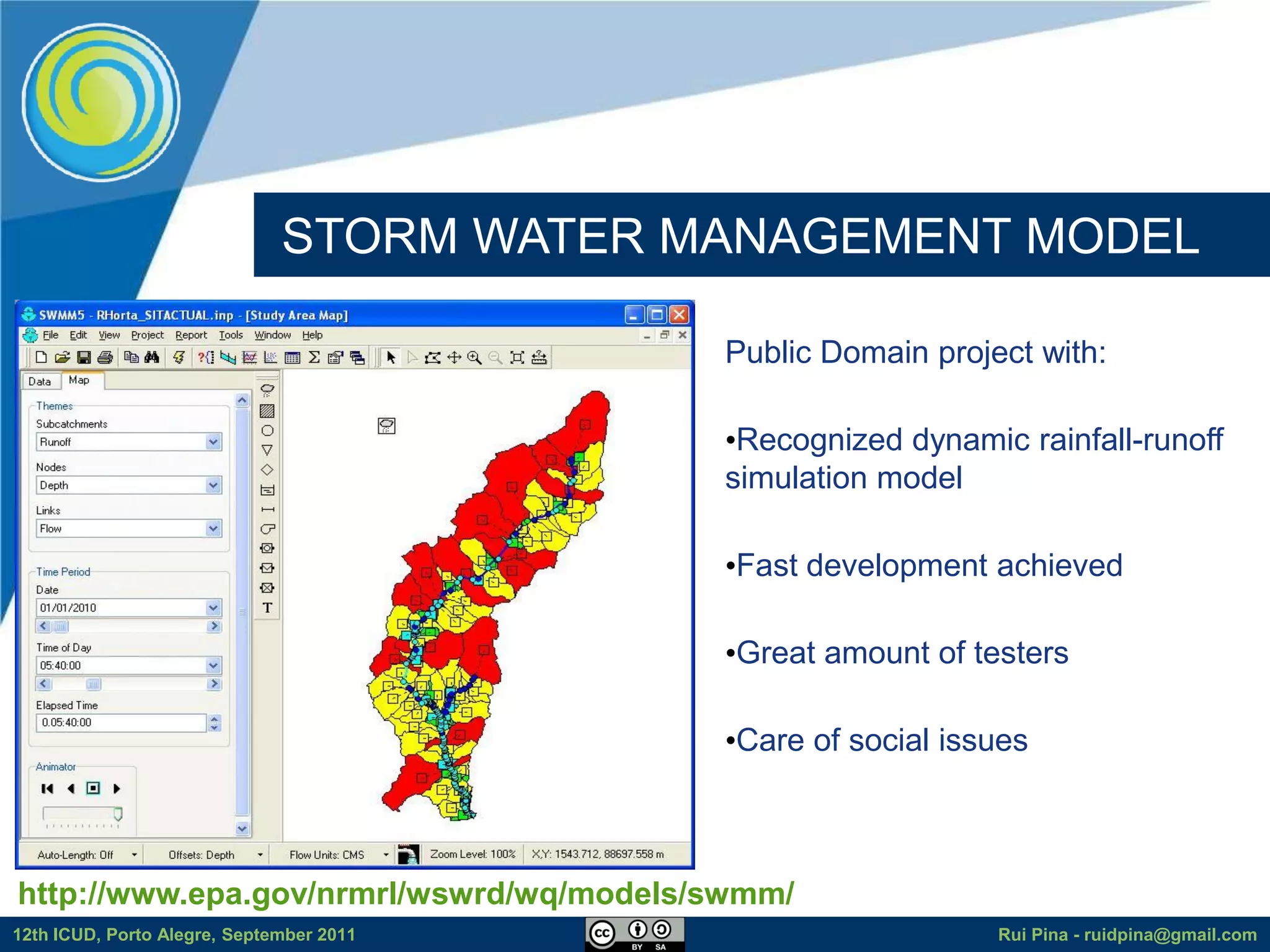
STORM WATER MANAGEMENT MODEL

                                           Public Domain project with:

                                           •Recognized dynamic rainfall-runoff
                                           simulation model

                                           •Fast development achieved

                                           •Great amount of testers

                                           •Care of social issues


http://www.epa.gov/nrmrl/wswrd/wq/models/swmm/
12th ICUD, Porto Alegre, September 2011                       Rui Pina - ruidpina@gmail.com
GOAL


             FOSS4G                       SWMM


12th ICUD, Porto Alegre, September 2011    Rui Pina - ruidpina@gmail.com
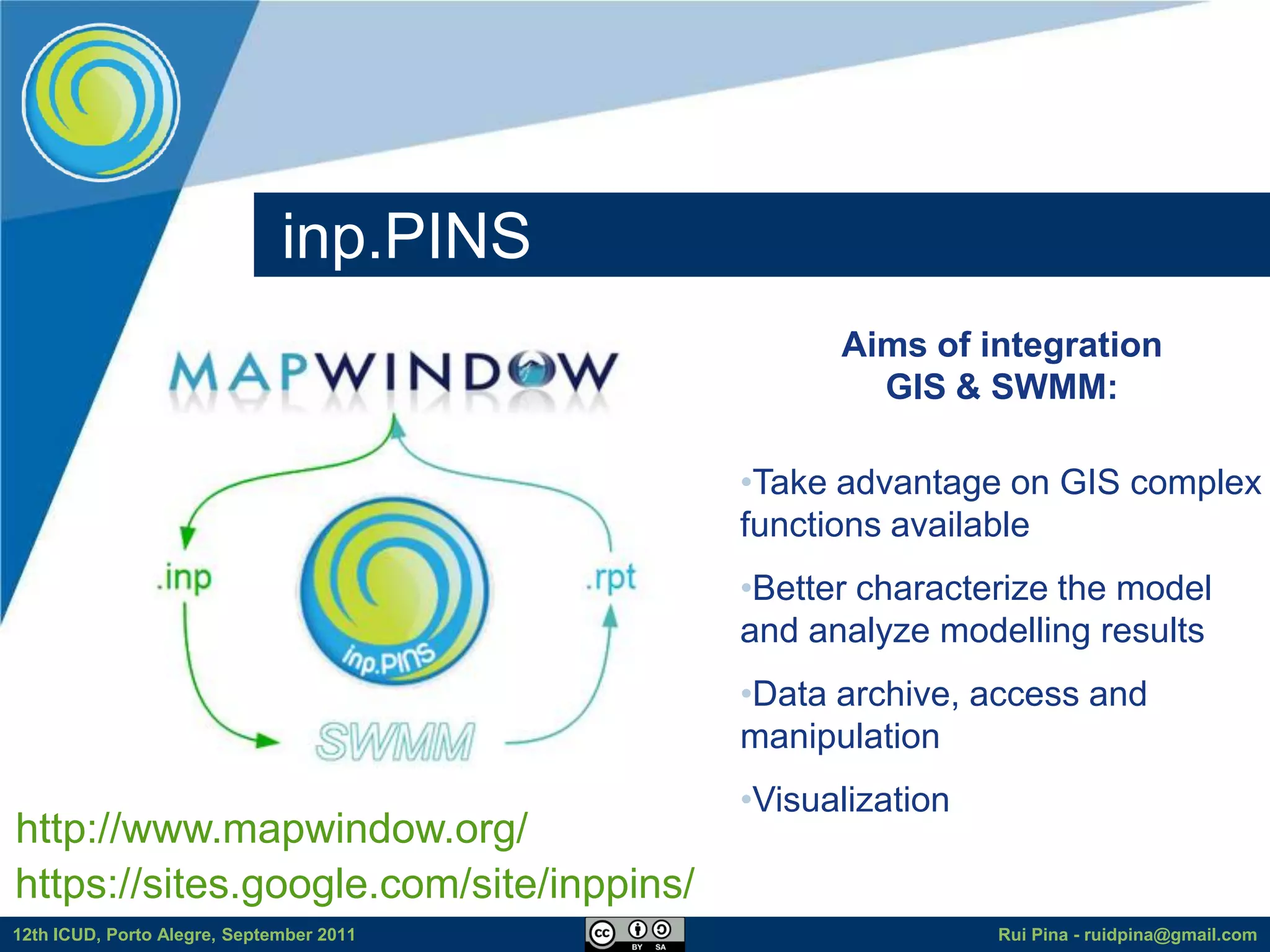
inp.PINS
                                                Aims of integration
                                                  GIS & SWMM:

                                          •Take advantage on GIS complex
                                          functions available
                                          •Better characterize the model
                                          and analyze modelling results
                                          •Data archive, access and
                                          manipulation
                                          •Visualization
http://www.mapwindow.org/
https://sites.google.com/site/inppins/
12th ICUD, Porto Alegre, September 2011                    Rui Pina - ruidpina@gmail.com
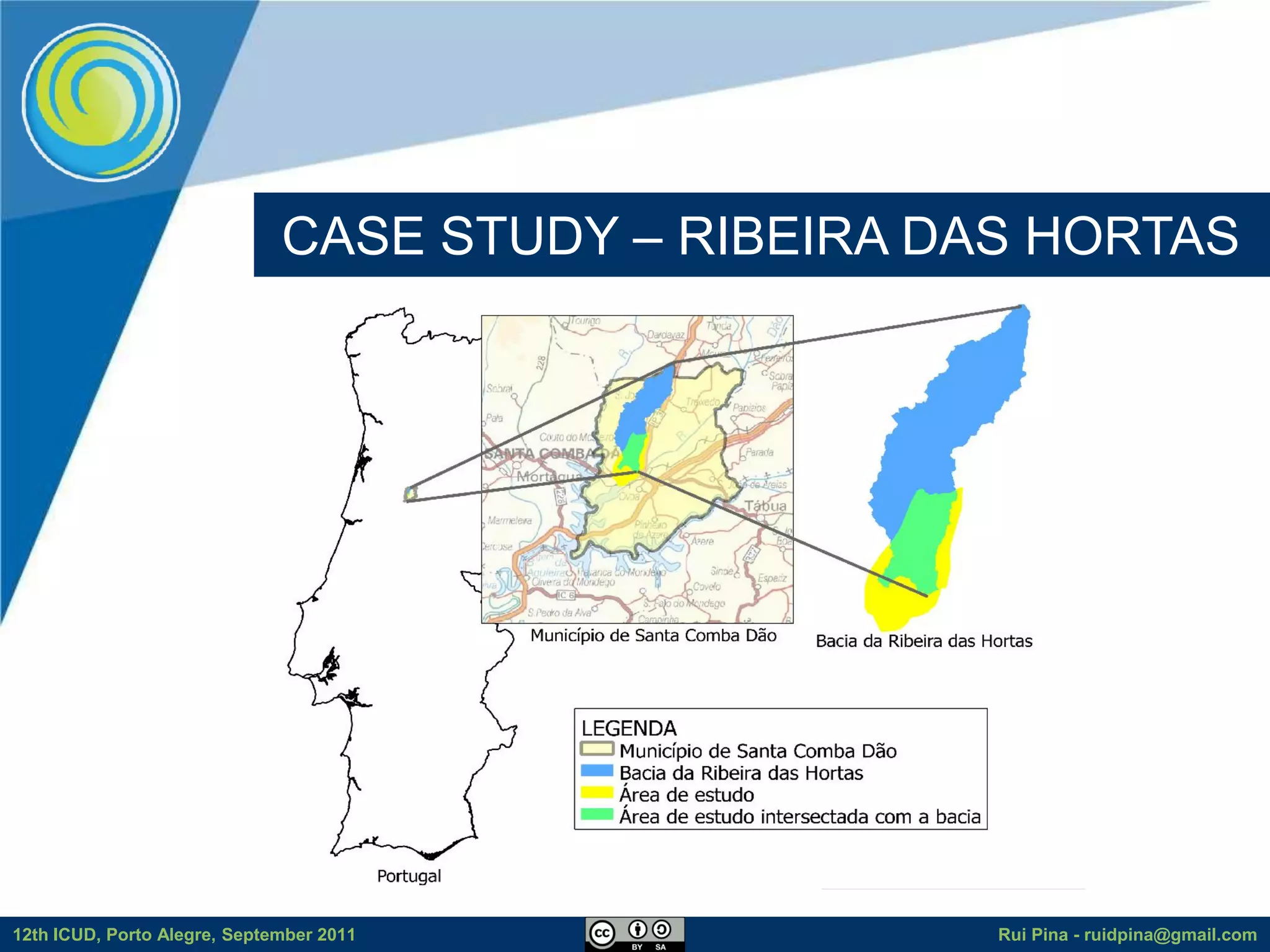
CASE STUDY – RIBEIRA DAS HORTAS


12th ICUD, Porto Alegre, September 2011              Rui Pina - ruidpina@gmail.com
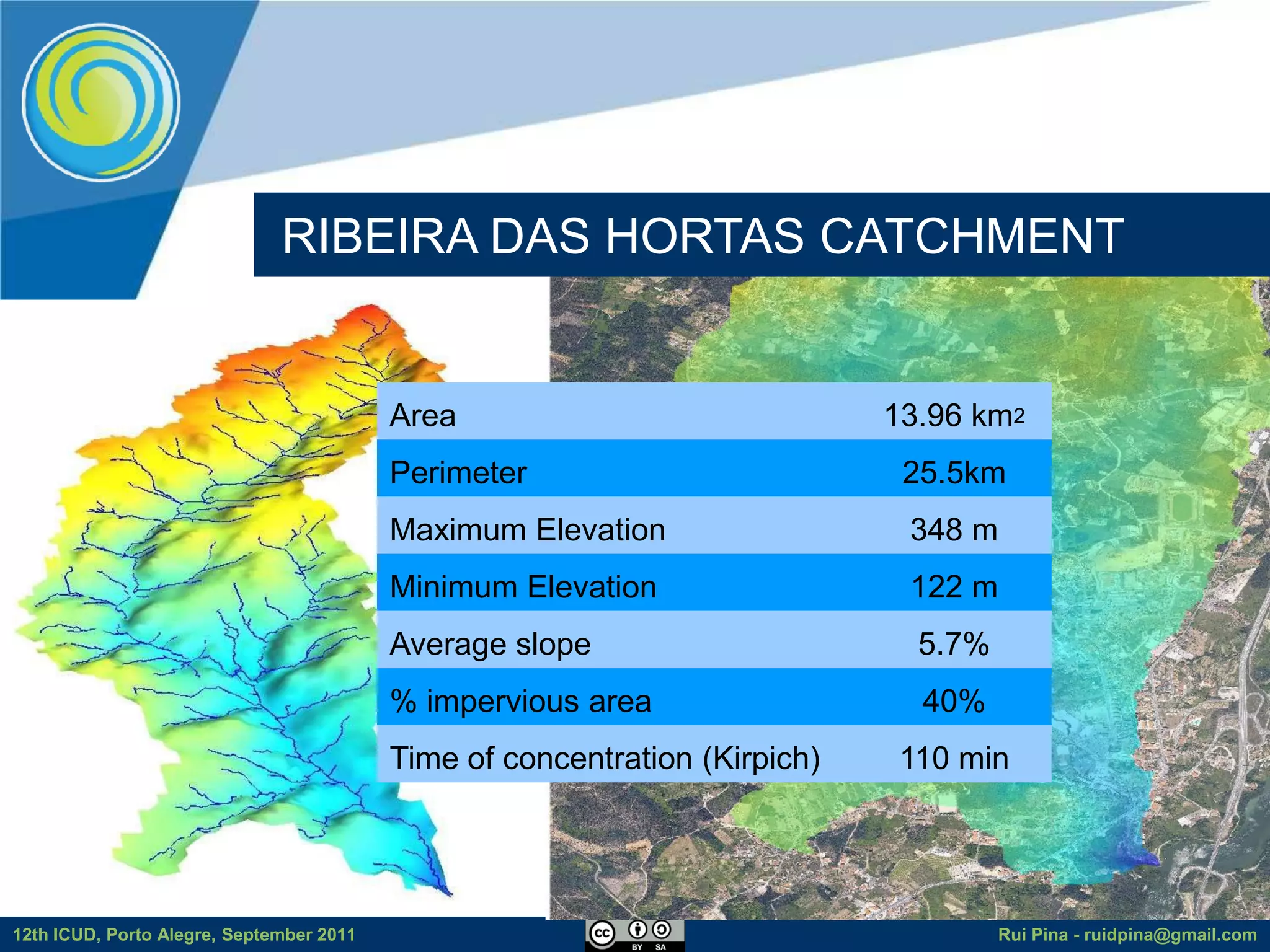
RIBEIRA DAS HORTAS CATCHMENT


                                          Area                              13.96 km2
                                          Perimeter                          25.5km
                                          Maximum Elevation                  348 m
                                          Minimum Elevation                  122 m
                                          Average slope                       5.7%
                                          % impervious area                   40%
                                          Time of concentration (Kirpich)    110 min


12th ICUD, Porto Alegre, September 2011                                              Rui Pina - ruidpina@gmail.com
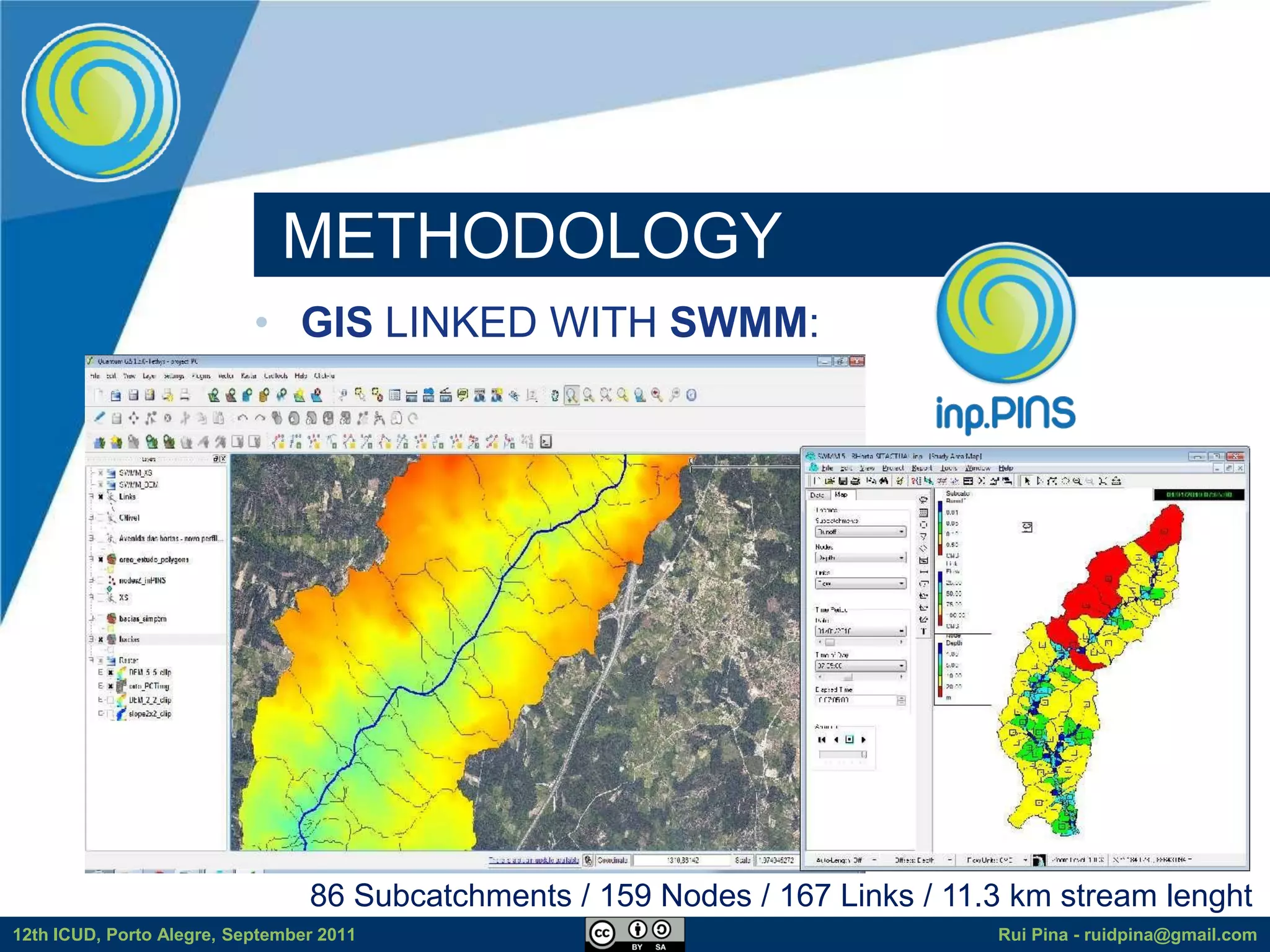
METHODOLOGY
                           • GIS LINKED WITH SWMM:


                                 86 Subcatchments / 159 Nodes / 167 Links / 11.3 km stream lenght
12th ICUD, Porto Alegre, September 2011                                        Rui Pina - ruidpina@gmail.com
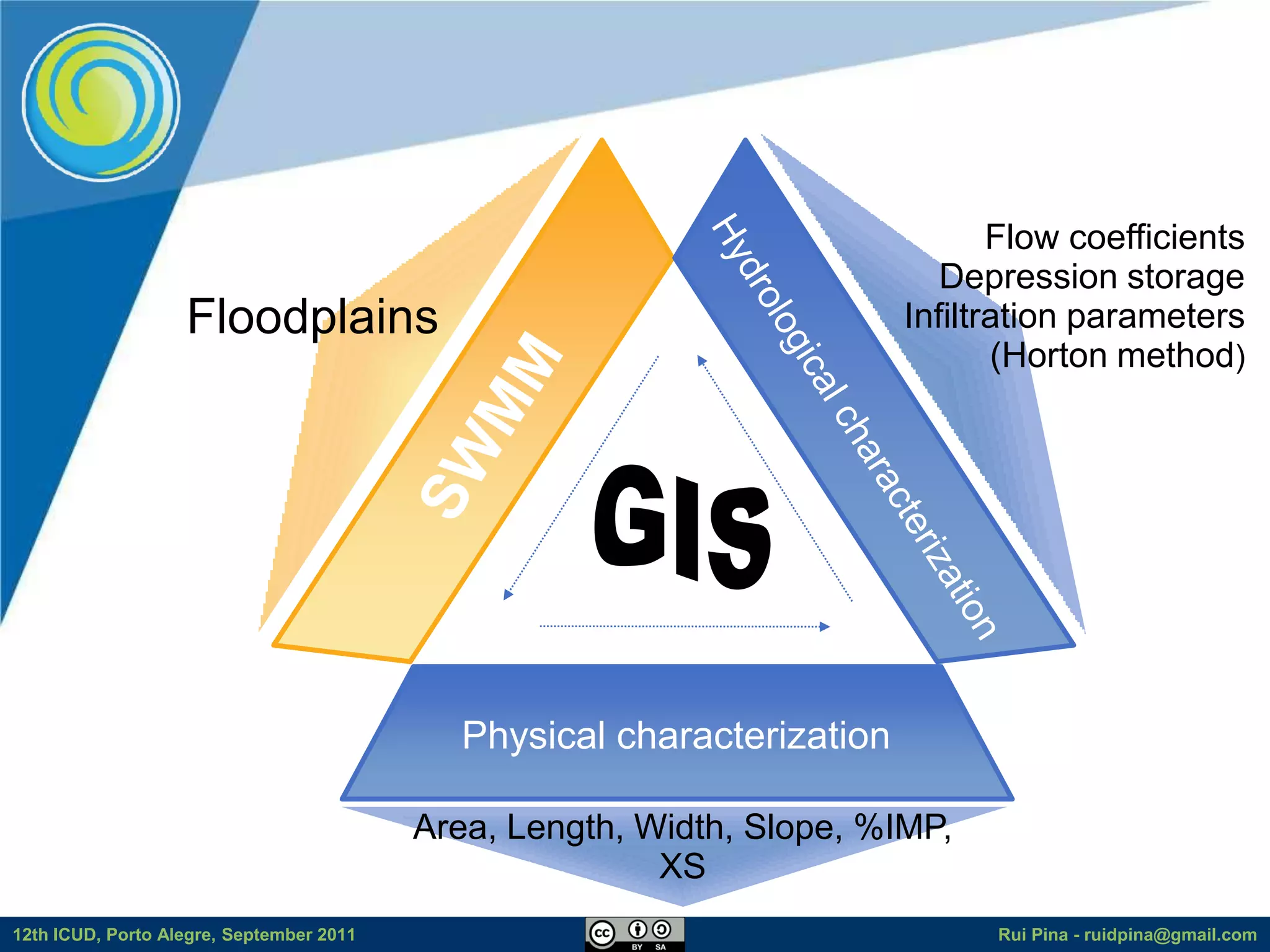
Flow coefficients
                                                                           Depression storage
                   Floodplains                                          Infiltration parameters
                                                                               (Horton method)


                                            Physical characterization

                                          Area, Length, Width, Slope, %IMP,
                                                         XS
12th ICUD, Porto Alegre, September 2011                                       Rui Pina - ruidpina@gmail.com
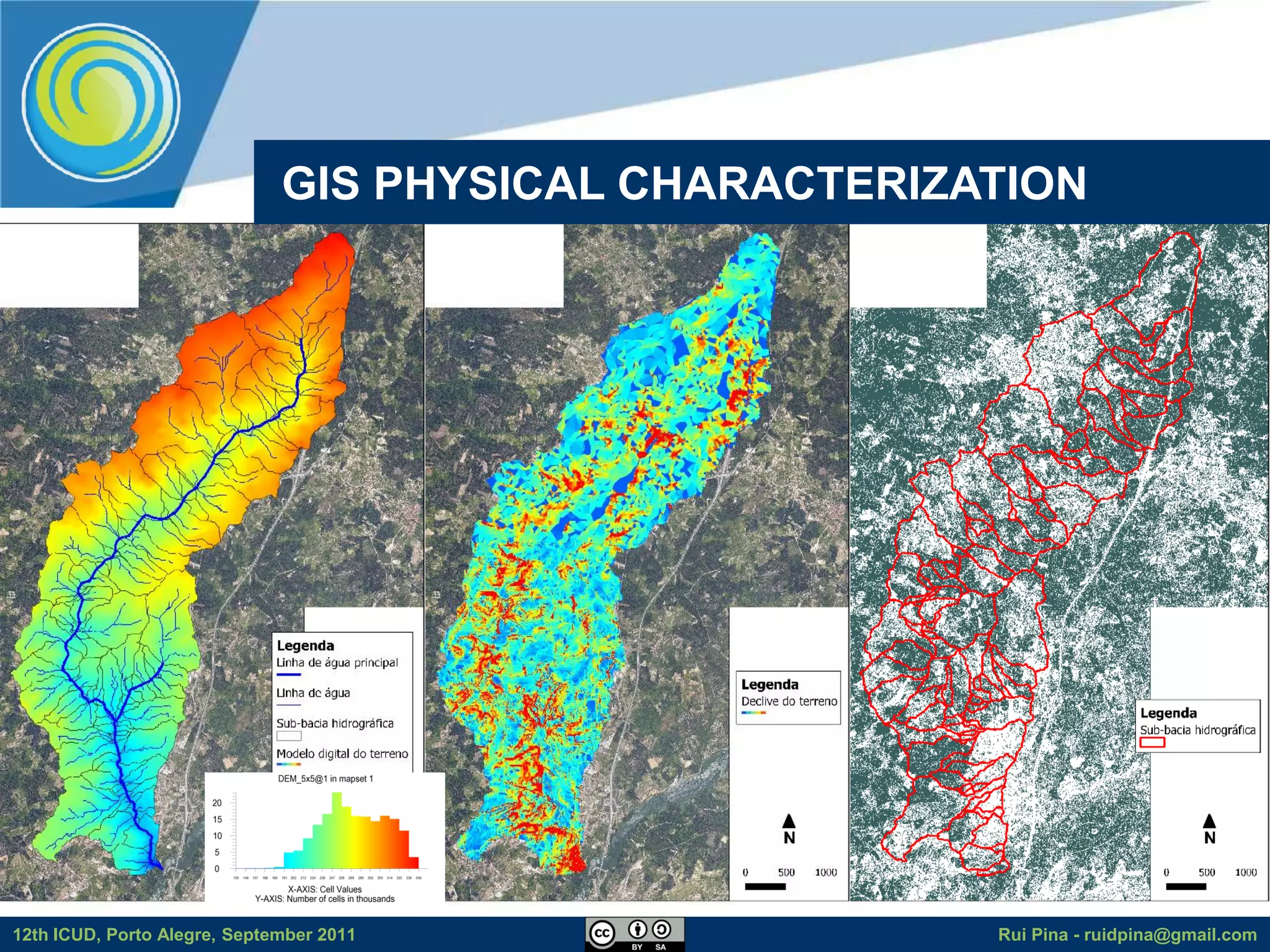
GIS PHYSICAL CHARACTERIZATION


12th ICUD, Porto Alegre, September 2011                Rui Pina - ruidpina@gmail.com
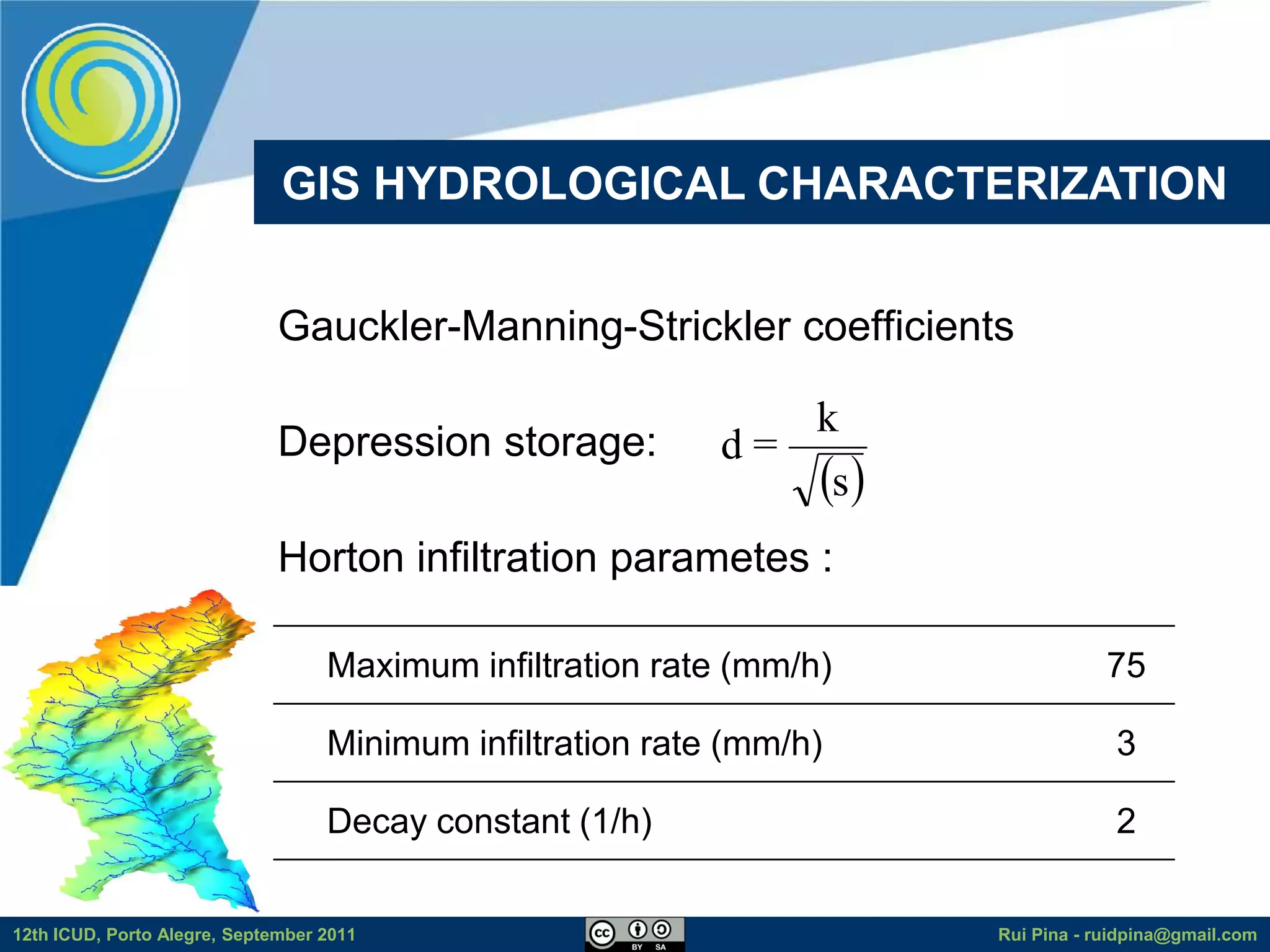
GIS HYDROLOGICAL CHARACTERIZATION


                              Gauckler-Manning-Strickler coefficients

                                                               k
                              Depression storage:           d=
                                                               s 
                              Horton infiltration parametes :

                                   Maximum infiltration rate (mm/h)               75

                                   Minimum infiltration rate (mm/h)                3

                                   Decay constant (1/h)                            2


12th ICUD, Porto Alegre, September 2011                               Rui Pina - ruidpina@gmail.com
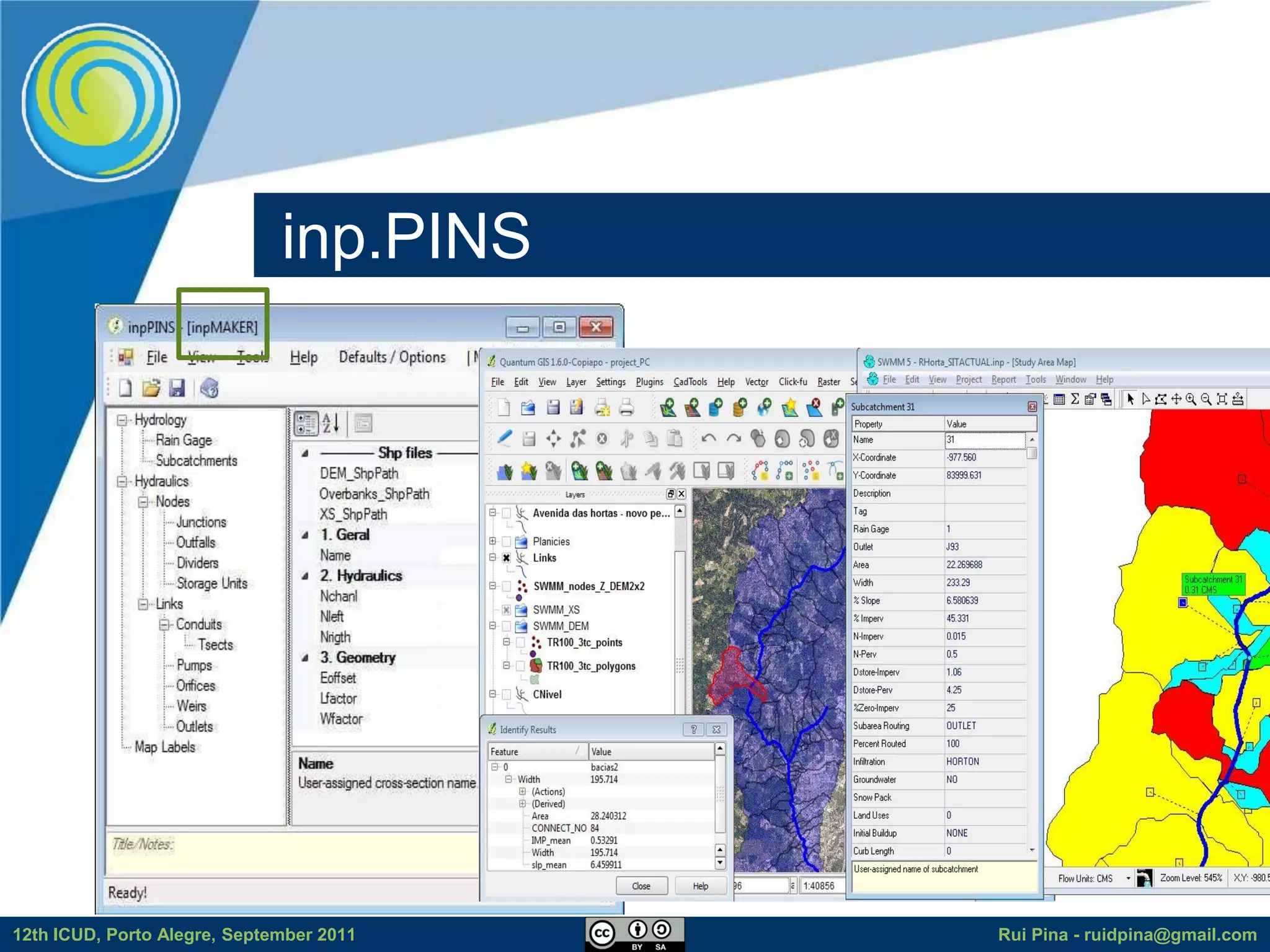
inp.PINS


12th ICUD, Porto Alegre, September 2011   Rui Pina - ruidpina@gmail.com
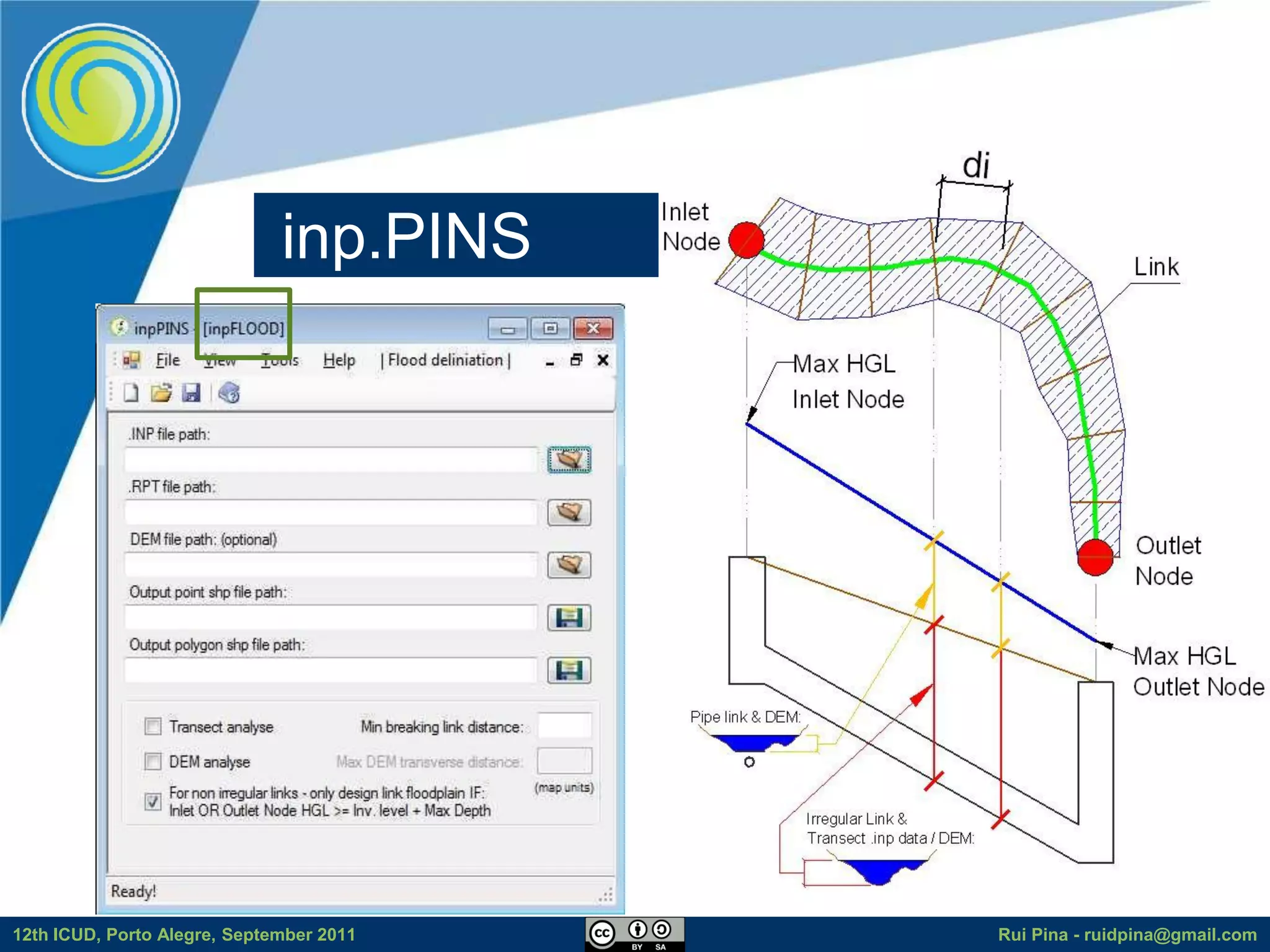
inp.PINS


12th ICUD, Porto Alegre, September 2011   Rui Pina - ruidpina@gmail.com
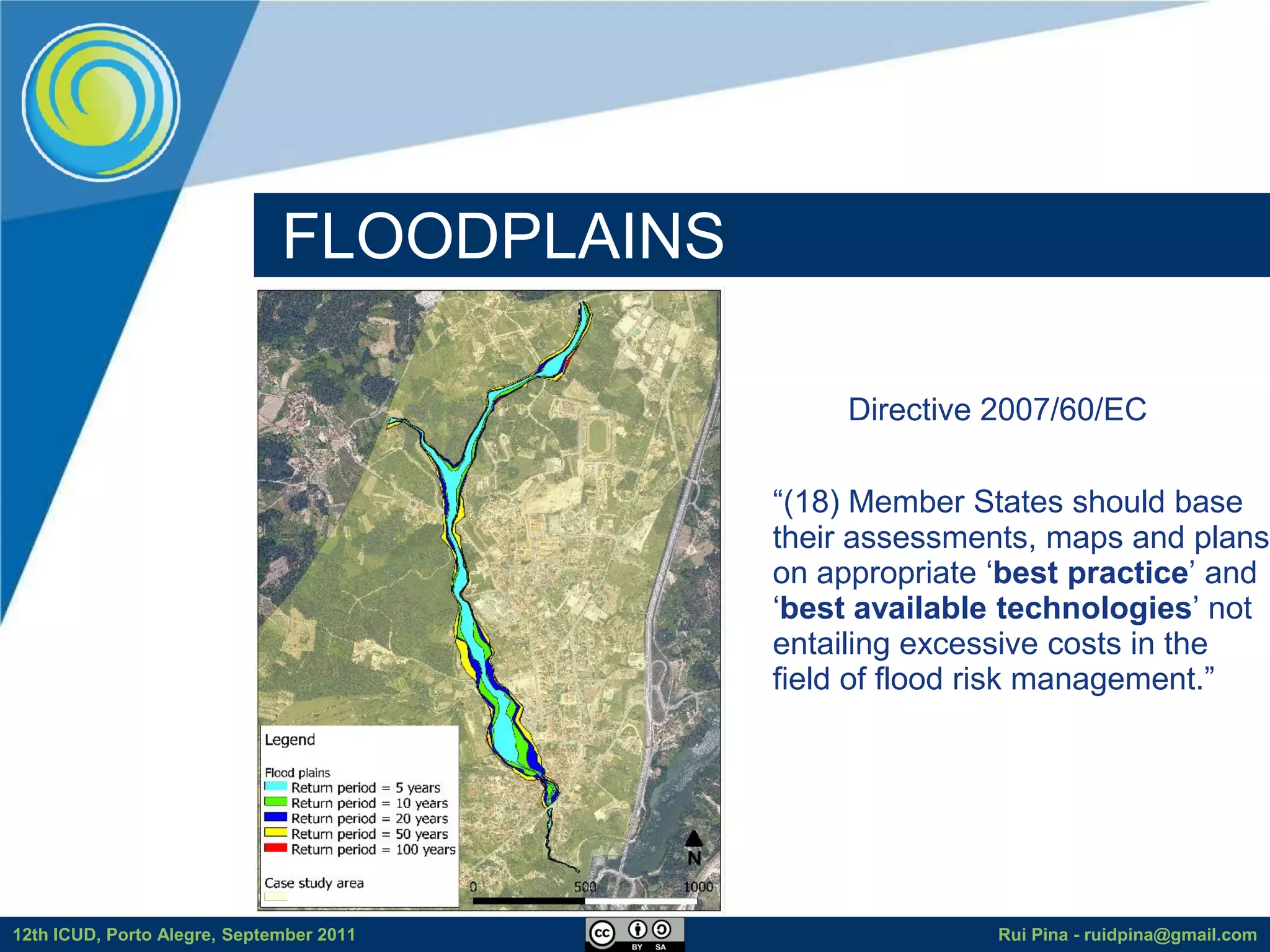
FLOODPLAINS

                                                 Directive 2007/60/EC

                                            “(18) Member States should base
                                            their assessments, maps and plans
                                            on appropriate „best practice‟ and
                                            „best available technologies‟ not
                                            entailing excessive costs in the
                                            field of flood risk management.”


12th ICUD, Porto Alegre, September 2011                    Rui Pina - ruidpina@gmail.com
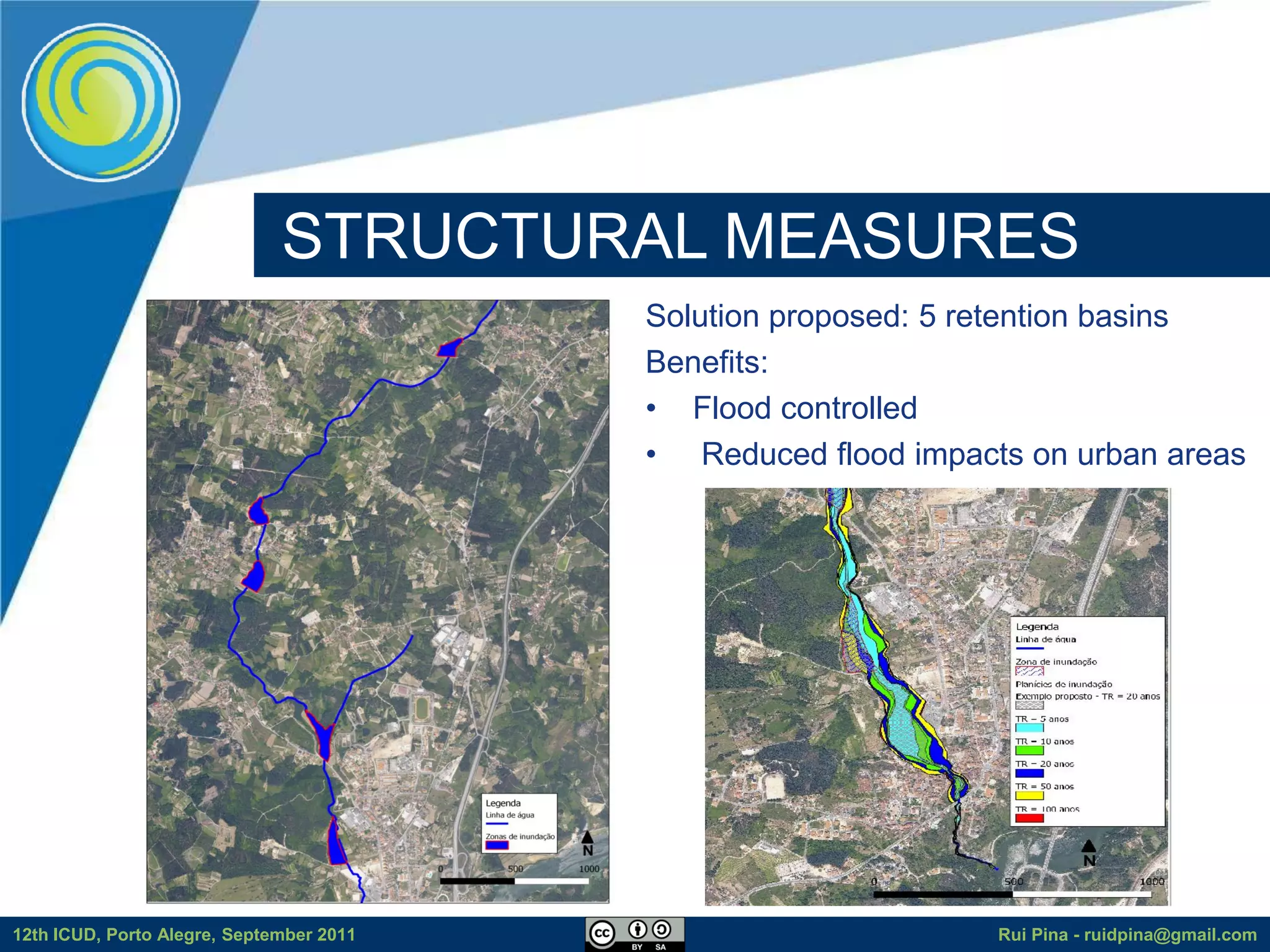
STRUCTURAL MEASURES
                                          Solution proposed: 5 retention basins
                                          Benefits:
                                          • Flood controlled
                                          • Reduced flood impacts on urban areas


12th ICUD, Porto Alegre, September 2011                         Rui Pina - ruidpina@gmail.com
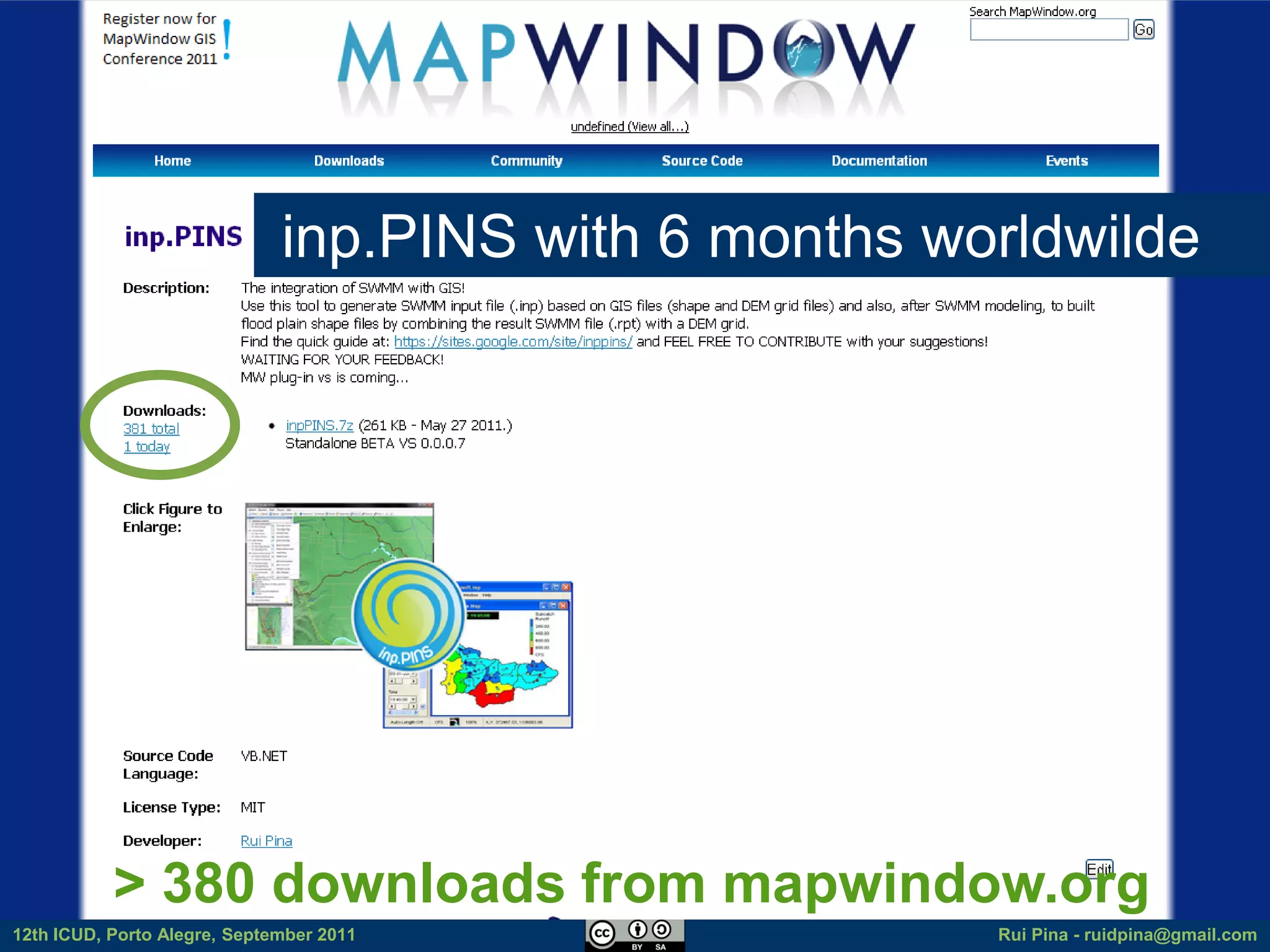
inp.PINS with months worldwilde
                              inp.PINS with 68months worldwilde


                                               https://sites.google.com/site/inppins/

           > 380 downloads> from mapwindow.org
                            380 downloads from http://www.mapwindow.org/
12th ICUD, Porto Alegre, September 2011                       Rui Pina - ruidpina@gmail.com
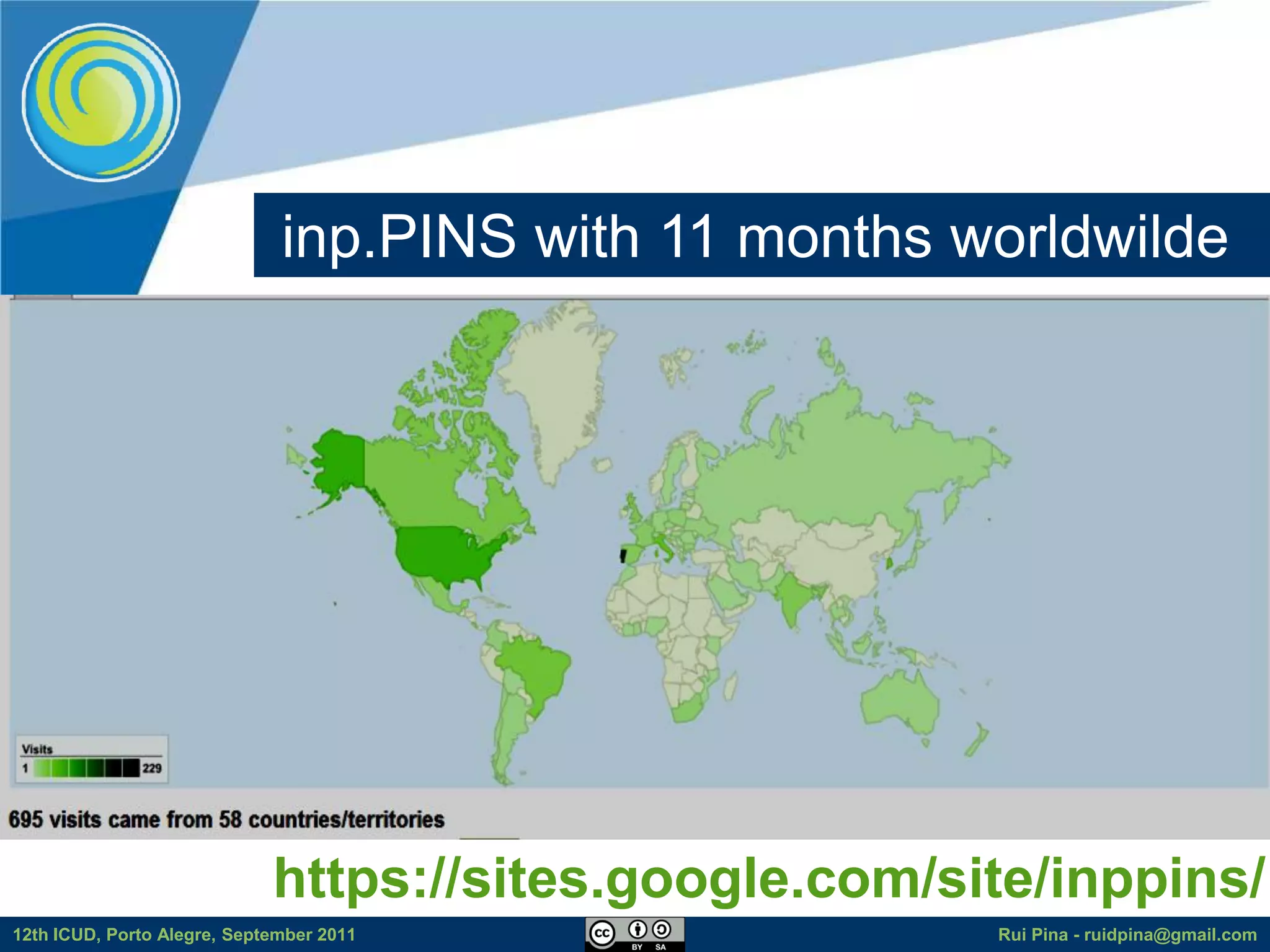
inp.PINS with 11 months worldwilde


                             https://sites.google.com/site/inppins/
12th ICUD, Porto Alegre, September 2011                 Rui Pina - ruidpina@gmail.com
CONCLUSIONS

             • inp.PINS – interoperability between
               GIS & SWMM
             • FOSS advantages:
                            –        Tools adapted to users' needs
                            –        Reduced costs
                            –        Standards: interoperability

12th ICUD, Porto Alegre, September 2011                          Rui Pina - ruidpina@gmail.com
This work is licensed under the Creative Commons Attribution-
            ShareAlike 3.0 Unported License. To view a copy of this license,
            visit http://creativecommons.org/licenses/by-sa/3.0/ or send a
            letter to Creative Commons, 171 Second Street, Suite 300, San
            Francisco, California, 94105, USA.


            Rui Daniel Pina
            ruidpina@gmail.com
            http://pt.linkedin.com/in/ruidpina
12th ICUD, Porto Alegre, September 2011                      Rui Pina - ruidpina@gmail.com

Floodplain delineation with Free and Open Source Software

  • 1.
    Floodplain delineation with Free and Open Source Software RUI Nuno Alfeu Sá Joaquim PINA Simões Marques Sousa ruidpina@gmail.com University of Coimbra - Portugal 12th ICUD, Porto Alegre, September 2011 Rui Pina - ruidpina@gmail.com
  • 2.
    FREE AND OPENSOURCE SOFTWARE (FOSS)? SWMM inp.PINS – GIS & SWMM CASE STUDY inp.PINS WORLDWILDE CONCLUSIONS 12th ICUD, Porto Alegre, September 2011 Rui Pina - ruidpina@gmail.com
  • 3.
    FREE AND OPENSOURCE SOFTWARE (FOSS)? 12th ICUD, Porto Alegre, September 2011 Rui Pina - ruidpina@gmail.com
  • 4.
    THE FREE SOFTWAREDEFINITION • Freedom 0: to run the program, for any purpose. • Freedom 1: to study how the program works, and change it so it does your computing as you wish. • Freedom 2: to redistribute copies so you can help your neighbor. • Freedom 3: to distribute copies of your modified versions to others. 12th ICUD, Porto Alegre, September 2011 Rui Pina - ruidpina@gmail.com
  • 5.
    WHAT IS FOSS? “It is a gift culture, where the basics are taken care of and social status is gained by giving things away, rather than accumulating.” (Harvey and Han, 2002) 12th ICUD, Porto Alegre, September 2011 Rui Pina - ruidpina@gmail.com
  • 6.
    FOSS4G http://www.osgeo.org/ 12th ICUD, Porto Alegre, September 2011 Rui Pina - ruidpina@gmail.com
  • 7.
    STORM WATER MANAGEMENTMODEL Public Domain project with: •Recognized dynamic rainfall-runoff simulation model •Fast development achieved •Great amount of testers •Care of social issues http://www.epa.gov/nrmrl/wswrd/wq/models/swmm/ 12th ICUD, Porto Alegre, September 2011 Rui Pina - ruidpina@gmail.com
  • 8.
    GOAL FOSS4G SWMM 12th ICUD, Porto Alegre, September 2011 Rui Pina - ruidpina@gmail.com
  • 9.
    inp.PINS Aims of integration GIS & SWMM: •Take advantage on GIS complex functions available •Better characterize the model and analyze modelling results •Data archive, access and manipulation •Visualization http://www.mapwindow.org/ https://sites.google.com/site/inppins/ 12th ICUD, Porto Alegre, September 2011 Rui Pina - ruidpina@gmail.com
  • 10.
    CASE STUDY –RIBEIRA DAS HORTAS 12th ICUD, Porto Alegre, September 2011 Rui Pina - ruidpina@gmail.com
  • 11.
    RIBEIRA DAS HORTASCATCHMENT Area 13.96 km2 Perimeter 25.5km Maximum Elevation 348 m Minimum Elevation 122 m Average slope 5.7% % impervious area 40% Time of concentration (Kirpich) 110 min 12th ICUD, Porto Alegre, September 2011 Rui Pina - ruidpina@gmail.com
  • 12.
    METHODOLOGY • GIS LINKED WITH SWMM: 86 Subcatchments / 159 Nodes / 167 Links / 11.3 km stream lenght 12th ICUD, Porto Alegre, September 2011 Rui Pina - ruidpina@gmail.com
  • 13.
    Flow coefficients Depression storage Floodplains Infiltration parameters (Horton method) Physical characterization Area, Length, Width, Slope, %IMP, XS 12th ICUD, Porto Alegre, September 2011 Rui Pina - ruidpina@gmail.com
  • 14.
    GIS PHYSICAL CHARACTERIZATION 12thICUD, Porto Alegre, September 2011 Rui Pina - ruidpina@gmail.com
  • 15.
    GIS HYDROLOGICAL CHARACTERIZATION Gauckler-Manning-Strickler coefficients k Depression storage: d= s  Horton infiltration parametes : Maximum infiltration rate (mm/h) 75 Minimum infiltration rate (mm/h) 3 Decay constant (1/h) 2 12th ICUD, Porto Alegre, September 2011 Rui Pina - ruidpina@gmail.com
  • 16.
    inp.PINS 12th ICUD, PortoAlegre, September 2011 Rui Pina - ruidpina@gmail.com
  • 17.
    inp.PINS 12th ICUD, PortoAlegre, September 2011 Rui Pina - ruidpina@gmail.com
  • 18.
    FLOODPLAINS Directive 2007/60/EC “(18) Member States should base their assessments, maps and plans on appropriate „best practice‟ and „best available technologies‟ not entailing excessive costs in the field of flood risk management.” 12th ICUD, Porto Alegre, September 2011 Rui Pina - ruidpina@gmail.com
  • 19.
    STRUCTURAL MEASURES Solution proposed: 5 retention basins Benefits: • Flood controlled • Reduced flood impacts on urban areas 12th ICUD, Porto Alegre, September 2011 Rui Pina - ruidpina@gmail.com
  • 20.
    inp.PINS with monthsworldwilde inp.PINS with 68months worldwilde https://sites.google.com/site/inppins/ > 380 downloads> from mapwindow.org 380 downloads from http://www.mapwindow.org/ 12th ICUD, Porto Alegre, September 2011 Rui Pina - ruidpina@gmail.com
  • 21.
    inp.PINS with 11months worldwilde https://sites.google.com/site/inppins/ 12th ICUD, Porto Alegre, September 2011 Rui Pina - ruidpina@gmail.com
  • 22.
    CONCLUSIONS • inp.PINS – interoperability between GIS & SWMM • FOSS advantages: – Tools adapted to users' needs – Reduced costs – Standards: interoperability 12th ICUD, Porto Alegre, September 2011 Rui Pina - ruidpina@gmail.com
  • 23.
    This work islicensed under the Creative Commons Attribution- ShareAlike 3.0 Unported License. To view a copy of this license, visit http://creativecommons.org/licenses/by-sa/3.0/ or send a letter to Creative Commons, 171 Second Street, Suite 300, San Francisco, California, 94105, USA. Rui Daniel Pina ruidpina@gmail.com http://pt.linkedin.com/in/ruidpina 12th ICUD, Porto Alegre, September 2011 Rui Pina - ruidpina@gmail.com

Editor's Notes

  • #4 Not Lucky clover, netheir low cost software... According to Free Software Foundation: FOSS is a matter of the users' freedom to run, copy, distribute, study, change and improve the software. Standards enables interoperability between different programs created by different developers. Exploring this advantage, inp.PINS is an application developed to link Geographical Information Systems (GIS) and Storm Water Management Model (SWMM).
  • #5 Freedom 0: The freedom to run the program, for any purpose. Freedom 1:The freedom to study how the program works, and change it so it does your computing as you wish. Access to the source code is a precondition for this. Freedom 2: The freedom to redistribute copies so you can help your neighbor (). Freedom 3: The freedom to distribute copies of your modified versions to others. By doing this you can give the whole community a chance to benefit from your changes. Access to the source code is a precondition for this.
  • #6 Similar to scientific information, whose work on themes they find interesting are driven to publish their research in order to gain recognition for the quality of information they are producing.
  • #7 OSGeo: ensures high quality projects becoming very important: GRASS and QuantumGIS.
  • #8 EPANET and SWMM: public domain software Developed: US-EPA Truth: became very important and well known in this field. Reasons: - Fast development achieved by the community - Great amount of testers - Take care of social issues by providing advanced modelling capabilities for everyone.
  • #9 Nowadays problems: - work with all this software together! - take advantage of each one’s capabilities. What happens often: losing a lot of their possibilities or doubling the work. Standards enables interoperability between different programs created by different developers. GIS & SWMM: Users usually find difficult to transform data coming from GIS to SWMM and vice-versa. FOSS can be significantly useful to spread the use of this tool - allowing community the possibility to run, copy, distribute, study, change and improve the software, in order to obtain the best from the two environments.
  • #10 inp.PINS: link GIS and SWMM Advantage: - GIS and its complex functions, to better characterize the model and to better analyse modelling results. - New scenarios and model developments are easily explored and analysed. - Additional archive, access, manipulation and visualization capabilities for SWMM modelling are achieved.
  • #11 This tool was developed to a work for Santa Comba Dão city hall: developing flood risk maps and flood management guidelines to support urban planning.
  • #12 Ribeira das Hortas Catchment: - Located in Santa Comba Dão Municipality, Portugal - Discharge to Dão River - Area: 14 km2 - Santa Comba Dão city is in the downstream part of the catchment and the River Ribeira das Hortas crosses the downtown area.
  • #13 Methodology was based on GIS and the linking with SWMM was provided by inp.PINS
  • #16 After that, TauDEM was used for catchment delineation and drainage system design. GRASS was used as a QuantumGIS plug-in for geostatistics applied to each sub-catchment. Typical Gauckler-Manning-Strickler coefficients were used for the land type and use observed and depression storage was characterized according to Butler and Davis, 2004: where, k – coefficient depending on the surface type (0.07 for impervious surfaces and 0.28 for pervious surfaces) (mm) s – ground slope.   Horton infiltration parameters are presented in Table 2 (Butler and Davis, 2004).   Table 2. Horton infiltration parametes. Maximum infiltration rate (mm/h) 75 Minimum infiltration rate (mm/h) 3 Decay constant (1/h) 2   The SWMM model was calibrated and validated with knowledge from similar studies and by comparing the results with data from flood registered events. The GIS was integrated with the SWMM model taking advantage of the inp.PINS capabilities. All the characterization process was developed in the GIS environment, and the results were used to build the *.inp file. After the SWWM analysis, inp.PINS was used again to integrate modelling results into the GIS.
  • #17 Idea: 1. Select a shape file 2. Link the columns fields of this shape to each object characteristic. Ability: generate XS from a DEM grid for channel links, defined as IRREGULAR shape conduits in SWMM.
  • #18 InpFloo - *.rpt combined *.inp file and/or DEM grid: 1. Water depth is calculated linearly from upstream to downstream node. 2. Analysis of the conduit geometric XS and/or DEM grid at that XS take place to define the floodplain limits.
  • #19 The project presented was developed according to this EU Directive. Taking advantage of FOSS the work presented established a method based on the ‘best available technologies’ not entailing excessive costs. ‘ best practice’ were also taken care for flood management guide lines development based on Sustainable Urban Drainage Systems.
  • #20 The flood plains obtained by the methodology presented (Figure 6) are in accordance with the data collected from the flood events registered: for 5 years return period no flood problems occur, but for more than 10 year return period important buildings are affected, such as the city council and the fire-station. Therefore, flood management guide lines were developed and a solution to mitigate flood problems was proposed based on the Sustainable Urban Drainage Systems concept.
  • #21 inp.PINS = a tool for all SWMM users What we give: They can now afford all GIS advantages with a FOSS. What we ask: Feedback, bug reports, and suggestions are welcome to improve this software. Future work: improve the capabilities, and also to turn the idea even more flexible, EPANET... STATS - 6 month of the project: - more than 300 downloads - web page visits: more than 400 times, by nearly 50 countries from all continents.
  • #22 inp.PINS = a tool for all SWMM users What we give: They can now afford all GIS advantages with a FOSS. What we ask: Feedback, bug reports, and suggestions are welcome to improve this software. Future work: improve the capabilities, and also to turn the idea even more flexible, EPANET... STATS - 6 month of the project: - more than 300 downloads - web page visits: more than 400 times, by nearly 50 countries from all continents.
  • #23 methodology presented: - efficient way to integrate GIS and SWMM. - the process is operationalized by a better characterization of the model and better analyses of the modelling results, taking advantage of all GIS and SWMM capabilities at the same time. FOSS: - reduced costs - allows the development of tools adapted to the user’s needs Limitations: EPAstandards - OS project with SWMM/EPANET is welcome! - Standards must be defined for the guaranteed success in the hands of the community who will help on its developments and also on testing it for growing up in an efficient and fast way.