SHRM Survey Findings: State of Employee Benefits in
the Workplace—Flexible Work Arrangements


                                            January 10, 2013
Introduction


• This is part two of a series of SHRM surveys examining the state of employee benefits in the
  workplace.


• The following topics are included in this six-part series:
     Part 1: Wellness initiatives
     Part 2: Flexible work arrangements
     Part 3: Health care
     Part 4: Leveraging benefits to retain employees
     Part 5: Leveraging benefits to recruit employees
     Part 6: Communicating benefits


                                     State of Employee Benefits in the Workplace—Flexible Work Arrangements ©SHRM 2012   2
Definition


•   For the purpose of this survey, flexible work arrangements may include full- or part-time
    telecommuting, flexible scheduling, compressed workweek, etc.


                                   State of Employee Benefits in the Workplace—Flexible Work Arrangements ©SHRM 2012   3
Key Findings


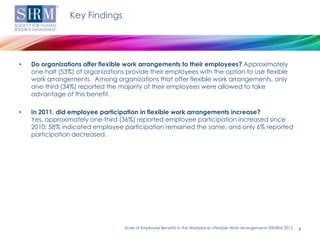
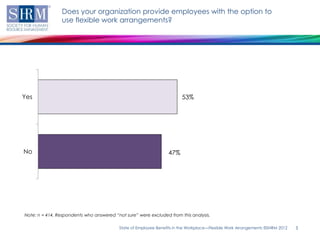
•   Do organizations offer flexible work arrangements to their employees? Approximately
    one-half (53%) of organizations provide their employees with the option to use flexible
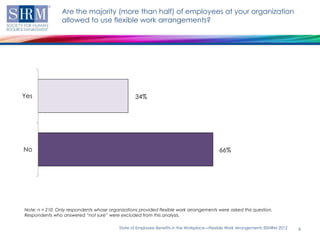
    work arrangements. Among organizations that offer flexible work arrangements, only
    one-third (34%) reported the majority of their employees were allowed to take
    advantage of this benefit.

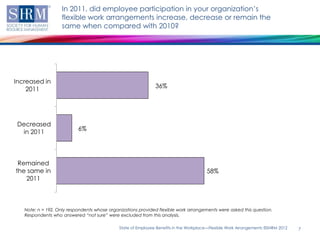
•   In 2011, did employee participation in flexible work arrangements increase?
    Yes, approximately one-third (36%) reported employee participation increased since
    2010; 58% indicated employee participation remained the same; and only 6% reported
    participation decreased.


                                   State of Employee Benefits in the Workplace—Flexible Work Arrangements ©SHRM 2012   4
Does your organization provide employees with the option to
                use flexible work arrangements?


Yes                                                                     53%


No                                                               47%


Note: n = 414. Respondents who answered “not sure” were excluded from this analysis.

                                          State of Employee Benefits in the Workplace—Flexible Work Arrangements ©SHRM 2012   5
Are the majority (more than half) of employees at your organization
                 allowed to use flexible work arrangements?


Yes                                               34%


No                                                                                         66%


Note: n = 210. Only respondents whose organizations provided flexible work arrangements were asked this question.
Respondents who answered “not sure” were excluded from this analysis.

                                           State of Employee Benefits in the Workplace—Flexible Work Arrangements ©SHRM 2012   6
In 2011, did employee participation in your organization’s
                    flexible work arrangements increase, decrease or remain the
                    same when compared with 2010?


Increased in
    2011                                                       36%


 Decreased
                           6%
  in 2011


 Remained
the same in                                                                             58%
   2011


   Note: n = 192. Only respondents whose organizations provided flexible work arrangements were asked this question.
   Respondents who answered “not sure” were excluded from this analysis.

                                              State of Employee Benefits in the Workplace—Flexible Work Arrangements ©SHRM 2012   7
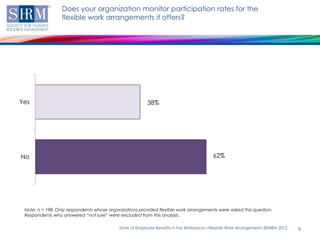
Does your organization monitor participation rates for the
                  flexible work arrangements it offers?


Yes                                                      38%


No                                                                                       62%


 Note: n = 198. Only respondents whose organizations provided flexible work arrangements were asked this question.
 Respondents who answered “not sure” were excluded from this analysis.

                                            State of Employee Benefits in the Workplace—Flexible Work Arrangements ©SHRM 2012   8
Organization Demographics


                            9
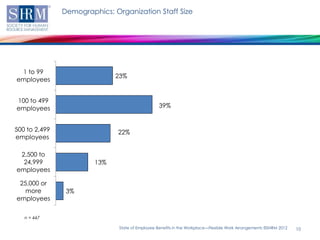
Demographics: Organization Staff Size


 1 to 99
                              23%
employees


100 to 499
employees                                         39%


500 to 2,499                  22%
employees

 2,500 to
  24,999                13%
employees

 25,000 or
   more         3%
employees

   n = 447

                               State of Employee Benefits in the Workplace—Flexible Work Arrangements ©SHRM 2012   10
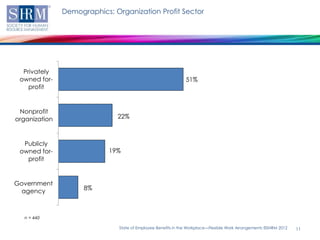
Demographics: Organization Profit Sector


  Privately
 owned for-                                                    51%
    profit


 Nonprofit
organization                  22%


  Publicly
 owned for-                 19%
   profit


Government
 agency              8%


   n = 440

                               State of Employee Benefits in the Workplace—Flexible Work Arrangements ©SHRM 2012   11
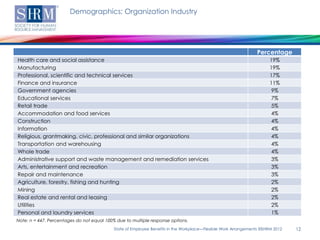
Demographics: Organization Industry


                                                                                                                Percentage
Health care and social assistance                                                                                      19%
Manufacturing                                                                                                          19%
Professional, scientific and technical services                                                                        17%
Finance and insurance                                                                                                  11%
Government agencies                                                                                                     9%
Educational services                                                                                                    7%
Retail trade                                                                                                            5%
Accommodation and food services                                                                                         4%
Construction                                                                                                            4%
Information                                                                                                             4%
Religious, grantmaking, civic, professional and similar organizations                                                   4%
Transportation and warehousing                                                                                          4%
Whole trade                                                                                                             4%
Administrative support and waste management and remediation services                                                    3%
Arts, entertainment and recreation                                                                                      3%
Repair and maintenance                                                                                                  3%
Agriculture, forestry, fishing and hunting                                                                              2%
Mining                                                                                                                  2%
Real estate and rental and leasing                                                                                      2%
Utilities                                                                                                               2%
Personal and laundry services                                                                                           1%
Note: n = 447. Percentages do not equal 100% due to multiple response options.
                                            State of Employee Benefits in the Workplace—Flexible Work Arrangements ©SHRM 2012   12
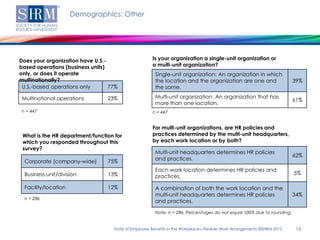
Demographics: Other


Does your organization have U.S.-                    Is your organization a single-unit organization or
based operations (business units)                    a multi-unit organization?
only, or does it operate                              Single-unit organization: An organization in which
multinationally?                                      the location and the organization are one and                    39%
 U.S.-based operations only       77%                 the same.

 Multinational operations        23%                  Multi-unit organization: An organization that has
                                                                                                                       61%
                                                      more than one location.
 n = 447                                             n = 447


                                                     For multi-unit organizations, are HR policies and
 What is the HR department/function for              practices determined by the multi-unit headquarters,
 which you responded throughout this                 by each work location or by both?
 survey?
                                                      Multi-unit headquarters determines HR policies
                                                                                                                       62%
                                                      and practices.
  Corporate (company-wide)       75%
                                                      Each work location determines HR policies and
  Business unit/division         13%                                                                                   5%
                                                      practices.

  Facility/location              12%                  A combination of both the work location and the
                                                      multi-unit headquarters determines HR policies                   34%
  n = 286
                                                      and practices.

                                                      Note: n = 286. Percentages do not equal 100% due to rounding.


                                   State of Employee Benefits in the Workplace—Flexible Work Arrangements ©SHRM 2012    13
SHRM Survey Findings: State of Employee Benefits in
          the Workplace—Flexible Work Arrangements


Survey Methodology
• Response rate = 12%
• 447 HR professional respondents from a randomly selected sample of SHRM’s
  membership participated in this survey
• Margin of error +/- 4%
• Survey fielded March 1, 2012 to April 6, 2012


                               State of Employee Benefits in the Workplace—Flexible Work Arrangements ©SHRM 2012 14
About SHRM Research


• For more survey/poll findings, visit www.shrm.org/surveys

• For more information about SHRM’s Customized Research Services, visit
  www.shrm.org/customizedresearch

• Follow us on Twitter @SHRM_Research

Project leaders:
   Shawn Fegley, SPHR, survey research analyst, SHRM Research
   Christina Lee, intern, SHRM Research

Project contributors:
   Mark Schmit, Ph.D., SPHR, vice president, SHRM Research
   Evren Esen, manager, Survey Research Center, SHRM Research

Copy editor:
  Katya Scanlan, SHRM Knowledge Center

                               State of Employee Benefits in the Workplace—Flexible Work Arrangements ©SHRM 2012 15

Flexible work-arrangements

  • 1.
    SHRM Survey Findings:State of Employee Benefits in the Workplace—Flexible Work Arrangements January 10, 2013
  • 2.
    Introduction • This ispart two of a series of SHRM surveys examining the state of employee benefits in the workplace. • The following topics are included in this six-part series: Part 1: Wellness initiatives Part 2: Flexible work arrangements Part 3: Health care Part 4: Leveraging benefits to retain employees Part 5: Leveraging benefits to recruit employees Part 6: Communicating benefits State of Employee Benefits in the Workplace—Flexible Work Arrangements ©SHRM 2012 2
  • 3.
    Definition • For the purpose of this survey, flexible work arrangements may include full- or part-time telecommuting, flexible scheduling, compressed workweek, etc. State of Employee Benefits in the Workplace—Flexible Work Arrangements ©SHRM 2012 3
  • 4.
    Key Findings • Do organizations offer flexible work arrangements to their employees? Approximately one-half (53%) of organizations provide their employees with the option to use flexible work arrangements. Among organizations that offer flexible work arrangements, only one-third (34%) reported the majority of their employees were allowed to take advantage of this benefit. • In 2011, did employee participation in flexible work arrangements increase? Yes, approximately one-third (36%) reported employee participation increased since 2010; 58% indicated employee participation remained the same; and only 6% reported participation decreased. State of Employee Benefits in the Workplace—Flexible Work Arrangements ©SHRM 2012 4
  • 5.
    Does your organizationprovide employees with the option to use flexible work arrangements? Yes 53% No 47% Note: n = 414. Respondents who answered “not sure” were excluded from this analysis. State of Employee Benefits in the Workplace—Flexible Work Arrangements ©SHRM 2012 5
  • 6.
    Are the majority(more than half) of employees at your organization allowed to use flexible work arrangements? Yes 34% No 66% Note: n = 210. Only respondents whose organizations provided flexible work arrangements were asked this question. Respondents who answered “not sure” were excluded from this analysis. State of Employee Benefits in the Workplace—Flexible Work Arrangements ©SHRM 2012 6
  • 7.
    In 2011, didemployee participation in your organization’s flexible work arrangements increase, decrease or remain the same when compared with 2010? Increased in 2011 36% Decreased 6% in 2011 Remained the same in 58% 2011 Note: n = 192. Only respondents whose organizations provided flexible work arrangements were asked this question. Respondents who answered “not sure” were excluded from this analysis. State of Employee Benefits in the Workplace—Flexible Work Arrangements ©SHRM 2012 7
  • 8.
    Does your organizationmonitor participation rates for the flexible work arrangements it offers? Yes 38% No 62% Note: n = 198. Only respondents whose organizations provided flexible work arrangements were asked this question. Respondents who answered “not sure” were excluded from this analysis. State of Employee Benefits in the Workplace—Flexible Work Arrangements ©SHRM 2012 8
  • 9.
  • 10.
    Demographics: Organization StaffSize 1 to 99 23% employees 100 to 499 employees 39% 500 to 2,499 22% employees 2,500 to 24,999 13% employees 25,000 or more 3% employees n = 447 State of Employee Benefits in the Workplace—Flexible Work Arrangements ©SHRM 2012 10
  • 11.
    Demographics: Organization ProfitSector Privately owned for- 51% profit Nonprofit organization 22% Publicly owned for- 19% profit Government agency 8% n = 440 State of Employee Benefits in the Workplace—Flexible Work Arrangements ©SHRM 2012 11
  • 12.
    Demographics: Organization Industry Percentage Health care and social assistance 19% Manufacturing 19% Professional, scientific and technical services 17% Finance and insurance 11% Government agencies 9% Educational services 7% Retail trade 5% Accommodation and food services 4% Construction 4% Information 4% Religious, grantmaking, civic, professional and similar organizations 4% Transportation and warehousing 4% Whole trade 4% Administrative support and waste management and remediation services 3% Arts, entertainment and recreation 3% Repair and maintenance 3% Agriculture, forestry, fishing and hunting 2% Mining 2% Real estate and rental and leasing 2% Utilities 2% Personal and laundry services 1% Note: n = 447. Percentages do not equal 100% due to multiple response options. State of Employee Benefits in the Workplace—Flexible Work Arrangements ©SHRM 2012 12
  • 13.
    Demographics: Other Does yourorganization have U.S.- Is your organization a single-unit organization or based operations (business units) a multi-unit organization? only, or does it operate Single-unit organization: An organization in which multinationally? the location and the organization are one and 39% U.S.-based operations only 77% the same. Multinational operations 23% Multi-unit organization: An organization that has 61% more than one location. n = 447 n = 447 For multi-unit organizations, are HR policies and What is the HR department/function for practices determined by the multi-unit headquarters, which you responded throughout this by each work location or by both? survey? Multi-unit headquarters determines HR policies 62% and practices. Corporate (company-wide) 75% Each work location determines HR policies and Business unit/division 13% 5% practices. Facility/location 12% A combination of both the work location and the multi-unit headquarters determines HR policies 34% n = 286 and practices. Note: n = 286. Percentages do not equal 100% due to rounding. State of Employee Benefits in the Workplace—Flexible Work Arrangements ©SHRM 2012 13
  • 14.
    SHRM Survey Findings:State of Employee Benefits in the Workplace—Flexible Work Arrangements Survey Methodology • Response rate = 12% • 447 HR professional respondents from a randomly selected sample of SHRM’s membership participated in this survey • Margin of error +/- 4% • Survey fielded March 1, 2012 to April 6, 2012 State of Employee Benefits in the Workplace—Flexible Work Arrangements ©SHRM 2012 14
  • 15.
    About SHRM Research •For more survey/poll findings, visit www.shrm.org/surveys • For more information about SHRM’s Customized Research Services, visit www.shrm.org/customizedresearch • Follow us on Twitter @SHRM_Research Project leaders: Shawn Fegley, SPHR, survey research analyst, SHRM Research Christina Lee, intern, SHRM Research Project contributors: Mark Schmit, Ph.D., SPHR, vice president, SHRM Research Evren Esen, manager, Survey Research Center, SHRM Research Copy editor: Katya Scanlan, SHRM Knowledge Center State of Employee Benefits in the Workplace—Flexible Work Arrangements ©SHRM 2012 15