SHRM Survey Findings: State of Employee Benefits in the
Workplace—Flexible Work Arrangements

December 18, 2013
Introduction

• This is part two of a series of SHRM survey findings examining employee benefits in the workplace.

• The following topics are included in the six-part series titled State of Employee Benefits in the
Workplace:
»
»
»
»
»
»

Part 1: Wellness initiatives
Part 2: Flexible work arrangements
Part 3: Health care
Part 4: Leveraging benefits to retain employees
Part 5: Leveraging benefits to recruit employees
Part 6: Communicating benefits

State of Employee Benefits in the Workplace—Flexible Work Arrangements ©SHRM 2013

2
Definition

• For the purpose of this survey, flexible work arrangements or flex work may include full- or part-time
telecommuting, flexible scheduling, compressed workweek, etc.

State of Employee Benefits in the Workplace—Flexible Work Arrangements ©SHRM 2013

3
Key Findings

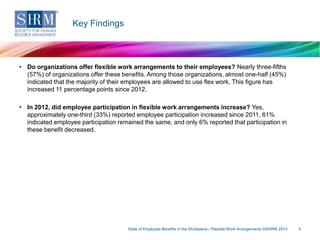
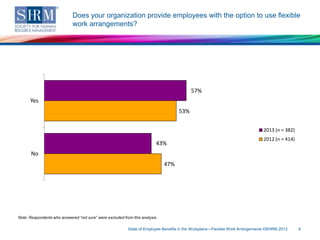
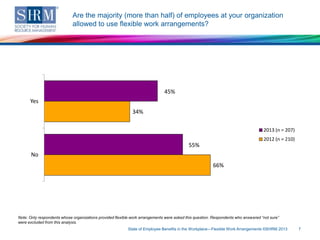
• Do organizations offer flexible work arrangements to their employees? Nearly three-fifths
(57%) of organizations offer these benefits. Among those organizations, almost one-half (45%)
indicated that the majority of their employees are allowed to use flex work. This figure has
increased 11 percentage points since 2012.
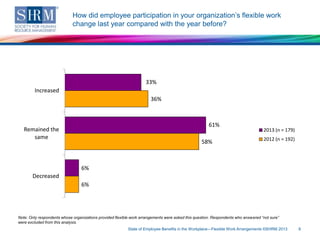
• In 2012, did employee participation in flexible work arrangements increase? Yes,
approximately one-third (33%) reported employee participation increased since 2011, 61%
indicated employee participation remained the same, and only 6% reported that participation in
these benefit decreased.

State of Employee Benefits in the Workplace—Flexible Work Arrangements ©SHRM 2013

4
What do these findings mean to the HR profession?

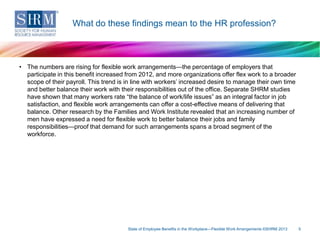
• The numbers are rising for flexible work arrangements—the percentage of employers that
participate in this benefit increased from 2012, and more organizations offer flex work to a broader
scope of their payroll. This trend is in line with workers’ increased desire to manage their own time
and better balance their work with their responsibilities out of the office. Separate SHRM studies
have shown that many workers rate “the balance of work/life issues” as an integral factor in job
satisfaction, and flexible work arrangements can offer a cost-effective means of delivering that
balance. Other research by the Families and Work Institute revealed that an increasing number of
men have expressed a need for flexible work to better balance their jobs and family
responsibilities—proof that demand for such arrangements spans a broad segment of the
workforce.

State of Employee Benefits in the Workplace—Flexible Work Arrangements ©SHRM 2013

5
Does your organization provide employees with the option to use flexible
work arrangements?

57%
Yes
53%
2013 (n = 382)

43%

2012 (n = 414)

No
47%

Note: Respondents who answered “not sure” were excluded from this analysis.
State of Employee Benefits in the Workplace—Flexible Work Arrangements ©SHRM 2013

6
Are the majority (more than half) of employees at your organization
allowed to use flexible work arrangements?

45%
Yes
34%
2013 (n = 207)
2012 (n = 210)

55%
No
66%

Note: Only respondents whose organizations provided flexible work arrangements were asked this question. Respondents who answered “not sure”
were excluded from this analysis.
State of Employee Benefits in the Workplace—Flexible Work Arrangements ©SHRM 2013

7
How did employee participation in your organization’s flexible work
change last year compared with the year before?

33%
Increased
36%

61%

Remained the
same

58%

2013 (n = 179)
2012 (n = 192)

6%
Decreased
6%

Note: Only respondents whose organizations provided flexible work arrangements were asked this question. Respondents who answered “not sure”
were excluded from this analysis.
State of Employee Benefits in the Workplace—Flexible Work Arrangements ©SHRM 2013

8
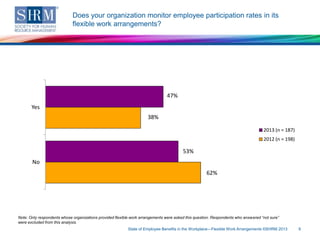
Does your organization monitor employee participation rates in its
flexible work arrangements?

47%
Yes
38%
2013 (n = 187)
2012 (n = 198)

53%
No
62%

Note: Only respondents whose organizations provided flexible work arrangements were asked this question. Respondents who answered “not sure”
were excluded from this analysis.
State of Employee Benefits in the Workplace—Flexible Work Arrangements ©SHRM 2013

9
Organization Demographics

State of Employee Benefits in the Workplace—Flexible Work Arrangements ©SHRM 2013

10
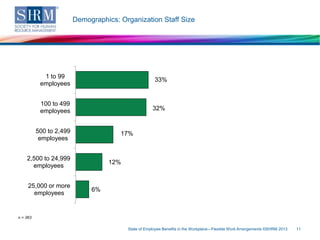
Demographics: Organization Staff Size

1 to 99
employees

33%

100 to 499
employees

32%

500 to 2,499
employees

17%

2,500 to 24,999
employees
25,000 or more
employees

12%

6%

n = 363
State of Employee Benefits in the Workplace—Flexible Work Arrangements ©SHRM 2013

11
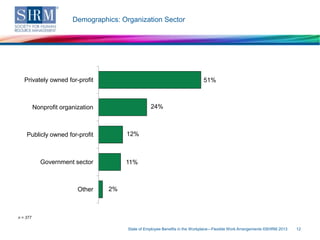
Demographics: Organization Sector

Privately owned for-profit

51%

24%

Nonprofit organization

Publicly owned for-profit

12%

Government sector

11%

Other

2%

n = 377
State of Employee Benefits in the Workplace—Flexible Work Arrangements ©SHRM 2013

12
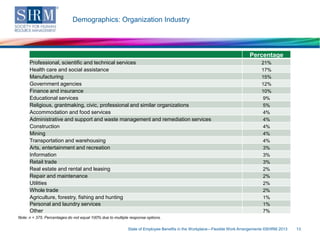
Demographics: Organization Industry

Percentage
Professional, scientific and technical services
Health care and social assistance
Manufacturing
Government agencies
Finance and insurance
Educational services
Religious, grantmaking, civic, professional and similar organizations
Accommodation and food services
Administrative and support and waste management and remediation services
Construction
Mining
Transportation and warehousing
Arts, entertainment and recreation
Information
Retail trade
Real estate and rental and leasing
Repair and maintenance
Utilities
Whole trade
Agriculture, forestry, fishing and hunting
Personal and laundry services
Other

21%
17%
15%
12%
10%
9%
5%
4%
4%
4%
4%
4%
3%
3%
3%
2%
2%
2%
2%
1%
1%
7%

Note: n = 375. Percentages do not equal 100% due to multiple response options.
State of Employee Benefits in the Workplace—Flexible Work Arrangements ©SHRM 2013

13
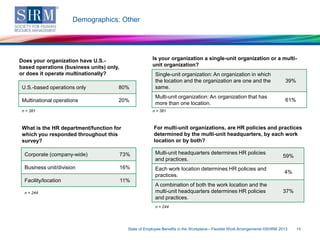
Demographics: Other

Is your organization a single-unit organization or a multiunit organization?

Does your organization have U.S.based operations (business units) only,
or does it operate multinationally?
U.S.-based operations only

80%

Multinational operations

20%

n = 381

Single-unit organization: An organization in which
the location and the organization are one and the
same.

39%

Multi-unit organization: An organization that has
more than one location.

61%

n = 381

For multi-unit organizations, are HR policies and practices
determined by the multi-unit headquarters, by each work
location or by both?

What is the HR department/function for
which you responded throughout this
survey?
Corporate (company-wide)

73%

Multi-unit headquarters determines HR policies
and practices.

59%

Business unit/division

16%

Each work location determines HR policies and
practices.

4%

Facility/location

11%

A combination of both the work location and the
multi-unit headquarters determines HR policies
and practices.

37%

n = 244

n = 244

State of Employee Benefits in the Workplace—Flexible Work Arrangements ©SHRM 2013

14
SHRM Survey Findings: State of Employee Benefits in
the Workplace—Flexible Work Arrangements

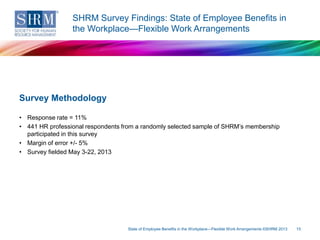
Survey Methodology
• Response rate = 11%
• 441 HR professional respondents from a randomly selected sample of SHRM’s membership
participated in this survey
• Margin of error +/- 5%
• Survey fielded May 3-22, 2013

State of Employee Benefits in the Workplace—Flexible Work Arrangements ©SHRM 2013

15
Additional SHRM Resources

• Workplace Flexibility Resource Page

• Work Life Fit Resource Page
• Alternative Work Schedules Resource Page
• Creating an Effective Flexible Work Environment

State of Employee Benefits in the Workplace—Flexible Work Arrangements ©SHRM 2013

16
About SHRM Research

For more survey/poll findings, visit www.shrm.org/surveys
For more information about SHRM’s Customized Research Services, visit
www.shrm.org/customizedresearch
Follow us on Twitter @SHRM_Research

Project leaders:
Christina Lee, researcher, SHRM Research
Project contributors:
Alexander Alonso, Ph.D., SPHR, vice president, SHRM Research
Evren Esen, manager, Survey Research Center, SHRM Research

Copy editor:
Katya Scanlan, SHRM Knowledge Center

State of Employee Benefits in the Workplace—Flexible Work Arrangements ©SHRM 2013

17
About SHRM

The Society for Human Resource Management (SHRM) is the world’s largest association devoted to
human resource management. Representing more than 250,000 members in over 140
countries, the Society serves the needs of HR professionals and advances the interests of the
HR profession. Founded in 1948, SHRM has more than 575 affiliated chapters within the United
States and subsidiary offices in China, India and United Arab Emirates.

State of Employee Benefits in the Workplace—Flexible Work Arrangements ©SHRM 2013

18

2013 benefit strategies flexible-work-arrangements

  • 1.
    SHRM Survey Findings:State of Employee Benefits in the Workplace—Flexible Work Arrangements December 18, 2013
  • 2.
    Introduction • This ispart two of a series of SHRM survey findings examining employee benefits in the workplace. • The following topics are included in the six-part series titled State of Employee Benefits in the Workplace: » » » » » » Part 1: Wellness initiatives Part 2: Flexible work arrangements Part 3: Health care Part 4: Leveraging benefits to retain employees Part 5: Leveraging benefits to recruit employees Part 6: Communicating benefits State of Employee Benefits in the Workplace—Flexible Work Arrangements ©SHRM 2013 2
  • 3.
    Definition • For thepurpose of this survey, flexible work arrangements or flex work may include full- or part-time telecommuting, flexible scheduling, compressed workweek, etc. State of Employee Benefits in the Workplace—Flexible Work Arrangements ©SHRM 2013 3
  • 4.
    Key Findings • Doorganizations offer flexible work arrangements to their employees? Nearly three-fifths (57%) of organizations offer these benefits. Among those organizations, almost one-half (45%) indicated that the majority of their employees are allowed to use flex work. This figure has increased 11 percentage points since 2012. • In 2012, did employee participation in flexible work arrangements increase? Yes, approximately one-third (33%) reported employee participation increased since 2011, 61% indicated employee participation remained the same, and only 6% reported that participation in these benefit decreased. State of Employee Benefits in the Workplace—Flexible Work Arrangements ©SHRM 2013 4
  • 5.
    What do thesefindings mean to the HR profession? • The numbers are rising for flexible work arrangements—the percentage of employers that participate in this benefit increased from 2012, and more organizations offer flex work to a broader scope of their payroll. This trend is in line with workers’ increased desire to manage their own time and better balance their work with their responsibilities out of the office. Separate SHRM studies have shown that many workers rate “the balance of work/life issues” as an integral factor in job satisfaction, and flexible work arrangements can offer a cost-effective means of delivering that balance. Other research by the Families and Work Institute revealed that an increasing number of men have expressed a need for flexible work to better balance their jobs and family responsibilities—proof that demand for such arrangements spans a broad segment of the workforce. State of Employee Benefits in the Workplace—Flexible Work Arrangements ©SHRM 2013 5
  • 6.
    Does your organizationprovide employees with the option to use flexible work arrangements? 57% Yes 53% 2013 (n = 382) 43% 2012 (n = 414) No 47% Note: Respondents who answered “not sure” were excluded from this analysis. State of Employee Benefits in the Workplace—Flexible Work Arrangements ©SHRM 2013 6
  • 7.
    Are the majority(more than half) of employees at your organization allowed to use flexible work arrangements? 45% Yes 34% 2013 (n = 207) 2012 (n = 210) 55% No 66% Note: Only respondents whose organizations provided flexible work arrangements were asked this question. Respondents who answered “not sure” were excluded from this analysis. State of Employee Benefits in the Workplace—Flexible Work Arrangements ©SHRM 2013 7
  • 8.
    How did employeeparticipation in your organization’s flexible work change last year compared with the year before? 33% Increased 36% 61% Remained the same 58% 2013 (n = 179) 2012 (n = 192) 6% Decreased 6% Note: Only respondents whose organizations provided flexible work arrangements were asked this question. Respondents who answered “not sure” were excluded from this analysis. State of Employee Benefits in the Workplace—Flexible Work Arrangements ©SHRM 2013 8
  • 9.
    Does your organizationmonitor employee participation rates in its flexible work arrangements? 47% Yes 38% 2013 (n = 187) 2012 (n = 198) 53% No 62% Note: Only respondents whose organizations provided flexible work arrangements were asked this question. Respondents who answered “not sure” were excluded from this analysis. State of Employee Benefits in the Workplace—Flexible Work Arrangements ©SHRM 2013 9
  • 10.
    Organization Demographics State ofEmployee Benefits in the Workplace—Flexible Work Arrangements ©SHRM 2013 10
  • 11.
    Demographics: Organization StaffSize 1 to 99 employees 33% 100 to 499 employees 32% 500 to 2,499 employees 17% 2,500 to 24,999 employees 25,000 or more employees 12% 6% n = 363 State of Employee Benefits in the Workplace—Flexible Work Arrangements ©SHRM 2013 11
  • 12.
    Demographics: Organization Sector Privatelyowned for-profit 51% 24% Nonprofit organization Publicly owned for-profit 12% Government sector 11% Other 2% n = 377 State of Employee Benefits in the Workplace—Flexible Work Arrangements ©SHRM 2013 12
  • 13.
    Demographics: Organization Industry Percentage Professional,scientific and technical services Health care and social assistance Manufacturing Government agencies Finance and insurance Educational services Religious, grantmaking, civic, professional and similar organizations Accommodation and food services Administrative and support and waste management and remediation services Construction Mining Transportation and warehousing Arts, entertainment and recreation Information Retail trade Real estate and rental and leasing Repair and maintenance Utilities Whole trade Agriculture, forestry, fishing and hunting Personal and laundry services Other 21% 17% 15% 12% 10% 9% 5% 4% 4% 4% 4% 4% 3% 3% 3% 2% 2% 2% 2% 1% 1% 7% Note: n = 375. Percentages do not equal 100% due to multiple response options. State of Employee Benefits in the Workplace—Flexible Work Arrangements ©SHRM 2013 13
  • 14.
    Demographics: Other Is yourorganization a single-unit organization or a multiunit organization? Does your organization have U.S.based operations (business units) only, or does it operate multinationally? U.S.-based operations only 80% Multinational operations 20% n = 381 Single-unit organization: An organization in which the location and the organization are one and the same. 39% Multi-unit organization: An organization that has more than one location. 61% n = 381 For multi-unit organizations, are HR policies and practices determined by the multi-unit headquarters, by each work location or by both? What is the HR department/function for which you responded throughout this survey? Corporate (company-wide) 73% Multi-unit headquarters determines HR policies and practices. 59% Business unit/division 16% Each work location determines HR policies and practices. 4% Facility/location 11% A combination of both the work location and the multi-unit headquarters determines HR policies and practices. 37% n = 244 n = 244 State of Employee Benefits in the Workplace—Flexible Work Arrangements ©SHRM 2013 14
  • 15.
    SHRM Survey Findings:State of Employee Benefits in the Workplace—Flexible Work Arrangements Survey Methodology • Response rate = 11% • 441 HR professional respondents from a randomly selected sample of SHRM’s membership participated in this survey • Margin of error +/- 5% • Survey fielded May 3-22, 2013 State of Employee Benefits in the Workplace—Flexible Work Arrangements ©SHRM 2013 15
  • 16.
    Additional SHRM Resources •Workplace Flexibility Resource Page • Work Life Fit Resource Page • Alternative Work Schedules Resource Page • Creating an Effective Flexible Work Environment State of Employee Benefits in the Workplace—Flexible Work Arrangements ©SHRM 2013 16
  • 17.
    About SHRM Research Formore survey/poll findings, visit www.shrm.org/surveys For more information about SHRM’s Customized Research Services, visit www.shrm.org/customizedresearch Follow us on Twitter @SHRM_Research Project leaders: Christina Lee, researcher, SHRM Research Project contributors: Alexander Alonso, Ph.D., SPHR, vice president, SHRM Research Evren Esen, manager, Survey Research Center, SHRM Research Copy editor: Katya Scanlan, SHRM Knowledge Center State of Employee Benefits in the Workplace—Flexible Work Arrangements ©SHRM 2013 17
  • 18.
    About SHRM The Societyfor Human Resource Management (SHRM) is the world’s largest association devoted to human resource management. Representing more than 250,000 members in over 140 countries, the Society serves the needs of HR professionals and advances the interests of the HR profession. Founded in 1948, SHRM has more than 575 affiliated chapters within the United States and subsidiary offices in China, India and United Arab Emirates. State of Employee Benefits in the Workplace—Flexible Work Arrangements ©SHRM 2013 18