This is an enhanced PDF from The Journal of Bone and Joint Surgery

                                The PDF of the article you requested follows this cover page.


THE TREATMENT OF FLAT-FOOT BY MEANS OF EXERCISE
ERNST BETTMANN
J Bone Joint Surg Am. 1937;19:821-825.


                               This information is current as of March 4, 2011

Reprints and Permissions       Click here to order reprints or request permission to use material from this
                               article, or locate the article citation on jbjs.org and click on the [Reprints and
                               Permissions] link.
Publisher Information          The Journal of Bone and Joint Surgery
                               20 Pickering Street, Needham, MA 02492-3157
                               www.jbjs.org
THE               TREATMENT                                          OF            FLAT-FOOT                                         BY            MEANS                          OF           EXERCISE

                                         BY          ERNST                 BETTMANN,                   M.D.,               LEIPZIG,                        GERMANY


            The             human                         foot             was          originally                          an            organ                 for         gripping.                            Our              fore-
fathers               had            a capacity                            for       walking                   and              climbing                      which               most           of        us         no      longer
possess.                       Nowadays,                                   due         to       the            wearing                        of        shoes               which               cramp                       the        feet
and             walking                        on      hard                pavements,                            the            foot            often              becomes                      painful                     and           in-
adequate                       to          perform                       its      function.            In           the          treatment                            of     flat-foot,                    exercise
is of equal                    importance                                 with,         if not              of       more               importance                           than,              the          mechanical
supports                    which                    are           too           generally                   sold               to      cure               individual                     cases.                       The           pur-
pose             of       medical                          exercises                   is      the           systematic                                strengthening of                  the           lifting
muscles                   on             the         inner               border                and           transverse                             portion                  of        the           arch,-tibialis
anterior,              tibialis                      posterior,                       flexor            hallucis                       longus,                   flexor            digitorum                           longus,
interossei,                     and                 peroneus                      longus.                      If         the          foot          muscles                  functioned                              properly,
they              would                    prevent                       the          painful                    lowering                       of           the           arch,             and             mechanical
support           would                           often  be                      unnecessary.
            There    are                        two types                         of gymnastics                                 which                may              be     employed                           to         correct
flat-foot:
            1.            A series                         of      foot             exercises      which       can                                         be         supervised                        by            the         wise
mother,                   the  nurse,                            or the              family     doctor.
            2.            Exercises                   by         means               of special     apparatus,                                              which            permit                  the        amount
of        the         exercise                       to         be         increased                    as           much                  as        is         necessary                      for         the              gradual
strengthening                                   of        the         weak             muscles.

                                                                                            EXERCISES

            Concerning                                the            first          type,             the            author                   suggests                      the          following                          simple
foot            exercises                       which                may             already                 be            known:


                                                                                                FIG.        1-A
                                                                      Exercise               with        the           medicine                    ball.

 VOLE       XIX       NO.           3.     JULY             1937                                                                                                                                                821
822                                                                             ERNST                BETTMANN


                                                                                                                      1.             Walking                         with                   bare               feet          on
                                                                                                     coarse                       and               uneven                            ground                       (grass,
                                                                                                     stubbles,                         and             pebbles).

:“
                                                                                                                      2.             Jumping                         rope;              this              improves
                                                                                                     posture                       and                   breathing,                                strengthens
                                                                                                     the calf                     muscles,                   and    raises                          the arch                  of
                                                                                                     the              foot.
                                                                                                                      3.             Use          of          the          so-called                        “Spitzy
                                                                                                     ball         “ (a wooden                                 ball          sewed                   on      a straw
                                                                                                     sole              and            worn               as         a      sandal).
                                                                                                                      4.         “ Towel                   exercises”,                              which             im-
                                                                                                     prove                    both            flexion                   and             adduction.
                                         FIG.      1-B                                                                In         order              to        make                    the          treatments
                  Exercise                with           a pine             cone.                    attractive                           for    children,                                   the    exercises
                                                                                                     may        be                       employed                                in          games,-foot
gymnastics                             with              the          medicine                    ball            and            the          gripping                        and             throwing                       of      pine
cones              or        chestnuts.                        (See          Figures              1-A           and              1-B.)                   Both               games                    strengthen
the          musculature                                  of         the        entire                   leg.                With              the              help               of         imagination                             and
experience,                         it is possible                           to develop                         innumerable                               combinations                                     of exercises.

                                                                                           APPARATUS

             The             following                         types                of      apparatus,                               which                    can           be           made                   by       a         good
carpenter                        and             mechanic,                          have            as      their                bases               these                 corrective                           principles:
             1.            Fixation                      of      the           heel          in      supination;
             2.            Pressure                      of      a stable                   correction                           cushion                   against                      the              weakest                  point.
in     the          foot            arch,-the                              talonavicular                              joint;
             3.          Regulated                          adduction                        and                pointed-toe                              position.
             All        exercises                        must      be                 carried                   out    with                   the          knee                  bent               at      right            angles
and          the lower                     leg         perpendicular.

The          Potter’s                    Disk
             It        consists                   of      a slanting                        disk,               forty             centimeters                               in         diameter,                      covered
with            rough                    rubber.          (See                         Figure  2.)    The     disk     revolves                                                                on four    wheels
and          its height                     is adjustable                             by means     of a screw      plate.                                                                   On the  fixed   hub
there  is an adjustable                                                plate for the    right                                        and            the             left         foot              in       supination.
A heel    clamp,     which                                            can be tightened and                                   loosened                    by          means                    of         a screw,
helps             to       fix      the           heel          in       position.                         Both                wings                of        the          clamp                   have            adjustable
cushions                      for          the           redressment                  of      the           talonavicular                           joint.                       The               fixation              is
maintained                            by         two           straps.          The          amount                        of flexion                     can           be varied                         by       raising
and           lowering                 the            disk.                 Movement                             of        the         disk            is made                        difficult                 by     means
of      a     braking                      weight.

The          Fool-Correction                                    Ball
             A wooden                            ball,          about               twenty                  centimeters                              in        diameter,                            is mounted                        on
a     round                  joint,                which                   makes              possible                         its         adjustment in                   every                   direction.
The           heel            rests              on       a support.                              (See                Figure                3.)                By           means                    ofa, screw
                                                                                                                                                                                                           the
height                 can          he       regulated                      ; by         screw the
                                                                                             b,                       degree               of supination                                    is controlled;

                                                                                                     THE              JOURNAL                  OF         BONE              AND             JOINT              SURGERY
TREATMENT                                  OF         FLAT-FOOT                                                                       823


                                                  FIG.         2                                                                                                    FIG.         3
                                   The          potter’s                 disk.                                                         Grasping                          exercise                with               the
                                                                                                                                   foot-correction                        ball.

by screw                  C, fixation                          of the                  heel           is guaranteed                                 ; and          by         d, the
                                                                                                                                                                              screw         correction
cushion                  is adjusted.                                If the                   axis          of the              ball       is horizontal                              and        parallel                    to      the
foot,         a “grasping                                 exercise”                            is afforded,                        which                    can          be     regulated                       by        moving
the         ball              or     by            elevation                             of         the           heel           support.                           If        the         axis          of          the           ball     is
vertical                  and              at       a      right                  angle                 with             the           foot,              the       foot             is     obliged                  to           adduct
in      order             to move                        the             ball.                  The                 amount                     of         adduction                       can           be          regulated
in         the                manner                just                      described.

Apparatus                      for         Limbering                                Stiffened
Flat         Feet in Adults
            This               apparatus                                 is         shown                  in
Figure                   4.               The              foot                  rests                  on d.. a
fixed                  cushioned                               stirrup,                a.           A
strap         cuff,           which                is laid                around                      the
ankle              and             passed                  over                  the           heel            of
the        foot,              is attached                           to         the           lever             at
b.         Another                        strap                is         laid               around
the         front              of         the        foot                and                led
                                                                                             over
a      pulley                 to          the        other                       end            of the
lever           at c.              The          attachment                                    of the
straps                  must                be             made                       when                  the
front              of          the              foot                is         in            extreme
plantar                   flexion.                         The                  axis            of          the
lever             is      connected                                with                a bar,
                                                                                           d,
which                  permits                      the              manipulation
of the   lever                             so        that                 a corrective
                                                                                                                                                            FIG.        4
pull  on the                             heel          and                front    of the
                                                                                                                Apparatus                           for     limbering                stiffened               flat     feet
foot         is        possible.                           The                 toes            rest          on
                                                                                                             in adults.

VOL.        XIX,          NO.        3.     JULY           1937
824                                                                       ERNST               BETTMANN


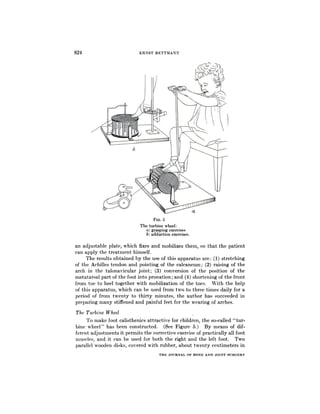
                                                                                        FIG.         5
                                                                          The       turbine               wheel:
                                                                                 a: grasping                   exercises
                                                                                 b: adduction                    exercises.


an       adjustable             plate,      which       fixes                                    and             mobilizes                         them,               so      that        the          patient
can        apply         the treatment           himself.
           The          results    obtained         by the                                       use           of this                apparatus                        are      : (1)        stretching
of the   Achilles                         tendon                   and            pointing                      of     the    calcaneum                               ; (2) raising                       of         the
arch   in the                         talonavicular                               joint;                 (3)         conversion         of                           the   position                       of          the
metatarsal                     part           of        the        foot          into          pronation                        ; and              (4)      shortening                      of      the        front
from            toe       to      heel             together                      with           mobilization              of         the       toes.             With            the        help
of this               apparatus,                    which               can  be used         from                                  two   to three                             times      daily                 for      a
period                of from                 twenty                  to thirty        minutes,                                     the   author                             has     succeeded                         in
preparing                  many                stiffened                 and   painful       feet                                for the     wearing                              of arches.

 The        Turbine                   Wheel
           To         make             foot             calisthenics                     attractive                            for         children,                   the       so-called                “tur-
bine         wheel”                   has           been             constructed.                    (See            Figure                   5.)               By           means    of   dif-
ferent            adjustments                      it    permits                  the          corrective                        exercise                  of     practically                     all     foot
muscles,                 and           it      can            be          used          for          both             the             right              and           the        left       foot.                   Two
parallel               wooden                 disks,               covered                    with              rubber,                    about                twenty                centimeters                      in

                                                                                               THE             JOURNAL                 OF      BONE              AND         JOINT         SURGERY
TREATMENT                     OF       FLAT-FOOT                                                    825

diameter,             and           about             thirty       centimeters                        apart,            are connected                    by means                 of
wooden             spokes.                   The         resulting        turbine                     wheel            is mounted                on       an axle              and
supplied            with          an       adjustable                    brake       to      guarantee                 movement                 in one           direction
only.            On      the        same             plate          which          carries            the      turbine            wheel          there         is a metal
bar        to support                     the adjustable                         heel   rest.       The                     heel      of       the      foot           remains
fixed        in the rest                 by a bandage                       strap     and     a rubber                      correction               cushion             at the
talonavicular                     joint.            At         the    upper                end        of the    bar    there    is a hand                              grip,      so
that     the        child          can        support             himself.                   In      this  form     (Fig. the5, apparatus
                                                                                                                      a),
permits            a flexion                  exercise,-the        child                  continues               to      grasp          the      connecting
spokes           with   the                toes     and     propels                 the       turbine.                   When           the      wheel       is placed
horizontal               to       the        plate           and          the      foot       rest          is lowered              (Fig.
                                                                                                                                      b),      the5,     child
can       practise      adduction.                                  In     order          to encourage       the                   child,   a small    animal
on      wheels     is attached                       to       the        turbine            and,  by turning                      the turbine,      the child
also       moves            the         animal               which          can       be      weighted                 so    as    to       increase             the      work
done.


VOL.      XIX.     NO.      3,    JULY        1937

Flat foot exercises

  • 1.
    This is anenhanced PDF from The Journal of Bone and Joint Surgery The PDF of the article you requested follows this cover page. THE TREATMENT OF FLAT-FOOT BY MEANS OF EXERCISE ERNST BETTMANN J Bone Joint Surg Am. 1937;19:821-825. This information is current as of March 4, 2011 Reprints and Permissions Click here to order reprints or request permission to use material from this article, or locate the article citation on jbjs.org and click on the [Reprints and Permissions] link. Publisher Information The Journal of Bone and Joint Surgery 20 Pickering Street, Needham, MA 02492-3157 www.jbjs.org
  • 2.
    THE TREATMENT OF FLAT-FOOT BY MEANS OF EXERCISE BY ERNST BETTMANN, M.D., LEIPZIG, GERMANY The human foot was originally an organ for gripping. Our fore- fathers had a capacity for walking and climbing which most of us no longer possess. Nowadays, due to the wearing of shoes which cramp the feet and walking on hard pavements, the foot often becomes painful and in- adequate to perform its function. In the treatment of flat-foot, exercise is of equal importance with, if not of more importance than, the mechanical supports which are too generally sold to cure individual cases. The pur- pose of medical exercises is the systematic strengthening of the lifting muscles on the inner border and transverse portion of the arch,-tibialis anterior, tibialis posterior, flexor hallucis longus, flexor digitorum longus, interossei, and peroneus longus. If the foot muscles functioned properly, they would prevent the painful lowering of the arch, and mechanical support would often be unnecessary. There are two types of gymnastics which may be employed to correct flat-foot: 1. A series of foot exercises which can be supervised by the wise mother, the nurse, or the family doctor. 2. Exercises by means of special apparatus, which permit the amount of the exercise to be increased as much as is necessary for the gradual strengthening of the weak muscles. EXERCISES Concerning the first type, the author suggests the following simple foot exercises which may already be known: FIG. 1-A Exercise with the medicine ball. VOLE XIX NO. 3. JULY 1937 821
  • 3.
    822 ERNST BETTMANN 1. Walking with bare feet on coarse and uneven ground (grass, stubbles, and pebbles). :“ 2. Jumping rope; this improves posture and breathing, strengthens the calf muscles, and raises the arch of the foot. 3. Use of the so-called “Spitzy ball “ (a wooden ball sewed on a straw sole and worn as a sandal). 4. “ Towel exercises”, which im- prove both flexion and adduction. FIG. 1-B In order to make the treatments Exercise with a pine cone. attractive for children, the exercises may be employed in games,-foot gymnastics with the medicine ball and the gripping and throwing of pine cones or chestnuts. (See Figures 1-A and 1-B.) Both games strengthen the musculature of the entire leg. With the help of imagination and experience, it is possible to develop innumerable combinations of exercises. APPARATUS The following types of apparatus, which can be made by a good carpenter and mechanic, have as their bases these corrective principles: 1. Fixation of the heel in supination; 2. Pressure of a stable correction cushion against the weakest point. in the foot arch,-the talonavicular joint; 3. Regulated adduction and pointed-toe position. All exercises must be carried out with the knee bent at right angles and the lower leg perpendicular. The Potter’s Disk It consists of a slanting disk, forty centimeters in diameter, covered with rough rubber. (See Figure 2.) The disk revolves on four wheels and its height is adjustable by means of a screw plate. On the fixed hub there is an adjustable plate for the right and the left foot in supination. A heel clamp, which can be tightened and loosened by means of a screw, helps to fix the heel in position. Both wings of the clamp have adjustable cushions for the redressment of the talonavicular joint. The fixation is maintained by two straps. The amount of flexion can be varied by raising and lowering the disk. Movement of the disk is made difficult by means of a braking weight. The Fool-Correction Ball A wooden ball, about twenty centimeters in diameter, is mounted on a round joint, which makes possible its adjustment in every direction. The heel rests on a support. (See Figure 3.) By means ofa, screw the height can he regulated ; by screw the b, degree of supination is controlled; THE JOURNAL OF BONE AND JOINT SURGERY
  • 4.
    TREATMENT OF FLAT-FOOT 823 FIG. 2 FIG. 3 The potter’s disk. Grasping exercise with the foot-correction ball. by screw C, fixation of the heel is guaranteed ; and by d, the screw correction cushion is adjusted. If the axis of the ball is horizontal and parallel to the foot, a “grasping exercise” is afforded, which can be regulated by moving the ball or by elevation of the heel support. If the axis of the ball is vertical and at a right angle with the foot, the foot is obliged to adduct in order to move the ball. The amount of adduction can be regulated in the manner just described. Apparatus for Limbering Stiffened Flat Feet in Adults This apparatus is shown in Figure 4. The foot rests on d.. a fixed cushioned stirrup, a. A strap cuff, which is laid around the ankle and passed over the heel of the foot, is attached to the lever at b. Another strap is laid around the front of the foot and led over a pulley to the other end of the lever at c. The attachment of the straps must be made when the front of the foot is in extreme plantar flexion. The axis of the lever is connected with a bar, d, which permits the manipulation of the lever so that a corrective FIG. 4 pull on the heel and front of the Apparatus for limbering stiffened flat feet foot is possible. The toes rest on in adults. VOL. XIX, NO. 3. JULY 1937
  • 5.
    824 ERNST BETTMANN FIG. 5 The turbine wheel: a: grasping exercises b: adduction exercises. an adjustable plate, which fixes and mobilizes them, so that the patient can apply the treatment himself. The results obtained by the use of this apparatus are : (1) stretching of the Achilles tendon and pointing of the calcaneum ; (2) raising of the arch in the talonavicular joint; (3) conversion of the position of the metatarsal part of the foot into pronation ; and (4) shortening of the front from toe to heel together with mobilization of the toes. With the help of this apparatus, which can be used from two to three times daily for a period of from twenty to thirty minutes, the author has succeeded in preparing many stiffened and painful feet for the wearing of arches. The Turbine Wheel To make foot calisthenics attractive for children, the so-called “tur- bine wheel” has been constructed. (See Figure 5.) By means of dif- ferent adjustments it permits the corrective exercise of practically all foot muscles, and it can be used for both the right and the left foot. Two parallel wooden disks, covered with rubber, about twenty centimeters in THE JOURNAL OF BONE AND JOINT SURGERY
  • 6.
    TREATMENT OF FLAT-FOOT 825 diameter, and about thirty centimeters apart, are connected by means of wooden spokes. The resulting turbine wheel is mounted on an axle and supplied with an adjustable brake to guarantee movement in one direction only. On the same plate which carries the turbine wheel there is a metal bar to support the adjustable heel rest. The heel of the foot remains fixed in the rest by a bandage strap and a rubber correction cushion at the talonavicular joint. At the upper end of the bar there is a hand grip, so that the child can support himself. In this form (Fig. the5, apparatus a), permits a flexion exercise,-the child continues to grasp the connecting spokes with the toes and propels the turbine. When the wheel is placed horizontal to the plate and the foot rest is lowered (Fig. b), the5, child can practise adduction. In order to encourage the child, a small animal on wheels is attached to the turbine and, by turning the turbine, the child also moves the animal which can be weighted so as to increase the work done. VOL. XIX. NO. 3, JULY 1937