Fixtures and factories
by Hector Canto
We will talk about
fixture concept
How to build fixtures with:
factoryboy: Mother pattern
faker: data generator
Make it work in pytest
What is a fixture
“””A test fixture is a device used to consistently test some item, device, or piece of software.
Test fixtures are used in the testing of electronics, software and physical devices.”””
wikipedia.com/en/Test_fixture
Why is this important
Testing should be a big chunk of our daily work
Testing is hard and costly
Let’s make it easier
Making new tests should become easier with time
Testing structure: AAA
Arrange
Act - Execute
Assert
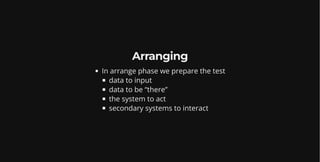
Arranging
In arrange phase we prepare the test
data to input
data to be “there”
the system to act
secondary systems to interact
Data fixtures
We are going to focus on data fixtures for
inputs
expectancies
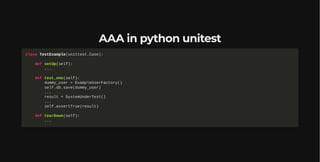
AAA in python unitest
class TestExample(unittest.Case):
def setUp(self):
...
def test_one(self):
dummy_user = ExampleUserFactory()
self.db.save(dummy_user)
...
result = SystemUnderTest()
...
self.assertTrue(result)
def tearDown(self):
...
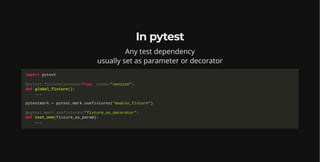
In pytest
Any test dependency
usually set as parameter or decorator
import pytest
@pytest.fixture(autouse=True, scope="session")
def global_fixture():
...
pytestmark = pytest.mark.usefixtures("module_fixture")
@pytest.mark.usefixtures("fixture_as_decorator")
def test_one(fixture_as_param):
...
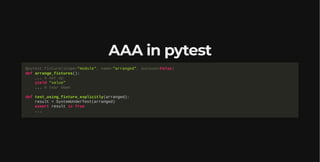
AAA in pytest
@pytest.fixture(scope="module", name="arranged", autouse=False)
def arrange_fixtures():
... # set up
yield "value"
... # tear down
def test_using_fixture_explicitly(arranged):
result = SystemUnderTest(arranged)
assert result is True
...
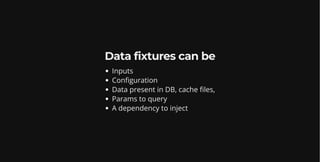
Data fixtures can be
Inputs
Configuration
Data present in DB, cache files,
Params to query
A dependency to inject
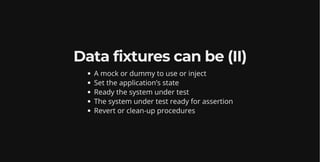
Data fixtures can be (II)
A mock or dummy to use or inject
Set the application’s state
Ready the system under test
The system under test ready for assertion
Revert or clean-up procedures
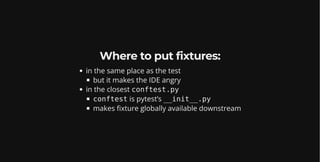
Where to put fixtures:
in the same place as the test
but it makes the IDE angry
in the closest conftest.py
conftest is pytest’s __init__.py
makes fixture globally available downstream
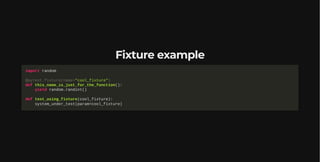
Fixture example
import random
@pytest.fixture(name="cool_fixture")
def this_name_is_just_for_the_function():
yield random.randint()
def test_using_fixture(cool_fixture):
system_under_test(param=cool_fixture)
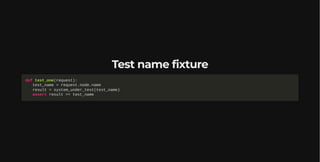
Test name fixture
def test_one(request):
test_name = request.node.name
result = system_under_test(test_name)
assert result == test_name
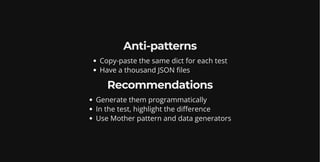
Anti-patterns
Copy-paste the same dict for each test
Have a thousand JSON files
Recommendations
Generate them programmatically
In the test, highlight the difference
Use Mother pattern and data generators
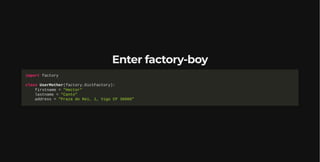
Enter factory-boy
import factory
class UserMother(factory.DictFactory):
firstname = "Hector"
lastname = "Canto"
address = "Praza do Rei, 1, Vigo CP 36000"
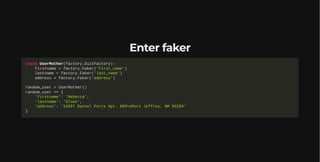
Enter faker
class UserMother(factory.DictFactory):
firstname = factory.Faker('first_name')
lastname = factory.Faker('last_name')
address = factory.Faker('address')
random_user = UserMother()
random_user == {
'firstname': 'Rebecca',
'lastname': 'Sloan',
'address': '52097 Daniel Ports Apt. 689nPort Jeffrey, NM 55289'
}
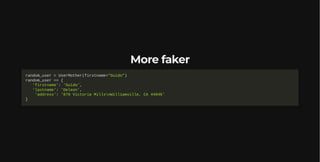
More faker
random_user = UserMother(firstname="Guido")
random_user == {
'firstname': 'Guido',
'lastname': 'Deleon',
'address': '870 Victoria MillsnWilliamville, CA 44946'
}
Batch generation
Iterated generation
UserMother.create_batch(size=5)
many = UserMother.create_batch(size=10, firstname=factory.Iterator(["One", "Two", "Three"]))
many[0].firstname == "One"
many[2].firstname == "Three"
many[3].firstname == "One"
FactoryBoy with ORMs
DjangoORM
SQLAlchemy
Mogo and MongoEngine
not hard to create your own
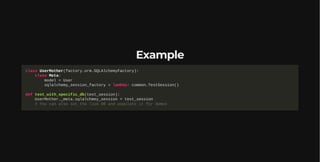
Example
class UserMother(factory.orm.SQLAlchemyFactory):
class Meta:
model = User
sqlalchemy_session_factory = lambda: common.TestSession()
def test_with_specific_db(test_session):
UserMother._meta.sqlalchmey_session = test_session
# You can also set the live DB and populate it for demos
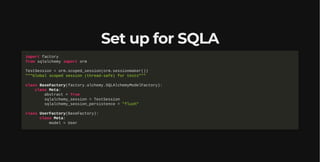
Set up for SQLA
import factory
from sqlalchemy import orm
TestSession = orm.scoped_session(orm.sessionmaker())
"""Global scoped session (thread-safe) for tests"""
class BaseFactory(factory.alchemy.SQLAlchemyModelFactory):
class Meta:
abstract = True
sqlalchemy_session = TestSession
sqlalchemy_session_persistence = "flush"
class UserFactory(BaseFactory):
class Meta:
model = User
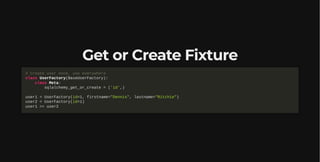
Get or Create Fixture
# Create user once, use everywhere
class UserFactory(BaseUserFactory):
class Meta:
sqlalchemy_get_or_create = ('id',)
user1 = UserFactory(id=1, firstname="Dennis", lastname="Ritchie")
user2 = UserFactory(id=1)
user1 == user2
Good things about factory-boy
Highly customizable
Related factories
Works with ORM
Bad things
Inner Faker is weird
Documentation gaps (as usual)
A bit hard to work with relationships
For the future
polyfactory
make your own providers
check out Maybe, Traits, post_gen hooks
random seed fixing
sequence resetting
user random.sample and others
Tactical tips
Add factories to your libraries
Specially in serverless and microservices
Real case example
3 libraries: common models, common APIs, common 3rd party services
On each we have factories to create
DB data
API callback bodies
event message payloads
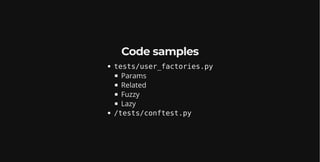
Code samples
tests/user_factories.py
Params
Related
Fuzzy
Lazy
/tests/conftest.py
Register fixtures
# tests/conftest/py
register(AdminFactory, "admin")
register(DbUserFactory, "user1", email="user1@hello.es")
register(DbUserFactory, "user2", status=0)
register(DbProfileFactory2, "profile")
# usage
def test_with_reg_fx(admin):
assert admin.first_name == "Admin"
Fixtures and Factories with python-factoryboyfactoryboy_hectorcanto.pdf

Fixtures and Factories with python-factoryboyfactoryboy_hectorcanto.pdf

  • 1.
  • 2.
    We will talkabout fixture concept How to build fixtures with: factoryboy: Mother pattern faker: data generator Make it work in pytest
  • 3.
    What is afixture “””A test fixture is a device used to consistently test some item, device, or piece of software. Test fixtures are used in the testing of electronics, software and physical devices.””” wikipedia.com/en/Test_fixture
  • 4.
    Why is thisimportant Testing should be a big chunk of our daily work Testing is hard and costly Let’s make it easier Making new tests should become easier with time
  • 5.
  • 6.
    Arranging In arrange phasewe prepare the test data to input data to be “there” the system to act secondary systems to interact
  • 7.
    Data fixtures We aregoing to focus on data fixtures for inputs expectancies
  • 8.
    AAA in pythonunitest class TestExample(unittest.Case): def setUp(self): ... def test_one(self): dummy_user = ExampleUserFactory() self.db.save(dummy_user) ... result = SystemUnderTest() ... self.assertTrue(result) def tearDown(self): ...
  • 9.
    In pytest Any testdependency usually set as parameter or decorator import pytest @pytest.fixture(autouse=True, scope="session") def global_fixture(): ... pytestmark = pytest.mark.usefixtures("module_fixture") @pytest.mark.usefixtures("fixture_as_decorator") def test_one(fixture_as_param): ...
  • 10.
    AAA in pytest @pytest.fixture(scope="module",name="arranged", autouse=False) def arrange_fixtures(): ... # set up yield "value" ... # tear down def test_using_fixture_explicitly(arranged): result = SystemUnderTest(arranged) assert result is True ...
  • 11.
    Data fixtures canbe Inputs Configuration Data present in DB, cache files, Params to query A dependency to inject
  • 12.
    Data fixtures canbe (II) A mock or dummy to use or inject Set the application’s state Ready the system under test The system under test ready for assertion Revert or clean-up procedures
  • 13.
    Where to putfixtures: in the same place as the test but it makes the IDE angry in the closest conftest.py conftest is pytest’s __init__.py makes fixture globally available downstream
  • 14.
    Fixture example import random @pytest.fixture(name="cool_fixture") defthis_name_is_just_for_the_function(): yield random.randint() def test_using_fixture(cool_fixture): system_under_test(param=cool_fixture)
  • 15.
    Test name fixture deftest_one(request): test_name = request.node.name result = system_under_test(test_name) assert result == test_name
  • 16.
    Anti-patterns Copy-paste the samedict for each test Have a thousand JSON files Recommendations Generate them programmatically In the test, highlight the difference Use Mother pattern and data generators
  • 17.
    Enter factory-boy import factory classUserMother(factory.DictFactory): firstname = "Hector" lastname = "Canto" address = "Praza do Rei, 1, Vigo CP 36000"
  • 18.
    Enter faker class UserMother(factory.DictFactory): firstname= factory.Faker('first_name') lastname = factory.Faker('last_name') address = factory.Faker('address') random_user = UserMother() random_user == { 'firstname': 'Rebecca', 'lastname': 'Sloan', 'address': '52097 Daniel Ports Apt. 689nPort Jeffrey, NM 55289' }
  • 19.
    More faker random_user =UserMother(firstname="Guido") random_user == { 'firstname': 'Guido', 'lastname': 'Deleon', 'address': '870 Victoria MillsnWilliamville, CA 44946' }
  • 20.
    Batch generation Iterated generation UserMother.create_batch(size=5) many= UserMother.create_batch(size=10, firstname=factory.Iterator(["One", "Two", "Three"])) many[0].firstname == "One" many[2].firstname == "Three" many[3].firstname == "One"
  • 21.
    FactoryBoy with ORMs DjangoORM SQLAlchemy Mogoand MongoEngine not hard to create your own
  • 22.
    Example class UserMother(factory.orm.SQLAlchemyFactory): class Meta: model= User sqlalchemy_session_factory = lambda: common.TestSession() def test_with_specific_db(test_session): UserMother._meta.sqlalchmey_session = test_session # You can also set the live DB and populate it for demos
  • 23.
    Set up forSQLA import factory from sqlalchemy import orm TestSession = orm.scoped_session(orm.sessionmaker()) """Global scoped session (thread-safe) for tests""" class BaseFactory(factory.alchemy.SQLAlchemyModelFactory): class Meta: abstract = True sqlalchemy_session = TestSession sqlalchemy_session_persistence = "flush" class UserFactory(BaseFactory): class Meta: model = User
  • 24.
    Get or CreateFixture # Create user once, use everywhere class UserFactory(BaseUserFactory): class Meta: sqlalchemy_get_or_create = ('id',) user1 = UserFactory(id=1, firstname="Dennis", lastname="Ritchie") user2 = UserFactory(id=1) user1 == user2
  • 25.
    Good things aboutfactory-boy Highly customizable Related factories Works with ORM
  • 26.
    Bad things Inner Fakeris weird Documentation gaps (as usual) A bit hard to work with relationships
  • 27.
    For the future polyfactory makeyour own providers check out Maybe, Traits, post_gen hooks random seed fixing sequence resetting user random.sample and others Tactical tips Add factories to your libraries Specially in serverless and microservices
  • 28.
    Real case example 3libraries: common models, common APIs, common 3rd party services On each we have factories to create DB data API callback bodies event message payloads
  • 29.
  • 30.
    Register fixtures # tests/conftest/py register(AdminFactory,"admin") register(DbUserFactory, "user1", email="user1@hello.es") register(DbUserFactory, "user2", status=0) register(DbProfileFactory2, "profile") # usage def test_with_reg_fx(admin): assert admin.first_name == "Admin"