Securing FIWARE Architectures
Jason Fox, Senior Technical Evangelist
FIWARE Foundation
Learning Goals
▪ What are Identity Management and Access Control?
Which FIWARE components will you need?
▪ What are Authentication and Authorization?
How do they differ?
▪ What is OAuth2? What flows are supported?
▪ What is a PEP Proxy? What does it do?
▪ What is a PDP and when will I need one?
▪ What terms such as RBAC, PBAC and XACML mean and how are
they used?
1
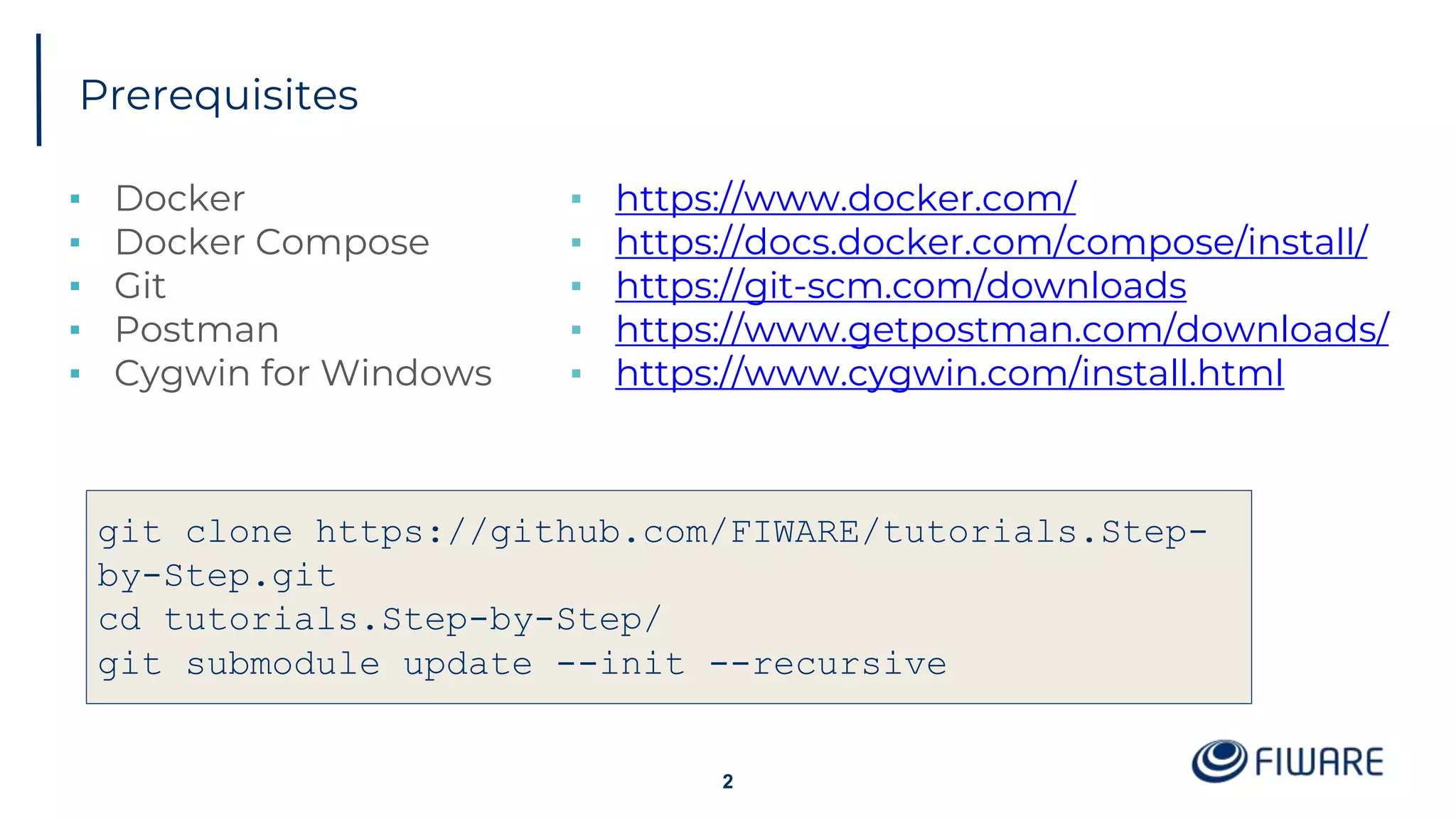
Prerequisites
▪ Docker
▪ Docker Compose
▪ Git
▪ Postman
▪ Cygwin for Windows
2
git clone https://github.com/FIWARE/tutorials.Step-
by-Step.git
cd tutorials.Step-by-Step/
git submodule update --init --recursive
▪ https://www.docker.com/
▪ https://docs.docker.com/compose/install/
▪ https://git-scm.com/downloads
▪ https://www.getpostman.com/downloads/
▪ https://www.cygwin.com/install.html
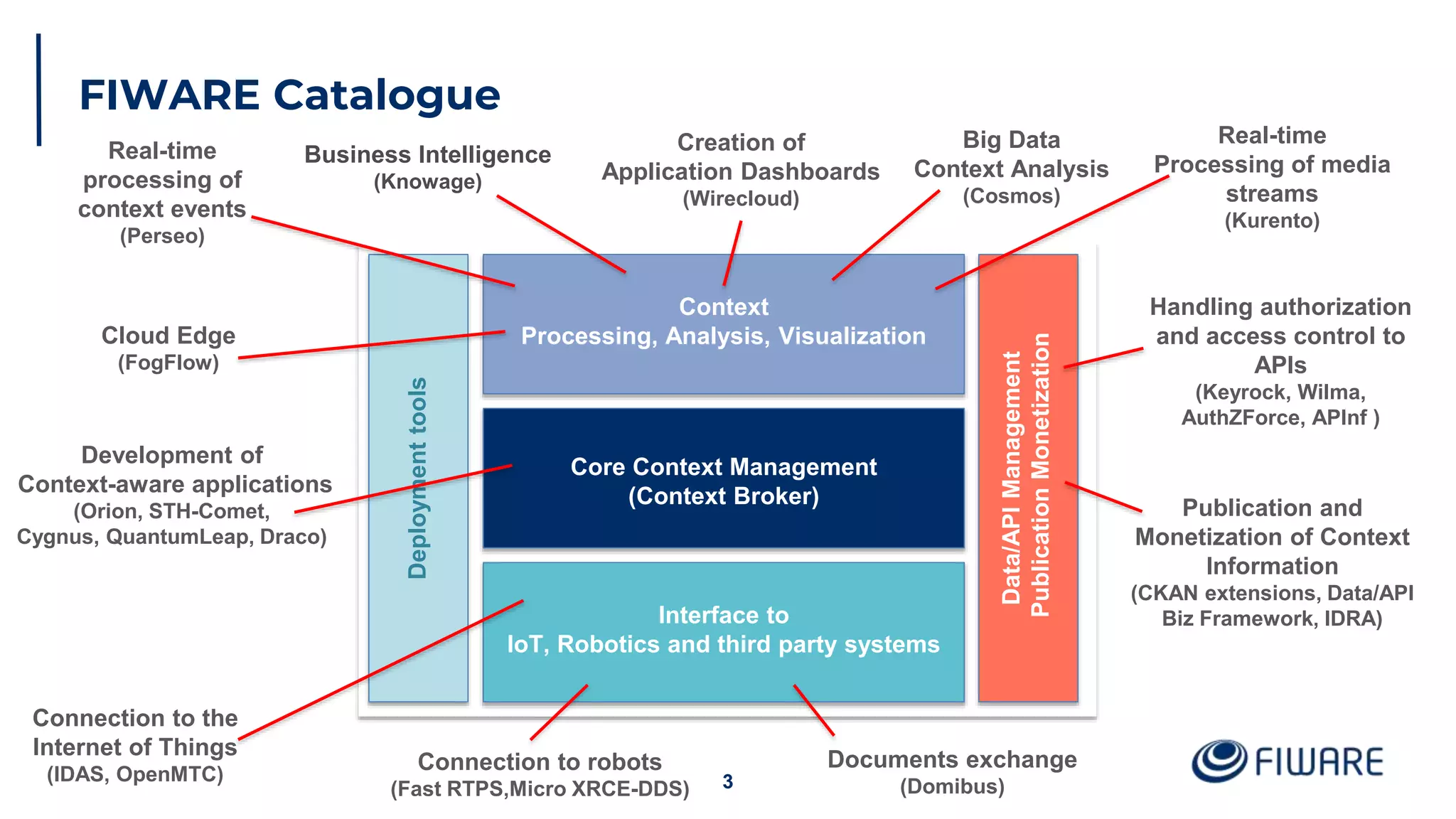
FIWARE Catalogue
33
Data/APIManagement
PublicationMonetization
Core Context Management
(Context Broker)
Context
Processing, Analysis, Visualization
Interface to
IoT, Robotics and third party systems
Deploymenttools
3
Development of
Context-aware applications
(Orion, STH-Comet,
Cygnus, QuantumLeap, Draco)
Connection to the
Internet of Things
(IDAS, OpenMTC)
Real-time
processing of
context events
(Perseo)
Handling authorization
and access control to
APIs
(Keyrock, Wilma,
AuthZForce, APInf )
Publication and
Monetization of Context
Information
(CKAN extensions, Data/API
Biz Framework, IDRA)
Creation of
Application Dashboards
(Wirecloud)
Real-time
Processing of media
streams
(Kurento)
Business Intelligence
(Knowage)
Connection to robots
(Fast RTPS,Micro XRCE-DDS)
Big Data
Context Analysis
(Cosmos)
Cloud Edge
(FogFlow)
Documents exchange
(Domibus)
Keyrock : Identity Management
4
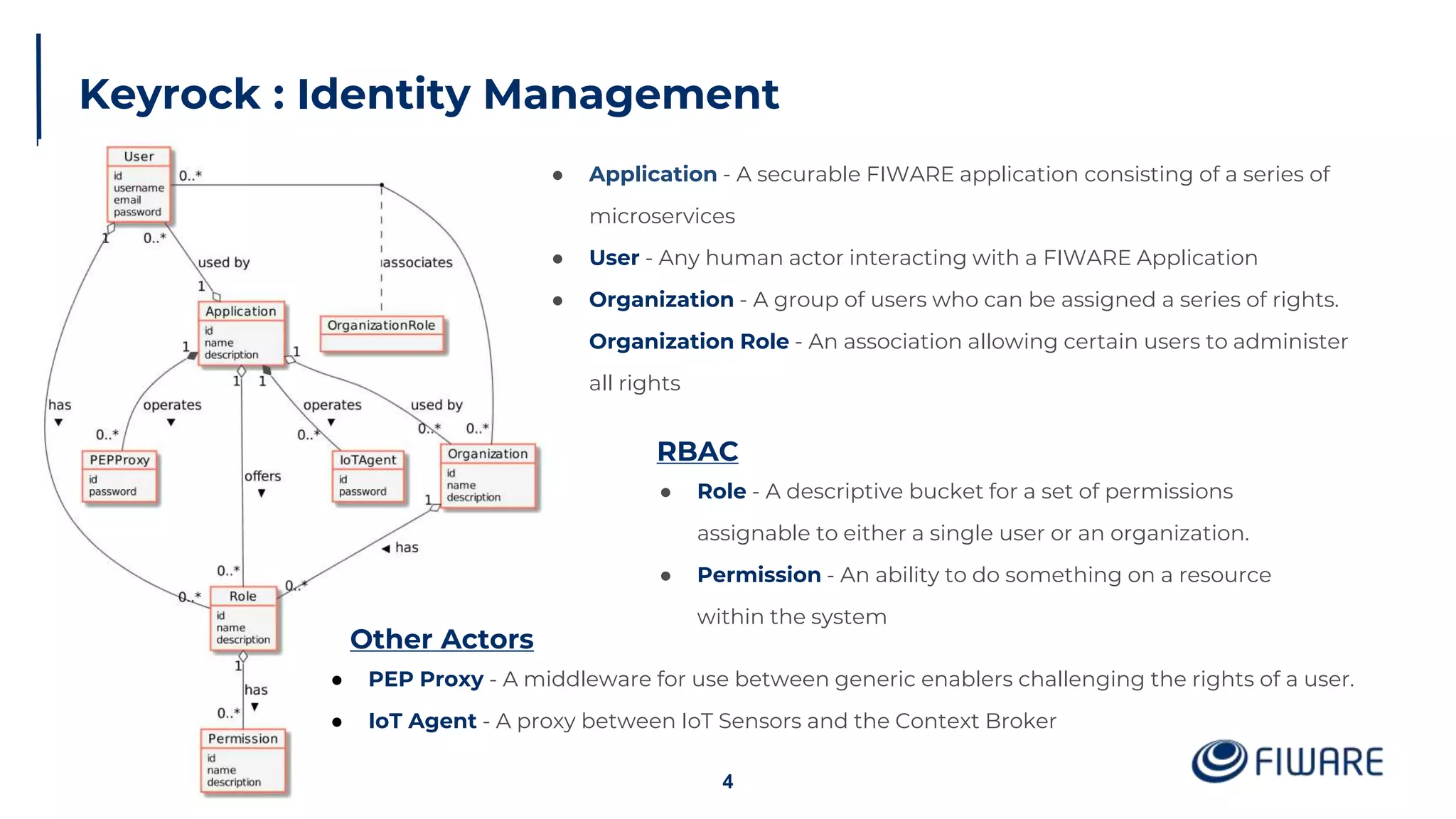
● Application - A securable FIWARE application consisting of a series of
microservices
● User - Any human actor interacting with a FIWARE Application
● Organization - A group of users who can be assigned a series of rights.
Organization Role - An association allowing certain users to administer
all rights
● PEP Proxy - A middleware for use between generic enablers challenging the rights of a user.
● IoT Agent - A proxy between IoT Sensors and the Context Broker
● Role - A descriptive bucket for a set of permissions
assignable to either a single user or an organization.
● Permission - An ability to do something on a resource
within the system
Other Actors
RBAC
Keyrock : Identity Manager
5
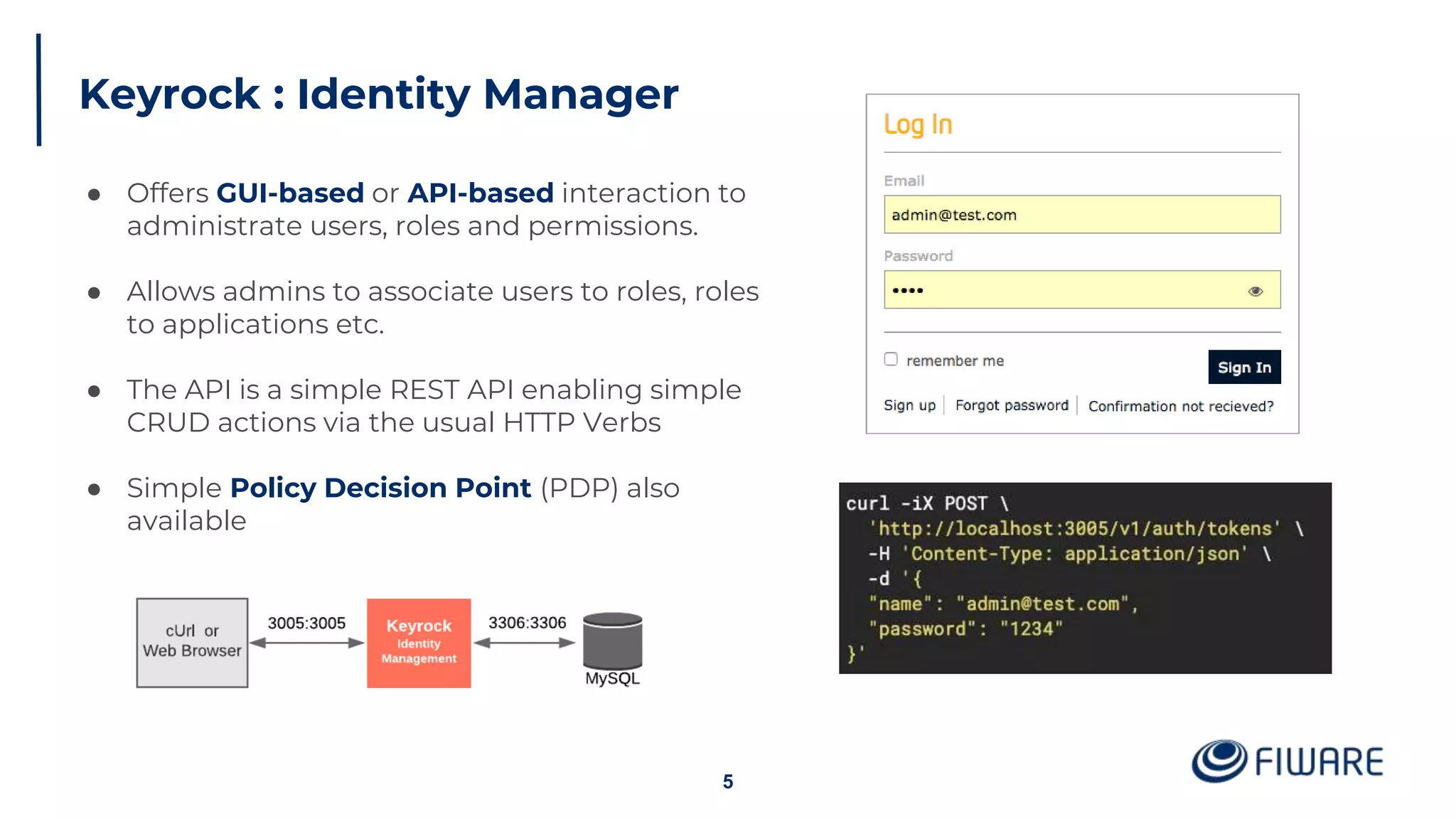
● Offers GUI-based or API-based interaction to
administrate users, roles and permissions.
● Allows admins to associate users to roles, roles
to applications etc.
● The API is a simple REST API enabling simple
CRUD actions via the usual HTTP Verbs
● Simple Policy Decision Point (PDP) also
available
OAuth 2 : Common Grant Types
6
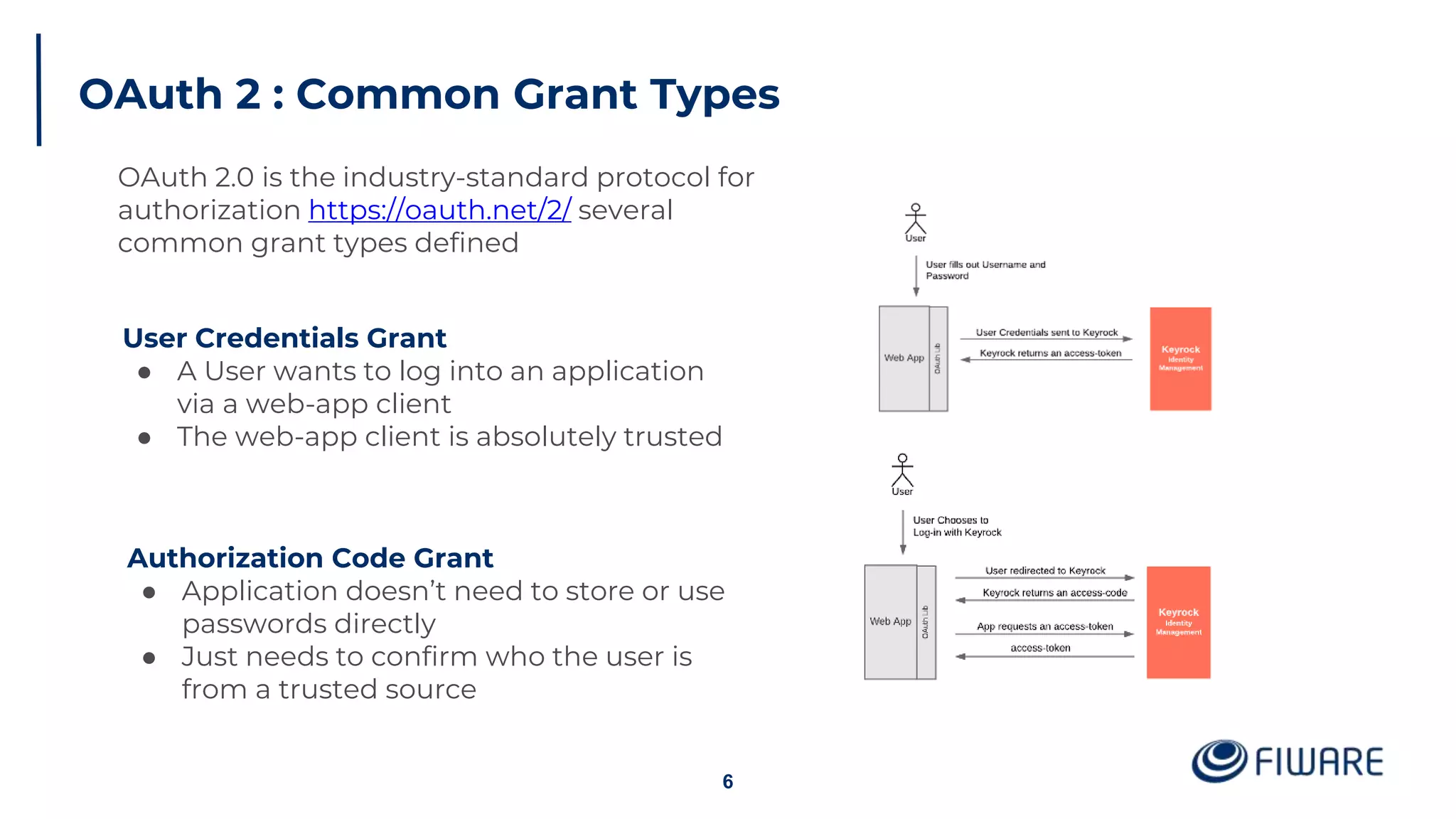
User Credentials Grant
● A User wants to log into an application
via a web-app client
● The web-app client is absolutely trusted
Authorization Code Grant
● Application doesn’t need to store or use
passwords directly
● Just needs to confirm who the user is
from a trusted source
OAuth 2.0 is the industry-standard protocol for
authorization https://oauth.net/2/ several
common grant types defined
OAuth 2 : Common Grant Types
7
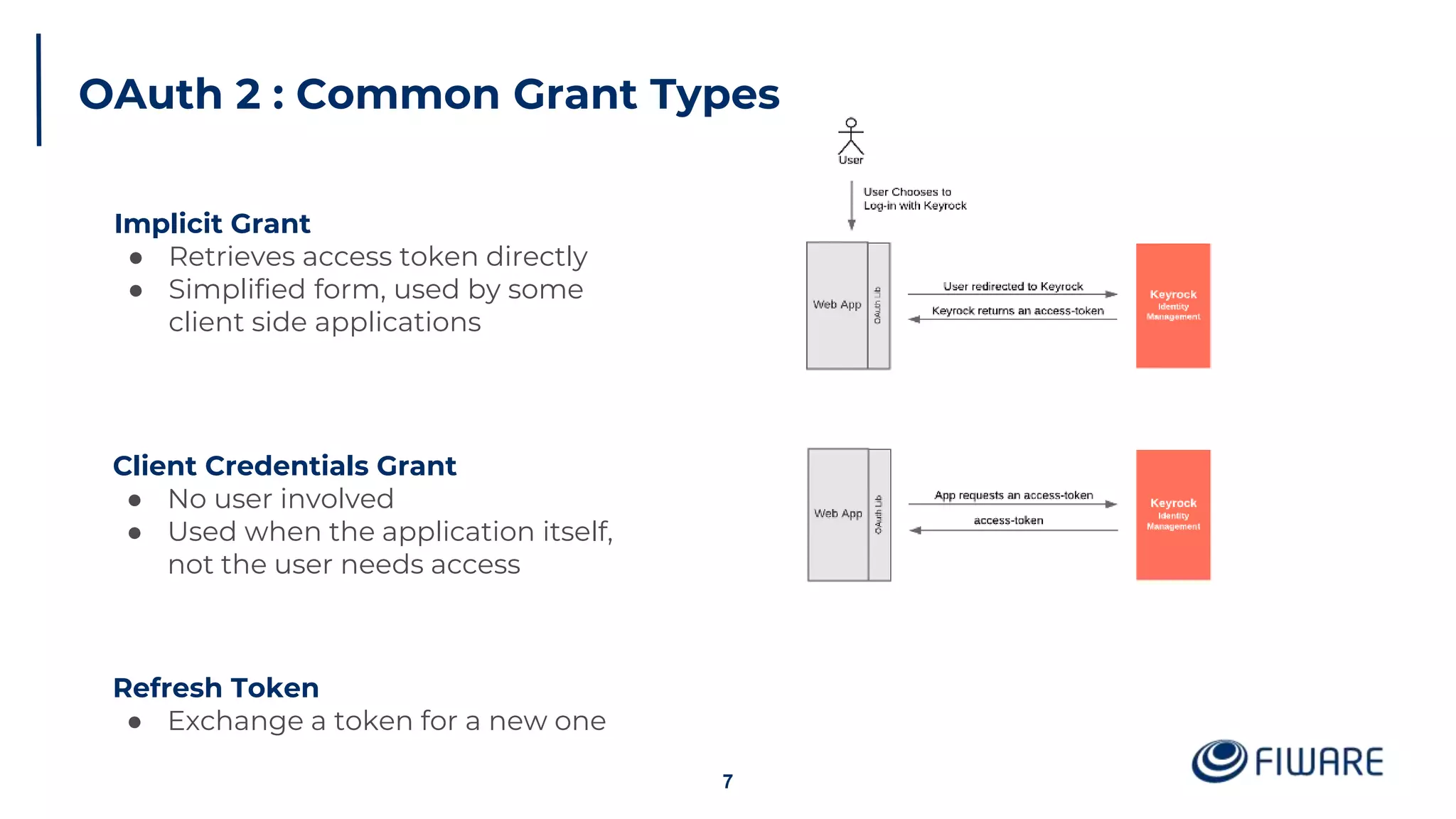
Implicit Grant
● Retrieves access token directly
● Simplified form, used by some
client side applications
Client Credentials Grant
● No user involved
● Used when the application itself,
not the user needs access
Refresh Token
● Exchange a token for a new one
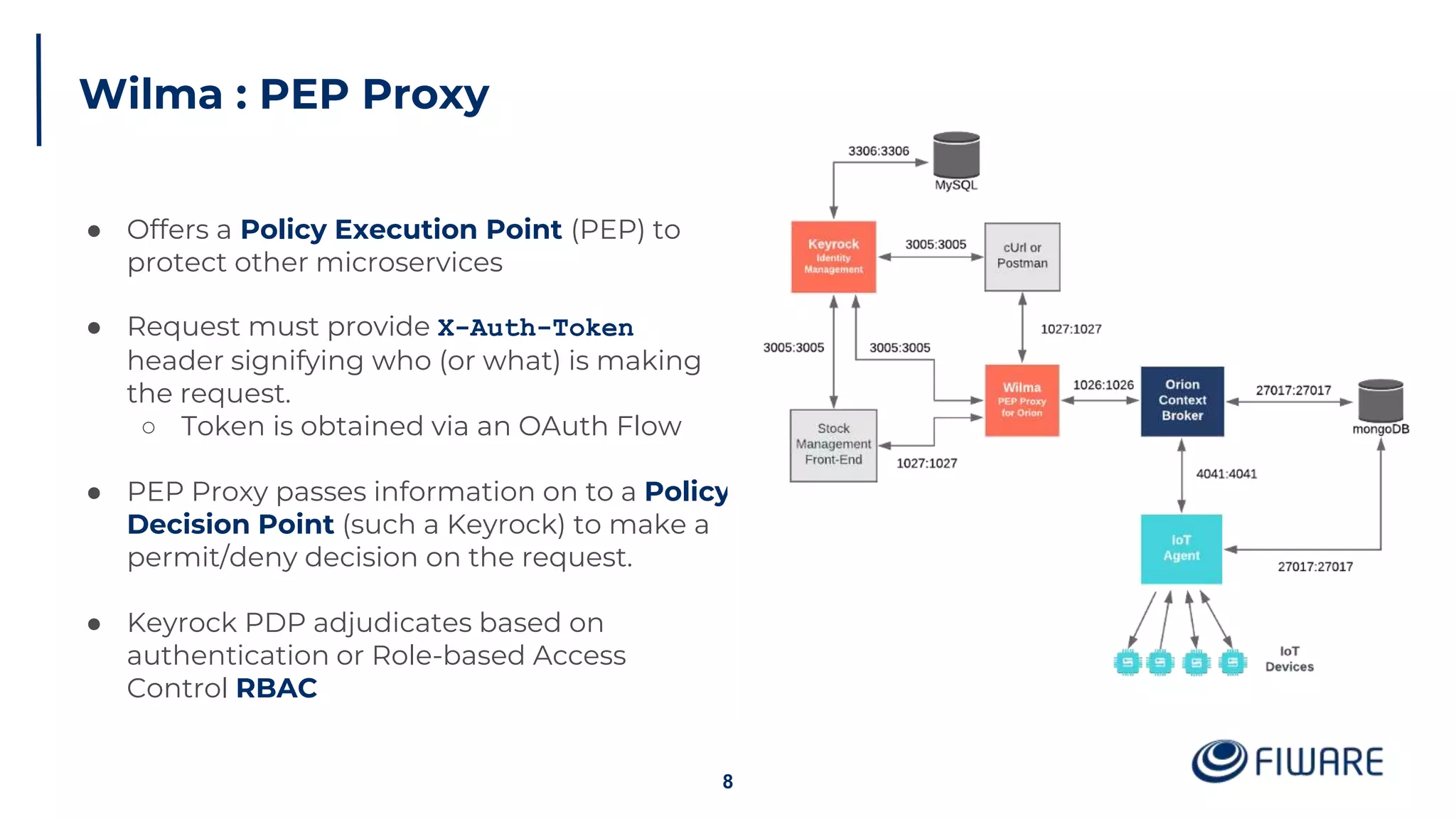
Wilma : PEP Proxy
8
● Offers a Policy Execution Point (PEP) to
protect other microservices
● Request must provide X-Auth-Token
header signifying who (or what) is making
the request.
○ Token is obtained via an OAuth Flow
● PEP Proxy passes information on to a Policy
Decision Point (such a Keyrock) to make a
permit/deny decision on the request.
● Keyrock PDP adjudicates based on
authentication or Role-based Access
Control RBAC
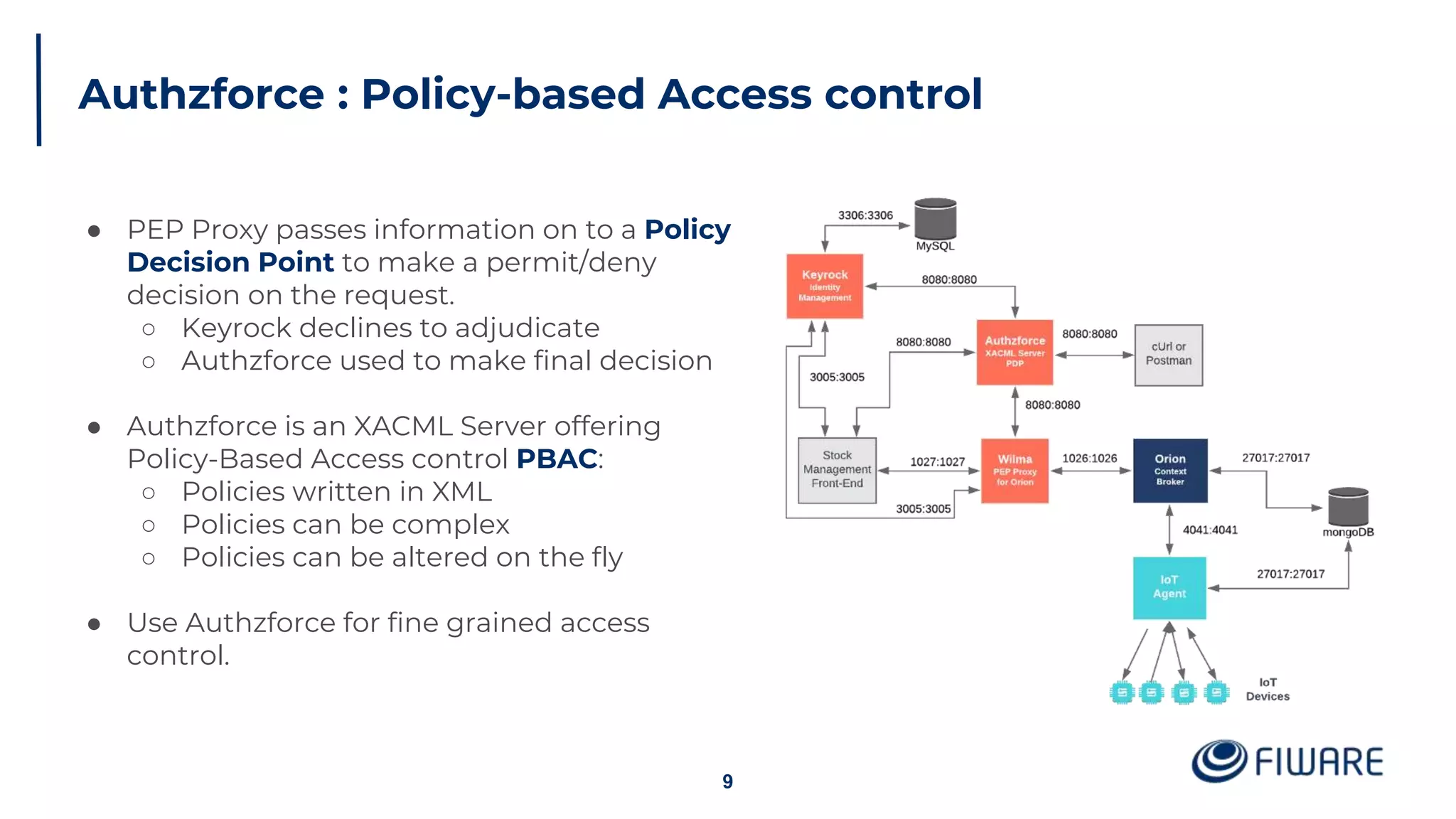
Authzforce : Policy-based Access control
9
● PEP Proxy passes information on to a Policy
Decision Point to make a permit/deny
decision on the request.
○ Keyrock declines to adjudicate
○ Authzforce used to make final decision
● Authzforce is an XACML Server offering
Policy-Based Access control PBAC:
○ Policies written in XML
○ Policies can be complex
○ Policies can be altered on the fly
● Use Authzforce for fine grained access
control.
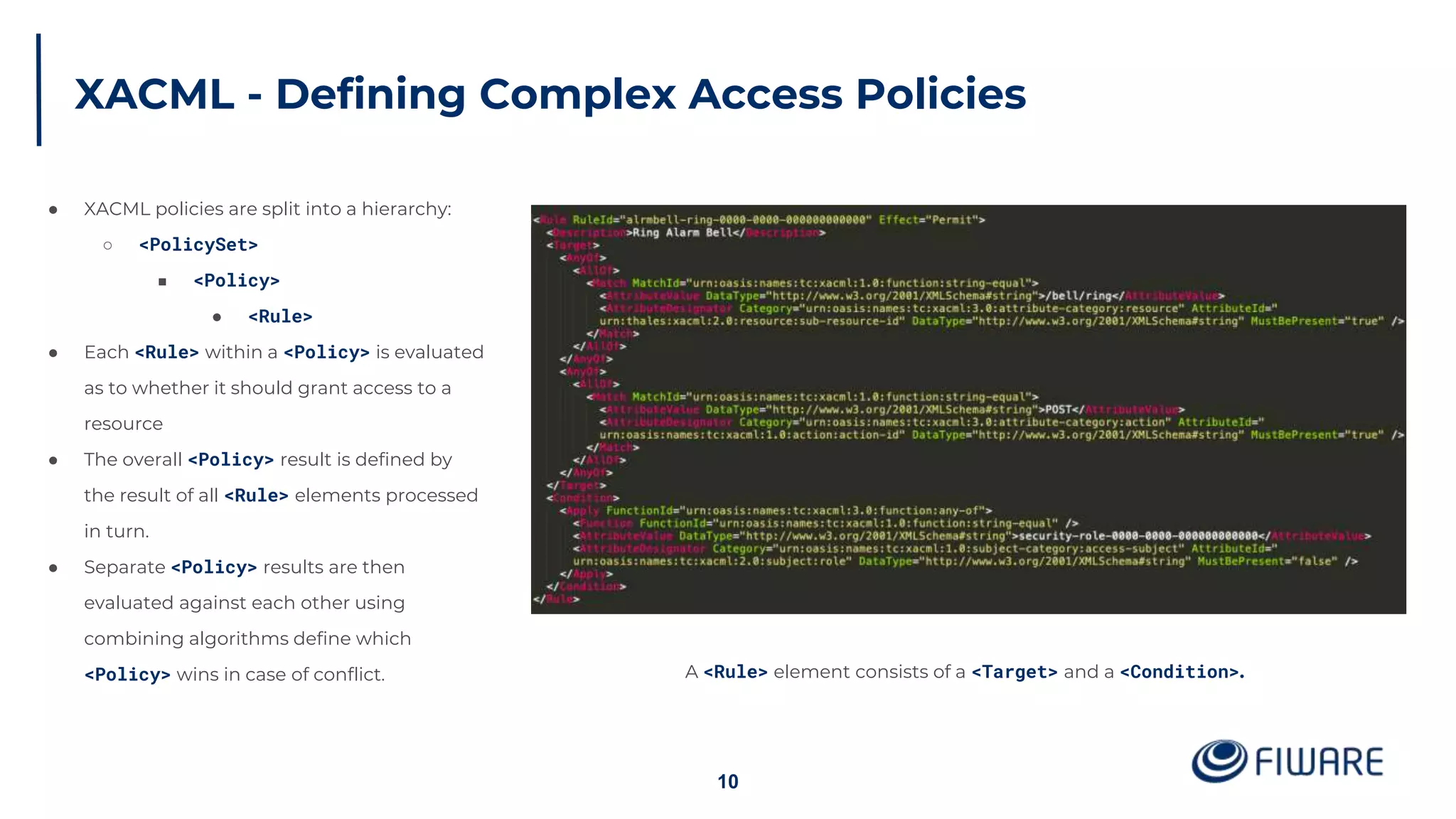
XACML - Defining Complex Access Policies
10
● XACML policies are split into a hierarchy:
○ <PolicySet>
■ <Policy>
● <Rule>
● Each <Rule> within a <Policy> is evaluated
as to whether it should grant access to a
resource
● The overall <Policy> result is defined by
the result of all <Rule> elements processed
in turn.
● Separate <Policy> results are then
evaluated against each other using
combining algorithms define which
<Policy> wins in case of conflict. A <Rule> element consists of a <Target> and a <Condition>.
Summary: Terms
▪ Identity Management ensures that only the right individuals get access to resources
• Usernames, passwords
• Roles and permissions
• etc...
▪ Access Control is the selective restriction of access to resources
▪ Authentication is a mechanism to confirm you are who you claim to be.
i.e. Who are you?
▪ Authorization is a mechanism to ensure you have permission to access a resource
i.e Is X allowed to do Y to Z?
▪ Authorization can be either Role Based (RBAC) or Policy Based (PBAC)
▪ When attempting to gain access you pass the PEP - Policy Execution Point
▪ You are either granted or denied access by a PDP - Policy Decision Point
▪ Administrators can set up rules using a PAP - Policy Administration Point
11
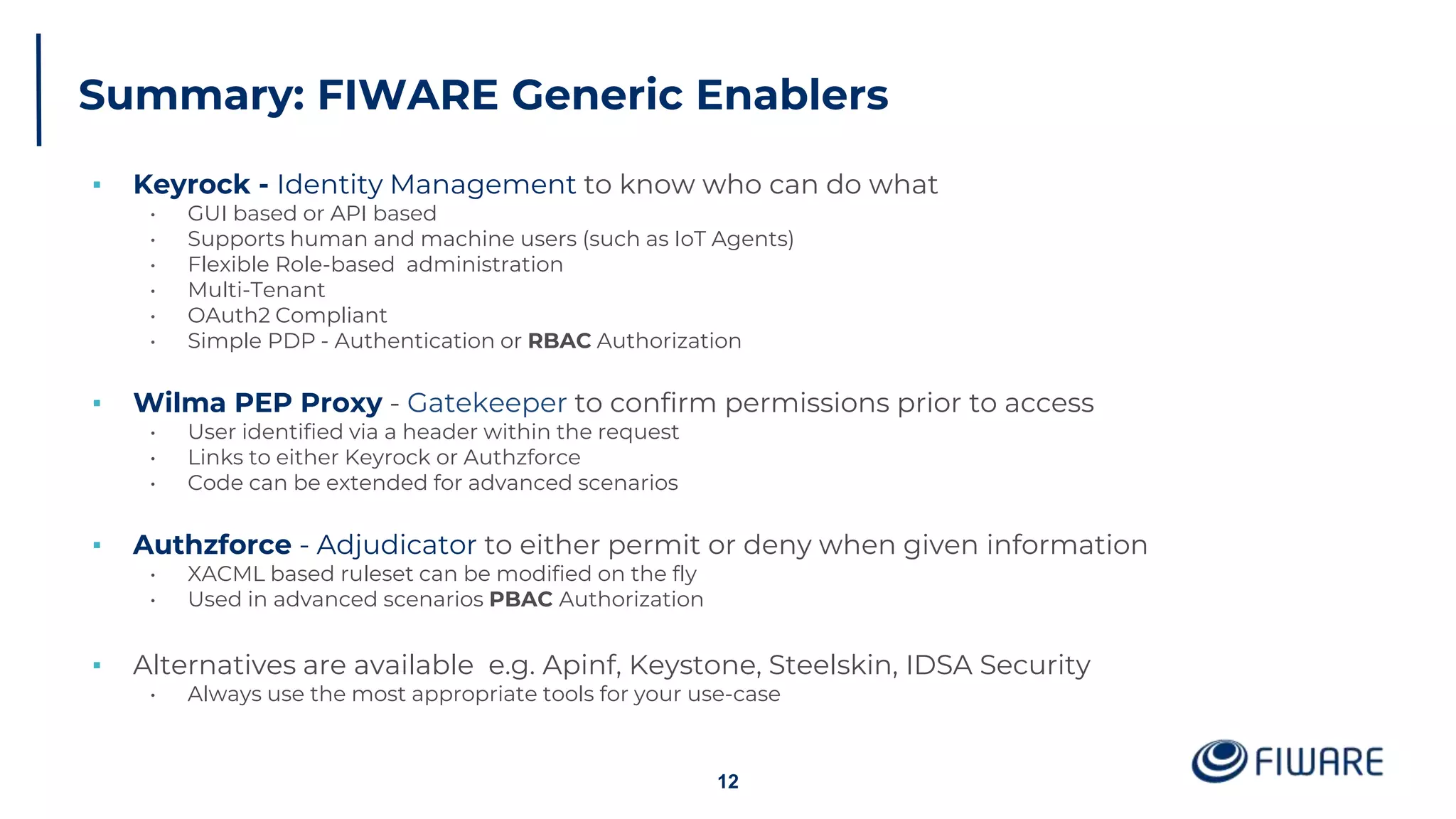
Summary: FIWARE Generic Enablers
▪ Keyrock - Identity Management to know who can do what
• GUI based or API based
• Supports human and machine users (such as IoT Agents)
• Flexible Role-based administration
• Multi-Tenant
• OAuth2 Compliant
• Simple PDP - Authentication or RBAC Authorization
▪ Wilma PEP Proxy - Gatekeeper to confirm permissions prior to access
• User identified via a header within the request
• Links to either Keyrock or Authzforce
• Code can be extended for advanced scenarios
▪ Authzforce - Adjudicator to either permit or deny when given information
• XACML based ruleset can be modified on the fly
• Used in advanced scenarios PBAC Authorization
▪ Alternatives are available e.g. Apinf, Keystone, Steelskin, IDSA Security
• Always use the most appropriate tools for your use-case
12
Thank you!
http://fiware.org
Follow @FIWARE on Twitter
13

FIWARE Wednesday Webinars - How to Secure FIWARE Architectures

  • 1.
    Securing FIWARE Architectures JasonFox, Senior Technical Evangelist FIWARE Foundation
  • 2.
    Learning Goals ▪ Whatare Identity Management and Access Control? Which FIWARE components will you need? ▪ What are Authentication and Authorization? How do they differ? ▪ What is OAuth2? What flows are supported? ▪ What is a PEP Proxy? What does it do? ▪ What is a PDP and when will I need one? ▪ What terms such as RBAC, PBAC and XACML mean and how are they used? 1
  • 3.
    Prerequisites ▪ Docker ▪ DockerCompose ▪ Git ▪ Postman ▪ Cygwin for Windows 2 git clone https://github.com/FIWARE/tutorials.Step- by-Step.git cd tutorials.Step-by-Step/ git submodule update --init --recursive ▪ https://www.docker.com/ ▪ https://docs.docker.com/compose/install/ ▪ https://git-scm.com/downloads ▪ https://www.getpostman.com/downloads/ ▪ https://www.cygwin.com/install.html
  • 4.
    FIWARE Catalogue 33 Data/APIManagement PublicationMonetization Core ContextManagement (Context Broker) Context Processing, Analysis, Visualization Interface to IoT, Robotics and third party systems Deploymenttools 3 Development of Context-aware applications (Orion, STH-Comet, Cygnus, QuantumLeap, Draco) Connection to the Internet of Things (IDAS, OpenMTC) Real-time processing of context events (Perseo) Handling authorization and access control to APIs (Keyrock, Wilma, AuthZForce, APInf ) Publication and Monetization of Context Information (CKAN extensions, Data/API Biz Framework, IDRA) Creation of Application Dashboards (Wirecloud) Real-time Processing of media streams (Kurento) Business Intelligence (Knowage) Connection to robots (Fast RTPS,Micro XRCE-DDS) Big Data Context Analysis (Cosmos) Cloud Edge (FogFlow) Documents exchange (Domibus)
  • 5.
    Keyrock : IdentityManagement 4 ● Application - A securable FIWARE application consisting of a series of microservices ● User - Any human actor interacting with a FIWARE Application ● Organization - A group of users who can be assigned a series of rights. Organization Role - An association allowing certain users to administer all rights ● PEP Proxy - A middleware for use between generic enablers challenging the rights of a user. ● IoT Agent - A proxy between IoT Sensors and the Context Broker ● Role - A descriptive bucket for a set of permissions assignable to either a single user or an organization. ● Permission - An ability to do something on a resource within the system Other Actors RBAC
  • 6.
    Keyrock : IdentityManager 5 ● Offers GUI-based or API-based interaction to administrate users, roles and permissions. ● Allows admins to associate users to roles, roles to applications etc. ● The API is a simple REST API enabling simple CRUD actions via the usual HTTP Verbs ● Simple Policy Decision Point (PDP) also available
  • 7.
    OAuth 2 :Common Grant Types 6 User Credentials Grant ● A User wants to log into an application via a web-app client ● The web-app client is absolutely trusted Authorization Code Grant ● Application doesn’t need to store or use passwords directly ● Just needs to confirm who the user is from a trusted source OAuth 2.0 is the industry-standard protocol for authorization https://oauth.net/2/ several common grant types defined
  • 8.
    OAuth 2 :Common Grant Types 7 Implicit Grant ● Retrieves access token directly ● Simplified form, used by some client side applications Client Credentials Grant ● No user involved ● Used when the application itself, not the user needs access Refresh Token ● Exchange a token for a new one
  • 9.
    Wilma : PEPProxy 8 ● Offers a Policy Execution Point (PEP) to protect other microservices ● Request must provide X-Auth-Token header signifying who (or what) is making the request. ○ Token is obtained via an OAuth Flow ● PEP Proxy passes information on to a Policy Decision Point (such a Keyrock) to make a permit/deny decision on the request. ● Keyrock PDP adjudicates based on authentication or Role-based Access Control RBAC
  • 10.
    Authzforce : Policy-basedAccess control 9 ● PEP Proxy passes information on to a Policy Decision Point to make a permit/deny decision on the request. ○ Keyrock declines to adjudicate ○ Authzforce used to make final decision ● Authzforce is an XACML Server offering Policy-Based Access control PBAC: ○ Policies written in XML ○ Policies can be complex ○ Policies can be altered on the fly ● Use Authzforce for fine grained access control.
  • 11.
    XACML - DefiningComplex Access Policies 10 ● XACML policies are split into a hierarchy: ○ <PolicySet> ■ <Policy> ● <Rule> ● Each <Rule> within a <Policy> is evaluated as to whether it should grant access to a resource ● The overall <Policy> result is defined by the result of all <Rule> elements processed in turn. ● Separate <Policy> results are then evaluated against each other using combining algorithms define which <Policy> wins in case of conflict. A <Rule> element consists of a <Target> and a <Condition>.
  • 12.
    Summary: Terms ▪ IdentityManagement ensures that only the right individuals get access to resources • Usernames, passwords • Roles and permissions • etc... ▪ Access Control is the selective restriction of access to resources ▪ Authentication is a mechanism to confirm you are who you claim to be. i.e. Who are you? ▪ Authorization is a mechanism to ensure you have permission to access a resource i.e Is X allowed to do Y to Z? ▪ Authorization can be either Role Based (RBAC) or Policy Based (PBAC) ▪ When attempting to gain access you pass the PEP - Policy Execution Point ▪ You are either granted or denied access by a PDP - Policy Decision Point ▪ Administrators can set up rules using a PAP - Policy Administration Point 11
  • 13.
    Summary: FIWARE GenericEnablers ▪ Keyrock - Identity Management to know who can do what • GUI based or API based • Supports human and machine users (such as IoT Agents) • Flexible Role-based administration • Multi-Tenant • OAuth2 Compliant • Simple PDP - Authentication or RBAC Authorization ▪ Wilma PEP Proxy - Gatekeeper to confirm permissions prior to access • User identified via a header within the request • Links to either Keyrock or Authzforce • Code can be extended for advanced scenarios ▪ Authzforce - Adjudicator to either permit or deny when given information • XACML based ruleset can be modified on the fly • Used in advanced scenarios PBAC Authorization ▪ Alternatives are available e.g. Apinf, Keystone, Steelskin, IDSA Security • Always use the most appropriate tools for your use-case 12
  • 14.